Occurrence of
Brettanomyces/Dekkera
in Brazilian red wines and its correlation
with ethylphenols
Larissa Dias de Ávila
1, Marco Antônio Záchia Ayub
21Instituto Federal de Educação, Ciência e Tecnologia do Rio Grande do Sul, Bento Gonçalves, RS, Brazil. 2Instituto de Tecnologia e Ciência de Alimentos, Universidade Federal do Rio Grande do Sul,
Porto Alegre, RS, Brazil.
Submitted: May 24, 2011; Approved: July 2, 2012.
Abstract
The yeast Brettanomyces/Dekkeracan cause important spoilage in wines, with the production of ethylphenols and other off-flavor compounds. This study aimed at determining the presence of this yeast and the ethylphenols produced by them in Brazilian red wines, establishing their relationship with other chemical characteristics. Isolates ofBrettanomyces/Dekkerawere quantified by plating 126 samples of dry red wine in selective culture medium, while ethylphenols were analyzed by solid phase extraction and GC/FID. Free and total SO2, alcohol, total dry extract, residual sugar, total and volatile acidity, and pH were also determined.Brettanomyces/Dekkerawas present in 27% of sam-ples. Ethylphenols were detected in most samples, with amounts higher than the threshold limit of 426mg/L found in 46.03% of samples. The majority of wine samples showed inadequate levels of
SO2and residual sugars, facts that might facilitate microbial spoilage. The passage in barrels and the grape varieties (Cabernet Sauvignon and Merlot), did not show any influence on the levels of con-tamination or ethylphenols contents. The prevalence ofBrettanomyces/Dekkeraand the concentra-tions of ethylphenols were high considering the sensory impact they can cause. The growth of Brettanomyces/Dekkerawas dependent on the levels of SO2and alcohol of wines. Knowledge of the contamination, the presence of ethylphenols, and their relationship with the chemical characteristics of wines can entice effective measures to preventBrettanomyces/Dekkeraand contribute to improve the general quality of Brazilian red wines.
Key words:Brettanomyces,Dekkera, 4-ethylphenol, 4-ethylguaiacol, wine.
Introduction
Wines are subject to chemical and microbiological spoilage and yeasts of the genusBrettanomycesor its teleo-morphDekkeracan be important causes of these problems, especially in red wines, with the production of ethylphenols and the formation of off-flavors, which are generally de-scribed asphenolic,medicinal, oranimal(horse sweat, sta-ble and leather) (Chatonnet et al., 1990). Ethylphenols, 4-ethylphenol, and 4-ethylguaiacol, are formed from the transformation ofp-coumaric and ferulic acids, naturally present in wines. These transformations occur by a chain reaction of cinnamate decarboxylase generating vinylphe-nols, and then ethylphenols via vinylphenol reductase
(He-resztyn, 1986; Lauritsen et al., 1991; Chatonnet et al., 1992). Spoilage sets up after the fermentation, usually dur-ing maturation in barrels (Chatonnetet al., 1990, 1992). The risk of microbial degradation of the wines is particu-larly high in wood barrels, due to the difficulty of cleaning and disinfection (Malfeito-Ferreiraet al., 2004). However, the growth ofBrettanomyces/Dekkeraand the formation of ethylphenols can also occur in concrete or stainless steel tanks (Rodrigues,et al., 2001), and even in bottles (Pérez-Prietoet al., 2003).
Although all wines are susceptible to contaminations, some factors will increase this risk, for instance, when us-ing very ripe grapes, with high contents of phenolic acids and high pH, long maceration times and difficult
fermenta-Send correspondence to M.A.Z. Ayub. Instituto de Tecnologia e Ciência de Alimentos, Universidade Federal do Rio Grande do Sul, Bento Gonçalves 9500, Porto Alegre, RS, Brazil. E-mail: [email protected].
tion, which will necessarily delay the addition of sulphite (Gerbauxet al., 2000; Pérez-Prieto et al., 2003). Higher temperatures and pH (Diaset al., 2003; Romano et al., 2008), dissolved oxygen (Ciani and Ferraro, 1997), and re-sidual sugar (Chatonnetet al., 1995), as well as the lower concentration of ethanol (Gerbauxet al., 2000) and sulphur dioxide (Chatonnetet al., 1992, 1993; Gerbauxet al., 2002; Barata et al., 2008), are other factors involved with the growth of Brettanomyces/Dekkera and the increase of ethylphenols in wines.
Brettanomyces/Dekkeracan use acetic acid (Geróset al., 2000) and ethanol (Diaset al., 2003) as the sole carbon sources, but in the presence of carbon sources commonly found in wines this metabolism is blocked (Vigentini,et al., 2008). Therefore, this yeast will grow in wines, taking ad-vantage of even small amounts of residual sugars such as glucose, fructose, arabinose and trehalose (Chatonnetet al., 1995), arginine (Joseph and Bisson, 2004), and organic ac-ids (Vigentiniet al., 2008). Theoretically, concentrations of hexoses of 100 mg/L can support populations of Brettanomyces/Dekkeraas large as 107cells/mL (Smith, 1998). Since the production of characteristic off-flavors of Brettanomyces/Dekkeracan start appearing in wines when its population is as low as 102or 103cells/mL, this becomes a major problem for the wine industry (Henick-Klinget al., 2000; Fugelsang and Zoecklein, 2003). Wine spoilage caused by Brettanomyces/Dekkera has been reported worldwide (Heresztyn, 1986; Chatonnet et al., 1992; Heimoff, 1996; Ibeas et al., 1996; Fugelsang and Zoe-cklein, 2003). Brazil is becoming an important wine pro-ducer and exporter, with very typified products, and its industry is well known for its good technology, although climate conditions will frequently pose some challenges for grape quality. Little is known on the presence of Brettanomyces/Dekkerain Brazilian wines and its possible effects on wine quality. In this context, the main objective of this study was to determine the presence of these yeasts and the related ethylphenols in samples of red wines, and try to establish a relationship with other chemical charac-teristics of these wines, thus contributing to improve the general quality of this important product.
Materials and Methods
Chemicals
Unless otherwise stated, all chemicals were of analyt-ical grade and purchased from Sigma-Aldrich (St. Louis, USA).
Wine samples
A total of 126 samples of 63 dry red wines were se-lected for this research. Wines were colse-lected from 26 win-eries located in the largest and most traditional wine region of southern Brazil, in the hills of the cities of Bento Gon-çalves and Farroupilha (RS, latitude 29°S, longitude
51°W). Samples were arranged as 54 of Cabernet Sauvi-gnon and 63 of Merlot, while 7 were of other red varieties, and 2 were assemblage of the mentioned varieties, distrib-uted between 2004 and 2005 vintages. Microbiological analyses were performed immediately after the opening of the bottles; the remaining wine was frozen for later chemi-cal analysis.
Culture medium and microbiological techniques
A selective and differential medium for Brettanomyces/Dekkera(DBDM) developed by Rodrigues et al.(2001) was used in this research, with some modifica-tions. Its basic composition is (in g/L): Yeast Nitrogen Base, 6.7; ethanol, 60; p-coumaric acid, 0.1; cyclohexi-mide, 0.01; bromocresol green, 0.022; agar, 20 (pH 5.4). The medium was modified by the addition of glucose (5 g/L) and chloramphenicol (0.1 g/L). This medium inhib-its the growth of other yeast species due to the presence of cycloheximide. In addition, the medium allows the differ-entiation of the Brettanomyces/Dekkera strains by their characteristic production of ethylphenols (off-flavors) from p-coumaric acid, the acidification, and the long incubation time required. Addition of glucose was to improve the re-covery of Brettanomyces/Dekkera, and chloramphenicol, to prevent growth of bacteria.
The medium was sterilized by filtration and the agar was autoclaved separately. Varying volumes of wine were plated in agar DBDM; 0.1 mL was directly spread onto plates, while volumes of 1 and 20 mL were filtered through a 0.45mm membrane that was placed over the medium.
Colonies were counted after 3 and 14 days of incubation at 28 °C.
Determination of 4-ethylphenol and 4-ethylguaiacol
Solid phase extraction (SPE) was performed using polystyrene-divinylbenzene cartridges Lichrolut-EN 200 mg (Merck, Darmstadt, Germany). The cartridges were conditioned with 4 mL of dichloromethane, 4 mL of metha-nol, and 4 mL of ethanol 12% (volume fraction). Subse-quently, 50 mL of filtered wine containing 5 mg/L of an internal standard (3,4-dimethylphenol) were passed through the SPE cartridge at a flow rate of 2 mL/min. The sorbent was washed with 3 mL of ultra-pure water, dried-up by airflow for 3 min Finally, ethylphenols were eluted with 1.4 mL dichloromethane. The eluate was kept frozen until analysis. The recovery efficiencies of 4-ethylphenol and 4-ethylguaiacol using this methodology were always around 100%.
A gas chromatograph (CG-14B Shimadzu, Tokyo, Japan) equipped with flame ionization (FID) was used to determine ethylphenols. The analyses were performed by injecting mLof the eluate in split mode (ratio 1:10, 250 °C)
into a DB-WAX column (60 m x 0.25 mm i.d. x 0.25mm
was as follows: 50 °C for 1 min, first ramp to 180 °C at 10 °C/min, second ramp to 205 °C at 3 °C/min, third ramp to 215 °C at 2 °C/min, fourth ramp to 230 °C at 15 °C/min, and then kept at 230 °C for 30 min. The detector was kept at 250 °C.
General Analytical procedures
Free SO2 in wine samples was analyzed using an Oenological Analyzer (Quick, Gibertini, Milano, Italy) equipped with SO2bubble, following titration with 0.02 N iodine solution. Total SO2, was analyzed by steam distilla-tion in an Oenochemical Distilling Unit (DEE, Gibertini, Milano, Italy) following titration with 0.02 N iodine solu-tion. The ethanol content, density and total dry extract were determined using Alcolyzer Wine and density meter (DMA 4500, Anton Paar®GmbH, Graz, Austria). Finally, residual sugar, total and volatile acidity, and pH were determined by infrared spectroscopy using a WineScanTMFT120 (FOSS, Denmark).
Statistical analysis
Spearman correlation (rs) analysis was used in order
to correlate yeast cell numbers, concentration of ethyl-phenols and other chemical parameters of wines. Student’s t-test was used to compare the average of results. The statis-tical analysis was performed using SPSS 16.0 software (SPSS Inc., USA).
Results and Discussion
Prevalence ofBrettanomyces/Dekkerain wine samples and concentration of ethylphenols
Results for the investigation of the presence of Brettanomyces/Dekkera in wine are shown in Table 1. Thirty-four (27%) samples produced typical colonies of this yeast when they were plated onto the DBDM medium: colonies yellow to olive green, acidification of the medium, phenolic flavour and slow growth, reaching up to 2.25 x 10³ CFU/mL. These values are similar to results reported by Gerbauxet al.(2000) and Rodrigueset al.(2001), in which the presence ofBrettanomyceswas found in 25 and 57% of a total of 44 and 88 samples of Pinot Noir wines from the Burgundy region and Portuguese wines, respectively,
con-taining up to 2.5 x 10³CFU/mL. This high CFU counting is of great concern for the wine industry, because it is very difficult to controlBrettanomyces/Dekkerain these envi-ronments. Concerning the samples amount of ethylphenols, they were present in high percentages, above the preference thresholds for these compounds, considering the sensory impact they may cause, but were within the range reported by others authors (Table 1). Chatonnetet al.(1992) have established the limit preference thresholds of 620mg/L for
4-ethylphenol, 140mg/L for 4-ethylguaiacol and 426mg/L
to a 10:1 mixture of 4-ethylphenol and 4-ethylguaiacol. Av-erage and maximal values (inmg/L) found in previous
stud-ies reached up to 1,164 and 6,047 for 4-ethylphenol, and 99 and 1,561 for 4-ethylguaiacol, respectively (Chatonnetet al., 1992; Gerbauxet al., 2000; Pollnitzet al., 2000; Rodri-gueset al., 2001; Lópezet al., 2002; Henschkeet al., 2004; Nikfardjamet al., 2009; Romanoet al., 2009).
The yeast counts correlated (p < 0.01) with concentra-tions of 4-ethylphenol (rs = 0.397) and 4-ethylguaiacol
(rs= 0.318) (Figure 1a). However, the prevalence of
ethyl-phenols was higher than that of Brettanomyces/Dekkera, similarly observed by Rodrigueset al.(2001). One possi-bility for this unusual result might reside in the fact that ethylphenols were produced in an early stage in the wine, previously of procedures that would reduce the microbial load for bottling or, for the same reasons, the yeast cells could be in a non-cultivable state (Millet and Lonvaud-Funel, 2000). Another possibility could be the action of other yeast species such asPichiaandCandida, or bacteria such as Lactobacillus, which can produce ethylphenols (Edlinet al., 1995; Chatonnetet al., 1995, 1997; Diaset al., 2003; Coutoet al., 2006; Rivaset al., 2009).
Surprisingly, the yeast counts showed variations among different bottles of the same wine, suggesting that each bottle should be individually evaluated. Thus, it would not be strictly correct to use the average of counts of differ-ent bottles of the same wine to express the presence of Brettanomyces/Dekkera. These variations among bottles were also observed and reported by other authors (Di Ste-fano, 1985; Chatonnetet al., 1993). The different environ-mental conditions of each fermentation tank, barrel or bot-tle, or different microbial loads of contaminated materials
Table 1- Determination ofBrettanomyces/Dekkera(CFU/mL), 4-ethylphenol (4-EP), and 4-ethylguaiacol (4-EG), inmg/L, and percentages above the
preference threshold of 126 samples of Brazilian red wines.
Brett/Dekkera 4-ethylphenol 4-ethylguaiacol Ratio 4-EP/4-EG
Minimal 0 0 0 1.29
Maximal 2,250 3,819.65 259.67 21.98
Average±SD 76.03±314.42 593.40±694.62 65.24±52.69 7.77±4.56
CV (%) 413.56 117.05 80.77 53.69
Above the preference threshold (%) 34.92 7.93 46.03*
and equipment at the beginning of the bottling process may be responsible for these variations, stressing the importance of careful processing to avoid these problems.
The concentrations of 4-ethylphenol and 4-ethyl-guaiacol were statistically correlated (rs= 0.860), and the
ratio between them varied from 1.37 to 21.98, which is close to the range (1.6 to 38) found by Pollnitzet al.(2000) and Henschkeet al.(2004). According to these authors, this ratio depends on the relative abundance of precursors, which is dependent on the geographic region and grape va-riety. Romanoet al.(2008) observed the ratio of 1:1 when they used a synthetic medium containing equal concentra-tions ofp-coumaric and ferulic acid, and the relationship with the precursors was confirmed.
Correlations with chemical parameters
In Table 2 are presented the chemical parameters of wine samples, while in Figure 1 are shown the possible cor-relations between these parameters and the presence of Brettanomyces/Dekkeraor concentrations of ethylphenols. Among the tested chemical parameters, only free and total SO2, alcohol, and volatile acidity correlated with counts of Brettanomyces/Dekkeraor concentrations of ethylphenols. The average concentration of free SO2was low (37.3% of samples), which is indicating a permissive condition for
microbial growth. Most of these samples showed high lev-els of ethylphenols (Figure 1b) and counts of Brettanomyces/Dekkera (Figure 1c), which explains the correlation between 4-ethylphenol and free and total SO2 (rs= -0.177 and -0.176, respectively). A free SO2content of 30 to 40 mg/L (Gerbauxet al., 2000; Ribéreau-Gayonet al., 2003) is necessary for the total elimination of viable popu-lations ofBrettanomyces/Dekkera, and even higher doses of SO2are required in wines with high values of pH (Su-draut and Chauvet, 1985). According to Henick-Klinget al. (2000), the wine should be maintained with at least 0.8 mg/L of molecular SO2in order to avoid the develop-ment ofBrettanomyces/Dekkera. It is known that the frac-tion of free SO2 in bottled wines decreases with storage time due to reactions with organic compounds and oxida-tion, which may explain some of the low values of free SO2 measured in this research. Notwithstanding, the total SO2 levels were also low (below 20 mg/L) in 16% of samples, which suggests that the addition of this preserving agent was carried out only once during production, leaving these wines unprotected against microbial deterioration.
The amount of alcohol weakly correlated (rs= -0.282)
with the counts ofBrettanomyces/Dekkera, although most samples with high counts had up to 13% (volume fraction) of alcohol (Figure 1d), which has been suggested by some
Figure 1- Correlation between 4-ethylphenol andBrettanomyces/Dekkeracounts (a), and free SO2(b); correlation betweenBrettanomyces/Dekkera
authors to be the minimal concentration showing inhibitory properties (Froudiére and Larue, 1988; Chatonnetet al., 1993; Rodrigueset al., 2001; Diaset al., 2003; Silvaet al., 2004).
Regression plots showed that the highest counts of Brettanomyces/Dekkera and concentrations of ethylphe-nols were found in samples in the range of 5.5 to 6.7 g tar-taric acid/L total acidity.
The volatile acidity of wines was high (Table 2), if the sensorial perception threshold of 0.6 to 0.9 g/L is consid-ered (Ough and Amerine, 1988). Twenty-three samples had volatile acidity above 1 g/L, which is detrimental to the aroma of wine. In general, the production of acetic acid by Brettanomyces/Dekkerais related to the concentration of sugar in the medium (Ciani and Ferraro, 1997; Diaset al., 2003; Abbottet al., 2005; Romanoet al., 2008; Vigentiniet al., 2008). It was found a weak correlation (rs= 0.193) be-tween volatile acidity andBrettanomyces/Dekkeracounts, but the production of acetic acid by this yeast can not be dis-charged, because of the high residual sugar of samples.
Brazilian legislation establishes that the maximal le-vel of residual sugar in wine to be defined as “dry wine” should not exceed 5 g/L, while a more restrict definition of dry wine, obtained by the complete fermentation of sugars, should not contain more than 1 g/L of residual sugars (Ough and Amerine, 1988). Twenty-three samples (18.25%) showed levels of sugars above 5 g/L (Table 2) suggesting that these samples were susceptible to microbial contamination. Sugar levels of 300 mg/L are considered high enough to allow the development of ethylphenols in concentrations corresponding to the perception threshold (Chatonnetet al., 1995). Silvaet al.(2004) observed that residual sugar concentrations in the range of 0.1 to 12% did not show any influence on the specific growth rates ofB. bruxellensisISA 1791 in mineral medium containing glu-cose as the sole carbon and energy source. These data sug-gest a lack of relationship between the residual sugar and ethylphenols concentrations, which was also observed in this work.
Presence ofBrettanomyces/Dekkeraand
ethylphenols correlated to the storage of wine in oak barrels
Wine samples were tested in order to investigate whether there was any effect correlated to the use of barrels during the maturation of wine on the presence of Brettanomyces/Dekkeraand ethylphenols. Table 3 presents the results for samples that were matured in wood barrels. Surprisingly, higher counts of Brettanomyces/Dekkera were found for wines that were not matured, when com-pared with wine samples that were stored in barrels. How-ever, the concentrations of ethylphenols were not statisti-cally different between the two groups of samples. Wines spoilage by Brettanomyces/Dekkera has been associated with long times of maturation in wood barrels, which pres-ents a number of factors that contribute to the contamina-tion (oxygen, wood porosity, small volume, etc.) (Suárezet al., 2007), but as it has been observed by some authors (Rodrigueset al., 2001; Pérez-Prietoet al., 2003; Couloet al., 2010), the problem associated with the presence of this yeast is much more complex. The development of Brettanomyces/Dekkeraand production of ethylphenols is influenced by the practices of vinification (Chatonnetet al., 1992, 1995) and wine storage time (Pérez-Prieto et al., 2003), which may be related to the results obtained.
Brazil-Table 3- MeanBrettanomyces/Dekkeracounts and ethylphenols concen-trations correlated to the stage of the wine in oak barrels.
With barrel maturation
Without barrel maturation
Number of samples (n) 39 32
Positive for
Brettanomyces/Dekkera
8 14
Brettanomyces/Dekkera
(CFU/mL)* 9.91±35.94 261.52±586.24
4-ethylphenol (mg/L) 610.66±761.24 495.13±407.30
4-ethylguaiacol (mg/L) 65.84±52.09 59.08±32.06
*Different by t-test (p = 0.021).
Table 2- Chemical parameters of 126 samples of Brazilian red wines.
Minimal Maximal Average±SD CV (%)
Total SO2(mg/L) 3.07 137.43 50.36±28.92 57.43
Free SO2(mg/L) 0 29.63 6.53±6.73 103.01
pH† 3.4 4.04 3.73
±0.13 3.42
Alcohol (% vol.) 10.83 14.05 12.64±0.66 5.25
Total dry extract (g/L) 22.52 38.78 29.51±2.69 9.13
Residual sugar (g/L) 1.1 6.7 3.94±1.22 30.94
Volatile acidity (g/L) 0.65 1.17 0.90±0,11 12.49
Total acidity†(g/L) 4.56 7.33 5.84
±0.49 8.38
ian wineries using oak barrels on a large scale are still very few, due to the high costs of these barrels. Thus, it appears that the use of wood barrels in a small-scale production fa-cility and shorter maturation times have favored greater care, compared with storage in stainless steel or concrete tanks, consequently reducing contaminations.
Presence ofBrettanomyces/Dekkeraas a function of grape variety
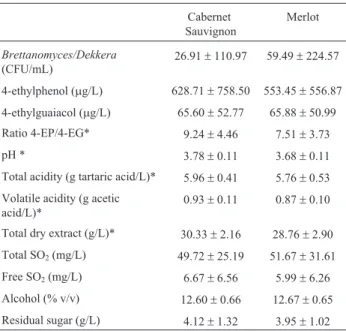
In this research, the presence of Brettanomyces/Dekkera was not found to be correlated with the variety of grape used in the wine making (Table 4), even though the Cabernet Sauvignon varieties were slightly more prone to microbial spoilage than the Merlot samples due to the characteristics of their pH and total dry extract. However, there were no statistical differences for Brettanomyces/Dekkeracounts between the two varieties, suggesting very similar winemaking practices for both va-rietals. The ratio of 4-ethylphenol and 4-ethylguaiacol was higher for Cabernet Sauvignon, which is linked to higher concentrations ofp-coumaric acid (Pollnitzet al., 2000), with values similar to those found by others authors: 10:1 for Cabernet Sauvignon and 8:1 for Merlot (Pollnitzet al., 2000); 8:1 for Bordeaux red wines (Chatonnetet al., 1992); and around 9:1 for 180 different Chilean wines (Majce-novic, 2003).
Conclusion
The prevalence of Brettanomyces/Dekkera and the concentrations of ethylphenols in the investigated Brazilian
red wines were similar to those found for wines from other countries. The levels of contamination could be considered high, if the possible impact on sensorial aspects is taken into account. The levels of SO2showed to be the determi-nant condition for microbial spoilage, since the growth of Brettanomyces/Dekkera was dependent on the levels of SO2and alcohol, but it seemed not to be influenced by vari-ations in sugar, acidity and total dry extract. Despite of a well-established correlation, ethylphenols were more fre-quent thanBrettanomyces/Dekkerain the investigated sam-ples, and the results showed that the stage in barrels and grape varieties did not influence the levels of contamina-tion and concentracontamina-tions of ethylphenols.
Acknowledgments
The authors wish to thank Dr. Paulo Gustavo Celso of the National Agricultural Laboratory (LANAGRO, RS, Brazil) for his collaboration in this work. The authors ac-knowledge the financial support of CAPES (Brazil) for the first author’s scholarship.
References
Abbott DA, Hynes SH, Ingledew WM (2005) Growth rates of Dekkera/Brettanomycesyeasts hinder their ability to com-pete withSaccharomyces cerevisiaein batch corn mash fer-mentations. Appl Microbiol Biotechn 66:641-647.
Barata A, Caldeira J, Botelheiro R, Pagliara D, Malfeito-Ferreira M, Loureiro V (2008) Survival patterns of Dekkera bruxellensisin wines and inhibitory effect of sulphur diox-ide. Int J Food Microbiol 121:201-207.
Chatonnet P, Boidron J, Pons M (1990) Elevage des vins rouges en fûts de chêne: Évolution de certains composés volatils et de leur impact arômatique. Sci Alim 10:565-587.
Chatonnet P, Dubourdieu D, Boidron N (1995) The influence of Brettanomyces/Dekkerasp. yeasts and lactic bacteria on the ethylphenol content of red wines. Am J Enol Vitic 46:463-468.
Chatonnet P, Dubourdieu D, Boidron JN, Lavigne V (1993) Syn-thesis of volatile phenols by Saccharomyces cerevisiaein wines. J Sci Food Agric 62:191-202.
Chatonnet P, Dubourdieu D, Boidron JN, Pons M (1992) The ori-gin of ethylphenols in wines. J Sci Food Agric 60:165-178. Chatonnet P, Viala C, Dubourdieu D (1997) Influence of poly-phenolic components of red wines on the microbial synthe-sis of volatile phenols. Am J Enol Vitic 48:443-448. Ciani M, Ferraro L (1997) Role of oxygen on acetic acid
produc-tion byBrettanomyces/Dekkerain winemaking. J Sci Food Agric 75:489-495.
Coulon J, Perello MC, Lonvaud-Funel A, Revel G, Renouf V (2010) Brettanomyces bruxellensis evolution and volatile phenols production in red wines during storage in bottles. J Appl Microbiol 108:1450-1458.
Couto JA, Campos FM, Figueiredo AR, Hogg TA (2006) Ability of Lactic Acid Bacteria to Produce Volatile Phenols. Am J Enol Vitic 57:166-171.
Di Stefano R (1985) The ethyl phenols in wines. Vignevini 12:35-38.
Table 4- Presence ofBrettanomyces/Dekkeraand chemical parameters of the wines as a function of grape variety.
Cabernet Sauvignon
Merlot
Brettanomyces/Dekkera
(CFU/mL) 26.91±110.97 59.49±224.57
4-ethylphenol (mg/L) 628.71±758.50 553.45±556.87
4-ethylguaiacol (mg/L) 65.60±52.77 65.88±50.99
Ratio 4-EP/4-EG* 9.24±4.46 7.51±3.73
pH * 3.78±0.11 3.68±0.11
Total acidity (g tartaric acid/L)* 5.96±0.41 5.76±0.53
Volatile acidity (g acetic
acid/L)* 0.93±0.11 0.87±0.10
Total dry extract (g/L)* 30.33±2.16 28.76±2.90
Total SO2(mg/L) 49.72±25.19 51.67±31.61
Free SO2(mg/L) 6.67±6.56 5.99±6.26
Alcohol (% v/v) 12.60±0.66 12.67±0.65
Residual sugar (g/L) 4.12±1.32 3.95±1.02
Dias L, Pereira-Da-Silva S, Tavares M, Malfeito-Ferreira M, Loureiro V (2003) Factors affecting the production of 4-ethylphenol by the yeast Dekkera bruxellensis in enological conditions. Food Microbiol 20:377-384. Edlin DAN, Narbad A, Dickinson JR, Lloyd D (1995) The
bio-transformation of simple phenolic compounds by Brettano-myces anomalus. FEMS Microbiol Lett 125:311-316. Froudiére I, Larue F (1988) Conditions de survie de
Brettanomyces(Dekkera) dans le moût de raisin et le vin. Conn Vigne Vin 2:296-303.
Fugelsang KC, Edwards CG (2007) Wine Microbiology: Practical Applications and Procedures. 2th ed. Springer, New York, 413 pp.
Fugelsang KC, Zoecklein BW (2003) Population dynamics and effects ofBrettanomyces bruxellensisstrains on Pinot Noir (Vitis viniferaL.) wines. Am J Enol Vitic 54:294-300. Gerbaux V, Jeudy S, Monamy C (2000) Etude des phénols volatils
dans les vins de Pinot noir en Bourgogne. Bull OIV 73:581-599.
Gerbaux V, Vincent B, Bertrand A (2002) Influence of macera-tion temperature and enzymes on the content of volatile phe-nols in Pinot noir wines. Am J Enol Vitic 53:131-137. Gerós H, Cássio F, Leão C (2000) Utilization and transport of
ace-tic acid inDekkera anomalaand their implications on the survival of the yeast in acidic environments. J Food Prot 63:96-101.
Heimoff S (1996) Brett study yields surprises. Wine Business Monthly 3:37-40.
Henick-Kling T, Egli C, Licker J, Mitrakul C, Acree TE (2000) Brettanomycesin wine. In: Fifth Int. Symp. Cool Climate Vitic. Oenol. Winetitles, Melbourne, pp 1-7.
Henschke P, Bellon J, Capone D, Coulter A, Cowey G, Cozzolino D, Curtin C, Field J, Gishen M, Graves P, Latey K, Robinson E, Francis IL, Lopes MB, Godden P (2004) Incidence and control ofBrettanomyces: The Australian perspective. Am J Enol Vitic 55:304-A.
Heresztyn T (1986) Metabolism of phenolic compounds from hydroxycinnamic acids by Brettanomyces yeasts. Arch Microbiol 146:96-98.
Ibeas JI, Lozano I, Perdigones F, Jimenez J (1996) Detection of Dekkera/Brettanomycesstrains in sherry by a Nested PCR method. Appl Environm Microbiol 62:998-1003.
Joseph CML, Bisson L (2004) Physiological diversity of Brettanomyces/Dekkera isolated from wine. Am J Enol Vitic, 55:302-A.
Lauritsen FR, Nielsen LT, Degn H, Lloyd D, Bohatka S (1991) Identification of dissolved volatile metabolites in microbial cultures by membrane inlet tandem mass-spectrometry. Biol Mass Spectrom 20:253-258.
López R, Aznar M, Cacho J, Ferreira V (2002) Determination of minor and trace volatile compounds in wine by solid-phase extraction and gas chromatography with mass spectrometric detection. J Chromat A 966:167-177.
Majcenovic AB (2003) Etilfenoles como indicadores de la acti-vidad deBrettanomyces. In: IX Congr. Latinoamer. Vitic. Enol. Pontificia Universidad Católica de Chile, Santiago, pp 205.
Malfeito-Ferreira M, Laureano P, Barata A, D’antuono I, Stender H, Loureiro V (2004) Effect of different barrique sanitation procedures on yeasts isolated from the inner layers of wood. Am J Enol Vitic 55:304-A.
Millet V, Lonvaud-Funel A (2000) The viable but non-culturable state of wine microorganisms during storage. Lett Appl Microbiol 30:136-141.
Nikfardjam MP, May B, Tschiersch C (2009) 4-ethylphenol and 4-ethylguaiacol contents in bottled wines from the German `Württemberg’ region. Eur Food Res Technol 230:333-341. Ough CS, Amerine MA (1988) Methods for Analysis of Musts
and Wines. 2thed. John Wiley & Sons, New York, 400 pp.
Pérez-Prieto LJ, López-Roca JM, Martínez-Cutillas A, Pardo-Mínguez F, Gómez-Plaza E (2003) Extraction and forma-tion dynamic of oak-related volatile compounds from differ-ent volume barrels to wine and their behavior during bottle storage. J Agric Food Chem 51:5444-5449.
Pollnitz AP, Pardon KH, Sefton MA (2000) Quantitative analysis of 4-ethylphenol and 4-ethylguaiacol in red wine. J Chromat A 874:101-109.
Ribéreau-Gayon P, Glories Y, Maujean A, Dubourdieu D (2003) Tratado de Enología: Química del Vino, Estabilización y Tratamientos. v. 2. Hemisfério Sur, Buenos Aires, 537 pp. Rivas B, Rodríguez H, Curiel JA, Landete JA, Muñoz R (2009)
Molecular screening of wine lactic acid bacteria degrading hydroxycinnamic acids. J Agric Food Chem 57:490-494. Rodrigues N, Gonçalves G, Pereira-Da-Silva S, Malfeito-Ferreira
M, Loureiro V (2001) Development and use of a new me-dium to detect yeasts of the generaDekkera/Brettanomyces. J Appl Microbiol 90:588-599.
Romano A, Perello MC, De Revel G, Lonvaud-Funel A (2008) Growth and volatile compound production by Brettanomyces/Dekkera bruxellensis in red wine. J Appl Microbiol 104:1577-1585.
Romano A, Perello MC, Lonvaud-Funel A, Sicard G, De Revel G (2009) Sensory and analytical re-evaluation of ``Brett char-acter”. Food Chem 114:15-19.
Silva P, Cardoso H, Gerós H (2004) Studies on the wine spoilage capacity of Brettanomyces/Dekkeraspp. Am J Enol Vitic 55:65-72.
Smith MT (1998) Brettanomyces Kufferath and van Laer. In: Kurtzman CP, Fell JW (eds) The Yeasts. 4th ed. Elsevier, New York, pp 450-453.
Suárez R, Suárez-Lepe JA, Morata A, Calderón F (2007) The pro-duction of ethylphenols in wine by yeasts of the genera Brettanomyces and Dekkera: A review. Food Chem 102:10-21.
Sudraut P, Chauvet S (1985) Activité antilevure de l’anhydride sulfureux moléculaire. J Int Sci Vigne Vin 19:31-40. Vigentini I, Romano A, Compagno C, Merico A, Molinari F,
Tirelli A, Foschino R, Volonterio G (2008) Physiological and oenological traits of differentDekkera/Brettanomyces bruxellensis strains underwine-model conditions. FEMS Yeast Res 8:1087-1096.