ISSN 0100-879X
CLINICAL INVESTIGATION
www.bjournal.com.br
www.bjournal.com.br
Volume 45 (9) 792-874 September 2012
Braz J Med Biol Res, September 2012, Volume 45(9) 856-861
doi:
10.1590/S0100-879X2012007500098
Memory mood congruency phenomenon in bipolar I disorder and
major depression disorder patients
V.B. Delgado, F. Kapczinski and M.L.F. Chaves
Institutional Sponsors
The Brazilian Journal of Medical and Biological Research is partially financed by
Faculdade de Medicina de Ribeirão Preto Campus
Ribeirão Preto
Explore High - Performance MS Orbitrap Technology In Proteomics & Metabolomics
Memory mood congruency phenomenon
in bipolar I disorder and major
depression disorder patients
V.B. Delgado
1,2, F. Kapczinski
1,4and M.L.F. Chaves
1,31Programa de Pós-Graduação em Ciências Biológicas: Bioquímica,
Universidade Federal do Rio Grande do Sul, Porto Alegre, RS, Brasil
2Serviço de Enfermagem Psiquiátrica, Hospital de Clínicas de Porto Alegre, Porto Alegre, RS, Brasil 3Departamento de Medicina Interna, Faculdade de Medicina,
Universidade Federal do Rio Grande do Sul and Serviço de Neurologia, Hospital de Clínicas de Porto Alegre, Porto Alegre, RS, Brasil
4Programa de Transtorno Bipolar e Unidade de Psiquiatria Molecular,
Hospital de Clínicas de Porto Alegre and Departamento de Psiquiatria, Faculdade de Medicina, Universidade Federal do Rio Grande do Sul, Porto Alegre, RS, Brasil
Abstract
The objective of the present study was to evaluate memory performance in tasks with and without affective content (to confirm the mood congruency phenomenon) in acutely admitted patients with bipolar I disorder (BD) and major depression disorder (MDD) and in healthy participants. Seventy-eight participants (24 BD, 29 MDD, and 25 healthy controls) were evaluated. Three word lists were used as the memory task with affective content (positive, negative and indifferent). Psychiatric symptoms were also evaluated with rating scales (Young Mania Rating Scale for mania and Hamilton Depression Rating Scale for depression). Patients were selected during the first week of hospitalization. BD patients showed higher scores in the word span with positive tone than MDD patients and healthy controls (P = 0.002). No other difference was observed for tests with affective tone. MDD patients presented significantly lower scores in the Mini-Mental State Exam, logical memory test, visual recognition span, and digit span, while BD patients presented lower scores in the visual recognition test and digit span. Mood congruency effect was found for word span with positive tone among BD patients but no similar effect was observed among MDD patients for negative items. MDD patients presented more memory impairment than BD patients, but BD patients also showed memory impairment.
Key words: Memory; Bipolar disorder; Depression; Affect
Introduction
Correspondence: M.L.F. Chaves, Rua Ramiro Barcelos, 2350, Sala 2040, 90035-903 Porto Alegre, RS, Brasil. Fax: +55-51-3388-5085. E-mail: [email protected]
Received March 12, 2012. Accepted June 5, 2012. Available online June 22, 2012. Published August 17, 2012.
Bipolar disorder (BD) is characterized by disturbances
in mood ranging from extreme elation (mania) to severe
depression often accompanied by psychotic features and cognitive changes (1). There are two types of diagnosis: bipolar I disorder and bipolar II disorder. Bipolar I disorder is characterized by recurrent episodes of mania and
de-pression, while bipolar II disorder is defined as recurrent
episodes of depression and hypomania (2). Bipolar I disorder is equally prevalent in men and women, whereas many studies have shown that there are more women than men with bipolar II disorder(3). Prevalence rates have been estimated to be 0.4-1.6% for bipolar I disorder and 0.5-1.9% for bipolar II disorder (2). However, when the spectrum of
bipolarity is extended to BD in general, the affected popula -tion is about 5% (4). BD is a genetically and
neurochemi-cally based complex, recurrent, and potentially progressive
neuropsychiatric disorder involving multiple brain systems at the level of neurochemistry, physiology, and structure (5). The precise cause of BD is not known. Historically, dopaminergic models of BD have been dichotomous and global, with mania considered to be a hyperdopaminergic state throughout the brain and depression the reverse of this state (6).
Memory mood congruency phenomenon in bipolar I disorder 857
Disorders, 4th edn. (DSM-IV), the diagnosis of MDD requires
a minimum of five symptoms (at least one being mood or
anhedonia) for a minimum of 2 weeks. The lifetime preva-lence of unipolar MDD is at least 10%, with the risk among women being twice the risk for men(7). There are no race differences, and, in general, the occurrence is higher among those without close relationships, divorced or separated (8). Recurrence and early age at onset characterize cases with the greatest familial risk. Most genetic studies have focused on functional polymorphisms (DNA sequence variations that
alter the expression and/or functioning of the gene product)
in the loci encoding the serotonin transporter (SLC6A4),
serotonin 2A receptor (5HTR2A), tyrosine hydroxylase (TH;
the limiting enzyme for dopamine synthesis), tryptophan
hydroxylase 1 (TPH1; serotonin synthesis), and
catechol-o-methyltransferase (COMT; dopamine catabolism)(9). A
recent etiological hypothesis is that neurotoxic effects (pos
-sibly related to excessive corticotrophin activity and/or to the inflammatory effects of cytokines) on hippocampal cells mediate many depressive symptoms with deficient function
of neuroprotective peptides(9). Brain-derived neurotrophic factor (BDNF) is a neuroprotective protein. Initial reports have shown reduced serum BDNF in MDD (10) and as-sociation between polymorphisms in BDNF and BD(10). However, subsequent studies have not corroborated such
findings uniformly for both disorders (11).
BD patients clearly exhibit extensive neurocognitive
dysfunction during acute episodes of mania or depression;
however, the demonstration that these deficits endure during
remission has raised the possibility that cognitive impairment may represent a trait rather than a state(12). Euthymic BD patients showed limitations in a number of cognitive
domains, especially executive function, declarative memory,
and sustained attention (13). MDD is associated with cogni-tive dysfunction, in particular episodic memory impairment
(14). The observed memory deficits may be explained by
the association with functional and structural changes in brain structures, including the hippocampus and prefrontal
cortex that are critical for episodic memory (15).
Mood is a relatively long-lasting emotional state. Affect is
the emotional experience immediately raised by an experi -ence. During a manic episode, the mood is elevated. Pa-tients feel happy, without problems and are not sympathetic to somebody else’s feelings, but when they are submitted to frustration they can be short-tempered. Patients show high energy, hyperactivity, distractibility, may be involved in many activities, loss of ideas, pressure to talk, and reduc-tion of sleep. Self-esteem is increased and there are ideas of grandiosity (2). During a depressive episode, a patient presents mood or affect change, can feel depressed, sad
and hopeless, report anxiety and agitation, loss of
self-esteem or feelings of guilt or depreciation, and reduction of appetite and activities, suicidal ideas or attempts, and sleep disorders (2).
The importance of mood or affect for memory is
sig-nificant because performance in memory tests may be influenced by the type of information to be processed or by
the affective state of the individual at the time of the test (4). The memory performance of depressed patients in different
tasks may be influenced by the affective state, with these patients presenting better acquisition and/or evocation of
negative information compared to normal individuals (16). The main evidence of the negative bias of depression was
derived from studies with recollection of personal experi -ences during a depressive episode or studies with the same type of recall during mood induction(4,17).
In state dependency, processing of information is influ -enced by mood during acquisition, and recall is highest if the mood state is the same. In mood congruency, informa-tion is better stored if the affective content corresponds to the subject’s affective state (5). In a study that evaluated
the acute effect of diazepam on explicit memory with and
without affective content in patients with major depression, no anterograde amnesia was observed following diazepam (18). The authors hypothesized that a dysfunction of limbic prefrontal cortical structures that impair the modulation of the
amygdala in major depression could explain these results.
No equivalent information is available for altered states of mood during mania episodes in BD (state dependency or mood congruency).
The hypothesis raised in the present study is that the mood congruence phenomenon would be present towards elation in BD patients and towards depression in MDD patients. We also intended to demonstrate that acutely
manic BD patients would present impaired memory/atten -tion performance compared to healthy participants, but not compared to acutely depressed MDD patients. Therefore, the objective of the present study was to evaluate memory performance in tasks with and without affective content (to verify the mood congruence phenomenon) in acutely admitted patients with type I BD and MDD, and in a group of healthy participants.
Material and Methods
Subjects and inclusion/exclusion criteria
A cross-sectional study was carried out to evaluate inpatients with type I BD during a mania episode, and patients with MDD. The sample was composed of 78 par-ticipants (24 BD, 29 MDD, and 25 healthy controls). The inclusion of patients followed the DSM-IV criteria for BD
and MDD. Exclusion criteria were severe cognitive deficit [Mini-Mental State Examination (MMSE) <10], legal or il -legal substance abuse (alcohol and drugs), illiteracy, and
age <20 and >60 years.
Patients were admitted to the Psychiatric Unit of a general university hospital, Hospital de Clínicas de Porto Alegre (Porto Alegre, RS, Brazil) for treatment during an
acute exacerbation of illness. The average number of
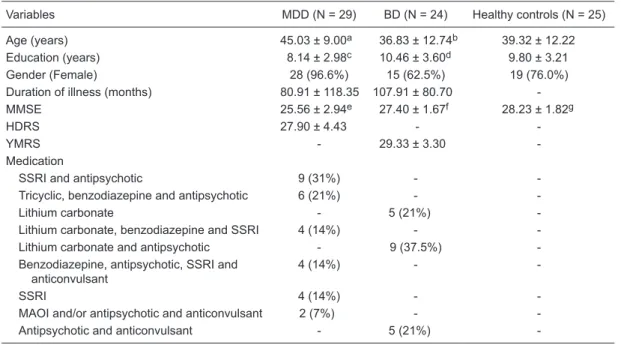
disease was 6.74 years. Among BD patients, the number of episodes was 5.19 and duration of disease was 8.99 years. Use of medication is presented in Table 1. Healthy controls were recruited randomly from the community where the hospital is located.
A battery of cognitive tests was administered to assess attention and memory. Testing began with a visual recognition memory task. Assessment of each participant lasted about 1 h. The same instructions were given to all subjects to prevent
subtle differences of interaction with the experimenter.
Cognitive testing and symptom rating scales
A set of attention/memory tests with affective content
(positive, negative, and indifferent) and without affective
content was selected to evaluate the attention/memory
performance of the participants. The selected tests have been previously adapted and validated for the Brazilian population (19-24).
1) Word span: word lists with emotional content, with 10
items each, presented at a rate of one word/second starting
with the positive span and presented consecutively. Higher scores represent better performance. The task evaluates verbal episodic memory (19,20).
2) Wechsler’s logical memory test (immediate and
delayed recall): a short story with 10 items is presented
auditorily to evaluate attention and verbal episodic memory (21,22). Higher scores represent better performance.
3) Digit span: the test starts with two consecutive
com-mands of 3 digits, which are progressively increased up to 2 commands of 10 digits. The test is interrupted when a participant fails to correctly repeat two consecutive
com-mands. Higher scores represent better attention/memory
processing. The test evaluates attentional processing, sustained attention and working memory (21,23).
4) Visuospatial recognition span: white round tokens are
displayed on a black board, starting from 1 and increasing up to 20 tokens. Each time a token is added to the board,
the board is covered. The examinee has to identify the
last added token (places are marked and the sequence is
fixed). Higher scores mean better performance. This is a
task developed to evaluate sustained visual attention and visual memory (24).
Symptoms were rated in each group with the Hamilton Depression Rating Scale (HDRS)(25) and with the Young Mania Rating Scale (YMRS) for mania (26). The 17-item version was used for the HDRS scale and the Portuguese-adapted version was used for the YMRS (27). The MMSE
was also applied to the 3 groups to exclude cognitive
impairment (28).
The study was approved by the Research Ethics Com-mittee of the Hospital de Clínicas de Porto Alegre and all participants gave written informed consent.
Statistical analysis
Descriptive statistics (means ± SD and relative
fre-quency) were calculated for demographic data, MMSE, and
memory tests. Spearman’s correlation coefficients were
calculated for correlations between the Hamilton and Young scales, number of affective episodes, duration of illness, and memory tests. A univariate general linear model (two-way ANOVA with the Bonferroni post hoc test) was designed for the evaluation of the effects of group (depression, mania, controls), number of affective episodes and memory test scores (ANCOVA with the Bonferroni post hoc test). The statistical analysis was carried out using the Statistical Pack-age for the Social Sciences for Windows (SPSS 14).
Results
Demographic data
To evaluate the severity of BD and MDD symptoms we applied the YMRS and the HDRS. The scores on the HDRS were 27.9 for the MDD group, and the scores on the YMRS were 29.3 for the BD group (Table 1).
MDD patients were significantly older and less educated
than BD patients (Table 1). Females were more prevalent
in all groups studied. The MMSE scores were significantly
lower among MDD patients (means ± SD, 25.56 ± 2.94) than among BD patients (27.40 ± 1.67) and healthy controls (28.23 ± 1.82).
Memory tests with affective content
In the word span with positive tone, the BD group showed higher scores than the MDD and healthy control
groups (Table 2). A significant effect of the number of
affective episodes was observed in this test (ANCOVA, negative correlation; B = -0.13; P = 0.035). The word lists
with indifferent and negative tones did not show significant
differences among groups.
Memory tests without affective content
MDD patients presented significantly lower scores in
the Digit span than BD and healthy controls (Table 2). A
significant effect of number of affective episodes was also
observed on Digit span (ANCOVA, negative correlation; B
= -0.21; P = 0.043). MDD and BD patients presented signifi -cantly lower scores than healthy controls in the visuospatial recognition span (P = 0.002; Table 2). No effect of number of affective episodes was observed.
In the Logical Memory test, the MDD group presented lower scores for immediate recall than healthy controls, but did not differ from the BD group (Table 2). In the delayed recall, both groups of patients (MDD and BD) presented
a significantly worse performance than the healthy control
group. No effect of number of affective episodes was observed.
Correlations
Age correlated significantly with word span positive
Memory mood congruency phenomenon in bipolar I disorder 859
= 0.015), and visuospatial span (rho = -0.26; P = 0.020). Education corre-lated with logical memory immediate recall (rho = 0.26; P = 0.024), word span negative content (rho = 0.38; P = 0.001), and digit span (rho = 0.27; P = 0.016). Duration of disease correlated with Word span positive content among BD patients (rho = -0.48; P = 0.022).
Discussion
This study was carried out to ana-lyze performance in memory tasks with and without affective content in acutely manic BD patients, acutely depressed MDD patients, and in a group of healthy controls.
Type I BD patients presented higher scores in the word span with positive content than MDD patients and
healthy controls. This finding suggests the hypothesis of
the memory mood congruency among BD patients. Mood and affect are important for memory because they may
influence performance according to the type of information
to be processed or according to the affective state of the
individual at the time of the test (4,17,29). Therefore, in mood congruency the information is better stored if the affective content corresponds to the subject’s affective state(4), as observed in the present study. No similar information was previously available for altered states of mood and memory processing during manic episodes in BD (state dependency or mood congruency). The performance in the word span
Table 1. Demographic and clinical data of the subjects studied.
Variables MDD (N = 29) BD (N = 24) Healthy controls (N = 25)
Age (years) 45.03 ± 9.00a 36.83 ± 12.74b 39.32 ± 12.22
Education (years) 8.14 ± 2.98c 10.46 ± 3.60d 9.80 ± 3.21
Gender (Female) 28 (96.6%) 15 (62.5%) 19 (76.0%)
Duration of illness (months) 80.91 ± 118.35 107.91 ± 80.70 -MMSE 25.56 ± 2.94e 27.40 ± 1.67f 28.23 ± 1.82g
HDRS 27.90 ± 4.43 -
-YMRS - 29.33 ± 3.30
-Medication
SSRI and antipsychotic 9 (31%) -
-Tricyclic, benzodiazepine and antipsychotic 6 (21%) -
-Lithium carbonate - 5 (21%)
-Lithium carbonate, benzodiazepine and SSRI 4 (14%) - -Lithium carbonate and antipsychotic - 9 (37.5%) -Benzodiazepine, antipsychotic, SSRI and
anticonvulsant
4 (14%) -
-SSRI 4 (14%) -
-MAOI and/or antipsychotic and anticonvulsant 2 (7%) -
-Antipsychotic and anticonvulsant - 5 (21%)
-Data are reported as means ± SD or number with percent in parentheses. a≠b (P = 0.029, Bonferroni post hoc test); c≠d (P = 0.031, Bonferroni post hoc test); e≠f; e≠g (P < 0.002, Bonferroni post hoc test). MDD = major depression disorder; BD = bipolar I disorder; MMSE = Mini-Mental State Examination; HDRS = Hamilton Depression Rating Scale; YMRS = Young Mania Rating Scale; SSRI = selective serotonin reuptake inhibitors; MAOI = monoamine oxidase inhibitors.
Table 2. Comparison of the scores (means ± SEM) of memory tests among the groups studied.
Tests MDD (N = 29) BD (N = 24) Healthy controls (N = 25)
Logical memory
Immediate recall 6.0 ± 2.34a 6.6 ± 1.40 7.5 ± 1.56b
Delayed recall 5.5 ± 2.49c 6.0 ± 1.53d 7.2 ± 1.50e
Word span
Positive tone 4.4 ± 1.42f 5.6 ± 1.21g 4.9 ± 1.24h
Negative tone 5.1 ± 1.72 5.6 ± 1.43 5.4 ± 1.08 Indifferent tone 4.9 ± 1.32 5.3 ± 1.56 5.8 ± 1.16 Digit span 3.7 ± 2.19i 5.7 ± 2.24j 5.8 ± 2.01l
Visuospatial recognition span 7.1 ± 3.50c 6.6 ± 2.42d 9.8 ± 3.13e
The number of episodes was controlled in the analysis as a covariant. a≠b; c,d≠e; g≠f,h; i≠j,l (P < 0.042, P < 0.017, P < 0.002, P < 0.001, respectively; ANCOVA with Bonferroni
with positive content was affected by the number of affec-tive episodes (as demonstrated by ANCOVA) and by the duration of disease (as shown by the Spearman correlation).
Thus, we may assume that the task was influenced by the
severity of BD (the more severe the disorder the lower the scores in the test). In BD, and depending on the severity of the disease (number of episodes and duration of disease), the positive biased memory processing and the symptoms of the disease (i.e., mania) may be interconnected - one reinforcing the other.
The memory performance of depressed patients has
been shown to be influenced by the affective state with better acquisition and/or evocation of negative information
(16,30). In our study, no mood congruency effect for negative
items was found for MDD patients. No influence of number
of episodes or duration of disease was observed in this group. The negative bias of depression was derived from
studies with recollection of personal experiences during a
depressive episode or studies with the same type of recall during mood induction (4,16,17,29).
MDD patients presented poorer memory performance than healthy participants in the following tests: logical memory immediate and delayed recall, digit span, and visuospatial recognition span. These patients also showed worse performance than BD patients in the digit span and word span with positive tone. In addition to memory tests, MDD patients also presented lower scores in the MMSE, corroborating previous data on cognitive impairment in de-pressed patients(14,31). Because depression is a frequent and disabling disorder often characterized by a recurrent and chronic course (32), it is well established that depres-sive disorders are associated with cognitive dysfunction, especially episodic memory impairment (33,34). Among
the explanations for these cognitive impairments in depres -sion, the possible association with functional and structural
changes in brain structures (i.e., hippocampus and prefrontal
cortex - critical for episodic memory) is central (15,35).
We also found other memory impairments among BD patients. The performance in the logical memory delayed recall and in the visuospatial recognition span was lower compared to that of the healthy participants. There is now much evidence that patients with BD show cognitive impairment during the acute phases of the illness, which persists during inter-episode periods, even when mood is
euthymic (36,37). Attentional processing, executive func -tion, and verbal memory are the cognitive functions usually impaired in BD (38). Impairment in some domains (visual and working memory, and risk-taking behavior) did not show remission during periods of euthymia, while it did show remission in others (selective attention, attentional shifting, verbal memory, verbal planning, processing speed, and the
elements of executive function such as inhibitory control,
response inhibition, or strategic thought) (39).
The large proportion of women among depressed pa-tients is one of the limitations of the study; however, this was evaluated in the statistical analysis. On the other hand, this investigation presents several strengths such as the evaluation of acutely hospitalized patients, the determina-tion of disease severity with worldwide rating scales, and the use of a healthy group from the same community as that of the patients.
We detected the mood congruency effect for the word span with positive content among BD patients but no similar effect among MDD patients for negative items. MDD patients presented more memory impairments than BD patients, while BD patients also showed memory impairments com-pared to the healthy participants. Indeed, bipolar patients did not resemble depressed patients in the performance of
different memory tasks, but cognitive difficulties in bipolar patients may help explain impairment of daily functioning.
References
1. Dias VV, Brissos S, Frey BN, Andreazza AC, Cardoso C, Kapczinski F. Cognitive function and serum levels of brain-derived neurotrophic factor in patients with bipolar disorder.
Bipolar Disord 2009; 11: 663-671.
2. World Health Organization. International statistical
clas-sification of diseases and related health problems ICD-10.
Tenth revision, 3rd Vol., 2nd edn., 2004.
3. Martinez-Aran A, Torrent C, Tabares-Seisdedos R, Salamero M, Daban C, Balanza-Martinez V, et al. Neurocognitive impairment in bipolar patients with and without history of psychosis. J Clin Psychiatry 2008; 69: 233-239.
4. Jorm AF, Henderson AS. Memory bias in depression: im-plications for risk factors studies relying on selfreports of exposure. Int J Methods Psychiat 1992; 2: 31-38.
5. Merikangas KR, Akiskal HS, Angst J, Greenberg PE, Hirschfeld RM, Petukhova M, et al. Lifetime and 12-month prevalence of bipolar spectrum disorder in the National Comorbidity Survey replication. Arch Gen Psychiatry 2007;
64: 543-552.
6. Cousins DA, Butts K, Young AH. The role of dopamine in bipolar disorder. Bipolar Disord 2009; 11: 787-806. 7. Weissman MM, Bland RC, Canino GJ, Faravelli C,
Green-wald S, Hwu HG, et al. Cross-national epidemiology of major depression and bipolar disorder. JAMA 1996; 276: 293-299.
8. Kaplan HI, Sadoch BJ. Comprehensive textbook of psychia
-try modern synopsis of comprehensive psychia-try. 7nd edn. Baltimore: Williams & Wilkins; 1990.
9. Levinson DF. The genetics of depression: a review. Biol Psychiatry 2006; 60: 84-92.
10. Karege F, Perret G, Bondolfi G, Schwald M, Bertschy G, Aubry JM. Decreased serum brain-derived neurotrophic factor levels in major depressed patients. Psychiatry Res
2002; 109: 143-148.
Memory mood congruency phenomenon in bipolar I disorder 861
Rev 2004; 45: 104-114.
12. Glahn DC, Therman S, Manninen M, Huttunen M, Kaprio J, Lonnqvist J, et al. Spatial working memory as an en-dophenotype for schizophrenia. Biol Psychiatry 2003; 53: 624-626.
13. Kurtz MM, Gerraty RT. A meta-analytic investigation of neu-rocognitive deficits in bipolar illness: profile and effects of clinical state. Neuropsychology 2009; 23: 551-562. 14. Airaksinen E, Larsson M, Lundberg I, Forsell Y. Cognitive
functions in depressive disorders: evidence from a popula-tion-based study. Psychol Med 2004; 34: 83-91.
15. Campbell S, Marriott M, Nahmias C, MacQueen GM. Lower hippocampal volume in patients suffering from depression: a meta-analysis. Am J Psychiatry 2004; 161: 598-607. 16. Teasdale JD, Russell ML. Differential effects of induced
mood on the recall of positive, negative and neutral words.
Br J Clin Psychol 1983; 22 (Part 3): 163-171.
17. Blaney PH. Affect and memory: a review. Psychol Bull 1986; 99: 229-246.
18. Delgado VB, Izquierdo I, Chaves ML. Differential effects of acute diazepam on emotional and neutral memory tasks in acutely hospitalized depressed patients. Neuropsychiatr Dis Treat 2005; 1: 269-275.
19. Ceitlin LHS, Santos BJ, Parizotto I, Parizotto I, Zanatta MS, Chaves MLF. Elaboration of word lists in Portuguese with emotional content and their influence on memory function in normal subjects. Int J Meth Psychiatric Res 1995; 4: 121-129.
20. Bertolucci PH, Okamoto IH, Brucki SM, Siviero MO, Toniolo NJ, Ramos LR. Applicability of the CERAD neuropsychologi-cal battery to Brazilian elderly. Arq Neuropsiquiatr 2001; 59: 532-536.
21. Wechsler D. Wechsler memory scale-revised. San Antonio: Psychol Cooperation; 1987.
22. Chaves ML, Ilha D, Maia AL, Motta E, Lehmen R, Oliveira LM. Diagnosing dementia and normal aging: clinical rel-evance of brain ratios and cognitive performance in a Brazil-ian sample. Braz J Med Biol Res 1999; 32: 1133-1143. 23. Chaves ML, Izquierdo I. Differential diagnosis between
dementia and depression: a study of efficiency increment.
Acta Neurol Scand 1992; 85: 378-382.
24. Rebok G, Brandt J, Folstein M. Longitudinal cognitive decline in patients with Alzheimer’s disease. J Geriatr Psy-chiatry Neurol 1990; 3: 91-97.
25. Hamilton M. A rating scale for depression. J Neurol Neuro-surg Psychiatry 1960; 23: 56-62.
26. Young RC, Biggs JT, Ziegler VE, Meyer DA. A rating scale
for mania: reliability, validity and sensitivity. Br J Psychiatry
1978; 133: 429-435.
27. Vilela JAA. Estudo da confiabilidade e validade de uma versão modificada da Young Mania Rating Scale. [Masters Dissertation]: Faculdade de Medicina de Ribeirão Preto; 2000.
28. Folstein MF, Folstein SE, McHugh PR. “Mini-mental state”. A practical method for grading the cognitive state of patients for the clinician. J Psychiatr Res 1975; 12: 189-198. 29. Blackburn IM, Roxborough HM, Muir WJ, Glabus M,
Black-wood DH. Perceptual and physiological dysfunction in depression. Psychol Med 1990; 20: 95-103.
30. Teasdale JD, Fogarty SJ. Differential effects of induced mood on retrieval of pleasant and unpleasant events from episodic memory. J Abnorm Psychol 1979; 88: 248-257. 31. Burt DB, Zembar MJ, Niederehe G. Depression and memory
impairment: a meta-analysis of the association, its pattern, and specificity. Psychol Bull 1995; 117: 285-305.
32. Ormel J, Oldehinkel AJ, Nolen WA, Vollebergh W. Psycho-social disability before, during, and after a major depressive episode: a 3-wave population-based study of state, scar, and trait effects. Arch Gen Psychiatry 2004; 61: 387-392. 33. Austin MP, Mitchell P, Goodwin GM. Cognitive deficits in
depression: possible implications for functional neuropathol-ogy. Br J Psychiatry 2001; 178: 200-206.
34. Airaksinen E, Wahlin A, Larsson M, Forsell Y. Cognitive and social functioning in recovery from depression: results from a population-based three-year follow-up. J Affect Disord 2006; 96: 107-110.
35. Drevets WC. Neuroimaging studies of mood disorders. Biol Psychiatry 2004; 8: 829.
36. Robinson LJ, Thompson JM, Gallagher P, Goswami U, Young AH, Ferrier IN, et al. A meta-analysis of cognitive deficits in euthymic patients with bipolar disorder. J Affect
Disord 2006; 93: 105-115.
37. Martinez-Aran A, Vieta E, Colom F, Torrent C, Sanchez-Moreno J, Reinares M, et al. Cognitive impairment in euthy-mic bipolar patients: implications for clinical and functional outcome. Bipolar Disord 2004; 6: 224-232.
38. Ferrier IN, Chowdhury R, Thompson JM, Watson S, Young AH. Neurocognitive function in unaffected first-degree rela-tives of patients with bipolar disorder: a preliminary report.
Bipolar Disord 2004; 6: 319-322.