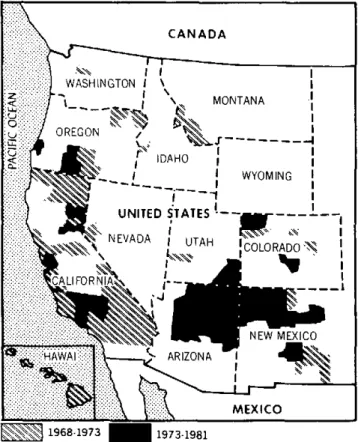
Figure 5. Plague occurrence in the United States of
America, 1968-1973 and 1973-1981. before human cases become evident. This predictivesurveillance is based on the premise that free-ranging do-mestic dogs ingest sick or dying plague infected mam-mals, developing a non-clinical infection which produces a demonstrable antibody response to the plague orga-nism. Therefore, by periodically collecting blood from dogs in infected areas and assaying their plague antibody levels, one may be able to determine if the area is plague endemic and if there is an epizootic occurring among the small mammals. In other words, this surveillance system may predict increasing animal plague activity and may also be useful in assessing the effectiveness of control procedures when they have been implemented.
The very remote areas in which sylvan plague occurs in the Americas have prevented the detailed ecological re-search necessary to describe the natural history of the disease in these areas. Nevertheless, the constant strengthening of national laboratory and epidemiological capabilities will gradually pave the way for a better derstanding of plague ecology in these relatively un-known areas, which in turn will provide for the develop-ment of more effective control measures.
(Source: Communicable Disease Program, Division of Disease Prevention and Control, PAHO.)
Patterns of Drinking in Five Latin American Cities
In 1975, a large-scale household survey of drinking patterns was carried out in five Latin American cities by the PAHO with a grant from the U.S. National Institute of Alcohol Abuse and Alcoholism. The survey was mod-eled after similar studies conducted by D. Cahalan, 1. H. Cisin, and H. M. Crossley' in the United States, and focused on drinking patterns rather than the prevalence of "alcoholism" per se. Heavy drinking was defined in the PAHO study using a quantity-frequency-variability index which classified a person as a heavy drinker if he or she got drunk and/or drank 10+ drinks per occasion at least once a month and/or 5+ drinks per occasion at
lAmerican Drinking Practices. A National Study of Drinking Be-haviour and Attitudes. Monograph of the Rutgers Center of Alcohol Studies, No. 6. College and University Press, New Jersey, 1969.
least twice a month. In effect, the classification of drinkers was somewhat more conservative in the PAHO study than in the research by Cahalan et al. Heavy drinking in Bogotá, Caracas, Santo Domingo, and San José (Costa Rica) tends to be characterized by the con-sumption of beer and/or distilled alcohol in rather large quantities about 1-4 times a month, while in the United States the quantity per occasion is less but the number of drinking sessions per month is greater. Further compari-sons with U.S. drinking patterns indicate that Latin Americans are more likely to fall into one of the extremes (abstention or heavy drinking), while North Americans are more likely to drink and to drink moderately.
The investigation revealed that four of the cities studied (Santo Domingo, San José, Caracas, and Bogotá) had a large proportion of heavy drinkers, while in Sáo Paulo drinking was relatively more moderate. The rate of heavy
8
drinking among males aged 15 to 64 runs as high as 39 per cent in Bogotá, with the highest proportion of heavy drinking occurring in the 30-39-year old group. Further, between 35-47 per cent of men in Bogotá, Caracas, Santo Domingo, and San José reported having drinking-related problems, particularly problems with interper-sonal relationships (family or friends) and with the ex-penses involved. Only 6-7 per cent of the women reported such problems. In general, men drink about three times as much as women and are far more likely to be heavy drinkers experiencing social, medical, or economic problems related to their drinking.
The study pointed out that there is a major need for treatment and prevention programs oriented toward male problem drinkers. Since the majority are employed and in the most productive period of their working life, programs operated in the workplace may be most effec-tive.
Although a number of variables were examined for their relationship to drinking patterns (i.e., age, socio-economic status, migration, employment, education, at-titudes, etc.), the only strong and consistent relationship with heavy and/or problem drinking was found with a
variable which measured the degree to which alcohol is present in one's environment. That is, heavy drinking was more prevalent among persons who reported having heavy drinking friends and/or persons who use alcohol on most social occasions. This finding is consistent with the results of several other studies which found that the degree of overall availability of alcohol in a society seems to have an independent effect on consumption.
In general, then, as has been suggested in recent WHO reports, preventive efforts might well be most ef-fective when aimed at reducing overall availability of alcohol in the population. While legislative action would seem indicated, it should be remembered that this must be accompanied by educational and promotional pro-grams aimed at changing social drinking habits and at-titudes over the long term.
A monograph based on this study is scheduled for publication and release in late 1981.
(Source: Mental Health Program, Alcohol and Drug Abuse, Non-Communicable Diseases, Division of Disease Prevention and Control, PAHO.)
Hospital Infections
Hospital-acquired infections1 are at present one of the leading causes of complications in hospitalized patients and account for a substantial increase in their mortality (in many cases they are the direct cause of the patient's death and therefore the responsibility of the institution) and in the cost of hospital care and are an additional health hazard for the community.
Although some success has been achieved in control-ling hospital infections, the advances made in biomedical technology and therapeutics are producing a large num-ber of very susceptible patients, which is aggravated by the appearance of certain pathogenic organisms with re-sistance to antibiotics.
I A hospital-acquired infection may be defined as "any clinically recognizable microbiological disease that affects the patient as a conse-quence of his being admitted to hospital or attending for treatment, or the hospital staff as a consequence of their work, whether or not the symptoms of the disease appear while the affected person is in hospital." WHO, European Series No. 4, 1978.
Recent studies in Latin America2 show that infection rates range between 5 and 70 per cent. The major impact is on human health and is shown by a high case-specific mortality rate, especially in the child population. In addition, the effects on the cost of hospital care are enor-mous.
According to recent data from Latin America, annual hospital care costs for infectious cases were approxi-mately US$196 million, on the basis of an acquired-infection rate of 10 per cent of annual discharges, an av-erage hospital stay of 10 days, and costs of approximately US$20 per day/bed. At present it is estimated that this figure has tripled.
In the United States, 70 hospitals in 31 states (that participated in a National Nosocomial Infections Study)
2Pan American Health Organization. Multi-disciplinary Group on
the Control of Hospital Infections in Latin America and the Caribbean.
Bol Ofic Sanit Panamer, Vol. LXXXVIII, No. 6, June 1980.