Prevalence of alcohol, tobacco and street drugs consumption in adult
Latin American immigrants
José Rafael González-López
2María de los Ángeles Rodríguez-Gázquez
3María de las Mercedes Lomas-Campos
4To estimate the prevalence of alcohol, tobacco and illicit drug consumption (through the self-report) in adult Latin-American immigrants of Seville, a cross-sectional descriptive study was carried out in a representative sample of 190 immigrants. The results showed that 61.4% of the participants had consumed alcohol in previous month before data collection, although 13.2% of them were at risk of alcoholism. Moreover, 30.0% were smokers. In addition, 5.3% of the interviewed people had consumed illicit psychoactive substances in the previous six months (Marihuana: 3.7%, hashish: 1.1% and cocaine: 0.5%). For all substances under analysis, the consumption prevalence was much higher in men from 25 to 39 years of age. In conclusion, prevalence levels of this consumption were high among the studied immigrants. Nurses could train the population in the prevention of these risk behaviors through preventive practices.
Descriptors: Emigration and Immigration; Prevalence; Alcohol Drinking; Tobacco; Street Drugs; Latin America.
1 This research was supported by Consejería de Salud de la Junta de Andalucía (PI-0138), Spain. 2 PhD, Professor, Facultad de Enfermería, Fisioterapia y Podología, Universidad de Sevilla, Spain. 3 PhD, Associate Professor, Facultad de Enfermería, Universidad de Antioquia, Colombia.
4 PhD, Full Professor, Facultad de Enfermería, Fisioterapia y Podología, Universidad de Sevilla, Spain.
Corresponding Author: José Rafael González López
Departamento de Enfermería. Facultad de Enfermería, Fisioterapia y Podología Universidad de Sevilla
Avda. Sánchez Pizjuán s/n 41009, Sevilla, España E-mail: [email protected]
Rev. Latino-Am. Enfermagem
2012 May.-June;20(3):528-35
www.eerp.usp.br/rlae
Prevalência do consumo de álcool, tabaco e drogas ilícitas em adultos imigrantes latino-americanos
Para estimar a prevalência de autorrelato de consumo de álcool, tabaco e drogas ilícitas
da população adulta de latino-americanos imigrantes, de Sevilha, foi realizado estudo
transversal descritivo em amostra representativa com 190 imigrantes. Os resultados
mostraram que 61,4% dos sujeitos ingeriam bebidas alcoólicas no mês anterior à coleta
de dados, 13,2% dos participantes apresentaram risco para alcoolismo, 30,0% já eram
fumantes, 5,3% dos entrevistados nos últimos seis meses haviam consumido drogas ilícitas
(maconha: 3,7%, haxixe: 1,1% e cocaína: 0,5%). Para todas as substâncias investigadas,
a prevalência do consumo foi maior em homens com idade entre 25 e 39 anos. Conclui-se
que os imigrantes apresentaram alta prevalência de consumo de drogas. A enfermeira pode
atuar na prevenção desses comportamentos de risco por meio da execução de práticas
educativas.
Descritores: Migração Internacional; Prevalência; Consumo de Bebidas Alcoólicas; Tabaco;
Drogas Ilícitas; América Latina.
Prevalencia de consumo de alcohol, tabaco y drogas ilícitas en inmigrantes latinoamericanos adultos
Con el in de estimar la prevalencia por autorreporte del consumo de alcohol, tabaco y drogas ilícitas en la población adulta de inmigrantes latinoamericanos en Sevilla, se realizó un
estudio descriptivo de corte transversal en una muestra representativa de 190 inmigrantes.
Los resultados mostraron que el 61,4% de los sujetos bebió alcohol en el mes anterior a la
recolección de datos, y el 13,2% de los participantes mostró tener riesgo de alcoholismo.
El 30,0% ya era fumador. El 5,3% de los encuestados ha consumido drogas ilícitas en los
últimos seis meses (marihuana: 3,7%, el hachís, la cocaína un 1,1% y 0,5%). Para todas
las sustancias investigadas, la prevalencia de consumo fue mayor en hombres de 25-39
años. Se concluye que los inmigrantes tienen una alta prevalencia de consumo de drogas.
La enfermera puede prevenir estos comportamientos de riesgo mediante la implementación
de prácticas educativas.
Descriptores: Migración Internacional; Prevalencia; Consumo de Bebidas Alcohólicas;
Tabaco; Drogas Ilícitas; América Latina.
Introduction
In the 1970’s, in the Lalonde report, the need was
emphasized to evolve from mere care interventions,
and that governments should also be concerned with
intervening in the risk factors of their populations’
lifestyles, which was further expressed in the 1986
Ottawa Charter. The IV International Conference on
Health Promotion, celebrated in Jakarta in 1997, further
elaborated on the need to enhance awareness of these
lifestyles, especially among the poorest. In principle,
fundamentally due to the living and work conditions they are frequently submitted to, immigrants it into this category in comparison with the autochthonous
population in the receiving zones.
Immigrants bring different types of behavior and
perceptions about access to social health services and drugs
consumption(1). Also, the migration process produces new
situations related to substance use(2). Migration entails
social stress (post-migration stress), with social, health and
economic implications that are often accompanied by a loss
of family structure, representing an important risk factor for
drugs consumption. Alcohol and tobacco are risk factors,
causing 12 percent of deaths around the world, according
to a World Health Organization study(3). Although tobacco
is the major preventable cause of death in the world(4), its
consumption is a growing epidemic and, unless urgent action
Rev. Latino-Am. Enfermagem 2012 May.-June;20(3):528-35.
530
Different studies(5-6) on lifestyles and health
determinants have looked at tobacco, alcohol and
drugs consumption. Results demonstrate distinguished
habits between the autochthonous and foreign
populations, particularly a higher prevalence of harmful
determinants of health. Data from the Spanish National
Survey on Drugs Use and Health (NSDUH) indicate
distinctly different lifetime consumption rates for
illegal substances (cocaine, marihuana and hashish)
between Latin and non-Latin white people (37.2% vs.
48.1%, respectively)(7). In España, one study(8) found
a speciic social problem concerning adult immigration and drugs consumption. High current alcohol (93.9%)
and tobacco (63.9%) consumption levels appear in the
study population(5), concretely among Ecuadorians in
leisure contexts, while practicing sports in the company
of friends and relatives. According to the Statistical
Yearbook on Immigration(9), in 2009, 8% of Latin
American immigrants in Spain were in Andalucía. In
Seville, this group represented almost half (46.3%) of
the immigrant population.
Health problems associated with the consumption of
tobacco, alcohol and other drugs demand further attention
from health services and adequate public intervention
policies(10). Thus, Nursing is in an excellent position to
play a prominent role in alcohol, tobacco and drugs
consumption control: professionals have the opportunity
to help the community change its unhealthy lifestyles
and sensitize the immigrant group to resulting problems
with a view to eradicating risk behaviors(11). Cultural
care is an interesting alternative for nursing practice and
research in displaced and migrating populations. In her
“Transcultural Nursing” theory, Leininger explains how
different economic, religious, cultural, political factors,
lifestyles, technological factors, ethnic history, religion
(moral code), cultural values and generic practices inluence health in a holistic perspective(12). As the
immigration phenomenon is relatively recent in Spain,
few studies exist about the relation between drugs
dependence and the immigrant population(5).
Aim
To estimate the self-reported prevalence of alcohol,
tobacco and drugs consumption in the adult Latin American
population of Seville during 2011.
Method
A descriptive and cross-sectional study was
developed, using stratified sampling with proportional
allocation for gender, age and administrative district.
From a total population of 8,675 immigrants, a
representative sample of 190 adult Latin American
immigrants between 25 and 44 years of age was taken;
this age range was used because it is the most frequent
in this population(9).
Some behavior-related sections were used from
the Risk Factor Surveillance System (2009) from the
US Centers for Disease Control and Prevention(13). In
this paper, results will be presented for: a) participants’
sociodemographic data (sex, age, marital status,
education level, place of birth, time of stay in Spain
and occupation), b) consumption of alcohol, tobacco
and illicit drugs (marihuana, hashish, cocaine). The
prevalence rates of tobacco, alcohol and drugs were
calculated, dividing the number of people who affirmed
this habit by the study participants.
For this research, immigrant refers to “that person
whose country of origin is distinct from Spain and, at the
time of this survey, has established habitual residency
within the national territory”, which corresponds to the
definition the Spanish National Institute of Statistics
used in its 2007 National Survey of Immigrants(14).
Data were collected between January and May
2011. The selection criteria were: male or female
person living in some of the Official Neighborhoods or
Census Sectors in the 11 administrative districts of the
city of Seville; age between 25 and 44 years; born in
any of the countries the United Nations Organization
recognizes in its list of nationalities, territories and
regions(15) as Latin or South American countries
(Argentina, Bolivia, Brazil, Chile, Colombia, Cuba,
Ecuador, Paraguay, Peru, Uruguay, Venezuela) and
having immigrated to Spain; able to communicate and
understand the study requirements and having signed
the informed consent term. A single surveyor collected
the data.
To capture the participants, different Latin
American immigrant associations and groups were
contacted to facilitate data collection. The procedures
used to accomplish this study complied with the
ethical principles in the World Medical Association’s
1975 Helsinki Declaration (updated version 2008);
participants signed the informed consent term and,
concerning sociodemographic data, to protect honor,
anonymity and personal intimacy, according to Organic
Law 15/1999 on the Protection of Personal Data,
questionnaires were numbered.
Data were analyzed using SPSS version 17.0 for
Windows statistical software. Descriptive analyses were
González-López JR, Rodríguez-Gázquez MA, Lomas-Campos MM.
quantitative and proportions for qualitative variables.
Relations between some variables of interest were
explored, using statistics indicated for independent
samples, as follows: a) difference of proportions: X2
was applied in case of expected values in contingency
tables ≥5; if not, Yatees’ continuity correction was used;
b) difference of means: Student’s t-test was used; c)
evaluation of strength of association: the Odds Ratios were calculated with their respective 95% conidence intervals; and d) cluster analysis: to explore if the study
group contained underlying natural clusters with similar
characteristics.
Results
Sociodemographic characteristics
The general sociodemographic profile of the 190
participants was as follows: the mean age is 33.8±6.3
years; 60% are women; as to marital status, married
(45.3%), single (36.8%) and people living with a
fixed partner (8.9%) are predominant; regarding
education, 3.7% have no degree, 15.3% have finished
primary, 40.0% secondary, 16.8% higher education
and the remaining 24.2% hold a university degree.
Concerning the country of origin, in decreasing order of
contribution: Bolivia (32.6%), Peru (18.9%), Colombia
(16.8%), Ecuador (11.1%), Paraguay (5.2%), Chile
(4.2%), Brazil (1.6%), Nicaragua (1.1%), and
Argentina and Cuba (0.5% each). The analysis of the
time of residence in Spain showed a mean 5.4±3.6
years, slightly higher than the mean time of residence
in Seville (4.6±3.2 years). As regards past occupation,
the highest proportions are for employed (53.7%),
self-employed (13.3%), unself-employed and student (11.6%
each) and housewife (5.8%). The most frequent current
occupation, on the other hand, was employed (59.3%),
followed by self-employed (18.4%), unemployed
(10.5%), student (6.8%) and housewife (4.7%). A
moderate correlation was found (ro=0.36; p<0.01)
between previous and current occupation.
Alcohol consumption
In the last month, the prevalence of alcohol consumption
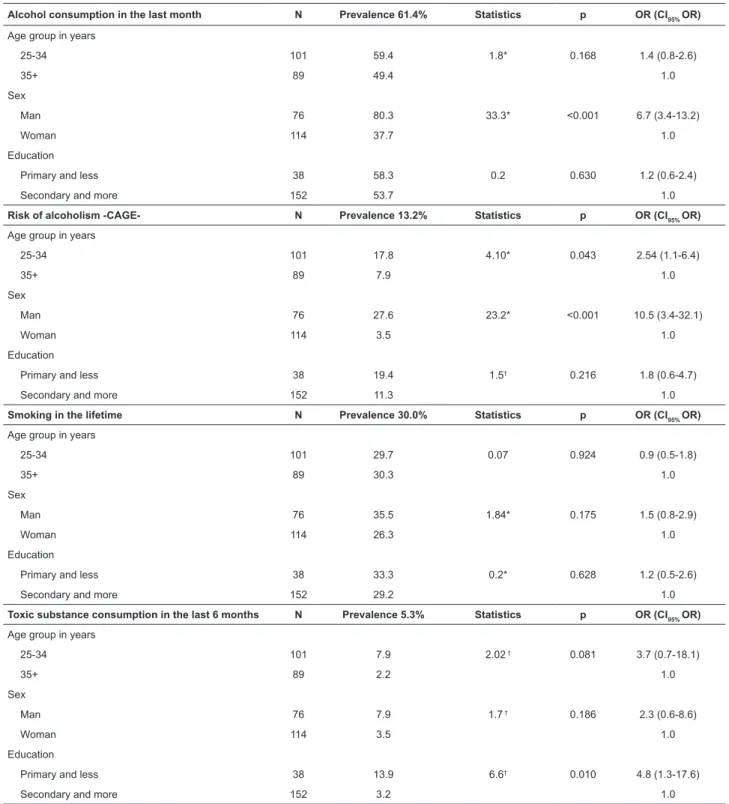
was 61.4% (CI95%=47.4%-61.9%). According to Table 1,
prevalence levels in the last month were almost seven times higher than in women, a statistically signiicant inding. Although no differences were found per age or education
level, the monthly prevalence of alcohol consumption was
higher in the group from 25 to 34 years and among people who had inished primary education or less. People started drinking at the mean age of 16.6±5.3 years.
As for the risk of alcoholism, measured through the
CAGE instrument, 13.2% of participants (CI95%=
8.4%-18.3%) show some and 6.8% high risk. Statistically signiicant differences were found according to sex (higher risk in men) and age (higher in people between 25 and 34
years of age). (Table 1)
Smoking cigarettes
Thirty percent (CI95%= 23.6%-37.1%) of the
study participants have smoked during the lifetime.
At the time of the survey, 26.3% were smokers, 3.7%
former smokers and the remainder (70.0%)
non-smokers. The median number of cigarettes current
smokers consume per day was four, so that 95.6%
of these people smoke less than a pack per day. In
the last year, 10.5% of this group has intended to
quit smoking. The mean age they started to smoke is
17.6±5.1 years. No significant differences were found
per age group, sex or education level.
Illegal psychoactive substance consumption
In the last six months, 5.3% of participants have
consumed an illegal psychoactive substance (CI95%
=2.7%-9.7%). According to substance type, the highest prevalence
was found for marihuana with 3,7% (CI95%= 1.5%-7.4%),
followed by hashish with 1.1% (CI95%= 0.1%-3.8%) and
cocaine with 0.5% (CI95%= 0.0%-2.9%). Consumption
of any other substance of this type was not reported.
According to Table 1, no differences were found per sex
or age group, as opposed to education, considering that
the risk of having consumed these substances was almost ive times higher among people with primary education or less when compared to the group with secondary and
higher education.
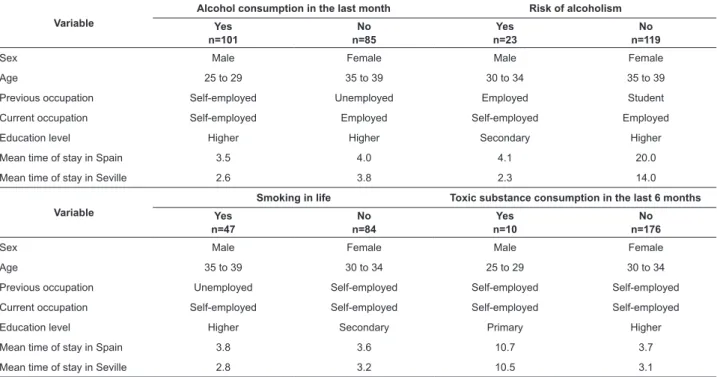
Table 2 displays the clusters for alcohol consumption in the last month, with a male proile, between 25 and 29 years, self-employed, with higher education and time of stay in Seville two years and a half. This proile is very similar to that of toxic substance consumers in
the last 6 months and that of risk of alcoholism. The
difference for the former is a much longer time of stay
in the city.
Rev. Latino-Am. Enfermagem 2012 May.-June;20(3):528-35.
532
Alcohol consumption in the last month N Prevalence 61.4% Statistics p OR (CI95% OR)
Age group in years
25-34 101 59.4 1.8* 0.168 1.4 (0.8-2.6)
35+ 89 49.4 1.0
Sex
Man 76 80.3 33.3* <0.001 6.7 (3.4-13.2)
Woman 114 37.7 1.0
Education
Primary and less 38 58.3 0.2 0.630 1.2 (0.6-2.4)
Secondary and more 152 53.7 1.0
Risk of alcoholism -CAGE- N Prevalence 13.2% Statistics p OR (CI95% OR)
Age group in years
25-34 101 17.8 4.10* 0.043 2.54 (1.1-6.4)
35+ 89 7.9 1.0
Sex
Man 76 27.6 23.2* <0.001 10.5 (3.4-32.1)
Woman 114 3.5 1.0
Education
Primary and less 38 19.4 1.5† 0.216 1.8 (0.6-4.7)
Secondary and more 152 11.3 1.0
Smoking in the lifetime N Prevalence 30.0% Statistics p OR (CI95% OR)
Age group in years
25-34 101 29.7 0.07 0.924 0.9 (0.5-1.8)
35+ 89 30.3 1.0
Sex
Man 76 35.5 1.84* 0.175 1.5 (0.8-2.9)
Woman 114 26.3 1.0
Education
Primary and less 38 33.3 0.2* 0.628 1.2 (0.5-2.6)
Secondary and more 152 29.2 1.0
Toxic substance consumption in the last 6 months N Prevalence 5.3% Statistics p OR (CI95% OR)
Age group in years
25-34 101 7.9 2.02 † 0.081 3.7 (0.7-18.1)
35+ 89 2.2 1.0
Sex
Man 76 7.9 1.7 † 0.186 2.3 (0.6-8.6)
Woman 114 3.5 1.0
Education
Primary and less 38 13.9 6.6† 0.010 4.8 (1.3-17.6)
Secondary and more 152 3.2 1.0
Table 1 – Percentage prevalence of tobacco consumption in the lifetime, alcohol consumption in the last month and toxic
substance consumption in the last six months among 190 Latin American immigrants living in Seville
*: Pearson’s X2; †: with Yates correction
Discussion
Some studies exist in Spain about immigrant health
and the importance of sociodemographic, economic factors
and lifestyles(16-17). Nevertheless, except in two studies(5,8)
that found a speciic social problem related to immigration and drugs consumption, there has been a lack of research
about the prevalence of tobacco, alcohol and other drugs
consumption once they reach their country of destination.
We do know, however, about the high prevalence of
alcohol (44%) and tobacco (26%) consumptions in the
Latin American countries of origin (Argentina, Bolivia,
Chile, Colombia, Ecuador, Peru and Uruguay) through
different studies(3,18).
In this research, the consumption patterns in the
adult Latin immigrant population in Seville are shown,
observing high levels for alcohol (in the last month:
González-López JR, Rodríguez-Gázquez MA, Lomas-Campos MM.
Variable
Alcohol consumption in the last month Risk of alcoholism
Yes n=101
No n=85
Yes n=23
No n=119
Sex Male Female Male Female
Age 25 to 29 35 to 39 30 to 34 35 to 39
Previous occupation Self-employed Unemployed Employed Student
Current occupation Self-employed Employed Self-employed Employed
Education level Higher Higher Secondary Higher
Mean time of stay in Spain 3.5 4.0 4.1 20.0
Mean time of stay in Seville 2.6 3.8 2.3 14.0
Variable
Smoking in life Toxic substance consumption in the last 6 months
Yes n=47
No n=84
Yes n=10
No n=176
Sex Male Female Male Female
Age 35 to 39 30 to 34 25 to 29 30 to 34
Previous occupation Unemployed Self-employed Self-employed Self-employed
Current occupation Self-employed Self-employed Self-employed Self-employed
Education level Higher Secondary Primary Higher
Mean time of stay in Spain 3.8 3.6 10.7 3.7
Mean time of stay in Seville 2.8 3.2 10.5 3.1
Table 2 – Clusters for alcohol consumption in the last month, risk of alcoholism, having smoked in life and having
consumed toxic substances in the last 6 months
30.0%) and low levels for marihuana and cocaine (in
the last 6 months: 3.7% and 0.5%, respectively).
Alcohol consumption, based on the results, varies in
function of two fundamental variables, the age group
- 25 to 34 years – and sex - man. Consumption in the
last month stands out (61.4%), higher than the 40.1%
in another study involving Latin American immigrants
in the community of Valencia(5). The explication for this
phenomenon can be due to the fact that, according
to the authors of a research about the evolution of
immigrant drugs consumption between 2004 and
2008(8), this group displays permissiveness and a
feeling of dangerousness in legal drugs consumption,
mainly of alcohol, contrasting with the perceived high
dangerousness of illegal drugs, with lower prevalence
levels, in line with this study. These percentages differ
in the autochthonous population, with lower levels for
alcohol (38.8%) and other illegal drugs (1.7%), but not
for tobacco (72.7%)(5).
In our study, the percentage of high-risk drinkers
(6.8%) exceeds the 4.8% described in a research
accomplished in an immigrant population of productive
age(19). In the last month, the consumption prevalence of
this substance amounted to 61.4% and was higher among
men, in the younger group (25 to 34 years) and among
people with primary education and less. Perhaps, as afirmed in the abovementioned study of Latin American immigrants(5), they tend to have less information about
its effects.
Concerning tobacco consumption prevalence, 30%
of the subjects have consumed 100 cigarettes in life and 26.3% are current smokers, lower igures than in the study of Latin American immigrants in Valencia(5) about
consumption and perceived consumption, where it was afirmed that 31.3% are habitual smokers. It is signiicant that the start age of the smoking habit is 17.6 years,
similar to the 17.5 years described in the United Nations
Workshop against Drugs and Crime for South American
countries(18). Both ages are higher than the Spanish
average of 13.5 years, according to the report Current
Situation of Smoking in Spain (2005-2010)(20).
The prevalence of illegal drugs consumption in our
study showed that 5.3% of the sample are consumers,
similar to the 5.7% in the Valencia study(5). Different risk
factors seem to determine these consumption similarities
in both studies (ethnic groups of origin, age, parental
education, among others), discussed in a study of this
population type in the United States(21), which should
be taken into account in the development of prevention
programs.
Consumption differences were found in function of
age. In the group from 25 to 34 years, the risk of having
consumed these substances is almost four times higher
than in the group over 35 years of age, according to
the authors of a study about immigrants in Sweden(22),
depending on whether they belong to the irst or second generation of immigrants. Over time, an assimilation
Rev. Latino-Am. Enfermagem 2012 May.-June;20(3):528-35.
534
standards among immigrants change and progressively
get closer to those of the citizens in the welcoming
country, in line with the North American analysis in the
2000 National Health Study(23). In this framework, the
prevalence of marihuana consumption (3.4%) detected
in this study was lower than that of the autochthonous
population(24), while cocaine consumption levels have been
higher, basically due to Andean immigrants’ consumption
of this substance, as highlighted in the study that involved
a similar population in Valencia(5).
These study results are a source of concern
when considering the health problems associated with
tobacco, alcohol and illegal drugs consumption and
addiction, which produce a greater demand for care and
rehabilitation services and require public health policies
that aim to solve or at least minimize these problems in
society(10). From the Nursing perspective, in the study
population, educative interventions are suggested to
prevent consumption, in immigrants’ health and work
contexts, in which nurses have direct and permanent
contact with individuals, their families and community,
with a view to raising awareness about the consumption
problem and enhancing self-care in health(25).
Conclusion
In this study, which involved a representative sample of
the immigrant population in Seville (Spain), the consumption
of alcohol, tobacco and illicit drugs is a problem that
deserves the attention of health authorities, as it surpasses
the prevalence rates in the autochthonous population. Based
on the knowledge reviewed in this research report, the
health and social entities in Seville will have new elements to
intervene, through health promotion and disease prevention
activities, prioritizing education on healthy lifestyles.
Further research in this sense is pertinent, with a view to
providing orientations for the design and implementation
of distinguished activities from a nursing perspective,
which are adequate to the immigrant group’s needs, such
as educative activities to prevent smoking, alcoholism and
drugs consumption, so as to train this population and, thus,
improve immigrants’ health level.
References
1. Dupont H, Kaplan CD, Verbraeck HT, Braam RV, van
de Wijngaart GF. Killing time: drug and alcohol problems
among asylum seekers in the Netherlands. Int J Drug
Policy. 2005;16(1):27-36.
2. Alaniz ML. Migration, acculturation, displacement:
migratory workers and “substance abuse”. Subst Use
Misuse. 2002;37(8-10):1253-7.
3. Buchanan JC, Pillon SC. Uso de drogas entre estudiantes
de medicina, tegucigalpa, Honduras. Rev. Latino-Am.
Enfermagem. 2008;16(Spec):595-600.
4. Rodríguez-Gazquez MA, Pineda SA, Vélez LF.
Características del consumo de tabaco en estudiantes de
enfermería de la Universidad de Antioquia (Colombia).
Invest Educ Enferm. 2010;28(3):370-83.
5. Tortajada S, Valderrama JC, Castellano M, Llorens
N, Agulló V, Herzog B, et al. Consumo de drogas y su
percepción por parte de inmigrantes latinoamericanos.
Psicothema. 2008;20(3):403-7.
6. Carrasco-Garrido P, De Miguel AG, Barrera VH, Jiménez-García R. Healthy proiles, lifestyles and use of health resources by the immigrant population resident in Spain.
Eur J Public Health. 2007;17(5):503-7.
7. Ojeda V, Patterson TL, Strathdee SA. The inluence of perceived risk to health and inmigration-related
characteristics on substance use among latins and other
inmigrants. Am J Public Health. 2008;98(5):862-8.
8. Tordable I, Sánchez A, Santos S, García MI, Redondo
S. Evolución del consumo de drogas por inmigrantes entre
los años 2004 y 2008. Gac Sanit. 2010;24(3):200-3.
9. Secretaría de Estado de Inmigración y Emigración (ES).
Anuario Estadístico de Inmigración en 2008. [acesso 2
nov 2010]. Disponível em: http://extranjeros.mtin.es/es/
InformacionEstadistica/Anuarios/Anuario2008.html
10. Mendes IAC, Luis MAV. Use of psychoactive substances:
a new-old challenge. Rev. Latino-Am. Enfermagem.
2004;12(Spec):297-8.
11. Salmeron J, Arillo E, Campuzano J. Tabaquismo en
profesionales de la salud del Instituto Mexicano, Morelos.
Salud Pub Mexico. 2002;44(1):67-75.
12. Leininger M. Culture care theory: a major contribution
to advance transcultural nursing and practices. J
Transcultural-Nurs. 2002;13(3):189-92.
13. Centers for Disease Control and Prevention. Surveillance
of Certain Health Behaviors Among States and Selected
Local Areas. Behavioral Risk Factor Surveillance System,
United States. MMWR Surveill Summ. 2010;59(1):1-220.
14. Gaete R, Rodríguez C. Una aproximación al análisis de
las cadenas migratorias en España a partir de la Encuesta
Nacional de Inmigrantes. Rev Cienc Polít. (Santiago).
2010;30(3):697-721.
15. González JR, Lomas MM, García J, Pascualvaca
J, Guardado MJ, Muñoz B, et al. Conductas de salud
en inmigrantes latinoamericanos adultos del Distrito
Macarena de Sevilla (España). Invest Educ Enferm.
2010;28(3):384-95.
16. Rodríguez-Álvarez E, Lanborena N, Senhaji M, Pereda C, Aguirre C. Variables sociodemográicas y estilos de vida como predictores de autovaloración de la salud de los inmigrantes
González-López JR, Rodríguez-Gázquez MA, Lomas-Campos MM.
17. Agudelo-Suárez AE, Ronda-Pérez H, Gil-González
D, Vives-Cases C, García AM, García-Benavides F, et
al. Proceso migratorio, condiciones laborales y salud en
trabajadores inmigrantes en España (proyecto ITSAL).
Gac Sanit. 2009;23(Suppl 1): 115-21.
18. Oicina de las Naciones Unidas contra la Droga y el Delito (US). Elementos orientadores para las políticas
públicas sobre drogas en la subregión: Primer Estudio
Comparativo sobre consumo de drogas y factores asociados
en población de 15 a 64 años. [Internet]. Washington:
ONUDD; 2008 [acesso 1 jun 2010]. Disponível em: http://
www.cicad.oas.org/oid/NEW/Research/comparativo_
subregional-2008-06.pdf
19. García-Gómez P, Oliva J. Calidad de vida relacionada
con la salud en población inmigrante en edad productiva.
Gac Sanit. 2009;23(Suppl 1):38-46.
20. Sociedad Española de Neumología y Cirugía Torácica.
Situación actual del tabaquismo en España (2005-2010).
Prev Tab. 2010;12(Suppl 1):27-33.
21. Delva J, Wallace JM, O’Malley PM, Bachman JG,
Johnston LD, Schulenberg JE. The epidemiology of alcohol,
marijuana and cocaine use among Mexican American,
Puerto Rican, Cuban American, and other Latin American
eighth-grade students in the United States: 1991-2002.
Am J Public Health. 2005;95(4):696-702.
22. Hjern A, Allebeck P. Alcohol-related disorders in irst- and second-generation immigrants in Sweden: A national
cohort study. Addiction. 2004;99(2):229-36.
23. Johnson TP, van Geest JB, Cho YI. Migration and
substance use: Evidence from the U.S. National Health
Interview Survey. Subst Use Misuse. 2002;37(8-10):
941-72.
24. Brugal MT, Barrio G, Royuela L, Bravo MJ, de la Fuente
L, Regidor E. Estimación de la mortalidad atribuible al
consumo de drogas ilegales en España. Med Clin (Barc).
2004;123(20):775-7.
25. Navarrete RP, Luis MA. Actitud de la enfermera de un
complejo hospitalario en relación al paciente alcohólico.
Rev. Latino-Am. Enfermagem. 2004;12(Spec):420-6.
Received: Ago. 18th 2011