regional committee
Ala%
PAN AMERICAN
WORLD
HEALTH
HEALTH
'/
~ORGANIZATION
ORGANIZATION
XVIII Meeting
XX
Aeeting Buenos Aires, ArgentinaOctober 1968
Provisional Agenda Item 24 CD18/18 (Eng.) 21 October 1968 ORIGINAL: ENGLISH
sVALUATION OF THE FELLOWSHIP PROGRAM
The Director has the honor to inform the Directing Council that Document CE59/9 was prepared pursuant to paragraph 7 of
Resolution XSLV adopted at its XVII Meeting, which reads as follows:
"7. To recommend to the Director that he
continue his efforts, in the way he deems most effective and in cooperation with the Executive Committee and the Governments, to carry out in the next two years an
evaluation of the fellowships program, and to submit a preliminary report on his findings to the XVIII Meeting
of the Directing Council."
After considering document CE59/9, the 59th Executive Committee adopted the following:
RESOLUTION IX
"THE EXECUTIVE COMMITTEE,
Having considered the report of the Director on the evaluation of the fellowship program (Document CE59/9);
Considering that the preliminary survey has shown that the format proposed for the evaluation of the fellow-ship program is satisfactory;
Bearing in mind the advisability of completing this study so as to ensure that the objectives of this important program are achieved; and
Having considered Resolution XXV of the XVII MIeeting of the Directing Council,
Page 2
RESOLVES:
1. To take note of the report of the Director (Document CE59/9) describing the activities so far accomplished in evaluating the fellowship program, the method proposed, some results of the preliminary survey and the total cost of the study.
2. To urge the Director to continue the proposed study until it is completed and to submit the findings to the Governing Bodies of the Organization in due course.
3. To tra-nsmit to the XVIII Meeting of the. Directing Council the above-mentioned report and to recommend to it that it approve the estimated budget for
completing the evaluation of the fellowship program."
executive committee of
working party of
the directing council
the regional committee
4%
NOPAN
AMERICAN
WORLD
I
HEALTH
HEALTH
HEALTH
ORGANIZATION
ORGANIZATION
59th Meeting
Washington, D. C. July-August 1968
Provisional Agenda Item 17 CE59/9 (Eng.)
12 July 1968
ORIGINAL: SPANISH
FELLOWSHIP PROGRAM
By Resolution XXV, adopted at its XVII Meeting, the Directing Council recommended that an evaluation be made of the fellowship program of the Organization and requested the Director to report to its XVIII Meeting on action taken to comply with this recommendation. In addition,
the Director offered to submit to the Executive Committee a plan for this evaluation.
As a first step, a consultant in sociological and administrative research methods was hired. After a careful study of the fellowship
pro-gram of the Organization, the consultant prepared a document setting forth the basic concepts of the evaluation and, in keeping with these, the guid-ing principles for designguid-ing the investigation requested by the Directguid-ing Council. This document is attached as Annex I.
As will be noted in this annex, the proposed evaluation will make it possible to measure the results achieved so far and their effect on the programs of the Governments and the Organization, as well as to compile information that will be useful to the Governing Bodies in determining fu-ture policy -in-this field.
In designing this investigation it has been necessary to identify the implicit or explicit purposes of the program in order to determine which are the variables to be investigated and measured in this study.
AmQng the many purposes which are sought or can theoretically be achieved through a fellowship, two have been chosen as a practical frame of reference for the study, that is, as basic factors in the ,,ollection of data for the evaluation. These objectives are the instruction and training of personnel of the health services and teaching-institutions to improve their capability, with proper provision for suosequent utilization of their new skills, and
the dissemination by the fellowship holder, upon returning to his country, of the knowledge, techniques, and skills he has acquired.
Page 2
from the authorities who requested the award of fellowships, proposed
can-didates, or supervised their performance, information on various matters
relating to the establishment and award of fellowships and on the effect
that the fellowship training has had on the fellows. Finally, the
inves-tigation will extend to the officials of the Bureau who are concerned with
the program in any of its stages. These officials will be found at three
administrative levels, all of which perform important functions in the
pro-grai, namely, Headquarters, the Zone Offices, and the offices in the member
countries. In this way, the information collected will not only make it
possible to determine to what extent the stated purposes have been
accom-plished, but also to identify and appraise the entire' administrative process,
beginning with the establishment of the fellowships and their inclusion in
the various programs, continuing with the selection of the fellows, the
se-lection of their program and place of study, and the supervision of their
studies, and ending with the evaluation of the trainees' performance after
the training
is
completed.
After these premises were agreed upon, four questionnaires were
pre-pared: two for completion by former fellows, one by their supervisors, and
the
last for obtaining a systematic summary of certain data carried in the
records of the Bireau. It was decided to test these questionnaires on all
the fellow.ship holders from two countries of the region where it was
pre-sumed to be a simple matter to loc-ate, along with their supervisors, these
trainees who had finished their fellowship studies in 1963, 1964 and 1965.
The countries chosen were Costa Rica and Panama, with a total of 128 trainees.
At
the same time, in order to determine the possible cost and duration of the
entire study, a PASB official in Brazil was assigned the task of locating all
the Brazilian fellowship holders for the same years.
The field work in Costa Rica and Panama was done by a special
con-sultant with wide experience in the fellowship program, with the following
results:
Replies were obtained from 114 former fellows, or 89%, which is very
satisfactory. Only three of the former fellows failed to return their
questionnaires, and of the remaining eleven, seven were traveling abroad,
one was on vacation, one was ill and two could not be located. 116
ques-ttonnaires for supervisors were also distributed, of which 106 (91.3%)
were returned. The other 10 had been sent to senior officials. Of the 114
questionnaires received, 10 were discarded for various reasons.
Eighty-three of the questionnaires were carefully reviewed and coded
at Headquarters and the resulting data were transferred to cards and
tabu-lated by computers. Some of the results obtained are presented in Annex
2.
CE59/9
(Engo)
Page 3
This information was used to make the necessary adjustments in the
questionnaires and it was decided to utilize a single questionnaire for the
former trainees, instead of the two initially proposed. All the data
col-lected in the preliminary trail in Costa Rica and Panama and in the special
study made in Brazil are being carefully examined and analyzed in order to
arrive at a definitive design for the investigation, with a view not only
to obtaining sufficiently complete and reliable information but also to
accomplishing this with the greatest possible economy of time and
finan-cial resources.
ANNEX I
EVALUATION OF THE fEaLOWSHIP PROGRAM
DESIGN
FOR A STUDY OF THE FELLOWSHIP PROGRAM
OF THE PAN AMERICAN HEALTH
OMRANIZATION
Dr. Carlota Rios de Garcia (*)
1.
DEFINITIO1N
OF THE PROGRAM
1.1.
The evaluation and its guiding criteria
Regarded in very general
terms,
the evaluation of a program
is
a
critical ana
ysis
of its activities and results. The criteria to guide
such an evaluation are varied and may include, among others, those of
le-gitimacy, effectiveness, and rationality.
fn
the sphere of public administration, which involves the use of
resources for the rendering of services, the prevailing evaluation criterion
has been legitimacy, which explains why public agencies are required to
pre-sent periodic reports.
Detailed quantification of results is a device for showing that the
proposed activities have been actually performed and available resources
properly utilized.
The introduction of private enterprise criteria into public
adminis-tration, together with current economic development policy, are imposing
another approach which seeks to add to the criterion of legitimacy that of
effectiveness. Effectiveness is measured by the extent to
which the
or-ganization or unit, as the case may be, has
achieved the purposes
estab-lished and stated, while efficiency
is
measured by the ratio between the
amount of investment and the results obtained.
In keeping with these criteria, the following are pre-requisites
for performing an evaluation: (a)
the specific purposes must be defined
in advance; (b) action must be directed in an orderly fashion to the
ac-complishment of those purposes; (c)
areas of jurisdiction and responsibility
must be well defined; (d)
resources must be clearly allotted; (e)
standards
or patterns of productivity must exist; and (f) there must be systems or
procedures within the organization that will make it possible to collect
the necessary information on a continuing or periodic basis.
The requisites set forth in the preceding paragraph are seldom found
in public service institutions. In actual practice public needs are
gener-ally satisfied through functions which in reality serve a number of purposes
CE59/9
(Eng.)
ANNEX I
Page 2
at the same time and the official definition of which is usually rather
inclusive and comprehensive, which makes it difficult to select the type
and amount of activities conducive to the purposes expected and regarded
as optimum. Moreover, such activities are complex in nature and
expecta-tions as to their results are ambiguous. In some instances such
activi-ties, while theoretically well defined, are in practice so interwoven that
it is difficult to determine the relationship between action and results
obtained.
This explains the reluctance of some to attempt to measure the
suc-cess or failure of a public activity by the extent to which it accomplishes
the officially stated purposes, since most public organizations are not in
a position to accomplish them or, even if they could, to prove that they
had done so. Thus, for example, when we say that the official purpose of
an organization is "to improve the living conditions of the population" or
that a given unit is responsible for "improving the civic awareness of the
population" or that an education program is an effort to "strengthen
pub-lic services and make them more effective", the very vagueness of these
statements renders it difficult to evaluate the results attributable to the
action carried out to achieve the desired effects.
It should be kept very much in mind that apart from the officially
stated objectives, the activities of an organization or of a program may
also be serving other purposes arising from the inner dynamics of an
insti-tution or 'of external social pressures. This process, in fact, may be
aided by the very generality and ambiguity with which the official purposes
are stated.
The difficulties mentioned above and the lack of effectiveness and
efficiency criteria in most institutions are responsible in part for the
frequent'lack of proper systems for evaluating activities and determining
what is done, how it is done, how much and what is accomplished, and at
what cost.
However, administration is today attempting to define specific and
partial goals, the progress toward which can be gauged in terms of actions
carried out, while also promoting the formulation of certain agreed upon
productivity standards for measuring the value and quantity of results in
terms of specific and shorter-term objectives.
1.2. The fellowship program
ANNEX I Page 3
educational or training centers or other institutions abroad whenever the required training is not available in the trainee s home country. As an exception to this rule, there are certain international courses which can be attended by nationals of the country where they are given.
This program is, in reality, a particular version of the type of training activity probably available in every organization. Its particular character and complexity derive from the need to send the trainees abroad whenever their home country lacks the facilities to provide them with the training or experience required for proper performance of their
occupa-tional role.
To supply this need, PASB/WHO awards fellowships of various kinds which offer the following opportunities:
a) to attend regular academic courses in foreign universities, re-gardless of whether or not they lead to a degree;
b) to attend regular academic courses in foreign universities for specific periods (four months or a semester);
c) to attend courses for the purpose of acquiring a specialty or increased knowledge therein;
d) to attend courses in which technical training is predominant;
e) to visit educational institutions or public health or related services in various countries as an active participant or as an observer of their activities;
f) to participate in seminars or working sessions on specific topics.
1.3. Purposes of fellowship program
The purposes of the fellowship program can be deduced from various documents of the Organization, such as resolutions of the Governing Bodies and the PASB/WHO Administrative Manual.
The following criteria are evident therein:
a) The fellowship program is one of the most effective means for the training of personnel from the health services and from the educational institutions responsible for training professional or auxiliary personnel.
b) It is a system of international cooperation for facilitating professional training and education, particularly in advanced technical
CE59/9 (Eng.)
ANNEX I
Page 4
c) The procram is helping to reduce the shortage of trained
per-Oonnel for healtL programs in the Member Countries.
d) It ie haelping to strengthen the health services and make their
action more ef'ectiveoa) It is an important means of..raising the. level- of instruction in health- medicine, and related. sciences.
f) It is also an important means of promoting the exchange of know-ledge and experience on a national and international level.
The foregoing would seem to suggest that the central purpose of the fellowship program is to train personnel from the above-mentioned
institu-tions, or those who aspire to work in them, in certain subjects, techniques
and procedures with the objective of strengthening those institutions, making them more effective and raising the level of instruction in health, medicine and related sciences. At the same time, the program also seeks to bring about the dissemination of the same knowledge, techniques, pro-cedures and experience by the fellowship holder himself when, having com-pleted his training, he puts them to actual use.
The underlying assumptions of the system may be stated as follows: (a) "If persons holding public office or aspiring to do so are sent out to study subjects, techniques or procedures or to observe actual operations required for the performance of the positions they hold or hope to occupy, their occupational capability will thereby be increased. If the functions they perform upon their return are such as to permit the utilization of such new or improved training, this will result in the strengthening of the
res-pective institutions and their activities and will raise the level of the
instruction given in the area." (b) "Sending these persons abroad to ac-quire or increase their occupational capability will result in a dissemin-ation and exchange of knowledge, techniques and experience, since the
fel-lowship holder, upon his return, can transmit them within his organization
and country."
The effectiveness or efficiency of a system would depend upon the extent to which these underlying assumptions held true.
It is necessary, however, to distinguish between two types of aims: (a) direct and immediate aims: i.e., specific training for the performance of the official's functions, whether administrative, technical or instruc-tional, and dissemination of the acquired knowledge upon the trainee's re-turn to his job and community; and (b) indirect and long-term aims, i.e.,
strengthening the health services and their activities, improving the
in-struction given by the institutions especially devoted to this purpose, and
CE59/9 (Eng.)
ANNEX I
Page 5
The program results indicated in (b) are difficult to measure, for
even if it were possible to determine or reach a consensus as to what the
governments of the member countries and the Organization mean by
"strength-ening the services and their activities and improving the instruction",
there would still be no pre-established terms of reference or yardsticks
for measuring or comparing. Moreover, the training of personnel does not
bear a pure and direct cost-and-effect relationship to this general,
longer-run purpose. The operating effectiveness of any institution
de-pends on
a
variety of factors, including some that are external to the
organization and spring from the socio-cultural environment in which it
operates,
so
that specialized training of personnel of a given type and
level is only one factor of limited importance, and it
is
therefore
dif-ficult to attribute changes in those activities to this factor
unless,
in
one way or another, experimental situations have been set up to determine
the role of this factor by controlling the others.
This prompts us to turn our attention to the direct and immediate aims, conceived as specific goals, and to begin by attempting to identify what can actually be proven.
1.3.1o Training and improvement
It is an accepted fact that every educational process seeks to
pro-vide or increase the capability of individuals for the performance of
cer-tain social roles and that every type of formal system of inn;truction or
training brings about a certain amount of change in the knowledge, skills
or attitudes of the individuals concerned.
It is also known that the specificity of the role calls for com-mensurate specificity in the training provided, if the aim is to see that those changes are pertinent and conducive to the desired goals. In the case at hand, the role is occupational and linked to a specific job in a public institution providing health services or performing instructional functions
Every program for the training of personnel seeks to improve the per-formance of a job. This improvement may be brought about in various as-pects of the individual' s capability, including the following:
(a) in general orientation, so that the individual concerned will identify more closely with the goals of Lis organization;
(b) in the area of knowledge, so that the official will be better equipped to cope with the problems encountered in the performance of his duties or will acquire the degree of skill or expertise demanded for such
activities;
CE59/9 (Eng.) ANNEX I
Page 6
The official fellowship application form requires a formal declar-ation by the government sponsoring the candidate to the effect that the training acquired by the candidate will be put to practical use in the performance of the functions he will assume upon his return and that the services of the candidate will be fully utilized i.J the area of the spe-..cialized training to be acquired.
Accordingly, there is no question that the training or experience provided to the trainee are regarded as directly related to his occupational performance and that its specific and immediate objective is to modify the trainee's knowledge or capacity to perform a particular job or category of functions.
It should be borne in mind, however, that preparation (including instruction, training and observation) and occupational performance (whether in a specific post or a category of functions) are decisively influenced by conditioning factors that will facilitate, restrict, or inhibit the de-sired results.
The principal conditiong factors are:
(a) in the area of the fellowship:
1o the quality and relevance of the training
given;-2. the personal attributes of the trainee, in so far as they influence his performance as a student;
3. the effect of the alien environment.
(b) in the area of occupational performance:
1. the degree of association of the individual with the organization in which he works (part-time, full-time, whole-time)
2. the closeness of the relations between the activities assigned to the individual and the training he has received;
3. the conditions and characteristics of his work situation (including material facilities, equipment, personnel, rank, etc.);
4. the behavioral patterns of the group in which he works; and
5. the personal attributes of the official, to the extent they affect the performance of his duties.
1.3.2. Dissemination
Apart from its importance as a means of improving occupational per-formance, another objective of fellowship training, and one on which great emphasis has been laid, is that of dissemination.
ANNEX I Page 7
the organization in which they work, and also to persons outside the or-ganization, by giving lectures, talks, and formal courses, preparing books
and articles and introducing innovations.
It is necessary to distinguish between two types of dissemination:
(a) automatic transference resulting from the mere fact that the trainee participates as a student, especially in working groups, discussion groups or seminars; and
(b) transference which comes about when the trainee returns to h4s job and as a result of his performance.
In regard to the second type of dissemination it should be kept in mind that every individual, when placed in a work situation within an
insti-tution, has a natural sphere of transmission and influence, the scope of which depends on the nature of his functions and his place in the chain of
command.
As a rule the trainee will be restricted to the natural area of dis-semination constituted by his inmediate work group. In order to exploit this potential he must have the support of the appropiate supervisors, who, wishing to have the utmost benefit from histraining, will entrust him with responsabilities parallel or related to those of his position. If the sys-tem is not too rigid and the trainee is in an appropiate hierarchical sit-uation, he may, by his own initiative, engage in personnel preparation or training,or community information activities, depending on the existing degree of receptiveness.
In considering this objective, it is therefore necessary to take the following conditioning factors into account:
(a) the personal attributes of the trainee;
(b) his work situations
(c) the kind of information he has; and
(d) the "openness" of the social system of the organization and community in which he must disseminate the information.
1.4. Evaluation of the fellowship program
The fellowship program is a system of complex and inter-acting oper-ations which encompasses the activities and expectoper-ations of at least:
(a) the competent authorities in the member countries,
(b) the Pan American Health Organization or the World Health Organi-zation,
(c) the educational institutions or special institutes, and
FIGURE 1
A B C
GOVERNMEINT PAHO/VrO EDUCATIONAL
CENTERS
RECRUITS SELECTS. TEACH
ORGANIZES HIS TRAIN PROGRAMII
PROVIDES FACILITIES
ADMINISTERS EVALUATE
RESOURCES
CE59/9
(Eng.)
ANNEX I
Page 9
Each of the stages shown in the preceding graph
is
important in
itself since its contribution influences the final results of the process.
Therefore, each of them, considered alone, may be evaluated in terms of
the effectiveness of its contribution to the partial goal assigned to it
within the program.
No
system
of evaluation could be constructed without consideration
being given to at least the basic elements of the
parts
composing the
sys-tem and the prin,:ipal varients and conditioning factors. It is obvious that
the system
can
trke on a multiplicity of forms, which will depend on the
relative performance of the elements shown in the diagram. Thus, excellent
training provided to a capable trainee may be lost because he fails to
re-turn or leaves the employment of the organization that sponsored his
fel-lowslhip; because the functions he
is
assigned in his organization are not
in keeping with the training received, or because the work situation
(equip-ment, materials, budget) does not enable him to use this training. In the
same way, a capable employee may be given training which is incomplete, superficial or irrelevant to the demands of his post, or sound and relevant training, combined with an appropriate assignment of functions, may fail to produce results because the trainee was poorly selected and did not have sufficient capacity or the proper background.
These examples, chosen at random, show how essential it is for the future eval'aticn syst¢.' to be based on two sub-systems: one in the
gov-ernmnItal
:istitwl-ii..:z
?ponso:ing the training
of
their officials, the
other in
the.
educaticen
or
trai.n-Ig
institutions attended by the fellow°
ship holder.
Actually, if we boar in mind that the fellowships make up a program for the trainiing of per -onnel already on the job, we can see that the
or-ganizations where thiLs personnel is employed should conduct a continuing
evaluation of results at two levels:
(a) on the individual level, to observe the changes in the occupa-tional performance of the employee and his impact on the work unit or pro-gram; and
(b) on the organizational level (work or program area), to observe changes in the effectiveness of activities as a result of the utilization
of personnel specially trained under the different fellowship programs.
Nor could an administrator fail to concern himself with the
recog-nition and evaluation of secondary and unexpected results, sometimes
nega-tive, as these may conflict with or inhibit the results that were expected. We are thinking, for instance, of the possible disaffection of the trainee
from his working environment as a result of receiving unduly long or
re-peated fellowships for study in places where the environment is quite
dif-ferent from his own or the resources much greater than those in his home
CE59/9 (Eng.)
ANNEX I
Page 10be a source of conflict which must be recognized and controlled so that the image of the fellowship program will not be unfavorable and the group will not resist the trainee's influence or impair his performance when he returns to his duties, especially if he is assigned more important duties within his specialized field.
2. THE INVESTIGATION
The proposed investigation has the following principal objectives:
(a) To describe the general characteristics of the system and those of the group of trainees in 1963, 1964 and 1965, thereby establishing a basis for subsequent comparisons that will make it possible to observe the
trend of those cthracteristics.
(b) To collect data in an orderly fashion, guided by an ideal eval-uation scheme, to determine what possibilities there are for information gathering and what machinery will have to be established for operating a future system of evaluation.
(c) To arrive at an approximate breakdown of the frequency and dis-tribution of the circumstances and conditions under which a fellowship hold-er is trained in ordhold-er to improve his occupational capability, as well as those to which he is subject after he completes his training and which govern the dissemination of his acquired knowledge, techniques and exper-ience.
2.1. Variables in the analysis
As shown by the discussion in earlier chapters, the investigation cannot be expected to furnish replies to questions concerning how effec-tive the fellowship program is in performing its indirect and long-run objectives. Its practical scope is centered around the direct and immed-iate objectives, namely the training of the official for improved perfor-mance of his occupational role and his dissemination of the content of
his. training.
TRAINING FOR THE IMPROVEMENT OF OCCUPATIONAL CAPABILITY
-
I
-. -.A- OBSEVATIUIU
ra-I E
I,
~~~~~~~I
~~~~~~
.I b .-.
relevrance
% -- -- --- -- __ --- CAPABI I
% I
I
I
I
adjustment,of
trainee
I
CAPABILITY ) It
3
4 GOVERNMENTAL EDUCATIONAL OR TRAINING
ORGANIZATION INSTITUTE
Trainee's occupa-
Liaison
Training
tional situation
5
6
7
-. INSTRUCTION
.
---
"4
,___
TRAINING P1
CE59/9 (Eng.)
ANNEX I
Page 12
As explained before, variable I (occupational capability) must be
modified to raise it to II in terms of the activity the trainee will
per-form in his organization upon his return, and this must be done through
the operation of variable P (training). The variables influencing the
re-sults are variables 1, 2, 3, 4, 5, 6, 7 and 8, which correspond to the
dif-ferent areas of the system.
Our goal
is
to determine the prevailing patterns of interplay
be-tween these variables, assuming only that if they are at an optimum or
satisfactory level this will bring about positive results that will
im-prove the trainee's effectiveness in his work.
These results are not measurable at this time, and it is only
pos-sible to obtain a subjective approximation by the trainee or his supervisors.
In regard to dissemination, we are interested in determining whether
it is actually achieved, what
is
its scope and whether it extends beyond the
natural sphere of influence consisting of the direct work group of the
for-mer trainee.
2.2. The sample
It has been decided to take a saturated sample consisting of all the
trainees who used their fellowships during 1963, 1964 and 1965, as well as
those who pursued fellowship studies in 1965 and completed them in the first
quarter of 1966.
These years were selected because it was condidered advisable not to
include trainees who received their fellowships more than five years ago,
since the factors that might have influenced their performance and careers
would have multiplied with the passage of time and the trainee's
recollec-tion of their fellowship would have weakened. The first semester of 1966
was fixed as the cut-off time to allow a reasonable period for the trainees
to have adjusted to their institutions and taken advantage of any
oppor-tunities.
The sample includes all types of fellowships because the factors we
propose to analyze are applicable to every fellowship and because, the
pur-poses of each type of fellowship being different, it is necessary to
deter-mine what is expected from each kind and to establish the different
cri-teria by which their effectiveness should be measured in the future, if
measurable it be.
2.3. The instruments
The data should be gathered from three sources:
CE59/9 (Eng.)
ANNEX I
Page 13
(b)
PASB records; and
(c)
the schools attended by those persons who received fellowships
of more than four months.
(a)
Two questionnaires have been prepared for the gathering of
information in the field (organizations in the countries). One of these
will be sent to the trainees included in the sample for completion by them
on their own time, in order to avoid the
loss
of working time, while the
other will be sent to their most immediate supervisors who may have known them, either personally or through official reference sources of the or-ganization, before and after their fellowship training.
(b)
A special questionnaire has been prepared for the collection
of data on the trainees which
is
contained in PASB records. In addition
to providing useful background material, this procedure will make it
pos-sible to reduce the length of the field questionnaire.
(c)
A part of the questionnaire mentioned in (b)
above will be
used for collecting information from the institutions where the trainees
did their studies. In some cases, however, and for certain types of
ma-terial, it will be necessary to request this information directly°
2.4. Field work procedure
The field work as such should be preceded by an effort to locate the former trainee, in much the same way as was done in the preliminary trial.
That is to say, the PASB/WHO country representatives or zone advisors in medical education would determine the present place of work of the former trainee through inquiries by telephone and/or letter. Once the current place of work or home address of each former trainee is determined, a let-ter will be sent to him asking for his cooperation and supplying
informa-tion on the study. Ideally, the same letter should inform him of the date
on which he will be interviewed.
Institutions where a considerable group of former trainees is em-ployed should also be asked to cooperate by allowing those persons to be interviewed during working hours. In the case of former trainees currently located in places far removed from the larger cities (from 30% to 40%, ac-cording to the preliminary sampling in Costa Rica, Panama and Brazil), their
employers should be requested to provide facilities for bringing together a group of them in a readily accessible place.
Experience in the trial survey and in other research conducted by the Medical Education Branch indicates that these preliminary stages of the field work will take about three months to complete.
CE59/9 (Eng.)
ANNEX
I
Page 14
work and maintain adequate control, the places where former trainees are now
located have been grouped into five geographical regions. An interviewer
will be assigned to each region to administer the questionnaires. Each
region contains approximately
400
former trainees
who,
judging
from the
results of the preliminary survey, can be interviewed in five months. We
believe that a maximum time lapse of five months will not substantially
affect the replies. The interviewers will be trained and supervised by
the permanent staff of the Medical Education Branch with the help of a
tem-porary assistant.
Since the questionnaire has been designed for self-administration,
two kinds of interviews can be used: (a)
interviews by an interviewer, and
(b) self interviews followed-up by verification and adjustment by an
inter-viewer.
The permanent staff of the Branch will verify the results of the
interviews by interviewing another group of former trainees.
2.5. Procedures for coding,
analysis
and reporting of results
The coding, analysis and publication of the results will be done at
Headquarters under the direction of permanent staff members assisted by the
necessary temporary personnel.
2.6.
Budget
The study will be of 12
months'
duration and
the following
budget
is
proposed for its execution:
I.
Personnel
(a)
Research assistant
$10,000
II. Services
(a)
Interviews (approximately
2,000
former trainees and 400 supervisors).
For each interviewer:
1) Salary $200 per month
$1,000
2) Per Diem, $20 x
150
days
3,000
3) Transportation
1,000
Total
$5,000
Five interviewers
$25,000
(b)
Coding and electronic processing
8.2CE59/9 (Eng.)
ANNEX I
Page 15
III. Supplies
(a) Office supplies $ 500
(b) Reproduction supplies 500
(o) Communicatio, -and
trans-portation sup d1ies 1,000 2,000
CE59/9 (Eng.)
ANNEX II
EVALUATION OF IHE FELLOWSHIP PROGRAM
SOME RESULTS OF PRELIMINARY TRIAL
Despite the methodological freedom that had to be allowed, since the main purpose of the trial survey was to test this instrument in the field, a large mass of useful data were obtained which provided some measure of the potential significance of this investigation.
All the data were cross-Checked against the variable factor "length of fellowship period" in order to determine whether or not there was any validity in this distinction. For this purpose two categories were estab-lished: fellowships of up to four months and fellowships of more than four months.
The results showed a very sharp differentiation. It was therefore decided that the omission of either category would impair the appraisal of
the program and result in the loss of data that might be useful in deciding on policy changes that might be desired.
Some of the marginal findings are outlined below. It should be noted, however, that the data have not been analyzed and that in some categories
the number is too small to indicate anything but trends.
1o Closeness of trainees' present association with the institution that sponsored their fellowships:
5.6% of the former trainees in the sample were no longer associated with the institutions that sponsored their fellowships and were now working
in the private sector or abroad.
The 94.4% still associated with the sponsoring institutions were in the following categories of employees:
TABLE 1
- 4 months + 4 months
Part-time 17.1 4.3
Full-time 57.1 25o5
Whole-time 25.7 70.2
2. Utilization of training
ANNEX II Page 2
20% said that this training had not been useful in this respect.
3% did not reply.
In explaining how the training had been useful or not, they replied as follows:
TABLE 2
The 77% for whom the training had been useful:
- 4 months + 4 months
It had been useful in a general, vague
and non-specific way
56.5
47.5
It had been useful in a specific way, as acquired knowledge, techniques and
ex-perience were applicable to their jobs 26.1 47.5
Useful in changing attitudes 8.7 2.5
Useful for teaching purposes 4,3 2.5
TABLE 3
The 20% for whom the training had not been useful replied that this was so because:
- 4 months + 4 months
The responsibilities or other features of their current job were not in the
field in which they had been trained 36.4 71
The training had been too brief, set on too low a level, or was otherwise
lacking
63.6
28.6
Better use of the training could be made:
TABLE 4
- 4 months + 4 months
In another public institution 12.5 31.2
In another private institution 3.1 4.2
In another country 3.1 16.7
Nowhere else
78.1
45,8
CE59/9 (Eng.) ANNEX II Page 3
30 Innovation
Have you presented suggestions for administrative innovations?
TABLE 5
- 4 months + 4 months
YES
57.1
.63.8
NO 42.9 36.2
Have you suggested technical innovations?
TABLE
6
- 4 months + 4 months
YES
84.8
66.7
NO 15.2 3303
4. Dissemination
Have you written any books?
- 4 months + 4 months
YES 14.3 0
NO 85.7 100
Have you written articles?
TABLE 8
- 4 months + 4 months
YES '. 45.7 27.1
CE59/9 (Eng.)
ANNEX II Page 4
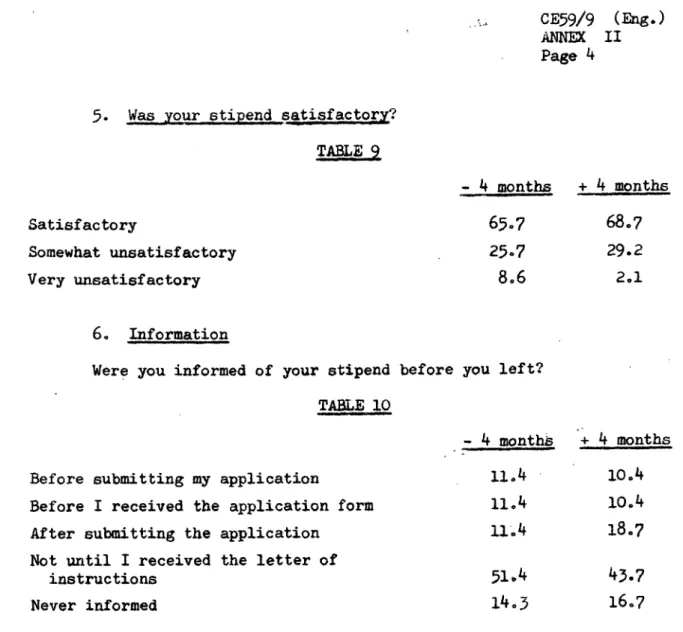
5. Was your stipend satisfactory?
TABLE 9
- 4 months
Satisfactory Somewhat unsatisfactory Very unsatisfactory
65.7
25.78.6
+ 4 months
68.7
29.2
2.1
6. Information
Were you informed of your stipend before you left?
TABLE 10
Before submitting my application
Before I received the application form
After submitting the application
Not until I received the letter of instructions
Never informed
- 4 months
11.4
11.4
1104
51,4
1403
+ 4 months
1004
10.4
18.7
43.7
16.7
Did you receive information on the program of studies before you left?
TABLE 11
Yes, before submitting my application
Upon submitting the application
After submitting the application
Not until I received the letter of instructions
Not received before my departure
- 4 months + 4 months
31.4
14.6
5°7
2.1
507 16.7
20
37.1
22.9