Comfort of formal and informal caregivers to palliative care patients
in primary health care
Conforto de cuidadores formais e informais de pacientes em cuidados paliativos na atenção
primária à saúde
Silmara Meneguin1, Rafaela Ribeiro2, Maria de Lourdes da Silva Marques Ferreira1
Objective: to analyze the comfort of formal and informal caregivers to palliative care patients, identifying the
variables associated with the difficulties for home care. Methods: cross-sectional study involving 50 caregivers of palliative care patients attended in the Family Health Strategy, using the General Comfort Questionnaire. Results: most caregivers were women (86.0%), with a mean age of 52 years, with partners (68.0%) and
practicing some religion (72.0%). The comfort scores ranged between 202 and 263, with a median of 235. An inverse relation was verified between the General Comfort Questionnaire score and caregiver reports of some
difficulty in care delivery to palliative care patients (OR=0.90; 95.0% CI 0.81-1.01). Conclusion: the comfort
level of the palliative care patients’ caregivers was relatively good and was associated with the difficulties in home care.
Descriptors: Primary Health Care; Caregivers; Palliative Care; Nursing.
Objetivo: analisar o conforto de cuidadores formais e informais de pacientes em cuidados paliativos, identificando
as variáveis associadas às dificuldades de cuidado no domicílio. Métodos: estudo transversal, realizado com 50
cuidadores de pacientes em cuidados paliativos, atendidos pela Estratégia Saúde da Família, utilizando o General Comfort Questionnaire.Resultados: a maioria dos cuidadores era mulher (86,0%), idade média de 52 anos, com
companheiros (68,0%) e praticantes de alguma religião (72,0%). Os escores de conforto oscilaram entre 202 e 263, com mediana de 235. Constatou-se relação inversa entre os escores do General Comfort Questionnaire e
o cuidador relatar ter alguma dificuldade no cuidado prestado aos pacientes em cuidados paliativos (OR=0,90; IC 95,0% 0,81-1,01). Conclusão: o nível de conforto dos cuidadores de pacientes em cuidados paliativos foi
relativamente bom e esteve associado às dificuldades de cuidado no domicílio.
Descritores: Atenção Primária à Saúde; Cuidadores; Cuidados Paliativos; Enfermagem.
1Universidade Estadual Paulista, Faculdade de Medicina de Botucatu. Botucatu, SP, Brazil. 2Hospital Sírio Libanês. São Paulo, SP, Brazil.
Introduction
Palliative care, considered as the approach intended to promote the quality of life of patients and relatives in response to life-threatening diseases(1),
initially developed among cancer patients. In the past
decades, it was extended to patients with chronic, progressive and degenerative diseases, who do not
respond to the curative treatment.
This scenario has made health professionals
rethink the way they take care of these patients as, despite the preference for home care, countless
difficulties are experienced in this environment,
which often end up determining an institutionalized death, even in developed countries(2).
In this context, the Family Health Strategy,
implemented as a proposal to reorganize primary health care, plays a fundamental role in this process, due to the possibility of offering care closer to the patient and the relative, besides offering tightened bonds of trust and humanized monitoring in the death process(3).
In palliative care, the patient and family
binomial is always considered a target of care, being both a care provider and receiver(4). In this process,
besides the family members’ need to adapt, certain roles are delegated to some people, such as the role
of caregiver. This activity can be practiced formally, by a specifically trained or hired professional; and
informally, by the family(5).
At home, the informal caregiver is obliged
to informally assume multiple tasks, becoming responsible for care(6). In many cases, a moral obligation is imposed on the family to assume
end-of-life care, without proper training or qualification to perform this function. In a study involving Canadian
informal caregivers for advanced cancer patients, recruited at a palliative care services, it was shown
that they presented emotional difficulties, besides the
need for support and information(7).
informal caregiver has been hardly valued, in view of the lack of governmental and infrastructural strategies to intervene in the context of the patient’s
situation of dependence at home. In a study involving
family caregivers to elderly users in the Family Health Strategy, it was evidenced that taking care of dependent elderly, besides the need to conciliate different tasks, demands physical effort, help from other people and emotional control(8).
In this context, as the health professionals
focus on the patient who requires specialized care, the informal caregiver’s needs sometimes end up
being neglected or hardly valued. Both the literature
and practice appoint that these caregivers tend to
experience a significant physical, emotional, social, material, financial and existential burden, mainly
when the care time is long and the disease has reached an advanced stage(1,5).
Measuring caregiver comfort, which is considered a synonym of wellbeing(9), is an indicator
that can influence the assessment of his/her quality of
life and, consequently, support proposed interventions in this progressive phase of the disease(10-11).
Comfort is a holistic, subjective and
multidimen-sional concept, influenced by the physical, environ
-mental, social and psychospiritual contexts. Comfort Theory departs from the satisfaction of caregivers’
needs in the context of relief, relaxation and
transcen-dence (state of overcoming pain or a problem) in the
different contexts of human experience(12).
Despite the relevance of the theme, little
attention has been paid in the literature to assessing
the comfort of palliative care patients’ caregivers. The assessment of burden and quality of life have
been focused on, using instruments and domains that are unable to apprehend the trajectory of the death
process, nor the need for interdisciplinary care. In view of the above, the objectives in this study
were to analyze the comfort of formal and informal caregivers to palliative care patients, identifying the
Methods
A cross-sectional study was developed in the
primary health care network of an interior city in the
state of São Paulo, Brazil.
The study included a convenience sample of
50 caregivers to palliative care patients, attended by
the Family Health Strategy, between May 2013 and December 2014, based on the following inclusion criteria: being a formal/informal caregivers to an
adult palliative care patient, being available to answer the questionnaire and agreeing to participate in the
study. Caregivers who did not comply with the preset
inclusion criteria and whose home was not located
were excluded.
It should be highlighted that, in the city where
the study was undertaken, no information was available on the palliative care patients attended in the
Family Health Strategy. The researcher undertook an
individual survey at the primary health care services
to obtain their addresses.
Two instruments were used to collect the
data: the sociodemographic characteristics and the Portuguese version of the General Comfort
Questionnaire, an instrument consisting of 49
questions, whose Likert-scale answers range between
1=I totally disagree and 6=I totally agree. The total scale ranges from 49 (very bad wellbeing) to 294 (excellent wellbeing). The questionnaire was initially
developed and tested in the United States, involving
51 caregivers to cancer patients, with a Cronbach;s alpha of 0.97 and evidences of excellent psychometric
property(13). In Brazil, its validation was undertaken recently and the Portuguese version reached a
Cronbach’s alpha coefficient of 0.83, indicating good
internal consistency among the items(14).
In this study, the reliability of the instrument
was also assessed, using internal consistency
analy-sis of the items, with a Cronbach’s alpha coefficient of 0.80.
The quantitative variables were analyzed in
terms of means and standard deviations and the qualifying variables were presented in tables with
absolute (n) and relative (%) frequencies. The scores
on the General Comfort Questionnaire were expressed
as medians, maxima and minima. To present the
results, the medians were used as, in an asymmetrical distribution, the median is much more representative
of the results than the mean.
The multiple logistic regression model was
used to analyze the caregivers’ chances of reporting
some difficulty in taking care of palliative care patients,
in function of the General Comfort Questionnaire
score and of sociodemographic variables. Statistical significance was set as p<0.05 and, for the analysis, Statistical Package for the Social Sciences version 15.0 was used.
The study complied with the formal require -ments of the Brazilian and international regulatory
standards for research involving human beings.
Results
As regards the sociodemographic variables, most caregivers were women (86.0%), with an average age of 52 years, with partners (68.0%), who practiced some religion (72.0%). It was also observed that about half of the interviewees (46.0%) were illiterate or had not finished primary education.
Most caregivers were directly related (70.0%) to the patient, had been informal caregivers (92.0%) for at least three years and 78.0% indicated difficulties in home care (Table 1).
Table 1 - Sociodemographic characteristics of primary caregivers to palliative care patients
Variable n (%) 95% CI
Sex
Female 43 (86.0) 76.4 - 95.6
Male 7 (14.0) 4.4 - 23.6
Age (years) (16-82)
16 – 26 7 (14.0) 4.4 - 23.6
27 – 37 7 (14.0) 4.4 - 23.6
38 – 48 7 (14.0) 4.4 - 23.6
49 – 59 16 (32.0) 19.1 - 44.9
Mean (±Standard deviation) 52 (±5.63) Instruction level
Illiterate/Unfinished primary 23 (46.0) 32.2 - 59.8 Finished primary/Unfinished secondary 10 (20.0) 8.9 - 31.1 Finished secondary/Unfinished higher 12 (24.0) 12.2 - 35.8
Finished higher 5 (10.0) 1.7 - 18.3 Having a partner
No 16 (32.0) 19.1 - 44.9
Yes 34 (68.0) 55.1 - 80.9
Practicing some religion
No 13 (26.0) 13.8 - 38.2
Yes 37 (72.0) 59.6 - 84.4
Degree of parenthood
None or indirect 15 (30.0) 17.3 - 42.7
Direct 35 (70.0) 57.3 - 82.7
Remunerated caregiver
No 46 (92.0) 84.5 - 99.5
Yes 4 (8.0) 68.9 - 91.1
Difficulties in home care
No 11.0 (22.0) 2.3 - 19.7
Yes 39.0 (78.0) 25.5 - 52.5
Length of care (years)
Mean (± Standard deviation) 3 (± 2.69) Income (Real)
Mean
(± Standard deviation) (± 522.61)1,257.04
CI=Confidence Interval
In Table 2, the medians, minima and maxima
are displayed for the General Comfort Questionnaire of caregivers to palliative care patients, according to
the sociodemographic characteristics. As observed,
female participants with a partner, practicing some
religion and illiterate/unfinished primary education
obtained higher scores on the General Comfort
Questionnaire, although not statistically significant.
Little variation was found in terms of the age range,
degree of parenthood and remunerated activity. As
Table 2 - Median, minimum and maximum for the Ge-neral Comfort Questionnaire of caregivers to palliati-ve care patients, according to the sociodemographic variables
Variable n Median Minimum-Maximum Sex
Female 43 235 202 - 263
Male 7 230 212 - 255
Age range
16-26 7 238 212 - 255
27-37 7 236 216 - 248
38-48 7 235 229 - 263
49-59 16 230 202 - 247
≥60 13 235 222 - 251
Having a partner
No 16 233 212 - 255
Yes 34 238 202 - 263
Practicing some religion
No 13 233 202 - 252
Yes 37 237 212 - 263
Instruction level
Illiterate/Unfinished primary 23 237 225 - 263
Finished primary/Unfinished secondary 10 232 212 - 247
Finished secondary/Unfinished higher 12 231 202- 255 Finished higher 5 232 224 – 235
Degree of parenthood
None or indirect 15 235 216 - 263
Direct 35 233 202 - 252
Remunerated caregiver
No 46 235 202 - 263
Yes 4 232 214 - 240
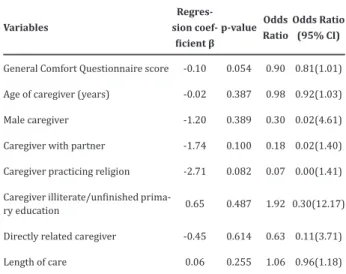
The analysis results inherent in the caregivers’ chances of reporting some difficulty in care delivery
to palliative care patients, in function of the General Comfort Questionnaire score and sociodemographic
variables, are displayed in Table 3. Although no statistically significant results were identified in this
analysis, an inverse relation was observed between the General Comfort Questionnaire score and the
Table 3 - Multiple regression analysis of factors
associated with difficulties in home care
Variables
Regres-sion
coef-ficient β
p-value Odds
Ratio
Odds Ratio (95% CI)
General Comfort Questionnairescore -0.10 0.054 0.90 0.81(1.01)
Age of caregiver (years) -0.02 0.387 0.98 0.92(1.03)
Male caregiver -1.20 0.389 0.30 0.02(4.61)
Caregiver with partner -1.74 0.100 0.18 0.02(1.40)
Caregiver practicing religion -2.71 0.082 0.07 0.00(1.41)
Caregiver illiterate/unfinished prima
-ry education 0.65 0.487 1.92 0.30(12.17)
Directly related caregiver -0.45 0.614 0.63 0.11(3.71)
Length of care 0.06 0.255 1.06 0.96(1.18)
CI=Confidence Interval
Discussion
The development of the research at a single
health service with local particularities was a limitation
in this research. In addition, the cross-sectional design
should be considered, which does not permit the establishment of cause and effect relations(15), as well
as the difficulty to identify the palliative care patients in the city’s primary health care network.
In this research, the caregivers were predomi -nantly women, who possessed a low education level
and worked informally. This finding is similar to the
reality in other countries, including developed na-tions, in accordance with the literature(6,16).
The participants assessed their comfort as satisfactory (median=235). Although the questions
on the General Comfort Questionnaire were focused on caregivers to cancer patients, which was not the case for all participants included in this research, little difference was found in the study in which the comfort
of 99 informal caregivers to patients attended at a specialized oncology outpatient clinic was assessed. In that research, the total score ranged between 140 and 263, with an average of 203(11). It should be
highlighted, however, that none of the studies analyzed the palliative care domains in the General Comfort Questionnaire, as the questions were not grouped in
the elaboration of this instrument.
Nevertheless, the absence of significant asso -ciations between comfort and the sociodemographic
factors was found in this research. Although these re -sults cannot be fully explained, they are not conside-red to derive from selection biases or even shortages
in the questionnaire. The use of qualitative research
methods could enhance the capacity to explain these
inquiries.
In a study involving ten caregivers to children
and adolescents beyond therapeutic possibilities of cure, the scores on the General Comfort Questionnaire ranged between 144 and 252, with an average of
189. These data demonstrate the low prevalence of very low global comfort scores. The concern with the family, the patient’s discomfort and his/her uncertain
future were the factors that most negatively affected the caregivers’ comfort, while the most positive
influences were the belief in spiritual help and in the
tranquility in the patient’s room(17).
In a recent study involving 96 relatives who took
care of adults with malign tumors, the total scores on the General Comfort Questionnaire ranged between
168 and 255, indicating great individual variation.
Higher scores were related to the items corresponding to spiritual beliefs and religious concepts(18).
The range of factors that interfere positive
and negatively in the perceived construct and the score range, as evidenced in the studies that used this
questionnaire, make it difficult to compare the results. This instrument has no final stratification to rank
the comfort levels, which simply appoint the items that contribute to the promotion and reduction of caregiver comfort(18). It does not permit grouping the
questions according to the multifactorial dimensions
Other relevant information found in this
research refers to the inverse relation between the General Comfort Questionnaire score and the
care difficulties for palliative care patients. These
results can be related with the subjective and multidimensional perception of comfort and with the
repercussion of the difficulties faced in daily reality.
Hence, the multidisciplinary assessment of the patient in these conditions should also be extended to the caregiver, who is often invisible to the health
system. In this context, one of the main potentials
of the Family Health Strategy is the capacity for wide-ranging interventions in the complexity of the
problems the caregivers experience at home. It is
fundamental that the professionals in this program understand the family dynamics and the role the patient plays in this group, with a view to tightening the support actions through the establishment of bonds of trust and embracement(3).
These data emphasize the need to bond with
the clients the health teams attend to as a fundamental condition to put in practice the embracement of the family, and particularly the caregivers of palliative
care patients, during the process of dying at home. Therefore, the Family Health Strategy teams
should be prepared for palliative care actions, such as the control of low-complexity symptoms, the prevention of problems and emotional support to the families, also during the mourning period(19).
And, finally, the lack of studies on the comfort of caregivers to palliative care patients made it difficult to compare our results. On the other hand, it showed that future studies are needed in this area.
Conclusion
The caregivers’ comfort in palliative care was
relatively good, going against the expectation that the burden imposed on them could interfere negatively
in the perception of the concept. In addition, it was
These research results could contribute to
the reorganization and local articulation of actions in the Family Health Strategy, with a view to the establishment of palliative care as a legitimate practice
in the country at all health care levels. In this sense, it
is fundamental to acknowledge the caregivers as care subjects and to provide them with the support needed
to cope with the disease at home.
Collaborations
Meneguin S, Ribeiro R and Ferreira MLSM participated in the conception, analysis, writing of the article, relevant critical review of the intellectual
content and final approval of the version for publication.
References
1. World Health Organization. Definition of palliative care [Internet]. 2010 [cited 2016 May 20]. Available from: http://www.who.int/cancer/ palliative/definition/em
2. Gomes B, Calanzani N, Curiale V, McCrone P, Higginson IJ. Effectiveness and cost-effectiveness
of home palliative care services for adults with
advanced illness and their caregivers. Cochrane Database Sist Rev [Internet]. 2013 [cited 2016 May 20]; 6:CD007760. Available from http:// onlinelibrary.wiley.com/doi/10.1002/14651858. C D 0 0 7 7 6 0 . p u b 2 / a b s t r a c t ; j s e s s i o n i d = 2C2C8F7E8B042D44A32B1C23A66347FA.f01t01 3. Queiroz AHAB, Pontes RJS, Souza AMA, Rodrigues
TB. Perception of family members and health
professionals on end of life care within the scope
of primary health care. Cienc Saúde Coletiva. 2013; 18(9):2615-23.
4. Fonseca JVC, Rebelo T. Nursing care needs of the caregiver of persons under palliative care. Rev Bras Enferm. 2011; 64(1):180-4.
5. Bevans M, Sternberg EM. Caregiving burden,
stress, and health effects among family caregivers
307(4):398-6. Sklenarova H, Krümpelmann A, Haun MW, Friederich HC, Huber J, Thomas M, Winkler EC, et al. When do we need to care about the caregiver?
Supportive care needs, anxiety, and depression among informal caregivers of patients with cancer
and cancer survivors. Cancer. 2015; 121(9):1513-9.
7. MacLeod A, Skinner MW, Low E. Supporting
hospice volunteers and caregivers through
community-based participatory research. Health Soc Care Community. 2012; 20(2):90-8.
8. Nardi EFR, Santos LMR, Oliveira MLF, Sawada NO. Dificuldades dos cuidadores familiares no cuidar de um idoso dependente no domicílio. Cienc Cuid Saúde. 2012; 11(1):98-105.
9. Northouse LL, Katapodi MC, Schafenacker AA, Weiss D. The impact of caregiving on the
psychological well-being of family caregivers
and cancer patients. Semin Oncol Nurs. 2012; 28(4):236-45.
10. Krinsky R, Murillo I, Johnson J. A practical application of Katharine Kolcaba´s comfort theory to cardiac patients. Appl Nurs Res. 2014; 27(2):147-50.
11. Lamino DA, Turrini RNT, Kolcaba K. Cancer patients caregivers comfort. Rev Esc Enferm USP. 2014; 48(2):278-84.
12. Kolcaba K, Fisher E. Holistic perspective on comfort care as an advance directive. Crit Care Nurs Q. 1996; 18(4):66-76.
13. Novak B, Kolcaba K, Steiner R, Dowd T. Measuring
comfort in caregiver and patients during late
end-of-live care. Am J Hosp Palliat Care. 2001; 18(3):170-80.
14. Rezende VL, Derchain S, Botega NJ, Sarian LO, Vial DL, Morais SS, et al.Avaliação psicológica
dos cuidadores de mulheres com câncer pelo
General Comfort Questionnaire. Paidéia. 2010; 20(46):229-37.
15. Polit DF, Beck CT. Fundamentos de pesquisa em enfermagem: avaliação de evidências para a prática de enfermagem. Artmed: Porto Alegre; 2011.
16. Guerriere D, Husain A, Zagorski B, Marshall D, Seow H, Brazil K, et al. Predictors of caregiver
burden across the home-based palliative care
trajectory in Ontario, Canada. Health Soc Care Community. 2016; 24(4):428-38.
17. Moreira LM, Ferreira RA, Costa Junior AL. Discussion of a care protocol for caregivers of cancer patients undergoing palliative care. Paidéia. 2012; 22(53):383-92.
18. Oliveira WT, Sales CA, Fernandes CAM, Haddad MCL. Avaliação do bem-estar de cuidadores
familiares de adultos com neoplasia maligna no
âmbito domiciliar. Rev Eletr Enf [Internet]. 2013 [citado 2016 Set 19];15(2):391-9. Disponível em:https://revistas.ufg.br/fen/article/ view/28714/19587
19. Paz CRP, Pessalaci JDR, Zoboli ELCP, Souza HL, Granja GF, Schveitzer MC.Novas demandas para a
atenção primária à saúde no Brasil: os cuidados