MASS PARTICIPATION IN ART: PATTERNS AND UNPREDICTABILITY
Thesis submitted to the Portuguese Catholic University for the Doctoral Degree in Science and Technologies of the Arts – Interactive Art
by
Luís Sarmento Ferreira
ESCOLA DAS ARTES (June 2017)
MASS PARTICIPATION IN ART: PATTERNS AND UNPREDICTABILITY
Thesis submitted to the Portuguese Catholic University for the Doctoral Degree in Science and Technologies of the Arts – Interactive Art
By Luís Sarmento Ferreira
Supervised by Professora Doutora Cristina Fernandes Alves de Sá
ESCOLA DAS ARTES (June 2017)
Acknowledgments
It has been a privilege to develop this research work in the Portuguese Catholic University, its School of Arts and research center (CITAR). For that, I am grateful to all whose mission is to make this institution a place of excellence.
This thesis is not the result of a solitary effort. Many were those whose conversations and tips influenced this work. Alexandra Moreira, Álvaro Barbosa, Carlos Caires, Guilhermina Castro, José Vasco Carvalho, Luís Gustavo Martins and Paulo Bernardino were some of them. I am thankful to all, for their key insights.
My deepest gratitude to Cristina Sá whose support and guidance went far beyond her supervising role.
I would like to acknowledge the support of my family and friends. I thank my mother Maria Amélia, Teresa and Ana for their love and kindness. A special word of gratitude is due to my father José Luiz for his translation and revision work. I thank Inês for her unconditional and unyielding love. Above all, I thank my son for his lesson on the importance of this work.
Abstract
A work of art's openness to participation is traditionally a focus for thought and debate on the artists’ role and on the way the participants relate to the artistic process. A recent artistic development in participation art - a formal definition of a work that involves a massive number of participants – calls for a reassessment of participation strategies and the study of the effects of this change on practices where the involvement of the other is simultaneously a method of art making and a field of poetic potential. In this thesis, current theoretical work on the broader context of participation has been critical to define mass participation within that field. However, a shift from views centred on the new status of the participant public and its impact on the social and political context of the artwork towards a view centred on the artists’ options is needed to assess the particularities of this practice. This shift reflects our research position that mass participation follows a process of artists’ gradual ceding of authorial control to external elements. This process, that we will argue to have its roots in ancient art, is further explored by the vanguards of the early twentieth century, and is part of current art practice and discourse. Such timeline has already been clearly described elsewhere. However, the distinctive trait of mass participation, in what relates to that agency transfer
is a set of form making strategies which have lately come together even if they have been individually sought throughout modern and contemporary artistic endeavour.
As such, the work here documented, involves the systematization of such strategies resorting to two main approaches: on one hand, through practice, dealing with the formal and poetical potential of working with the mass. The main conceptual and implementation themes of four projects, that are accounted for in the second half of this document, establishes the seeds for the proposition of a mass participation strategy; on the other hand, a theoretical generalization effort, that makes for the first half of this document, creates the abstract framework of such proposition. Along with its general technological, cultural and artistic context, mass participation is posited within a critical review of the notions of agency, participation, the mass, and complexity.
Keywords: Mass participation, Art, Agency, Participation, Mass, Complexity.
Resumo
A abertura de uma obra de arte à participação constitui tradicionalmente um foco de reflexão e debate sobre o papel do artista e sobre as maneiras dos participantes se relacionarem com o processo artístico. Um desenvolvimento recente na arte participativa – a definição formal de uma obra que envolve um número massivo de participantes – apela a uma reavaliação das estratégias participativas e ao estudo dos efeitos desta mudança sobre práticas em que o envolvimento d’o outro é simultaneamente um método para o fazer arte e o campo de um potencial poético.
Para esta tese, o trabalho teórico actual sobre o contexto alargado da participação foi crucial para aí inscrever a definição especifica de participação em massa. Contudo, para avaliar as particularidades daquela prática é necessário deslocar as perspectivas centradas no público participante e no seu impacte na obra de arte em direcção a uma perspectiva centrada nas escolhas do artista. Esta deslocação reflecte a posição resultante da nossa investigação de que a participação de massa segue um processo de cedência gradual pelo artista do seu controlo autoral a elementos externos. Este processo, que, segundo nos propomos arguir, tem as suas raízes na arte mais antiga, é explorado de modo mais extensivo pelas
vanguardas artísticas do início do século XX e é parte do discurso e da prática actuais. Esta evolução temporal tem sido descrita na literatura relevante; contudo, o traço distintivo da participação de massa enquanto tal, no que respeita a transferência de agência, é conjunto das suas estratégias para a produção de forma, mesmo que tenham sido procuradas individualmente ao longo das experiências artísticas modernas e contemporâneas.
Assim, o trabalho que aqui documentamos envolve a sistematização destas estratégias recorrendo a uma dupla abordagem. Por um lado é mobilizada uma prática que recorre ao potencial formal e poético do trabalho com as massas: os principais temas conceptuais e de implementação presentes em quatro projectos, dos quais é dada conta na segunda parte deste documento, formam a raiz da proposta de uma estratégia de participação de massas. Por outro lado, o esforço de generalização teórica que constitui a primeira metade deste documento cria a moldura abstracta dessa proposta. Em consonância com o seu contexto geral no plano artístico, tecnológico e cultural, a participação de massa é postulada no âmbito de uma revisão crítica das noções de agência, participação, massa e complexidade.
Palavras-chave: Participação em massa, Arte, Agência, Participação, Massa, Complexidade.
Contents
Acknowledgments v
Abstract vi
Resumo viii
List of Figures xii
Introduction 1
Relevance and context 3
Aims and objectives 6
Methodology 7
Document structure 9
1 Mass participation 14
1.1 Proposition 14
1.3 Frameworks 30
1.3.1 Agency 30
1.3.2 Participation 42
… and its actors 52
1.3.3 Mass 68
1.3.4 Complexity 77
1.4 Mass participation strategy 88
1.4.1 Typology 89
1.4.2 Classification 93
2 Projects 105
2.1 ocidental sentimento dum o 105
2.2 net art 118
2.3 Babel´s Monkeys 129
2.4 I feel sea 143
Conclusion 161
List of Figures
Figure 1. Left: Peter Verbruggen I, detail from the confessionals of Saint Paul's Church in Antwerp (17th century). Photo by Hugo Mae, Copyright Lukas - Art in Flanders VZW; Right: Julien Dillens Monument Everard 't Serclaes (1902). Photo by KAZ2.0, (CC BY-SA
2.0). 1
Figure 2. Alexander Calder The Tree (1966). Foto: Mark Niedermann, copyright ProLitteris,
Zürich. 31
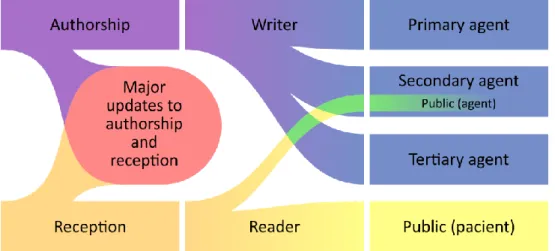
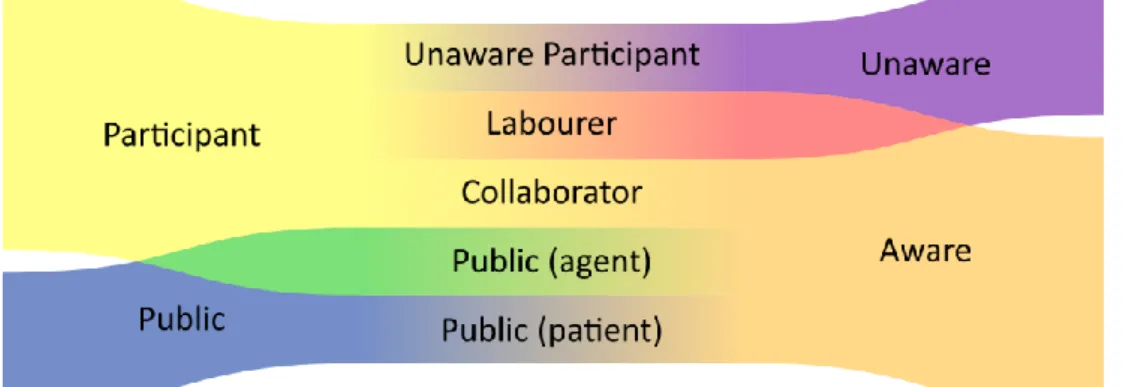
Figure 3. Mapping of the writer/reader notions to the authorship/reception model and to our proposed agency system’s categories. 53 Figure 4. Francis Alÿs When Faith Moves Mountains (2002). Retrieved from
http://francisalys.com/when-faith-moves-mountains/. 58 Figure 5. Types of human contact with the work of art. 65 Figure 6. Oliver Laric Versions (2009). Screenshot from video, retrieved from
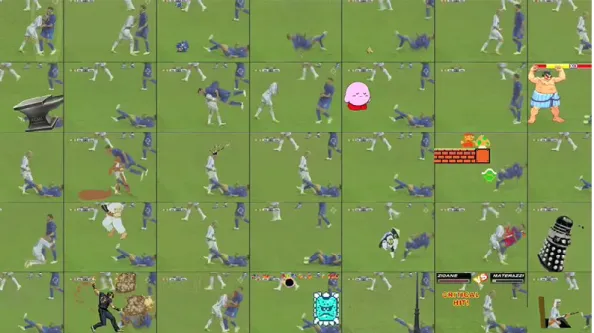
http://oliverlaric.com/versions.htm. 73
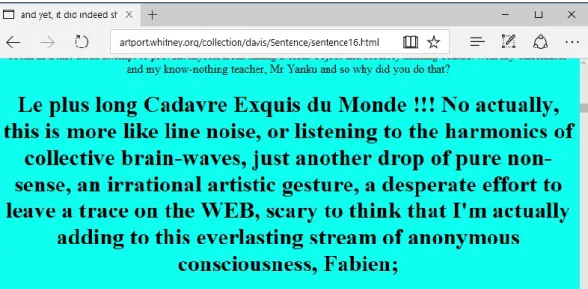
Figure 7. Marina Abramović Rhythm 0 (1974) Studio Morra, Naples (Ward, 2010). 75 Figure 8. Douglas Davies The World’s First Collaborative Sentence (1994). Detail from page 16. Screenshot from
http://artport.whitney.org/collection/davis/Sentence/sentence16.html. 94 Figure 9. Christa Sommerer and Laurent Mignonneau Life Spacies (1997) screenshots (Stocker, Sommerer, & Mignonneau, 2009). 95
Figure 10. Mark Hansen and Ben Rubin Listening Post (2001) display grid (Hansen &
Rubin, 2002). 96
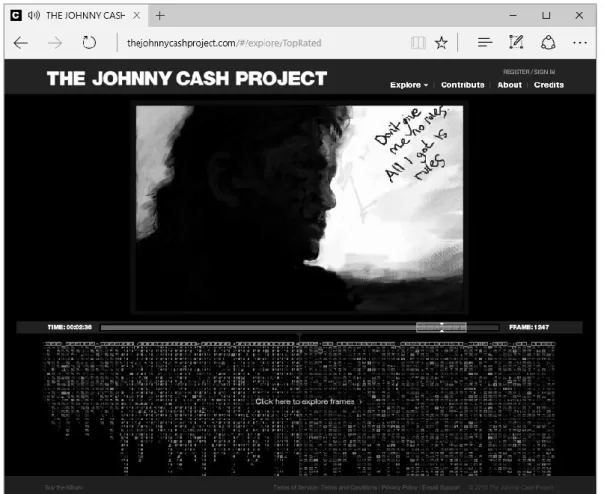
Figure 11. Aaron Koblin and Takashi Kawashima Ten Thousand Cents (2008). Top: full bill, Bottom: detail of six (out of ten thousand) participant responses. Screenshots from http://www.tenthousandcents.com/top.html. 98 Figure 12. Chris Milk The Johnny Cash Project (2010a). Screenshot of highest rated
drawing for frame 1247 in 2017/04/16 from
http://www.thejohnnycashproject.com/#/explore/TopRated. 100 Figure 13. The Single Lane Superhighway (2011). Screenshot from
http://www.thesinglelanesuperhighway.com/. 101 Figure 14. ocidental sentimento dum o (2015). Screenshot of its configuration on
7/9/2016. 105
Figure 15. Number of lines per poem on 7/9/2016 versus system equilibrium. 116 Figure 16. net art (2010) screenshot taken on 25/09/2016. 119 Figure 17. map of the geographical distribution of the devices used to access net art. 127
Figure 18. Babel’s Monkeys (2012). 129
Figure 19. Two stages of the writing process. In the top screenshot only common words were found. Later, as shown in the bottom screenshot, not so common words start to appear, until only uncommon words are missing. 131 Figure 20. i feel sea (2012) screenshot. 144 Figure 21. Magnified details of the insert new colors algorithms - from random color placement (top) to organization (bottom) - each color square is one pixel. 155 Figure 22. Examples of different weights of algorithm influence on the final image. 156 Figure 23. Results of the final alghorithm (changes in color organization during a five
Introduction
Art loves people. Awareness of a relation of this sort between art and its lovers is surely not absent from any approach, whatever it may be, to the very notion of art. We address here a tangible sense of physical love between the work of art and people –a longing for touch and the marks of this desire. The roots of this work reach down to an ever-present feeling of amazement
Figure 1. Left: Peter Verbruggen I, detail from the confessionals of Saint Paul's Church in Antwerp (17th century). Photo by Hugo Mae, Copyright Lukas - Art in Flanders VZW; Right: Julien Dillens Monument Everard 't Serclaes (1902). Photo by KAZ2.0, (CC BY-SA 2.0).
brought about by the multifarious manifestations of such contacts – namely those that issue from a great number of small individual contacts, from which emerge formal patterns that go beyond any possible prediction by the artist. It is commonplace to find, especially in public art, the evidence for this irresistible yearning: while the traces of a single soft rubbing action on a bronze or wood statue are hardly perceptible, a large number of such strokes, concentrating in specific areas, will leave lasting marks (Figure 1). As far as this example extends, it is probable that the visual and tangible result of that longing is foreign, and indeed opposed, to the artist’s will. Nevertheless, such a rich vein, shaped by the unpredictabilites and pattern-forming potential of external mass intervention on art, is worth exploring as artist’s material and strategy of art making.
The general motivation for this work lies in our endeavour to explore such physical desires, along with art’s longing for touch and, decisively, the manner in which the artist brings to her work the spoils of that love affair. Such is the context for mass participation: it is centred on an artist’s strategies to deal with large scale human intervention on her work. Human behaviour, taking into account the diversity in our individual responses to the world, is a bewildering phenomenon. If we approach each of these individual responses, taken as a small part within a collection of innumerable interacting humans, we will find human behaviour unfathomable.
Even in a context that is markedly different from that of sculpture or public art, and is framed rather by contemporary art practices – namely those in which participation plays a central role – the type of intervention with which we are dealing in this work remains the same: form-altering intervention, potentially defiant of stated participation rules, acted by large numbers of
agents, characterized by emerging behaviour patterns, and leading to results that have not been determined in advance.
Mass participation is proposed as an artistic strategy to deal with that kind of intervention. When considering how to gather the potential inherent in the mass of participants, artists are faced with key options that relate to the effort required from and allowed to the participant; to the degree of awareness that the participant has of the participation process; to how and if participant contribution is filtered; to the possibility of participant identification; and to the time frame for the participation process to occur. All those options influence artists’ poetic and formal exploration in the mass participation setting. Both the practice-led and the theoretical approach here documented converge in the systematization of such strategies.
Relevance and context
The digital art setting is so much a battleground for timeless art notions to be questioned and rethought as it is the fertile ground for new art notions to grow. In this document, we address art notions which, framed by participation practices in a post-internet context, call for arms – or alternatively for the watering can. There is a sense, running throughout this document, that most of the matters with which it is concerned have been relevant to artistic creation and its study since the early 20th century vanguards at least, and in some cases from much earlier times. As far as participation is concerned, we argue that its expansion to the masses does not lend itself to the definition of a point of rupture with traditional forms of participation. We consider, nevertheless, that the advent of digital technologies, and the Internet in particular – if it has provided in fact new matter for the discussion of contemporary and participative art (Bourriaud, 2002b; Groys, 2008) – is particularly relevant for a mass participation
proposition. This relevance stems both from its power to make it technically viable to expand participation possibilities into the innumerable and, on the other hand, from the way the feedback from participation has affected the present-day cultural context in which it is framed. These vectors underscore our confidence in the need for, and indeed the latency of, a mass participation aesthetics.
We propose mass participation as an artist’s strategy for formal and poetic exploration. Such a proposal is not, as such, so grandiose as to aspire to a complete aesthetics for such a practice. Even so, we consider it to be a fundamental step in that direction. This stance follows from our belief that an artist’s choice to deal with participation and participants in great number does not currently define a concrete art practice or genre, nor is it framed by a specific art theory. Nevertheless, we consider that there is a set of commonalities within contemporary artistic proposals, where such an artistic strategy is central, which makes such a definition and framing both useful and necessary for art makers and art theorists alike.
From the art-making perspective, we were unable to find a suitable, generally adopted designation that comprises current artists, and works of art, that make use of the participant mass. Such a practice is not yet established by a sizeable and coherent group or body of work that might be best characterized by that distinctive feature. Still, there are major contact points between both established and recent categorization attempts, as those represented by such terms as social practice, data visualization or crowdsource art, to name a few. These contact points allow us to place mass participation at the intersection of various practices and artistic strategies which share specific traits and are equally endowed with poetic potential. From the theoretical viewpoint, we find that current discourse on participation falls short on delivering tools that can be used to consider
those commonalities. However, such a discourse, woven together with the various discourses on art practices that are closely related to the participatory phenomenon (where key words such as collaboration, community, relational or crowdsource can be found), as well as discourses on practices apparently not so close (with keywords as generative, a-life, post-production, chance or database, to refer to a few of those practices that appear along this document), makes up a fabric able to sustain and propel our mass-participation proposal.
We focused, then, on approaching mass participation as a strategy employed by the artist as she deals with others. In considering mass participation in this sense, we highlighted its independence from questions in the authorship and reception realm. However, we strongly believe that this document paves the way for a larger discussion of a mass-participation aesthetics and politics, which needs to be understood as fundamentally different from current views on participation. That discussion, however, while highly relevant for a foreseeable future, does not belong to the scope of the present document.
As such, the work reflected on this document assumes the nature of a seed for future theoretical and artistic work. While we consider its relevance to be contingent on future developments on those fronts, such work as we are undertaking is also necessary in allowing for this future and contributing for it to happen. There is in consequence a measure of risk, which must be accepted, arising from the anticipatory nature of this proposition. It can turn out that no such thing as a group of artists or works of art – where mass participation, understood as an aesthetics or politics of art production and reception, takes the central stage – will ever come into existence; in which case a theoretical frame for such practices would be pointless. However, considered purely as a strategy, we find mass participation already very
much present in a myriad of artistic proposals; and it follows closely, as we put forward, advancements which are very much noticeable in current art discourse. Accordingly, both the exploration of its poetic potential through practice, and the creation of general frameworks that allow it to be understood in its fundamentals and specifics – in which the two general approaches to mass participation in this document are grounded – provide an answer to a call for systematization, albeit of a very speculative sort.
Aims and objectives
When related to form, as well as when related to concept, scale is present at a fundamental level in artistic activity. As artists devise strategies to deal with it - be it the creation of tools, materials, production and presentation schemes, or of conceptual frameworks to explore the incomprehensible, immeasurably small or large - new problems and opportunities arise for them and art theorists alike. In this document, we aim to explore and systematize the formal and poetic potentials of an artistic strategy based on participation taken to the scale of the mass, and to provide for such a strategy’s theoretical frameworks.
To accomplish this end, this research has the following operational objectives:
To explore the artistic context of the concepts that underlie formal strategies used in a personal practice setting, in order to establish key contact points between such concepts and strategies and mass-participation poetic potential.
To systematize artist’s options, and their respective poetic potential, whenever they employ mass-participation strategies, into a proposed typology based on the classification of case study artistic projects.
To identify the main characteristics of the current cultural, technological, and artistic settings that foster and inform the use of mass-participation strategies.
To critically review relevant viewpoints occurring in current multidisciplinary discourse on the notions of agency, participation, mass and complexity, so as to clarify the operational frameworks upon which the proposal of mass participation is built.
Methodology
The work reflected in this document follows, in broad terms, a practice-led research approach to the main questions it raises. In this context, the term practice-led research relates to how our praxis suggested research paths, which have been subsequently documented, theorized and generalized (Smith & Dean, 2009).
The main research problems, that directly express our motivation for this work, can be reduced in simple terms to: is there anything special about working with the mass of people as material? and how can such choice be framed in the contemporary art context? We gave conceptual precedence, if not chronological, to tackling this question in practice. The practice side of the equation consists, thus, in four projects developed in the context of this PhD submission. While those projects were not intended to be a part of, or to stand for, an answer to our starting question, they became the setting for an exploration of the poetic potential implicit it its formulation. That
exploration corresponds to a process of critical reflection on the projects’ conceptual contexts, implementation choices and results. This method was chosen so as to permit the abduction of potential guidelines for that answer from the very personal, specific interests manifested in the projects distinct particularities. Chapter 2 accounts for that process, which took place in an eclectic and serendipitous manner and opened up research paths which led in their turn to a concrete proposal for theoretical generalization. Those paths can be summarized by the notions of pattern and unpredictability; and the resulting proposition is informed by the very notion of mass participation.
It should be noted that our practice-led approach was not one-way, that is, a simple progression from practice to theory. On the contrary, we actively sought reciprocal contamination between practice and its theorization as research. By methodological choice, both types of work were conducted concurrently. This option allowed for a constant interchange between the role of the practitioner and that of the researcher. As a result, the work reflected in this document is a product of a cross-current navigation through existing practices and theories. It results from the setting brought about by that unique entanglement of practice and research which, in turn, works into this document a strong element of intermixture between the academic and the poetic discourse.
In tune with the critical and reflexive nature of their practice counterpart, the theorization and generalization efforts dealing with the proposition of mass participation were conducted, as suggested in the previous paragraph, in a dynamic fashion. Our framing of mass participation as an artistic strategy thus, coupled with the absence of prior attempts on such a task, dictated a comprehensive approach to the various levels on which the theorization and generalization of that strategy could and should take place.
A great expanse of ground had to be covered between exploring how mass participation is being used, as well as systematizing artists’ choices in such a context, all the way to accounting for the general cultural, artistic and theoretical frameworks structuring its characterization within and along contemporary art practices. We present a typology of mass participation to tackle the latter proposition. This typology is followed by a discussion of case study projects, chosen not as to provide examples of supposedly perfect instances of mass participation practice, but instead of the main characteristic aspects of the proposed typology. Furthermore, the chosen projects aim at highlighting some of the points of contact between mass participation strategies and other areas or modalities of artistic intervention. At all other levels, the theorization and generalization process followed the same design: key texts on every problem that we address were subjected to critical review to provide for the threads and the framework used in weaving our analysis of the mass participation phenomenon. This brought about, more often than not, that the arguments in those texts were selected, not for their relevance in the specific context they were produced, or indeed because they might reflect our own position on any given subject, but for what we considered to be their usefulness in the creation of operational frameworks specific to this document’s take on mass participation as a strategy.
Document structure
This document is divided into two main chapters: the first one deals with the general problematics of definition and contextualization of a mass participation proposition; the second discusses the four projects that make up the practical context from which the general outline of the proposition emerged.
This structure does not reflect the methodological progression –or, for that matter, the chronological one – of the research work this document stands for. The chronological ordering for the work done would be irrelevant, and in all cases, impossible, as major leaps, halts and overlaps across specific phases of research activity were not only a contingence but actually resulted from our methodological approach. Nevertheless, the practice-led approach suggests and allows for reading the document backwards. In the introduction and conclusion, the order in which the research is advanced follows that option.
Notwithstanding, the order of the two main chapters’ contents follows a progressive move from the abstract context for the mass-participation proposal to its presence, even if just as a seed, in a specific and personal practice setting.
As such, chapter 1 opens up with a summary discussion of the notions of informationalism (Castells, 2004), remix culture (Bourriaud, 2002b) and open work aesthetics (Eco, 1989) so as to highlight the main characteristics of current technological, cultural and artistic contexts framing a mass-participation proposition. This proposition is based on the artist’s choice to expand the control of a work of art’ form to external agency. In Form from people and form from systems, the roots of the two main branches of artistic strategies in which that choice is central are reviewed as to introduce their relation with the notions of patterns and unpredictability that guide this document.
In Frameworks, the notions of agency, participation, mass and complexity and their use in current art discourses are critically reviewed. Abstract and comprehensive readings of such notions are argued as the operational frameworks of the mass-participation proposition. In Agency, this concept, as formulated in a archaeology of art and social sciences context (Gell, 1998;
Latour, 2005), informs a classification effort of distinct types of form-changing intervention upon the work of art. Those types are grouped into three classes – primary, secondary and tertiary agency. This classification corresponds to the artist’s agency, external agency sought by the artist, and external agency that manifests itself upon the work of art outside the conditions set by the artist. Within this agency model, a preliminary approach to the scope of our mass-participation proposition is made clear: this document deals, in the immediate, with the particular conditions set by the artist to gather and explore secondary agency in the context of her work. In Participation, we further circumscribe our terms by focusing on secondary agency by humans, which we had labelled form from people in Form from people and form from systems. The comprehensive nature of what can constitute secondary agency as it is proposed in Agency leads a process where current views on participation (Bishop, 2004; Bishop, 2012; Kester, 2011; Adamson & Bryan-Wilson, 2016) and the classical notions of writer, reader, and text are abstracted from their relations to authorship and reception. This proposed level of abstraction makes for the clarification of terminology and concepts related to participation as they are of operative value for this document’s argument. As such, participation takes a more inclusive meaning, as participants are considered independently of their status or place within the hierarchies of authorship and reception.
In Mass, the concept of masses is approached in a similar manner: we follow the fluctuation in its meanings throughout the genealogy of participation practices (Groys, 2008), and propose its operative redefinition by highlighting the influence of technological advances in participation (Arns, 2004) and in the general current cultural setting (Bourriaud, 2002b). As such, the political consideration of the mass is abstracted from its original meaning as we propose a shift towards its understanding as an immense
pool of potential participants, of participation motives and attitudes, and of mechanisms and devices that allow for participation. Our third and final approach to the scope of this work sets of participation in a context that is related to this abstract and comprehensive notion of mass. In this document, then, and in this final sense, we posit mass participation as an artist’s strategy that makes use of a new practical possibility: the possibility of comprising individual action, in all of its unpredictability and multiplied by the innumerable, within the limits of the single work of art.
In Complexity, this notion is presented as one of the background concepts through which mass is proposed as a special case in the context of participation. It is approached from a triple viewpoint: complexity science in the definition of complex systems’ core characteristics (Holland, 1998); current art discourse on the convergence of art and science through complexity (Galanter, 2008); and complexity as mode of thought (Morin, 2008). Beyond the political and cultural context of the mass, we focus on how the notions of complexity and emergence can help us understand the intricacies of mass behaviour, its patterns and unpredictabilities. Complexity is addressed so as to find the core characteristics of mass behaviour that contribute for its attractiveness as material for art making. Mass participation is a strategy that reveals itself both in complex collective patterns and in unique individual choices.
The Mass participation strategy section accounts for a systematization of artist’s choices and respective poetic potential when incorporating mass participation in their practice. The proposed typology, and subsequent classification of case study artistic projects, is the pivot that articulates the abstract frameworks of the previous sections with the work documented in the succeeding chapter. As such, each of the typology’s criteria reflects a choice about how wide the scope should be in building those frameworks;
and how wide the range in exploring the specific concepts and strategies that ensued in the context of the projects discussed in chapter 2. To highlight this relation between, on the one hand, the concrete poetic potential of an artist’s choices when using a mass-participation strategy and, on the other hand, its theorized abstract conditions, seven projects from diverse artistic contexts are discussed as case studies in the light of the typology criteria, and subsequently classified.
The second chapter accounts for of a process of critical reflection on four personal projects. These projects’ conceptual contexts, implementation choices and results are thus reviewed; we highlight their mutual contact points, and point out their contribution to the definition of our mass-participation proposition. As such, the projects chapter presents an intricately woven account of their conceptual genesis and of the employed formal strategies. More relevantly, its contents reflect a practice-led exploration of their artistic context. As such, a broad range of such concepts and strategies, present in an equally broad range of artistic practices, was subjected to analysis. Those concepts and strategies are approached from the viewpoint of their poetic intentions and results; and are relevant, consequently, mainly to the discussion of the particular projects in hand. Nevertheless, it is their exploration that constitutes the methodological starting point for our mass-participation proposition; this is what makes possible a reverse reading of this document.
1.1 Proposition
Mass participation, regarded as a set of formal strategies of artistic creation, can be discussed in any context where a key condition is met: an artist’s choice to expand part of the formal control over her work to a large number of people. As we will see, the present body of work advances the view that this transference process conforms to a trend in artistic practices whereby the transfer of formal control to elements outside pure authorial determination is central. The initial instant of this development can be placed – depending on the scope of the discussion – at practically any moment in the history of art, whether we look for the roots of algorithmic art in 70000 years old artefacts1 or in the systematic use of chance in Modernism. Even considering the particular case of there being another person or persons involved, often the public itself, such instances can be
found in the combinatory poetry of Optanianus Porfyrius in the 4th century2 as well as in the Dada manifestations in the early Twenties of the 20th century. These roots will be dealt with along this document with a view to proposing the set of strategies suggested by the expression mass participation as one of the present branches of that line of evolution. This document assumes a bias toward digital culture as the instance that will frame a proposal which, keeping within the general scope of contemporary art, particularly stresses the number of participants that are brought in to contribute to the work of art’s form . This cultural frame will be explored, respecting its intersections with the discourse on contemporary art, along three main guidelines: i) the advent of informationalism and rapid technological development; ii) the remix culture; iii) open work aesthetics.
Informationalism and rapid technological development
The massification of digital technologies is bringing us, at least in the so-called developed countries, to the verge of an interconnected world. This is a world of immediate access to information, instant sharing and real-time collaboration – a world where virtual environments, manipulation, telepresence, enhanced reality, programming, sensors, big data, internet of things, interactive interfaces, instant copy, complex data manipulation, among so many other phenomena made massive, or even possible, by the network model and digital technologies have become ubiquitous. As far as
2 Poem XXV in Optatianus Porfyrius' Carmen series will be referred to more than once throughout this document.
art is concerned, this new reality is part of a frame in which information and database play a central role as a mode of production and cultural context3. In 1996, Manuel Castells (1996; 2004) proposed the term informationalism, which he later specified as an abbreviation of “electronic informational-communicationalism” (2004, p. 9), to denote the present technological paradigm that brings to date, and succeeds to, the centuries old but still present industrialism. This coinage reflects a perception of present-day technological developments as something with a historical impact similar to that of the Industrial Revolution. Geoff Cox (2010) followed Castells’ proposal in his historical approach to technological development in the general context of the study of software art:
[Cox position is] historical in scope, in order to situate the specific mode of production in the context of previous modes. The lines of continuity are easily overlooked in descriptions that rush to dramatise technological change and forget the lines of continuity. (p. 84)
Cox’s (2010) position resonates with the line followed in this document, in the sense that the technological context of our approach to mass participation does nor entail a radical change in the manner modern art relates to its classical concepts (as they have been explored for more than a century). In a critical review to Christiane Paul’s (2008) position on the
relevance of the disembodiment concept to digital age artists, Brett Stalbaum (2006) argued:
Disembodiment is not the difference making difference that the digital age brings. […] "disembodiment" is not a new issue just because we have entered a digital era. […] it is not the
disembodiment of the referrer from the referent that creates the radical difference that the digital era has brought, but rather that it is the nature of distributed, high speed data processing that makes all the difference because it radically motorizes, automates and makes ubiquitous the potential for data and information to impinge on daily life.
Assuming as a context those artistic practices that are founded on the database, Stalbaum (2006) proposes database formalism as a “contra-disembodiment mode of production, which “allows aesthetic analysis to move toward and explore truly interesting, purely formal issues of database itself as a medium”. We assume in this dissertation an approach parallel to Stalbaum’s, albeit applied to the point of intersection where information and human behaviour relate to each other as the means and materials of artistic production – a relation that will be explored in further detail in Complexity. The main point of divergence between this relation and actual database art practices consists in the importance given to working with a more direct human contribution to the formal results of artistic production. The database as a model and repository of human actions provide artists with the inner patterns of those actions, but – from the perspective of action considered as a material itself, issuing from a process that approaches more closely a discourse on participation – the intrinsic value of human complexity is multiplied by the unpredictability specific to the relation between the individual participant and the artwork. Thus, the emphasis we
put on technologies in this document is due solely to the need to underline the amplification effect of those modes of production on the evolution of participative strategies in art.
A reservation should be made concerning those technologies whose transformative potential is yet to be proved, which in this context fuels our interest in human participation as a material. Cox (2010) has quoted Castells to name biotechnology on its own as a potential hotbed of technological revolution, and added nanotechnology to the factors of this latent revolution (p. 85). Artificial Intelligence, as well as the more or less realistic prognoses about the advent of the singularity4, can be added further to that range of embryonic technological revolutions, which inspire as a whole this document’s assumption that humankind, along with its behaviours, organization and intelligence, considered both individually and in the collective, remains the phenomenon and mystery most interesting to ourselves. It is, moreover, from this belief that the need arises to explore present-day strategies to appropriate human participation as a material for artistic creation.
The remix culture
The new variable introduced by the present-day technological paradigm, based on the Internet, on digital processes, and on information, is the scale
4 See Paul G. Allen and Mark Greaves (2011) The Singularity Isn’t Near and Ray Kurzweil (2011) Kurzweil Responds: Don't Underestimate the Singularity for a lively discussion on the topic
and depth in the access options to those complex material models5. As such, the digitalization of human production has resulted in something far beyond any one person’s possibility of immediate access, sharing and collaboration. It has created a new cultural paradigm consisting in constant intervention on the production of our global neighbours. Digital items seem to attract meddling minds. Nicolas Bourriaud (2002b)addresses this paradigm shift brought about by the appearance of the Internet. He states the main problem: “How to find one’s bearings in the cultural chaos and how to extract new modes of production from it” (p. 14). These digital, Internet inspired modes of production are defined by Bourriaud as perpetual postproductions, where “[t]he artwork is no longer an end point but a simple moment in an infinite chain of contributions” (p. 20).
Digital processes clearly point to this approach on production. In the heart of these processes there is one motive that is continuously repeated. In every stage of the process, the concept of digital comes in close association with the concept of copy. In the very core of computer operations, information is copied between the storage system, operational memory and processor. Along the road to its pre-determined use, digital items are copied into work versions and redundant file storage systems, and are copied further when they are distributed and shared among the intended recipients. A third copying wave comes with future derivative use of those items. It can be legitimate or abusive, as it takes the shape of reference, appropriation, plagiarism or even pure digital vandalism.
5 By scale we mean that the amount of available options to access such material. And by depth we mean that since information is hyperlinked we can search through an infinitude of layers for each content.
Both the call for constant intervention and the perpetual copy processes that are core features of a digital culture bring digital production to a condition of imminent reuse. The possibility and ease of future intervention precludes the possibility of declaring a final formal status for a digital item. This digital condition leads the way to a permanent collaboration world where one’s production is projected into the future with its unforeseen uses (and misuses). Mass participation draws from that plasticity of the digital realm that is on the centre of our definition of the main characteristics of the mass, which we explore in detail in Mass.
The open work aesthetics
In art, the infinite recycling process brought about by the massification of digital production methods continues a paradigm shift that has its roots in the artistic vanguards of the twentieth century. For Ink Arns (2004) the concepts of participation, interaction and communication result in a series of opening-up movements “from the closed to the ‘open’ work of art, from the static object to the dynamic process, from contemplative reception to active participation” and stated that “the nineteenth century artist-genius had evolved into an initiator of communicative, and often also social and political, (exchange) processes”. A common direction in these movements is a change in the time of art. Past and present works of art are reshaped to include the future, and become what Umberto Eco (1989, p. 23) defined as work in progress.
As we progress to the end of the last century, the role of the digital advent in these movements turns out to be not a small one. Bourriaud (2002b) observed:
The remarkable thing in the nineties was that the notions of interactivity, environment, and ‘participation’ – classic art
historical notions – were being rethought through and through by artists according to a radically different point of view. (p. 9)
A great widening of the possible scope of participation, interaction and communications has been brought about by digital systems. The re-centring of the discussion taking place in the art world around those notions has resulted in part from the innovative ways artists have been exploring a constantly changing playground of possibilities, demanding a faster adaptation of the theoretical background.
That theoretical background on the opening up, for which Eco’s open-work stands as a key example is generally related to questions of authorship and reception. This document’s scope, however, calls for a different theoretical generalization work, one that favours the point of view of the artist in her art making process. As such, the theory and terminology related to those opening-up movements in art are critically and operationally reviewed for the mass participation proposition.
All these changes - fast technological advances, the remix culture, and open work aesthetics - paved the way for major developments in participation-based artworks. A specific manifestation of participation in art is the use by the artist of formal strategies based in a large-scale distribution of possibilities in artwork participation. Formally and conceptually, this mass of contributions is a rich and complex prime material that results simultaneously from the unpredictabilities that arise both from collective action’s emergent patterns and from the diversity of individual human action. Mass participation is a strategy that translates into the collective patterns and simultaneously into the unique character of each individual choice in a large number of human contributions to a work of art. Throughout this chapter, this balance between pattern and unpredictability is the guideline to mass participation as a proposal.
1.2 Form from people and form from systems
The control mechanism over the formal definition of a work of art is traditionally associated to its author’s agency. From that perspective, the perceptible manifestation of an artist’s decisions and formal choices stems from a creation process that ends at the exact moment the artist has determined. In the next section, we put forward a notion of agency as a system that incorporates elements external to the artist as contributions to the formal result of the work. In the meantime, it is sufficient to note that this shift from singular agency to a system of agencies implies the premise, on the one hand, that external elements play a role in the artistic process and affect its resulting formal solution; and, on the other hand, that these perceived agencies are part of a process that does not end at the moment the artist defines as the conclusion of her creative process, but rather extends itself throughout the time of the work’s existence. This double premise is central to our proposal of mass participation considered as a set of formal strategies.
In this section, we visit form making strategies as systems spread in time, in contradistinction to authorial agency in an art making process regarded as something that precedes contact between the artwork and the public. Such strategies are framed by the notions of pattern and unpredictability. These notions are the guidelines of our proposition, in the sense that we find in their interaction the lowest common denominator to the two great vectors of a line of evolution in art, in which the movement of opening up the formal control over the art object to external elements constitutes the core element of both formal and conceptual strategies. We will call the first of these vectors form from systems and the second form from people. Both vectors are to be understood in this context as comprehensive categories including all artistic strategies where such a movement takes place. Accordingly, when
we use the expression form from systems we will be dealing in general with artistic practices whose agency systems will include elements as diverse as those comprised in the various usages of generative and chance procedures6. Beyond these, systems that call upon the unconscious mind (such as Surrealist automatisms) or upon Nature (such as land art) meet the conditions for being included. Likewise, form from people is to be construed comprehensively as something that deals not only with participation, if it were to be understood as the opening of a work of art to the actions of its public, but also, in a general context, as any practice that seeks any form of human contribution. In this sense, the proposed designation ought to comprise any practice where key-words such as collaboration, participation, relational, social, activism, interactivity, database or crowdsource, to name but some of the most common, might apply and appear related to artistic practice - to sum up, wherever the other is implied in a work of art, whether in its conception, materialization or presentation stages.
We will deal next with these vectors with the specific aim of showing them, notwithstanding their divergent directions, and in so far as they intersect, as the common root of mass participation strategies. For the moment, the notion of unpredictability associated to a distributed agency model does not
6 Philip Galanter’s (2003; 2006; 2016b) work on generative art will be profusely referred to throughout this document. Form from systems ought to be construed as a notion comprehensive enough to comprise all the examples that Galanter (2006) used to illustrate the distinction between generative art and rules-based art. In a similar way, Margaret Iversen’s (2010) work is taken as reference in so far as it refers to chance as a strategy; but our context comprises both the practices to which Iversen’s work is restricted and those she refers as being outside its scope (p. 12).
make it necessary for us to dwell in too much detail. It will be sufficient to consider the notion that that distribution, whether the artist seeks form from systems or form from people, will bring about results that presuppose a certain level of unpredictability – in other words, that the form of a work of art cannot be predicted, in part or in the whole, before we become aware of the contribution of such agencies. It is nevertheless worth emphasizing that there is a relation between the notion of unpredictability, such as is useful to us in this document, and the extended timeline of the work in its contact with the public. Furthermore, unpredictability will acquire a different meaning as we draw closer to the intersection point mentioned above as it is discussed in Mass and in Complexity. The notion of pattern emerges, in its turn, as deserving of a more detailed approach. This notion of pattern can acquire, especially if it is simply understood as the repetition of a visual motif, a self-evident meaning in the context of some form from systems strategies, namely such as issue from rule-based strategies. Even so, the meaning we give in this document to the word pattern derives more closely from our comprehensive understanding of form from people, which serves as a foundation to our proposal of mass participation. This section is centred on the exploration of artistic practices where agency distribution from the artist to other human being or beings – an exploration that will serve to make explicit the path to the point where form from people and form from systems meet, not only as two mutually independent strategies for the distribution of agency, but conceptually united, and made interdependent, by the complementary notions of pattern and unpredictability.
The 20th century is a particularly fruitful period for continually reassessing artist’s agency through the historical process during which the distribution of agency becomes increasingly central in the artistic practices of the time. Questions such as the work’s final condition and its reception, authorship
and the relationship between the work and its context were revisited at an unprecedented pace as each vanguard positioned itself in relation, and almost always in opposition, to its forerunners.
As far as formal solutions are concerned, the guideline for these transformations corresponds to a movement of conscious and rational distribution of control from the artist to something external to her. It is this vector that gives direction to the continual redefinitions of the author’s role that we can observe as well as redefinitions of the importance of context for the work of art, of the relation between the work and its space of legitimization, and of the relation of the work of art with people. Grant H. Kester (2011) has stated that “[i]n fact, one of the primary trajectories of modernist art involves the gradual erosion of the authoring conscious […]. The history of modernism can be viewed from this perspective as enacting a relentless disavowal of agency (and the rational, calculating mind it was seen to represent): a surrendering of authorial power to the unconscious, chance, or desire” (p. 4). Magaret Iversen (2010), mentioned that trajectory in the context of artistic strategies in which chance plays a determinant role. She stated that the “gap between intension and outcome seems crucial to the meaning of chance in art”, and questioned “why should artists deliberately set up such a gap in their practice?” (p. 12). Claire Bishop (2006) identified an agency transfer of the same order, addressed this time to a collaborator or participant, as being central to the process of redefining authorship; this redefinition being one of the three motivating factors cited most often for the encouragement of participation in art since the 1960’s (p. 12). Both Iversen and Bishop mentioned the unexpected and unpredictable nature of the result of such artistic strategies. Taking this trait into account may lead to an answer, however simplistic, to the question raised by Iversen, given the potential richness of a lode that lies hidden in a stratum of
possibilities unknown to the artist’s conscious mind; and given the artist’s inherent role in exploring those possibilities.
As we stated above, we analyse artistic strategies in the light of the influence of agency distribution on the formal definition of a work of art, keeping in mind that this distribution always results in a poetic choreography between the notions of unpredictability and pattern. In this sense, the point of departure for the exploration of artistic strategies based on this distribution of formal control is not to be found only in artistic practices arising from the early 20th century onwards. Following his definition of generative art, Philip Galanter (2016b) stated that “[t]he key element in generative art is then the system to which the artist cedes partial or total subsequent control” (p. 151). According to Galanter, this type of system, configured by iterative processes to obtain specific geometry and symmetry that is then translated into form, may be traced back to the oldest known (more than 70000 years old) art artefacts. This view allows him to present the case that generative art is as old as art itself (p. 153). The fact that artists resort to these systems, for which Galanter argues there is overwhelming evidence around the world and throughout history, signals that even early abstract geometric form is dependent of its maker’s obedience to a set of rule-based procedures. These processes may be the earliest examples of formal strategies based on the transfer from primary to secondary agencies. It should be noted that even if the notion of pattern seems more fitting to frame the discussion of these early examples, such a simple process can be discussed with reference to the notion of unpredictability in the sense that it is the rule that defines the form. Patterns emerge from the rules rather than from the artist’s anticipatory vision of a desired formal result. The artist’s plastic intervention becomes, therefore, a manifestation of an external agency that follows her will, in the shape of a rule definition. Nevertheless, the meaning
of pattern in the context of the proposed concept of mass participation is not so closely related to the meaning of spatial pattern amounting to visual adornment based on the repetition of a motif – that would bind the analyses of mass participation strategies to their results in the shape of an art object – as to the meaning of behavioural pattern, linked to the notions of method, structure, sequence and order that span the whole timeline of an work of art’s conception, making process and contact with the public.
The example of poem XXV in Optatianus Porfyrius' Carmen series7 (a fourth century poem that permits several verses to be created through the permutation of the words in its original four-line stanza) can lead us to a further step in the exploration of how the notions of pattern and unpredictability relate to each other as frames of reference for the subject of this dissertation. In his work on pattern poetry, Dick Higgins (1987) referred to Carmen XXV as a predecessor of what he calls proteus poems. Higgins explained that “[t]he proteus poem takes its name from the mythical Proteus, who is always changing his shape”, and that “[a]lthough clearly not a visual form, its logic seems to partake more of geometrical thinking than of normative, linear reasoning”. Higgins further underlined this connection to figure poems stating that “proteus poems have been made by many of the same poets who made pattern poems” (p. 183). William Levitan (1985) noted that Optatianus Porfyrius' poems “make entirely unremarkable, even banal reading […]. But it is not ‘reading’, as the word is commonly
7 The series comprises mainly pattern and intexti poems, from what proteus
poems XV and XXV are exceptions. See Levitan (1985) and Edwards (2005) for an in depth analysis of Porfyrius' work and of poem XXV. This same poem is referred to in ocidental sentimento dum o and in Babel´s Monkeys following permutation as concept and strategy in artistic practice.
understood, that the poems invite; rather ‘wonder’, to say the least, at the appalling genius responsible for them” (p. 246). This response results from the virtuosity in the arrangement of the words in the text, as well as from the reader’s action on the text. According to John S. Edwards (2005) “[t]he text itself invites the reader to rearrange the words to form new verses” and “[w]here the pattern poems ‘dazzle’ through the creation of an overall pattern or ‘picture,’ these latter poems instead ‘dazzle’ by displaying a proficiency at choosing words and arraying them so as to create subtle tricks and poetic devices”. These accounts of poem XXV lead us to the inextricably association of the reader’s agency to both the formal patterns and the unpredictability resulting from the author’s use of permutation techniques which he makes available to the reader. The reader navigates, by a process that pertains to reading as well as writing, through the poetic system created by Optatianus Porfyrius. This system of agencies, from which all possible configurations of the poem issue, extends in this manner throughout time, comprising every subsequent reading of XXV.
The examples of pre-historic artefacts and Optanianus Porfyrius’s poem illustrate the sources, respectively potential and arbitrary, of the form from systems and form from people vectors that inform our proposed line of evolution. In this line, the distribution of formal control over the work of art as an artistic strategy amounts to a core element.
On the one hand, if we approach the timeline from the vantage point of system-based strategies of form making, we will realize we have come a long way: from the use of rule-based procedures for the achievement of geometrical patterns, through chance-based systems at the beginning of the 2oth century, to present-day artistic practices based on artificial life systems. While we intend this vector, defined by the achievement of form from systems, to be construed as comprehensive, we believe that Galanter’s
(2016b) work on generative art, in its historical context, already implies a relation, on the one hand, of pattern and unpredictability with, on the other hand, procedures of the form from systems type. It does so by supporting itself particularly on the all-important notion of complexity, which, as we will see in Complexity, where the particular relevance of generative and A-life-based art to this proposal will be reassessed, is one of the conceptual pillars of our mass participation proposal.
On the other hand, approaching distribution of agency from the perspective to which we gave the name of form from people, entails further clarification of scope and terminology. In the next section, the comprehensive nature of form from people is mapped directly into an operative definition of participation. The main focus is on following in greater detail how strategies of distribution of agency can be framed within current and traditional concepts and terms associated with the influence of the other on the work of art. The necessary exploration and clarification of this document’s use of participation and its associated terminology precedes the advance to our discussion of the mass participation strategy framed as well by the notions of pattern and unpredictability.
In either case, a notion of agency as a network that incorporates elements external to the artist as contributions to the formal result of the work, calls for a clarification of concepts and terminology. The next section opens up with a proposition of a general agency model that frames both vectors of external formal intervention.
1.3 Frameworks
1.3.1 Agency
Mass participation, regarded as a set of strategies in artistic practice, has at its core the transfer to external agents of the power to act on the work of art. Artistic strategies grounded on such transfers are as old as art itself, as we argued in the previous section, and, in a general sense, this document regards them as inseparable from any sort of artistic practice. This approach to art postulates the premise that an art work, as an artefact, must be the product of a set of actions that shape it from its origin to the present instant. This set comprises not only the direct agency of the author over her working materials, but also, and not necessarily in a less direct way, the various agencies ascribable to a vast number of elements external to this relation. Three evidences lead us to this premise: i) that actions external to the artist contribute to the formal result of the work; ii) that the result may fall outside the artist’s direct control; iii) that outside contributions may persist beyond the durance of the artist’s contact with the work, in the making process. The aging or the restoration of an antique work of art are examples that come immediately to mind in respect to this, as they portrait extreme cases where changes in the work of art form are completely independent from the artist. Those points, self-evident as they are, argue for the proposition of an agency-based framework to deal with artistic strategies, in the core of which lie the deliberate use of any specific actions outside the artist’s immediate scope The purposeful character of this use implies the need to discriminate, among the actions from which the work arises in its present and actual form, those that just happen from those that are actively sought by the artist even if they don’t depend on her. The work with which we deal in this section aims, accordingly, at providing an agency-based framework that allows our
exploration of the influence of those strategies upon the shape of the work of art as it is presented to the public. As we see in this section, a philosophical approach to agency is too restrictive for this exercise. A social-sciences-based approach to agency, as well as one that is based on an anthropology of art theory are better suited for this task.
Figure 2. Alexander Calder The Tree (1966). Foto: Mark Niedermann, copyright ProLitteris, Zürich.
A straightforward instance of multiple agencies at play at any given moment may be found in the way in which the form of an Alexander Calder’s outdoor mobile, as the one pictured in Figure 2, results from his purpose in designing it to move with the forces of nature, but simultaneously from the shaping action of nature – of arguably equal importance – upon the mobile, which acquires in this manner different forms at different times.
There are at least two types of action in play upon the materials of the artwork: the artist’s action and that of the wind. If the former action conforms to the notion of agency as generically postulated in the philosophy of action8, where action and intention are interconnected, the role of the latter appears more problematic. Indeed, the existence of a relation, however complex, between agency and some type of intentionality seems consensual in a philosophical context. Even so, the underlying framework for the assumption of multiple sources of formal change must be the one of agency, as no other is available for us to approach artistic strategies regarded as choices of shared action upon the artwork which result in formal solutions. Hence, the matter of intention turns out to be, on the one hand, a hindrance to the shared agency condition (the wind can not have, surely, a subjective intention), but also, on the other hand, a paramount consideration if we are to understand any process whereby an individual’s initiative determines and regulates the potential for action (Calder chose to allow the intervention of the wind in his sculpture). Accordingly, we assume in this section the concept of agency in its broader meaning, approaching it from an understanding of an artwork’s formal result which encompasses the possibility that the artist may purposefully transfer the acting out of the process to forces, whether or not capable of volition, external to her exclusive determination.
Markus Schlosser (2011) stated that “[a]gents are beings or systems that can bring about change in their environment by bringing about change in themselves […]. Agency is an exercise of this ability” (p. 18). In this broad
8 See the Stanford Encyclopedia of Philosophy entry for Agency for a summary discussion on the subject (Schlosser, Agency, 2015)