UNIVERSIDADE DE LISBOA FACULDADE DE CI ˆENCIAS DEPARTAMENTO DE INFORM ´ATICA
SECURE AND DEPENDABLE VIRTUAL NETWORK
EMBEDDING
Lu´ıs Xavier Mimoso Ferrolho
MESTRADO EM ENGENHARIA INFORM ´
ATICA
Especializac¸˜ao em Arquitetura, Sistemas e Redes de Computadores
Dissertac¸˜ao orientada por:
Prof. Doutor Fernando Manuel Valente Ramos
e co-orientada pelo Prof. Doutor Nuno Fuentecilla Maia Ferreira Neves
Agradecimentos
Comec¸o por agradecer aos meus orientadores Prof. Doutor Fernando Manuel Valente Ramos e Prof. Doutor Nuno Fuentecilla Maia Ferreira Neves por me terem acompanhado ao longo deste ano. O bom ambiente e boa disposic¸˜ao com que se trabalhou, bem como a motivac¸˜ao dada contribu´ıram para que a concretizac¸˜ao deste projeto fosse atingida mais facilmente. Neste mesmo contexto, quero tamb´em deixar um agradecimento ao Prof. Jos´e Figueira pelo esclarecimento de d´uvidas mais t´ecnicas relacionadas com este traba-lho, bem como ao Max Alaluna pelas trocas de ideias ao longo do ano que me foram ajudando tamb´em a delinear melhor algumas fases do projeto. Agradec¸o ainda ao projeto SUPERCLOUD onde esta dissertac¸˜ao esteve inserida.
Deixo um grande agradecimento `a minha fam´ılia (pais e irm˜a) por terem sempre acre-ditado em mim e por todo o apoio dado, e principalmente por todos os esforc¸os e sa-crif´ıcios que fizeram para que tudo isto se pudesse concretizar. Sem eles, certamente nada disto seria poss´ıvel.
Deixo tamb´em um agradecimento especial `a minha namorada, Isabel, por todo o apoio, toda a compreens˜ao, motivac¸˜ao, amor e amizade ao longo de todo este tempo. Obrigado pela enorme paciˆencia que tiveste.
Ao pessoal que conheci na faculdade, o Joel, o Super, o Brito e o Rebelo, com os quais desenvolvi uma grande amizade, um muito obrigado. Tive a oportunidade de partilhar praticamente todos os meus dias convosco durante este tempo. Por todas as dores de cabec¸a que partilh´amos por causa de projetos, por todas as tardadas e noitadas a trabalhar, pelos almoc¸os e pelas gargalhadas que existiram todos os dias.
Agradec¸o ainda ao grupo de amigos de longa data, Matias, Diogo Teixeira, Gustavo, Jo˜ao Redondo e Rui Poeiras com os quais partilho boas mem´orias de todos estes anos. Espero poder continuar a partilhar bons momentos convosco. E que nos continuemos a encontrar na acolhedora sede durante os fins-de-semana! A eles junto tamb´em a Rita, por tudo o que aturou de n´os todos ao longo de todo este tempo.
Um sincero obrigado a todos aqueles que, de alguma forma, contribu´ıram para a minha evoluc¸˜ao como pessoa e como profissional.
Resumo
A virtualizac¸˜ao de redes tornou-se uma t´ecnica poderosa que permite que v´arias redes virtuais, criadas por diferentes utilizadores, operem numa infraestrutura partilhada. Com o avanc¸o de tecnologias como Redes Definidas por Software1, a virtualizac¸˜ao de re-des ganhou um novo ´ımpeto e tornou-se uma funcionalidade central em ambientes de computac¸˜ao em nuvem.
Um dos grandes desafios que a virtualizac¸˜ao de redes apresenta ´e como utilizar de forma eficiente os recursos oferecidos pelas redes f´ısicas dos fornecedores de infraestru-turas, nomeadamente os n´os - entidades de uma rede com capacidade computacional - e ligac¸˜oes – entidades de uma rede que transportam dados entre pares de n´os. De forma a resolver este problema, v´arios trabalhos da ´area de virtualizac¸˜ao de redes tˆem sido desen-volvidos [1]. Em particular, tˆem sido propostos algoritmos que encontram formas eficazes para decidir onde mapear os n´os e as ligac¸˜oes virtuais na rede f´ısica. Estes algoritmos po-dem assumir uma de trˆes aproximac¸˜oes diferentes: soluc¸˜oes exatas, que resolvem peque-nas instˆancias do problema e encontram soluc¸˜oes ´otimas para a localizac¸˜ao dos recursos virtuais na rede f´ısica; soluc¸˜oes baseadas em heur´ısticas, que se focam em obter um bom resultado, pr´oximo do ´otimo, em pouco tempo; e meta-heur´ısticas, que usam t´ecnicas espec´ıficas independentes do problema para achar um resultado pr´oximo do ´otimo.
Tipicamente o objetivo destes algoritmos ´e achar estes mapeamentos tendo em conta determinadas m´etricas, como qualidade de servic¸o, custos econ´omicos ou confiabilidade. Neste contexto, uma das m´etricas menos exploradas ´e a garantia da seguranc¸a das re-des virtuais, um tema que ´e cada vez mais importante, especialmente em ambientes de computac¸˜ao em nuvem.
As plataformas de virtualizac¸˜ao propostas recentemente d˜ao aos utilizadores a liber-dade para especificarem de forma arbitr´aria as topologias virtuais para as suas redes e es-quemas de enderec¸amento. Estas plataformas tˆem sido desenvolvidas considerando ape-nas um provedor de nuvem, forc¸ando os clientes a confiarem que este provedor mant´em os seus dados e cargas de trabalho seguros e dispon´ıveis. Infelizmente, existem evidˆencias de que problemas nestes ambientes ocorrem, tanto de natureza maliciosa (ataques causa-dos atrav´es de algum elemento corrompido na rede) como benigna (falhas em elementos
1Paradigma que separa os planos de controlo e de dados/encaminhamento de uma rede.
e a confiabilidade s˜ao dois fatores cr´ıticos e, por isso, devem ser considerados durante o processo de mapeamento das redes virtuais.
Nesse sentido, neste trabalho definimos um problema denominado Mapeamento de Redes Virtuais Seguro e Confi´avel, e constru´ımos um algoritmo que resolve este pro-blema num ambiente constitu´ıdo por v´arias nuvens (i.e., m´ultiplos provedores de recursos f´ısicos). Ao considerar-se um ambiente como este, evita-se que o cliente fique restringido a apenas um provedor, aumentando a possibilidade de a sua rede e o seu servic¸o resistirem a falhas em elementos da rede f´ısica ou interrupc¸˜oes numa nuvem, atrav´es da replicac¸˜ao dos servic¸os por diversas nuvens. A seguranc¸a das redes virtuais tamb´em ´e melhorada na medida em que os servic¸os mais sens´ıveis podem ser colocados em nuvens que oferecem maiores garantias de seguranc¸a.
O problema em si tem como principal objetivo mapear redes virtuais sobre a rede f´ısica, distribu´ıda potencialmente por diferentes nuvens, utilizando a menor quantidade de recursos, e satisfazendo, ao mesmo tempo, os seguintes requisitos: (i) cada n´o e ligac¸˜ao virtual ´e mapeado na rede f´ısica satisfazendo os requisitos de capacidade de computac¸˜ao e de largura de banda, respetivamente, e tamb´em os requisitos de seguranc¸a e confiabilidade associados; (ii) cada n´o virtual ´e mapeado num n´o f´ısico cuja localizac¸˜ao satisfaz os requisitos do primeiro (isto ´e, se por exemplo um n´o virtual procura uma nuvem que fornec¸a um n´ıvel de m´axima seguranc¸a, o n´o f´ısico que ser´a alocado tem de pertencer a uma nuvem com essa caracter´ıstica); (iii) a rede virtual est´a protegida contra erros na rede f´ısica ou disrupc¸˜ao numa nuvem, de modo a cumprir os requisitos de confiabilidade.
O algoritmo que apresentamos nesta tese cobre todos os requisitos deste problema, juntando, pela primeira vez, as propriedades seguranc¸a e confiabilidade. Adicionalmente, esta soluc¸˜ao considera um ambiente de m´ultiplos dom´ınios (neste caso, m´ultiplas nuvens), de maneira a eliminar eventuais limitac¸˜oes que surgem quando se usa um ´unico provedor de nuvem. A soluc¸˜ao criada ´e uma soluc¸˜ao exata, desenvolvida atrav´es de uma t´ecnica de otimizac¸˜ao de programac¸˜ao inteira mista, e tem como objetivo minimizar os custos de mapeamento de redes virtuais, cobrindo sempre os seus requisitos de seguranc¸a e confi-abilidade. Nesta soluc¸˜ao s˜ao definidas diversas restric¸˜oes que tˆem de ser cumpridas para que uma rede virtual possa ser mapeada sobre uma rede f´ısica.
O nosso algoritmo oferece v´arios n´ıveis de seguranc¸a e confiabilidade que podem ser escolhidos na definic¸˜ao das redes virtuais, nomeadamente associados aos n´os e `as ligac¸˜oes que as comp˜oem. O cliente pode escolher arbitrariamente que n´ıveis deseja para cada recurso virtual, para al´em de poder especificar tamb´em a topologia da sua rede e os requisitos de capacidade de computac¸˜ao e largura de banda para os n´os e ligac¸˜oes, res-petivamente. Sumariamente, nesta tese consideramos que s˜ao suportados v´arios n´ıveis de seguranc¸a para os n´os e ligac¸˜oes virtuais, que v˜ao desde seguranc¸a por omiss˜ao, isto ´e,
garantias m´ınimas de seguranc¸a, at´e `a inclus˜ao de mecanismos criptogr´aficos que garan-tem maior seguranc¸a. Em relac¸˜ao `a confiabilidade, os clientes podem optar por adicionar redundˆancia aos seus recursos virtuais de modo a tolerar falhas. Quando ´e requisitada redundˆancia, os clientes podem escolher, para cada n´o virtual, se desejam a respetiva re-serva adicional na mesma nuvem onde se encontra o n´o prim´ario, tolerando apenas falhas locais, ou localizada noutra nuvem, com o intuito de aumentar a probabilidade de a sua rede virtual sobreviver a uma disrupc¸˜ao de uma nuvem.
Na nossa soluc¸˜ao, as nuvens s˜ao tamb´em distinguidas entre si consoante o n´ıvel de confianc¸a que fornecem ao cliente. Podem ser consideradas nuvens p´ublicas (pertencentes a provedores), privadas (pertencentes aos pr´oprios clientes), entre outras. A definic¸˜ao de diferentes tipos de nuvem d´a a possibilidade ao cliente de escolher as nuvens consoante a sensibilidade da sua informac¸˜ao.
Nesta tese ´e ainda apresentada uma interface de programac¸˜ao de aplicac¸˜oes, que for-nece como funcionalidade o mapeamento de redes virtuais segura e confi´avel, e que pode ser utilizada por plataformas de virtualizac¸˜ao que tenham em conta ambientes de m´ultiplos dom´ınios [3].
Quanto aos resultados, quando seguranc¸a e confiabilidade s˜ao requisitadas pelas redes virtuais, os mesmos mostram que existe um custo adicional (j´a esperado) para fornecer estas propriedades. No entanto, um ligeiro ajuste no prec¸o dos recursos permite aos for-necedores de infraestruturas que fornecem seguranc¸a e confiabilidade obter um lucro se-melhante (ou superior) ao dos fornecedores que n˜ao fornecem este tipo de propriedades. Os resultados mostram ainda que o nosso algoritmo se comporta de maneira similar ao algoritmo mais utilizado para mapeamento de redes virtuais, D-ViNE [4, 5], quando os requisitos de seguranc¸a e confiabilidade n˜ao s˜ao considerados.
Apesar de serem uma boa base para novos trabalhos na ´area, as soluc¸˜oes exatas n˜ao escalam (este tipo de soluc¸˜oes apenas consegue resolver problemas num tempo razo´avel se estes forem de pequena escala). Deste modo, como trabalho futuro, o primeiro cami-nho a tomar ser´a o desenvolvimento de uma heur´ıstica que garanta as propriedades de seguranc¸a e confiabilidade.
Palavras-chave: Virtualizac¸˜ao de Redes, Mapeamento de Redes Virtuais, Seguranc¸a, Confiabilidade, Computac¸˜ao em Nuvem
Abstract
Network virtualization is emerging as a powerful technique to allow multiple virtual net-works (VN), eventually specified by different tenants, to run on a shared infrastructure. With the recent advances on Software Defined Networks (SDN), network virtualization – traditionally limited to Virtual Local Area Networks (VLAN) – has gained new traction.
A major challenge in network virtualization is how to make efficient use of the shared resources. Virtual network embedding (VNE) addresses this problem by finding an ef-fective mapping of the virtual nodes and links onto the substrate network (SN). VNE has been studied in the network virtualization literature, with several different algorithms having been proposed to solve the problem. Typically, these algorithms address vari-ous requirements, such as quality of service (QoS), economic costs or dependability. A mostly unexplored perspective on this problem is providing security assurances, a gap increasingly more relevant to organizations, as they move their critical services to the cloud. Recently proposed virtualization platforms give tenants the freedom to specify their network topologies and addressing schemes. These platforms have been targeting only a datacenter of a single cloud provider, forcing complete trust on the provider to run the workloads correctly and limiting dependability. Unfortunately, there is increasing evidence that problems do occur at a cloud scale, of both malicious and benign natures. Thus, in this thesis we argue that security and dependability is becoming a critical factor that should be considered by VNE algorithms.
Motivated by this, we define the secure and dependable VNE problem, and design an algorithm that addresses this problem in multiple cloud environments. By not relying on a single cloud we avoid internet-scale single points of failures, ensuring the recovery from cloud outages by replicating workloads across providers. Our solution can also enhance security by leaving sensitive workloads in more secure clouds: for instance, in private clouds under control of the user or in facilities that employ the required security features. The results from our experiments show that there is a cost in providing security and availability that may reduce the provider profit. However, a relatively small increase in the price of the richer features of our solution (e.g., security resources) enables the provider to offer secure and dependable network services at a profit. Our experiments also show that our algorithm behaves similarly to the most commonly used VNE algorithm when security and dependability are not requested by VNs.
Contents
List of Figures xviii
List of Tables xxi
1 Introduction 1
1.1 Network Virtualization . . . 1
1.2 Virtual Network Embedding . . . 3
1.3 The Supercloud Concept . . . 4
1.4 Motivation . . . 5
1.5 Goals and Contributions . . . 6
1.6 Planning . . . 7 1.7 Thesis Organization . . . 8 2 Related Work 9 2.1 Network Virtualization . . . 9 2.1.1 NVP . . . 10 2.1.2 OVX . . . 12
2.1.3 Multi-tenant multi-datacenters network virtualization platform . . 13
2.2 Virtual Network Embedding . . . 14
2.2.1 Basic Virtual Network Embedding Algorithms . . . 16
2.2.1.1 Uncoordinated Algorithms . . . 16
2.2.1.2 Two-Stage Coordinated Algorithms . . . 16
2.2.1.3 One-Stage Coordinated Algorithms . . . 19
2.2.2 Sophisticated Virtual Network Embedding Algorithms . . . 20
2.2.2.1 Energy efficiency . . . 20
2.2.2.2 Dependability . . . 20
2.2.2.3 Quality of Service . . . 27
2.2.2.4 Security . . . 28
2.2.2.5 Multiple Infrastructure providers . . . 30
3.2 Network Model . . . 37
3.2.1 Substrate Network . . . 37
3.2.2 Virtual Network Requests . . . 39
3.2.3 Measurement of Substrate Network Resources . . . 41
3.2.4 Objectives . . . 41 3.3 MILP Formulation . . . 42 3.3.1 Variables . . . 42 3.3.2 Objective Function . . . 43 3.3.3 Typical Constraints . . . 44 3.3.4 Security Constraints . . . 47 3.3.5 Dependability Constraints . . . 48 3.4 A Simple API . . . 54 3.4.1 Usage . . . 54
3.4.2 Classes and Work flow . . . 55
4 Evaluation 57 4.1 Simulation Setup . . . 57 4.2 Comparison Method . . . 58 4.3 Evaluation Results . . . 59 4.4 Discussion . . . 63 5 Conclusion 65 5.1 Conclusions . . . 65 5.2 Future Work . . . 66 Glossary 69 References 75 xiv
List of Figures
1.1 Network virtualization environment . . . 1
1.2 Multiple clouds environment . . . 5
1.3 Activites developed . . . 8
1.4 Anticipated work plan . . . 8
2.1 NVP Architecture . . . 11
2.2 OVX Architecture . . . 13
2.3 Architecture of multi-tenant multi-datacenters NVP . . . 14
2.4 Multiple VNRs Embedding . . . 15
2.5 D-ViNE SN augmentation . . . 17
2.6 Isomorphism of graphs . . . 19
2.7 K-redundant VN graph . . . 21
2.8 Backup pooling scheme . . . 23
2.9 SiMPLE embedding algorithm . . . 25
2.10 DRONE embedding algorithm . . . 26
2.11 Secure VN embedding . . . 29
2.12 Embedding in multiple domains environment . . . 32
3.1 Proposed solution overview . . . 36
3.2 Embedding with the proposed solution . . . 38
3.3 SN definition . . . 39
3.4 VN definition . . . 40
3.5 Working path embedding . . . 46
3.6 Multiple VNs embedding . . . 47
3.7 Backup path embedding . . . 49
3.8 Correct virtual node mapping . . . 50
3.9 Mapping avoiding paths collision . . . 51
3.10 Mapping respecting dependability . . . 51
3.11 Secure and Dependable VNE . . . 54
3.12 SecDep VNE API input . . . 55
3.13 SecDep VNE API output . . . 55
4.1 VNR acceptance ratio over time. . . 61
4.2 Time average of generated revenue. . . 61
4.3 Average cost of accepting VNRs over time. . . 61
4.4 Average node utilization. . . 62
4.5 Average link utilization. . . 62
List of Tables
3.1 MILP formulation variables . . . 43 4.1 Compared algorithms . . . 59 4.2 Prices increasing . . . 62
Chapter 1 - Introduction
1.1
Network Virtualization
Network virtualization has emerged as a powerful technique to allow multiple networks, each customized to a particular service, application or user community, to run on a com-mon substrate. Introduced as a way to evaluate new protocols and services, network virtualization was originally used in research testbeds [6] and has more recently started being applied in distributed cloud computing environments. In addition, it is seen as a tool to overcome the resistance of the current Internet to fundamental changes, mainly due to the existence of multiple stakeholders with conflicting goals and policies.
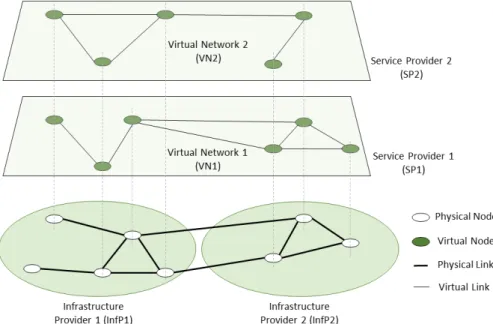
The basic entity of network virtualization is the virtual network (VN). A VN is a col-lection of virtual nodes and virtual links forming a virtual topology that is mapped/embedded1 onto physical nodes and physical links belonging to a physical/substrate network2(Figure
1.1).
Figure 1.1: Network virtualization environment, with the SN at the bottom and one or more VNs on top. VNs are mapped onto the physical network. VNs can create a VN hierarchy, on which some architectural attributes can be inherited.
1The words ’map’ and ’embed’ are used interchangeably throughout this thesis. 2The words ’physical’ and ’substrate’ are used interchangeably throughout this thesis.
Network virtualization is defined by decoupling the roles of the traditional Internet service providers (ISPs) into two different players [7]: the Infrastructure Provider (InP), who deploys and manages the physical infrastructure; and the Service Provider (SP), who creates and manages virtual networks, and deploys customized end-to-end services. The SP accomplishes these tasks through the Virtual Network Provider (VNP), which assembles virtual resources from one or more InPs, and the Virtual Network Operator (VNO), which installs, manages and operates the VN according to the needs of the SP.
The overall goal of enabling multiple heterogeneous VNs to coexist together on a shared physical infrastructure can be subdivided into several smaller objectives. Network virtualization tries to achieve flexibility in order to make SPs able to use arbitrary network topologies, routing or forwarding functions. It also tries to achieve manageability by modularizing the network management tasks through the separation between the SPs and the InPs. Scalability is another important objective, since the InPs should try to maximize the number of coexisting VNs in their network without degrading the performance of any one of them. Other goals that network virtualization tries to achieve are, for instance, programmability and heterogeneity. Programming network elements makes possible the SPs to implement customized protocols and deploy diverse services, and VNs are more flexible and manageable.
In order to take network virtualization to its full potential, several challenges have been addressed over time:
• Interfacing - Every InP has to provide an interface, following some standard, so that SPs can express their requirements;
• Resource and topology discovery - There must be ways to discover resources and topologies so that InPs understand the topology of the networks they manage; • Resource allocation - Efficient allocation and scheduling of physical resources among
multiple VNs;
• Virtualization of the allocated physical resources;
• Naming and addressing with different, and often incompatible, addressing require-ments in different VNs;
• Mobility management - Support mobility in core network elements (routers and switches) through migration techniques;
• Failure handling and security - Handle failures and guarantee isolation between coexisting VNs.
Chapter 1. Introduction 3
1.2
Virtual Network Embedding
In this dissertation we will focus on three of the above challenges, namely resource al-location, failure handling and security. We address these challenges by focusing on the problem of embedding VNs in a SN, a problem known as VNE. This problem consists in mapping a new VN, with virtual nodes and links that have certain constraints, onto spe-cific physical nodes and links in the SN, ensuring that the constraints are fulfilled while optimizing some objective.
Since VNE deals with the allocation of virtual resources of two types (nodes and links), it can be split into two sub-problems [1]: Virtual Node Mapping (VNoM), where virtual nodes are allocated to physical nodes, and Virtual Link Mapping (VLiM), where virtual links interconnecting the virtual nodes are mapped to paths connecting the corre-sponding nodes in the physical network.
In the definition of the problem, each resource, either virtual or physical, has one or more parameters. Node and link parameters are attributes that refer to nodes and links, respectively. These parameters are of extreme importance in order to obtain a valid em-bedding. An example of a virtual node parameter is the CPU capacity demand, i.e., the computational capacity that this node should have to run some workload. An example of a physical node parameter is the CPU capacity, i.e., the processing capabilities the node can provide to one or more virtual nodes that are mapped on it. The same stands for virtual and physical links: virtual links may demand a certain bandwidth, while physical links have some maximum bandwidth that can be used by the virtual links mapped on it.
VNE consists of finding the optimal or near-optimal way to solve the two sub-problems - VNoM and VLiM - with respect to a certain objective. There are many different objec-tives that are pursued by VNE algorithms. One example is Quality of Service (QoS), where Virtual Network Requests (VNRs) are installed and operated according to a set of QoS constraints defined by the SP. Another is to maximize the economical profit of the InP. Typically, the more VNRs that can be accepted, the more profit the provider will obtain. In order to achieve this objective, VNE algorithms should try to minimize the re-sources spent by the SN to map the VNR (known as the embedding cost). A final common objective is dependability. Since failures may occur during the virtual network lifetime, it is important to guarantee that the workload remains operational despite any problems that may occur. To achieve this, there are VNE approaches that setup backup nodes and links to be used in case of faults.
For large problem sizes (large SN and VNRs) the time to find the optimal solution of embedding can become too high, since the VNE problem is computationally intractable [1]. Taking this into account, there are three types of approaches that have been used to solve VNE:
to return optimal results. These optimal VNE solutions can be achieved through Integer Linear Programming (ILP) or Mixed Integer Linear Programming (MILP) (a variant of the first one). These techniques can be used to formulate the VNE problem including the VNoM and VLiM sub-problems. These formulations are then executed in solvers (e.g., GLPK [8] and CPLEX [9]), in order to obtain the result. This is the approach we follow in our work;
• Heuristic solutions - Algorithms that normally find good solutions while keeping execution time low. Since network virtualization deals with dynamic environments where VNRs arrival time is not known in advance, it is important to avoid delays in the processing of new VNs. However, these algorithms may suffer from a limitation where they can get stuck in a local optimum value that can be distant from the real optimum result;
• Meta-heuristic solutions - Algorithms that use specific techniques that are inde-pendent from the problem to find near-optimal solutions with a certain measure of quality in a reasonable time.
Normally, the VNO uses the embedding algorithms to decide which virtual resources to request from the VNP, which in turn, instantiates them by using the InPs substrate resources.
1.3
The Supercloud Concept
Cloud computing has evolved and gained reputation over the years [10], having revolu-tionized many areas, such as military, scientific research, and financial systems. However, current private and public clouds normally have difficulties to efficiently respond to the requirements of new applications. In particular, those where the robustness and avail-ability despite cloud failures or cloud-based attacks is paramount. Building applications using resources from multiple clouds is an approach to tackle these limitations. In addi-tion, it would give other benefits, such as users could connect to the nearest data center in order to obtain low latency and highest bandwidth, and services could migrate their virtual resources to providers with lower prices.
Despite the benefits, the use of a multiple cloud providers solution is complex, mainly due to the heterogeneity and the lack of interoperability between them. Different cloud providers use different virtual machine (VM) image formats, and it is not possible to live migrate a VM from one type of hypervisor to another. Networking between VMs in different clouds is also not supported. Therefore, applications are locked-in to a specific cloud, which makes the use of resources from multiple cloud providers difficult.
The Supercloud concept, also referred as cloud-of-clouds, is a “meta-cloud” that uses resources from several private and public clouds. In order to solve the heterogeneity
be-Chapter 1. Introduction 5
tween the virtual devices and VM images of different clouds, Supercloud makes use of nested virtualization [11, 12]. Nested virtualization allows a hypervisor to run other hy-pervisors with their associated VMs. This technology has many potential uses in cloud environments. An Infrastructure-as-a-Service provider can give a user the ability to run a user-controller hypervisor as a VM. This way the cloud user can manage its own VMs directly with his favorite hypervisor. Furthermore, nested virtualization enables live mi-gration of hypervisors and their guest VMs as a single entity. This characteristic can be useful for load balancing and disaster recovery.
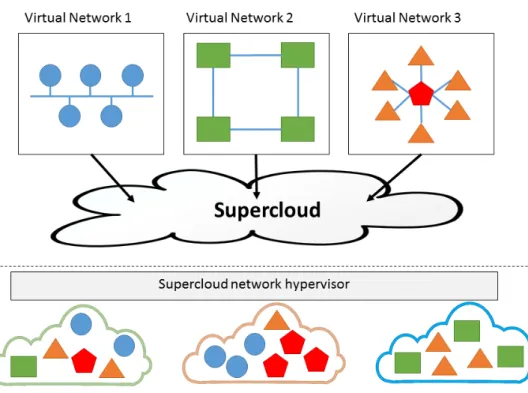
Figure 1.2 shows a multiple clouds environment that is inherent to the Supercloud concept. In this environment, each user’s VM may use resources from different cloud providers, e.g., virtual network 1 includes resources from cloud providers a and b, while virtual network 2 is mapped to resources from cloud providers a and c. In this figure, it is also possible to observe the entity that deals with the heterogeneity between different cloud hypervisors and VM images, the Supercloud network hypervisor.
Figure 1.2: Multiple clouds environment representation. The tenants’ VNs are mapped into re-sources belonging to different cloud providers.
1.4
Motivation
With the advent of network virtualization platforms, cloud operators now have the ability to extend their cloud computing offerings with virtual networks. To shift their workloads to the cloud, tenants trust their cloud providers to guarantee that their workloads are se-cure and available. However, there is increasing evidence [2] that problems do occur, of
malicious kind where resources may be compromised (e.g., caused by a corrupt cloud insider), or benign when services can not be provided (e.g., a cloud outage), causing im-portant security and dependability concerns.
Embedding VNs in an environment with multiple clouds brings benefits that may attenuate these problems: cloud users are no longer limited to just one provider, having a wider range of resources available to map their VNs, allowing the placement of the most critical services in the clouds where the user has the highest trust. In addition, VNs can be made more robust and have a higher probability to survive to cloud failures if backups are set up at several providers.
Thus, there is a need for VNE algorithms that take into account security and depend-ability requirements of users, while taking advantage of the benefits provided by a multi-cloud environment.
1.5
Goals and Contributions
In this thesis, we argue that security and dependability are becoming critical factors that should be considered by VNE algorithms. In this sense, the main contribution of this work is the design of a secure and dependable VNE algorithm, through a MILP formulation. Our solution considers dependability constraints that allocate additional computing and communication resources during the process of embedding (to tolerate possible failures), and security constraints that require appropriate security mechanisms in place. We also assume a multiple cloud provider model (e.g., one based on nested virtualization) where different types of clouds may coexist: both private, belonging to the tenant, and public, belonging to cloud providers. By not relying on a single cloud provider, we avoid internet-scale single points of failures, tolerating cloud outages by replicating workloads across clouds. In addition, we can enhance security by leaving sensitive workloads in the tenant’s private clouds or in trustworthy public facilities.
To the best of our knowledge, this is the first proposal that puts together security and dependability in a formulation of the VNE problem, further extending these requirements to a multiple clouds environment. The main contributions can be summarized as follow-ing:
• A MILP solution for the secure and dependable VNE problem in a multiple clouds environment;
• A simple application programming interface (API) that can be used by virtualiza-tion platforms to enable the definivirtualiza-tion of security and dependability attributes; • An evaluation of the solution comparing its behavior against the most common
Chapter 1. Introduction 7
− The acceptance ratio, i.e., the ratio of VNs that are served during a certain period of time;
− The average embedding cost, i.e., the average cost of allocating resources for a certain VN;
− The generated revenue over a period of time;
− The average node utilization, i.e., how much total CPU capacity is allocated to all VNs over time;
− The average link utilization, i.e., how much total bandwidth capacity is allo-cated to all VNs over time.
In summary, the experimental results show that there is a profit decrease for the providers when security and dependability are taken into account. A relatively small increase of the price of these features enables the provider to obtain a similar profit to the profit of providers that do not offer security and dependability. Our experi-ments also show that our algorithm behaves similarly to the most commonly used VNE algorithm when security and dependability are not requested by VNs.
We note that this thesis contributed to a section in a deliverable document to SU-PERCLOUD project (D4.2 Specification of Self-Management of Network Security and Resilience) [13], and also resulted on an abstract [14] that was presented at NSDI’16 (Symposium on Networked Systems Design and Implementation) poster session.
1.6
Planning
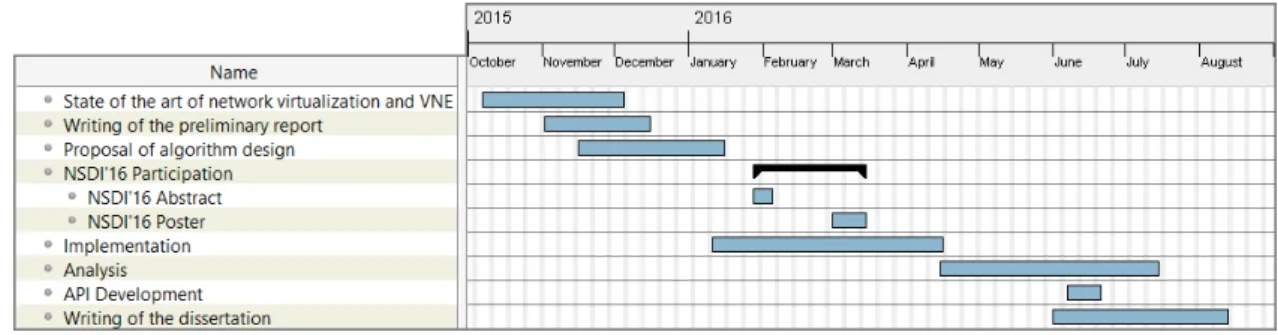
Figure 1.3 shows the activities that we have performed in order to produce this disserta-tion. The scheduling deviated slightly from the initially proposed work plan (Figure 1.4) for multiple reasons:
1. Algorithm proposal - The proposal of the algorithm was delayed since it was nec-essary to first understand better the practical implementations (mainly exact and heuristic solutions) of other works in the field. This helped us to define which type of solution we would use;
2. Implementation phase - The implementation phase also took some time, since we had to learn the language used in GLPK (GNU MathProg modeling language [8]) to model our solution. Small tests to ensure the correctness of the solution also delayed this phase. During this period, we also worked on an abstract [14] that was presented at NSDI’16 poster session;
3. Evaluation - The evaluation phase was delayed because the writing of a simulator that reproduces the online arrival of VNRs took more time than was planned. The need for repeat the simulations due to modifications to the algorithm as it evolved and the addition of other experiments also delayed this phase. We also had to un-derstand the structure of the inputs for D-ViNE. The construction of an API for network virtualization platforms that takes into account dependability and security also contributed to the delay of this phase;
4. Dissertation - The delay to complete the writing of the dissertation was caused by all the above delays. We worked on this phase in parallel with the evaluation phase.
Figure 1.3: The activities developed and respective durations to produce this dissertation.
Figure 1.4: The activities (and respective durations) anticipated to produce this dissertation.
1.7
Thesis Organization
Chapter 2 covers the related work. This is an extensive chapter: we present some network virtualization platforms that are interrelated and that include VNE algorithms in their designs (Section 2.1), and we present VNE algorithms, their evolution and the different types of objectives they try to achieve (Section 2.2).
Chapter 3 defines the Secure and Dependable VNE problem and presents an exact solution to address it. An explanation of the API developed is also presented.
Chapter 4 explains our evaluation method and shows the results obtained from our simulation. A discussion about which alternative techniques can be used in order to im-prove our results is also shown.
Chapter 2 - Related Work
2.1
Network Virtualization
Network virtualization is not a novel idea [15]. Some well-known technologies are closely related with this concept, such as virtual local area networks (VLANs), virtual private net-works (VPNs), and overlay netnet-works. In short, VLANs are groups of logically networked hosts with a single broadcast domain, regardless of their physical connectivity; VPNs are specialized VNs connecting multiple distributed sites through tunnels over shared or public networks; overlay networks are typically implemented in the application layer and they are virtual computer networks which create virtual topologies on top of the physical topologies of other networks.
In recent years, with the technologies advance in networking - namely with SDN - and with the development of datacenters design, network virtualization experienced major im-provements. Traditionally, datacenters used dedicated servers to run applications, but this approach resulted in poor server utilization and high operational cost, where management of the resources was hard and time-consuming. Server virtualization, which allows mul-tiple VMs to be co-located on a single physical machine (giving a software abstraction of a server to users), solved these problems, although achieving a transparent manage-ment of the resources remained a challenge. In practical environmanage-ments, datacenters have a multi-tenant nature, that is, single physical datacenters are shared by many tenant users (customers, developers, applications/services). Besides the challenge of resources man-agement, server virtualization alone can not solve all issues: different workloads require different services and network topologies; and virtualized workloads need to operate in the same address space as the physical network. Consequently, the operators can not move their VMs to arbitrary locations, can not authorize VMs to execute their own In-ternet Protocol (IP) address management schemes (common requirements in datacenters) and can not change the addressing type.
Network virtualization has helped to overcome these challenges by allowing the cre-ation of VNs, each with independent service models, topologies and addressing archi-tectures, on top of a shared physical network, and by permitting the configuration and management of these VNs through global abstractions, reducing the management com-plexity.
In this section we present network virtualization platforms that are related with our work. All of them are related with the evolution of datacenters, namely multi-tenant datacenters (MTDs), and were constructed in the context of SDN [16], a networking paradigm that separates the control plane from the data (forwarding) plane, centralizes the network control, and defines open, programmable interfaces. In Section 2.1.1, we present NVP, and in Section 2.1.2, we present OVX. Lastly, as in our work we target a multi-cloud scenario, in Section 2.1.3, we present a multi-tenant multi-datacenter network virtualization platform.
2.1.1
NVP
NVP [17] is a network virtualization solution for MTDs. It is the result from the advances in datacenter network design, software forwarding, programming languages, and SDNs.
In MTDs, the hosts are connected by a physical network. Each host has multiple VMs supported by the host’s hypervisor. A hypervisor on a host provides the right virtualization abstractions to VMs and it has an internal software virtual switch (which is implemented with Open vSwitch (OvS) [18]) that accepts packets from these local VMs and forwards them either to another local VM or over the physical network to another host hypervisor.
The architecture of NVP is built around a network hypervisor. A network hypervisor is a software layer located between the physical forwarding infrastructure and the tenant control planes responsible for providing the right network virtualization abstractions, and has essentially two abstractions: control abstraction, where tenants define a set of logical network data plane elements that they can control; and packet abstraction, that makes packets sent by endpoints see the same service as on a “native” network.
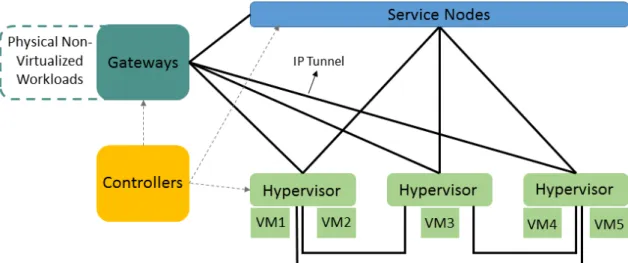
To achieve these abstractions, in NVP design, logical datapaths are implemented in the virtual switches of each host hypervisor and the network hypervisor creates tunnels between every pair of host hypervisors (as such, the physical network only sees IP packets between physical hosts). Additional support is required to provide multicast or broadcast services with the tunnels. To achieve this, NVP constructs a simple overlay multicast using additional physical forwarding elements, known as service nodes. This feature is only used by distributions that need multicast services, otherwise service nodes are not used. NVP also makes use of a logically centralized SDN controller to configure the hosts virtual switches, e.g., modify their flow tables1, with the appropriate logical rules as tenants show up in the network. Figure 2.1 presents a general architecture of NVP.
Host hypervisors and physical gateways provide location and topology information to the controller. The controller is configured by the SPs and the forwarding state is pushed from the controller to the virtual switches through OpenFlow [19]. This design choice
1The flow table in a virtual switch contains a set of flow entries. A flow entry consists of match fields
that are matched against packets when they arrive to the switch, and a set of actions that are applied when there is a matching. The match fields can be any field of a packet header and the actions can be forward the matched packet to a given port, forward the matched packet to a SDN controller, or simply drop it.
Chapter 2. Related Work 11
Figure 2.1: General architecture of NVP. Controllers manage the forwarding state of all hyper-visors, gateways and service nodes. Gateways connect the logical networks with workloads on non-virtualized servers and service nodes are used for logical multicast or broadcast.
triggers other two challenges: software switching at the end hosts needs to be fast (that is, OvS in the end hosts must classify each incoming packet against its entire flow table in software, and that can be a slow process); and the controller computation (computation of the logical datapaths and tunnels) has to scale. The first challenge is solved by making NVP perform exact-match flows in the kernel module of OvS. The first packet of each flow in OvS is sent from its kernel module to the userspace program, where it is matched against the full flow table. Then, the userspace program installs exact-match flows into a flow table in the kernel, which contains a match for every part of the flow. Future packets in this same flow can then be matched entirely by the kernel, saving the time that would be spent by switching between kernel and user spaces. The second challenge is solved by decomposing controller computation into two layers. The upper layer consists in logical controllers, that parallelize the computational workload, i.e., the computation of flows and tunnels for logical datapaths. The bottom layer consists in physical controllers that communicate with hypervisors, gateways and service nodes.
The controller is responsible for every forwarding state and its dissemination to the virtual switches. In order to reduce the recomputing costs, ensure consistency between different orders of events, and handle network changes, the authors of NVP also developed a declarative language for the controller.
Despite the importance of this platform, the work does not mention any type of VNE algorithm to embed VNs that arrive to the system. On the contrary, OpenVirteX [20], which we will describe next, is a network virtualization platform that shows a concrete VNE module in the system design.
2.1.2
OVX
OVX [20] is another network virtualization platform that has SDN at its core. In this platform, operators can create and manage virtual SDNs. Tenants are free to specify the topology and addressing scheme of their virtual SDN, and run their own network operat-ing system (NOS) (system that creates the network view, and is capable to communicate with forwarding elements, send control orders, get state information from them, among other features) to control it.
OVX is built based on the design of FlowVisor [21], another virtualization platform, and behaves as an OpenFlow [19] controller proxy between an operator’s network and the tenant’s NOSs. The topologies of tenants’ VNRs can be arbitrary. In OVX, a network embedder module is considered. First, the user specifies all the topology information in a request and sends it to the embedder, which generates a mapping (that is, which decide in which physical elements the virtual elements will be located) using the information from OVX, who has a global view of the physical network. Then, the mapping result is passed to OVX, which is responsible to instantiate the request on the physical topology. The authors do not propose a new embedding algorithm: the network embedder module can use any VNE algorithm depending on the objectives of the SP and the InP. This separation of OVX from the VNE is important since it reduces the complexity of the system, and also reduces the probability of errors in the request mappings, since it uses well-studied VNE works.
To publish a virtual topology, OVX resolves Link Layer Discovery Protocol (LLDP) (protocol used by network devices for advertising their identity, capabilities, and neigh-bors in Ethernet) messages coming from the tenants’ NOS. When an LLDP message arrives at a virtual switch element with a certain outport specified in its body, OVX knows where the other end of that link is. Therefore, OVX forges an LLDP response packet and sends it back to the tenants’ NOS, creating the illusion of a link at the NOS.
The address scheme can be defined as the tenant wishes, which increases the prob-ability of existing overlapping IP address blocks in the same physical network. To dif-ferentiate hosts, OVX generate globally unique tenant identifiers (IDs) for each tenant, and for each host, a physical address that encodes the host’s membership using the tenant ID. Collisions of addresses are avoided by installing flow rules to rewrite addresses at the edge switches of the network: from tenant-assigned address to physical IP address at the ingress edge, and vice-versa at the egress edge, as illustrated in Figure 2.2.
Although these two works have shown that network virtualization is possible, both of them are confined to one datacenter controlled by a single cloud operator. This limitation can be a barrier since many critical applications are being moved to the cloud.
Chapter 2. Related Work 13
Figure 2.2: OVX system architecture. The IP translation is done at the edge switches for data packets and between OVX and the NOS for control packets.
2.1.3
Multi-tenant multi-datacenters network virtualization platform
In [3], a network virtualization platform that tackles the challenge of using multiple clouds is presented. Using resources from several cloud providers can potentiate some benefits: by spreading the services across different providers, a tenant can be made immune to any single datacenter or cloud availability zone outage, and thus, it is possible to state that this approach ensures greater dependability; user costs can be decreased due to dynamic pricing plans from the several cloud providers by moving its VMs to less costly locations; and performance and QoS also can be increased by bringing services closer to clients or by migrating VMs that need to closely cooperate during a certain time.
The network virtualization platform proposed takes into account network infrastruc-tures from public cloud providers, on which this platform has a limited control, and private clouds belonging to the tenants. Considering this setting, the platform tries to fulfill three requirements: remote and flexible control over network elements, full network virtualiza-tion, and network snapshot and migration. The first requirement is achieved in different ways for the two types of clouds considered. For public clouds, since the control is lim-ited, the platform has an additional virtualization layer on top of the cloud hypervisor to provide virtualization between multiple tenants. Private clouds include the proposed network hypervisor, with OvSs running on bare metal, as is shown in Figure 2.3.
The second requirement is fulfilled by ensuring that the network hypervisor guarantees isolation between tenants, while enabling them to use their desired addressing schemes and topologies. The network hypervisor runs on top of the SDN controller to map the physical to virtual events by intercepting the message flows between the physical
net-Figure 2.3: Network virtualization architecture.
work and the users’ applications. This, along with flow rule redefinition at the edge of the network (like OVX), allows isolation between tenants’ networks. For addressing vir-tualization, the traffic that originates from tenant VMs is all tagged. The first 16 bits of the media access control (MAC) address are used as tenant ID. For topology abstraction LLDP messages are all intercepted. By intercepting all topology-related messages the SDN controller can offer arbitrary virtual topologies to tenants.
In order to accomplish the third requirement, the platform uses well-studied snapshot techniques and further extends them to deal with the multiple datacenters environment. For migration, the idea is to clone one or more switches at a time, and then move the VMs associated. This leads to two copies of the same switch to co-exist. To avoid in-consistencies the actions that a switch can take are limited during the migration period. Furthermore, to also respect packet orders, packets from the respective flow are temporar-ily sent to the controller until it is guaranteed that the rules are installed in both switch replicas.
As in OVX, this platform can make use of a VNE algorithm to decide the mapping between the virtual elements of a tenant’s VN and the physical elements (in [3] no such algorithm is presented). The solution we propose in this thesis is the perfect fit for this platform, since it considers a multiple domain environment, namely public and private clouds, and it gives dependability guarantees so that tenants’ VNs survive to clouds out-ages. Furthermore, the security guarantees given by our solution are also an added value to the network virtualization platform.
2.2
Virtual Network Embedding
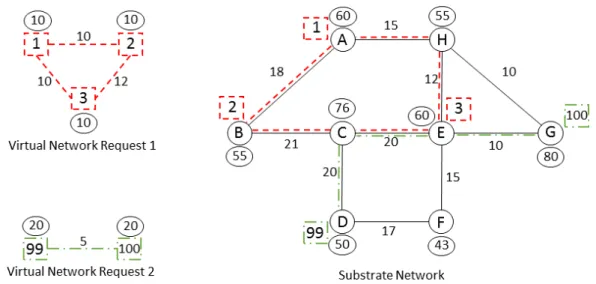
The VNE problem consists in efficiently mapping a VN, with virtual nodes and links, onto SN resources (physical nodes and links). In Figure 2.4 we present an example of
Chapter 2. Related Work 15
how VNRs can be mapped to a physical network. The virtual nodes in VNR 1 demand 10 units of capacity (CPU) and the virtual links demand 10 – (1,2) and (1,3) – and 12 – (2,3) – units of capacity (bandwidth). The virtual nodes 1, 2 and 3 are mapped to the substrate nodes A, B and E, respectively, respecting the capacity constraints. The virtual link (1,2) is mapped to the substrate links (A,B). The virtual link (1,3) is mapped to the substrate links (A,H) and (H,E). The virtual link (2,3) is mapped to the substrate links (B,C) and (C,E). The virtual resources from VNR 2 are mapped to the SN resources in a similar way as the VNR 1. It is important to note that a substrate resource can map virtual resources from different VNs at the same time, since the sum of capacity demands from the virtual resources do not exceed the capacity available in the substrate resource, e.g., the substrate link (C,E) is part of the path of virtual links (2,3) from VNR 1 and (99,100) from VNR 2.
Figure 2.4: Embedding of multiple VNRs onto a shared SN. The circular shapes near the nodes in all networks are node parameters, i.e., CPU demand for virtual nodes and CPU available for substrate nodes. The numbers near the links are link parameters, i.e., bandwidth demand for virtual links and bandwidth available for substrate links. It is important to note that virtual links can be allocated to multiple substrate links (a path) in the SN.
In this section we present the major research contributions to the VNE problem. We divide the existing works in basic VNE algorithms and in sophisticated VNE algorithms. In basic VNE algorithms (Section 2.2.1), we show the early algorithms that were devel-oped in the field, classifying each one accordingly with their method to solve the sub-problems of the VNE problem, namely, VNoM (mapping of the virtual nodes onto phys-ical nodes) and VLiM (mapping of the virtual links connecting the virtual nodes onto paths that connect the corresponding nodes in the physical network) problems. We clas-sify them into uncoordinated VNE algorithms, where there is no coordination between the VNoM and VLiM phases; two-stage coordinated VNE algorithms, where VNE is achieved through two stages and the VNoM phase tries to obtain a result that optimizes the VLiM phase, achieving better performance; and one-stage coordinated VNE algo-rithms, where virtual links are mapped at the same time as virtual nodes (in a single
stage). More complex VNE algorithms with specific objectives, such as to achieve energy efficiency, to achieve dependability, to solve the VNE problem across multiple domains, among others, are presented in the sophisticated VNE algorithms section (Section 2.2.2).
2.2.1
Basic Virtual Network Embedding Algorithms
In this section we show the VNE algorithms that first addressed this problem. Currently, they are still being used as baseline for many other VNE algorithms. Most of these works try to increase the performance and average revenue, or to reduce the embedding costs. The first algorithms try to address some challenges that make the VNE problem hard [22]: Node and link constraints (the combination of these constraints make the embedding prob-lem computationally difficult to solve), admission control (substrate resources are limited and some VNRs must be rejected or postponed to avoid violating the resources guaran-tees for existing VNs), online requests (VNRs arrive dynamically and stay in the network for an arbitrary period of time) and diverse topologies (handling arbitrary topologies is difficult).
2.2.1.1 Uncoordinated Algorithms
In [22], M. Yu et al. present an efficient and simple embedding algorithm that addresses the challenges listed above and maximizes the long-term average revenue from accepting VNRs.
The algorithm for VNE is solved in two independent phases. In the VNoM phase a greedy algorithm is employed. It chooses, for each virtual node from a certain VN, a set of eligible substrate nodes and then assigns one of them based on its amount of available resources. The aim is to assign the virtual nodes with higher demands to the substrate nodes with better resources. Then, in the VLiM phase, there are two different ways for mapping the links: Single path mapping using the k-shortest path algorithm [23] when each virtual link must be mapped to a single path in the SN; or Path splitting / Multiple path mapping when each virtual link demand can be carried by several paths in the SN, enabling better resource utilization by harnessing the small pieces of available bandwidth and consequently accepting more VNRs.
2.2.1.2 Two-Stage Coordinated Algorithms
The algorithm presented in [22] does a clear separation between the node and the link mapping phases. However, mapping the nodes without considering its relation to the link mapping stage restricts the solution space and may result in poor performance.
N. Chowdhury et al. in [4] introduce better coordination between the two phases by proposing two new VNE algorithms: D-ViNE (Deterministic VNE) and R-ViNE
(Ran-Chapter 2. Related Work 17
domized VNE). In these algorithms the authors also minimize the embedding cost and add a new set of node constraints – geographical location for substrate and virtual nodes and a non-negative distance per VNR, indicating how far a virtual node of the VNR can be of its demanded location.
The algorithms take online VNRs as input, i.e., VNRs arrive dynamically, and map them onto the SN one at a time. In order to coordinate the two phases, the substrate graph is augmented with a set of meta-nodes, one per virtual node, each connected to a cluster of candidate substrate nodes obeying location and capacity constraints. A representation of this phase is presented in Figure 2.5. Over the augmented graph, the algorithms execute a MILP formulation that tries to embed the virtual nodes and links. The MILP main goal is to solve the VNE trying to minimize the embedding cost. Since solving MILP formu-lations is known to be computationally intractable (working only for small instances), the authors present a Linear Programming (LP) relaxation. In this approach, the relaxation is solved and virtual nodes are mapped to real substrate nodes by rounding the obtained so-lution from the relaxation either deterministically (D-ViNE) or randomly (R-ViNE). Once all the virtual nodes have been mapped, the algorithms perform one of the two solutions proposed in [22] for the VLiM phase.
Figure 2.5: Augmented substrate graph with meta-nodes and meta-edges for a VNR. For each vir-tual node, it is created a meta-node that connects to a cluster of candidate substrate nodes, obeying location and capacity constraints. The connection between the meta-nodes and the substrate nodes is done through meta-edges with infinite bandwidth.
In [5] the same authors improve the previous work to a generalized window-based VNE algorithm (WiNE) to evaluate the effect of look-ahead on VN embedding. WiNE discretizes time into consecutive time windows, and instead of making individual embed-ding decisions for each VN arrival, it batches the requests to process them at the end of a window period. In WiNE, each VNR comes with an additional information denominated maximum waiting period, which sets a deadline on how long WiNE can defer making an embedding decision for that request.
ordered by revenue, so that the maximum revenues are considered first for embedding, maximizing the overall revenue.
Addressing a different problem from the dynamic arrival of VNRs, in [24], X. Cheng et al. consider that one of the most important parameters of a network node (substrate or virtual) is its position inside the topology. Topological attributes of a node have a di-rect impact on the success and efficiency of the embedding. Taking this into account, the authors created a node ranking approach, called NodeRank, to measure the topology inci-dence of a node. This approach is inspired by the PageRank algorithm used by Google’s search engine to measure the popularity of web pages based on Markov random walks.
Based on NodeRank, the authors devised RW-MaxMatch to find possible embedding solutions to VNRs. In a pre-stage, the node rank for each node in a VNR and for each node in the residual SN are computed. Then, in the first stage, the algorithm maps the virtual nodes with the highest ranks to the substrate nodes with the highest ranks. In the second stage it embeds virtual links using one of the solutions presented in [22]: shortest path algorithm if path splitting is not supported by the substrate network or multi-commodity flow otherwise.
Most of the algorithms listed until here do not take workload fluctuation into consid-eration. Predicting workload in a system (or network) that targets users all over the world is extremely difficult. To cope with a peak workload on demand, SPs often over-purchase physical resources, which may lead to a considerable waste of resources for a normal workload and to a loss of some upcoming costumers due to inefficient resource utilization for InPs.
To solve this problem, S. Zhang et al. in [25] re-examine the VN mapping problem proposing a VN mapping framework, ORSTA, which is based on Opportunistic Resource Sharing and Topology-Aware node ranking.
In Opportunistic Resource Sharing, the workload in a VN is modeled as the combi-nation of a basic sub-workload, which always exists, and a variable sub-workload, which occurs with some probability. Multiple variable sub-workloads from different VNs are allowed to share some common resources to achieve efficient resource utilization, while for a basic sub-workload the required resources are allocated as usual.
To facilitate the efficient embedding of VNs, the authors take topology into consider-ation and also design a Markov Chain-based substrate node ranking algorithm, MCRank, to measure the importance of each substrate node. MCRank is also inspired by PageRank Google’s algorithm. To calculate the importance of a substrate node, MCRank takes both residual resources and topology into consideration.
In ORSTA, the algorithm starts computing the residual resources for each substrate node and link, and running the MCRank algorithm. After the arrival of a VNR, in the VNoM phase, all virtual nodes are sorted in a decreasing order of their CPU constraints and are placed in a queue. Then, each virtual node in the sorted queue is mapped to the
Chapter 2. Related Work 19
unused substrate node with the highest MCRank. In the VLiM phase, each virtual link is mapped to the shortest path between its end hosts. At the end, after a VNR is successfully embedded, ORSTA updates the residual resources and the MCRank of each substrate node and link.
Although two-stage coordinated algorithms have a better coordination between the two mapping phases, they may lead sometimes to unnecessary consumption of bandwidth resources of the SN. For instance, sometimes virtual nodes that are just separated by one-hop in a VN are mapped to a longer path in the SN, wasting its bandwidth resources. 2.2.1.3 One-Stage Coordinated Algorithms
One stage coordinated VNE algorithms are another approach to solve the VNE problem. These solutions try to save bandwidth resources of the SN. Solving the VNE in one sin-gle stage implies that virtual links are mapped at the same time as virtual nodes. More precisely, when the first virtual node pair is mapped, the virtual link between them is also mapped.
In [26] a one-stage coordinated algorithm is presented. The authors propose a back-tracking algorithm, known as vnmFlib, based on a subgraph isomorphism search method that maps the nodes and links at the same time.
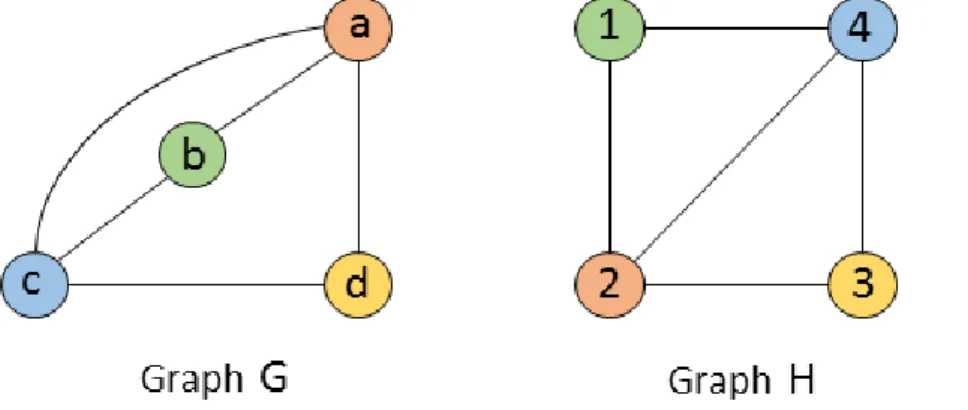
An isomorphism of graphs G and H is a bijection between the vertex sets of G and H, f : V (G) → V (H), such that any two vertices i and j of G are adjacent in G if and only if f (i) and f (j) are adjacent in H too. Figure 2.6 shows an example of an isomorphism of graphs G and H.
In short, to map a VN, vnmFlib as to find an isomorphic subgraph of the VN in the physical network with the minimum number of hops in the substrate paths.
Figure 2.6: An example of an isomorphism of graphs.
In [24], the authors also present RW-BFS, a one-stage backtracking VNE algorithm based on Breadth-First Search (BFS). As most of the algorithms of this type, this solution
was designed to solve the unnecessary consumption of bandwidth resources of the SN that a two-stage embedding algorithm may cause.
After computing the NodeRank values for all nodes, substrate or virtual, RW-BFS constructs a BFS tree of the VN, whose root node is the virtual node with the largest NodeRank value. The remaining virtual nodes are sorted in non-increasing order in each level of the tree according to their NodeRank values. Then, for each virtual node, it is built a candidate substrate node list. The substrate nodes in these lists are also sorted by their NodeRank values in non-increasing order. After this, VNE is performed by going through the BFS tree and mapping each virtual node in the first feasible substrate node of its list and, at the same time, mapping the virtual links incident to that virtual node onto the substrate shortest paths that satisfy the bandwidth demands. If there is no suitable mapping for a virtual node v, RW-BFS backtracks to the previous one, re-map it to another substrate node and continues to map v.
2.2.2
Sophisticated Virtual Network Embedding Algorithms
The algorithms described previously were very important to the initial development of the VNE field. However, these algorithms only focus on capacity requirements of VNs, i.e., they only focus on CPU and bandwidth capacity requirements. As new technologies and paradigms appeared, the need to consider more complex requirements has grown. Thus, in this section, we present VNE algorithms that try to achieve more complex objectives, namely energy efficiency, fault-tolerance, security, and also inter-domain environments. 2.2.2.1 Energy efficiency
Most of the previous works presented solve the VNE only looking for the minimization of the embedding cost, i.e., the total resources spent by the SN to embed a VNR, to increase the probability of embedding the next VNR and, as a consequence, minimize the percentage of rejected VNRs.
In order to minimize the energy cost, the authors of [27] introduce a VNE energy aware problem (VNE-EA), where the goal is to allocate the set of VNRs in a reduced group of physical network equipment, and propose a MILP to solve it. In this work, the substrate nodes and links that are not used to realize the mapping of the VN can be deactivated by switching them off to minimize the overall energy consumption of the SN. The proposed model is based on cost-based formulations, similar to [5].
2.2.2.2 Dependability
Due to the shared nature of virtualization and the probability of failures to occur, de-pendability (i.e., ability to tolerate failures and recover from them) is another complex
Chapter 2. Related Work 21
objective that has gained importance. To guarantee dependability, redundant computing resources and communication bandwidth need to be allocated for each VN.
In [28], H. Yu et al. study the VN mapping problem where they focus on the failure recovery of facility nodes while minimizing the total amount of computing and bandwidth resources. A facility node is a node with computing capability that can fail if any of its components fails (computer(s), disks, memory, among others). The objective is to restore a VN node mapped onto a facility node that failed by migrating it and its associated virtual connections to a backup facility node.
The authors propose two MILP solutions for dependability, namely 1-redundant scheme and K-redundant scheme, and a heuristic solution. The idea of the 1-redundant scheme is to take the original non-survivable VN graph and transform it to a graph with redundancy by adding one additional VN node. If any of the critical VN nodes fails, the failed VN node and its connections are migrated to that redundant node. Hence, the redundant node should have redundant VN links with all neighbors of all critical nodes. In some cases, especially when resources are limited, establishing multiple VN links from the backup node to each neighbor of all critical nodes is not cost-efficient. It can be difficult or even impossible to support such mapping. The K-redundant scheme solves this problem. This approach is a flexible solution, where in a design phase a K-redundant reliable VN graph is created, in which it is permitted each critical node to have a corresponding backup node. The backup nodes are connected to all neighbors of their corresponding critical VN node. Figure 2.7 shows a K-redundant VN graph, where it is possible to observe backup nodes for the critical nodes and the respective redundant links to their neighbors. In the heuristic, the idea is to use D-ViNE [4] to find the working mapping for the original VNR and use the result to obtain the backup solution through a simplified MILP.
Figure 2.7: Representation of a K-redundant VN graph.
In [29], Qian Hu et al. study a similar problem but with one new factor: location-awareness. In network planning or design, location is critical and can affect the system
performance. When embedding VNs, SPs may place constraints on the location of the substrate nodes in order to ensure QoS metrics (e.g., response time, end-to-end delay). Location constraints may also be posed due to geographic requirements of the SP (e.g., the major customers of a service are more concentrated in a certain region). In this sense, to solve this problem defined as Location-constrained survivable network embedding, the authors present an ILP solution that yields a joint optimal solution for both the active and backup traffic accommodation, and also present a heuristic algorithm for larger scales. In both the solutions, the goal is to guarantee the protection against single facility node failures using the minimum quantity of resources at the SN.
In [30], Rahman et al. formulate the survivable virtual network embedding (SVNE) problem to incorporate single substrate link failures in VNE and propose an efficient hybrid policy heuristic to solve it. The main objective of SVNE is to maximize long term business profit. The hybrid heuristic that solves SVNE consists in three separated phases. In the first phase, before any VNR arrives, the InP pre-computes possible backup paths for each substrate link using a path selection algorithm, e.g., k-shortest path algorithm [23]. Therefore, each substrate link have a set of candidate backup detours. The second phase starts when a VNR arrives. In this phase, the InP performs a node embedding using existing heuristics, e.g. [4], and a multi-commodity flow based link embedding through a linear program. The last phase is invoked when a substrate link failure happens. In this event a reactive backup detour optimization solution is invoked which reroutes the affected bandwidth along candidate backup detours selected in the first phase.
In [31], Guo et al. also tackle substrate link failures, postulating that resource effi-ciency from the perspective of an InP is extremely important. Therefore, they argue that backup resources can be reused by several VNs enabling more space to accept more in-coming VNRs. In this sense, the authors propose two shared backup network provision schemes for VNE: Shared-On-Demand approach (SOD BK) and Shared Pre-Allocation approach (SP A BK). In short, in the first approach, backup resources are allocated on demand, i.e. upon the arrival of each VNR. In the second one, backup resources are pre-allocated during the configuration phase before any VNR arrives to protect against any potential link failure. The authors focus on link embedding procedure, assuming that node embedding is done firstly using existing approaches, e.g., [22].
Both the approaches presented are formulated through linear programs. In SOD BK the objective is to minimize the total resources reserved for both primary flows and restoration flows as well as balance the load to avoid a bottleneck link separating the substrate topology. In this approach, for the primary flows of a VNR, no bandwidth shar-ing is possible since they need to be operatshar-ing all the time. The restoration flows, that protect against different substrate link failures, can share the bandwidth to minimize the resources utilization for backup purpose. In SP A BK the objective is to maximize the total protected bandwidth of the SN for mapping primary flows, since this approach
pre-Chapter 2. Related Work 23
allocates the backup bandwidth for each substrate link during network pre-configuration phase and it is impossible to predict the arrival and demand pattern of the future VNRs.
Also looking for the minimum quantity of SN resources used, Yeow et al. [32] defend that backup resources should be pooled and shared across multiple VNs. In this sense, they propose an Opportunistic Redundancy Pooling (ORP) mechanism to leverage the properties of the VN and achieve a n : k redundancy architecture (where k redundant resources can be backups for any of the n primary resources), and share the backups across multiple VNs. ORP ensures VNs do not connect to more redundant nodes than necessary in order to keep the number of redundant links low. Figure 2.8 demonstrates the concept of polling backup nodes for multiple VNs. Backup nodes can be used by several VNs. In this figure, it can be seen as VN1 lending some of its backup nodes to other VNs. This approach presents some advantages such as no degradation for large number of n, the possibility for VNs of arbitrary reliability requirements to be pooled together, and flexibility in adding VNs and in removing them.
Figure 2.8: Pooling backup nodes. The backup nodes can be used by several VNs.
To balance the trade-off between service resource consumption and service resiliency, an efficient resource allocation approach is required. In [33], Y. Chen et al. present Pardalis, another algorithm with resiliency guarantees. By exploiting a heuristic VN map-ping scheme and a restoration path selection scheme based on intelligent bandwidth shar-ing, the algorithm simultaneously makes cost-effective usage of network resources and protects VN services against network failures.
The algorithm solves two problems: the VN mapping and the selection of restora-tion paths. To solve the first problem, the algorithm tries to use the minimum number of substrate nodes, always respecting the requirements of virtual nodes. Once all the virtual nodes have been mapped to the SN, a primary path is determined for each virtual link. In this work, the authors adopt shortest path algorithms to find a path with minimum band-width usages for simplicity, but they could also chose a multi-commodity flow approach. For the second problem, the authors focus on finding a restoration path that is disjoint from its primary path. To achieve this, for each virtual link l, the algorithm removes the