Establishing a good governance system for the
Porto Metropolitan Region
Abstract
In November 1998 the Portuguese voters turned down a proposal to divide the country into eight administrative regions. The lack of defined competencies for the latter and the fear that those regions would only add another layer of bureaucracy were presented as the major reasons for the referendum result. The debate about decentralization, however, is not over. A new law that comprises the voluntary creation of both metropolitan areas and urban
communities (depending on the municipalities and population involved) was approved in May 2003, and can be considered an alternative to the original proposal. In the specific case of the Porto and Lisbon Metropolitan Areas, which were already in place but did not really function as such, the law allows for their reshaping, including new additions.
It is to be expected that this decentralization will only be successful if these regions have defined competencies, control over their budget and if the overall structure embodies good governance principles, is democratic and stimulates participatory citizenship. However, very little has been said about this, and almost nothing has been decided.
Among others, this paper will assess the following issues: which should be the competencies of the Porto Metropolitan Area (PMA)?; which competencies should be transferred from the municipalities and which from the central government?; what kind of precautionary control should be attributed to each?; what kind of democratic structures should form the basis of the PMA?; and what level of citizen involvement should be promoted? In attempting to question and summarise these issues about PMA, this paper may provide some useful insights to the design and management of urban regions within the Portuguese context.
Introduction
Regions are increasingly becoming the privileged spaces of economic competitiveness. Globalization is acting more upon limited territories inside countries than between the countries themselves. As Brenner (2003: 298) puts it, “major political-economic actors throughout western Europe have embraced the assumption that metropolitan regions, rather than localities or national economies, represent the natural economic zones in which
economic development must be promoted”. Regionalism has probably emerged as a consequence of this trend, as nation states “interiorize global economic constraints in the form of new policies oriented towards territorial competitiveness” (Brenner, 2003: 313). Regionalism has suffered waves of ups and downs in the United States and in Europe. First, during the high fordism years (1960s – 70s), metropolitan institutions were created by central governments mainly as a way to coordinate welfare services and to manage the physical
expansion of urban agglomerations; between the early 70s and the late 80s came the first wave of “glocalization” strategies: metropolitan institutions were abolished or downsized at the same time local municipalities were giver greater powers; the second wave of
“glocalization” started in the early 1990s, corresponding to the current situation of regional competitiveness, as described (Brenner, 2003: 318).
One of the best known examples is the London area. The Greater London Council was established in 1963, only to be dismantled two decades later, in 1986, as part of the non interventionist ideology of the neoconservative Thatcher government. The only central government strategic guidance for London, just a few pages long, was released in 1989, and had a very limited effect. A period of privately promoted region-wide thinking to which the government adhered allowed for some new strategic planning. In 1997, the winning Labour Party under Tony Blair devised a new political arrangement and set the Greater London Authority. “For the first time in history, this included an elected mayor for the whole of London”, which happened in May 2000 (UN Habitat, 2001a: 29).
In Portugal, metropolitan areas were first created in 1991 Porto and Lisbon, the two largest regions by far which, apart from the fact that they are still in place, are almost non-functional. Their competencies were never objectively defined, their budget was insignificant and
political turmoil prevented the structure from functioning properly. Moreover, they were only seen as a new bureaucratic layer, since no citizen representation through election had been envisaged. As will be discussed further on, a new law was later passed by the parliament in an attempt to revert this situation. Currently, the Porto Metropolitan Region covers an area of 815 km2; by 2001, it was inhabited by about 2,7 million people and had an unemployment rate of 5,1% (Instituto Nacional de Estatística, 2004: 19-21).
The emergence of well defined regions as spaces of globalization and competition suggests that regions are also the correct level to address decentralization efforts by means of a good governance system. This is so important that the UN Habitat Centre has dedicated a whole report to the study of “cities in a globalizing world”. “Cities are emerging as new territories of regulation, that is, as territories relevant to address crucial issues […]. Cities are at the forefront of competitive processes whose successful management requires an effective capacity to govern a territory.” (UN Habitat, 2001a: 58).
This paper does not pretend to re-examine or deepen the theoretical basis under the “new regionalism”, decentralization or governance. There is a wealth of literature to which the reader may refer to. Instead, after reviewing the current “state of art” experience from abroad and the specific situation of Portugal as well as its constrains, a new system of good
governance will be proposed to the Porto Metropolitan Region. This proposal will not account for legal or political difficulties, privileging a particular ideal solution (even if many are
Regional good governance: what is it and what is it for?
Governance has been defined as “the exercise of economical, political and administrative authority to manage a country’s affairs at all levels. It comprises the mechanisms, processes and institutions through which citizens and groups articulate their interests, exercise their legal rights, meet their obligations and mediate their differences” (UN Habitat and
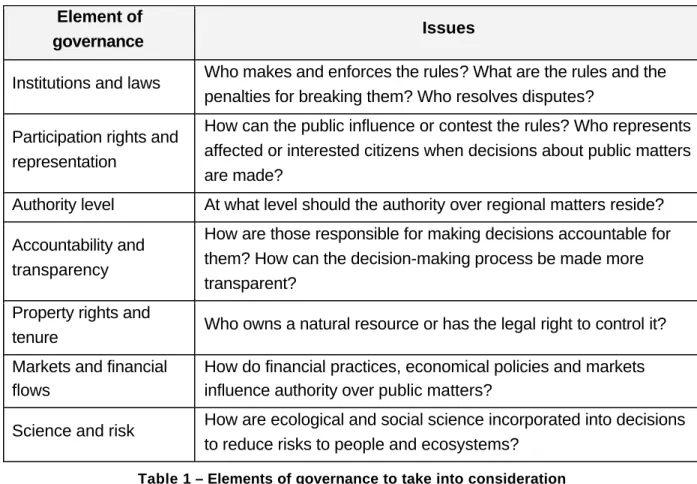
Transparency International, 2004: 7). To be successful, it must address three key tasks: coordinate a more complex and fragmented government landscape, steer interdependent activities through public-private partnerships or regional confederations and integrate and manage networks (UN Habitat, 2001a: 57). But what precisely are we referring to when we talk about good governance? Seven basic elements have been defined, according to Table 1. A good governance system as the one we propose in this paper must consider each of the questions below.
Element of
governance Issues
Institutions and laws Who makes and enforces the rules? What are the rules and the penalties for breaking them? Who resolves disputes?
Participation rights and representation
How can the public influence or contest the rules? Who represents affected or interested citizens when decisions about public matters are made?
Authority level At what level should the authority over regional matters reside? Accountability and
transparency
How are those responsible for making decisions accountable for them? How can the decision-making process be made more transparent?
Property rights and
tenure Who owns a natural resource or has the legal right to control it? Markets and financial
flows
How do financial practices, economical policies and markets influence authority over public matters?
Science and risk How are ecological and social science incorporated into decisions to reduce risks to people and ecosystems?
Table 1 – Elements of governance to take into consideration (World Resources Institute, 2003: 7).
A number of initiatives have proposed criteria to evaluate what can be called good governance. The White Paper on European Governance prepared by the European
Commission stipulates five guiding principles: (a) openness: the institutions should work in a more open manner; (b) participation: the quality, relevance and effectiveness of policies depend on ensuring wide participation throughout the policy chain, from conception to implementation; (c) accountability: roles in the legislative and executive processes need to
be clearer; (d) effectiveness: policies must be effective and timely, delivering what is needed on the basis of clear objectives, an evaluation of future impact and, where available, of past experience; and (e) coherence: policies and action must be coherent and easily understood (Comissão das Comunidades Europeias, 2001: 11). The Global Campaign on Urban
Governance, managed by the United Nations Habitat Centre, proposes a similar set of criteria: (a) sustainability in all dimensions of urban development; (b) subsidiarity of authority and resources to the closest appropriate level; (c) equity of access to the decision-making process and the basic necessities of urban life; (d) efficiency in the delivery of public services and in promoting local economic development; (e) transparency and accountability of
decision-makers and all stakeholders; (f) civic engagement and citizenship; and (g) security of individuals and their living environment (UN Habitat, undated).
There is evidence that local and regional governments are better at acting on these principles than central governments. Because they are based more on local knowledge, interest and expertise, local authorities are more likely to be effective in the services
provided. In addition, because they are closest to people, they tend to be more accountable, to represent a broader strand of opinions and to widen the opportunities for citizen
consultation and political participation (Andrew and Goldsmith, 1998: 108, 112). The current vision of metropolitan governance is no longer the top down bureaucratic approach that characterized the 60s and 70s. The emerging elements of governance, which are described in detail in UN Habitat (2001a: 59-62), include decentralization and formal government reforms, participation of civil society, multi-level governance and process oriented and territorially-based policies. According to Brenner (2002: 13), the metropolitan institutions created during the 90s had several goals: (a) to coordinate the activities of municipalities according to previously established regional priorities; (b) to create a regional framework in which local planning policies, infrastructural investments and other projects may be coordinated; (c) to pool fiscal resources at a regional level; and (d) to control land uses in order to protect the environment.
It is especially important that this various of roles be taken together. Too often governments fail to transfer the appropriate and sufficient powers to local authorities, probably because they fear losing economic benefits and the powers that defines and supports their political and administrative roles (Ribot, 2002: 7). Albeit in the specific context of natural resources management, Ribot (2002: 10-16) and World Resources Institute (2003: 93) establish some basic conditions to allow for an effective decentralization: (a) accountability of metropolitan institutions to the public through an electoral process; locally empowered organizations, even non governmental, should be accountable to their associates and some control mechanism should be put in place to avoid over representation of elites and powerful interests; (b) discretionary powers to enable local authorities to respond flexibility to local needs and aspirations; “while power transfers without accountable representation can be dangerous, representation without powers is empty” (p. 13); and security, so that people and institutions are clear about their rights and are willing to invest in them. However, it is also important that
some complementary measures be put in place, such as minimum environmental standards to avoid a possible excessive environmental exploitation by local authorities.
Brenner (2002: 19) presents an inspiring vision of the role of metropolitan institutions: “A key task for progressive socio-political forces is to harness metropolitan reform initiatives in order to enhance regional democratic accountability, to counteract racist and class-based forms of residential segregation, to foster environmentally sustainable forms of urban development and to promote a more egalitarian distribution of public resources and investments at all spatial levels.” The North American landmark study “Governance and opportunity in
metropolitan America” points towards the same direction, indicating that policy makers and society as a whole “must begin to identify and evaluate state-level policies that aim to undermine the forces of inequality” such as spatial mismatch, concentrated poverty and social isolation, racial and economic segregation and tax and service disparities (Altschuler, 2003). Peter Calthorpe and William Fulton (2001: 61-87) go further and define the policies that must be integrated in order to have what they call a “regional city”: (a) regional
boundaries for urban growth; (b) common land use and transport plans; (c) regional fair-share housing; (d) regional tax-base sharing; and (e) urban educational reform.
Current legal framework
In Portugal there are two main levels of governance: central (central government and national parliament) and municipalities (including municipal companies). During the last decade a continuous state decentralization effort has empowered local authorities with substantial competencies in several domains, including control over land use through municipal master plans, water distribution and sewage works, garbage collection, K-10 education, road maintenance and construction, cultural activities, specific tax collection, etc. The central government must, in some cases, approve local plans or at least ratify them. Conversely, municipalities are given superintendence or enforcement powers over several activities that are primarily managed by the central government.
In addition to these two basic layers, there are associations of municipalities (chosen and created by those interested) to develop specific activities such as tourism, and also
“freguesias”. Each municipality is divided into several of these “freguesias”, depending on its area, but they have a very limited set of powers, the possible benefits of greater proximity to citizens being ignored. Some shared services such as garbage treatment and water
distribution are managed by inter-municipal companies where central government has, in some cases, majority vote.
The Metropolitan Regions of Lisbon and Porto, set up in 1991, are now being reshaped by a law passed by the national parliament in May 2003 that establishes a new framework for regional governance. This law can be understood as a different decentralization path after portuguese voted down, in a referendum held in November 1998, the creation of
administrative regions. This law allows for the voluntary creation of metropolitan regions and urban communities (depending on the municipalities and population involved) and, as a
result, the country will be completely divided into them, i.e., all municipalities will belong to one of those structures. This “bottom up” approach may perform better than the current Porto and Lisbon Metropolitan Regions do but that will, above all, depend on the true
competencies they will have – and that is yet to defined precisely.
Strangely, in October 2003 the central government created the Metropolitan Transportation Authorities of Porto and Lisbon, where municipalities have a voice but are not the main deciders. Not a single word is said about their relationship to metropolitan regions, creating the typical conditions for an overlap of competencies.
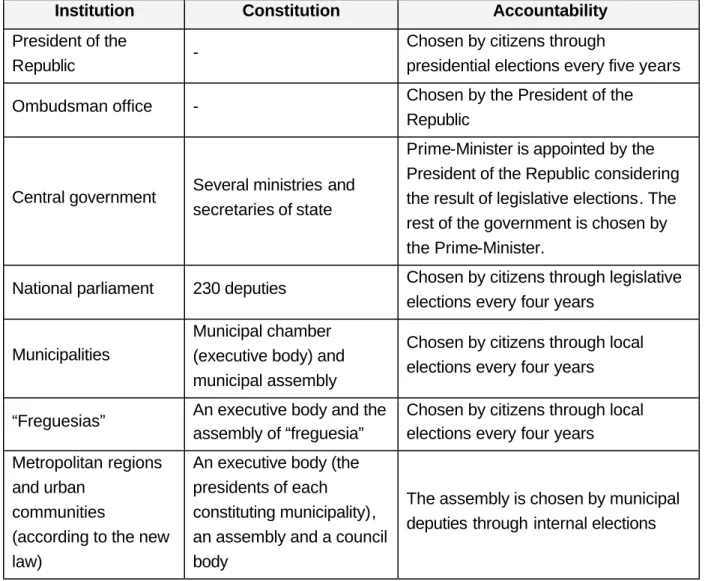
The constitution and accountability of each of the institutions described, as well as others, is summarized in Table 2. The judicial system is not mentioned.
Institution Constitution Accountability
President of the
Republic -
Chosen by citizens through
presidential elections every five years
Ombudsman office - Chosen by the President of the
Republic
Central government Several ministries and secretaries of state
Prime-Minister is appointed by the President of the Republic considering the result of legislative elections. The rest of the government is chosen by the Prime-Minister.
National parliament 230 deputies Chosen by citizens through legislative elections every four years
Municipalities
Municipal chamber (executive body) and municipal assembly
Chosen by citizens through local elections every four years
“Freguesias” An executive body and the assembly of “freguesia”
Chosen by citizens through local elections every four years Metropolitan regions
and urban communities
(according to the new law)
An executive body (the presidents of each constituting municipality), an assembly and a council body
The assembly is chosen by municipal deputies through internal elections
Table 2 – Main portuguese institutions, their constitution and accountability.
The metropolitan regions are not directly accountable to citizens, nor are guaranteed the other conditions to implement a successful decentralization policy. Specifically, according to law, there is also no evidence that meaningful powers will be transferred to them, that they
will be representative of the local populace and that they fiscal and regulatory incentives will be in place. Clearly, we are in presence of a typical “incomplete decentralization” (Ribot, 2002: 7).
A good governance system for the Porto Metropolitan Region
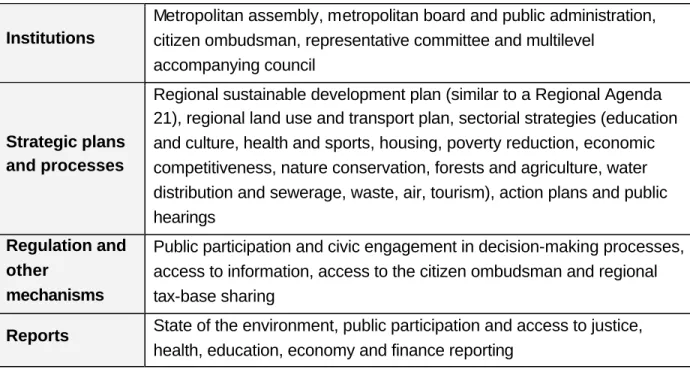
Being evident that the current legal system falls short in its decentralization efforts, the authors propose an alternative model based on the application of Montesquieu’s doctrine of the separation of powers (legislative, executive and judicial) at the regional level, on the “community method” of the European Union (Comissão das Comunidades Europeias, 2001: 8) and on several other recommendations (World Resources Institute, 2003; UN Habitat, 2001a; UN Habitat, 2001b; UN Habitat and Transparency International, 2004; Conselho Nacional do Ambiente e do Desenvolvimento Sustentável, 2003; Haughton, 1999; Ache, 2000; Souza, 2001).It would be impossible in this paper to describe all the details of a new governance system, as the task is extremely complex and requires a profound discussion. As such, the focus will be on what we consider the fundamental building blocks of that system: (a) institutions; (b) strategic plans and processes; (c) regulation and other mechanisms; (d) reports. Table 3 summarises the overall structure and its constituting elements as proposed.
Institutions
Metropolitan assembly, metropolitan board and public administration, citizen ombudsman, representative committee and multilevel
accompanying council
Strategic plans and processes
Regional sustainable development plan (similar to a Regional Agenda 21), regional land use and transport plan, sectorial strategies (education and culture, health and sports, housing, poverty reduction, economic competitiveness, nature conservation, forests and agriculture, water distribution and sewerage, waste, air, tourism), action plans and public hearings
Regulation and other
mechanisms
Public participation and civic engagement in decision-making processes, access to information, access to the citizen ombudsman and regional tax-base sharing
Reports State of the environment, public participation and access to justice,
health, education, economy and finance reporting
Table 3 – Elements of the proposed good governance system.
In order to enable this organizational reform competencies would have to be transferred from the central government and from the municipalities to the metropolitan institutions: grosso
subsidiarity principle, are better suited to be managed at the regional level, would be
affected. Specifically, those competencies would involve the preparation, implementation and supervision of all regional strategic plans and processes, of regulation and other
mechanisms, and of reports, as mentioned in Table 3. Globally, the region should be given full executive and policy powers within its mandated roles and territory. To ensure
compatibility between local, regional and national policies and projects, a multilevel
accompanying council ought to be established. A more detailed description for each element of the governance system will be given below.
It is important to note the kind of region being considered. In Portugal there are two
autonomous regions (the Madeira and Azores archipelagos) which retain substantial powers, including legislative ones. But there is no reason to invest in the new metropolitan regions, particularly the Porto Metropolitan Region, such a wide autonomy from the central
government. Portugal is a small unified country that needs a governance system capable of improving the territory and the quality of life, not a complicated structure of competing organizations with dubious and overlapping roles that would originate further difficulties.
Institutions
Institutions with executive, legislative, judicial and advisory powers were devised according to Table 4. The explanation follows below.
Role Legislative Executive Judicial Advisory Coordination
Institutions Metropolitan assembly Metropolitan board and public administration Citizen ombudsman Representative committee Multilevel accompanying council
Table 4 – Proposed institutions for the governance system.
The metropolitan assembly, likewise a national parliament, would represent the citizens of the region through deputies elected every four years. To avoid the monopolization of
elections by existing parties, independent groups of citizens informally organized would also be able to participate. A reasonable number of signatures should be required, small enough to prevent the task from being prohibitive. In all cases, fairly distributed public financing should be available for electoral campaigns. The primary role of the assembly would be the promotion of discussion and the approval of regional strategies, plans, processes and
regulations. Contrary to what happens with Madeira and Azores, metropolitan regions should not be given legislative powers. However, assemblies could establish regulation translating into concrete procedures the framework created by national laws, particularly if they resulted in a broader environmental and social protection, or create new rules when law is missing or
incomplete. These regulation must be mandatory and of immediate applicability in municipalities.
The metropolitan board would be the political branch of the executive power. In much the same way as the government, the president of the board would be appointed by the winning party or coalition of the elections mentioned above. The role of this structure can also be compared with that of national governments, providing the political leadership necessary to carry on all regional policies.
The public administration complements the political quality of the metropolitan board and is responsible for the implementation of regional policies. It could have specialized agencies such as a Regional Environmental Protection Agency (integrating all matters dealing with the environment) and a Regional Sustainable Development Agency (responsible for financing projects promoting sustainable development and allocating structural funds). The leaders of metropolitan public administration should be appointed by the board. However, just as the European Commission, there should be a greater independence between political and administrative levels. Public administration should be free to choose the best methods to implement the policies adopted by the board and by the assembly. This is to avoid
administrative decisions clouded by political reasons and not by objective criteria stipulated by strategies, laws or regulations. In Portugal, at least, there is a record of a more than acceptable interference of the government into the public administration and even into specialised agencies.
Citizen ombudsman: the new metropolitan regions mustn’t have specific courts, since the
national judicial system is already decentralized and, although suffering from deficiencies, tends to work fairly. At the national level there is also an ombudsman but, considering a need for greater proximity to citizens, a regional office – linked to the national one – would benefit the public. The ombudsman would analyse all complaints dealing with its territorial area provided that no satisfactory response has been given to the complainer by the appropriate public agency. We suggest that recommendations of the ombudsman be mandatory in the metropolitan region, local authorities and to the decentralized central administration delegations, although the possibility of court appealing must always be guaranteed.
The representative committee integrates the various interests of society, namely industry, commerce, environmental protection, philanthropy, cultural heritage, unions, universities, etc. Representatives of the regions’ municipalities, members of relevant national public
administration bodies and members of “freguesias” would also have a seat. The committee should reflect on and advice about regional policies and strategies, delivering non-binding recommendations.
The multilevel accompanying council aims to ensure formal and substantive compatibility between national, regional and local policies. It would be formed by high-level
representatives (mayors, presidents, etc.) of governmental organizations from those three layers. All strategies and plans which require central government approval would have to go through the council first; government representatives should have, as a result, veto power, but council decisions would be binding to the central government.
Strategic plans and processes
The regional institutions would, every ten years and after the widest discussion process, approve a sustainable development plan according to the principles of Agenda 21, a regional land use and transport plan and several sectorial strategies in the fields of education and culture, health and sports, housing, poverty reduction, economic competitiveness, nature conservation, forests and agriculture, water distribution and sewerage, waste, air and tourism. Each political cycle of four years would be guided by action plans (with targets, timetables and funding) aimed at implementing such strategies. Every year several thematic public hearings would be organized in order to stimulate public participation, access to information and civic engagement into the decision-making processes.
Regulation and other mechanisms
Region-wide rules would be laid down defining specific procedures to guarantee public participation, civic engagement in decision making processes and access to information. Some of these procedures, such as those associated with environmental impact
assessment, are already in place, but others, as the ones required by the Århus Convention, need further development. In any case, the provisions must become more ambitious than they are nowadays. The conditions regulating complaints to the citizen ombudsman and a coherent regional tax-base sharing should also be stipulated. Most taxes should be due first to the regional authorities, after what a portion of them would be transferred to the central government and municipalities. A rewarding mechanism to municipalities and regions performing better on environmental and social issues should be put in place.
Reports
As part of the overall strategy to promote access to information and citizen involvement in public matters, regional authorities would have to publish, every four years, extensive reports covering the state of environment, public participation and access to justice, health,
education, economy, activities and finance. In addition, every year a small update would be released.
Conclusion
Regional governance is deemed to carry out a fundamental role in territorial management, “glocalization” strategies and environmental and social protection. In Portugal, only tiny steps have been given towards a complete and coherent decentralization policy, although literature presents useful information such as guidance principles and good governance criteria. The authors, acknowledging the insufficient efforts of a new law comprising the creation or reformulation of metropolitan regions, have presented an alternative model of governance at the regional level. Its basic elements would be a new set of empowered and directly elected bodies – metropolitan assembly and metropolitan board – complemented by a more
independent public administration, a citizen ombudsman, a representative committee (with consultative roles) and a multilevel accompanying council (ensuring compatibility between the various levels of governance). In addition, a framework of strategic plans and processes, regulations and reports that would guide regional authorities was devised.
The authors believe that, taken together, the proposed structure of regional governance would represent a significant progress for portuguese institutions. However, and since this is such an intricate and complex matter, we welcome all comments and criticisms.
References
Ache, Peter (2000) “Vision and creativity – challenge for city regions”, Futures, Vol. 32: 435-449.
Altschuler, A., Merril, W., Wolman, H. and Mitchell, F. (2003) Governance and opportunity in
metropolitan America: executive summary, Washington, DC: National Academy Press.
Andrew, Caroline and Goldsmith, Michael (1998) “From local government to local
governance – and beyond?”, International Political Science Review, Vol. 19, No. 2: 101-117. Brenner, Neil (2002) “Decoding the newest “metropolitan regionalism” in the USA: a critical overview”, Cities, Vol. 19, No. 1: 3-21.
Brenner, Neil (2003) “Metropolitan institutional reform and the rescaling of state space in contemporary western Europe”, European Urban and Regional Studies, Vol. 10, No. 4: 297-324.
Calthorpe, Peter and Fulton, William (2001) The regional city: planning for the end of sprawl, Washington, DC: Island Press.
Comissão das Comunidades Europeias (2001) Governança europeia: um livro branco, Bruxelas.
Comissão Europeia (2001) As instituições e órgãos da União Europeia – Quem faz o quê na
União Europeia? – Qual a contribuição do Tratado de Nice? – Guia do cidadão europeu,
Conselho Nacional do Ambiente e do Desenvolvimento Sustentável (2003) Reflexão sobre o
acesso à informação, a participação pública nos processos de tomada de decisão e o acesso à justiça, Lisboa: Fundação Calouste Gulbenkian.
Haughton, Graham (1999) “Information and participation within environmental management”,
Environment & Urbanization, Vol. 11, No. 2: 51-62.
Instituto Nacional de Estatística (2004) Retrato da Área Metropolitana do Porto, Porto: Instituto Nacional de Estatística – Direcção Regional do Norte.
Ribot, Jesse (2002) Democratic decentralization of natural resources: institutionalizing
popular participation, Washington, DC: World Resources Institute.
Souza, Celina (2001) “Participatory budgeting in Brazilian cities: limits and possibilities in building democratic institutions”, Environment & Urbanization, Vol. 13, No. 2: 159-184. UN Habitat (2001a) Cities in a globalizing world: global report on human settlements 2001, London and Sterling: Earthscan Publications.
UN Habitat (2001b) The state of the world’s cities 2001, Nairobi: UN Habitat.
UN Habitat and Transparency International (2004) Tools to support transparency in local
governance, Urban Governance Toolkit Series, Nairobi: UN Habitat.
UN Habitat (undated) Towards norms of good urban governance, http://www.unchs.org/c ampaigns/governance/Principles.asp.
World Resources Institute (2003) World resources 2002-2004: decisions for the earth: