Music Therapy: A Randomized Controlled Trial
Alfredo Raglio*1, Marcello Imbriani1, Chiara Imbriani1, Paola Baiardi1, Sara Manzoni2, Marta Gianotti2, Mauro Castelli3, Leonardo Vanneschi3, Francisco Vico4, Luca
Manzoni5,6
1 Istituti Clinici Scientifici Maugeri IRCCS, Pavia 27100, Italy
2 Fondazione Istituto Ospedaliero di Sospiro, Sospiro (CR) 26048, Italy
3 NOVA Information Management School (NOVA IMS), Universidade Nova de Lisboa, Campus de Campolide, Lisboa 1070-312, Portugal
4 ETSI Informatica, Andalucia Tech, University of Malaga, Malaga 29071, Spain
5 Dipartimento di Informatica, Sistemistica e Comunicazione (DISCo), Università degli Studi di Milano-Bicocca, Viale Sarca 336, 20126 Milan, Italy
6 Dipartimento di Matematica e Geoscienze, Università degli Studi di Trieste, via Weiss 2, 34128 Trieste, Italy
*Corresponding Author at: Istituti Clinici Scientifici Maugeri IRCCS, Via Boezio 28, Pavia 27100, Italy.
E-mail addresses: [email protected] (A. Raglio), [email protected] (M. Imbriani), [email protected] (C. Imbriani), [email protected] (P. Baiardi), [email protected] (S. Manzoni), [email protected] (M. Gianotti), [email protected] (M. Castelli), [email protected] (L. Vanneschi), [email protected] (F. Vico), [email protected] (L.Manzoni)
This is the accepted author manuscript of the following article published by Elsevier:
Raglio, A., Imbriani, M., Imbriani, C., Baiardi, P., Manzoni, S., Gianotti, M., ... Manzoni, L. (2020). Machine learning techniques to predict the effectiveness of music therapy: A randomized controlled trial. Computer Methods and Programs in Biomedicine, 185, [105160]. https://doi.org/10.1016/j.cmpb.2019.105160 , which has been published in final form at https://doi.org/10.1016/j.cmpb.2019.105160
This work is licensed under a Creative Commons Attribution-NonCommercial-NoDerivatives 4.0 International License.
Machine Learning Techniques to Predict the Effectiveness of Music Therapy: A Randomized Controlled Trial.
Alfredo Raglio*1, Marcello Imbriani1, Chiara Imbriani1, Paola Baiardi1, Sara Manzoni2, Marta Gianotti2, Mauro Castelli3, Leonardo Vanneschi3, Francisco Vico4, Luca
Manzoni5,6
1 Istituti Clinici Scientifici Maugeri IRCCS, Pavia 27100, Italy
2 Fondazione Istituto Ospedaliero di Sospiro, Sospiro (CR) 26048, Italy
3 NOVA Information Management School (NOVA IMS), Universidade Nova de Lisboa, Campus de Campolide, Lisboa 1070-312, Portugal
4 ETSI Informatica, Andalucia Tech, University of Malaga, Malaga 29071, Spain 5 Dipartimento di Informatica, Sistemistica e Comunicazione (DISCo), Università degli Studi di Milano-Bicocca, Viale Sarca 336, 20126 Milan, Italy
6 Dipartimento di Matematica e Geoscienze, Università degli Studi di Trieste, via Weiss 2, 34128 Trieste, Italy
*Corresponding Author at: Istituti Clinici Scientifici Maugeri IRCCS, Via Boezio 28, Pavia 27100, Italy.
E-mail addresses: [email protected] (A. Raglio),
[email protected] (M. Imbriani), [email protected] (C. Imbriani), [email protected] (P. Baiardi), [email protected] (S. Manzoni), [email protected] (M. Gianotti),
[email protected] (M. Castelli), [email protected] (L. Vanneschi), [email protected] (F. Vico), [email protected] (L.Manzoni)
Keywords
Therapeutic Music Listening; Medicine; Machine Learning Techniques; Decision Tree Methods; Therapeutic Predictivity
Abstract
Background. The literature shows the effectiveness of music listening, but which factors
and what types of music produce therapeutic effects, as well as how music therapists can select music, remain unclear. Here, we present a study to establish the main predictive factors of music listening’s relaxation effects using machine learning methods.
Methods. Three hundred and twenty healthy participants were evenly distributed by age,
education level, presence of musical training, and sex. Each of them listened to music for nine minutes (either to their preferred music or to algorithmically generated music). Relaxation levels were recorded using a visual analogue scale (VAS) before and after
the listening experience. The participants were then divided into three classes: increase, decrease, or no change in relaxation. A decision tree was generated to predict the effect of music listening on relaxation.
Results. A decision tree with an overall accuracy of 0.79 was produced. An analysis of
the structure of the decision tree yielded some inferences as to the most important factors in predicting the effect of music listening, particularly the initial relaxation level, the combination of education and musical training, age, and music listening frequency.
Conclusions. The resulting decision tree and analysis of this interpretable model makes
it possible to find predictive factors that influence therapeutic music listening outcomes. The strong subjectivity of therapeutic music listening suggests the use of machine learning techniques as an important and innovative approach to supporting music therapy practice.
Introduction
Music listening is a widespread technique used by music therapists in various clinical settings [1-6]. A recent survey administered to a sample of music therapists from around the world underlined that 42.7% of these professionals use music listening in
therapeutic interventions [7]. Music listening can be administered as self-selected or experimenter-selected music [8]. In the first case (individualized music listening), patients/clients select their preferred music to listen to at various moments, while in the second condition, the experimenter selects playlists, considering music parameters and structures in relation to therapeutic aims. Music listening is mainly aimed at reducing behavioral and psychological symptoms, such as agitation, anxiety, stress, or pain. [5, 9-15]. In this light, one of the most frequent and important objectives of music listening in clinical settings is psychophysical relaxation (deactivation). Relaxation can be defined as an absence of physical and emotional tension and stress, a deactivation of the mind that promotes general wellbeing. We can consider this a possible cross-cutting outcome that involves many clinical areas: pain medicine [16], hospitalization conditions [5], psychological symptoms [4,17], behavioral disturbances [9], etc. The literature has shown the effectiveness of music listening, but what types of music produce which effects remains unknown, as well as how music therapists can select music while keeping therapeutic aims in mind. Moreover, the complexity of music structures and parameters makes it difficult to find a connection between music elements (rhythm, melody, and harmony but also intensity, pitch, timbre, etc.) and therapeutic results [5].
Thus, the relationship between music characteristics and their effects on therapeutic outcomes has not been thoroughly explored. In this study, we hypothesized that algorithmic music with specific characteristics (Melomics-Health music) [18] can activate neutral music listening, bypassing cultural and aesthetic references and promoting relaxation and deactivation. Algorithmic music creates the possibility to study therapeutic music impact using music structures and parameters created for specific therapeutic aims.
Many studies have also shown a link between musical styles and personality [19-23] or cognitive styles [24]. Cultural aspects were implicitly present, as they influenced the musical tastes of the participants. In all cases, the therapeutic effects of music were not considered. Other studies have used machine learning (ML) techniques: Vempala and Russo [25] studied the link between musical listening and emotion judgments using various ML methods, such as (ensembles of) artificial neural networks, linear
regression, and random forests. In that study, the relationship between music listening and therapeutic outcomes remained unexplored. The present study compared
algorithmic music (based on sonorous music features aimed at therapeutic effects) and individualized music listening (based on subjective choices) to find possible predictivity factors of effectiveness related to these two types of music listening approaches. For this comparison, we relied on decision trees: this choice is motivated by the ability of this machine learning technique in extracting complex relations among the dependent variables while producing a human-readable model that can be fully understood by a domain expert.
This property distinguishes decision trees from other machine learning methods that provide a black-box-like model. From such a model, it is impossible (or at least difficult and time-consuming) to extract meaningful information that can support the domain experts in their daily activities.
Aims and Research Hypotheses
The main aim of the present study was to use ML techniques to investigate how personal factors (age, sex, education, music training, preferred music genre, music listening frequency) can predict/classify the effectiveness of two music listening approaches (individualized and Melomics-Health music listening) for relaxation. We used decision trees, a well-known ML method [26-30].
Material and Methods
Participants
Three hundred and twenty healthy volunteer participants were recruited and allocated to two homogeneous groups (with and without musical training or practice) stratified by sex, age and education. Each final subgroup was formally randomized to individualized or Melomics-Health music listening. Table 1 shows the actual age distribution of the participants, while Table 2 shows the distributions of education levels, musical training, and sex. To select only healthy participants, before starting the questionnaire, the examiners asked the participants for the presence of any health-related problem. Participants with deafness/hypoacusis problems or severe neurological/psychiatric diseases in the last year and participants that showed a low level of cooperation/refusal were excluded from the study.
Measurement Instruments
A discrete VAS with a range of 0 to 10 was used to evaluate the participants’ relaxation levels.
The variation of the relaxation level, obtained comparing VAS scores before and after music listening, was considered as a dependent variable, with three possible categories (increase, decrease, or no variation).
For the classification of music effects, three classes were selected: positive effect (pre-listening relaxation lower than post-(pre-listening relaxation), no effect (no change in relaxation), and negative effect (a decrease in relaxation).
Design
This study is a Randomized Controlled Trial. For each participant, the information about musical training/practice, sex, age, education level, and listening habits were collected as independent variables. Figure 1 summarizes the study’s design and the distribution of musical training/practice, sex, age (in two categories), and education level, that was planned during the selection of the participants.
Procedure
After randomization, the participants underwent one of the two music listening conditions (with earphones) in a state of comfort. Each music listening session lasted approximately 9 minutes. In the individualized music listening group (IMLG), before the experiment, the researcher asked each subject to select a list of 2-3 preferred
relaxing pieces of music; the only restriction was a total length of 9 minutes at the most. In the Melomics-Health group (MHG) participants listened to 3 relaxing pieces of
music, with a total length of 9 minutes composed by the Melomics-Health algorithm [18]. Melodies were composed based on experimenter-selected music parameters according to the therapeutic aim of relaxation and deactivation (for an example, see the supplementary material in Raglio and Vico, 2017) [18].
Before and after music listening experiences, both groups completed the VAS related to relaxation and, only before, a questionnaire to collect general information (age, sex, education, musical training or practice, music preferences, music preferences and music listening frequency) used as independent variables.
Decision Trees
Given a series {(𝑥1, 𝑦1), (𝑥2, 𝑦2), … , (𝑥𝑛, 𝑦𝑛)} of pairs each made of an input 𝑥𝑖, which might include multiple features (e.g., age, sex, …), and a class 𝑦𝑖 (e.g., positive or negative effect) called the training set, a classification task consists in finding a function 𝑓 that maps each input to its corresponding class, i.e., 𝑓(𝑥𝑖) = 𝑦𝑖. To be useful, the function 𝑓 must be able to generalize. That is, given an input 𝑧 not in the training set, 𝑓(𝑧) should be the correct class label.
In the practice of ML, there are multiple ways of defining such a function, like Artificial Neural Networks (ANN), Support Vector Machines (SVM), and Decision trees. Among all these methods, decision trees were selected because they are simple to visualize, and they allow us to evaluate the importance of each feature in the final result. In particular, a variable located near the root of the tree produces a more important effect on the final result than a variable that is close to the leaves of the tree. Such analysis is either more complex or less informative with other ML methods, like ANN or SVN.
In decision tree the main idea is that the class label (in our case consisting of the relaxation effect of a music listening session) is determined by successive choices (or questions) to be performed in sequence and whose answer depends on the value of the features of the input. We remark that, in contrast to most ML algorithms, the final product of the learning process can be interpreted and is not a black box; i.e., the actual process used to assign a class label can be understood. Each node of a decision tree is either a leaf node (containing the class in which an instance is classified) or an internal node, with labeled outgoing edges that cover the entirety of the values that can be assumed by one of the attributes/features. In this case, we say that the decision tree splits the data.
For this study, we used the general learning algorithm for decision trees as follows: Starting with the entire set of participants (i.e., the training set), the first split was
chosen by optimizing a measure (in our case, the minimization of a function of entropy) by looking at all the possible attributes and their possible values. Intuitively, the
measure employed to select the split quantified how “well separated” the two resulting sets were while taking into account their relative sizes. The splits were performed recursively (i.e., for each of the sets resulting from the first split) with the remaining samples until one of the stopping criteria was satisfied (e.g., only one class remained, the number of samples was too low, the maximum depth of the tree was reached, or no further splits provided an improvement of the chosen measure).
After removing records with missing attributes, there were 314 participants remaining, of whom 219 were used for the training of the classifier and 96 for testing its
performance. To maintain the relative numerosity of the classes, stratified sampling was used to divide the original dataset into training and test sets. In fact, the three classes were not equally represented in the original dataset, which contained 233 positive samples, 44 samples with no effect, and 47 negative samples.
The tuning of the parameters employed in the construction of the decision tree was performed by executing multiple tests with a 5-fold cross-validation. After the execution of these tests, the combination of parameters that maximized the average accuracy on unseen samples (validation set) was selected. The resulting set of parameters consisted of a minimum number of samples per leaf equal to 3 and a minimum number of samples per internal node equal to 7. The maximum depth of the tree was 5, with a maximum of 14 leaves. The separation criterion employed was “entropy.” The experimental phase was performed using the scikit-learn Python
package version 0.19.2 [31], which employs a variant of the CART algorithm described by Breiman et al. [28].
The study was approved by the local Ethics Committee (Protocol Number 2175CE, 11/01/2018), and participants signed an informed consent form before enrollment.
Results
Subjective responses
Table 3 shows the distributions of VAS scores for pre and post-listening relaxation levels in different music listening conditions (Melomics health and individualized listening). In both conditions, the average of the registered scores in the post-listening assessment was higher than in the listening evaluations: Melomics health
pre-listening=5.8/post-listening=6.5; Individualized listening pre-listening=5.9/post listening=8.2.
Decision trees
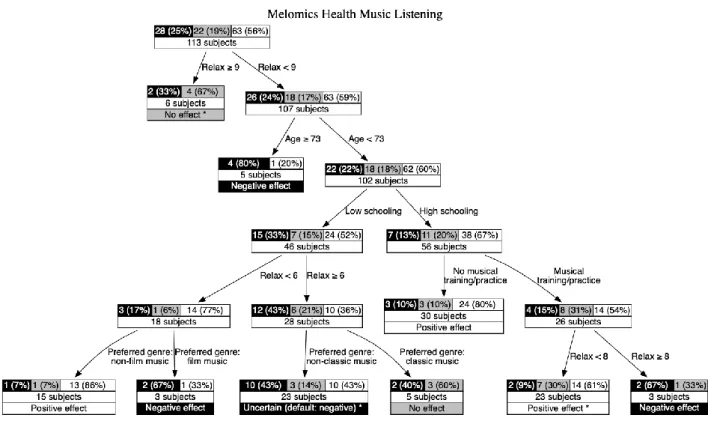
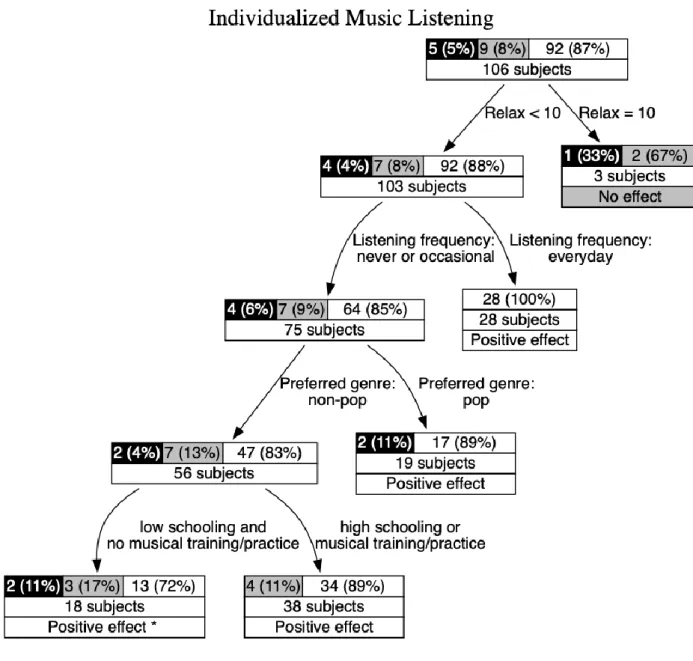
Table 4 summarized the most significant factors in the prediction of the changes in relaxation level, that, in order of importance were: a) relaxation level before music listening; b) type of music listening (individualized or Melomics-Health music listening); c) education and musical training/practice combination; d) age; e) music listening frequency; and f) music genre (mainly classical, pop, and film music). The decision tree is split in two because the root node corresponds to the type of listening (individualized or with Melomics-Health). Figure 2 shows the case in which the participants listened to Melomics-Health music and Figure 3 shows the case of individual listening. As a general observation, the section near the top of the decision tree in Figures 2 and 3 contains the most important and significant predictive factors (plus the decision to use individualized listening or Melomics-Health). The section near the bottom of the tree reports less relevant elements.
In more detail, in Figure 2, the first two splits are performed by relaxation level and age. The next factor appearing is the education level. There, for participants with low levels of education, the pre-listening relaxation level is the most significant factor, while in the case of higher education, it is superseded by the presence or absence of musical training. Figure 3 shows a less complex decision tree, in which the first splits are on the
relaxation levels and the listening frequency, followed by the musical genre (either pop or another kind of music) and by the level of education.
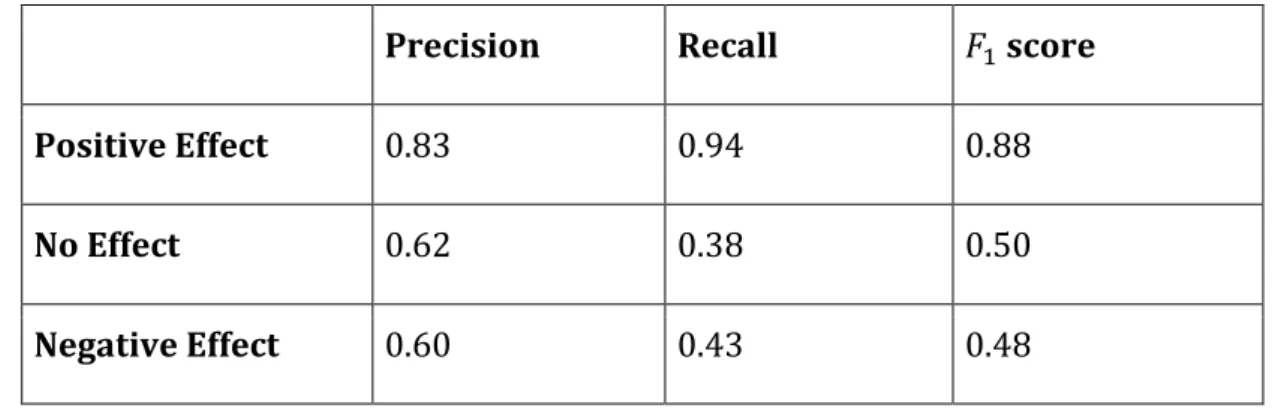
The results of the test set for the decision tree (Figures 2 and 3) are summarized in Table 5. We recall that to assess the quality of an ML model, its performances should be evaluated on previously unseen data (i.e., the test set).
The accuracy of the classifier on the test data is 0.79. The precision of a class 𝐶
indicates the fraction of correctly classified samples among the one identified as 𝐶. The recall measure of a class 𝐶 identifies the fraction of correctly classified samples among all the ones whose correct class is 𝐶. As a combination, the 𝐹1 score is defined as the harmonic average of precision and recall. All these measures are better when near one and worse when near zero. The leaves that produce the highest classification errors (>30%) on the test data are labeled with asterisks in Figures 2 and 3. The
the decision tree, but most of them can be traced back to four leaves (highlighted by asterisks in Figures 2 and 3).
Due to the “white box” nature of the decision tree, it is possible to derive the feature importance, which is the normalized total reduction of the measure used to select the split. Therefore, a higher value of feature importance corresponds to a higher reduction of the measure.
Discussion
This research showed how it is possible to find predictive factors that influence relaxation levels, thus answering the main research question of this study.
Among predictive factors, sex and some music genres (other than classical, pop, and film music) are not displayed. This can be explained by participants’ musical
preferences oriented to classical, pop, and film music. The influence of other genres on the results of music listening cannot be excluded if other music preferences are
expressed by participants.
The leaves where most of the misclassification errors happen correspond to situations in which the split (also on the training set) was not clear. This means that additional
factors (not registered in this study) might explain the errors in those specific cases. Of particular interest is the leftmost leaf node of the tree, where the maximum number of classification errors (in both absolute value and in percentage) is reached. In that case, we are considering participants who rarely listen to music, have no musical training, have a low level of education, and prefer non-pop music genres. These participants seem to be less sensitive to music listening, with the actual relaxation effect of a listening session more difficult to predict. These combined factors can be considered common in no-response participants. In fact, listening preferences and frequency seem to indicate that the participants are only rarely exposed to the music they prefer. Another possibility is that participants show a low level of sensitivity to music, which could be considered an exclusion criterion for music treatment when the target is increasing relaxation. Additional features could be considered to further improve the classification performances. In particular, personality factors might provide additional insight for the cases presenting a higher classification error.
Conclusion
This study shows which factors can influence the relaxation effect of individualized or algorithmic music listening via ML techniques. The use of ML techniques can
potentially be considered an important and innovative methodological approach in the field of music therapy to overcome the strong subjectivity of music listening choices. Thus, ML seems to be an important new supporting tool for music therapy intervention; ML methods can provide music therapy professionals with very important (though not strict) suggestions for music listening choices by identifying possible predictive factors of therapeutic success. Further studies, also in clinical settings, will be needed to validate these findings and methods.
Acknowledgements
Special thanks to Beatrice Barbano, Lorenzo Cela, Giulia Gontero, Anna Chiara Griesi, Lara Morotti, and Ester Pavlic for their contributions in questionnaire administration and data collection.
Declarations of interest: None.
Funding: This research did not receive any specific grants from funding agencies in the
References
[1] P. Pérez-Ros, L. Cubero-Plazas, T. Mejías-Serrano, C. Cunha, F.M.Martínez-Arnau, Preferred Music Listening Intervention in Nursing Home Residents with Cognitive Impairment: A Randomized Intervention Study, J Alzheimers Dis. (2019) in press, doi: 10.3233/JAD-190361.
[2] M. de Witte, A. Spruit, S. van Hooren, X. Moonen, G.J. Stams, Effects of Music Interventions on Stress-Related Outcomes: A Systematic Review and Two Meta-Analyses, Health Psychol Rev. (2019) 1-62, doi:10.1080/17437199.2019.1627897. [3] E.A. Garza-Villarreal, V. Pando, P. Vuust, C. Parsons, Music-Induced Analgesia in Chronic Pain Conditions: A Systematic Review and Meta-Analysis, Pain Physician. 20(7) (2017) 597-610.
[4] J. Bradt, C. Dileo, L. Magill, A. Teague, Music interventions for improving
psychological and physical outcomes in cancer patients, Cochrane Database Syst Rev. 8 (2016) CD006911, doi: 10.1002/14651858.
[5] J. Hole, M. Hirsch, E. Ball, C. Meads, Music as an aid for postoperative recovery in adults: a systematic review and meta-analysis, Lancet. 386(10004) (2015) 1659-71, doi: 10.1016/S0140-6736(15)60169-6.
[6] J. Bradt, C. Dileo, M. Shim, Music interventions for preoperative anxiety, Cochrane Database Syst Rev. (6) 2013 CD006908, doi:10.1002/14651858.CD006908.
[7] P. Kern, D.B. Tague, Music Therapy Practice Status and Trends Worldwide: An International Survey Study, J. Music Ther. 54(3) (2017) 255-286,
doi:10.1093/jmt/thx011.
[8] A. Raglio, O. Oasi, Music and health: what interventions for what results? Front. Psychol. 6 (2015) 230, doi:10.3389/fpsyg.2015.00230.
[9] L.A. Gerdner, Effects of individualized versus classical "relaxation" music on the frequency of agitation in elderly persons with Alzheimer's disease and related disorders, Int. Psychogeriatr. 12(1) (2000) 49-65.
[10] M. Clark, G. Isaacks-Downton, N. Wells, S. Redlin-Frazier, C. Eck, J.T. Hepworth, B. Chakravarthy, Use of preferred music to reduce emotional distress and symptom activity during radiation therapy, J. Music Ther. 43(3) (2006) 247-65.
[11] T. Särkämö, M. Tervaniemi, S. Laitinen, A. Forsblom, S. Soinila, M. Mikkonen, T. Autti, H.M. Silvennoinen, J. Erkkilä, M. Laine, I. Peretz, M. Hietanen, Music listening
enhances cognitive recovery and mood after middle cerebral artery stroke, Brain 131 (2008) 866-76, doi: 10.1093/brain/awn013.
[12] K.J. Kemper, C.A. Hamilton, T.W. McLean, J. Lovato, Impact of music on paediatric oncology outpatients, Pediatr. Res. 64 (1) (2008) 10–9, doi:
10.1203/PDR.0b013e318174e6fb.
[13] J.H. Lee, The Effects of Music on Pain: A Meta-Analysis, J. Music Ther. 53(4) (2016) 430-477, doi: 10.1093/jmt/thw012.
[14] N. Ames, R. Shuford, L. Yang, B. Moriyama, M. Frey, F. Wilson, T.
Sundaramurthi, D. Gori, A. Mannes, A. Ranucci, D. Koziol, G.R. Wallen, Music Listening Among Postoperative Patients in the Intensive Care Unit: A Randomized Controled Trial with Mixed-Methods Analysis, Integr. Med. Insights 12 (2017) 1178633717716455, doi: 10.1177/1178633717716455.
[15] J. Mackintosh, G. Cone, K. Harland, K.B. Sriram, Music reduces state anxiety scores in patients undergoing pleural procedures: a randomised controlled trial. Intern. Med. J. 48(9) (2018) 1041-1048, doi: 10.1111/imj.13738.
[16] A. Linnemann, M.B. Kappert, S. Fischer, J.M. Doerr, J. Strahler, U.M. Nater, The effects of music listening on pain and stress in the daily life of patients with
fibromyalgia syndrome, Front Hum Neurosci. (9) 2015 434, doi:10.3389/fnhum.2015.00434.
[17] A.Linnemann, B. Ditzen, J. Strahler, J.M. Doerr, U.M. Nater, Music listening as a means of stress reduction in daily life, Psychoneuroendocrinology. 60 (2015) 82-90. doi: 10.1016/j.psyneuen.2015.06.008.
[18] A. Raglio, F. Vico, Music and Technology: The Curative Algorithm, Front. Psychol. 8 (2017) 2055, doi: 10.3389/fpsyg.2017.02055.
[19] P.J. Rentfrow, S.D. Gosling, The do re mi's of everyday life: the structure and personality correlates of music preferences. J. Pers. Soc. Psychol. 84(6) (2003) 1236-56. [20] M. Kopacz, Personality and music preferences: the influence of personality traits on preferences regarding musical elements, J. Music Ther. 42(3) (2005) 216-39. [21] A.C. North, Individual differences in musical taste. Am. J. Psychol. 123(2) (2010) 199-208.
[22] J.K. Vuoskoski, T. Eerola, The role of mood and personality in the perception of emotions represented by music. Cortex 47(9) (2011) 1099-106, doi:
[23] P.J. Rentfrow, L.R. Goldberg, D.J. Levitin, The structure of musical preferences: a five-factor model, J. Pers. Soc. Psychol. 100(6) (2011) 1139-57, doi:
10.1037/a0022406.
[24] D.M. Greenberg, S. Baron-Cohen, D.J. Stillwell, M. Kosinski, P.J. Rentfrow, Musical Preferences are Linked to Cognitive Styles, PLoS One 10(7) (2015) e0131151, doi: 10.1371/journal.pone.0131151.
[25] N.N. Vempala, F.A. Russo, Modeling Music Emotion Judgments Using Machine Learning Methods, Front. Psychol. 8 (2017) 2239, doi: 10.3389/fpsyg.2017.02239. [26] T.M. Mitchell, Machine Learning, McGraw Hill Inc, New York, 1997.
[27] J. Friedman, T. Hastie, R. Tibshirani, The Elements of Statistical Learning, Springer New York Inc, New York, 2001.
[28] L. Breiman, J.H. Friedman, R.A. Olshen, C.J. Stone, Classification and Regression Trees, Wadsworth International Group, Belmont, USA, 1984.
[29] L. Rokach, O.Z. Maimon, Data mining with decision trees: theory and applications, World Scientific, Londres, 2008.
[30] S.R. Safavian, D. Landgrebe, A Survey of Decision Tree Classifier Methodology, IEEE Transactions on Systems, Man, and Cybernetics, 21(3) (1991) 660–674,
doi: 10.1109/21.97458.
[31] F. Pedregosa, G. Varoquaux, A. Gramfort, V. Michel, B. Thirion, O. Grisel, M. Blondel, P. Prettenhofer, R. Weiss, V. Dubourg, J. Vanderplas, A. Passos, D.
Cournapeau, M. Brucher, M. Perrot, E. Duchesnay, Scikit-Learn: Machine Learning in Python. Journal of Machine Learning Research 12 (2011) 2825–30.
Figure 1. Study design and participants allocation.
Legend: 320 = aparticipants to recruit; 160 = bparticipants with musical training or practice >3 years and cparticipants without musical training or practice; 80 = dmales and efemales; 40 = fparticipants 25-50 years old and gparticipants 51-75 years old; 20 = hparticipants with 0-11 years of education and iparticipants with > 11 years of education; RDZ = randomization; 10 = participants allocated to the individualized music listening group (IMLG) and participants allocated to the Melomics-Health group (MHG).
Figure 2. The decision tree resulting from the learning process for the participants of
the MHG. Each edge is labeled with a subset of possible values for an attribute, and each node contains the number of samples considered up to that point in the tree and their distribution among the three different classes. Each leaf node is also labeled with the classification choice. (White= positive effect; Black= negative effect; Grey= no effect)
Figure 3. The decision tree resulting from the learning process for the participants of
the IMLG. As in Figure 2, each edge is labeled with a subset of possible values for an attribute, and each node contains the number of samples considered up to that point in the tree and their distribution among the three different classes. Each leaf node is also labeled with the classification choice. (White= positive effect; Black= negative effect; Grey= no effect)
Table 1. Age distribution of all the participants to the study.
Age 0-24 25-44 45-64 65-74 75+
Number of
Participants 0 109 141 59 5
Table 2. Distributions of the education levels, the musical training and the sex
among the participants.
Years of education Musical Training Sex
Number of Participants
163 (> 11 years) 156 (with training) 162
(Females)
Table 3. Distribution of the VAS scores. From left to right: pre-listening relaxation
level for Melomics Health and for Individualized listening, post-listening relaxation level for Melomics Health and for Individualized listening.
Pre-listening VAS scores Post-listening VAS scores VAS score Melomics
Health Individualized listening Melomics Health Individualized listening 0 1 0 3 0 1 3 2 1 0 2 6 4 8 1 3 13 13 8 1 4 13 13 10 1 5 27 32 10 8 6 37 45 28 21 7 25 21 30 16 8 20 22 30 36 9 10 8 22 37 10 2 4 7 43
Table 4. The feature importance of the attributes considered, sorted in order of
decreasing importance. The features not appearing in the table also do not appear in the tree and have an importance of 0.
Attribute Feature Importance
Pre-listening relaxation 0.338
Type of listening 0.243
Education and musical training 0.139
Age 0.066
Listening frequency 0.064
Classical music as preferred 0.061
Pop music as preferred 0.045
Film music as preferred 0.044
Table 5. A summary of the results, showing precision, recall, and 𝐹1 score for each class.
Precision Recall 𝐹1 score
Positive Effect 0.83 0.94 0.88
No Effect 0.62 0.38 0.50