Pergamon
This paper presents an evaluation of a technique used in land consolidation projects (LCPs) to identify the ways by which characteristics and perceptions of individuals influence their propensity to adopt innovations. We investigate the influence of household characteris- tics on the adoption of selected agri- cultural innovations in Valenqa-LCP (northwest Portugal). At the project scale it appears that younger, better educated household heads who have farmed all their lives, on large holdings, producing prlmarily for the market, are the most likely to adopt new agricultu- ral equipment and technology.
J C Coelho and P A Pinto are, respective- ly, Assistant and Associate Professors at lnstituto Superior de Agronomia, Unversi- dade Tecnica de Lisboa (ISANTL), Tapa- da da Adiuda 1399. Lisboa Codex. Portu- gal. J. Pbrtela is Associate Professor at Universidade de Tras-os-Montes e Alto Douro (UTAD), Quinta de Prados, 5000 Vila Real, Portugal.
‘King, R L and Burton, S P An Introduction to the Geography of Land fragmentation and Consolidation Occasional Paper 8, Leicester University Department of Geography, Leicester (1981)
‘Binns, B 0 The Consolidation of Frag- mented Agricultural Ho/dings FAO Agri- cultural Studies Washington (1950)
continued on page 130
0264-8377(95)00037-2
Land Use Policy, Vol. 13, No. 2, pp. 12%147, 1996 Copyright (Q 1996 Elsevier Science Ltd Printed in Great Britain. All rights reserved
0264-8377/96 $15.00 + 0.00
A social approach
land consolidation
schemes
toA Portuguese case
Valenqa Project
study: the
Jo& Castro Coelho, JosC Portela and P Aguiar Pinto
Introduction
Land consolidation (LC) is a spatial problem-solving technique that attempts to eliminate certain types of land fragmentation through a process of concentration of plots. Land consolidation projects (LCPs) are the actual action of spatial concentration, which is usually accompa- nied by the construction of new roads, irrigation facilities and other auxiliary services.’ According to Binns ,2 fragmentation can be defined as a stage of the evolution of an agricultural holding where a single farm consists of numerous discrete parcels, often scattered over a wide area, and four general types can be distinguished: the fragmentation that is unavoidable due to natural conditions; the one that is justified by reasons of agricultural convenience or efficiency (for example, due to crop rotation); the fragmentation that arises from physical conditions created by human activity unconnected to agriculture, for instance, construction of roads, railways, water channels, etc; and, finally, the one that is neither related to any rationale nor to the other reasons. Obviously, LC can be seen as the solution for these last two types of fragmentation.
Studies of LC schemes have tended, as it is suggested from Binn’s quotation, to concentrate on the physical environment and economic effects, ignoring social factors. Although economic factors are import- ant for an evaluation of LC, it must not be forgotten that farms function within more general social systems. Thus, an understanding of these social systems should be incorporated into any agricultural study.3 Portela4 argues that, while economic, physical and environmental factors are important in an evaluation of LC, sociology offers com- plementary insights into human behaviour in rural life and farming. It
Sociul approach to land consolidurion schemes: J C Coelho. J Portelu and P A Pinto
also provides a more informed basis for the economist’s assumptions about social structures and human motivation and helps in the consid- eration of non-economic variation in human behaviour. It is unquestion- able that evaluation studies of LC schemes pose multidisciplinary problems, where thematic rather than disciplinary views are needed.” Tarran recognizes three possible approaches to the estimation of farmers’ reactions. The first assumes that the physical environment controls agricultural decision-making. The second can be called econo-
mic determinism and assumes that producers react uniformly and
rationally to economic circumstances. The third recognizes a further set of influences on agricultural decision, including the values of individual farmers and their aims, attitudes and perceptions, all of which are important in the final spatial structure of farmland. Portela’ emphasizes that not only geography and agronomy are indispensable tools for LCP’s problem-solving; sociology is also crucial. Every LC intervention changes not only the physical, biological and structural environment, but the human, social and economic milieu as well. Besides the physical and agronomic analyses, it is also necessary to know and understand the land tenure system and inheritance laws. All these influences are likely to be strengthened by demographic growth, particularly, where alterna- tive sources of employment are lacking.
continued from page 729
3Gasson, R ‘Goals and values of farmers’ Journal of Agricultural Economics 1973 24 521-524
4Portela, J ‘Reestrutura@o fundiaria em Portugal: dez pontos para reflexao’ Cader- nos de Ci&cias Sociais 1993 14 49-82 ‘Coelho, J C An#se de frojectos de Emparcelamento Rural: 0 Caso de Valen- ca do Minho. Disserta@o apresentada para a obten@o do grau de Doutor. ISA, UTL, Lisboa (1992)
6Tarrant, J R Agricultural Geography David and Charles, Newton Abbot (1974) ‘Portela, J lnvestigadores e Agricultores; Tese. Antftese e Sfntesel Comunicacao apresentada & II Confer&ncia National dos
Economistas Lisboa, unpublished (1984) ‘Jacoby, E H Land Consolidation in Europe International Institute for Land Re- clamation and Improvement, Wageningen (1959)
In this work we study the role that social factors play in the acceptance or rejection of an LCP and in the farmers’ ability to respond positively to changes in farm structure. This is a crucial problem when trying to evaluate the economic viability of LCPs. Ex ante evaluation of an LCP involves the definition, description and quantification of its effects. The usual procedure of project evaluation compares just the situations ‘without’ or ‘before’ versus ‘with’ or ‘after’ the LCP imple- mentation. A better procedure considers as a basic rule to see whether an effect is caused by the LCP, which consists of comparing the situation ‘after’ the LCP to the (hypothetical) development of the area if the project is not executed. Nevertheless, they normally do consider that the situation ‘after’ the LCP is deterministic and strictly based on economic rationality. Therefore, what becomes clear so far is that, in an ex ante evaluation, the results of the two situations need to be simulated
and compared as A: situation without the LCP but with autonomous development of the area (simulation); and B: situation with the LCP (simulation).
In our opinion, a more accurate simulation of these scenarios could be done if it is based on the sociological characteristics and the past dynamics of adoption of agricultural innovations of the farmers in- volved.
Social factors and agricultural change
‘Chisholm, M Rural Settlement and Land Use: an Essay in Location Hutchinson, London (1979)
Several authors point out that land fragmentation is a result of social factors,x,y but the literature review reveals a lack of knowledge as to the effects of such a phenomenon on rural social systems. As to this, one finds very broad comments, and authors tend to ignore social and cultural behaviour that promote social adjustments to fragmentation. The morgadio, a Portuguese custom of concentrating the inherited land on the eldest son, the marriages among individuals of the same social level and the Islamic practice of marriages between cousins are cases in point.
Social approach to land consolidation schemes: J C Coelho, J Portela and P A Pinto
Some other works, which do not deal specifically with LC
problems, ‘“,’ ’ tried to show the importance of social factors, such as age, education, stage in life cycle, attitude towards agriculture, mod- ernization and extension services in agricultural change. In many rural communities, change is looked upon with great precaution, particularly by the social and economically disfavoured, who are powerless and may suffer much from taking risks. This is perfectly understandable and justifiable, since one of the essential requisites of society’s normal functioning is the continuity of certain equilibrium already tested, what can be called ‘tradition’. The ‘new’ generates risks and additional uncertainties, and thk individual might be unprepared to innovate. This may imply not only economic risks, but it may also jeopardize one’s acquired status and prestige within society.
Among other scholars, Raup” noted that farmers who own large farms are more dynamic in the adoption of technological innovations. Their higher degree of education increases awareness of technical progress; their higher tendency to take risks as well as an easier access to capital allows them to adopt new technologies faster. Yet the low adoption rate of new technologies among small farmers does not lie only in their lack of motivation, or in their fear of change, but mainly in the fact that those innovations are generally directed and tested towards the large farm. In this vein, Yapa” has classified innovations into three types: peasant-biased labour augmenting innovations, neutral innova- tions and landlord-biased material augmenting innovations. Exemplify- ing with the Green Revolution case, he argues that the package of high-yielding seed varieties, fertilizers, irrigation, pesticides and herbi- cides has given a strong capital material bias to the changes that have taken place, and that consequently landlords have benefited the most.
“Caldas, E C A Difus& de T6cnicas e de Conhecimentos entre OS Agricultores; Aspectors Sociotbgicos FundaCao Calouste Gulbenkian, CEEA, Lisboa (1964)
“Unwin, T ‘individuals and the adoption of agrarian innovations’ Papers in Geogra- phy 17 Bedford College, London (1985a) “Raup P M ‘Societal goals in farm size’ in Ball, A’G and Heady, E 0 (eds) Size, Structure and Future of Farms Iowa State University Press, Ames, IA (1972) 3-18 13Yapa, T ‘Ecopolitical economy of the Green Revolution’ Professional Geog- rapher 1979 31 371-376
‘?lbery, B W ‘Point score analysis: a methodological framework for analysing the decision-making process in agriculture’
Tijdschrift voor Econ. en Sot. Geografie 1977a 66 (2) 66-71
15Morgan, W B and Munton, R C Agricultu- ral Geography Methuen, London (1971) ‘%aup op tit Ref 12
17Loomis, R S ‘Traditional agriculture in America’ Ann. Rev. Ecol. Syst. 1984 15 449-78
Information: a crucial requisite for an LCP
Much work has been done to demonstrate that expectations and values play an important role in rural people’s behaviour.14 The availability and uses of information are also key factors in the process of perception of socio-economic change, and this is especially the case in government promoted policies, such as LC. According to Morgan and Mutton,‘” and as this Portuguese case study well shows, information sources might be classified into two main groups: internal and external to the agricultural society. The former is based on the contact among farmers, and the second is constituted by mass media communication and extension services. Information acceptance depends not only on its source, but also on its content, particularly, its novelty. If the idea that is communi- cated just completes or amplifies a known technique, it is more likely that the farmer will accept and adopt it than if the concept is entirely new. In the former case, he will also require less information before acceptance and adoption of the idea. At the same time, farmers have characteristics, such as education. age, stage in life-cycle, etc, that exert a decisive influence in the way they look for and act upon information. For instance, due to their more advanced stage in life-cycle, older farmers are generally less willing to take great risks, as it happens particularly in the case of an LCP, where there is much at stake.
Raup” calls attention to the direct relationship between the amount of available information and farm size. Loomis” points out that the basic problem derives from the fact that information is not equally
Social approach to land consolidation schemes: J C Coelho. J Portela and P A Pinto
‘BEveraet, H ‘Attitudes of farmers to land consolidation: a sociological survey in the study area of eastern Flanders’ Cahiers de
I’lnstitut Economique Agricole 172/W-1 44 57p 1974 Brussels
‘gBurton, S and King, R ‘Land fragmenta- tion and consolidation in Cyprus: a de- scriptive evaluation’ Agricultural Adminis- tration 1982 11 183-200
20Burton, S P ‘Land consolidation in Cyp- rus: a vital policy for rural reconstruction’ Land Use Policy 1988 131-l 47
“Unwin, T ‘Farmers perceptions of agra- rian change in north-west Portugal’ Jour-
nal of Rural Studies 1985b 1 (4) 339-357 “Burton and King op tit Ref 19
23Rogers, E M Diffusion of Innovations
Free Press, New York (1983)
available to all farms, since sales volume might allow for the presence of specialized management skills-from bookkeepers and other financial experts to professional agronomists. Even among farms with no means to establish contracts of technical assistance, one can verify that information is not equally available. As a matter of fact, government extension agents tend to contact farmers in a selective fashion, serving mainly large farmers, those that have profitable enterprises and are market-oriented.
A model of farmer behaviour
Several studies have attempted to link attitudes towards LC with social and economic characteristics. 1&Z’ In theory, a behavioural perspective on LC should allow both a more detailed and clearer picture of the effects of the emerging consolidation process. Personal and social characteristics of farmers included in the project goal must be identified and linked to variation in the adaptation and change capacity towards the new environment. In spite of very few studies on the subject, the general knowledge about farmer behaviour and Burton and King’s22 work indicate that a large part of the response to the LC process might be forecast as a function of farmers’ stage in life-cycle and their perception about the process. According to this hypothesis, it would be possible to link farmers’ attitude and behaviour towards agriculture modernization to a set of easily measurable social and economical variables, such as education, stage in life-cycle, etc, and preview the response of a given group of farmers to an actual LC action. In this type of study, a general tendency is to express social systems as a function of a small number of variables and their relationships. A model of this kind might arise from the attempt to build an index of adhesion to the LCP, which would be made of a mix of information from each individual farmer on the perception of its advantages and disadvantages and their own future projects. Such an index would, therefore, reflect the rate of the process of change initiated with the LC.
The classical Rogers2” scheme of classification considers five classes as a function of the personality and behaviour of those who are included. Thus, the innovative group has been identified with a ‘venturesome’ personality, which must be occasionally cautioned in order to avoid risks due to an optimistic appreciation of the viability of the new technolo- gies. The early birds correspond to farmers that own large farms (‘respectable’); they show the effect of the imposed changes sooner because, using their higher economic capacity, they always try to adopt profitable innovations in their production systems. The first wave adopters are characterized by the caution and reflection used in their options (‘deliberate’). They generally come from an average social stratum and constitute the safest class to use as innovation spreaders. The second wave adherents are characterized mainly by their skepticism’ (‘skeptical’) and are presented as deeply conservative and traditional ‘traditional’).
Given its idealistic and arbitrary nature, this classification scheme must be looked upon with caution. It is possible that in different situations the process of adoption might include unexpected and contra- dictory responses. It is also important to avoid making qualifying judgments of the diverse classes based on mental correlation, such as ‘innovative is good and latecomer is bad’. For this purpose it is useful to
Social approach to land consolidation schemes: J C Coelho, J Portela and P A Pinto
Viana do Castelo district
Figure 1. Location of the Land Consolidation Project of Valeqa.
quote Unwin:24 ‘. . . Much research is aimed at finding out why laggards do not adopt innovations earlier, so that in the future such people can be persuaded more rapidly to adopt new innovations. The very good reasons why many “peasants” do not adopt innovations are frequently ignored. , . .’
Valenga-LCP: the case study2’
Socio-economic context of the LCP
As a consequence of multiple factors (for instance, topography, scat- tered habitat, demographic pressure on land resources, laws of inheri- tance and endowment of patrimony), farmland in northwest Portugal is divided into very many small farms, which are scattered in numerous non-contiguous plots. This is widely seen as unfavourable for efficient agriculture. A group of farmers of the municipality of Valenca shared this view and, in conjunction with the Portuguese LC authorities, approved a specific LCP for an area of 300 ha, which is located in the valley of the Minho River, along the border with Spain (see Figure 1). The Valenca-LCP had a global nature and provided the means (legal, financial, technical, etc) to assure the ‘combination’ of the scattered parcels of the concerned owners, the construction and/or the improve- ment of the access to the consolidation area (via roads and small bridges) and of the irrigation and drainage systems.
The LCP has been perceived as a way of counteracting the prevailing local situation to a certain extent. Local farming is suffering from a Wnwin op tit Ref 11 process of fast decline, which is reinforced by the exodus of its work 25All data presented here comes from the force to other jobs. These are related to both the emigration and the work of Coelho op tit Ref 5. notorious development of commercial activities and small industries in
Social approach to land consolidation schemes: J C Coelho, J Portela and P A Pinto ,... housing and horticulture land Energy & Capital F I I I , b 1 I I I bushy t forest land )
vegetation 4 vineyard land ) maize and forage land
* W
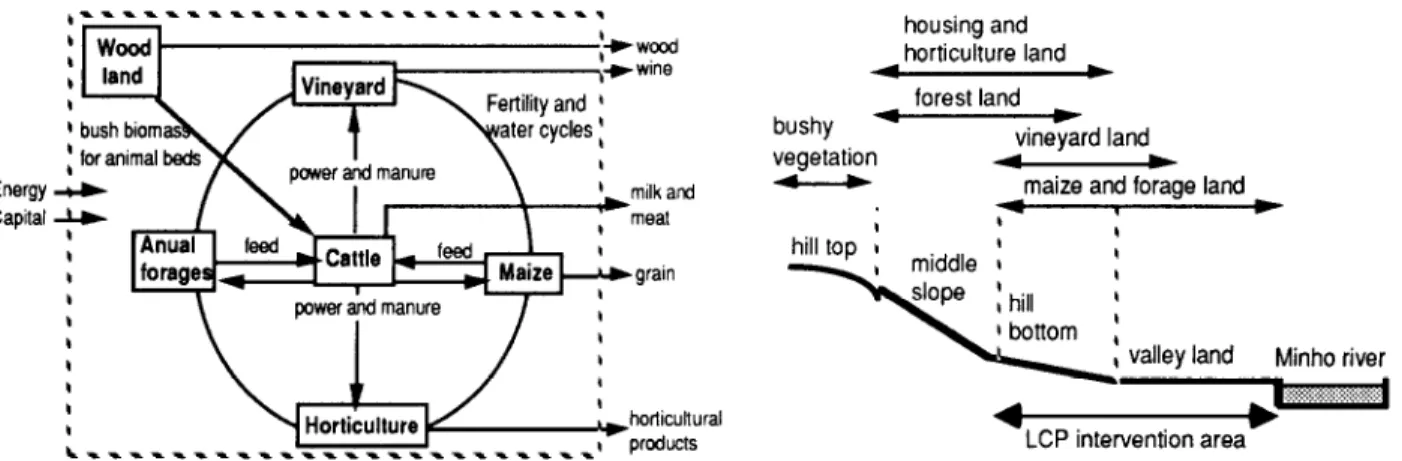
Figure 2. Farming system (left) and soil utilization (right) of the Valerqa-LCP area.
26The freguesia is the smallest administra- tive territorial division in use in Portugal, which formerly coincided to a parish. Our sample is from Ganfei.
27Marten, G G ‘Productivity, sustainbility, equity and autonomy as properties for agroecosystem assessment’ Agricultural systems 1988 26 291-3 16
Valenca, one of the busiest towns in the country’s border. As opposed to the neighbouring municipalities, such a development results from the offer of several historical and tourist landmarks.
In the freguesia of Ganfei,26 families are small (1.67 members average), have no children at home (70%), and their members tend to be old. On average, the household head age is 63 years. The education level is very low (40% of the household heads had no formal education), and the majority of the farmers are functionally illiterate. Most of those working in the farm are kin-related and work full time (93%). Their productions are primarily consumed at home (79%). Part-time farmers (7%) usually only grow a small horticultural plot (leido) for self- consumption. Their land is either cultivated by farmers that pay no rent or is left uncultivated.
The farming system in the project area (Figure 2) has been long established, and, according to Marten’s*’ criteria, it can be classified as low productive, sustainable and autonomous. Almost two-thirds of the agricultural area included in the Valenca-LCP is planted with maize, mostly double-cropped with green forages or hay. Both maize and forages are mostly used on farms as animal feed, and a small part of the maize might be used to make bread. Vineyards occupy an additional 25% of the farm area, and wine accounts for about one-third of the region’s gross agricultural product. Animal and wine production, there- fore, dominate the region’s farming system. Horticulture and fruit trees occupy 9% of the farm area, always close near the household, and the products are almost entirely for self-consumption.
Farm wage-workers are practically non-existent, but exchange labour among neighbours is common, particularly in peak periods. Tasks related to maize harvesting and crushing of grapes are cases in point. The few existing wage-workers are employed in a daily or task basis and for manual operations such as maize cultivation and vineyard pruning and cultivation. Usually, the payment includes one main meal and wine. Draught-cows are used for most farm operations, but some opera- tions are mechanized (for example, soil tillage and harvesting of forage and maize). In Ganfei there are 18 tractors, 12 of which belong to farmers who rent them, thus having a complementary source of income. Apparently, there are no problems in assuring the rental of the proper machinery in the right occasion. In order to reduce costs, farmers only rent machinery for the most power consuming or difficult tasks, and
Social approach to land consolidation schemes: .I C Coelho, J Portela and P A Pinto there is always the concern of using it in the most regular and better dimensioned plots.
Seeds, fertilizers, pesticides and animal feed are usually bought in the local cooperative. Due to their low quality some products are not easily marketed or do not get a good price. In the project area, wine is made at the farmers’ households, and it is extracted from a mixture of several grape varieties, including some that are not recommended or even
authorized. So wine production is mainly oriented towards self-
consumption. Occasionally, neighbouring farmers and local merchants
may become buyers. Milk is sold to AGROS (a large union of
cooperatives) that has a local collecting stand. The milk is collected twice daily.
The sale of animals, mainly beef cattle, is directed towards mer- chants. Most of these come from Ponte de Lima, a not distant urban center. Normally, farmers sell one or more animals, which weigh around 500 kg. As a rule, they acquire simultaneously the same number of calves, in order to restore their herd. These may weigh around 150 kg. The two transactions are done via cattle merchants, who act as middle-men between farmers and butchers. Their good knowledge of the availability of cattle in the region allow them such roles.
Land structure and water rights
In Valenga municipality land fragmentation has been particularly inten- sive for a long time. In 1979, 82% of the farms were smaller than 2 ha, and there were, on average, 9.5 plots per farm. This situation has remained practically unchanged according to the National Statistics Institute. In the specific case of the LCP area, the problem of frag- mentation is even more severe. The area of 300 ha was controlled by 900 landowners and used by 363 farmers. The average farm size as 0.826 ha, which was divided into 3.75 plots per farm.
This is the result of the general inheritance pattern, which splits the land by patrimony into equal shares, resulting in a farm division whenever there is more than one heir. The only current exception occurs when one of the heirs intends to be a farmer and he is able to negotiate and compensate the remaining heirs with commonly agreed capital assets. Two or three decades ago, however, every heir would want to own land and even a fraction of every plot, particularly if it was perceived as a good one. Nowadays, plots are not divided further. Instead, they are endowed as elements of relatively homogeneous sets, these being evenly distributed among the heirs, who draw their share by chance.
The plots in the project area are served either by wells (‘private water’) and/or a farmer-managed irrigation system, in which two water allocation principles28 are established: ‘times shares’ (giro) and ‘free-to- take’ (tapa-tapa, torna-torna or pifha-pilha). The giro consists of the common use of a water line by all the neighbouring plots. In a cyclic sequence, usually every 14 or 21 days, plots are entitled to use the whole scheme flow for a given time period, which depends on the crop and plot size. This water right might be recognized in the land property registra- tion. Under the tapa-tapa regime, any owner of a potential irrigated plot has the right to use the scheme flow ad Zibitum whenever he wants. The only rule is to restore the normal water flow after utilization. These two ‘*Concerning a classification of water principles are the most common and are associated with distinct climatic allocation principles in northeast Portugal. conditions. During dry periods, the giro replaces the tapa-tapa. which is
Social approach IO land consolidation schemes: J C Coelho, J Portela and PA Pinto
more common during periods when water is relatively abundant. Yearly maintenance of the irrigation system takes place by St John’s day (24 June). At least one person per household having water rights provides work for the cleaning of the water bed, from its origin to the earthen reservoir @~a). From there on, maintenance is up to the individual farmer. This collective system is becoming inefficient because there are many absent landowners who do not cooperate in the maintenance. Therefore, each year the lack of water is felt more intensively. This is one of the reasons for the low productivity of maize in the most fertile lands, which are located at the head end. Here the irrigation water is particularly scarce.
Land market
The availability of land for rent has increased recently. This results from several motives, particularly migration, increase of local demand of off-farm work, aging of rural population, continued degradation of infrastructures and steady decrease of the profitability of farms. All these reasons are important per se, but a synergetic effect appears when they are taken together. For instance, if emigration contributes to alleviate the demographic pressure on the land, because it is a highly differentiated phenomena between the age classes of the active popula- tion, it also implies a significant decrease of the work force available. In turn, this undermines the feasibility of the highly labour-intensive farming system. This is a very common situation, and, given the generally small capital resources of those farms, it is not opposed by substituting capital for labour.
The increase of farm land availability has been accompanied by changes in lease agreements. The land rents decreased from the customary basis of 50% of net income to 30%. Now, in some cases, land rents have vanished. Land offer largely exceeds demand, and sometimes it is given free to those farmers who want to cultivate it. Absentee landowners, particularly emigrants, try to avoid that plots remain uncultivated, thus downgrading their farming value.
The tendency to offer free-rent land is favoured by both the low crop yields and the difficulty of mechanizing farm operations. Plot size, shape and spatial location make it difficult. It is common to find plots with no proper access, which are rectangular-shaped and less than 10 m wide, with orientation perpendicular to the margin of the river and smaller than 2000 m*. Land investments are practically non-existent, except in a few cases that are related to the plantation of vineyards.
In contrast with the farmland rental market, the farmland sales market is characterized by high prices and very low levels of activity. Within the project area, the land prices have been established by a commission of farmers and vary between 40 and 80 escudos per m*, depending on soil quality and proximity to the town of Valenca. These prices are strongly inflated as compared to expected net income flows. Much of this price premium may be attributed to non-income sources of owners satisfaction. Land is commonly viewed as a safety net during uncertain economic times, as is the case in Valenca-LCP. Moreover, land ownership, unlike ownership of other factors of production, is a source of personal pride and evidence of accomplishment. This pride of ownership is enhanced by the fact that land can serve as the basis of inheritance for potential heirs. These non-income sources of value can be thought of as the ‘intrinsic value’ associated with land ownership.
%oelho op tit Fief 5
Social approach to land consolidation schemes: J C Coelho, J Portela and P A Pinto A sociological approach to the Valeqa-LCP
Linking the above remarks to our LC study, three areas of research were pursued, which were:
??relations between the social and economic characteristics of the farmers, farm structure and the dynamics of the innovation adoption process (analysis of the past evolution and prediction of the future evolution);
??the identification and measurement of the perceived image of LCP. This may help explain variations in response to the LCP itself. Moreover, changes in attitude towards general and specific farming operations must be identified if the general effects of the LCP are to be understood; and
??implications of sociological characteristics on the economic viability of the Valenca-LCP.
The main agricultural change that took place in recent years was the introduction of machinery, especially the tractor. Nowadays, it assumes an irreplaceable role, since labour availability and the number of draught-animals tend to decrease. Hybrid maize is also an important novelty. However, the results of its introduction are very modest, particularly due to a generalized lack of water in the best soils. Next, and with equal relevance, the farmers interviewed indicate several agricultural innovations: the new soil fertilization practices, mainly the use of NPK fertilizers, vineyard herbicides and artificial insemination. The milk production was greatly increased in the 1970s when the local cooperative joined AGROS. Nevertheless, it did not have a strong productive impact, since the average milk performance (8 l/cow/day) is still very low.
The prognosis of the adoption of new technologies is, of course, an uncertain exercise, because the full set of future technological alter- natives is unknown in advance. We believe that the more important short- and medium-run changes are available from transfers of already known technologies. Within the agricultural area of the Valenca-LCP, these may include fertilizers, tractors, herbicides, irrigation pumps, hybrid maize and two vineyard trellises (cruzeta and co&o). These technological alternatives are already being used with success in north- erii Portugal, but the problem of wider dissemination and adoption still remains.
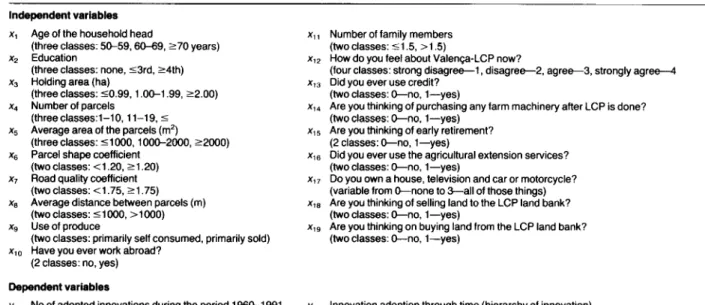
Centering the analysis in these innovations, one can raise the ques- tion: Do the social, economic and structural characteristics of both the farm and the household interfere with the adoption of innovations? From this question, we propose to study a specific hypothesis related to each one of the characteristics under study. Is it possible, from the knowledge of farm characteristics (independent variable Xi), to infer about the innovations adopted or the rate of innovation (dependent variable yi) in that farm? The analysis includes the study of the variables described in Table 1.
Material and methods
In order to acquire more detailed information about farms (household characteristics, the structure of holdings, variations in management and production technologies, as well as patterns of resource use, especially land and labour) a survey of the Valensa-LCP area was carried out in 1988 and 1991. The survey was conducted by one of the authors,29 and,
Social approach to land consolidation schemes: J C Coelho, J Porrela and PA Pinto Table I. List of variables used in the analysis of the innovation adoption.
Independent variables
Age of the household head
(three classes: S59,60-69,?70 years) Education
(three classes: none, 13rd, 24th) Holding area (ha)
(three classes: 50.99. 1.00-i .99, 22.00) Number of parcels
(three classes:&10, 1 i-19. 5 Average area of the parcels (m’) (three classes: ~1000,1000-2000,~2000) Parcel shape coefficient
(two classes: <I .2O,z1.20) Road quality coefficient (two classes: < 1.75, 2 1.75) Average distance between parcels (m) (twoclasses: 11000, >lOOO) Use of produce
(two classes: primarily self consumed, primarily sold) Have you ever work abroad?
(2 classes: no, yes)
x11 x12 x13 x14 x15 X16 x17 XV3 x19 Dependent variables
y, No of adopted innovations during the period 1960-l 991 y2 Innovation adoption through time (hierarchy of innovation) Number of family members
(two classes: 51.5, >I .5)
How do you feel about ValenCa-LCP now?
(four classes: strong disagree-l, disagree-2. agree-3, strongly agreti Did you ever use credit?
(two classes: O-no, i-yes)
Are you thinking of purchasing any farm machinery after LCP is done? (two classes: O-no, i-yes)
Are you thinking of early retirement? (2 classes: O-no, l-yes)
Did you ever use the agricultural extension services? (two classes: O-no, l-yes)
Do you own a house, television and car or motorcycle? (variable from O-none to 3-all of those things) Are you thinking of selling land to the LCP land bank? (two classes: O-no, l-yes)
Are you thinking on buying land from the LCP land bank? (two classes: O-no, l-yes)
The estimate of the household size was based on the assumption that a man, when working full time in the farm, is equivalent to one man-labour unit (MLU) and a women, sharing her time between home chores and farm work, is equivalent to 0.5 MLU. In this way, a household of 1.5 size corresponds to a couple without children at home, while a size 3.0 corresponds to a couple with two children, a boy and a girl, that have already completed compulsory school.
out of a total of 363 farm households, 29 farmers were interviewed. These producers represent 8% of the total number of farmers and 18.5% of the total farm area. Sample selection incorporated the major known sources of variation in the area: farm size and age of the householder (see Table 2).
Table 3 identifies the sampled farms and summarizes their character- istics before and after the LCP.
Before the LCP, the average farm area is scattered into 12.6 plots of 0.15 ha each. After the LCP, the expectation is that it will be reduced to 6.2 more regular field plots of 0.37 ha each. The LCP will have two other tangible effects: the average distance between the farmstead and the field plots will decrease from 1.19 km to 0.83 km, and, due to road quality improvement, the average transportation time requirement will be reduced by 52%.
Table 2. Distribution of farms by size and age of the householder in the study area of the Valenw-LCP.
Corresponding values from the sample studied parentheses. are within Housholder age class 559 60-69 570 Subtotals
Class of farm size (ha)
SO.99 1.00-I .99 r2.00 Subtotals
no. % no. 96 no. % no. %
42(4) 12 49(4) 13 50(3) 14 141(11) 39 43(4) 12 49(4) 13 50(4) 14 142(12) 39 24(1 I 3: 2f3M : 26(3) 2 60(6) 22 109(9) 126(10) 126(10) 35 363(29) 100
Table 3. Farm characterization before (A) and after(B) the Valenpa-LCP.
Simulation A B Total agricultural area (ha) 55.5 66.6 Total number of parcels 365 180 Average number of parcels/farms 12.6 6.2 Averages characteristics
area (ha) distance (km)
0.15 1.19 0.37 0.83 Road quality coefficient 1.52 1 .oo Parcel shape cosfficient 1.16 1.13
Social approach to land consolidation schemes: J C Coelho, J Portela and PA Pinto Ilbery,‘“,31 Unwin32 and 0ppenheim33 identify, describe and analyze several methods of questionnaire design applicable in this type of study.
The questionnaire applied here draws on that experience and is
composed of three parts. The first is composed by 20 closed and mixed questions aiming to collect detailed information about the sample, such as data related to the farmer, his family, farm structure, crops, etc. This questionnaire took place in the winter of 1987/88. The second part includes four questions aimed at getting farmers’ views about the LCP, including a ‘Likert’ scale. The interviewee is asked to state his opinion about the project in a 5 item scale--strongly agree, agree, do not know, disagree and strongly disagree-marked 4 to 0, respectively. Finally, the third part is composed of another two scales of the ‘Likert’ type, having 11 and 18 items, respectively. The first aims to estimate the relative importance of several limiting factors to the local agriculture. The second scale, largely based on the work of Burton and King34 aims to estimate the farmers’ perception of both the benefits and losses associ- ated with the implementation of the LCP. The second and third set of questions were raised in October 1991. Data treatment involved: descriptive and analytical statistics of farmer characterization; analytical statistics of the grades obtained with the several scales used; principal components analysis as an exploratory method of the relative import- ance of the variables involved in the process of innovation adoption; cluster analysis to establish groups based on objective criteria; and linear regression analysis (stepwise regression) for the election of the independent variables in the model of the process of innovation adoption.
Since data on characterization of individuals is not normally distri- buted, depending on each specific case, non-parametric tests were used, such as the chi-square and the Kolmogorov-Smirnov tests. In the cases where the test was significant, a residual analysis was performed in order to verify the relationship among variables. Where point scores were used, a total score for each factor was also calculated. These factors were then ranked in order of magnitude, and according to van der Vliet,‘s three indices were calculated: Total Percentage (%T), Percentage of Applicability (%A), and Percentage of Importance (%I). The study of innovation adoption was based on the analysis of two dependent variables: the number of innovations adopted and the rate of innovation adoption, as determined by the variable Innovation Hierarchy, which is a measure of the order by which each farmer adopted each innovation. The cluster analysis, performed after the principal components analysis, is of the sequential agglomeration type, where groups are formed in sequential steps in accordance to a proximity criteria. The contribution of each independent variable to the explanation of the Innovation Hierarchy was evaluated by stepwise regression. The goodness of fit of the selected regression equations is evaluated by the determination coefficient (2) and Fisher’s test probability level.
The empirical analysis of the impact of the LCP requires identifica- tion and description of the main crop technologies, in order that the importance of changing trends in crop, technology and profitability in different farms under the structural reorganization of the area might be assessed. The survey also provided valuable data for the definition of representative farming systems, which resulted from varied combina- tions of crop technologies (Table 4).
3011bery, B W ‘The application of non- parametric measures of association in geography: a comparison of three techni- ques’ Area 1977b 9 99-l 03
3’llbery, B W Agricultural Geography: A Social and Economic Analysis Oxford Uni- versity Press, New York (1985)
32Unwin, T ‘Household characteristics and agrarian innovation adoption in north-west Portugal’ Trans. of the Inst. Br Geogr. 1986 12 (2) 131-146
330ppenheim, A N Questionnaire Design and Attitude Measurement Gower Pub- lishing Company Limited, London (1986) 34Burton and King op tit Ref 19
35van der Vliet, E ‘The nature of farming on south-west Gower: a study of some factors influencing farmers choice of enterprise’ Unpublished M.Sc. (Econ.) Thesis, Uni- versity of Wales, Swansea (1972)
Social approach to land consolidation schemes: J C Coelho, J Portela and P A Pinto
Table 4. Repmeentative crop technologies.
Crop Maize Annual forages Technology Ml M2 M3 M4 M5 M6 Al A2 A3 Vineyard VI v2 v3
-type
regional regional regional hybrid hybrid hybrid Situation Mechanization Level border manual border medium in rows medium none low medium medium medium medium manual low medium Crop cycle small small-medium medium FAO 200 FAO 300 FAO 400 Trellising ramada cruzeta Potential productivity (tJ-) % area LCP % area after LCP (simulated) 4.0 11.62 1.13 5.0 32.94 2.36 6.0 3.34 0.20 8.0 4.14 6.67 10.0 10.76 2.00 12.0 0.0 57.30 3.5 11.62 1.13 3.5 32.94 2.36 3.5 18.24 66.17 Potential productivity (hka) 90 red wine 2.26 6.16 70 white wine 15.17 19.75 36 red + 54 white 11.26 0.06 80% m t 70% 5 ; 60% ResultsInnovation adoption analysis
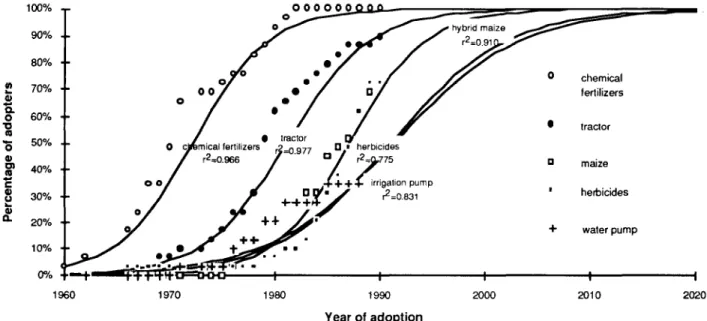
In our sample, the introduction of inorganic fertilizers took place in the early 1960s (Figure 3). Inorganic fertilization has rapidly spread, and by 1982 all farmers used it.
In the late 1960s the first motorized means of traction appeared. At present 90% of all farmers use either the tractor of a cultivator, although only 28% of the farmers own one of these pieces of equipment. Tractor and cultivator acquisition are strongly related to capital inflows from non-farming activities, particularly income earned during emigra- tion. In fact, out of eight farmers that once were emigrants in France, seven bought their tractors after returning. The introduction of the first powered irrigation pump occurred in 1971. The number of adopters is apparently low (35%), but such a pump is only justifiable in the case of
0 chemical fertilizers 0 tractor 0 maize I herbicides + water pump 1960 1970 1960 1996 2000 2010 2020 Year of adoption
Figure 3. Observed and estimated evolution of the innovation adoption process in the sample studied using a logistic model.
Social approach to land consolidation schemes: J C Coelho, J Portela and P A Pinto
Table 5. Relationships between farm characteristics (x,, x,~) and the number of innovations adopted (y,) and innovation hierarchy (y2).
Number of innovation innovations adopted hierarchy (level of
significance) Farm characteristics (test used)
(level of significlaynce)
n.8. 5% 0 n.8. 5% 1%
x1 Age (x2) 3.77 4.55
x2 Level of instruction (x2) 6.79 9.22
x, Farm size (x2) 5.04 3.51
x, Number of parcels in farm (x2) 0.36 6.19 x, Average parcel area (x2) 5.32 6.26 x, Parcels shape coefficient (KS) 0.60 0.52 x, Road quality coefficient (KS) 2.15 1.20 x, Average distance among parcels (KS) 2.95 a.48 x9 Produce destination (KS) a.28 7.22 x,,, Has been emigrant (KS) 1.61 3.41 x, , Household size (KS) 2.57 4.26 _+ Opinion on land consolidation project (KS) 0.50 1.02 x13 Has used bank credit (KS) 3.84 7.22 x,~ Thinks about acquiring machinery (KS) 6.37 5.75
x,~ Thinks about retirement (KS) 4.08 7.26 .x,~ Has used ths officiaf Agrfc. Minist. service (KS) 6.63 15.45 x,, Standard of life (x2) 10.93 7.84
x2 = chi-square test; KS = Kolmogorov-Smirnov x,~ Has thought about selling land (KS) 9.44 6.63 test. x,~ Has thought about buying land (KS) a.83 7.97
parcels that are adjacent to the Minho River, have a well, or a water reservoir.
The adoption curves of hybrid maize, irrigation pumps and herbicides are somewhat similar. This might be explained by the complementary nature of such innovations. Their generalized adoption took place in the 1980s (the expansion rate was between 5 and 7% per year) as a result of intense extension activity. Unwin”’ attributes an important role to the commercial enterprises, which he considers to be the most effective means of diffusion. However, in the particular case of Valenca, communication among farmers (90%) and the official extension services (10%) were more effective.
To forecast the future behaviour of the adoption process, a logistic model 0, = a/(1 + b x e-“)) was fitted to each type of innovation (Figure 3). According to these functions, full adoption of these innova- tions (inorganic fertilizer, tractor, hybrid maize, herbicide and powered irrigation pump) takes place in the years of 1989, 2000, 2017 and 2020. In spite of our own criticism of the application of this model, it represents an advance to the general assumption that every farmer will change to the best known technologies immediately after the LCP implementation.
Based on the relationship analysis among the number of innovations adopted, the rate of innovation and farm characteristics (Table 5), as well as in their residual analyses, it is possible to formulate the following predictive hypotheses.
?? 36Unwin, T ‘The propagation of agrarian change in north-west Portugal’ Journal of
Rural Studies 1988 4 (3) 223-238 0
Farms that have better structures (better access roads, larger, more regular and closer to the farm centre parcels) and that use credit are also those that innovate more and faster.
The adoption of the defined innovations is more frequent and faster among farmers with a higher level of education and higher standard of life, produce mainly for the market, use the official extension services and plan to increase their farm size by land acquisition. Among those who innovate more and faster, there is the desire of acquiring new machinery.
Social approach to land consolidation schemes: J C Coelho, J Portela and P A Pinto , Main plane: Factor 1 vs. Factor 2 J%var. explained - 51.
.a. .6.
-
.4. Hierarchy Dista$e Retgment
c\I .2- 0 0 Selling 5 o...--. ??Age sha e a- - 5 ([I LL -.2. -.4 . -_ 6. -.8 - -l* _ . _ , _ , , _
NP parcels . kind of farm Family size
.o
Family we 0 Machine acqulsltlon ??
-,-d
Opinion land consol.. 0
Emtgratlon hlsto?
-1 -.8 -.6 -.4 -. 2 0 .2 .4 .6 .6
Factor 1
, Main plane : Factor 1 vs. Factor 3 (%var. explained - 50.5)
J ’ - ’ . ’ _ ‘. ’ - ‘. ’ . ‘. ’ . F .8. Quality 0 Emlgratlon hlstory .6- * .4. Distance NP parcels. m shape 0
Fam”y Size lnstructlon -
.2. 0 Machlne acqulslllon Credtt
* @3 o- Family size I b 0. __YLU_____YU_~__,__,__~ .,.,...,,,,... ..““..“...,..,...,...,~,...,,.. .,__.,.- -ae. Std. of llvlng a * 5 -.2 . ’ Hierarchy Yrement ??*Min. Agric. * IL” 0 -.4 . ,,,,,$i;,31,‘“,~;” 0 p@arce’ : -.6 . Sell?g ??Age
Oplnlon IanYconsol.. Btying
-.8 .
-1, , , , , . , . , I , , , . . I . . I . c
-1 -.8 -.6 -.4 -.2 0 .2 .4 .6 .8 1
Factor 1
Figure 4. Main planes in the Principal Components Analysis.
decreasing the scale of their farming by selling land and using this opportunity to retire.
The relative importance of the several variables involved in the innova- tion adoption process was also exploited by a Principal Components Analysis (Figure 4).
The 19 independent variables studied might be represented by the first six main axes, which explain 80.8% of the data cloud overall variability. It will be reasonable to comment only on the first three axes that account for 62.3% variability.
For a given axis, the variables with the larger absolute coefficients are those that contribute the most to its formation. In accordance with this principle and taking as reference variable ‘Innovation Hierarchy’, it is possible from Table 5 and Figure 4 to draw the following conclusions.
??There is a sharp opposition between two groups of variables; the first group aggregates innovation hierarchy, intention of retirement, distance, intention of selling, road quality and age; the second group aggregates intention of buying, level of education, average parcel area, farm size, destination of produce, former use of official services and credit and size of the household.
??From the weak spatial representation of parcel shape, emigration history, number of parcels per farm, opinion of LCP, standard of life and intention of new machinery acquisition, one can not conclude anything about their effect.
Social approach to land consolidation schemes: J C Coelho, J Portela and P A Pinto
Table 6. Stepwise regression analysis for the Innovation Hierarchy.
Step 1 variable in: standard of life: x,,
equation: yz = 34.606 - 9.172 x,, ? = 0.474 f = 24.37 (0.01) Step 2 variable in: has thought about selling land: x,~
equation: yz = 26.234 - 7.46 ,q7 + 6.745 x,~ ?=0.692 F=29.17(0.01) Step 3 variable in: has used the official extension services: xj6
equation: y2 = 26.662 - 6.576x,, + 6.651 x,~ - 5.361 x,~ ? = 0.756 F= 26.06 (0.01)
The most revealing characteristics of individuals with lower grades in the Innovation Hierarchy, for example those that innovated less and later, are the unfavourable characteristics of their farms, namely, the distance they have to travel, the desire of selling land and retire, probably as a consequence of the deficient farm structure and their advanced age. On the contrary, the characteristics of those farmers that got the best grades in the Hierarchy of Innovation, ie those that innovated more and faster, are a relatively favourable structural arrangement of their farms, translated into a larger farm and parcel area, the wish of buying land, a greater instruction level, a numerous family, the use of the official extension services and bank credit and, finally, a dominant market-orientation.
The cluster analysis resulted in the definition of three farm groups. Group I includes the ‘innovators’ and the ‘early birds’, Group II includes the first and second wave adherents, and Group III includes the ‘latecomers’. The cluster analysis corroborates previous conclusions, adding some details that are worth reporting. Group I is composed of farmers that think of buying new machinery and enlarging their farm size after the LCP is concluded. With one single exception belonging to Group II, the first group includes also the market-oriented and credit- user farmers. On the contrary, the third group is composed of indi- viduals that have shown the desire to retire and think about selling land (with one exception that once again belongs to the second group). This group includes also a large fraction of illiterate people (69%). Finally, the differences in the modal size of the household between Group I, on the one hand, and Groups II and III, on the other hand, are noticeable, reflecting the fact that these individuals are in different stages of their life-cycles. The household size mode is three in Group I, indicating that the household is constituted by a couple and two children at home. The mode of 1.5 for Group II and III reveals one couple alone.
Finally, the study of the Innovation Hierarchy is completed with the stepwise regression analysis (Table 6).
The fitted regression equations underline the importance of the standard of life, intention of selling land and use of official extension services as descriptors of the Innovation Hierarchy, with these three variables explaining 76% of the overall variability. The next variables in order of F-value to enter (emigration history and the intention of buying land) add very little to the explanation of overall variability.
Analysis of farmers’ perceptions
This analysis aimed to estimate the relative importance of several limiting factors of the local agriculture and the farmers’ perception of the benefits and losses associated with the implementation of the LCP.
The most important restrictions derive from the bad road quality (76%), which results in great consumption of time for transportation (Table 7). The limitations imposed by lack of water, reduced parcel size, difficulty in machine acquisition and water-logged lands are also con-
Social approach to land consolidation schemes: .I C Coelho, J Portela and PA Pinto
Table 7. Perception of the main restrictions and expected benefits in the area under the Land Consolidation Project of Vaienw. -
What is the importance you give to the following factors? Total score
gtai
percentage)Better roads
Shorter distances Professional courses More water availability Larger parcels Larger farm More machinery More time farming Drained land
Investing more money in the farm Using new crops
91 76 80 76 29 60 63 58 64 57 35 55 34 53 28 47 38 43 28 37 8 25 %A (Percentage of applicability) 100 100 41 93 97 55 55 52 76 66 28
Whai is the importance you give to tha foliowing statemente? Traditional vineyards surrounding fields should be replaced by row-oriented vine crops
New parcels will improve machinery usage
The new irrigation network will increase water availability The new roads will save transportation time
New parcels will allow better land use
Increased parcel size will increase cultivated areas The new irrigation network will increase crop yields The smaller number of parcels, the lesser crops will be grown Closer parcels will allow more time to spend cropping The new drainage network will increase cropped area New parcels will allow belter yields
With the new irrigation network I will use sprinker irrigation After land consolidation I will crop more hybrid corn Larger parcels will reduce production costs
Vineyard’s new sbuclure will allow the use of new grape varieties With the new drainage network I will grow new crops With the new irrigation network I will grow new crops Closer parcels will reduce production costs
15 75 34 26 26 72 62 45 24 71 59 41 40 69 100 69 26 68 66 45 23 68 59 40 32 67 83 55 27 64 72 47 22 61 62 38 22 50 76 38 11 42 45 19 10 32 97 31 12 22 93 21 8 21 66 14 0 0 21 0 -10 -25 69 -17 -2 -25 14 -3 -7 -50 24 -12 %I (Percentage of importance) 78 76 25 54 55 30 29 24 33 24 7
sidered relevant. The most frequently referred limitations (A%) are related to road condition and time consumption (100%). Next, reduced parcel size (97%), lack of water (93%) and water-logging (76%) follow. The frequency of professional courses is referred at a low applicability percentage (<50%), but with a high level of importance (60%). The fact that the introduction of new crops was either ignored or judged as having little importance (25%) also deserves notice.
A clearly positive image (40-58 points) is revealed only in relation to new roads and decreased consumption of time for transportation. Yet, there seems to be a clear perception (20-39 points) of the benefits resulting from a new spatial arrangement, new irrigation network and drainage. Based on the sample surveyed, it is expected that the new land structure will improve efficiency of machinery use, land use and labour organization in the farm. Similarly, the new irrigation network would contribute to an increase of available water, and consequently to higher yields, while drainage would expand the cropping area. In regard to all other questions the project image is neutral or undefined (-19 - +19 points), leading to the conclusion that benefits are seen as irrelevant, or that there is a need for adequate information, which project promoters should provide.
Based on the analysis of the realtionships between farm characteris- tics and farmers’ image of the LCP, the most prominent traits of individuals having a clear perception of the project benefits are: better level of instruction, better standard of living, larger farm, market- orientation, use of credit and official extension services, and the wish of buying land to increase farm size and of acquiring new machinery. The preferred land to be bought had to be of significant size, adjacent to
Social approach to land consolidation schemes: J C Coelho, J Portela and P A Pinto
Table 8. Estimation of svnemv effects among farm roads, drainage system, farm rENg8nbtiOn and irrigation invetiments.
Situation before LCP (A)
Benefits from investments in: Farm roads Drainage system Farm reorganization Irrigation system Aggregated benefits (1) Situation after LCP (8) Synergy effects (B)-(l) Maize productivity (kg/ha) Total labour requirements (hours) 49.3 uw (100) 4685 51229 (100) 0.0 0 -5514 +5.9 +606 +10977 +10.3 +1314 -3532 0.0 +1238 0 65.5 7843 53160 65.5 11139 46735 (133) (238) (91) 0 +3296 -6425 Returns to family labour (llxm WC.) (loo0 esc.lha) 12123 246 (100) (100) +602 +221 +7921 +2535 23452 356 30445 (251) (YE, +6993 +107
% total return to family labour coming from:
maize forages vineyard8 18.7 0.3 81 .O
44.1 7.6 48.3
existing parcels, close to the household and with good access. On the contrary, farmers who have an unclear image of the project benefits are characterized as owning farms with a more unfavourable structure, larger distances between parcels and, probably as a result, willing to sell their land.
The main obstacles to innovate in the region are the unfavourable farm structure, the low professional skills of the farmers, the deficient or non-existent support from the extension agents and the present uncer- tainty in the land market. These obstacles generate a rationale for adjustment, which is reflected, for example, in a generalized aversion to using credit and in a strong concern about reducing expenses.
Due to the LCP the land market is currently very active. Indeed, many landowners are willing to sell, and the project administration is interested in buying as much land as possible. However, in practice this process has been slowed by the non-existence of registered properies.
Project evaluation
The economic evaluation of the LCP has been described elsewhere.32 Yet it is interesting to compare the economic advantages expected from the LCP with the farmers’ perception of its benefits. The results of the simulations for the two scenarios A and B (expected land structure and gains in cropped area, crop productivity and labour savings) are presented in Tables 3 and 8, which also shows that the joint effect of every partial improvement results in increased labour savings and increased returns to the farmer’s family, indicating that a considerable benefit may be expected from the LCP, at least from the individual farmer’s point of view.
Conclusions
Among the several causes of land fragmentation in Valenqa, the most relevant are the inheritance rules, high population density, scattered habitat and the concern for maintenance of system autonomy. In the peasant agriculture 38 of Valenqa, high fragmentation is also viewed as advantageous, allowing a strategy of risk reduction via the utilization of different soil types. Both the non-existence of an active land market and
37Coelho op tit Ref 5
ssBarros, Ii OS Grandes Sistemas de the high cost-df credit for buying land constitute strong obstacles to Organiza@o da Economica Agrfcola Sa spontaneous land aggregation.