i
IDENTIFYING THE DRIVERS OF BLOCKCHAIN
ADOPTION WITHIN SUPPLY CHAINS
Leonor Santos Jardim
Dissertation presented as the partial requirement for
obtaining a Master's degree in Data Science and Advanced
Analytics
ii
NOVA Information Management School
Instituto Superior de Estatística e Gestão de Informação
Universidade Nova de LisboaIDENTIFYING THE DRIVERS OF BLOCKCHAIN ADOPTION WITHIN
SUPPLY CHAINS
by
Leonor Santos Jardim
Dissertation presented as the partial requirement for obtaining a Master's degree in Data Science and Advanced Analytics
Advisor: Professor Pedro Miguel Fernandes Ruivo, PhD
iii
ACKNOWLEDGEMENTS
First and foremost, I would like to express my deep and sincere gratitude to my research supervisor, Dr. Pedro Ruivo, for all the guidance and support given throughout this study.
Also, I would like to thank the co-authors of the published researches, without whom this work could not have been completed, as well as the panel of experts that took part in this research.
To all my colleagues, teachers, students, and to everyone that in one way or another contributed to my academic growth, I would like to say: thank you so much.
Finally, I would like to thank my father for the inspiration, drive and support he has given me throughout this journey.
iv
ABSTRACT
In order to understand the applicability of blockchain technology to Supply Chains, this thesis intends to deliver insights on its adoption with a two-part study, that combines a literature review and a theoretical framework where adoption drivers are identified. The approach consists on the research and review of all available publications published within the AISNET’s basket of eight journals on the topic Blockchain and a list of selected top IS conferences, with the utilization of a unique interpretation framework and focus on the avenues of research provided by these articles, gathering information in order to create discussion debates, grouped by the unit of analysis identified, within Supply Chain. Following the Design Science Research (DSR) methodology and focusing on defining, validating and reducing a myriad of factors, derived from the literature review, with the aid of experts on both blockchain and supply chain fields, through means of questionnaires, factors were rated and refuted according to the relevance given. Two rounds narrowed the results, and upon consensus 9 drivers were identified fitting under two categories: Challenges and Incentives. Overall, providing academics with a theoretical framework that combines existing literature into a set of drivers, and providing insights to vendors on how their reputation may influence clients' adoption, whilst fulfilling a literature gap in the supply chain area.
KEYWORDS
Blockchain; Supply Chain; Literature Review; Organizational Level; Design Research Methodology; Adoption Framework
v
PUBLICATIONS
Publications resulting from this dissertation:
CENTERIS 2020 Conference:
Jardim, L., Pranto, S., Ruivo, P. & Oliveira, T. (2020). What are the main drivers of Blockchain Adoption within Supply Chain? – an exploratory research.
CAPSI 2019 Conference:
Pranto, S., Jardim, L., Ruivo, P., & Oliveira, T. (2019). Literature Review on Blockchain with focus on Supply Chain
vi
INDEX
1.
Preamble ... 1
2.
Introduction ... 2
3.
Literature review ... 3
3.1.
Literature Review on Blockchain with focus on Supply Chain ... 3
3.1.1.
Introduction ... 3
3.1.2.
Blockchain Definition ... 4
3.1.3.
Supply Chain Definition ... 4
3.2.
Methodology ... 5
3.2.1.
Search and Selection ... 5
3.2.2.
Analysis and synthesis of the literature ... 7
3.3.
Debates about Blockchain Literature ... 9
3.3.1.
Real case applications of blockchain technology and observed benefits ... 9
3.3.2.
Interrelations verified in a Supply Chain Network, B2B and B2C... 10
3.3.3.
Focus on constraints and challenges within the Supply Chain ... 11
3.4.
Limitations and Avenues for Future Research ... 12
4.
What are the mains drivers of blockchain adoption within Supply Chain? – an
exploratory Research ... 14
4.1.
Introduction ... 14
4.2.
Theoretical Background ... 14
4.3.
Methodology and Implementation ... 18
4.4.
Results and Discussion... 20
4.5.
Conclusions, Contributions, Limitations and Further Research ... 25
5.
Concluding Remarks and Future Research ... 27
6.
Bibliography ... 28
7.
Appendix ... 34
7.1.
Appendix A. Respondents Profile For Round 1 ... 34
7.2.
Appendix B. Respondents Profile For Round 2 ... 34
vii
LIST OF FIGURES
Figure 1 – Search and Selection Method ... 7
Figure 2 – Summary of debates related to blockchain applied to supply chain. ... 9
Figure 3 – Findings of the main drivers of Blockchain adoption within Supply Chain ... 24
viii
LIST OF TABLES
Table 1 – AIS Senior Scholars' Basket of Journals ... 5
Table 2 – AIS Senior Scholars Conferences ... 6
Table 3 – Debates Provided from Literature Review ... 17
Table 4 – Blockchain Characteristics considered for debate ... 17
Table 5 – Organizational Structure considered for debate ... 18
Table 6 – Summary listing of analysed topics for initial evaluation ... 19
Table 7 – Rated Questions Output ... 21
Table 8 – Open ended questions transformed in statements adjusted with experts’ input. . 22
Table 9 – Statistical Results of the rated statements regarding blockchain adoption within
supply chain, by experts on the second-round survey ... 23
ix
LIST OF ABBREVIATIONS AND ACRONYMS
B2B Business-to-Business
B2C Business-to-Consumer
DSR Design Science Research
ICO Initial Coin Offerings
IoT Internet of Things
1
1. PREAMBLE
In trying to keep up with the latest technology trends, the topic of choice for this dissertation was the applicability of Blockchain technology in Supply Chains.
Having a bachelor’s in business administration, the way technology creates shifts in company’s operations, strategies, and the way it can make or break traditional businesses, having these to adapt or risk losing competitiveness, has always fascinated me. Therefore, my academic path has reflected this interest, following my bachelors with a Postgraduate Course in Digital Enterprise Management, where I was introduced to buzz topics such as Big Data and its value, Digital Transformation and the way processes have to be adjusted. Naturally, the choice of a Masters’ in Analytics, at a time Data Science became the trendiest area for companies willing to gain insights and adjust to market trends, seemed the right fit for me. With that in mind, I decided to focus my dissertation research topic on Blockchain technology, as I was introduced to real case applications of it within my professional environment and because, for me, at the time, it seemed to be the latest trend for business disruption.
The research process started by defining where I wanted to understand the added value of the technology, which ended up being Supply Chain and Logistics, given that there were already successful applications of it, even though the literature available seemed scarce.
In choosing my supervisor and partnering up with fellow colleagues willing to explore the same topic, the presented work in this paper was developed with the goal of identifying the motivations needed for businesses to be willing to incorporate blockchain in their transactions. For that, a grounded literature review was necessary. Initially, it with a dataset of 31697 records, extracted from b-on (Online Knowledge Library) online portal with the search word “blockchain”, which presented to be too generic, as this database needed to be filtered out to only keep publications on the desired topic and with enough reliability. In the end, the literature review was done considering only papers from journals and conferences within the AIS Senior Scholars’ Basket. Afterwards, an empirical analysis was done on the resulting sources, leading to what was the focal point of this research, the identification of adoption drivers with the validation of experts on both Blockchain and Supply Chain. Having this work resulted in two publications, as described in the following sections.
2
2. INTRODUCTION
Although blockchain technology has gain a lot of attention from companies in the last few years [1], its adoption has yet to be clarified, in terms of what will motivate companies to adjust to this trend [2].
Regarding the technology itself several authors have tried to explore the technology’s implications to areas other than cryptocurrencies [3], which was how the technology built up its popularity, back in 2008 [4]. Nonetheless, the scarce literature on its applications within Supply Chains is little by little being filled with more recent publications [5]. These publications explore other implications for the technology when applied to logistics, such as the opportunities that the use of it provides, especially when combined with other emerging systems, as the Internet of Things [6], and such as the barriers of adoption of the technology that can be expressed in different categories, like: intra-organizational, inter-organizational, system-related, and external barriers considering the internal and external limitation of the organization in adopting a new technology [7].
The disruption caused by technology is threatening to businesses [8]. Focusing specifically on Supply Chain Management (SCM), that depends on several parties for sustainable operations, them being either Suppliers, Channels of Distribution or Customers [9]. The effective communication between each player of the chain and the traceability of shared transactions plays a crucial role for the success of its operations, for that reason, blockchain presents the necessary features to respond to these needs and creates added benefits to each party [10]. Having this mind, it is essential to understand what adopting blockchain means to each participant of the Supply Chain and how the adoption of one can bring competitive advantages over others, given this high dependability, as the technology focuses on collaboration [11].
To respond to this, grounded on reputable sources and experts’ opinions, this study develops not only a debate structure for its literature but also a theoretical framework with the main drivers for the adoption of the technology within Supply Chains. In doing so, contributing to the still scarce literature available for the technology being applied to supply chain, by gathering insights from previous researches and converging those insights into statements validated by industry experts, as to answer the following research question (RQ):
RQ1 – “What are the main drivers for the adoption of blockchain within Supply Chains?”
The remainder of the paper is organized as follows: In Section 3, the literature review on Blockchain and Supply Chain is presented, in which the methodology used to generate debates from the literature is presented and where further research on that chapter is appointed. Section 4, focuses on answering the proposed research question sustained by the findings of the previous section, introducing the proposed framework as well as the results and analysis. Finally, Section 5 presents the concluding remarks of this investigation.
3
3. LITERATURE REVIEW
3.1.
L
ITERATURER
EVIEW ONB
LOCKCHAIN WITH FOCUS ONS
UPPLYC
HAIN3.1.1. Introduction
Nowadays the word Bitcoin is on everyone's lips, due to the explosion of its value in the beginning of 2018 [12]. Bitcoin is considered by many the first successful technological envelope of its type to be implemented effectively [13]. After this first successful launch many variants, based on the same core principals of Bitcoin, such as Ethereum, Ripple, Hyperledger and others, were released and are already being used worldwide, although some are still in test phase and others in small and restricted production environments [14].
Although Blockchain technology is on its embryonic phase, its potential has already been recognized and there is a growing interest for full production deployments in firms, to optimize their current business processes and to provide, in some areas, the trust and transparency that are still missing. [15][16].
Currently, topics surrounding blockchain are creating almost spontaneous interest throughout organizations, society and also Academia [17]. It is believed that the inherent capabilities of this technology contribute to an overall optimization of several processes, such as value transactions (money/currency), ownership of goods, with special emphasis on trust and transparency features of the technology that are crucial in some areas, and for some reason have not yet been accomplished. To consolidate this idea, the statement "blockchain is an innovative technology in search of use
cases" as recited by Glaser [18], proves to be very accurate.
Putting aside the potential benefits this technology could bring for the financial sector, there are other areas of great interest and focus, where blockchain could prove itself very useful, such as organizational supply chain processes. Companies are dealing with daunting and complex supply chains where the lack of trust and transparency can undermine the efficiency, create a lack of responsiveness, which compromises the overall profitability that was strategically set beforehand [19]. Several studies, suggest that a significant number of companies worldwide are willing to use blockchain solutions to address traceability, responsiveness and trust issues [20].
Provided the above, this study gathers and analyses the most relevant publications from the most reputable journals and conferences within the scientific IT community, that cover both the Blockchain topic combined with supply chain, providing relevant insights and inputs to both academics and practitioners on how to pursue study works on the topic.
In the following section, we define blockchain and supply chain. In section 3, we describe the followed methodology and analyse the results, and where the selection process takes place. Section 4 presents the most relevant debates about blockchain literature, given the context. Finally, section 5 is reserved to point out limitations and avenues for future researches given the overall discussions and conclusions regarding this study.
4
3.1.2. Blockchain Definition
A blockchain is an open database constituted by a distributed ledger within a peer to peer network that can be access restricted or not. In the first case the access restricted blockchains are called permissioned blockchains whereas the last ones are the so called permissionless blockchains, like many cryptocurrencies available [21].
One of the most popular blockchains known to date is Bitcoin. Since one of the pillars of Bitcoin is the fact that the information contained in the ledger is made of immutable sequential blocks, like the links of a chain, the community started to name this technology: Blockchain. Similar solutions based on these same technological principles, started to be addressed as Blockchain technologies [4]. Some other blockchains, like Ethereum [22], have enhanced capabilities called smart contracts that are not more than “orchestration and choreography protocols that facilitate, verify and enact with computing means a negotiated agreement between consenting parties” [23]. Smart contracts definition [24] dates back some years, but it is only now, with the possibilities associated with the usage of blockchain technology, when they are having more practical use. Smart contracts, besides applicability in areas such as finance, authentication, identity and reputation systems, can also be used along with IoT (Internet of Things) applications and devices, where it can be used to track and trace different types of products and materials [25] and automate routines and actions, therefore be used as a tracking record stored in the blockchain ledger.
Considering the above, and from a non-pure technological point of view, the IS academic community shows to be more interested in cryptography and security related subjects, even though blockchain has for sure room for further study and development, especially when it comes to businesses and the economy in general, specifically in terms of processes, as blockchain usage and adoption represents a ground breaking revolution that could change the way companies and markets currently work as appointed by Swan [26].
3.1.3. Supply Chain Definition
Martin [27], proposed the concept of supply chain management as, “The management of upstream and downstream relationships with suppliers and customers in order to deliver superior customer value at less cost to the supply chain as a whole”. Thus, a supply chain is an end to end process that is reflected on a network between a company and its suppliers, including several activities and respective stakeholders, comprising the moment in which a product or service is in its initial state, to the moment it is being distributed to its end client.
The concept of supply chain has gained significant relevance over the years. It was only once companies detected the benefits of effective collaboration that the term gained its form. It is through collaboration that companies integrate supply and demand, and deliver significantly improved performance, and benefits to its operations [28].
Consequently, companies have become more specialized and are now searching for suppliers who can provide low cost, quality materials rather than own their source of supply [29].
As the concept evolved so did consumers’ demands. Each of these necessitate closer coordination with suppliers and distributors [30]. With the adaptation of consumers’ needs to the technological
5 developments, the way product and service ranges reach individuals became disruptive, this process is a consequence of digitalization.
Retailers provide consumers with various digital products and services that are adapted to the use of digital technologies and are simultaneously affected by the new forms of consumption [31]. Digital technology affects everyday businesses across several industries, considering that, a supply chain covers more than just products moving across the network it also covers the amount of information flowing at each step. Performance gains from participating in a cooperative supply network, derive from the information sharing across the chain, highlighting firms’ ability to effectively communicate with customers and suppliers [32] and the relevance digitization of processes has had on this topic.
3.2. M
ETHODOLOGYIn this section we explore the methodology deployed, based on the proposed definitions and guidelines imposed. The proposed method consists on a structured literature review on blockchain using the top eight peer-reviewed IS journals from the AIS Senior Scholars’ Basket as well as a list of selected IS conferences, also from AIS, that could be more promising in terms of content and more generally renowned: AMCIS, ICIS, ECIS, HICSS, ICEB, ISD, CONF-IRM, ICMB, MCIS, PACIS, WHICEB, in order to retrieve relevant information from properly acclaimed sources. The in-depth analysis in this section was conducted following the recommendations of Webster & Watson [33].
3.2.1. Search and Selection
Given the scarce availability of research papers on the topic blockchain combined with supply chain, our intention was to compile a set of papers that (a) focused on the adoption, implementation, or use of blockchain technology and that (b) had applicability to supply chain.
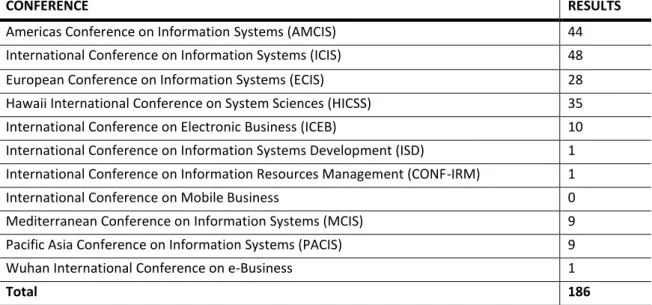
The literature available was considered until March 2019 with the search key “blockchain”. This extraction comprised a total amount of 197 potential candidates (Table 1 and 2).
JOURNAL RESULTS
European Journal of Information Systems 0
Information Systems Journal 5
Information Systems Research 2
Journal of AIS 3
Journal of Information Technology 0
Journal of MIS 0
Journal of Strategic Information Systems 1
MIS Quarterly 0
Total 11
6
CONFERENCE RESULTS
Americas Conference on Information Systems (AMCIS) 44
International Conference on Information Systems (ICIS) 48
European Conference on Information Systems (ECIS) 28
Hawaii International Conference on System Sciences (HICSS) 35
International Conference on Electronic Business (ICEB) 10
International Conference on Information Systems Development (ISD) 1
International Conference on Information Resources Management (CONF-IRM) 1
International Conference on Mobile Business 0
Mediterranean Conference on Information Systems (MCIS) 9
Pacific Asia Conference on Information Systems (PACIS) 9
Wuhan International Conference on e-Business 1
Total 186
Table 2 – AIS Senior Scholars Conferences
However, the majority of papers returned were essentially focused on cryptocurrency related topics. For that reason and because those papers did not meet the imposed criteria they were automatically discarded from further analysis. Other than the areas of focus stated above, Fintech, Initial Coin Offerings (ICO), Healthcare, Social Media, were filtered out of the analysis, for these last ones in specific, an empirical analysis lead to the exclusion of what would be the first round of the filtering process, resulting in 61 potential candidates. This round also took into consideration the type of papers to be analysed, meaning those that did not cover enough of the topic such as: Panel, TREO Talk Paper, Forum Paper, Tutorial, were discarded, and also those that used blockchain as a mere illustrative example of a technology application.
The 2nd and final round of the process consisted on defining papers that presented relevant content for the study, therefore papers that included blockchain applied to supply chain. The analysis required an in-depth study of each candidate, which lead to a total of 10 potential candidates for further debate. Figure 1 shows, in a detailed manner the overall process.
7 Figure 1 – Search and Selection Method
3.2.2. Analysis and synthesis of the literature
In order to extract value from the verified candidates, we followed a grouping approach of the results based on content similarity, much like other research papers that follow an archetype categorization [34]. To identify clusters, this paper focused on extracting valuable insights from similar literatures that could generate some sort of debate amongst the results. This grouping was developed to identify, and debate contrasts and semblances found in each segment that consisted on 3 debates. Taking into consideration the methodology of review used by Webster [33], that is to consider Blockchain and Supply Chain combined as a concept and the debates within each topic as units of analysis. Each debate was created in order to understand where blockchain technology should be positioned in the supply chain management process.
The rationale behind the labels attributed to each debate (Figure 2), where conclusions and main findings will be compared and consequently discussed in the following section, was based on the area of focus and unit of analysis in question. To support the previous statement, allusive references common to the articles were extracted.
For the Industry Specific domain, four real use cases of blockchain applications in supply chain were verified. The first one focuses on the automotive industry [A]: “The results of this study can be a
guideline for organizations involved with the automotive industry to apply Blockchain technologies to the organization operations and make them acquire the influential factors that affect the acceptance
8
of the Blockchain technology application of the Thai automotive industry.” [35], and the following
study relates to the application of the technology on the diamond trading industry [B], which is once again applied to a specific transactions’ market: “We explore how blockchain technology changes the
need for and the role of trust when trading high value physical goods.” [36]. The third one, within the
Industry Specific group, analyses the shipping industry [C] with a well-known implementation, pertaining the world's largest container shipping company, Maersk [37]: “We identify the need to
investigate blockchain applications for decentralized, inter-organizational environments that have already been implemented. To address this deficit, we plan to further develop our findings into more mature design principles as part of an ongoing collaboration with Maersk.” [38]. The last article
reports findings from an “ongoing development effort focusing on transparency in the transport
industry” [39] [D].
Regarding the Business Relationships domain and the articles reviewed, different study approaches were used: One is a generic blockchain literature review focusing on supply chain that points out that “distrust among partners, transaction fees and restrictions plague consumers in marketplaces and
they have no insight into the supply chain of their valuable products” [40] [E]. The other is based on a
case study approach focusing on “business networks, and specifically business-to-business (B2B)
relationships within digital supply integration” [41] [F].
For the last domain, Comprehensive Approach is where all the nonspecific blockchain and supply chain related topics, resulting from the analysis of the remaining papers fit in. The authors of the first paper propose “a structured approach to assess the application landscape of blockchain
technologies” [42] [G]. Another relevant insight from the following paper was that “the impact of the structure and setup of business networks on successfully applying blockchain technology, remains largely unexplored” [43] [H]. In one of the studies, authors for this domain also considered “the
effect of blockchain technology on market structure of online business” [44] [I], and the last author focused on “linking between the capabilities of blockchain technology and trust, privacy and
9 Figure 2 – Summary of debates related to blockchain applied to supply chain.
3.3. D
EBATES ABOUTB
LOCKCHAINL
ITERATUREProvided the above, we were able to structure the reviewed literature into a total of three debates, that concern the findings verified in the application of Blockchain technology to Supply Chain. In doing so, these 3 clusters based on the unit of analysis of each candidate presented several points of view on the technology’s applicability.
3.3.1. Real case applications of blockchain technology and observed benefits
Overall, the technology is perceived as beneficial in the three contexts introduced. Although each focused on different features of Blockchain: [A] Acceptance [B] Trust [C] Smart Contracts [D] Adoption. Every single one of them seem to agree on the elements to point out of the application, as presented on the previous Figure. Naturally, the acceptance of the technology in an environment where several parties interact and depend on the behaviour of each player, highlights the network effects of the technology [46], which in turn make evident the care for trust, that once verified generates adoption trends and the necessity to create the so called smart contracts, that make the interactions between transacting parties on a network to be set up and automated [25], making it a more secure way for transactions to be processed.
For the automotive industry [A], the success of blockchain applications relies on the non-mediated power, meaning the removal of third parties translates directly into trust among organizations, given the inter-organizational trust that comes from this direct linkage. This is what is highlighted as a critical factor of acceptance of Blockchain technology application in the supply chain process. The
10 diamond industry [B], that relates to the transaction of high value physical goods, demands higher caution in transactions. Also, from a social perspective, it attributes the value of the technology to the transparent proof of ownership based on traceability of all related actions in the blockchain, avoiding fraud and illegal measures. This statement goes hand-in-hand with what is observed in [A], where trust becomes the distinctive factor of the technology. Also, for this sensitive industry, the consensus mechanism of the technology avoids recording fraudulent transactions in the ledger, which is of utmost importance, given the risks involved in luxury goods transactions.
Although the shipping industry [C] highlights the tamper-proof storage of information as a determinant benefit of the solutions, as it is an essentially decentralized environment, where accessibility is crucial, given that systems need to be shared within a network of participants, where transactions need to be traced back to certain users, whilst preserving privacy. The importance of smart contracts in this segment is given as a more secure and trustworthy way of information management in international trade, that nowadays is centred around the Bill of Lading, which is the physical document that goes across the different stakeholders in the supply chain. The position that Blockchain can have for this purpose is evidenced in the text, when it states that: “According to
Maersk, the largest container shipping company in the world, managing the trade documentation can be more costly than the actual transport of the container.” [47]. Lastly, for the transport industry the
greatest concern pertains to the immaturity of the technology and lack of successful implementations, as it questions the adoption of the technology and how disruptive it actually is, when applied to supply chain. As observed in the previous industries, trust is a highly debated aspect of the technology, but it also regards the importance of the adoption of other players for that to be verified. The reasoning behind such debate is verified in the paper and by the industry, that integration of logistics activities and adoption of supply chain technology may not be straightforward, which causes the need for clear incentives for the implementation of the blockchain. Whilst for this industry the incentives are verified on a firm level, [B] determines that the incentives may come from consumers, that may be willing to pay 'higher' prices if they 'trust' the originality and quality of the goods.
3.3.2. Interrelations verified in a Supply Chain Network, B2B and B2C
Distrust between parties is one of the most common issues within supply chains that blockchain tries to address and come as solution [48]. Therefore, new ways for consumers to gain insights regarding how their products are produced and having detailed information of all the steps that a given product took up until the point it reaches them, is considered beneficial. The same applies if a solution of this kind could provide the necessary trust within the intermediaries [E]. Another dimension of trust pointed out by one of the authors is related to payments between the supply chain involved parties using blockchain. If the overall process is considered effective and transparent with the added benefit of having an overall reduction of financial transactions costs, considering payments, blockchain adoption is considered very positive [F].
Product and service tracking are one of the most emphasized advantages that could be achieved through the implementation of a blockchain solution by the studied authors. By tracking and tracing the products from their origin up to the consumer certain quality standards and overall transparency can be achieved [E][F].
11 The usage of the ledger, and the ability that it has, to store information and to allow further analysis of all transactions done throughout the supply nodes is one of the features that has been highlighted by one of the authors. This characteristic allows all intervenient parties to have access in real time to all transactions that have been done ensuring a transparent flow of goods and/or services. In addition to this, the enhanced functionalities brought by the smart contracts’ usage could allow blockchain to make automated actions once a certain threshold is attained, exempting from the whole process an intervention of an additional third party [F].
Commercial transactions have been mediated for some years until now by the usage of IS solutions. Currently companies execute transactions relying mainly on third parties, and from an overall process optimization this could eventually be done with the usage of a blockchain solution that will remove unnecessary intermediaries [F].
3.3.3. Focus on constraints and challenges within the Supply Chain
Despite the broad usage of blockchain technology in the financial sector, including the wide adoption mainly with cryptocurrencies, there are a reasonable number of authors that state that there are more usages rather than these aforementioned [G]. Other authors state that business networks are structural templates and architectures where a blockchain solution could take an important role [H]. Finally, one specific publication is dedicated to the implementation of a blockchain solution within the logistics area, that corroborates the feasibility of this deployment [J].
Adoption of new technologies is not a straightforward process, that is why several authors invested a lot of research effort into this topic [49]. This is why the same challenges are also valid for blockchain adoption and it is where some of the reviewed articles also focus on. One of the authors states that
“to drive research efforts and the overall adoption of blockchain technology, we contribute to the establishment of a common understanding of the interactions and structure in blockchain business networks” [H]. Another paper points out that since there are different interactions between business
networks, a common understanding could be beneficial to adoption of blockchain solutions, which means that there could exist different approaches for the same problem and eventually a lack of uniformization could poise blockchain adoption [I]. Finally, the last author focuses his studies in the blockchain adoption cost, where he concludes that “industries with low adoption cost (e.g.
cryptocurrency, digital contents, and video games) and high (cost of) uncertainty (e.g. food, pharmaceutical, and luxury good industry)” which could indicate that there are industries more
prone to adopt blockchain rather than others due to cost related decisions [J].
According to one of the authors, one major challenge that blockchain adoption is facing is caused by the focus on research published in the last 5 years, that instead of dealing with several other possible applications, focuses mainly on the financial/cryptocurrency area. This same author also suggests that there isn’t yet available a standardized approach for each industry or specific use cases based on the type of blockchain solutions available, permission wise and according to the available consensus mechanism. This void could create a barrier that can increase the difficulty of blockchain adoption per industry [G]. The last authors point out that there are several challenges regarding the level of privacy, transparency, and trust that a blockchain can provide or ensure. In the study it is stated that using a blockchain solution can simultaneously, contrary to what would be expected, provide privacy and the necessary transparency. Regarding trust, this study contradicts what most of the authors ensure, that is that blockchain establishes trust between the involved parties, but in the specific
12 logistics sector and according to them it doesn’t, being currently the trust in third parties the preferred way to work [J].
3.4. L
IMITATIONS ANDA
VENUES FORF
UTURER
ESEARCHAlthough it is verified a growth on the available literature regarding the emergent technology, that is blockchain, one can say that the application of it to specific areas, other than cryptocurrencies and financial markets is fairly low [50]. One evident limitation of the current research is the scarce literature on the application of it to areas, such as Supply Chain.
Even though the results focusing on supply chain are not as abundant as initially expected, it can be concluded that some of the authors do not reserve the use of blockchain technologies to financial/cryptocurrency related scenarios [51]. This is notorious when Constantinides [52], states that one of the future research questions could be “How can blockchain-based digital platforms transform existing value-creating interactions?”
Despite most of the articles that are part of the study sample are not blockchain and supply chain relevant simultaneously, a large number of them, proved to be very useful by providing general blockchain considerations regarding challenges surrounding IT value and adoption within firm level [53].
By the end of the research phase of this paper, additional limitations arose, ones concerning the number of candidates accounted for, this limitation was due to the mislabelling of the source of some articles on the search engine sites. Only one element was detected, by the end of the process and therefore was not included in the analysis, even though it presented high potential to be part of the final candidates: “Industrial Case: Blockchain on Aircraft' s Parts Supply Chain Management” [54]. This limitation leads us to believe that perhaps expanding the literature sources could present broader results, nonetheless the reliability and quality of the objects of analysis in those cases may not be as acclaimed.
Several studies point out that strategic value, derived from blockchain adoption, is mainly coming from cost reduction resulting from operational and process improved efficiency. The removal of intermediaries will lower the overall inefficiencies thus creating value, and in the long term, via the creation of new business models, additional value could come from revenue generation and capital relief [55].
Keeping the above in mind it can be concluded that studying existing value-creating interactions at firm level, considering the framework proposed by [56] “The Relative Advantage of Blockchain Applications”, could be one interesting avenue of research.
In order to guarantee that the aspects of blockchain verified in each debate are to be conjugated, when applied to a supply chain management solution, that can be replicated to several businesses and not only adapted to the conditions predefined by each unit of analysis, one may explore the evaluation and ranking of each attribute by experts on the topic, from which the benefits all together can be exploited to a more significant contribution to current literature and organizational frameworks, therefore being generalized to the whole business process [57]. The need to reach consensus on both areas, blockchain and supply chain, prompts incremental adoption incentives for the technology’s implementation [58]. Additionally, and on a more quantitative approach, the
13 extrapolated outcomes of this paper may serve as a base to create key performance indicators for how the technology behaves in a real case application, and comparisons to what has been observed so far, can serve as a way to understand how the verified benefits apply to a more general context, measuring technological innovation capabilities and firm performance [59]. Given the low maturity of the technology applications, this approach may take more resources, as we must account for the implementation and performing phases altogether.
14
4. WHAT ARE THE MAINS DRIVERS OF BLOCKCHAIN ADOPTION WITHIN
SUPPLY CHAIN? – AN EXPLORATORY RESEARCH
4.1. I
NTRODUCTIONOver the past few years, blockchain technology has attracted a lot of attention from academia to practitioners across industries [44]. Its value is undeniably attractive [60], however, a clear adoption framework has still to be discussed, since only recently other management applications of blockchain networks have gained focus [61].
In fact, the technology itself has been around for quite a few years now, considering that its first application was through Bitcoin [4], back in 2008. Without focusing on the cryptocurrency context and highlighting the technology behind it, a blockchain is a distributed ledger, meaning it is a chain of “blocks” of information where each “block” contains a record of valid network activity from when the last block was added [62]. Within the Supply Chain context, the use of a decentralized distributed system, allows to collect, store and manage information of each product throughout its life cycle, and enhances secure transactions, as a product moves across the chain interacting with several actors, for instance, producers, suppliers, manufacturers, distributors and retailers in order to reach the end consumer, which characterizes a Supply Chain [63].
The recent hype around the technology, is justified by the fact that a lot of the benefits provided by blockchains overcome some of the challenges affecting the relationships across Supply Chains [19], making it a very attractive strategical move from a business perspective [64].
Nonetheless, in recent studies [65] some concerns regarding the barriers of adoption have been appointed, such as: Regulatory Issues, Implementation Constraints (when it comes to replacing and adapting existing legacy systems), the Potential Security Threats and so on. In the same study, that followed a survey-like approach, in 2019, only 8% of respondents did not identify barriers to the adoption, which gives room for further analysis. Motivated by these issues, and grounded on the literature review [66–69], this study has as its main objective to identify the main drivers of blockchain adoption applied to supply chains, attempting to providing a clear framework aided by experts’ opinions for content validity [66], through the means of survey-like interviews, the study intends to answer the following research question (RQ):
“What are the main drivers for the adoption of blockchain within Supply Chains?”
In order to do so, the proposed work adopted the Design Science Research (DSR) methodology [70]. In the following section, the theoretical background for the research is introduced followed by the methodology and implementation, where the main drivers are presented in a conceptual framework. Closing with the conclusions, limitations, and avenues for further research.
4.2. T
HEORETICALB
ACKGROUNDToday, Blockchain is perceived as a way to redefine companies and economies, relying on distributed networks, which can change enterprise architectures and affect company’s value proposition [71]. IDC predicts that Blockchain will play a significant role in the differentiation strategy
15 of supply chain management for early adopters, as it will create data management and service quality challenges that less prepared organizations will fail to respond to [72]. Therefore, gaining insights over the drivers for its adoption enables us to understand how this process can be accelerated, as the process of its adoption is believed to be gradual and not sudden [13].
Given the context of this study, there is still a need to fill the research gaps that accompany the maturity level of the technology [73]. The literature that supports this study, presented on Table 3, is from peer-reviewed IS journals and selected IS conferences, following the same approach of [33,74]. The focus on the presented papers, was inspired by the three debates created by [68] around Blockchain when applied to supply chain: 1) the Industry Specific, that included real case applications of blockchain technology and observed benefits; 2) the Business Relationships, that identified Interrelations verified in a Supply Chain Network, B2B (Business to Business) and B2C (Business to Consumer); and 3) the Comprehensive Approach, which focused on constraints and challenges within the Supply Chain, the information regarding the references that integrated each debate and the generated content used to support this study’s approach can be found on Table 3, presented below:
Published
In Debate Label
Unit of Analysis
Theoretical
Foundations Main Contribution Data & Context Date Author(s)
HICSS Comprehensive Approach Blockchain Business Networks focusing on Supply Chain Traceability.
[75] design criteria for developing an ontology and a layer model, capable of capturing the properties of existing blockchain-driven business networks. Blockchain Business Network Ontology, providing concepts and properties for describing all parts of a blockchain network, specifying, and formalizing them. Use Case; Model-driven approach. 2018 [43] HICSS Comprehensive Approach Business Communities, commercially available applications of blockchain.
Cited application areas emerging from literature. Relied on largely accepted classifications of blockchains, based on protocols, consensus mechanisms and ownership. Own assessment framework to map blockchain applications into distinct clusters and identify which industries are the most impacted by the technology. Academic and Technical Literature Review on Blockchain; Framework applied on a database of 460 released of blockchains. 2018 [42] ICIS Comprehensive Approach Effects of blockchain on the market structure of online business. Economic Theory (Game Theory). Own Framework: Game theory model for strategy selection, developin g a sequential game to examine firms’ entrance strategies and blockchain adoption strategies. Literature Review on Blockchain Trust and Traditional Trust Building Approaches and existing studies on the Technology. 2018 [44] MCIS Comprehensive Approach Blockchain usage in the Logistics area.
N/a. Provides insights on
to the major issues in logistics and supply chain when an innovative digital technology is put into action. Literature review on blockchain, trust and privacy in logistics. Case Study exploring the dynamics of blockchain adoption in terms of trust, privacy and transparency. 2018 [45]
16 ICEB Industry Specific Blockchain Acceptance within the Automotive Industry. Inter-organizational Trust [76]. Usage of a framework to study Blockchain Acceptance in the Supply Chain Process of the Thai Automotive Industry. Framework and questionnaire to executives and practical staff from the first-tier suppliers of automotive parts and automotive assembly companies. 2017 [35] ECIS Industry Specific Trust in Blockchain Transactions on the Diamond Market. Blockchain definition Trust: Definitions, Characteristics, and Architectures. Debate on how crucial the conceptualization of the impact of blockchains on the role of trust, transactions, and market constellations is. Explorative Research: Debate and Comparison between diamond transactions with and without using Blockchain technology. 2018 [36] ICIS Industry Specific Managing International Trade Documents with blockchain. Design Science Research (DSR) approach [77,78]. Theoretical Framework: Construction and evaluation of an information technology artefact in collaboration with a leading international shipping company, where central documents in shipping, such as the Bill of Lading, are turned into a smart contract on blockchain. Literature Review on both blockchain and informational flows in international trade; Panel of Experts to evaluate the proposed Prototype solution. 2017 [38] HICSS Industry Specific Supply Chain Management. Relog to create an information disclosure program (IDP) for supply chain transparency.
Attempts to link blockchain technology to supply chain and logistics. Focusing on the potential of utilizing distributed ledger technology together with the existing systems in the Supply Chain context. Conceptual Research: Workshops; Meetings (consis ting of the university researcher and the technical project leader), Interviews. 2018 [39] HICSS Business Relationships Consumers on the B2C (Business-To-Consumer) and the C2C (Consumer- To-Consumer) end.
Content Analysis. Own framework, providing insights and describing how blockchain affects consumers. Literature Review with keywords - “(Blockchain Consumer) OR (Blockchain Consumers)” and “(Blockchain Application) OR (Blockchain Applications)”; Semi-structured interviews with 3 blockchain experts. 2018 [40]
17 HICSS Business Relationships Supply Chain Management and business to business (B2B); Requirements and functionalitie s of supply chain integration with Blockchain. Transaction Cost Economics (TCE), Coase’s theory; DBE framework, based on the Zachman Enterprise Architecture. Digital business ecosystem (DBE) architecture as a framework for designing requirements and functionalities for Digital Supply Chain integration, explaining how B2B Digital Supply Chain integration can be accelerated through the blockchain, by generating requirements and functionalities proving the technology can achieve disruptive transformation in digital supply chains and networks. Literature review and interviews with international experts (Delphi Method) in blockchain technology; Case Study approach of a consortium of companies operating in global supply chain environments; workshops and focus groups; 2017 [41]
Table 3 – Debates Provided from Literature Review
The present study was developed between May 2019 and January 2020, it should be noted that the literature scarcity on the topic was complemented in the meantime with papers that might have been incorporated in its foundational phase, since valid inputs are shed when understanding the adoption behaviour at the individual level of blockchain within supply chain management [79] and its challenges and benefits [80].
Provided Table 3, the literature review covered specific segments of Supply Chains but not on a generally applicable adoption context, hence not being capable of answering, the research question proposed for this research on its own. As to enrich the gathered information, additional sources were added, complementing what was described so far, with generally mentioned characteristics of blockchain, present on all the articles derived from the literature review, those additions can be found on Table 4 presented below:
Blockchain Characteristics Literature Support
Trust [19]
Decentralization [81,82]
Security [83]
Table 4 – Blockchain Characteristics considered for debate
Table 5, considers factors not inherent to blockchain, but focused on the company’s propensity to adopt a technology, which can impact the adoption decision [84]:
18
Organizational Structure Literature Support
Institutional Pressures [85]
Organizational Culture [86,87]
Acceptance [13]
Table 5 – Organizational Structure considered for debate
The following section describes the methodology and implementation of the proposed work.
4.3. M
ETHODOLOGY ANDI
MPLEMENTATIONFor established technologies and for information management publications with similar objectives, adoption drivers are often identified either through literature research or by qualitative research. The authors performed both a literature review, as described in the Theoretical Background section, and an exploratory approach to identify the main drivers of adoption of Blockchain Technology applied to a Supply Chain context [70].
Instead of solely following the Delphi methodology, where participants focus on predefined and precise statements of future outcomes [88], we used a broader methodology, the Design Science Research (DSR) methodology as suggested by [70] to capture and develop the proposed adoption drivers, the analysis focused on both the inductive and deductive reasoning, in which new knowledge is explored and existing knowledge is refined and tested, respectively in rounds [89].
Once the results of the different literature sources were consolidated, a two-part questionnaire, with both open-ended and rated questions, was conducted on experts on the fields of blockchain and supply chain industry, from August until October 2019, as to identify what drivers to consider. The open-ended questions were done for the literature review statements [68], while the rated questions were dedicated to general adoption elements and technology’s known characteristics. The questionnaire was initially conducted on a pilot sample of 15 participants (Appendix A: Respondents Profile Survey 1), identifying whether respondents understood the questions and instructions [90], in order to reduce complexity and filtering out the elements that did not present representability for the study, while detecting possible flaws [91]. Afterwards, with more concise and refined elements, these statements were introduced to a larger number of participants (27), that shared the same characteristics as the original sample, but did not include the same individuals (Appendix B: Respondents Profile for Round 2). In this round the statements retrieved from the pilot sample were validated and measured for consensus, determining the elements that define the theoretical framework proposed in this paper.
The experts considered, were chosen taking in consideration their LinkedIn profiles, and guaranteeing that they should have at least some experience in both Supply Chain and in Blockchain technology, following [92]’s guidelines. Although the identity of respondents will remain anonymous, the authors did track the responses during the conduction of the surveys to guarantee continuity of the study.
For both surveys the majority of respondents had a Consultancy background followed by a Software vendor related position. The most prominent industry sector was related to IT, and Information and Communication Services. Regarding the number of “Years of experience with Blockchain” the
19 majority of the respondents had 2 or less years, but on the other hand the majority of “Year of experience within Supply Chain” was over 5 or more years of experience, as reflected on Appendix A: Respondents Profile for Round 1 and Appendix B: Respondents Profile for Round 2. This can eventually be explained by the novelty of Blockchain technology and by the fact that supply chain studies and professionals are well spread across several industries.
The execution methodology used for both surveys was as follows: Round 1
The original sample to whom the survey was sent had a size of 88 experts. Out of this sample a total of 15 completed answers were considered, given the time frame of the study [93].
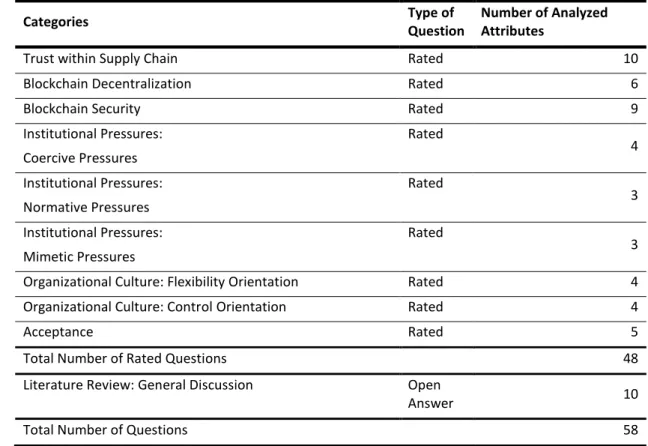
The objective of this round was to capture the main dimensions within each identified area. The type of questions proposed was divided in two parts, the rated type attributes, and the open response questions. The questionnaire was divided in 3 sections: the respondents’ profiling, that is presented on Appendix A: Respondents Profile for Round 1; the rated questions and the “open answer” questions, enumerated on Table 6, and further detailed on Appendix C: First Round Structure. It resulted in a total of 48 rated attributes divided in 9 categories for the rated questions, and 10 open answered questions, as represented in the Table below:
Categories Type of
Question
Number of Analyzed Attributes
Trust within Supply Chain Rated 10
Blockchain Decentralization Rated 6
Blockchain Security Rated 9
Institutional Pressures: Coercive Pressures Rated 4 Institutional Pressures: Normative Pressures Rated 3 Institutional Pressures: Mimetic Pressures Rated 3
Organizational Culture: Flexibility Orientation Rated 4
Organizational Culture: Control Orientation Rated 4
Acceptance Rated 5
Total Number of Rated Questions 48
Literature Review: General Discussion Open
Answer 10
Total Number of Questions 58
Table 6 – Summary listing of analysed topics for initial evaluation Round 2
For the second survey, we were able to collect 27 completed answers, (available from the authors on request), and once again incomplete surveys were discarded from the analysis. This round was elaborated based on the results of the first one, where 18 questions were selected out of the initial
20 58 and adapted into statements (described in the results section), based on expert’s opinion. To ensure validity, in this round, the authors requested respondents to rate these statements in terms of significance using a 7-point Likert scale that ranged between Strongly Disagree (1) to Strongly Agree (7).
A detailed overview of these statements can be found in the next section.
4.4. R
ESULTS ANDD
ISCUSSIONThe analysis was done so that it was possible to reduce complexity and, in a way, answer the proposed research question of this study. For the first round, the analysis was divided in two parts, one for the rated questions, that consisted on a quantitative analysis, where result were measured by adding up the response scores on related sets of items as Likert scales are “summative” [94]. The open response questions required a qualitative analysis. This analysis followed partially the inductive reasoning present in the DSR methodology, where new knowledge, meaning the experts’ inputs is explored [95]. For the validation round, an adaptation of the sample results was needed for the deductive reasoning of the used methodology, as existing knowledge is refined and tested, once again, in this case through the means of a survey. Nonetheless in both results analysis, some elements were dropped for coherence and rectification purposes.
Round 1
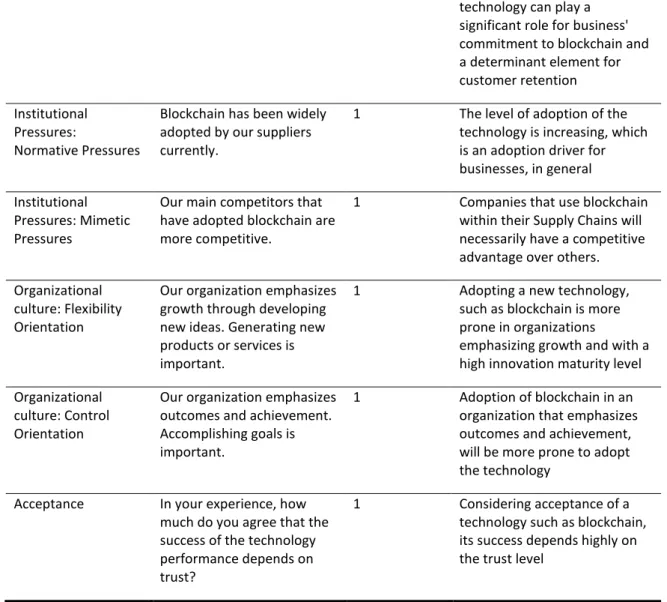
The rated attributes results treatment consisted on excluding the least ranked attributes per category, therefore out of the 48 rated attributes, for each of the 9 categories, the ones that summed the highest amount of points were considered, therefore 9 elements were considered, here the questions were rewritten into statements, as illustrated on Table 7.
Context Original Questions Rank Within Category
Reconciled Statements
Trust Though circumstances
change, we believe that the business partner will be ready to provide us assistance and support.
1 Adoption of the technology is
influenced by the choice of the business partner and its readiness to provide assistance and support.
Decentralization Blockchain’s decentralization
is a core strength, as a copy of the database file is owned by all actors.
1 Blockchain’s decentralization is
a core strength and an
adoption incentive, as a copy of the database file is owned by all actors.
Security Consider there is "51%"
consensus vulnerability within consensus
mechanism, does it play a security issues related to blockchain?
1 Consensus mechanisms may
present Security vulnerabilities that may concern the
technology’s adoption level
Institutional Pressures: Coercive Pressures
Our main customers that matter to us believe that we should use blockchain.
1 As an Institutional Coercive
Pressures, Customers
21 technology can play a
significant role for business' commitment to blockchain and a determinant element for customer retention Institutional
Pressures:
Normative Pressures
Blockchain has been widely adopted by our suppliers currently.
1 The level of adoption of the
technology is increasing, which is an adoption driver for businesses, in general Institutional
Pressures: Mimetic Pressures
Our main competitors that have adopted blockchain are more competitive.
1 Companies that use blockchain
within their Supply Chains will necessarily have a competitive advantage over others. Organizational
culture: Flexibility Orientation
Our organization emphasizes growth through developing new ideas. Generating new products or services is important.
1 Adopting a new technology,
such as blockchain is more prone in organizations
emphasizing growth and with a high innovation maturity level Organizational
culture: Control Orientation
Our organization emphasizes outcomes and achievement. Accomplishing goals is important.
1 Adoption of blockchain in an
organization that emphasizes outcomes and achievement, will be more prone to adopt the technology
Acceptance In your experience, how
much do you agree that the success of the technology performance depends on trust?
1 Considering acceptance of a
technology such as blockchain, its success depends highly on the trust level
Table 7 – Rated Questions Output
Regarding the open response questions, of the 10, only 9 statement were returned from the experts’ input, here an empirical analysis was necessary, as statements were created regarding the similarities between answers and the level of response per question, which explains why one of the questions asked was not considered given that none of the experts responded to it.
The end result is presented on Table 8, as follows:
A main incentive to implement a blockchain solution in a Supply Chain environment, is its traceability feature, i.e. tracking and tracing driven by network collaboration.
The current maturity at which blockchain is at does not allow businesses to evaluate the positive outcomes of adoption.
Smart contracts are a determinant feature of blockchain, when applied to supply chain because they promote transparency, data verifiability, no alterations to data, and allow products and services tracking.
A cost benefit that can prove to be attractive to upcoming adopters of the technology, is the reduction of the bullwhip effect on supply chains (distorted information from one end of a supply chain to the other that can lead to inefficiencies).
A main incentive to implement a blockchain solution in a Supply Chain environment, is that it represents a single source of information, i.e. Several sources integrated in one.
22 One of the challenges for Blockchain adoption could be the acceptance of the solution by the whole Supply Chain players.
Smart contracts are a determinant feature of blockchain, when applied to supply chain by promoting automation, therefore presenting performance increases and process simplification. Adoption of blockchain technology presents benefits for custom clearance and dangerous goods transactions, as these are highly regulated which means you might shift knowledge from one business partner to another.
Blockchain can automate processes in a holistic manner over multiple business partners.
Table 8 – Open ended questions transformed in statements adjusted with experts’ input. Round 2
Based on the list of factors derived from the original sample questionnaire, presented on the above Tables 7 and 8, an online questionnaire was designed in which experts were asked to rate those factors on a 7-point numerical scale. The decision served as means to enhance the reliability of the study and therefore avoiding ambiguity as data was pre-tested on a sample of respondents different from the final experts’ panel. Table 9 describes how the results from the validation round were treated, followed by the description of the analysis process.
Statement – Validation Round SD CV Sum (Ri)
Rank *
Q1 Q3 IQR Cut-Off Of 1
A main incentive to implement a blockchain solution in a Supply Chain environment, is that it represents a single source of information, i.e. Several sources integrated in one.
0.59 0.09 162 1st 6 7 1 acceptable
consensus
One of the challenges for Blockchain adoption could be the acceptance of the solution by the whole Supply Chain players.
0.71 0.11 160 2nd 6 7 1 acceptable
consensus A main incentive to implement a blockchain
solution in a Supply Chain environment, is its traceability feature, i.e. tracking and tracing driven by network collaboration.
0.87 0.14 160 3rd 6 7 1 acceptable
consensus
Adoption of the technology is influenced by the choice of the business partner and its readiness to provide assistance and support.
0.71 0.11 155 4th 6 7 1 acceptable
consensus
Blockchain can automate processes in a holistic manner over multiple business partners.
0.80 0.13 154 5th 6 7 1 acceptable
consensus Smart contracts are a determinant feature
of blockchain, when applied to supply chain because they promote transparency, data verifiability, no alterations to data and allow products and services tracking.
1.03 0.17 154 6th 6 7 1 acceptable
consensus
The level of adoption of the technology is increasing, which is an adoption driver for businesses, in general.
0.93 0.15 153 7th 6 7 1 acceptable
23 A cost benefit that can prove to be
attractive to upcoming adopters of the technology, is the reduction of the bullwhip effect on supply chains (distorted
information from one end of a supply chain to the other that can lead to inefficiencies).
1.05 0.17 153 8th 6 7 1 acceptable
consensus
Considering acceptance of a technology such as blockchain, its success depends highly on the trust level.
1.41 0.23 152 9th 6 7 1 acceptable
consensus Smart contracts are a determinant feature
of blockchain, when applied to supply chain by promoting automation, therefore presenting performance increases and process simplification.
1.09 0.19 147 10th 5 7 2 no consensus
reached
Companies that use blockchain within their Supply Chains will necessarily have a competitive advantage over others.
1.41 0.24 145 11th 5 7 2 no consensus
reached Blockchain’s decentralization is a core
strength and an adoption incentive, as a copy of the database file is owned by all actors.
1.10 0.19 143 12th 5 7 2 no consensus
reached
Adoption of blockchain technology presents benefits for custom clearance and
dangerous goods transactions, as these are highly regulated that means you might shift knowledge from one business partner to another.
1.50 0.27 140 13th 4 7 3 no consensus
reached
As an Institutional Coercive Pressures, Customers pressuring for adoption of the technology can play a significant role for business' commitment to blockchain and a determinant element for customer retention.
1.42 0.26 137 14th 4 7 3 no consensus
reached
Adopting a new technology, such as blockchain is more prone in organizations emphasizing growth and with a high innovation maturity level.
1.86 0.35 133 15th 5 7 2 no consensus
reached
An organization that emphasizes outcomes and achievements, will be more prone to adopt blockchain technology.
1.59 0.30 131 16th 4 7 3 no consensus
reached Consensus mechanisms may present
security vulnerabilities that may concern the technology's adoption level.
1.50 0.33 114 17th 4 5 1 acceptable
consensus The current maturity at which blockchain is
at does not allow businesses to evaluate the positive outcomes of adoption.
1.61 0.40 100 18th 3 5 2 no consensus
reached Table 9 – Statistical Results of the rated statements regarding blockchain adoption within supply
chain, by experts on the second-round survey
*Corrected by the Standard Deviation (SD), and based on the total number of points given by Sum-Ri value
Following [96,97] approach to measure consensus on scaled inquiries, the Interquartile Range (IQR) was used with a threshold of acceptance of 1, therefore results with IQR over 1 were labelled with “no consensus reached”, and the ones with IQR equal to 1 with the label “acceptable consensus”. As

![Table 5, considers factors not inherent to blockchain, but focused on the company’s propensity to adopt a technology, which can impact the adoption decision [84]:](https://thumb-eu.123doks.com/thumbv2/123dok_br/15141919.1011988/26.892.95.795.817.925/considers-factors-inherent-blockchain-propensity-technology-adoption-decision.webp)