arXiv:1203.3172v2 [hep-ex] 14 Sep 2012
CERN-PH-EP-2012-056
Submitted to: European Physical Journal C
Search for second generation scalar leptoquarks in
pp
collisions at
√
s
= 7
TeV with the ATLAS detector
The ATLAS Collaboration
Abstract
The results of a search for the production of second generation scalar leptoquarks are presented
for final states consisting of either two muons and at least two jets or a muon plus missing transverse
momentum and at least two jets. A total of 1.03 fb
−1integrated luminosity of proton-proton collision
data produced by the Large Hadron Collider at
√
s
= 7
TeV and recorded by the ATLAS detector is
used for the search. The event yields in the signal regions are found to be consistent with the Standard
Model background expectations. The production of second generation leptoquarks is excluded for a
leptoquark mass
m
LQ<
594 (685) GeV at 95% confidence level, for a branching ratio of 0.5 (1.0) for
leptoquark decay to a muon and a quark.
Search for second generation scalar leptoquarks in
pp
collisions at
√
s
= 7 TeV with the ATLAS detector
The ATLAS Collaboration
August 16, 2012
Abstract The results of a search for the production of second generation scalar leptoquarks are presented for final states consisting of either two muons and at least two jets or a muon plus missing transverse mo-mentum and at least two jets. A total of 1.03 fb−1 inte-grated luminosity of proton-proton collision data pro-duced by the Large Hadron Collider at √s = 7 TeV and recorded by the ATLAS detector is used for the search. The event yields in the signal regions are found to be consistent with the Standard Model background expectations. The production of second generation lep-toquarks is excluded for a leptoquark mass mLQ< 594 (685) GeV at 95% confidence level, for a branching ra-tio of 0.5 (1.0) for leptoquark decay to a muon and a quark.
1 Introduction
The remarkable similarities between quarks and leptons in the Standard Model (SM) lead to the supposition that there could be a fundamental relationship between them at a sufficiently high energy scale, manifested by the existence of leptoquarks (LQ) [1]. LQs are hypothet-ical particles which carry both baryon and lepton num-ber and have fractional electrical charge. The present search is performed within the minimal Buchm¨ uller-R¨uckl-Wyler model [2], where LQs are restricted to couple to quarks and leptons of one generation. In this model, LQs are required to have pure chiral couplings to SM fermions in order to avoid inducing four-fermion interactions that would cause flavour-changing neutral currents and lepton family-number violations. At the Large Hadron Collider (LHC), scalar LQs can be
pro-duced either in pairs or singly. Single LQ production involves the unknown λLQ−ℓ−qcoupling, while pair pro-duction of scalar LQs occurs mostly via gluon-gluon fu-sion, dominant for mLQ.1 TeV, and qq-annihilation, dominant at larger masses. Both pair-production modes involve only the strong coupling constant, and therefore all model dependence is contained in the assumed LQ mass mLQand the branching ratio β for LQ decay to a charged lepton and a quark1. LQs can also decay to a neutrino and a quark; in this case, the branching ratio is 1 − β. Pair production of scalar LQs at the LHC has been calculated at next-to-leading order (NLO) [4].
The results presented in this paper are an update of the previous ATLAS search for second generation LQs [5] and extend the bounds arising from previous di-rect searches performed by CMS [6], ATLAS [5], D0 [7] and OPAL [8]. A total integrated luminosity of 1.03 fb−1 of proton-proton collision data at a centre of mass en-ergy√s = 7 TeV, collected with the ATLAS detector from March through July 2011, is used for the search. The final states arising from leptoquark pairs decay-ing into two muons and two quarks (µµjj), or into a muon, a neutrino and two quarks (µνjj), are consid-ered. These result in experimental signatures of either two high transverse momentum (pT) muons and two high pT jets, or one high pTmuon, missing transverse momentum, and two high pT jets.
Analyses for both dimuon and single muon final states start with the selection of event samples with
1 The λ
LQ−ℓ−q coupling determines the LQ lifetime and
width [3]. For LQ masses considered here, 200 GeV≤ mLQ≤700 GeV, couplings greater than e ×10−6, with e=
√
4πα the electron charge, and α(MZ) = 1/128, correspond
to decay lengths less than roughly 1 mm. In addition, to be insensitive to the coupling, the width cannot be larger than the experimental resolution of a few GeV. This sets the ap-proximate sensitivity to the unknown coupling strength.
large signal acceptance. Since background cross sec-tions are several orders of magnitude larger than the signal cross sections, these samples are dominated by the major backgrounds: Z+jets and t¯t in the µµjj case, and W +jets and t¯t for the µνjj case. Further selec-tion requirements are then applied to these samples to define control regions used to determine the normal-ization of the aforementioned backgrounds. The deter-mination of the multi-jet background is performed in a fully data-driven approach, and the smaller diboson and single top-quark backgrounds are estimated using Monte Carlo (MC) simulations.
After all background contributions are determined, variables selected to enhance the discrimination between signal and background are combined into a log like-lihood ratio, which is used to search for an excess of events over the SM background prediction. The searches are performed independently for each final state. The results are then combined and interpreted as lower bounds on the LQ mass for different β hypotheses.
2 The ATLAS detector
The ATLAS detector [9] is a multi-purpose detector with a forward-backward symmetric cylindrical geome-try and nearly 4π coverage in solid angle2.
The three major sub-components of ATLAS are the tracking detectors, the calorimeters and the muon spec-trometer. Charged particle tracks and vertices are re-constructed with silicon-based tracking detectors that cover |η| < 2.5 and a transition radiation tracker ex-tending to |η| < 2.0. The inner tracking system is im-mersed in a homogeneous 2 T axial magnetic field pro-vided by a solenoid. Electron, photon, and jet energies are measured in the calorimeters. The calorimeter sys-tem is segmented into a central barrel and two endcaps, collectively covering the pseudorapidity range of |η| < 4.9. A liquid-argon (LAr) electromagnetic calorimeter covers the range |η| < 3.2 and an iron-scintillator tile hadronic calorimeter covers the range |η| < 1.7. Endcap and forward LAr calorimeters provide both electromag-netic and hadronic measurements and cover the region 1.5 < |η| < 4.9.
Surrounding the calorimeters, a muon spectrome-ter [9] with air-core toroids, a system of precision track-ing chambers, and detectors with triggertrack-ing capabili-ties provides muon identification and precise
momen-2 ATLAS uses a right-handed coordinate system with its
origin at the nominal interaction point and the z-axis along the beam pipe. Cylindrical coordinates (r,φ) are used in the transverse plane, withφthe azimuthal angle around the beam pipe. The pseudorapidity η is defined in terms of the polar angleθbyη= –ln tan(θ/2).
tum measurements. The muon spectrometer is based on three large superconducting toroids with coils ar-ranged in an eight-fold symmetry around the calorime-ters, covering a range of |η| < 2.7. Over most of the η range, precision measurements of the track coordinates in the principal bending direction of the magnetic field are provided by Monitored Drift Tubes (MDTs). At large pseudorapidities (2.0 < |η| < 2.7), Cathode Strip Chambers (CSCs) with higher granularity are used in the innermost station.
A three-level trigger system selects events to be recorded for offline analysis. The muon trigger detectors consist of Resistive Plate Chambers (RPCs) in the barrel (|η| < 1.05) and Thin Gap Chambers (TGCs) in the end-cap regions (1.05 < |η| < 2.4), with a small overlap in the |η| = 1.05 region. The data considered in this analysis are selected from events containing at least one muon with the transverse momentum determined by the trig-ger system satisfying pT> 18 GeV.
3 Simulated samples
Simulated event samples are used to determine all sig-nal and some of the background yields. Sigsig-nal samples for LQ masses between 200 GeV and 1000 GeV are sim-ulated with PYTHIA 6.4.25 [10]. NLO cross sections as determined in Ref. [4], using CTEQ6.6 [11] parton dis-tribution functions (PDFs), are used to normalize the samples at each mass point.
Samples of W and Z/γ⋆ production in association with n partons (where n can be 0, 1, 2, 3, 4 and 5 or more) are simulated with the ALPGEN [12] gen-erator interfaced to HERWIG [13] and JIMMY [14] to model parton showers and multiple parton interactions, respectively. The MLM [12] parton-shower matching scheme is used to form inclusive W/Z+jets samples. MC@NLO [15] is used to estimate the production of single top quarks and top quark pairs. A top quark mass of 172.5 GeV is used in the simulation. Diboson events are generated using HERWIG, and the cross sections are scaled to NLO calculations [15,16].
All simulated events are passed through a full detec-tor simulation based on GEANT4 [17] and then recon-structed with the same software chain as the data [18]. During the data-taking period considered in this search, the mean number of primary proton-proton interactions per bunch crossing was approximately six. The effect of this pile-up is taken into account in the analysis by over-laying simulated minimum bias events onto the simu-lated hard-scattering events. The MC samples are then reweighted such that the average number of pile-up in-teractions matches that seen in the data.
4 Object and Event selection
Collision events are identified by requiring at least one reconstructed primary vertex candidate with at least three associated tracks with pT,track> 0.4 GeV. If two or more such vertices are found, the one with the largest sum of p2
T,trackis taken to be the primary vertex. Muons are reconstructed by matching tracks in the inner de-tector to track segments in the muon spectrometers, as described in Ref. [19]. In addition to the track qual-ity requirements imposed for identification, the muon tracks must also satisfy |d0| < 0.1 mm and |z0| < 5 mm, where d0and z0are the transverse and longitudinal im-pact parameters measured with respect to the primary vertex. All selected muons must have pT> 30 GeV and are restricted to be within |η| < 2.4. Muon candidates must pass the isolation requirement pcone20
T /pT< 0.2, where pcone20
T is the sum of the pTof the tracks within ∆R = p(∆φ)2+ (∆η2) < 0.2 of the muon track, ex-cluding the muon pTcontribution. Selected events must have at least one muon identified by the trigger system within a cone ∆R < 0.1 centered on a selected muon.
Jets are reconstructed from calorimeter energy clus-ters using the anti-kt algorithm [21] with a radius pa-rameter R = 0.4. Corrections are applied in order to ac-count for the effects of the non-compensating calorime-ter, upstream material and other effects, by using pT and η-dependent correction factors derived from simu-lation and validated with test-beam [22] and collision data studies [23]. After applying quality requirements based on shower shape and signal timing with respect to the beam crossing, the selected jets must satisfy pT> 30 GeV, |η| < 2.8 and must be separated from the selected candidate muons by ∆R > 0.4. The presence of neutrinos is inferred from the missing transverse mo-mentum Emiss
T , defined as the magnitude of the negative vector sum of the transverse momenta of reconstructed electrons, muons and jets, as well as calorimeter energy deposits not associated to reconstructed objects.
Corrections to the muon trigger and reconstruction efficiencies and to the momentum resolution are applied to the simulated events so that their kinematic distribu-tions match those observed in data, with an impact on the predicted number of events of less than 2%. These corrections are derived from samples of Z → µµ and W → µν decays [19], taking into account the effects of multiple scattering and the intrinsic resolution of the muon spectrometer [20]. In order to validate the cor-rections at high pT, the alignment of the muon spec-trometer, which dominates the momentum resolution for pT larger than approximately 200 GeV, is derived from a sample of straight track data taken in special
runs with the toroids turned off, resulting in agreement within the considered systematic uncertainties.
Events selected for this search are required to con-tain either exactly two muons and at least two jets for the µµjj final state, or exactly one muon, at least two jets and Emiss
T > 30 GeV for the µνjj final state. In the µµjj channel, only events with mµµ> 40 GeV are considered. In the µνjj channel, events are required to have mT=p2pµTETmiss(1 − cos(∆φ)) > 40 GeV, where ∆φ is the angle between the muon and the Emiss
T di-rection in the plane perpendicular to the beam. Events with identified electrons as defined in Ref. [24], with pT > 30 GeV, and |η| < 2.47 are rejected. After all the selection criteria are applied the acceptance times efficiency ranges from about 60% (55%) for a LQ signal of mLQ = 300 GeV to 65% (60%) for a LQ signal of mLQ= 600 GeV for the µµjj (µνjj) channel.
5 Background determination
Major backgrounds in this search arise from V +jets (V = W, Z) and t¯t processes. The kinematic distribu-tions of these are determined using MC samples, and their absolute normalization is evaluated from data us-ing control regions, which are subsets of the selected sample, designed to enhance either the V +jets or the top quark contribution. The multi-jet background is ob-tained directly from data and prior to the estimation of the normalization for the two main backgrounds, while the determination of the remaining backgrounds (dibo-son and single top quark production) relies entirely on MC simulations.
Two control regions are used in the µµjj channel. (I) Z+jets: formed by events within a narrow dimuon invariant mass mµµ window around the Z boson mass, defined by 81 < mµµ< 101 GeV, and at least two jets, and (II) t¯t: one of the muons is replaced by an electron resulting in events with a muon and an electron, and at least two jets.
Three control regions are used in the µνjj chan-nel. (I) W + 2 jets: events in the vicinity of the W bo-son Jacobian peak, selected by requiring 40 < mT < 120 GeV, exactly two jets and ST < 225 GeV, where STis the scalar summed transverse energy ST, defined as ST = pµT+ EmissT + p
jet1 T + p
jet2
T , (II) W + 3 jets: events passing the 40 < mT < 120 GeV requirement, with at least three jets and ST < 225 GeV, and (III) t¯t: events with at least four jets, with pjet1T > 50 GeV and pjet2T > 40 GeV. In all of the control regions the expected signal yields are negligible.
The normalizations of the V +jets and t¯t backgrounds are obtained by comparing data and MC yields in the
) [GeV] 2 µ , 1 µ m( 100 200 300 400 500 600 Events / 20 GeV -1 10 1 10 2 10 3 10 4 10 5 10 Data ( s=7 TeV) V+Jets Top Multi−jet Diboson LQ (m=600 GeV) jj µ µ → LQ LQ -1 Ldt = 1.03 fb
∫
ATLAS (a)Average LQ Mass [GeV] 100 200 300 400 500 600 700 800 900 Events / 50 GeV -1 10 1 10 2 10 3 10 4 10 5 10 Data ( s=7 TeV) V+Jets Top Multi−jet Diboson LQ (m=600 GeV) jj µ µ → LQ LQ -1 Ldt = 1.03 fb
∫
ATLAS (b) [GeV] T S 200 400 600 800 1000 1200 1400 1600 1800 Events / 50 GeV -1 10 1 10 2 10 3 10 4 10 5 10 Data ( s=7 TeV) V+Jets Top Multi−jet Diboson LQ (m=600 GeV) jj µ µ → LQ LQ -1 Ldt = 1.03 fb∫
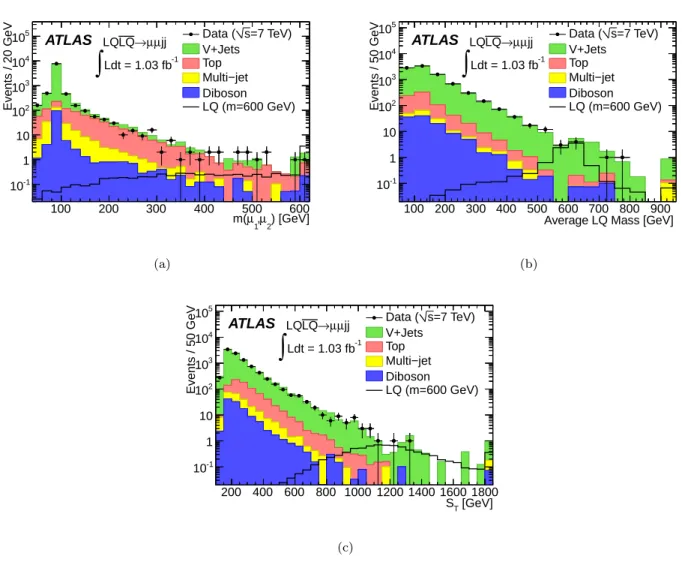
ATLAS (c)Fig. 1 Distributions of the inputLLRvariables for theµµjj channel for data and the SM backgrounds. (a) Invariant mass of
the two muons in the event, (b) Average LQ mass resulting from the best muon-jet combinations in each event, and (c)ST.
The stacked distributions show the various background contributions, and data are indicated by the points with error bars. The 600 GeV LQ signal is also shown forβ= 1.0. In all figures, the last bin contains the sum of all entries equal to and above the bin lower boundary.
control samples defined above. In the µµjj channel, each correction factor is obtained independently for each background, on account of the high purity of the two different control regions. In the µνjj channel, there is significant cross-region contamination and therefore the number of V +jets and t¯t events is determined by simul-taneously minimizing the χ2 formed by the differences between the observed and predicted SM yields in the three control regions. The resulting scale factors are of the order of 10% in the low STregion.
The multi-jet background in the selected sample and in each control sample is obtained from a fit to the mµµ and Emiss
T distribution in the µµjj and µνjj channels, respectively. In these fits, the relative fraction of the multi-jet background is a free parameter, and the sum of the total predicted events is constrained to be equal
to the total observed number of events. The V +jets and t¯t normalizations are not fixed. Multi-jet background arises predominantly from muons from secondary de-cays. Therefore, templates for the multi-jet background distributions are constructed from multi-jet enhanced samples of data events in which the muons fail the re-quirement on the transverse impact parameter or the isolation selection requirements described in Section 4. In the µµjj channel, the W +jets contribution is esti-mated together with the multi-jet background. During this procedure, the V +jets and t¯t normalizations are fitted as well, providing an independent estimate. The resulting values agree with those obtained from the con-trol regions, which are the ones used in the analysis.
After analyzing 1.03 fb−1 of data and applying the analysis requirements described in Section 4, good
agree-) [GeV] T E , µ ( T m 100 200 300 400 500 600 Events / 15 GeV -1 10 1 10 2 10 3 10 4 10 5 10 6 10 ) [GeV] T E , µ ( T m 100 200 300 400 500 600 Events / 15 GeV -1 10 1 10 2 10 3 10 4 10 5 10 6 10 Data ( s=7 TeV) V+Jets Top Multi-jet Diboson LQ (m=600 GeV) jj ν µ → LQ LQ -1 Ldt = 1.03 fb
∫
ATLAS (a) [GeV] T S 200 400 600 800 1000 1200 1400 1600 1800 Events / 40 GeV -1 10 1 10 2 10 3 10 4 10 5 10 6 10 [GeV] T S 200 400 600 800 1000 1200 1400 1600 1800 Events / 40 GeV -1 10 1 10 2 10 3 10 4 10 5 10 6 10 Data ( s=7 TeV) V+Jets Top Multi-jet Diboson LQ (m=600 GeV) jj ν µ → LQ LQ -1 Ldt = 1.03 fb∫
ATLAS (b) Leptoquark m [GeV] 0 100 200 300 400 500 600 700 800 900 1000 Events / 40 GeV -1 10 1 10 2 10 3 10 4 10 5 10 6 10 Leptoquark m [GeV] 0 100 200 300 400 500 600 700 800 900 1000 Events / 40 GeV -1 10 1 10 2 10 3 10 4 10 5 10 6 10 Data ( s=7 TeV) V+Jets Top Multi-jet Diboson LQ (m=600 GeV) jj ν µ → LQ LQ -1 Ldt = 1.03 fb∫
ATLAS (c) [GeV] T Leptoquark m 0 100 200 300 400 500 600 700 800 900 1000 Events / 40 GeV -1 10 1 10 2 10 3 10 4 10 5 10 6 10 [GeV] T Leptoquark m 0 100 200 300 400 500 600 700 800 900 1000 Events / 40 GeV -1 10 1 10 2 10 3 10 4 10 5 10 6 10 Data ( s=7 TeV) V+Jets Top Multi-jet Diboson LQ (m=600 GeV) jj ν µ → LQ LQ -1 Ldt = 1.03 fb∫
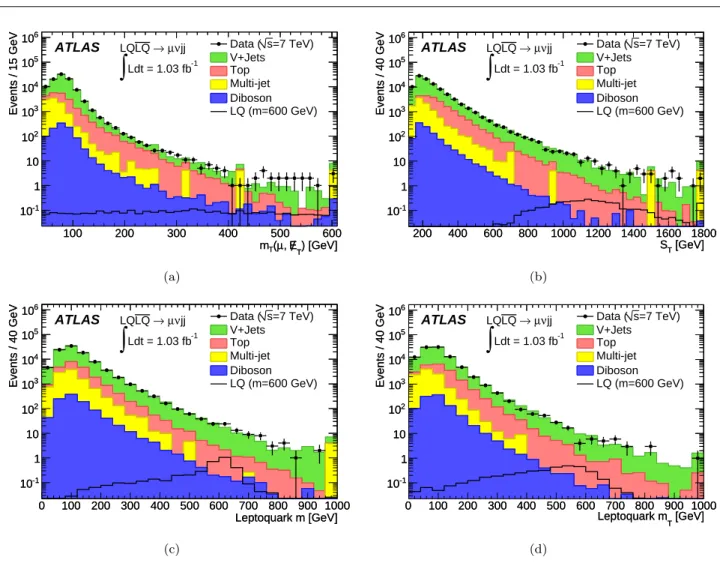
ATLAS (d)Fig. 2 Distributions of the inputLLRvariables for theµνjjchannel for data and the SM backgrounds. (a) Transverse mass
of the muon and theEmiss
T in the event, (b)ST, (c) LQ mass, and (d) LQ transverse mass. The stacked distributions show the
various background contributions, and data are indicated by the points with error bars. The expected signal for a 600 GeV LQ signal is also shown forβ= 0.5. In all figures, the last bin contains the sum of all entries equal to and above the bin lower boundary.
ment is observed between the data and the SM expecta-tion. The observed and expected yields in the selected sample are 9254 and 9300 ± 1700 for the µµjj channel, and 97113 and 97000 ± 19000 for the µνjj channel. For a LQ mass of 600 GeV, 8.2±0.4 and 3.9±0.2 events are expected for the µµjj and the µνjj final states, respec-tively. The aforementioned uncertainites fully account for (the dominant) systematic and statistical uncertain-ties.
6 Likelihood analysis
Several kinematic variables, selected to provide the best discrimination between LQ events and SM backgrounds, are combined in a log likelihood ratio in order to search for a LQ signal. In the µµjj channel, mµµ, ST= pµ1T + pµ2T + pjet1T + pjet2T and the average reconstructed
lep-toquark mass ¯mLQare used. In the µνjj channel, ST, mT, the transverse leptoquark mass mLQT and the lep-toquark mass mLQare used. The distributions of these input variables are shown in Fig. 1 and Fig. 2 for the µµjj and the µνjj final states, respectively.
In the µµjj channel, an average LQ mass ¯mLQis de-fined for each event by reconstructing all possible com-binations of lepton-jet pairs, using the two highest pT jets in each event. Of the four possible combinations in each event, the pairing which provides the smallest dif-ference between the LQ masses is chosen, and their av-erage is used in the likelihood analysis. In the µνjj final state, because the longitudinal component of the neu-trino momentum is unknown, only one mass from the muon and a jet can be reconstructed, and the Emiss
T and the remaining jet are used to calculate the transverse mass of the other LQ. The two masses which provide the smallest absolute difference are used in the
likeli-Table 1 The predicted and observed yields and the expected yields for a LQ signal of mLQ = 600 GeV after requiring
LLR ≥ 2 for the µµjj channel and LLR ≥ 7 for the µνjj
channel. Theµµjj (µνjj) channel signal yields are computed assumingβ= 1.0 (0.5). Statistical and systematic uncertain-ties as described in Section 7 are shown. These are calculated assuming a 100% correlation for the same source between the different backgrounds. These systematic uncertainties are computed as the sum of the absolute values of the systematic variation in each bin and are shown to indicate the scale. This is an approximation to the standard ensemble method used in the limit setting code.
Source µµjj Channel µνjjChannel
V+jets 14.2±6.4 12.9±9.9 Top 3.0±2.2 1.9±1.2 Diboson 0.8±0.6 0.3±0.1 Multi-jet <0.1 <0.1 Total 18±8 15±11 Data 16 14 LQ 8.2±0.4 3.2±0.2
hood analysis. With this algorithm, the probability of picking the correct pairing is of around 90% for both channels.
For each event, likelihoods are constructed for the background (LB) and the various signal LQ hypothesis (LS) as follows: LB ≡Q bi(xij), LS ≡Q si(xij), where bi, si are the probabilities of the i–th input variable from the normalized summed background and signal distributions, respectively, and xij is the value of that variable for the j–th event in a sample. The log likeli-hood ratio for each tested signal, LLR =log(LS/LB), is used as the final variable to search for the LQ signal.
7 Systematic uncertainties
Systematic uncertainties originating from several sources are considered. These include uncertainties in lepton momentum, jet energy and Emiss
T scales and resolutions and their dependence on the number of pile-up events, the background estimations, and the LQ production cross section. For each source of uncertainty consid-ered, the analysis is repeated with the relevant variable varied within its uncertainty, and a new LLR is built for the systematically varied sample, enabling the un-certainty in both the predicted yield and the kinematic distributions to be propagated to the final result. In this section, systematic uncertainties are described for each source of systematics, calculated assuming each source to be 100% correlated among the different backgrounds. Uncertainties are given for the region of LLR ≥ 2 and LLR ≥ 7 for the µµjj and the µνjj channels, respec-tively, although the full LLR distribution is used to search for the LQ signal.
LLR -10 -8 -6 -4 -2 0 2 4 6 Events -1 10 1 10 2 10 3 10 4 10 5 10 Data ( s=7 TeV) V+Jets Top Multi−jet Diboson LQ (m=600 GeV) jj µ µ → LQ LQ -1 Ldt = 1.03 fb
∫
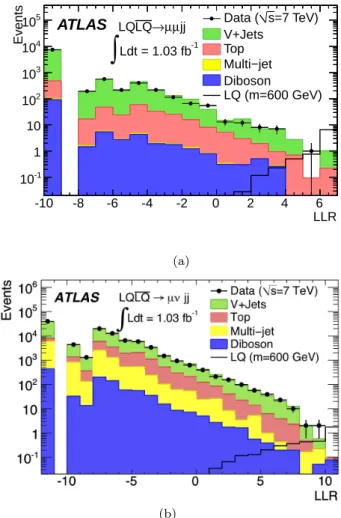
ATLAS (a) (b)Fig. 3 (a) LLR distributions for the µµjj and (b) for the
µνjj final states for a LQ mass of 600 GeV. The data are indicated with the points and the filled histograms show the SM background. The multi-jet background is estimated from data, while the other background contributions are obtained from simulated samples as described in the text. The LQ signal corresponding to a LQ mass of 600 GeV is indicated by a solid line, and is normalized assuming β = 1.0(0.5) in theµµjj(µνjj) channel. The lowest bin corresponds to back-ground events in regions of the phase space for which no signal events are expected.
The jet energy scale (JES) and resolution (JER) are varied up and down by 1σ [23] for all simulated events. Their impact is estimated independently, and the cor-responding variations are propagated to the Emiss
T in the case of the µνjj channel. The resulting effect of the JES (JER) uncertainty is 9% (8%) and 15% (7%) for the backgrounds in the µµjj and the µνjj channels, respectively. For a LQ signal of mLQ= 600 GeV, both are 1% for the µµjj channel, and 2.4% and 1% for the µνjj channel.
The systematic uncertainties from the muon reso-lution and momentum scale are derived by comparing the mµµ distribution in Z → µµ control samples to
Z → µµ MC samples and are approximately 1% [20]. These result in uncertainties of 12% and 3% for the total background prediction in the µµjj and the µνjj channels, respectively, and in uncertainties of 1.4% for a LQ signal of mLQ = 600 GeV for the µµjj and the µνjj channels.
Systematic uncertainties due to assumptions in the modelling of the V +jets background are estimated by using SHERPA [25] samples instead of the ALPGEN samples described in Section 3. The resulting uncer-tainty is 30% for the µµjj channel and 60% for the µνjj channel. Similarly, systematic uncertainties aris-ing from the modellaris-ing of the t¯t process are obtained by using different parameter values to simulate alternative samples to the one described in Section 3. These in-clude samples in which the top quark mass is varied up and down by 2.5 GeV, generated with MC@NLO, sam-ples where the initial and final-state radiation (ISR and FSR) contributions are varied accordingly to their un-certainties, generated with ACER MC [26], and samples generated with POWHEG [27] interfaced to PYTHIA and JIMMY. These impact the total background yields by 12% (7%) for the µµjj (µνjj) final state. For both V +jets and t¯t backgrounds, a 10% uncertainty on the scale factors is considered, covering the variation of the scale factors in the low and high pTregions.
Systematic uncertainties in the multi-jet background in the µµjj channel are determined by comparing re-sults derived from fits to kinematic variables other than the nominal ones. These include the leading muon pT, the leading jet pT, the ETmiss and the scalar sum of the transverse momenta of the two muons in the event. In the µνjj channel, an alternative loose-tight matrix method [28] with two different multi-jet enhanced sam-ples obtained by inverting the isolation and the |d0| requirements is used. Since the relevant phase space of the multi-jets in the two channels is very different, the different control regions have very different statistics which leads to a large difference in precision to which this background can be estimated. The resulting uncer-tainties are 90% in the µµjj channel and 33% in the µνjj channel.
A luminosity uncertainty of 3.7% [29] is assigned to the LQ signal yields and to the yields of background processes determined from simulation: diboson and sin-gle top quark production. Further systematic uncertain-ties considered arise from the finite number of events in the simulated samples, amounting to 4%–25% depend-ing on the LQ mass bedepend-ing considered.
For the signal samples, additional systematic uncer-tainties originate from ISR and FSR effects, resulting in an uncertainty of 2% for both channels. The choice of the renormalization and factorization scales, which are
varied from mLQ to 2mLQ and mLQ/2, and the choice of the PDF, determined with the CTEQ eigenvectors errors and by using the MRST2007LO* PDF set [30], result in an uncertainty in the signal acceptance of 1%– 6% for LQ masses between 300 GeV and 700 GeV.
8 Results
Figure 3 shows the LLR for the data, the predicted backgrounds and a LQ signal of 600 GeV for the µµjj and the µνjj channels. To ensure sufficient background statistics, bins with a total background yield less than twice the statistical uncertainty in that bin are merged into a single bin. There is no significant excess in data observed at large LLR values where such a signal would appear, and the data are found to be consistent with the SM background expectations (see Table 1). Upper limits are derived at 95% confidence level (CL) for the scalar leptoquark production cross section using a mod-ified frequentist CLsapproach [31,32]. The test statis-tic is defined as −2 ln(Q) = −2 ln(Ls+b/Lb), where the likelihoods Ls+b and Ls follow a Poisson distribution and are calculated based on the corresponding LLR distributions. Systematic uncertainties as described in Section 7 are treated as nuisance parameters with a Gaussian probability density function.
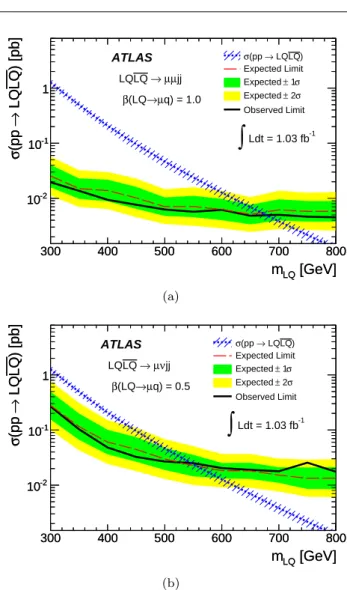
The 95% CL upper bounds on the cross section for leptoquark pair production as a function of mass are shown in Fig. 4 for the µµjj and the µνjj channels at β = 1.0 and β = 0.5, respectively. The expected and observed limits for the combined channels are shown in the β vs. mLQplane in Fig. 5.
9 Conclusions
The results of a search for the pair production of sec-ond generation scalar leptoquarks using 1.03 fb−1 of proton-proton collision data produced by the LHC at √
s = 7 TeV and recorded by the ATLAS detector are presented. The data are in good agreement with the expected SM background, and no evidence of LQ pro-duction is observed. Lower limits on leptoquark masses of mLQ > 685 GeV and mLQ > 594 GeV for β = 1.0 and β = 0.5 are obtained at 95% CL, whereas the ex-pected limits are mLQ> 671 GeV and mLQ> 605 GeV, respectively. These are the most stringent limits to date arising from direct searches for second generation scalar leptoquarks.
[GeV] LQ m 300 400 500 600 700 800 ) [pb] LQ LQ → (pp σ -2 10 -1 10 1 ) LQ LQ → (pp σ Expected Limit σ 1 ± Expected σ 2 ± Expected Observed Limit [GeV] LQ m 300 400 500 600 700 800 ) [pb] LQ LQ → (pp σ -2 10 -1 10 1 -1 Ldt = 1.03 fb
∫
jj µ µ → LQ LQ q) = 1.0 µ → (LQ β ATLAS (a) [GeV] LQ m 300 400 500 600 700 800 ) [pb] LQ LQ → (pp σ -2 10 -1 10 1 ) LQ LQ → (pp σ Expected Limit σ 1 ± Expected σ 2 ± Expected Observed Limit [GeV] LQ m 300 400 500 600 700 800 ) [pb] LQ LQ → (pp σ -2 10 -1 10 1 -1 Ldt = 1.03 fb∫
jj ν µ → LQ LQ q) = 0.5 µ → (LQ β ATLAS (b)Fig. 4 (a) 95% CL upper limit on the pair production cross
section of second generation leptoquarks for theµµjjchannel atβ=1.0 and (b) for theµνjjchannel at β=0.5. The solid lines indicate the individual observed limits, while the ex-pected limits are indicated by the dashed lines. The theoret-ical prediction is indicated by the hatched band and includes the systematic uncertainties due to the choices of the PDF and the renormalization and factorization scales. The dark (green) and light (yellow) solid band contains 68% (95%), re-spectively, of possible outcomes from pseudo-experiments in which the yield is Poisson-fluctuated around the background-only expectation.
10 Acknowledgements
We thank CERN for the very successful operation of the LHC, as well as the support staff from our institutions without whom ATLAS could not be operated efficiently. We acknowledge the support of ANPCyT, Argentina; YerPhI, Armenia; ARC, Australia; BMWF, Austria; ANAS, Azerbaijan; SSTC, Belarus; CNPq and FAPESP, Brazil; NSERC, NRC and CFI, Canada; CERN; CON-ICYT, Chile; CAS, MOST and NSFC, China; COL-CIENCIAS, Colombia; MSMT CR, MPO CR and VSC
[GeV] LQ m 200 300 400 500 600 700 800 900 1000 1100 q) µ → BR(LQ ≡ β 0 0.1 0.2 0.3 0.4 0.5 0.6 0.7 0.8 0.9 1 jj µ µ jj νµ jj (Exp.) ν µ jj+ µ µ jj (Obs.) ν µ jj+ µ µ ) -1 D0 (1.0 fb ) -1 CMS (34 pb [GeV] LQ m 200 300 400 500 600 700 800 900 1000 1100 q) µ → BR(LQ ≡ β 0 0.1 0.2 0.3 0.4 0.5 0.6 0.7 0.8 0.9 1 = 7 TeV s -1 Ldt = 1.03 fb
∫
jj ν µ jj+ µ µ → LQ LQ ATLASFig. 5 95% CL exclusion region resulting from the
combi-nation of the µµjj and the µνjj channels shown in the β versus leptoquark mass plane. The shaded area at the left dicates the D0 exclusion limit [7] and the thick dotted line in-dicates the CMS exclusion region [6]. The dotted and dotted-dashed lines indicate the individual limits derived for the µµjjandµνjjchannels, respectively. The combined observed limit is indicated by the solid black line. The combined ex-pected limit is indicated by the dashed line, together with the solid band containing 68% of possible outcomes from pseudo-experiments in which the yield is Poisson-fluctuated around the background-only expectation.
CR, Czech Republic; DNRF, DNSRC and Lundbeck Foundation, Denmark; ARTEMIS and ERC, European Union; IN2P3-CNRS, CEA-DSM/IRFU, France; GNAS, Georgia; BMBF, DFG, HGF, MPG and AvH Founda-tion, Germany; GSRT, Greece; ISF, MINERVA, GIF, DIP and Benoziyo Center, Israel; INFN, Italy; MEXT and JSPS, Japan; CNRST, Morocco; FOM and NWO, Netherlands; RCN, Norway; MNiSW, Poland; GRICES and FCT, Portugal; MERYS (MECTS), Romania; MES of Russia and ROSATOM, Russian Federation; JINR; MSTD, Serbia; MSSR, Slovakia; ARRS and MVZT, Slovenia; DST/NRF, South Africa; MICINN, Spain; SRC and Wallenberg Foundation, Sweden; SER, SNSF and Cantons of Bern and Geneva, Switzerland; NSC, Taiwan; TAEK, Turkey; STFC, the Royal Society and Leverhulme Trust, United Kingdom; DOE and NSF, United States of America.
The crucial computing support from all WLCG part-ners is acknowledged gratefully, in particular from CERN and the ATLAS Tier-1 facilities at TRIUMF (Canada), NDGF (Denmark, Norway, Sweden), CC-IN2P3 (France), KIT/GridKA (Germany), INFN-CNAF (Italy), NL-T1 (Netherlands), PIC (Spain), ASGC (Taiwan), RAL (UK) and BNL (USA) and in the Tier-2 facilities worldwide.
References
1. W. Buchm¨uller and D. Wyler, Phys. Lett.B177(1986) 377; J. C. Pati and A. Salam, Phys. Rev.D10(1974) 275; H. Georgi and S. Glashow, Phys. Rev. Lett.32 (1974) 438; S. Dimopoulus and L. Susskind, Nucl. Phys.B155 (1979), 237; S. Dimopoulus, Nucl. Phys.B168(1980) 69; E. Eichten and K. Lane, Phys. Lett. B90 (1980) 125; B. Schrempp and F. Schrempp, Phys. Lett.B153(1985) 101; V. D. Angelopoulus et al., Nucl. Phys.B292(1987) 59.
2. W. Buchm¨uller et al., Phys. Lett.B191(1987) 442. 3. A. Belyaev, C. Leroy, R. Mehdiyev, A. Pukhov, JHEP09
(2005) 005.
4. M. Kramer, T. Plehn, M. Spira and P. M. Zerwas, Phys. Rev.D71(2005) 057503.
5. ATLAS Collaboration, Phys. Rev.D83(2011) 112006. 6. CMS Collaboration, Phys. Rev. Lett.106(2011) 201803. 7. D0 Collaboration, V. M. Abazov et al., Phys. Lett.B636
(2006) 183.
8. OPAL Collaboration, G. Abbiendi et al., Eur. Phys. J. C31(2003) 281.
9. ATLAS Collaboration, JINST3, S08003 (2008). 10. T. Sjostrand, S. Mrenna and P. Skands, JHEP05(2006)
026.
11. D. Stump et al., JHEP10(2003) 046; 12. M. Mangano et al., JHEP07(2003) 001. 13. G. Corcella et al., JHEP01(2001) 010.
14. J. Butterworth, J. Forshaw and M. Seymour, Z. Phys. C72(1996) 637.
15. S. Frixione and B. R. Webber, JHEP 06 (2002) 029; S. Frixione, P. Nason and B. R. Webber, JHEP08(2003) 007.
16. J. M. Campbell and R. K. Ellis, Phys. Rev.D60, 113006 (1999).
17. S. Agostinelli et al., GEANT4 Collaboration, Nucl. In-strum. Meth.A506(2003) 250.
18. ATLAS Collaboration, Eur. Phys. J.C70(2010) 823. 19. ATLAS Collaboration, Phys. Rev.D85(2012) 072004. 20. ATLAS Collaboration, ATLAS-CONF-2011-046,
http://cdsweb.cern.ch/record/1338575.
21. M. Cacciari, G. P. Salam and G. Soyez, JHEP04, (2008) 063; M. Cacciari and G. P. Salam, Phys. Lett. B641 (2006) 57.
22. P. Adragna et al., Nucl. Instrum. Meth. A615, (2010) 158.
23. ATLAS Collaboration, arXiv:1112.6426, Submitted to Eur. Phys. J. C.
24. ATLAS Collaboration, Phys. Lett.B709, 158-176 (2012). 25. T. Gleisberg et al. JHEP02(2009) 007; S. Schumann and F. Krauss, JHEP03(2008) 038; S. Hoeche, F. Krauss, S. Schumann, and F. Siegert, JHEP05(2009) 053. 26. B. P. Kersevan and E. Richter-Was, arXiv:0405247
(2004).
27. S. Frixione, P. Nason and C. Oleari, JHEP11(2007) 070. 28. ATLAS Collaboration, Eur. Phys. J.C71, 1577 (2011). 29. ATLAS Collaboration, ATLAS-CONF-2011-116,
http://cdsweb.cern.ch/record/1376384;
ATLAS Collaboration, Eur. Phys. JC71, 1630 (2011). 30. A. Sherstnev and R. S. Thorne, Eur. Phys. J.C55, 553
(2008).
31. W. Fisher, FERMILAB-TM-2386-E.
The ATLAS Collaboration
G. Aad48, B. Abbott112, J. Abdallah11, S. Abdel Khalek116, A.A. Abdelalim49, A. Abdesselam119, O. Abdinov10, B. Abi113, M. Abolins89, O.S. AbouZeid159, H. Abramowicz154, H. Abreu137, E. Acerbi90a,90b,
B.S. Acharya165a,165b, L. Adamczyk37, D.L. Adams24, T.N. Addy56, J. Adelman177, M. Aderholz100, S. Adomeit99, P. Adragna76, T. Adye130, S. Aefsky22, J.A. Aguilar-Saavedra125b,a, M. Aharrouche82, S.P. Ahlen21, F. Ahles48, A. Ahmad149, M. Ahsan40, G. Aielli134a,134b, T. Akdogan18a, T.P.A. ˚Akesson80, G. Akimoto156, A.V. Akimov95, A. Akiyama67, M.S. Alam1, M.A. Alam77, J. Albert170, S. Albrand55, M. Aleksa29, I.N. Aleksandrov65, F. Alessandria90a, C. Alexa25a, G. Alexander154, G. Alexandre49,
T. Alexopoulos9, M. Alhroob165a,165c, M. Aliev15, G. Alimonti90a, J. Alison121, M. Aliyev10, B.M.M. Allbrooke17, P.P. Allport74, S.E. Allwood-Spiers53, J. Almond83, A. Aloisio103a,103b, R. Alon173, A. Alonso80,
B. Alvarez Gonzalez89, M.G. Alviggi103a,103b, K. Amako66, P. Amaral29, C. Amelung22, V.V. Ammosov129, A. Amorim125a,b, G. Amor´os168, N. Amram154, C. Anastopoulos29, L.S. Ancu16, N. Andari116, T. Andeen34, C.F. Anders20, G. Anders58a, K.J. Anderson30, A. Andreazza90a,90b, V. Andrei58a, M-L. Andrieux55,
X.S. Anduaga71, A. Angerami34, F. Anghinolfi29, A. Anisenkov108, N. Anjos125a, A. Annovi47, A. Antonaki8, M. Antonelli47, A. Antonov97, J. Antos145b, F. Anulli133a, S. Aoun84, L. Aperio Bella4, R. Apolle119,c,
G. Arabidze89, I. Aracena144, Y. Arai66, A.T.H. Arce44, S. Arfaoui149, J-F. Arguin14, E. Arik18a,∗, M. Arik18a, A.J. Armbruster88, O. Arnaez82, V. Arnal81, C. Arnault116, A. Artamonov96, G. Artoni133a,133b, D. Arutinov20, S. Asai156, R. Asfandiyarov174, S. Ask27, B. ˚Asman147a,147b, L. Asquith5, K. Assamagan24, A. Astbury170, B. Aubert4, E. Auge116, K. Augsten128, M. Aurousseau146a, G. Avolio164, R. Avramidou9, D. Axen169, C. Ay54, G. Azuelos94,d, Y. Azuma156, M.A. Baak29, G. Baccaglioni90a, C. Bacci135a,135b, A.M. Bach14, H. Bachacou137, K. Bachas29, M. Backes49, M. Backhaus20, E. Badescu25a, P. Bagnaia133a,133b, S. Bahinipati2, Y. Bai32a, D.C. Bailey159, T. Bain159, J.T. Baines130, O.K. Baker177, M.D. Baker24, S. Baker78, E. Banas38, P. Banerjee94, Sw. Banerjee174, D. Banfi29, A. Bangert151, V. Bansal170, H.S. Bansil17, L. Barak173, S.P. Baranov95,
A. Barashkou65, A. Barbaro Galtieri14, T. Barber48, E.L. Barberio87, D. Barberis50a,50b, M. Barbero20, D.Y. Bardin65, T. Barillari100, M. Barisonzi176, T. Barklow144, N. Barlow27, B.M. Barnett130, R.M. Barnett14, A. Baroncelli135a, G. Barone49, A.J. Barr119, F. Barreiro81, J. Barreiro Guimar˜aes da Costa57, P. Barrillon116, R. Bartoldus144, A.E. Barton72, V. Bartsch150, R.L. Bates53, L. Batkova145a, J.R. Batley27, A. Battaglia16, M. Battistin29, F. Bauer137, H.S. Bawa144,e, S. Beale99, T. Beau79, P.H. Beauchemin162, R. Beccherle50a, P. Bechtle20, H.P. Beck16, S. Becker99, M. Beckingham139, K.H. Becks176, A.J. Beddall18c, A. Beddall18c, S. Bedikian177, V.A. Bednyakov65, C.P. Bee84, M. Begel24, S. Behar Harpaz153, P.K. Behera63, M. Beimforde100, C. Belanger-Champagne86, P.J. Bell49, W.H. Bell49, G. Bella154, L. Bellagamba19a, F. Bellina29, M. Bellomo29, A. Belloni57, O. Beloborodova108,f, K. Belotskiy97, O. Beltramello29, O. Benary154, D. Benchekroun136a, M. Bendel82, K. Bendtz147a,147b, N. Benekos166, Y. Benhammou154, E. Benhar Noccioli49,
J.A. Benitez Garcia160b, D.P. Benjamin44, M. Benoit116, J.R. Bensinger22, K. Benslama131, S. Bentvelsen106, D. Berge29, E. Bergeaas Kuutmann41, N. Berger4, F. Berghaus170, E. Berglund106, J. Beringer14, P. Bernat78, R. Bernhard48, C. Bernius24, T. Berry77, C. Bertella84, A. Bertin19a,19b, F. Bertinelli29, F. Bertolucci123a,123b, M.I. Besana90a,90b, N. Besson137, S. Bethke100, W. Bhimji45, R.M. Bianchi29, M. Bianco73a,73b, O. Biebel99, S.P. Bieniek78, K. Bierwagen54, J. Biesiada14, M. Biglietti135a, H. Bilokon47, M. Bindi19a,19b, S. Binet116, A. Bingul18c, C. Bini133a,133b, C. Biscarat179, U. Bitenc48, K.M. Black21, R.E. Blair5, J.-B. Blanchard137, G. Blanchot29, T. Blazek145a, C. Blocker22, J. Blocki38, A. Blondel49, W. Blum82, U. Blumenschein54,
G.J. Bobbink106, V.B. Bobrovnikov108, S.S. Bocchetta80, A. Bocci44, C.R. Boddy119, M. Boehler41, J. Boek176, N. Boelaert35, J.A. Bogaerts29, A. Bogdanchikov108, A. Bogouch91,∗, C. Bohm147a, J. Bohm126, V. Boisvert77, T. Bold37, V. Boldea25a, N.M. Bolnet137, M. Bomben79, M. Bona76, V.G. Bondarenko97, M. Bondioli164, M. Boonekamp137, C.N. Booth140, S. Bordoni79, C. Borer16, A. Borisov129, G. Borissov72, I. Borjanovic12a, M. Borri83, S. Borroni88, V. Bortolotto135a,135b, K. Bos106, D. Boscherini19a, M. Bosman11, H. Boterenbrood106, D. Botterill130, J. Bouchami94, J. Boudreau124, E.V. Bouhova-Thacker72, D. Boumediene33, C. Bourdarios116, N. Bousson84, A. Boveia30, J. Boyd29, I.R. Boyko65, N.I. Bozhko129, I. Bozovic-Jelisavcic12b, J. Bracinik17, A. Braem29, P. Branchini135a, G.W. Brandenburg57, A. Brandt7, G. Brandt119, O. Brandt54, U. Bratzler157, B. Brau85, J.E. Brau115, H.M. Braun176, B. Brelier159, J. Bremer29, K. Brendlinger121, R. Brenner167,
S. Bressler173, D. Britton53, F.M. Brochu27, I. Brock20, R. Brock89, T.J. Brodbeck72, E. Brodet154, F. Broggi90a, C. Bromberg89, J. Bronner100, G. Brooijmans34, W.K. Brooks31b, G. Brown83, H. Brown7,
M. Bruschi19a, T. Buanes13, Q. Buat55, F. Bucci49, J. Buchanan119, N.J. Buchanan2, P. Buchholz142,
R.M. Buckingham119, A.G. Buckley45, S.I. Buda25a, I.A. Budagov65, B. Budick109, V. B¨uscher82, L. Bugge118, O. Bulekov97, A.C. Bundock74, M. Bunse42, T. Buran118, H. Burckhart29, S. Burdin74, T. Burgess13,
S. Burke130, E. Busato33, P. Bussey53, C.P. Buszello167, F. Butin29, B. Butler144, J.M. Butler21, C.M. Buttar53, J.M. Butterworth78, W. Buttinger27, S. Cabrera Urb´an168, D. Caforio19a,19b, O. Cakir3a, P. Calafiura14,
G. Calderini79, P. Calfayan99, R. Calkins107, L.P. Caloba23a, R. Caloi133a,133b, D. Calvet33, S. Calvet33, R. Camacho Toro33, P. Camarri134a,134b, M. Cambiaghi120a,120b, D. Cameron118, L.M. Caminada14, S. Campana29, M. Campanelli78, V. Canale103a,103b, F. Canelli30,g, A. Canepa160a, J. Cantero81,
L. Capasso103a,103b, M.D.M. Capeans Garrido29, I. Caprini25a, M. Caprini25a, D. Capriotti100, M. Capua36a,36b, R. Caputo82, R. Cardarelli134a, T. Carli29, G. Carlino103a, L. Carminati90a,90b, B. Caron86, S. Caron105, E. Carquin31b, G.D. Carrillo Montoya174, A.A. Carter76, J.R. Carter27, J. Carvalho125a,h, D. Casadei109, M.P. Casado11, M. Cascella123a,123b, C. Caso50a,50b,∗, A.M. Castaneda Hernandez174, E. Castaneda-Miranda174, V. Castillo Gimenez168, N.F. Castro125a, G. Cataldi73a, A. Catinaccio29, J.R. Catmore29, A. Cattai29,
G. Cattani134a,134b, S. Caughron89, D. Cauz165a,165c, P. Cavalleri79, D. Cavalli90a, M. Cavalli-Sforza11, V. Cavasinni123a,123b, F. Ceradini135a,135b, A.S. Cerqueira23b, A. Cerri29, L. Cerrito76, F. Cerutti47, S.A. Cetin18b, F. Cevenini103a,103b, A. Chafaq136a, D. Chakraborty107, I. Chalupkova127, K. Chan2, B. Chapleau86, J.D. Chapman27, J.W. Chapman88, E. Chareyre79, D.G. Charlton17, V. Chavda83, C.A. Chavez Barajas29, S. Cheatham86, S. Chekanov5, S.V. Chekulaev160a, G.A. Chelkov65,
M.A. Chelstowska105, C. Chen64, H. Chen24, S. Chen32c, T. Chen32c, X. Chen174, S. Cheng32a, A. Cheplakov65, V.F. Chepurnov65, R. Cherkaoui El Moursli136e, V. Chernyatin24, E. Cheu6, S.L. Cheung159, L. Chevalier137, G. Chiefari103a,103b, L. Chikovani51a, J.T. Childers29, A. Chilingarov72, G. Chiodini73a, A.S. Chisholm17, R.T. Chislett78, M.V. Chizhov65, G. Choudalakis30, S. Chouridou138, I.A. Christidi78, A. Christov48, D. Chromek-Burckhart29, M.L. Chu152, J. Chudoba126, G. Ciapetti133a,133b, A.K. Ciftci3a, R. Ciftci3a, D. Cinca33, V. Cindro75, C. Ciocca19a, A. Ciocio14, M. Cirilli88, M. Citterio90a, M. Ciubancan25a, A. Clark49, P.J. Clark45, W. Cleland124, J.C. Clemens84, B. Clement55, C. Clement147a,147b, R.W. Clifft130, Y. Coadou84, M. Cobal165a,165c, A. Coccaro139, J. Cochran64, P. Coe119, J.G. Cogan144, J. Coggeshall166, E. Cogneras179, J. Colas4, A.P. Colijn106, N.J. Collins17, C. Collins-Tooth53, J. Collot55, G. Colon85, P. Conde Mui˜no125a, E. Coniavitis119, M.C. Conidi11, M. Consonni105, S.M. Consonni90a,90b, V. Consorti48, S. Constantinescu25a, C. Conta120a,120b, G. Conti57, F. Conventi103a,i, J. Cook29, M. Cooke14, B.D. Cooper78, A.M. Cooper-Sarkar119, K. Copic14, T. Cornelissen176, M. Corradi19a, F. Corriveau86,j, A. Cortes-Gonzalez166, G. Cortiana100,
G. Costa90a, M.J. Costa168, D. Costanzo140, T. Costin30, D. Cˆot´e29, L. Courneyea170, G. Cowan77, C. Cowden27, B.E. Cox83, K. Cranmer109, F. Crescioli123a,123b, M. Cristinziani20, G. Crosetti36a,36b, R. Crupi73a,73b,
S. Cr´ep´e-Renaudin55, C.-M. Cuciuc25a, C. Cuenca Almenar177, T. Cuhadar Donszelmann140, M. Curatolo47, C.J. Curtis17, C. Cuthbert151, P. Cwetanski61, H. Czirr142, P. Czodrowski43, Z. Czyczula177, S. D’Auria53, M. D’Onofrio74, A. D’Orazio133a,133b, P.V.M. Da Silva23a, C. Da Via83, W. Dabrowski37, A. Dafinca119,
T. Dai88, C. Dallapiccola85, M. Dam35, M. Dameri50a,50b, D.S. Damiani138, H.O. Danielsson29, D. Dannheim100, V. Dao49, G. Darbo50a, G.L. Darlea25b, W. Davey20, T. Davidek127, N. Davidson87, R. Davidson72,
E. Davies119,c, M. Davies94, A.R. Davison78, Y. Davygora58a, E. Dawe143, I. Dawson140, J.W. Dawson5,∗, R.K. Daya-Ishmukhametova22, K. De7, R. de Asmundis103a, S. De Castro19a,19b, P.E. De Castro Faria Salgado24, S. De Cecco79, J. de Graat99, N. De Groot105, P. de Jong106, C. De La Taille116, H. De la Torre81,
B. De Lotto165a,165c, L. de Mora72, L. De Nooij106, D. De Pedis133a, A. De Salvo133a, U. De Sanctis165a,165c, A. De Santo150, J.B. De Vivie De Regie116, G. De Zorzi133a,133b, S. Dean78, W.J. Dearnaley72, R. Debbe24, C. Debenedetti45, B. Dechenaux55, D.V. Dedovich65, J. Degenhardt121, C. Del Papa165a,165c, J. Del Peso81, T. Del Prete123a,123b, T. Delemontex55, M. Deliyergiyev75, A. Dell’Acqua29, L. Dell’Asta21, M. Della Pietra103a,i, D. della Volpe103a,103b, M. Delmastro4, N. Delruelle29, P.A. Delsart55, C. Deluca149, S. Demers177,
M. Demichev65, B. Demirkoz11,k, J. Deng164, S.P. Denisov129, D. Derendarz38, J.E. Derkaoui136d, F. Derue79, P. Dervan74, K. Desch20, E. Devetak149, P.O. Deviveiros106, A. Dewhurst130, B. DeWilde149, S. Dhaliwal159, R. Dhullipudi24,l, A. Di Ciaccio134a,134b, L. Di Ciaccio4, A. Di Girolamo29, B. Di Girolamo29,
S. Di Luise135a,135b, A. Di Mattia174, B. Di Micco29, R. Di Nardo47, A. Di Simone134a,134b, R. Di Sipio19a,19b, M.A. Diaz31a, F. Diblen18c, E.B. Diehl88, J. Dietrich41, T.A. Dietzsch58a, S. Diglio87, K. Dindar Yagci39, J. Dingfelder20, C. Dionisi133a,133b, P. Dita25a, S. Dita25a, F. Dittus29, F. Djama84, T. Djobava51b, M.A.B. do Vale23c, A. Do Valle Wemans125a, T.K.O. Doan4, M. Dobbs86, R. Dobinson29,∗, D. Dobos29, E. Dobson29,m, J. Dodd34, C. Doglioni49, T. Doherty53, Y. Doi66,∗, J. Dolejsi127, I. Dolenc75, Z. Dolezal127,
B.A. Dolgoshein97,∗, T. Dohmae156, M. Donadelli23d, M. Donega121, J. Donini33, J. Dopke29, A. Doria103a, A. Dos Anjos174, M. Dosil11, A. Dotti123a,123b, M.T. Dova71, A.D. Doxiadis106, A.T. Doyle53, Z. Drasal127, J. Drees176, N. Dressnandt121, H. Drevermann29, C. Driouichi35, M. Dris9, J. Dubbert100, S. Dube14, E. Duchovni173, G. Duckeck99, A. Dudarev29, F. Dudziak64, M. D¨uhrssen29, I.P. Duerdoth83, L. Duflot116, M-A. Dufour86, M. Dunford29, H. Duran Yildiz3a, R. Duxfield140, M. Dwuznik37, F. Dydak29, M. D¨uren52, W.L. Ebenstein44, J. Ebke99, S. Eckweiler82, K. Edmonds82, C.A. Edwards77, N.C. Edwards53, W. Ehrenfeld41, T. Ehrich100, T. Eifert144, G. Eigen13, K. Einsweiler14, E. Eisenhandler76, T. Ekelof167, M. El Kacimi136c, M. Ellert167, S. Elles4, F. Ellinghaus82, K. Ellis76, N. Ellis29, J. Elmsheuser99, M. Elsing29, D. Emeliyanov130, R. Engelmann149, A. Engl99, B. Epp62, A. Eppig88, J. Erdmann54, A. Ereditato16, D. Eriksson147a, J. Ernst1, M. Ernst24, J. Ernwein137, D. Errede166, S. Errede166, E. Ertel82, M. Escalier116, C. Escobar124,
X. Espinal Curull11, B. Esposito47, F. Etienne84, A.I. Etienvre137, E. Etzion154, D. Evangelakou54, H. Evans61, L. Fabbri19a,19b, C. Fabre29, R.M. Fakhrutdinov129, S. Falciano133a, Y. Fang174, M. Fanti90a,90b, A. Farbin7, A. Farilla135a, J. Farley149, T. Farooque159, S. Farrell164, S.M. Farrington119, P. Farthouat29, P. Fassnacht29, D. Fassouliotis8, B. Fatholahzadeh159, A. Favareto90a,90b, L. Fayard116, S. Fazio36a,36b, R. Febbraro33, P. Federic145a, O.L. Fedin122, W. Fedorko89, M. Fehling-Kaschek48, L. Feligioni84, D. Fellmann5, C. Feng32d, E.J. Feng30, A.B. Fenyuk129, J. Ferencei145b, J. Ferland94, W. Fernando110, S. Ferrag53, J. Ferrando53, V. Ferrara41, A. Ferrari167, P. Ferrari106, R. Ferrari120a, D.E. Ferreira de Lima53, A. Ferrer168, M.L. Ferrer47, D. Ferrere49, C. Ferretti88, A. Ferretto Parodi50a,50b, M. Fiascaris30, F. Fiedler82, A. Filipˇciˇc75, A. Filippas9, F. Filthaut105, M. Fincke-Keeler170, M.C.N. Fiolhais125a,h, L. Fiorini168, A. Firan39, G. Fischer41, P. Fischer20, M.J. Fisher110, M. Flechl48, I. Fleck142, J. Fleckner82, P. Fleischmann175, S. Fleischmann176, T. Flick176, A. Floderus80, L.R. Flores Castillo174, M.J. Flowerdew100, M. Fokitis9, T. Fonseca Martin16, D.A. Forbush139, A. Formica137, A. Forti83, D. Fortin160a, J.M. Foster83, D. Fournier116, A. Foussat29, A.J. Fowler44, K. Fowler138, H. Fox72, P. Francavilla11, S. Franchino120a,120b, D. Francis29, T. Frank173, M. Franklin57, S. Franz29,
M. Fraternali120a,120b, S. Fratina121, S.T. French27, C. Friedrich41, F. Friedrich43, R. Froeschl29, D. Froidevaux29, J.A. Frost27, C. Fukunaga157, E. Fullana Torregrosa29, B.G. Fulsom144, J. Fuster168, C. Gabaldon29, O. Gabizon173, T. Gadfort24, S. Gadomski49, G. Gagliardi50a,50b, P. Gagnon61, C. Galea99, E.J. Gallas119, V. Gallo16, B.J. Gallop130, P. Gallus126, K.K. Gan110, Y.S. Gao144,e, V.A. Gapienko129,
A. Gaponenko14, F. Garberson177, M. Garcia-Sciveres14, C. Garc´ıa168, J.E. Garc´ıa Navarro168, R.W. Gardner30, N. Garelli29, H. Garitaonandia106, V. Garonne29, J. Garvey17, C. Gatti47, G. Gaudio120a, B. Gaur142,
L. Gauthier137, P. Gauzzi133a,133b, I.L. Gavrilenko95, C. Gay169, G. Gaycken20, J-C. Gayde29, E.N. Gazis9, P. Ge32d, Z. Gecse169, C.N.P. Gee130, D.A.A. Geerts106, Ch. Geich-Gimbel20, K. Gellerstedt147a,147b, C. Gemme50a, A. Gemmell53, M.H. Genest55, S. Gentile133a,133b, M. George54, S. George77, P. Gerlach176, A. Gershon154, C. Geweniger58a, H. Ghazlane136b, N. Ghodbane33, B. Giacobbe19a, S. Giagu133a,133b, V. Giakoumopoulou8, V. Giangiobbe11, F. Gianotti29, B. Gibbard24, A. Gibson159, S.M. Gibson29,
L.M. Gilbert119, V. Gilewsky92, D. Gillberg28, A.R. Gillman130, D.M. Gingrich2,d, J. Ginzburg154, N. Giokaris8, M.P. Giordani165c, R. Giordano103a,103b, F.M. Giorgi15, P. Giovannini100, P.F. Giraud137, D. Giugni90a,
M. Giunta94, P. Giusti19a, B.K. Gjelsten118, L.K. Gladilin98, C. Glasman81, J. Glatzer48, A. Glazov41, K.W. Glitza176, G.L. Glonti65, J.R. Goddard76, J. Godfrey143, J. Godlewski29, M. Goebel41, T. G¨opfert43, C. Goeringer82, C. G¨ossling42, T. G¨ottfert100, S. Goldfarb88, T. Golling177, A. Gomes125a,b,
L.S. Gomez Fajardo41, R. Gon¸calo77, J. Goncalves Pinto Firmino Da Costa41, L. Gonella20, A. Gonidec29, S. Gonzalez174, S. Gonz´alez de la Hoz168, G. Gonzalez Parra11, M.L. Gonzalez Silva26, S. Gonzalez-Sevilla49, J.J. Goodson149, L. Goossens29, P.A. Gorbounov96, H.A. Gordon24, I. Gorelov104, G. Gorfine176, B. Gorini29, E. Gorini73a,73b, A. Goriˇsek75, E. Gornicki38, V.N. Goryachev129, B. Gosdzik41, A.T. Goshaw5, M. Gosselink106, M.I. Gostkin65, I. Gough Eschrich164, M. Gouighri136a, D. Goujdami136c, M.P. Goulette49, A.G. Goussiou139, C. Goy4, S. Gozpinar22, I. Grabowska-Bold37, P. Grafstr¨om29, K-J. Grahn41, F. Grancagnolo73a,
S. Grancagnolo15, V. Grassi149, V. Gratchev122, N. Grau34, H.M. Gray29, J.A. Gray149, E. Graziani135a, O.G. Grebenyuk122, T. Greenshaw74, Z.D. Greenwood24,l, K. Gregersen35, I.M. Gregor41, P. Grenier144, J. Griffiths139, N. Grigalashvili65, A.A. Grillo138, S. Grinstein11, Y.V. Grishkevich98, J.-F. Grivaz116,
E. Gross173, J. Grosse-Knetter54, J. Groth-Jensen173, K. Grybel142, V.J. Guarino5, D. Guest177, C. Guicheney33, A. Guida73a,73b, S. Guindon54, H. Guler86,n, J. Gunther126, B. Guo159, J. Guo34, A. Gupta30, Y. Gusakov65, V.N. Gushchin129, P. Gutierrez112, N. Guttman154, O. Gutzwiller174, C. Guyot137, C. Gwenlan119,
C.B. Gwilliam74, A. Haas144, S. Haas29, C. Haber14, H.K. Hadavand39, D.R. Hadley17, P. Haefner100, F. Hahn29, S. Haider29, Z. Hajduk38, H. Hakobyan178, D. Hall119, J. Haller54, K. Hamacher176, P. Hamal114, M. Hamer54,
A. Hamilton146b,o, S. Hamilton162, H. Han32a, L. Han32b, K. Hanagaki117, K. Hanawa161, M. Hance14, C. Handel82, P. Hanke58a, J.R. Hansen35, J.B. Hansen35, J.D. Hansen35, P.H. Hansen35, P. Hansson144, K. Hara161, G.A. Hare138, T. Harenberg176, S. Harkusha91, D. Harper88, R.D. Harrington45, O.M. Harris139, K. Harrison17, J. Hartert48, F. Hartjes106, T. Haruyama66, A. Harvey56, S. Hasegawa102, Y. Hasegawa141, S. Hassani137, M. Hatch29, D. Hauff100, S. Haug16, M. Hauschild29, R. Hauser89, M. Havranek20, B.M. Hawes119, C.M. Hawkes17, R.J. Hawkings29, A.D. Hawkins80, D. Hawkins164, T. Hayakawa67, T. Hayashi161, D. Hayden77, H.S. Hayward74, S.J. Haywood130, E. Hazen21, M. He32d, S.J. Head17, V. Hedberg80, L. Heelan7, S. Heim89, B. Heinemann14, S. Heisterkamp35, L. Helary4, C. Heller99, M. Heller29, S. Hellman147a,147b, D. Hellmich20, C. Helsens11, R.C.W. Henderson72, M. Henke58a, A. Henrichs54, A.M. Henriques Correia29, S. Henrot-Versille116, F. Henry-Couannier84, C. Hensel54, T. Henß176, C.M. Hernandez7, Y. Hern´andez Jim´enez168, R. Herrberg15, G. Herten48, R. Hertenberger99, L. Hervas29, G.G. Hesketh78, N.P. Hessey106, E. Hig´on-Rodriguez168, D. Hill5,∗, J.C. Hill27, N. Hill5, K.H. Hiller41, S. Hillert20, S.J. Hillier17, I. Hinchliffe14, E. Hines121, M. Hirose117,
F. Hirsch42, D. Hirschbuehl176, J. Hobbs149, N. Hod154, M.C. Hodgkinson140, P. Hodgson140, A. Hoecker29, M.R. Hoeferkamp104, J. Hoffman39, D. Hoffmann84, M. Hohlfeld82, M. Holder142, S.O. Holmgren147a, T. Holy128, J.L. Holzbauer89, Y. Homma67, T.M. Hong121, L. Hooft van Huysduynen109, T. Horazdovsky128, C. Horn144, S. Horner48, J-Y. Hostachy55, S. Hou152, M.A. Houlden74, A. Hoummada136a, J. Howarth83, D.F. Howell119, I. Hristova15, J. Hrivnac116, I. Hruska126, T. Hryn’ova4, P.J. Hsu82, S.-C. Hsu14, G.S. Huang112, Z. Hubacek128, F. Hubaut84, F. Huegging20, A. Huettmann41, T.B. Huffman119, E.W. Hughes34, G. Hughes72,
R.E. Hughes-Jones83, M. Huhtinen29, P. Hurst57, M. Hurwitz14, U. Husemann41, N. Huseynov65,p, J. Huston89, J. Huth57, G. Iacobucci49, G. Iakovidis9, M. Ibbotson83, I. Ibragimov142, R. Ichimiya67, L. Iconomidou-Fayard116, J. Idarraga116, P. Iengo103a, O. Igonkina106, Y. Ikegami66, M. Ikeno66, Y. Ilchenko39, D. Iliadis155, N. Ilic159, M. Imori156, T. Ince20, J. Inigo-Golfin29, P. Ioannou8, M. Iodice135a, K. Iordanidou8, V. Ippolito133a,133b, A. Irles Quiles168, C. Isaksson167, A. Ishikawa67, M. Ishino68, R. Ishmukhametov39, C. Issever119, S. Istin18a, A.V. Ivashin129, W. Iwanski38, H. Iwasaki66, J.M. Izen40, V. Izzo103a, B. Jackson121, J.N. Jackson74,
P. Jackson144, M.R. Jaekel29, V. Jain61, K. Jakobs48, S. Jakobsen35, J. Jakubek128, D.K. Jana112, E. Jansen78, H. Jansen29, A. Jantsch100, M. Janus48, G. Jarlskog80, L. Jeanty57, K. Jelen37, I. Jen-La Plante30, P. Jenni29, A. Jeremie4, P. Jeˇz35, S. J´ez´equel4, M.K. Jha19a, H. Ji174, W. Ji82, J. Jia149, Y. Jiang32b,
M. Jimenez Belenguer41, G. Jin32b, S. Jin32a, O. Jinnouchi158, M.D. Joergensen35, D. Joffe39, L.G. Johansen13, M. Johansen147a,147b, K.E. Johansson147a, P. Johansson140, S. Johnert41, K.A. Johns6, K. Jon-And147a,147b, G. Jones119, R.W.L. Jones72, T.W. Jones78, T.J. Jones74, O. Jonsson29, C. Joram29, P.M. Jorge125a, J. Joseph14, K.D. Joshi83, J. Jovicevic148, T. Jovin12b, X. Ju174, C.A. Jung42, R.M. Jungst29, V. Juranek126, P. Jussel62, A. Juste Rozas11, V.V. Kabachenko129, S. Kabana16, M. Kaci168, A. Kaczmarska38, P. Kadlecik35, M. Kado116, H. Kagan110, M. Kagan57, S. Kaiser100, E. Kajomovitz153, S. Kalinin176, L.V. Kalinovskaya65, S. Kama39, N. Kanaya156, M. Kaneda29, S. Kaneti27, T. Kanno158, V.A. Kantserov97, J. Kanzaki66, B. Kaplan177, A. Kapliy30, J. Kaplon29, D. Kar53, M. Karagounis20, M. Karagoz119, M. Karnevskiy41, V. Kartvelishvili72, A.N. Karyukhin129, L. Kashif174, G. Kasieczka58b, R.D. Kass110, A. Kastanas13, M. Kataoka4, Y. Kataoka156, E. Katsoufis9, J. Katzy41, V. Kaushik6, K. Kawagoe70, T. Kawamoto156, G. Kawamura82, M.S. Kayl106, V.A. Kazanin108, M.Y. Kazarinov65, R. Keeler170, R. Kehoe39, M. Keil54, G.D. Kekelidze65, J.S. Keller139, J. Kennedy99, M. Kenyon53, O. Kepka126, N. Kerschen29, B.P. Kerˇsevan75, S. Kersten176, K. Kessoku156, J. Keung159, F. Khalil-zada10, H. Khandanyan166, A. Khanov113, D. Kharchenko65, A. Khodinov97, A.G. Kholodenko129, A. Khomich58a, T.J. Khoo27, G. Khoriauli20, A. Khoroshilov176, N. Khovanskiy65, V. Khovanskiy96, E. Khramov65, J. Khubua51b, H. Kim147a,147b, M.S. Kim2, S.H. Kim161, N. Kimura172,
O. Kind15, B.T. King74, M. King67, R.S.B. King119, J. Kirk130, L.E. Kirsch22, A.E. Kiryunin100, T. Kishimoto67, D. Kisielewska37, T. Kittelmann124, A.M. Kiver129, E. Kladiva145b, M. Klein74, U. Klein74, K. Kleinknecht82, M. Klemetti86, A. Klier173, P. Klimek147a,147b, A. Klimentov24, R. Klingenberg42, J.A. Klinger83,
E.B. Klinkby35, T. Klioutchnikova29, P.F. Klok105, S. Klous106, E.-E. Kluge58a, T. Kluge74, P. Kluit106, S. Kluth100, N.S. Knecht159, E. Kneringer62, J. Knobloch29, E.B.F.G. Knoops84, A. Knue54, B.R. Ko44,
T. Kobayashi156, M. Kobel43, M. Kocian144, P. Kodys127, K. K¨oneke29, A.C. K¨onig105, S. Koenig82, L. K¨opke82, F. Koetsveld105, P. Koevesarki20, T. Koffas28, E. Koffeman106, L.A. Kogan119, S. Kohlmann176, F. Kohn54, Z. Kohout128, T. Kohriki66, T. Koi144, T. Kokott20, G.M. Kolachev108, H. Kolanoski15, V. Kolesnikov65,
I. Koletsou90a, J. Koll89, M. Kollefrath48, S.D. Kolya83, A.A. Komar95, Y. Komori156, T. Kondo66, T. Kono41,q, A.I. Kononov48, R. Konoplich109,r, N. Konstantinidis78, A. Kootz176, S. Koperny37, K. Korcyl38, K. Kordas155, V. Koreshev129, A. Korn119, A. Korol108, I. Korolkov11, E.V. Korolkova140, V.A. Korotkov129, O. Kortner100,