EUROPEAN ORGANISATION FOR NUCLEAR RESEARCH (CERN)
CERN-PH-EP-2014-228
Submitted to: Physics Letters B
Search for pair-produced long-lived neutral particles decaying
to jets in the ATLAS hadronic calorimeter in pp collisions at
√
s
= 8
TeV
The ATLAS Collaboration
Abstract
The ATLAS detector at the Large Hadron Collider at CERN is used to search for the decay of
a scalar boson to a pair of long-lived particles, neutral under the Standard Model gauge group, in
20.3 fb
−1of data collected in proton–proton collisions at
√
s
= 8 TeV. This search is sensitive to
long-lived particles that decay to Standard Model particles producing jets at the outer edge of the ATLAS
electromagnetic calorimeter or inside the hadronic calorimeter. No significant excess of events is
observed. Limits are reported on the product of the scalar boson production cross section times
branching ratio into long-lived neutral particles as a function of the proper lifetime of the particles.
Limits are reported for boson masses from 100 GeV to 900 GeV, and a long-lived neutral particle
mass from 10 GeV to 150 GeV.
c
2015 CERN for the benefit of the ATLAS Collaboration.
Search for pair-produced long-lived neutral particles decaying to jets in the ATLAS
hadronic calorimeter in pp collisions at
√
s
= 8 TeV
The ATLAS Collaboration
Abstract
The ATLAS detector at the Large Hadron Collider at CERN is used to search for the decay of a scalar boson to a pair of long-lived
particles, neutral under the Standard Model gauge group, in 20.3 fb−1of data collected in proton–proton collisions at √s= 8 TeV.
This search is sensitive to long-lived particles that decay to Standard Model particles producing jets at the outer edge of the ATLAS electromagnetic calorimeter or inside the hadronic calorimeter. No significant excess of events is observed. Limits are reported on the product of the scalar boson production cross section times branching ratio into long-lived neutral particles as a function of the proper lifetime of the particles. Limits are reported for boson masses from 100 GeV to 900 GeV, and a long-lived neutral particle mass from 10 GeV to 150 GeV.
Keywords: high-energy collider experiment, long-lived neutral particle, new physics
1. Introduction
The discovery of the Higgs boson [1–3] by the ATLAS and CMS experiments [4, 5] in 2012 identified the last piece of the highly successful Standard Model (SM). Subsequent mea-surements of the Higgs boson branching ratios and couplings, while consistent with the SM expectations, allow for a substan-tial branching ratio to exotic particles. This letter describes a search for decays of the Higgs boson and other scalar bosons to non-SM states that in turn decay to SM particles.
A number of extensions of the SM involve a hidden sector that is weakly coupled to the SM, with the two connected via a communicator particle. This letter considers models contain-ing a hidden sector with a confincontain-ing gauge interaction that is otherwise invisible to the SM. The communicator is chosen to be a SM-sector scalar boson, Φ [6–9]. The communicator
mixes with a hidden-sector scalar boson, Φhs, which decays
into detectable SM particles. This search considers commu-nicator masses between 100 GeV and 900 GeV. A Φ mass close to the mass of the discovered Higgs boson is included to search for exotic decays of the Higgs boson.
A Hidden Valley (HV) model [8, 9] is used as the benchmark model. The lightest HV particles form an isospin triplet of
pseu-doscalar particles which are called valley pions (πv) because
of their similarity to the SM triplet. The πvare pair-produced
(Φhs→ πvπv) and each decays to a pair of SM fermions. The
πvpossess Yukawa couplings to fermions and therefore
pref-erentially decay to accessible heavy fermions, primarily bb, cc
and τ+τ−.
The lifetime of the πvis unconstrained and could be quite
long. A long-lived πvcan result in signatures that traditional
searches fail to detect. If a πv decays in the inner detector or
muon spectrometer, it can be reconstructed as a displaced ver-tex. However, standard vertex-finding algorithms [10] are not
likely to reconstruct it without modification. Likewise, a πv
de-cay deep inside the calorimeter is reconstructed as a jet with an unusual energy signature that most traditional searches re-ject as having poor data quality. This search focusses on
fi-nal states where both πvdecay in the hadronic calorimeter or
near the outer edge of the electromagnetic calorimeter. Each
heavy fermion pair from a πvdecay is reconstructed as a single
calorimeter jet with three characteristic properties: a narrow ra-dius, no tracks from charged particles matched to the jet, and little or no energy deposited in the electromagnetic calorimeter. Scalar boson masses ranging from 100 GeV to 900 GeV are considered in addition to the Higgs boson’s mass
(gener-ated at mH = 126 GeV) and πv masses between 10 GeV and
150 GeV are studied. Other searches for pairs of displaced ver-tices generated by pair-produced neutral, long-lived particles were performed in ATLAS [11] and CMS [12] at the LHC and in D0 [13] and CDF [14] at the Tevatron. The Tevatron exper-iments and CMS searched for displaced vertices in their track-ing system only, which results in a correspondtrack-ing proper decay length range of a few meters. CMS also looked at the multi-lepton decay channel, another possible decay of HV particles. The previous ATLAS analysis, based on 7 TeV data, used the muon spectrometer and is sensitive to proper decay lengths be-tween 0.5 m and 27 m, depending on the benchmark model. No evidence of physics beyond the SM was found.
2. The ATLAS detector
The ATLAS detector [15] is a multi-purpose detector at the LHC, consisting of several sub-detectors. From the interaction point (IP) outwards there are an inner detector (ID), electro-magnetic and hadronic calorimeters, and a muon spectrometer (MS). The ID, immersed in a 2 T axial magnetic field, provides tracking and vertex information for charged particles within the
pseudorapidity1(η) region |η| < 2.5. It consists of three dif-ferent tracking detectors. From small radii outwards, these are a silicon pixel detector, a silicon microstrip tracker (SCT) and a transition radiation tracker (TRT).
The calorimeter provides coverage over the range |η| < 4.9. It consists of a lead/liquid-argon electromagnetic calorimeter (ECal) at smaller radii surrounded by a hadronic calorimeter (HCal) at larger radii comprising a steel and scintillator-tile system in the barrel region (|η| < 1.7) and a liquid-argon sys-tem with copper absorbers in the endcaps (1.5 < |η| < 3.2). The ECal spans the range 1.5 m < r < 2.0 m in the barrel and 3.6 m < |z| < 4.25 m in the endcaps. The HCal covers 2.25 m < r < 4.25 m in the barrel and 4.3 m < |z| < 6.05 m in the endcaps. There is also a forward calorimeter (FCal), with coverage between 3.1 < |η| < 4.9, which uses copper ab-sorbers in the first layer, and tungsten abab-sorbers in the second and third layers, and liquid-argon as the active medium in all layers. Muon identification and momentum measurement are provided by the MS, which extends to |η| = 2.7. It consists of a three-layer system of gas-filled precision-tracking cham-bers. The region |η| < 2.4 is also covered by separate trigger chambers.
A sequential three-level trigger system selects events to be recorded for offline analysis. The first level consists of custom hardware that implements selection on jets, electrons, photons, τ leptons, muons, and missing transverse momentum or large total transverse energy. The second and third levels add charged particle track finding and refine the first-level selections with progressively more detailed algorithms.
3. Data and simulation samples
All data used in this analysis were collected during the 2012 LHC proton-proton run at a centre-of-mass energy of 8 TeV. After data quality requirements are applied, the sample
corre-sponds to an integrated luminosity of 20.3 fb−1. The HV Monte
Carlo (MC) samples are generated with PYTHIA 8.165 [16] and the PDF MSTW2008 [17] to simulate gluon fusion gg → Φ
production and the Φhsdecay Φhs→ πvπvfor different Φ and
πv masses (Table 1). Φ masses below 300 GeV are
consid-ered low-mass samples and the rest are considconsid-ered high-mass
samples. The πvlifetime is fixed in each sample to ensure
de-cays throughout the ATLAS detector. The Φ is simulated in PYTHIA by replacing the Higgs boson with the Φ and having
the Φ decay to πv100% of the time. The Φ samples are
pro-duced with cross sections calculated at next-to-logarithmic accuracy in QCD processes and at next-to-leading-order in electro-weak processes assuming the Φ at each mass has the same properties as the SM Higgs boson [18]. After generation the events are passed through a detailed simulation
1ATLAS uses a right-handed coordinate system with its origin at the
nom-inal interaction point (IP) in the centre of the detector and the z-axis along the beam pipe. The x-axis points from the IP to the centre of the LHC ring, and the y-axis points upward. Cylindrical coordinates (r, φ ) are used in the transverse plane, φ being the azimuthal angle around the beam pipe. The pseudorapidity is defined in terms of the polar angle θ as η = − ln tan(θ /2).
of the detector response with GEANT4 [19, 20] and the same reconstruction algorithms as are used on the data. GEANT4 needed no modification to simulate the signal as all decay parti-cles are SM partiparti-cles. All MC samples are reweighted to repro-duce the number of interactions per bunch crossing observed in the data.
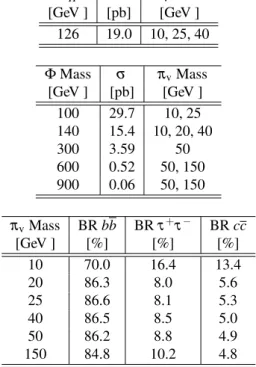
Table 1: The Φ mass or Higgs boson mass, Φ gluon fusion production cross section, and πvmass of each benchmark Hidden Valley model generated. The
cross-sections are based on the assumption in the benchmarked model that the Φ boson production mechanism is the same as the Higgs boson production mechanism. The decay branching ratios of the πv as a function of the πvmass
are listed in the second table as determined in the simulation samples.
mH σ πvMass [GeV ] [pb] [GeV ] 126 19.0 10, 25, 40 Φ Mass σ πvMass [GeV ] [pb] [GeV ] 100 29.7 10, 25 140 15.4 10, 20, 40 300 3.59 50 600 0.52 50, 150 900 0.06 50, 150 πvMass BR bb BR τ+τ− BR cc [GeV ] [%] [%] [%] 10 70.0 16.4 13.4 20 86.3 8.0 5.6 25 86.6 8.1 5.3 40 86.5 8.5 5.0 50 86.2 8.8 4.9 150 84.8 10.2 4.8
4. Trigger and event selection
Candidate events are collected using a dedicated trigger, called the CalRatio trigger [21], which looks specifically for long-lived neutral particles that decay near the outer radius of the ECal or within the HCal. The trigger is tuned to look for events containing at least one narrow jet with little energy de-posited in the ECal and no charged tracks pointing towards the jet. At the first level the trigger selects only narrow jets
by requiring at least 40 GeV of transverse energy (ET) in the
calorimeter in a 0.2 × 0.2 (∆η × ∆φ ) region using topological jets [15, 22], in contrast to the default algorithm in which the
energy in a 0.4 × 0.4 region is summed. The 40 GeV ET
thresh-old requirement is fully efficient at an offline jet ETof 60 GeV.
To select jets with a high fraction of their energy in the HCal the second level of the trigger requires these narrow jets to have
log10(EH/EEM) > 1.2, where EH/EEMis the ratio of the energy
deposited in the HCal (EH) to the energy deposited in the ECal
(EEM). The trigger also requires no tracks with pT> 1 GeV in
level of the trigger uses the slower but more accurate anti-kt
al-gorithm [23] with R = 0.4 to reconstruct the jet and requires the jet to have a minimum of 35 GeV of transverse energy.
The probability (επv) for a single πvto fire the trigger in
sim-ulated events is shown in Fig. 1, for the (a) barrel and (b) end-cap region of the calorimeter in several different signal samples. The average probability for the low (high) scalar boson masses
is about 20% (55%) for πv decays occurring at radii between
2.0 m and 3.5 m in the barrel, and about 6% (30%) for πv
de-cays with |z| between 4.0 m and 5.5 m in the endcaps. The turn-on takes place before the inner edge of the HCAL as the
log10(EH/EEM) cut allows for a small amount of energy in the
ECal. The probability decreases towards the outer region of the HCal where too much of the energy escapes the HCal to pass
the jet ETrequirement. The efficiency is lower in the endcaps
because events tend to not satisfy the isolation criteria due to the increased occupancy from extra collision events in the same bunch crossing as a hard-scatter interaction (pile-up).
r[m] 1 1.5 2 2.5 3 3.5 4 4.5 5 v π probability 0 0.1 0.2 0.3 0.4 0.5 0.6 ATLAS Simulation barrel 10 GeV v π 126 GeV - m H m 25 GeV v π 126 GeV - m H m 40 GeV v π 140 GeV - m H m 50 GeV v π 300 GeV - m Φ m 150 GeV v π 600 GeV - m Φ m 150 GeV v π 900 GeV - m Φ m (a) z[m] 3.5 4 4.5 5 5.5 6 v π probability 0 0.1 0.2 0.3 0.4 0.5 0.6 ATLAS Simulation endcap 10 GeV v π 126 GeV - m H m 25 GeV v π 126 GeV - m H m 40 GeV v π 140 GeV - m H m 50 GeV v π 300 GeV - m Φ m 150 GeV v π 600 GeV - m Φ m 150 GeV v π 900 GeV - m Φ m (b)
Fig. 1: The probability (επv) for a single πvto pass the trigger as a function of
the πv(a) radial decay length in the barrel and (b) the z position of the decay
vertex in the endcaps for several Φ and πvmasses.
Events also contain a reconstructed primary vertex with at
least three tracks with pT> 1 GeV. Events are rejected if any
reconstructed jets show evidence of being caused by a beam-halo interaction [21]. A missing transverse momentum
require-ment, ETmiss< 50 GeV, is applied to reject non-collision events,
such as cosmic rays or beam-halo interactions.
In the offline selection, jets are reconstructed with an anti-kt
algorithm with R = 0.4, starting from calorimeter energy clus-ters calibrated using the local cluster weighting method [24]. Jets are then calibrated using an energy- and η-dependent simulation-based calibration scheme. Jets are rejected if they do not satisfy the standard ATLAS good-jet criteria with the exception of requirements that reject jets with small electro-magnetic energy fraction (EMF) [25]. At least one jet must have fired the CalRatio trigger. The jet matching the trigger
must pass an ET> 60 GeV requirement while a second jet must
satisfy an ET> 40 GeV requirement. If more than one jet fired
the CalRatio trigger then only the leading jet is required to have
ET> 60 GeV.
Individually, all jets must satisfy |η| < 2.5, have
log10(EH/EEM) > 1.2, and have no good tracks in the ID with
pT >1 GeV in a region ∆R < 0.22centred on the jet axis. A
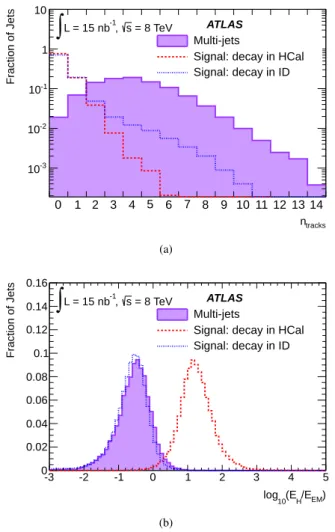
good track must have at least two hits in the pixel detector and a total of at least nine hits in the pixel and SCT detectors. Fig. 2(a) compares the distribution of the number of good tracks associated with each jet in the multi-jet sample (described in the
next section) with that in jets resulting from simulated πv
de-cays in the HCAL or ID. Fig. 2(b) makes the same comparison
for the distribution of log10(EH/EEM) of each jet. The multi-jet
data was gathered using a prescaled, single-jet trigger with a 15 GeV requirement.
Jets caused by cosmic rays and beam-halo interactions are often out-of-time. The jet timing is calculated by making an energy-weighted average of the timing for each cell in the jet. Each cell is defined to have a time of 0 ns if its energy is recorded at a time consistent with the arrival of a β = 1 par-ticle from the IP. The timing of each jet is required to satisfy −1 < t < 5 ns. This cut will impact the efficiency for low β
πv. Due to the requirement of a high-ETjet in this analysis the
β -distribution is peaked near 1 for low mass Φ samples. For
the high mass Φ samples the difference between mΦ and mπv
results in a large boost for the πvat the generated lifetimes. As
a result, the inefficiency introduced by the timing cut is at worst 1.5% for the considered samples.
The analysis requires that exactly two jets satisfy these re-quirements. The second jet requirement significantly reduces the SM multi-jet background contribution. Table 3 lists the fi-nal number of expected events in each sigfi-nal MC sample. The final number of events selected in data is 24.
5. Background estimation
The largest contribution to the expected background comes from SM multi-jet events. Cosmic-ray interactions contribute
2
tracks n 0 1 2 3 4 5 6 7 8 9 10 11 12 13 14 Fraction of Jets -3 10 -2 10 -1 10 1 10 Multi-jets
Signal: decay in HCal Signal: decay in ID ATLAS = 8 TeV s , -1 L = 15 nb
∫
(a) ) EM /E H (E 10 log -3 -2 -1 0 1 2 3 4 5 Fraction of Jets 0 0.02 0.04 0.06 0.08 0.1 0.12 0.14 0.16 Multi-jetsSignal: decay in HCal Signal: decay in ID ATLAS = 8 TeV s , -1 L = 15 nb
∫
(b)Fig. 2: Distribution of (a) the number of good tracks (ntracks) with pT> 1 GeV
and ∆R < 0.2 around the jet axis and (b) the distribution of jet log10(EH/EEM)
with jet |η| < 2.5, pT> 40 GeV. The dashed histogram is for πvjets decaying
in the hadronic calorimeter, and the dotted histogram is for πvjets decaying in
the ID. Both are from the mH= 126 GeV, mπv= 10 GeV sample. The filled
histogram is the multi-jet data sample used to evaluate the multi-jet contribution to the background. Events are required to satisfy Emiss
T < 50 GeV.
at a much lower level, and beam-halo interactions make a neg-ligible contribution.
To estimate the jet background contribution, a multi-jet data sample is used to derive the probability that a multi-jet passes the trigger and analysis selection. To obtain a raw background prediction, these jet probabilities are applied to a data sample that represents the multi-jet background before application of jet-level analysis selection. A correction to account for two-jet correlations is applied to this raw prediction to yield the final multi-jet background estimate.
The multi-jet data sample contains events that pass
single-jet triggers with an ET threshold of 15 GeV or higher. These
triggers were prescaled in 2012 and their effective
luminosi-ties range between 14.8 nb−1and 454.1 nb−1. The dataset is
representative of the full 20.3 fb−1 of data collected in 2012
and contains events from throughout the data collection
pe-riod. The events are required to pass the analysis ETmiss
require-ment and have at least two back-to-back (∆φ > 2.0) jets with
ET> 40 GeV and −2.5 < η < 2.5. One jet is required to
sat-isfy the modified ATLAS good-jet criteria used by the analysis. The second is used to measure two probabilities: one, called P,
for a jet to pass the trigger and the ET> 60 GeV jet
ment and the other, called Q, for a jet to satisfy the
require-ment ET> 40 GeV. For both P and Q the jet must also pass
the log10(EH/EEM), track isolation, and all other analysis jet
selection requirements including the modified ATLAS good-jet criteria. The probabilities are determined as a function of jet
ETand η. The jet ETand η dependence is calculated
indepen-dently because the sample is not large. A systematic uncertainty to account for any potential correlation is included in the anal-ysis. To calculate this systematic uncertainty the change in the
mean ET as a function of η and the change in the mean η as
a function of ETis measured in the multi-jet data sample. The
maximum variation is 2% for both ETand η. The ETor η of
each jet are systematically shifted by this amount as P and Q are recalculated. The new P and Q distributions are used to estimate the multi-jet background as described below, and the maximum variation in the result (6%) is used as the systematic uncertainty.
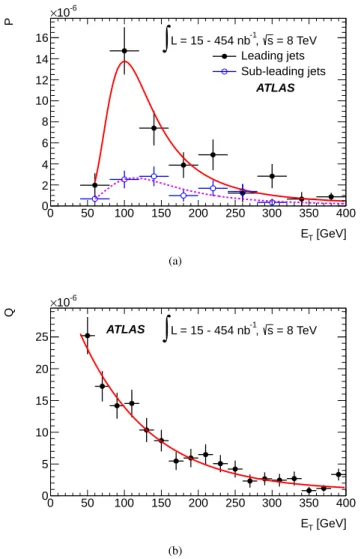
Binned fits of the probabilities as a function of ETare made
to a Landau function and an exponential function for P and Q,
respectively. The ETrequirement is ignored when fitting to
al-low the curve to best match the distribution’s shape. The fit errors are propagated through to the systematic in the multi-jet background. The η dependence is strongly correlated with the distribution of material in the calorimeters and cannot be well described by any simple functional form. Thus the probability
is obtained directly from the distribution. The P(ET)
parameter-isation is additionally split into leading jet and sub-leading jet samples because the probability is different for the two types of jets. This effect is also present for Q; however, it is accounted for by the correction for jet correlations discussed below. Plots
of P(ET) and Q(ET) are shown in Fig. 3. The peak present
in P(ET) is the result of the trigger turn-on for the full trigger
chain. The trigger jets are dominated by leading jets, and so dominated by the leading jet P.
The probability P is verified using the CalRatio-triggered data. The CalRatio-triggered events are required to pass the same event selection used to derive the single-jet probabilities as well as the requirements for calculating P. The CalRatio-triggered data contains 501 387 events that fired the unprescaled CalRatio trigger and passed the required selection, and the single-jet probabilities predict 513 000 ± 94 000 (statistical er-ror only) events.
To calculate the raw multi-jet background prediction the probabilities P and Q are applied to jets in events selected by the 15 GeV single-jet trigger. These single-jet probabilities are combined into an event probability using a combinatoric cal-culation that requires at least one jet in the event to fire the trigger and exactly two jets to pass all the jet selection crite-ria. The event probability is scaled to account for single-jet trigger prescales, yielding a weight for each event. The sum of all weights in the data sample yields a raw background predic-tion of 13.2 ± 2.9 (statistical ⊕ systematic error) events. The uncertainty is dominated by the small number of jets firing the
[GeV] T E 0 50 100 150 200 250 300 350 400 P 0 2 4 6 8 10 12 14 16 -6 10 × Leading jets Sub-leading jets ATLAS = 8 TeV s , -1 L = 15 - 454 nb
∫
(a) [GeV] T E 0 50 100 150 200 250 300 350 400 Q 0 5 10 15 20 25 -6 10 × ATLAS∫
L = 15 - 454 nb-1, s = 8 TeV (b)Fig. 3: The probability, P, that a jet from the multi-jet data sample passes the trigger and all jet requirements including the ET> 60 GeV requirement is
shown in (a). A Landau function is fitted to the leading and sub-leading jet distributions separately (solid and dashed lines). The probability, Q, to pass all jet requirements including the ET> 40 GeV requirement as a function of jet ET
is shown in (b). An exponential function is fitted to the distribution (solid line). The ETrequirement is ignored when fitting to allow the curve to best match the
shape of the data, but is used explicitly when P and Q are applied to a jet. The multi-jet data was gathered using a range of prescaled, single-jet triggers.
CalRatio trigger in multi-jet events.
In multi-jet events the log10(EH/EEM) and track isolation
values of one jet are correlated with those of the second jet.
If an event contains one jet of high log10(EH/EEM), the second
jet is more likely to have high log10(EH/EEM) as well.
Like-wise, if one jet has no tracks associated with it, the other is more likely to have no associated tracks as well. The single-jet probabilities above ignore this correlation because each is
cal-culated independently of the log10(EH/EEM) and ntrackof other
jets in the event. As a result, Q is lower than if it were
cal-culated only in events with an accompanying low ntrack, high
log10(EH/EEM) jet.
A scale factor to account for the correlation is calculated from the multi-jet data sample and the CalRatio-triggered data sample by examining numbers of events in regions in the
log10(EH/EEM) and number-of-tracks (ntrack) plane that are
out-side the signal region (log10(EH/EEM) > 1.2 and ntrack= 0).
The log10(EH/EEM) binning is chosen such that binning is
uni-form in EMF,3. A range from 0 to 7 was used for n
track. The
regions outside the signal region are expected to have very little signal contamination.
In each region the ratio of the number of events observed in the CalRatio-triggered data to the raw prediction is calcu-lated. Two series of ratios are calculated, one as a function of
log10(EH/EEM) and one as a function of ntrack. To determine
the trend in the ratio as a function of log10(EH/EEM) the ntrack
requirement is held constant: a jet is required to have 5 or 6 tracks. The ratio is then determined for several non-overlapping
ranges of log10(EH/EEM). The same procedure is used for ntrack
by requiring jets to have 0.55 < EMF < 0.65. Because the ratio is taken with respect to the observed data, this ratio will correct for any normalisation errors in P or Q.
Both sets of ratios are fitted to allow extrapolation into the signal region. The product of the two ratios in the signal region yields a scale factor to correct for the correlation between jets. A systematic error is added to account for the assumption that the two ratios are uncorrelated. The calculated scale factor is 1.8 ± 0.5. The uncertainty on the scale factor is due to the limited sample size.
To verify the procedure eight other bins on the
log10(EH/EEM) and ntrack plane were chosen and the full
background prediction method was applied. Because signal contamination is negligible outside of the signal region, the predicted number of events can be directly compared to the
number of events in the same log10(EH/EEM)–ntrack region
in the CalRatio-triggered data. In all cases the prediction is consistent with data to within one standard deviation.
The final multi-jet prediction is 23.2 ± 8.0 (statistical ⊕ sys-tematic error) events in the signal region. The uncertainty is dominated by the statistical uncertainty, which is in turn domi-nated by the small number of jets matching the CalRatio trigger in the multi-jet data sample. The systematic contribution comes
from the correlation between ETand η as well as from the
in-clusion of a requirement on ∆φ (not used in the signal selection) in the determination of P and Q.
Particles from a cosmic-ray shower may pass through and deposit energy in the calorimeter without passing through the ID. These energy deposits can be reconstructed as trackless jets. The overall contribution to the expected background is reduced
by the jet-timing and ETmissrequirements.
The cosmic-ray background was studied using a trigger sim-ilar to the CalRatio trigger, but active only during an empty crossing. Each proton beam is divided up into buckets, most of which are filled with protons. An empty crossing occurs when an empty bucket in each beam coincides in the centre of the detector, and five buckets on either side in each beam are also empty. Data gathered from these empty crossings are used to study backgrounds that are not beam related.
The analysis selection, with the exception of the jet-timing requirement and the good-vertex requirement, are applied to all
3log
events triggered in empty crossings. The −1 < t < 5 ns timing requirement is removed to retain more events to give a more accurate determination of the background. A simple scaling can be used to predict the expected cosmic-ray event rate within the timing window because the arrival time of cosmic-ray muons is uniformly distributed. It is found that about 5% of cosmic-ray events firing the trigger and containing two jets are events where both jets satisfy the −1 < t < 5 ns requirement.
Two additional corrections are applied to determine the fi-nal background prediction due to cosmic-ray events. The first accounts for the different live-times of the triggers. The num-ber of empty crossings is 2.9 times smaller than the numnum-ber
used to collect the full data of 20.3 fb−1. The second
correc-tion weights each event to account for soft tracks due to pile-up and underlying-event effects that would have caused the jet to fail the track isolation requirement had it occurred in a collision environment. To determine the weights a trigger that selects random collision events is used to determine the probability as
a function of η that a track with pT> 1 GeV is present in a
∆R < 0.2 cone anywhere in the detector as a function of η . This probability is applied to each jet in each event to deter-mine an event weight. The event weights range from 0.55 to 0.63. Combining all the corrections results in a predicted num-ber of cosmic-ray events of 0.3 ± 0.2 (statistical error).
Another possible background contribution comes from a beam-halo muon that undergoes bremsstrahlung in the HCal. Two selection criteria reduce this type of background. A jet-timing requirement is imposed because most of the jets pro-duced by beam-halo interactions are not coincident in time with jets from pp interactions. In addition, events are rejected when track segments in the endcap muon chambers, from the entering beam-halo muon, align in φ with a jet. These two requirements reduce the background considerably with no discernible effect on the signal.
Unpaired isolated crossings, i.e. crossings where only pro-tons from a single beam are present and at least three buckets on either side of the empty beam’s bucket are also empty, can be used to study beam-halo events. To estimate this background, artificial events are created by sampling two jets from a col-lection of jets passing both a CalRatio trigger active only dur-ing unpaired isolated crossdur-ings and the leaddur-ing jet requirements from unpaired isolated crossings. All possible pairs of jets are
used and the ETmiss< 50 GeV requirement is applied to each
constructed event. The number of jets passing the jet analysis selection and the fraction of constructed events satisfying the
ETmiss requirement are combined to estimate the background.
This method, which also accounts for cosmic-ray muon con-tamination, predicts 0.07 ± 0.07 events. The large uncertainty is due primarily to the small number of jets passing all required cuts.
Backgrounds from combinations of these non-beam interac-tions, i.e. a beam-halo jet plus a multi-jet, or a beam-halo jet plus a jet due to a cosmic-ray muon, were found to be negligi-ble.
6. Systematic uncertainties
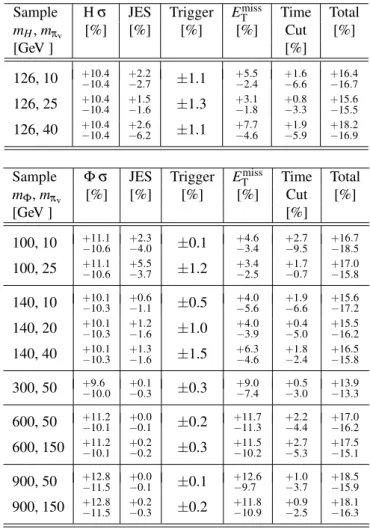
Table 2 presents a summary of systematic uncertainties as-sociated with the signal sample. The overall uncertainty, taken as the sum in quadrature of all positive and negative contribu-tions respectively, is listed in the last column. The MC signal samples’ statistical uncertainty is shown in Table 3 and it is accounted for in the statistical analysis. The overall normalisa-tion uncertainty of the integrated luminosity is 2.8% obtained following the same methodology as that detailed in Ref. [26] from a preliminary calibration of the luminosity scale derived from beam-separation scans performed in November 2012. The uncertainties on the Higgs boson production cross-sections at √
s= 8 TeV, which are equal to the uncertainties on the Φ
pro-duction cross-sections, are about 10% [18].
The uncertainty on the signal MC samples due to parton distribution functions (PDF) is calculated by reweighting each event using three different PDF sets (MSTW2008nlo68cl [17], CT10 [27], and NNPDF2.3 [28]) and their associated error sets. The RMS change in acceptance for the error sets of each PDF is calculated and combined with the difference in acceptances for each of the three PDFs.
Pile-up primarily affects the acceptance by adding extra tracks and degrading the track isolation of a jet. All MC sam-ples are reweighted to reproduce the observed distribution of the number of interactions per bunch crossing in the data. To determine if pile-up is simulated properly in the MC samples, a direct comparison of data and MC multi-jet samples is
per-formed. The jet ET, EMF, η, φ , associated tracks and timing
distributions as a function of the mean number of pile-up in-teractions are compared in data and MC simulation. A 10% systematic uncertainty is assigned to the acceptance covers all the observed differences.
The jet energy scale (JES) uncertainty is evaluated as a func-tion of the jet EMF and η, following the same strategy used in the in situ jet energy intercalibration [24]. The JES is rederived for low EMF jets for this analysis. The relative jet calorimeter response is studied by balancing the transverse momenta of di-jets. The systematic uncertainty is obtained by comparing the
pT-balance in data to the pT-balance in MC samples. This
dif-ference is used to calculate a difdif-ference in the JES in data and MC simulation and is propagated to the signal MC samples to get a systematic uncertainty on the acceptance. This study also provides a useful performance comparison between data and MC jets that resemble signal jets.
The ETmiss uncertainty accounts for variations in missing
transverse momentum scale and resolution [29]. The timing systematic accounts for mismodeling of jet timing between MC and data. Both of these uncertainties were determined by smearing the associated cut to determine the impact on the ac-ceptance.
The simulation of the trigger is verified by comparing the performance of the trigger in data with the performance in MC simulation on the same multi-jet sample used to evaluate the multi-jet background. Each trigger requirement is studied
indi-vidually: the jet ET, the log10(EH/EEM), and the track isolation.
data and MC events, and the resulting differences in acceptance from the nominal acceptance, for each requirement, are added in quadrature to determine the systematic uncertainty.
The simulation of initial state radiation (ISR) cannot be di-rectly verified because it is difficult to uniquely identify ISR jets in data [30]. An incorrect ISR rate in the simulation im-pacts the acceptance by altering the number of jets in the event and by altering the boost of the Φ boson. Each of these is stud-ied independently. The ISR jet population is altered event by event so that the number of ISR jets is halved or doubled (jets in MC samples are labelled as containing ISR if they contain a
gluon with pT> 2 GeV). The population of πvjets is not altered
by this process, but an added ISR jet may overlap with one of
the πvjets. The effect of a boost caused by an ISR jet is studied
by exploiting the correlation between the πvjet ETand the Φ
boost. From Ref. [30], the Φ pTspectrum has an uncertainty of
5%, which directly correlates with a 5% uncertainty in the πv
jet energy. To calculate the systematic uncertainty associated
with the boost, the pT of ISR jets is conservatively varied by
5% and the change in acceptance is observed.
The changes in acceptance from both sources of ISR uncer-tainty are taken as correlated systematic errors and added to get the total systematic for ISR simulation.
An incorrect simulation of final state radiation (FSR) has a negligible effect on the analysis’ acceptance. FSR can occur in a prompt or displaced jet. But even if displaced, the extra jet cannot degrade track isolation or deposit extra energy in the
ECal if the πvhas decayed in the HCal.
7. Results and exclusion limits
The global acceptance of the selected event topology in the
signal MC samples is a function of mΦ, mπv and the proper
de-cay length of the πv. At a proper decay length of 1.5 m the
acceptance ranges from 0.07% to 0.61%. The main efficiency
loss is due to the low probability that both πvdecay inside the
calorimeter. High mass samples suffer further efficiency loss
due to the ETmiss requirement. Table 3 lists the expected
num-ber of events from all signal MC samples and the background
expectation in 20.3 fb−1. The mH = 126 GeV mass samples
use the SM Higgs boson cross-sections of σSM = 19.0 pb for
the gluon fusion process: other production modes are ignored. The number of events observed in data, 24, is also shown for comparison. No excess of events is observed since the expected
background is 23.5 ±8.0. The CLsmethod [31] is used to derive
an upper limit on the σ (Φ)×BR(Φ → πvπv). A profile
likeli-hood ratio is used as the test statistic and a frequentest calculator is used to generate toy data. The likelihood includes a Poisson probability term describing the total number of observed events. Systematic uncertainties are incorporated as nuisance parame-ters through their effect on the mean of the Poisson functions and through convolution with their assumed Gaussian distribu-tions. The number of expected events in signal MC samples, to-gether with the estimate of expected background, the observed collision events and all the systematic uncertainties are
pro-vided as input for computing the CLs value, which represents
Table 2: Summary of systematic uncertainties for the Φ and Higgs boson pro-duction cross-section, jet energy scale, trigger, missing transverse momentum, and the requirement on jet timing as a percentage of the signal yield. Systematic errors that have common values across samples are not listed (pile-up at 10%, ISR at+2.9−1.2%, and PDF at 2.1%). The last column reports the total systematic uncertainty (including the luminosity and common systematic errors).
Sample H σ JES Trigger ETmiss Time Total
mH, mπv [%] [%] [%] [%] Cut [%] [GeV ] [%] 126, 10 +10.4−10.4 +2.2−2.7 ±1.1 +5.5−2.4 +1.6−6.6 +16.4−16.7 126, 25 +10.4−10.4 +1.5−1.6 ±1.3 +3.1−1.8 +0.8−3.3 +15.6−15.5 126, 40 +10.4−10.4 +2.6−6.2 ±1.1 +7.7 −4.6 +1.9−5.9 +18.2−16.9
Sample Φ σ JES Trigger ETmiss Time Total
mΦ, mπv [%] [%] [%] [%] Cut [%] [GeV ] [%] 100, 10 +11.1−10.6 +2.3−4.0 ±0.1 +4.6−3.4 +2.7−9.5 +16.7−18.5 100, 25 +11.1−10.6 +5.5−3.7 ±1.2 +3.4 −2.5 +1.7−0.7 +17.0−15.8 140, 10 +10.1−10.3 +0.6−1.1 ±0.5 +4.0−5.6 +1.9−6.6 +15.6−17.2 140, 20 +10.1−10.3 +1.2−1.6 ±1.0 +4.0 −3.9 +0.4−5.0 +15.5−16.2 140, 40 +10.1−10.3 +1.3−1.6 ±1.5 +6.3 −4.6 +1.8−2.4 +16.5−15.8 300, 50 +9.6−10.0 +0.1−0.3 ±0.3 +9.0 −7.4 +0.5−3.0 +13.9−13.3 600, 50 +11.2−10.1 +0.0−0.1 ±0.2 +11.7 −11.3 +2.2−4.4 +17.0−16.2 600, 150 +11.2−10.1 +0.2−0.2 ±0.3 +11.5−10.2 +2.7−5.3 +17.5−15.1 900, 50 +12.8−11.5 +0.0−0.1 ±0.1 +12.6−9.7 +1.0−3.7 +18.5−15.9 900, 150 +12.8−11.5 +0.2−0.3 ±0.2 +11.8−10.9 +0.9−2.5 +18.1−16.3
the probability for the given observation to be compatible with the signal + background hypothesis.
The acceptance is a function of the Φ mass, the πvmass and
πv proper decay length. To extrapolate to the number of
ex-pected events at different proper decay lengths, a large sample
of πvdecays is generated in a range from 0 to 50 m and an
ef-ficiency map as a function of πvboost is used to determine the
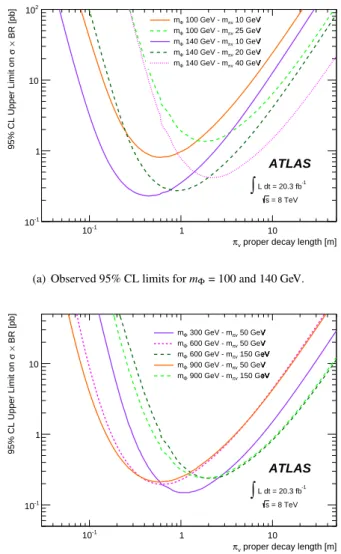
efficiency at each decay length. The resulting efficiencies are then converted into the final number of expected events shown in Fig. 4. Finally, Fig. 5 and Fig. 6 show the observed limit dis-tribution for the three 126 GeV Higgs samples and for the other Φ samples respectively. The derived 95% confidence level (CL) excluded ranges of proper decay length are listed in Table 4 for
the mH= 126 GeV samples, under the alternative assumptions
proper decay length [m] v π -1 10 1 10 -1 Expected events in 20.3 fb 10 2 10 3 10 10 GeV v π 126 GeV - m H m 25 GeV v π 126 GeV - m H m 40 GeV v π 140 GeV - m Φ m 10 GeV v π 126 GeV - m H m 25 GeV v π 126 GeV - m H m 40 GeV v π 140 GeV - m Φ m 10 GeV v π 126 GeV - m H m 25 GeV v π 126 GeV - m H m 40 GeV v π 140 GeV - m Φ m ATLAS Simulation -1 L dt = 20.3 fb
∫
= 8 TeV s (a)proper decay length [m]
v π -1 10 1 10 -1 Expected events in 20.3 fb 10 2 10 3 10 50 GeV v π 300 GeV - m Φ m 150 GeV v π 600 GeV - m Φ m 50 GeV v π 900 GeV - m Φ m 50 GeV v π 300 GeV - m Φ m 150 GeV v π 600 GeV - m Φ m 50 GeV v π 900 GeV - m Φ m 50 GeV v π 300 GeV - m Φ m 150 GeV v π 600 GeV - m Φ m 50 GeV v π 900 GeV - m Φ m ATLAS Simulation -1 L dt = 20.3 fb
∫
= 8 TeV s (b)Fig. 4: Number of events expected to pass the analysis selection in 20.3 fb−1as a function of the πvproper decay length for (a) three low-mass datasets and (b)
three high-mass datasets. 100% branching ratios for Φhs→ πvπvare assumed.
Table 3: Summary of expected number of signal events, expected background present in the data sample, and the observed number of events in 20.3 fb−1. The global acceptance is also given. The error on the signal samples is statis-tical only, the error on the expected background is statisstatis-tical ⊕ systematic. All results are normalised for a proper decay length of the πvof 1.5 m. A 100%
branching ratio for Φhs→ πvπvis assumed.
Sample Expected Global (mH, mπv[GeV ]) yields acceptance (%) 126, 10 536 ± 23 0.139 ± 0.006 126, 25 941 ± 44 0.244 ± 0.011 126, 40 365 ± 31 0.095 ± 0.008
Sample Expected Global (mH, mπv[GeV ]) yields acceptance (%) 100, 10 440 ± 29 0.073 ± 0.005 100, 25 424 ± 37 0.070 ± 0.006 140, 10 525 ± 20 0.168 ± 0.006 140, 20 900 ± 37 0.287 ± 0.012 140, 40 641 ± 30 0.205 ± 0.010 300, 50 444 ± 11 0.609 ± 0.015 600, 50 35 ± 1 0.330 ± 0.010 600, 150 41 ± 2 0.386 ± 0.015 900, 50 3.5 ± 0.1 0.304 ± 0.011 900, 150 4.6 ± 0.2 0.397 ± 0.016
Background Expected events SM Multi-jets 23.2 ± 8.0 Cosmic rays 0.3 ± 0.2 Total Expected Background 23.5 ± 8.0
Data 24
proper decay length [m]
v π -1 10 1 10 SM σ × BR / σ 95% CL Upper Limit on -2 10 -1 10 1 10 GeV v π 126 GeV - m H m 25 GeV v π 126 GeV - m H m 40 GeV v π 126 GeV - m H m 10 GeV v π 126 GeV - m H m 25 GeV v π 126 GeV - m H m 40 GeV v π 126 GeV - m H m 10 GeV v π 126 GeV - m H m 25 GeV v π 126 GeV - m H m 40 GeV v π 126 GeV - m H m BR 30% BR 10% -1 L dt = 20.3 fb
∫
= 8 TeV s ATLASFig. 5: Observed 95% CL limits on σ /σSMfor mH= 126 GeV as a function of
the πvproper decay length: the solid line is for mπv= 10 GeV, the short-dashed
line is for mπv= 25 GeV, the long-dashed line is for mπv= 40 GeV. The σSM
is taken to be 19.0 pb. The horizontal solid line corresponds to BR = 30% and the horizontal dashed line to BR = 10%.
proper decay length [m] v π -1 10 1 10 BR [pb] × σ 95% CL Upper Limit on -1 10 1 10 2 10 10 GeV v π 100 GeV - m Φ m 25 GeV v π 100 GeV - m Φ m 10 GeV v π 140 GeV - m Φ m 20 GeV v π 140 GeV - m Φ m 40 GeV v π 140 GeV - m Φ m 10 GeV v π 100 GeV - m Φ m 25 GeV v π 100 GeV - m Φ m 10 GeV v π 140 GeV - m Φ m 20 GeV v π 140 GeV - m Φ m 40 GeV v π 140 GeV - m Φ m 10 GeV v π 100 GeV - m Φ m 25 GeV v π 100 GeV - m Φ m 10 GeV v π 140 GeV - m Φ m 20 GeV v π 140 GeV - m Φ m 40 GeV v π 140 GeV - m Φ m 10 GeV v π 100 GeV - m Φ m 25 GeV v π 100 GeV - m Φ m 10 GeV v π 140 GeV - m Φ m 20 GeV v π 140 GeV - m Φ m 40 GeV v π 140 GeV - m Φ m 10 GeV v π 100 GeV - m Φ m 25 GeV v π 100 GeV - m Φ m 10 GeV v π 140 GeV - m Φ m 20 GeV v π 140 GeV - m Φ m 40 GeV v π 140 GeV - m Φ m -1 L dt = 20.3 fb
∫
= 8 TeV s ATLAS(a) Observed 95% CL limits for mΦ= 100 and 140 GeV.
proper decay length [m]
v π -1 10 1 10 BR [pb] × σ 95% CL Upper Limit on -1 10 1 10 50 GeV v π 300 GeV - m Φ m 50 GeV v π 600 GeV - m Φ m 150 GeV v π 600 GeV - m Φ m 50 GeV v π 900 GeV - m Φ m 150 GeV v π 900 GeV - m Φ m 50 GeV v π 300 GeV - m Φ m 50 GeV v π 600 GeV - m Φ m 150 GeV v π 600 GeV - m Φ m 50 GeV v π 900 GeV - m Φ m 150 GeV v π 900 GeV - m Φ m 50 GeV v π 300 GeV - m Φ m 50 GeV v π 600 GeV - m Φ m 150 GeV v π 600 GeV - m Φ m 50 GeV v π 900 GeV - m Φ m 150 GeV v π 900 GeV - m Φ m 50 GeV v π 300 GeV - m Φ m 50 GeV v π 600 GeV - m Φ m 150 GeV v π 600 GeV - m Φ m 50 GeV v π 900 GeV - m Φ m 150 GeV v π 900 GeV - m Φ m 50 GeV v π 300 GeV - m Φ m 50 GeV v π 600 GeV - m Φ m 150 GeV v π 600 GeV - m Φ m 50 GeV v π 900 GeV - m Φ m 150 GeV v π 900 GeV - m Φ m -1 L dt = 20.3 fb
∫
= 8 TeV s ATLAS(b) Observed 95% CL limits for mΦ= 300, 600, and 900 GeV.
Fig. 6: Observed 95% CL limits on σ × BR [pb] for (a) low and (b) high-mass Φ samples.
Table 4: Ranges of πvproper decay lengths excluded at 95% CL assuming a
30% and a 10% BR for a mH= 126 GeV.
MC sample Excluded range Excluded range
mH, mπv 30% BR H → πvπv 10% BR H → πvπv
[GeV ] [m] [m]
126, 10 0.10 – 6.08 0.14 – 3.13
126, 25 0.30 – 14.99 0.41 – 7.57
126, 40 0.68 – 18.50 1.03 – 8.32
8. Summary and conclusions
A search for the decay of a scalar boson in the mass range from 100 GeV to 900 GeV, including a search for an exotic decay of the Higgs boson, to a pair of long-lived neutral par-ticles decaying in the ATLAS hadronic calorimeter has been
presented. The analysis is based on 20.3 fb−1 of pp collisions
at √s= 8 TeV collected in 2012 by the ATLAS experiment at
the LHC.
No significant excess of events is observed over the
back-ground estimate. Limits are set on the πvproper decay lengths
for different scalar boson and πvmass combinations. For a SM
Higgs decaying to πvproper decay lengths between 0.10 m and
18.50 m assuming a 30% BR are ruled out, and between 0.14 m and 8.32 m assuming a BR of 10%. Results for low mass Φ (100 GeV and 140 GeV) and high mass Φ (300 GeV, 600 GeV, and 900 GeV) have also been presented as a function of proper decay length.
Acknowledgements
We thank CERN for the very successful operation of the LHC, as well as the support staff from our institutions without whom ATLAS could not be operated efficiently.
We acknowledge the support of ANPCyT, Argentina; Yer-PhI, Armenia; ARC, Australia; BMWFW and FWF, Austria; ANAS, Azerbaijan; SSTC, Belarus; CNPq and FAPESP, Brazil; NSERC, NRC and CFI, Canada; CERN; CONICYT, Chile; CAS, MOST and NSFC, China; COLCIENCIAS, Colom-bia; MSMT CR, MPO CR and VSC CR, Czech Repub-lic; DNRF, DNSRC and Lundbeck Foundation, Denmark; EPLANET, ERC and NSRF, European Union; IN2P3-CNRS, CEA-DSM/IRFU, France; GNSF, Georgia; BMBF, DFG, HGF, MPG and AvH Foundation, Germany; GSRT and NSRF, Greece; RGC, Hong Kong SAR, China; ISF, MINERVA, GIF, I-CORE and Benoziyo Center, Israel; INFN, Italy; MEXT and JSPS, Japan; CNRST, Morocco; FOM and NWO, Netherlands; BRF and RCN, Norway; MNiSW and NCN, Poland; GRICES and FCT, Portugal; MNE/IFA, Romania; MES of Russia and ROSATOM, Russian Federation; JINR; MSTD, Serbia; MSSR, Slovakia; ARRS and MIZ ˇS, Slovenia; DST/NRF, South Africa; MINECO, Spain; SRC and Wallenberg Foundation, Sweden; SER, SNSF and Cantons of Bern and Geneva, Switzerland; NSC, Taiwan; TAEK, Turkey; STFC, the Royal Society and Leverhulme Trust, United Kingdom; DOE and NSF, United States of America.
The crucial computing support from all WLCG partners is acknowledged gratefully, in particular from CERN and the ATLAS Tier-1 facilities at TRIUMF (Canada), NDGF (Den-mark, Norway, Sweden), CC-IN2P3 (France), KIT/GridKA (Germany), INFN-CNAF (Italy), NL-T1 (Netherlands), PIC (Spain), ASGC (Taiwan), RAL (UK) and BNL (USA) and in the Tier-2 facilities worldwide.
References
[1] F. Englert and R. Brout, Phys. Rev. Lett. 13 (1964) 321. [2] P. Higgs, Phys. Lett. 12 (1964) 132.
[3] G.S. Guralnik, C. R. Hagen, and T. W. B. Kibble, Phys. Rev. Lett. 13 (1964) 585.
[4] ATLAS Collaboration, Phys. Lett. B 716 (2012) 1, arXiv:1207.7214 [hep-ex].
[5] CMS Collaboration, Phys. Lett. B 716 (2012) 30, arXiv:1207.7235 [hep-ex].
[6] S. Chang, P.J. Fox and N.Weiner, JHEP 0608 (2006) 068. arXiv:0511250 [hep-ph].
[7] S. Chang, R. Dermisek, J. F. Gunion and N. Weiner, Ann. Rev. Nucl. Part. Sci. 58 (2008) 75-98. arXiv:0801.4554 [hep-ph]
[8] M. J. Strassler and K. M. Zurek, Phys. Lett. B 651 (2007) 374–379, arXiv:0604261 [hep-ph].
[9] M. J. Strassler and K. M. Zurek, Phys. Lett. B 661 (2008) 263–267, arXiv:0605193 [hep-ph].
[10] ATLAS Collaboration, New J. Phys. 13 (2011) 053033, arXiv:1012.5104 [hep-ex].
[11] ATLAS Collaboration, Phys. Rev. Lett. 108 251801 (2012), arXiv:1203.1303 [hep-ex].
[12] CMS Collaboration, JHEP 1302 (2013) 085, arXiv:1211.2472 [hep-ex].
[13] D0 Collaboration, V. Abazov et. al., Phys. Rev. Lett. 103 (2009) 071801, arXiv:0906.1787 [hep-ex].
[14] CDF Collaboration, T. Aaltonen et. al., Phys. Rev. D 85 (2012) 012007, arXiv:1109.3136 [hep-ex].
[15] ATLAS Collaboration, JINST 3 (2008) S08003.
[16] T. Sjostrand, S. Mrenna and P. Skands, Comput. Phys. Commun. 178 (2008) 852-867, arXiv:0710.3820 [hep-ph]
[17] A. D. Martin, W. J. Stirling, R. S. Thorne and G. Watt, Eur. Phys. J. C63 (2009) 189-285, arXiv:0901.0002 [hep-ex].
[18] LHC Higgs Cross Section Working Group, S. Dittmaier, C. Mariotti, G. Passarino and R. Tanaka (Eds.), CERN-2011-002 (CERN, Geneva, 2011) arXiv:1307.1347 [hep-ex].
[19] ATLAS Collaboration, Eur. Phys. J. C 70 (2010) 823–874, arXiv:1005.4568 [physics.ins-det].
[20] GEANT4 Collaboration, S. Agostinelli et. al., Nucl. Instrum. Meth. A506 (2003) 250–303.
[21] ATLAS Collaboration, JINST 8 (2013) P07015, arXiv.org:1305.2284 [hep-ex].
[22] R Achenbach et al, JINST 3 (2008) P03001
[23] M. Cacciari, G. P. Salam and G. Soyez, JHEP 0804 (2008) 0633, arXiv:0802.1189 [hep-ph].
[24] ATLAS Collaboration, Eur. Phys. J. C73 (2013) 2304, arXiv:1112.6426 [hep-ex].
[25] ATLAS Collaboration, ATLAS-CONF-2010-038, https://cdsweb.cern.ch/record/1277678.
[26] ATLAS Collaboration, Eur. Phys. J. C73 (2013) 2518, arXiv:1302.4393 [hep-ex].
[27] J. Gao et. al., Phys. Rev. D89 (2014) 033009, arXiv:1302.6246 [hep-ex].
[28] R. D. Ball et. al., Nucl. Phys. B 867 (2013) 244, arXiv:1207.1303 [hep-ex].
[29] ATLAS Collaboration, ATLAS-CONF-2013-082, http://cds.cern.ch/record/1570993.
[30] D. de Florian, G. Ferrera, M. Grazzini and D. Tommasini, JHEP 1111 (2011) 064, arXiv:1109.2109 [hep-ex].
The ATLAS Collaboration
G. Aad84, B. Abbott112, J. Abdallah152, S. Abdel Khalek116, O. Abdinov11, R. Aben106, B. Abi113, M. Abolins89,
O.S. AbouZeid159, H. Abramowicz154, H. Abreu153, R. Abreu30, Y. Abulaiti147a,147b, B.S. Acharya165a,165b,a, L. Adamczyk38a,
D.L. Adams25, J. Adelman177, S. Adomeit99, T. Adye130, T. Agatonovic-Jovin13a, J.A. Aguilar-Saavedra125a,125f, M. Agustoni17,
S.P. Ahlen22, F. Ahmadov64,b, G. Aielli134a,134b, H. Akerstedt147a,147b, T.P.A. kesson80, G. Akimoto156, A.V. Akimov95,
G.L. Alberghi20a,20b, J. Albert170, S. Albrand55, M.J. Alconada Verzini70, M. Aleksa30, I.N. Aleksandrov64, C. Alexa26a,
G. Alexander154, G. Alexandre49, T. Alexopoulos10, M. Alhroob165a,165c, G. Alimonti90a, L. Alio84, J. Alison31,
B.M.M. Allbrooke18, L.J. Allison71, P.P. Allport73, A. Aloisio103a,103b, A. Alonso36, F. Alonso70, C. Alpigiani75, A. Altheimer35,
B. Alvarez Gonzalez89, M.G. Alviggi103a,103b, K. Amako65, Y. Amaral Coutinho24a, C. Amelung23, D. Amidei88,
S.P. Amor Dos Santos125a,125c, A. Amorim125a,125b, S. Amoroso48, N. Amram154, G. Amundsen23, C. Anastopoulos140,
L.S. Ancu49, N. Andari30, T. Andeen35, C.F. Anders58b, G. Anders30, K.J. Anderson31, A. Andreazza90a,90b, V. Andrei58a,
X.S. Anduaga70, S. Angelidakis9, I. Angelozzi106, P. Anger44, A. Angerami35, F. Anghinolfi30, A.V. Anisenkov108,c, N. Anjos12,
A. Annovi47, A. Antonaki9, M. Antonelli47, A. Antonov97, J. Antos145b, F. Anulli133a, M. Aoki65, L. Aperio Bella18,
R. Apolle119,d, G. Arabidze89, I. Aracena144, Y. Arai65, J.P. Araque125a, A.T.H. Arce45, J-F. Arguin94, S. Argyropoulos42,
M. Arik19a, A.J. Armbruster30, O. Arnaez30, V. Arnal81, H. Arnold48, M. Arratia28, O. Arslan21, A. Artamonov96, G. Artoni23,
S. Asai156, N. Asbah42, A. Ashkenazi154, B. sman147a,147b, L. Asquith6, K. Assamagan25, R. Astalos145a, M. Atkinson166,
N.B. Atlay142, B. Auerbach6, K. Augsten127, M. Aurousseau146b, G. Avolio30, G. Azuelos94,e, Y. Azuma156, M.A. Baak30,
A.E. Baas58a, C. Bacci135a,135b, H. Bachacou137, K. Bachas155, M. Backes30, M. Backhaus30, J. Backus Mayes144, E. Badescu26a,
P. Bagiacchi133a,133b, P. Bagnaia133a,133b, Y. Bai33a, T. Bain35, J.T. Baines130, O.K. Baker177, P. Balek128, F. Balli137, E. Banas39,
Sw. Banerjee174, A.A.E. Bannoura176, V. Bansal170, H.S. Bansil18, L. Barak173, S.P. Baranov95, E.L. Barberio87,
D. Barberis50a,50b, M. Barbero84, T. Barillari100, M. Barisonzi176, T. Barklow144, N. Barlow28, B.M. Barnett130, R.M. Barnett15,
Z. Barnovska5, A. Baroncelli135a, G. Barone49, A.J. Barr119, F. Barreiro81, J. Barreiro Guimar˜aes da Costa57, R. Bartoldus144,
A.E. Barton71, P. Bartos145a, V. Bartsch150, A. Bassalat116, A. Basye166, R.L. Bates53, J.R. Batley28, M. Battaglia138,
M. Battistin30, F. Bauer137, H.S. Bawa144, f, M.D. Beattie71, T. Beau79, P.H. Beauchemin162, R. Beccherle123a,123b, P. Bechtle21,
H.P. Beck17, K. Becker176, S. Becker99, M. Beckingham171, C. Becot116, A.J. Beddall19c, A. Beddall19c, S. Bedikian177,
V.A. Bednyakov64, C.P. Bee149, L.J. Beemster106, T.A. Beermann176, M. Begel25, K. Behr119, C. Belanger-Champagne86,
P.J. Bell49, W.H. Bell49, G. Bella154, L. Bellagamba20a, A. Bellerive29, M. Bellomo85, K. Belotskiy97, O. Beltramello30,
O. Benary154, D. Benchekroun136a, K. Bendtz147a,147b, N. Benekos166, Y. Benhammou154, E. Benhar Noccioli49,
J.A. Benitez Garcia160b, D.P. Benjamin45, J.R. Bensinger23, K. Benslama131, S. Bentvelsen106, D. Berge106,
E. Bergeaas Kuutmann167, N. Berger5, F. Berghaus170, J. Beringer15, C. Bernard22, P. Bernat77, C. Bernius78, F.U. Bernlochner170,
T. Berry76, P. Berta128, C. Bertella84, G. Bertoli147a,147b, F. Bertolucci123a,123b, C. Bertsche112, D. Bertsche112, M.I. Besana90a,
G.J. Besjes105, O. Bessidskaia Bylund147a,147b, M. Bessner42, N. Besson137, C. Betancourt48, S. Bethke100, W. Bhimji46,
R.M. Bianchi124, L. Bianchini23, M. Bianco30, O. Biebel99, S.P. Bieniek77, K. Bierwagen54, J. Biesiada15, M. Biglietti135a,
J. Bilbao De Mendizabal49, H. Bilokon47, M. Bindi54, S. Binet116, A. Bingul19c, C. Bini133a,133b, C.W. Black151, J.E. Black144,
K.M. Black22, D. Blackburn139, R.E. Blair6, J.-B. Blanchard137, T. Blazek145a, I. Bloch42, C. Blocker23, W. Blum82,∗,
U. Blumenschein54, G.J. Bobbink106, V.S. Bobrovnikov108,c, S.S. Bocchetta80, A. Bocci45, C. Bock99, C.R. Boddy119,
M. Boehler48, T.T. Boek176, J.A. Bogaerts30, A.G. Bogdanchikov108, A. Bogouch91,∗, C. Bohm147a, J. Bohm126, V. Boisvert76,
T. Bold38a, V. Boldea26a, A.S. Boldyrev98, M. Bomben79, M. Bona75, M. Boonekamp137, A. Borisov129, G. Borissov71,
M. Borri83, S. Borroni42, J. Bortfeldt99, V. Bortolotto135a,135b, K. Bos106, D. Boscherini20a, M. Bosman12, H. Boterenbrood106,
J. Boudreau124, J. Bouffard2, E.V. Bouhova-Thacker71, D. Boumediene34, C. Bourdarios116, N. Bousson113, S. Boutouil136d,
A. Boveia31, J. Boyd30, I.R. Boyko64, I. Bozic13a, J. Bracinik18, A. Brandt8, G. Brandt15, O. Brandt58a, U. Bratzler157, B. Brau85,
J.E. Brau115, H.M. Braun176,∗, S.F. Brazzale165a,165c, B. Brelier159, K. Brendlinger121, A.J. Brennan87, R. Brenner167,
S. Bressler173, K. Bristow146c, T.M. Bristow46, D. Britton53, F.M. Brochu28, I. Brock21, R. Brock89, C. Bromberg89, J. Bronner100,
G. Brooijmans35, T. Brooks76, W.K. Brooks32b, J. Brosamer15, E. Brost115, J. Brown55, P.A. Bruckman de Renstrom39,
D. Bruncko145b, R. Bruneliere48, S. Brunet60, A. Bruni20a, G. Bruni20a, M. Bruschi20a, L. Bryngemark80, T. Buanes14, Q. Buat143,
F. Bucci49, P. Buchholz142, R.M. Buckingham119, A.G. Buckley53, S.I. Buda26a, I.A. Budagov64, F. Buehrer48, L. Bugge118,
M.K. Bugge118, O. Bulekov97, A.C. Bundock73, H. Burckhart30, S. Burdin73, B. Burghgrave107, S. Burke130, I. Burmeister43,
E. Busato34, D. B¨uscher48, V. B¨uscher82, P. Bussey53, C.P. Buszello167, B. Butler57, J.M. Butler22, A.I. Butt3, C.M. Buttar53,
J.M. Butterworth77, P. Butti106, W. Buttinger28, A. Buzatu53, M. Byszewski10, S. Cabrera Urb´an168, D. Caforio20a,20b, O. Cakir4a,
P. Calafiura15, A. Calandri137, G. Calderini79, P. Calfayan99, R. Calkins107, L.P. Caloba24a, D. Calvet34, S. Calvet34,
R. Camacho Toro49, S. Camarda42, D. Cameron118, L.M. Caminada15, R. Caminal Armadans12, S. Campana30, M. Campanelli77,
A. Campoverde149, V. Canale103a,103b, A. Canepa160a, M. Cano Bret75, J. Cantero81, R. Cantrill125a, T. Cao40,
M.D.M. Capeans Garrido30, I. Caprini26a, M. Caprini26a, M. Capua37a,37b, R. Caputo82, R. Cardarelli134a, T. Carli30,
G. Carlino103a, L. Carminati90a,90b, S. Caron105, E. Carquin32a, G.D. Carrillo-Montoya146c, J.R. Carter28, J. Carvalho125a,125c,
D. Casadei77, M.P. Casado12, M. Casolino12, E. Castaneda-Miranda146b, A. Castelli106, V. Castillo Gimenez168, N.F. Castro125a,
M. Cavalli-Sforza12, V. Cavasinni123a,123b, F. Ceradini135a,135b, B.C. Cerio45, K. Cerny128, A.S. Cerqueira24b, A. Cerri150,
L. Cerrito75, F. Cerutti15, M. Cerv30, A. Cervelli17, S.A. Cetin19b, A. Chafaq136a, D. Chakraborty107, I. Chalupkova128,
P. Chang166, B. Chapleau86, J.D. Chapman28, D. Charfeddine116, D.G. Charlton18, C.C. Chau159, C.A. Chavez Barajas150,
S. Cheatham86, A. Chegwidden89, S. Chekanov6, S.V. Chekulaev160a, G.A. Chelkov64,g, M.A. Chelstowska88, C. Chen63,
H. Chen25, K. Chen149, L. Chen33d,h, S. Chen33c, X. Chen146c, Y. Chen66, Y. Chen35, H.C. Cheng88, Y. Cheng31, A. Cheplakov64,
R. Cherkaoui El Moursli136e, V. Chernyatin25,∗, E. Cheu7, L. Chevalier137, V. Chiarella47, G. Chiefari103a,103b, J.T. Childers6,
A. Chilingarov71, G. Chiodini72a, A.S. Chisholm18, R.T. Chislett77, A. Chitan26a, M.V. Chizhov64, S. Chouridou9, B.K.B. Chow99,
D. Chromek-Burckhart30, M.L. Chu152, J. Chudoba126, J.J. Chwastowski39, L. Chytka114, G. Ciapetti133a,133b, A.K. Ciftci4a,
R. Ciftci4a, D. Cinca53, V. Cindro74, A. Ciocio15, P. Cirkovic13b, Z.H. Citron173, M. Citterio90a, M. Ciubancan26a, A. Clark49,
P.J. Clark46, R.N. Clarke15, W. Cleland124, J.C. Clemens84, C. Clement147a,147b, Y. Coadou84, M. Cobal165a,165c, A. Coccaro139,
J. Cochran63, L. Coffey23, J.G. Cogan144, J. Coggeshall166, B. Cole35, S. Cole107, A.P. Colijn106, J. Collot55, T. Colombo58c,
G. Colon85, G. Compostella100, P. Conde Mui˜no125a,125b, E. Coniavitis48, M.C. Conidi12, S.H. Connell146b, I.A. Connelly76,
S.M. Consonni90a,90b, V. Consorti48, S. Constantinescu26a, C. Conta120a,120b, G. Conti57, F. Conventi103a,i, M. Cooke15,
B.D. Cooper77, A.M. Cooper-Sarkar119, N.J. Cooper-Smith76, K. Copic15, T. Cornelissen176, M. Corradi20a, F. Corriveau86, j,
A. Corso-Radu164, A. Cortes-Gonzalez12, G. Cortiana100, G. Costa90a, M.J. Costa168, D. Costanzo140, D. Cˆot´e8, G. Cottin28,
G. Cowan76, B.E. Cox83, K. Cranmer109, G. Cree29, S. Cr´ep´e-Renaudin55, F. Crescioli79, W.A. Cribbs147a,147b,
M. Crispin Ortuzar119, M. Cristinziani21, V. Croft105, G. Crosetti37a,37b, C.-M. Cuciuc26a, T. Cuhadar Donszelmann140,
J. Cummings177, M. Curatolo47, C. Cuthbert151, H. Czirr142, P. Czodrowski3, Z. Czyczula177, S. D’Auria53, M. D’Onofrio73,
M.J. Da Cunha Sargedas De Sousa125a,125b, C. Da Via83, W. Dabrowski38a, A. Dafinca119, T. Dai88, O. Dale14, F. Dallaire94,
C. Dallapiccola85, M. Dam36, A.C. Daniells18, M. Dano Hoffmann137, V. Dao48, G. Darbo50a, S. Darmora8, J. Dassoulas42,
A. Dattagupta60, W. Davey21, C. David170, T. Davidek128, E. Davies119,d, M. Davies154, O. Davignon79, A.R. Davison77,
P. Davison77, Y. Davygora58a, E. Dawe143, I. Dawson140, R.K. Daya-Ishmukhametova85, K. De8, R. de Asmundis103a,
S. De Castro20a,20b, S. De Cecco79, N. De Groot105, P. de Jong106, H. De la Torre81, F. De Lorenzi63, L. De Nooij106,
D. De Pedis133a, A. De Salvo133a, U. De Sanctis150, A. De Santo150, J.B. De Vivie De Regie116, W.J. Dearnaley71, R. Debbe25,
C. Debenedetti138, B. Dechenaux55, D.V. Dedovich64, I. Deigaard106, J. Del Peso81, T. Del Prete123a,123b, F. Deliot137,
C.M. Delitzsch49, M. Deliyergiyev74, A. Dell’Acqua30, L. Dell’Asta22, M. Dell’Orso123a,123b, M. Della Pietra103a,i,
D. della Volpe49, M. Delmastro5, P.A. Delsart55, C. Deluca106, S. Demers177, M. Demichev64, A. Demilly79, S.P. Denisov129,
D. Derendarz39, J.E. Derkaoui136d, F. Derue79, P. Dervan73, K. Desch21, C. Deterre42, P.O. Deviveiros106, A. Dewhurst130,
S. Dhaliwal106, A. Di Ciaccio134a,134b, L. Di Ciaccio5, A. Di Domenico133a,133b, C. Di Donato103a,103b, A. Di Girolamo30,
B. Di Girolamo30, A. Di Mattia153, B. Di Micco135a,135b, R. Di Nardo47, A. Di Simone48, R. Di Sipio20a,20b, D. Di Valentino29,
F.A. Dias46, M.A. Diaz32a, E.B. Diehl88, J. Dietrich42, T.A. Dietzsch58a, S. Diglio84, A. Dimitrievska13a, J. Dingfelder21,
C. Dionisi133a,133b, P. Dita26a, S. Dita26a, F. Dittus30, F. Djama84, T. Djobava51b, J.I. Djuvsland58a, M.A.B. do Vale24c,
A. Do Valle Wemans125a,125g, D. Dobos30, C. Doglioni49, T. Doherty53, T. Dohmae156, J. Dolejsi128, Z. Dolezal128,
B.A. Dolgoshein97,∗, M. Donadelli24d, S. Donati123a,123b, P. Dondero120a,120b, J. Donini34, J. Dopke130, A. Doria103a, M.T. Dova70,
A.T. Doyle53, M. Dris10, J. Dubbert88, S. Dube15, E. Dubreuil34, E. Duchovni173, G. Duckeck99, O.A. Ducu26a, D. Duda176,
A. Dudarev30, F. Dudziak63, L. Duflot116, L. Duguid76, M. D¨uhrssen30, M. Dunford58a, H. Duran Yildiz4a, M. D¨uren52,
A. Durglishvili51b, M. Dwuznik38a, M. Dyndal38a, J. Ebke99, W. Edson2, N.C. Edwards46, W. Ehrenfeld21, T. Eifert144,
G. Eigen14, K. Einsweiler15, T. Ekelof167, M. El Kacimi136c, M. Ellert167, S. Elles5, F. Ellinghaus82, N. Ellis30, J. Elmsheuser99,
M. Elsing30, D. Emeliyanov130, Y. Enari156, O.C. Endner82, M. Endo117, R. Engelmann149, J. Erdmann177, A. Ereditato17,
D. Eriksson147a, G. Ernis176, J. Ernst2, M. Ernst25, J. Ernwein137, D. Errede166, S. Errede166, E. Ertel82, M. Escalier116, H. Esch43,
C. Escobar124, B. Esposito47, A.I. Etienvre137, E. Etzion154, H. Evans60, A. Ezhilov122, L. Fabbri20a,20b, G. Facini31,
R.M. Fakhrutdinov129, S. Falciano133a, R.J. Falla77, J. Faltova128, Y. Fang33a, M. Fanti90a,90b, A. Farbin8, A. Farilla135a,
T. Farooque12, S. Farrell15, S.M. Farrington171, P. Farthouat30, F. Fassi136e, P. Fassnacht30, D. Fassouliotis9, A. Favareto50a,50b,
L. Fayard116, P. Federic145a, O.L. Fedin122,k, W. Fedorko169, M. Fehling-Kaschek48, S. Feigl30, L. Feligioni84, C. Feng33d,
E.J. Feng6, H. Feng88, A.B. Fenyuk129, S. Fernandez Perez30, S. Ferrag53, J. Ferrando53, A. Ferrari167, P. Ferrari106, R. Ferrari120a,
D.E. Ferreira de Lima53, A. Ferrer168, D. Ferrere49, C. Ferretti88, A. Ferretto Parodi50a,50b, M. Fiascaris31, F. Fiedler82,
A. Filipˇciˇc74, M. Filipuzzi42, F. Filthaut105, M. Fincke-Keeler170, K.D. Finelli151, M.C.N. Fiolhais125a,125c, L. Fiorini168,
A. Firan40, A. Fischer2, J. Fischer176, W.C. Fisher89, E.A. Fitzgerald23, M. Flechl48, I. Fleck142, P. Fleischmann88,
S. Fleischmann176, G.T. Fletcher140, G. Fletcher75, T. Flick176, A. Floderus80, L.R. Flores Castillo174,l, A.C. Florez Bustos160b,
M.J. Flowerdew100, A. Formica137, A. Forti83, D. Fortin160a, D. Fournier116, H. Fox71, S. Fracchia12, P. Francavilla79,
M. Franchini20a,20b, S. Franchino30, D. Francis30, L. Franconi118, M. Franklin57, S. Franz61, M. Fraternali120a,120b, S.T. French28,
C. Friedrich42, F. Friedrich44, D. Froidevaux30, J.A. Frost28, C. Fukunaga157, E. Fullana Torregrosa82, B.G. Fulsom144,
J. Fuster168, C. Gabaldon55, O. Gabizon176, A. Gabrielli20a,20b, A. Gabrielli133a,133b, S. Gadatsch106, S. Gadomski49,
G. Gagliardi50a,50b, P. Gagnon60, C. Galea105, B. Galhardo125a,125c, E.J. Gallas119, V. Gallo17, B.J. Gallop130, P. Gallus127,
G. Galster36, K.K. Gan110, J. Gao33b,h, Y.S. Gao144, f, F.M. Garay Walls46, F. Garberson177, C. Garc´ıa168, J.E. Garc´ıa Navarro168,
M. Garcia-Sciveres15, R.W. Gardner31, N. Garelli144, V. Garonne30, C. Gatti47, G. Gaudio120a, B. Gaur142, L. Gauthier94,