EUROPEAN ORGANIZATION FOR NUCLEAR RESEARCH (CERN)
CERN-PH-EP/2013-226 2014/04/29
CMS-SUS-13-014
Search for top squark and higgsino production using
diphoton Higgs boson decays
The CMS Collaboration
∗Abstract
Results are presented of a search for a “natural” supersymmetry scenario with gauge mediated symmetry breaking. It is assumed that only the supersymmetric partners of the top quark (the top squark) and the Higgs boson (higgsino) are accessible. Events are examined in which there are two photons forming a Higgs boson candidate, and at least two b-quark jets. In 19.7 fb−1 of proton-proton collision data at√s = 8 TeV, recorded in the CMS experiment, no evidence of a signal is found and lower limits at the 95% confidence level are set, excluding the top squark mass below 360 to 410 GeV, depending on the higgsino mass.
Published in Physical Review Letters as doi:10.1103/PhysRevLett.112.161802.
c
2014 CERN for the benefit of the CMS Collaboration. CC-BY-3.0 license ∗See Appendix C for the list of collaboration members
1
The recent measurements of the properties of the new boson with mass around 126 GeV by ATLAS [1, 2] and CMS [3, 4] experiments confirm that it is consistent with the standard model (SM) Higgs boson. One of the most important problems in particle physics is now to under-stand why the boson’s mass is so small compared to the Planck scale. Supersymmetry (SUSY) offers an elegant solution to this hierarchy problem. Although experimental searches have found no signs of it so far and the simplest SUSY models have become increasingly more con-strained, there remain very large yet unprobed areas of SUSY parameter space that can still be “natural”, i.e. have a fairly small amount of fine tuning.
The essential requirement of “natural” SUSY is that the masses of the superpartners of the top quark and the Higgs bosons, the top squark and the higgsinos, be light (see, e.g. [5, 6]). This Letter describes a search we performed for events with a topology motivated by SUSY with a gauge mediated SUSY breaking (GMSB) model [7–10]. Complete GMSB models are considered with a minimal number of accessible SUSY partners to satisfy the naturalness requirements, namely the right-handed top squark and higgsinos.
The lightest chargino (χe +
1) and neutralinos (χe
0
1,χe
0
2) in this case are almost pure higgsinos and
are therefore almost mass-degenerate.
Pairs of higgsinos are produced either directly through electroweak production or through right-handed top squark-antisquark pairs (strong production) with cascade decays
etR→bχe + 1 oretR →tχe 0 i, (1) where i = 1, 2. Theχe + 1 (χe 0
2) subsequently decays into a very off-shell W+(Z) boson and aχe
0
1.
(Here, and in what follows, the charge-conjugate final states are also implied.) The near mass degeneracy of the higgsino states requires the off-shell boson decay products to be very soft. The decay of the lightest neutralino in all cascades is
e
χ01 →H eG orχe
0
1→Z eG, (2)
where eG is the gravitino. The branching fractions ofχe
0
1 decays depend on SUSY parameters.
For a significant portion of the parameter space, neutralino decays into Higgs bosons dominate. This includes regions of low tan β, the ratio of the vacuum expectation values of the two SUSY Higgs doublets, and negative values of the higgsino mass term µ [11].
P1 P2 ˜ t⇤ R ˜ tR ˜1 ˜+1 ˜0 1 ˜0 1 ˜ G H f ¯ f b b ¯ f f H ˜ G 1 P1 P2 ˜1 ˜+1 ˜0 1 ˜0 1 f ¯ f ˜ G H H ˜ G ¯ f f 1
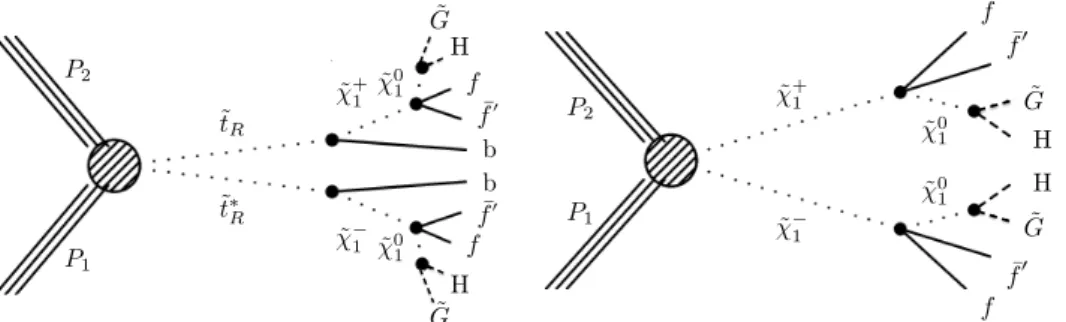
Figure 1: Example Feynman diagram of strong (left) and electroweak (right) higgsino produc-tion. The jets or leptons resulting from transitions between higgsinos are extremely soft in both diagrams due to the near mass degeneracy among the higgsinos.
The final state of interest, therefore, has two Higgs bosons, some missing energy from the gravitinos escaping detection, and, in the case of strong production, two bottom (or top, if
2
kinematically allowed) quarks from top squark decays, as shown in Fig. 1. SM backgrounds, e.g. from top quark pair production, are suppressed by taking advantage of the known Higgs boson mass and by considering the case when at least one of the Higgs bosons decays into two photons and at least two b-quarks are present from either Higgs or top squark decays. This approach also allows us to use diphoton mass sidebands for an estimate of the background from data, without sensitivity to the exact composition of the background, which is dominated by QCD production of γγbb events and γbb+j events with the jet being misidentified as a photon.
We use a data sample of 19.7 fb−1 collected during the LHC 8 TeV running with the CMS de-tector, which is described in detail elsewhere [12]. The detector comprises a silicon pixel and strip tracker covering the pseudorapidity range|η| < 2.4 (where η = −ln[tan(θ/2)]and θ is the polar angle of the particle with respect to the counterclockwise proton beam direction) and electromagnetic and hadronic calorimeters, which cover|η| < 3.0 and|η| < 5.0, respectively. The tracking and calorimeter systems are housed inside a 3.8 T solenoidal magnet. Muon cham-bers are imbedded in the iron return yoke of the solenoid up to pseudorapidity of |η| < 2.4. Events are required to pass a suite of diphoton triggers that impose mild shower shape and isolation requirements and demand transverse energies (ET = E·sin θ) above 36 and 22 GeV
for the leading and the sub-leading photon, respectively.
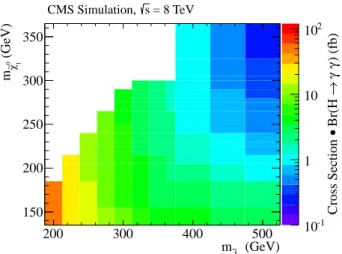
The signal is simulated for a grid of higgsino and top squark masses using the MADGRAPH 5 v.1.5.4 [13] and PYTHIA 6.4.22 [14] generators and fast simulation of the CMS detector [15]. The next-to-leading order (NLO) cross sections (shown in Fig. 2) are calculated usingPROSPINO 2.1 [16–21]. The higgsino mass splittings m
e χ02−mχe + 1 and mχe + 1 −mχe 0
1are set to 5 GeV, and a 100%
branching fraction is assumed for theχe
0
1 → H eG decay. All other superpartners have masses
too heavy to influence SUSY production at 8 TeV.
(GeV) R t ~ m 200 300 400 500 (GeV) 0 1 χ∼ m 150 200 250 300 350 ) (fb) γ γ → Br(H • Cross Section -1 10 1 10 2 10 = 8 TeV s CMS Simulation,
Figure 2: Cross section times branching ratio Br(H → γγ) as a function of top squark and higgsino masses.
Photon candidates are reconstructed from the energy deposits in the electromagnetic calorime-ter by grouping the calorimecalorime-ter’s data channels into supercluscalorime-ters [22, 23]. Photons are required to register in the barrel portion of the calorimeter (|η| <1.4442) and to pass shower shape and isolation requirements. To reject electrons misidentified as photons, photons are also required not to have associated hit patterns in the pixel detector consistent with a track. Photon energies are calculated using multivariate regression [4, 23].
3
The particle-flow (PF) algorithm [24] is used to reconstruct individual particles (PF candidates) in the events, combining all available sub-detector information in a coherent and optimal man-ner. Jets are reconstructed from the PF particles using the anti-kT[25] algorithm with a distance
parameter of 0.5 and are required not to overlap with the two leading photons by imposing a requirement∆R>0.6, where∆R=p
(∆φ)2+ (∆η)2and φ is the azimuthal angle. Transverse
momentum and η-dependent corrections to the jet energies are applied to account for residual effects of non-uniform detector response. The pileup contribution is estimated and subtracted from the jet energy using the jet area method [26] on an event-by-event basis. The combined secondary vertex (CSV) algorithm [27] is employed to identify jets that originate from a bottom quark.
The missing transverse energy (Emiss
T ) of the event is computed as the magnitude of the vectorial
sum of the transverse momenta of all PF candidates [24].
Events are selected if they have at least two identified photons with transverse energies above 40 and 25 GeV for the leading and sub-leading photons, respectively. Events are also required to have at least two jets with transverse energy above 30 GeV and |η| < 2.4 and satisfying the loose (CSV-loose) b-tag requirements, at least one of which also must pass the medium (CSV-medium) requirement. The CSV-loose and CSV-medium working points have signal ef-ficiencies of 80-85% and 50-75%, respectively, and mistag rates from light-flavor jets of 8-13% and 1-2%, respectively [27].
The events with diphoton mass between 120 and 131 GeV constitute the signal sample, while the events with mass between 103 and 118 GeV and between 133 and 163 GeV compose the lower sideband and upper sideband samples, respectively.
In the investigated SUSY signal, b-quark jets can originate from decays of the other Higgs boson and from decays of top squark. This is exploited by separating events into three categories with different expected background as follows: (i) events with at least one additional CSV-loose b-quark jet in addition to the two (i.e. events with three or more b-b-quark jets), (ii) events for which the invariant mass of the two b-quark jets is within a Higgs mass window from 95 to 155 GeV, (iii) all other events.
The distribution of signal events among the three categories depends on the top squark and higgsino masses. For small top squark-higgsino mass differences, most of the signal populates category (ii), while for large mass differences categories (i) and (iii) dominate.
The search is performed independently in the three categories and the results are combined, leading to as much as 35% improvement in expected SUSY cross section limits compared to the analysis without categorization.
The peaking background from the SM Higgs boson production with subsequent diphoton de-cay is found negligible using MC simulation. The diphoton mass sidebands are used to derive an estimate of all other SM background processes from data.
The diphoton distribution is fitted using a power law from 103 to 163 GeV [28]. The region from 118 to 133 GeV, corresponding to the signal region plus the 2 GeV “buffers” on each side of the signal region, is excluded from the fitter’s consideration to prevent potential signal from affecting the background estimate. The result of the fit is used to calculate the normalization of the background. The effects of various other fit functions have been explored, and the resulting changes in the estimated background yields are well within the uncertainty in the fit function integral from the power law fit. The fit and background estimates are done independently in all three event categories.
4
Binned background distributions of relevant kinematic variables are obtained for each event category separately from the lower and upper sidebands and are weighted according to the fit function integrals. This provides two independent estimates of the distribution of the SM background in the corresponding variable. No significant correlations are observed between the diphoton mass and other kinematic variables. However, to account for possible corre-lations, the background yield is conservatively assumed to be bounded by the independent background estimates from the upper and lower sidebands. The background prediction using this bound as a systematic uncertainty is calculated as follows. The main background esti-mate in each bin of a kinematic variable is formed by taking an average of the two background estimates from the sidebands. Half the difference between the two estimates is taken as a sys-tematic uncertainty for that bin, so that the central value and its uncertainty spans the range between the two estimates coming from the lower and upper sidebands. For the main variable used in this analysis, Emiss
T , the background uncertainty is dominated by the statistical
uncer-tainty in the sideband samples. The small correlation between the bin errors, originating from the common normalization from the fit, is taken into account during the statistical analysis described below.
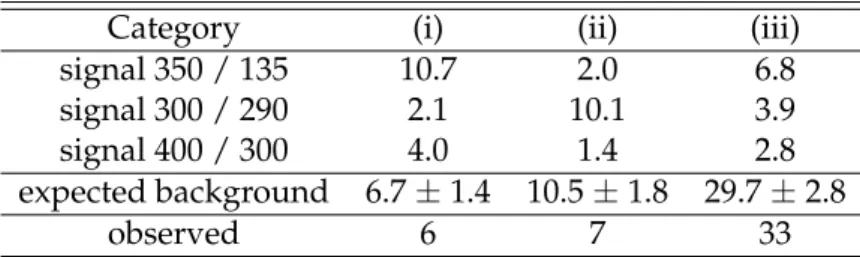
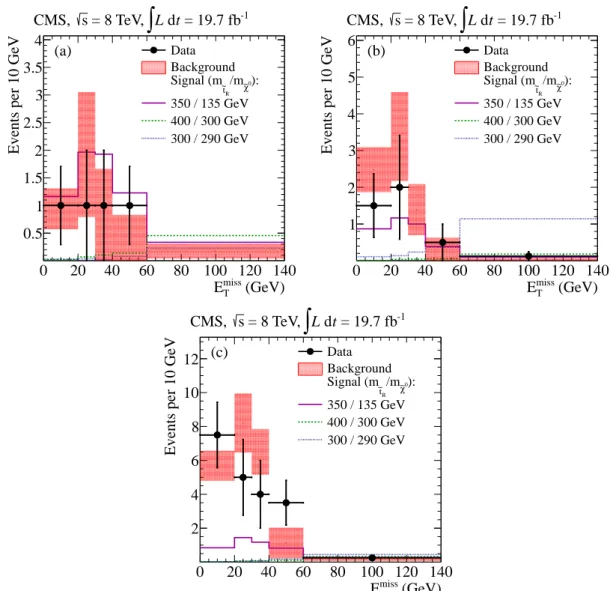
The observed distributions of ETmiss are shown in Fig. 3 separately for the three event cate-gories, together with the background estimates from the above procedure and the expected distributions from three characteristic signal points. Table 1 shows the expected signal yields, background predictions, and observed event counts for the three event categories. The obser-vations are in agreement with the background predictions.
Table 1: Expected and observed event counts. The yields for three signal points are shown for comparison indicating m
etRand mχe
0
1 in GeV, respectively.
Category (i) (ii) (iii)
signal 350 / 135 10.7 2.0 6.8
signal 300 / 290 2.1 10.1 3.9
signal 400 / 300 4.0 1.4 2.8
expected background 6.7±1.4 10.5±1.8 29.7±2.8
observed 6 7 33
Since the data agree with the expected background we proceed to set limits on the SUSY model described above. The expected limits were calculated using a variety of kinematic variables and it was determined that EmissT is the single most sensitive variable.
The observed ETmissdistributions for the three event categories, shown in Fig. 3, together with the signal and background expectations listed in Table 1, are used as input to the limit setting procedure.
A frequentist LHC-style profiled likelihood test statistic is used [29–31]. For each model mass point, the modified frequentist CLSmethod is used to calculate upper limits on the cross section
for the model.
The dominant uncertainty in the analysis is the statistical uncertainty of the background predic-tion. The leading sources of systematic uncertainties are the b-quark jet identification efficiency and the jet energy scale. The magnitude of the uncertainties depends on the event category and ETmiss. For b-quark jet identification it varies from 1 to 5% for categories with two b-quark jets and from 6 to 17% for the three or more b-quark jets. For the jet energy scale, the uncertainty is important only for ETmissvalues below 40 GeV and varies from 7 to 43%.
5 (GeV) miss T E 0 20 40 60 80 100 120 140
Events per 10 GeV
0.5 1 1.5 2 2.5 3 3.5 4 Data Background ): 0 χ∼ /m R t ~ Signal (m 350 / 135 GeV 400 / 300 GeV 300 / 290 GeV -1 = 19.7 fb t d L
∫
= 8 TeV, s CMS, (a) (GeV) miss T E 0 20 40 60 80 100 120 140Events per 10 GeV
1 2 3 4 5 6 Data Background ): 0 χ∼ /m R t ~ Signal (m 350 / 135 GeV 400 / 300 GeV 300 / 290 GeV -1 = 19.7 fb t d L
∫
= 8 TeV, s CMS, (b) (GeV) miss T E 0 20 40 60 80 100 120 140Events per 10 GeV
2 4 6 8 10 12 Data Background ): 0 χ∼ /m R t ~ Signal (m 350 / 135 GeV 400 / 300 GeV 300 / 290 GeV -1 = 19.7 fb t d L
∫
= 8 TeV, s CMS, (c)Figure 3: EmissT distributions for the data, background predictions, and representative signals for the three event categories (i), (ii), and (iii) in frames (a), (b) and (c), respectively. For each histogram, the last bin includes the overflow.
in integrated luminosity (2.6%) [32], the diphoton trigger efficiency (0.1%), the photon recon-struction and identification efficiency (1%), and the photon resolution uncertainty (1%) [4]. All systematic uncertainties are correlated among the event categories and are treated as nuisance parameters in the likelihood, profiled according to their estimated value.
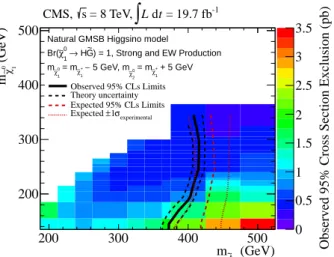
Fig. 4 shows the limits on the GMSB model in the top squark-higgsino mass plane. Depending on the higgsino mass, and conservatively using the minus-one-standard-deviation value for the theoretical cross section [16], top squark masses below 360 to 410 GeV are excluded at a 95% confidence level, corresponding to the region to the left of the leftmost thin dashed black line in Fig. 4.
To summarize, a search for a “natural” SUSY scenario with light higgsinos and a top squark was performed, using Higgs tagging in the diphoton decay mode, in a final state containing at least two photons and two or more b-quark jets. No evidence for a signal is observed, and 95% confidence level limits are set in the top squark-higgsino mass plane, excluding a significant
6 References (GeV) R t ~ m 200 300 400 500 (GeV) 0 1 χ∼ m 200 300 400 500
Observed 95% Cross Section Exclusion (pb)
0 0.5 1 1.5 2 2.5 3 3.5 + 5 GeV + 1 χ∼ = m 0 2 χ∼ 5 GeV, m − + 1 χ∼ = m 0 1 χ∼ m
) = 1, Strong and EW Production G~ H → 0 1 χ∼ Br(
Natural GMSB Higgsino model
Observed 95% CLs Limits Theory uncertainty Expected 95% CLs Limits experimental σ 1 ± Expected -1 = 19.7 fb t d L
∫
= 8 TeV, s CMS,Figure 4: Limits on SUSY production cross sections for different top squark and higgsino masses. The regions to the left of the contours are expected (thick dash/red) and observed (solid/black) to be excluded at the 95% confidence level. Black dashed curves reflect the theo-retical uncertainty on the cross section. Red dotted curves correspond to one standard devia-tion in expected sensitivity.
portion of the “natural” parameter space up to top squark masses of 410 GeV.
We congratulate our colleagues in the CERN accelerator departments for the excellent perfor-mance of the LHC and thank the technical and administrative staffs at CERN and at other CMS institutes for their contributions to the success of the CMS effort. In addition, we gratefully ac-knowledge the computing centers and personnel of the Worldwide LHC Computing Grid for delivering so effectively the computing infrastructure essential to our analyses. Finally, we ac-knowledge the enduring support for the construction and operation of the LHC and the CMS detector provided by the following funding agencies: BMWF and FWF (Austria); FNRS and FWO (Belgium); CNPq, CAPES, FAPERJ, and FAPESP (Brazil); MES (Bulgaria); CERN; CAS, MoST, and NSFC (China); COLCIENCIAS (Colombia); MSES (Croatia); RPF (Cyprus); MoER, SF0690030s09 and ERDF (Estonia); Academy of Finland, MEC, and HIP (Finland); CEA and CNRS/IN2P3 (France); BMBF, DFG, and HGF (Germany); GSRT (Greece); OTKA and NIH (Hungary); DAE and DST (India); IPM (Iran); SFI (Ireland); INFN (Italy); NRF and WCU (Republic of Korea); LAS (Lithuania); CINVESTAV, CONACYT, SEP, and UASLP-FAI (Mex-ico); MBIE (New Zealand); PAEC (Pakistan); MSHE and NSC (Poland); FCT (Portugal); JINR (Dubna); MON, RosAtom, RAS and RFBR (Russia); MESTD (Serbia); SEIDI and CPAN (Spain); Swiss Funding Agencies (Switzerland); NSC (Taipei); ThEPCenter, IPST, STAR and NSTDA (Thailand); TUBITAK and TAEK (Turkey); NASU (Ukraine); STFC (United Kingdom); DOE and NSF (USA).
References
[1] ATLAS Collaboration, “Measurements of Higgs boson production and couplings in diboson final states with the ATLAS detector at the LHC”, Phys. Lett. B 726 (2013) 88, doi:10.1016/j.physletb.2013.08.010, arXiv:1307.1427.
[2] ATLAS Collaboration, “Evidence for the spin-0 nature of the Higgs boson using ATLAS data”, Phys. Lett. B 726 (2013) 120, doi:10.1016/j.physletb.2013.08.026, arXiv:1307.1432.
References 7
[3] CMS Collaboration, “Study of the Mass and Spin-Parity of the Higgs Boson Candidate via its Decays to Z Boson Pairs”, Phys. Rev. Lett. 110 (2013) 081803,
doi:10.1103/PhysRevLett.110.081803, arXiv:1212.6639.
[4] CMS Collaboration, “Observation of a new boson with mass near 125 GeV in pp collisions at√s = 7 and 8 TeV”, JHEP 06 (2013) 081,
doi:10.1007/JHEP06(2013)081, arXiv:1303.4571.
[5] R. Barbieri and G. F. Giudice, “Upper Bounds on Supersymmetric Particle Masses”, Nucl. Phys. B 306 (1988) 63, doi:10.1016/0550-3213(88)90171-X.
[6] M. Papucci, J. T. Ruderman, and A. Weiler, “Natural SUSY endures”, JHEP 09 (2012) 035, doi:10.1007/JHEP09(2012)035, arXiv:1110.6926.
[7] S. Dimopoulos, M. Dine, S. Raby, and S. D. Thomas, “Experimental signatures of low-energy gauge mediated supersymmetry breaking”, Phys. Rev. Lett. 76 (1996) 3494, doi:10.1103/PhysRevLett.76.3494, arXiv:hep-ph/9601367.
[8] S. Ambrosanio et al., “Search for supersymmetry with a light gravitino at the Fermilab Tevatron and CERN LEP colliders”, Phys. Rev. D 54 (1996) 5395,
doi:10.1103/PhysRevD.54.5395, arXiv:hep-ph/9605398.
[9] K. T. Matchev and S. D. Thomas, “Higgs and Z boson signatures of supersymmetry”, Phys. Rev. D 62 (2000) 077702, doi:10.1103/PhysRevD.62.077702,
arXiv:hep-ph/9908482.
[10] K. Howe and P. Saraswat, “Excess Higgs production in neutralino decays”, JHEP 10 (2012) 065, doi:10.1007/JHEP10(2012)065, arXiv:1208.1542.
[11] P. Meade, M. Reece, and D. Shih, “Prompt decays of general neutralino NLSPs at the Tevatron”, JHEP 05 (2010) 105, doi:10.1007/JHEP05(2010)105,
arXiv:0911.4130.
[12] CMS Collaboration, “The CMS experiment at the CERN LHC”, JINST 3 (2008) S08004, doi:10.1088/1748-0221/3/08/S08004.
[13] J. Alwall et al., “MadGraph 5: going beyond”, JHEP 06 (2011) 128, doi:10.1007/JHEP06(2011)128, arXiv:1106.0522.
[14] T. Sj ¨ostrand, S. Mrenna, and P. Z. Skands, “PYTHIA 6.4 physics and manual”, JHEP 05 (2006) 026, doi:10.1088/1126-6708/2006/05/026, arXiv:hep-ph/0603175. [15] CMS Collaboration, “The fast simulation of the CMS Detector at the LHC”, in
International Conference on Computing in High Energy and Nuclear Physics (CHEP 2010). J. Phys.: Conference Series 331 (2011) 032049. doi:10.1088/1742-6596/331/3/032049. [16] M. Kr¨amer et al., “Supersymmetry production cross sections in pp collisions at√s = 7
TeV”, (2012). arXiv:1206.2892.
[17] W. Beenakker, R. Hopker, M. Spira, and P. M. Zerwas, “Squark and gluino production at hadron colliders”, Nucl. Phys. B 492 (1997) 51,
doi:10.1016/S0550-3213(97)80027-2, arXiv:hep-ph/9610490. [18] A. Kulesza and L. Motyka, “Threshold resummation for squark-antisquark and
gluino-pair production at the LHC”, Phys. Rev. Lett. 102 (2009) 111802, doi:10.1103/PhysRevLett.102.111802, arXiv:0807.2405.
8 References
[19] W. Beenakker et al., “Soft-gluon resummation for squark and gluino hadroproduction”, JHEP 12 (2009) 041, doi:10.1088/1126-6708/2009/12/041, arXiv:0909.4418. [20] W. Beenakker et al., “Squark and Gluino Hadroproduction”, Int. J. Mod. Phys. A 26
(2011) 2637, doi:10.1142/S0217751X11053560, arXiv:1105.1110.
[21] W. Beenakker, R. Hopker, and M. Spira, “PROSPINO: A Program for the production of supersymmetric particles in next-to-leading order QCD”, (1996).
arXiv:hep-ph/9611232.
[22] CMS Collaboration, “Photon reconstruction and identification at√s = 7 TeV”, CMS Physics Analysis Summary CMS-PAS-EGM-10-005, 2010.
[23] CMS Collaboration, “Energy calibration and resolution of the CMS electromagnetic calorimeter in pp collisions at√s=7 TeV”, JINST 8 (2013) 09009,
doi:10.1088/1748-0221/8/09/P09009, arXiv:1306.2016.
[24] CMS Collaboration, “Commissioning of the Particle-Flow Reconstruction in Minimum-Bias and Jet Events from pp Collisions at 7 TeV”, CMS Physics Analysis Summary CMS-PAS-PFT-10-002, 2010.
[25] M. Cacciari, G. P. Salam, and G. Soyez, “The anti-ktjet clustering algorithm”, JHEP 04
(2008) 063, doi:10.1088/1126-6708/2008/04/063, arXiv:0802.1189.
[26] M. Cacciari and G. P. Salam, “Pileup subtraction using jet areas”, Phys. Lett. B 659 (2008), no. 12, 119, doi:10.1016/j.physletb.2007.09.077, arXiv:0707.1378.
[27] CMS Collaboration, “Identification of b-quark jets with the CMS experiment”, JINST 8 (2013) P04013, doi:10.1088/1748-0221/8/04/P04013, arXiv:1211.4462. [28] CMS Collaboration, “Search for top squark and higgsino production using diphoton
Higgs boson decays”, (2013). The fits of diphoton mass distributions and distributions of considered kinematic variables are shown in the Appendix.
[29] ATLAS Collaboration, CMS Collaboration, and LHC Higgs Combination Group, “Procedure for the LHC Higgs boson search combination in Summer 2011”, Technical Report CMS-NOTE-2011-005. ATL-PHYS-PUB-2011-11, CERN, Geneva, Aug, 2011. [30] T. Junk, “Confidence level computation for combining searches with small statistics”,
Nucl. Instrum. Meth. A 434 (1999) 435, doi:10.1016/S0168-9002(99)00498-2, arXiv:hep-ex/9902006.
[31] A. L. Read, “Presentation of search results: The CLstechnique”, J. Phys. G 28 (2002) 2693,
doi:10.1088/0954-3899/28/10/313.
[32] CMS Collaboration, “CMS Luminosity Based on Pixel Cluster Counting - Summer 2013 Update”, CMS Physics Analysis Summary CMS-PAS-LUM-13-001, 2013.
9
A
Diphoton mass fits
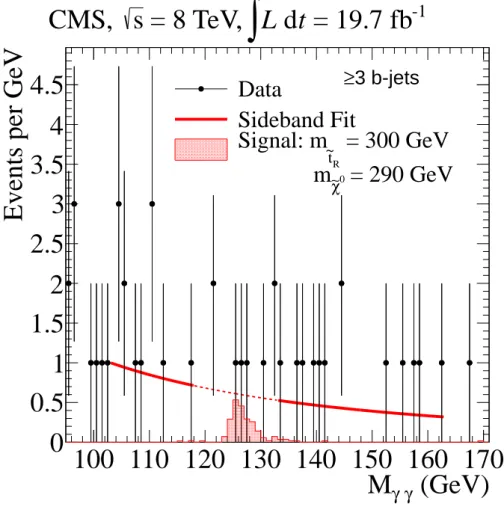
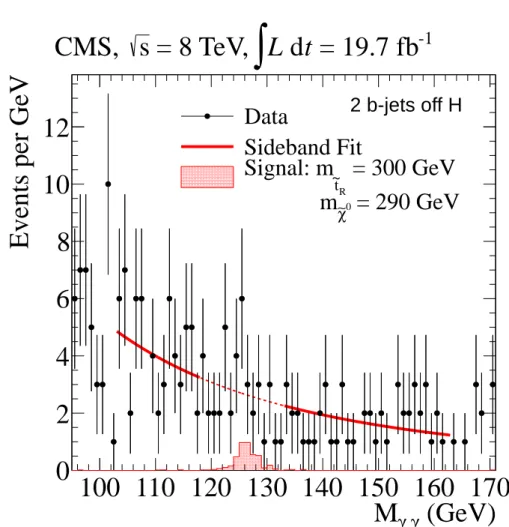
Figures 5, 6, and 7 show the diphoton mass distributions in the three event categories and the fits to a power law.
(GeV)
γ γ
M
100 110 120 130 140 150 160 170
Events per GeV
0
0.5
1
1.5
2
2.5
3
3.5
4
4.5
-1= 19.7 fb
t
d
L
∫
= 8 TeV,
s
CMS,
Data
Sideband Fit
= 300 GeV
R t ~Signal: m
= 290 GeV
0 χ∼m
3 b-jets
≥
Figure 5: Diphoton mass distribution (points with errors) in event category (i) and the power law fit (thick red line). The interval from 118 to 133 GeV is excluded from the fit.
B
Other kinematic variables
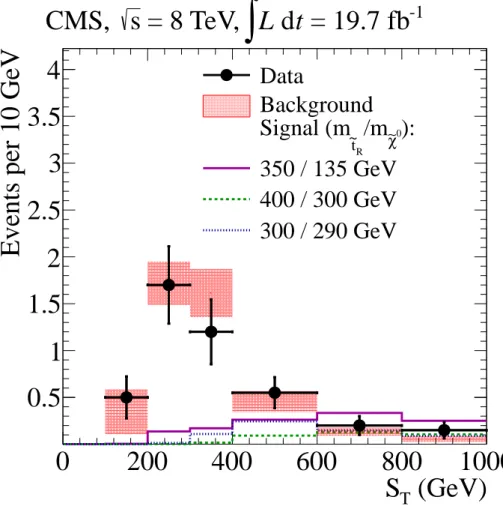
In addition to ETmiss, the following kinematic variables were studied:
• ST, defined as a scalar sum of pTof all jets and photons in the event;
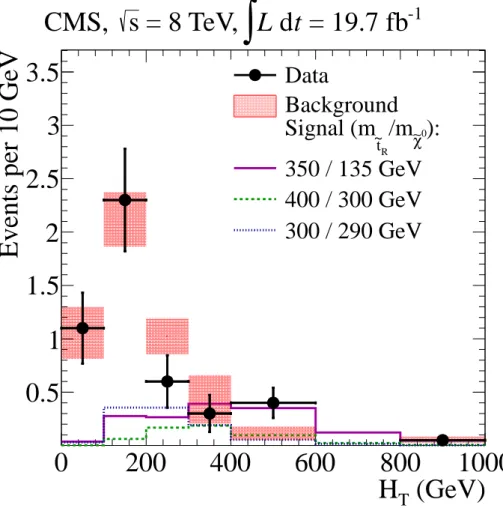
• HT, defined as a scalar sum of pTof all jets in the event;
• BT, defined as a scalar sum of pTof all b-quark jets in the event;
• HTmiss, defined as an absolute value of a vector sum of p~T of all jets in the event;
• pγγ
T , defined as a pT of the Higgs boson canidate.
Figures 8, 9, 11, 10, and 12 show the expected and observed distributions of these variables for the three event categories combined, together with expected signal contribution.
10 B Other kinematic variables
(GeV)
γ γM
100 110 120 130 140 150 160 170
Events per GeV
0
2
4
6
8
10
-1= 19.7 fb
t
d
L
∫
= 8 TeV,
s
CMS,
Data
Sideband Fit
= 300 GeV
R t ~Signal: m
= 290 GeV
0 χ∼m
2 b-jets on H
Figure 6: Diphoton mass distribution (points with errors) in event category (ii) and the power law fit (thick red line). The interval from 118 to 133 GeV is excluded from the fit.
11
(GeV)
γ γM
100 110 120 130 140 150 160 170
Events per GeV
0
2
4
6
8
10
12
-1= 19.7 fb
t
d
L
∫
= 8 TeV,
s
CMS,
Data
Sideband Fit
= 300 GeV
R t ~Signal: m
= 290 GeV
0 χ∼m
2 b-jets off H
Figure 7: Diphoton mass distribution (points with errors) in event category (iii) and the power law fit (thick red line). The interval from 118 to 133 GeV is excluded from the fit.
12 B Other kinematic variables
(GeV)
TS
0
200
400
600
800
1000
Events per 10 GeV
0.5
1
1.5
2
2.5
3
3.5
4
Data
Background
):
0 χ∼/m
R t ~Signal (m
350 / 135 GeV
400 / 300 GeV
300 / 290 GeV
-1= 19.7 fb
t
d
L
∫
= 8 TeV,
s
CMS,
Figure 8: ST distributions for the data, background prediction, and representative signals for
13
(GeV)
TH
0
200
400
600
800
1000
Events per 10 GeV
0.5
1
1.5
2
2.5
3
3.5
Data
Background
):
0 χ∼/m
R t ~Signal (m
350 / 135 GeV
400 / 300 GeV
300 / 290 GeV
-1= 19.7 fb
t
d
L
∫
= 8 TeV,
s
CMS,
Figure 9: HT distributions for the data, background prediction, and representative signals for
14 B Other kinematic variables
(GeV)
TB
0
100
200
300
400
500
600
Events per 10 GeV
1
2
3
4
5
Data
Background
):
0 χ∼/m
R t ~Signal (m
350 / 135 GeV
400 / 300 GeV
300 / 290 GeV
-1= 19.7 fb
t
d
L
∫
= 8 TeV,
s
CMS,
Figure 10: BT distributions for the data, background prediction, and representative signals for
15
(GeV)
miss TH
0
50
100
150
200
250
Events per 10 GeV
1
2
3
4
5
6
7
8
9
Data
Background
):
0 χ∼/m
R t ~Signal (m
350 / 135 GeV
400 / 300 GeV
300 / 290 GeV
-1= 19.7 fb
t
d
L
∫
= 8 TeV,
s
CMS,
Figure 11: HmissT distributions for the data, background prediction, and representative signals for the three event categories combined. The last bin includes the overflow.
16 B Other kinematic variables
(GeV)
γ γ Tp
0
20
40
60
80 100 120 140
Events per 10 GeV
2
4
6
8
10
12
Data
Background
):
0 χ∼/m
R t ~Signal (m
350 / 135 GeV
400 / 300 GeV
300 / 290 GeV
-1= 19.7 fb
t
d
L
∫
= 8 TeV,
s
CMS,
Figure 12: pγγT distributions for the data, background prediction, and representative signals for
17
C
The CMS Collaboration
Yerevan Physics Institute, Yerevan, Armenia
S. Chatrchyan, V. Khachatryan, A.M. Sirunyan, A. Tumasyan
Institut f ¨ur Hochenergiephysik der OeAW, Wien, Austria
W. Adam, T. Bergauer, M. Dragicevic, J. Er ¨o, C. Fabjan1, M. Friedl, R. Fr ¨uhwirth1, V.M. Ghete, C. Hartl, N. H ¨ormann, J. Hrubec, M. Jeitler1, W. Kiesenhofer, V. Kn ¨unz, M. Krammer1, I. Kr¨atschmer, D. Liko, I. Mikulec, D. Rabady2, B. Rahbaran, H. Rohringer, R. Sch ¨ofbeck,
J. Strauss, A. Taurok, W. Treberer-Treberspurg, W. Waltenberger, C.-E. Wulz1
National Centre for Particle and High Energy Physics, Minsk, Belarus
V. Mossolov, N. Shumeiko, J. Suarez Gonzalez
Universiteit Antwerpen, Antwerpen, Belgium
S. Alderweireldt, M. Bansal, S. Bansal, T. Cornelis, E.A. De Wolf, X. Janssen, A. Knutsson, S. Luyckx, L. Mucibello, S. Ochesanu, B. Roland, R. Rougny, H. Van Haevermaet, P. Van Mechelen, N. Van Remortel, A. Van Spilbeeck
Vrije Universiteit Brussel, Brussel, Belgium
F. Blekman, S. Blyweert, J. D’Hondt, N. Heracleous, A. Kalogeropoulos, J. Keaveney, T.J. Kim, S. Lowette, M. Maes, A. Olbrechts, D. Strom, S. Tavernier, W. Van Doninck, P. Van Mulders, G.P. Van Onsem, I. Villella
Universit´e Libre de Bruxelles, Bruxelles, Belgium
C. Caillol, B. Clerbaux, G. De Lentdecker, L. Favart, A.P.R. Gay, A. L´eonard, P.E. Marage, A. Mohammadi, L. Perni`e, T. Reis, T. Seva, L. Thomas, C. Vander Velde, P. Vanlaer, J. Wang
Ghent University, Ghent, Belgium
V. Adler, K. Beernaert, L. Benucci, A. Cimmino, S. Costantini, S. Dildick, G. Garcia, B. Klein, J. Lellouch, J. Mccartin, A.A. Ocampo Rios, D. Ryckbosch, S. Salva Diblen, M. Sigamani, N. Strobbe, F. Thyssen, M. Tytgat, S. Walsh, E. Yazgan, N. Zaganidis
Universit´e Catholique de Louvain, Louvain-la-Neuve, Belgium
S. Basegmez, C. Beluffi3, G. Bruno, R. Castello, A. Caudron, L. Ceard, G.G. Da Silveira, C. Delaere, T. du Pree, D. Favart, L. Forthomme, A. Giammanco4, J. Hollar, P. Jez, M. Komm, V. Lemaitre, J. Liao, O. Militaru, C. Nuttens, D. Pagano, A. Pin, K. Piotrzkowski, A. Popov5, L. Quertenmont, M. Selvaggi, M. Vidal Marono, J.M. Vizan Garcia
Universit´e de Mons, Mons, Belgium
N. Beliy, T. Caebergs, E. Daubie, G.H. Hammad
Centro Brasileiro de Pesquisas Fisicas, Rio de Janeiro, Brazil
G.A. Alves, M. Correa Martins Junior, T. Martins, M.E. Pol, M.H.G. Souza
Universidade do Estado do Rio de Janeiro, Rio de Janeiro, Brazil
W.L. Ald´a J ´unior, W. Carvalho, J. Chinellato6, A. Cust ´odio, E.M. Da Costa, D. De Jesus Damiao,
C. De Oliveira Martins, S. Fonseca De Souza, H. Malbouisson, M. Malek, D. Matos Figueiredo, L. Mundim, H. Nogima, W.L. Prado Da Silva, J. Santaolalla, A. Santoro, A. Sznajder, E.J. Tonelli Manganote6, A. Vilela Pereira
Universidade Estadual Paulistaa, Universidade Federal do ABCb, S˜ao Paulo, Brazil
C.A. Bernardesb, F.A. Diasa,7, T.R. Fernandez Perez Tomeia, E.M. Gregoresb, C. Laganaa, P.G. Mercadanteb, S.F. Novaesa, Sandra S. Padulaa
18 C The CMS Collaboration
Institute for Nuclear Research and Nuclear Energy, Sofia, Bulgaria
V. Genchev2, P. Iaydjiev2, A. Marinov, S. Piperov, M. Rodozov, G. Sultanov, M. Vutova
University of Sofia, Sofia, Bulgaria
A. Dimitrov, I. Glushkov, R. Hadjiiska, V. Kozhuharov, L. Litov, B. Pavlov, P. Petkov
Institute of High Energy Physics, Beijing, China
J.G. Bian, G.M. Chen, H.S. Chen, M. Chen, R. Du, C.H. Jiang, D. Liang, S. Liang, X. Meng, R. Plestina8, J. Tao, X. Wang, Z. Wang
State Key Laboratory of Nuclear Physics and Technology, Peking University, Beijing, China
C. Asawatangtrakuldee, Y. Ban, Y. Guo, Q. Li, W. Li, S. Liu, Y. Mao, S.J. Qian, D. Wang, L. Zhang, W. Zou
Universidad de Los Andes, Bogota, Colombia
C. Avila, C.A. Carrillo Montoya, L.F. Chaparro Sierra, C. Florez, J.P. Gomez, B. Gomez Moreno, J.C. Sanabria
Technical University of Split, Split, Croatia
N. Godinovic, D. Lelas, D. Polic, I. Puljak
University of Split, Split, Croatia
Z. Antunovic, M. Kovac
Institute Rudjer Boskovic, Zagreb, Croatia
V. Brigljevic, K. Kadija, J. Luetic, D. Mekterovic, S. Morovic, L. Tikvica
University of Cyprus, Nicosia, Cyprus
A. Attikis, G. Mavromanolakis, J. Mousa, C. Nicolaou, F. Ptochos, P.A. Razis
Charles University, Prague, Czech Republic
M. Finger, M. Finger Jr.
Academy of Scientific Research and Technology of the Arab Republic of Egypt, Egyptian Network of High Energy Physics, Cairo, Egypt
A.A. Abdelalim9, Y. Assran10, S. Elgammal9, A. Ellithi Kamel11, M.A. Mahmoud12, A. Radi13,14
National Institute of Chemical Physics and Biophysics, Tallinn, Estonia
M. Kadastik, M. M ¨untel, M. Murumaa, M. Raidal, L. Rebane, A. Tiko
Department of Physics, University of Helsinki, Helsinki, Finland
P. Eerola, G. Fedi, M. Voutilainen
Helsinki Institute of Physics, Helsinki, Finland
J. H¨ark ¨onen, V. Karim¨aki, R. Kinnunen, M.J. Kortelainen, T. Lamp´en, K. Lassila-Perini, S. Lehti, T. Lind´en, P. Luukka, T. M¨aenp¨a¨a, T. Peltola, E. Tuominen, J. Tuominiemi, E. Tuovinen, L. Wendland
Lappeenranta University of Technology, Lappeenranta, Finland
T. Tuuva
DSM/IRFU, CEA/Saclay, Gif-sur-Yvette, France
M. Besancon, F. Couderc, M. Dejardin, D. Denegri, B. Fabbro, J.L. Faure, F. Ferri, S. Ganjour, A. Givernaud, P. Gras, G. Hamel de Monchenault, P. Jarry, E. Locci, J. Malcles, A. Nayak, J. Rander, A. Rosowsky, M. Titov
19
Laboratoire Leprince-Ringuet, Ecole Polytechnique, IN2P3-CNRS, Palaiseau, France
S. Baffioni, F. Beaudette, P. Busson, C. Charlot, N. Daci, T. Dahms, M. Dalchenko, L. Dobrzynski, A. Florent, R. Granier de Cassagnac, P. Min´e, C. Mironov, I.N. Naranjo, M. Nguyen, C. Ochando, P. Paganini, D. Sabes, R. Salerno, Y. Sirois, C. Veelken, Y. Yilmaz, A. Zabi
Institut Pluridisciplinaire Hubert Curien, Universit´e de Strasbourg, Universit´e de Haute Alsace Mulhouse, CNRS/IN2P3, Strasbourg, France
J.-L. Agram15, J. Andrea, D. Bloch, J.-M. Brom, E.C. Chabert, C. Collard, E. Conte15, F. Drouhin15, J.-C. Fontaine15, D. Gel´e, U. Goerlach, C. Goetzmann, P. Juillot, A.-C. Le Bihan, P. Van Hove
Centre de Calcul de l’Institut National de Physique Nucleaire et de Physique des Particules, CNRS/IN2P3, Villeurbanne, France
S. Gadrat
Universit´e de Lyon, Universit´e Claude Bernard Lyon 1, CNRS-IN2P3, Institut de Physique Nucl´eaire de Lyon, Villeurbanne, France
S. Beauceron, N. Beaupere, G. Boudoul, S. Brochet, J. Chasserat, R. Chierici, D. Contardo2, P. Depasse, H. El Mamouni, J. Fan, J. Fay, S. Gascon, M. Gouzevitch, B. Ille, T. Kurca, M. Lethuillier, L. Mirabito, S. Perries, J.D. Ruiz Alvarez, L. Sgandurra, V. Sordini, M. Vander Donckt, P. Verdier, S. Viret, H. Xiao
Institute of High Energy Physics and Informatization, Tbilisi State University, Tbilisi, Georgia
Z. Tsamalaidze16
RWTH Aachen University, I. Physikalisches Institut, Aachen, Germany
C. Autermann, S. Beranek, M. Bontenackels, B. Calpas, M. Edelhoff, L. Feld, O. Hindrichs, K. Klein, A. Ostapchuk, A. Perieanu, F. Raupach, J. Sammet, S. Schael, D. Sprenger, H. Weber, B. Wittmer, V. Zhukov5
RWTH Aachen University, III. Physikalisches Institut A, Aachen, Germany
M. Ata, J. Caudron, E. Dietz-Laursonn, D. Duchardt, M. Erdmann, R. Fischer, A. G ¨uth, T. Hebbeker, C. Heidemann, K. Hoepfner, D. Klingebiel, S. Knutzen, P. Kreuzer, M. Merschmeyer, A. Meyer, M. Olschewski, K. Padeken, P. Papacz, H. Reithler, S.A. Schmitz, L. Sonnenschein, D. Teyssier, S. Th ¨uer, M. Weber
RWTH Aachen University, III. Physikalisches Institut B, Aachen, Germany
V. Cherepanov, Y. Erdogan, G. Fl ¨ugge, H. Geenen, M. Geisler, W. Haj Ahmad, F. Hoehle, B. Kargoll, T. Kress, Y. Kuessel, J. Lingemann2, A. Nowack, I.M. Nugent, L. Perchalla, O. Pooth, A. Stahl
Deutsches Elektronen-Synchrotron, Hamburg, Germany
I. Asin, N. Bartosik, J. Behr, W. Behrenhoff, U. Behrens, A.J. Bell, M. Bergholz17, A. Bethani, K. Borras, A. Burgmeier, A. Cakir, L. Calligaris, A. Campbell, S. Choudhury, F. Costanza, C. Diez Pardos, S. Dooling, T. Dorland, G. Eckerlin, D. Eckstein, T. Eichhorn, G. Flucke, A. Geiser, A. Grebenyuk, P. Gunnellini, S. Habib, J. Hauk, G. Hellwig, M. Hempel, D. Horton, H. Jung, M. Kasemann, P. Katsas, J. Kieseler, C. Kleinwort, M. Kr¨amer, D. Kr ¨ucker, W. Lange, J. Leonard, K. Lipka, W. Lohmann17, B. Lutz, R. Mankel, I. Marfin, I.-A. Melzer-Pellmann, A.B. Meyer, J. Mnich, A. Mussgiller, S. Naumann-Emme, O. Novgorodova, F. Nowak, H. Perrey, A. Petrukhin, D. Pitzl, R. Placakyte, A. Raspereza, P.M. Ribeiro Cipriano, C. Riedl, E. Ron, M. ¨O. Sahin, J. Salfeld-Nebgen, P. Saxena, R. Schmidt17, T. Schoerner-Sadenius, M. Schr ¨oder, M. Stein, A.D.R. Vargas Trevino, R. Walsh, C. Wissing
20 C The CMS Collaboration
University of Hamburg, Hamburg, Germany
M. Aldaya Martin, V. Blobel, H. Enderle, J. Erfle, E. Garutti, K. Goebel, M. G ¨orner, M. Gosselink, J. Haller, R.S. H ¨oing, H. Kirschenmann, R. Klanner, R. Kogler, J. Lange, T. Lapsien, I. Marchesini, J. Ott, T. Peiffer, N. Pietsch, D. Rathjens, C. Sander, H. Schettler, P. Schleper, E. Schlieckau, A. Schmidt, M. Seidel, J. Sibille18, V. Sola, H. Stadie, G. Steinbr ¨uck, D. Troendle, E. Usai, L. Vanelderen
Institut f ¨ur Experimentelle Kernphysik, Karlsruhe, Germany
C. Barth, C. Baus, J. Berger, C. B ¨oser, E. Butz, T. Chwalek, W. De Boer, A. Descroix, A. Dierlamm, M. Feindt, M. Guthoff2, F. Hartmann2, T. Hauth2, H. Held, K.H. Hoffmann, U. Husemann, I. Katkov5, A. Kornmayer2, E. Kuznetsova, P. Lobelle Pardo, D. Martschei, M.U. Mozer, Th. M ¨uller, M. Niegel, A. N ¨urnberg, O. Oberst, G. Quast, K. Rabbertz, F. Ratnikov, S. R ¨ocker, F.-P. Schilling, G. Schott, H.J. Simonis, F.M. Stober, R. Ulrich, J. Wagner-Kuhr, S. Wayand, T. Weiler, R. Wolf, M. Zeise
Institute of Nuclear and Particle Physics (INPP), NCSR Demokritos, Aghia Paraskevi, Greece
G. Anagnostou, G. Daskalakis, T. Geralis, S. Kesisoglou, A. Kyriakis, D. Loukas, A. Markou, C. Markou, E. Ntomari, A. Psallidas, I. Topsis-giotis
University of Athens, Athens, Greece
L. Gouskos, A. Panagiotou, N. Saoulidou, E. Stiliaris
University of Io´annina, Io´annina, Greece
X. Aslanoglou, I. Evangelou, G. Flouris, C. Foudas, J. Jones, P. Kokkas, N. Manthos, I. Papadopoulos, E. Paradas
Wigner Research Centre for Physics, Budapest, Hungary
G. Bencze, C. Hajdu, P. Hidas, D. Horvath19, F. Sikler, V. Veszpremi, G. Vesztergombi20, A.J. Zsigmond
Institute of Nuclear Research ATOMKI, Debrecen, Hungary
N. Beni, S. Czellar, J. Molnar, J. Palinkas, Z. Szillasi
University of Debrecen, Debrecen, Hungary
J. Karancsi, P. Raics, Z.L. Trocsanyi, B. Ujvari
National Institute of Science Education and Research, Bhubaneswar, India
S.K. Swain
Panjab University, Chandigarh, India
S.B. Beri, V. Bhatnagar, N. Dhingra, R. Gupta, M. Kaur, M.Z. Mehta, M. Mittal, N. Nishu, A. Sharma, J.B. Singh
University of Delhi, Delhi, India
Ashok Kumar, Arun Kumar, S. Ahuja, A. Bhardwaj, B.C. Choudhary, A. Kumar, S. Malhotra, M. Naimuddin, K. Ranjan, V. Sharma, R.K. Shivpuri
Saha Institute of Nuclear Physics, Kolkata, India
S. Banerjee, S. Bhattacharya, K. Chatterjee, S. Dutta, B. Gomber, Sa. Jain, Sh. Jain, R. Khurana, A. Modak, S. Mukherjee, D. Roy, S. Sarkar, M. Sharan, A.P. Singh
Bhabha Atomic Research Centre, Mumbai, India
21
Tata Institute of Fundamental Research - EHEP, Mumbai, India
T. Aziz, R.M. Chatterjee, S. Ganguly, S. Ghosh, M. Guchait21, A. Gurtu22, G. Kole, S. Kumar, M. Maity23, G. Majumder, K. Mazumdar, G.B. Mohanty, B. Parida, K. Sudhakar, N. Wickramage24
Tata Institute of Fundamental Research - HECR, Mumbai, India
S. Banerjee, S. Dugad
Institute for Research in Fundamental Sciences (IPM), Tehran, Iran
H. Arfaei, H. Bakhshiansohi, H. Behnamian, S.M. Etesami25, A. Fahim26, A. Jafari, M. Khakzad, M. Mohammadi Najafabadi, M. Naseri, S. Paktinat Mehdiabadi, B. Safarzadeh27, M. Zeinali
University College Dublin, Dublin, Ireland
M. Grunewald
INFN Sezione di Baria, Universit`a di Barib, Politecnico di Baric, Bari, Italy
M. Abbresciaa,b, L. Barbonea,b, C. Calabriaa,b, S.S. Chhibraa,b, A. Colaleoa, D. Creanzaa,c, N. De Filippisa,c, M. De Palmaa,b, L. Fiorea, G. Iasellia,c, G. Maggia,c, M. Maggia, B. Marangellia,b, S. Mya,c, S. Nuzzoa,b, N. Pacificoa, A. Pompilia,b, G. Pugliesea,c, R. Radognaa,b, G. Selvaggia,b, L. Silvestrisa, G. Singha,b, R. Vendittia,b, P. Verwilligena, G. Zitoa
INFN Sezione di Bolognaa, Universit`a di Bolognab, Bologna, Italy
G. Abbiendia, A.C. Benvenutia, D. Bonacorsia,b, S. Braibant-Giacomellia,b, L. Brigliadoria,b, R. Campaninia,b, P. Capiluppia,b, A. Castroa,b, F.R. Cavalloa, G. Codispotia,b, M. Cuffiania,b, G.M. Dallavallea, F. Fabbria, A. Fanfania,b, D. Fasanellaa,b, P. Giacomellia, C. Grandia, L. Guiduccia,b, S. Marcellinia, G. Masettia, M. Meneghellia,b, A. Montanaria, F.L. Navarriaa,b, F. Odoricia, A. Perrottaa, F. Primaveraa,b, A.M. Rossia,b, T. Rovellia,b, G.P. Sirolia,b, N. Tosia,b,
R. Travaglinia,b
INFN Sezione di Cataniaa, Universit`a di Cataniab, CSFNSMc, Catania, Italy
S. Albergoa,b, G. Cappelloa, M. Chiorbolia,b, S. Costaa,b, F. Giordanoa,c,2, R. Potenzaa,b, A. Tricomia,b, C. Tuvea,b
INFN Sezione di Firenzea, Universit`a di Firenzeb, Firenze, Italy
G. Barbaglia, V. Ciullia,b, C. Civininia, R. D’Alessandroa,b, E. Focardia,b, E. Galloa, S. Gonzia,b,
V. Goria,b, P. Lenzia,b, M. Meschinia, S. Paolettia, G. Sguazzonia, A. Tropianoa,b
INFN Laboratori Nazionali di Frascati, Frascati, Italy
L. Benussi, S. Bianco, F. Fabbri, D. Piccolo
INFN Sezione di Genovaa, Universit`a di Genovab, Genova, Italy
P. Fabbricatorea, R. Ferrettia,b, F. Ferroa, M. Lo Veterea,b, R. Musenicha, E. Robuttia, S. Tosia,b
INFN Sezione di Milano-Bicoccaa, Universit`a di Milano-Bicoccab, Milano, Italy
A. Benagliaa, M.E. Dinardoa,b, S. Fiorendia,b,2, S. Gennaia, R. Gerosa, A. Ghezzia,b, P. Govonia,b, M.T. Lucchinia,b,2, S. Malvezzia, R.A. Manzonia,b,2, A. Martellia,b,2, B. Marzocchi, D. Menascea, L. Moronia, M. Paganonia,b, D. Pedrinia, S. Ragazzia,b, N. Redaellia, T. Tabarelli de Fatisa,b
INFN Sezione di Napoli a, Universit`a di Napoli ’Federico II’ b, Universit`a della Basilicata (Potenza)c, Universit`a G. Marconi (Roma)d, Napoli, Italy
S. Buontempoa, N. Cavalloa,c, F. Fabozzia,c, A.O.M. Iorioa,b, L. Listaa, S. Meolaa,d,2, M. Merolaa, P. Paoluccia,2
22 C The CMS Collaboration
INFN Sezione di Padovaa, Universit`a di Padovab, Universit`a di Trento (Trento)c, Padova, Italy
P. Azzia, N. Bacchettaa, D. Biselloa,b, A. Brancaa,b, R. Carlina,b, P. Checchiaa, T. Dorigoa, M. Galantia,b,2, F. Gasparinia,b, U. Gasparinia,b, P. Giubilatoa,b, A. Gozzelinoa, K. Kanishcheva,c,
S. Lacapraraa, I. Lazzizzeraa,c, M. Margonia,b, A.T. Meneguzzoa,b, M. Passaseoa, J. Pazzinia,b, M. Pegoraroa, N. Pozzobona,b, P. Ronchesea,b, F. Simonettoa,b, E. Torassaa, M. Tosia,b, A. Triossia, S. Venturaa, A. Zucchettaa,b, G. Zumerlea,b
INFN Sezione di Paviaa, Universit`a di Paviab, Pavia, Italy
M. Gabusia,b, S.P. Rattia,b, C. Riccardia,b, P. Vituloa,b
INFN Sezione di Perugiaa, Universit`a di Perugiab, Perugia, Italy
M. Biasinia,b, G.M. Bileia, L. Fan `oa,b, P. Laricciaa,b, G. Mantovania,b, M. Menichellia, F. Romeoa,b, A. Sahaa, A. Santocchiaa,b, A. Spieziaa,b
INFN Sezione di Pisaa, Universit`a di Pisab, Scuola Normale Superiore di Pisac, Pisa, Italy
K. Androsova,28, P. Azzurria, G. Bagliesia, J. Bernardinia, T. Boccalia, G. Broccoloa,c, R. Castaldia, M.A. Cioccia,28, R. Dell’Orsoa, F. Fioria,c, L. Fo`aa,c, A. Giassia, M.T. Grippoa,28, A. Kraana, F. Ligabuea,c, T. Lomtadzea, L. Martinia,b, A. Messineoa,b, C.S. Moona,29, F. Pallaa, A. Rizzia,b, A. Savoy-Navarroa,30, A.T. Serbana, P. Spagnoloa, P. Squillaciotia,28, R. Tenchinia, G. Tonellia,b,
A. Venturia, P.G. Verdinia, C. Vernieria,c
INFN Sezione di Romaa, Universit`a di Romab, Roma, Italy
L. Baronea,b, F. Cavallaria, D. Del Rea,b, M. Diemoza, M. Grassia,b, C. Jordaa, E. Longoa,b, F. Margarolia,b, P. Meridiania, F. Michelia,b, S. Nourbakhsha,b, G. Organtinia,b, R. Paramattia, S. Rahatloua,b, C. Rovellia, L. Soffia,b, P. Traczyka,b
INFN Sezione di Torino a, Universit`a di Torino b, Universit`a del Piemonte Orientale (No-vara)c, Torino, Italy
N. Amapanea,b, R. Arcidiaconoa,c, S. Argiroa,b, M. Arneodoa,c, R. Bellana,b, C. Biinoa, N. Cartigliaa, S. Casassoa,b, M. Costaa,b, A. Deganoa,b, N. Demariaa, C. Mariottia, S. Masellia, E. Migliorea,b, V. Monacoa,b, M. Musicha, M.M. Obertinoa,c, G. Ortonaa,b, L. Pachera,b, N. Pastronea, M. Pelliccionia,2, A. Potenzaa,b, A. Romeroa,b, M. Ruspaa,c, R. Sacchia,b, A. Solanoa,b, A. Staianoa, U. Tamponia
INFN Sezione di Triestea, Universit`a di Triesteb, Trieste, Italy
S. Belfortea, V. Candelisea,b, M. Casarsaa, F. Cossuttia, G. Della Riccaa,b, B. Gobboa, C. La Licataa,b, M. Maronea,b, D. Montaninoa,b, A. Penzoa, A. Schizzia,b, T. Umera,b, A. Zanettia
Kangwon National University, Chunchon, Korea
S. Chang, T.Y. Kim, S.K. Nam
Kyungpook National University, Daegu, Korea
D.H. Kim, G.N. Kim, J.E. Kim, M.S. Kim, D.J. Kong, S. Lee, Y.D. Oh, H. Park, D.C. Son
Chonnam National University, Institute for Universe and Elementary Particles, Kwangju, Korea
J.Y. Kim, Zero J. Kim, S. Song
Korea University, Seoul, Korea
S. Choi, D. Gyun, B. Hong, M. Jo, H. Kim, Y. Kim, K.S. Lee, S.K. Park, Y. Roh
University of Seoul, Seoul, Korea
23
Sungkyunkwan University, Suwon, Korea
Y. Choi, Y.K. Choi, J. Goh, E. Kwon, B. Lee, J. Lee, S. Lee, H. Seo, I. Yu
Vilnius University, Vilnius, Lithuania
A. Juodagalvis
University of Malaya Jabatan Fizik, Kuala Lumpur, Malaysia
J.R. Komaragiri
Centro de Investigacion y de Estudios Avanzados del IPN, Mexico City, Mexico
H. Castilla-Valdez, E. De La Cruz-Burelo, I. Heredia-de La Cruz31, R. Lopez-Fernandez,
J. Mart´ınez-Ortega, A. Sanchez-Hernandez, L.M. Villasenor-Cendejas
Universidad Iberoamericana, Mexico City, Mexico
S. Carrillo Moreno, F. Vazquez Valencia
Benemerita Universidad Autonoma de Puebla, Puebla, Mexico
H.A. Salazar Ibarguen
Universidad Aut ´onoma de San Luis Potos´ı, San Luis Potos´ı, Mexico
E. Casimiro Linares, A. Morelos Pineda
University of Auckland, Auckland, New Zealand
D. Krofcheck
University of Canterbury, Christchurch, New Zealand
P.H. Butler, R. Doesburg, S. Reucroft
National Centre for Physics, Quaid-I-Azam University, Islamabad, Pakistan
M. Ahmad, M.I. Asghar, J. Butt, H.R. Hoorani, S. Khalid, W.A. Khan, T. Khurshid, S. Qazi, M.A. Shah, M. Shoaib
National Centre for Nuclear Research, Swierk, Poland
H. Bialkowska, M. Bluj32, B. Boimska, T. Frueboes, M. G ´orski, M. Kazana, K. Nawrocki,
K. Romanowska-Rybinska, M. Szleper, G. Wrochna, P. Zalewski
Institute of Experimental Physics, Faculty of Physics, University of Warsaw, Warsaw, Poland
G. Brona, K. Bunkowski, M. Cwiok, W. Dominik, K. Doroba, A. Kalinowski, M. Konecki, J. Krolikowski, M. Misiura, W. Wolszczak
Laborat ´orio de Instrumenta¸c˜ao e F´ısica Experimental de Part´ıculas, Lisboa, Portugal
P. Bargassa, C. Beir˜ao Da Cruz E Silva, P. Faccioli, P.G. Ferreira Parracho, M. Gallinaro, F. Nguyen, J. Rodrigues Antunes, J. Seixas2, J. Varela, P. Vischia
Joint Institute for Nuclear Research, Dubna, Russia
M. Gavrilenko, I. Golutvin, I. Gorbunov, A. Kamenev, V. Karjavin, V. Konoplyanikov, G. Kozlov, A. Lanev, A. Malakhov, V. Matveev33, P. Moisenz, V. Palichik, V. Perelygin, M. Savina, S. Shmatov, N. Skatchkov, V. Smirnov, A. Zarubin
Petersburg Nuclear Physics Institute, Gatchina (St. Petersburg), Russia
V. Golovtsov, Y. Ivanov, V. Kim, P. Levchenko, V. Murzin, V. Oreshkin, I. Smirnov, V. Sulimov, L. Uvarov, S. Vavilov, A. Vorobyev, An. Vorobyev
Institute for Nuclear Research, Moscow, Russia
Yu. Andreev, A. Dermenev, S. Gninenko, N. Golubev, M. Kirsanov, N. Krasnikov, A. Pashenkov, D. Tlisov, A. Toropin
24 C The CMS Collaboration
Institute for Theoretical and Experimental Physics, Moscow, Russia
V. Epshteyn, V. Gavrilov, N. Lychkovskaya, V. Popov, G. Safronov, S. Semenov, A. Spiridonov, V. Stolin, E. Vlasov, A. Zhokin
P.N. Lebedev Physical Institute, Moscow, Russia
V. Andreev, M. Azarkin, I. Dremin, M. Kirakosyan, A. Leonidov, G. Mesyats, S.V. Rusakov, A. Vinogradov
Skobeltsyn Institute of Nuclear Physics, Lomonosov Moscow State University, Moscow, Russia
A. Belyaev, E. Boos, V. Bunichev, M. Dubinin7, L. Dudko, A. Ershov, A. Gribushin, V. Klyukhin,
O. Kodolova, I. Lokhtin, S. Obraztsov, S. Petrushanko, V. Savrin
State Research Center of Russian Federation, Institute for High Energy Physics, Protvino, Russia
I. Azhgirey, I. Bayshev, S. Bitioukov, V. Kachanov, A. Kalinin, D. Konstantinov, V. Krychkine, V. Petrov, R. Ryutin, A. Sobol, L. Tourtchanovitch, S. Troshin, N. Tyurin, A. Uzunian, A. Volkov
University of Belgrade, Faculty of Physics and Vinca Institute of Nuclear Sciences, Belgrade, Serbia
P. Adzic34, M. Djordjevic, M. Ekmedzic, J. Milosevic
Centro de Investigaciones Energ´eticas Medioambientales y Tecnol ´ogicas (CIEMAT), Madrid, Spain
M. Aguilar-Benitez, J. Alcaraz Maestre, C. Battilana, E. Calvo, M. Cerrada, M. Chamizo Llatas2, N. Colino, B. De La Cruz, A. Delgado Peris, D. Dom´ınguez V´azquez, C. Fernandez Bedoya, J.P. Fern´andez Ramos, A. Ferrando, J. Flix, M.C. Fouz, P. Garcia-Abia, O. Gonzalez Lopez, S. Goy Lopez, J.M. Hernandez, M.I. Josa, G. Merino, E. Navarro De Martino, J. Puerta Pelayo, A. Quintario Olmeda, I. Redondo, L. Romero, M.S. Soares, C. Willmott
Universidad Aut ´onoma de Madrid, Madrid, Spain
C. Albajar, J.F. de Troc ´oniz, M. Missiroli
Universidad de Oviedo, Oviedo, Spain
H. Brun, J. Cuevas, J. Fernandez Menendez, S. Folgueras, I. Gonzalez Caballero, L. Lloret Iglesias
Instituto de F´ısica de Cantabria (IFCA), CSIC-Universidad de Cantabria, Santander, Spain
J.A. Brochero Cifuentes, I.J. Cabrillo, A. Calderon, S.H. Chuang, J. Duarte Campderros, M. Fernandez, G. Gomez, J. Gonzalez Sanchez, A. Graziano, A. Lopez Virto, J. Marco, R. Marco, C. Martinez Rivero, F. Matorras, F.J. Munoz Sanchez, J. Piedra Gomez, T. Rodrigo, A.Y. Rodr´ıguez-Marrero, A. Ruiz-Jimeno, L. Scodellaro, I. Vila, R. Vilar Cortabitarte
CERN, European Organization for Nuclear Research, Geneva, Switzerland
D. Abbaneo, E. Auffray, G. Auzinger, M. Bachtis, P. Baillon, A.H. Ball, D. Barney, J. Bendavid, L. Benhabib, J.F. Benitez, C. Bernet8, G. Bianchi, P. Bloch, A. Bocci, A. Bonato, O. Bondu, C. Botta, H. Breuker, T. Camporesi, G. Cerminara, T. Christiansen, J.A. Coarasa Perez, S. Colafranceschi35, M. D’Alfonso, D. d’Enterria, A. Dabrowski, A. David, F. De Guio, A. De Roeck, S. De Visscher, S. Di Guida, M. Dobson, N. Dupont-Sagorin, A. Elliott-Peisert, J. Eugster, G. Franzoni, W. Funk, M. Giffels, D. Gigi, K. Gill, M. Girone, M. Giunta, F. Glege, R. Gomez-Reino Garrido, S. Gowdy, R. Guida, J. Hammer, M. Hansen, P. Harris, V. Innocente, P. Janot, E. Karavakis, K. Kousouris, K. Krajczar, P. Lecoq, C. Lourenc¸o, N. Magini, L. Malgeri, M. Mannelli, L. Masetti, F. Meijers, S. Mersi, E. Meschi, F. Moortgat, M. Mulders, P. Musella, L. Orsini, E. Palencia Cortezon, E. Perez, L. Perrozzi, A. Petrilli, G. Petrucciani, A. Pfeiffer,
25
M. Pierini, M. Pimi¨a, D. Piparo, M. Plagge, A. Racz, W. Reece, G. Rolandi36, M. Rovere, H. Sakulin, F. Santanastasio, C. Sch¨afer, C. Schwick, S. Sekmen, A. Sharma, P. Siegrist, P. Silva, M. Simon, P. Sphicas37, J. Steggemann, B. Stieger, M. Stoye, A. Tsirou, G.I. Veres20, J.R. Vlimant, H.K. W ¨ohri, W.D. Zeuner
Paul Scherrer Institut, Villigen, Switzerland
W. Bertl, K. Deiters, W. Erdmann, R. Horisberger, Q. Ingram, H.C. Kaestli, S. K ¨onig, D. Kotlinski, U. Langenegger, D. Renker, T. Rohe
Institute for Particle Physics, ETH Zurich, Zurich, Switzerland
F. Bachmair, L. B¨ani, L. Bianchini, P. Bortignon, M.A. Buchmann, B. Casal, N. Chanon, A. Deisher, G. Dissertori, M. Dittmar, M. Doneg`a, M. D ¨unser, P. Eller, C. Grab, D. Hits, W. Lustermann, B. Mangano, A.C. Marini, P. Martinez Ruiz del Arbol, D. Meister, N. Mohr, C. N¨ageli38, P. Nef, F. Nessi-Tedaldi, F. Pandolfi, L. Pape, F. Pauss, M. Peruzzi, M. Quittnat, F.J. Ronga, M. Rossini, A. Starodumov39, M. Takahashi, L. Tauscher†, K. Theofilatos, D. Treille, R. Wallny, H.A. Weber
Universit¨at Z ¨urich, Zurich, Switzerland
C. Amsler40, V. Chiochia, A. De Cosa, C. Favaro, A. Hinzmann, T. Hreus, M. Ivova Rikova,
B. Kilminster, B. Millan Mejias, J. Ngadiuba, P. Robmann, H. Snoek, S. Taroni, M. Verzetti, Y. Yang
National Central University, Chung-Li, Taiwan
M. Cardaci, K.H. Chen, C. Ferro, C.M. Kuo, S.W. Li, W. Lin, Y.J. Lu, R. Volpe, S.S. Yu
National Taiwan University (NTU), Taipei, Taiwan
P. Bartalini, P. Chang, Y.H. Chang, Y.W. Chang, Y. Chao, K.F. Chen, P.H. Chen, C. Dietz, U. Grundler, W.-S. Hou, Y. Hsiung, K.Y. Kao, Y.J. Lei, Y.F. Liu, R.-S. Lu, D. Majumder, E. Petrakou, X. Shi, J.G. Shiu, Y.M. Tzeng, M. Wang, R. Wilken
Chulalongkorn University, Bangkok, Thailand
B. Asavapibhop, N. Suwonjandee
Cukurova University, Adana, Turkey
A. Adiguzel, M.N. Bakirci41, S. Cerci42, C. Dozen, I. Dumanoglu, E. Eskut, S. Girgis,
G. Gokbulut, E. Gurpinar, I. Hos, E.E. Kangal, A. Kayis Topaksu, G. Onengut43, K. Ozdemir, S. Ozturk41, A. Polatoz, K. Sogut44, D. Sunar Cerci42, B. Tali42, H. Topakli41, M. Vergili
Middle East Technical University, Physics Department, Ankara, Turkey
I.V. Akin, T. Aliev, B. Bilin, S. Bilmis, M. Deniz, H. Gamsizkan, A.M. Guler, G. Karapinar45, K. Ocalan, A. Ozpineci, M. Serin, R. Sever, U.E. Surat, M. Yalvac, M. Zeyrek
Bogazici University, Istanbul, Turkey
E. G ¨ulmez, B. Isildak46, M. Kaya47, O. Kaya47, S. Ozkorucuklu48
Istanbul Technical University, Istanbul, Turkey
H. Bahtiyar49, E. Barlas, K. Cankocak, Y.O. G ¨unaydin50, F.I. Vardarlı, M. Y ¨ucel
National Scientific Center, Kharkov Institute of Physics and Technology, Kharkov, Ukraine
L. Levchuk, P. Sorokin
University of Bristol, Bristol, United Kingdom
J.J. Brooke, E. Clement, D. Cussans, H. Flacher, R. Frazier, J. Goldstein, M. Grimes, G.P. Heath, H.F. Heath, J. Jacob, L. Kreczko, C. Lucas, Z. Meng, D.M. Newbold51, S. Paramesvaran, A. Poll, S. Senkin, V.J. Smith, T. Williams
26 C The CMS Collaboration
Rutherford Appleton Laboratory, Didcot, United Kingdom
K.W. Bell, A. Belyaev52, C. Brew, R.M. Brown, D.J.A. Cockerill, J.A. Coughlan, K. Harder, S. Harper, J. Ilic, E. Olaiya, D. Petyt, C.H. Shepherd-Themistocleous, A. Thea, I.R. Tomalin, W.J. Womersley, S.D. Worm
Imperial College, London, United Kingdom
M. Baber, R. Bainbridge, O. Buchmuller, D. Burton, D. Colling, N. Cripps, M. Cutajar, P. Dauncey, G. Davies, M. Della Negra, W. Ferguson, J. Fulcher, D. Futyan, A. Gilbert, A. Guneratne Bryer, G. Hall, Z. Hatherell, J. Hays, G. Iles, M. Jarvis, G. Karapostoli, M. Kenzie, R. Lane, R. Lucas51, L. Lyons, A.-M. Magnan, J. Marrouche, B. Mathias, R. Nandi, J. Nash, A. Nikitenko39, J. Pela, M. Pesaresi, K. Petridis, M. Pioppi53, D.M. Raymond, S. Rogerson, A. Rose, C. Seez, P. Sharp†, A. Sparrow, A. Tapper, M. Vazquez Acosta, T. Virdee, S. Wakefield, N. Wardle
Brunel University, Uxbridge, United Kingdom
J.E. Cole, P.R. Hobson, A. Khan, P. Kyberd, D. Leggat, D. Leslie, W. Martin, I.D. Reid, P. Symonds, L. Teodorescu, M. Turner
Baylor University, Waco, USA
J. Dittmann, K. Hatakeyama, A. Kasmi, H. Liu, T. Scarborough
The University of Alabama, Tuscaloosa, USA
O. Charaf, S.I. Cooper, C. Henderson, P. Rumerio
Boston University, Boston, USA
A. Avetisyan, T. Bose, C. Fantasia, A. Heister, P. Lawson, D. Lazic, J. Rohlf, D. Sperka, J. St. John, L. Sulak
Brown University, Providence, USA
J. Alimena, S. Bhattacharya, G. Christopher, D. Cutts, Z. Demiragli, A. Ferapontov, A. Garabedian, U. Heintz, S. Jabeen, G. Kukartsev, E. Laird, G. Landsberg, M. Luk, M. Narain, M. Segala, T. Sinthuprasith, T. Speer, J. Swanson
University of California, Davis, Davis, USA
R. Breedon, G. Breto, M. Calderon De La Barca Sanchez, S. Chauhan, M. Chertok, J. Conway, R. Conway, P.T. Cox, R. Erbacher, M. Gardner, W. Ko, A. Kopecky, R. Lander, T. Miceli, D. Pellett, J. Pilot, F. Ricci-Tam, B. Rutherford, M. Searle, S. Shalhout, J. Smith, M. Squires, M. Tripathi, S. Wilbur, R. Yohay
University of California, Los Angeles, USA
V. Andreev, D. Cline, R. Cousins, S. Erhan, P. Everaerts, C. Farrell, M. Felcini, J. Hauser, M. Ignatenko, C. Jarvis, G. Rakness, P. Schlein†, E. Takasugi, V. Valuev, M. Weber
University of California, Riverside, Riverside, USA
J. Babb, R. Clare, J. Ellison, J.W. Gary, G. Hanson, J. Heilman, P. Jandir, F. Lacroix, H. Liu, O.R. Long, A. Luthra, M. Malberti, H. Nguyen, A. Shrinivas, J. Sturdy, S. Sumowidagdo, S. Wimpenny
University of California, San Diego, La Jolla, USA
W. Andrews, J.G. Branson, G.B. Cerati, S. Cittolin, R.T. D’Agnolo, D. Evans, A. Holzner, R. Kelley, D. Kovalskyi, M. Lebourgeois, J. Letts, I. Macneill, S. Padhi, C. Palmer, M. Pieri, M. Sani, V. Sharma, S. Simon, E. Sudano, M. Tadel, Y. Tu, A. Vartak, S. Wasserbaech54, F. W ¨urthwein, A. Yagil, J. Yoo
27
University of California, Santa Barbara, Santa Barbara, USA
D. Barge, C. Campagnari, T. Danielson, K. Flowers, P. Geffert, C. George, F. Golf, J. Incandela, C. Justus, R. Maga ˜na Villalba, N. Mccoll, V. Pavlunin, J. Richman, R. Rossin, D. Stuart, W. To, C. West
California Institute of Technology, Pasadena, USA
A. Apresyan, A. Bornheim, J. Bunn, Y. Chen, E. Di Marco, J. Duarte, D. Kcira, A. Mott, H.B. Newman, C. Pena, C. Rogan, M. Spiropulu, V. Timciuc, R. Wilkinson, S. Xie, R.Y. Zhu
Carnegie Mellon University, Pittsburgh, USA
V. Azzolini, A. Calamba, R. Carroll, T. Ferguson, Y. Iiyama, D.W. Jang, M. Paulini, J. Russ, H. Vogel, I. Vorobiev
University of Colorado at Boulder, Boulder, USA
J.P. Cumalat, B.R. Drell, W.T. Ford, A. Gaz, E. Luiggi Lopez, U. Nauenberg, J.G. Smith, K. Stenson, K.A. Ulmer, S.R. Wagner
Cornell University, Ithaca, USA
J. Alexander, A. Chatterjee, N. Eggert, L.K. Gibbons, W. Hopkins, A. Khukhunaishvili, B. Kreis, N. Mirman, G. Nicolas Kaufman, J.R. Patterson, A. Ryd, E. Salvati, W. Sun, W.D. Teo, J. Thom, J. Thompson, J. Tucker, Y. Weng, L. Winstrom, P. Wittich
Fairfield University, Fairfield, USA
D. Winn
Fermi National Accelerator Laboratory, Batavia, USA
S. Abdullin, M. Albrow, J. Anderson, G. Apollinari, L.A.T. Bauerdick, A. Beretvas, J. Berryhill, P.C. Bhat, K. Burkett, J.N. Butler, V. Chetluru, H.W.K. Cheung, F. Chlebana, S. Cihangir, V.D. Elvira, I. Fisk, J. Freeman, Y. Gao, E. Gottschalk, L. Gray, D. Green, S. Gr ¨unendahl, O. Gutsche, D. Hare, R.M. Harris, J. Hirschauer, B. Hooberman, S. Jindariani, M. Johnson, U. Joshi, K. Kaadze, B. Klima, S. Kwan, J. Linacre, D. Lincoln, R. Lipton, J. Lykken, K. Maeshima, J.M. Marraffino, V.I. Martinez Outschoorn, S. Maruyama, D. Mason, P. McBride, K. Mishra, S. Mrenna, Y. Musienko33, S. Nahn, C. Newman-Holmes, V. O’Dell, O. Prokofyev, N. Ratnikova, E. Sexton-Kennedy, S. Sharma, W.J. Spalding, L. Spiegel, L. Taylor, S. Tkaczyk, N.V. Tran, L. Uplegger, E.W. Vaandering, R. Vidal, A. Whitbeck, J. Whitmore, W. Wu, F. Yang, J.C. Yun
University of Florida, Gainesville, USA
D. Acosta, P. Avery, D. Bourilkov, T. Cheng, S. Das, M. De Gruttola, G.P. Di Giovanni, D. Dobur, R.D. Field, M. Fisher, Y. Fu, I.K. Furic, J. Hugon, B. Kim, J. Konigsberg, A. Korytov, A. Kropivnitskaya, T. Kypreos, J.F. Low, K. Matchev, P. Milenovic55, G. Mitselmakher, L. Muniz, A. Rinkevicius, L. Shchutska, N. Skhirtladze, M. Snowball, J. Yelton, M. Zakaria
Florida International University, Miami, USA
V. Gaultney, S. Hewamanage, S. Linn, P. Markowitz, G. Martinez, J.L. Rodriguez
Florida State University, Tallahassee, USA
T. Adams, A. Askew, J. Bochenek, J. Chen, B. Diamond, J. Haas, S. Hagopian, V. Hagopian, K.F. Johnson, H. Prosper, V. Veeraraghavan, M. Weinberg
Florida Institute of Technology, Melbourne, USA
M.M. Baarmand, B. Dorney, M. Hohlmann, H. Kalakhety, F. Yumiceva
University of Illinois at Chicago (UIC), Chicago, USA
28 C The CMS Collaboration
O. Evdokimov, L. Gauthier, C.E. Gerber, D.J. Hofman, S. Khalatyan, P. Kurt, D.H. Moon, C. O’Brien, C. Silkworth, P. Turner, N. Varelas
The University of Iowa, Iowa City, USA
U. Akgun, E.A. Albayrak49, B. Bilki56, W. Clarida, K. Dilsiz, F. Duru, M. Haytmyradov, J.-P. Merlo, H. Mermerkaya57, A. Mestvirishvili, A. Moeller, J. Nachtman, H. Ogul, Y. Onel, F. Ozok49, S. Sen, P. Tan, E. Tiras, J. Wetzel, T. Yetkin58, K. Yi
Johns Hopkins University, Baltimore, USA
B.A. Barnett, B. Blumenfeld, S. Bolognesi, D. Fehling, A.V. Gritsan, P. Maksimovic, C. Martin, M. Swartz
The University of Kansas, Lawrence, USA
P. Baringer, A. Bean, G. Benelli, R.P. Kenny III, M. Murray, D. Noonan, S. Sanders, J. Sekaric, R. Stringer, Q. Wang, J.S. Wood
Kansas State University, Manhattan, USA
A.F. Barfuss, I. Chakaberia, A. Ivanov, S. Khalil, M. Makouski, Y. Maravin, L.K. Saini, S. Shrestha, I. Svintradze
Lawrence Livermore National Laboratory, Livermore, USA
J. Gronberg, D. Lange, F. Rebassoo, D. Wright
University of Maryland, College Park, USA
A. Baden, B. Calvert, S.C. Eno, J.A. Gomez, N.J. Hadley, R.G. Kellogg, T. Kolberg, Y. Lu, M. Marionneau, A.C. Mignerey, K. Pedro, A. Skuja, J. Temple, M.B. Tonjes, S.C. Tonwar
Massachusetts Institute of Technology, Cambridge, USA
A. Apyan, R. Barbieri, G. Bauer, W. Busza, I.A. Cali, M. Chan, L. Di Matteo, V. Dutta, G. Gomez Ceballos, M. Goncharov, D. Gulhan, M. Klute, Y.S. Lai, Y.-J. Lee, A. Levin, P.D. Luckey, T. Ma, C. Paus, D. Ralph, C. Roland, G. Roland, G.S.F. Stephans, F. St ¨ockli, K. Sumorok, D. Velicanu, J. Veverka, B. Wyslouch, M. Yang, A.S. Yoon, M. Zanetti, V. Zhukova
University of Minnesota, Minneapolis, USA
B. Dahmes, A. De Benedetti, A. Gude, S.C. Kao, K. Klapoetke, Y. Kubota, J. Mans, N. Pastika, R. Rusack, A. Singovsky, N. Tambe, J. Turkewitz
University of Mississippi, Oxford, USA
J.G. Acosta, L.M. Cremaldi, R. Kroeger, S. Oliveros, L. Perera, R. Rahmat, D.A. Sanders, D. Summers
University of Nebraska-Lincoln, Lincoln, USA
E. Avdeeva, K. Bloom, S. Bose, D.R. Claes, A. Dominguez, R. Gonzalez Suarez, J. Keller, D. Knowlton, I. Kravchenko, J. Lazo-Flores, S. Malik, F. Meier, G.R. Snow
State University of New York at Buffalo, Buffalo, USA
J. Dolen, A. Godshalk, I. Iashvili, S. Jain, A. Kharchilava, A. Kumar, S. Rappoccio
Northeastern University, Boston, USA
G. Alverson, E. Barberis, D. Baumgartel, M. Chasco, J. Haley, A. Massironi, D. Nash, T. Orimoto, D. Trocino, D. Wood, J. Zhang
Northwestern University, Evanston, USA
A. Anastassov, K.A. Hahn, A. Kubik, L. Lusito, N. Mucia, N. Odell, B. Pollack, A. Pozdnyakov, M. Schmitt, S. Stoynev, K. Sung, M. Velasco, S. Won
29
University of Notre Dame, Notre Dame, USA
D. Berry, A. Brinkerhoff, K.M. Chan, A. Drozdetskiy, M. Hildreth, C. Jessop, D.J. Karmgard, N. Kellams, J. Kolb, K. Lannon, W. Luo, S. Lynch, N. Marinelli, D.M. Morse, T. Pearson, M. Planer, R. Ruchti, J. Slaunwhite, N. Valls, M. Wayne, M. Wolf, A. Woodard
The Ohio State University, Columbus, USA
L. Antonelli, B. Bylsma, L.S. Durkin, S. Flowers, C. Hill, R. Hughes, K. Kotov, T.Y. Ling, D. Puigh, M. Rodenburg, G. Smith, C. Vuosalo, B.L. Winer, H. Wolfe, H.W. Wulsin
Princeton University, Princeton, USA
E. Berry, P. Elmer, V. Halyo, P. Hebda, J. Hegeman, A. Hunt, P. Jindal, S.A. Koay, P. Lujan, D. Marlow, T. Medvedeva, M. Mooney, J. Olsen, P. Pirou´e, X. Quan, A. Raval, H. Saka, D. Stickland, C. Tully, J.S. Werner, S.C. Zenz, A. Zuranski
University of Puerto Rico, Mayaguez, USA
E. Brownson, A. Lopez, H. Mendez, J.E. Ramirez Vargas
Purdue University, West Lafayette, USA
E. Alagoz, D. Benedetti, G. Bolla, D. Bortoletto, M. De Mattia, A. Everett, Z. Hu, M. Jha, M. Jones, K. Jung, M. Kress, N. Leonardo, D. Lopes Pegna, V. Maroussov, P. Merkel, D.H. Miller, N. Neumeister, B.C. Radburn-Smith, I. Shipsey, D. Silvers, A. Svyatkovskiy, F. Wang, W. Xie, L. Xu, H.D. Yoo, J. Zablocki, Y. Zheng
Purdue University Calumet, Hammond, USA
N. Parashar
Rice University, Houston, USA
A. Adair, B. Akgun, K.M. Ecklund, F.J.M. Geurts, W. Li, B. Michlin, B.P. Padley, R. Redjimi, J. Roberts, J. Zabel
University of Rochester, Rochester, USA
B. Betchart, A. Bodek, R. Covarelli, P. de Barbaro, R. Demina, Y. Eshaq, T. Ferbel, A. Garcia-Bellido, P. Goldenzweig, J. Han, A. Harel, D.C. Miner, G. Petrillo, D. Vishnevskiy, M. Zielinski
The Rockefeller University, New York, USA
A. Bhatti, R. Ciesielski, L. Demortier, K. Goulianos, G. Lungu, S. Malik, C. Mesropian
Rutgers, The State University of New Jersey, Piscataway, USA
S. Arora, A. Barker, J.P. Chou, C. Contreras-Campana, E. Contreras-Campana, D. Duggan, D. Ferencek, Y. Gershtein, R. Gray, E. Halkiadakis, D. Hidas, A. Lath, S. Panwalkar, M. Park, R. Patel, V. Rekovic, J. Robles, S. Salur, S. Schnetzer, C. Seitz, S. Somalwar, R. Stone, S. Thomas, P. Thomassen, M. Walker
University of Tennessee, Knoxville, USA
K. Rose, S. Spanier, Z.C. Yang, A. York
Texas A&M University, College Station, USA
O. Bouhali59, R. Eusebi, W. Flanagan, J. Gilmore, T. Kamon60, V. Khotilovich, V. Krutelyov, R. Montalvo, I. Osipenkov, Y. Pakhotin, A. Perloff, J. Roe, A. Safonov, T. Sakuma, I. Suarez, A. Tatarinov, D. Toback
Texas Tech University, Lubbock, USA
N. Akchurin, C. Cowden, J. Damgov, C. Dragoiu, P.R. Dudero, K. Kovitanggoon, S. Kunori, S.W. Lee, T. Libeiro, I. Volobouev