A Work Project, presented as part of the requirements for the Award of a Masters Degree in Management from the Faculdade de Economia da Universidade Nova de
Lisboa
VENTURING INTO CASHEW BUSINESS IN GUINEA - BISSAU
Bianca Carvalho Voss Wahnon Flamengo nº 561
With the supervision of Professor Paulo Pinho
2
Executive Summary
This project consists of a business plan for a cashew processing factory in Guinea-Bissau. A company will be created to implement the project with the objective to sell whole white cashews to the general cashew market of the Netherland. To do so the company will have to acquire the ISO 22000 certification and fulfill the Dutch importers quality and quantity standards. In the second year the company will either sell the cashews as certified organic products or expand the factory capacity. The financial projections were made and both strategies (enter organic niche market or expand) will result in a positive NPV project with an IRR of 61% and 63% respectively. In terms of long run objectives the company will continue to expand. Besides implementing a sustainable and profitable project this new company will surely have a social-economic impact.
Introduction
The company implementing the project will open a factory capable of meeting the quantity/quality demanding markets requirement (EU) that will transform raw cashew nuts into cashew kernels with 30-35% of value added. The company strategy should also take into account the possibility of expanding capacity.
The transformed, but not fully processed product will be sold to the EU consuming market, more specifically the Netherlands, where it will be further processed by the product buyer and sold to end consumers or food industry or even re-exported.
Opportunity
The company believes that the opportunity to do business exists due to four main facts. Firstly there is a cost advantage to be derived from Guinea’s geographic localization.
3
More than 90% of raw cashew nuts are bought by Indian importers. The raw cashew is then processed in India and exported to consuming markets. If the raw cashew nuts are processed at the origin and exported directly to the target market there will be a 10-15% saving on cost transportation (African Cashew Alliance. 2010).
Secondly, demanding markets such as EU and US have been showing a growing concern about product traceability. Processing the raw cashew nuts at the origin will meet this demand, difficult to fulfill by India which imports about 50% of raw cashew from different sources.
Thirdly, the organic and fair trade niche markets are growing due to health and social concerns especially in the US and EU markets. It is an opportunity since Guinea-Bissau production has almost no input in cashew production, meaning there is no use of fertilizers, pesticides or any other kind of chemical products during the cashew production and harvesting. By entering this niche market the company could command a premium of 10-20% (Nair, Hari. 2007).
Finally, cashew nuts consumption in emerging markets has increased substantially due to growing middle class and increased purchasing power. In the Indian case the export quantity has even declined due to domestic demand. This trend decreases the capability of exporting countries like India to supply markets such as the EU.
Market and Competition
Market characteristics Edible nuts marketCashew nuts belong to the broader market of edible nuts. In the EU the edible nuts imports in 2008 amounted €5.6 million with an increase of 29% in value and 17% in volume since 2004 (CBI. 2009).
4
The edible nuts market can be divided into two segments: the end-users/consumers segment and the food-service segment (the nuts are sold as ingredients in the bakery industry for example). More luxurious nuts like macadamia, pecan or cashew nuts are usually consumed by end consumers as snacks. More matured markets as the EU and US are highly competitive and have less capacity to eat more, thus changes are caused by consumers switching products. In terms of the EU market trends health, quality, indulgence or convenience needs are the main factors that influence nuts consumption (CBI. 2009).
Global cashew nut market
In the global market 40% of the cashew is produced in Africa but not processed at the origin. India is the biggest processor and raw cashew nuts importer. Around 50% of the raw material used in India is imported from East but mainly Western Africa.
Growing consuming markets in developing countries have changed the market dynamics. India once the biggest exporter decreased export quantities due to domestic demand. Nowadays this position has been taken by Vietnam. US and UE are the biggest and more demanding consuming market. The US accounts for around 40% of shelled cashews imports. The main producers, importers and suppliers distribution is represented in appendix 6. Another important trend in the Global Cashew market is the fast growing organic and fair trade niche markets in demanding markets. France, Germany, Italy and the United Kingdom which are the four largest markets in the EU present notorious growth of the organic sector: average annual increase of 18.1% for France (2005-2009); 14.0% for Germany 2008) and 11.9% for the UK (2000-2008) (European Commission. 2010).
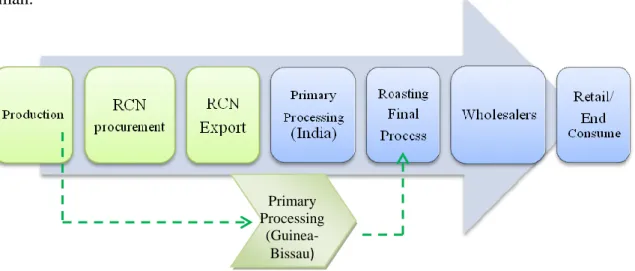
To represent what generally happens in the global market in terms of the industry player’s dynamics a simple industry supply chain representation is presented in Fig. 1.
5
This dynamic change’s according to each specific case/country but generally the governance distribution and player’s concentration is has described below.
Production is highly fragmented and producers have no market information resulting in very low bargaining power.
Raw cashew nuts procurement is made either by small intermediaries that sell the product in Bissau or by the licensed in natura exporters directly who also buy to middle man.
Fig. 1: Cashew industry supply chain.
Source: interviews with industry players, mainly exporters and cashew focused NGO’s members.
Although being quite fragmented and pressured by cashew importers/traders, licensed in natura exporters are, to a certain extent, protected by high demand of raw material. Using the Guinean case has an example: the harvest period occurs in the last months of the year, so when the world production is low or the market demand is high there is a fierce search for raw cashew by Indian buyers. This tendency increases the exporters bargaining power despite their low concentration.
The processing node of the supply chain is usually very fragmented. Processors have generally the same cost structure but even when lower operating costs are achieved some fail to translate it into higher margins. This is due to high competitive pressure on global markets. Processor’s customers are: traders, importers and the roasters.
Primary Processing
(Guinea-Bissau)
6
Retailers have control in the upstream nodes due to fierce competition among big retailers, the high quality pressure/standards that the consumers demand and especially high concentration of supermarkets. Following the world retail concentration trend importers/roasters are also seeking consolidation (Harilal, K.N. et al. 2006).
The market size was measured in terms of global shelled cashew nuts imports. Hence in 2007 market size accounted for 310.441 tones in volume and €1,41billion in value these values represent an increase of around 14,4% in value and volume since 2006 (FAOSTAT. 2010).
In the specific case of Guinea-Bissau the country is present only in the production and in natura export nodes of the industry supply chain. The company goal is to participate further more in the value chain and move closer to the more value added chain stages by adding more 30-35% value to the product before exporting, an effort that has also been made, successfully, by other African producing countries (Mozambique example). The target market
The choice of targeting the EU market was made due to the new market dynamics already stated but majorly due to the cost advantages resultant from Guinea – Bissau localization.
In 2007, according to FAOSTAT, the Netherlands was the second biggest shelled cashew nuts importer in the world. It has a small but growing domestic market and it plays an important role in the intra-EU trade of edible nuts as a re-exporter, it is the largest EU cashew exporter. Netherlands re-export increased and is growing fast.
These facts plus the historic Netherlands interest in the Guinean cashew and the already existent relationship between Guinean processors and Dutch importers makes the Netherlands a logical market choice to be targeted.
7
In the Netherlands domestic edible nut market the cashew nut is the second more consumed. In terms of imports in 2008 cashew nuts accounted for 25% of the edible nuts imports which corresponds to €193 million in value. Between 2004 and 2008 the market for cashew nuts grew 73%. In 2008 90% of the imports were from developing countries (CBI. 2009).
Despite the slow edible nuts market growth trend in the EU, the edible nuts imports in the Netherlands are large and expected to grow specially the developing country nuts supply. The Netherlands imports are stronger for nuts produced at tropical climates such as the cashew nuts. The retails sales of nuts snacks grew between 2007 and 2008 in volume and value (4.2% in value and 1000 tones in volume) (CBI. 2009).
Features of the target market segments
In the Netherlands 52% of cashew kernels are supplied by the Vietnam, followed by India, Mozambique, Tanzania and Brazil. In 2008 Guinea – Bissau was processing cashew nuts and accounted for 0,1% of the amount imported (CBI. 2009). Currently all the known factories in Guinea are not functioning despite the existing capacity.
In terms of market trends the company should be aware of EU end-consumer trends which will influence importers demand for cashew. According to the CBI report on edible nuts and dried fruit and vegetables market consumption trends include:
Health concerns.
Convenience: the key driver being the changing European lifestyles. Less time to prepare meals (snacks consumption: nuts mix).
Growing consumption of luxury products/exotic products.
Product diversity trend: consumers are willing to try new products.
Organic and fair trade niche markets: the increased health concerns and growing social awareness is leading to a fast growth of these two niche markets.
8
Ethnic products: this niche market is gaining increased importance due to the growth of ethnic population.
Competition
Industry rivalry
The competitor companies are all the companies in the cashew industry that focus on the processing node of the value chain. Companies like Olam Industries that accomplish to vertically integrate most of the value chain aren’t a good example of direct competition for our company. The processing node is quite fragmented among the countries that supply the Netherlands. This increases considerably Dutch importer’s bargaining power and could be a source of high internal rivalry which enables price competition. On the other hand there are quite a few facts that lower the internal rivalry: the market is usually quite observant, world demand is increasing and quite
strong except in certain crisis periods;
forward contracts are made in lower quantities than before which decreases the incentives to undercut prices;
Low exit barriers: the main investment is the purchase of raw material and the salaries. So in a context of a fierce price war the incentives to exit are higher; lack of vertical integration and growing alternative markets;
New entrants
The cashew industry barriers of entry are high: high capital necessary for raw cashew nuts procurement; difficult access to credit and high capital cost; the high value of supplier’s reputation; established network and the importance of know-how. Incumbent’s advantage derives from being reliable in terms of quality, proven lower risk of default and in time deliveries. In the specific case of new entrants in Guinea-Bissau one other fact that lowers the threat is the difficulty of being resilient.
9 Competitive Advantage
The company comparative advantage is based on the product itself and the country localization. The fact that the product can be certified as organic and can be traced back to the producer will differentiate it and allow us to specialize in specific segments. The comparative advantage resultant from the country localization will allow the company to offer competitive prices in the high quality segment. Assuming that the costs of processing the cashew nuts and the RCNi price are the same for India and Guinea-Bissau the Indian processors have an additional cost in terms of shipment freight of $3.363,64 per ton.
Product
Cashew nuts are commercialized in shell (raw), semi-processed (shelled and peeled) and finalized (salted, roasted, etc) being this last form with the most value added. Usually cashew finalization is done in the consuming countries which adapt the final product to consumer’s tastes. Cashew nut like other nuts consumption is seasonable 25% of all nut sales is made by the end of the year.
The importers/traders demand is mainly influenced by the international cashew kernel prices. The price is influenced by the supply of raw cashew nuts and consuming markets stock, speculation, competition with substitute products and exchange rates (Horus Enterprises. 2005).
EU market requires high quality cashews. The product quality is assessed, among other factors, through taste, size and color. US and EU usually demand for white and whole (appendix 1) cashews the WW180 ii being the best. The Guinean cashew is one of the best quality cashews in the world only compared to Brazil or India with an outturn of
i
Raw Cashew Nuts
10
48-56iii. It is also a very tasty cashew kernel according to consumers which makes this cashew capable of commanding a premium (Guinean raw cashew nuts were the most expensive bought by Indian importers $1.050 f.o.b).
The company product is able to fulfill both the traceability and organic EU market trends requirements at competitive prices resulting in a unique value proposition Fig.2.
Fig.2:The product unique selling proposition.
The company will use the semi-manual process(appendix 2) which has an efficiency of 75-85% compared to the 50% efficiency of the fully mechanized process (USAIB BRAZIL. 2006). The process does the first stages of transformation and the shelled product is then exported ready to be finalized in the consuming market (roasted, salted). The company must acquire ISO 22000 (which include the HACCP standards) certification, which is given by the Guinean government, and fulfill the safety and quality standards required by importers/agents. There is no authorized laboratory in Guinea so the assessment is usually made by the buyer and thus the product can end up being undervaluated. In order to enter the organic segment the company must have a special certification which process is slow and expensive.
Company Description
Current status
iii
It is the quantity of good nuts in 80 Kg of raw cashew nuts. The count is in pounds per 80kg. A good out turn is from 43 to 48 lbs. An excellent out turn is from 48 to 55 lbs.
11
The project will be implemented by a startup company. The company will undergo the raw cashew procurement, first steps of processing and export white and whole cashew kernels to the Dutch market according to the buyer’s requirements and needs. To do so the company will have to do an initial investment of around $256.000 (which accounts for the factory equipment and the necessary facility construction; training sections and 2 trucks) and raise $323.000 to buy the necessary quantity of raw cashew nuts amounting a total of around $580.000.
The company will establish a joint venture with a Guinean company Construções LDA. This company has access to land, warehouses, factory equipment and the needed resources to undergo the necessary factory constructions and thus lowering the initial investment costs and sharing the risk inherent to the venture. This Joint venture has also the advantage of leveraging the influence and know-how necessary, especially concerning cashew procurement.
Objectives in the short long run
Short run objectives:
Begin factory activities and procurement after 4 months implementation/ training;
Start buying raw cashew nuts beginning of April; Have 720 ton of raw cashew nuts by the end of June;
Sell the first container, 15-15.6 ton, by the middle/end of June; Achieve a market share of 0,3% in the first year;
Break even in the second year of operation. Long run objectives:
Expand capacity after 2 years or enter the organic segment after 1 year of implementation;
12
Create the Cashew Foundation during the 3rd year.
Current shareholders
As stated the company will results from a joint venture with a local partner and the amount of equity allocated will depend on the local partner contribution during the project implementation, especially concerning the initial investment and infrastructures. The company should also be prepared to the strong possibility of having its equity diluted during the fund raising period. The company intends to finance the procurement through loans given by partners or interested investors assuming that the interests are lower than the ones of Guinean bank loans (only short term loans with interests of 10-14%). The remaining investment (equipment, training and operating costs for the first 3 months of operations) will be financed by bringing another partner to the venture which preferably will also have know-how that could be leverage.
Doing business in Guinea - Bissau
According to the World Bank the disadvantages of doing business in Guinea – Bissau are (English, Philip. 2010) firstly competition with exporters: the competition is fierce and cashew exporters are even willing to pay higher prices for raw cashew in order to fulfill their procurement requirements. This can increase prices to a point that domestic processors cannot maintain a profitable venture. Secondly the high investment costs. Thirdly low labor productivity: the lack of skills and high percentage of absenteeism are key HR problems. Fourthly the small domestic market: the majority of the processing waste can be commercialized in less demanding markets. And finally the high political instability, bad road conditions and high port costs.
13 Outline of skills & experience
The company will need a good factory manager that will be in direct contact with the operations and manage sales. The process of cashew transformation is labor intensive thus the company profit margin and cost structure is highly dependent on employee’s productivity. The plant manager has to be capable of motivate the employees and increase the employees productivity, develop and put into place incentive plans, control the process system and make sure that the minimum cashew quantities are being processed and stored, control the output quality, develop and implement parallel plans to reach established objectives such as getting organic certificate.
The company will also need a CEO and it is crucial to be someone with experience in the area, have local experience, networking and a person with a good reputation.
Business System
Company StrategyThe company wants to implement a sustainable project of cashew processing based on the company’s product and resources competitive advantages. First of all the company will establish the joint venture and actively search for a suitable CEO. After raising funds the company should start the project activities.
The factory construction will be done taking into account the expansion objectives. The strategy is to start small and get bigger. The factory will have the area constructed for a 3500ton/year capacity but will only have the equipment and staff to reach 1000ton/year capacity. The company will develop first an intensive training plan, the employee’s productivity is a key success factor.
The raw material procurement will have to be done with the least intermediaries possible. The company must buy directly to producers. The factory activities must start as soon as the first tons of cashew are bought in order to start selling if possible in June.
14
The company will start selling cashew in the general cashew segment has high quality cashew kernels with competitive prices. Despite this first move the company will start putting into place the necessary information, equipment, process standards to have the product certified as organic cashew kernels and by doing so being able to command a 10-20% premium (Nair, Hari. 2007). After being certified the company objective is to sell as much cashew with organic certification as possible.
Long run objective is to keep investing in the cashew nut process expansion. In terms of long run objectives the company is also interested in starting a Foundation which objective is to support and incentive producers to improve and increase cashew quality standards.
Company structure
The company structure presented in appendix 3 will be based on the notion that the employees, especially in jobs of more responsibility, should be able to work in different areas. For instance the different section supervisors should also be able to cut, peel or classify.
Company operations and process description
In terms of primary activities and the value distribution among them the company undergoes: inbound logistics which accounts for 2% of the value created; processing activities 31% and outbound logistics 2%. The company also undertakes support activities: procurement which accounts for 30% of the value; company overhead costs account for 4% plus other minor support activities costs 1%. This results in a margin of 31%. Part of the margin should be used to marketing and sales activities.
Training
The company will have intensive training sessions before the procurement and process starts. The training will be done by the Construções LDA cashew factory former
15
manager/supervisor. The company will also seek for training force in specialized institutions such as FUNDEIiv .
Raw cashew nuts procurement
The first step in the company value chain is the RCN procurement. In this stage the company will purchase the raw material in near Bissau production points (Appendix 4) in order to avoid intermediaries, higher transportation costs and risk and bad road conditions. The company will have to buy enough RCN for a whole year of production during the 4 harvest months April-July. This amounts a total of 720-750 ton of raw material (depending on the quantity of smaller cashew nuts the company will buy an extra 20%). The purchase should be done intensively during the first two months in order to buy the best quality cashews at the lowest prices and to avoid direct confrontation with licensed exporters and the Indian buyers.
Transformation Process
The transformation process (Paiva, Francisco. 2007) complies with activities inside and outside the factory area. The first activities are considered the dirty stages and the last stages are the clean ones hence special attention in terms of quality standards is taken. In appendix 5 a transformation process description is included.
From the factory to the port
The cost of transporting the packaged cashew kernel to the port is 50.000xof including the driver and the container transportation (during the harvest period this value increases to 100.000xof). The company will have to pay 775.000Fcfa for each container (around $18.630/year) which corresponds to the port agent, customs house and other port costs. Currently there’s no tax or interest applied on processed cashew exports.
iv It is a financing institution that is specialized on the cashew industry and also provides training services.
16 Purchasing, construction and outsourcing issues
Process Related
Raw cashew procurement: in this stage the company should buy at least two truckswith the capacity of 7,5 ton.
At the factory door: the company will have to purchase most of the factory equipments appendix 8, the remaining equipment needed will be given by CONSTRUÇÕES LDA.
Construction
The company will build the infrastructure for a factory with 3500ton capacity. This investment will cost around $140.000 appendix 9 which will be incurred by the local partner. Next to the factory the company will also have to provide a suitable canteen where the employees will lunch in order to meet a continuous high productivity.
Outsourcing
The company will outsource four services: the accounting; the canteen service, enabling the company to focus on the core business; the employee's training sessions; medical assistance.
Implementation schedule and roll-out plan of the operations
The implementation plan schedule is represented on Figure 2 and corresponds to a 1 year timeline. The first milestone is the 1st contract signed.
During end/middle June the company will deliver the first container. By July the company intends to assess the employee's productivity and decide if it is necessary further training to improve efficiency. Finally another important milestone is the cashew certification acquired one year later. To do so the company has to, with the interested buyer's support, receive an authorized team that will assess the production and process conditions and identify the critic points that have to be changed. In terms of certification
17
the company will incur the certification fee, the cost of bringing the team and their housing in Bissau. Other important activities and milestones will take place only in the second and third year of operations: project break-even, the process expansion, the Foundation opening among others.
December 1 2 3 4 5 6 7 8 9 10 11 12 January Marketing/Relationship with Buyer Fund Raising Facilities Construction/Adaptation Equipment Purchase/Install Training RCN Procurement Cashew Processing Cashew sale
Organic Cashew certification
ISO certification
Fig. 2 1 year roll-out plan of the operations. Timeline and milestones.
Company Milestones
Human Resources Management
The factory will have a total of 246 employees. A list of the necessary staff and the respective salary is included in appendix 6. The salaries are based on productivity and efficiency, for example a peeler receives 150xof/Kg of cashew kernels weighted by its supervisor. Depending on the type of job the remuneration per kg varies. Supervisors will receive a fixed remuneration plus the productivity based salary.
Due to the lack of industrial culture and expertise the company should invest in training and incentive plans using bonuses when certain KPI's are achieved (lower absenteeism
18
%; higher quantity of cashew cut; etc). During the procurement stage the company will hire temporary employees. The company will also provide medical assistance. Bonuses plan will only be applied after the company break-even and based on the company profitability.
Marketing Strategy
The company aims to develop an image of trust, reliability and high quality close to the customer. This image should become the company's brand image and a company competitive advantage besides the ones already stated. The company long run marketing objective is to become a specialized competitor targeting the organic niche market. In the mean time the company will target the more general market segment using a differentiation strategy based on the company's competitive and comparative advantages.
The company will offer a high quality product at competitive prices for customers that seek a reliable, trust worthy supplier of processed and traceable cashew nuts. After entering the organic niche market the company will have to re-position in order to translate the new marketing objective.
Strategic pricing issues
The product price will have to translate the high quality positioning, take into consideration the product cost, the demand and the competition price. When targeting the general cashew market the price is already establish by the international market and the small possibility of negotiation is attained by differentiating the product from the competition. This can be quite difficult to do in the general cashew market especially for a new entrant which lacks the reputation and strong bonds with the customer. Hence it becomes very important to the company to specialize by entering in the organic niche.
19 Distribution channels
The company has 3 possible customers: specialized importers sell directly to retailers or trough traders. The preferred option is by far selling f.o.b to importers and by doing so the company will be sharing the risk with the buyer. The retailers could also be an option but the fact that they are more concentrated than the importers increases their bargaining power and lowers our possibility of negotiation.
Sales methods and communication
The company first attempt to reach the buyers will be done with the support of specialized entities (FUNDEI, No Fiansa Project, etc) that already made the connection in the past and know the Netherland's market and distribution channels. After the first contact the company should invest in nurturing this one contact, be aware the of distribution channels identifying all the possible buyers and work on alternative options. The company should also work on communicating the company brand and product through specialized trade websites, international fairs and by contacting directly possible buyer’s trough a push strategy. The Foundation besides having the direct impact of increasing the cashew nuts quality bought and therefore decreasing the company costs in the long run will also work as a communication strategy by translating the company pursue for excellence, quality and positive social and economic impact in the production value chain node. For this purpose the company will have a commercial office in the factory facilities.
Sales forecasts
The company intends to sell in the first year 12 containers of cashew kernels in the Netherlands general market (0,3% market share). In the second year the company will either start selling organic cashew nuts in the organic niche market achieving a 17,5% market share or choose to expand by selling 2 containers/month (0,7% market share).
20
Assumptions and Risks
Description of the key assumptions of the business plan
The training costs (5% of the employee’s salaries), construction areas, the lawyer salary (150.000xof/month) or the cost of Indian and Guinean freights were assumed. The later was assumed based on an interview with an Indian business man and the local partner (freight Guinea-India plus discharge $2000; freight India-Netherlands $2500; freight Bissau-Netherlands $1500). The financial computations were made assuming the currency rates from December 3rd.
An additional 60% in operating costs was assumed (comparing with the previous local partner factory). The RCN transport was assumed to be 10xof/kg according to the Guinean industry average has it was the minimum average of productivity (cut 80kg/day; peeler 6kg/day; grader 20kg/day). The price per kg of RCN was based on the 2009 price paid to producer. The costs of the organic certification fee were also assumed to be $3000 per year. In order to compute the free cash flows we assumed a price for a cashew container based on the international price for WW320 (infobanc. 2010). Due to the lack of an accurate proxy the discount rate was assumed to be equal to 15% translating the interest costs and the great risk of doing business in Guinea-Bissau. This risk results from the high Guinean political instability and also the low investment liquidity (the likelihood of selling the factory is rather low).
Key success factors
The procurement must be made as efficient as possible by buying the RCN as fast as possible and at the lowest prices. The minimum productivity values must be achieved and enhanced in order to have the container ready to export every month and lower operating costs especially if expanding. It is also crucial to be certified with the ISO 22000 and as an organic product in order to sell efficiently to the general market and to
21
get the 10-20% organic premium. It is possible that in times of crisis or economic instability this premium could decrease substantially. Since the company could still sell to the general market maintaining the venture profitable this situation is not a threat.
Financial Plan
The financial projections for 5 years were conducted for two possible situations. One concerns the decision to sell the product as organic in the second year Fig. 3 and the second concerning the factory expansion to 2 containers a month (double the factory equipment and increase by 80% the factory human resources) Fig. 4. In both cases the company achieves break-even point in the second year and positive NPV’s. In the first case the project has an IRR of 61% and in the second one 63%. In both cases the discount rate was assumed to be 15%. In the second case, and because the investment is higher and consequently the risk, even when the discount rate is increased to 25% the NPV steal maintains a positive value.
A sensitivity analysis was also conducted to understand the impact of RCN price in the project. If the RCN is bought always at 100xof/kg (minimum price possible) the project will have an IRR of 104% appendix 10. This is a case scenario quite unrealistic since it is almost impossible to buy all the RCN for a year at the same price, especially being the price so low. If, on the other hand the cashew is bought always at the price of 400xof/kg appendix 11 (considered a very high price for processors) the NPV becomes negative at least for a 5 year projection. Probably in the case of RCN at this price the company would only survive if it happened as a onetime situation.
Working Capital Requirements 322.644,8 156.861,2 156.861,2 156.861,2 156.861,2 156.861,2 Accounts Receivable 76.200,00 76.200,00 76.200,00 76.200,00 76.200,00 Inventory 322.644,84 80.661,21 80.661,21 80.661,21 80.661,21 80.661,21 Accounts Payable 0,00 0,00 0,00 0,00 0,00 0,00 Change NWCR 322.644,84 -165.783,63 0,00 0,00 0,00 0,00
22
Discount rate 15%
$ 0 1 2 3 4 5
Initial Investment -245.335,99
Sales 914.400,00 1.051.560,00 1.051.560,00 1.051.560,00 1.051.560,00 Cost of goods sold 322.644,84 348.674,15 325.644,84 325.644,84 325.644,84 Operating costs 330.338,43 330.338,43 330.338,43 330.338,43 330.338,43 Outbound Logistics 20.232,90 20.232,90 20.232,90 20.232,90 20.232,90 Depreciation 10.174,86 10.174,86 10.174,86 10.174,86 10.174,86 Gross Profit 231.008,98 342.139,67 365.168,98 365.168,98 365.168,98 Corporate Taxes 0,00 0,00 0,00 0,00 0,00 Net Profit 231.008,98 342.139,67 365.168,98 365.168,98 365.168,98 Depreciation 0,00 10.174,86 10.174,86 10.174,86 10.174,86 10.174,86 Change WCR 322.644,84 -165.783,63 0,00 0,00 0,00 0,00 Capex -245.335,99 0,00 0,00 0,00 0,00 0,00 FCF -567.980,83 406.967,47 352.314,52 375.343,84 375.343,84 375.343,84 NPV 700.315,27 IRR 61%
Fig. 3: A 5 years Financial Projection concerning the option to sell organic cashews from year 2.
Working Capital Requirements 322.644,8 156.861,2 266.489,8 313.722,4 313.722,4 313.722,4
Accounts Receivable 76.200 152.400 152.400 152.400 152.400 Inventory 322.644,84 80.661,21 161.322,42 161.322,42 161.322,42 161.322,42 Accounts Payable 0 0 47.232,60 0 0 0 Change NWCR 322.644,8 -165.783,6 109.628,6 47.232,60 0 0 Discount rate 15% $ 0 1 2 3 4 5 Initial Investment -245.335,99 Sales 914.400,00 1.828.800,00 1.828.800,00 1.828.800,00 1.828.800,00 Cost of goods sold 322.644,84 928.685,30 645.289,67 645.289,67 645.289,67 Operating costs 330.338,43 594.609,17 594.609,17 594.609,17 594.609,17 Outbound Logistics 20.232,90 20.232,90 20.232,90 20.232,90 20.232,90 Depreciation 10.174,86 38.514,42 38.514,42 38.514,42 38.514,42 Gross Profit 231.008,98 246.758,21 530.153,84 530.153,84 530.153,84 Corporate Taxes 0,00 0,00 0,00 0,00 0,00 Net Profit 231.008,98 246.758,21 530.153,84 530.153,84 530.153,84 Depreciation 0,00 10.174,86 38.514,42 38.514,42 38.514,42 38.514,42 Change WCR 322.644,84 -165.783,63 109.628,60 47.232,60 0,00 0,00 Capex -245.335,99 0,00 0,00 0,00 0,00 0,00 FCF -567.980,83 406.967,47 175.644,03 521.435,66 568.668,26 568.668,26 NPV 869.435,01 IRR 63%
23
Appendices
Appendix 2
Appendix 3
Appendix 5
Transformation Process description
RCN weighing: before starting the process the cashew is weighted in order to assess productivity and for control purposes. The RCN are pre-classified and only the right sized cashews are processed and storage.
Cooking: it softens the cashew shell and detaches the shell from the kernel. The manual shelling becomes easier to do and decreases the probability of breaking the kernel. The cooking stage is done outside the factory area, to keep the Accounting
24
factory temperature from rising. It is made through steam by an autoclave using burned cashew shell to boil the water instead of gas or firewood.
Semi manual shelling: the objective is to separate the shell without cracking or damage the nut. Usually the machines are handled by two employees: one cut and the other takes of the shell. Their hands have to be covered with oil in order to protect them from the CSNLv. These steps are known as the dirty process part. Only 30 to 33% of the initial volume corresponds to cashew kernels. 85-90% whole nuts, the remaining are mostly waste (broken kernel, xerem, brocado or damaged kernel).
Drying: the objective is to make the testa removal easier by drying the cashew nuts. The process takes 6-8h with a temperature of 60-70oC, decreases the kernel humidity in 3%. The oven is always placed outside the factory area to avoid temperature rising. The cashew nuts are usually re-humidified to reach 5% moisture content.
Peeling: it is made manually. From this point on the process has to be very hygienic and special care is taken, from the employees uniform to the storage conditions.
Grading and selection: the graders receive less 15% (testa, broken and damaged kernel) of the kernels produced in the previous section. The grading is made by color, size and integrity. This stage is very important since the quality supplied to importers is taken very seriously. An order can only have up to 5% of lower grade cashews.
Packaging: this stage can be made in the selection location in sealed in vacuum using CO2. The packages are usually 25 or 50lb weight.
25
References
African Cashew Alliance. 2010. African Cashew Initiative. www.africancashewalliance.com (accessed October 21, 2010).
CBI. 2009. “Cbi Market Survey The Edible Nuts And Dried Fruit And Vegetables Market In The Eu”. www.cbi.eu/disclaimer
CBI. 2009. “Cbi Market Survey The Edible Nuts And Dried Fruit And Vegetables Market In The Netherlands”. www.cbi.eu/disclaimer
English, Philip. 2010. “Guinea-Bissau Cashew and Beyond: Diversification through Trade. Diagnostic Trade Integration Study for the Enhanced Integrated Framework for Trade-Related Technical Assistance”. World Bank Report No. 54145-GW
European Commission. 2010. “An analysis of the EU organic sector”.
http://ec.europa.eu/agriculture/analysis/markets/organic_2010_en.pdf
FAOSTAT. 2010. Food And Agriculture Organization Of The United Nations. http://faostat.fao.org/site/342/default.aspx (accessed October 29, 2010).
Harilal, K.N. et al. 2006. “Power in Global Value Chains: Implications for Employment and Livelihoods in the Cashew Nut Industry in India Summary”. http://www.iied.org/NR/agbioliv/ag_liv_projects/t3proj01.html
Horus Enterprises. 2005. “Long term trends in the international cashew market and strategic implications for Sub-Saharan African exporters”. http://www.hubrural.org/pdf/cashew_study_horus.pdf
infobanc. 2010. infobanc. http://www.infobanc.com/mandi/mancash1.htm (accessed November 21, 2010).
Nair, Hari. 2007. “The International Value-chain of Cashew and Alternative Paths to Development” Paper presented at Meeting on Cashew Sub-sector Development, Senegal, Dakar.
Paiva, Francisco. 2007. “Projeto de Reestruturação da Cajucultura na Guiné Bissau”. Final Report for World Bank provided by the National Cashew Association of Guinea-Bissau.
USAIB BRAZIL. 2006. "Inserção de Micro e Pequenas Empresas no mercado internacional. Análise da indústria de castanha de caju". http://pdf.usaid.gov/pdf_docs/PNADM250.pdf
Bibliography
Besanko, David et al. 2004. Economics of Strategy. 3rd ed. USA: John Wiley & Sons, Inc.
Lindon, Denis et al. 2004. MERCATOR XXI Teoria e Prática do Marketing. 10th ed. Lisboa: Publicações Dom Quixote.
26
Secondary appendices
Appendix 1
Grade Definition
White kernels White, pale ash grey or light yellow colored kernels. Scorched
Kernels
Light brown, deep ivory or yellow in color. Scorched
Seconds
Brown, amber or light blue in color. Dessert
Kernels
Kernels may be deep scorched, brown, discolored or black spotted.
Whole Kernels Kernels with kidney shape and not more than 1/8 of the kernel has been broken off.
Splits Kernels split naturally length-wise provided not more than 1/8 of its cotyledon has been broken off.
Butts Kernels of not less than 3/8 of a whole kernel which have been broken crosswise but the cotyledons are still naturally attached.
Pieces Kernels broken into more than 2 parts.
Large Pieces Pieces of cashew kernels not passing through a sieve of aperture 4.75mm. Small Pieces Cashew kernel pieces passing between 4.75mm-2.80mm
Baby Bits Plumules and fragments of cashew kernels between 2.80mm-1.70mm
This table corresponds to the cashew kernel grading system. The pre-classification only serves to separate the different types of RCN before processing and it is based on the RCN sizes.
Appendix 4
The 4 points of cashew nuts purchase are represented in the map: Quinhamel, Bula, N´nhacra and Mansoa.
27
Appendix 6
Activity xof/kg Number Salary/year$
Temporary 4months Truck drivers - 2 834 Cashew carriers - 5 2.885 CEO - 1 21.635 Manager - 1 12.019,5 Scretary - 1 1.562,5 Security - 3 1.803 Storage supervisor - 1 1.322 Cook+classification in natura 50 4 3.005 Cooking supervisor - 1 1.082 Cut 100 31 42.001 Cut assistent 100 30 40.501 Cut supervisor 100+5000 1 1.620 Drying 50 2 1.534 Drying supervisor - 1 1.202 Peelers 150 124 85.848 Packers 50 4 18.116 Packers Supervisor - 1 1.202 Classification supervisor 100+5000 1 1.274 Graders 100 34 39.232 Peller supervisor 150+5000 1 812,5
28
Appendix 7
Source: FAOSTAT 2008
29
30
Appendix 8
Insurance $ Freight $
350 6.790
Insurance and freight (Brazil-Portugal and Portugal-Bissau) value for equipment container.
Equipment Budjet
Item Quantity Price$/unit Total Price In natura classifier 1 7.530,9 7.530,9 Caltoclave 1 7.500 7.500 Cut machines 15 234,19 3.512,8 Cut tables 5 450 2.250,0 Bodkin 100 1,00 100,2 Tweezers 100 1,00 100,2 Hoven 1 9.860,5 9.860,5 Tray 40 86,3 3.451,2 Tray Cars 2 801,2 1.602,3 Peeling tables 4 2.500 10.000,0 Grading tables 3 2.500 7.500,0 Re-humidifying machine 1 3.574,4 3.574,4 Packing Machine 1 6.130,0 6.130,0 Scale - - 100kg 1 570 570,0 50kg 2 142,5 285,0 Precision 1 1.122 1.122,0 Uniforms 160 15 2.400,0 Table toals 40 10 400,0 Buckets - - Small 20 4,01 80,1 Medium 30 7,01 210,3 Large 40 10,02 400,7 Bowls - - Small 20 2,00 40,1 Medium 20 4,01 80,1 Large 30 5,01 150,2 Total 75.990,98
31
Appendix 9
Company constraction budject.
Appendix 10
Working Capital Requirements$ 193.348,89 124.537,22 135.967,22 135.967,22 135.967,22 135.967,22
Accounts Receivable 76.200 87.630 87.630 87.630 87.630 Inventory 193.348,89 48.337,22 48.337,22 48.337,22 48.337,22 48.337,22 Accounts Payable 0 0 0 0 0 0 Change NWCR 193.348,89 -68.811,66 11.430 0 0 0 $ 0 1 2 3 4 5 Initial Investment -245.335,99 Sales 914.400,00 1.051.560,00 1.051.560,00 1.051.560,00 1.051.560,00 Cost of goods sold 193.348,89 196.348,89 196.348,89 196.348,89 196.348,89 Operating costs 330.338,43 330.338,43 330.338,43 330.338,43 330.338,43 Outbound Logistics 20.232,90 20.232,90 20.232,90 20.232,90 20.232,90 Depreciation 10.174,86 10.174,86 10.174,86 10.174,86 10.174,86 Gross Profit 360.304,93 494.464,93 494.464,93 494.464,93 494.464,93 Corporate Taxes 0,00 0,00 0,00 0,00 0,00 Net Profit 360.304,93 494.464,93 494.464,93 494.464,93 494.464,93 Depreciation 0,00 10.174,86 10.174,86 10.174,86 10.174,86 10.174,86 Change WCR 193.348,89 -68.811,67 11.430,00 0,00 0,00 0,00 Capex -245.335,99 0,00 0,00 0,00 0,00 0,00 FCF -438.684,88 439.291,45 493.209,79 504.639,79 504.639,79 504.639,79 NPV 1.187.478,6 IRR 104%
Financial Projection for the best case scenario using a discount rate of 15%
Construction Budjet Xof/m2 m2 Total xof Total$
Factory 3500ton/year 34.000 1.700 57.800.000 115.788,27 Canteen 34.000 350 11.900.000 23.838,76
32
Appendix 11
$ 0 1 2 3 4 5
Initial Investment -245.335,99
Sales 914.400,00 1.051.560,00 1.051.560,00 1.051.560,00 1.051.560,00 Cost of goods sold 626.052,46 629.052,46 629.052,46 629.052,46 629.052,46 Operating costs 330.338,43 330.338,43 330.338,43 330.338,43 330.338,43 Outbound Logistics 20.232,90 20.232,90 20.232,90 20.232,90 20.232,90 Depreciation 10.174,86 10.174,86 10.174,86 10.174,86 10.174,86 Gross Profit -72.398,64 61.761,36 61.761,36 61.761,36 61.761,36 Corporate Taxes 0,00 0,00 0,00 0,00 0,00 Net Profit -72.398,64 61.761,36 61.761,36 61.761,36 61.761,36 Depreciation 0,00 10.174,86 10.174,86 10.174,86 10.174,86 10.174,86 Change WCR 626.052,5 -393.339,35 11.430,00 0,00 0,00 0,00 Capex 626.052,46 0 0 0,00 0,00 0,00 FCF 0,00 -331.115,56 60.506,21 71.936,21 71.936,21 71.936,21 NPV 457.871,96 IRR #NÚM!
Financial Projection for the worst case scenario using a discount rate of 15% Working Capital Requirements 626.052,5 232.713,12 244.143,12 244.143,12 244.143,12 244.143,12 Accounts Receivable 76200 87630 87630 87630 87630 Inventory 626.052,5 156.513,12 156.513,12 156.513,12 156.513,12 156.513,12 Accounts Payable 0 0 0 0 0 0 Change NWCR 626.052,5 -393.339,35 11.430 0 0 0