DEPARTAMENTO DE INFORM ´ATICA
Tools and Techniques for Mobile Interaction
Design
Marco de S´
a
DOUTORAMENTO EM INFORM ´ATICA ESPECIALIDADE ENGENHARIA INFORM ´ATICA
DEPARTAMENTO DE INFORM ´ATICA
Tools and Techniques for Mobile Interaction
Design
Marco de S´
a
DOUTORAMENTO EM INFORM ´ATICA ESPECIALIDADE ENGENHARIA INFORM ´ATICA
April 2009
First and foremost I wish to thank my advisor, Prof. Lu´ıs Carri¸co. Without him, without his insight, his knowledge on so many topics, without the lessons he taught me without giving me the answers, without his tolerance towards my laziness and hectic schedules, his belief in my abilities (even in the absence of my own) none of this would be possible. Thank you so much!
I also want to thank Prof. Carlos Duarte for his careful revision of this thesis and his help throughout some of the experiences presented in it. I extend this appreciation to Prof. Pedro Antunes and Prof. Ana Paula Afonso for allowing me to interact with their students in such a fruitful manner.
To my friends and colleagues from LaSIGE and HCIM, who made it seem a lot like fun and very little like work. It was a pleasure to live amongst such bright minds who contributed to my growth and indirectly to this work: Paulo, Rui, Daniel, Liliana, Jo˜ao, Francisco, Alysson, Henrique, Pedro and all those that I cannot remember at this late hour. A special remark goes to Lu´ıs and Tiago for their help, support, critiques and programming skills that made some of my work easier and more complete. My gratitude also goes out to all the members of LaSIGE and professors from the Department of Informatics who, in some way, contributed to my development. I am also grateful to FCT (Funda¸c˜ao para a Ciˆencia e Tecnologia) for providing me the financial means to dedicate myself to this work.
I bow to Jo˜ao, Lu´ıs, Nini, Rafa, Tiago and Ziege for the endless hours of fun when I should have been working. You kept me sane in our own twisted ways.
having a solution for my problems and my father, the man I can only hope to become someday, for his righteousness and for having a heart that is larger than life. My sister for inspiring me by following her dreams no matter what.
At last, to my Lu, for her patience, her love, her strength, for always standing by my side and for all the fun we had all along!
O desenho de sistemas interactivos ´e uma tarefa ´ardua que requer a aten¸c˜ao dos designers a uma grande diversidade de factores, variando estes desde as necessidades dos utilizadores finais at´e ao contexto em que a solu¸c˜ao final vai ser utilizada. Nesse sentido, as metodologias de desenho e as t´ecnicas que estas englobam foram introduzidas com o objectivo de auxiliar os designers, oferecendo guias e procedimentos que suportam o processo de desenho de aplica¸c˜oes e suas interfaces durante as suas v´arias fases.
No entanto, o recente aparecimento de conceitos como a computa¸c˜ao m´ovel e ub´ıqua, suportados por uma s´erie de novos dispositivos em constante crescimento, introduziu um conjunto de dificuldades e de-safios extra no processo de desenho de aplica¸c˜oes para este tipo de plataforma. Dadas as caracter´ısticas espec´ıficas e peculiares dos dis-positivos m´oveis, especialmente a sua natureza ub´ıqua e permanente, tamanho reduzido e variadas modalidades de interac¸c˜ao, um novo leque de paradigmas de utiliza¸c˜ao tem vindo a surgir. Como con-sequˆencia, novas aproxima¸c˜oes e t´ecnicas, focando as potencialidades ´
unicas e as limita¸c˜oes inerentes aos dispositivos m´oveis, a sua ubiq-uidade, utiliza¸c˜ao recorrente e permanente em ambientes e locais difer-entes, tem vindo a ganhar cada vez mais aten¸c˜ao.
Em particular, trabalhos recentes nesta ´area tˆem mostrado que, no caso particular do desenho de aplica¸c˜oes e de interfaces para disposi-tivos m´oveis, o processo de desenho e desenvolvimento deve ser neces-sariamente transportado para fora do laborat´orio, levando o processo a cabo em cen´arios e condi¸c˜oes realistas, superando os frequentemente utilizados testes de laborat´orio e, consequentemente, produzindo re-sultados mais fi´aveis e um processo de desenho mais eficiente e coer-ente.
maioria das t´ecnicas existentes e descritas na literatura assentam em simula¸c˜oes dentro de ambientes laboratoriais e tentam recriar vari´aveis e caracter´ısticas de localiza¸c˜oes exteriores dentro de laborat´orios, sob condi¸c˜oes controladas. Estas aproxima¸c˜oes tentam evitar o trabalho extra que levar o processo de desenho para o exterior do laborat´orio pode requerer.
A necessidade de recolher dados e avaliar aplica¸c˜oes fora do labo-rat´orio implica, na maioria dos casos, a necessidade de seleccionar ou definir cen´arios e contextos nos quais praticar estes procedimentos. Entre outros, a fraca ades˜ao que o desenho fora do laborat´orio tem, apesar das suas vantagens, ´e um reflexo da inexistˆencia de guias e regras que ajudem designers na tentativa de conduzir o processo de desenho e avalia¸c˜ao de aplica¸c˜oes m´oveis em contextos reais. A quan-tidade cr´ıtica de poss´ıveis situa¸c˜oes de uso, em conjunto com os v´arios aspectos que devem, necessariamente, ser levados em considera¸c˜ao du-rante o processo de desenho para dispositivos com caracter´ısticas t˜ao particulares, s˜ao dif´ıceis de gerir e geralmente levam ao esquecimento de detalhes, negligˆencia de in´umeros aspectos e a resultados aqu´em do esperado.
Neste momento, e face `a falta de suporte, ao tentar superar estas di-ficuldades, os designers optam frequentemente por fazer o porte de aplica¸c˜oes existentes, geralmente dispon´ıveis para plataformas com maiores dimens˜oes (e.g., PCs), para os dispositivos m´oveis, ajustando alguns detalhes imprescind´ıveis para o funcionamento b´asico das mes-mas. No entanto, esta aproxima¸c˜ao leva, na maioria dos casos, a aplica¸c˜oes pouco elegantes e us´aveis que, mesmo sendo providas de um conte´udo brilhante, em pouco tempo se tornam obsoletas e evi-tadas pelos utilizadores. Mais uma vez, o factor primordial para que os designers sigam tal aproxima¸c˜ao centra-se na inexistˆencia de
Apesar de algumas guias e regras de desenho, presentes nas tradi-cionais metodologias de desenho centradas no utilizador, se poderem aplicar a este processo de desenho t˜ao espec´ıfico, as caracter´ısticas ´
unicas dos dispositivos, as restri¸c˜oes impostas por determinados con-textos e a liberdade que surge como consequˆencia da sua portabil-idade, juntamente com os demais desafios que s˜ao introduzidos no processo, requerem novas, ou no m´ınimo aproxima¸c˜oes altamente re-finadas.
Trˆes fases do processo desenho - (1) recolha e an´alise de requisitos; (2) prototipagem; e (3) avalia¸c˜ao - s˜ao particularmente sens´ıveis e apresentam um maior n´umero de dificuldades.
1. An´alise e recolha de requisitos em cen´arios m´oveis, onde o uso constante do dispositivo ou aplica¸c˜ao m´ovel, ´e feito em contextos mut´aveis, introduz detalhes que dificilmente s˜ao detect´aveis com a utiliza¸c˜ao de m´etodos tradicionais. Poder-se-´a at´e imaginar que, conhecendo todos os contextos de utiliza¸c˜ao poss´ıveis, a aplica¸c˜ao de m´etodos tradicionais poder´a resultar na detec¸c˜ao da influˆencia do contexto nesses cen´arios espec´ıficos. No entanto, para al´em de esta ser uma perspectiva irrealista, as implica¸c˜oes de mudar de contexto e como esta mudan¸ca afecta o utilizador e os seus requisitos perante a aplica¸c˜ao, passam despercebidos.
2. No processo de cria¸c˜ao de esbo¸cos e constru¸c˜ao de prot´otipos de baixa fidelidades, existem tamb´em v´arios problemas que afec-tam o processo de forma evidente. Os prot´otipos de baixa-fidelidade, tal como s˜ao presentemente utilizados, s˜ao inadequa-dos `as peculiaridades dos dispositivos m´oveis e aos seus cen´arios de uso. Estes m´etodos de prototipagem pouco adequados, para al´em de levarem a resultados err´oneos, especialmente quando os utilizadores finais s˜ao envolvidos, tˆem tamb´em repercuss˜oes nas fases posteriores de avalia¸c˜ao.
iliem os designers, esta fase do processo de desenho ´e frequente-mente ignorada. Este problema surge n˜ao s´o como uma con-sequˆencia de prot´otipos pouco adequados a testes em cen´arios reais, tal como `a ausˆencia de t´ecnicas que facilitem, mais uma vez, a recolha de dados nestas situa¸c˜oes. No geral, as dificul-dades inerentes ao processo de desenho de aplica¸c˜oes para este tipo de dispositivos requerem novas aproxima¸c˜oes e extens˜oes `as t´ecnicas e ferramentas fornecidas pelas metodologias de desenho centradas no utilizador.
Esta tese apresenta solu¸c˜oes e experiˆencias que abordam estes prob-lemas e visam resolver as quest˜oes que afectam as v´arias fases de desenho. Em particular, como primeira contribui¸c˜ao, para os est´agios iniciais, onde ´e feita a an´alise de requisitos e a sua recolha, ´e sugerida uma moldura conceptual para a selec¸c˜ao e gera¸c˜ao de cen´arios de suporte para o desenho. Esta apresenta componentes at´omicos que, quando conjugados, definem contextos de utiliza¸c˜ao detalhados e que enfatizam as vari´aveis mais predispostas a afectar a experiˆencia de utiliza¸c˜ao m´ovel. Como complemento, s˜ao ainda oferecidas sugest˜oes para a recolha de dados, em fases iniciais do processo, nos contextos m´oveis definidos pela moldura conceptual.
No que diz respeito `a prototipagem, especialmente a de baixa-fidelidade, a tese contribui tamb´em para a evolu¸c˜ao das t´ecnicas existentes de modo a suportarem, de forma adequada, a constru¸c˜ao de prot´otipos e a sua avalia¸c˜ao em cen´arios reais. Nesse sentido, s˜ao descritas novas abordagens de prototipagem que para al´em de promoverem o real-ismo e a participa¸c˜ao dos utilizadores finais, facilitam, de forma sig-nificativa, a sua avalia¸c˜ao. Nesta ´ultima fase, este trabalho contribui tamb´em com a introdu¸c˜ao de um conjunto de guias que sugerem for-mas de capitalizar a participa¸c˜ao dos utilizadores finais durante a recolha de dados em sess˜oes de avalia¸c˜ao e, mais ainda, mecanismos
em cen´arios reais. Estes m´etodos permitem portanto a detec¸c˜ao de problemas de usabilidade em fases muito iniciais do processo de de-senho, com custos muito baixos.
Finalmente, como ´ultima contribui¸c˜ao do trabalho descrito nesta tese, ´e apresentada uma plataforma de software, denominada MobPro, que leva em considera¸c˜ao todas as t´ecnicas acima descritas e oferece, num ambiente de desenvolvimento integrado, funcionalidades de suporte `
as duas fases principais do processo de desenho: a prototipagem e avalia¸c˜ao. A plataforma, constitu´ıda por v´arias ferramentas, oferece de forma simples e sem requerer conhecimentos de programa¸c˜ao, fun-cionalidades como:
• Constru¸c˜ao de prot´otipos de v´arias fidelidades - A utiliza¸c˜ao de prot´otipos de v´arias fidelidades, desde esbo¸cos desenhados `a m˜ao, com ´areas interactivas, at´e prot´otipos de software com compo-nentes visuais, permite a avalia¸c˜ao e detec¸c˜ao de problemas de usabilidade a v´arios n´ıveis (e.g., problemas de navega¸c˜ao, local-iza¸c˜ao de bot˜oes, dimens˜ao dos v´arios ´ıcones).
• Prototipagem directamente nos dispositivos m´oveis - a possibili-dade de editar e actualizar os prot´otipos nos dispositivos onde s˜ao experimentados, configurando pequenos detalhes como sequˆencias de ecr˜as ou localiza¸c˜ao de componentes, permite aos designers corrigir problemas de usabilidade e testar v´arias alternativas nos contextos reais onde decorrem as sess˜oes de avalia¸c˜ao, sem ne-cessidade de interromper a sess˜ao ou de equipamento de labo-rat´orio para criar novos prot´otipos. Mais ainda, tendo em conta o processo de edi¸c˜ao guiado e sem necessidade de programa¸c˜ao, a participa¸c˜ao dos utilizadores finais ´e fomentada, abrindo portas para a utiliza¸c˜ao de t´ecnicas como as sondas e desenho partici-pado directamente nos contextos finais de utiliza¸c˜ao.
idade que podem ser automaticamente aplicadas, quando esta op¸c˜ao for seleccionada pelo designer. Estas estabelecem, por ex-emplo, regras no que diz respeito `a posi¸c˜ao dos componentes, ao seu tamanho, `a quantidade de informa¸c˜ao para cada ecr˜a e `
a disposi¸c˜ao dos v´arios elementos visuais relativamente uns aos outros. Estas guias s˜ao configur´aveis e podem ser orientadas a dom´ınios espec´ıficos (e.g., e-health, educa¸c˜ao). A ferramenta de prototipagem inclui ainda funcionalidades que apresentam v´arias alternativas para os prot´otipos criados (e.g., apresentar um prot´otipo com uma modalidade alternativa de interac¸c˜ao -conjunto de bot˜oes em substitui¸c˜ao de uma lista).
• Melhoria do realismo da experiˆencia de utiliza¸c˜ao - capitalizando as li¸c˜oes resultantes das t´ecnicas de prototipagem anteriormente descritas, a plataforma permite a utiliza¸c˜ao dos prot´otipos, e a sua consequente avalia¸c˜ao, directamente nos dispositivos m´oveis para os quais as aplica¸c˜oes e interfaces est˜ao destinadas. Ao uti-lizar dispositivos reais, problemas relativos ao peso do mesmo, tamanho e resolu¸c˜ao do ecr˜a, a sua forma e modalidades de in-terac¸c˜ao s˜ao automaticamente solucionados. Mais ainda, como uma vantagem adicional, surge a possibilidade, para os utilizadores finais, de interagir com os prot´otipos em cen´arios reais, sem as complica¸c˜oes das t´ecnicas tradicionais.
• Suporte autom´atico `a t´ecnica “Wizard-of-Oz” - ao serem utiliza-dos dispositivos reais e ao permitir a inclus˜ao de ´areas inter-activas em prot´otipos de baixa-fidelidade (incluindo prot´otipos baseados em esbo¸cos `a m˜ao), a ferramenta permite a utilizadores finais a interac¸c˜ao directa com estes, sem a necessidade de um designer simular o comportamento do sistema.
• Recolha de dados de modo passivo e activo - no caso de recolha de dados de modo passivo, todas as ac¸c˜oes do utilizador, perante
- M´etodo de amostragem de experiˆencia (herdado da psicologia) ou registos di´arios, s˜ao directamente integradas nos prot´otipos, permitindo a recolha de dados de uma forma alternativa. Ques-tion´arios integrados podem ser automaticamente apresentados ao utilizador durante ou imediatamente depois da utiliza¸c˜ao do prot´otipo, facilitando a sua resposta e consequente recolha de dados.
• Anota¸c˜ao e ordena¸c˜ao contextual de ecr˜as/cart˜oes - cada ecr˜a do prot´otipo pode ser numerado e anotado directamente no local onde est´a a ser utilizado, definindo a sequˆencia de navega¸c˜ao num contexto em particular. Esta t´ecnica permite que os designers seleccionem configura¸c˜oes ´optimas para as aplica¸c˜oes e interfaces que est˜ao a ser desenhados. Mais ainda, oferece uma base para a percep¸c˜ao de condi¸c˜oes de adaptabilidade aquando do desenho de aplica¸c˜oes adapt´aveis.
• Funcionalidades de an´alise - levando em considera¸c˜ao a importˆancia da an´alise de dados recolhidos durante as sess˜oes de avalia¸c˜ao, o MobPro inclui um conjunto de funcionalidades de an´alise que permite a revis˜ao completa e detalhada da toda a interac¸c˜ao que o utilizador teve com a interface. Mais ainda, inclui tamb´em mecanismos de navega¸c˜ao pelos resultados dos question´arios e registos que s˜ao feitos quando s˜ao utilizadas t´ecnicas de recolha de dados activas. Estas funcionalidades, juntamente com as t´ecnicas de recolha de dados que a plataforma integra, resolvem parcialmente os problemas de seguir e observar utilizadores du-rante as fases de avalia¸c˜ao.
• Arquitectura extens´ıvel e modular - toda a plataforma est´a de-senhada de modo a poder evoluir e crescer. Os componentes que a mesma disponibiliza, usados na cria¸c˜ao dos prot´otipos e inter-faces correspondentes (e.g., bot˜oes, ´ıcones) podem ser ajustados,
Tanto para esta plataforma, como para as experiˆencias e t´ecnicas que a motivaram (e.g., recolha de dados, prototipagem e avalia¸c˜ao) s˜ao ainda detalhadas, ao longo da tese, as v´arias aproxima¸c˜oes e casos de estudo onde estas contribui¸c˜oes foram aplicadas, validando n˜ao s´o a sua influˆencia em cada uma das fases a que se destinam, como no conjunto do processo de desenho.
Em resumo, nesta tese s˜ao apresentadas novas t´ecnicas e ferramentas que suportam o processo de desenho de interfaces para aplica¸c˜oes e dispositivos m´oveis, superando alguns dos problemas descritos na lit-eratura dispon´ıvel e preenchendo as lacunas existentes nas metodolo-gias de desenho tradicionais.
Palavras Chave: Interac¸c˜ao M´ovel, Metodologias de Desenho, Pro-totipagem, Avalia¸c˜ao, Usabilidade, Interfaces Pessoa-M´aquina
Design methodologies and techniques are essential tools that have been successfully used by developers and designers to create usable applications for a wide variety of purposes. However, the recent burst of mobile devices and their constant use amongst several contexts has introduced new challenges that are awkwardly or scarcely handled by these methodologies. Their characteristics impose restrictions and incorporate potentialities that present new usage paradigms.
This thesis addresses these challenges, providing and extending con-cepts that are particularly devoted to mobile applications. The main umbrella goal is to facilitate the design process of mobile applications by updating and introducing several practical techniques that target the most affected design stages. Overall, besides providing concep-tual directives that point specific concerns and concepts that need to be regarded during the entire process, the main focus is directed to (1) initial requirements gathering and specification; (2) low-fidelity prototyping and sketching for mobile devices; and (3) both early and final stage evaluation.
Through these several stages, specific notations and procedures are assessed and used, providing new tools to define, prototype and test mobile applications. Additionally, and based on the results from ex-periments with these techniques, a mixed-fidelity prototyping frame-work is also be presented. It includes mechanisms to create and use low-fidelity and software prototypes on actual devices, allowing de-signers to define presentation and interaction, arrange navigation and gather usage and behaviour information on realistic usage settings.
Keywords: Mobile Interaction, Design Methodologies, Prototyping, Evaluation, Usability, User Interfaces
1 Introduction 1
1.1 Motivation . . . 2
1.1.1 Application 1 - Psychotherapy . . . 3
1.1.2 Application 2 - Education . . . 5
1.1.3 Chosen Methodology and Main Problems . . . 6
1.2 Challenges and Concerns . . . 7
1.2.1 Requirement Analysis and Data Gathering . . . 7
1.2.2 Modelling the Data and Representing Context . . . 8
1.2.3 UI Sketching and Low-Fi Prototyping . . . 9
1.2.4 Evaluation . . . 10
1.3 Discussion and Objectives . . . 11
1.4 Dissertation’s Contributions . . . 13
1.4.1 Theoretical contributions . . . 13
1.4.2 Methodological contributions . . . 14
1.4.3 Software contributions . . . 14
1.4.4 Publications . . . 15
1.4.4.1 Publications on Theoretical Contributions . . . . 15
1.4.4.2 Publications on Methodological Contributions . . 16
1.4.4.3 Publications on Software Contributions . . . 18
1.4.4.4 Publications on Case Studies . . . 20
1.4.4.5 Other Related Contributions . . . 22
1.4.5 Extensions and inspiration to others . . . 26
2 State-of-the-Art 29
2.1 User Centred Design Methodologies . . . 29
2.1.1 Task-Centred Design . . . 30
2.1.2 Scenario-Based Design . . . 32
2.1.3 Contextual Design . . . 33
2.1.4 Overview and Discussion . . . 35
2.2 Common Design Stages and Techniques . . . 37
2.2.1 Requirements Gathering and Analysis . . . 37
2.2.1.1 User Surveys . . . 39
2.2.1.2 Interviews . . . 40
2.2.1.3 User Observation . . . 40
2.2.1.4 Contextual Inquiry . . . 41
2.2.1.5 Brainstorming . . . 41
2.2.1.6 Evaluating Existing Systems . . . 42
2.2.1.7 Generating Scenarios of Use . . . 42
2.2.1.8 Task analysis . . . 42
2.2.1.9 Overview and discussion . . . 43
2.2.2 Models and Specification . . . 46
2.2.2.1 Flow Model and User Task Organisation Model . 47 2.2.2.2 Data Flow Model and Context Diagrams . . . 48
2.2.2.3 Sequence Model and Task Sequence Model . . . . 48
2.2.2.4 Artefact Model . . . 48
2.2.2.5 Cultural Model . . . 49
2.2.2.6 Physical Model . . . 49
2.2.2.7 UED Diagram . . . 50
2.2.2.8 Overview and discussion . . . 50
2.2.3 Prototyping . . . 52
2.2.3.1 Overview and discussion . . . 58
2.2.4 Evaluation . . . 59
2.2.4.1 Overview and discussion . . . 64
2.3 Tools for Mobile Design . . . 65
2.3.1 Prototyping Frameworks . . . 65
2.3.2 Evaluation Frameworks and Tools . . . 68
2.3.2.1 Overview and discussion . . . 70
2.4 UI Design Guidelines . . . 70
2.4.1 Overview and discussion . . . 72
2.5 Summary and Open Issues . . . 73
3 Scenario and Context Framework 75 3.1 Main Goals . . . 75
3.2 The Framework . . . 77
3.2.1 Contextual Scenarios . . . 78
3.2.2 Scenario Transitions . . . 78
3.2.3 Scenario variables . . . 79
3.2.3.1 Locations and Settings . . . 80
3.2.3.2 Movement and Posture . . . 80
3.2.3.3 Devices and Usages . . . 81
3.2.3.4 Workloads, Distractions and Activities . . . 82
3.2.3.5 Users and Personas . . . 83
3.2.4 Guidelines for Gathering Data . . . 84
3.2.4.1 Experience Sampling Method and Diary Studies . 85 3.2.4.2 Contextual Questionnaires and Probing . . . 86
3.2.4.3 Equipment for ubiquitous data collection . . . 87
3.3 Usage Example . . . 87
3.4 Evaluation . . . 93
3.4.1 Comparative/Quantitative Evaluation . . . 93
3.4.1.1 Setup and Participants . . . 93
3.4.1.2 Design Problems/Challenges . . . 94
3.4.1.3 Procedure . . . 95
3.4.1.4 Results . . . 96
3.4.1.5 Designers’ assessment of the framework . . . 99
3.4.2 Case Studies . . . 100
3.4.2.1 Mobile Learning Tool . . . 101
3.4.2.2 E-White Cane . . . 103
3.5 Summary, overall design implications and resulting guidelines . . . 106
4 Prototyping Requirements and Techniques 111
4.1 Prototyping Techniques . . . 112 4.1.1 Frames and Sketches . . . 114 4.1.2 Representing Interaction modalities . . . 115 4.1.3 Creating the Frames . . . 115 4.1.4 Evaluation . . . 118 4.1.4.1 Setup and Participants . . . 118 4.1.4.2 Design Problems/Challenges . . . 120 4.1.4.3 Procedures . . . 121 4.1.4.4 Results . . . 124 4.2 Ubiquitous Evaluation Techniques . . . 131 4.2.1 Using Low-Fidelity Prototypes . . . 132 4.2.1.1 Self Wizard-of-Oz . . . 132 4.2.1.2 Contextual Card-Sorting . . . 133 4.2.1.3 Analog usage logs . . . 134 4.2.1.4 Participatory Design and Probing . . . 134 4.2.2 Mobile Video Kit . . . 135 4.2.2.1 Audio and Think Aloud . . . 138 4.2.2.2 Remote Monitoring . . . 139 4.3 Case Studies . . . 140 4.3.1 Case Study 1 - Digital White-Cane . . . 141 4.3.2 Case Study 2 - Personal Assistant for the Elderly . . . 142 4.3.3 Case Study 3 - Mobile GPS . . . 146 4.3.4 Summary . . . 150 4.4 Summary, overall design implications and resulting guidelines . . . 150
5 MobPro 153
5.1 Concept and Goals . . . 154 5.1.1 Architecture/Implementation . . . 157 5.1.2 Prototypes and Elements . . . 158 5.1.2.1 Domain oriented and other elements . . . 159 5.1.2.2 Integrated Usability Guidelines and Suggestions . 160
5.1.3 Bringing the Prototypes to Life . . . 162 5.2 Environment and Tools . . . 165 5.2.1 Wizard Editor . . . 165 5.2.2 Advanced Editor . . . 167 5.2.3 Mobile Editor . . . 169 5.2.4 Runtime Environment and Logging Module . . . 171 5.2.5 Log Player . . . 172 5.2.5.1 On-line Analysis/Remote Monitoring . . . 174 5.3 Usage Example and Other Features . . . 175 5.3.1 Creating a Prototype . . . 175 5.3.1.1 Step-by-step procedure . . . 176 5.3.2 Transferring and Using the Prototypes . . . 178 5.3.3 Gathering Data for Evaluation . . . 178 5.3.3.1 Passive Data Gathering . . . 178 5.3.3.2 Active Data Gathering . . . 180 5.4 Evaluation . . . 182 5.4.1 Setup and Participants . . . 183 5.4.2 Design Challenge . . . 184 5.4.3 Procedures . . . 185 5.4.4 Results . . . 186 5.4.4.1 Time measurements . . . 186 5.4.4.2 Developed prototypes . . . 188 5.4.4.3 Designer’s assessment . . . 193 5.4.4.4 Suggestions and improvements . . . 195 5.5 Case Studies . . . 195 5.5.1 Psychotherapy - SCOPE v2 . . . 196 5.5.2 Mobile Learning Tool - Test-It v2 . . . 198 5.5.3 Summary . . . 201 5.6 Summary, overall design implications and resulting guidelines . . . 204
6 Conclusions and Future Work 207 6.1 Conclusions . . . 207 6.1.1 Design Techniques and Guidelines . . . 207 6.1.1.1 Scenarios for design and requirements analysis . . 207 6.1.1.2 Prototyping Techniques . . . 208 6.1.1.3 Data Gathering and Evaluation Procedures . . . 209 6.1.2 Tools for Mobile Design . . . 210 6.1.3 Summary . . . 210 6.2 Future Work . . . 211 6.2.1 Design Techniques . . . 211 6.2.2 MobPro . . . 213
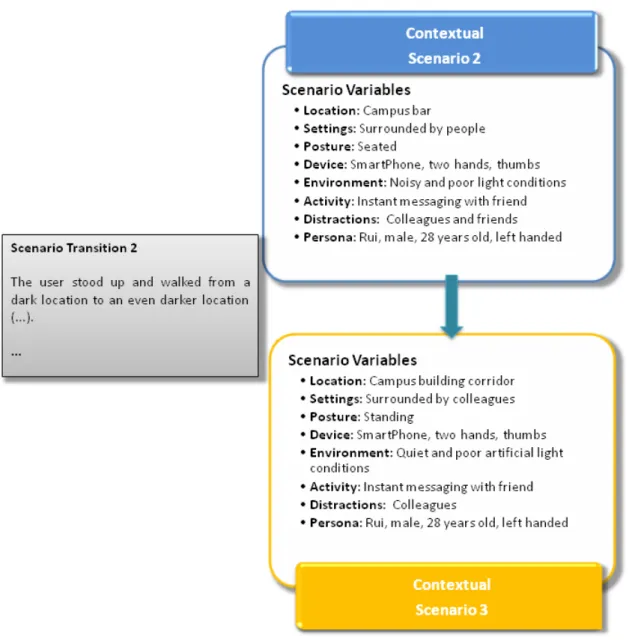
2.1 Typical Stages for a User Centred Design Process. . . 38 2.2 Common low-fidelity prototyping and evaluation process. . . 53 3.1 Scenario Generation Conceptual Framework. . . 76 3.2 Representations of contextual scenarios. . . 77 3.3 Notations used to represent transitions between contextual scenarios. 78 3.4 Four different contextual scenarios with 8 transitions between them. 88 3.5 The first two contextual scenarios, their variables and the
transi-tion between them. . . 88 3.6 Transition between contextual scenario 2 and 3, including the
vari-ables that compose both these scenarios. . . 89 3.7 Scenarios 3 and 4 and correspondent transition. . . 90 3.8 Scenarios 4 and 1 and correspondent transition. . . 91 3.9 Example of a composed scenario. . . 92 3.10 Examples of scenarios and settings that emerged from the
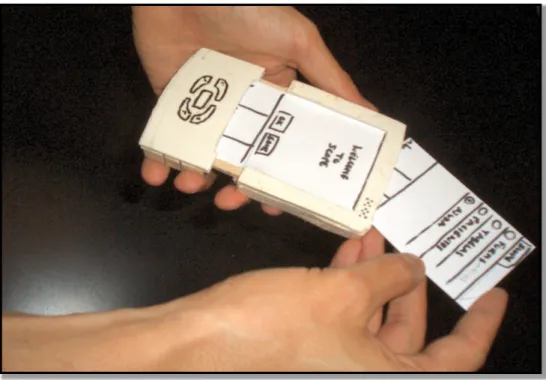
frame-work’s utilisation. . . 100 4.1 A prototype emulating a Palm Tungsten T3. . . 113 4.2 A frame that has the same dimensions and size than a Siemens
PocketLoox device, built with rubber erasers and duck tape. . . . 116 4.3 Participants were paired and worked on a design challenge during
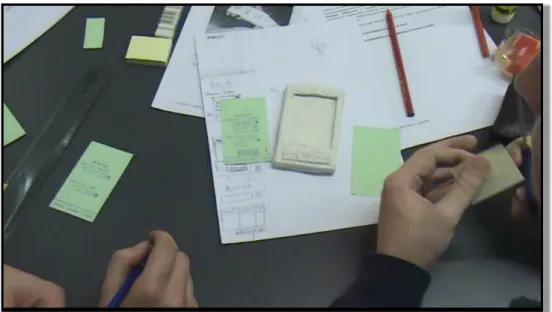
the first 60 minutes of the evaluation session. . . 118 4.4 Participants working on sketches while testing them on one of the
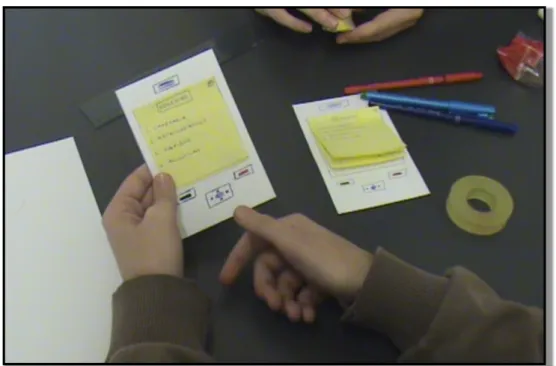
frames. . . 119 4.5 Detail of sketches and a frame for a cell-phone. . . 120
4.6 Resulting Prototype for the first group that did not use the tech-niques. . . 121 4.7 Second prototype created without the techniques. . . 122 4.8 End-user interacting with one of the prototypes that was created
without the use of techniques. The designer, on the right, is anno-tating some of the errors that were found. . . 123 4.9 End-user testing a prototype of the virtual bartender on a
smart-phone frame. . . 125 4.10 User testing the digital personal trainer user interface on an HP
smartphone while the designer acts as the Wizard-of-Oz and changes the cards. . . 126 4.11 Detail of the various prototypes and sketches that were
devel-oped by the designers with (on the left) and without (on the top right) the techniques. On the bottom right, all the prototypes and sketches placed together. . . 127 4.12 Mobile Video Kit composed by a backpack, a laptop, a web camera
and a cap. . . 136 4.13 First version of the video kit with the camera mounted on the
user’s shoulder. . . 137 4.14 Second version of the video kit with head mounted camera. . . 138 4.15 Images captured by the second mobile video kit. . . 139 4.16 Remote monitoring with the mobile video kit and a messaging
application. . . 140 4.17 Low-fidelity prototype for the digital cane and bluetooth earpiece. 142 4.18 Final Low-Fidelity prototype of a digital white cane. The strap
is adjustable and the tip includes an infra-red sensor that detects distance and reads bar-codes. The wheel on the centre allows users to select different options and to control the cane. . . 143 4.19 Prototype for the mobile companion on the left and dock/charging
station on the right. . . 144 4.20 The prototype has an opening on the top where cards/sketches can
be inserted. . . 145 4.21 Prototyping frame and sketches for the mobile GPS. . . 146
4.22 The used frame closely resembles the actual device. . . 147 4.23 The prototype is composed by the frame and the exchangeable cards.148 4.24 Sketches marked by users while testing them in different locations. 149 5.1 MobPro’s Global Architecture. . . 158 5.2 High level diagram of the rule mechanism. . . 164 5.3 Prototype building tool - Wizard Mode. . . 166 5.4 Configuration options on the left and element creation interface on
the right. . . 167 5.5 Prototype building tool - Advanced Mode. . . 168 5.6 Prototype building tool - Advanced Mode - Zoomed out. . . 170 5.7 ClickArea Definition on the mobile editor. . . 171 5.8 Editing an item on the mobile editor. . . 172 5.9 MobPro Runtime Environment. . . 173 5.10 Log Player - Revision of a mid-fidelity prototype interaction log. . 174 5.11 Prototyping sequence with MobPro support. . . 175 5.12 Creating a low-fidelity screen with the advanced editor (organised
following a clockwise orientation). . . 177 5.13 Log player replaying an interaction log for a low-fidelity prototype. 179 5.14 Active data gathering - Contextual Questionnaires on the Runtime
Environment. Questionnaires can be composed with the same ele-ments that are used to create the software/high-fidelity prototypes. Once completed, they can be browsed directly on the mobile device.181 5.15 End-users during evaluation sessions. . . 184 5.16 Screenshot of end-user creating the prototype with MobPro. . . . 188 5.17 Completed prototype. . . 189 5.18 Prototype created with Microsoft PowerPoint 2007. . . 190 5.19 Prototype created with Microsoft Visual Studio 9. . . 191 5.20 Low-fidelity and high-fidelity prototype for a psychotherapy tool. . 197 5.21 High-fidelity prototype of a mobile tool for 4th grade students. . . 199
3.1 Amount of requirements gathered by the 3 teams that did not use the framework for the first part of the evaluation session (40 minutes). . . 96 3.2 Results from the five teams that used the framework during the
experience (amount of gathered requirements). . . 97 3.3 Results from the questionnaires that were completed by the
par-ticipating designers. . . 99 4.1 Results from the questionnaires completed by the 12 participating
designers. . . 128 4.2 Responses from the end-users regarding their assessment of the
prototypes and evaluation session. . . 130 5.1 Time spent using the various tools. . . 187 5.2 Used prototyping tools and resulting prototypes’ features. . . 192 5.3 Results from the questionnaires completed by the participant
Introduction
Recent developments in mobile technology, particularly the appearance and mass commercialization of personal computing devices such as PDAs, (smart)phones, portable GPS systems, UMPCs (Ultra Mobile PCs), etc., have introduced new paradigms in the way applications and technology are used. Devices are now utilised ubiquitously by a wide variety of users with varied intentions, moving between different contexts and environments with different characteristics. They have transitioned from recreational and luxury products to necessary items in-cluded on multiple parts of users’ lives. Furthermore, given their characteristics they are also highly adaptable to cooperative scenarios (Duarte et al.,2007,2008;
Zurita et al.,2006) supporting several activities while simultaneously offering dif-ferent connectivity and communication options (Wadekar & Fagoonee, 2006).
Accordingly, as new ways to use the devices appear, new applications have also been made available. These extend the scope of software development, in-troducing behaviour, new media utilisation possibilities and even new interaction options, trying to adjust the user interface or features to the surrounding and available resources. In addition and in concert with these advances, mobile user interfaces are increasingly leaning towards multimodality, supporting different interaction options that better suit the current utilisation requirements ( Lem-mel¨a et al., 2008; Solon et al., 2004).
These advances and features, as well as their implications become more chal-lenging when users circulate through different settings arbitrarily. Still, the stan-dards of usability and quality that users are now accustomed to, on traditional
applications, need to be maintained, even throughout the usage experience. More importantly, usability levels should match the requirements of the variety of ac-tivities and intensive use that also characterise ubiquitous technology, especially within the adverse settings of specific locations, where interaction can be re-stricted by a large set of phenomenona. For this to happen, new ways to create, design and evaluate these applications should also be made available.
Contrarily to technology, design methodologies and techniques did not follow closely the emergence of mobile computing. The delay on design methodologies’ evolution and the lack of specific approaches for mobile systems is retracting from the applications and user interfaces’ quality and usability. Even if most of the currently used design techniques are quite flexible, the specific characteristics and potentialities offered by mobile devices are not easily or clearly accommodated by most approaches and, usually, they are not even considered (Kjeldskov & Graham,
2003; Lee & Benbasat,2003). This results in applications that even if composed by brilliant content, quickly become unusable on realistic settings, mainly due to the demanding or specific characteristics of some of the scenarios in which they need to be used. Moreover, designers often opt to port existing applications to mobile devices or reuse them on ubiquitous environments, generally leading to cumbersome and unusable applications (Lee & Benbasat, 2003) or requiring alternative, intrusive and expensive techniques and material (Nakajima, 2006).
In general, attention must be paid to the user behaviour that changes accord-ing to the surroundaccord-ing environment, the variables that trigger these changes and how they affect usability. Different approaches regarding the design process, tar-geting prototyping, User Interface (UI) design and evaluation are required, taking into account the challenges posed by the volatile and endless usage contexts that shape the user experience. Extensions and new concepts, which are specific to ubiquitous and active applications or multi-device architectures, are crucial for a more efficient and sound design process and better software applications.
1.1
Motivation
Overall, the difficulties found while designing two software systems, that include mobile devices, were the main motivation behind this work. Both systems were
developed to run on several hardware platforms although the primary target were PDAs (Personal Digital Assistants). This choice was based on these devices’ most marking characteristics and their adequateness to the initial requirement, namely:
• Great mobility • Easy transportation • Large battery life • Small size and weight
• Various input/interaction modalities
Given these characteristics, the applications, their features and user interface, can be adjusted to specific settings and to the devices’ characteristics. Besides the already stated difficulties inherent to mobile and ubiquitous computing, one of these systems was to be used in critical scenarios (e.g. psychotherapy), further increasing the design challenges and usability demands of the expected outcome. Throughout the design process, several problems were encountered on various stages. Some were solved using on-the-fly solutions that resolved occasional prob-lems. Others required additional effort and time in order to achieve acceptable levels of usability on the developed solutions while a few had to be neglected in order to comply with design deadlines. The two following sections provide a detailed description of the applications’ main goals, domains and restrictions, in-troducing the initial requirements that led to the aforementioned design process.
1.1.1
Application 1 - Psychotherapy
Psychotherapy, through various approaches and methods, aims at understand-ing patients’ problems or disorders and ultimately to overcome them as possible. Cognitive Behavioural Therapy (CBT) is a particular method where patients assume a participative role collaborating closely with therapists during extended periods of time (Mahoney, 2003; Neimeyer, 1993). Activities are highly perva-sive for therapist and patient, taking place in various settings and environments. The first’s off-sessions tasks include the analysis of data that is gathered during
sessions and the adjustment of therapy accordingly, also taking into consideration patients’ homework and evolution as well as annotations taken during conversa-tions. These activities are performed individually. During sessions therapists su-pervise patients’ activities, annotate their reactions, relevant subjects and gather information from the available sources (e.g. used artefacts and patient homework) and often collaborate with patients during their tasks. For patients, tasks com-prise in-session activities (e.g. conversations with the therapist, completing tests and questionnaires) done individually or in cooperation with the therapist and off-session activities generally regarded as homework and completed independently during the patient’s daily life. These make use of the same questionnaires and tests also including thought registration together with activity planning tables.
Overall, CBT presents an interesting opportunity to take advantage of a tech-nological approach that could enhance the process and facilitate the various ac-tivities that it includes, allowing both actors to focus on the relevant details of the therapy and diagnosis process. This was the starting point of project SCOPE (Supporting Cognition Outlines on Psychological Evaluation) (Carri¸co & de S´a,
2005). SCOPE aimed to provide users with tools that would allow therapists to manage, gather and customize all the data and therapy artefacts relieving patients from demanding activities, thus facilitating therapy and diagnosis and hopefully improving the process and reducing costs and time spent for these pur-poses (de S´a, 2005; de S´a & Carri¸co, 2004, 2005a). Although some work had already addressed these topics (Gega et al., 2004; Newman, 2004; Przeworski & Newman, 2004), it focused either therapist or patient isolated solutions with-out providing any customization and personalization options. Furthermore, most of these solutions adopted fixed platforms which are intrusive (Das, 2002) or incompatible with the described scenarios. In fact, the understanding of these problems, the pervasiveness of the activities and the ubiquitous nature of the process, yielded, on the first approaches to the project, the need for handheld devices and an overall mobile architecture (Carri¸co et al., 2006a,b; de S´a et al.,
1.1.2
Application 2 - Education
M-Learning is an increasingly important concept amongst educational commu-nities. Several system have now become widely available supporting a diverse set of activities. While some might act merely as replacement of paper artefacts with some enhancements (Ljungblad et al., 2004), others are directed to tutors and teachers enabling the organization and scheduling of classes, search within content, access to dictionaries, etc. (Kortenkamp & Materlik, 2004; Virvou & Alepis, 2005). For students, the majority allows the completion of simple tests, the access to digital books or even some cooperative chat tools (Perry, 2003;
Pownell & Bailey, 2000; Smith & Kent, 2003). Recent work has also introduced collaborative tools that allow students to exchange more complex information and cooperate in difficult tasks (Alford & Ruocco, 2001).
Furthermore, supporting this recent movement that aims to convey educa-tional matters with mobile technology, various studies have proven the efficacy and benefits of allying hand-held devices with school activities (Abowd et al.,
1997; Graham, 1997; Segall et al., 2004). However, most of the existing systems are directed to either students or to teachers (de S´a & Carri¸co, 2005b). More-over, a great deal focuses on specific subjects or courses (Alford & Ruocco,2001;
Kortenkamp & Materlik, 2004), or specific ages (Inkpen, 1999; Mandrik, 2001) failing to capture the needs of a wider range of students and teachers.
The need for a generic tool that enabled teachers to create specific and per-sonalized studying material was the motivation behind project Test-IT (de S´a & Carri¸co, 2006a). Test-IT is a framework available for desktop computers that provides teachers with the necessary mechanisms to define tests and studying material for their students. Overall, it contains a tool that includes several spec-ification options which enable users, without programming knowledge, to create artefacts with different characteristics. Depending on the subject, content, tar-get students or even stage of the educational process, teachers are able to include images, drawings, text, multiple-choice or open ended questions and gauges on every artefact. Furthermore, hints, links and cross-referencing between different contents are also part of the tool paraphernalia.
However, the greatest contribution, is the possibility of utilising all this con-tent and tests on mobile devices. Every artefact created by a teacher can be easily transferred to a student’s personal device (e.g. PDA or Smartphone). Therefore, tests and studying material can be (re)viewed during classes, at home, on field trips, etc. Furthermore, the data stored and introduced by both students and teachers can be easily exchanged, propelling cooperation. The electronic medium also facilitates the analysis of test results and student data.
1.1.3
Chosen Methodology and Main Problems
The design of SCOPE, Test-IT and all their tools followed a traditional User Cen-tred Design (UCD) methodology, Contextual Design (Beyer & Holtzblatt,1998). With UCD methodologies users take a central role and participate on the pro-cess allowing a detailed understanding of work flow problems, users’ difficulties, cultural and social issues. The methodology and included techniques have been widely applied in several studies, some on critical scenarios, with positive results, improving the design life cycle and the projects’ outcome (Mao et al., 2001). However, despite its many advantages and adequateness to several scenarios and problems, this approach had several limitations that hindered the design process on most stages for both these cases.
On the initial experiences with SCOPE, which preceded Test-IT, problems appeared through various stages, mainly because of the lack of adequate advice and techniques to tackle the added efforts that the mobile settings and activities required. These were once again felt during the design of Test-IT. Furthermore, at this time, a secondary objective was to understand if the problems felt on the previous design experience were domain independent and would be recurrent on this new context.
Overall, during the design process of both these applications, initial problems that were felt hindered the design process and affected its outcome by compro-mising the initial prototypes’ quality and how these performed usability wise. At the end of the process, the design team was left with the feeling of need for tech-niques better suited to all the constraints and requirements that were inherited by the mobile domains.
1.2
Challenges and Concerns
Although the encountered problems can be summed up as the absence of a specific design approach, including appropriate techniques that cope with mutating and volatile contextual settings and tackle the specific problems brought by mobile devices’ characteristics, it is important to stress the various difficulties that were encountered in each specific design stage.
1.2.1
Requirement Analysis and Data Gathering
The first problems appeared while gathering information and requirements through interviews and ethnographic sessions. These two techniques usually bring design-ers the possibility to unddesign-erstand the work flow on various activities and detect problems that might be solved by introducing a technological system. However, on such pervasive and mobile activities, the chosen methodology proved to be quite unable to provide sufficient detail and guidelines in how to achieve such results and even on how to apply both techniques. Which settings to select while conducting ethnographic sessions, how to conduct these sessions while moving between settings, what questions to ask and what details to look at were some of the issues that affected these procedures. Little or no information on how to apply requirement assessment and data gathering techniques for mobile settings and multiple contexts was available. No directions on how to select relevant sce-narios or define effective conceptual frameworks were found. Consequentially, it was difficult to cope with all the working contexts, locations, and endeavours that needed to be contemplated when addressing psychotherapy and education, within our projects’ requirements and goals. This led to the identification of the first main problem.
There were no guidelines or suggestions on how to gather information and assess requirements for mobile systems, identifying problems on pervasive/ubiquitous activities and scenarios. Some of the used techniques for data collec-tion and requirement assessment, available in the
litera-ture, were inadequate to mobile scenarios and others needed extensions and clear examples of procedures to follow.
In order to mitigate this problem to a certain extent, data was gathered by reviewing videos of current psychotherapy practices (Davidson et al., 2000) and simulations; questionnaires were given to users (on both domains) for them to complete on specific settings; and school classes were evaluated and analysed.
Complementing this information, scenario-based simulations (Jones & Mars-den,2006) were made, covering a considerable roll of activities and contexts (e.g. to complete a diagnostic test at home, at school, at the therapist’s office and at the supermarket; do homework on various settings, transfer completed test to teacher, etc.). For session/class/cooperative tasks the same approach was used establishing different scenarios and representations of what usually occurs during a session (e.g. simple conversation, annotation process, fetching new artefacts for the patient, engaging on collaborative activities). Overall, this scenario-based exercise provided insight on a large deal of problems that might occur on several activities. However, it required a great amount of effort, time and planning.
Still, this approach falls short to cover some possible scenarios and situations and, if care is not taken, neglect paramount concerns, possibly preventing the de-tection of errors that might appear on posterior phases of design or even with final users. Accordingly, the requirement assessment and the definition of the design concepts took longer than expected and were deemed incomplete as adjustments would have to be necessarily introduced to cope with future issues.
The selection and identification of crucial concerns when brainstorming and defining requirements or even when en-gaging on mobile data collection for specific scenarios re-quired great effort and still remained incomplete and unfo-cused on very relevant problems.
1.2.2
Modelling the Data and Representing Context
Afterwards, problems continued with the modelling and representation of the gathered data. Although the used methodology (Beyer & Holtzblatt,1998) sug-gests a set of notations to model and make sense of all the gathered information,
more specific representations of the contexts of use, the details that characterise these contexts, and on the users’ behaviour on each were needed. Furthermore, and most importantly, the behaviour of the user and the new requirements that emerged each time the context changed and what triggered those changes was not addressed on the available literature. However, these details were of extreme importance, taking into consideration that on these particular projects, it was necessary to understand how users changed their behaviour from location to lo-cation (e.g. therapist’s office, home, etc.). This process led to the identifilo-cation of another problem.
The available notations were limited when trying to rep-resent and model some of the gathered data, particularly when addressing context characteristics and commuting be-tween different contexts implying behaviour, activity and procedure modifications. Representations that capture the dynamics of behaviour and changes through various con-texts, highlighting how the settings affect the usage experi-ence, would facilitate the design process.
1.2.3
UI Sketching and Low-Fi Prototyping
Once the requirements had been defined, the sketching of UIs on paper cards started to take place. Various examples on building low-fidelity prototypes were reviewed, even some particularly applied to mobile devices (Ballagas et al.,2006;
Jones & Marsden, 2006; Weiss, 2002). However, even these few examples of low-fidelity prototyping for mobile devices that were found, used classic proto-typing approaches, with simple cards or paper and low accuracy regarding the screen measurements and available components (e.g. drop boxes, text fields, etc) (Svanaes & Seland, 2004; Weiss, 2002).
Classic low-fidelity prototyping approaches produced awk-ward and cumbersome prototypes for mobile devices that did not capture the devices’ essence regarding interaction, dimensions, portability and usage patterns, affecting the sketch and overall UI design process.
Also regarding the low-fidelity prototyping stage, more realistic tools than post-its or cards, as exemplified in (Beyer & Holtzblatt, 1998; Svanaes & Se-land, 2004; Weiss,2002) were needed. These materials, besides affecting some of the sketching process, started to mislead end-users regarding weight, size or the interaction with the devices.
Common procedures found in the existing literature mixed UI sketches with the device/hardware prototypes leading to the creation of ineffective prototypes, hindering the detec-tion of UI design errors and ultimately, misleading end-users.
Furthermore, the cards started to deteriorate during tentative outside evalu-ation sessions, especially each time a user tried to put a paper PDA prototype in his/her pocket. This affected the experimentation and evaluation of the sketches that were available and confused the UI design problems with those that de-pended on the device and used materials. These problems also retracted from contextual evaluation sessions, requiring the construction of new prototypes each time new ideas emerged.
Paper-based low-fidelity prototypes created following the available guidelines were not suited to mobile evaluation scenarios and obstructed contextual evaluation.
1.2.4
Evaluation
Also, usability evaluation out of the lab, especially on early design stages, which revealed essential, was not a common procedure (Kjeldskov & Graham, 2003). Although some recent work addressed this subject (Duh et al., 2006; Jones & Marsden, 2006; Kjeldskov & Graham, 2003), stressing the need to evaluate the prototypes on the real situations where they will most likely be used when com-pleted, these practices are rarely applied (Kjeldskov & Graham,2003). Accord-ingly, no advice or guidelines on how, when or within which settings to conduct evaluation were available.
No specific techniques for mobile evaluation on real sce-narios were found at the time. In fact, according to the available literature, evaluation of mobile devices and user interfaces on real usage scenarios was scarce and still avoided by designers.
Furthermore, despite the existing literature, no substantial advice on which or how to use existing evaluating techniques was available. For instance, the use of Wizard of Oz techniques (Kelley,1984) with mobile prototypes was extremely demanding. Following a user while s/he tests a prototype on every imagined scenario turned out to be impossible to achieve. Furthermore, the procedure itself might cause ethical and social problems. This problem was further aggravated when trying to evaluate the software applications. Here users required privacy and long periods of time using the applications. Thus, no observation and detection of usability flaws could be made. Once again, the used methodology, and others that were found (Mayhew, 1999), provided no guidance on such procedures or specific techniques that coped with mobile or critical settings.
In addition to the absence of specific techniques for mobile evaluation, no practical advice on how to apply the tradi-tional evaluation techniques on mobile scenarios were avail-able. Once again, ubiquitous data gathering was demanding and provided poor results.
1.3
Discussion and Objectives
Besides the problems that were already mentioned in the previous section, the two design experiences made it clear that issues were present in most stages of the design process. Moreover, and given the entanglement of design stages, issues that hindered one stage also hindered the consequent activities. Accordingly, problems are not only technical and related to the used procedures, but also methodological, requiring adjustments even from the initial stages. Furthermore, and although the critical scenarios (e.g., psychotherapy) focused in these projects might have
enhanced and highlighted some domain problems, it is noteworthy that most of the design problems appeared to be domain independent. In summary, it was noticeable that designers working with mobile technology are generally faced with the following unanswered questions:
• Where and what to look for when designing for mobile devices?
• What information is significant for the design process and how can it be used to represent real usage examples and settings?
• Which techniques can and should be used to gather data within ubiquitous and realistic usage settings?
• How to design and create proper prototypes and which tools to use in order to respond to the demanding settings of real world usage experiences?
• How to use the tools and prototypes in efficient ways, collecting usability data in realistic situations?
• Can technology aid or even enhance this process?
To cope with the identified problems and challenges and focusing on the re-search questions that emerged, this work aims to study the requirements and challenges that mobile devices and mobile interaction introduce into the design process and resulting applications’ usability. Its main goal is to extend and or-ganize the several steps that are necessary to design into a high level framework which supplies guidelines to achieve efficient design processes and valuable re-sults for ubiquitous computing. Therefore, it is particularly important to update faulty or outdated methods and concepts with the necessary tools and mecha-nisms which enable designers to effectively conduct the development and design of usable applications that cope with all the intricate dimensions that mobil-ity, ubiquity and adaptation might entangle. As a starting point, User Centred Design (UCD) methodologies will be complemented by introducing new concepts and guidelines specific to mobile applications and user interfaces. The work spans from the initial data gathering stage, through low-fidelity prototyping, up to the evaluation of final products, addressing also mixed-fidelity prototyping solutions.
To accomplish so, a set of main umbrella goals was defined. Each is composed by sub-goals that target specific concerns and aim at offering, individually at first, a global solution to a larger issue:
• Identify the critical concerns and dimensions that affect, and how they affect, mobile usability, establishing means to cope with them.
• Create new, adapt and organize existing techniques, specific for mobile user interfaces and applications, for the most crucial stages of common user centred design methodologies, extending their scope to cope with multiple contexts, ubiquity and pervasiveness.
• Develop a prototyping framework that conveys the advantages of low-fidelity prototyping with actual mobiles, providing mechanisms to evaluate pro-totypes and gather usage information on real-life settings, supporting its features and functionality on user centred design techniques.
• Apply and validate the aforementioned lessons, techniques and framework through real-life case studies and design processes and assess the advantages over existing methods, techniques and tools.
1.4
Dissertation’s Contributions
The work that has been developed within the scope of this PhD has provided contributions on several facets.
1.4.1
Theoretical contributions
Throughout the experiences and research enterprises that took place during the course of this PhD, the following theoretical contributions emerged:
• Scenario Generation and Context Selection Framework including guidelines for the definition of scenarios for design and contexts for evaluation.
• A notation/specification approach that copes with the concepts and di-mensions introduced by the Scenario Generation Framework and provides designers means to describe contexts, transitions and their influence over the user experience.
1.4.2
Methodological contributions
From a methodological and practical perspective, this thesis has also provided the following contributions:
• The application of adjusted and new techniques to the initial Data Gath-ering and Requirements assessment stages.
• A set of Low-Fidelity Prototyping techniques that take into account the needs of mobile devices and mobile interaction.
• Techniques for the In-Situ Evaluation of Low-Fidelity Mobile Prototypes. • A Low Cost Mobile Video Capturing Kit for ubiquitous evaluation.
1.4.3
Software contributions
As a result from the techniques and work that was developed during this PhD, several software tools, (most) included within the MobPro environment were con-ceived and developed:
• ScoFORMS v2 for PalmOS
• ScoTherapy PocketPC (developed by Lu´ıs Duarte et al) • ScWiz
• User Management Tool • Group Management Tool • MobPro Prototype Designer • MobPro Wizard
• MobPro Desktop Persistance Layer/XML Exporter • MobPro PocketPC Mobile Editor
• MobPro Pocket PC Runtime Environment (developed by Lu´ıs Duarte and Tiago Reis)
• MobPro Log Player (developed by Lu´ıs Duarte)
1.4.4
Publications
In order to validate and disseminate the various concepts, ideas, contributions and results from the work presented in this thesis, by and to the Scientific Community, the papers listed bellow were published.
1.4.4.1 Publications on Theoretical Contributions
1. Marco de S´a, Carlos Duarte, Lu´ıs Carri¸co, Tiago Reis. Designing Multi-modal Mobile Applications. Chapter – , MultiMulti-modality in Mobile Computing and Mobile Devices: Methods for Adaptable Usability, –, pp. —. -(Eds.), IGI Global, — 2009. ISBN: - - - (to appear - accepted for publica-tion).
Contribution This is a book chapter that describes a design approach for mobile multimodal applications. The text discusses how the scenario generation framework can be extended and applied to the design of multimodal applications. It also discusses the utilisation of MobPro for the same end, stressing its multimodal capabilities illustrated by a case study of a rich digital book player design.
2. Marco de S´a, Luis Carri¸co. Defini¸c˜ao de Cen´arios para o Desenho e Avalia¸c˜ao de Interfaces para Dispositivos M´oveis (in Portuguese). Proceedings of In-terac¸c˜ao 2008, 3nd National Conference in Human Computer Interaction,
´
Evora, Portugal, October 15-17, pp. 115-121. Jos´e Creissac Campos, Daniel Gon¸calves, Teresa Rom˜ao and Lu´ıs Rato (Eds.), GPCG, October 2009. ISBN: 972-98464-9-9.
Contribution This paper is a short paper written in Portuguese describing the first experiences that led to the scenario generation framework.
3. Marco de S´a, Lu´ıs Carri¸co. Lessons from Early Stages Design of Mo-bile Applications. Proceeding of MoMo-bileHCI’08, 10th International ACM Conference on Human Computer Interaction with Mobile Devices and Ser-vices, Amsterdam, Netherlands, 2-5 September, pp. 127-136. ACM Press, September 2008. ISBN:978-1-59593-952-4.
Contribution This is the main full paper that presents the scenario gen-eration framework and its validation through several case studies. It describes the framework’s impact on the design process and provides guidelines for other researchers. The paper also stresses the used tech-niques and approaches to the initial data gathering stages and following design and evaluation sessions.
4. Marco de S´a, Lu´ıs Carri¸co. Defining Scenarios for Mobile Design and Eval-uation. Proceedings of CHI’08, SIGCHI Conference on Human Factors in Computing Systems (extended abstracts), Florence, Italy, April 05 - 10, pp. 2847-2852. ACM Press, April 2008. ISBN: 978-1-60558-012-X.
Contribution This paper is a Work-In-Progress paper describing the first version of the scenario generation framework. It is the paper that preceded, and is a subset of, the MobileHCI’08 paper.
1.4.4.2 Publications on Methodological Contributions
1. Marco de S´a, Lu´ıs Carri¸co, Carlos Duarte. Mobile Interaction Design: Tech-niques for Early Stage In-Situ Design. Human-Computer Interaction: New Developments, Chapter 10, pp. 191-216. Kikuo Asai (Eds.), I-Tech Educa-tion and Publishing: Vienna, Austria, EU, October 2008. ISBN 978-953-7619-14-5.
Contribution This book chapter discusses the early stage low-fidelity pro-totyping and evaluation techniques in detail, presenting them along with case studies, placing them in context within an extensive review
of the current and most relevant literature. The chapter also discusses results and generic guidelines for both design stages.
2. Marco de S´a, Lu´ıs Carri¸co. Designing for Mobile Devices: Requirements, Low-Fi Prototyping and Evaluation. Human-Computer Interaction. In-teraction Platforms and Techniques, 12th International Conference, HCI International 2007, Proceedings, Part II, Beijing, China, July 22-27, Lec-ture Notes in Computer Science, vol. 4551/2007, pp. 260–269. Jacko, Julie A. (Eds.), Springer: Berlin/Heidelberg, August 2007. ISSN: 0302-9743 (Print) 1611-3349 (Online), ISBN: 978-3-540-73106-1, DOI: 10.1007/978-3-540-73107-829.
Contribution This paper presents the early stage low-fidelity prototyp-ing and evaluation techniques and was the paper that originated the invitation for the I-Tech book chapter.
3. Marco de S´a, Lu´ıs Duarte, Jo˜ao Carvalho and Lu´ıs Carri¸co. A Methodology and a Framework for Mobile Interaction Design. Proceedings of WSMU’07, 1st Workshop in Mobile and Ubiquitous Systems, Coimbra, Portugal, June 22, pp. 30–35. June 2007.
Contribution Presents an overview on the PhD work, superficially ad-dressing the various design stages and the various MobPro’s software components.
4. Marco de S´a, Lu´ıs Carri¸co. Low-Fi Prototyping for Mobile Devices. In Proceedings of CHI’06, SIGCHI Conference on Human Factors in Comput-ing Systems (extended abstracts), Montr´eal, Qu´ebec, Canada, pp. 694-699, ACM Press, April, 2006, ISBN: 1-59593-372-7.
Contribution Work-in-Progress describing the initial experiments and re-sults from the prototyping techniques discussed in the thesis and on the papers above.
1.4.4.3 Publications on Software Contributions
1. Marco de S´a and Lu´ıs Carri¸co (2009). An Evaluation Framework for Mobile User Interfaces. Proceedings of INTERACT 2009, the 12th IFIP TC13 Conference in Human-Computer Interaction, Uppsala, Sweden, pp. – , Springer-Verlag, Lecture Notes in Computer Science, (to appear - accepted for publication).
Contribution Main paper describing MobPro’s evaluation features, dis-cussing in detail the multimedia Experience Sampling Method and the intelligent logging mechanisms. The paper also presents case studies and results.
2. Marco de S´a, Lu´ıs Carri¸co, Lu´ıs Duarte, Tiago Reis. A Mixed-Fidelity Prototyping Tool for Mobile Devices. Proceeding of AVI’08, International Working Conference on Advanced Visual Interfaces, Napoli, Italy, pp. 225-232. ACM Press, Paolo Bottoni, Stefano Levialdi (Eds.), May 2008. ISBN: 1-978-60558-141-5.
Contribution Main paper describing MobPro’s prototyping features. The paper introduces MobPro’s main goals, its architecture and ad-dresses the design and mixed-fidelity development features, demon-strating how they can be used to create both paper-based low-fidelity prototypes and functional software prototypes.
3. Marco de S´a, Lu´ıs Carri¸co, Lu´ıs Duarte, Tiago Reis. A Framework for Mobile Evaluation. Proceedings of CHI’08, SIGCHI Conference on Human Factors in Computing Systems (extended abstracts), Florence, Italy, April 05 - 10, pp. 2673-2678. ACM Press, April 2008. ISBN: 978-1-60558-012-X. Extended abstracts acceptance ratio: 38
Contribution Work-In-Progress paper that presents the initial develop-ments on MobPro’s evaluation features. It originated the full paper accepted at INTERACT 2009.
4. Marco de S´a, Lu´ıs Carri¸co, Lu´ıs Duarte, Tiago Reis (2009). Supporting the design of mobile interactive artefacts. Journal of Advances in Engineer-ing Software (JAES), Elsevier (to appear - accepted for publication).
Contribution This journal article focuses on MobPro’s wizard and how it allows end-users to create their own, personalized mobile interactive artefacts. Its main contribution lies on the description of the usability and design guidelines that the tool includes.
5. Marco de S´a, Lu´ıs Carri¸co, Lu´ıs Duarte, Tiago Reis. Supporting the Design of Mobile Artefacts for Paper-Based Activities. Computer-Aided Design of User Interfaces VII, –, pp. —. V´ıctor L´opez-Jaquero, Francisco Montero, Jos´e Pascual Molina (Eds.), Springer: Dordrecht/Netherlends, — 2009. ISBN: — (Print) — (e-book) . (to appear - accepted for publication).
Contribution This book chapter details MobPro’s wizard explaining its architecture and included elements and how they can be applied to sup-port end-user development of mobile artefacts directed towards paper-based activities. This is the book chapter that originated the invited journal paper accepted for the Journal of Advances in Engineering Software.
6. Marco de S´a, Lu´ıs Carri¸co, Lu´ıs Duarte, Tiago Reis. Multi-Purpose Mo-bile Artefacts. International Journal of Smart Home, vol. 22, nº 4, pp. 75-88. Sajal K. Das (Eds.), Science and Engineering Research Support Center, October 2008. ISSN: 1975-4094.
Contribution This journal article presents a set of experiences that illus-trate how MobPro can be used to support the development of mobile artefacts for multiple activities and users. It details the overall devel-opment process by providing a step-by-step description of the various construction procedures. It also presents case studies in different do-mains.
7. Marco de S´a, Lu´ıs Carri¸co, Lu´ıs Duarte, Tiago Reis. Multi-Purpose Proactive m-Artifacts. In Proceedings of SAC’08, ACM Symposium on
Applied Computing, Ubiquitous Computing Track, Fortaleza, Brazil, pp. 1629-1633, ACM Press, March, 2008.
Contribution Paper presenting MobPro’s behaviour tools and rule trig-gers, stressing their ability to include active response on the developed artefacts without programming needs. This paper is the original paper that was posteriorly invited to be submitted as an extended version for the International Journal of Smart Home (IJSH).
1.4.4.4 Publications on Case Studies
1. Marco de S´a, Lu´ıs Carri¸co. Supporting End-User Development of Per-sonalized Mobile Learning Tools. Human-Computer Interaction. Learning and Personalisation, 13th International Conference, HCI International 2009, San Diego, California, U.S.A (to appear - accepted for publication).
Contribution Paper describing MobPro’s Wizard educational counter-part’s architecture and features applied to end-user development of tools for mobile learning.
2. Marco de S´a, Lu´ıs Carri¸co. Mobile Support for Personalized Therapies - OmniSCOPE: Richer Artefacts and Data Collection. 3rd International Conference on Pervasive Computing Technologies for Healthcare 2009 (Per-vasiveHealth’09), London, United Kingdom, April 1-3, pp. —, IEEE Press with Technical Cooperation from ACM SIGCHI, April, 2009.
Contribution This paper focuses on the additional data gathering fea-tures that MobPro’s psychotherapy counterpart required in order to extend its scope to therapies such as physiotherapy, aphasia and speech therapy. Best Student Paper Award.
3. Marco de S´a, Lu´ıs Carri¸co. Detecting Learning Difficulties on Ubiquitous Scenarios. Human-Computer Interaction. HCI Applications and Services, 12th International Conference, HCI International 2007, Proceedings, Part IV, Beijing, China, July 22-27, Lecture Notes in Computer Science, vol.
4553/2007, pp. 235–244. Jacko, Julie A. (Eds.), Springer: Berlin/Heidel-berg, August 2007. ISSN: 0302-9743 (Print) 1611-3349 (Online), ISBN: 978-3-540-73109-2, DOI: 10.1007/978-3-540-73111-527.
Contribution Paper discussing how the proactive features and rule-engine included within MobPro’s runtime environment allowed teachers to detect learning difficulties and behaviour issues while away from their students. It provides detail on the used techniques and on the re-sults that teachers were able to encounter based on their students’ behaviour.
4. Marco de S´a, Luis Carri¸co, Pedro Antunes, Joaquim Reis, Hugo Lucas. Defining Personalized Therapies for Handheld Devices. Proceedings of the 22nd Annual ACM Symposium on Applied Computing, Special Track on Computer Applications in Health Care (CAHC), Seoul, Korea, pp. 163– 164. ACM Press, March, 2007. ISBN: 1-59593-480-4.
Contribution Short paper introducing MobPro’s dedicated version for mobile psychotherapy artefact construction. It explains the overall architecture and data dissemination aspects of the tools.
5. Marco de S´a, Lu´ıs Carri¸co, Pedro Antunes. Ubiquitous Psychotherapy. IEEE Pervasive Computing, Special Issue on Healthcare, vol. 6, nº 1, pp. 20-27. Gaetano Borriello, Vince Stanford, Chandra Narayanaswami, Walter Menning (Eds.), IEEE Computer Society, Los Alamitos, CA, USA, January-March, 2007. ISSN: 1536-1268, http://doi.ieeecomputersociety.org/ 10.1109/ MPRV.2007.23. ISI Impact Factor (2005): 2.036; Number of papers (2005): 39.
Contribution This is a journal article with the extended description of MobPro’s psychotherapy version (ScWiz), focusing the entire process and the entire range of tools that the framework includes (e.g., user manager, group manager and mobile counterparts of the development tool).