UNIVERSIDADE DE LISBOA
FACULDADE DE LETRAS
QUALITY IN MACHINE TRANSLATION AND
HUMAN POST-EDITING:
ERROR ANNOTATION AND SPECIFICATIONS
LUCIA COMPARIN
Trabalho de projeto orientado pela Professora Doutora Sara Mendes,
especialmente elaborado para a obtenção do grau de Mestre em TRADUÇÃO
i
ABSTRACT
Machine translation (MT) has been an important field of research in the last decades and is currently playing a key role in the translation market. The variable quality of results depending on various factors makes it necessary to combine MT with post-editing, to obtain high-quality translation. Post-editing is, nonetheless, a costly and time-consuming task. In order to improve the overall performance of a translation workflow involving MT, it is crucial to evaluate the quality of results produced to identify the main errors and outline strategies to address them. In this study, we assessed the results of MT and after the first human post-edition at Unbabel, a Portuguese startup that provides translation services combining MT with post-editing performed online by a community of editors. A corpus of texts translated at Unbabel from English into Italian was annotated after MT and after the first post-edition step. The data collected allowed us to identify three types of errors that are frequent and critical in terms of quality, namely “word order”, “agreement”, and “tense/mood/aspect”. Hence, correcting the errors belonging to these categories would have a major impact on the quality of translation and turn the post-editing process more accurate and efficient. The errors annotated in the corpus were analyzed in order to identify common patterns of errors, and possible solutions to address the issues identified were outlined. The MT system used at Unbabel and the tools available determined the choice to integrate information retrieved by error analysis in the Smartcheck, the tool used at Unbabel to automatically detect errors in the target text produced by the MT system and provide relevant messages to the editors. Therefore, our study focused on the definition and integration of rules in the Smartcheck to detect the most frequent and critical errors in the texts, in order to provide informative and accurate messages to the editor to aid him/her in the post-editing process.
Keywords: machine translation, post-editing, error annotation, automatic error detection,
iii
RESUMO
A tradução automática tem vindo a assumir uma grande importância no mercado da tradução e representa atualmente uma importante área de investigação. Durante os últimos cinquenta anos, vários sistemas de tradução automática foram desenvolvidos com base em paradigmas e abordagens diferentes. Os sistemas de tradução automática podem ser divididos entre sistemas baseados em conhecimento linguístico em forma de regras e sistemas baseados em corpora de textos, como os estatísticos e os baseados em exemplos. Além disso, nas últimas décadas, paradigmas diferentes foram combinados para desenvolver sistemas híbridos que utilizam corpora de textos, como nos sistemas estatísticos ou nos baseados em exemplos, mas integram regras e princípios linguísticos, como nos sistemas baseados em conhecimento, para resolver dificuldades gramaticais ou lexicais. Os sistemas de tradução automática são cada vez mais utilizados no processo de tradução, devido ao crescente volume de textos para traduzir e aos curtos prazos estabelecidos. Apesar de haver diferentes sistemas, os resultados são variáveis no que diz respeito à qualidade, dependendo do paradigma e do grau de especialização do sistema e dos textos a traduzir num determinado domínio. Estes factos impõem a necessidade de realizar uma edição dos textos, que pode ocorrer antes da tradução (pré-edição) ou depois (pós-edição). No primeiro caso, do texto de partida são eliminadas as estruturas ou palavras que representam dificuldades para a tradução automática realizada por um sistema em particular. No segundo caso, o texto traduzido pelo sistema é controlado e corrigido por um revisor humano. Para que este tipo de processo possa ser utilizado em grande escala no mercado da tradução, é importante reduzir os custos que lhe são inerentes e agilizá-lo. Além da pré-edição ou pós-edição, em função do paradigma considerado, integrar mais informação linguística ou atualizar os recursos lexicais utilizados permite melhorar os resultados da tradução automática.
O presente trabalho tem como objeto de estudo o controlo de qualidade na área da tradução automática, mais especificamente, na fase de pós-edição. O estudo e a análise dos resultados da tradução automática e da fase de pós-edição permitem delinear estratégias para intervir em dois sentidos: por um lado, melhorar os resultados do sistema de tradução automática graças à integração de mais informação no sistema; por outro lado, apoiar o trabalho do revisor na pós-edição, destacando erros prováveis ou assinalando pontos
iv
críticos. A avaliação dos resultados da tradução automática inclui uma fase de análise dos erros presentes no texto de chegada e uma classificação dos mesmos, de acordo com uma tipologia de categorias de erros. No estudo da fase de pós-edição, a análise dos erros mais frequentemente corrigidos pelos revisores permite identificar que tipo de informação deve ser integrada no sistema de tradução automática e que instruções podem ser úteis aos revisores. Para a realização desta análise, adotou-se um sistema de classificação a fim de categorizar os erros e, portanto, de realizar uma avaliação quantitativa da qualidade da tradução.
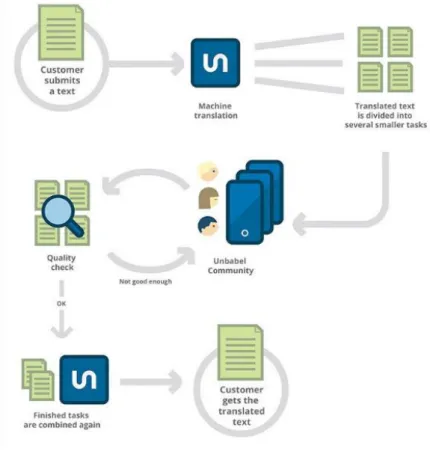
O presente trabalho de projeto foi realizado em colaboração com a Unbabel, uma startup portuguesa que oferece serviços de tradução quase em tempo real, combinando tradução automática com uma comunidade de revisores. O corpus que é utilizado para a realização do trabalho que aqui se propõe é formado por textos em língua inglesa, traduzidos para italiano através de um sistema de tradução automática, corrigidos e editados por vários revisores humanos. São analisados os erros presentes nos textos de chegada após a tradução automática e a primeira revisão. A identificação e a análise dos erros permite chegar a generalizações sob a forma de regras a ser implementadas no processo tradução e pós-edição de textos realizado pela Unbabel. Em particular, as regras destinam-se à integração numa ferramenta que identifica automaticamente os erros no texto de chegada de algumas categorias específicas, depois da tradução automática e durante o processo de pós-edição. A ferramenta assinala o erro e, em função do tipo de problema, sugere ao revisor uma correção ou dá-lhe indicações para prestar atenção a um aspeto particular da sequência assinalada, pois é provável que contenha um erro.
O presente trabalho divide-se em oito capítulos em que são abordados os temas fundamentais envolvidos na realização do trabalho. No primeiro capítulo apresenta-se o objeto de estudo, a motivação do trabalho de projeto, a abordagem metodológica adoptada e a organização do documento. No segundo capítulo apresenta-se a fundamentação teórica em que se baseou o estudo. Aborda-se brevemente a história da tradução automática, desde as suas primeiras tentativas em meados do século XX, até aos mais recentes sistemas da primeira década do século XXI. Após a apresentação da história, são descritas algumas dificuldades linguísticas e operacionais relacionadas com a tradução automática e apresenta-se uma descrição dos diferentes sistemas de tradução automática, nomeadamente os baseados em conhecimento linguístico, os baseados em corpora e os híbridos. No terceiro capítulo apresenta-se o processo de tradução automática utilizado na Unbabel,
v
fazendo-se uma breve descrição dos passos que o compõem, o sistema de tradução automática usado para a tradução dos textos do corpus e as ferramentas utilizadas na fase de pós-edição para a deteção de erros e para os testes de qualidade. No quarto capítulo introduz-se a tarefa da anotação de erros descrevendo-se, em primeiro lugar, a tipologia de erros adotada na análise e a ferramenta usada para a tarefa. Seguidamente, é apresentado o corpus de textos considerado neste estudo e são apresentados os dados recolhidos, nomeadamente o número de erros anotados nos textos depois da tradução automática e depois da primeira fase de pós-edição. Uma análise do número de erros anotados nas várias categorias de erros segue-se a apresentação dos dados e justifica a escolha de algumas categorias de erros para as quais são propostas soluções. Nos três capítulos seguintes são analizados os erros que pertencem às três categorias escolhidas, nomeadamente “word order” (ordem de palavras), no quinto capítulo, “agreement” (concordância), no sexto capítulo, e “tense/mood/aspect” (tempo/modo/aspeto), no sétimo capítulo. Em primeiro lugar, para cada categoria de erro, são abordadas as linhas gerais que caraterizam o fenómeno linguístico em inglês e italiano, e em seguida, os erros anotados são analisados e divididos em sub-categorias. Isto permite encontrar padrões de erros frequentes e generalizá-los, de maneira a poder propor soluções gerais que dêem conta de todos os erros do mesmo tipo. No último capítulo apresentam-se as conclusões e o trabalho futuro que pode ser realizado como continuação do presente estudo e aproveitando aspetos que não foi possível explorar no âmbito do trabalho de projeto aqui apresentado.
Em suma, o presente trabalho centra-se na identificação de questões problemáticas e na proposta de soluções para a melhoria da qualidade dos resultados no processo de tradução automática, na fase de pós-edição, constituindo um importante contributo não só para a formação da mestranda no âmbito dos sistemas de tradução automática e do seu funcionamento, como também para a melhoria do desempenho do sistema de trabalho específico levado a cabo na Unbabel.
Palavras chave: tradução automática, pós-edição, anotação de erros, revisor humano,
vii
Acknowledgments
First of all, I would like to thank my supervisor, Sara Mendes. Without her enthusiasm and patience this work wouldn’t have been possible. Not only she helped me to address the linguistic aspects of this thesis in an accurate way, but also, and more important, to develop an interest in this field and in the related areas.
This study was carried out with the collaboration of Unbabel. I would like to thank João Graça and Helena Moniz for making it possible and for their continue support. A special thanks to André Martins and André Silva, for their precious help and patience in answering all my questions. My gratitude also goes to all the colleagues and friends at Unbabel who contributed in making this such a great experience.
Last but not least, a special thanks to my family for their passionate support during these years in Lisbon, everyone in a special way and from a different place. Finally, I would like to thank my friends in Italy, Portugal, and many other countries, for sharing with me this experience and making it more enjoyable.
viii
Contents
1 INTRODUCTION ... 1
1.1 MOTIVATION ... 2
1.2 OBJECTIVES ... 3
1.3 METHODOLOGICAL APPROACH OF THIS STUDY... 3
1.4 ORGANIZATION ... 4
2 THEORETICAL OVERVIEW ... 5
2.1 INTRODUCTION ... 5
2.2 A BRIEF HISTORY OF MACHINE TRANSLATION ... 6
2.3 CHALLENGES IN MT ... 9 2.4 CATEGORIZATION OF MT SYSTEMS ... 15 2.4.1 Rule-Based MT Systems ... 15 2.4.2 Corpus-Based MT Systems ... 20 2.4.3 Hybrid MT Systems ... 22 3 TRANSLATION AT UNBABEL ... 25 3.1 INTRODUCTION ... 25
3.2 THE UNBABEL WORKFLOW ... 25
3.3 MACHINE TRANSLATION AT UNBABEL ... 28
3.4 TOOLS USED AT UNBABEL ... 29
3.4.1 Smartcheck ... 30
3.4.2 Dependency and Syntactic Parser ... 31
4 ERROR ANNOTATION ... 33
4.1 INTRODUCTION ... 33
4.2 DEVELOPING AN ERROR TYPOLOGY AT UNBABEL ... 33
4.3 ERROR TAXONOMY ... 36
4.3.1 Special Remarks on the Annotation Performed at Unbabel ... 41
4.4 ANNOTATION DATA ... 42 4.4.1 Determiners ... 51 4.4.2 Sentence Structure ... 53 5 WORD ORDER ... 57 5.1 INTRODUCTION ... 57 5.2 NOUN MODIFICATION ... 58
5.2.1 Adjective Noun Modification in English and Italian ... 59
5.2.2 Noun-Noun Modification in English and Italian ... 61
5.2.3 Other Types of Noun Modification in English and Italian ... 62
ix
5.3.1 Noun Modification Errors in the Corpus ... 64
5.3.2 Possible Solutions ... 71
6 AGREEMENT ... 77
6.1 INTRODUCTION ... 77
6.2 AGREEMENT IN ENGLISH AND ITALIAN ... 78
6.2.1 Gender in English and Italian ... 78
6.2.2 Number in English and Italian ... 82
6.2.3 Person in English and Italian ... 83
6.2.4 Agreement in Different Word Pairs in English and Italian ... 84
6.3 AGREEMENT IN MT ... 86
6.4 AGREEMENT ERRORS IN THE CORPUS ... 89
6.4.1 Gender Agreement Errors in the Corpus ... 90
6.4.2 Number Agreement Errors in the Corpus ... 97
6.4.3 Person Agreement in the Corpus ... 101
7 TENSE/MOOD/ASPECT ... 103
7.1 INTRODUCTION ... 103
7.2 TENSE, MOOD, AND ASPECT IN ENGLISH AND ITALIAN ... 104
7.2.1 Mood... 104
7.2.2 Modal Verbs in English and Italian ... 108
7.2.3 Modal Verbs in English ... 108
7.2.4 Tense... 110
7.2.5 ASPECT ... 116
7.3 TENSE/MOOD/ASPECT IN MT ... 118
7.4 TENSE, MOOD, AND ASPECT ERRORS IN THE CORPUS ... 120
7.4.1 Tense Errors ... 121
7.4.2 Mood Errors ... 124
8 CONCLUSIONS AND FUTURE WORK ... 129
8.1 CONCLUSIONS ... 129
8.2 FUTURE WORK ... 131
xi
List of Abbreviations and Acronyms
ADJ: adjective
CBMT: corpus-based machine translation EBMT: example-based machine translation MOD: modifier MT: machine translation N: noun NN: noun-noun NP: noun phrase POS: part-of-speech PP: prepositional phrase PROPN: proper noun
RBMT: rule-based machine translation SMT: statistical machine translation SPR: specifier
V: verb
1
1
INTRODUCTION
Machine translation (henceforth MT) has been an important field of research since the second half of the 20th century. The work done in the area enabled improvements in the results, and the development of different systems that are able to perform MT. At the same time, research in MT encouraged the work in related areas, such as computational linguistics and machine learning. Thanks to research in these fields and to the improvements achieved, MT has become an important part of the translation process in the current market, as it plays a key role in handling the increasing volume of translation needed and the short time available to deliver it that has characterized the translation market over the last decades. Although the use of MT in the translation market is increasing, the quality of the results is still variable and dependent on several aspects such as the paradigm of the MT system used. Additionally, the MT systems currently available are numerous and their performance is not alike in terms of quality. These two aspects, namely the variability of the results and the number of different types of MT systems, make the evaluation of the systems a necessary step not only to define how MT systems can be improved, but also to accurately characterize the different MT systems currently available in the market and their performance, on the basis of the quality of the results.
In this thesis, we have studied quality assessment in machine translation and in post-edited texts. Quality assessment is the evaluation of the performance of a MT system in terms of the quality of the translated texts. It consists of an analysis of the results of the translation process, that is to say the output text. Quality assessment allows not only to understand whether the system produces satisfactory results, but also to identify the aspects that have to or can be improved. Assessing the quality of the results produced by a MT system also helps to define the advantages and disadvantages of the approach adopted in the translation process, and whether it is the most appropriate to translate a given type of texts. Such an analysis can be performed through the qualitative identification of errors, i.e. annotation, or through quantitative methods (BLEU, METEOR). While assessing the quality of results of a MT system, it is also useful to consider the post-editing process and the steps it consists of.
Post-editing is often combined with MT to produce high-quality results. Analyzing more thoroughly the post-editing process helps not only to assess the quality of results
2
produced by a MT system, but also to identify the steps performed in post-edition and the improvements that can be made in order to turn the post-editing step more efficient.
The present study, which focuses on quality assessment in MT, has been carried out in collaboration with Unbabel, a Portuguese startup that offers almost real-time translation services, combining MT with crowd post-edition, done online on a platform developed by the company. In this thesis we have studied the error annotation process and the quality of the results obtained after MT and after the first human post-edition, in the language pair English-Italian. This way, we were able to identify and categorize the most common errors. The analysis of the results allowed us to find error patterns and to outline solutions to address specific issues, or to elaborate rules to automatically detect the errors and provide a warning to the post-editor. By doing so, the work presented here contributed to improving the post-editing process at Unbabel and thus to obtain higher quality results in a more cost and time efficient translation process.
1.1 MOTIVATION
As previously mentioned, research in MT is motivated by its key role in the current translation market, and by the fact that the quality of machine translated texts is not consistent, due to the fact that it depends on the paradigm of the MT system used and on whether the system is domain-specific and adapted to the texts being translated. Therefore, given the current state-of-art in the field, post-editing is necessary, even if it can be costly and time-consuming. The automatization of the post-editing process is therefore, at least in part, a necessary step. The analysis of post-editing operations allows us to work in two directions: on the one hand, it helps to improve the results of MT systems by identifying systematic errors and to take action to prevent them (possibly by integrating additional information in the translation model); on the other hand, it can aid human post-editing and make it easier, by highlighting problematic sentences and potential errors, likely to be present in the text.
As we already said, editing plays a key role in current MT processes. For post-edition to guarantee high-quality results, it is essential that it is done in a precise and accurate way. However, it should not be time-consuming, in order for the client to continue to benefit from the speed of MT. Automatization of the post-editing process can not only make the task more cost and time efficient, but can also contribute to preventing certain errors from going by unnoticed by the editor.
3
Analyzing errors in MT in the language pair English-Italian can provide useful insight not only to improve the performance of the specific MT process considered in this study, but also that of other systems, as the generalization work done for this language combination can be applied to any application involving this language pair. The choice for the language pair English-Italian is based on the fact that it is one of the most important at Unbabel in terms of volume of translation. Additionally, several linguistic phenomena observed in Italian are also characteristic of other languages, in particular Romance languages. Being so, the work done in this study can therefore be applied, with the necessary adaptations, to other language pairs.
1.2 OBJECTIVES
The general objective of this study consists in contributing to improving the quality of the results in texts translated from English into Italian by the MT system used at Unbabel. By analyzing the categories of errors that are more frequent in translated texts, and the post-editing operations performed by the editors, we aim at accomplishing the following specific goals of this study: to identify which information the system needs to integrate and what kind of guidelines can be given to editors for results to be improved, both in terms of general quality and efficiency of the translation process.
As a consequence of these general and specific goals of this study, the tangible results of the work presented here consisted in defining a set of rules to improve the performance of the Smartcheck, i.e. the tool that automatically detects errors after a text is machine translated at Unbabel. This tool provides information to the editor in order to guarantee better results after post-edition.
The main objective of this study and the methodological approach adopted will allow us to provide a thorough analysis of a number of linguistic issues in MT from English into Italian. Both the data and the analysis of linguistic issues presented in this study can be used for improving the quality of results produced by other MT systems for the same language combination.
1.3 METHODOLOGICAL APPROACH OF THIS STUDY
Literature in the field was the starting point for studying MT, the challenges it poses, and the issues it has to address. Additionally, the study of the possible paradigms adopted in MT systems helped us to identify the advantages and disadvantages of the system used
4
at Unbabel, characterize the way it works, the results that are expected, and whether it is possible to integrate linguistic information directly in the system or if other methods should be used to overcome some of its shortcomings. In addition to more general literature on MT and MT systems, the work already published regarding the evaluation of MT systems and post-editing was considered in order to define the work that could be done in our specific case.
In order to study the errors in machine translated texts, we collected a corpus of texts translated at Unbabel from English into Italian and post-edited by human editors. The texts were then annotated and the errors were categorized. The data were studied in order to find repeated patterns and to identify the most common errors. When it was possible, a rule to automatically detect issues in the post-editing stage was provided. When this was not possible, given to specific limitations described for each case, an outline of possible future work was provided.
1.4 ORGANIZATION
The work presented in this document is organized as follows. In the second chapter of this study we will present a theoretical overview on the area of this study, in particular we will take into account MT, its history, the challenges it entails, and the paradigms used in MT systems. In chapter three, we will provide more details on how the translation process is done at Unbabel, on the specific MT system used by the company and the tools used to provide the service. In chapter four, we will introduce the first part of the empirical study developed, present the error annotation process and the data collected. In chapter five, we will present an analysis of word order errors annotated in the corpus and provide possible solutions to address the issue. The same will be done in chapter six, for agreement errors, and in chapter seven, for errors involving tense, mood, or aspect of the verb. The final chapter of this thesis will present some conclusions and future work.
5
2
THEORETICAL OVERVIEW
2.1 INTRODUCTION
Machine translation is a process consisting of the translation from one natural language into another performed by a computer system (Dorr et al., 1989:1). In a machine translation process the input text is inserted in the system which generates an output text corresponding to the translation. MT systems do not involve human translator’s intervention. This is the main difference between MT and computer-aided translation, in which the human translator has an active role in the translation process and is assisted in the task by one or more tools, such as dictionaries, translation memories, glossaries, and terminology databanks.
The results of MT are variable and depend on factors including the kind of text translated, the purpose of the communication, the domain of the source text, the system that provided the translation, and the lexicon and syntax in the source text. The variable quality of the results is the main reason why MT is often blamed of producing poor-quality translation results. In order to obtain better results, it is necessary to either pre-edit or post-edit, respectively, the input or the output text, as we will discuss in more detail in section 2.3. Despite its shortcomings, over the last decades MT started to be used more and more, in order to deal with the increasing volume of translations needed in many fields and the short time available to deliver them. This way, MT is used to aid human translation and is integrated in the “traditional” translation process: MT systems provide the human translator with a first version of the target text that has to be edited to produce a quality translation. As a result, the translation process is accelerated and the cost reduced. However, the use of MT is not generalized among professional translators due to the fact that, when the quality of the results is poor, the translator would spend more time in correcting or re-writing a sentence than in translating it from scratch. On the contrary, MT can be used, either with or without post-editing, when the aim is not producing a high-quality translation, but rather accessing the meaning of the source text. Additionally, it is possible to adapt MT systems to the user by making them domain-specific and by integrating glossaries, and thus producing better results.
In section 2 of this chapter, we will present a brief history of MT to arrive at the present state-of-the-art. In section 3, we will consider the main challenges MT presently faces, and,
6
in section 4, we provide a general classification of MT systems and discuss their advantages and disadvantages.
2.2 A BRIEF HISTORY OF MACHINE TRANSLATION
Even if the first idea of a mechanical translation of one text from one language into another dates back to the beginning of the 17th century, the first research and attempts to develop a working machine translation system were conducted in the second half of the 20th century, after the Second World War, when state-of-the-art technology was able to help in the task (Hutchins, 1978:119). Research focused on the creation and improvement of tools that could aid translation, such as bilingual dictionaries and terminology databases. The availability of computers encouraged research in the field and generated considerable optimism regarding the possibility of achieving a complete mechanical translation. The memorandum sent in 1949 by the American scientist and mathematician Warren Weaver to several acquaintances of his contributed to drawing the attention of researchers to MT (Hutchins, 1986: 6-7). On one side, Weaver highlighted the importance of MT as a scientific activity and research field; on the other side, he mentioned the issues it involved, including handling ambiguity and multiple meanings. In the following decades, until the mid-1960s, prototypes of MT helped in raising expectations and optimism, as researchers forecast the development of commercially available MT systems within five years (Hutchins, 1978: 119). During these years the work done in the field was extensive and the translation approach that was generally adopted was direct translation (see section 2.4 for a description of the main translation approaches followed in MT systems). At the same time, the first attempts to more accurate and elaborate approaches were made. Lexical resources were improved in those years, thanks to updated and more complete bilingual dictionaries, and new glossaries. As the research continued, the complexity of linguistic problems started to become apparent. In 1964, due to the huge investment and effort in the field, the American National Science Foundation set up a committee, the Automatic Language Processing Advisory Committee (ALPAC) to analyze the efforts done and the opportunities in MT. In 1966, the ALPAC report was issued, causing a significant reduction of funding in R&D in the MT field. The committee criticized the lack of speed and accuracy, and the high cost of MT, compared to human translation (ALPAC report, 1966: 16-20). The results of MT were considered poor in terms of quality. Instead, the ALPAC report recommended the development of machine aids for translators (ALPAC report, 1966: 32-34). An aspect that contributed to the negative opinion expressed by the
7
ALPAC on MT was the fact that expectations in the 1950s and 1960s were too high, considered the fact that the theoretical foundation in the field at that time was not enough to allow good results in a short period of time. Despite the report and the reduction of funding, research continued, focusing on different areas related to MT, such as computational linguistics and artificial intelligence. At the same time interactive systems were being developed, to assist translators in the translation process, but without providing a MT of the text. They included, for instance, translation memories and information about terminology.
As a consequence of the ALPAC report, in the 1960s and 1970s, research in the USA continued mainly in the translation of Russian technical and scientific texts into English, with less ambitious purposes than those of the previous decade (Hutchins, 1978: 120). However, research continued and increased in other countries as it was encouraged by specific reasons. In Canada, bilingualism boosted research in MT, due to the need of translating official documents from English into French and vice-versa. The project TAUM (Traduction Automatique de l’Université de Montréal) started in 1965 at the University of Montréal, and the TAUM-METEO MT system was presented in 1977 (Slocum, 1985: 12). In Europe, the European Communities needed to provide translations in all national languages of its member states for all the documents issued by the European Commission, and for technical and economic material. Due to the volume of translation, to the short time to deliver it, and to the limited resources, MT was considered helpful in the translation process. The EUROTRA project was launched with the goal of achieving complete and satisfactory translation in the combination of all the languages in the European Communities (EUROTRA: 2-4). At that time nine languages were included in the project. The aim of the project was to create a multilingual transfer system that integrated lexical, syntactic, and semantic information. The kind of texts to be translated was not strictly defined, but included documents issued by the European Commission and Council, and working material. In the late 1980s the project ended without achieving its primary goal, but was able to boost research in the field of MT across Europe.
Following the ALPAC report and the consequent reduction of funding in MT in the USA, the first operational MT systems appeared in the 1970s. One of them was SYSTRAN, developed by Peter Toma in California, for Russian-English translation and used by the United States Air Force and by NATO in the Apollo-Soyuz space project (Hutchins, 2001: 8). Made available in 1970, SYSTRAN was purchased by the European
8
Communities in 1976 for English-French. The design was later modified and more languages were added to serve the internal purposes of the European Communities. According to Hutchins (1978: 130), SYSTRAN’s main competitors were LOGOS, that released an English-Vietnamese MT system in 1972, and METAL, for the language pair German-English. Additionally, several special-purpose MT systems were developed in these years. A characteristic of the systems developed in the 1970s was that their objectives were less ambitious than those set before the ALPAC report. Researchers agreed that MT systems should convey the meaning of the message, even if they did not achieve high-quality results.
In the following decade more effort was put into natural language processing and artificial intelligence, as researchers believed these areas could improve MT quality. In the end of the 1980s a team at Carnegie-Mellon University developed the KANT system (Nyberg, Mitamura, Carbonell, 1997: 1), a rule-based MT system that used lexicon, grammar and semantic resources. The system used an intermediate representation, that was called “pivot”, which is characteristic of the interlingua architecture, as we will see in section 2.4.
In the 1990s, new methods dominated the MT field, while rule-based approaches started to be used less. The new systems were corpus-based and statistic-based. These approaches do not integrate linguistic rules manually defined by researchers, but deduct rules from a corpus. Analysis and generation are based on statistical methods. In corpus-based statistic MT systems, translation units are aligned in a corpus of parallel texts, and then the matching probabilities are calculated. An example of such systems is Candide, that was developed by a group at the IBM center in 1989 (Hutchins, 1984-1994: 4). In the same years the example-based approach was developed. In this approach, given a database of parallel corpora, the system processes, extracts, and selects equivalent phrases that are previously aligned by a statistical or rule-based method. Semantic information or statistical data on lexical occurrences are used in matching the selected phrases. One of the advantages of such systems is the accuracy of the results, as the examples are extracted from human translated texts. However, a disadvantage is that the system does not recognize the input text when it is not part of the examples in the corpus, and, since the system does not rely on linguistic rules to perform the translation, it is not able to translate it correctly.
9
Since the mid 1990s, MT was heavily influenced by the Internet (Hutchins 2010: 17). Several MT softwares specialized in the translation of web content such as web pages, emails, and chat room messages. At the same time, more MT software for personal computers were made available (Hutchins, 2005: 4) and used mainly by large corporations to translate working material and documents. According to Hutchins (2010: 17), an example of such software is SYSTRAN. Online and free MT services to be used on the Internet also appeared in these decades, such as the application Babel Fish, first created by AltaVista and then sold to Yahoo (Hutchins, 2005: 4). These systems are often used to translate articles and web content that is not necessarily syntactically correct or well-written. At the same time, several electronic dictionaries were made available on the Internet. Additionally, more Internet applications have been developed to provide MT directly on a web page or in emails (Hutchins, 2005: 4). According to Hutchins (2010:17), overall, the quality of machine translated texts on the Internet is usually poor, but often sufficient to meet the needs of the user, i.e. understanding the general meaning of a text written in another language.
With regard to research, in the first decade of the 21st century, MT research focused mainly on hybrid paradigms that combined the advantages of linguistic rules and statistical methods, in order to achieve a better fluency in target texts, as we will see in section 2.4. Research in related areas, such as natural language processing, artificial intelligence, and speech recognition was often combined with research in MT and applied to many processes, such as speech translation and multilingual summarization.
The analysis and study of the development of different MT systems during the 20th and 21st century and the emergence of different approaches to MT allowed us to understand that these two aspects are strictly related to the need to overcome several issues that arise in MT and that we will discuss in the next section.
2.3 CHALLENGES IN MT
MT is a complex field that combines both linguistic and computational aspects, requiring a knowledge of both for a system to operate (Dorr et al., 1998: 4). As a consequence, there are several difficulties in MT regarding linguistic phenomena and operational aspects. Linguistic issues are particularly due to the fact that natural languages can be ambiguous and that the specific meaning of particular words can be strictly related to the context. Operational issues, on the other side, are related to the architecture of the
10
system itself, to the way it handles information, and to its maintenance. Solving issues in both areas contributes to achieving high-quality automatic translations.
With regard to linguistic challenges, problems can arise in MT either in source language understanding or in target language generation. A full understanding of the source language and a full ability to generate outputs in the target language are not always necessary to produce acceptable results in MT (Dorr et al., 1989: 4). Linguistic problems can be reduced by translating texts from a restricted domain, or by editing the text in order to solve problematic issues in the target text and improve the results. Editing can be performed on the input text (pre-editing) or on the target text (post-editing). The former consists of using a controlled natural language or simplifying lexicon and syntax, to make sure that the system correctly analyzes the source sentences and thus has a bigger probability of producing quality translation. Post-editing consists of correcting the errors in the target text and can be performed by a human editor or by an automatic system. In addition to the editing of the source or target text, in MT systems based on linguistic information, more rules related to a given language pair can be prepared in order to solve some issues, and the specifications can be integrated in the system to improve its performance.
The main linguistic difficulty in MT is dealing with ambiguity, i.e. the fact that a constituent can have more than one meaning or function in the sentence. Since MT systems do not integrate any context information or understanding of the world, they can only rely on the information in the sentence to solve any ambiguity. Ambiguity depends on the source and the target language. There are cases in which ambiguity does not need to be solved, because it is possible to preserve it in the target text (Dorr et al., 1998: 5). Often, however, it is necessary to disambiguate and there is not enough information available in the source text to do so. Ambiguity can arise due to specific syntactic structures or certain lexical choices. Syntactic ambiguity regards the structure of the sentence and the dependency between constituents. Ambiguity may be due, for instance, to different possible dependencies of a prepositional phrase (henceforth PP) (see example 1) or to several possibilities in terms of the coordination of clauses and verbs (see example 2)1.
1
Please note that, throughout this document, when the example presented is related to a translation issue, it will be provided both in English and in Italian, in this order, since this is the language combination considered in this study. The incorrect translation provided by the system will be preceded by an *, while the correct translation will be provided below. When the example illustrates a language-specific phenomenon,
11
1. I saw the man on the hill with the telescope. Ho visto l’uomo sulla collina con il cannocchiale. 2. I know you disagree with me and feel sorry.
So che non sei d’accordo con me e mi dispiace. So che non sei d’accordo con me e che ti dispiace.
In 1, the PP “with the telescope” may refer either to the NP “the man on the hill”, or to the verb “saw”. The ambiguity cannot be solved without more information about the context, but, as it can be maintained in Italian, it does not pose a problem to automatic systems. In 2, however, the syntactic ambiguity lies in the coordination of the clause “feel sorry”, that can be coordinated either to the main clause “I know”, or to the subordinate clause “you disagree with me”. The translation in Italian is different in the two cases. Since it is necessary to disambiguate in the translation into Italian, and an equivalent ambiguous structure in Italian does not exist, such cases can be problematic for MT systems.
Lexical ambiguity2 is related to the meaning or different possible meanings of a word. It can include cases of homography and polysemy, i.e. cases in which a single word form has two different meanings (homography), and cases in which a single word has two or more meanings that are related (polysemy). There are sentences in which the correct translation of a word depends on the correct identification of its part-of-speech (henceforth POS). In such cases, enough syntactic information and an accurate POS tagging can provide relevant information about the function of that word in the sentence and, therefore, allow for a correct translation (see example 3). However, there are cases in which lexical ambiguity does not depend on the POS but on the context and on the use of a specific word in a language (see example 4). In such cases, only a more fine-grained lexical resource can allow for solving the issue3.
3. HopeN - speranza
HopeV – sperare
examples will be provided only in the relevant language. With regard to Italian examples, a gloss in English will be provided in square brackets.
2 Dorr, Jordan, and Benoit in “A Survey of Current Paradigms in Machine Translation” (Dorr et al., 1998: 5)
distinguish lexical selection ambiguity and semantic ambiguity. In the context of this work, we do not make this distinction and consider a single kind of ambiguity, that we designate as “lexical ambiguity”, besides syntactic ambiguity mentioned above, naturally.
3
A reference to the tags used in this study can be found in the list of abbreviations and acronyms at the beginning of this work.
12
4. RowN (line) - fila RowN (street) – via
RowN (argument, British English) - litigio
In addition to syntactic and lexical ambiguity, there are also cases in which the ambiguity is due to the lack of information in the source text (Dorr et al, 1998:6). It occurs when it is not possible to fully understand the meaning of a sentence simply by considering the information in it, for example because the referent of a given constituent cannot be clearly identified. In such cases contextual information is needed to solve the ambiguity.
5. I am tired. Sono stanco. Sono stanca.
As we can see in example 5, the adjective “tired” can combine with both a feminine and a masculine noun, or pronoun, as in the case in 5, and it is impossible to retrieve information regarding the gender from the pronominal subject, as gender is not morphologically expressed in it. However, the information is crucial for the translation, as the correct masculine or feminine form of the adjective must be selected for in the translation into languages such as Italian.
As previously mentioned, linguistic challenges such as ambiguity can arise not only in language understanding, but also in language generation. In this case, it is believed that complete ability to generate natural language sentences is not necessary in MT systems, since the source text provides the majority of the information needed. Yet, there are cases in which the generation requires more information than that present in the source text, for example in tense selection when the target language has a richer tense system than the source text, or in gender agreement, as we saw in 5.
Target language generation difficulties can be due to the lack of information provided by the source text analysis to select the correct constituents in the target language, or to the lack to information regarding the use of particular words in the target language. One of the difficulties in target text generation is lexical selection, when a word in the source text can have two meanings (homography or polysemy) but only one is appropriate in a given context. This difficulty is due to lexical ambiguity in the source text and can be avoided by integrating more information in the lexical resource for the target language. Tense
13
generation, as we already mentioned, is also a problem in many cases, specially when the target language has a more complex verbal system than the source text, and therefore the information about the correct verb form in that context cannot be extracted from the source text analysis.
Depending on the source and target languages, there can also be cases in which different sentence structures are used in the source and in the target text. For example, the differences in the two languages can regard different syntactic functions for the same semantic argument, which is syntactically realized either as a subject or as an indirect object (example 6), or either as an object or as an indirect object (example 7).
6. John likes swimming. A John piace nuotare. 7. John told Ann that story.
John ha raccontato a Ann quella storia.
In addition to linguistic challenges, such as those we already mentioned above, there are operational challenges regarding computational aspects. According to Dorr et al. (1998: 10), among operational challenges we can include the need to improve the system and the syntactic and lexical resources in order to handle new domains and text styles, as well as the need to include more languages and to evaluate the performance of the MT system (Dorr et al., 1998: 11-12). Including more languages in the MT system requires a significant effort, since the resources needed to perform analysis and generation must be acquired. The effort depends on the kind of approach adopted in the MT system, as the resources needed to perform translation can be either linguistic rules, when the MT system is rule-based, or corpora of translated texts, when the MT system is statistical or based on examples. In the first case, when linguistic rules must be acquired in order to include a new language in the MT system, the set of rules needed depends on the language combination, on the translation direction, and on the level of analysis performed by the system. For every new language added, rules must be defined to analyze the source text in the new language and to generate the target language. Additionally, a set of rules is needed to perform the transfer from the source language to the target language, depending on the language combination. In the second case, when the system is statistical or based on examples, the difficulty can be related to the fact that not enough data is available for the
14
new language pair considered and, therefore, it is not possible to create a corpus to perform high-quality translations.
Among operational challenges, the maintenance of the system also requires an important effort, for instance because lexical resources have to be updated. The task is complex, since the relevant lexical information must be selected to be integrated in the lexical resource and the different uses of words must be accounted for. Additionally, it is also possible that more information has to be integrated in the tools performing the syntactic analysis, if different kinds of texts are translated with the MT system. With regard to the domain, translating texts from different domains is challenging mainly because an accurate lexical resource is needed, in order for the terminology to be translated correctly. In fact, the use of specific terms and expressions is crucial in domain-specific texts, and the MT system is not able to produce good results in translation, if it does not integrate information on the distinctive characteristics of a particular domain. Not only terminology varies from domain to domain, but also a specific syntax is used in some kinds of texts: general-purpose texts, for instance, tend to use more complex syntactic constructions, while in domain-specific documents, such as legal texts, often the syntactic constructions are more repetitive and even formulaic. On the other side, restricting the domain, apart from improving the linguistic results of MT, is also convenient from the operational point of view. Restricting the domain allows not only to reduce the size of the lexicon that needs to be acquired, but also to reduce the cost and effort of maintaining such a resource. Finally, another operational challenge cited is the evaluation of MT systems. It regards the assessment of the quality of the results of the system and whether it is properly working. Therefore, it is crucial to understand if the approach used is the most appropriate. We will discuss the evaluation of MT systems more thoroughly in chapter 4.
Linguistic and operational challenges make MT a complex process and help to determine which MT system is the most appropriate to be used. Depending on the linguistic or operational issues that may occur in the translation process, a specific approach in a MT system can be the most adequate to be used, instead of a different one. The different approaches and paradigms that can be adopted in MT systems will be discussed in the next section.
15 2.4 CATEGORIZATION OF MT SYSTEMS
Among MT systems, one major distinction can be made between those that are knowledge-based and those that are data driven. This distinction is crucial, as it regards the paradigm of the MT system, that is to say the kind of information that enables the translation process, and the way the translation is performed. Therefore, it is also related to the quality of the results. In rule-based (or linguistic-based) MT systems the information is expressed in the form of linguistic rules, that can account for morphological, syntactic, or semantic phenomena. In data-driven MT systems, the information used to perform a translation is extracted from corpora (bilingual and/or monolingual) by an automatic system. We can also mention the existence of hybrid MT systems, that combine more than one MT paradigm. In the next sections, we will generally characterize these three types of MT systems describing the way they perform translation, their advantages and disadvantages. This information is useful to evaluate the performance of a MT system, and to understand how to improve it, depending on its approach.
2.4.1 Rule-Based MT Systems
In rule-based MT (RBMT) systems, translation is based on linguistic principles that account for syntactic and semantic phenomena. They include several MT paradigms, depending on the way the principles are formulated and the way translation is performed. As general characteristics of these systems, we underline, on one side, the fact that RBMT systems produce high-quality translation results, whereas, on the other side, their coverage is reduced, because accounting for a large amount of information covering a wide range of linguistic phenomena requires a lot of effort and is very costly.
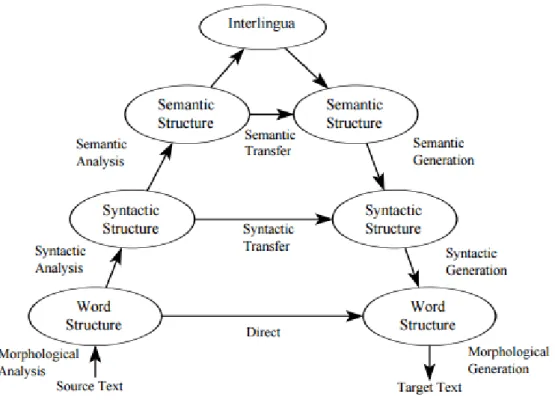
In RBMT systems we can distinguish three architectures, that is to say three ways in which the translation process can be designed. The architecture of a MT system accounts for the general design of the translation process and the way it is performed by the system. The three architectures – direct, transfer, and interlingua – can be distinguished on the basis of the analysis that is involved in the translation process. These different levels of analysis are represented in the Vauquois triangle below.
16
Figure 1. The Vauquois triangle
In Figure 1, we can see the levels of analysis involved in the three architectures that can be used in a MT system. Independently of the kind of architecture, the process always includes the analysis of the source language text and the generation (or synthesis) of the target language text. The analysis provided by the system is quite different in the three architectures and determines the kind of transfer that is performed in the translation process. In a direct approach, the analysis is limited to the word level, and the transfer is word-to-word. In the transfer architecture, the analysis of the source text can be syntactic and semantic, and the syntactic and lexical information retrieved by the source text analysis is transferred to syntactic and lexical information needed for the target text generation. In the interlingua architecture, the analysis of the source text is the most accurate one and provides a deep representation of the meaning of the source language text which is then used to generate the target language text. Both in the transfer and in the interlingua approach, an intermediate representation is considered necessary for the translation to take place.
The tools used in the translation task to acquire the information needed for the automatic system to work include dictionaries, that contain morphological, semantic, and syntactic information. The syntactic analysis is done by a parser, that identifies not only the syntactic structure, but also POS, phrases, and clauses (Hutchins, 1978: 122). The information provided by the parser is relevant not only in the analysis, but also in target
17
language generation, as it helps to retrieve syntactic and lexical information that is used by the system in the translation of the constituent. The features of the constituents (e.g. “animate”, “inanimate”, “male”, “female”, etc.) included in the lexical resource are useful in semantic analysis, as well information regarding semantic relations between predicates and arguments that can be provided, for example, by a semantic parser. Semantic information is crucial in the translation of a sentence because it is often the only way to solve ambiguity cases, for example in the cases of homography and polysemy. As a consequence, semantic analysis in many cases is restricted to ambiguity resolution persisting after morphological and syntactic analysis (Hutchins, 1978: 122).
When a MT system is based on the direct architecture, the result of the translation process is a string of target-language words that maintains the same order of the source-language words. There are some systems with direct architecture that recognize some simple syntactic structures and are able to derive the order of the target language words in the translation of such structures. Only simple syntactic structures are recognized, as the analysis is not based on a complete syntactic analysis. The analysis of the source language is limited to the one that is needed to produce a target text that is acceptable and, therefore, it is determined by the target language (Hutchins, 1978: 121). According to Hutchins, for example, if a word in the source language can only be translated into one word in the target language, it is not relevant if the target language word has also other meanings. The resources used are generally limited to a bilingual dictionary, to find equivalents in the target language and, in some cases, a list of semantic and syntactic specifications, which does not allow the system to perform an accurate analysis (Hutchins, 1978:122). With regard to the quality of the results, it is often difficult or impossible for the readers to understand the target text if they do not know the source language and its characteristics. The lack of source text analysis makes it difficult to successfully handle lexical ambiguities in the majority of the cases. In the cases of lexical ambiguity in which the translation of a word depends on its POS, already mentioned in section 2.3, the system based on a direct architecture is unable to handle the ambiguity, since the POS tagging is not performed and the system cannot determine the word class and function of the word. In such cases, nevertheless, the system selects an equivalent in the target language and this could be either the word that is the most frequent, or the first meaning that is included in the lexical entry. Since the selection of the POS of the equivalent in the target language is not based on POS tagging information, the system often generates an error in the target text. Despite
18
the lack of linguistic information to support the translation process, the results of a direct MT system can be acceptable when the text is simple, the syntax is not critical, and the domain is specific. Given all the aspects mentioned above, direct MT systems rely entirely on post-editing to produce acceptable results. The direct approach was the first adopted in the SYSTRAN MT system (Hutchins, 1978: 26-27), which was eventually combined with other approaches to improve the quality of the results achieved by the system.
As we can see from Figure 1, transfer systems range from systems using a direct architecture and those adopting the interlingua architecture. In the transfer architecture, a translation process involves three stages: the analysis of the source language, transfer, and generation of target language. The source language representations obtained through the analysis of the source text are transformed, or transferred, into the corresponding target language representations. This can be done both at the syntactic and semantic level. Three sets of rules are needed in the process: source-language analysis rules, transfer rules, and target language generation rules (Hutchins 1978: 130). These depend both on the source and on the target language. Source language analysis rules and target language generation rules are able to map the surface text and source and target representations, respectively, while transfer rules map these two types of representations with each other. Semantic analysis and rules can be added to the system in order to improve the results by having a deeper source text analysis. When MT systems incorporate this kind of information, the relevant semantic and syntactic information is combined in the representation of the source text before the transfer. The quality of the results can also be improved by a deeper analysis and more complete rules, and a rich bilingual lexical resource. With regard to ambiguity, as we saw in section 2.3, in those cases in which lexical ambiguity can be solved with POS information, transfer systems are usually able to disambiguate, because the source language analysis provides information about the POS. In those cases in which the ambiguity does not need to be solved in the target text, in some transfer systems, a set of rules is integrated to recognize the cases in which the equivalent in the target language also admits the same ambiguity. However, there are structures that are more problematic and that transfer systems are not able to solve. For instance, the system is not always able to solve ambiguity in long and complex sentences, when the syntax structure is ambiguous and difficult to identify. The disadvantage of transfer systems is that, as stated above, a large set of rules is needed. Additionally, the rules are specific to each language pair considered and direction of translation, and transfer rules have to be prepared and added
19
when the source or the target language changes. In this case, the recognition or production part of the set of rules must be adapted to the new language pair considered (Hutchins, 1978: 130). The MT system developed under the scope of the EUROTRA project which, as previously mentioned aimed at providing multilingual translation for the languages of the European Communities member states, is an example of MT system based on the transfer architecture (Slocum, 1985: 34).
While in MT systems based on the transfer approach a translation is performed between the source language representation and the target language representation, in MT systems that adopt the interlingua architecture the analysis of the source language text results in a representation that is not language-specific. The target text is generated using this “universal” representation. In this architecture, the transfer between the source and the target text is almost absent. According to Hutchins (1978: 131), in this architecture, the translation only consists of two phases: the generation of the interlingua representation from the source text and the generation of the target text from the interlingua representation. Syntactic and semantic information is included in the interlingua representation. This architecture is based on the idea that a single concept can be derived from the meaning of a sentence, and the representation of such a concept is the same in the source and target languages, or in any language. In an interlingua MT system, in order to perform the translation, the sets of rules needed are those linking the surface text and the interlingua representation. The advantage of such an architecture is that the analysis done for one source language can be used for several language pairs and the linking rules used to generate the target language can be used in the translation from any source language. Additionally, indirect approaches (transfer and interlingua) are useful in multilingual MT systems, because only one program has to be written for source analysis and target synthesis for every language. According to Slocum (1985: 11), an example of a MT system based on the interlingua architecture is the one developed under the scope of the CETA project (Centre d’Études pour la Traduction Automatique) at Grenoble University, France, between 1961 and 1971.
Apart from the architecture of the system, RBMT systems can also be distinguished on the basis of the type of linguistic rules they incorporate. For example, we can distinguish MT systems based on rules regarding syntax or lexicon. However, and independently of all these subtypes of RBMT system, overall, the quality of the results obtained with RBMT systems is satisfactory. They are able to handle several cases of ambiguity, for example
20
head-switching ambiguity presented in 6 and 7. The main disadvantage is that creating a system for a new language pair requires a major effort and that grammatical and lexical resources currently available are not sufficient to handle some cases of ambiguity. Additionally, the grammatical and lexical coverage of RBMT systems depends solely on the information integrated in the system and, therefore, the results are poor when the source text contains words or syntactic structures that are not covered by the system and thus which are not recognized by it.
2.4.2 Corpus-Based MT Systems
As we already mentioned, RBMT dominated until the 1980s, while in the end of the decade, corpus-based MT (CBMT) research started to be predominant, thanks to the availability of large text corpora and of computational systems that were able to deal with such data. In CBMT systems, the information needed in the translation process is provided by corpus-data. Among CBMT systems we can distinguish statistical MT (SMT) systems and example-based MT (EBMT) systems. The first results in CBMT research regarding SMT systems were published in 1988 by the IBM center, while those regarding EBMT systems were first published in 1984 by the Japanese computer scientist Nagao (Hutchins, 2015: 14). SMT research focused on the use of probability models in translation, while EBMT research preferred the use of corpora to train the system to obtain translation models. The use of explicit linguistic information in both paradigms is reduced. The number of rules aiding the translation process is limited, while data and translation and language models are extracted from the texts included in the corpus.
As mentioned, the SMT approach was first developed in 1988 at the IBM center, in the Candide project (Hutchins, 1994: 4). The research in the field was based on speech processing techniques and on a mathematical theory of probability distribution and estimation (Dorr et al. 1998: 30). A bilingual parallel corpus was used to acquire a translation model, while a monolingual corpus was used to learn a language model. This approach relies on the use of machine learning methods applied to translation. According to Hutchins (2015: 13), in the development of the MT system, the texts of the bilingual corpus are aligned, in order to acquire a translation model, and the monolingual corpus is analyzed to acquire a language model. The frequency of words in the corpus that is calculated in the development process, as well as the probability of their specific combination and equivalence between language pairs, are used, in the translation process,
21
to identify the most probable equivalent of a given input word or phrase. Once the most probable translation of the words or phrases occurring in a sentence is extracted, the output is reordered based on the language model that determines the most common sequences of words in a given language, i.e. the probability of a given word being followed by another. The language model is developed using a monolingual corpus that contains information about word frequencies in the target language. The kind of corpus that is used determines the accuracy of the translation results, as these depend on the quantity, quality, domain of the data, and their closeness to the type of text being translated. The only information used in the translation process is statistically-retrieved information, extracted from the bilingual corpus, without using any lexicon or grammar, i.e. any external language resources. Therefore, the quality of the translation can be increased by improving the accuracy of the probabilistic models used in the translation process. In comparison to RBMT systems, SMT systems handle cases in which the input is not understood by the system, either because it is the first time it is translated, or because it is not grammatical. Thanks to the probabilistic method, the system is able to provide a translation even in such cases, while RBMT systems are unable to provide any results in such cases since no linguistic rule related to the problem is integrated in the system.
The other paradigm of MT systems that is based on a corpus, in addition to the paradigm adopted in SMT systems, is the one used in example-based MT systems. The first EBMT system, as we already mentioned, was developed in 1984 in Japan. According to Somers (2003: 6), the system presented by Nagao was based on the idea that translation always involves a process of finding examples that are similar to the text to be translated and that were already translated. Therefore, the fundamental steps of MT performed through an EBMT system in the system developed by Nagao were “matching fragments against a database of real examples, identifying the corresponding translation fragments, and recombining these to give the target text” (Somers, 2003: 7). In the system proposed, a bilingual corpus was extracted from dictionaries and pairs that set lexical equivalences. The matching between the source and the target text was done with a semantic method, through a semantic network and domain terms (Hutchins, 2015: 14). In current EBMT systems, the bilingual corpus consists of parallel translations. The source language sentence, or the sentence with the highest correspondence to it in the corpus, when the exact same sentence does not occur in it, are searched in the corpus and this process substitutes the source text analysis that some MT systems such as RBMT systems perform.