CERN-PH-EP/2012-292 2013/11/11
CMS-EXO-12-012
Search for a non-standard-model Higgs boson decaying to
a pair of new light bosons in four-muon final states
The CMS Collaboration
∗Abstract
Results are reported from a search for non-standard-model Higgs boson decays to pairs of new light bosons, each of which decays into the µ+
µ− final state. The new bosons may be produced either promptly or via a decay chain. The data set corresponds to an integrated luminosity of 5.3 fb−1 of proton-proton collisions at
√
s = 7 TeV, recorded by the CMS experiment at the LHC in 2011. Such Higgs bo-son decays are predicted in several scenarios of new physics, including supersym-metric models with extended Higgs sectors or hidden valleys. Thus, the results of the search are relevant for establishing whether the new particle observed in Higgs boson searches at the LHC has the properties expected for a standard model Higgs boson. No excess of events is observed with respect to the yields expected from standard model processes. A model-independent upper limit of 0.86±0.06 fb on the prod-uct of the cross section times branching fraction times acceptance is obtained. The results, which are applicable to a broad spectrum of new physics scenarios, are com-pared with the predictions of two benchmark models as functions of a Higgs boson mass larger than 86 GeV/c2 and of a new light boson mass within the range 0.25– 3.55 GeV/c2.
Published in Physics Letters B as doi:10.1016/j.physletb.2013.09.009.
c
2013 CERN for the benefit of the CMS Collaboration. CC-BY-3.0 license ∗See Appendix A for the list of collaboration members
1
Introduction
The observation of a new particle [1, 2] with a mass near 125 GeV/c2 in searches for the stan-dard model (SM) Higgs boson [3–5] at the Large Hadron Collider (LHC) raises the critical question of whether the new particle is in fact the SM Higgs boson. The precision of the com-parisons of the new particle’s production and decay properties with the final states predicted by the SM will improve with additional data. However, distinguishing a true SM Higgs boson from a non-SM Higgs bosons with couplings moderately different from the SM values will re-main a challenge. Searches for non-SM Higgs boson production and decay modes are therefore particularly timely as they provide a complementary path, which in many cases can allow a discovery or rule out broad ranges of new physics scenarios with existing data.
This Letter presents a search for the production of a non-SM Higgs boson (h) decaying into a pair of new light bosons (a) of the same mass, which subsequently decay to pairs of oppositely charged muons (dimuons) isolated from the rest of the event activity: h → 2a+X → 4µ+X, where X denotes possible additional particles from cascade decays of a Higgs boson. This se-quence of decays is predicted in several classes of models beyond the SM. One example is the next-to-minimal supersymmetric standard model (NMSSM) [6–14], which extends the mini-mal supersymmetric standard model (MSSM) [15–17] by an additional gauge singlet field un-der new U(1)PQsymmetry in the Higgs sector of the superpotential. Compared to the MSSM, the NMSSM naturally generates the mass parameter µ in the Higgs superpotential at the elec-troweak scale [18] and significantly reduces the amount of fine tuning required [19–21]. The Higgs sector of the NMSSM consists of 3 CP-even Higgs bosons h1,2,3 and 2 CP-odd Higgs bosons a1,2.
In the NMSSM, the CP-even Higgs bosons h1and h2can decay via h1,2 → 2a1, where one of the h1or h2is a SM-like Higgs boson that could correspond to the newly observed state at the LHC with a mass near 125 GeV/c2[1, 2] and a1is a new CP-odd light Higgs boson [22–26]. The Higgs boson production cross section may differ substantially from that of the SM, depending on the parameters of a specific model. The new light boson a1couples weakly to SM particles, with the coupling to fermions proportional to the fermion mass, and can have a substantial branching fractionB(a1→µ+µ−)if its mass is within the range 2mµ <ma1 <2mτ [27, 28].
Pair production of light bosons can also occur in supersymmetric models with additional hid-den (or dark) valleys [29–31], which are motivated by the excesses in positron spectra observed by satellite experiments [32, 33]. These dark-SUSY models predict cold dark matter with a mass scale of∼1 TeV/c2, which can provide the right amount of relic density due to the Sommerfeld enhancement in the annihilation cross section arising from a new U(1)D symmetry [34, 35]. In these models, U(1)D is broken, giving rise to light but massive dark photons γD that weakly couple to the SM particles via a small kinetic mixing [36–38] with photons. The lightest neu-tralino n1in the visible (as opposed to hidden) part of the SUSY spectrum is no longer stable and can decay via e.g. n1 → nD+γD, where nD is a light dark fermion (dark neutralino) that es-capes detection. The SM-like Higgs boson can decay via h→2n1, if mh>2mn1. The branching fractionB(h → 2n1)can vary from very small to large, bounded by the LHC measurements in the context of Higgs searches, since the bounds obtained at LEP can be circumvented [31]. The lack of an anti-proton excess in the measurements of the cosmic ray spectrum constrains the mass of γD to be≤O(1)GeV/c2[39]. Assuming that γD can only decay to SM particles, the branching fractionB(γD →µ+µ−)can be as large as 45%, depending on mγD [31]. The Higgs boson production cross section may or may not be enhanced compared to the SM, depending on the specific parameters of the model. The search described in this Letter was designed to be independent of the details of specific models, and the results can be interpreted in the context
2 3 Data selection
of other models predicting the production of the same final states.
Previous searches for the pair production of new light bosons decaying into dimuons were performed at the Tevatron with a 4.2 fb−1data sample [40] and more recently at the LHC with a 35 pb−1 [41] and a 1.9 fb−1 [42] data samples. Associated production of the light CP-odd scalar bosons has been searched for at e+e− colliders [43, 44] and the Tevatron [45]. Direct production of the a1 has been studied at the LHC [46], but in the framework of NMSSM the sensitivity of these searches is limited by the typically very weak coupling of the a1 to SM particles. The most stringent limits on the Higgs sector of the NMSSM are provided by the WMAP data [47] and LEP searches [48–50] (mh1 >86 GeV/c2). In the framework of dark SUSY, experimental searches for γD have focused on the production of dark photons at the end of SUSY cascades at the Tevatron [51–53] and the LHC [41]. Furthermore, if the newly observed particle at the LHC [1, 2] is indeed a Higgs boson, the studies of its SM decays will provide additional constraints on the allowed branching fractions for the non-SM decays.
2
The CMS detector
The analysis presented in this Letter uses experimental data collected by the Compact Muon Solenoid (CMS) experiment at the LHC in 2011. The central feature of the CMS apparatus is a superconducting solenoid of 6 m internal diameter, providing a magnetic field of 3.8 T. Within the superconducting solenoid volume are a silicon pixel and strip tracker, a lead tungstate crystal electromagnetic calorimeter, and a brass/scintillator hadron calorimeter. The inner tracker measures charged particles within the pseudorapidity range |η| < 2.5, where η = −ln[tan(θ/2)]and θ is the polar angle with respect to the direction of the counterclockwise proton beam that is the z-axis of the CMS reference frame. The tracker provides an impact parameter resolution of ∼15 µm and a transverse momentum (pT) resolution of about 1.5% for 100 GeV/c particles. Muons are measured in gas-ionization detectors embedded in the steel return yoke. The muon detectors are made using the following technologies: drift tubes (|η| < 1.2), cathode strip chambers (0.9< |η| <2.4), and resistive-plate chambers (|η| <1.6). Matching the muons to the tracks measured in the silicon tracker results in a transverse mo-mentum resolution between 1 and 5% for pT values up to 1 TeV/c. A more detailed description can be found in Ref. [54].
3
Data selection
The search is performed as a “blind” analysis, i.e. data in the signal region were not used to define the reconstruction and selection procedures. The analysis is based on a data sample corresponding to an integrated luminosity of 5.3 fb−1of proton-proton collisions at√s=7 TeV, obtained in 2011. The data were collected with a trigger selecting events containing at least two muons, one with pT >17 GeV/c and one with pT > 8 GeV/c. In the offline analysis, events are selected by requiring at least one primary vertex reconstructed with at least four tracks and with its z coordinate within 24 cm of the nominal collision point. Offline muon candidates are built using tracks reconstructed in the inner tracker matched to track segments in the muon system, using an arbitration algorithm [55]. The candidates are further required to have at least eight hits in the tracker, with the χ2/Ndof < 4 for the track fit in the inner tracker (where Ndof is the number of degrees of freedom), and at least two matched segments in the muon system. The data are further selected by requiring at least four offline muon candidates with pT > 8 GeV/c and |η| < 2.4; at least one of the candidates must have pT > 17 GeV/c and be reconstructed in the central region, |η| < 0.9. Application of the selection requirements
described above yields 1, 745 events in the data. The trigger efficiency for the selected events is high (96–97%) and is nearly independent of the pT and η of any of the four muons. The
|η| < 0.9 requirement is tighter than that imposed by the trigger, but eliminates significant model dependence attributable to the reduced trigger performance in the forward region in the presence of multiple spatially close muons. This η requirement causes an overall reduction in the analysis acceptance of about 20%, as obtained in a simulation study with one of the NMSSM benchmark samples used in the analysis.
Next, oppositely charged muons are grouped into dimuons (a muon may be shared between several dimuons) if their pairwise invariant mass satisfies mµµ < 5 GeV/c2and if either the fit
of the two muon tracks for a common vertex has a χ2fit probability greater than 1% or the two muon tracks satisfy the cone size requirement∆R(µ+, µ−) =
q
(ηµ+−ηµ−)2+ (φµ+−φµ−)2 <
0.01, where φ is the azimuthal angle in radians. The ∆R requirement compensates for the re-duced efficiency of the vertex probability requirement for dimuons with very low mass (mµµ &
2mµ), in which the two muon tracks are nearly parallel to each other at the point of closest
approach.
Once all dimuons are constructed, only events with exactly two dimuons not sharing common muons are selected for further analysis. There is no restriction on the number of ungrouped (orphan) muons. Assuming that each dimuon is a decay product of a new light boson, we require that the two dimuons have invariant masses in the range 0.25–3.55 GeV/c2. We recon-struct zµµ, the projected z coordinate of the dimuon system at the point of the closest approach
to the beam line, using the dimuon momentum measured at the common vertex and the vertex position. We ensure that the two dimuons originate from the same pp interaction by requiring
|zµµ1 −zµµ2| <1 mm. This selection yields 139 events in data and it is fully efficient for signal events while reducing the probability of selecting rare events with dimuons from two separate primary interactions.
To suppress backgrounds with dimuons coming from jets, we require that the dimuons be isolated from other activity in the event, using the criterion Isum<3 GeV/c, where the isolation parameter of the dimuon system Isum is defined as the scalar sum of the transverse momenta of all additional charged tracks with pT >0.5 GeV/c within a cone of size∆R=0.4 centered on the momentum vector of the dimuon system. Tracks used in the calculation of Isummust also have a z coordinate at the point of the closest approach to the beam line that lies within 1 mm of the z coordinate of the dimuon system. The Isumselection yields three events in data and it suppresses the contamination from bb production by about a factor of 40 (measured in data) while rejecting less than 10% of the signal events (obtained from the simulation study).
Finally, we require that the invariant masses of the two reconstructed dimuons are compatible with each other within the detector resolution|m1−m2| <0.13 GeV/c2+0.065× (m1+m2)/2, where m1 = mµµ1 and m2 = mµµ2. The numerical parameters in this last requirement corre-spond to at least five times the size of the core resolution in dimuon mass, including the differ-ences in resolution in the central and forward regions. The signal inefficiency of this m1 ' m2 selection is less than 5% per event; it is due to QED final-state radiation and is unrelated to the detector resolution. No constraint is imposed on the four-muon invariant mass, in order to maintain the model independence of the analysis, in particular with respect to models resulting in cascade decays such as dark-SUSY, where an unknown fraction of the energy goes into the light dark fermions, which escape detection.
To demonstrate the ability of the analysis to select a possible signal, we use the two benchmark models introduced earlier. The NMSSM samples are simulated with the PYTHIA 6.4.26 event
4 3 Data selection
Table 1: Event selection efficiencies efullMC(mh1, ma1), as obtained from the full detector simula-tion, and the geometric and kinematic acceptances αgen(mh1, ma1) calculated using generator level information only, with statistical uncertainties for the NMSSM benchmark model. The experimental data-to-simulation scale factors are not applied.
mh1[GeV/c 2] 90 100 125 125 125 125 125 150 ma1[GeV/c 2] 2 2 0.25 0.5 1 2 3 2 efullMC[%] 12.1±0.1 14.7±0.1 46.2±0.1 24.6±0.2 21.1±0.1 20.1±0.1 19.7±0.1 24.0±0.1 αgen[%] 16.6±0.1 20.0±0.1 62.2±0.1 33.2±0.3 28.6±0.1 27.5±0.1 27.1±0.1 33.2±0.1 efullMC/αgen[%] 73.0±0.3 73.5±0.3 74.3±0.3 74.2±0.6 73.8±0.3 72.6±0.3 72.7±0.3 72.2±0.2
Table 2: Event selection efficiencies eMCfull(mh, mγD), as obtained from the full detector simulation, and the geometric and kinematic acceptances αgen(mh, mγD)calculated using generator level information only, with statistical uncertainties for a dark-SUSY benchmark model, as obtained from simulation. The experimental data-to-simulation scale factors are not applied.
mh[GeV/c2] 90 125 150 mγD[GeV/c 2] 0.4 0.4 0.4 eMCfull[%] 2.7±0.1 7.6±0.1 11.4±0.1 αgen[%] 3.6±0.1 10.1±0.1 15.2±0.1 eMCfull/αgen[%] 76.1±0.8 75.5±0.5 74.9±0.4
generator [56] using MSSM Higgs boson production via gluon-gluon fusion gg → H0MSSM, where the Higgs bosons are forced to decay via H0MSSM →2A0MSSM. The masses of H0MSSM and A0MSSM are set to the desired values for the h1 mass and a1 mass, respectively. Both A0MSSM bosons are forced to decay to a pair of muons. The dark-SUSY samples are simulated with the MADGRAPH4.5.2 event generator [57] using SM Higgs boson production via gluon-gluon fusion gg→hSM, where the mass of hSMis set to the desired value for the h mass. TheBRIDGE software [58] was used to implement the new physics model that forces the Higgs bosons hSM to undergo a non-SM decay to a pair of neutralinos n1, each of which decays n1 → nD+γD, where mn1 = 10 GeV/c2, mnD = 1 GeV/c2 and mγD = 0.4 GeV/c2. Both dark photons γD are forced to decay to two muons, while both dark neutralinos nD escape detection. The narrow width approximation is imposed by setting the widths of the Higgs bosons and dark photons to a small value (10−3GeV/c2). All benchmark samples are generated using the leading-order CTEQ6L1 [59] set of parton distribution functions (PDF), and are interfaced withPYTHIA6.4.26 using the Z2 tune [60] for “underlying event” (UE) activity at the LHC and to simulate jet fragmentation, when applicable.
All events in the benchmark signal samples are processed through a detailed simulation of the CMS detector based on GEANT4 [61] and are reconstructed with the same algorithms used for data analysis. Tables 1 and 2 show the event selection efficiencies eMCfull obtained using the simu-lated signal events for these two benchmark models using representative choices for masses of h, a1or γD. To provide a simple recipe for future reinterpretations of the results in the context of other models, we separately determine αgen, the geometric and kinematic acceptance of this analysis calculated using generator level information only. It is defined with the criteria that an event contains at least four muons with pT >8 GeV/c and|η| <2.4, with at least one of these muons having pT >17 GeV/c and|η| <0.9. Tables 1 and 2 also show αgenalong with the ratio eMCfull/αgen.
The model independence of the ratio eMCfull/αgen permits an estimate of the full event selection efficiency of this analysis for an arbitrary new physics model predicting the signature with a pair of new light bosons. The analysis makes some assumptions on the nature and characteris-tics of the new light bosons, namely that they should be of the same type, have a mass in range 2mµ <ma <2mτ, decay to the µ+µ−final state and not have a significant lifetime. In addition,
the two bosons, should be isolated and sufficiently separated from each other to avoid being vetoed by the isolation requirement. The acceptance αgenmay be calculated using only the gen-erator level selection requirements that have been defined above. The full efficiency efullcould then be calculated by multiplying αgen by the ratio efull/αgen = r×eMCfull/αgen = 0.67±0.05, where r = efull/eMCfull = 0.91±0.07 is the scale factor defined in Sec. 5 that accounts for dif-ferences between data and simulation, and eMC
full/αgen = 0.74±0.02 is an average ratio over all of the benchmark points used. The systematic uncertainty in the ratio efull/αgen is around 7.4%. For reference, the individual systematics uncertainties in αgenand efullare 3.0% and 8.0%, respectively, as discussed in Sec. 5.
4
Background estimation
The background contributions after final selections are dominated by bb and direct J/ψ pair production events. The leading part of the bb contribution is due to b-quark decays to pairs of muons via double semileptonic decays or resonances, i.e. ω, ρ, φ, J/ψ. A smaller contri-bution comes from events with one real dimuon and a second dimuon with a muon from a semileptonic b-quark decay and a charged hadron misidentified as another muon. The misidentification typically occurs due to the incorrect association of the track of the charged hadron with the track segments from a real muon in the muon system. The contribution of other SM processes has been found to be negligible (less than 0.1 events combined), for ex-ample low mass Drell–Yan production is heavily suppressed by the requirement of additional muons, and pp → Z/γ∗ → 4µ production is suppressed by the requirement of small and mutually consistent masses of the dimuons [27]. The analysis is not sensitive to SM process pp → H → ZZ → 4µ because the invariant mass of the dimuons is substantially lower than the Z mass.
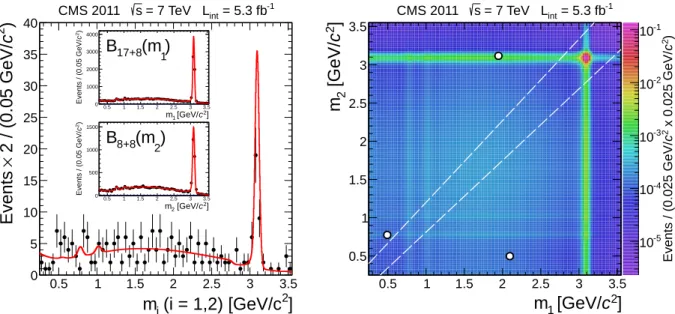
Using data control samples, the bb background is modeled as a two dimensional (2D) template Bbb(m1, m2) in the plane of the invariant masses of the two dimuons in the selected events, where m1 always refers to the dimuon containing a muon with pT > 17 GeV/c and|η| < 0.9. For events with both dimuons containing such a muon, the assignment of m1 and m2 is ran-dom. As each b quark fragments independently, we construct the template describing the 2D probability density function as a Cartesian product B17+8(m1) ×B8+8(m2), where the B17+8 and B8+8templates model the invariant-mass distributions for dimuons with or without the re-quirement that the dimuon contains at least one muon satisfying pT >17 GeV/c and|η| < 0.9. This distinction is necessary as the shape of the dimuon invariant mass distribution depends on the transverse momentum thresholds used to select muons and whether the muons are in the central (|η| < 0.9) or in the forward (0.9 < |η| < 2.4) regions, owing to the differences in momentum resolution of the barrel and endcap regions of the tracker. The B17+8 shape is measured using a data sample enriched in bb events with exactly one dimuon and one orphan muon under the assumption that one of the b quarks decays to a dimuon containing at least one muon with pT > 17 GeV/c and|η| <0.9, while the other b quark decays semileptonically resulting in an orphan muon with pT > 8 GeV/c. For the B8+8shape, we use a similar sample and procedure but only require the dimuon to have both muons with pT >8 GeV/c, while the orphan muon has to have pT > 17 GeV/c and |η| < 0.9. Both data samples used to measure
6 4 Background estimation ] 2 (i = 1,2) [GeV/c i m 0.5 1 1.5 2 2.5 3 3.5 ) 2 c 2 / (0.05 GeV/ × Events 0 5 10 15 20 25 30 35 40 ] 2 c [GeV/ 2 m 0.5 1 1.5 2 2.5 3 3.5 ) 2 c Events / (0.05 GeV/ 0 500 1000 1500 ) 2 (m 8+8 B ] 2 c [GeV/ 1 m 0.5 1 1.5 2 2.5 3 3.5 ) 2c Events / (0.05 GeV/ 0 1000 2000 3000 4000 ) 1 (m 17+8 B -1 = 5.3 fb int = 7 TeV L s CMS 2011 ) 2 c x 0.025 GeV/ 2 c Events / (0.025 GeV/ -5 10 -4 10 -3 10 -2 10 -1 10 ] 2 c [GeV/ 1 m 0.5 1 1.5 2 2.5 3 3.5 ] 2 c [GeV/2 m 0.5 1 1.5 2 2.5 3 3.5 -1 = 5.3 fb int = 7 TeV L s CMS 2011
Figure 1: Left: Comparison of the data (solid circles) failing the m1 ' m2 requirement in the control sample where no isolation requirement is applied to reconstructed dimuons with the prediction of the background shape model (solid line) scaled to the number of entries in the data. The insets show the B17+8 and B8+8 templates (solid lines) for dimuons obtained with background-enriched data samples. Right: Distribution of the invariant masses m1 vs. m2for the isolated dimuon systems for the three events in the data (shown as empty circles) surviving all selections except the requirement that these two masses fall into the diagonal signal region m1 'm2(outlined with dashed lines). The intensity (color online) of the shading indicates the background expectation which is a sum of the bb and the direct J/ψ pair production contribu-tions.
background shapes are collected with the same trigger and with kinematic properties similar to those bb events passing the selections of the main analysis. These event samples do not overlap the sample containing two dimuons that is used for the main analysis, and they have negligible contributions from non-bb backgrounds. The B17+8and B8+8distributions, fitted with a para-metric analytical function using a combination of Bernstein polynomials [62] and Crystal Ball functions [63] describing resonances, are shown as insets in Fig. 1 (left). Once the Bbb(m1, m2)
template is constructed, it is used to provide a description of the bb background shape in the main analysis.
To validate the constructed Bbb(m1, m2)template, we compare its shape with the distribution of the invariant masses m1 vs. m2 from events obtained with all standard selections except the requirement that each of the two reconstructed dimuons is isolated. Omitting the isolation requirement provides a high-statistics control sample of events with two dimuons highly en-riched with bb events. To avoid unblinding the search, the diagonal signal region is excluded in both the data and the template, i.e. the comparison has been limited to the data events that satisfy all analysis selections but fail the m1 ' m2requirement. Distributions of m1and m2are consistent with the projections of the Bbb(m1, m2)template on the respective axes normalized to the number of events in the data control sample. The sum of the m1 and m2 distributions agrees well with the sum of the template projections as shown in Fig. 1 (left).
Another cross-check has been performed using data events which satisfy all analysis selec-tions except that the isolation parameters of each dimuon system have been required to satisfy 3 GeV/c < Isum < 8 GeV/c, which removes potential signal events since the signal selections
require Isum <3 GeV/c for each dimuon. These selections with both dimuons in isolation side-band yield four events in the off-diagonal region and zero events in the diagonal region of
(m1, m2)plane. Normalizing the background distribution to these four observed events, we predict 0.9±0.4 bb events in the diagonal region of the(m1, m2)plane with both dimuons in the isolation sideband (3 GeV/c< Isum <8 GeV/c). This prediction is consistent with no events being observed there.
To normalize the constructed Bbb(m1, m2)template, we use the data events that satisfy all anal-ysis selections, but fail the m1 ' m2 requirement. These selections yield three events in the off-diagonal sideband region of the(m1, m2)plane, leading, in the diagonal signal region, to an expected number of 0.7±0.4 bb events, where the estimated uncertainty is dominated by the statistical uncertainty. These three events in the off-diagonal sidebands of the (m1, m2)plane are shown as empty circles in Fig. 1 (right).
The direct J/ψ pair production contribution is estimated using simulations normalized to the data in the region of low invariant mass of the two J/ψ candidates. The data for the study were collected using a trigger requiring three muon candidates with transverse momenta pT > 1 GeV/c and a scalar sum of momenta p(µ1) +p(µ2) +p(µ3) > 2.5 GeV/c. In addition, among these muon candidates there must be at least one pair with opposite charges, originating from a common vertex and having an invariant mass in the range 2.8 < mµµ < 3.35 GeV/c2. In the
offline selection, four high quality muon candidates are required, forming two J/ψ candidates within this same mass window. The resulting data sample has significant contamination from non-prompt J/ψ pairs produced in heavy flavor decays, combinatorial backgrounds, and com-binations of the two. The rate of prompt double J/ψ production in the data sample is extracted by extrapolating in the plane of the transverse lifetime ctxyof the two J/ψ candidates and their measured invariant masses. The rate thus obtained from data is used to normalize the simula-tion, which is produced using the double parton scattering (DPS) J/ψ pair production process in thePYTHIA8.108 event generator [64], applying the same selections as applied to the data.
This calculation provides an estimate of the background rate due to prompt double J/ψ pro-duction in the signal region. To evaluate the systematic uncertainty, this normalization factor is recalculated separately for each of the four ranges of the invariant masses m2J/ψof the two J/ψ candidates: 6–13, 13–22, 22–35, and 35–80 GeV/c2. Although the control samples overlap with the data sample used for the search, for none of the benchmark models considered are the con-trol samples significantly contaminated with the signal. This is because the dark-SUSY models predict new bosons with a mass of less than 1 GeV/c2, and LEP measurements set an upper limit of about 90 GeV/c2on the NMSSM CP-even Higgs boson mass. With approximately 1500 events in the prompt double J/ψ control sample, the statistical component of the prompt double J/ψ background uncertainty is very small compared to the systematic error. For this reason, the correlation introduced into the limit calculation by the potential presence of a small amount of signal in the control region may be safely neglected. Nevertheless, we have treated the higher mass ranges with particular caution, as an excess there could be a sign of a potential signal of new physics, in which case it would have been necessary to change the strategy of this analy-sis. Measurements in all ranges of m2J/ψyield consistently low estimates of the contamination due to the prompt double J/ψ background in the signal region. The final estimate of the rate is 0.3±0.3, where the uncertainty accounts for both statistical and systematic effects. This value is used to normalize a 2D Gaussian template B2J/ψ(m1, m2)in the (m1, m2)plane that models the double J/ψ background contribution.
The distribution of the total background expectation in the (m1, m2) plane is Bbb(m1, m2) + B2J/ψ(m1, m2), i.e. a sum of the bb and the direct J/ψ pair production contributions. It is shown by the intensity of the shading in Fig. 1 (right). The background expectation in the diagonal
sig-8 5 Systematic uncertainties
]
2c
[GeV/
1 hm
90 100 110 120 130 140 150) [fb]
µ
2
→
1(a
2) B
12a
→
1,2h
→
(pp
σ
0 1 2 3 4 5 6 7 8 NMSSM 95% CL Limits: 2 c = 3.55 GeV/ 1 a m 2 c = 2 GeV/ 1 a m 2 c = 0.25 GeV/ 1 a m ), 1 h (m SM σ ) = 1 h → (pp σ Prediction with ) = 0, 1 2a → 2 B(h × ) 2 h → (pp σ ) = 3%, 1 2a → 1 B(h ) = 7.7% µ 2 → 1 and B(a -1 = 5.3 fb int = 7 TeV L s CMS 2011]
2c
[GeV/
hm
90 100 110 120 130 140 150) [fb]
µ
2
→
Dγ
(
2) B
D+2n
Dγ
2
→
h
→
(pp
σ
0 5 10 15 20 25 30Dark SUSY 95% CL Limit:
2 c = 1 GeV/ D n , m 2 c = 10 GeV/ 1 n m 2 c = 0.4 GeV/ D γ and m ), h (m SM σ h)= → (pp σ Prediction with ) = 1%, 1 2n → B(h ) = 50%, D + n D γ → 1 B(n ) = 45% µ 2 → D γ and B( -1 = 5.3 fb int = 7 TeV L s CMS 2011
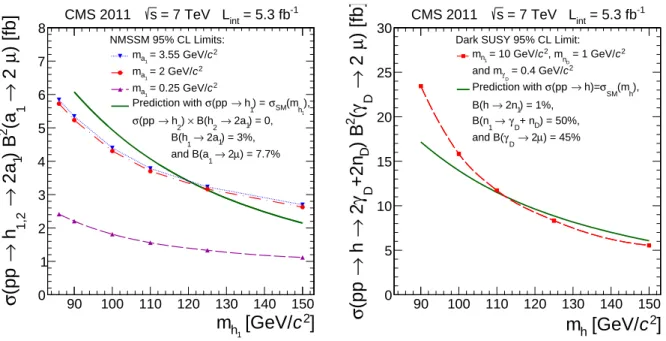
Figure 2: Left: The 95% CL upper limits as functions of mh1, for the NMSSM case, on σ(pp→ h1,2 → 2a1) × B2(a1 → 2µ)with ma1 = 0.25 GeV/c
2 (dashed curve), m
a1 = 2 GeV/c
2 (dash-dotted curve) and ma1 =3.55 GeV/c
2(dotted curve). As an illustration, the limits are compared to the predicted rate (solid curve) obtained using a simplified scenario with σ(pp → h1) = σSM(mh1) [65], σ(pp → h2) × B(h2 → 2a1) = 0, B(h1 → 2a1) = 3%, and B(a1 → 2µ) = 7.7%. The chosenB(a1 → 2µ)is taken from [28] for ma1 = 2 GeV/c2 and NMSSM parameter tan β = 20. Right: The 95% CL upper limit as a function of mh, for the dark-SUSY case, on σ(pp→ h→ 2n1 → 2nD+2γD) × B2(γD → 2µ)with mn1 = 10 GeV/c
2, mn
D =1 GeV/c 2 and mγD = 0.4 GeV/c
2 (dashed curve). As an illustration, the limit is compared to the predicted rate (solid curve) obtained using a simplified scenario with SM Higgs boson production cross section σ(pp → h) = σSM(mh) [65], B(h → 2n1) = 1%, B(n1 → nD+γD) = 50%, and
B(γD →2µ) =45%. The chosenB(γD →2µ)is taken from [31] for mγD =0.4 GeV/c 2.
nal region is 1.0±0.5 events, where the uncertainty accounts for both statistical and systematic effects.
5
Systematic uncertainties
The selection efficiencies of offline muon reconstruction, trigger, and dimuon isolation criteria are obtained with simulation and have been corrected with scale factors derived from a com-parison of data and simulation using Z → µµ and J/ψ → µµ samples. The scale factor per event is r = 0.91±0.07 (syst.). It accounts for the differences in the efficiency of the trigger, the efficiency of the muon reconstruction and identification for each of the four muon candi-dates, and the combined efficiency of the isolation requirement for the two dimuon candidates. The correlations due to the presence of two close muons have been taken into account. The main systematic uncertainty is in the offline muon reconstruction (5.7%) which includes an uncertainty (1% per muon) to cover variations of the scale factor as a function of pT and η of muons. Other systematic uncertainties include the uncertainty in the trigger (1.5%), dimuon isolation (negligible), dimuon reconstruction effects related to overlaps of muon trajectories in the tracker and in the muon system (3.5%), and dimuon mass shape, which affects the efficiency of the requirement that the two dimuon masses are compatible (1.5%). The uncertainty in the LHC integrated luminosity of the data sample (2.2%) is also included [66]. All the uncertainties
]
2c
[GeV/
1 am
0 0.5 1 1.5 2 2.5 3 3.5 4) [fb]
µ
2
→
1(a
2) B
12a
→
1,2h
→
(pp
σ
1 10 2 10 NMSSM 95% CL Limits: 2 c = 90 GeV/ 1 h m 2 c = 125 GeV/ 1 h m 2 c = 150 GeV/ 1 h m ) = 3% 1 2a → 1 Prediction with B(h ), 2 c = 125 GeV/ 1 h (m SM σ ) = 1 h → (pp σ ) = 0 1 2a → 2 B(h × ) 2 h → (pp σ and -1 = 5.3 fb int = 7 TeV L s CMS 2011]
2c
[GeV/
1 am
0 0.5 1 1.5 2 2.5 3 3.5 4) [%]
µ
2
→
1(a
2) B
12a
→
1B(h
-2 10 -1 10 1 NMSSM 95% CL Limits with ) = 0: 2 h → (pp σ ) and 1 h (m SM σ ) = 1 h → (pp σ 2 c = 90 GeV/ 1 h m 2 c = 125 GeV/ 1 h m 2 c = 150 GeV/ 1 h m ) = 3% 1 2a → 1 Prediction with B(h -1 = 5.3 fb int = 7 TeV L s CMS 2011Figure 3: Left: The 95% CL upper limits as functions of ma1, for the NMSSM case, on σ(pp→ h1,2 → 2a1) × B2(a1 → 2µ) with mh1 = 90 GeV/c
2 (dashed curve), m
h1 = 125 GeV/c
2 (dash-dotted curve) and mh1 = 150 GeV/c
2 (dotted curve). The limits are compared to the predicted rate (solid curve) obtained using a simplified scenario withB(h1 →2a1) =3%, σ(pp→h1) = σSM(mh1 =125 GeV/c
2)[65], σ(pp→h
2) × B(h2 →2a1) =0, andB(a1 →2µ)as a function of ma1which is taken from [28] for NMSSM parameter tan β=20. Right: The 95% CL upper limits onB(h1→2a1) × B2(a1 →2µ)with mh1 =90 GeV/c
2(dashed curve), m
h1 =125 GeV/c
2 (dash-dotted curve) and mh1 =150 GeV/c
2(dotted curve) assuming σ(pp→h
1) =σSM(mh1)[65] and
σ(pp→ h2) × B(h2 → 2a1) = 0. The limits are compared to the predicted branching fraction (solid line) obtained using a simplified scenario withB(h1 →2a1) =3% andB(a1 →2µ)as a function of ma1 which is taken from [28] for NMSSM parameter tan β=20.
quoted above, which relate to the final analysis selection efficiency for signal events, sum up to 7.4%. The uncertainties related to the parton distribution functions (PDFs) and the knowledge of the strong coupling constant αsare estimated by comparing the PDFs in CTEQ6.6 [67] with those in NNPDF2.0 [68] and MSTW2008 [69] following the PDF4LHC recommendations [70]. Using the analysis benchmark samples, they are found to be 3% for the signal acceptance. Vary-ing the QCD renormalization/factorization scales has a negligible effect. The total systematic uncertainty in the signal acceptance and selection efficiency is 8.0%.
6
Results
When the data satisfying all analysis selections were unblinded, no events were observed in the signal diagonal region, as illustrated in Fig. 1 (right). The expected background in the diagonal signal region is 1.0±0.5 events, where the uncertainty accounts for both statistical and systematic effects. This background includes contributions from bb production and direct J/ψ pair production, as discussed in Sec. 4.
For an arbitrary new physics model predicting the signature investigated in this Letter, the results can be presented as the 95% confidence level (CL) upper limit:
10 6 Results
where αgen is the generator-level kinematic and geometric acceptance defined in Sec. 3. The calculation uses the value of the integrated luminosityL = 5.3 fb−1of the data, and takes the ratio efull/αgen =0.67±0.05, derived in Sec. 3. This ratio includes the scale factor that corrects for experimental effects not accounted for by the simulation. The variation in this ratio over all of the used benchmark points is covered by systematic uncertainties. The limit is applicable to models with two pairs of muons coming from light bosons of the same type with a mass in range 0.25 < ma < 3.55 GeV/c2where the new light bosons are typically isolated, spatially separated to not be vetoed by the isolation requirement and have no substantial lifetime. The efficiency of the selections in this analysis abruptly deteriorates if the light boson’s decay vertex is more than∼4 cm from the beamline in the transverse plane.
We interpret these results in the context of the NMSSM and the dark-SUSY benchmark models, taking into account the dependence of the signal selection efficiencies on mhand ma(see Tab. 1 and Tab. 2), and derive 95% CL upper limits on the product of the cross section and branching fraction, using a Bayesian prescription. We also compare the derived experimental limits with a few simplified prediction scenarios. In the representative models, for any fixed combinations of mhand ma both the Higgs boson production cross section and the branching fractions can vary significantly, depending on the choice of parameters. In the absence of broadly accepted benchmark scenarios, we normalize the production cross sections in these examples to that of the SM Higgs boson [65].
For the NMSSM, the 95% CL upper limit is derived for σ(pp→h1,2 →2a1) × B2(a1 → 2µ) as a function of mh1 for three choices of ma1 as shown in Fig. 2 (left) and as a function of ma1 for three choices of mh1 as shown in Fig. 3 (left). As mh2 is unrestricted for any given mh1, we use efull(mh2) =efull(mh1)to simplify the interpretation. This is conservative since efull(mh2) >
efull(mh1)if mh2 >mh1, for any ma1. We also derive the 95% CL upper limit forB (h1 →2a1) ×
B2(a
1 → 2µ)as a function of ma1 for three choices of mh1 as shown in Fig. 3 (right) assuming that only h1gives a significant contribution to the final state considered in this analysis and has the production cross section of a SM Higgs boson, i.e. σ(pp → h1) = σSM(mh1)and σ(pp → h2) × B(h2 →2a1) = 0. For the NMSSM simplified prediction scenario we useB(a1 →2µ)as a function of ma1, calculated in [28] for tan β=20 with no hadronization effects included in the ma1 <2mτregion. The branching fractionB(a1→2µ)is influenced by the a1 →s¯s and a1 →gg channels. The significant structures in the predicted curves visible in Fig. 3 arise from the fact thatB(a1→ gg)varies rapidly in that region of ma1. The rapid variation inB(a1 →gg)occurs when ma1 crosses the internal quark loop thresholds. The representative value ofB(a1 → 2µ) is equal to 7.7% for ma1 ≈ 2 GeV/c
2. Finally, we choose B(h
1 → 2a1) = 3%, which yields predictions for the rates of dimuon pair events comparable to the obtained experimental limits. In the case of the dark-SUSY model, the 95% CL upper limit is derived for σ(pp→h→2n1→
2nD+2γD) × B2(γD →2µ)as a function of mh. This limit is shown in Fig. 2 (right) for mn1 = 10 GeV/c2, mnD = 1 GeV/c2 and mγD = 0.4 GeV/c
2. For the dark-SUSY simplified prediction scenario we use the branching fractionB(γD →2µ)close to its maximum at mγD =0.4 GeV/c
2, of 45%, calculated in [31]. We also useB(n1 → nD+γD) = 50%, allowing for other possible decays. Finally, we chooseB(h→2n1) =1%, which yields predictions for the rates of dimuon pair events comparable to the obtained experimental limits.
The sensitivity of this search can be compared to that of a similar analysis performed at the Tevatron [40] after rescaling with the ratio of the Higgs boson cross sections at the LHC and the Tevatron. If plotted in Fig. 2 and Fig. 3 (left), the Tevatron results would have exclusion limits above∼130 fb, therefore the search presented in this Letter has one order of magnitude better sensitivity compared to previous experimental constraints.
7
Summary
A search for non-standard-model Higgs boson decays to pairs of new light bosons, which sub-sequently decay to pairs of oppositely charged muons (h → 2a+X → 4µ+X) has been pre-sented. The search is based on a data sample corresponding to an integrated luminosity of 5.3 fb−1collected by the CMS experiment in proton-proton collisions at√s =7 TeV in 2011. No excess is observed with respect to the SM predictions. An upper limit at 95% confidence level on the product of the cross section times branching fraction times acceptance is obtained. The limit is valid for new light-boson masses in the range 0.25 < ma < 3.55 GeV/c2 and for Higgs boson masses in the range mh > 86 GeV/c2. Although the results have been interpreted in the context of the NMSSM and the dark-SUSY benchmark models for mh < 150 GeV/c2, it is pos-sible to extend them by smoothly extrapolating the model-independent cross section limit to higher masses. The analysis has been designed as a quasi-model-independent search allowing interpretation of its results in the context of a broad range of new physics scenarios predicting the same type of signature. In the context of the NMSSM and one of the SUSY models with hid-den valleys this search provides the best experimental limits to date, significantly surpassing the sensitivity of similar searches performed at the Tevatron.
8
Acknowledgments
We would like to thank Joshua Ruderman (LBNL and University of California at Berkeley) for his guidance with the theoretically motivated benchmark samples of dark SUSY and useful discussions. We wish to congratulate our colleagues in the CERN accelerator departments for the excellent performance of the LHC machine. We thank the technical and administrative staff at CERN and other CMS institutes, and acknowledge support from: FMSR (Austria); FNRS and FWO (Belgium); CNPq, CAPES, FAPERJ, and FAPESP (Brazil); MES (Bulgaria); CERN; CAS, MoST, and NSFC (China); COLCIENCIAS (Colombia); MSES (Croatia); RPF (Cyprus); Academy of Sciences and NICPB (Estonia); Academy of Finland, MEC, and HIP (Finland); CEA and CNRS/IN2P3 (France); BMBF, DFG, and HGF (Germany); GSRT (Greece); OTKA and NKTH (Hungary); DAE and DST (India); IPM (Iran); SFI (Ireland); INFN (Italy); NRF and WCU (Korea); LAS (Lithuania); CINVESTAV, CONACYT, SEP, and UASLP-FAI (Mexico); MSI (New Zealand); PAEC (Pakistan); SCSR (Poland); FCT (Portugal); JINR (Armenia, Belarus, Georgia, Ukraine, Uzbekistan); MST and MAE (Russia); MSTD (Serbia); MICINN and CPAN (Spain); Swiss Funding Agencies (Switzerland); NSC (Taipei); TUBITAK and TAEK (Turkey); STFC (United Kingdom); DOE and NSF (USA).
References
[1] ATLAS Collaboration, “Observation of a new particle in the search for the standard model Higgs boson with the ATLAS detector at the LHC”, Phys. Lett. B 716 (2012) 1, doi:10.1016/j.physletb.2012.08.020, arXiv:1207.7214.
[2] CMS Collaboration, “Observation of a new boson at a mass of 125 GeV with the CMS experiment at the LHC”, Phys. Lett. B 716 (2012) 30,
doi:10.1016/j.physletb.2012.08.021, arXiv:1207.7235.
[3] F. Englert and R. Brout, “Broken symmetry and the mass of gauge vector mesons”, Phys. Rev. Lett. 13 (1964) 321, doi:10.1103/PhysRevLett.13.321.
12 References
[4] P. W. Higgs, “Broken symmetries and the masses of gauge bosons”, Phys. Rev. Lett. 13 (1964) 508, doi:10.1103/PhysRevLett.13.508.
[5] G. S. Guralnik, C. R. Hagen, and T. W. B. Kibble, “Global conservation laws and massless particles”, Phys. Rev. Lett. 13 (1964) 585, doi:10.1103/PhysRevLett.13.585. [6] P. Fayet, “Supergauge invariant extension of the Higgs mechanism and a model for the
electron and its neutrino”, Nucl. Phys. B 90 (1975) 104, doi:10.1016/0550-3213(75)90636-7.
[7] R. K. Kaul and P. Majumdar, “Cancellation of quadratically divergent mass corrections in globally supersymmetric spontaneously broken gauge theories”, Nucl. Phys. B 199 (1982) 36, doi:10.1016/0550-3213(82)90565-X.
[8] R. Barbieri, S. Ferrara, and C. A. Savoy, “Gauge models with spontaneously broken local supersymmetry”, Phys. Lett. B 119 (1982) 343,
doi:10.1016/0370-2693(82)90685-2.
[9] H. P. Nilles, M. Srednicki, and D. Wyler, “Weak interaction breakdown induced by supergravity”, Phys. Lett. 120 (1983) 346, doi:10.1016/0370-2693(83)90460-4. [10] J.-M. Frere, D. R. T. Jones, and S. Raby, “Fermion masses and induction of the weak scale
by supergravity”, Nucl. Phys. B 222 (1983) 11, doi:10.1016/0550-3213(83)90606-5.
[11] J.-P. Derendinger and C. A. Savoy, “Quantum effects and SU(2)×U(1) breaking in supergravity gauge theories”, Nucl. Phys. B 237 (1984) 307,
doi:10.1016/0550-3213(84)90162-7.
[12] M. Drees, “Supersymmetric models with extended Higgs sector”, Int. J. Mod. Phys. A 4 (1989) 3635, doi:10.1142/S0217751X89001448.
[13] M. Maniatis, “The next-to-minimal supersymmetric extension of the standard model reviewed”, Int. J. Mod. Phys. A 25 (2010) 3505, doi:10.1142/S0217751X10049827, arXiv:0906.0777.
[14] U. Ellwanger, C. Hugonie, and A. M. Teixeira, “The next-to-minimal supersymmetric standard model”, Phys. Rept. 496 (2010) 1, doi:10.1016/j.physrep.2010.07.001, arXiv:0910.1785.
[15] H. P. Nilles, “Supersymmetry, supergravity and particle physics”, Phys. Rept. 110 (1984) 1, doi:10.1016/0370-1573(84)90008-5.
[16] S. P. Martin, “A supersymmetry primer”, (1997). arXiv:hep-ph/9709356. [17] D. J. H. Chung et al., “The soft supersymmetry breaking Lagrangian: theory and
applications”, Phys. Rept. 407 (2005) 1, doi:10.1016/j.physrep.2004.08.032, arXiv:hep-ph/0312378.
[18] J. E. Kim and H. P. Nilles, “The µ-problem and the strong CP-problem”, Phys. Lett. B 138 (1984) 150, doi:10.1016/0370-2693(84)91890-2.
[19] J. A. Casas, J. R. Espinosa, and I. Hidalgo, “The MSSM fine tuning problem: a way out”, JHEP 01 (2004) 008, doi:10.1088/1126-6708/2004/01/008,
[20] R. Dermisek and J. F. Gunion, “Escaping the large fine tuning and little hierarchy problems in the next to minimal supersymmetric model and h→aa decays”, Phys. Rev. Lett. 95 (2005) 041801, doi:10.1103/PhysRevLett.95.041801,
arXiv:hep-ph/0502105.
[21] S. Chang, R. Dermisek, J. F. Gunion, and N. Weiner, “Nonstandard Higgs boson decays”, Ann. Rev. Nucl. Part. Sci. 58 (2008) 75,
doi:10.1146/annurev.nucl.58.110707.171200, arXiv:0801.4554.
[22] J. Ellis et al., “Higgs bosons in a nonminimal supersymmetric model”, Phys. Rev. D 39 (1989) 844, doi:10.1103/PhysRevD.39.844.
[23] U. Ellwanger, M. Rausch de Traubenberg, and C. A. Savoy, “Particle spectrum in supersymmetric models with a gauge singlet”, Phys. Lett. B 315 (1993) 331, doi:10.1016/0370-2693(93)91621-S, arXiv:hep-ph/9307322.
[24] U. Ellwanger, M. Rausch de Traubenberg, and C. A. Savoy, “Higgs phenomenology of the supersymmetric model with a gauge singlet”, Z. Phys. C 67 (1995) 665,
doi:10.1007/BF01553993, arXiv:hep-ph/9502206.
[25] B. A. Dobrescu, G. L. Landsberg, and K. T. Matchev, “Higgs boson decays to CP-odd scalars at the Tevatron and beyond”, Phys. Rev. D 63 (2001) 075003,
doi:10.1103/PhysRevD.63.075003, arXiv:hep-ph/0005308.
[26] D. J. Miller, R. Nevzorov, and P. M. Zerwas, “The Higgs sector of the next-to-minimal supersymmetric standard model”, Nucl. Phys. B 681 (2004) 3,
doi:10.1016/j.nuclphysb.2003.12.021, arXiv:hep-ph/0304049. [27] A. Belyaev et al., “LHC discovery potential of the lightest NMSSM Higgs in the
h1 →a1a1→4µ channel”, Phys. Rev. D 81 (2010) 075021,
doi:10.1103/PhysRevD.81.075021, arXiv:1002.1956.
[28] R. Dermisek and J. F. Gunion, “New constraints on a light CP-odd Higgs boson and related NMSSM ideal Higgs scenarios”, Phys. Rev. D 81 (2010) 075003,
doi:10.1103/PhysRevD.81.075003, arXiv:1002.1971.
[29] N. Arkani-Hamed, D. P. Finkbeiner, T. R. Slatyer, and N. Weiner, “A theory of dark matter”, Phys. Rev. D 79 (2009) 015014, doi:10.1103/PhysRevD.79.015014, arXiv:0810.0713.
[30] M. Baumgart et al., “Non-Abelian dark sectors and their collider signatures”, JHEP 04 (2009) 014, doi:10.1088/1126-6708/2009/04/014, arXiv:0901.0283.
[31] A. Falkowski, J. T. Ruderman, T. Volansky, and J. Zupan, “Hidden Higgs decaying to lepton jets”, JHEP 05 (2010) 077, doi:10.1007/JHEP05(2010)077,
arXiv:1002.2952.
[32] PAMELA Collaboration, “An anomalous positron abundance in cosmic rays with energies 1.5-100 GeV”, Nature 458 (2009) 607, doi:10.1038/nature07942, arXiv:0810.4995.
[33] Fermi LAT Collaboration, “Measurement of separate cosmic-ray electron and positron spectra with the Fermi Large Area Telescope”, Phys. Rev. Lett. 108 (2012) 011103, doi:10.1103/PhysRevLett.108.011103, arXiv:1109.0521.
14 References
[34] J. Hisano, S. Matsumoto, and M. M. Nojiri, “Explosive dark matter annihilation”, Phys. Rev. Lett. 92 (2004) 031303, doi:10.1103/PhysRevLett.92.031303,
arXiv:hep-ph/0307216.
[35] M. Cirelli, M. Kadastik, M. Raidal, and A. Strumia, “Model-independent implications of the e±, ¯p cosmic ray spectra on properties of dark matter”, Nucl. Phys. B 813 (2009) 1, doi:10.1016/j.nuclphysb.2008.11.031, arXiv:0809.2409.
[36] B. Holdom, “Two U(1)’s and e charge shifts”, Phys. Lett. B 166 (1986) 196, doi:10.1016/0370-2693(86)91377-8.
[37] K. R. Dienes, C. F. Kolda, and J. March-Russell, “Kinetic mixing and the supersymmetric gauge hierarchy”, Nucl. Phys. B 492 (1997) 104,
doi:10.1016/S0550-3213(97)00173-9, arXiv:hep-ph/9610479.
[38] C. Cheung, J. T. Ruderman, L.-T. Wang, and I. Yavin, “Kinetic mixing as the origin of light dark scales”, Phys. Rev. D 80 (2009) 035008, doi:10.1103/PhysRevD.80.035008, arXiv:0902.3246.
[39] PAMELA Collaboration, “PAMELA results on the cosmic-ray antiproton flux from 60 MeV to 180 GeV in kinetic energy”, Phys. Rev. Lett. 105 (2010) 121101,
doi:10.1103/PhysRevLett.105.121101, arXiv:1007.0821.
[40] D0 Collaboration, “Search for NMSSM Higgs bosons in the h→aa →µµµµ, µµττ channels using p ¯p collisions at√s=1.96 TeV”, Phys. Rev. Lett. 103 (2009) 061801, doi:10.1103/PhysRevLett.103.061801, arXiv:0905.3381.
[41] CMS Collaboration, “Search for light resonances decaying into pairs of muons as a signal of new physics”, JHEP 07 (2011) 098, doi:10.1007/JHEP07(2011)098,
arXiv:1106.2375.
[42] ATLAS Collaboration, “Search for displaced muonic lepton jets from light Higgs boson decay in proton-proton collisions at√s =7 TeV with the ATLAS detector”, (2012). arXiv:1210.0435. Submitted to Phys. Lett. B.
[43] CLEO Collaboration, “Search for very light CP-odd Higgs boson in radiative decays of Υ(1S)”, Phys. Rev. Lett. 101 (2008) 151802,
doi:10.1103/PhysRevLett.101.151802, arXiv:0807.1427.
[44] BABAR Collaboration, “Search for dimuon decays of a light scalar boson in radiative transitionsΥ→γA0”, Phys. Rev. Lett. 103 (2009) 081803,
doi:10.1103/PhysRevLett.103.081803, arXiv:0905.4539.
[45] CDF Collaboration, “Search for a very light CP-odd Higgs boson in top quark decays from p ¯p Collisions at 1.96 TeV”, Phys. Rev. Lett. 107 (2011) 031801,
doi:10.1103/PhysRevLett.107.031801, arXiv:1104.5701.
[46] CMS Collaboration, “Search for a light pseudoscalar Higgs boson in the dimuon decay channel in pp collisions at√s =7 TeV”, Phys. Rev. Lett. 109 (2012) 121801,
doi:10.1103/PhysRevLett.109.121801, arXiv:1206.6326.
[47] N. Jarosik et al., “Seven-year Wilkinson microwave anisotropy probe (WMAP) observations: sky maps,systematic errors, and basic results”, Astrophys. J. Suppl. 192 (2011) 14, doi:10.1088/0067-0049/192/2/14, arXiv:1001.4744.
[48] OPAL Collaboration, “Decay mode independent searches for new scalar bosons with the OPAL detector at LEP”, Eur. Phys. J. C 27 (2003) 311,
doi:10.1140/epjc/s2002-01115-1, arXiv:hep-ex/0206022.
[49] OPAL Collaboration, “Search for a low mass CP-odd Higgs boson in e+e−collisions with the OPAL detector at LEP-2”, Eur. Phys. J. C 27 (2003) 483,
doi:10.1140/epjc/s2003-01139-y, arXiv:hep-ex/0209068. [50] ALEPH, DELPHI, L3, OPAL, LEP Working Group for Higgs Boson Searches
Collaboration, “Search for neutral MSSM Higgs bosons at LEP”, Eur. Phys. J. C 47 (2006) 547, doi:10.1140/epjc/s2006-02569-7, arXiv:hep-ex/0602042.
[51] D0 Collaboration, “Search for dark photons from supersymmetric hidden valleys”, Phys. Rev. Lett. 103 (2009) 081802, doi:10.1103/PhysRevLett.103.081802,
arXiv:0905.1478.
[52] D0 Collaboration, “Search for events with leptonic jets and missing transverse energy in p ¯p collisions at√s =1.96 TeV”, Phys. Rev. Lett. 105 (2010) 211802,
doi:10.1103/PhysRevLett.105.211802, arXiv:1008.3356.
[53] CDF Collaboration, “Search for anomalous production of multiple leptons in association with W and Z bosons at CDF”, Phys. Rev. D 85 (2012) 092001,
doi:10.1103/PhysRevD.85.092001, arXiv:1202.1260.
[54] CMS Collaboration, “The CMS experiment at the CERN LHC”, JINST 3 (2008) S08004, doi:10.1088/1748-0221/3/08/S08004.
[55] CMS Collaboration, “Performance of CMS muon reconstruction in pp collision events at√ s =7 TeV”, JINST 7 (2012) P10002, doi:10.1088/1748-0221/7/10/P10002, arXiv:1206.4071.
[56] T. Sj ¨ostrand, S. Mrenna, and P. Z. Skands, “PYTHIA 6.4 physics and manual”, JHEP 05 (2006) 026, doi:10.1088/1126-6708/2006/05/026, arXiv:hep-ph/0603175. [57] J. Alwall et al., “MadGraph/MadEvent v4: the new web generation”, JHEP 09 (2007)
028, doi:10.1088/1126-6708/2007/09/028, arXiv:0706.2334.
[58] P. Meade and M. Reece, “BRIDGE: branching ratio inquiry / decay generated events”, (2007). arXiv:hep-ph/0703031.
[59] J. Pumplin et al., “New generation of parton distributions with uncertainties from global QCD analysis”, JHEP 07 (2002) 012, doi:10.1088/1126-6708/2002/07/012, arXiv:hep-ph/0201195.
[60] CMS Collaboration, “Measurement of the Underlying Event Activity at the LHC with√ s =7 TeV and Comparison with√s=0.9 TeV”, JHEP 1109 (2011) 109,
doi:10.1007/JHEP09(2011)109, arXiv:1107.0330.
[61] J. Allison et al., “Geant4 developments and applications”, IEEE Trans. Nucl. Sci. 53 (2006) 270, doi:10.1109/TNS.2006.869826.
[62] S. Bernstein, “Demonstration du theoreme de Weierstrass fondee sur le calcul des probabilities”, Comm. Soc. Math. Kharkov 13 (1912) 1.
16 References
[63] M. J. Oreglia, “A study of the reactions ψ0 →γγψ”. PhD thesis, Stanford University, 1980. SLAC Report SLAC-R-236, Appendix D.
[64] T. Sj ¨ostrand, S. Mrenna, and P. Z. Skands, “A Brief Introduction to PYTHIA 8.1”, Comput. Phys. Commun. 178 (2008) 852, doi:10.1016/j.cpc.2008.01.036,
arXiv:0710.3820.
[65] LHC Higgs Cross Section Working Group Collaboration, “Handbook of LHC Higgs cross sections: 1. Inclusive observables”, (2011). arXiv:1101.0593.
[66] CMS Collaboration, “Absolute Calibration of the Luminosity Measurement at CMS: Winter 2012 Update”, CMS Physics Analysis Summary CMS-PAS-SMP-12-008, (2012). [67] P. M. Nadolsky et al., “Implications of CTEQ global analysis for collider observables”,
Phys. Rev. D 78 (2008) 013004, doi:10.1103/PhysRevD.78.013004, arXiv:0802.0007.
[68] R. D. Ball et al., “A first unbiased global NLO determination of parton distributions and their uncertainties”, Nucl. Phys. B 838 (2010) 136,
doi:10.1016/j.nuclphysb.2010.05.008, arXiv:1002.4407.
[69] A. D. Martin, W. J. Stirling, R. S. Thorne, and G. Watt, “Parton distributions for the LHC”, Eur. Phys. J. C 63 (2009) 189, doi:10.1140/epjc/s10052-009-1072-5,
arXiv:0901.0002.
[70] M. Botje et al., “The PDF4LHC working group interim recommendations”, (2011). arXiv:1101.0538.
A
The CMS Collaboration
Yerevan Physics Institute, Yerevan, Armenia
S. Chatrchyan, V. Khachatryan, A.M. Sirunyan, A. Tumasyan Institut f ¨ur Hochenergiephysik der OeAW, Wien, Austria
W. Adam, E. Aguilo, T. Bergauer, M. Dragicevic, J. Er ¨o, C. Fabjan1, M. Friedl, R. Fr ¨uhwirth1, V.M. Ghete, J. Hammer, N. H ¨ormann, J. Hrubec, M. Jeitler1, W. Kiesenhofer, V. Kn ¨unz, M. Krammer1, I. Kr¨atschmer, D. Liko, I. Mikulec, M. Pernicka†, B. Rahbaran, C. Rohringer, H. Rohringer, R. Sch ¨ofbeck, J. Strauss, A. Taurok, W. Waltenberger, G. Walzel, E. Widl, C.-E. Wulz1
National Centre for Particle and High Energy Physics, Minsk, Belarus V. Mossolov, N. Shumeiko, J. Suarez Gonzalez
Universiteit Antwerpen, Antwerpen, Belgium
M. Bansal, S. Bansal, T. Cornelis, E.A. De Wolf, X. Janssen, S. Luyckx, L. Mucibello, S. Ochesanu, B. Roland, R. Rougny, M. Selvaggi, Z. Staykova, H. Van Haevermaet, P. Van Mechelen, N. Van Remortel, A. Van Spilbeeck
Vrije Universiteit Brussel, Brussel, Belgium
F. Blekman, S. Blyweert, J. D’Hondt, R. Gonzalez Suarez, A. Kalogeropoulos, M. Maes, A. Olbrechts, W. Van Doninck, P. Van Mulders, G.P. Van Onsem, I. Villella
Universit´e Libre de Bruxelles, Bruxelles, Belgium
B. Clerbaux, G. De Lentdecker, V. Dero, A.P.R. Gay, T. Hreus, A. L´eonard, P.E. Marage, A. Mohammadi, T. Reis, L. Thomas, G. Vander Marcken, C. Vander Velde, P. Vanlaer, J. Wang Ghent University, Ghent, Belgium
V. Adler, K. Beernaert, A. Cimmino, S. Costantini, G. Garcia, M. Grunewald, B. Klein, J. Lellouch, A. Marinov, J. Mccartin, A.A. Ocampo Rios, D. Ryckbosch, N. Strobbe, F. Thyssen, M. Tytgat, P. Verwilligen, S. Walsh, E. Yazgan, N. Zaganidis
Universit´e Catholique de Louvain, Louvain-la-Neuve, Belgium
S. Basegmez, G. Bruno, R. Castello, L. Ceard, C. Delaere, T. du Pree, D. Favart, L. Forthomme, A. Giammanco2, J. Hollar, V. Lemaitre, J. Liao, O. Militaru, C. Nuttens, D. Pagano, A. Pin, K. Piotrzkowski, N. Schul, J.M. Vizan Garcia
Universit´e de Mons, Mons, Belgium
N. Beliy, T. Caebergs, E. Daubie, G.H. Hammad
Centro Brasileiro de Pesquisas Fisicas, Rio de Janeiro, Brazil
G.A. Alves, M. Correa Martins Junior, T. Martins, M.E. Pol, M.H.G. Souza Universidade do Estado do Rio de Janeiro, Rio de Janeiro, Brazil
W.L. Ald´a J ´unior, W. Carvalho, A. Cust ´odio, E.M. Da Costa, D. De Jesus Damiao, C. De Oliveira Martins, S. Fonseca De Souza, D. Matos Figueiredo, L. Mundim, H. Nogima, V. Oguri, W.L. Prado Da Silva, A. Santoro, L. Soares Jorge, A. Sznajder
Instituto de Fisica Teorica, Universidade Estadual Paulista, Sao Paulo, Brazil
T.S. Anjos3, C.A. Bernardes3, F.A. Dias4, T.R. Fernandez Perez Tomei, E.M. Gregores3, C. Lagana, F. Marinho, P.G. Mercadante3, S.F. Novaes, Sandra S. Padula
Institute for Nuclear Research and Nuclear Energy, Sofia, Bulgaria
V. Genchev5, P. Iaydjiev5, S. Piperov, M. Rodozov, S. Stoykova, G. Sultanov, V. Tcholakov, R. Trayanov, M. Vutova
18 A The CMS Collaboration
University of Sofia, Sofia, Bulgaria
A. Dimitrov, R. Hadjiiska, V. Kozhuharov, L. Litov, B. Pavlov, P. Petkov Institute of High Energy Physics, Beijing, China
J.G. Bian, G.M. Chen, H.S. Chen, C.H. Jiang, D. Liang, S. Liang, X. Meng, J. Tao, J. Wang, X. Wang, Z. Wang, H. Xiao, M. Xu, J. Zang, Z. Zhang
State Key Lab. of Nucl. Phys. and Tech., Peking University, Beijing, China
C. Asawatangtrakuldee, Y. Ban, Y. Guo, W. Li, S. Liu, Y. Mao, S.J. Qian, H. Teng, D. Wang, L. Zhang, W. Zou
Universidad de Los Andes, Bogota, Colombia
C. Avila, J.P. Gomez, B. Gomez Moreno, A.F. Osorio Oliveros, J.C. Sanabria Technical University of Split, Split, Croatia
N. Godinovic, D. Lelas, R. Plestina6, D. Polic, I. Puljak5 University of Split, Split, Croatia
Z. Antunovic, M. Kovac
Institute Rudjer Boskovic, Zagreb, Croatia
V. Brigljevic, S. Duric, K. Kadija, J. Luetic, S. Morovic University of Cyprus, Nicosia, Cyprus
A. Attikis, M. Galanti, G. Mavromanolakis, J. Mousa, C. Nicolaou, F. Ptochos, P.A. Razis Charles University, Prague, Czech Republic
M. Finger, M. Finger Jr.
Academy of Scientific Research and Technology of the Arab Republic of Egypt, Egyptian Network of High Energy Physics, Cairo, Egypt
Y. Assran7, S. Elgammal8, A. Ellithi Kamel9, M.A. Mahmoud10, A. Radi11,12 National Institute of Chemical Physics and Biophysics, Tallinn, Estonia M. Kadastik, M. M ¨untel, M. Raidal, L. Rebane, A. Tiko
Department of Physics, University of Helsinki, Helsinki, Finland P. Eerola, G. Fedi, M. Voutilainen
Helsinki Institute of Physics, Helsinki, Finland
J. H¨ark ¨onen, A. Heikkinen, V. Karim¨aki, R. Kinnunen, M.J. Kortelainen, T. Lamp´en, K. Lassila-Perini, S. Lehti, T. Lind´en, P. Luukka, T. M¨aenp¨a¨a, T. Peltola, E. Tuominen, J. Tuominiemi, E. Tuovinen, D. Ungaro, L. Wendland
Lappeenranta University of Technology, Lappeenranta, Finland K. Banzuzi, A. Karjalainen, A. Korpela, T. Tuuva
DSM/IRFU, CEA/Saclay, Gif-sur-Yvette, France
M. Besancon, S. Choudhury, M. Dejardin, D. Denegri, B. Fabbro, J.L. Faure, F. Ferri, S. Ganjour, A. Givernaud, P. Gras, G. Hamel de Monchenault, P. Jarry, E. Locci, J. Malcles, L. Millischer, A. Nayak, J. Rander, A. Rosowsky, I. Shreyber, M. Titov
Laboratoire Leprince-Ringuet, Ecole Polytechnique, IN2P3-CNRS, Palaiseau, France
S. Baffioni, F. Beaudette, L. Benhabib, L. Bianchini, M. Bluj13, C. Broutin, P. Busson, C. Charlot, N. Daci, T. Dahms, M. Dalchenko, L. Dobrzynski, R. Granier de Cassagnac, M. Haguenauer, P. Min´e, C. Mironov, I.N. Naranjo, M. Nguyen, C. Ochando, P. Paganini, D. Sabes, R. Salerno, Y. Sirois, C. Veelken, A. Zabi
Institut Pluridisciplinaire Hubert Curien, Universit´e de Strasbourg, Universit´e de Haute Alsace Mulhouse, CNRS/IN2P3, Strasbourg, France
J.-L. Agram14, J. Andrea, D. Bloch, D. Bodin, J.-M. Brom, M. Cardaci, E.C. Chabert, C. Collard, E. Conte14, F. Drouhin14, C. Ferro, J.-C. Fontaine14, D. Gel´e, U. Goerlach, P. Juillot, A.-C. Le Bihan, P. Van Hove
Centre de Calcul de l’Institut National de Physique Nucleaire et de Physique des Particules, CNRS/IN2P3, Villeurbanne, France, Villeurbanne, France
F. Fassi, D. Mercier
Universit´e de Lyon, Universit´e Claude Bernard Lyon 1, CNRS-IN2P3, Institut de Physique Nucl´eaire de Lyon, Villeurbanne, France
S. Beauceron, N. Beaupere, O. Bondu, G. Boudoul, J. Chasserat, R. Chierici5, D. Contardo, P. Depasse, H. El Mamouni, J. Fay, S. Gascon, M. Gouzevitch, B. Ille, T. Kurca, M. Lethuillier, L. Mirabito, S. Perries, L. Sgandurra, V. Sordini, Y. Tschudi, P. Verdier, S. Viret
Institute of High Energy Physics and Informatization, Tbilisi State University, Tbilisi, Georgia
Z. Tsamalaidze15
RWTH Aachen University, I. Physikalisches Institut, Aachen, Germany
G. Anagnostou, C. Autermann, S. Beranek, M. Edelhoff, L. Feld, N. Heracleous, O. Hindrichs, R. Jussen, K. Klein, J. Merz, A. Ostapchuk, A. Perieanu, F. Raupach, J. Sammet, S. Schael, D. Sprenger, H. Weber, B. Wittmer, V. Zhukov16
RWTH Aachen University, III. Physikalisches Institut A, Aachen, Germany
M. Ata, J. Caudron, E. Dietz-Laursonn, D. Duchardt, M. Erdmann, R. Fischer, A. G ¨uth, T. Hebbeker, C. Heidemann, K. Hoepfner, D. Klingebiel, P. Kreuzer, M. Merschmeyer, A. Meyer, M. Olschewski, P. Papacz, H. Pieta, H. Reithler, S.A. Schmitz, L. Sonnenschein, J. Steggemann, D. Teyssier, M. Weber
RWTH Aachen University, III. Physikalisches Institut B, Aachen, Germany
M. Bontenackels, V. Cherepanov, Y. Erdogan, G. Fl ¨ugge, H. Geenen, M. Geisler, W. Haj Ahmad, F. Hoehle, B. Kargoll, T. Kress, Y. Kuessel, J. Lingemann5, A. Nowack, L. Perchalla, O. Pooth, P. Sauerland, A. Stahl
Deutsches Elektronen-Synchrotron, Hamburg, Germany
M. Aldaya Martin, J. Behr, W. Behrenhoff, U. Behrens, M. Bergholz17, A. Bethani, K. Borras, A. Burgmeier, A. Cakir, L. Calligaris, A. Campbell, E. Castro, F. Costanza, D. Dammann, C. Diez Pardos, G. Eckerlin, D. Eckstein, G. Flucke, A. Geiser, I. Glushkov, P. Gunnellini, S. Habib, J. Hauk, G. Hellwig, H. Jung, M. Kasemann, P. Katsas, C. Kleinwort, H. Kluge, A. Knutsson, M. Kr¨amer, D. Kr ¨ucker, E. Kuznetsova, W. Lange, W. Lohmann17, B. Lutz, R. Mankel, I. Marfin, M. Marienfeld, I.-A. Melzer-Pellmann, A.B. Meyer, J. Mnich, A. Mussgiller, S. Naumann-Emme, O. Novgorodova, J. Olzem, H. Perrey, A. Petrukhin, D. Pitzl, A. Raspereza, P.M. Ribeiro Cipriano, C. Riedl, E. Ron, M. Rosin, J. Salfeld-Nebgen, R. Schmidt17, T. Schoerner-Sadenius, N. Sen, A. Spiridonov, M. Stein, R. Walsh, C. Wissing
University of Hamburg, Hamburg, Germany
V. Blobel, J. Draeger, H. Enderle, J. Erfle, U. Gebbert, M. G ¨orner, T. Hermanns, R.S. H ¨oing, K. Kaschube, G. Kaussen, H. Kirschenmann, R. Klanner, J. Lange, B. Mura, F. Nowak, T. Peiffer, N. Pietsch, D. Rathjens, C. Sander, H. Schettler, P. Schleper, E. Schlieckau, A. Schmidt, M. Schr ¨oder, T. Schum, M. Seidel, J. Sibille18, V. Sola, H. Stadie, G. Steinbr ¨uck, J. Thomsen, L. Vanelderen
20 A The CMS Collaboration
Institut f ¨ur Experimentelle Kernphysik, Karlsruhe, Germany
C. Barth, J. Berger, C. B ¨oser, T. Chwalek, W. De Boer, A. Descroix, A. Dierlamm, M. Feindt, M. Guthoff5, C. Hackstein, F. Hartmann, T. Hauth5, M. Heinrich, H. Held, K.H. Hoffmann, U. Husemann, I. Katkov16, J.R. Komaragiri, P. Lobelle Pardo, D. Martschei, S. Mueller, Th. M ¨uller, M. Niegel, A. N ¨urnberg, O. Oberst, A. Oehler, J. Ott, G. Quast, K. Rabbertz, F. Ratnikov, N. Ratnikova, S. R ¨ocker, F.-P. Schilling, G. Schott, H.J. Simonis, F.M. Stober, D. Troendle, R. Ulrich, J. Wagner-Kuhr, S. Wayand, T. Weiler, M. Zeise
Institute of Nuclear Physics ”Demokritos”, Aghia Paraskevi, Greece
G. Daskalakis, T. Geralis, S. Kesisoglou, A. Kyriakis, D. Loukas, I. Manolakos, A. Markou, C. Markou, C. Mavrommatis, E. Ntomari
University of Athens, Athens, Greece
L. Gouskos, T.J. Mertzimekis, A. Panagiotou, N. Saoulidou University of Io´annina, Io´annina, Greece
I. Evangelou, C. Foudas, P. Kokkas, N. Manthos, I. Papadopoulos, V. Patras KFKI Research Institute for Particle and Nuclear Physics, Budapest, Hungary G. Bencze, C. Hajdu, P. Hidas, D. Horvath19, F. Sikler, V. Veszpremi, G. Vesztergombi20 Institute of Nuclear Research ATOMKI, Debrecen, Hungary
N. Beni, S. Czellar, J. Molnar, J. Palinkas, Z. Szillasi University of Debrecen, Debrecen, Hungary J. Karancsi, P. Raics, Z.L. Trocsanyi, B. Ujvari Panjab University, Chandigarh, India
S.B. Beri, V. Bhatnagar, N. Dhingra, R. Gupta, M. Kaur, M.Z. Mehta, N. Nishu, L.K. Saini, A. Sharma, J.B. Singh
University of Delhi, Delhi, India
Ashok Kumar, Arun Kumar, S. Ahuja, A. Bhardwaj, B.C. Choudhary, S. Malhotra, M. Naimuddin, K. Ranjan, V. Sharma, R.K. Shivpuri
Saha Institute of Nuclear Physics, Kolkata, India
S. Banerjee, S. Bhattacharya, S. Dutta, B. Gomber, Sa. Jain, Sh. Jain, R. Khurana, S. Sarkar, M. Sharan
Bhabha Atomic Research Centre, Mumbai, India
A. Abdulsalam, R.K. Choudhury, D. Dutta, S. Kailas, V. Kumar, P. Mehta, A.K. Mohanty5, L.M. Pant, P. Shukla
Tata Institute of Fundamental Research - EHEP, Mumbai, India
T. Aziz, S. Ganguly, M. Guchait21, M. Maity22, G. Majumder, K. Mazumdar, G.B. Mohanty, B. Parida, K. Sudhakar, N. Wickramage
Tata Institute of Fundamental Research - HECR, Mumbai, India S. Banerjee, S. Dugad
Institute for Research in Fundamental Sciences (IPM), Tehran, Iran
H. Arfaei23, H. Bakhshiansohi, S.M. Etesami24, A. Fahim23, M. Hashemi, H. Hesari, A. Jafari, M. Khakzad, M. Mohammadi Najafabadi, S. Paktinat Mehdiabadi, B. Safarzadeh25, M. Zeinali INFN Sezione di Baria, Universit`a di Barib, Politecnico di Baric, Bari, Italy
Filippisa,c,5, M. De Palmaa,b, L. Fiorea, G. Iasellia,c, G. Maggia,c, M. Maggia, B. Marangellia,b, S. Mya,c, S. Nuzzoa,b, N. Pacificoa,b, A. Pompilia,b, G. Pugliesea,c, G. Selvaggia,b, L. Silvestrisa, G. Singha,b, R. Vendittia,b, G. Zitoa
INFN Sezione di Bolognaa, Universit`a di Bolognab, Bologna, Italy
G. Abbiendia, A.C. Benvenutia, D. Bonacorsia,b, S. Braibant-Giacomellia,b, L. Brigliadoria,b, P. Capiluppia,b, A. Castroa,b, F.R. Cavalloa, M. Cuffiania,b, G.M. Dallavallea, F. Fabbria, A. Fanfania,b, D. Fasanellaa,b,5, P. Giacomellia, C. Grandia, L. Guiduccia,b, S. Marcellinia, G. Masettia, M. Meneghellia,b,5, A. Montanaria, F.L. Navarriaa,b, F. Odoricia, A. Perrottaa, F. Primaveraa,b, A.M. Rossia,b, T. Rovellia,b, G.P. Sirolia,b, R. Travaglinia,b
INFN Sezione di Cataniaa, Universit`a di Cataniab, Catania, Italy
S. Albergoa,b, G. Cappelloa,b, M. Chiorbolia,b, S. Costaa,b, R. Potenzaa,b, A. Tricomia,b, C. Tuvea,b INFN Sezione di Firenzea, Universit`a di Firenzeb, Firenze, Italy
G. Barbaglia, V. Ciullia,b, C. Civininia, R. D’Alessandroa,b, E. Focardia,b, S. Frosalia,b, E. Galloa, S. Gonzia,b, M. Meschinia, S. Paolettia, G. Sguazzonia, A. Tropianoa,b
INFN Laboratori Nazionali di Frascati, Frascati, Italy
L. Benussi, S. Bianco, S. Colafranceschi26, F. Fabbri, D. Piccolo INFN Sezione di Genovaa, Universit`a di Genovab, Genova, Italy P. Fabbricatorea, R. Musenicha, S. Tosia,b
INFN Sezione di Milano-Bicoccaa, Universit`a di Milano-Bicoccab, Milano, Italy
A. Benagliaa,b, F. De Guioa,b, L. Di Matteoa,b,5, S. Fiorendia,b, S. Gennaia,5, A. Ghezzia,b, S. Malvezzia, R.A. Manzonia,b, A. Martellia,b, A. Massironia,b,5, D. Menascea, L. Moronia, M. Paganonia,b, D. Pedrinia, S. Ragazzia,b, N. Redaellia, S. Salaa, T. Tabarelli de Fatisa,b
INFN Sezione di Napolia, Universit`a di Napoli ”Federico II”b, Napoli, Italy
S. Buontempoa, C.A. Carrillo Montoyaa, N. Cavalloa,27, A. De Cosaa,b,5, O. Doganguna,b, F. Fabozzia,27, A.O.M. Iorioa,b, L. Listaa, S. Meolaa,28, M. Merolaa, P. Paoluccia,5
INFN Sezione di Padovaa, Universit`a di Padovab, Universit`a di Trento (Trento)c, Padova, Italy
P. Azzia, N. Bacchettaa,5, D. Biselloa,b, A. Brancaa,b,5, R. Carlina,b, P. Checchiaa, T. Dorigoa, F. Gasparinia,b, U. Gasparinia,b, A. Gozzelinoa, K. Kanishcheva,c, S. Lacapraraa, I. Lazzizzeraa,c, M. Margonia,b, A.T. Meneguzzoa,b, M. Passaseoa, J. Pazzinia,b, M. Pegoraroa, N. Pozzobona,b, P. Ronchesea,b, F. Simonettoa,b, E. Torassaa, M. Tosia,b, S. Vaninia,b, P. Zottoa,b
INFN Sezione di Paviaa, Universit`a di Paviab, Pavia, Italy M. Gabusia,b, S.P. Rattia,b, C. Riccardia,b, P. Torrea,b, P. Vituloa,b INFN Sezione di Perugiaa, Universit`a di Perugiab, Perugia, Italy
M. Biasinia,b, G.M. Bileia, L. Fan `oa,b, P. Laricciaa,b, G. Mantovania,b, M. Menichellia, A. Nappia,b†, F. Romeoa,b, A. Sahaa, A. Santocchiaa,b, A. Spieziaa,b, S. Taronia,b
INFN Sezione di Pisaa, Universit`a di Pisab, Scuola Normale Superiore di Pisac, Pisa, Italy P. Azzurria,c, G. Bagliesia, J. Bernardinia, T. Boccalia, G. Broccoloa,c, R. Castaldia, R.T. D’Agnoloa,c,5, R. Dell’Orsoa, F. Fioria,b,5, L. Fo`aa,c, A. Giassia, A. Kraana, F. Ligabuea,c, T. Lomtadzea, L. Martinia,29, A. Messineoa,b, F. Pallaa, A. Rizzia,b, A.T. Serbana,30, P. Spagnoloa, P. Squillaciotia,5, R. Tenchinia, G. Tonellia,b, A. Venturia, P.G. Verdinia
INFN Sezione di Romaa, Universit`a di Romab, Roma, Italy