A Work Project, presented as part of the requirements for the Award of a Masters Degree in Management from the NOVA – School of Business and Economics
Social Impact Bond Feasibility Study
Preventing Juvenile Delinquency: Academia do Johnson
Maria Benedita Moura Pinheiro Guedes de Carvalho 3540
A Project carried out under the supervision of:
Prof. António Miguel, Executive Director of the Social Investment Lab
January 3, 2017
Abstract
Juvenile delinquency is a pressing problem in Portugal, being responsible for major costs to the government, namely those that involve education. Due to the multi-faceted nature of the problem, a strong intervention model has to be one that fights in several fronts. Academia do Johnson has become an exemplary organization due to its positive influence on at-risk youngsters in the most problematic neighborhoods of Lisbon.
The present thesis, integrated in the SIB Research Program from the Social Investment Lab, evaluates the feasibility of this project in Coimbra, to be financed through a Social Impact Bond, an innovative outcomes-based financing model.
Keywords: Social Impact Bond; Feasibility study; Juvenile delinquency; Academia do
Johnson’s case
Acknowledgments
The author would like to sincerely thank Professor António Miguel for his help and wise orientation through this feasibility study, as well as for the contact that he established between the author and the Social Investment Lab. The author would also like to express its great admiration for Miguel Herdade, Academia do Johnson’s executive director and a friend, who helped thoroughly and was always available for any questions and interesting brain-stormings. Finally, a great appreciation goes to the author’s close family and best friends.
1. Methodology
The present thesis was completed within the scope of the SIB Research Program of Laboratório de Investimento Social. The main objective of this work is to study the feasibility of a given social project (in this case, Academia do Johnson (AJ)) being funded through a SIB. This thesis specifically presents the work needed for a formal application to the recent Portuguese initiative that uses a large part of the structural European funds (150 million euros) – Portugal Inovação Social - to support social innovation in the country, by using innovative financial methods, namely SIBs. Given this aim, the thesis respected the following order of contents: 1) Literature review on Social Impact Bonds 2) Understanding the social problem 3) Identifying a strong intervention model 4) Developing a SIB business case by analyzing its applicability to the project and by creating different scenarios 5) Conclusions and recommendations. An excel model was developed during this thesis in order to understand the financial dynamics of the project. This excel model was the entire base of the SIB business case.
The present work was completed using a mix of sources and methods. A close contact was established with the thesis supervisor, by one-to-one meetings, e-mails and even telephone contact. The supervisor also offered training sessions conveying the understanding of social impact bonds in depth (1), excel formatting (2 and 3) and the building of an SIB business-case, using powerpoint (4). Another important contact was that of the researcher with AJ’s team. There were multiple one-to-one meetings with Miguel Herdade, the organization’s executive director, which made the access to all the needed documents for the work possible. Johnson helped the understanding of the practical side of the organization and the everyday struggles and successes that are not available in documents or other formal/theoretical sources. In order to improve even more the understanding of the whole social work, the researcher visited the organization very frequently (almost weekly) to witness the work being done in the field. A chronogram illustration is available on Appendix 1).
2. Social Impact Bond: An innovative social financing mechanism
The world is witnessing a change of mindset on how social problems are addressed by bringing mechanisms of the private, public and social sector together to what is called “social entrepreneurship”, a hybrid model of for-profit and non-profit activities which is agnostic to legal forms and can occur within the nonprofit, business or government sector (S. &. Trevis Certo 2008). The traditional “fee for service” model in which governments contract public social services based on prescribed activities has proven to be insufficient and inefficient in solving the complexity of social problems, namely because of its lack of innovation, performance metrics and incentives. However, social organizations by themselves have other types of problematics in solving the problems they are challenged with, mainly because of their lack of sustainability and their low knowledge on how to properly use the resources they have
(Gustafsson-Wright 2015), resulting in an impossibility to scale up and deep. From this scenario, results a belief in a multi-dimensional model that needs appropriate financial mechanism that have to lie between philanthropy and mainstream investment. Impact investors that put their money into hybrid business-models want two things that were thought incompatible until recently: to generate social impact (based on philanthropy) by getting a return on their money (based on mainstream investment).
A Social Impact Bond (SIB) is one innovative financial mechanisms that attracts impact investors. A SIB consists in a future contract for social outcomes (Galitopoulou s.d.), that binds three parties: the Government or commissioners, private investors and social providers. The mechanism serves to fund preventive interventions1 that will pay back in the future, not by generating cash-flows but rather by reducing existing costs to the government on a certain social area.
In a SIB, the government pays private investors that decide to provide upfront funding to a project, if previous agreed results by all are achieved (Services, Social Impact Bonds s.d.). Furthermore, a SIB is only appropriate when: 1) there is a clear social problem that is costing high amounts of money to the government; 2) the social intervention aimed for the investment has a clear business-model to solve the social problem; 3) the pre-defined metrics are focused on bringing performance incentives and on proving savings for the government. (Finance 2016)
The benefits are great for all parties. The government transfers the risk of losing money to investors and it innovates by allowing new ways of using resources more efficiently. The investors, on the other hand, gain mainly through the diversification of their portfolio and have the opportunity of getting a return on the money invested. (Grupo de Trabalho Português para o Investimento Social s.d.) The social organization benefits greatly as it has more incentives and resources so that it can best achieve its goals and scale up. Normally in a SIB the financial return will depend on the degree of success of the intervention, meaning that there is tolerance for different outcomes, as long as they are agreed beforehand. Currently, there has been an increasing practice of dynamic payments by the investors which make the money recyclable in the intervention, giving the opportunity to optimize it, opposite to what occurred in the first SIBs, that started in 2010. A SIB would be valuable for AJ as a reliable financing mechanism, and it would be appropriate because the youngster criminality and consequent imprisonment, if not tackled, results in great costs for the government and society as a whole.
3. Understanding the Social Problem
3.1. Youth Risk Behaviors
Juvenile delinquency is defined as “every problematic behavior that goes against conventional societal norms and that is manifested in the period of transition of youngsters to adulthood”
(Carvalho 2004). Nevertheless, there has to be a persistent long-term anti-social behavior by the youngster for him/her to be evaluated as a delinquent. Anti-social behavior that occurs after
pre-adolescence phase is a continuation of a pattern that started in someone’s childhood (Vale-Dias 2013), which may explain why intervention programs that have a larger impact for anti-social behavior are those that focus on the individual’s family, who have a strong influence in a child’s development.
There are universally defined risk factors that seem to be transversal to most young delinquents that are all highly related to their social environment (S. I. Appelbaum 2007) (e.g. socioeconomic status, sex, alcohol and drugs), their schooling context (Born 2005) (e.g. low academic achievement; dropout) and their parental context (Kury 2002). (e.g. child maltreatment; parental anti-social or crime involvement). There are also individual intrinsic characteristics that can lead someone to the life of delinquency, namely psychic conditions as a disease or depression and anxiety. (Nunes 2015) Finally, males report for more delinquent acts than females. Appendix 2) represents World Health Organization’s evidence on the existing risk factors for youth violence and their progress throughout the development of a children into adulthood.
3.2. The case of Portugal
A European study was made on juvenile delinquency in both rural and urban areas in Portugal.
(Perista s.d.) The study confirmed the abovementioned literature in concluding that the delinquents in the country have the following risk factors: are male; have parental-related problems (lack of one parent; parental socio-economic conditions) ; have a low socio-economic background; live in problematic neighborhoods ; have friends that engage in violent acts; see themselves as bad students and report not having a good relationship with educational facilities. It also states that immigration backgrounds reveal some influence on violent acts, nevertheless, in a still less impactful manner than a youngster’ evaluation of his/her neighborhood and his/her own performance in school.
In its latest report publically available, the Commission for Supervision and Assistance of Educational Centers of Portugal described the interned youngsters as “(…) missing frequently
school, having an extremely low literacy level, having no-boundaries for their behavior in school, lacking emotional development, and a strong feeling of abandonment.” (Commission for Supervision and Assistance of Educational Centers 2016)
Fundação Francisco Manuel dos Santos has conducted a study on social mobilization in Portugal (Bago D'uva 2017), which is valuable to understand the current possibilities of youngsters with low socio-economic conditions to fight their environment and thrive. About 5% of variation of Portuguese children’s income2 is still explained by their parents’ schooling and someone’s parents’ professional activity is similarly important. In the EU, the percentage is of 2%, meaning that Portugal is still a country with lower social mobilization in the continent. Juvenile criminality has decreased majorly in Portugal in the last 20 years and it is stabilizing, based on the number of police interventions. It is also true, however, that due to the economic crisis the country went through, the number of police resources has likewise decreased, which results in less reported crimes (Câncio 2016). Juvenile delinquency registered 1636 cases in 2016, a decline of 22,7% from the year before, but still an extremely high number. (Agusto 2017) According to the National Statistics Institute, the number of registered youngsters in educational centers in 2016 in Portugal was of 138, the large majority (123) of which were male and aged 15-16. (INE 2017) .
3.3. Cost associated to Juvenile Delinquency
The delinquent acts in themselves can take several forms, being the more predominant and worrying: substance abuse, that can lead to addictions and anti-social behaviors (Nardi 2012), the practice of crimes (Passini 2012), problems with the justice (Taxman 2014), violent actions and even risky sexual practices (Lyman 2014). The costs are not only high for the youngster and his/her family and friends, but also for society as a whole. Economic costs involve the costs of
2 Data from 1940-1985
healthcare, criminal justice, property damages, earning and future earning losses, among others. Due to the fact that one of the risk factors to become a delinquent is a bad relationship with school (i.e. failing in school/dropping out), an accessible and easy cost to government with not preventing this problem is school cost of each student that failed, that accounts for approximately 200 million total per year, given that there are 35% and 7,5% of youngsters that have failed at least once or at least twice respectively and that each youngster costs the state around 4.415 euros (Laboratório de Investimento Social 2015). It is also easy to calculate the
government’s cost in an educational center, which is 137€ per day per person and in a prison, which is 41€. This means that, given that the average of an individual’s sentence of a youngster is at least 1 year, the government’s cost in 2016 with this target was 7 574 million euros. There are also intangible costs as increased insecurity for society, reduced social cohesion and fear and suffering. (World Health Organization 2015, 11).
3.4. Preventing Juvenile Delinquency – what works?
The following section focuses on the significant worldwide evidence on the success of specific preventive methods of the Youth 21, a UN Habitat program that joins several youth-oriented organizations and governments and structures a set of recommendations to improve the 21st century youth (World Health Organization, 2015). The program that intervenes the earlier to prevent is the home visiting programs, consisting on medical and educational home-counselling for vulnerable parents (young parents, parents living in deprived settings) before the baby is born, and until the child turns 2-4 years, which result in lowering child-maltreatment. Parenting and early-child development programs are proven to be even more effective in this stage. Later, there is evidence for life and social skills development in schools; academic enrichment programs for higher self-esteem and higher grades but still with low evidence; and after-school structured leisure time activities, with needed adaptations for each reality, but valuable for youngsters that live in unsafe neighborhoods, as there is evidence for
them benefiting more from this than more fortunate ones. For young people who are at a higher risk therapeutical approaches are the ones who have more positive evidence. Mentoring approaches are thought of as very valuable as well but they show high variability across cases due to lack of information and because its effectiveness is highly dependent on the mentor-mentee relationship. Every community and society-level strategies (e.g. drug control programs; spacial modification and urbanization; poverty de-concentration) have strong evidence on their success.
Interestingly for the present thesis is the evidence for the specific impact of sports in elementary-school children, which goes in line with the idea of an early intervention -Children that consistently participated in extra-curricular activities in kindergarten and 1st grade had better math and reading scores than those who didn’t (Committee on Family and Work Progress 2001) and time spent in sports was linked with fewer depression symptoms at the age of 10-12, controlling for family factors (McHalle et al.,2001)- but also in general - students who engage in sports demonstrated more psychosocial benefits compared with those who were active in after-school programs not related to sport. (LA Taliaferro 2008). And, even tough sports are generally linked to males, the benefits for females are clear: girls who participate in sports are less likely to be depressed, more likely to reach higher academic goals, and more likely to demonstrate improved self-confidence and body image and rates of teenage pregnancy, unprotected sexual intercourse, smoking, drug use, and suicide decrease with increasing physical activity and participation in sports ( (EJ 2009).
4. Academia do Johnson – a strong intervention model
4.1. Who is Johnson?
It is impossible to explain AJ without talking about its founder and director, Johnson Semedo. Johnson grew up in one of the most problematic neighborhoods in Lisbon, Cova da Moura. He became a “street child” when he turned 9 by abandoning his home and turning to drugs, which
later led him to prison for 10 entire years. The association starts in 2014, after Johnson left prison and engaged in studies at IES Social Business School. After that, he made a life-changing decision to do good and become an example for children just like he was.
4.2. Academia do Johnson’s Team
Alongside with Johnson, the President, there is the Vice-President Sandra Cunha, psychologist and responsible for the prisoners’ reintegration and Miguel Herdade, executive director and responsible for the prevention of the youngster’s risk-behaviors.
4.3. Target
AJ target is youngsters 6-18 years old who live in the most problematic neighborhoods in the Lisbon area: Cova da Mora, Zambujal, 6 de Maio and Boavista, that have the social, economical and parental risk factors abovementioned. The organization works with children and teenagers as it is their belief that an early intervention is essential for a possibility to change the youngster’s life-course. The prevention of risk behaviors, as well as the youngsters’ integration on their community, school and society in general is made by giving them tools to construct their guiding principles, abilities and values. When the children in AJ reach 13 years of age, this prevention work is continued, alongside with an active recognition of their abilities by making them a part of the children’s group training as their mentors. The mentorship program is, indeed, the long-term goal of the organization so that there is continuity and self-sustainability of the project. The majority of the targeted at-risk youngsters are suggested to the organization by their schools and/or the National Youngsters and Children Protection Commission (CPCJ).
4.4. The intervention
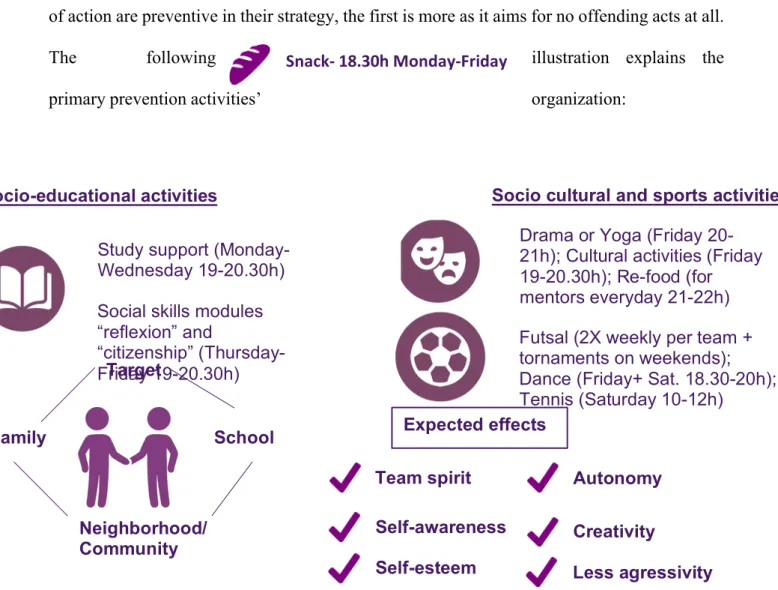
There are two scopes of action: the primary or preventive action and the secondary action. The first consists on different activities such as the practice of socio-educational activities. The secondary is mainly focused on the reintegration of an offender into society, so as to minimize
its chances of reoffending. As it was abovementioned, this thesis will analyze the most preventive part of the project, as it is the most suitable for a SIB. Even though the two scopes of action are preventive in their strategy, the first is more as it aims for no offending acts at all.
The following illustration explains the
primary prevention activities’ organization:
The association has a physical space for the socio-educational activities in Zambujal where youngsters from different schools and neighborhoods are brought together and foster the importance of group-work and social cohesion. The sociocultural and sports area is based on the belief that extra-curricular activities may have a positive effect on youngsters with risk factors (UN Plan-Youth 21) and highly promotes soft skills. Futsal has 6 federate teams, for different age-groups. The teams have their weekly practices in Escola Secundária da Amadora and Campo da Cova da Moura.
4.5. Results by Academia do Johnson Socio-educational activities
Study support (Monday- Wednesday 19-20.30h) Social skills modules “reflexion” and
“citizenship” (Thursday- Friday 19-20.30h)
Futsal (2X weekly per team + tornaments on weekends);; Dance (Friday+ Sat. 18.30-20h);; Tennis (Saturday 10-12h)
Drama or Yoga (Friday 20- 21h);; Cultural activities (Friday 19-20.30h);; Re-food (for mentors everyday 21-22h)
Socio cultural and sports activities
Family
Neighborhood/ Community
School Expected effects Team spirit Self-esteem Creativity Autonomy Self-awareness Less agressivity Target Snack-‐ 18.30h Monday-‐Friday
The association has been able to significantly increase its scope of action, since its creation, in 2014. As a whole, AJ currently supports 166 youngsters 6-20 years old, as well as their family and school net.
100 youngsters are athletes in the association’s teams and the remaining 66 are being supported in other areas, being 25 the ones that are simultaneously in study support and futsal. AJ also kept track of the food that it was able to distribute in 2017, that amounted to 1200 snacks and 3 familiar baskets per month.
4.6. Academia do Johnson’s differentiation factors
The following section is consequent of a careful research and benchmarking that is available in Appendix 3). AJ’s main differentiation factor, according to Johnson himself, is the proximity that there is between the association and the youngsters. Johnson states that when he was in Prison, he could feel when the psychological support and technician help would be genuinely concerned with him and connected, and when it was not, and he attributes most of his influence on the children and teenagers to the nature of his relationship with them. In addition, external observers can state that Johnson himself is a “lighthouse” to his target because he is relatable to his target. The proximity that Johnson demands from all the workers of the organization results in a high customized approach.
A strong key to AJ’s sustainability is its mentorship program which aims to develop specific abilities in impact-motivated youngsters to support, motivate and stimulate other children and younger people to find a meaning to their life and pursue the correct path for them. (Academia
do Johnson 2017) The main objective of this mentorship program is a multiplying effect of good examples and well-being of the target.
Another important aspect of the project is the federation of its Futsal teams by the Lisbon Football Association, increasing the youngster’s motivation, recognition, and contact with different realities. Relating to this, there is an extremely interesting characteristic that contributes to AJ’s success: the organization uses Futsal (and other recreational activities if popular) as an instrument to encourage their target to study: if they are not achieving academically by missing their study support, they will be punished by being removed from the teams, or rewarded in the teams if they are showing effort.
All in all, AJ gives the youngsters the necessary tools to fight in various fronts, which is extremely valuable for their difficult multi-dimensional complex reality.
5. How can a SIB be Applied to Academia do Johnson?
5.1. Service provider prepared for scaling
Due to the fact that Portugal Inovação Social 2020 currently can only finance out of the Great Lisbon area, several meetings were held with the Executive Director of AJ, until Coimbra was decided as the location for the potential SIB. The choice of Coimbra was based on the fact that it has three extremely problematic neighborhoods- Bairro Ignote, Bairro da Rosa and Bairro António Sérgio, with failing rates around 16% in elementary school (9% national average) and 18% in 10th grade (15% national average), serious police interventions and because AJ already has contact with the city with a project of the organization’s secondary action - the prevention of re-offending rates in Education Center- Centro Educativo dos Olivais, supported by the project of Inovação Social, Parcerias para o Impacto3. This context enables Johnson, the
3 This program involves the non-refundable financial support by a public entity and social investors and the project agrees to
meet pre-established metrics. AJ’s intervention consists in the prevention of criminals re-offending by targeting the total of 20 youngsters/year that are close to the end of their sentence in an educational center in Coimbra (Centro Educativo dos Olivais) and a School-prison in Leiria (EP de Leiria) and trying to reduce at least 75% of them re-offending after the annual intervention.
organization’s president to be able to easily visit its unit in Coimbra and it enables easier adaptations, because the organization already knows the city. Adaptations to the project for it to be suitable for an SIB are recommended more ahead.
5.2. Economic Benefits of Academia do Johnson
By tackling the roots of the juvenile delinquency problem, AJ is able to directly increase the approval schooling rate and increase the youngster’s grades, as well as providing them with their lacking social skills, which, in turn, will hopefully keep them away from educational centers and have them contributing for society in the future by being employed, paying taxes, among others. The intervention is able to save the government educational, prison, and police costs and even contribute for future revenues, by trying to reduce greatly the abovementioned great government costs of 200 million with school retention.
5.3. Alignment with Public Policies
Portugal is more and more a country that values and that is becoming well-known for its innovation, including social innovation. For the first time, the Portuguese budget of 2018 includes fiscal benefit enterprises that invest on social innovation, making it the second country doing this to support SIBs. In addition, Portugal has demonstrated to be focused on solving problems related with youth, with its Programa Escolhas, which is a source of investment in smart solutions for integrating social-economically vulnerable youngsters so that there is a bigger social cohesion in the country.
6. Modelling Academia do Johnson
6.1. Coimbra’s Intervention Scope
Target Population – Currently, AJ does not have an eligibility criteria, or, in other words, it has an excessive broad one (accepting every youngster from the intervention area that is willing to join), which faces a problem for a possible SIB. For this reason, the present thesis recommends a stricter target, based on what was learnt from the AJ’s experience with the target.
Age: To be able to join AJ’s SIB in Coimbra 24 children have to be 7-10 as the desired project will focus in an early intervention, due to the strong evidence in favor of it. It is recommended that another 24 should be 10-13 mostly to analyze how close to the end of the intervention they can or cannot be sentenced to an educational center, given their ageing. In addition, the two age groups make this SIB a serious and honest analysis of AJ’s intervention model, as the Lisbon intervention-model targets a big range of ages.
Geographical: The youngsters have to live in one of the following neighborhoods, given their vulnerable socio-economic conditions: Bairro do Ingote, Bairro da Rosa and Bairro do António Sérgio.
Parental-related problems: The children must present at least one of the familiar risk-factors identified by the World Health’s Organization4. This criteria is to focus the intervention in people that lack a familiar/social structure at home, so that the intervention can fill this gap as it is designed to do. In Coimbra this is even more important, given the high number of considered high-risk Roma people youngsters that, due to their culture, have a big familiar and community net that supports them, not being suitable for this specific project. Nevertheless, the criteria is not based on ethnicity, meaning that a Roma youngster with no social net, will be of course eligible to participate.
Low academic achievement – Youngsters that are appointed by different schools in the area that have either failed in the year before the project or are at risk of doing so for the next year.
Cohort Delivery Model – It is recommended to decrease the number of youngsters that receive the intervention, so that they can receive a closer, customized relationship which is essential to understand each one of the youngster’s problems, as they will not communicate them as an adult will. Instead of the 166 that AJ currently supports, each cohort would have 48 youngsters – 12 boys and 12 girls from each age-set, so that they can compose 4 federate futsal teams in
4 Parents divorce; Parental antisocial history (including drug-use and violence); Parental depression; Poor parental
total. In this way, no one is excluded from the important part of the intervention which is the sports and the motivation and rules that come from it. Each cohort will have the duration of one school year, resulting in the total of 3 cohorts. Nevertheless, the 48 youngsters will be the same throughout the project, as this specific prevention model needs time to be well-analyzed and it is interesting to see how the same youngsters can improve in different ages. The design assumes that there can be some dropouts and substitutions.
Specific adaptations- In the several conversations with Johnson’s team and subsequent analysis, Johnson is undoubtedly an essential factor for the intervention’s power, as it was already mentioned. However, it is unrealistic to think that Johnson can be as present in Coimbra as he is in Lisbon and doing so is also missing the point as Johnson is merely an example of a successful intervention tool: having a highly influential and relatable person for Coimbra’s youth that will be present in most activities, and that is able to enter in a deep conversation with the target so that they trust him/her and feel his/her support. Adding to this, and based on the AJ’s worker’s suggestions, a new team for the Coimbra unit is needed, only consisting on two paid workers- one Influencer and Activities Manager and one Executive director and several volunteers, as well as the support from the Lisbon’s existing structure.
In order for the project to be suitable for a SIB, it is recommended a budget that specializes in the AJ’s core-activities: federate futsal and study support. Reflection time will also be available as it gives the youngsters the opportunity and space to talk about their fears and wishes with their influential light-house and strengthen their relationship with him and the organization.
6.2. Intervention Costs
The intervention costs for the SIB in Coimbra are based on AJ’s previous budgets with the needed adaptations according to the change of district, namely, careful studying of the Coimbra Football Federation costs for the four teams in different age divisions and the rent of a sports
pavilion in the area, just to name a phew. With the proposed adaptations of the project to the SIB in Coimbra, the total cost for the 3 cohorts during the 3 years will be of 313 492 euros.
6.3. Outcome Metrics
The selection of outcome metrics is an extremely important step towards constructing a credible SIB model. As such, the metrics should be able to demonstrate the project’s impact as well as being accessible and practical to measure. In the case of AJ in Coimbra, the only metric that is going to be used to prevent juvenile delinquency is the level of grade promotion, due to the fact that the target is too young to be eligible to enter an educational center (which could be used as another metric) and because its success rate is extremely challenging to define. The grade promotion decision is based on the high relationship that schooling has with an at-risk youngster and because it is the most accessible of all the risk-factors to be measured. From the 48 youngsters in each cohort, the metric recommended is that at least 65% move on to the next grade5, percentage which is based on the limited data of approval rates of the Lisbon’s AJ’s youngsters since its beginning (the lowest was 70% but it did not include the totality of the organization’s participants). As the youngsters will grow up along the three cohorts, there will be a time where they will be eligible to be convicted to an educational center, making this an interesting metric to evaluate and monitor on a regular basis. However, it will not be a used metric for the financial modelling as the percentage that can mean a success is hard to indicate.
7. SIB Business Case and Sensitivity Analysis
7.1. Costs and Revenues
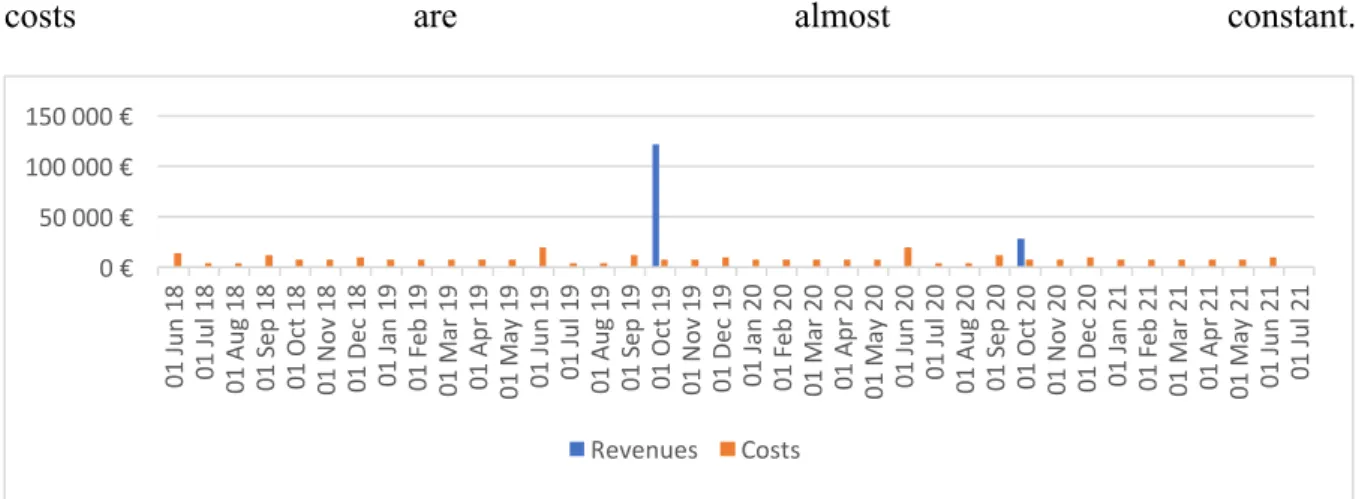
The total costs of the intervention of a given cohort are paid, if the metric is achieved. Given that the investors start the project with an upfront funding which is lower than the total project costs, the revenues of the project serve in two ways: to recycle in the project, so that it
5 This project only includes basic and middle school. In the first year, the youngest are supposed to move on from 3rd/4th to
the 4th/ 5th and the older age-set from the 5th/6th to the 6th/7th, and this continuously during the 3 years. The last year the
continues, and to reimburse the investors in the total of their initial investment with parcels of these revenues. In this way, the revenues are larger in the beginning (121 427 euros in Oct 2019) than in the end of the project (28 186 euros in Oct 2020), even though the total monthly
costs are almost constant.
7.2. Annual Cost Structure
The project’s annual costs were calculated using the cost data from the 3 13-month duration cohorts. General Costs are lower in the 1st year because direct activities with the youngsters are not in place yet in June, contrary to other years, and HR as well due to the fact that the first June does not include holiday subsidy. In the consequent years, these two costs are the same.
Futsal costs suffer a slight increase from year 1 to year 2 due to the fact that the teams have to go up a federation step each year, being the higher steps more expensive. However, it goes down in year 3 because there are no costs with federation as the intervention finishes in that June. Appendix 4) shows the monthly detailed costs.
7.3. Payment for Results
0 € 50 000 € 100 000 € 150 000 € 01 Ju n 18 01 Ju l 18 01 Au g 18 01 Se p 18 01 O ct 18 01 N ov 18 01 De c 18 01 Ja n 19 01 Fe b 19 01 M ar 19 01 Ap r 19 01 M ay 19 01 Ju n 19 01 Ju l 19 01 Au g 19 01 Se p 19 01 O ct 19 01 N ov 19 01 De c 19 01 Ja n 20 01 Fe b 20 01 M ar 20 01 Ap r 20 01 M ay 20 01 Ju n 20 01 Ju l 20 01 Au g 20 01 Se p 20 01 O ct 20 01 N ov 20 01 De c 20 01 Ja n 21 01 Fe b 21 01 M ar 21 01 Ap r 21 01 M ay 21 01 Ju n 21 01 Ju l 21 Revenues Costs
Figure 3: Costs and Revenues
Figure 3: Annual Cost Structure
0 € 20 000 € 40 000 € 60 000 € 80 000 € 100 000 € 120 000 € 140 000 €
Year 1 Year 2 Year 3 General Costs HR Costs Futsal Costs
Payment for results are accordingly to the accumulated costs of the project until the metric is measured. SIBs nowadays work by having each payment by results be defined by how much the project costs (contrary to the beginning of SIBs, where payment by results were directly linked to the percentage that the government saved with the different project success rates). In this project, the metric “School approval rate” will be measured exactly at the end of the intervention
(0 months of time to results), given that it can only be measured in June, when students end school and the cohort. A delay of the payment of three months from June is assumed. The total payments sum into the total intervention costs: 313 492 euros.
7.4. Investors Cash-Flows
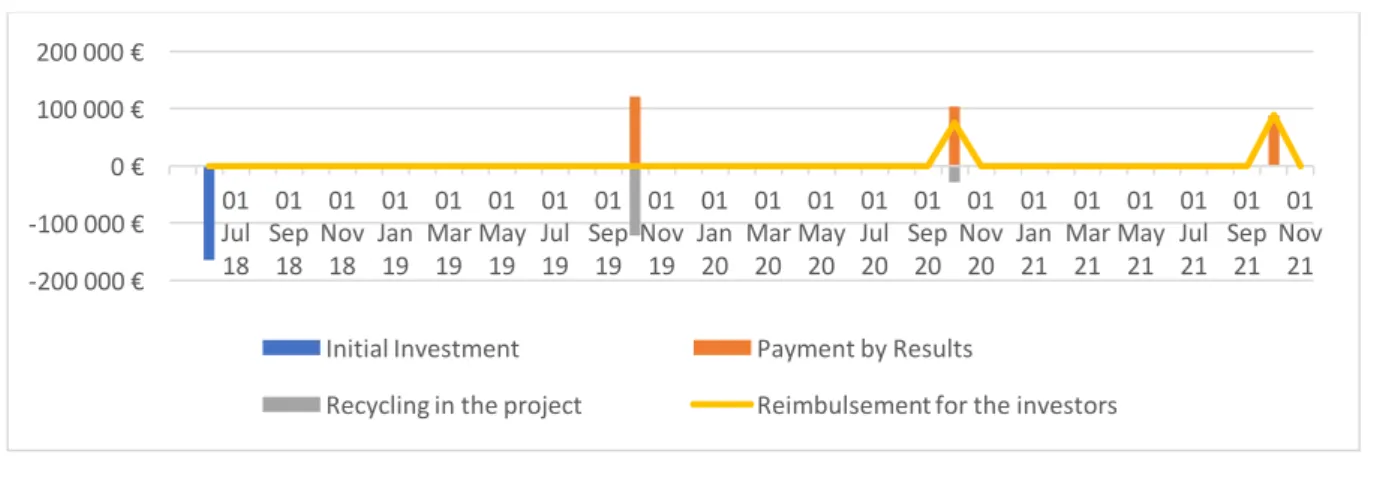
Under a SIB, the investors invest upfront according to the financial needs of the service provider, and are then repaid once outcomes are achieved.
The total investor requirement is 163 879 euros. The whole amount will outflow at the beginning of the intervention as an upfront investment. Investors will only be reimbursed in
-‐200 000 € -‐100 000 € 0 € 100 000 € 200 000 € 01 Jul 18 01 Sep 18 01 Nov 18 01 Jan 19 01 Mar 19 01 May 19 01 Jul 19 01 Sep 19 01 Nov 19 01 Jan 20 01 Mar 20 01 May 20 01 Jul 20 01 Sep 20 01 Nov 20 01 Jan 21 01 Mar 21 01 May 21 01 Jul 21 01 Sep 21 01 Nov 21 Initial Investment Payment by Results
Recycling in the project Reimbulsement for the investors
2019 2020 2021 School Approval Rate 121 427 € 103 154 € 88 912 € 0 € 20 000 € 40 000 € 60 000 € 80 000 € 100 000 € 120 000 € 140 000 €
Figure 5: Payment for Results
Oct of 2020 and Oct of 2021, given that the repayment made before (Oct 2019) will be used to cover the project costs.
7.5. Scenarios
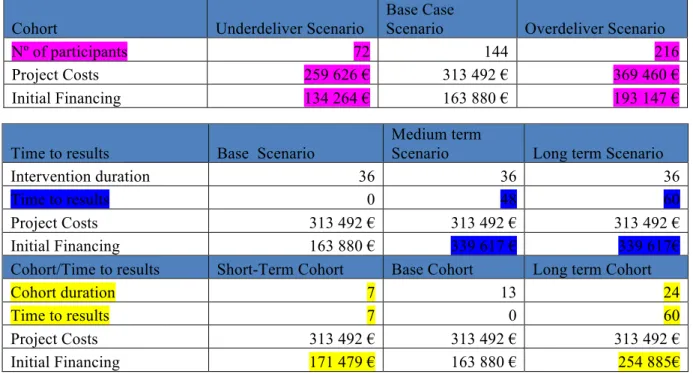
Given that the proposed business case is calculated based on estimations and because the intervention deals with human beings, there is the need to analyze the sensitivity of the project to any foreseen events. In order to do this, different scenarios that change key factors- number of participants, time to results and cohort duration - were tested. Figure 7 presents the impact of these scenarios in the model’s initial financial need and project costs.
Number of Participants – The number of participants per edition has implications on the financials of the model, due to the variable costs that change according to the number of youngsters tackled: e.g. futsal equipment, snacks, transportation costs, among others. Two scenarios were considered. One where AJ would only intervene in youngsters 7-10, and thus, having only two futsal teams, one male and one female, accounting for a total of 24 kids per cohort. Another scenario in which the intervention would be more broad and close to Lisbon’s one, where there would be two extra teams (on top of the 4 of the base scenario) aged 13-15, male and female, accounting for a total of 72 kids per cohort. However, the “best scenario” may be negative for the kids, as it would decrease the customized response to each.
Time to Results – Another extremely interesting metric is changing the time to results. However, as abovementioned, AJ’s cohorts aim to coincide with the school year, resulting in both ending at the same time. Given that the metric is knowing whether the youngster passed the year or not, which is always known at the end of the school year, the time to results would always be 0 months. However, if one believes that the impacts of the intervention can only be seen in the longer-term, it would be interesting to see how its financials would change if we would only measure their schooling approval 1 or 2 years after the total intervention finishes, given that they are always the same youngsters in each cohort. However, in the mid and
long-term scenario the investors would invest more than the project costs (because the initial investment has to be equal to the total cost of the intervention of 36 months+ the working capital contingency) and would need more time than usual to be reimbursed.
Cohort Duration – Finally, different cohort durations, that can change time to results, were tested to understand why the base design that is presented in this thesis was considered the most appropriate. The scenario presents a first option of a cohort of 7 months (1 Sep.-1 Jan) and 7 months to results, interesting because it would give some time to understand if the project’s potential positive influence would have a medium-term effect, rather than an immediate and thus, possibly an easier one (base scenario of 0 months to results). The other test was a scenario of a cohort of 24 months, which would mainly result in an adaptation of the activities and less pressure, and the time to results being measured immediately after, 0 months to results. Although interesting, this scenario testing has its limitations as an intervention of 7 months is extremely different from one that lasts 24 months, and this would mean a dramatic change of the intervention scope, as well as going against AJ’s continuity philosophy.
Cohort Underdeliver Scenario
Base Case
Scenario Overdeliver Scenario
Nº of participants 72 144 216
Project Costs 259 626 € 313 492 € 369 460 €
Initial Financing 134 264 € 163 880 € 193 147 €
Time to results Base Scenario
Medium term
Scenario Long term Scenario
Intervention duration 36 36 36
Time to results 0 48 60
Project Costs 313 492 € 313 492 € 313 492 €
Initial Financing 163 880 € 339 617 € 339 617€
Cohort/Time to results Short-Term Cohort Base Cohort Long term Cohort
Cohort duration 7 13 24
Time to results 7 0 60
Project Costs 313 492 € 313 492 € 313 492 €
Initial Financing 171 479 € 163 880 € 254 885€
8. Limitations
The main limitation of this thesis is the lack of data from the organization, as it does not have neither the financial nor the human resources sufficient to measure its impact in a thoroughly manner. In addition, the intervention is fairly recent and there is no sufficient track record with quantitative data to accurately inform the business case, which is reflected in a higher outcome risk. In this way, this work was based mainly on the perceptions of the workers and on careful research in order to establish a proper design of the project in Coimbra and an accessible metric to measure its impact. Moreover, there is the limitation of the complexity of the youngster delinquency problem aligned with very recent impact-evaluation studies on the preventive mechanisms that work, which, because of their recentness, may not be legitimate in their totality. Information about Portugal, furthermore, was extremely limited on the problem itself. the Lastly, there is the fact that the project was thought to be implemented in Coimbra, and there were no physical visits to the location to better understand its social reality, which could have very much contributed to the design of the project in a more specific way.
9. Recommendations
In order for this feasibility SIB study to happen in practice, some recommendations are made to overcome the limitations abovementioned but not only. Firstly, it is recommended that the Portuguese Government provides more in-depth and national studies about the problems of juvenile delinquency, its causes and effects, as it is a pressing issue in the country and its prevention a priority for Europe. It would, moreover, help to improve a specific SIB, given the increase in knowledge about the specificities of the problem in Portugal. In the long-term, it would also be positive to have an increase in impact-evaluation studies of the initiatives that deal with this problem as Programa Escolhas6 only measures the metric of the number of youngsters reached in each of the interventions, which is insufficient and does not necessarily
reveal a positive social impact. As for AJ, recommendations are made to increase its human resources team, to reach its target in a more customized way. It is also recommended that each of the youngsters of the intervention participate in the same activities, at least all having both socio-educational and sport’s activities, so that they have a multidimensional response to their problem and for the impact to be clearer to everyone involved. Finally, some financial adjustments are recommended, mostly, to increase its budget in order to expand and have a more one-to-one approach to each at-risk youngster.
Bibliography
Academia do Johnson. 2017. “Curso de mentores sociais e culturais na Academia do Johnson.” Amadora.
Agusto, Fábio. 2017. “Da delinquência juvenil aos crimes informáticos: os principais indicadores de segurança interna.” Jornal Público, 31 de 03.
Appelbaum, S., Iaconi, G., & Matousek, A. (2007). Positive and negative deviant workplace behaviors: Causes, impacts, and solutions. 7, 586-598. s.d. Corporate Governance,. Associação Nacional de Futebol de Rua . s.d. Bola P'ra Frente.
http://www.futrua.org/projectos/bola-pra-frente/.
Bago D'uva, Teresa. 2017. Mobilidade Social em Portugal. Fundação Francisco Manuel dos Santos.
Born, M. 2005. Psicologia da delinquência. Lisboa: Slimepsi Editores.
Câncio, Fernanda. 2016. “Nos últimos 20 anos a delinquência juvenil diminui em número e gravidade.” Diário de Notícias, 30 de 09.
Carvalho, M. 2004. Entre as malhas do Desvio: Jovens, espaços, trajectórias e delinquências. Coimbra: Universidade de Coimbra, Centro de Estudos Sociais, Faculdade de Economia.
Commission for Supervision and Assistance of Educational Centers. 2016. Report 2014. Portuguese Republic, 13.
Committee on Family and Work Progress. 2001. Working parents and gwoing Kids. Washington. DC: The National Academies Press.
Cordeiro, Ana Dias. 2015. “Portugal é excepção ao colocar crianças e jovens em prisões de adultos.” Jornal Público , 12 de 02.
EJ, Staurowsky et al. 2009. Her Life Depends On It II: Sport, Physical Activity, and the Health and Well-Being of American Girls and Women. Women's Sports Foundation.
Finance, Social. 2016. “Social Impact Bonds: The Early Years.”
Galitopoulou, Stellina & Noya, Antonella. s.d. Understanding Social Impact Bonds. OECD Leed programme.
Grupo de Trabalho Português para o Investimento Social. s.d. “Final Report.” Grupo de Trabalho para o Investimento Social. http://grupodetrabalho.investimentosocial.pt/wp-content/uploads/2015/08/EN_Final-report.pdf.
Gustafsson-Wright, Emily et al. 2015. “The potential and limitations of impact bods: Lessons from the first five years of experience worldwide.” Brookings.
INE. 2017. “Jovens internadas/os (Nª) em colégios para acolhimento de educação e formação e centros educativos por Sexo e Grupo Etário.” Instituto Nacional de Estatística. 30 de 05.
Kury, H., & Woessner, G. 2002. A família e os comportamentos desviantes dos jovens. Coimbra: Almedina.
LA Taliaferro, et al. 2008. High school youth and suicide risk: exploring protection afforded through physical activity and sport participation.
Laboratório de Investimento Social. 2015. A retenção escolar em Portugal.
Lyman, M. 2014. Drugs in society. Causes, concepts, and control. London: Anderson Publishing.
Nardi, F., Cunha, S., Bizarro, L., & Dell’Aglio, D. 2012. Drug use and antisocial behavior among adolescents attending public schools in Brazil. Trens in Psychiatry and Psychotherapy .
Nunes, LM. 2015. “Avaliação psicológica de jovens com comportamentos desviantes.” SciELO (Universidade Fernando Pessoa ).
Passini, S. 2012. The delinquency-drug relationship: The influence of social reputation and moral disengagement.
Perista, Heloísa et al. s.d. Delinquência e Violência Juvenil em Portugal. Centro de Estudos para a Intervenção Social , YouPrev.
Programa Escolhas. s.d. Projectos - Programa Escolhas 6ª Geração. http://www.programaescolhas.pt/projetos-e6g.
s.d. Services, Social Impact Bonds. http://www.socialfinance.org.uk/services/social-impact-bonds/.
Taxman, Faye S. 2014. Drug treatment for offenders: Evidence-based criminal justice and treatment practices (Drugs, crime and justice. Contemporary perspectives). Editado por Graines & J. Kremling (Eds. Illinois: Waveland Press.
The Swiss Authorities online. s.d. www.ch.ch. https://www.ch.ch/en/what-penalties-juvenile-crime/.
Travis Certo, S. and Miller, Toyah. 2008. “Social entrepreneurship: Key issues and concepts.” Horizons, Business.
Vale-Dias, Alice Murteira Morgado and Maria da Luz. 2013. The antisocial phenomenon in adolescence: What is literature telling us? Aggression and Violent Behavior. Vol. Volume 18.
World Health Organization. 2015. Preventing Youth Violence: an Overview of the Evidence. Geneva: WHO Press, 11 and 14
Young, Emma. 2017. “How Iceland got Teens to Say No to Drugs.” The Atlantic.
ZHAW Zurique University of Applied Sciences . 2016. 14 de 07. https://blog.zhaw.ch/socialwork/juvenile-delinquency-in-switzerland-and-the-us/.
A Work Project, presented as part of the requirements for the Award of a Masters Degree in Management from the NOVA – School of Business and Economics
Social Impact Bond Feasibility Study
Preventing Juvenile Delinquency: Academia do Johnson
APPENDIX
Maria Benedita Moura Pinheiro Guedes de Carvalho 3540
A Project carried out under the supervision of:
Prof. António Miguel, Executive Director of the Social Investment Lab
1. Methodology scheme
2. Risk factors for youth violence by developmental stage and ecological level (World Health
Organization 2015)
Training1 Training2 Training3 Training 4
Weekly visits to Academia do Johnson
Several meetings and contact with supervisor
Sep.17 Sep. (1/2) Oct.17 Oct. (1/2) Nov.17 Nov(1/2) Dec.17 Dec. (1/2) Jan.17
Literature
Review Delineating a clear intervention
Understanding the Social Problem model
SIB Business Case Revision Submission
3. Benchmarking
International
In some countries, the public sector plays an essential role by having the prevention of risk behaviors high in its agenda, resulting in great benefits for their societies (e.g. reduces crime, number of prisoners). Two of the world-wide countries with less criminality, Switzerland and Iceland, are active in preventing juvenile delinquency.
Iceland is an extremely interesting case as it was able to reduce the alcohol consumption from 42% (1998) to 5% (2016), cannabis from 17% to 7% and cigarettes regular consumption from 23% to only 3%. This was possible due to a program– Youth in Europe.7 The idea behind the model is to get teenagers to get addicted to a healthy, dynamic activities, instead of substances. The model is integrated into the country’s national plan and its main implementations were: the purchase of tobacco under 18 and alcohol under 20 became illegal; a mandatory time for teenagers 13-16 to return home at night; organization-parents agreements which may include the right to supervised parties, the prohibition to buy minors alcohol, among others; state funding for organized sports, art, dance and other clubs and financial help to those in need directed at recreational activities. (Young 2017)
Switzerland, on the other hand, reveals itself innovative in its flexibility in leading with risk behaviors, even when they involve crimes, represented by its Juvenile Protection Act and Juvenile Criminal Law Act. Children are responsible for their criminal acts from the age of 10, but the State believes education is more important and effective than punishment until the age of 18. Therefore, any offender will have the right to protection by having supervision, personal care, outpatient treatment, and placement with a family or educative facility (The Swiss Authorities online s.d.). The legislation aims to protect teenagers by hiding their criminal
7 The program, in general, is comprehensive and it consists of two stages: 1) Surveys to 13-16 years old’ about their life style, involving questions on risk factors 2) individual communities decide what active intervention to undertake (initiatives, legislation, meetings, …) based on the results and on the original psychologists’ team recommendations.
charges, educate them to prevent later offenses, reintegrate the offender into society, and prevent stigmatization of the youth based on the offense committed when they were young.. When the offense is not extremely serious, the offender will be given the right to stay home with its family, to reestablish and improve his/her relationship and contact with them, expect when the home is a negative influence where the child is mistreated. (ZHAW Zurique University of Applied Sciences 2016)
National
There is a Portuguese public initiative called Programa Escolhas, which is a prevention national program that was created in 2001 with the purpose of preventing criminality and integration of the youngsters of most problematic neighborhoods of Lisbon, Porto and Setubal. Nowadays, and due to its success, its mission is more comprehensive: integrating social-economically vulnerable youngsters so that there is a bigger social cohesion in the country. Programa Escolhas acts by financing projects that work around four purposes I) Schooling inclusion and non-formal education II) Professional training and employment III) Civic participation and IV) Digital inclusion.All the projects tackling youngsters’ risk factors in Portugal are characterized mainly by being local and consequently, extremely adapted to the localities’ children and teenager’s characteristics. The belief that a higher involvement of their target population in their community is key for integration is transversal to all. Thus, there are several projects that work with arts and sports to promote a feeling of group, action and responsibility, as well as self-expression (e.g. Bola p’ra frente; Terras d’ART) and many others that deal mainly with visits to cultural activities that occur in their society, so as to work their target’s motivation and knowledge (e.g. Cresce e Aparece; Pro Infinito e mais além). The projects all aim to build/improve the target’s social, educational, professional and entrepreneurial skills. All interventions adopt a multi-faceted solution, revealing an understanding of a complex, overreaching number of sources of deviant behaviors.
3. Monthly Cost Structure
There are strong variations in the month of June (the majority of the futsal federation costs are demanded at this month, before the season starts, excepts for the last June, which does not demand a renovation of the federation costs due to the end of the intervention), which coincides the end of a cohort with the beginning of another one, resulting in summed costs. September is responsible for the increase in General Costs because general costs including school material, insurances, office material, among others are all deposited at the start of the school year. December and June are responsible for the increase of the HR costs due to holidays subsidies.
Bibliography
The Swiss Authorities online (n.d.), www.ch.ch. Retrieved from https://www.ch.ch/en/what-‐ penalties-‐juvenile-‐crime/
World Health Organization (2015). Preventing youth violence: an overview of the evidence. World Health Organization.
Young E. (2017). How Iceland got Teens to Say No to Drugs. The Atlantic.
ZHAW Zurique University of Applied Sciences. (2016, 07 14). Retrieved from blog.zhaw.ch: https://blog.zhaw.ch/socialwork/juvenile-‐delinquency-‐in-‐switzerland-‐and-‐the-‐us/ 0 € 5 000 € 10 000 € 15 000 € 20 000 € 25 000 € 01 Jun 18 01 Aug 18 01 Oct 18 01 Dec 18 01 Feb 19 01 Apr 19 01 Jun 19 01 Aug 19 01 Oct 19 01 Dec 19 01 Feb 20 01 Apr 20 01 Jun 20 01 Aug 20 01 Oct 20 01 Dec 20 01 Feb 21 01 Apr 21 01 Jun 21 HR General Costs Futsal Costs