MASTER THESIS
DEVELOPMENT OF A NEW WINE TOURISM PRODUCT
AT JEAN LEON`S WINERY
ISIDORA LAMBERT ROYO
Internship developed at Jean Leon S.L.
Torrelavit, Spain.
Professional supervisor
Asier Vivanco
Academic Supervisor
Professor Albert Mas
Universitat Rovira i Virgili
TABLE OF CONTENTS
1. INTRODUCTION ... 1
1.1 Description of the company ... 1
1.2 Story of Jean Leon ... 1
1.2.1 A Man ... 1
1.2.2 A Time. ... 2
1.2.3 A Wine. ... 2
1.3 Duties and activities during the internship ... 3
1.3.1 Administrative part ... 3
1.3.2 Hosting tourists ... 3
1.3.3 Events ... 4
1.3.4 Development of a new wine tourism product ... 4
1.4 Master Thesis Proposal ... 5
2. METHODOLOGICAL APPROACH ... 6
3. DISCUSSION AND RESULTS ... 6
3.1 Rural wine tourism context ... 6
3.2 Wine tourism context in Penedès region ... 7
3.3 Jean Leon’ s situation ... 8
3.3.1 Current tourism offer ... 8
3.3.2 Jean Leon visitors ... 10
3.3.3 Wine bar ... 13
3.3.3.1 Wine bars market research ... 14
3.3.3.2 SWOT analysis ... 17
3.3.3.3 Marketing mix ... 20
3.3.2.4 Current Wine bar situation and projections ... 22
4. CONCLUSIONS ... 25
5. BIBLIOGRAPHY ... 26 ANNEXES
ABSTRACT
Jean Leon winery was founded in 1963 in Torrelavit, a small town of Penedès region, in Catalonia, Spain. The winery has an interesting story, based on his founder life and success. A man who fulfilled almost all his dreams, in 1956 he opened his own restaurant named “La Scala” in Beverly Hills, U.S; and 7 years after he built his own winery named as him, “Jean Leon”.
The visitor center in Jean Leon is managed by the wine tourism department, where different types of services and tours are offered for the customers. All the departments of Jean Leon are constantly looking for new challenges, the wine tourism department is nowadays implementing a new project, a Wine bar on the terraces of the visitor center.
Saying so, the purpose of this Master Thesis was to evaluate the viability of the new Wine bar. First, a presentation of the actual activities of Jean Leon’s winery is going to be exposed, after this, the study is going to be focused on the Wine bar, analyzing the current situation of it, the strengths and weaknesses, as well as the opportunities and challenges faced by the company on the development of this new project.
Methodology used consisted of author’s personal experience and the data recollected from the database that Jean Leon wine tourism department uses for their own researches and analysis. For this thesis a qualitative approach and analysis is going to be done.
The study proves that the concept of a Wine Bar or a place to drink wine inside wineries is a product not common and quite new in Penedès region. Most wineries understand intuitively that it is important to connect emotionally with consumers, but many do not know how to put the principle into practice. That is why is very important to provide different and new services to strengthen the relationship with current customers, but also to attract new ones, who seek to live new experiences in relation to wine. The results show that the new project in Jean Leon is increasing in number of visitors, has good acceptance mainly in local people but also in international tourists. The intention of the winery creating this project is to magnify its strengths and abate its weakness in terms of wine tourism by creating a unique and finished product for their customers.
The final conclusion was that with only four months of work in a new wine tourism product is not enough to recollect the proper amount of data and develop a good table of results, but the result obtained in 2 months proved to be very positive, with significant increase in the touristic flow, improvement on marketing and social media presence, and better brand recognition and loyalty with the clients.
Keywords: Penedès, Catalonia, Wine bar, Wine tourism, Tourism offer.
List of abbreviations: DO: Denomination of origin
1. INTRODUCTION
1.1 Description of the company
Jean Leon is a winery of 150 ha located in Torrelavit, a small town 8 Km from Vilafranca del Penedès, in Catalonia, Spain. The winery was founded in 1963 by a Spanish man born in Santander, called Ceferino Carrion. The winery has an interesting story, based on his founder life and success that after living in United States changed his name to Jean Leon. The winery not only stands out for its history, also for its good wines. In Jean Leon 7 wines are produced, where 4 of them have the certificate of “Single vineyard wine”, awarded in 2013 by the Agriculture Council of Catalonia. Becoming Jean Leon in the first winery of the Penedès region and the second in Catalonia to obtain the maximum distinction that a wine can have.
1.2 Story of Jean Leon 1.2.1 A Man
Ceferino Carrion was born in Santander, Spain in 1929. In 1941 a terrible fire destroyed his house, so his family moved to Barcelona. When he was 19 years old he decided with no money to travel to Paris, he spent some months there, but his final goal was to arrive to United States. In 1949, form “Le Havre” port in France, he finally crossed the ocean to arrive to New York, and was in United States where he decided to change his name to Jean Leon. He started working on anything that could give him money. He cleaned bathrooms and washed dishes, also he began to work as a waiter in the “Rockefeller Center”. Then Jean decides to move to California and in here he started to drive a taxi. But Jean Leon`s career didn’t start until he started to work in the restaurant “Villa Capri”, owned by Frank Sinatra and the famous baseball player Joe DiMaggio. Working there allowed him to meet actors and celebrities of Hollywood, such as Elizabeth Taylor, Natalie Wood, Paul Newman, James Dean, among others.
In 1956 finally, he opened his own restaurant, named “La Scala”, helped by his friend James Dean.
1.2.2 A Time.
The restaurant “La Scala” became in the 60s the place where all the famous people of that time got together to eat and hang out. The place stood out for its good taste and elegance. Celebrities such as Marilyn Monroe, Robert Wagner and Marlon Brando, were regular customers of the restaurant. Even more than 5 American presidents went frequently to “La Scala”, including Ronald Reagan and John F. Kennedy.
Jean Leon was a wine lover and at the restaurant he had a large wine cellar, with wines from all over the world, but mostly from France. He always wanted to produce his own wine, so he could impress his customers with it. That why in 1962 he started his second dream, to build a winery.
1.2.3 A Wine.
Jean Leon started to search the perfect land for his wines, until he found what he was looking in Spain, 150 ha in Catalonia, specifically in Penedès region. In 1963 his dream started, constructing the winery that looks like an identical Chateau from Bordeaux. He replaces existing local varieties with grafts of French varieties, such as Cabernet Sauvignon, Merlot, Cabernet Franc, Petit Verdot and Chardonnay. Jean Leon wines have, besides the certification of “Single Vineyard Wine”, also the certification of organic farming, since 2012.
Since 1994 the winery belongs to Torres Family, because that year Jean Leon discovered that he had a throat cancer and 2 years after, in 1996, he died. That is why he sold the winery to his good friend Miguel Torres, who till now conserve the same philosophy and French style that Jean Leon always wanted (Jean Leon, 2019).
1.3 Duties and activities during the internship
The internship was performed between the 25th of February and the 7th of June 2019. The activities carried out during this period were part of the wine tourism department’s activities of the company. The department is formed by 5 people. Asier Vivanco, the professional supervisor of this master thesis, is the director of the department, and he have a small staff of 4 people, 2 of them work only on weekends and holidays.
1.3.1 Administrative part
The first activity performed during the internship was linked to the administrative part of the wine tourism department. The main activity on regular days was to manage all the bookings and reservation. Answering emails, phone calls, getting in touch with tourists and agencies that wanted to visit the winery.
Jean Leon works with an agenda of visits, which varies a bit depending on the day. During the week the visiting hours are between 9.00 to 18hr, whereas during the weekend it is from 9.00 to 15hr.
Generally, the weekends are where the mayor part of the visits is focused, national and internationals tourists. In the week they are mostly agencies from Barcelona or different parts of Catalonia, that are coming with his own clients and customers.
1.3.2 Hosting tourists
The second part of the work consisted on making the tours and the workshops that the winery offers, such us the tour to the winery, wine tastings, wine pairing activities (Ham/Cheese & wine), walking tour through the vineyards, electric bike rides, electric scooter rides and some gastronomic activities, like the Paella workshop.
1.3.3 Events
The events are very important in Jean Leon. There are two types of them:
1. Space rental, where agencies, companies or individuals pay to use the center for birthdays, marriages or ceremonies.
2. Events of agencies or companies, where some of the activities offered by the department of wine tourism is done but for large groups, usually over 50 people. After the tour, generally people have lunch or dinner at Jean Leon. A catering service from some regional restaurants is hired to prepare the menu.
1.3.4 Development of a new wine tourism product
All the departments of Jean Leon are constantly looking for new challenges, in terms of wine production, marketing but also, the wine tourism department is nowadays implementing new projects, such as a new wine bar on the terraces of the visitor center in Jean Leon. So, a big part of the internship activities was related with the creation and development of this project.
To create this project the wine tourism department had to buy the infrastructure, as terrace furniture and decoration, also create the menu with the wines and food served.
The promotion of it was also very important, marketing department helped on it, promotion on social media like Instagram, Facebook, also in the web page of Enoturisme Penedès. A very important part of this project was the inauguration of it. The launch of the new bar was on Saturday 30th of March, with good ambient and live music for the customers.
1.4 Master Thesis Proposal
Hall et al. (2000) note that wine tourism is a concept that is still undergoing substantial development. They also highlight the fact that wine can provide a major motivating factor for tourists to visit a destination as, wine regions tend to be attractive places, and the vineyards themselves are aesthetically pleasing.
Jean Leon is a winery located on a hill, with 150 ha that apart from vineyards also includes native forest, this produces that the views and landscapes that can be observed are liked by all tourists. In Jean Leon tourists have the disconnection of the urban zones and the tranquility of the countryside. The setting of wine tourism is an important factor in the consumption of wine tourism. The rural countryside where agriculture is normally practiced, vineyard landscape, cellar doors and facilities, and so on, is what people call as a ‘‘winescape’’ (Bruwer and Alant, 2009).
The winescape makes it possible for wine tourists to indulge in hedonic experiences in sometimes aesthetically pleasing environments, of both a natural and physical nature (Hall et al., 2000). The master thesis proposal takes advantage of this. The great views and the placid sensation produced by drinking wine in a place like Jean Leon, allow the creation and then the development of a new product for Jean Leon. The creation of a space, a Wine bar, where customers could enjoy a glass or bottle of wine, accompanied by some appetizers and enjoying the good weather that Catalonia has in spring and summer. On the other hand, as Getz and Brown (2006) said, wine tourism products are a strategy to develop the geographical area, the wine market of that area, and an opportunity to promote the wineries to sell their own products directly to consumers. Offering a place as a Wine bar in Jean Leon’s winery is another way of direct wine sale and opens another opportunity for the winery to present the wines, and then if people like them, they can buy it directly from the store.
Finally, as Hall et al. (2004) mention, the experience at the cellar door is crucial for creating a positive link between the wine tourist and the wine product. Cellar door experiences could entail more activities than just trying to sell wine. This new space is the perfect place to sell Jean Leon’s wines, but the most important part is to give tourists and locals a really nice experience, promoting the brand loyalty between them and the winery.
2. METHODOLOGICAL APPROACH
This study has the aim to analyze and evaluate the viability of the new wine tourism product in Jean Leon, the wine bar.
So, first a brief description will be made about the general wine tourism context and, specifically in the Penedès region. Subsequently, the document will focus on the company and the current wine tourism situation of it, especially in the new wine tourism product that is being developed. To achieve this, first, a market research will be done. Followed by a SWOT analysis (Strength, Weakness, Opportunity and Threat) that was performed to find out the main characteristics of the company. Afterwards, a marketing mix will be exposed for the new product. Finally, a projection for the future of the Wine bar is going to be done. For the development of this thesis, a qualitative approach and analysis was done, based in different original materials collected during the internship. The data used in this document came from the database that Jean Leon wine tourism department uses for their own researches and analysis, besides to the own observation of the author of the thesis.
3. DISCUSSION AND RESULTS 3.1 Rural wine tourism context
Is increasing the number of groups of people that approaches wineries in full rural areas, eager for new experiences or to enter the attractive world of wine. Selling wine, is selling culture and identity of a territory and of a landscape in its purest state.
Matellanes (2009) says that wine tourism is a word that begins to be increasingly common in our society. Probably, if we were in another region, country, continent or perhaps at another time in our history, surely talk about this new concept would not have as much interest and meaning as it can have today in Spain and outside of our borders.
Macdonald and Denault (2001) in several of their investigations affirm that the tourists of wine, look for unique and authentic experiences through the consumption of local products of the wine-growing areas. In this way, they approach the culture of the place and exchange experiences with people, cuisine, traditions and wine of the tourist destination.
Nowadays the importance of wine tourism is increasing for rural areas, and also gastronomy and wine are the main attraction to visit a certain region and not necessarily a second (or complementary) attraction of the trip (Stewart et al. 2008).
Wine reflects the social, cultural and environmental history of people, that is, the idiosyncrasy of its inhabitants, and actually is what tourist are looking for nowadays, to recognize the spirit and costumes of the locals, by tasting their wines and food. (Brunori and Rossi, 2001).
In Europe, wine tourism has developed officially through wine routes nature (Hall et al., 2000). According to a study presented at the Vinitaly Fair by Matellanes (2009) every €10 spent in a winery generates at least €50 of other tourism expenses in the visited region. The wine tourist is not only interested in visiting wineries and tasting their wines, but in knowing the culture of the land where they are produced, their artistic manifestations, their history, their customs, their most typical dishes and why not, spend a few days rest in the middle of its nature practicing some entertainment or sport.
3.2 Wine tourism context in Penedès region
Jean Leon is located in D.O Penedès that is the main wine-growing destination in Catalonia and one of the most important in Spain along with Rioja and Jerez. This is because of the surface of the vineyards planted, the volume of production, the number of wineries, the variety and the quality achieved by its wines and its national and international prestige. It is in this territory where most of the Catalan wineries are concentrated. The area of cultivation and production of the D.O Penedès covers six counties: Alt Penedès, Baix Penedès and Garraf (which together are known as the Gran Penedès), as well as Alt Camp, Anoia and Baix Llobregat (Medina, 2008).
Penedès is one of the oldest DO of the country. The Spanish Republic published in 1932 the “Status of Wine” in the form of a decree, which was later elevated to the category of Law in 1933, in which twenty DO of wine were recognized, five of them in Catalonia, and one of them is the Penedès (Rexac, 2002).
The regulatory council was founded in 1969. At first, the claim was simply recognition of a very specific product, in addition to offering the consumer the guarantee of a certain quality of the area. Currently the council has registered 5,700 wine growers and 270 wineries. This
contingent implies an annual production between one and a half million and two million hectoliters of wine (Rexac, 2002).
Penedès is a destination in process of settlement and tourist maturation. With a strong influence of the large multinational companies in the sector (Torres, Freixenet and Codorniu). The wine region of Penedès has as an advantage, the relative proximity to important tourist areas of sun and beach like Sitges and Costa del Garraf. On the other hand, also the relative dependence at the tourist level of the metropolitan area of Barcelona, which provides a good percentage of wine tourism visits. Added to this, the Penedès region has an increasingly developed in wine tourism offer and a series of related leisure initiatives, such as the Cava week, the Cavatast, the “Vendimia y Mosto” fest, ViJazz, among others, and they allow to consolidate a competitive and quality offer (Medina, 2008).
It is also important to contribute with innovative experiences, with interactive spaces to present the wine as a multisensory and practical experience, from the vineyard and the elaboration to the final tasting of the wine. At the same time, promote and implement new projects and programs to attract more and different types of tourists. It is important to focus and direct all these aspects integrated in the concept of wine tourism as a transmitter of culture of the entire region (Getz and Brown, 2006).
3.3 Jean Leon’ s situation
3.3.1 Current tourism offer
Jean Leon’s visitor center is managed by the wine tourism department, where different types of services and tours are offered for the customers. The Figure 1 shows all the services and activities that the department offer for the tourists, showing the percentage of preference of each activity in the present year, therefore the data collected are from the month of January to May of 2019.
As the Figure 1 shows the most performed activity are the tours with wine tasting. The guided tour with 3 wine tasting has a 32% of preference, on the other side the guided tour with 4 wine tasting has 15,5% of preference, this difference can be explained mainly for the price of the tours, the first one is cheaper than the one with 4 wines. For the same reason it could explain the low interest (0,11%) that the tour with the tasting of 7 wines have, may be could be because the price of this tour is higher than the other two ones.
Figure 1. Percentage of Sales in 2019
The other activities that are quite strong, and tourist are interested on, are the workshops. Starting with the wine pairing activities, the most performed one from January to May was the Cheese and wine pairing with 17% of performance, followed by the Ham and wine pairing with only 4%. On the other side, the walking tour through the vineyards and the electric bike ride have 5% and 4% of preference respectively.
Finally, the gastronomic activities such as the paella workshop, coffee breaks and some appetizer menus show almost a 20% of preference on the tourists but is important to mention that this type of activities are accompanied by some of the previous experiences, they are not activities that are carried out separately. Generally, the gastronomic activities are done after a guided tour or a walking tour/ electric ride through the vineyards.
All the tours and activities done in Jean Leon are developed and made by the wine tourism department at the visitor center. All the visits include first a video presentation to the history and life of Jean Leon, then the visit continue in the vineyards, the winery, underground cellar, finishing with the final tasting or the workshop. Normally the wine tastings are done in the reception where the wine shop is, but now with the terrace of the Wine bar open is a good opportunity for having the tastings outside, perfect for people that want to enjoy the sun and the views from outside.
3.3.2 Jean Leon visitors
Jean Leon works hard to increase the number of tourists each year, but also increasing the quality of the service and experiences offered. The number of total visitors that Jean Leon receives increased in the past year 2018. As is shown on Figure 2, in 2015 the total number of visitors was 9.013, in 2016 was 8.873, in 2017 was 8.188 and in 2018 Jean Leon received a total number of tourists of 9.500, being the higher number of tourists in the past 4 years. The Figure 2 also shows that the International tourist are the main clients of Jean Leon, but the number of National tourists is increasing year by year. On 2015 the national tourists were 2.865 and last year 2018 Jean Leon received 4.252 national tourists. This considerable increase in the number of national tourists can be due that the previous years there was still a fear in the population because of the Spanish economic crisis, also called Spanish economic depression, that refers to the economic crisis that began in 2008. The big recession has had a strong impact on the economic activity of European Union countries, such us Spain, with consequences in terms of job destruction and increase of the unemployment. This have caused a significant deterioration of living and working conditions of a large part of the population. It is important to note that the rate of job destruction has not been uniform, that means that passed through different stages: a first between 2008 and 2009, with more intense fall in employment; a later one, in which the loss of employment is mitigated; and a third, which begins at the end of 2011, in which it occurs again a new relapse. Because of this process, the volume of employment has fallen to 17.4 million people and the employment rate has fallen by eight points percentage, until standing at 45.3% in 2012 (Rocha et al.,2012)
The visitor center receives tourists from all over the world. International tourist on 2018 were mainly from U.S, China, Russia and European countries such as France, Germany and Sweden.
Focusing on the national market, as the Figure 3 marks out, the main tourists are from Catalonia. Showing and increase in the number thought the last 4 years. In 2015 the number of national tourists was 3.090, where 2.519 of them were from Catalonia, proving that 88% are mostly local people. On the following years this number increased, in 2016 around 93% where Catalan, in 2017 91% were Catalan people and in the last year 2018, 4.090 visitors where from Catalonia and only 215 from other parts of the country, showing that 95% of the
national visitors comes from the areas close to the winery such us, Vilafranca del Penedès, Barcelona, Tarragona, Sitges, etc.
Figure 2. Total number of Visitors from 2015 to 2018.
Figure 3. National visitors from 2105 to 2018.
The number of visitors received this year (2019) look very favorable with respect to previous years. In the Figure 4 can be seen that till now the total amount of visitors received on 2019 from January to April is 3.020 people, that is the 31% of visitors received on 2018.
0 2000 4000 6000 8000 10000
Nº of Visitors 2015-2018
National International 80% 82% 84% 86% 88% 90% 92% 94% 96% 98% 100% 2015 2016 2017 2018National Visitors 2015-2018
In January and February were mainly national tourists, being February the more favorable month for national tourism till now. On the opposite the next two months, March and April, the international tourism starts to increase, being March the month more favorable of international tourists.
The visitor center received in the last four months international tourists mainly from U.S, Russia and European countries such as Germany, Finland and Sweden.
The Figure 5 present the percentage of national visitors in 2019. Following the same tendency that the last four years (2015 -2018) the Catalan visitors are the main market of Jean Leon. Showing a growth in the amount of Catalan people in February, March and April in comparison to January.
Figure 4. Total number of visitors in 2019.
Beside this, from January to April the Catalan visitors have more than 80%. January had 277 national tourists, 235 were Catalan and only 42 of them were from other parts of Spain. February had in total 329 national tourist and only 2 of them were from other parts of Spain, specifically from Balearic Island. In March the total amount of national tourist was 534, from Catalonia 515 people and 19 from other parts of Spain. The last analyzed month of the investigation was April with 517 national tourists, where only 3 of them were from Valencia, all the rest from Catalonia.
0 100 200 300 400 500 600
January February March April
Nº of Visitors 2019
Figure 5. National visitors in 2019.
3.3.3 Wine bar
Hall et al. (2000) consider that wine tourism beside the experience of visiting vineyards, knowing wineries, attending festivals and wine demonstrations, the wine tasting and the experience of it is the main reason for visitors. At the end, the real reason of visiting a winery is to be able to taste and enjoy the wines.
This new project of wine bar started because was observed that the visitors of Jean Leon after the tour they wanted to stay longer and to enjoy the beautiful landscape, but here was no place to do it. There is also another profile of customers, usually, people from the area and some North Americans, who want to go to Jean Leon not for a tour, they want to enjoy a glass of good wine, the vineyard views and the sun, so this project fit perfectly the needs of the customers.
Tempesta et al. (2010) says that the effect of landscape on the perception of the wine’s sensory quality proved to be significant and it leaves little doubt as to its importance for the development and promotion of wine products. Landscape perception is the principal way in which man relates to his surrounding environment (Kaplan and Kaplan, 1989). Landscape perception depends on biological, affective and cognitive factors (Bourassa,1990). Biological and affective factors can act in essentially a subconscious manner and can
75% 80% 85% 90% 95% 100%
January February March April
National visitors 2019
deeply influence memory and overall evaluation of a recreational or consumption experience.
In terms of wine tourism is important to promote relative experiences to the wine and the environment that surrounds it offering, such us live music, theater or cinema among the vineyards. This natural amphitheater is a splendid space to relax with a glass of wine (Matellanes, 2009). Finally, as Bruwer and Reilly (2006) says an important outcome of the tourism experience can, among other things, be a greater consumer affinity with the wine product, and that is the main goal of the Wine bar project, to create a positive relationship with the clients so in the future incomes this brand loyalty could be demonstrated.
3.3.3.1 Wine bars market research
This market research analyzes which wineries in Penedès region have developed a similar product as the Jean Leon Wine bar. D.O Penedès has a total of 160 wineries and around 80 of them are open to the public and offer some wine tourism activity (Enoturisme Penedès, 2019).
There is a big complexity and difficulty in terms of getting information about this type of product, meanly because a small number of wineries in the region offer something like this. Of the 80 wineries in the Penedès region that are open to the public, only 9 have a wine bar or a product related with this concept.
The focus of this market research will be on 3 main characteristics: 1. Capacity of people.
2. Business hours, in terms of the schedule. 3. Equipments of the bar.
The results showed in the Table 1 help to prove that the concept of a “Bar” or a place to drink wine inside wineries is a product quite new in the region and no so common. Besides Jean Leon, only the 8 wineries exposed above offer this type of service in the Penedès region.
Table 1. Market Research of Wine bars of the area Winery name Capacity
of people
Business hours Equipments
Freixenet (Cava Corner)
25 Week from 9h to 15.00h, weekends from 10h to 14h
Adapted for people with disabilities, Heating, Garden,
Terrace, Wi-fi Albet i Noya 15 Week from 10h to 13.30h,
weekends from 10h to 14.30h.
Terrace, Wi-fi
Eudald Massana Noya
(Meet & Taste bar)
25 All week from 10h to 14.00h.
Garden and Terrace
Bodegues Sumarroca (Cava & Vi
bar)
20 Only Saturdays from 12 to 14h Terrace Carol Valles (Cava bar) 30 Week from 10h to 18h, weekends from 10h to 14h.
Pets allowed, Adapted for people with disabilities,
Heating, Garden Avgvstvs
Forvm
30 Wednesday to Friday from 9h a 18h, weekends from
9h to 14.30h.
Adapted for people with disabilities, Heating, Garden, Meeting room, Terrace, Wi-fi
Cuscó Berga 30 Tuesday to Friday from 10h to 13.00h. Saturday 17h to 19.30h.
Terrace, Wi-fi
Canals & Munné
Is important to mention that Jean Leon has a capacity for 40 people sitting down on barstools and sofas. The schedule for the wine bar from Monday to Friday is from 9.30 to 17h and on weekends from 9.30 to 14.30h. This is mainly because the business hours for the staff that works on the wine tourism department starts and finished approximately at that time. As is a new project they don’t have an exclusive staff of people working for the wine bar, and it depends on the evolution of the project if they are going to hire more people to provide a better service and to open more amounts of hours.
In addition, Jean Leon has the wine bar on the garden and terraces, because the project was made thinking for the spring and summer season. So, it is an open space, where families can go with children or pets if they want and is adapted for people with disabilities. Mainly all the wine bar services of the area have the same type of equipment. Freixenet, Carol Vallesand, Avgvstvs Forvm and Canals & Munné have an indoor space, what is very useful on cold and rainy days. Talking about a good service for customers, to provide Wi-fi nowadays is very important. Free Wifi allows users to connect mobile devices, which provide tourists a better trip experience, but also in terms of marketing is a good tool and strategy (Wang et al., 2016). Nowadays everything is published through social networks. So, if some tourist or customer is having a good time in your winery, they are going to take photos and upload them to their own platforms, which can be used as free advertising for the winery.
In terms of schedule, almost all the wineries exposed on Table 1 work all the days of the week, except Bodegues Sumarroca, Avgvstvs Forvm and Cuscó Berga, that provide this service some days of the week, and Bodegues Sumarroca only have open doors on Saturdays. This could be an advantage for Jean Leon, that provides this service all week. Robinette et al. (2002) says that a tasting room experience is a perfect place to start building a relationship with the client. Consumers are emotional beings and they strive to meet their higher level needs in every aspect of their lives. We see consumers trying to meet their emotional needs through their consumption choices, through where they dine out, what they wear, what they drive, and of course, their alcoholic beverage choices.
Most wineries understand intuitively that it is important to connect emotionally with consumers, but many do not know how to put the principle into practice. Instead, they neglect the opportunity to make emotional connections and focus their attention on
Spectator scores, and appellations of origin. While all of this is going on, the wine industry continues to become increasingly competitive, with fine wines available from all over the world at reasonable prices, forcing bankruptcies, and buyouts (Nowak et al., 2016).
Finally, as Dodd (1999) found, satisfied customers return to the winery, bring their friends, and spend more on both wine and wine accessories than typical first time visitors. That is why is very important to provide different and new services to strengthen the relationship with current customers, but also to attract new ones, who seek to live new experiences in relation to wine.
3.3.3.2 SWOT analysis
With the aim of understanding and then discussing the challenges and opportunities of Jean Leon’s wine bar, a SWOT analysis has been done. The idea is to have a complete picture of it, in order to magnify the strong part of the project and decrease the weaknesses or threats that could affect it.
1. Strengths
ü Powerful winery story.
ü Proximity to the city of Barcelona
ü Proximity to Costa of Barcelona and Costa Daurada ü The Vineyards views from the wine bar
ü Wine bar is surrounded by nature and nice landscape ü Wines of different price ranges
ü Try expensive wine by the glass, reducing the cost of it.
ü Company with a well-known prestige at a national and international scale ü Big space that can be used if the project has good results
ü Easy access ü Nice decoration
ü Comfortable and new furniture ü Parking in front of the entrance ü Accessible for bicycles
ü Open the 7 days of the week ü Prepared staff
ü Enough bathrooms
ü Option for food appetizers like cheese or ham portions, olives, vegetable chips, bread, etc.
ü Access to disabled people
ü Acceptance of different payment methods 2. Weaknesses
ü Not open at night
ü Reduced schedule. From 9.30 to 17hrs in the week and 9.30 to 14.30hrs on weekends
ü Need to come by car, risk for alcohol drinking. ü Need to use highways to arrive
ü Needs good weather because is on the terrace ü Only still wines, not sparkling wines.
ü Not space for children 3. Opportunities
ü DO Penedès well-known worldwide.
ü Number of visitors to Jean Leon is increasing
ü Growing popularity of Catalonia as a wine tourism destination
ü Every year people are more open to taste different wines, more educated on it ü Low number of wineries offer the same service
ü Jean Leon’s roads are constantly used for running or walking people on weekends and holidays
ü Visiting a winery just to taste the wines without the need to do the tour 4. Threats
ü Summer tourism on Coastal zones
ü Big competitors offer wine bar service, as Codorniu or Freixenet. ü Other wine bars with more completed infrastructure
As it is shown, the new project of Jean Leon’s wine bar has more positive points (strengths and opportunities) than negative (weaknesses and threats) points. Which is very encouraging and verifies that the idea can be further developed and soon continue to grow. First, the proximity to different areas of big tourist interest is a factor very important, not only for the Wine bar, it also creates a benefit for all the offers and experiences offered by the winery and the wine tourism department of Jean Leon. Specially in spring, where the vineyard views and the climate are in the best moment, and tourist doesn`t want to go to the beach because is not hot enough.
The easy access and the factor that people have a parking place, not only for cars, also for bicycles is very important. Is very common to see people using the roads and street of Jean Leon for different types of sport, mainly on weekends and holidays, such us biking, running and walking. The roads and passages are totally open for anyone that wants, and because of the nice views and the slight slope that the small streets have, is that Jean Leon is the favorite place for doing some sports and an obligatory part of the route of the athletes and lovers of the outdoors activities in the area. So, this is a perfect opportunity for those people, after some morning sport, to continue enjoying the views but sitting down in the bar. On the other hand, the winery is completely prepared in terms of the infrastructure of the buildings to receive big amount of people. A big advantage is the flexibility of the spaces, that can be used for a big event or to enlarge the wine bar in the future. In addition, the wine bar has a very good accessibility, also for disabled people, with ramps and large spaces. The main idea of this project is to give more possibilities for the different kinds of tourist and customers that Jean Leon receives, there are some clients that prefer spending the same amount of money in drinking and tasting wines than in the tour. Giving also the opportunity to everyone to taste Jean Leon’s wines, there is no more need to buy the bottle, just a glass of wine with a cheaper cost.
Talking about the negative points of the project is more focused on the schedule and the need of private transportation to arrive. Customers and tourists coming from Barcelona or other cities as Vilafranca del Penedès, Sitges, Tarragona, etc; need to rent cars or hire a taxi to visit the winery. As most wineries in the area, that are in rural zones. The main problem of this, is to drive after drinking. The same happens with the locals, people that live in the area but in other towns not so close to Jean Leon.
On the other hand, the reduced schedule of the wine bar also affects a bit. First, local people, as Catalan or Spanish are used to go to bars and enjoy a glass of wine but after work, that means evening or at night. As Jean Leon wine bar works in the same timetable than the visitor center, because is the same staff that works on it, is not possible to open it in more favorable horary at the moment. Maybe, if the project goes well, Jean Leon could think in hire a person or a staff only for the wine bar, so it can be open also at night.
3.3.3.3 Marketing mix
1. Product:
The new product called “Jean Leon’s Wine bar” or “Terrazas de Jean Leon” in Spanish, is a project inaugurated on March 30, 2019. The wine tourism department with the marketing department have been working on the project. Marketing side helping mainly with the promotion on social media of the winery such us, Instagram, Facebook and Twitter, also in some press platforms and blogs. On the other side, the wine tourism department is the one in charge of the full develop of the project and to provide a good service. The aim is to give to the current customers another service, where they can drink Jean Leon’s wines and enjoy the place without any booking or reservation. Most of the current clients have already made the tour, but they like the place so they like to come back and enjoy it in a different way. On the other hand, there are new clients, mainly Americans and local people, that they don’t want to do the tour, they only want to enjoy a glass of wine, so this Wine bar fit perfectly with their needs.
2. Price:
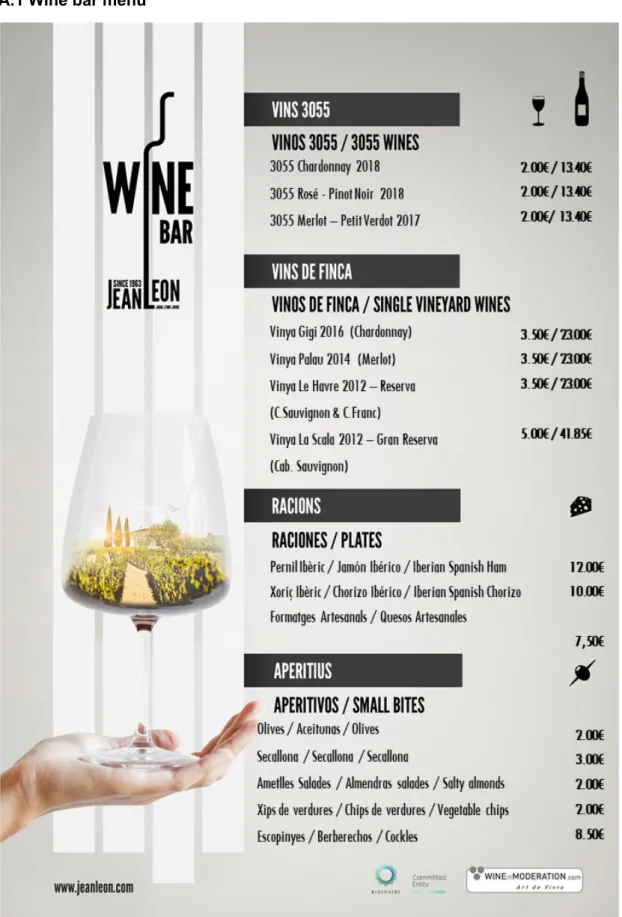
As this project is not an activity, there is no single price. It is a bar and there are many products that are offered in the menu. Therefore, the price varies according to the product. Regarding the price of wine, it was already established long before the Wine bar, because Jean Leon already offered the tasting service by the glass for people who after the tour wanted to continue trying other wines that were not included in the tasting. The price of the glass of wine is increasing according to the wine price. The young wines of Jean Leon are the most economical, then the price increases in aged wines, being the Gran Reserva "La Scala" the most expensive.
Talking about food, the bar offers mostly snacks. For example, olives, almonds, vegetable chips, fuet and cockles. Also, some cheese and ham portions accompanied by bread with tomato and olive oil, these last snacks are the most expensive in the menu. The price was calculated by the wine tourism department, analyzing the costs of the products, leaving a small margin of profit, because the main objective of the project is not the sale of food, but of the wines.
3. Placement
The Wine bar takes place in the outside part of the Visitor center in Jean Leon winery. The Wine bar has a covered roof part, with 3 high tables and 2 set of armchairs. It also has two other sets of armchairs located in front but in the garden, this last onces totally exposed to the sun. The place is totally open and wide, so the facilities can be enlarged if in the future they would like it.
4. Promotion
The promotion of this product is a very important issue, especially for local people that frequently go out for a drink in the different bars around the area.
The marketing department take care of almost all kind of Jean Leon’s promotion on the different platforms. The web page is the most important one, where all the activities are exposed, such us events, tours, workshops and now the Wine bar.
Jean Leon also puts a lot of effort in uploading quality material on social media, especially Instagram and Facebook. In this last two platforms they continuously promote the Wine bar. On Instagram they upload stories all weeks motivating people to come to visit the winery and the Wine bar.
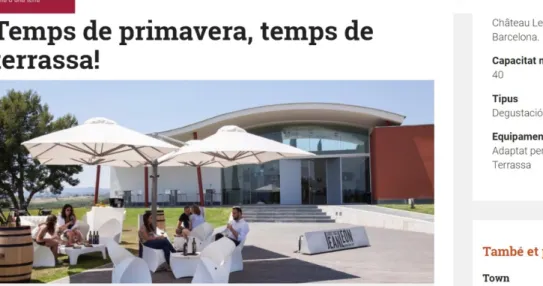
Finally, another important issue is the online advertisement of the Wine bar that the web page of Enoturisme Penedès has. This is an organization formed by public and private entities, created with the aim of promoting and boost coordinated policies in the field of the D.O. Penedès. Enoturisme Penedès is a very important platform for Jean Leon wine tourism department because their website has a section where all the wineries in the area open to tourism are published, exposing their activities. Tourists can directly reserve a workshop or tour of Jean Leon through this page and see the new activities and events that Jean Leon has, as the Wine bar.
3.3.2.4 Current Wine bar situation and projections
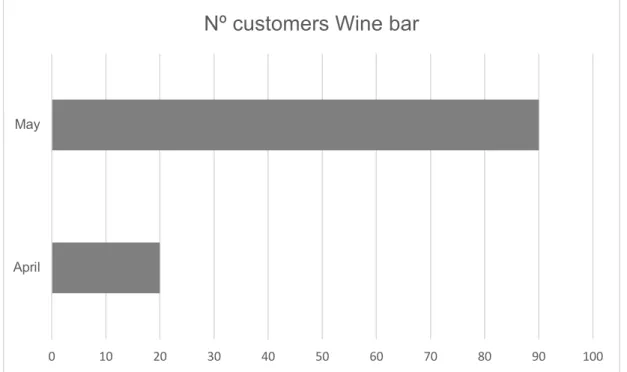
The Wine bar situation is improving every day but is very important to have in mind that new projects need time, and the analysis and data taken for this thesis are only from the first 2 months of the project. Figure 6 shows the total amount of customers in the past months. As the project is new and was inaugurated the last week of March the amount of data collected was very low. The Figure 6 shows that the first month (April) the Wine bar received 20 people and the next month (May) the number of people increased in 90.
Figure 6. Number of customers in the Wine bar
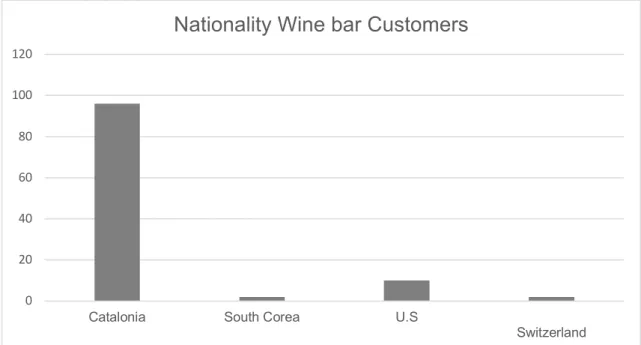
The intention of the winery creating this project is to magnify its strengths and abate its weakness in terms of wine tourism by creating a unique and finished product for their current customers and to open a new opportunity to future ones, and as is shown in Figure 6, the Wine bar is having more and more success. On the other side, for analyzing the data, it must be considered that April apart from being the first month of life the Wine bar, it was also a very rainy month, which also affects the Wine bar because it is outdoors, then as the weather improves and the days get sunnier there is more opportunity to receive customers. In Figure 7 the nationality of the visitors in the Wine bar is exposed. As was predicted local people form areas around the winery are the major client. In April and May the Wine bar have received 95 Catalan people. On the other hand, the second client are people from
0 10 20 30 40 50 60 70 80 90 100
April May
tours they are more comfortable with drinking wines in an informal way, as they do in California wineries, so doing some tastings on the Wine bar is perfect for them. The other two clients received were people from South Corea and Switzerland, but the numbers are very low, 2 persons from each nationality.
Figure 7. Nationality Wine bar customers
Figure 8. What customers order in the Wine bar. 0 20 40 60 80 100 120
Catalonia South Corea U.S
Switzerland
Nationality Wine bar Customers
0 2 4 6 8 10 12 14 16 18 20
Glass young range wine
Glass single vineyard wine
Small appetizers Cheese portion Ham portion
Analyzing which type of products, the Jean Leon`s Wine bar clients prefer is also very interesting. Figure 8 demonstrate that the most consumed wines are of the young range, that are the cheapest, a total of 19 glasses of young wines were sold from April to May. Then 16 glasses of the single vineyard wines were sold in these two months, these wines are a bit more expensive and the quality is also better. People also like to have some food to accompany the wines, 7 clients bought small appetizers (olives, almonds, vegetable chips, etc.), 5 clients preferred the cheeses portion and 4 more the Ham portion, that are more expensive than the small appetizers, but the ration is bigger and can be shared into more persons.
In terms of projections the Wine bar has a lot of potential, the visitor center is strengthening the advantages that have and struggling and trying to cope with the disadvantages. The number of customers in the past month has increased significantly, as the number of consumptions. The social networks of the winery are very powerful, but the greatest power is in what people say, what is called "word of mouth" if people speak well about the Wine bar, there will be more and more customers, apart that the climate is improving, so June can be a good month for the project.
The results of this research support what Nowak et al. (2006) proved, with positive tasting room experiences, wineries can cultivate relationships with customers that build commitment and loyalty. Building deeper relationships with the customer lead to long term, profitable relationships through continued patronage. Carefully orchestrating a tasting room experience that creates a positive experience for the customer is a critical component of future repurchase intentions.
Finally, the recognition of the brand is a very important issue. The company has a well-known prestige at a national and international scale, receiving tourist everyday where most of them know perfectly the brand and go because of it. Wine consumers have a vast array of choices and there are many quality wines being produced worldwide. Creating an experience in the Wine bar or tasting place, that is fun or exciting builds customer loyalty and future sales. Through careful research into the needs of the wine consumer, wineries can focus their efforts on improving customer satisfaction in all areas of the customer’s experience (Robinette et al., 2002).
4. CONCLUSIONS
The internship performed for four months was very positive and profitable, achieving personal and professional objectives and helping with the development and performance of the activities offered by the wine tourism department. Consequently, the number of visitors increased, as well as the time spend by the clients in Jean Leon increase with the Wine bar, as same as the expenditures. Is important to mention that four months were not enough to gather all the information and data for the study or to solve all the weak points of the project. Thinking that in wine tourism beside the experience of visiting vineyards, wineries and cellars, the main reason for visitors is to taste the wine and the experience of it, the creation of a Wine bar in Jean Leon was a good idea. The study and the results exposed in the document prove that there is a segment or a type of customer that prefer the experience of visiting a winery just with a wine tasting.
Forming an emotional bond with a customer involves showing them that the winery truly cares about they as people. Product quality and fair pricing is still forming an important part for a successful brand, but the emotional components of a brand can be effective in differentiating a wine from its competitors.
5. BIBLIOGRAPHY
Bourassa, S. C. 1990. A paradigm for landscape aesthetics. Environment and behavior, 22, 787-812.
Bruwer, J., & Alant, K. 2009. The hedonic nature of wine tourism consumption: an experiential view. International Journal of Wine Business Research, 21, 235-257
Brunori, G., & Rossi, A. 2000. Synergy and coherence through collective action: some insights from wine routes in Tuscany. Sociologia Rurales, 40, 409-423.
Bruwer, J., & Reilly, M. 2006. The power of word-of-mouth communication as an information source for winery cellar door visits. Australian and New Zealand Wine Industry Journal, 21, 43-51.
Dodd, T.H. 1999, ‘Attracting repeat customers to wineries. International Journal of Wine Marketing, 11, 18-28.
Enoturisme Penedès. 2019. Consorci de Promoció Turística del Penedès. Available: https://www.enoturismepenedes.cat. Accessed: 15th May 2019.
Getz, D., & Brown, G. 2006. Critical success factors for wine tourism regions: a demand analysis. Tourism management, 27, 146-158.
Hall, C. M., Mitchell, R., Macionis, N., Cambourne, B., & Sharples, L. 2004. Consuming places: the role of food, wine and tourism in regional development. Butterworth-Heinemann,
Oxford. Food tourism around the world: Development, Management and Markets, 25-59.
Hall, C. M., & Mitchell, R. 2000. Wine tourism in the Mediterranean: A tool for restructuring and development. Thunderbird International Business Review, 42, 445-465.
Jean Leon. 2019. Available: https://www.jeanleon.com. Accesses: 10th May.
Kaplan, R., & Kaplan, S. 1989. The experience of nature: A psychological perspective, Cambridge University press, 9-32.
Matellanes Lazo, M. 2009. Gestión del enoturismo en la DO Ribera del Duero de España.
Tesis para grado de Doctora de la Universidad de Valladolid. Valladolid, España: Departamento de Ingeniería Agrícola y Forestal. 171.
Medina, F. X., & Tresserras, J. 2008. Turismo enológico y rutas del vino en Cataluña. Análisis de casos: DO Penedès, DO Priorat y DO Montsant. Turismo y Patrimonio Cultural,
6, 493-509.
Nowak, L. I., & Newton, S. K. 2006. Using the tasting room experience to create loyal customers. International Journal of Wine Marketing, 18, 157-165.
Rocha, F., & Aragon, J. 2012. La crisis económica y sus efectos sobre el empleo en España. Gaceta Sindical, 19, 67-90.
Robinette, S., Brand, C., & Lenz, V. 2002. Emotion marketing: The hallmark way of winning customers for life. New York: McGraw-Hill, 247.
Rexac, A. 2002. Els vins de Cataluyna i les seves denominacions. Els sentits del vi. 1st ed. Generalitat de Catalunya, 192.
Stewart, J. W., Bramble, L., & Ziraldo, D. 2008. Key challenges in wine and culinary tourism with practical recommendations. International Journal of Contemporary Hospitality Management, 20, 303-312.
Tempesta, T., Giancristofaro, R. A., Corain, L., Salmaso, L., Tomasi, D., & Boatto, V. 2010. The importance of landscape in wine quality perception: An integrated approach using choice-based conjoint analysis and combination-based permutation tests. Food Quality and Preference, 21, 827-836.
Wang, X., Li, X. R., Zhen, F., & Zhang, J. 2016. How smart is your tourist attraction? Measuring tourist preferences of smart tourism attractions via a FCEM-AHP and IPA approach. Tourism Management, 54, 309-320.
ANNEXES
A.1 Wine bar menu
A.2 Wine bar photos
A.3 Wine bar promotion
Figure 12. Wine bar promotion in Enoturisme Penedès web page.