Probabilistic Perception Revision in A
GENT
S
PEAK
(L)
Francisco Coelho and Vitor Nogueira
Departamento de Inform´atica, Escola de Ciˆencias e Tecnologia, Universidade de ´Evora {fc,vbn}@di.uevora.pt
Abstract. Agent programming is mostly a symbolic discipline and, as such, draws little benefits from probabilistic areas as machine learning and graphical models. However, the greatest objective of agent research is the achievement of autonomy in dynamical and complex environments — a goal that implies embrac-ing uncertainty and therefore the entailed representations, algorithms and tech-niques. This paper proposes an innovative and conflict free two layer approach to agent programming that uses already established methods and tools from both symbolic and probabilistic artificial intelligence. Moreover, this method is illus-trated by means of a widely used agent programming example, GoldMiners.
1
Introduction and Motivation
Agent autonomy is a key objective in Artificial Intelligence (AI). Complex environ-ments, like the physical world where robots must delve, impose a degree of uncertainty that challenges symbolic processing. But while a probabilistic approach, currently ex-pressed in Machine Learning (ML) and Probabilistic Graphical Models (PGMs) [14], is required for certain aspects of autonomy, a great deal of agent programming is bet-ter handled by declarative programming (e.g. PROLOG) and more specifically, Beliefs, Desires and Intentions (BDI) architectures for autonomous agents, part of symbolic AI. Symbolic and probabilistic areas of AI are not necessarily incompatible. Consider for example distribution semantics [18] and markov logic [8]. From there two paths exist towards the interplay of symbolic and probabilistic AI: extending PGMs with lo-gical representations, in Statistical Relational Learning (SRL) [18], and extending logic programming languages with probability, in Probabilistic Logic Programming (PLP) [11,12]. For autonomous agents the symbolic vs. probabilistic division persists. Sym-bolic architectures, such as BDI, describe agent behavior on the basis of metaphors (e.g. goals, beliefs, plans) drawn from human behavior while the principle of Maximum Ex-pected Utility (MEU) guides probabilistic AI but there is only seminal work blurring that division.
Concerning agents programming JASON[6] is a popular AGENTSPEAK(L) (ASL) [17] interpreter and framework, triggering a considerable amount of research (e.g. [5]). The BDI architecture in general, including ASL and JASONin particular, outline a set of symbolic data structures and processes with more or less detailed semantics. However we can see these agents in trouble when their environment becomes stochastic. This assertion is supported by the experiment plotted in Figure 3: the GoldMiners (GM) is a virtual scenario used in the 2006 Multi-Agent Programming Contest [3] edition, now part of JASON’s examples. The two playing teams reach scores that are clearly
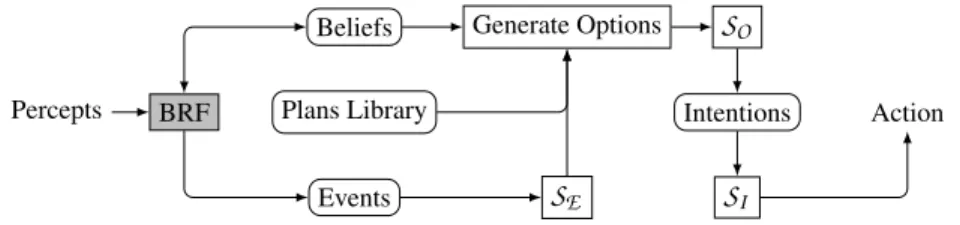
Percepts BRF Beliefs Events Plans Library Generate Options SE SO Intentions SI Action
Fig. 1. The JASONdeliberation process outlined, with the BRF highlighted. Percepts are pro-cessed to generate events and update the beliefs base. Available options are instantiated plans triggered by one event (selected bySE) and compatible with the current beliefs. One option
(de-fined bySO) is then appended to the intentions, whereSI chooses an action.
reduced even with a small amount of sensor misreadings. It turns out that Bayesian Networks (BNs) are representations of dependency of random variables and, thus, nat-ural candidates to represent probabilistic beliefs. But replacing symbolic beliefs by BNs is not trivial in part because changing the symbolic nature of beliefs entails reconsider-ations about the BDI architecture (e.g. the beliefs base must unify with plans contexts; changing these to a distribution will break the semantic of such unifications).
Our proposal is, at large, to wrap a layer of probabilistic techniques around certain symbolic processes without altering those processes or associated semantics. Here we illustrate this approach by focusing on the perception. In a stochastic environment, with a certain probability, values reported by sensors differ from the actual value. If sensor reported values are directly used by the deliberation process then performance suffers a penalty that results from the illusions about the truth of the environment. But sen-sor misreadings can be partially corrected under certain conditions using probabilistic methods. Our task is to find out if with such corrections performance degradation is attenuated and the added complexity has little impact in the deliberation cycle.
The remainder of this paper is organized as follows: next are provided the main concepts of these areas, followed, in section 2, by a general description of the percept-correction function (PCF) in the BDI architecture and a specific instantiation for the GM scenario extended with sensor misreadings. Section 3 presents a particular experi-ment on that scenario and respective results. In the last section the authors draw some conclusions on that experiment and outline future research.
1.1 State of the Art
Here we outline the groundwork of our proposal: the ASL language, its interpreter JA
-SON, together with PGMs, Dynamic Bayesian Networks (DBNs), and Hidden Markov Models (HMMs).
AGENTSPEAK(L) and JASON. BDI is the predominant architecture used for defin-ing intelligent agents. ASL [17] can be described as a logic programmdefin-ing based lan-guage geared towards the BDI architecture. JASON[6,4] implements the operational semantics of an extension of ASL and its deliberation cycle is depicted in Figure 1. In this cycle, the environment generates percepts that are processed by a belief-revision
function (BRF). Each change in the beliefs base generates an event. Goals in the set of events represent different desires that the agent selects by the function
S
E. The selected event entails applicable plans (options) instantiated from the plans library. Selection of a plan among applicable ones is performed by the functionS
O and included in the set of (current) intentions. Finally functionS
I selects one action from the set of intentionsthe one (action). Although the BRF evaluation is not part of the ASL specification it is a necessary component of the architecture. The default one that comes with JASON
“simply updates the belief base and generates the external events in accordance with current percepts. In particular, it does not guarantee belief consistency.” [4] (neverthe-less, in [1], the authors present a polynomial-time belief revision algorithm that restores belief base consistency when there are derived inconsistencies). JASONis used as the ASL framework and scenario simulator in this work.
Hidden Markov Models and Dynamic Bayesian Networks. HMM is a well-known framework to deal with latent variables in stochastic processes [2,16,14]. A (discrete) system state at time step t is described by a random variable X(t)that verifies the markov condition Pr(X(t+1)| X(0:t)) = Pr(X(t+1) | X(t)). This distribution is the tran-sition modelof the system. If X(t) is hidden but a sensor model Pr(Y(t)| X(t)) is known then the filter problem is to compute the distribution of X(t) given an initial state, x(0), and a sequence of observations, y(1:t). The forward algorithm is a common procedure to compute Pr(X(t)) that requires a belief about the previous environment state, ˆx(t−1), updates it with the transition model and corrects that update with the sensor model and current sensor reading, y(t). The major problem with a na¨ıve approach of HMMs is that the size of the transition model is quadratic in the number of system states. DBNs tries to minimize this problem by exploiting independences in the structure of the sys-tem to, hopefully, produce smaller representations of the transition and sensor models. The general HMM and DBN frameworks can be used directly to describe agent related problems. Perceptions are represented by the observation model and actions by an ob-served variable, say a(t). The transition model becomes Pr(X(t) | X(t−1), A(t)) and the sensor model Pr(Y(t) | X(t), A(t)). DBN are used in this work to correct agent percep-tions. In this specific case the transition and sensor models have many independence relations that are exploited to obtain “small” matrices. The next section describes the construction of such models.
2
Probabilistic Perception Correction
Here we illustrate how probabilistic methods can be used to improve performance in the GM noisy scenario without changing original the symbolic processing.
Currently the problem of extending ASL with probabilistic features is mostly di-rected to belief representation and addressed by many authors [15,10,9,13,19] but isn’t yet fully solved. An alternative and less intrusive application of probabilistic AI to ASL, proposed here, targets the processes instead of the data structures. Bounding probabilis-tic techniques to the computation of certain ASL functions (e.g. the BRF,
S
E,S
O,S
I functions, as in figure 1) promises a number of advantages. Since the computations of those functions are unspecified in ASL (and overwritable in JASON), probabilistic techniques can be used there without invalidating previous work. So symbolic andprob-Detail current belief revision. . . to include perception correction before symbolic BRF. Percepts BRF Beliefs Percepts PCF Sensors Belief sBRF Beliefs
Fig. 2. Inclusion of percept-correction function (PCF) before the original, symbolic, BRF (de-noted by sBRF) to correct noisy perceptions. The Sensors Belief is a distribution of sensor values and independent of the (symbolic) beliefs used in the BDI deliberation.
abilistic AI have clearly separated roles and each is used to solve “familiar” problems in the respective domain while both simultaneously contribute to the agent behavior. Symbolic programming uses unchanged ASL programs to define high level agent be-havior, with plans, beliefs, etc. while probabilistic algorithms process low level noisy signals — with BNs, influence diagrams, etc.
Defining certain functions of ASL as tasks to be solved by probabilistic techniques seems a promising technique to address open problems in agent autonomy, using al-ready known theory and tools. Next we describe the setup of an example of this in-terplay of symbolic and probabilistic techniques. This experiment uses original ASL programs designed for a (mostly) deterministic scenario; adds sensor misreadings, the respective rate being defined by a parameter; re-defines the computation of the BRF with the help of a probabilistic process and records the performance of agents. The out-come of the first two steps is depicted in Figure 3 where performance degradation is associated with increased sensor misreadings.
Problem Statement: (Noisy) GoldMiners. The GM competition is described in [7]. A miner is equipped with a 3 × 3 grid of sensors, Y0:8, that scans its neighborhood.
Each sensor reports the content of a cell, that can be one of empty, obstacle, gold or miner. The miner can also select one action of up, down, left, right, pick, drop and skip. Non-determinism is present as incomplete perception and action failure and in the examples in JASON noise increases the probability of action failure in proportion to current cargo. Values depicted in Figure 3 result from the JASONsimulator with noisy sensors. The “noise” parameter is the rate of cell misreadings. Sensors are independent but equally parameterized: the value reported by each sensor depends only on the noise parameter and cell content.
Proposal: Percept-Correction Function. Our proposal to recover agent perfor-mance is to prepend a percept-correction function (PCF) to the BRF applying proba-bilistic knowledge of the environment (see Figure 2). Correction of perceptions is an inference problem in the framework of HMMs and DBNs .
The formal problem statement is: In the GM simulation extended with sensor noise parameter θ, update the estimate of cells content ˆx00:8given the previous estimatexˆ0:8,
current action A0= a0and sensor readings Y0:80 = y00:8.For notation simplicity we write X = X(t−1)0:8 , X0= X(t), etc. A resolution is as follows. Given the previous estimate ˆx,
N(0) = {0, 1, 3} N(1) = {0, 1, 2, 4} N(2) = {1, 2, 5} N(3) = {0, 3, 4, 6} N(4) = {1, 3, 4, 5, 7} N(5) = {2, 4, 5, 8} N(6) = {3, 6, 7} N(7) = {4, 6, 7, 8} N(8) = {5, 7, 8}
Table 1. Neighbors in the grid sensor. The function N(i) defines the set of neighbors of sensor i. From this topology follow independence statements of the form Xi0 ⊥⊥ X\N(i) | XN(i)where
\N(i) is a short-hand to 1 : 8 \ N(i).
current action a0and sensor reading y0, the update is
Pr(X0| ˆx, a0, y0) ∝ Pr(y0| X0) Pr(X0| ˆx, a0) (1) and perception correction is the maximum a posteriori (MAP) of each sensor,
ˆ
x0i= argsmax Pr(Xi0= s | ˆx, a0, y0) (2) where s ranges over all (four) sensor values. The argsmax computation doesn’t require normalizing the right side of Equation 1, a welcome simplification but direct calculation doesn’t scale to the grid sensor. Each location has four different values so the state space has 49 and for each action the corresponding transition has 49×2 parameters. Numbers of this magnitude render intractable a direct HMM approach. Fortunately, the grid sensor entails many independence statements that reduce the number of transition and observation parameters to a convenient size:
1. Sensor values are independent between them so instead of a “big” transition we only need to deal with nine “small” transitions, one for each sensor;
2. Updated values of each sensor depend only on the action and the previous values of neighbor sensors, defined in Table 1. This can be further refined when the action is considered (e.g. for the “up” action the “bottom” neighbors are irrelevant); 3. The observed value of a sensor depends only on the corresponding cell content; Using these independence statements the transition and observation models can be de-scribed by relatively small matrices and the computations of Equations 1 and 2 become acceptable for the inclusion of the PCF in the BDI deliberation process. The sensor model is very simple:
Pr(Yi0= x | Xi0= x) = 1 − θ, ∀x (3) for noise parameter θ. The transition model, more complex than the sensor model, is explained in the next sub-section.
Resolution: Transition Model. The transition model is based on a few simplifying assumptions about the environment:
1. The state of the environment only changes by effect of the miner’s actions. In par-ticular detected miners do not move and gold doesn’t “appear” in empty cells; 2. The miner never moves to “obstacle” or “miner” cells;
3. The content of unscanned cells is uniformly distributed over all possible values; The state of a sensor depends only on the action and previous values of the neigh-bors. Different actions entail different schemes for the transition parameters, easier to describe one action at a time.
Action “skip”. In this case the miner doesn’t change the environment state; Action “pick”. The miner removes a gold from its location, if one exists; Action “drop”. The miner adds a gold in its location, if that cell is empty;
Action “up”. The miner moves up and the sensors that enter unscanned cells are {0, 1, 2}. For these cells the scanned value is uniformly distributed. Each one of the other sensors scans the cell previously above it;
Remaining actions (“right”, “down” and “left”.) These are similar to “up”; These descriptions can be easily translated into conditional probabilities that com-pletely define the transition model for the sensor grid. That model can be used by the forward algorithm outlined before and Equations 1 – 2 to correct perceptions.
3
Results
The proposed approach requires support on the effect it may have on agents perfor-mance. Our option was to gather empirical evidence to guide further research.
Implementation Notes. JASONalready provides a simulator for the original GM. Its object-oriented nature helps the construction of a noisy variant by overriding some classes and methods. Computation of the PCF uses two libraries developed by the au-thors, one (at https://github.com/fmgc/jpgm) targeted to the sparse representation of ma-trices and related operations and a second one (at https://github.com/fmgc/ngm) bridg-ing the operations of the first library to the noisy GM scenario. These are minimal libraries providing only the necessary support here.
Empirical Results. Evaluation of the effect of the PCF uses three teams: a “dummy” team that barely uses any ASL features; a “smart” team that makes heavy use of ASL but not the PCF and a “corrected” team that has the same ASL programs of the “smart” team and uses the PCF. Performance of each team is the number of gathered golds after a given number of time-steps and the sensor noise rate is set at five values: 0.000, 0.025, 0.050, 0.075 and 0.100. A run is defined by a team and a noise value and simulates the GM scenario for 700 time-steps. At the end the number of gathered golds is recorded. Each run (team, noise) is launched ten times and those runs are summarized by the mean and standard variation of the number of gathered golds. The final result are fifteen pairs of (mean, standard variation), plotted in Figure 3.
4
Conclusion
These results provide empirical support to further research the interplay of symbolic and probabilistic AI specifically concerning BDI agent architectures.
There seems to be no major theoretical obstacles to generalize this method to other domains and applications. However probabilistic inference in general is intractable [2] despite factorization methods and efficient algorithms for specific graph structures (e.g. DBN, Junction Tree). Probabilistic learning was not considered here, although unsu-pervised bayesian learningseems tailored to suit autonomous agents since the benefits of self-reconfiguration might prove critical. Again, adoption of such features stumbles into the computational complexity of the problem.
0.000 0.025 0.050 0.075 0.100 0 10 20 30 Sensor noise Gathered golds
Effect of Perception Correction
dummy smart corrected
Fig. 3. Sensor noise (horizontal axis) vs. agent performance measured by gathered golds (vertical axis). Performance of the “dummy”, “smart” and “corrected” teams under various levels of sensor noise are plotted. Each data point summarizes the number of gathered golds by team in a given noise value and consists of the mean (black line) and standard variation (band of dotted lines) of ten samples. The results of the “corrected” team are clearly above the others.
For relatively simple scenarios the definition of the transitions of the probabilistic model of the environment used by the PCF can be done “by hand” but for problems with large number of variables this raises an usability problem with no easy resolution. This is also an issue with probabilistic methods, not specific to this work.
One particular problem with this symbolic/probabilistic separation is that there can be inconsistencies between the probabilistic model and the symbolic beliefs. Also the advantages of a single, coherent and theoretically sound language cannot be easily dis-carded. Seemingly in opposition to this line of research, an unified symbolic and prob-abilistic framework using Markov Logic (MkL), Statistical Relational Learning (SRL) or Probabilistic Logic Programming (PLP) for example, could, in principle, simplify the semantic study of agent behavior and formal verification of agent programs. Future Work. The major application area seems to include robotics where intrinsi-cally noisy perception is one of the major obstacles to symbolic controls. Hopefully this line of research might facilitate such integration. Further development of this work folds into four major lines: formal specification and semantics to support verification of agent programs, guaranteed behavior, etc; further applications of probabilistic methods to symbolic agent programming (e.g. use of influence diagrams to sort actions in the in-tention selection); simulations in virtual environments is a key step in robotics. JASON
already provides a large set of scenarios ready to explore in the lines of the GM exam-ple presented here; deployment in physical robots like the ardrone or twopi is a major challenge given the (usual) computation and real-time constraints of such platforms.
Acknowledgements
The people around us, the flow of life, the internet. And, of course, the gracious money provider, Fundac¸˜ao para a Ciˆencia e Tecnologia.
References
1. Alechina, N., Bordini, R.H., H¨ubner, J.F., Jago, M., Logan, B.: Belief Revision for AgentS-peak Agents. In: Proceedings of the Fifth International Joint Conference on Autonomous Agents and Multiagent Systems. AAMAS ’06 (2006)
2. Barber, D.: Bayesian reasoning and machine learning. Cambridge University Press (2012) 3. Behrens, T., Dix, J., K¨oster, M., H¨ubner, J.: Special issue about multi-agent-contest II. Annals
of Mathematics and Artificial Intelligence 61 (2011)
4. Bordini, R.H., H¨ubner, J.F.: BDI agent programming in AgentSpeak using Jason. In: Com-putational logic in multi-agent systems, pp. 143–164. Springer (2006)
5. Bordini, R.H., H¨ubner, J.F.: Semantics for the Jason variant of AgentSpeak (plan failure and some internal actions). In: ECAI. pp. 635–640 (2010)
6. Bordini, R.H., H¨ubner, J.F., Wooldridge, M.: Programming multi-agent systems in AgentS-peak using Jason. Wiley (2007)
7. Dastani, M., Dix, J., Nov´ak, P.: The second contest on multi-agent systems based on compu-tational logic. In: Compucompu-tational Logic in Multi-Agent Systems. Springer (2007)
8. Domingos, P., Kok, S., Poon, H., Richardson, M., Singla, P.: Unifying logical and statistical AI. In: AAAI. vol. 6, pp. 2–7 (2006)
9. Fagundes, M.S.: Integrating BDI model and Bayesian Networks. Master’s thesis, Universi-dade Federal do Rio Grande do Sul (2007)
10. Fagundes, M.S., Vicari, R.M., Coelho, H.: Deliberation process in a BDI model with bayesian networks. In: Agent Computing and Multi-Agent Systems. pp. 207–218. Springer (2009)
11. Fierens, D., den Broeck, G.V., Renkens, J., Shterionov, D., Gutmann, B., Thon, I., Janssens, G., Raedt, L.D.: Inference and learning in probabilistic logic programs using weighted boolean formulas. arXiv p. 1304.6810 (04 2013), http://arxiv.org/abs/1304.6810 12. Gutmann, B., Thon, I., De Raedt, L.: Learning the parameters of probabilistic logic programs
from interpretations. In: Machine Learning and Knowledge Discovery in Databases, pp. 581– 596. Springer (2011)
13. Kieling, G.L., Vicari, R.M.: Insertion of probabilistic knowledge into BDI agents construc-tion modeled in bayesian networks. In: Complex, Intelligent and Software Intensive Systems (CISIS), 2011 International Conference on. pp. 115–122. IEEE (2011)
14. Koller, D., Friedman, N.: Probabilistic graphical models: principles and techniques. The MIT Press (2009)
15. Luz, B., Meneguzzi, F., Vicari, R.: Alternatives to threshold-based desire selection in bayesian BDI agents. In: 1st International Workshop on Engineering Multi-Agent Systems (2013)
16. Murphy, K.P.: Machine learning: a probabilistic perspective. MIT press (2012)
17. Rao, A.S.: AgentSpeak (L): BDI agents speak out in a logical computable language. In: Agents Breaking Away, pp. 42–55. Springer (1996)
18. Sato, T.: A statistical learning method for logic programs with distribution semantics. In: Proceedings of the 12th International Conference on Logic Programming (ICLP’95) (1995) 19. Silva, D.G., Gluz, J.C.: AgentSpeak(PL): A new programming language for BDI agents with
integrated bayesian network model. In: International Conference on Information Science and Applications (2011)