Probabilistic models for mechanical properties
of prestressing strands
Luciano Jacintoa, Manuel Pipab, Luís Nevesc, Luís Oliveira Santosb
a Instituto Superior de Engenharia de Lisboa, Rua Conselheiro Emídio Navarro, 1, 1959-007 Lisbon, Portugal. b Laboratório Nacional de Engenharia Civil, Avenida do Brasil 101, 1700-066, Lisbon, Portugal.
c UNIC, Faculdade de Ciências e Tecnologia da UNL, 2829-516, Caparica, Portugal.
Corresponding author: Luciano Jacinto.
Tel.: (+351) 96 940 15 76; Fax.: (+351) 21 831 70 21 E-mail address: [email protected]
Abstract
This study focus on the probabilistic modelling of mechanical properties of prestressing strands based on data collected from tensile tests carried out in Laboratório Nacional de Engenharia Civil (LNEC), Portugal, for certification purposes, and covers a period of about 9 years of production. The strands studied were produced by 6 manufacturers from 4 countries, namely Portugal, Spain, Italy and Thailand. Variability of the most important mechanical properties is examined and the results are compared with the recommendations of the Probabilistic Model Code, as well as the Eurocodes and earlier studies. The obtained results show a very low variability which, of course, benefits structural safety. Based on those results, probabilistic models for the most important mechanical properties of prestressing strands are proposed.
Keywords
Prestressing strands, probabilistic models, tensile strength, 0.1% proof stress, modulus of elasticity, Bayesian statistics.
1 Introduction
(Y1860 grade) and are all composed by 7 wires. The analysed strands correspond to the most widely used worldwide in the last decades.
Samples were collected from tensile tests performed between 2001 and 2009 in Laboratório Nacional de Engenharia Civil (LNEC), Portugal. During this period, over 500 tensile tests were carried out for the 3 families mentioned above. However, several of these tests refer to strands produced from the same heat (same casting). As it is known, the variability within a single heat is lower than the variability between different heats. Thus, for the purpose of statistical analysis, only one test from each heat was selected (at random), which reduced the sample to 131 tests.
Differently to what was done in a previous study [1], where stresses were computed dividing the forces measured in those tests by the actual strands cross-section-areas, in the present study all the stresses were computed using nominal cross-section areas. This is common practice [2,4].
For each of the 3 families of strands, the studied properties were: tensile strength or maximum stress ( fp), 0.1% proof stress ( fp0.1), total elongation at maximum force (eu) and modulus of elasticity (Ep). It was found out that the difference in the mean of
those properties between families was of the same order of magnitude as the standard deviations, which allowed us to consider the 3 families of strands as belonging to the same population. The 3 families were thus merged into a single sample.
The tested strands came from six manufacturers of different countries, including Portugal, Spain, Italy and Thailand. However, as it will be seen, the variability of the studied properties is very small, not justifying thus a separated analysis by manufacturer.
ε σ
εu fp
0.1
fp
Ep
0.1%
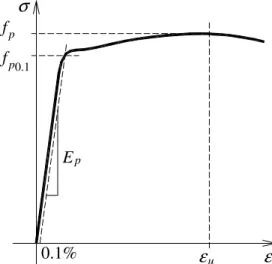
Figure 1 — Typical stress-strain diagram for a prestressing strand.
lower script. For example, the characteristic value of the variable fp0.1 will be denoted by fp0.1k. As shown in Figure 1, prestressing strands do not exhibit a distinct yield
point, which is typical of high strength steels, presenting however a slight inflection in the beginning of the hardening zone.
As stated above, the studied strands are all of the Y1860 grade, which has been the most commonly used in Portugal and in other countries. The value 1860 is termed nominal tensile strength, expressed in MPa, and corresponds to the characteristic value of the tensile strength fp, that is, fpk = 1860 MPa [2].
The main purpose of this study is to analyse the variability of the mentioned mechanical properties of prestressing strands and compare it with the corresponding recommendations of the Probabilistic Model Code [5] and other sources. Based on this comparison, probabilistic models for the mechanical studied properties are proposed.
2 Critical review of the Probabilistic Model Code
recommendations
Table 1 shows the recommendations of the Probabilistic Model Code (PMC) [5] concerning the tensile strength fp, modulus of elasticity Ep and total elongation at
maximum force εu of prestressing steels. As it can be observed, PMC presents two
expressions for the mean of fp, one of which assumes constant coefficient of variation
and the other constant standard deviation. PMC gives no indication about which one should be used.
Table 1 — Prestressing steels. Recommendations of the Probabilistic Model Code[5]
Variable Mean Std. dev. V* Distribution 1.04fpk - 0.025
fp or Normal
fpk+66 MPa 40 MPa
-Wires 200 GPa
-Ep Strands 195 GPa - 0.02 Normal
Bars 200 GPa
-εu 0.05 0.0035 - Normal
* Coefficient of variation
Regarding the 0.1% proof stress, PMC recommends for strands the model:
0.1= 0.85
p p
3 Statistical analysis of the available sample
This section presents the results of the statistical analysis performed and produces some comments on its relevance for the structural safety. It must be emphasized that the stresses were computed for all cases dividing the forces obtained from the tests by the nominal cross-section area of the strands, as it is usual [2]. In this way, the variability of the computed stresses (fp and fp0.1) already includes the variability of the cross-section area. Thus, in the model Fp = fp0.1×Ap, which gives the force in a cable, the area of the
cable Ap is the nominal one, that is, the area of the cable should be modelled as
deterministic. Nevertheless, the variability of the cross-section area is also analysed.
3.1 Tensile strength
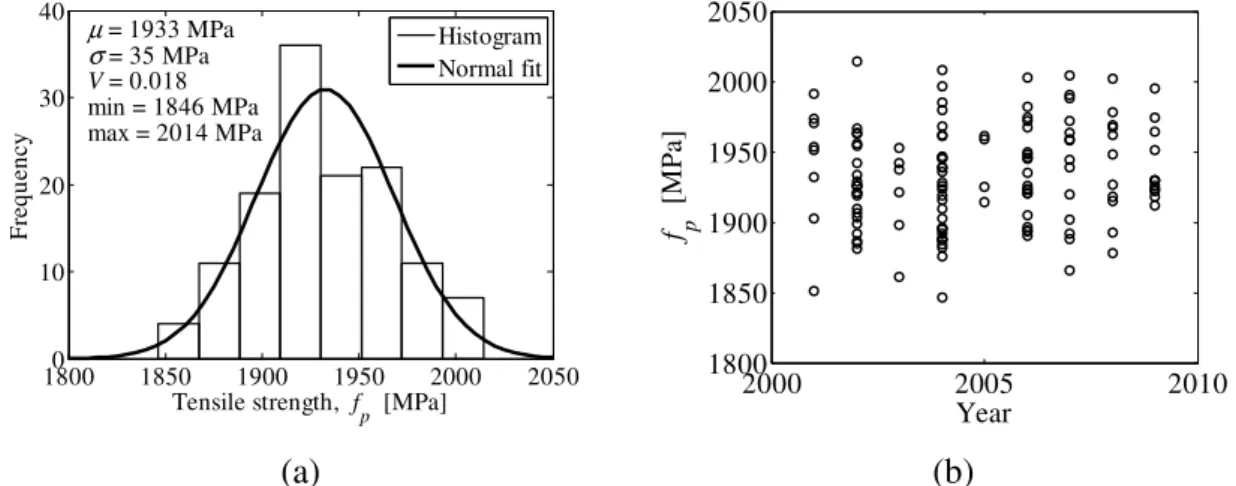
Figure 2 shows the histogram of the tensile strength fp of the tests available (131 tests).
As it can be seen, the normal model fits well the histogram, which agrees with the PMC recommendations [5] and the prEN 10138-1 [2]. The coefficient of variation obtained is very low, V = 0.018.
According to the parameters obtained (µ =1933 MPa, σ =35 MPa), the characteristic value of fp can be estimated as fpk =1933 1.645 35 1875 MPa− × = , which satisfies the specified value for the Y1860 grade. The estimate of fpk using directly the sample available ( i.e., empirical distribution) is 1881 MPa.
18000 1850 1900 1950 2000 2050 10
20 30 40
Tensile strength, f p [MPa]
F
re
q
u
en
cy
µ = 1933 MPa σ = 35 MPa
V = 0.018 min = 1846 MPa max = 2014 MPa
Histogram Normal fit
2000 2005 2010
1800 1850 1900 1950 2000 2050
Year
f p
[M
P
a]
(a) (b)
Figure 2 — Tensile strength fp. (a) Histogram. (b) Values of fp by year. Each dot corresponds
to a tensile test.
These results agree with the results reported by other authors, namely Casas & Sobrino [6], Nowak & Szerszen [7], and Wisniewski et al. [8]. The value of 40 MPa for the standard deviation, as suggested by PMC, seems a reasonable assumption. So, for modelling the tensile strength the following model can be used:
~ ( , )
p
Figure 2.b shows the values of the tensile strength fp by production year, indicating
that there is no trend during the observed period (2001—2009). This Figure also suggests that the sample is free of outliers.
3.2 The 0.1% proof stress
From the structural safety point of view, the 0.1% proof stress fp0.1 is more decisive
than the tensile strength, because this one is only reached for large strains, rarely observed in real structures, even for ultimate limit states.
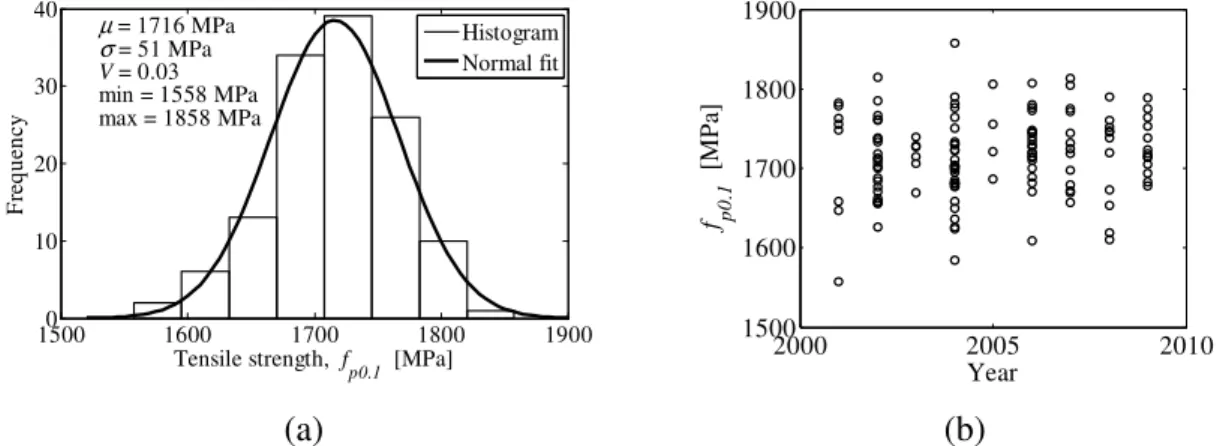
Figure 3 shows the histogram for the 0.1% proof stress and its temporal variation. As it can be seen, the 0.1% proof stress has greater variability (σfp0.1=51 MPa) than the tensile strength (σfp =35 MPa), which agrees with results reported in earlier studies [6, 8, 9]. In fact the 0.1% proof stress is more sensitive than the tensile strength, because it depends on the measured modulus of elasticity and the curvature of the stress-strain diagram where the yielding starts. This finding raises a comment on the model fp0.1= 0.85fp proposed by PMC. According to this model the standard
deviation of the 0.1% proof stress is smaller than the standard deviation of the tensile strength, contrarily to the results obtained. Later in this article a model for obtaining
0.1
p
f from fp based on regression analysis will be proposed, which allows overcoming
this limitation.
15000 1600 1700 1800 1900
10 20 30 40
Tensile strength, f
p0.1 [MPa]
F re q u en cy
µ = 1716 MPa
σ = 51 MPa
V = 0.03
min = 1558 MPa max = 1858 MPa
Histogram Normal fit
2000 2005 2010
1500 1600 1700 1800 1900 Year f p 0 .1 [M P a]
(a) (b)
Figure 3 — The 0.1% proof stress, fp0.1. (a) Histogram. (b) Values of fp0.1 by production year.
According to the results presented in Figure 3, the characteristic value of fp0.1 can be estimated as fp0.1k = 1716 1.645 51 1632 MPa- ´ = . The ratio between fpk0.1 and
pk
f is then 1632/1860 = 0.88, which agrees with prEN 10138-3 [3]. The ratio between the mean of fp0.1 and fpk is 1716/1860 = 0.92. Regarding the coefficient of variation,
the obtained value (V = 0.03) is similar to the results reported by Wiśniewski [8]. Therefore, based on these considerations, the following model is proposed:
0.1~ ( , )
p
3.3 Total elongation at maximum force
Total elongation at maximum force eu, undoubtedly an important parameter for the
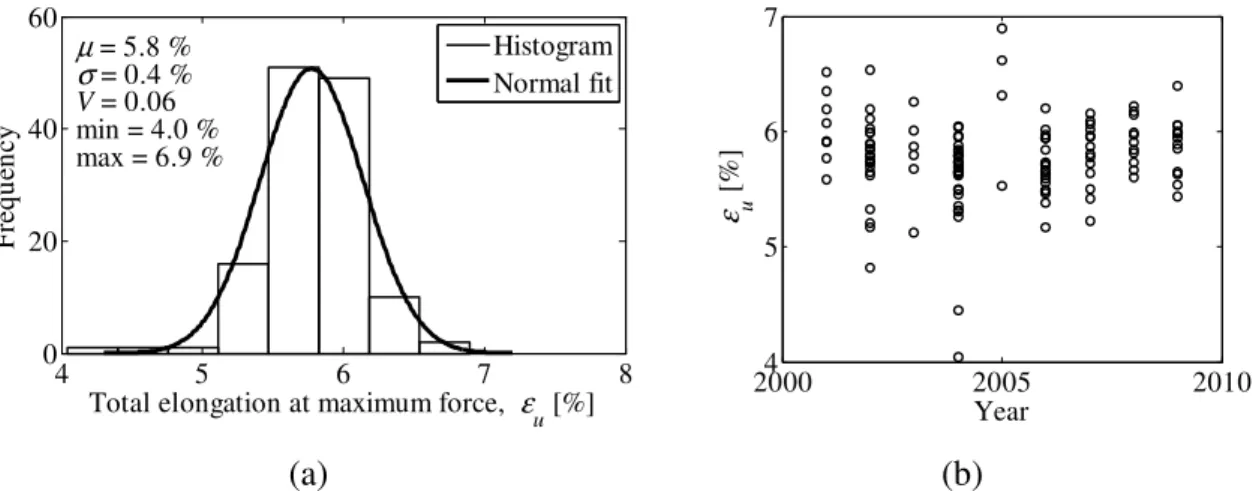
structural safety, does not generally raises concerns since typical values of this parameter (mean value above 5%, as shown in Figure 4) provide a rotation capacity of concrete sections in plastic domain higher than what is usually required in plastic analysis. Indeed, even for strains relatively high during tensioning operations (for example strains of about 0.7%), the increase in strain necessary to reach failure would be 5% 0.7%− =4.3%, which would correspond to very high plastic deformations in concrete members.
It is interesting to note that the prestressing strands meet the requirements of high ductility (class B) as specified in EN 1992-1-1:2004 [4], Annex C, for reinforcing steels. In fact, the characteristic value of εu (0.10-quantile, according to that Standard)
is euk = 5.8% 1.28 0.4%- ´ = 5.3%, which is greater than 5.0% and (fp / fp0.1)k is greater than 1.08.
Figure 4 shows the histogram of the εu as well as its variation over last decade. Comparing the obtained values (mean and standard deviation) with the recommendations of the PMC, these seem reasonable. The histogram, which appears relatively symmetrical, supports the recommendation of PMC that suggests a normal distribution. The graphic (b) shows no temporal trend, and the minimum and maximum values observed did not seem to be outliers. It is noted that the available sample satisfies the requirement εu ≥3.5% specified in prEN 10138-1 [2].
4 5 6 7 8
0 20 40 60
Total elongation at maximum force, ε
u [%]
F
re
q
u
en
cy
µ = 5.8 %
σ = 0.4 %
V = 0.06 min = 4.0 % max = 6.9 %
Histogram Normal fit
20004 2005 2010
5 6 7
Year
ε u
[
%
]
(a) (b)
Figure 4 — Total elongation at maximum force, eu . (a) Histogram. (b) Values of eu by
production year.
Other authors, namely Casas & Sobrino [6] and Wiśniewski [8], report results compatible with the results obtained in this study. Based on those results, the following model is proposed:
~ ( , )
u N
3.4 Modulus of elasticity
Accurate knowledge on the actual value of the modulus of elasticity is important especially during tensioning operations, since one of the criteria for controlling the actual applied prestressing force is made by measuring the tendon elongations, which, of course, depend on the modulus of elasticity. However, regarding safety checking, this is a parameter of some importance with regard to serviceability limit states, namely decompression limit state and cracks width, having however little effect on ultimate limit states, since when these are reached the steel are in general in plastic domain.
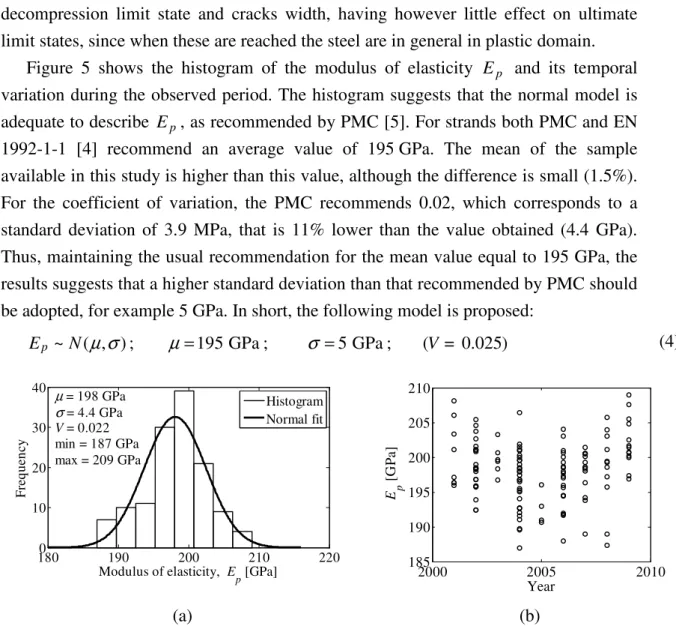
Figure 5 shows the histogram of the modulus of elasticity Ep and its temporal
variation during the observed period. The histogram suggests that the normal model is adequate to describe Ep, as recommended by PMC [5]. For strands both PMC and EN
1992-1-1 [4] recommend an average value of 195 GPa. The mean of the sample available in this study is higher than this value, although the difference is small (1.5%). For the coefficient of variation, the PMC recommends 0.02, which corresponds to a standard deviation of 3.9 MPa, that is 11% lower than the value obtained (4.4 GPa). Thus, maintaining the usual recommendation for the mean value equal to 195 GPa, the results suggests that a higher standard deviation than that recommended by PMC should be adopted, for example 5 GPa. In short, the following model is proposed:
~ ( , )
p
E N µ σ ; µ=195 GPa; σ =5 GPa; (V = 0.025) (4)
1800 190 200 210 220
10 20 30 40
Modulus of elasticity, E
p [GPa]
F
re
q
u
en
cy
µ = 198 GPa
σ = 4.4 GPa V = 0.022 min = 187 GPa max = 209 GPa
Histogram Normal fit
2000 2005 2010
185 190 195 200 205 210
Year
E
p
[
G
P
a]
(a) (b)
Figure 5 — Modulus of elasticity Ep. (a) Histogram. (b) Values of Ep by year. Each dot corresponds
to a tensile test.
3.5 Cross-section area
As mentioned earlier, the proposed models for stresses, fp or fp0.1, already include the
variation of the cross-section areas are very small. Figure 6 shows the histogram of the family 15.2 mm. As it can be seen, the Normal model fits well the histogram.
Table 2 — Sample statistics concerning the cross sectional area of the studied strands (tests performed between 2001 and 2009).
Nominal area mean Stand. deviation Coeff. of Min Max [mm2] [mm2] [mm2] variation [mm2] [mm2] 13.0 mm 100 98 100 1.0 0.010 99 102 15.2 mm 140 257 141 1.0 0.007 138 143 15.7 mm 150 151 151 1.3 0.009 148 156 Strand family Sample
size
1360 138 140 142 144 146 10
20 30 40 50 60
Cross sectional area, A
p [mm
2]
F
re
q
u
en
cy
µ = 141 mm2
σ = 1.0 mm2
V = 0.007 min = 138 mm2 max = 143 mm2
Histogram Normal fit
Figure 6 — Cross-section area histogram for strands with nominal diameter of 15.2 mm.
According to prEN 10138-1[2], the tolerance concerning the mass per metre for strands is ±2% of its nominal value. This requirement is generally satisfied by the samples analysed.
3.6 Correlation analysis
Correlation between 0.1% proof stress and tensile strength
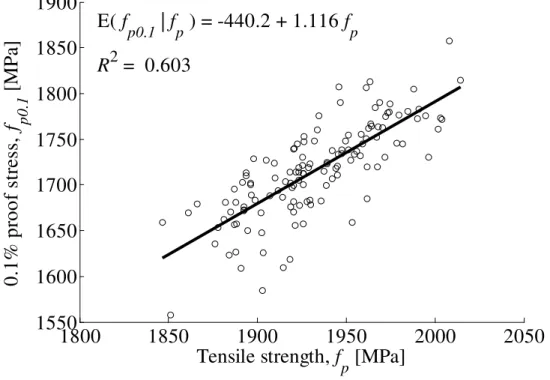
Figure 7 shows the scatter diagram of points ( ,fp fp0.1) regarding the sample of 131
tensile tests studied. A linear regression analysis was performed and the following regression parameters were obtained:
0
ˆ 440 MPa
β = − ; βˆ1=1.12; ˆσ =32 MPa, (5)
where βˆ0 and βˆ1 represent estimates of the intercept and the slope of the straight line,
of determination is R2 = 0.603, which corresponds to a coefficient of correlation of
0.78 and indicates high correlation (but not perfect) between those two variables. Based on the above regression model, the following probabilistic model can be used in case it is necessary to model simultaneously fp0.1 and fp:
0.1 440 1.12 32 [MPa]
p p
f = − + f + Z (6)
where fp must be given in MPa and Z ~N(0,1), which is rather different from the model fp0.1 = 0.85fp proposed by PMC, which assumes a perfect correlation between the variables.
1800
1850
1900
1950
2000
2050
1550
1600
1650
1700
1750
1800
1850
1900
Tensile strength,
f
p
[MPa]
0
.1
%
p
ro
o
f
st
re
ss
,
f
p0
.1
[
M
P
a]
E(
f
p0.1
|
f
p) = -440.2 + 1.116
f
pR
2= 0.603
Figure 7 — Scatter diagram of points ( ,fp fp0.1).
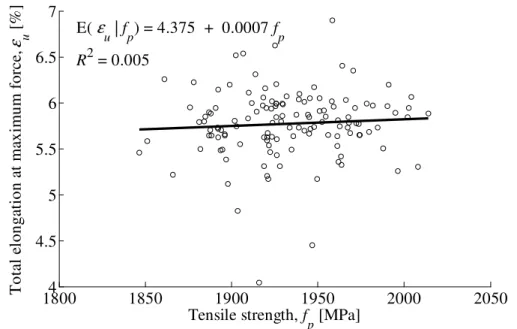
Correlation between total elongation at maximum force and tensile strength The correlation between total elongation eu and tensile strength fp was also analysed (Figure 8). As observed the coefficient of determination is R2 = 0.005, which
18004 1850 1900 1950 2000 2050 4.5
5 5.5 6 6.5 7
Tensile strength, f
p [MPa]
T
o
ta
l
el
o
n
g
at
io
n
a
t
m
ax
im
u
m
f
o
rc
e,
ε u
[
%
]
E(ε
u | fp) = 4.375 + 0.0007 fp R2 = 0.005
Figure 8 — Scatter diagram of points ( ,f ep u).
4 Uncertainty induced by the limitation of the available
sample size
The results presented above were based on a sample of size 131. This is not a very large sample and certainly induces uncertainty (statistical uncertainty). In this section, the effect of the sample size is analysed. The discussion focuses on the 0.1% proof stress, since it is one of the most important parameters studied. Remember that the characteristic value of this parameter was estimated in 1632 MPa. Obviously, this estimate is not error-free. In order to evaluate the error in this estimate, or, equivalently, to assess the goodness of the available sample size, the Bayesian paradigm will be adopted. This approach has been widely accepted as the most appropriate to deal with statistical uncertainty [11].
Since it was assumed that fp0.1 follows a normal distribution, i.e., fp0.1~N( , )µ σ , an estimate of fp0.1k was computed using the following expression:
0.1 1.645
p k
f = −µ σ (7)
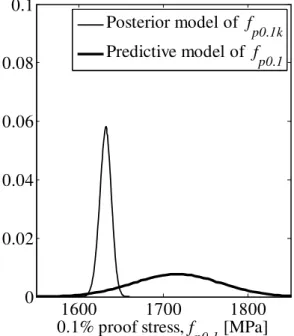
According to the Bayesian paradigm the parameters µ and σ are modelled as random variables [12]. Since fp0.1k is a function of µ and σ , it follows that fp0.1k is also a random variable. The standard deviation of fp0.1k constitutes a good measure of the error in the estimate fp0.1k = 1632 MP a.
a sample of fp0.1k was generated using Monte Carlo simulation from which the mean
and the standard deviation were computed. The mean of fp0.1k is 1632 MPa and the
standard deviation is 6.9 MPa, which yields a relative error of 6.9/1632 = 0.4%. Since this is a very small error, it can be concluded that the estimate fp0.1k = 1632 MP a can be considered very close to the true value, or that the simple size can be regarded as good enough for the purpose of estimating fp0.1k.
The quantile 0.05 of fp0.1k was also computed and the value 1620 MPa was obtained, that is, the probability that the true fp0.1k is greater than 1620 MPa is 0.95. The fact that 1620 is close to 1632 indicates that the distribution of fp0.1k is quite narrow or that the uncertainty in fp0.1k is small. This can be appreciated in Figure 9, where the distribution of fp0.1k together with the predictive model of fp0.1 is presented.
It is interesting to note that the Bayesian 0.05-quantile of fp0.1k (1620 MPa) coincides with the corresponding classical lower limit of the one-sided tolerance interval with confidence level of 0.95 and coverage probability of 0.95 [14, 15].
1600 1700 1800
0 0.02 0.04 0.06 0.08 0.1
0.1% proof stress, f
p0.1 [MPa] Posterior model of f
p0.1k Predictive model of f
p0.1
Figure 9 — Bayesian probabilistic models for fp0.1 and fp0.1k.
5 Conclusions
The Bayesian analysis showed that the estimate of the characteristic value of the 0.1% proof stress can be considered accurate, that is, the uncertainty induced by the limitation of the sample at hand is relatively small. In addition it is believed that the available sample has a reasonable representativeness, so that it can be used for defining probabilistic models for the main mechanical properties of prestressing strands. Table 3 summarizes the models proposed in this study.
Table 3 — Proposed probabilistic models for prestressing strands.
Variable Unit Mean Std. dev. V Distrib.
fp MPa fpk+1.645×40 40 - Normal fp0.1 MPa 0.90 fpk 50 - Normal εu - 5% 0.40% 0.08 Normal Ep GPa 195 5 0.025 Normal
Notes:
(1) The model parameters are expressed as a function of fpk,
which represents the nominal value of the tensile strength. (2) The variables fp0.1 and fp0.1k are dependent on each other. In
case it is necessary to model simultaneously both variables the Eq. (6) can be used.
The proposed models were based on the results obtained for strands of the Y1860 grade. Therefore, strictly speaking, they are valid only for that grade. However, if more accurate values for other grades are not known, those models can be applied.
It was demonstrated that the correlation between 0.1% proof stress and tensile strength is strong. On the other hand, the correlation between tensile strength and total elongation at maximum force can be neglected.
Finally, it should be emphasized that the proposed models were the result of tests performed between 2001 and 2009. During this period the mechanical properties studied did not show any trend. However, for purposes of assessment of existing structures, the models should be verified, especially if the steel have been produced in a period outside the period analysed
Acknowledgments
References
[1] Jacinto L, Pipa M, Santos L, Neves L. Statistical analysis of mechanical properties of prestressing strands. In: Proceedings of the 11th International Conference on Applications of Statistics and Probability in Soil and Structural Engineering, ICASP 11, Zurich, 2011.
[2] prEN10138-1:2009. Prestressing steels - Part 1: General requirements. CEN, Brussels, 2009.
[3] prEN10138-3:2009. Prestressing steels - Part 3: Strand. CEN, Brussels, 2009.
[4] EN 1992-1-1:2004. Eurocode 2: Design of concrete structures – Part 1-1: General rules and rules for buildings, CEN, Brussels, 2004.
[5] JCSS. Probabilistic Model Code. Joint Committee on Structural Safety, 2001. http://www.jcss.ethz.ch, 12th draft.
[6] Casas JR, Sobrino JA. Geometrical and material uncertainties in reinforced and prestressed concrete bridges. In: Proceedings of Structures Congress XIII, ASCE, Boston, 1995, pp. 1462-5.
[7] Nowak AS, Szerszen MM. Calibration of design codes for buildings, ACI 318: Part 1 – Statistical models for resistance. ACI Structural Journal, 2003; 100: 377– 82.
[8] Wiśniewski D, Cruz P, Henriques A, Simões R. Probabilistic models for
mechanical properties of concrete, reinforcing steel and pre-stressing steel. Structure and Infrastructure Engineering, 2012; 8:111-23.
[9] Strauss A. Stochastische Modellierung und Zuverlassigkeit von Betonkonstruktionen. Thesis (PhD). University of Applied Science and Natural Resources, Vienna, Department of Civil Engineering and Natural Hazards, 2003.
[10] Ang A, Tang WH. Probability Concepts in Engineering, John Wiley & Sons, Chichester, 2nd edition, 2007.
[11] Engelund S, Rackwitz R. On predictive distribution for the three asymptotic extreme value distributions. Structural Safety, 1992; 11:255-8.
[12] Bernardo JM, Smith AFM. Bayesian Theory. John Wiley & Sons, 2000.
[13] Paulino CD, Turkman MA, Murteira B. Bayesian Statistics. Fundação Calouste Gulbenkian, Lisboa, 2003 [in Portuguese].