1Instituto de Geociências, Universidade de São Paulo – USP, São Paulo (SP), Brazil. E-mails: [email protected], [email protected], [email protected], [email protected] 2Dipartimento di Matematica e Geoscienze, Università degli Studi di Trieste, Trieste, Italia. E-mail: [email protected]
*Corresponding author.
Manuscript ID: 20170213. Received on: 10/10/2017. Approved on: 01/30/2018.
ABSTRACT: This paper reviews general aspects of alkaline-carbonatitic rocks of Brazilian, Paraguayan and Bolivian terrains. Although 30 such oc-currences are known in literature, only the major ones have been thoroughly investigated. The carbonatites are of Cretaceous age, with two well-defined Lower Cretaceous and Upper Cretaceous generation episodes. A clear tectonic control by ancient structural features such as archs, lineaments and faults characterizes most cases. The rocks exhibit a large compositional variation, in decreasing orders of abundance from calciocarbonatites to magnesiocar-bonatites to ferrocarmagnesiocar-bonatites. In some complexes, they form multistage intrusions. C-O isotopes indicate that, in general, the carmagnesiocar-bonatites were affected by post-magmatic processes associated with the topographic level of emplacement and low-temperature H2O-CO2 rich fluids responsible for the increased amount of heavy carbon and oxygen. Sr-Nd isotopic compositions similar to those of coeval alkaline silicate rocks, ranging from depleted to enriched mantle sources, have been influenced by two distinct metasomatic events in Proterozoic at 2,0-1.4 Ga and 1.0-0.5 Ga. Sr-Nd-Pb-Os data seem related to an isotopically enriched source, their chemical heterogeneities reflecting a depleted mantle that was metasomatized by small-volume melts and by fluids rich in incompatible elements. Fractional crystallization and liquid immiscibility are believed to be the most effective processes in the formation of the Cretaceous carbonatites, with minor contribution of crustal contamination. Pb isotopic ratios yield evidence that HIMU and EM I mantle components played an important role in the genesis of the carbonatitic magma.
KEYWORDS: Carbonatites; Alkaline Rocks; Brazilian Platform.
Cretaceous carbonatites of the
southeastern Brazilian Platform: a review
Celso de Barros Gomes1*, Piero Comin-Chiaramonti2, Rogério Guitarrari Azzone1,
Excelso Ruberti1, Gaston Eduardo Enrich Rojas1
ARTICLE
INTRODUCTION
Only a few review papers dealing specifically with Cretaceous carbonatites of the southeastern Brazilian Platform are known in literature. Studies by Rodrigues and Lima (1984), Berbert (1984), and Gomes et al. (1990) are among the first ones. More recently, papers such as those by Castorina
et al. (1996, 1997), Comin-Chiaramonti et al. (2005c, 2014) and a general review by Comin-Chiaramonti et al. (2007a), including some African occurrences in Angola and Namibia, became available. The associated silicate alkaline rocks, on the other hand, have more frequently been reviewed (Ulbrich & Gomes 1981, Woolley 1987, Morbidelli et al. 1995, Comin-Chiaramonti et al. 2005a, 2005d, 2007b, 2015, Brod et al. 2005, Gomes et al. 2011a, 2011b, 2013, Gomes & Comin-Chiaramonti 2017, etc.).
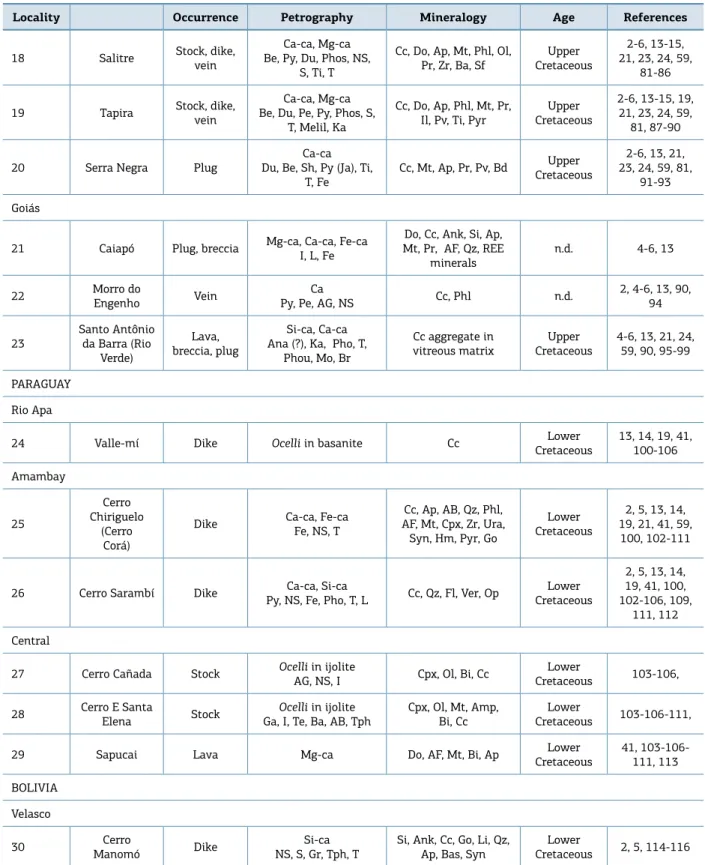
According to Gomes and Comin-Chiaramonti (2017), a total of 30 carbonatite occurrences have been described,
most of them in Brazilian terrains (23), but also in Paraguay (6) and Bolivia (1) (Table 1). Included are carbonate ocelli
Table 1. General information on the carbonatite occurrences of different regions of Brazil, Paraguay and Bolivia.
Continue...
Locality Occurrence Petrography Mineralogy Age References
BRAZIL
Ribeira Valley
1 Barra do
Itapirapuã
Dike, vein, breccia
Mg-ca, Fe-ca, Si-ca, Ca-ca, Fe, S, L
Do, Ank, Cc, Phl, Pr, Qz, Ap, Bas, Pa, Syn, AB,
Ga, Sph
Lower
Cretaceous 1-19
2 Ipanema Dike, vein Ca-ca
Gl, Sh, Di, S, Fe, Te
Cc, Phl, Op, Ap, Cpx, Amp, Ba, Sf
Lower Cretaceous
2-6, 12, 13, 15, 18-26, 59
3
Itanhaém (Ilha das Cabras or
Givura)
Dike Mg-ca Do, Ap, Phl, Pv, Gr, alterated mafics Lower Cretaceous
2, 4-6, 18, 19, 21, 23, 24, 27,
28, 59
4 Itapirapuã Dike, vein, breccia
Ca-ca
NS, I-Mel, Ti Cc, Ap, AF, Ne, Mt, Pt
Lower Cretaceous
2, 4-6, 12, 13, 18,-19, 21, 23, 24, 29-32, 59
5 Jacupiranga Plug, dike
Ca-ca, Mg-ca Du, Py (Ja), I-Mel, Tr, E,
Mz, Fe, Sd, S, A, AB
Cc, Do, Phl, Ol, Mt, Ap, Pr, Il, Pv, Pyr, Ga, Cl,
Ne, Amp
Lower Cretaceous
2-6, 12-15, 18,19, 21, 23, 24, 33-48, 59
6 Juquiá
(Serrote) Plug, dike
Mg-ca, Ca-ca Py, AG, I-Mel, NS, S, Sd,
AB, Te, Pho, Fe
Do, Ank, Cc, Phl, Mt, Ba, Ap, Mo, Anc, No
Lower Cretaceous
2-6, 12-15, 18, 19, 21, 23, 24, 41, 49-52, 59
7 Mato Preto Plug, breccia
Ca-ca, Fe-ca NS, Ti, Pho, Ga, I, Mel,
L, Ta
Cc, Ank, Mt, Ap, Pr, Ba, Fl, Qz, AF, Flca
Lower Cretaceous
1, 2, 4-8, 12-19, 21, 24, 27,
53-57, 59
8 Piedade Lower
Cretaceous 12, 21, 58, 59
São Paulo Coast Line
9 Ilhas Dike Mg-ca, Si-ca Cc, Do, Phl, Ap,
phyllosilicates n.d. 60
Cabo Frio Lineament
10. Poços de
Caldas Dike, breccia
Si-ca, ocelli in lamprophyre NS, Ti, Pho, L, La, Lp,
Cc, Pr, Phl Upper Cretaceous
2, 5, 21, 59, 61-63
Santa Catarina
11 Anitápolis Plug, dike, vein
Ca-ca, Mg-ca Py, Biot, I-Mel, NS, Phos, Fe, Apt, Ne, L, Pho
Cc, Do, Ap, Mt, Ol, Phl, Pr, Bd, Qz, Al, Anc,
Bas, Sf
Lower Cretaceous
2-6, 13-15, 18, 19, 21, 23, 24,
59, 64-69
12 Lages Plug, dike, vein, breccia
Fe-ca, Ca-ca NS, Pho, Ba, Ne, Meli,
Te, Pht, Ki
Ank, Cc, Ap, Phl, Qz, AF, Pr, Pyr, Syn, Bas
Upper Cretaceous
2-6, 13-15, 19, 21, 23, 24, 59,
70-74
Rio Grande do Sul
13 Joca Tavares Plug? Ca Do (Cc), Ap, Op (Hm,
Il), Ch n.d. 75, 76
14 Porteira Dike Ca Do, Ap., Flo, Op (Hm,
Il), Ch n.d. 75, 76
Alto Paranaíba
15 Araxá
(Barreiro) Stock, dike
Mg-ca, Ca-ca, Fe-ca Gl, Py, Phos, Sil
Do, Cc, Ank, Str, Si, Mg, Bu, Mt Ap, Phl, AF,
Anc, Pr, Mo, Sf
Upper Cretaceous
2-6, 13-15, 19, 21, 23, 24, 59,
77, 78
16 Catalão I Dike
Mg-ca, Ca-ca, Si-ca Phl, Du, Be, Phos, NS,
Nel, Sil
Do, Cc, Mg, Ap, Phl, Mt, Ba, Ti, Mo, Zr, Pr, Sf,
Fl, No
Upper Cretaceous
2-6, 13-15, 19, 21, 23, 24, 59,
79-81
17 Catalão II Stock
Ca-ca, Mg-ca Py, Gl, Phos, Apt, Mgt,
Fe, S, L, Sil
Cc, Phl, Ver, AF, Mt, Pr, Ba, Pyr, REE
minerals
Upper Cretaceous
2-6, 13-15, 19, 21, 23, 24,
Table 1. Continuation.
Locality Occurrence Petrography Mineralogy Age References
18 Salitre Stock, dike, vein
Ca-ca, Mg-ca Be, Py, Du, Phos, NS,
S, Ti, T
Cc, Do, Ap, Mt, Phl, Ol, Pr, Zr, Ba, Sf
Upper Cretaceous
2-6, 13-15, 21, 23, 24, 59,
81-86
19 Tapira Stock, dike, vein
Ca-ca, Mg-ca Be, Du, Pe, Py, Phos, S,
T, Melil, Ka
Cc, Do, Ap, Phl, Mt, Pr, Il, Pv, Ti, Pyr
Upper Cretaceous
2-6, 13-15, 19, 21, 23, 24, 59,
81, 87-90
20 Serra Negra Plug
Ca-ca Du, Be, Sh, Py (Ja), Ti,
T, Fe
Cc, Mt, Ap, Pr, Pv, Bd Upper Cretaceous
2-6, 13, 21, 23, 24, 59, 81,
91-93
Goiás
21 Caiapó Plug, breccia Mg-ca, Ca-ca, Fe-ca I, L, Fe
Do, Cc, Ank, Si, Ap, Mt, Pr, AF, Qz, REE
minerals
n.d. 4-6, 13
22 Morro do
Engenho Vein
Ca
Py, Pe, AG, NS Cc, Phl n.d.
2, 4-6, 13, 90, 94
23
Santo Antônio da Barra (Rio
Verde)
Lava, breccia, plug
Si-ca, Ca-ca Ana (?), Ka, Pho, T,
Phou, Mo, Br
Cc aggregate in vitreous matrix
Upper Cretaceous
4-6, 13, 21, 24, 59, 90, 95-99
PARAGUAY
Rio Apa
24 Valle-mí Dike Ocelli in basanite Cc Lower
Cretaceous
13, 14, 19, 41, 100-106
Amambay
25
Cerro Chiriguelo
(Cerro Corá)
Dike Ca-ca, Fe-ca Fe, NS, T
Cc, Ap, AB, Qz, Phl, AF, Mt, Cpx, Zr, Ura,
Syn, Hm, Pyr, Go
Lower Cretaceous
2, 5, 13, 14, 19, 21, 41, 59, 100, 102-111
26 Cerro Sarambí Dike Ca-ca, Si-ca
Py, NS, Fe, Pho, T, L Cc, Qz, Fl, Ver, Op
Lower Cretaceous
2, 5, 13, 14, 19, 41, 100, 102-106, 109,
111, 112
Central
27 Cerro Cañada Stock Ocelli in ijolite
AG, NS, I Cpx, Ol, Bi, Cc
Lower
Cretaceous 103-106,
28 Cerro E Santa
Elena Stock
Ocelli in ijolite Ga, I, Te, Ba, AB, Tph
Cpx, Ol, Mt, Amp, Bi, Cc
Lower
Cretaceous 103-106-111,
29 Sapucai Lava Mg-ca Do, AF, Mt, Bi, Ap Lower
Cretaceous
41, 103-106-111, 113
BOLIVIA
Velasco
30 Cerro
Manomó Dike
Si-ca NS, S, Gr, Tph, T
Si, Ank, Cc, Go, Li, Qz, Ap, Bas, Syn
Lower
Cretaceous 2, 5, 114-116
Caçapava do Sul (Passo Feio and Picada dos Tocos) and Lavra do Sul (Três Estradas) areas (Rocha et al. 2013, Toniolo et al. 2013, Maciel 2016, Cerva-Alves et al. 2017), all in the Rio Grande do Sul State. Because the last three intrusions are believed to be of Proterozoic age, with U-Pb zircon data indicating a ca. value of 603.2 ± 4.5 Ma for the Picada dos Tocos beforsite (Cerva-Alves et al. 2017), they are excluded of this study. Other important carbonatitic occurrences are the Amambay (Cerro Chiriguelo, Cerro Sarambí; Comin-Chiaramonti et al. 2014) and Velasco (Cerro Manomó; Comin-Chiaramonti et al. 2011) regions in Paraguay and Bolivia, respectively. Figure 1 shows the distribution of alkaline and alkaline-carbonatite occur-rences in the three countries.
The present paper reviews general aspects of carbon-atite bodies represented by not only well-defined struc-tures and a variety of dikes and veins, but also small aggregates (ocelli) in coarse and fine-grained alkaline silicate rocks.
GEOLOGICAL SETTING
The most remarkable alkaline-carbonatite complexes of the southeastern Brazilian Platform usually show intru-sive/subintrusive, subcircular or oval-shaped structures that are clearly discerned in aerial photographs and are indica-tive of high emplacement energy. In general, carbonatites are found chiefly as stocks, plugs, dikes, dike swarms, and veins, forming occasionally complex systems (stockworks) as in Barra do Itapirapuã in the Ribeira Valley (Ruberti et al. 2002, 2008), where distinct events may be recognized from a network of multiple intrusions. Dikes and veins
constitute single bodies or complex systems that cut asso-ciated alkaline silicate rocks or penetrate country rocks. Occasionally, dikes conform to a radial or ring-like dis-tribution. Sometimes, they correspond to more than one rock generation phase, like in Barra do Itapirapuã (Ruberti
et al. 2002, 2008), Juquiá (Walter et al. 1995) and Cerro Chiriguelo (Censi et al. 1989) districts, for example. Carbonatites and their associated alkaline rocks are com-monly emplaced into Precambrian groups (e.g., Açungui, Araxá, Canastra, etc.) and have quartzites, schists, granites and gneisses as their main country rocks. However, some complexes also intrude sedimentary rocks of different types and ages, the regional rocks consisting, in a few cases (e.g., Lages and Santo Antônio da Barra), of tholeiitic basalts of the Paraná Basin.
In most cases, the emplacement of alkaline-carbon-atite complexes is controlled by ancient tectonic features that were reactivated in Mesozoic times, related mainly to regional structures such as arches, lineaments and rifts. These tectonic alignments have been active since Lower Cretaceous, as suggested by the distribution of earthquakes in southern Brazil (Berrocal & Fernandes 1996). The most prominent tectonic lineaments are represented by deep, NW-trending parallel fractures clearly associated with arch structures (Almeida 1971) and, apparently, in some cases, by old NE-trending fault zones as in Itanhaém (Coutinho & Ens 1992) and Cerro Manomó (Comin-Chiaramonti et al. 2005d). In the Ribeira Valley, emplacement was tectonically related to the Ponta Grossa Arch (Algarte 1972), a NW-trending uplift structure active since Paleozoic times that consists of four different lineaments (Guapiara, São Jerônimo-Curiúva, Rio Alonso and Piqueri; Almeida 1983). The
Mato Preto: 53, Jenkis II (1987); 54, Santos (1988); 55, Santos et al. (1996); 56, Santos et al. (1990); 57, Comin-Chiaramonti et al. (2001); Piedade: 58, Knecht (1960); 59, Amaral et al. (1967); Ilhas: 60, Coutinho (2008); Poços de Caldas; 61, Ulbrich et al. (2002); 62, Vlach et al. (2003); 63, Ulbrich et al. (2005); Anitápolis: 64, Melcher & Coutinho (1966); 65, Rodrigues (1985); 66, Furtado et al. (1986); 67, Furtado (1989); 68, Comin-Chiaramonti et al. (2002); 69, Scheibe etal. (2005); Lages: 70, Scheibe & Formoso (1982); 71, Scheibe (1986); 72, Traversa et al. (1994); 73, Traversa et al. (1996); 74, Barabino et al. (2007); Joca Tavares and Porteira: 75, Toniolo et al. (2013); 76, Monteiro et al. (2016); Araxá: 77, Issa Filho et al. (1984); 78, Traversa et al. (2001); Catalão I: 79, Carvalho & Bressan (1981); 80, Cordeiro et al. (2010); 81, Gomes & Comin-Chiaramonti (2005); Salitre: 82, Morbidelli et al. (1997); 83, Barbosa (2009); 84, Barbosa et al. (2012a); 85, Barbosa et al. (2012b); 86, Haggerty & Mariano (1983); Tapira: 87, Guimarães et al. (1980); 88, Brod (1999); 89, Brod et al. (2000); 90, Brod et al. (2005); Serra Negra: 91, Mariano & Marchetto (1991); 92, Souza Filho (1974); 93, Grasso (2010); Morro do Engenho: 94, Pena (1974).
Santo Antônio da Barra: 95, Gaspar & Danni (1981); 96, Moraes (1984); 97, Moraes (1988); 98, Sgarbi (1998); 99, Junqueira-Brod et al. (2002); Valle-mí: 100, Livieres e Quade (1987); 101, Gibson et al. (1995a); 102, Gomes et al. (1996b); 103, Castorina et al. (1997); 104, Comin-Chiaramonti et al. (2007b); 105, Gomes et al. (2013); 106, Comin-Chiaramonti et al. (2014); Cerro Chiriguelo: 107, Comte & Hasui (1971); 108, Censi et al. (1989); 109, Comin-Chiaramonti et al. (1999); 110, Gibson et al. (2006); 111, Comin-Chiaramonti et al. (2007c); Cerro Sarambí: 112, Gomes et al. (2011b); Sapucai: 113, Comin-Chiaramonti et al. (1992); Cerro Manomó: 114, Fletcher et al. (1981); 115, Comin-Chiaramonti et al. (2005b); 116, Comin-Chiaramonti et al. (2011). Other references consulted are listed in Gomes and Comin-Chiaramonti (2017).
Rock abbreviations: A, ankaratrite; AB, alkali basalt; AG, alkali gabbro; Ana, analcimite; Apt, apatitite; Ba, basanite; Be, bebedourite; Biot, biotitite; Ca, carbonatite; Ca-ca, calciocarbonatite; Di, diorite; Du, dunite; E, essexite: Fe, fenite; Fe-ca, ferrocarbonatite; Fou, fourchite; Ga, gabbro; Gl, glimmerite; Gr, granite; I, ijolite; Ja, jacupiranguite; Ka, kamafugite; Ki, kimberlite; L, lamprophyre; Lp, lamproite; Mel, melteigite; Meli, melilitite; Melil, melilitolite; Mgt, magnetitite; MMzd, melamonzodiorite; Mo, monchiquite; Mz, monzonite; Ne, nephelinite; Nel, nelsonite; NS, nepheline syenite; Pc, picrite; Pe, peridotite; Phl, phlogopitite; Pho, phonolite; Phos, phoscorite; Pht, phonotephrite; Py, pyroxenite; S, syenite; Sd, syenodiorite; Sh, shonkinite; Si-ca, silicocarbonatite; Sil, silexite; T, trachyte; Ta, trachyandesite; Te, tephrite; Tph, trachyphonolite; Ti, tinguaite Tr, theralite; Ur, urtite; We, wehrlite.
Mineral abbreviations: AF, alkali feldspar; Al, alstonite; Amp, amphibole; An, ancylite; Ank, ankerite; Ap, apatite; Ba, barite; Bas, bastnäesite; Bd,
baddeleyite; Bi, biotite; Bu, burbankite; Caz, calzirtite; Cc, calcite; Ch, chlorite; Cl, clinohumite; Cpx, clinopyroxene; Do, dolomite; F, feldspar; Fl, fluorite; Flca, fluorocarbonates; Ga, galena; Go, goethite; Gr, garnet; Hb, hornblende; Hm, hematite; Il, ilmenite; Mg, magnesite; Mt, magnetite; Mo, monazite; Ne,
nepheline; No, norsethite; Ol, olivine; Op, opaques; Pa, parisite; Phl, phlogopite; Pyr, pyrite; Pr, pyrochlore; Pt, pyrrhotite; Pv, perovskite; Sph, sphalerite;
residual deposits of apatite, pyrochlore, vermiculite, anatase and REE carbonates and phosphates can be present (Biondi 2005). Fresh rocks are usually scarce or even inexistent at surface, and samples for petrological studies are obtained mostly from drill cores. Jacupiranga is the only exception, presently mined for phosphate (Morro da Mina) with good local exposures that allow for sampling of fresh rock.
PETROGRAPHIC AND
MINERALOGICAL CONSIDERATIONS
The carbonatites are characterized by a large variation in grain-size and texture, that grades from equi- to inequi-granular and hypidiomorphic to allotriomorphic or even seriate. Other common features include structural flow with alignment of elongated crystals (e.g. apatite), presence of brecciated and xenolithic material, and typical banding from differential concentration of minerals, particularly apa-tite, phlogopite, olivine and magneapa-tite, as well evidenced in Jacupiranga carbonatites (Melcher 1966, Morbidelli et al. 1986, Chmyz et al. 2017).
The carbonatites are associated (or spatially rather than genetically associated, as postulated by Gittins & Harmer 2003) with silicate rock types of varied compo-sition, mainly cumulates of different petrographic and compositional characteristics. They are found in close contact with ultrabasic-ultramafic lithologies having dunites, peridotites and pyroxenites as their main repre-sentative variants (Tab. 1). These rocks are abundant and well-exposed at surface in the Jacupiranga (Melcher 1966, German et al. 1987) and Juquiá (Born 1971, Beccaluva
et al. 1992) complexes, but are also present in a large number of occurrences. Other cumulates associated with carbonatites are glimmerites, especially in Ipanema (Guarino et al. 2012) and Catalão (Machado Jr. 1991, Carvalho & Bressan 1997, Cordeiro et al. 2010); bebe-dourites in Alto Paranaíba complexes, notably in Salitre (Barbosa 2009, Barbosa et al. 2012a, 2012b) and Tapira (Brod et al. 2013); phoscorites in Anitápolis (Furtado et al. 1986, Scheibe et al. 2005), Ipanema (Guarino et al. 2012) and several bodies in Alto Paranaíba (Cordeiro et al. 2010, Guarino et al. 2017); kamafugites, kimberlites, lamproites and picrites. All these rock types are practically restricted to occurrences in Minas Gerais and Goiás (Danni 1994, Meyer et al. 1994, Gibson et al. 1995a, 1995b, Brod et al. 2000, 2005, Sgarbi et al. 2000, Junqueira-Brod et al. 2000, 2002, Melluso et al. 2008, Guarino
et al. 2013, 2017), except for the presence of kimber-lites in Lages (Scheibe et al. 2005) and kimberlites and major Jacupiranga and Juquiá complexes are related to
the Guapiara Lineament, whereas Barra do Itapirapuã, Itapirapuã and Mato Preto ones associate with the São Jerônimo-Curiúva Lineament. Other occurrences in the region (Ipanema, Itanhaém and Piedade) are linked to the Piedade Lineament, a parallel structural feature lying to the south (Riccomini et al. 2005). The Alto Paranaíba complexes in Minas Gerais (Araxá, Catalão I and II, Salitre, Serra Negra, and Tapira) follow a NW-trending linear structure that borders the São Francisco Craton, as indicated by aeromagnetic surveys, corresponding to a well-marked regional high, the Alto Paranaíba Uplift (Hasui et al. 1975). In the state of Goiás, occurrences (Caiapó, Morro do Engenho and Santo Antônio da Barra) are controlled by a pronounced NW-trending alignment that shows rift tectonics characteristics (Almeida 1983). Considering the distribution of alkaline bodies in both areas along NW-trending crustal discontinuities, that extend for considerable distances, and the nature of the magmatism, Riccomini et al. (2005) postulated that deep lithospheric faults played a major role in the tectonic con-trol of these carbonatitic occurrences. According to these authors, the emplacement of carbonatites in the state of Santa Catarina is still a matter of debate: Lages appears to have been subject to NW-trending faults, whereas Anitápolis does not show a clear structural control. In the specific case of Anitápolis, Melcher and Coutinho (1966) pointed out the influence of N-S-trending faults. Comin-Chiaramonti et al. (2005c) proposed the Uruguay Lineament to have controlled the emplacement of both complexes. The recently described occurrences in Rio Grande do Sul (Jocas Tavares and Porteira) are structur-ally controlled by NE-trending faults related to the Ibaré Lineament (Costa et al. 1995). In Amambay, northeastern Paraguay, the Cerro Chiriguelo and Cerro Sarambí com-plexes are tectonically related to the NE-trending Ponta Porã Arch (Livieres & Quade 1987, Comin-Chiaramonti
et al. 1999). There, more intense magnetic anomalies at the southwestern end of the arch seem to support such a hypothesis (Velázquez et al. 1998). Comin-Chiaramonti
et al. (2005c) also recall that both these Paraguayan com-plexes and the Valle-mí dikes are mainly found along the Piquiri Lineament. Sapucai in central-eastern Paraguay is located within the domains of the Asunción Rift and its associated faults.
Figure 1. Schematic maps showing the distribution of alkaline and alkaline-carbonatite occurrences in Brazil (after Ulbrich & Gomes, 1981, modified) and Paraguay (after Gomes et al. 2013, simplified). Also, indicated is
lamproites in Rio Grande do Sul (Philipp et al. 2005). Monomineralic cumulatic rocks (apatitites, magnetitites, phlogopitites) were described in a few complexes (e.g., Anitápolis, Ipanema and Catalão) as small segregations forming decimetric to metric irregular bands.
Association of carbonatites and alkaline gabbros of the melteiigite-ijolite-urtite series is quite frequent. It chiefly characterizes the alkaline-carbonatites of southeastern Brazil, especially in the Ribeira Valley, being particularly frequent in Jacupiranga and Juquiá and of subordinate presence in other districts (Ruberti et al. 2005, Gomes et al. 2011a). Association with lithologies of syenitic compo-sition represented by coarse-grained (nepheline syenites, syenites) and fine-grained (phonolites, trachytes) rock types (Beccaluva et al. 1992, Ruberti et al. 2002) is also frequent. The presence of fenites, mostly of syenitic com-position, is notable. Syenodioritic and dioritic fenites are scarce. Fenites are described in many carbonatitic bod-ies as forming irregular masses in the inner parts of the alkaline intrusions or being concentrated along their bor-ders. Fenitization processes are occasionally responsible for aureoles in country rock that can reach tens of meters wide (e.g., 2.5 km in Araxá, Rodrigues & Lima 1984; 2.0 km in Jacupiranga, Gaspar 1989). Fenites do not usually constitute individual mappable units. They are interpreted as metasomatic bodies originated by either magmatic flu-ids enriched in Na and/or K and F from carbonatitic or alkaline silicatic magmas acting on the associated alka-line rocks and country rocks. Such processes can be of sodic or potassic nature, as suggested by changes in the chemical composition and texture of the rocks and by mineralogical evidences, notably the presence of sodic pyroxene and/or amphibole in the first case, and the appearance of alkali potassic feldspar in the second case (Le Bas 2008). Evidence of fenitization has been reported for a large numbers of alkaline-carbonatite complexes, especially where carbonatites are in direct contact with ultrabasic rocks (e.g., Morbidelli et al. 1986, Guarino et al. 2012). Jacupiranga is the best example of such an asso-ciation, with pyroxenites (jacupirangites) and carbonatites forming reaction bands from fenitization of older ultra-basic rocks by alkali-enriched metasomatic fluids derived from carbonatite magma. This type of reaction bands was investigated in detail by Morbidelli et al. (1986), who distinguished among concentric, centimeter-to-decime-ter layers consisting of alcentimeter-to-decime-ternating carbonate and silicate material. Amphibolitization and phlogopitization of the pyroxenitic protolith by alkali-enriched fluids associated with carbonatitic magmas seem to be a constant feature in almost all Brazilian and Paraguayan carbonatite com-plexes (Haggerty & Mariano 1983, Gomes et al. 1990).
Petrographic associations allow the major alkaline-car-bonatite complexes to be identified as primary or magmatic carbonatites, as defined by Mitchell (2005) and Woolley and Kjarsgaard (2008). Yet, they allow most carbonatites to be included in at least two different clans that conform in general terms the geographic distribution areas of the occurrences. The nephelinite-clan carbonatites (Mitchell 2005) or car-bonatite occurrences with melteigite-ijolite-urtite (no neph-elinite extrusive rocks,Woolley & Kjarsgaard 2008) are a classical association, ijolite being the predominant rock type. They represent about 20% of the magmatic carbon-atite occurrences known to the latter authors worldwide. Ultramafic bodies (pyroxenites or olivinites or both), inter-preted as cumulates, correspond to 60% of the occurrences, whereas nepheline syenites and syenites, along with rocks of the melteigite-ijolite-urtite series, are present in 84% of the cases. Considering the occurrences reviewed in the present study, this is the most abundant association, being repre-sented mainly by the Lower Cretaceous complexes of the Ribeira Valley (Ipanema, Itapirapuã, Jacupiranga, Juquiá), Santa Catarina (Anitápolis) and Paraguay (Cerro Sarambí) and the Upper Cretaceous intrusions of Mato Preto, also in the Ribeira Valley and, apparently, Caiapó and Morro do Engenho in Goiás.
rock types are phoscorites, nepheline syenites and syenites (or both). In some localities, carbonatites form km-scale diameter ore-hosting bodies with Nb (pyrochlore), phos-phate and vermiculite. Rocks of the melteigite-ijolite-urtite series are missing. Guarino et al. (2017) emphasized the close relationship of Alto Paranaíba carbonatites and phlogopite picrites and ultramafic lamprophyres.
Although not mentioned by either Mitchell (2005) or Woolley and Kjarsgaard (2008), melilite-bearing rocks are also found in an Upper Cretaceous alkaline-carbonatite occurrence in Lages, State of Santa Catarina (Traversa et al. 1994, 1996, Gibson et al. 1999). Their occurrence is of very complex composition, consisting of large amounts of syenitic rocks (predominantly phonolites and peralkaline phonolites), carbonatites, ultrabasic types that occur mainly as dikes, and kimberlites. Outcrops of olivine melilitites are described in various places in Lages, Cerro Alto de Cima, a semiring, 50 m wide dike being the most significant body (Scheibe 1986).
More recently, Beccaluva et al. (2017) noticed the pres-ence of melilite with modal content higher than 10% in ijolitic rocks of the Jacupiranga carbonatites.
Additionally, the overall petrographic association allows to distinguish a new group of carbonatites, the hydrothermal
ones (also referred to as carbothermals by Mitchell 2005; or carbohydrothermals by Woolley & Kjarsgaard 2008). These latter authors define carbohydrothermal carbonatites as formed by precipitation at subsolidus temperatures, from a mixed CO2-H2O fluid that can be either CO2-rich (i.e., carbothermal), or H2O-rich (i.e., hydrothermal). Mitchell (2005) added variable proportions of F to the composition of the low-temperature fluids. A statistical study performed by Woolley and Kjarsgaard (2008) indicated that carbohy-drothermal carbonatites amounted to 74 out of the 477 occurrences (magmatic carbonatites included) in the world, 54 of them being predominantly associated with intrusive alkali silicate rocks. Their research also made evident that syenitic rocks (feldspathoidal syenites, syenites and quartz syenites) constitute the dominant silicate rock in this asso-ciation. Also according to Woolley and Kjarsgaard (2008), these occurrences typically consist of calcite ± barite ± fluo-rite ± quartz ± sulfides ± K-feldspar ± zeolites. However, the hydrothermal stages can also have involved enrichment in elements such as Th, REE and F, as reflected in the miner-alogical assemblage, that bears REE fluorocarbonates, fluorite and other fluoride phases. Based on chemical and mineralog-ical evidence, notably the presence of rare accessory phases like ancylite, bastnäesite, synchysite, parisite, etc., Barra do Itapirapuã (Ruberti et al. 2002, 2008), Cerro Chiriguelo (Haggerty & Mariano 1983, Censi et al. 1989) and Cerro Manomó (Fletcher et al. 1981, Comin-Chiaramonti et al. 2005d, 2011) complexes fall within the hydrothermal group.
No data is presently available on the Piedade (SP), Jocas Tavares (RS) and Porteira (RS) carbonatites, but, consider-ing the occurrence of alkaline rocks in Rio Grande do Sul, represented by the phonolitic suite of Piratini (Barbieri
et al. 1987), it is possible that both bodies correlate with the aforementioned volcanism event. Woolley and Kjarsgaard (2008) described the occurrence of carbonatite with only phonolite or feldspathoidal syenite, without any ultramafic cumulates or members of the melteigite-ijolite-urtite series or melilite-bearing rocks. This association is considered to be the third most significant one, with carbonatite intru-sions forming small dikes into larger bodies.
Other carbonatitic occurrences are represented by small dikes in Itanhaém (Coutinho & Ens 1992) and in an island on the coast of the State of São Paulo (Ilhas, Coutinho 2008); dikes and ultramafic silico-carbonatitic plugs and carbon-atitic fragments within volcanoclastic deposits in the Poços de Caldas alkaline complex (Ulbrich et al. 2002, 2005, Vlach
et al. 2003, Alves 2003); and as minor aggregates (ocelli) in association with fine-grained (Valle-mí) and coarse-grained (Cerro Cañada and Cerro E Santa Elena) silicate alkaline rocks in Paraguay (Castorina et al. 1997, Comin-Chiaramonti
et al. 2007a, Gomes & Comin-Chiaramonti 2017). Carbonatites are predominantly calcic (sövites-alvi-kites) and, even in more magnesian (beforsites) intrusions (e.g., Araxá, Barra do Itapirapuã, Juquiá, etc.), calcite is an important constituent. A more iron-rich composition with ankerite as the chief mineral form is present in Lages and Cerro Manomó, for example (Comin-Chiaramonti et al. 2002, 2011). The three primary end-member minerals are not usually found in the same complex, Barra do Itapirapuã and Juquiá being the most noticeable exceptions, with such phases present in different stages of intrusion. More com-monly, carbonate minerals exhibit a complex and varied chemical composition, due mainly to post-magmatic changes induced by hydrothermal and deuteric-groundwater processes, as described by Comin-Chiaramonti et al. (2007a) in many occurrences of Lower Cretaceous (e.g., Barra do Itapirapuã, Cerro Chiriguelo) and Upper Cretaceous (e.g., Lages, Mato Preto). A secondary, hydrothermal mineralogical assemblage is the main characteristic of some complexes bearing hetero-geneous and complex chemical composition phases enriched in Nb, Ti, Zr, Th, U, F, Ba, and REE. Araxá and Barra do Itapirapuã are good examples of a mineral assemblage consist-ing of REE-bearconsist-ing carbonates, fluorocarbonates and phos-phates, which was intensively investigated by Traversa et al. (2001) and Ruberti et al. (2008), respectively. Additional mineral information is also found in the studies by Fletcher
of Gomes and Comin-Chiaramonti (2017) compiles a great number of less common and even exotic minerals related to alkaline-carbonatite complexes, including sorosilicates ( lam-prophyllite,rosenbuschite, Sr-chevkinite), cyclosilicates ( eudi-alyte, wadeite), inosilicates (pectolite, serandite, wollastonite), phyllosilicates (neptunite), oxides and hydroxides (baddeleyte, loparite, menezesite, perovskite, pyrochlore, zirconolite), carbon-ates (alstonite, ancylite, bastnäesite, breunnerite, burbankite, cordyllite, magnesite, norsethite, olekminskite, parisite, remon-dite, shortite, strontianite, synchysite, witherite), and phosphates (britholite, galgenbergite, gorceixite, monazite). Although not cited in Table 7.1, the following should be also mentioned: carbonates (ankerite, kutnehorite, rodochrosite, siderite), flu-orides (fluorite), oxides (calzirtite, geikielite, uranpyrochlore), phosphates (dahlite), sulphates (barite, celestine), and sulfides (chalcopyrite, galena, phyrotite, pyrite, sphalerite).
AGES
Except for a small number of occurrences such as Barra do Itapirapuã, Jacupiranga and Poços de Caldas (Ruberti
et al. 1997, Chmyz et al. 2017, Vlach et al. 2003, respec-tively), whose ages were determined directly from carbon-atites and their mineral constituents, most available data resulted from analysis of associated silicate alkaline rocks (whole-rock and mineral concentrates of different miner-als). Data for all presently known alkaline-carbonatite occur-rences indicates that these rocks are of Cretaceous age, with two clearly distinguished formation intervals, 120–140 Ma and 70–90 Ma, Lower Cretaceous and Upper Cretaceous (Ulbrich & Gomes 1981, Rodrigues & Lima 1984, Berbert 1984, Gomes et al. 1990, Gibson et al. 1995a, Ruberti et al. 2005, Comin-Chiaramonti et al. 2007a, 2007b, Gomes et al. 2011a, 2011b, 2013, Gomes & Comin-Chiaramonti 2017). Preferred ages for the occurrences are shown in Figure 2.
Lower Cretaceous
Although some results are yet to be confirmed by new analytical methods, this interval is apparently represented by three distinct generation episodes. The oldest age of ~139 Ma is suggested for the Amambay (Cerro Chiriguelo and Cerro Sarambí), Rio Apa (Valle-mí) occurrences in north-ern Paraguay and Cerro Manomó in southeastnorth-ern Bolivia. An average approximately 130 Ma age characterizes the Ribeira Valley complexes (Barra do Itapirapuã, Ipanema, Itanhaém, Jacupiranga, Juquiá and Piedade) in southeastern Brazil and also Anitápolis to the south, in the State of Santa Catarina. Carbonatite flows cropping out nearby the village of Sapucai and ijolitic rocks of Cerro Cañada and Cerro E Santa Elena, all in central-eastern Paraguay, are probably
related to the same magmatic event. The Itapirapuã massif, also in the Ribeira Valley, seems to represent the youngest Lower Cretaceous episode, with ages in the 100–110 Ma range, as suggested by old K-Ar results (Gomes & Cordani 1965) confirmed by recent Ar-Ar and U-Pb SHRIMP deter-minations (Gomes et al. 2018).
Upper Cretaceous
The Alto Paranaíba (Araxá, Catalão I and II, Salitre, Serra Negra and Tapira) and Goiás (Santo Antônio da Barra) com-plexes in central-western Brazil, together with Mato Preto and Lages complexes in the south, have ages that fall within the 70–90 Ma interval. The Joca Tavares and Porteira bodies in the State of Rio Grande do Sul probably belong to the same interval. It is also important to notice that three of the above ages fit the chronogroups of 133 Ma, 108 Ma and 84 Ma proposed by Ulbrich et al. (1991) to define peaks of alka-line magmatism along the borders of the Paraná Basin. These chronogroups are believed to represent different phases of evolution of the basaltic and alkaline magmatism in the South Atlantic Plate. They stress the coherent relationship of this volcano-tectonic cycle to important changes in the position of rotation poles and spreading rates of the South American and African plates (Herz 1977, Sadowski 1987).
GEOCHEMISTRY
Major elements
of CaO, 0.34 wt% of MgO and 7.1 wt% of MnO (Comin-Chiaramonti et al. 2011). However, it is important to consider that in some complexes like Barra do Itapirapuã, Jacupiranga and Juquiá, the evolution of carbonatite magmas resulted in rocks of wide variation in chemical composition repre-senting different stages of intrusion. Thus, early stage car-bonatites of the Jacupiranga and Alto Paranaíba complexes tend to show a more calcic composition, that evolved to more magnesian in latter stages of crystallization (Gomide
et al. 2016). This calciocarbonatites→magnesiocarbonatites
evolution trend, reaching up to ferrocarbonatites in a few
cases, has been described in Barra do Itapirapuã (Ruberti
et al. 2002), Cerro Chiriguelo (Censi et al. 1989) and Juquiá (Walter et al. 1995) complexes. In some occurrences (e.g., Mato Preto, Santo Antônio da Barra, etc.), the carbonatitic association also includes silicocarbonatites, carbonatites with > 20% SiO2 occurring mostly as dikes.
The Lower Cretaceous carbonatites of southern Brazil seem to be chemically related to a potassic magmatism of plagioleucitic composition in Foley’s (1992) classification (Comin-Chiaramonti & Gomes 1996b), chiefly represented by evolved rock types of syenitic filiation. On the other
hand, the Upper Cretaceous carbonatites of central-western Brazil are characterized by ultrapotassic-kamafugitic asso-ciations (Junqueira-Brod etal. 2002, Guarino et al. 2017). Usually, also included in the Lower and Upper Cretaceous occurrences are less evolved lithologies of gabbroic-basal-tic affinity and cumulates of diverse nature (e.g., dunites, pyroxenites, phoscorites).
Trace and rare earth elements
Incompatible elements (IE) diagrams normalized to prim-itive mantle concentration (Sun & McDonough 1989) for Brazilian Lower Cretaceous carbonatites (Anitápolis, Barra do Itapirapuã, Jacupiranga, Juquiá) and Paraguay (Cerro Chiriguelo, Cerro Sarambí, Sapucai, Valle-mí) and for Upper Cretaceous Brazilian complexes (Alto Paranaíba, Lages, Mato Preto) were compiled in review papers by Comin-Chiaramonti et al. (2005c, 2007a). Additional multielement diagrams are also found for other areas: the Ponta Grossa Arch (Gomes et al. 2011a, Azzone et al. 2013, Beccaluva et al. 2017, Chmyz et al. 2017), Amambay (Gomes et al. 2011b, Comin-Chiaramonti et al. 2014), and the Alto Paranaíba province (Gomide et al. 2016).
For any given incompatible element, there is a large variation in normalized values from one carbonatite com-plex to another. Scatters for the different carbonatites seem to reflect, to some extent, the variable distribution and the concentration of phases, IE occurring mainly as accessory minerals such as phosphates (e.g., apatite and monazite: rare earth elements — REE), oxides (e.g, pyrochlore: Nb, Th, U; calzirtite: Nb, Zr; zirconolite: Ti, Nb, Zr; loparite: Ti, Nb, REE) and REE-carbonates and fluorocarbonates (e.g., ancylite, bastnäesite, burbankite, parisite, synchysite). In comparison to associated silicate alkaline rocks, the car-bonatites follow a general tendency to higher abundances in practically all of the incompatible trace elements. Even con-sidering variable composition and stage of intrusion, they are usually characterized by the presence of negative anomalies for Rb, K, P, Hf-Zr and Ti and positive spikes for Ba, Th-U and La-Ce. The behavior of Nb-Ta and Sr appears to be less regular, but pointing mostly to positive anomalies. Although based only on little data available (e.g., Anitápolis, Lages, Mato Preto, cf. Gibson et al. 1999, Comin-Chiaramonti
et al. 2005c, 2007a), no significant difference is noticed in the chemical behavior of IE in early and late carbonatites of a same complex, except for a clear tendency of the latter rocks to be more enriched in all the elements.
REE display remarkable scatters even within a single complex. This is particularly evident for samples from areas that involve different stages of formation, i.e., magmatic, late-magmatic or hydrothermal conditions. Similar to the IE, scatters are mainly attributed to the presence of accessory
minerals such as apatite, REE fluorocarbonates, fluorite and barite. REE fluorocarbonates are relatively abundant in late stage carbonatites (e.g., Barra do Itapirapuã, Cerro Manomó). Chondrite-normalized (Thompson 1982, Boynton 1984, McDonough & Sun 1995) REE distribution diagrams for various carbonatite complexes are discussed in several papers (e.g., Comin-Chiaramonti et al. 2005c, 2007a, 2014, Gomes
et al. 2011a, 2011b, Azzone et al. 2013, Gomide et al. 2016, Beccaluva et al. 2017, Chmyz et al. 2017). Patterns are in gen-eral marked by high REE concentration and variable LREE/ HREE fractionation degrees. A strong increase from Lu to La is observed in Cerro Chiriguelo, Jacupiranga, Lages (both early and late carbonatites) and Mato Preto complexes, and also Alto Paranaíba occurrences that characterizes different stages of fractional crystallization (C1 to C5, cf. Gomide
et al. 2016). Flat REE or patterns with a smooth decrease from La to Lu are characteristic of Anitápolis, Barra do Itapirapuã (late calciocarbonatites), Ipanema, Jacupiranga (calciocarbonatites) and Juquiá (magnesio- and calciocar-bonatites) rocks. In these occurrences, the REE distribution seems to be related to the apatite composition. Concave patterns with a HREE plateau and a steady increase from Dy to LREE are typical of Valle-mí and Barra do Itapirapuã carbonatitic rocks. Ferrocarbonatites are generally more enriched than calcio- and magnesiocarbonatites, mainly as evidenced in Lages. Comin-Chiaramonti et al. (2007a) gave especial attention to the stockwork of Barra do Itapirapuã, that includes four generations of carbonatite dikes of simi-lar, parallel and slightly enriched LREE pattern. As a result from the presence of REE fluorocarbonate minerals, the dikes more intensely subject to hydrothermal alteration show higher LREE concentrations (Andrade 1998).
C and O isotopes
The behavior of carbon and oxygen isotopes derived mainly from carbonates of Brazilian and Paraguayan car-bonatitic rocks has been discussed in detail by many authors over the last decades (e.g., Nelson et al. 1988, Censi et al. 1989, Santos et al. 1990, Santos & Clayton 1995, Huang
et al. 1995, Toyoda et al. 1994, Walter et al. 1995, Castorina
et al. 1996, 1997, Speziale et al. 1997, Andrade et al. 1999, Comin-Chiaramonti et al. 2001, 2002, 2005b, 2005c, 2007a, Ruberti et al. 2002, Gomide et al. 2013, 2016, Gomes & Comin-Chiaramonti 2017). In general, δ18O
data available in literature for such occurrences covers a wide interval, from about 5 to 25‰ (V-SMOW notation per thousand, cf. Deines 1989). For approximately 50% of the analyses, however, results lie between 6 and 10‰. In contrast, δ13C values show a more restricted variation,
of δ18O and δ13C between 6 and 10‰ and between -4
and -8‰, respectively, correspond to the field defined by Taylor et al. (1967) and Keller and Hoefs (1995) for primary carbonatites. The plot of δ18O vs. δ13C (Fig. 3),
including some Brazilian Lower Cretaceous and Upper Cretaceous and Paraguayan Lower Cretaceous carbonatite occurrences, makes evident that:
■ a clear primary signature of the Lower Cretaceous com-plexes in southeastern Brazil, as exemplified mainly by the Jacupiranga rocks plotting entirely inside the range of mantle values;
■ two well-distinct linear enrichment trends of heavy iso-topes are present.
Enrichment of heavy isotopes is interpreted as result-ing from mantle source heterogeneity (Nelson et al. 1988), contamination processes by country rocks, especially lime-stone (Santos & Clayton 1995), or magmatic vs. hydrother-mal evolution at shallow levels (Censi et al. 1989). The first trend is characterized by a shift to positive values of both
δ18O and δ13C (e.g., Barra do Itapirapuã, Jacupiranga, Mato
Preto), and it appears to be an extension of the Jacupiranga carbonatites, which are believed to have a primary signa-ture (Huang et al. 1995). A similar isotopic evolution from magmatic fractionation also characterizes early stage carbon-atites (C1) of the Alto Paranaíba province (Gomide et al. 2016). Other carbonatites representing intermediate (C2, C3) and later (C4, C5) stages of the same region also show isotopic evolution consistent with magmatic fractionation, but with additional interaction with carbohydrotermal flu-ids and hydrothermal alteration. The second trend shows a
δ18O increase for similar values of δ13C typical of the Juquiá,
Lages, Cerro Chiriguelo and some Alto Paranaíba (e.g., Catalão I, Catalão II, Tapira) complexes.
As stressed in literature (e.g., Deines 1989), the large variation in the content of oxygen and carbon isotopes in carbonatitic complexes results from magmatic (crystal frac-tionation, degassing, crustal contamination) and post-mag-matic (hydrothermal) processes. Systepost-mag-matic investigation of carbonatites of the Paraná Basin points out that most occur-rences have enriched isotopic composition and negligible or absent crustal signature, and that fractional crystallization and liquid immiscibility processes cause little effect on oxy-gen and carbon isotopic values (Santos & Clayton 1995, Castorina et al. 1997, Comin-Chiaramonti et al. 2005b, Gomes & Comin-Chiaramonti et al. 2017). Also, according to these authors, the main variations in δ18O and δ13C could
be explained by isotopic exchange between these rocks and H2O-CO2 rich fluids at different temperatures and H2O/CO2 ratios in a hydrothermal environment (e.g., below 300ºC for the first two authors, and in the range of 400–80ºC and fluids with a 0.8–1 CO2/H2O ratio for the others). The two paths of δ18O-δ13C fractionation previously mentioned are
attributed to different emplacement levels, that reflect sub-volcanic and surface conditions, respectively. Weathering and groundwater fluids are locally important factors, as is meteoric water, that yielded samples strongly enriched in light carbon due to contamination by a biogenic component (Castorina et al. 1997, Comin-Chiaramonti et al. 2005b). Crustal contamination by limestone country rocks of the Açungui Group (δ18O = +25.0 to +24.4‰ and δ13C = +3.5
to -8.6‰), as suggested by Santos and Clayton (1995) for Mato Preto carbonatites, does not seem necessary to explain the enrichment in both heavy oxygen and carbon isotopes of some hydrothermally altered samples of the complex, based
Figure 3.Fields of δ18O‰ (V-SMOW) vs. δ13C‰
(PDB-1) for Lower Cretaceous (Jacupiranga, Juquiá, Barra do Itapirapuã, Anitápolis) and Upper Cretaceous (Araxá, Catalão I, Catalão II, Tapira, Mato Preto, Lages) carbonatites of Brazil and for Lower Cretaceous carbonatites of Eastern Paraguay (Cerro Chiriguelo, Cerro Sarambí, Valle-mí). Data sources: Comin-Chiaramonti et al. (2005c and therein references),
Cordeiro et al. (2011), Guarino et al. (2012, 2017),
Gomes and Comin-Chiaramonti 2017). PC, field for primary carbonatites from Taylor et al. (1967) and
on considerations by Speziale et al. (1997) and Comin-Chiaramonti et al. (2005b). This interpretation is also sup-ported by the initial 87Sr/86Sr and 143Nd/144Nd isotopic ratios
of some selected carbonatites, that present the same values as their associated alkaline rocks (Comin-Chiaramonti et al. 2005c). Speziale et al. (1997) pointed out that, in terms of radiogenic isotopes, Barra do Itapirapuã and Mato Preto car-bonatites preserve mantle source characteristics, even where original O-C isotopic signatures were in part modified by low temperature post-depositional hydrothermal fluids. A more complex situation is apparently associated with the wide δ18O (between 8.58 to 23.11%) and δ13C (between
-3.55 and -7.88%) values shown by Catalão I carbonatitic rocks (Cordeiro et al. 2011, Oliveira et al. 2017). There, the original isotopic composition of carbonates was modified by at least two events of magmatic fractionation (1 — Rayleigh fractionation, with carbonate signatures being related to the isotopic fractionation between carbonates and other miner-als as well as to the temperature and the isotopic composi-tion of the initial melt, and 2 — degassing) and three fluid fractionation (fluid degassing, H2O percolation and CO2 -H2O fluid percolation) episodes.
Apparently, sulfur and carbon isotopic data from sul-phides is only available in studies by Gomide et al. (2013, 2016) on the Alto Paranaíba complexes (Araxá, Catalão I, Catalão II, Salitre, Serra Negra and Tapira) and Jacupiranga in the Ribeira Valley. In these occurrences, almost all carbonatite intrusions present an isotopic composition of sulfur that is compatible with values for the mantle and carbonatites around the world. Exceptions are a few Catalão I and Tapira samples showing distinctly negative
34S values more consistent with sulfur degassing and/or
hydrothermal alteration processes (Gomide et al. 2013). Gomide et al. (2013) also noted that in Jacupiranga sul-fides have relatively narrow 34S ranges and more primitive 34S values than in minerals of the Alto Paranaíba occurrences
for the same rock type, which suggests that the Jacupiranga magmas are less evolved and/or that they intruded deeper levels than in the aforementioned complexes.
Sr and Nd isotopes
In Brazil and Paraguay, carbonatites are characterized by initial 87Sr/86Sr (Sr
i) and
143Nd/144Nd (Nd
i) ratios similar to
those of their associated alkaline rocks, even in late stages of fluid-rock re-equilibration (i.e., hydrothermal environment), as already established by Castorina et al. (1997) and Speziale
et al. (1997). However, the wide ranges of Ndi isotopes for a narrow Sri interval reported for the Catalão I complex by Cordeiro et al. (2011) are indicative that magmatic and/or carbohydrothermal processes were able to fractionate Nd, leaving Sr isotopes unaffected. Thus, caution should be
taken when analyzing carbonatites submitted to post-mag-matic modifications.
In general, the Sri and Ndi isotopic values for Brazilian Lower Cretaceous carbonatites presented by Comin-Chiaramonti et al. (1999) range from 0.70425 to 0.70595 (mean Sri = 0.70527 ± 0.00034) and from 0.51213 to 0.51280 (mean Ndi = 0.51224 ± 0.00011), respectively. Values of Sri = 0.70538 and Ndi = 0.51253 for a sample of a carbonatite intrusion from Jacupiranga were more recently given by Beccaluva et al. (2017). Average values for Upper Cretaceous alkaline occurrences of different regions are: Alto Paranaíba, Sri = 0.70527 ± 0.00036 and Ndi = 0.51224 ± 0.00006 (Bizzi et al. 1994, Gibson et al. 1995a, 1995b, and references therein); Taiúva-Cabo Frio and Serra do Mar, Sri = 0.70447 ± 0.00034 and Ndi = 0.51252±0.00008 (Thompson et al. 1998); Lages, Sri = 0.70485 ± 0.00053 and Ndi = 0.51218 ± 0.00022 (Traversa et al. 1996, Comin-Chiaramonti et al. 2002). Guarino et al. (2017) postulated that the Sr-Nd isotopic composition of the Alto Paranaíba carbonatites is markedly different from rocks of the south-ernmost parts of Brazil, suggesting regional-scale heteroge-neity in mantle sources underneath the Brazilian Platform. In the initial (87Sr/86Sr)
i vs. (
143Nd/144Nd)
I correlation
dia-gram (Fig. 4A), values for Lower and Upper Cretaceous carbonatites display the same trend defined for Lower Cretaceous tholeiitic lavas of the Paraná Basin (H-Ti and L-Ti), Upper Cretaceous volcanics of the Rio Grande Rise and Paleocene alkaline rocks of the Serra do Mar province (Comin-Chiaramonti et al. 2005c, 2007a).
Lower Cretaceous potassic alkaline rocks of Paraguay (both pre- and post- tholeiitic lavas) and associated car-bonatites yield Sri and Ndi values within 0.70612-0.70754 and 0.51154-0.51184, respectively (Fig. 4B). These higher Sri and lower Ndi values are distinct when compared with those relative to late Lower Cretaceous (Misiones province) and Paleocene (Asunción province, ASV) Na-alkaline rocks, i.e., Sri = 0.70362-0.70524 and Ndi = 0.51225-0.51277. Together, they define a trend similar to the Low Nd array of Hart et al.(1986), i.e., Paraguayan array according to Comin-Chiaramonti et al. (1995). Figure 4B also makes evident that sodic alkaline rocks and associated xenolith plots are close to Bulk Earth (BE) values, and that the high and low TiO2 tholeiites are intermediate between K- and Na-alkaline rocks.
(Comin-Chiaramonti et al. 1997). On the other hand, iso-topically Sr-enriched alkaline and alkaline-carbonatites of Paraguay are not easily explained by crustal contamination processes, because that would require high percentages of
crustal components, up to 90% according to those authors. Thus, following Castorina et al. (1996, 1997), the Sr-Nd systematics for Paraguayan rocks seems to be related to an isotopically enriched source, where chemical heterogeneities reflect a depleted mantle metasomatized by small-volume melts and fluids rich in incompatible elements.
The 87Sr/86Sr vs. 143Nd/144Nd diagram in Figure 5
shows that the carbonatites extend across the field of Lower Cretaceous Hi-Ti tholeiites of northern Paraná and are intermediate between the two groups of kimberlites (Type I, Gibeon, Namibia, cf. Davies et al. 2001; type II, cf. Smith 1983 and Clark et al. 1991). In the εSr vs. εNd inset of the figure, isotopic data ranges widely in
the enriched quadrant, with the kamafugite field over-lapping all lithological types. In the other inset, model ages TDM for the overall Alto Paranaíba population fit to
0.99 ± 0.10 Ga. The constant Sm/Nd ratio in these rocks allows considering Nd ages as indicative of the main metasomatic event that affected the lithosphere beneath the Alto Paranaíba region.
Nd-model ages
Despite their limited petrological meaning, Nd ages are useful indicators of metasomatic events that affected tholeiites and alkaline rocks of different regions of Brazil and Paraguay. Data on volcanic rocks of the Paraná Basin indicates TDM (Nd) ages that range mainly from 0.5 to 2.1
Ga for Hi-Ti flood tholeiites and dikes, with a mean peak at 1.1 ± 0.1 Ga. Values for L-Ti tholeiites span between 0.7 and 2.4 Ga for L-Ti tholeiites, with a mean peak at 1.6 ± 0.3 Ga (Comin-Chiaramonti et al. 2014). Regarding spe-cifically the tholeiitic rocks of Paraguay, TDM (Nd) ages vary
from 0.9 to 1.4 Ga for Hi-Ti and from 0.7 to 2.8 for L-Ti, respectively. Apparently, an age increase is observed from North to South and West to East (Comin-Chiaramonti
et al. 2007a). TDM (Nd) ages for the whole
Paraná-Angola-Namibia (Etendeka) system reported by these authors vary from 0.8 to 2.4 Ga for Hi-Ti and from 0.8 to 2.7 Ga for L-Ti, respectively.
Age histograms for Brazilian and Paraguayan tholeiites, alkaline rocks and carbonatites are grouped together in studies by Castorina et al. (1997) and Comin-Chiaramonti
et al. (1997). Nd model age values listed more recently (e.g., Gomes & Comin-Chiaramonti 2005, Bizzi & Araújo 2005, Ruberti et al. 2005, Scheibe et al. 2005, Comin-Chiaramonti et al. 2007a, 2014, Carlson et al. 2007, Gomes et al. 2011b) allow distinguishing among chronological events in the alkaline magmatism. Thus, the Lower Cretaceous alkaline potassic magmatism includes pre- and post-tholeiite rock types, the first group being only recognized in northern Paraguay. Nd model ages
Figure 4. Correlation diagrams for 87Sr/86Sr (Sr) i
vs. 143Nd/144Nd (Nd)
i initial ratios for Brazilian and
Paraguayan alkaline-carbonatites after Comin-Chiaramonti et al. (2005c, modified). Basalts and
andesi-basalts are represented by poorly crustally contaminated or uncontaminated rocks (Piccirillo & Melfi 1988). (A) Brazil: H-Ti, L-Ti and LCAC, Lower Cretaceous high- and low-TiO2 flood tholeiites and
alkaline complexes, respectively; RGR and UCAC,
Upper Cretaceous Rio Grande Rise volcanic rock types
and alkaline complexes, respectively; P, Paleocene
alkaline complexes in the Serra do Mar region. (B) Eastern Paraguay: K-I and K-II, Lower Cretaceous
potassic alkaline complexes, pre- and post-tholeiites, respectively; H-Ti and L-Ti as in (A); MIS, late Lower Cretaceous sodic alkaline complexes in the Misiones
province; ASV, Paleocene sodic alkaline complexes
in the Asunción province and associated mantle xenoliths (X). Data sources for both diagrams are given in Comin-Chiaramonti et al. (2005c). DMM,
HIMU, EM I and EM II are approximations of mantle end-members taken from Hart etal. (1992).
A
for the pre-tholeiite rocks display two peaks, one at 1.1 Ga (Valle-mí region) and the other at 1.4 Ga (Amambay region), respectively. The Lower Cretaceous syn- and post-tholeiitic magmatism Nd model ages vary from 0.6 to 0.9 Ga. The Upper Cretaceous alkaline rocks and carbonatites, represented mainly by the Alto Paranaíba complexes in Brazi, as well asthe late Lower Cretaceous Misiones and Paleocene Asunción volcanics in Paraguay, yield Nd model ages within the 0.6–1.0 Ga interval. The youngest TDM ages
are related to the Asunción Tertiary sodic alkaline rocks. The large variation in model ages seems related to differ-ent metasomatic evdiffer-ents that took place from Paleoproterozoic to Neoproterozoic. The resulting isotopically distinct alka-line and tholeiitic magmas follow two main subcontinen-tal lithospheric mantle enrichment episodes, at 2.0–1.4 and 1.0–0.5 Ga (Castorina et al. 1997, Comin-Chiaramonti et al. 1997). These metasomatic events, characterized by strong
chemical differences in Ti, LILE and HFSF concentrations, may have been precursors to the genesis of tholeiitic and alkaline magmatism in the Paraná Basin.
Pb isotopes
Only a few studies present initial Pb isotopic compo-sitions for 206Pb/204Pb, 207Pb/204Pb and 208Pb/204Pb ratios in
alkaline-carbonatite complexes of the southeastern Brazilian Platform (e.g., Antonini et al. 2005, Comin-Chiaramonti
et al. 2005c, 2007a, Bizzi & Araújo 2005, Beccaluva et al. 2017, Gomes & Comin-Chiaramonti et al. 2017). Values are reported for Lower Cretaceous occurrences of Brazil and Paraguay and for some Brazilian Upper Cretaceous complexes in the Alto Paranaíba province (Figs. 6A and 6B). In gen-eral, isotopic values vary significantly with the different ages. Brazilian and Paraguayan Lower Cretaceous rocks values range in 17.033–19.968, 15.380–15.641 and 37.373–39.011
Figure 5. Correlation diagrams for 87Sr/86Sr (Sr) i vs.
143Nd/144Nd (Nd)
i initial ratios of rock types from the Alto
Paranaíba province after Bizzi and Araújo (2005; modified by Comin-Chiaramonti et al. 2005c). Data sources:
GK, Gibeon kimberlites (Davies et al. 2001); TGI, Tristan da Cunha, Gough and Inaccessible islands (Le Roex
1985; Le Roex et al. 1990); Walvis Ridge (Richardson et al. 1984); Group I, Group II and transitional kimberlites
(Smith 1983, Clark et al. 1991), Trindade (Siebel et al. 2000, Marques et al. 2000). Paraná uncontaminated high-Ti
tholeiites (Comin-Chiaramonti et al. 1997). HIMU and EM I (Zindler & Hart 1986, Hart & Zindler 1989). Insets: Nd
model ages (TDM) histograms for Alto Paranaíba rock associations (Gomes & Comin-Chiaramonti 2005) and fields
for different alkaline petrographic types (kamafugites, kimberlites, carbonatites and G-P: glimmerites and mica peridotites) in the time integrated εSr vs. εNd diagram (Bizzi & Araújo 2005, modified). TDM values calculated
intervals for 206Pb/204Pb, 207Pb/204Pb and 208Pb/204 ratios,
respectively. Higher values for 206Pb/204Pb, 207Pb/204Pb and 208Pb/204Pb ratios are typical of a basanite dike that crops
out in the Rio Apa region (Valle-mí) in northern Paraguay (K-I, Figs. 6A and 6B). Brazilian Upper Cretaceous occur-rences, in turn, show 206Pb/204Pb, 207Pb/204Pb and 208Pb/204
ratios that vary within narrow intervals: 17.51–18.52, 15.44– 15.55 and 38.20–38.76, respectively. These variations are well-evidenced in correlation diagrams involving 207Pb/204Pb
and 208Pb/204Pb vs 206Pb/204Pb, and Sr
i and Ndi vs
206Pb/204Pb
initial ratios, respectively, especially for the Brazilian rocks. In the diagrams, Lower Cretaceous carbonatites superpose tholeiites of the Paraná Basin, suggesting a common geo-dynamic evolution for both alkaline and tholeiitic magma-tisms, yet emphasizing the more Sr-enriched composition of coeval Paraguayan rocks and the scatter caused mainly by the values for samples from Valle-mí (K-I). Investigating Sr-Nd-Pb-isotopes of some selected Paraguayan Cretaceous to Tertiary alkaline-carbonatites, Antonini et al. (2005) pos-tulated that two main mantle components were involved in the genesis of these rocks: an extreme and heterogeneous EM I, which was prevalent in the Lower Cretaceous potas-sic alkaline magmatism (K-I and K-II), and a HIMU com-ponent, which become more important in the late Lower Cretaceous and Paleocene sodic magmatism (LEC-P).
More recently, Beccaluva et al. (2017) provided isoto-pic data for some intrusions of the Jacupiranga complex. The northwestern body includes alkali gabbros, syenodiorites and syenites around dunites, while the southeastern body consists of clinopyroxenites and rocks of the melteigite-ijo-lite-urtite series and associated carbonatites. 206Pb/204Pb, 207Pb/204Pb and 208Pb/204 ratios for the former petrographic
association range from 17.34 to 17.94, from 15.49 to 15.59 and from 37.94 to 38.93, respectively. For the latter asso-ciation, values vary from 17.70 to 17.87, from 15.47 to 15.50 and from 38.03 to 38.41, respectively. The carbon-atite intrusion shows 206Pb/204Pb, 207Pb/204Pb and 208Pb/204
ratios of 17.21, 15.42 and 37.87, respectively. According to these authors, the silicate and carbonatite intrusions have markedly different Sr-Nd-Pb isotopic compositions, which support derivation of the relative parental magmas from independent mantle sources.
Diagrams for Pb isotopes (Fig. 7A) define linear arrays that are subparallel to both Lower Cretaceous Paraná tholei-ites (Marques et al. 1999a) and the Northern Hemisphere Reference Line (NHRL, cf. Hart 1984). Notably, some kimberlites appear to approach the HIMU mantle com-ponent. The Alto Paranaíba rocks fall within the Brazilian Upper Cretaceous alkaline-carbonatite complexes (Fig. 4A), which contain all the magmatic petrographic types of the Paraná Basin. Considering the 206Pb/207Pb vs. 87Sr/86Sr and
143Nd/144Nd initial ratio diagrams (Fig. 7B), it should be
noticed that the majority of the Alto Paranaíba rocks cor-respond to peridotite xenoliths, some kimberlites excluded. These latter lithologies show less radiogenic Nd in compar-ison to other Upper Cretaceous kimberlites (e.g., Gibeon, cf. Davies et al. 2001).
Re-Os isotopes
Carbonatite complexes strictly associated with highly potassic mafic-ultramafic rocks of kamafugitic-kimberlitic affinity may represent useful sources of information on the behavior of platinum group elements. Analytical isotopic data on Re, Os and platinoids for rocks from the Alto Paranaíba province are discussed by Bizzi et al. (1994, 1995), Carlson
et al. (1996), Araújo et al. (2001), Bizzi and Araújo (2005) and Comin-Chiaramonti et al. (2007a).
The Re-Os isotope systematics (Gomes and Comin-Chiaramonti et al. 2017) does not seem to allow for a clear distinction among rock types in the Alto Paranaíba province, although data provided by Comin-Chiaramonti et al. (2007a) indicates that glimmerites have the highest 187Os/188Os and 187Re/188Os ratios (Fig. 7C). Radiogenic 187Os/188Os ratios
for kimberlites and kamafugites range from 0.11 to 0.13 (av. 0.122 ± 0.005) and from 0.11 to 0.15 (av. 0.134 ± 0.013), respectively. TRD (Os) model ages reported by Bizzi and Araújo
(2005) for the Alto Paranaíba petrographic association vary between 1.39 and 1.64 Ga, correlating these lithologies to an older event with respect to the Nd model ages (0.99 ± 0.10).
Hf isotopes
Hafnium isotopic composition is only available for badde-leyite separates from cumulatic rocks (magnetitites and apa-titites) of Catalão I. Data reported by Guarino et al. (2017) depict a narrow range of initial 176Hf/177Hf of 0.28248 to
0.28249 and εHf
i of -10.3 to -10.9. εHfi values are distinct
with respect to those of peridotite xenoliths hosted by kama-fugites of the Goiás province (Carlson et al. 2007), confirm-ing mantle heterogeneities in the Alto Paranaíba province. Calculated hafnium model ages (TDM Hf = 1.0–1.1 Ga)
are coherent to regional tectonomagmagmatic events that affected the central-southern Brazil.
Noble gases
Figure 6. Correlation diagrams for (A) 207Pb/204Pb and 208Pb/204Pb vs. 206Pb/204Pb initial ratios and for (B) 206Pb/204Pb
initial ratios vs.Sri and Ndi of rock types of southern Brazil and eastern Paraguay (after Comin-Chiaramonti et al. 2005c, modified). Brazil: LCAC and UCAC, Lower Cretaceous and Upper Cretaceous alkaline-carbonatite magmatism,
respectively. Eastern Paraguay: LLC-P, late Lower Cretaceous-Paleocene sodic alkaline magmatism. NHRL, North
Hemisphere Reference Line (Hart 1984); Th, Paraná tholeiites; WR, Walvis Ridge; 132 Ma geochron according to Ewart et al. (2004). Data sources are given in Comin-Chiaramonti et al. (2005c). Further information as in Figure 4.
A
■ apatites from both carbonatite complexes are in the same range of possible derived sources (e.g., HIMU and MORB);
■ sources are enriched in F;
■ carbonatites are unlikely to derive from subduction-re-lated carbon, whereas they support a C-O fractionation model of mantle-derived sources.
PETROLOGICAL CONSIDERATIONS
Carbonatite melts from all over the world are currently assigned to some main processes:
■ immiscibility of silicate and carbonatite liquids (e.g., Baker & Wyllie 1990, Kjarsgaard & Hamilton 1988, 1989, Lee & Wyllie 1996, 1997, 1998b);
Figure 7. Graphical representation of rock samples from the Alto Paranaíba province in correlation diagrams involving isotopic ratios: (A) (206Pb/204Pb)
i vs. (
207Pb/204Pb) i and (
208Pb/204Pb) i; (B) (
206Pb/204Pb) i vs. (
143Nd/144Nd) i and
(87Sr/86Sr)
i; (C) (206Pb/ 204Pb)
i vs. (187Os/188Os)i and (187Re/188Os)i (after Bizzi & Araújo 2005, modified; cf. also Gomes &
Comin-Chiaramonti 2017). OIB, Ocean islands basalts and peridotite xenoliths (Smith 1983; Smith et al. 1985;
Clark et al. 1991); TdC, Tristan da Cunha-Gough-Inaccessible islands (Le Roex et al. 1990); TR, Trindade island
(Marques et al. 2000). Further information as in Figures 4, 5 and 6.
A
C