Ovary development, egg production and oviposition for mated and
virgin females of the predator
Podisus nigrispinus
(Heteroptera:
Pentatomidae)
Marcus Alvarenga Soares1*, Joana Darc Batista2, José Cola Zanuncio2, José Lino-Neto2 and José Eduardo Serrão2
1
Faculdade de Ciências Agrárias, Universidade Federal dos Vales do Jequitinhonha e Mucuri, 39100-000, Diamantina, Minas Gerais, Brazil. 2Departamento de Biologia Animal, Universidade Federal de Viçosa, Viçosa, Minas Gerais, Brazil. *Author for correspondence. E-mail: [email protected]
ABSTRACT. The Asopinae insects are generalist predators, and Podisus nigrispinus (Dallas) (Heteroptera: Pentatomidae) is the most studied species of this group in Brazil. The objective was to study ovarian development, egg production and oviposition of mated and virgin P. nigrispinus females. Five 24-hours-old females were dissected and the ovaries were analyzed. Fifteen females of this predator were mated (T1), and another fifteen were individualized without mating (T2). The ovaries of five females per treatment were dissected and mature and immature eggs were counted. Five virgin females of P. nigrispinus
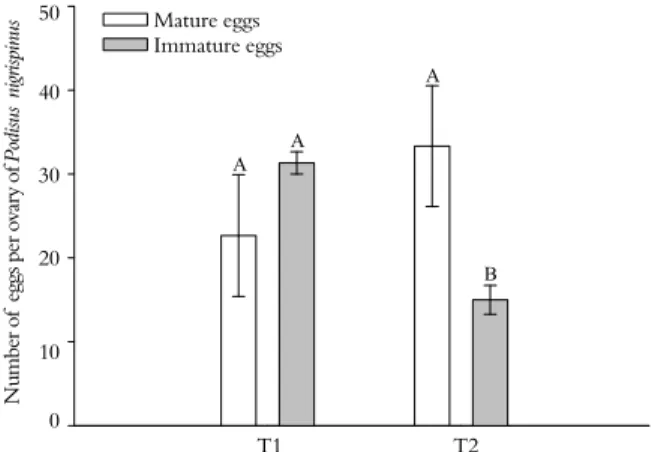
at twenty days old were also analyzed. Twenty-four-hours-old P. nigrispinus females had low ovary development without the evidence of oocyte production. The females of the T1 had completely developed ovaries, with 22.67 ± 7.26 mature eggs and 31.33 ± 1.33 oocytes in the maturation process. Ovaries of females of T2 had a lower quantity of eggs in the early maturation stage (15 ± 1.73). Females of T2 that were dissected at day 20 had 28.33 ± 2.31 and 15 ± 1.96 mature and immature eggs, respectively. Podisus nigrispinus females begin oogenesis and egg maturation soon after their emergence but mating is important to maintain egg production and oviposition.
Keywords: biological control, insect physiology, oogenesis, progeny, reproduction.
RESUMO. Desenvolvimento ovariano, produção de ovos e oviposição de fêmeas virgens ou acasaladas do predador Podisus nigrispinus (Heteroptera: Pentatomidae). Insetos Asopinae são predadores generalistas e Podisus nigrispinus (Dallas) (Heteroptera: Pentatomidae) é a espécie mais estudada desse grupo no Brasil. O objetivo foi avaliar o desenvolvimento ovariano, a produção de ovos e a oviposição de fêmeas de P. nigrispinus virgens ou acasaladas. Cinco fêmeas com 24 horas de idade foram dissecadas e os ovários foram analisados. Quinze fêmeas desse predador foram acasaladas (T1) e outras 15 foram individualizadas sem acasalamento (T2). Os ovários de cinco fêmeas por tratamento foram dissecados e os ovos maduros e em formação foram contados. Cinco fêmeas virgens de
P. nigrispinus com 20 dias de idade foram também analisadas. Fêmeas de P. nigrispinus com 24
horas de idade apresentaram baixo desenvolvimento ovariano, sem evidencia de produção de ovócitos. As fêmeas do tratamento T1 apresentaram ovários completamente desenvolvidos, com 22,67 ± 7,26 ovos maduros e 31,33 ± 1,33 ovos em processo de maturação. Ovários de fêmeas do tratamento T2 apresentaram uma quantidade baixa de ovos nos primeiros estágios de maturação (15 ± 1,73). Fêmeas do tratamento T2, dissecadas aos 20 dias, apresentaram 28,33 ± 2,31 e 15 ± 1,96 ovos maduros e imaturos, respectivamente. Fêmeas de P. nigrispinus iniciam a ovogênese e a maturação dos ovos logo após a emergência, porém o acasalamento é importante para manter a produção dos ovos e a oviposição.
Palavras-chave: controle biológico, fisiologia de insetos, ovogênese, progênie, reprodução.
Introduction
The Asopinae (Pentatomidae) insects have predatory species (SOARES et al., 2009), but only about 10% of the 300 known species have been studied (DE CLERCQ et al., 2002). These are generalist natural enemies, and Podisus nigrispinus (Dallas) (Hete-
Brazil, and their potential to regulate pest populations, especially Lepidoptera and Coleoptera, has been shown (GROSMAN et al., 2005).
The efficiency of P. nigrispinus depends on its reproduction capacity because the number of eggs produced and the survival of the progeny can guarantee the permanence of this species in the field of controlling pests (MOLINA-RUGAMA et al., 1998; ZANUNCIO et al., 2001). However, the strategies to increase the number of eggs produced and the performance of the progeny vary between insects (RIDLEY, 1988). The reproduction of the predator Cycloneda sanguinea Linnaeus (Coleoptera: Coccinelidae) was stimulated by climatic conditions (LEITE et al., 2008). Males of some insect orders can stimulate the reproduction of females in order to maximize the number of eggs produced and fertilized (CHAPMAN et al., 2003; CIVETTA, 2003; ROONEY; LEWIS, 2002; WEDELL; KARLSSON, 2003).
The mating status affected the reproduction of Podisus maculiventris (Say) (Heteroptera: Pentatomidae) because virgin females of this predator lay low numbers of unfertile eggs (DE CLERCQ; DEGHEELE, 1997). Podisus nigrispinus virgin females reduced their oviposition and presented longer preoviposition period (TORRES et al., 1997). On the other hand, multiple matings can stimulate oviposition of these predators (DE CLERCQ; DEGHEELE, 1997; RODRIGUES et al., 2008; TORRES et al., 1997). Despite many studies on the biology of P. nigrispinus (DE CLERCQ, 2000; TORRES et al., 2006) their mechanisms of reproduction is still unclear.
The objective of this study was to verify if mating is necessary to stimulate ovarian development, egg production and oviposition of P. nigrispinus.
Material and methods
Nymphs of P. nigrispinus were obtained from the Laboratory of Biological Control of Insects of the Institute of Applied Biotechnology to Agriculture (BIOAGRO), where this predator was reared at 25 ± 2°C, 70 ± 10% relative humidity and a photo phase of 12 hours.
Nymphs of P. nigrispinus at the beginning of the third instar were individualized in Petri dishes (9 cm) with a moist cotton ball. They were fed on Tenebrio molitor (Linnaeus) (Coleoptera: Tenebrionidae) pupae ad libitum from the insectary of the UFV (SOARES et al., 2009).
Podisus nigrispinus adults were sexed just after emergence, and five 24-hours-old females were dissected to observe their ovaries. Fifteen P. nigrispinus females were mated on the fourth day
after their emergence, and one pair of this predator was maintained per Petri dish (T1); the other fifteen were individualized without mating (T2). Females of this predator were observed daily until the first egg-lay (seventh day after their emergence), and the ovaries of five females of each treatment were dissected on this date. Podisus nigripinus females were killed in a chamber with ethyl acetate, dissected in the presence of saline solution and the number of eggs counted in their ovaries. The eggs were classified as mature (larger, wrinkled texture and prominent corion) and immature (smaller, smooth texture and non-prominent corion) (LEGASPI; LEGASPI JR., 2004).
Non-sacrificed females were observed daily to count the eggs laid over 20 days. Podisus nigrispinus males that died during the experiment were substituted by others of similar age. Five P. nigrispinus females of the T2 and without oviposition were dissected on the twentieth day. All ovaries were photographed with an 8.1-megapixels digital camera coupled to a light microscope.
The numbers of eggs were submitted to an analysis of variance (ANOVA) and compared by the "F" test at a 5% probability with the SAEG program of statistical analysis (GOMES, 1985).
Results and discussion
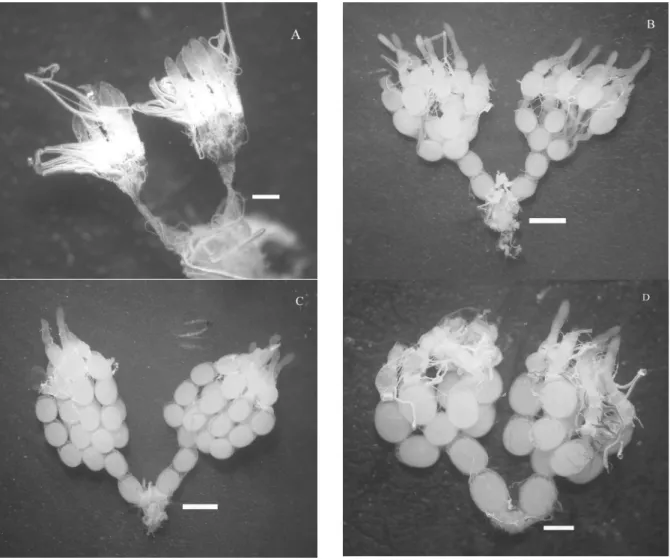
Podisus nigrispinus females possess a pair of ovaries, two lateral oviducts, a common oviduct, accessory glands, spermatheca and vagina. These structures are ventrally located in the abdominal cavity of the insects, immediately below the alimentary canal and extending from the genital capsule to the beginning of the thorax. Each ovary of P. nigrispinus has 6-7 ovarioles linked in the distal ending by terminal filaments (Figures 1A and D). These ovarioles are joined to each other in the proximal extremity to form the lateral oviduct. The lateral oviducts form the common oviduct. The reproductive tract of P. nigrispinus females was similar to that of other Heteroptera (ADAMS, 2000, 2001; KUGLER et al., 2006; LEMOS et al., 2005; WITTMEYER et al., 2001), with meroistic telotrophic ovaries ventrally located in the gut and involved by a tracheal net and fat body.
Figure 1. Ovaries of Podisus nigrispinus females: 24 hours old (A), mated and with seven days old (B), virgins with seven days old (C) and virgins with 20 days old (D). Bars= 1 mm.
Copidosoma floridanum (Ashmead) (Hymenoptera: Encyrtidae), Kapala sulcifacies (Cameron) (Hymenoptera: Eucharitidae), Anagrus erythroneurae (Trjapitzin and Chiappini), Anagrus giraulti (Crawford), Anagrus sophiae (Dozier), Anaphes yawl (Girault), Anaphes ovijentatus (Crosby and Leonard) (Hymenoptera: Mymaridae), Leptopilina boulardi (Barbotin, Carton and Kelner-Pillaut) and Trybliographa rapae (Westwood) (Hymenoptera: Eucoilidae) showed immature eggs in their ovaries at emergence (JERVIS et al., 2001). Podisus nigrispinus begins its oogenesis just after its emergence, and its maturation continues along the reproductive lifespan of this predator. This result agrees with that found for P. maculiventris, which tends to have a longer adult period, continued egg maturation and increasing numbers of immature eggs with increasing age of this predator (LEGASPI; LEGASPI JR., 2004).
Mated P. nigrispinus females (T1) had ovaries with a whitish color that were completely
developed, with mature eggs and oocytes in the maturation process after the first oviposition (Figure 1B). The numbers of mature and immature eggs in the ovaries of each T1 female were 22.67 ± 7.26 and 31.33 ± 1.33, respectively. These females started oviposition from the seventh day post-emergence with 10% mortality up to the twentieth day (Figure 3). Virgin females (T2) had similar ovary development and number of mature eggs (33.33 ± 7.21) compared to mated ones but with lower numbers of eggs in the initial maturation stage (15 ± 1.73) (Figures 1C and 2). Only one female of the T2 laid eggs (21 unfertile eggs on day 18), but all females survived during the evaluation period (Figure 4).
proteins in the body fat and their transport by the hemolymph for ovary development.
Nu m b er of eggs p er ov ar y of P odi sus ni gr ispi nus 50 40 30 20 10 0 Mature eggs Immature eggs A B A A
T1 T2
Figure 2. Number of mature and immature eggs per ovary of Podisus nigrispinus (Heteroptera: Pentatomidae), Viçosa, Minas Gerais State, Brazil. T1- mated females dissected at seven days old; T2- virgin females dissected at seven days old. Bars followed by same letter do not differ between them by the "F” test at 5% probability. N u mb er o f e gg s p er fem al e p er day 35 30 25 20 15 10 5 0
Number of eggs per female/day Survival 100 80 60 40 20 0 Su rvival (% )
0 3 6 9 12 15 18 21 24
Days after de emergence of female of Podisus nigrispinus (n = 10)
Figure 3. Number of eggs per female/day of Podisus nigrispinus (Heteroptera: Pentatomidae) and survival (%). Viçosa, Minas Gerais State, Brazil. T1- mated females; n- number of individuals evaluated. N u mb er o f e gg s p er fem al e p er day 5 4 3 2 1 0
Number of eggs per female/day Survival 100 80 60 40 20 0 Su rvival (% )
0 3 6 9 12 15 18 21 24 Days after de emergence of female of Podisus nigrispinus (n = 10)
Figure 4. Number of eggs per female/day of Podisus nigrispinus (Heteroptera: Pentatomidae) and percentage of survival. Viçosa Minas Gerais State, Brazil. T2- virgin females; n- number of individuals evaluated.
Additionally, P. nigrispinus has ovary of meroistic type (LEMOS et al., 2005), with nutritive cells known as nurse cells or trophocytes, which supply metabolites and organelles through cytoplasmic bridges to oocytes. For these reasons, the vitellogenesis of insects with meroistic ovaries can be completed in up to two days (PAPAJ, 2000).
The well-developed ovaries of mated and non-mated P. nigrispinus females seven days after their emergence suggest that the development of this organ and the production and maturation of oocytes occur independent of mating. On the other hand, this development differs from that of Photinus ignitus (Fall) (Coleoptera: Lampyridae) females that store substances produced by accessory glands of the reproductive tract of males and digests them into amino acids for oocytes up to two days after mating (ROONEY; LEWIS, 1999), which demonstrates the importance of mating for the oogenesis of this insect.
Mating is not a limiting factor for the oogenesis of P. nigrispinus females, but it stimulates the continuity and the oviposition process of this predator. This result agrees with that found for P. maculiventris, wich begin oogenesis before mating and presented mature eggs in their oviducts at 21 days after emergence (DE CLERCQ; DEGHEELE, 1997). However, mating can stimulate oviposition and reduce the preoviposition period as found for P. ignitus, Ellychnia corrusca (Linnaeus) (Coleoptera: Lampyridae), Drosophila melanogaster (Meigen) (Diptera: Drosophilidae) and Pieris napi (Linnaeus) (Lepidoptera: Pieridae), possibly due to secretions transferred with the spermatozoids by males (CHAPMAN et al., 2003; CIVETTA, 2003; ROONEY; LEWIS, 2002; WEDELL; KARLSSON, 2003) or due to endocrine influence (DAVEY, 2007).
The high number of immature eggs and oviposition of mated P. nigrispinus females can be explained by the stimulus from the juvenile hormone (JH) secreted by the gland corpora allata (CA) as found for Rhodnius prolixus (Stal) (Hemiptera: Reduviidae). The mating status of insects affects the CA metabolism by interrupting its activity earlier in virgin females, but the synthesis of JH occurs over a longer time in mated females (DAVEY, 2007).
Females at 20 days old dissected without mating had ovaries, and their numbers of mature and immature eggs similar to those dissected at seven days after their emergence (28.33 ± 2.31 and 15 ± 1.96) (Figure 1D). Virgin P. nigrispinus females showed a lower presence of oocytes in the initial maturation stage and larger amounts of mature eggs,
Mature eggs Immature eggs
Number of eggs per female day-1
Survival
Number of eggs per female day-1
possibly due to the reduction of oogenesis. The delay in oocyte production and the oviposition process can represent an adaptation of virgin females of this predator to encountering a male to fertilize their eggs. However, virgin P. nigrispinus females may not been able to reabsorb their eggs because they keep them stored in the ovaries until they are laid. This characteristic differs from species of the superfamily Aphidoidea that interrupt vitellogenesis and degenerate oocytes in the absence of fecundation or food to re-allocate the energy and increase longevity (BELL; BOHM, 1975; ROSENHEIM et al., 2000).
The lower survival of mated P. nigrispinus females can be explained by injury, diseases and predation (WARD et al., 1992), in addition to the higher use of energy in multiple mating, egg production and oviposition and the toxic effects of the seminal fluid of males (CHAPMAN et al., 1995; CIVETTA; CLARK, 2000; KAWAGOE et al., 2001).
Conclusion
Podisus nigrispinus females start their egg production and maturation just after their emergence, whether mated or not, but mating is important to maintain the egg production and oviposition rates of this predator.
The ovaries of P. nigrispinus possibly stop receiving endocrine incentives and they reduce egg production and delay oviposition without mating.
The energy used for reproduction is not diverted to survival strategies because females of this predator have no oosorption.
Acknowlegements
To “Conselho Nacional de Desenvolvimento Científico e Tecnológico (CNPq): “Coordenação de Aperfeiçoamento de Pessoal de Nível Superior (CAPES)” and “Fundação de Amparo à Pesquisa do Estado de Minas Gerais (Fapemig)”.
References
ADAMS, T. S. Effect of diet and mating status on ovarian development in the predaceous stink bug
Perillus bioculatus (Hemiptera: Pentatomidae). Annals
of the Entomological Society of America, v. 93, n. 3, p. 529-535, 2000.
ADAMS, T. S. Morphology of the internal reproductive system of the male and female two-spotted stink bug Perillus
bioculatus (F.) (Heteroptera: Pentatomidae) and the transfer of
products during mating. Invertebrate Reproduction and Development, v. 39, n. 1, p. 45-53, 2001.
BELL, W. J.; BOHM, M. K. Oosorption in insects. Biological Reviews,v. 50, n. 4, p. 373-396, 1975.
CHAPMAN, T.; LIDDLE, L. F.; KALB, J. M.; WOLFNER, M. F.; PARTRIDGE, L. Cost of mating in
Drosophila melanogaster is mediated by male accessory gland
products. Nature, v. 373, n. 6511, p. 241-244, 1995. CHAPMAN, T.; BANGHAM, J.; VINTI, G.; SEIFRIED, B.; LUNG, O.; WOLFNER, M. F.; SMITH, H. K.; PARTRIDGE, L. The sex peptide of Drosophilamelanogaster: Female post-mating responses analyzed by using RNA interference. Proceedings of the National Academy of Sciences of the United States of America, v. 100, n. 17, p. 9923-9928, 2003.
CIVETTA, A. Shall we dance or shall we fight? Using DNA sequence data to untangle controversies surrounding sexual selection. Genome, v. 46, n. 6, p. 925-926, 2003.
CIVETTA, A.; CLARK, A. G. Correlated effects of sperm competition and postmating female mortality. Proceedings of the National Academy of Sciences of the United States of America, v. 97, n. 24, p. 13162-13165, 2000.
DAVEY, K. The interaction of feeding and mating in the hormonal control of egg production in Rhodnius prolixus. Journal of Insect Physiology, v. 53, n. 3, p. 208-215, 2007. DE CLERCQ, P. Predaceous stinkbugs (Pentatomidae: Asopinae). In: SCHAEFER, C. W.; PANIZZI, A. R. (Ed.). Heteroptera of economic importance. Boca Raton: CRC Press, 2000. p. 737-789.
DE CLERCQ, P.; DEGHEELE, D. Effects of mating status on body weight, oviposition, egg load, and predation in the predatory stinkbug Podisus maculiventris
(Heteroptera: Pentatomidae). Annals of the Entomological Society of America, v. 90, n. 1, p. 121-127, 1997.
DE CLERCQ, P.; WYCKHUYS, K.; OLIVEIRA, H.; KLAPWIJK, J. Predation by Podisus maculiventris on different life stages of Nezara viridula. Florida Entomologist, v. 85, n. 1, p. 197-202, 2002.
FREITAS, S. P. C.; EVANGELISTA JÚNIOR, W. S.; ZANUNCIO, J. C.; SERRÃO, J. E. Development, survival and reproduction of Podisus nigrispinus (Dallas, 1851) (Heteroptera: Pentatomidae) with salt and amino acids solution supplementary diet. Brazilian Archives of Biology and Technology, v. 49, n. 3, p. 449-455, 2006. GOMES, J. M. SAEG 3.0: Sistema de Análises Estatísticas e Genéticas. Viçosa: UFV, 1985.
GROSMAN, A. H.; BREEMEN, M. V.; HOLTZ, A. M.; PALLINI, A.; MOLINA-RUGAMA, A. J.; PENGEL, H.; VENZON, M.; ZANUNCIO, J. C.; SABELIS, M. W.; JANSSEN, A. Searching behaviour of an omnivorous predator for novel and native host plants of its herbivores: a study on arthropod colonization of eucalyptus in Brazil. Entomologia Experimentalis et Applicata, v. 116, n. 2, p. 135-142, 2005.
JERVIS, M. A.; HEIMPEL, G. E.; FERNS, P. N.; HARVEY, J. A.; KIDD, N. A. C. Life-history strategies in parasitoid wasps: a comparative analysis of “ovigeny”. Journal of Animal Ecology, v. 70, n. 3, p. 442-458, 2001.
windmill butterfly Atrophaneura alcinous. Ecological Entomology, v. 26, n. 3, p. 258-269, 2001.
KUGLER, J.; RÜBSAM, R.; TRAUNER, J.; BÜNING, J. The larval development of the telotrophic meroistic ovary in the bug Dysdercus intermedius (Heteroptera, Pyrrhocoridae). Arthropod Structure and Development, v. 35, n. 2, p. 99-110, 2006.
LEGASPI, J. C.; LEGASPI JR., B. C. Does a polyphagous predator prefer prey species that confer reproductive advantage? Case study of Podisus
maculiventris. Environmental Entomology, v. 33, n. 5,
p. 1401-1409, 2004.
LEITE, G. L. D.; PIMENTA, M.; FERNANDES, P. L.; VELOSO, R. V. S.; MARTINS, E. R. Fatores que afetam artrópodes associados a cinco acessos de ginseng-brasileiro
(Pfaffia glomerata) em Montes Claros, Estado de Minas Gerais.
Acta Scientiarum. Agronomy, v. 30, n. 1, p. 7-11, 2008. LEMOS, W. P.; RAMALHO, F. S.; SERRÃO, J. E.; ZANUNCIO, J. C. Morphology of female reproductive tract of the predator Podisus nigrispinus (Dallas) (Heteroptera: Pentatomidae) fed on different diets. Brazilian Archives of Biology and Technology, v. 48, n. 1, p. 129-138, 2005.
MOLINA-RUGAMA, A. J.; ZANUNCIO, J. C.; OLIVEIRA, M. L. R. Reproductive strategy of Podisus
rostralis (Stal) (Heteroptera: Pentatomidae) females under
different feeding intervals. Biocontrol Science and Technology, v. 8, n. 4, p. 583-588, 1998.
PAPAJ, D. R. Ovarian dynamics and host use. Annual Review of Entomology, v. 45, n. 1, p. 423-448, 2000. RIDLEY, M. Mating frequency and fecundity in insects. Biology Reviews, v. 63, n. 4, 509-549, 1988.
RODRIGUES, A. R. S.; SERRÃO, J. E.; TEIXEIRA, V. W.; TORRES, J. B.; TEIXEIRA, A. A. Spermatogenesis, changes in reproductive structures, and time constraint associated with insemination in Podisus nigrispinus. Journal of Insect Physiology, v. 54, n. 1, p. 1543-1551, 2008. ROONEY, J.; LEWIS, S. M. Differential allocation of male-derived nutrients in two lampyrid beetles with contrasting life-history characteristics. Behavioral Ecology, v. 10, n. 1, p. 97-104, 1999.
ROONEY, J.; LEWIS, S. M. Fitness advantage from nuptial gifts in female fire flies. Ecological Entomology, v. 27, n. 3, p. 373-377, 2002.
ROSENHEIM, J. A.; HEIMPEL, G. E.; MANGEL, M. Egg maturation, egg resorption and the costliness of transient egg limitation in insects. Proceedings of the Royal Entomological Society of London B, v. 267, n. 1452, p. 1565-1573, 2000.
SOARES, M. A.; ZANUNCIO, J. C.; LEITE, G. L. D.; WERMELINGER, E. D.; SERRÃO, J. E. Does Thyrinteina
arnobia (Lepidoptera: Geometridae) use different defense
behaviours against predators? Journal of Plant Diseases and Protection, v. 116, n. 1, p. 30-33, 2009.
THOMAS, D. B. Taxonomic synopsis of the Asopinae Pentatomidae (Heteroptera) of the Western Hemisfere. Lanham: Entomological Society of America, 1992.
TORRES, J. B.; ZANUNCIO, J. C.; MOURA, M. A. The predatory stinkbug Podisus nigrispinus: biology, ecology and augmentative releases for lepidoperan larval control in Eucalyptus in Brazil. Biocontrol News and Information, v. 27, n. 15, p. 1-18, 2006.
TORRES, J. B.; ZANUNCIO, J. C.; OLIVEIRA, M. C. Mating frequency and its effect on female reproductive output in the stinkbug predator Podisus nigrispinus
(Heteroptera: Pentatomidae). Mededelingen Faculteit Landbouwwetenschappen Rijksuniversiteit Gent, v. 62, n. 2B, p. 491-498, 1997.
WARD, P.; HEMMI, J.; ROOSLI, T. Sexual conflict in the dung fly Sepsis cynipsea. Functional Ecology, v. 6, n. 6, p. 649-653, 1992.
WEDELL, N.; KARLSSON, B. Paternal investment directly affects female reproductive effort in an insect. Proceedings of the Royal Entomological Society of London B, v. 270, n. 1528, p. 2065-2071, 2003.
WITTMEYER, J. L.; COUDRON, T. A.; ADAMS, T. S. Ovarian development, fertility and fecundity in Podisus
maculiventris (Say) (Heteroptera: Pentatomidae): an
analysis of the impact of nymphal, adult, male and female nutritional source on reproduction. Invertebrate Reproduction and Development, v. 39, n. 1, p. 9-20, 2001.
ZANUNCIO, J. C.; MOLINA-RUGAMA, A. J.; SERRÃO, J. E. Nymphal development and reproduction of Podisus
nigrispinus (Heteroptera: Pentatomidae) fed with
combinations of Tenebrio molitor (Coleoptera: Tenebrionidae) pupae and Musca domestica (Diptera: Muscidae) larvae. Biocontrol Science and Technology, v. 11, n. 1, p. 331-337, 2001.
Received on March 19, 2009. Accepted on November 2, 2009.