Challenges and prospects of population genetic studies in terns
(Charadriiformes, Aves)
Patrícia J. Faria
1,2, Erika Baus
2, João S. Morgante
1and Michael W. Bruford
2 1Departamento de Genética e Biologia Evolutiva, Instituto de Biociências, Universidade de São Paulo,
SP, Brasil.
2
Biodiversity and Ecological Processes Group, Cardiff University, Cardiff, UK.
Abstract
Little information is available about the population structure of communally nesting terns (Sternidae) and skimmers (Rynchopidae) throughout the world. In order to fill this gap, a survey of molecular markers was carried out for six species of terns (Anous stolidus, Sterna hirundinacea, S. fuscata, S. superciliaris, Thalasseus maximus and Phaetusa simplex) and one species of skimmer (Rynchops niger). First, we describe the results of the construction of genomic DNA libraries and document problems encountered during this procedure. Secondly, we tested the cross-amplification of 18 microsatellite loci previously described for related species (the number of polymorphic loci ranged from three to seven). Thirdly, we tested the usefulness of mtDNA (control region, ND2, Cytochromeb and ATPase 6/8) for phylogeographic studies in this group of birds. The occurrence of nuclear copies of the mitochondrial control region is reported. Nucleotide divergence in the mtDNA genes analyzed ranged from 0.0 to 0.006. Despite the difficulties associated with the selection of variable markers in this group of seabirds, we were able to select poly-morphic markers for each species tested and we anticipate these results will help the development of genetic studies concerning important biological questions in terns.
Key words:molecular markers, microsatellites, mitochondrial DNA, terns.
Received: October 20, 2006; Accepted: March 8, 2007.
Introduction
Terns (Sternidae, Charadriiformes) are migratory seabirds widely dispersed throughout the world and include several threatened species (Gochfeld and Burger, 1996). Despite this, there is not enough information about many species to enable effective conservation measures to be taken and several important biological questions regarding their dispersal behavior are not yet understood.
Molecular markers have been useful for addressing many questions in conservation and population biology. From 44 extant species of terns, only three have been genet-ically studied at the population level (S. fuscata,S. dougalli andS. albifrons) (Aviseet al., 2000; Peck and Congdon, 2004; Szczyset al., 2005; Whittieret al., 2006). To carry out such genetic studies, it is important to obtain markers that provide suitable levels of variation for the scope of the proposed questions, which are so far unknown for terns.
Two main types of molecular markers can be used: general (e.g. RAPDs, ISSR and AFLP) or locus-specific
markers. Among the locus-specific markers, micro-satellites have become widely applied for several types of study, due to their advantages over other markers, such as the relative ease in obtaining markers, their use with non-invasive samples, their high level of variation and the possibility of cross amplification (Bruford et al., 1996; Beaumont and Bruford, 1999).
However, while in many organisms the first and ap-parently simple step of isolating variable microsatellites is an easy task, in others it has proved to be problematic and can be both time-consuming and expensive (Beaumont and Bruford, 1999). It is known that the abundance of micro-satellites across the taxa varies by orders of magnitude (Nève and Meglécz, 2000), and in some groups, such as birds, their frequency is relatively low (Primmer et al., 1997; Neff and Gross, 2001). In addition, major difficulties in the isolation of these markers have been reported for groups such as leptidoptera (Saccheri and Bruford, 1993), birds (Beaumont and Bruford, 1999) and some plants (Squirrellet al., 2003).
Mitochondrial DNA is also extensively used in evolu-tionary studies because of its unique characteristics such as predominantly maternal inheritance, lack of recombination
Send correspondence to Patrícia de Jesus Faria. Present address: Biodiversity and Ecological Processes Group School of Biosci-ences, Cardiff University, CF10 3TL Cardiff, United Kingdom. E-mail: [email protected] / [email protected].
and high evolutionary rate. Conserved primers can be used to amplify DNA in divergent taxa (Kocheret al., 1989) and this enhances the application of mitochondrial DNA. Nev-ertheless, a high number of studies reported the existence and amplification of nuclear copies of mitochondrial DNA in many organisms (cats: Lopezet al., 1994; gorillas: Thal-mannet al., 2005; humans: Mourieret al., 2001; Tourmen et al., 2002 and other eukariotes: Richly and Leister, 2004), including several species of birds (Quinn, 1992; Arctander, 1995; Kidd and Friesen, 1998; Sorenson and Quinn, 1998). When undetected, these nuclear sequences, which are known as nuclear mitochondrial translocated sequences (Numts) (e.g. Zhang and Hewitt, 1996; Sorenson and Quinn, 1998; Richly and Leister, 2004), can lead to misin-terpretations of phylogenetic and population genetic data.
It is relatively uncommon to find reports document-ing difficulties related to the use and development of mo-lecular markers in some groups. In this paper, we describe problems encountered while conducting population genetic studies in terns that breed in Brazil. First, we describe is-sues associated with isolating microsatellite loci; second, the occurrence of nuclear copies of mtDNA involving the control region and third, low variation of the few molecular markers available. In order to select and test markers, six species of terns (Anous stolidus,Sterna hirundinacea,S. fuscata, S. superciliaris, Thalasseus maximus and Phaetusa simplex) and one species of black-skimmer (Rynchops niger) were evaluated. Our aims were to select polymorphic and useful molecular markers for conducting population genetic studies in different species of terns and skimmers and also to report our results to researchers at-tempting to select informative markers in `recalcitrant’ spe-cies. By reporting this information we hope to improve general understanding of the dynamics of these markers in different groups.
Material and Methods
Samples and DNA extraction
The blood samples used in this study were taken dur-ing the field work of 2001 to 2004 and are part of a broader study involving population genetics of different species of tern that breed in Brazil. Chicks and adults were captured using hand nets and mist nets at 16 different locations in Brazil. During this survey, 1200 blood samples (200µL of blood) from 11 species were taken from the brachial vein. In laboratory, these samples were kept in absolute ethanol at 4 °C and the genomic DNA was isolated using standard phenol-chloroform extraction followed by ethanol precipi-tation (Sambrooket al., 1989).
Microsatellites
Enriched and non-enriched genomic libraries were constructed for two species (Sterna hirundinacea and Rynchops niger), using a well-established protocol
de-scribed by Hammond et al. (1998), e.g. Williams et al. (2002), Harperet al.(2006). DNA was digested withMboI and selected fragments (300-1000 bp) were isolated from a 2.0% agarose gel by electroelution into dialysis tubing and purified using Centricon tubes (Amicon). For the enriched library, fragments were enriched for CA and GA repeats us-ing biotin-labelled probes (Hammond et al., 1998). The fragments of both enriched and non-enriched libraries were ligated into a pUC18 vector and the ligation products were cloned into Invitrogen Topo-one shot competent cells (Top10). Colonies were screened following the PCR-based method of Lunt et al. (1999). Positive clones were se-quenced directly from the PCR products using Big Dye Terminator Sequencing kit (version 2.0, ABI) following the manufacturer’s instructions. Primers for those se-quences containing microsatellites were designed using Primer 3 (http://www.basic.nwu.edu/biotools/Primer3. html) and DSGene 1.0 (Accelrys Inc).
The microsatellites isolated from the genomic librar-ies, together with eighteen additional microsatellite loci previously described in the literature for other species in-cluding the Red-billed Gull (RBG 13, RBG18, RBG20, RBG27, RBG28, RBG29 and RBG39; Givenet al., 2002), the Black-legged Kittiwake (K6, K16, K31, K32, K56, K67 and K71; Tirard et al., 2002) and the Roseate Tern (Sdaat20, Sdaat27, Sdaat46 and Scaac20; Szczys et al., 2005), were tested in at least 14 specimens of each studied species.
Amplifications were performed in a Perkin Elmer thermocycler (9700) using a fluorescent primer (TET, HEX or 6-FAM) and the Qiagen Multiplex PCR Kit (Qiagen) ac-cording to the manufacturers instructions. PCR products were visualized and sized on an automated DNA sequencer (ABI PRISM 377) using TAMRA-350 size standard (ABI) and GENESCAN version 2.0 (ABI). The software GENO-TYPER 1.1 was also used to identify alleles and genotypes.
Mitochondrial DNA
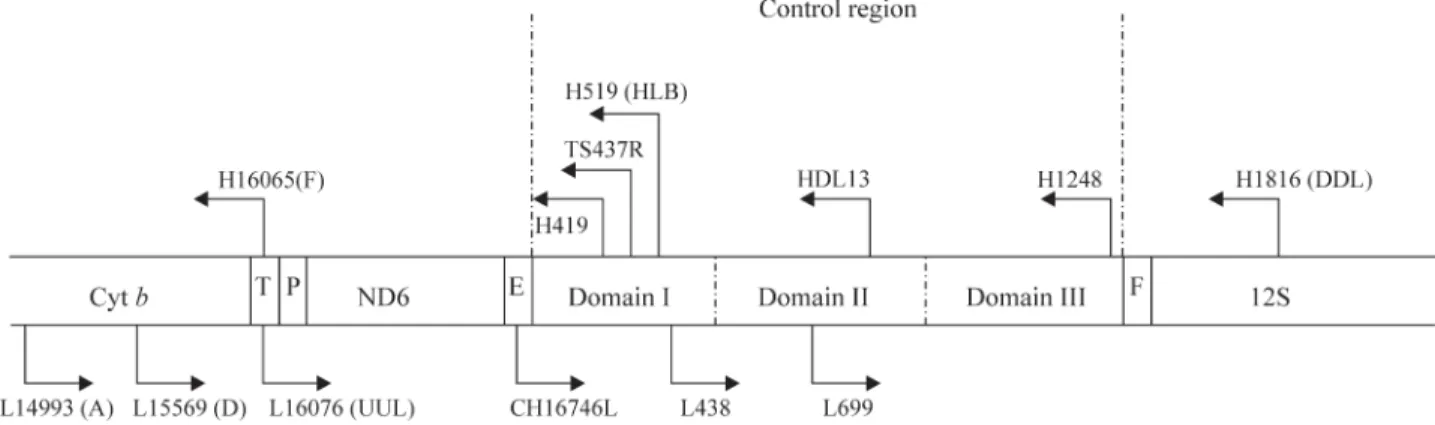
TACTC), H1816 (GCACCGCCAAGTCCTTAGAGTT), UUL 16076 (AAAACATTGGTCTTGTAAACC) (Helbig and Seibold, 1999), H519 (GGCCCTGACATAGGAAC CAGAGG) and H419 (GGGTTGCTGATTTCACGTGA) (Lieberset al., 2001). Figure 1 shows the flanking position of these primers in the control region.
A portion of the cytochromebgene (320 bp) was am-plified using L15008 (AACTTCGGATCTCTACTAGG) and H15326 (GAATAAGTTGGTGATGACTG) (Desjar-din and Morais, 1990). Partial sequences of the ND2 gene (500 bp) were obtained using the primers MetL (AAGCT ATCGGGCCCATACCCG) and H5766 (GATGAGAAG GCTAGGATTTTKCG) (Sorensonet al., 1999), while for the amplification of a portion of the ATPase 6/8, Lys L (CAGCACTAGCCTTTTAAGCT) (Sorenson et al., 1999), and ATP6 intH (TGGGATTAGATGTTTTCTTG) (designed for this study) were used.
Amplifications were carried out in a MJ Research thermocycler (PTC-100 and PTC-200) using: an initial de-naturation step of 95 °C, followed by 35 cycles of 95 °C for 30 s, 55-60 °C for 30 s and 72 °C for 30 s, with a final elon-gation step of 72 °C for 10 min. Long PCRs were carried out using the TripleMaster System (Eppendorf) following the manufacturer’s instructions.
PCR products were purified using shrimp alkaline phosphatase/exonuclease I enzymes (Amersham Biosci-ences) and sequenced using the Big Dye Terminator Sequencing kit (version 3.1, ABI) following the manufac-turer’s instructions. The products were loaded in an auto-mated sequencer (ABI 3100 and 3700). Sequences were aligned manually, corrected using the program Sequence Navigator (version 1.0, Applied Biosystems) and aligned with sequences in GenBank to check if they matched mtDNA sequences already available.
Results and Discussion
Microsatellites
Isolation: the enriched libraries yielded a total of 1162 recombinant clones and from this total only 451 positives (white colonies) were recovered: 288 clones forS.
hirundinacea and 163 for R. niger. The positives were screened for the presence of microsatellites, however due to the low number of clones identified as potentially contain-ing microsatellites (less than 5%), all clones with inserts larger than 250 bp were sequenced: a total of 171 clones for S. hirundinaceaand 115 forR. niger. From these, 47 were microsatellite sequences inS. hirundinaceawith only 13 in R. niger.
The cloning efficiency of our enriched libraries (per-centage of positives clones obtained that contains micro-satellite sequences from the total of recombinants) was 5.16% (in total for both species). This value is similar to those described in the literature for other bird species, such as the crested ibisNipponia nippon(Jiet al., 2004; 4%), but smaller when compared with other taxa, such as fish and mammals (Zaneet al., 2002). Comparisons of these values are problematic due to the different isolation techniques used and their expected efficiency (see review in Zaneet al., 2002 and Gregory and Quinn, 2006). Nevertheless, low values of cloning efficiency in enriched protocols have been attributed to the low number of microsatellites present in the taxon (as for example in lepidoptera, where cloning efficiency is around 2.5%, Jiet al., 2003), which has led to several hypotheses about the origin of the reduced abun-dance of microsatellites in these genomes (Nève and Meglécz, 2000).
The non-enriched protocol yielded 466 recombinant clones forS. hirundinaceaand 247 forR. niger. Here, only the positive clones for the PCR screening were sequenced (16 forS. hirundinaceaand 8 forR. niger) and none of them were found to be true microsatellite sequences. The per-centage of positive clones using traditional methods of microsatellite isolation (non-enriched libraries) has been found to be lower in birds (0.46%), compared to other taxa, such as mammals (1.67%) and fish (3.1%; Primmeret al., 1997; Zaneet al., 2002). Even considering that in our study a relatively low number of clones were screened (about 2000), our results suggested that the frequency of micro-satellites inS. hirundinaceaandR. nigermay be than for other species of birds studied to date.
Givenet al.(2002) reported that for the development of polymorphic microsatellites forLarus novaehollandiae scopulinus, a gull species, it was necessary to carry out screening of 150,000 clones (using both procedures: en-riched and non-enen-riched) of which only 39 contained microsatellites and seven were polymorphic. Until now, only four microsatellite loci have been isolated for the ge-nusSterna(Szczyset al., 2005). However, to obtain these markers, the authors reported that it was necessary to screen approximately 250 million base pairs of the Roseate tern (Sterna dougallii) genome, which produced 166 positive clones and only four polymorphic markers. In this study it was concluded that genomes in the genusSternaare partic-ularly poor in microsatellites (Szczyset al., 2005).
Our data could also be explained due to the low effi-ciency of the protocols used in this study or even by poten-tial problems during the isolation of microsatellites. However, this seems unlikely for three main reasons. First, several studies using the same protocol (Hammondet al., 1998) have been successfully done (examples can be found in: Aransayet al., 2001; Baileyet al., 2005; Berendonk and Evans, 2004; Berendonk and Dobson, 2006; Burlandet al., 2001; Horninget al., 2003; Liuet al., 2005; Liuet al., 2006; Paiet al., 2003; Tero and Schlotterer, 2005; Harperet al., 2006); Second, our laboratory is experienced in the devel-opment of microsatellites in different group of organisms, including birds (Jeffery et al., 2001), reptiles (Ciofi and Bruford, 1998); mammals (Radespielet al., 2001), insects (Wilcocket al., 2001; Seabraet al., 2002; Williamset al., 2002) and earthworms (Harperet al., 2006); and third, the few reports on microsatellite isolation in this group of birds (only one record forSterna; Szczyset al., 2005 and two for seagulls; Givenet al., 2002; Tirardet al., 2002) and several personal communications from researchers that were not successful in the development of polymorphic loci in tern species.
From sixty positive clones containing true micro-satellites obtained in our study (47 forS. hirundinaceaand 13 forR. niger), using the enriched protocol, eighteen did not possess suitable flanking sequences for primer design, seven possessed very small number of repeat units (< 4) and twenty-seven were replicate sequences present in other clones. The libraries constructed in our study generated only eight primers pairs, six of which produced an amplifi-cation profile comprising a large number of bands, one of which presented a single product, but not of the expected size and one produced a monomorphic product in six differ-ent species of terns. Similar results of non-specific or repet-itive DNA amplification have also been reported in lepi-doptera. Recent studies of this group have shown the occurrence of microsatellite DNA families, with loci con-taining similar or almost identical flanking regions, that can complicate the selection of single locus markers (Nève and Meglécz, 2000; Zhang, 2004). These findings have been re-lated to the genesis and spread of microsatellites in
lepidop-tera (Nève and Meglécz, 2000; Zhang, 2004). It has been suggested that mobile elements could be involved in the evolutionary dynamics of microsatellites, including gener-ation of the sequence followed by dispersal and diversifica-tion. Accordingly, in organisms that have low micro-satellite frequencies and high redundancy, micromicro-satellites would still be in the early stage of evolution and their flank-ing regions would not have accumulated many mutations (Ellegren, 2004; Zhang, 2004).
In conclusion, further effort is needed to isolate microsatellites specific for terns and skimmers before gen-eral conclusions can be drawn. However, it seems to date that the abundance of microsatellites in this group is lower than in other species and the level of redundancy is high. Further investigation into the evolutionary trajectory of microsatellites within this group is needed, as well as the development of new methods to increase the efficiency of microsatellite isolation.
Cross amplification of microsatellites. In birds, a wide survey of the literature has reported a success rate of cross amplification of 84% in several passerine species (Galbuseraet al., 2000), while the level of polymorphism ranged from 39% (Galbuseraet al., 2000) to 46% (Primmer et al., 1996). The probability of success seems to be higher in species that belong to the same genus or recently sepa-rated genera (Zaneet al., 2002)
The results of the cross amplification in our data are shown in Table 1. Some loci did not amplify in some speci-mens inT. maximus(K67 and K16),S. hirundinacea(K67), S. fuscata(K16) andA. stolidus(Sdaat20) (Table 1). This result could be a consequence of the occurrence of null al-leles in those species, therefore those primers were not used further.
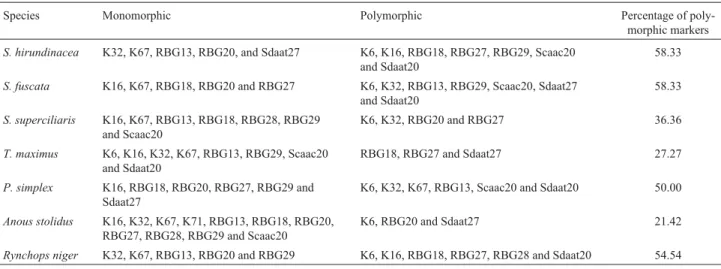
The proportion of polymorphic markers in each spe-cies ranged from 16.6% inA. stolidusto 38% inS. fuscata (Table 2). These results are within the range obtained for other species of seabirds. InRissa tridactyla, only 14.28% of the loci were polymorphic when used inStercorarius parasiticus, a species belonging to a closely related family (Tirardet al., 2002). A recent survey of seventeen micro-satellite loci developed for whiskered auklet (Aethia pygmaea) in 42 species of seabirds, showed that as the ge-netic distance increased, the level of polymorphism de-creased more rapidly than amplification success (Dawson et al., 2005). The average level of polymorphism within the family was 52%, while outside the family it dropped to 5% (Dawsonet al., 2005). About 90% of the loci developed for Larus novaehollandiae scopulinus were polymorphic within the same genus (Givenet al., 2002).
Mitochondrial DNA
Considering the difficulties associated with the isola-tion of polymorphic microsatellite loci, it was decided to select mitochondrial DNA sequences that could also be highly informative for addressing questions concerning the population genetics of terns.
Control region. The most suitable region of the mtDNA for population studies is the control region (D-loop) because it evolves rapidly. This segment of the mtDNA has been used in several phylogeographic studies of seabirds (Kidd and Friesen, 1998; Burg and Croxall,
2001; Lieberset al., 2001; Abbot and Double, 2003). How-ever, in some avian species, the control region is not more variable than coding genes (Randi and Lucchini, 1998; Crochet and Desmarais, 2000). In gulls, the third domain of the D-loop showed the same variation as the second domain and cytochromebgene. This slower rate of evolution could be partly explained by the existence of secondary structures in the third domain of the D-loop of these species (Crochet and Desmarais, 2000).
Sequences of the first domain of D-loop were used by Aviseet al., (2000) in a phylogeographic study of the sooty tern (Sterna fuscata). For the amplification of this region,
Table 1- Number of alleles found in each species of seabird for each primer combination. The number of individuals tested is shown in brackets.
SH SF SS TM PS AS RN
K6 3 (12) 5 (14) 3 (3) 1 (10) 4 (8) 6 (14) 3 (10)
K16 4 (12) 2 (2)* 2 (4) 2 (10) 1 (8) 1 (14) 3 (10)
K31 NS NS NS NS NS NS NS
K32 1 (12) 6 (14) 2 (4) 1 (10) 4 (8) 1 (14) 1 (12)
K56 NS NS NS NS NS NS NS
K67 2 (8)* 2 (14) 2 (4) 1 (6)* 2 (8) 1 (14) 1 (12)
K71 NS NS NS NS NS 1(14) NS
RBG13 2 (17) 6 (14) 2 (2) 1 (10) 3 (8) 1 (14) 1 (11)
RBG18 3 (12) 1 (14) 2 (5) 2 (10) 2 (8) 1 (14) 5 (12)
RBG20 1 (12) 2 (14) 3 (4) 2 (8)* 1 (8) 2 (75) 1 (11)
RBG27 7 (12) 1 (14) 3 (4) 2 (10) 1 (8) 1 (14) 2 (11)
RBG28 NS NS NS NS NS 1 (14) 2 (12)
RBG29 4 (12) 8 (14) 1 (5) 1 (10) 2 (8) 1 (14) 1 (12)
RBG39 NS NS NS NS NS NS NS
Sdaat20 7 (11) 4 (14) ? 1 (10) 4 (8) 2 (7)* 4(5)
Sdaat27 1 (53) 2 (14) ? 2 (10) 1 (8) 2 (15) 2 (11)
Sdaat46 - - -
-Scaac20 8 (11) 3 (14) 2 (5) 1 (10) 4 (6)* 1 (13) ?
Abbreviations: SH (S. hirundinacea), TM (T. maximus), SF (S. fuscata), SS (S. superciliaris), PS (Phaetusa simplex), AS (Anous stolidus), and RN (Rynchops niger). NS = non-specific amplification; (-) non-amplification; *lack of amplification in some specimens; ? not tested.
Table 2- Summary of the monomorphic and polymorphic microsatellite loci and its proportion in each species.
Species Monomorphic Polymorphic Percentage of
poly-morphic markers
S. hirundinacea K32, K67, RBG13, RBG20, and Sdaat27 K6, K16, RBG18, RBG27, RBG29, Scaac20 and Sdaat20
58.33
S. fuscata K16, K67, RBG18, RBG20 and RBG27 K6, K32, RBG13, RBG29, Scaac20, Sdaat27 and Sdaat20
58.33
S. superciliaris K16, K67, RBG13, RBG18, RBG28, RBG29 and Scaac20
K6, K32, RBG20 and RBG27 36.36
T. maximus K6, K16, K32, K67, RBG13, RBG29, Scaac20 and Sdaat20
RBG18, RBG27 and Sdaat27 27.27
P. simplex K16, RBG18, RBG20, RBG27, RBG29 and Sdaat27
K6, K32, K67, RBG13, Scaac20 and Sdaat20 50.00
Anous stolidus K16, K32, K67, K71, RBG13, RBG18, RBG20, RBG27, RBG28, RBG29 and Scaac20
K6, RBG20 and Sdaat27 21.42
they used the primers CH1674 GL and T5437R, previously described for other species of birds (Weninket al., 1994). In the present study, several trials were performed using this set of primers in the six species tested. For all species analyzed in our study, two fragments were obtained, sized 450 bp (ex-pected size) and 600 bp. Peck and Congdon (2004) also re-lated difficulties associated to the use of these primers on the same species (Sterna fuscata) analyzed by Avise et al., (2000). After changes to the PCR conditions, a single frag-ment of 600 bp was isolated. This fragfrag-ment was sequenced and the resulting sequences were of good quality and without ambiguities. These sequences were submitted and aligned using BLASTn with those in the GenBank database (Acces-sion number EF028082) and were matched to nuclear copies described forCepphus(Alcidae) (Kidd and Friesen, 1998).
Avise et al. (2000), isolated mtDNA from tissues such as liver and muscle through CsCl-ethidium bromide density gradient centrifugation. In the present study, only blood samples were used. Sorenson and Quinn (1998) pointed out that avian blood samples are particularly likely to yield Numts and should be avoided for mtDNA sequenc-ing. Indeed, red blood cells in birds are nucleated and rela-tively depauperate in mtDNA. Instead of total genomic extractions, the use of purified mtDNA from mtDNA-rich tissues is preferred.
The occurrence of Numts can be detected when: 1) the PCR amplification produces more than one band; 2) there are ambiguities in the sequence or poor quality; 3) there are stop codons, frameshifts, deletions or insertions in gene sequences; and 4) when the analysis produces contra-dictory results (Zhang and Hewitt, 1996). Unfortunately, it is not always possible to identify Numts at the first three steps (as happened in our study) and sometimes the detec-tion occurs when all the laborious work has been done and misleading results have been reported as a consequence -including in Genbank (Cliffordet al., 2004; Anthonyet al., 2007).
Identification of nuclear copies of mtDNA is impor-tant because unrecognized inclusion of Numts in an analy-sis can lead to incorrect conclusions and can invalidate the
analyses. However, nuclear integrations provide a real op-portunity to study the relative rate of evolution of nuclear and mitochondrial sequences and in calibration of sequence divergence (Zhang and Hewitt, 1996; Sorenson and Quinn, 1998; Bensassonet al., 2001).
Other experiments were carried out in an attempt to sequence the second and third domain of D-loop and the whole control region using the primer sets described in Ma-terial and Methods. Long PCR was also used in order to avoid nuclear copies and identify the true mtDNA se-quence. Non-specific fragments were produced on amplifi-cation of the second and third domain and the whole control region.
Mitochondrial genes. Considering the problems re-lated to sequencing of the control region, it was decided to evaluate the utility of mitochondrial genes in this study. Cytochromeb, ND2 and ATPase 6/8 were chosen as candi-dates. Cytochromebis one of the most commonly utilized mtDNA genes in phylogenetics, however, it does not al-ways seem to be the optimal choice. According to Sorenson (2003), all mitochondrial protein genes have similar rates of substitution at the third codon position, but vary in the rate of amino acid substitution. Certain proteins, such as the Cytochromebare subject to more biochemical constraints than others and, as a result, the levels of homoplasy are of-ten higher than in comparatively unconstrained regions (Johnson and Sorenson, 1998).
In terms of variation, ATPase 8, ND6 and ND2 are considered the most variable genes in birds. However, due to the small size of ATPase 8 and the unusual base compo-sition and location of ND6, they often provide little infor-mation (Sorenson, 2003). Sequences of ND2 and ATPase 6/8 have been used in several phylogenetic and phylo-geographic studies (Garcia-Morenoet al., 2004; Kennedy and Spencer, 2004; Overton and Rhoads, 2004; Givenet al., 2005; Zink, 2005).
Partial sequences of cyt b, ND2 and ATPase 6/8 genes were obtained for each of the six species studied (S. hirundinacea,S. fuscata,S. superciliaris,T. maximus,P. simplexandR. niger). The values of nucleotide divergence ranged from 0.0 to 0.006 within species (Table 3). Conse-quently, their usefulness for genetic studies is limited and depends on the species analyzed and the questions ad-dressed. Unfortunately, it is impossible to know in advance which gene will be informative in which species for con-ducting studies at population level.
It seems that the selection of suitable (variable) mo-lecular markers to address questions of population and evo-lutionary genetics for terns is not a straightforward task and significant effort is needed for each species. However, de-spite all difficulties encountered during the course of this study, polymorphic markers were selected for each species and can potentially be used in further genetic studies of this group of seabirds. Reports on potential problems encoun-tered during the selection of molecular markers are also
im-Table 3- Number of haplotypes and values of nucleotide divergence in five species of terns and one species of black skimmer for each mtDNA gene sequences. The number of individuals tested is shown in brackets.
Species Cytochromeb ND2 ATPase 6/8
S. hirundinacea 2/0.006 (21) 2/0.002 (17) 2/0.002 (11)
S. fuscata ? 3/0.006 (16) 3/0.006 (13)
S. superciliaris 1/0 (4) ? 1/0 (5)
T. maximus 1/0 (10) 1/0 (9) 1/0 (10)
P. simplex 1/0 (8) ? ?
Anous stolidus 1/0 (9) 2/0.004 (14) 2/0.005 (14)
Rynchops niger 1/0 (8) 1/0 (15) 2/0.004 (12)
portant to improve general understanding of their dynamics in different groups.
For future studies involving population genetics of terns, the utilization of other kinds of molecular markers that have proved to be suitable to conduct genetic studies in other species of birds might be considered, such as nuclear introns (Congdonet al., 2000; Pachecoet al., 2002; Friesen et al., 2005; Whittier et al., 2006), SNPs (Saetre et al., 2001; Benschet al., 2002) and AFLP (Wanget al., 2003; Bouletet al., 2005; Helbiget al., 2005).
In a recent study, cytochromeband nuclear introns (332pb of α-enolase and 289 bp of glyceraldehydes-3-phosphate dehydrogenase) were used to determine the netic variation among subspecies of Least tern. Low ge-netic variability was found using all markers: only three cyt bhaplotypes in 50 individuals, a single allele usingEnol and three alleles usingGadp (Whittieret al., 2006). Our findings in addition to the published record suggest that this group of birds presents low levels genetic variation despite the choice of the molecular markers. Further studies need to be done in order to confirm these results, nevertheless if they prove to be general the causes and consequences of this lack of genetic variation needs to be further investi-gated.
Acknowledgements
We thank Fausto P. Campos, Sérgio L. Pereira, Sílvia R. Blanco, Simon P. Shayler, Sofia Seabra and Trinidad Pérez for suggestions and support in lab work. Patricia Szczys for provided Roseate tern microsatellites primers before their publication. Kate Devlin, Ann Lashko, Gernot Segelbacher, Veronica Neves and Dorit Liebers for sharing information about genetics of seabirds. This research was funded by Cardiff University, Wales, UK and Fundação de Amparo à Pesquisa do Estado de São Paulo (FAPESP, Pro-cess n. 01/01868-7 and 00/13213-2). Blood samples were taken under IBAMA permissions (228/2001, 008/2002, 022/2003, 033/2004; DEUCs: 039/2004, 060/2003, 136/2001 and 057/2001).
References
Abbott CL and Double MC (2003) Genetic structure, conserva-tion genetics and evidence of speciaconserva-tion by range expansion in shy and white-capped albatrosses. Mol Ecol 12:2953-2962.
Anthony NM, Clifford SL, Bawe-Johnson M, Abernethy KA, Bruford MW and Wickings EJ (2007) Distinguishing gorilla mitochondrial sequences from nuclear integrations and PCR recombinants: Guidelines for their diagnosis in complex se-quence databases. Mol Phylogenet Evol 43:553-566. Aransay AM, Malarky G and Ready PD (2001) Isolation (with
en-richment) and characterization of trinucleotide microsatelli-tes fromPhlebotomus perniciosus, a vector ofLeishmania infantum. Mol Ecol Notes 1:176-178.
Arctander P (1995) Comparison of a mitochondrial gene and a corresponding nuclear pseudogene. Proc Royal Soc Lond B 262:13-19.
Avise JC, Nelson WS, Bowen BW and Walker D (2000) Phylo-geography of colonially nesting seabirds with special refer-ence to global matrilineal patterns in the sooty tern (Sterna fuscata). Mol Ecol 9:1783-1792.
Bailey NW, Hockham LR, Graves JA and Ritchie MG (2005) De-velopment and characterization of microsatellite loci in Mormon crickets (Anabrus simplex, Orthoptera, Tetti-goniidae). Mol Ecol Notes 5:613-615.
Beaumont MA and Bruford MW (1999) Microsatellites in conser-vation genetics. In: Goldstein DB and Schlotterer C (eds) Microsatellites: Evolution and Application. Oxford Univer-sity Press, Oxford, pp 165-182.
Bensasson D, Zhang DX, Hartl DL and Hewitt GM (2001) Mito-chondrial pseudogenes: Evolution’s misplaced witnesses. Trends Ecol Evol 16:314-321.
Bensch S, Akesson S and Irwin DE (2002) The use of AFLP to find an informative SNP: Genetic differences across a mi-gratory divide in willow warblers. Mol Ecol 11:2359-2366. Berendonk TU and Evans T (2004) Isolation of polymorphic microsatellite loci in three phantom midge species of the ge-nus Chaoborus (Diptera, Chaoboridae). Mol Ecol Notes 4:250-252.
Berendonk TU and Dobson K (2006) Isolation of polymorphic microsatellite loci in the clear lake gnat and two other phan-tom midge species of the genusChaoborus(Diptera, Chao-boridae). Mol Ecol Notes 6:17-19.
Boulet M, Potvin C, Shaffer F, Breault A and Bernatchez L (2005) Conservation genetics of the threatened horned grebe (Podiceps auritusL.) population of the Magdalen Islands, Québec. Conserv Genet 6:539-550.
Bruford MW, Cheesman DJ, Coote T, Green HAA, Haines SA, O’Ryan C and Williams TR (1996) Microsatellites and their application to conservation genetics. In: Smith TB and Way-ne RK (eds) Molecular GeWay-netic Approaches in Conserva-tion. Oxford University Press, New York, pp 278-297. Burg TM and Croxall JP (2001) Global relationships amongst
black-browed and grey-headed albatrosses: Analysis of pop-ulation structure using mitochondrial DNA and micro-satellites. Mol Ecol 10:2647-2660.
Burland TM, Bishop JM, O’Ryan C and Faulkles CG (2001) Microsatellite primers for the African mole-rat genus
Cryptomysand cross-species amplification within the fam-ily Bathyergidae. Mol Ecol Notes 1:311-314.
Ciofi C and Bruford MW (1998) Isolation and characterization of microsatellite loci in the Komodo dragon Varanus komodoensis.Mol Ecol 7:134-136.
Clifford SL, Anthony NM, Johnson-Bawe M, Abernethy KA, Tutin CEG, White LJT, Bermejo M, Goldsmith ML, McFarland K, Jeffery KJ,et al.(2004) Mitochondrial DNA phylogeography of western lowland gorillas (Gorilla gorilla gorilla). Mol Ecol 13:1551-1565.
Crochet PA and Desmarais E (2000) Slow rate of evolution in the mitochondrial control region of gulls (Aves, Laridae). Mol Biol Evol 17:1797-1800.
Dawson DA, Hunter FM, Pandhal J, Buckland R, Parham A, Jones IL, Bradshaw M, Jehle R and Burke T (2005) Assess-ment of 17 new whiskered auklet (Aethia pygmaea) microsatellite loci in 42 seabirds identifies 5-15 polymor-phic markers for each of nine Alcinae species. Mol Ecol Notes 5:289-297.
Desjardin P and Morais R (1990) Sequence and gene organization of the chicken mitochondrial genome: A novel gene order in higher vertebrates. J Mol Biol 212:599-634.
Ellegren H (2004) Microsatellites: Simple sequences with com-plex evolution. Nat Rev Genet 5:435-445.
Friesen VL, Birt TP, Piatt JF, Golightly RT, Newman SH, Hébert PN, Congdon BC and Gissing G (2005) Population genetic structure and conservation of marbled murrelets (Brachyramphus marmoratus). Conserv Genet 6:607-614. Galbusera P, Dongen SV and Mattysen E (2000) Cross-species
amplification of microsatellite primers in passerine birds. Conserv Genet 1:163-168.
García-Moreno J, Navarro-Siguenza AG, Peterson AT and Sán-chez-González LA (2004) Genetic variation coincides with geographic structure in the common bush-tanager (Chlorospingus ophthalmicus) complex from Mexico. Mol Phylogenet Evol 33:186-196.
Given AD, Mills A and Baker AJ (2002) Isolation of polymorphic microsatellite loci from the red-billed gull (Larus novaehollandiae scopulinus) and amplification in related species. Mol Ecol Notes 2:416-418.
Given AD, Mills JA and Baker AJ (2005) Molecular evidence for recent radiation in southern hemisphere masked gulls. Auk 122:268-279.
Gochfeld M and Burger J (1996) Family Sternidae (terns). In: Del Hoyo J, Elliot A and Sargatal J (eds) Handbook of the Birds of the World. v. 3. Lynx Edicion, Barcelona, pp 572-623. Gregory SM and Quinn JS (2006) Microsatellite isolation from
four avian species comparing two isolation techniques. Mol Ecol Notes 6:87-89.
Hammond RL, Saccheri IJ, Ciofi C, Coote T, Funk SM, McMillan O, Bayes MK, Taylor E and Bruford MW (1998) Isolation of microsatellite markers in animals. In: Karp A, Isaac PG and Ingram DS (eds) Molecular Tools for Screening Biodiver-sity. Chapman & Hall, London, pp 279-287.
Harper GL, Cesarini S, Casey SP, Morgan AJ, Kille P and Bruford MW (2006) Microsatellite markers for the Earthworm
Lumbricus rubellus. Mol Ecol Notes 6:325-327.
Helbig AJ and Seibold I (1999) Molecular phylogeny of pa-leartic-africanAcrocephalusandHippolaiswarblers (Aves, Sylviidae). Mol Phylogenet Evol 11:246-260.
Helbig AJ, Seibold I, Kocum A, Liebers D, Irwin J, Bergmanis U, Meyburg Bu, Scheller W, Stubbe M and Bensch S (2005) Genetic differentiation and hybridization between greater and lesser spotted eagles (Accipitriformes,Aquila clanga,A. pomarina). J Ornithol 146:226-234.
Horning ME, Maloney SC and Webster MS (2003) Isolation and characterization of variable microsatellite loci in Lilium philadelphicum(Liliaceae). Mol Ecol Notes 3:412-413. Jeffery KJ, Keller LF, Arcese P and Bruford MW (2001) The
de-velopment of microsatellite loci in the song sparrow,
Melospiza melodia(Aves) and genotyping errors associated with good quality DNA. Mol Ecol Notes 1:11-13.
Ji YJ, Zhang DX, Hewitt GM, Kang L and Li DM (2003) Poly-morphic microsatellite loci for the cotton bollworm
Helicoverpa armigera(Lepidoptera, Noctuidae) and some remarks on their isolation. Mol Ecol Notes 3:102-104. Ji YJ, Liu YD, Ding CQ and Zhang DX (2004) Eight polymorphic
microsatellite loci for the critically endangered crested ibis,
Nipponia nippon (Ciconiiformes, Threskiornithidae). Mol Ecol Notes 4:615-617.
Johnson KJ and Sorenson MD (1998) Comparing molecular evo-lution in two mitochondrial protein coding genes (cyto-chromeband ND2) in the dabbling ducks (Tribe, Anatini). Mol Phylogenet Evol 10:82-94.
Kennedy M and Spencer HG (2004) Phylogenies of the frigate-birds (Fregatidae) and tropicfrigate-birds (Phaethonidae), two di-vergent groups of the traditional order Pelecaniformes, inferred from mitochondrial DNA sequences. Mol Phylo-genet Evol 31:31-38.
Kidd MG and Friesen VL (1998) Analysis of mechanisms of microevolutionary change inCepphusguillemots using pat-terns of control region variation. Evolution 52:1158-1168. Kocher TD, Thomas WK, Meyer A, Edwards SV, Pääbo S and
Villablanca FX (1989) Dynamics of mitochondrial DNA evolution in animals: Amplification and sequencing with conserved primers. Proc Natl Acad Sci USA 86:6196-6200. Liebers D, Helbig AJ and Knijff P (2001) Genetic differentiation
and phylogeography of gulls in theLarus cachinnans-fuscus
group (Aves, Charadriiformes). Mol Ecol 10:2447-2462. Liu Z, Zhang B, Wei F and Li M (2005) Isolation and
character-ization of microsatellite loci in the red panda, Ailurus fulgens. Mol Ecol Notes 5:27-29.
Liu YD, WU KM and Guo YY (2006) Isolation and characteriza-tion of polymorphic microsatellite loci from the pink bollworm Pectinophora gossypiella (Saunders) (Lepidoptera, Gelechiidae). Mol Ecol Notes 6:847-849. Lopez JV, Yuhki N, Masuda R, Modi W and O’Brien SJ (1994)
Numt, a recent transfer and tandem amplification of mito-chondrial DNA to the nuclear genome of the domestic cat. J Mol Evol 39:174-190.
Lunt DH, Hutchinson WF and Carvalho GR (1999) An efficient method for PCR-based isolation of microsatellite arrays (PIMA). Mol Ecol 8:891-994.
Overton LC and Rhoads DD (2004) Molecular phylogenetic rela-tionships based on mitochondrial and nuclear gene sequen-ces for the todies (Todus, Todidae) of the Caribbean. Mol Phylogenet Evol 32:524-538.
Mourier T, Hansen AJ, Willerslev E and Arctander P (2001) The human genome project reveals a continuous transfer of large mitochondrial fragments to the nucleus. Mol Biol Evol 18:1833-1837.
Neff BD and Gross MR (2001) Microsatellite evolution in verte-brates: Inference from AC dinucleotide repeats. Evolution 55:1717-1733.
Nève G and Meglécz E (2000) Microsatellite frequencies in dif-ferent taxa. Trends Ecol Evol 15:376-377.
Pacheco NM, Congdon BC and Friesen VL (2002) The utility of nuclear introns for investigating hybridization and genetic introgression: A case study involving Brachyramphus murrelets. Conserv Genet 3:175-182.
Peck DR and Congdon BC (2004). Reconciling historical pro-cesses and population structure in the sooty tern Sterna fuscata. J Avian Biol 35:327-335.
Primmer CR, Moller AP and Ellegren H (1996) A wide range sur-vey of cross species microsatellite amplifications in birds. Mol Ecol 5:365-378.
Primmer CR, Raudsepp T, Chowdhary BP, Moller AP and Elle-gren H (1997) Low frequency of microsatellites in the avian genome. Genome Res 7:471-482.
Quinn TW (1992) The genetic legacy of Mother Goose - Phylo-geographic patterns of Lesses Snow Goose Chen caerulescensmaternal lineages. Mol Ecol 1:105-117. Radespiel U, Funk SM, Zimmermann E and Bruford MW (2001)
Isolation and characterization of microsatellite loci in the grey mouse lemur (Microcebus murinus) and their amplifi-cation in the family Cheirogaleidae. Mol Ecol Notes 1:16-18.
Randi E and Lucchini V (1998) Organization and evolution of the mitochondrial DNA control region in the avian genus
Alectoris.J Mol Evol 47:449-462.
Richly E and Leister D (2004) NUMTs in sequenced eukaryotic genomes. Mol Bio Evol 21:1081-1084.
Saccheri IJ and Bruford MW (1993) DNA fingerprinting in a but-terflyBicyclus anynana(Satyridae). J Hered 84:195-200. Saetre GP, Borge T, Lindell J, Moum T, Primmer CR, Sheldon
BC, Haavie J, Johnsen A and Ellegren H (2001) Speciation, introgressive hybridization and nonlinear rate of molecular evolution in flycatchers. Mol Ecol 10:737-749.
Sambrook J, Fritsch E and Maniatis T (1989) Molecular Cloning: A Laboratory Manual. Cold Spring Harbor Press, New York.
Seabra, SG, Wilcock, HR, Quartau, JA and Bruford MW (2002) Microsatellite loci from the Mediterranean speciesCicada barbera(Stal) andC. orniL. (Hemiptera, Cicacoidea). Mol Ecol Notes 2:173-175.
Sorenson MD (2003) Avian mtDNA primers. Boston University. Available at: http://people.bu.edu/msoren/primers.html. Sorenson MD, Ast JC, Dimcheff DE, Yuri T and Mindell DP
(1999) Primers for a PCR based approach to mitochondrial genome sequencing in birds and other vertebrates. Mol Phylogenet Evol 12:105-114.
Sorenson MD and Quinn TW (1998) Numts: A challenge for avian systematics and population biology. Auk 115:214-221.
Squirrell J, Hollingsworth PM, Woodhead M, Russell J, Lowe AJ, Gibby M and Powell W (2003) How much effort is required to isolate nuclear microsatellites from plants? Mol Ecol 12:1339-1348.
Szczys P, Hughes CR and Kesseli RV (2005) Novel microsatellite markers used to determine the population genetic structure
of the endangered Roseate Tern,Sterna dougallii, in North-west Atlantic and Western Australia. Conserv Genet 6:461-466.
Tero N and Schlötterer C (2005) Isolation and characterization of microsatellite loci from Silene tatarica. Mol Ecol Notes 5:517-518.
Thalmann O, Serre D, Hofreiter M, Lukas D, Eriksson J and Vigi-lant L (2005) Nuclear insertions help and hinder inference of the evolutionary history of gorilla mtDNA. Mol Ecol 14:179-188.
Tirard C, Helfenstein F and Danchin E (2002) Polymorphic mi-crosatellites in the black-legged kittiwakeRissa tridactyla. Mol Ecol Notes 2:431-433.
Tourmen Y, Baris O, Dessen P, Jacques C, Malthiery Y and Reynier P (2002) Structure and chromosomal distribution of human mitochondrial pseudogenes. Genomics 80:71-77. Wang Z, Baker AJ, Hill GE and Edward SV (2003) Reconciling
actual and inferred populations histories in the house finch (Carpodacus mexicanus) by AFLP analysis. Evolution 57:2852-2864.
Wenink PW, Baker AJ and Tilanus MGJ (1993) Hypervariable-control-region sequences reveal global population structur-ing in a long distance migrant shorebird, the dunlin (Calidris alpina). Proc Natl Acad Sci USA 90:94-98.
Wenink PW, Baker AJ and Tilanus MGJ (1994) Mitochondrial control-region sequences in two shorebird species, the turn-stone and the dunlin, and their utility in population genetic studies. Mol Biol Evol 11:22-31.
Whittier JB, Leslie DM and Van den Bussche RA (2006) Genetic variation among subspecies of Least tern (Sterna antillarum): Implications for conservation. Waterbirds 29:176-184.
Wilcock HR, Hildrew AG, Nichols RA and Bruford MW (2001) Isolation and characterisation of microsatellites in the caddis flyPlectrocnemia conspersa. Mol Ecol Notes 1:318-320. Williams HC, Wilcock HR and Bruford MW (2002)
Micro-satellite loci for the mayfly Baetis rhodani (Baetidae, Ephemeroptera). Mol Ecol Notes 2:411-412.
Zane L, Bargelloni L and Patarnello T (2002) Strategies for microsatellite isolation: A review. Mol Ecol 11:1-16. Zhang D (2004) Lepidopteran microsatellite DNA: Redundant
but promising. Trends Ecol Evol 19:507-509.
Zhang D and Hewitt GM (1996) Nuclear integrations: Challenges for mitochondrial DNA markers. Trends Ecol Evol 11:247-251.
Zink RM (2005) Natural selection on mitochondrial DNA in
Parusand its relevance for phylogeographic studies. Proc Royal Soc Lond B 272:71-78.