ORIGIN
AL RESEAR
CH
1Lato sensu graduate degree in Physical Therapeutic Intervention in Neuromuscular Diseases at the Universidade Federal de São Paulo
(Unifesp) – São Paulo (SP), Brazil.
2Stricto sensu graduate degree in Rehabilitation Sciences at the Faculdade de Medicina of the Universidade de São Paulo (USP) – São
Paulo (SP), Brazil.
ABSTRACT | Diadochokinesis is the ability to perform fast, repeated and alternate movements. Diadochokinesis tests can assess both speech and upper extremities. The primary objective was to present an interdisciplinary diadochokinesis assessment protocol. The secondary objectives were to compare the performance with different phonemes of the oral diadochokinesis test (/papapa/, /tatata/, /kakaka/ and /pataka/); to compare the performance with different conditions of the upper extremities diadochokinesis test (conducted with both upper extremities in a mirrored manner, only with the right upper extremity, only with the left upper extremity, with both upper extremities in an alternately manner); and to investigate possible relationships between oral and upper extremities diadochokinesis. A total of fifteen healthy adults/seniors from 40 to 70 years old participated. Data were represented by descriptive statistics. The syllable numbers in /papapa/, /tatata/, /kakaka/ and /pataka/ conditions and the numbers of movements in mirrored, right, left and alternated conditions were compared by ANOVA and correlated by Pearson test. There was no significant difference in results between the phonemes of oral diadochokinesis test (p<0.001). There was difference between the conditions assessed in the upper extremities diadochokinesis test (p<0.001). The number of repeated phonemes was correlated with the alternate performance of upper extremities. We concluded that the correlation between scores of oral and upper extremities diadochokinesis tests can be explained by the fact that motor and language programs are predominantly
420
represented in the left hemisphere. Common/connected brain areas or motor programs in common can guide these tasks.
Keywords | Disability Evaluation; Motor Skills; Psychomotor
Performance.
RESUMO | Diadococinesia é a capacidade de executar movimentos rápidos, repetidos e alternados. Testes de diadococinesia podem avaliar tanto a fala quanto os membros superiores. O objetivo primário foi apresentar um protocolo interdisciplinar de avaliação da diadococinesia. Os objetivos secundários foram comparar o desempenho com os diferentes fonemas do teste de diadococinesia oral (/papapa/, /tatata/, /kakaka/ e / pataka/), comparar o desempenho com as diferentes condições do teste de diadococinesia de membros superiores (realizado com ambos os membros superiores de forma espelhada, apenas com o membro superior direito, apenas com o membro superior esquerdo, com ambos os membros superiores de forma alternada) e investigar possíveis relações entre diadococinesia oral e de membros superiores. Participaram quinze adultos/idosos saudáveis de 40 a 70 anos. Os dados foram representados por estatística descritiva. Os números de sílabas nas condições /papapa/, /tatata/, /kakaka/ e /pataka/ e os números de movimentos nas condições espelhado, direito, esquerdo e alternado foram comparados por ANOVA e correlacionados pelo teste de Pearson. Não houve diferença significativa nos resultados entre os fonemas do teste de diadococinesia oral (p<0,001). Houve diferença
Interdisciplinary diadochokinesis assessment:
a pilot study
Avaliação interdisciplinar da diadococinesia: um estudo piloto
Evaluación interdisciplinaria de la diadococinesia: un estudio piloto
Jessica Talita da Cruz Albuquerque1, Tamara Passos Macedo1, Francis Meire Favero1,
Alessandra Ferreira Barbosa2, Fátima Aparecida Caromano2, Mariana Callil Voos1,2
entre as condições avaliadas no teste de diadococinesia dos membros superiores (p<0,001). O número de fonemas repetidos esteve correlacionado com o desempenho alternado de membros superiores. Concluiu-se que a correlação entre os escores dos testes de diadococinesia oral e de membros superiores pode ser explicada pelo fato de a programação motora e a linguagem estarem predominantemente representadas no hemisfério esquerdo. Áreas cerebrais comuns/conectadas ou programas motores em comum podem nortear essas tarefas.
Descritores | Avaliação da Deficiência; Destreza Motora;
Desempenho Psicomotor.
RESUMEN | Diócocinesia es la capacidad de realizar
movimientos rápidos, repetidos y alternados. Las pruebas de diadococinesia pueden evaluar tanto el habla como los miembros superiores. El objetivo primario ha sido presentar un protocolo interdisciplinario de evaluación de la diadococinesia. Los objetivos secundarios han sido comparar el rendimiento con los diferentes fonemas de la prueba de diadococinesia oral (/papapa/, /tatata/, /kakaka/ y /pataka/), comparar el rendimiento con las diferentes condiciones de la prueba de diadococinesia de miembros superiores (realizado con ambos miembros superiores de forma reflejada, sólo con el miembro
superior derecho, sólo con el miembro superior izquierdo, con ambos los miembros superiores de forma alternada) e investigar posibles relaciones entre diadococinesia oral y de miembros superiores. Participaron quince adultos/ancianos sanos de 40 a 70 años. Se representaron los datos por estadística descriptiva. Los números de sílabas en las condiciones /papapa/, /tatata/, /kakaka/ y /pataka/ y los números de movimientos en las condiciones reflejada, derecha, izquierda y alternada han se comparado por ANOVA y se correlacionado por la prueba de Pearson. No hubo diferencia significativa en los resultados entre los fonemas de la prueba de diadococinesia oral (p<0.001). Se observó diferencia entre las condiciones evaluadas en la prueba de diadococinesia de los miembros superiores (p<0.001). El número de fonemas repetidos estuvo correlacionado con el rendimiento alternado de miembros superiores. Se concluyó que la correlación entre los escores de las pruebas de diadococinesia oral y de miembros superiores puede ser explicada por el hecho de que la programación motora y el lenguaje están predominantemente representadas en el hemisferio izquierdo. Las áreas cerebrales comunes/conectadas o programas motores en común pueden guiar esas tareas.
Palabras clave | Evaluación de la Discapacidad; Destreza Motora;
Rendimiento Psicomotor.
INTRODUCTION
Diadochokinesis is the ability to perform alternate movements in a fast and repeated manner1. The
diadochokinesis test provides information regarding the neuromotor control and integration2. The observation of
uncoordinated movements can help identify neurological disorders3. The decrease in speed and quality of movements
of oral diadochokinesis4 and upper extremities5 occurs in
people with cerebellar ataxia, chorea or Parkinson disease. The basal ganglia select the muscular groups that will perform movements and send information to the cortex. The cerebellum conducts sensory information modulation, monitors the movement results, though feedback, controlling the time and sequence of movements. The prefrontal region is responsible for establishment of goals, the parietal lobes process spatial information and the premotor and supplementary areas assist in movement selection6.
The diadochokinesis test has been used in several studies and in clinical practice as a way to assess the control of motor speech (oral diadochokinesis) and upper extremities
(diadochokinesis of upper extremities)4-7.However,
normative values are required, so that professionals can compare the performance of people with neurological alterations. In addition, a diadochokinesis assessment protocol, including tests of oral and upper extremities diadochokinesis, would interdisciplinary contribute to the integration of knowledge and results on the motor control of speech and upper extremities8.
Our study aimed (1) to present an interdisciplinary protocol for diadochokinesis assessment; (2) to compare the performance with different phonemes of the oral diadochokinesis test (/papapa/, /tatata/, /kakaka/ and /pataka/); (3) to compare the performance with the different conditions of the upper extremities diadochokinesis test (mirrored, right upper extremity, left upper extremity and alternated); (4) to investigate the possible relationships between scores in oral and upper extremities diadochokinesis tests.
METHODOLOGY
Participants
A convenience sample was used. A total of 25 healthy volunteers, aged between 40 and 70 years old, of both sexes, residents in Cotia was assessed. All of them read and signed the informed consent form. Inclusion criteria were: to score above 50 points in Berg balance scale; to score above 24 points in Mini–Mental State Examination scale; to be right-handed; and to have at least four years of formal study. Exclusion criteria were: to have any respiratory, neurological, orthopedic, rheumatological or psychiatric disease. A total of ten participants were excluded because they did not meet the criteria and, therefore, data from 15 participants were analyzed.
Procedures
This study was approved by the Research Ethics Committee of the Universidade Federal de São Carlos (UFSCar) (opinion 55948116.6.0000.0068). Age, schooling and related diseases were registered. Subsequently, participants were assessed with the Berg balance scale9. The scale has 14 items and each item is
scored from 0 to 4 points. Maximum score has 56 points and the score from 41 to 56 indicates low fall risk10.
Volunteers took the oral and upper extremities diadochokinesis tests in sitting posture. Before each test, the demonstration was held by the examiner. The oral diadochokinesis test is used to assess the speech sound articulatory system and the oro-motor functions11. The volunteers performed the repetition of
the phonemes /papapa/, /tatata/and /kakaka/ and of the non-word /pataka/ as fast as possible, avoiding mistakes, for 15 seconds. The test was recorded and the PRAAT
software (free download available from http://www. fon.hum.uva.nl/praat/) was used to count the number of syllables.
Finally, the upper extremities diadochokinesis test was carried out. Volunteers remained seated in a chair with their forearms on their thighs. They received guidance to perform the movements as quickly as possible, avoiding mistakes. Each test was filmed and lasted 15 seconds. First, the mirrored movement test was carried out: with both forearms over the thighs, the participant was requested to perform the pronation and supination of the forearms, simultaneously. In the right upper extremity movement test, the extremity assessed stayed over the ipsilateral thigh and performed prono-supination, the other extremity was positioned behind the torso. After upper right extremity assessment, the same task was carried out with upper left extremity Subsequently, in the alternated movement test, both forearms stayed over the thighs and pronation and supination of forearms were carried out, alternately. Incomplete (parcial pronation or supination) or asynchronous movements were not scored.
RESULTS
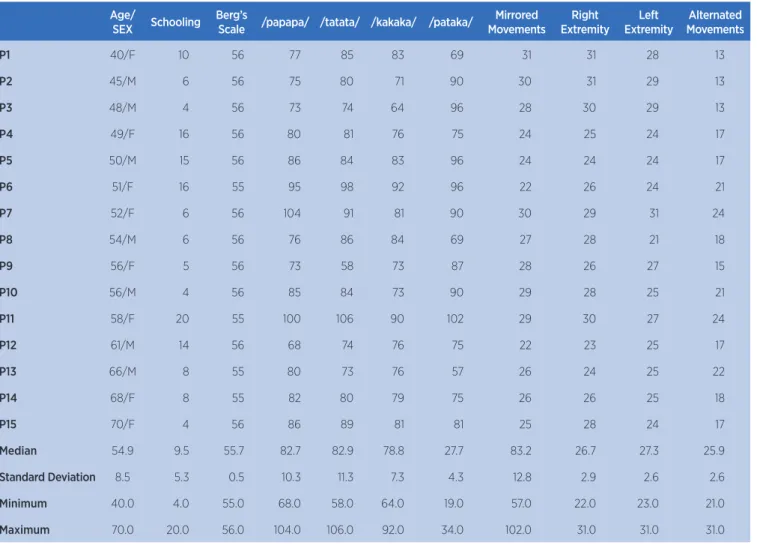
The performance in oral diadochokinesis (number of times the phonemes /papapa/; /tatata/; /kakaka/ and /pataka/ were repeated) and upper extremities diadochokinesis (mirrored, right upper extremity, left upper extremity and alternated movements) tests are presented in Table 1 and in Figure 1. Each subtest was assessed for 15 seconds. In Table 1, age, schooling (in formal study years), score in Berg balance scale and descriptive analysis are also presented.
All diadochokinetic data had normal distribution (according to the Shapiro-Wilk test). The numbers of repetitions of the phonemes /papapa/; /tatata/; /kakaka/ and /pataka/ were compared by ANOVA. There was no significant difference between number of phonemes of the oral diadochokinesis test (F(3, 27)=0.637; p=0.598) (Figure 1).
than the number of movements in other conditions (p<0.001).
Table 2 shows the analysis results of Pearson’s correlation and Figure 2 shows the scatter plots and
equations of adjusted straight lines. The correlation coefficients (r) between 0.399 and 0.699 are considered moderate and between 0.700 and 0.999 they are considered strong (Table 2 and Figure 2).
Oral diadochokinesis test Upper extremitites diadochokinesis test
Mirrored Right Left Alternated
Number of syllables Number of repetitions
Figure 1. Performance in oral and lower extremities diadochokinesis tests Table 1. General score of participants in the scale and tests used
Age/
SEX Schooling Berg’s
Scale /papapa/ /tatata/ /kakaka/ /pataka/
Mirrored Movements
Right Extremity
Left Extremity
Alternated Movements
P1 40/F 10 56 77 85 83 69 31 31 28 13
P2 45/M 6 56 75 80 71 90 30 31 29 13
P3 48/M 4 56 73 74 64 96 28 30 29 13
P4 49/F 16 56 80 81 76 75 24 25 24 17
P5 50/M 15 56 86 84 83 96 24 24 24 17
P6 51/F 16 55 95 98 92 96 22 26 24 21
P7 52/F 6 56 104 91 81 90 30 29 31 24
P8 54/M 6 56 76 86 84 69 27 28 21 18
P9 56/F 5 56 73 58 73 87 28 26 27 15
P10 56/M 4 56 85 84 73 90 29 28 25 21
P11 58/F 20 55 100 106 90 102 29 30 27 24
P12 61/M 14 56 68 74 76 75 22 23 25 17
P13 66/M 8 55 80 73 76 57 26 24 25 22
P14 68/F 8 55 82 80 79 75 26 26 25 18
P15 70/F 4 56 86 89 81 81 25 28 24 17
Median 54.9 9.5 55.7 82.7 82.9 78.8 27.7 83.2 26.7 27.3 25.9
Standard Deviation 8.5 5.3 0.5 10.3 11.3 7.3 4.3 12.8 2.9 2.6 2.6
Minimum 40.0 4.0 55.0 68.0 58.0 64.0 19.0 57.0 22.0 23.0 21.0
Table 2. Pearson’s correlation coefficient
Coefficients /papapa/ /tatata/ /kakaka/ /pataka/ Mirrored Extremity Extremity Alternated
/papapa/ r 0.778 0.635 0.465 0.107 0.187 0.180 0.781
p 0.001 0.011 0.050 0.704 0.503 0.520 0.001
/tatata/ r 0.778 0.756 0.376 0.023 0.348 -0.069 0.550
p 0.001 0.001 0.167 0.935 0.203 0.806 0.034
/kakaka/ r 0.635 0.756 0.094 -0.230 -0.052 -0.346 0.527
p 0.011 0.001 0.737 0.409 0.851 0.206 0.044
/pataka/ r 0.465 0.376 0.094 0.103 0.318 0.352 0.112
p 0.050 0.167 0.737 -0.713 0.247 0.198 -0.690
Mirrored r 0.107 0.023 -0.230 0.103 0.817 0.654 -0.086
p 0.704 0.935 0.409 0.713 0.001 0.008 0.760
Right r 0.187 0.348 -0.052 0.318 0.817 0.561 -0.189
p 0.503 0.203 0.851 0.247 0.001 0.029 0.499
Left r 0.180 -0.069 -0.346 0.352 0.654 0.561 -0.096
p 0.520 0.806 0.206 0.198 0.008 0.029 0.733
Alternated r 0.781 0.550 0.527 0.112 -0.086 -0.189 -0.096
p 0.001 0.034 0.044 -0.690 0.760 0.499 0.733
Alternated Alternated
No correlation Alternated
Alternated movements Alternated movements
Alternated movements Alternated movements
DISCUSSION
Our study had a diadochokinesis assessment interdisciplinary protocol. Previous studies had similar results in the oral diadochokinesis test1,2,7,12.
However, our study is the first to have results of two diadochokinesis tests and its correlations. Normative data to assess upper extremities diadochokinesis are scarce and the few studies available have not tested mirrored unilateral or bilateral movements5,13,14.
We compared the performance with different phonemes of the oral diadochokinesis test (/papapa/, /tatata/, /kakaka/ and /pataka/). Different from what was expected, we did not observe the difference in number of repetitions in the four conditions. In the research found in literature, there was no comparison between performance of the different phonemes. In studies with native participants in other languages, /pataka/ was the harder than the isolated phonemes, showing lower number of repetitions1,11.
Also, our study compared the performance with the different conditions of the upper extremities diadochokinesis test (mirrored movements, with right upper extremity, left upper extremity, alternated movements). In the literature were not found studies with comparison of different conditions. We observe that, in the alternated movements condition, in fact, the difficulty is higher, because participants performed lower number of movements.
Finally, the possible correlations between oral and upper extremities diadochokinesis were investigated. We observed that the phonemes /papapa/, /tatata/ and /kakaka/ were correlated to the alternated performance of upper extremities. The motor program of both tasks predominantly occurs in the left hemisphere15,16, which
also modulates the coordination of motor sequences and language15. In addition, both tasks involve
rhythmic control, carried out mainly by the cerebellum and the switching of synergic patterns, mediated by the nuclei of the base and by frontal cortical regions. People with stuttering show subtle deficits in manual motor control, which reinforced the idea that oral production and manual motor control are mediated by paths that coincide or communicate with each other17.
Participants that were able to speak more syllables were the same that were able to perform the higher number of alternated movements.
As study limitation, we must emphasize that only fifteen volunteers participated in it. Future studies will
be able to investigate differences between the conditions of mirrored movements, only with right upper extremity, only with left upper extremity and alternated movements in group of patients and to investigate differences between age and schooling. Moreover, future studies will be able to investigate other sequences of the tests, for example, initiating by the phonemes /pataka/ or by the condition of alternated movements
CONCLUSION
This pilot study described the performance in tests of oral and upper extremities diadochokinesis, with interdisciplinary approach. There was no difference between the phonemes of the oral diadochokinesis test. There was a difference between the conditions evaluated in the test of diadochokinesis of the upper extremities. The phonemes were correlated with the alternating performance of upper extremities. The participants who successfully spoke more phonemes were the same ones who successfully made the most alternating movements, which reinforces the theory that there are components in common between the articulatory phonetics coordination of syllables and the coordination of forearm pronosupination.
REFERENCES
1. Pierce JF, Cotton S, Perry A. Alternating and sequential motion rates in older adults. Int J Lang Commun Disord. 2013;48(3):257-64. doi: 10.1111/1460-6984.12001
2. Louzada T, Beraldinelle R, Berretin-Felix G, Brasolotto AG. Oral and vocal fold diadochokinesis in dysphonic women. J Appl Oral Sci. 2011;19(6):567-72. doi: 10.1590/ S1678-77572011000600005
3. Shirota C, Jansa J, Diaz J, Balasubramanian S, Mazzoleni S, Borghese NA, Melendez-Calderon AM. On the assessment of coordination between upper extremities: towards a common language between rehabilitation engineers, clinicians and neuroscientists. J Neuroeng Rehabil. 2016;13(80):1-37. doi 10.1186/s12984-016-0186-x
4. Wang YT, Kent RD, Duffy JR, Thomas, JE. Analysis of diadochokinesis in ataxic dysarthria using the motor speech profile program. Folia Phoniatr Logop. 2009;61(1):1-11. doi: 10.1159/000184539
6. Tracy JI, Faro SS, Mohammed FB, Pinus AB, Madi SM, Laskas JW. Cerebellar mediation of the complexity of bimanual compared to unimanual movements. Neurology. 2001;57(10):1862-9. doi: 10.1212/WNL.57.10.1862
7. Tjaden K, Watling E. Characteristics of diadochokinesis in multiple sclerosis and Parkinson’s disease. Folia Phoniatr Logop. 2003;55(5):241-. doi: 10.1159/000072155
8. Matos E, Pires DEP, Campos GWS. Relações de trabalho em equipes interdisciplinares: contribuições para a constituição de novas formas de organização do trabalho em saúde. Rev Bras Enferm. 2010;63(5):775-81. doi: 10.1590/ S0034-71672010000500013
9. King LA, Priest KC, Salarian A, Pierce D, Horak FB. Comparing the Mini-BESTest with the Berg Balance Scale to evaluate balance disorders in Parkinson’s disease. Parkinsons Dis. 2012;(ID375419):1-7. doi: 10.1155/2012/375419
10. Ferrazzoli D, Fasano A, Maestri R, Bera R, Palamara G, Ghilardi Mf, et al. Balance dysfunction in Parkinson’s disease: the role of posturography in developing a rehabilitation program. Parkinsons Dis. 2015;2015(ID520128):1-10. doi: 10.1155/2015/520128
11. Ben-David BM, Icht M. Oral-diadochokinetic rates for Hebrew-speaking healthy ageing population: non-word versus real-word repetition. Int J Lang Commun Disord. 2017;52(3):301-10. doi: 2017;52(3):301-10.1111/1460-6984.12272
12. Padovani M, Gielow I, Behlau M. Phonarticulatory diadochokinesis in young and elderly individuals. Arq Neuropsiquiatr. 2009;67(1):58-61. doi: 10.1590/ S0004-282X2009000100015
13. Haaxma CA, Bloem BR, Overeem SMD, Borm GF, Horstink MM. Timed motor tests can detect subtle motor dysfunction in early Parkinson’s disease. Mov Disord. 2010;25(9):1150-6. doi: 10.1002/mds.23100
14. Dennis M, Salman MS, Jewell D, Hetherington R, Spiegler BJ, MacGregor DL, et al. Upper limb motor function in young adults with spina bifida and hydrocephalus. Childs Nerv Syst. 2009;25(11):1447-53. doi: 10.1007/s00381-009-0948-x
15. Hodgson JC, Hirst RJ, Hudson JM. Hemispheric speech lateralisation in the developing brain is related to motor praxis ability. Dev Cogn Neurosci. 2016;22:9-17. doi: 10.1016/j. dcn.2016.09.005
16. Serrien DJ, Sovijärvi-Spapé MM. Manual dexterity: functional lateralisation patterns and motor efficiency. Brain Cogn. 2016;108:42-6. doi: 10.1016/j.bandc.2016.07.005