CLINICAL SCIENCE
A comparative study of pelvic floor muscle training
in women with multiple sclerosis: its impact on lower
urinary tract symptoms and quality of life
Ade´lia Correia Lu´cio, Maria Carolina Perissinoto, Ricardo Aydar Natalin, Alessandro Prudente, Benito Pereira Damasceno, Carlos Arturo Levi D’ancona
Servic¸o de Urologia - Hospital das Clı´nicas Universidade de Campinas (Unicamp), Cidade Universita´ria Zeferino Vaz, Distrito de Bara˜o Geraldo, Campinas/ SP, Brazil.
OBJECTIVE:To compare pelvic floor muscle training and a sham procedure for the treatment of lower urinary tract symptoms and quality of life in women with multiple sclerosis.
METHODS:Thirty-five female patients with multiple sclerosis were randomized into two groups: a treatment group (n = 18) and a sham group (n = 17). The evaluation included use of the Overactive Bladder Questionnaire, Medical Outcomes Study Short Form 36, International Consultation on Incontinence Questionnaire Short Form, and Qualiveen questionnaire. The intervention was performed twice per week for 12 weeks in both groups. The treatment group underwent pelvic floor muscle training with assistance from a vaginal perineometer and instructions to practice the exercises daily at home. The sham group received a treatment consisting of introducing a perineometer inside the vagina with no exercises required. Pre- and post-intervention data were recorded.
RESULTS: The evaluation results of the two groups were similar at baseline. At the end of the treatment, the treatment group reported fewer storage and voiding symptoms than the sham group. Furthermore, the differences found between the groups were significant improvements in the following scores in the treatment group: Overactive Bladder Questionnaire, International Consultation on Incontinence Questionnaire Short Form, and the General Quality of Life, and Specific Impact of Urinary Problems domains of the Qualiveen questionnaire.
CONCLUSIONS:The improvement of lower urinary tract symptoms had a positive effect on the quality of life of women with multiple sclerosis who underwent pelvic floor muscle training, as the disease-specific of quality of life questionnaires demonstrated. This study reinforces the importance of assessing quality of life to judge the effectiveness of a treatment intervention.
KEYWORDS: Vaginal perineometer; Sham treatment; Quality of life questionnaires; Pelvic floor exercises; Neurogenic bladder.
Lucio AC, Perissinoto MC, Natalin RA, Prudente A, Damasceno BP, D’Ancona CAL. A comparative study of pelvic floor muscle training in women with multiple sclerosis: its impact on lower urinary tract symptoms and quality of life. Clinics. 2011;66(9):1563-1568.
Received for publication onFebruary 24, 2011;First review completed onMarch 20, 2011;Accepted for publication onMay 24, 2011 E-mail: [email protected]
Tel.: 55 19 33885074
INTRODUCTION
Multiple sclerosis (MS) is a chronic neurological disease involving the deterioration of the white matter pathways in the brain and spinal cord. MS is generally described as either relapsing-remitting (the most common presentation form), characterized by episodes of neurological dysfunc-tion followed by remissions, or as primary progressive, where patients present a continuous and progressive decline in their neurological function.1,2
Lower urinary tract symptoms (LUTS) are highly pre-valent and affect approximately 50 to 90% of these patients throughout the course of the disease.2-4Most patients report
a combination of both storage and voiding symptoms5,6 caused by parasympathetic dysfunction due to brain and spinal cord damage.7
There are several treatments for this condition, such as anti-cholinergic drugs, botulinum toxin, electrical stimula-tion, surgical intervenstimula-tion, and pelvic floor muscle training (PFMT). PFMT was developed by Kegel in 1948 and was primarily used for treatment of stress urinary incontinence (SUI). Few studies have evaluated PFMT for the treatment of patients with MS.3,8
These symptoms are not life-threatening, and, thus, are often neglected by health professionals. However, bladder dysfunction is responsible for a significant negative impact on the quality of life (QoL) of affected patients.1,9
Copyrightß2011CLINICS– This is an Open Access article distributed under
Health care professionals recognizing the impact of urinary disorders on QoL in patients with MS is essential for enabling appropriate investigations and judging the effectiveness of the treatment intervention.1,9,10
Thus, the aim of this study was to compare PFMT and a sham procedure for the treatment of LUTS and their effects on QoL. The effects of PFMT on disability were discussed in another study.11
MATERIALS AND METHODS
We performed a prospective randomized controlled trial at the Neurourology Clinic of the Universidade Estadual de Campinas (UNICAMP), Campinas, Brazil. The study was approved by the Institutional Ethics Committee (protocol number 242/2006), and all of the subjects provided informed consent.
The clinical history and a neurological examination, including a Kurtzke’s Expanded Disability Status Scale (EDSS) evaluation, were assessed for each patient. The EDSS is a neurological scale that grades the level of disability in MS with a score that ranges from 0 (normal neurological findings) to 10 (death due to MS).12
A questionnaire containing items asking about the presence (’’yes’’ or ‘‘no’’) of daytime urinary frequency and urgency, urge incontinence, nocturnal enuresis, noc-turia, hesitancy, a slow urine stream, and incomplete emptying was provided to the patients.
The Overactive Bladder Questionnaire (OAB-V8)13 is a self-administered questionnaire designed to rate how disturbed patients are regarding four OAB symptoms: urinary frequency, urgency, nocturia, and urge inconti-nence. The patients respond to each item using a 6-point Likert scale ranging from 0 (not at all) to 5 (a very great deal). The subjects were considered to have a likely diagnosis of LUTS if their total score was more than eight. The OAB-V8 is a questionnaire that is commonly used to assess overactive bladder symptoms, but it is also an important tool for evaluating the patients’ self-perception of the symptoms caused by lower urinary tract dysfunction. The inclusion criteria were as follows: women with a definitive diagnosis of MS14with a stable disease over the
previous four months; a relapsing-remitting form of MS; 18 years of age or older; an EDSS score12less than or equal to 6.5; the cognitive capacity to complete the assessment and treatment protocol; reporting lower urinary tract symptoms (nine or more positive responses on the OAB-V8 ques-tionnaire). The exclusion criteria were as follows: preg-nancy, previous vaginal prolapse surgery, stress urinary incontinence surgery, Caesarean section or vaginal delivery in the six months prior to enrollment, MS relapse during treatment (defined as any change in symptoms according to the EDSS evaluation), pelvic organ prolapse (detected during the vaginal examination) of grade II or more,15
urinary tract infection (confirmed by lab tests), and a post-menopausal status due to a reduction in muscle strength after menopause.16
Volunteers taking anti-cholinergic or other medications for the treatment of LUTS were permitted to participate if they had been taking the medication for at least three months prior to enrollment and if the dosage would not change over the duration of their participation in the study. Similarly, if any participant reported any worsening of double or blurred vision, increased muscle weakness,
fatigue, or deterioration in coordination, he or she was re-evaluated by the neurologist using the EDSS. If his or her EDSS score increased by more than 0.5 relative to their initial score, he or she was removed from the study.
All of the patients were blind to the randomization and were randomly allocated to one of the following two groups according to a computer-generated randomization list: treatment (GI, n = 18) or sham (GII, n = 17). The patients were evaluated before and after the intervention. All of the assessments were performed by a physiotherapist who was blinded to the patient group assignments. The patients were unaware of which group they were participating in until the end of the study. Two different informed consent proce-dures were prepared explaining each treatment and provided to the patients only after the randomization.
Patient QoL was assessed using the Medical Outcomes
Study Short Form 36 (SF-36) questionnaire,17 the
International Consultation on Incontinence Questionnaire Short Form (ICIQ-SF)10 and the Qualiveen,9 a disease-specific questionnaire.
The SF-36 is a generic questionnaire with 36 questions and eight multi-item scales containing physical function (ten items), social function (two items), mental health (five items), role limitation due to physical problems (four items), role limitation due to emotional problems (three items), vitality (four items), bodily pain (two items), and general health perceptions (five items). An additional one-item measure of any self-evaluated change in health status is also available. Each domain is coded, summed, and transformed into a scale from 0 (worst) to 100 (best).
The ICIQ-SF is a brief and subjective questionnaire that is used to assess the level and impact of urinary incontinence in the patients’ lives; it is comprised of three questions that target the daytime frequency, severity of incontinence, and QoL impact of the incontinence along with an eight-item scale assessing the possible causes or situations related to the urinary incontinence. The final ICIQ-SF score is the sum of the total scores, ranging from 0 to 21; the higher the score, the greater the impact on QoL.
The Qualiveen is an extensive questionnaire specifically developed for use with patients with urinary dysfunction due to neurological disorders. It is divided into two major sections: the Specific Impact of Urinary Problems on Quality of Life (SIUP) and General Quality of Life (GQoL). The SIUP section is split into four domains (inconvenience, restric-tions, fears, and impact on daily life), with a total of 30 questions. Each answer has five quantified items using a five-category ordinal Likert scale, with values ranging from 0 (no impact) to 4 (great negative impact). The average for each domain is calculated and used to determine the final SIUP score, which also ranges from 0 to 4, with 4 being the greatest negative impact. The GQoL section has nine questions, also using a five-category ordinal Likert scale, with values ranging from -2 to+2 (very badly to very well, respectively). The final general QoL value is calculated as the average of the nine questions, also ranging from -2 to+2. All of the questionnaires used in this study were translated into and validated in Portuguese.9,10,13,17 The questionnaires were filled out by the patients at the physiotherapist’s office, but, if necessary, the assistance of the blind (to group affiliation) physiotherapist, who conducted the evaluations, was allowed.
examination, which includes assessments of the following: power (P), scored from 0 (no contraction) to 5 (contraction against strong resistance) according to the modified Oxford grading system; endurance (E), noted in seconds and referring to the duration that a maximal contraction could be held; repetitions (R), recorded from muscle exhaustion and described as the number of times (at maximum 10) that contraction could be repeated without losing both power and endurance; the number of fast contractions (F) with every contraction timed (ECT).
The interventions (treatment and sham) were performed by a single physiotherapist for GI and GII over a period of 12 weeks, with the participants in both groups attending twice per week for 30 minutes per session.
The GI patients underwent an intervention that consisted of PFMT in the supine position with the assistance of a perineometer (Perina, Quark, Sa˜o Paulo, Brazil). The patients were instructed to practice the exercises learned during the intervention at home three times daily, without the assistance of any device and in various positions (such as sitting and standing). They were also advised to integrate the exercises into their daily activities. The regimen was evaluated weekly according to a vaginal assessment using the PERFECT scheme and by the physiotherapist respon-sible for the treatment; the data were recorded by the blind physiotherapist before and after the intervention. The training focused on improving pelvic floor muscle aware-ness and contraction strength, and the exercises were individualized according to the degree of pelvic floor weakness, the loss of proprioception and the patient’s tolerance.
The GII patients received a sham procedure that solely consisted of introducing a perineometer into the vagina. The patients were asked to keep the device in place for 30 minutes, with no contraction required. No instructions regarding performing the exercises at home were given. The physiotherapist was present during all of the sham procedures.
Statistical analysis was performed using the SAS (Statistical Analysis System) system for Windows. The data from nine patients were used to perform a pilot study, and
the desired sample size was determined using an SAS program (fpower).
The sample size needed was calculated on the basis of the pilot study, with four patients in GI and five patients in GII. The evaluations chosen for this test were the following: pad testing, bladder diary (number of pads) and the ICIQ-SF. By setting the alpha at 5% and the power at 90%, the results of the sample size calculation showed that 10 patients were necessary for each group.
To compare the baseline measurements between the two groups, a Mann-Whitney test was employed, and repeated-measures ANOVA was used to compare the measurements between groups. To compare proportions, we used the chi-square or Fisher’s exact test. For all of the statistical tests, the significance criterion ofp,0.05 was used.
RESULTS
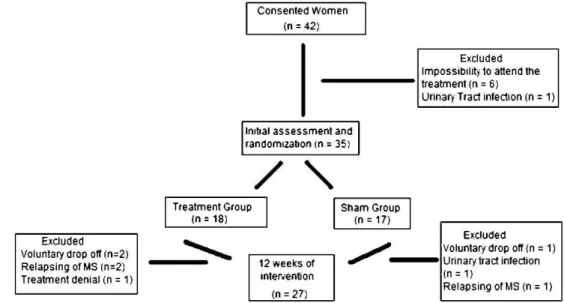
Between July 2007 and December 2008, a total of forty-two patients consented, out of which thirty-five fulfilled the inclusion criteria. The exclusions were resulted from the following: the impossibility of attending the treatment twice per week (six patients), a relapse of MS (three patients), voluntary dropout (three patients), treatment denial (one patient), and a urinary tract infection diagnosis before (one patient) or during (one patient) the intervention. (Figure 1). The patients who were excluded from the study but wanted to continue the treatment were treated by the physiotherapy staff.
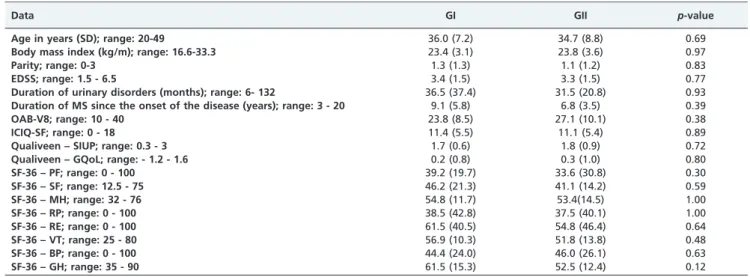
The baseline demographic data and the initial assessment are shown in Table 1. No statistical differences were found between groups.
The numbers of patients in each group complaining about storage and voiding symptoms before and after the intervention, based on their initial clinical history, are shown in Table 2.
After the treatment, no differences in the EDSS assess-ment were found between the groups.
In contrast, there were significant differences in the OAB-V8 assessment between the groups (p,0.0001) (Figure 2).
In the SF-36 assessment, no differences were found between GI and GII.
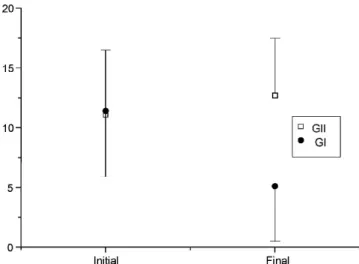
In the ICIQ-SF assessment, significant differences (p= 0.0003) were found between the two groups (Figure 3). In the Qualiveen questionnaire, the Specific Impact of Urinary Problems on Quality of Life (SIUP) domain showed significant differences (p= 0.0001) between the groups. In the same manner, the General QoL domain of the same questionnaire showed significant differences (p= 0.0443) between GI and GII (Figure 4).
Compliance was based on the patients’ attendance at the clinic sessions, and there was no difference in compliance (p= 0.9622) between the patients in GI (mean+SD = 21.5+1.8)
vs. GII (mean+SD = 21.5+1.8) across the 24 sessions.
DISCUSSION
In the patients who were analyzed in this study, the
impairment measured by EDSS was unchanged.
Rehabilitation will not improve the neurological damage, but it will certainly reduce the disability and help patients face the disability with a better outlook.19,20
Both groups had the same visit schedule. Thus, the observed improvement was not due to the relationship between the health care professionals and their patients.
The OAB-V8 was very important for analyzing urinary symptoms in these patients with MS. This questionnaire is commonly used to assess overactive bladder symptoms, but it was observed that it is an important tool for evaluating the patients’ self-perception of LUTS.
Although movement disorders, depressive moods, and fatigue affect the QoL of people with MS,19,21,22 urinary problems also have a major impact on the health-related QoL of these patients.1
The patients who underwent PFMT presented improve-ment in their LUTS and QoL compared with the sham group. It would seem reasonable to assume that a decrease in LUTS would increase QoL. However, a randomized controlled trial3 found encouraging results regarding the treatment of LUTS but unclear results regarding any improvement in QoL.
QoL should be evaluated using generic and disease-specific21,10instruments. The most commonly used instru-ment to assess general QoL is the SF-36.5,20,22,23In our study,
this questionnaire was not adequately sensitive to detect Table 1 -The mean, standard deviation (SD) andp-value of the baseline, demographic data and the initial assessments
in the treatment (GI) and sham (GII) groups, as determined by the Mann-Whitney test.
Data GI GII p-value
Age in years (SD); range: 20-49 36.0 (7.2) 34.7 (8.8) 0.69
Body mass index (kg/m); range: 16.6-33.3 23.4 (3.1) 23.8 (3.6) 0.97
Parity; range: 0-3 1.3 (1.3) 1.1 (1.2) 0.83
EDSS; range: 1.5 - 6.5 3.4 (1.5) 3.3 (1.5) 0.77
Duration of urinary disorders (months); range: 6- 132 36.5 (37.4) 31.5 (20.8) 0.93
Duration of MS since the onset of the disease (years); range: 3 - 20 9.1 (5.8) 6.8 (3.5) 0.39
OAB-V8; range: 10 - 40 23.8 (8.5) 27.1 (10.1) 0.38
ICIQ-SF; range: 0 - 18 11.4 (5.5) 11.1 (5.4) 0.89
Qualiveen – SIUP; range: 0.3 - 3 1.7 (0.6) 1.8 (0.9) 0.72
Qualiveen – GQoL; range: - 1.2 - 1.6 0.2 (0.8) 0.3 (1.0) 0.80
SF-36 – PF; range: 0 - 100 39.2 (19.7) 33.6 (30.8) 0.30
SF-36 – SF; range: 12.5 - 75 46.2 (21.3) 41.1 (14.2) 0.59
SF-36 – MH; range: 32 - 76 54.8 (11.7) 53.4(14.5) 1.00
SF-36 – RP; range: 0 - 100 38.5 (42.8) 37.5 (40.1) 1.00
SF-36 – RE; range: 0 - 100 61.5 (40.5) 54.8 (46.4) 0.64
SF-36 – VT; range: 25 - 80 56.9 (10.3) 51.8 (13.8) 0.48
SF-36 – BP; range: 0 - 100 44.4 (24.0) 46.0 (26.1) 0.63
SF-36 – GH; range: 35 - 90 61.5 (15.3) 52.5 (12.4) 0.12
SIUP, specific impact of urinary problems on quality of life; GQoL, general quality of life; PF, physical function; SF, social function; MH, mental health; RP, role limitation due to physical problems; RE, role limitation due to emotional problems; VT, vitality; BP, bodily pain; GH, general health perceptions.
Table 2- The number of patients complaining about storage and voiding symptoms before and after the intervention in the treatment (GI) and sham (GII) groups.
GI GII
SYMPTOMS Baseline Final Baseline Final p-value
Frequency 13 4 14 14 ,0.0001
Urgency 13 4 14 13 0.0013
Urge urinary incontinence
12 4 13 13 0.0013
Nocturnal enuresis 8 2 9 10 0.0034
Nocturia 12 2 12 11 0.0010
Hesitancy 10 3 8 9 0.0313
Slow stream 8 5 6 6 0.8163
Incomplete emptying 8 3 7 7 0.2365
any improvement in QoL, which is predictable given that this is a general questionnaire and does not specifically measure the impact of urinary urgency, frequency, nocturia, and incontinence on QoL.
Studies have shown that MS patients have a worse QoL compared with non-MS populations,24 which explains the
importance of identifying specific problems that have negative impacts on QoL. The Qualiveen questionnaire showed that PFMT improves LUTS and contributes to both an improved General Quality of Life domain and a Specific Impact of Urinary Problems on Quality of Life domain.
The findings of this study show that, although it is subjective, the assessment of QoL provides important additional information about the effects of the proposed treatment, the measure of the rehabilitation outcomes and the patients evaluation of their own health. This information will help health professionals to choose the best treatment to obtain the most improvement.
CONCLUSION
The improvement of LUTS had a positive effect on QoL in women with MS who underwent PFMT compared with a sham group. This study reinforces the importance of assessing QoL to judge the effectiveness of a treatment intervention. Furthermore, a disease-specific QoL tool should be used to identify the specific problems that contribute to negative impacts on QoL in patients with MS.
ACKNOWLEDGMENTS
The authors would like to thank FAPESP.
REFERENCES
1. Quarto G, Autorino R, Gallo A, De Sio M, D’Armiento M, Perdona S, et al. Quality of life in women with multiple sclerosis and overactive bladder syndrome. Int Urogynecol J. 2007;18:189-94, doi: 10.1007/s00192-006-0131-9. 2. Litwiller SE, Frohman EM, Zimmern PE. Multiple sclerosis and the urologist. J Urol. 1999;161:743-57, doi: 10.1016/S0022-5347(01)61760-9. 3. McClurg D, Ashe RG, Marshall K, Lowe-Strong AS. Comparison of
pelvic floor muscle training electromyography biofeedback, and neuro-muscular electrical stimulation for bladder dysfunction in people with multiple sclerosis: a randomized pilot study. Neurourol Urodyn. 2006;25:337-48, doi: 10.1002/nau.20209.
4. McClurg D, Ashe RG, Lowe-Strong AS. Neuromuscular electrical stimulation and the treatment of lower urinary tract dysfunction in multiple sclerosis – A double blind, placebo controlled randomised clinical trial. Neurourol Urodyn. 2008;27:231-7, doi: 10.1002/nau.20486. 5. Bonniaud V, Bryant D, Parratte B, Gallien P, Guyatt G. Qualiveen: A
urinary disorder-specific instrument for use in clinical trials in multiple Sclerosis. Arch Phys Med Rehabil. 2006;87(12):1661-3, doi: 10.1016/j. apmr.2006.08.345.
6. Haslam C. Managing bladder symptoms in people with multiple sclerosis. Nurs Times. 2005;101:48-52.
7. Fingerman JS, Finkelstein LH. The overactive bladder in multiple sclerosis. JAOA. 2000;100:9-12.
8. De Ridder D, Vermeulen C, Ketelaer P, Van Poppel H, Baert L. Pelvic floor rehabilitation in multiple sclerosis. Acta Neurol Belg. 1999;99:61-4. 9. D’Ancona CA, Tamanini JT, Botega N, Lavoura N, Ferreira R, Leita˜o V, et al. Quality of life of neurogenic patients: translation and validation of the Portuguese version of Qualiveen. Int Urol Nephrol. 2009;41:29-33, doi: 10.1007/s11255-008-9402-3.
10. Tamanini JT, Dambros M, D’Ancona CA, Palma PC, Rodrigues-Netto NJr. Responsiveness to the Portuguese version of the international consultation on incontinence questionnaire – short form (ICIQ-SF) after stress urinary incontinence surgery. Int Braz J Urol. 2005;31:482-9, doi: 10.1590/S1677-55382005000500013.
11. Lu´cio AC, Campos RM, Perissinotto MC, Miyaoca R, Damasceno BP, D’Ancona CA. Pelvic floor muscle training in the treatment of lower urinary tract dysfunction in women with multiple sclerosis. Neurourol Urodyn. 2010;29:1410-3, doi: 10.1002/nau.20941.
12. Kurtzke JF. Rating neurologic impairment in multiple sclerosis: an expanded disability status scale (EDSS). Neurology. 1983;33:1444-52. 13. Acquadro C, Kopp Z, Coyne KS, Corcos J, Tubaro A, Choo MS, et al.
Translating overactive bladder questionnaires in 14 languages. Urology. 2006;67:536-40, doi: 10.1016/j.urology.2005.09.035.
14. Polman CH, Reingold SC, Edan G, Filippi M, Hartung HP, Kappos L, et al. Diagnostic criteria for multiple sclerosis: 2005 revisions to the ‘‘McDonald Criteria’’. Ann Neurol. 2005;58:840-6, doi: 10.1002/ana.20703.
15. Swift SE. The distribution of pelvic organ support in a population of female subjects seen for routine gynaecologic health care. Am J Obstet Gynecol. 2000;183:277-85, doi: 10.1067/mob.2000.107583.
16. Elliott KJ, Sale C, Cable NT. Effects of resistance training and detraining on muscle strength and blood lipid profiles in postmenopausal women. Br J Sports Med. 2002;36:340-4, doi: 10.1136/bjsm.36.5.340.
17. Ciconelli RM, Ferraz MB, Santos W, Meina˜o I, Quaresma MR. Traduc¸a˜o para a lı´ngua portuguesa e validac¸a˜o do questiona´rio gene´rico de avaliac¸a˜o de qualidade de vida SF-36 (Brasil SF-36). Rev Bras Reumatol. 1999;39:143-50. 18. Laycock J, Jerwood D. Pelvic floor muscle assessment: The PERFECT
scheme. Physiotherapy. 2001;87:631-41, doi: 10.1016/S0031-9406(05)61108-X.
19. Attarian H. Importance of sleep in the quality of life of multiple sclerosis patients: a long under-recognized issue. Sleep Med. 2009;10:7-8, doi: 10. 1016/j.sleep.2008.02.002.
20. Patti F, Ciancio MR, Reggio E, Lopes R, Palermo F, Cacopardo M, et al. The impact of outpatient rehabilitation on quality of life in multiple sclerosis. J Neurol. 2002;249:1027-33, doi: 10.1007/s00415-002-0778-1. Figure 3 -The mean and standard deviation of ICIQ - SF before
and after the intervention in the treatment (GI) and sham (GII) groups. Mean: 11.38 initial and 5.07 final in GI and 11.07 initial and 12.71 final in GII (p= 0.0003).
Figure 4 -The means of the final evaluations of the Qualiveen domains (Specific Impact of Urinary Problems on Quality of Life (SIUP) and General Quality of Life (GQoL)) before and after the intervention in the treatment (GI) and sham (GII) groups. Mean: 1.65 initial and 0.78 final in GI and 1.77 initial and 2.05 final in GII in the SIUP domain (p= 0.0001). Mean: 0.23 initial and 0.81 final
21. Lobentanz IS, Asenbaum S, Vass K, Sauter C, Klosch G, Kollegger H, et al. Factor influencing quality of life in multiple sclerosis patients: disability, depressive mood, fatigue and sleep quality. Acta Neurol Scand. 2004;100:6-13, doi: 10.1111/j.1600-0404.2004.00257.x.
22. Hemmett L, Barnes M, Russell N. What drives quality of life in multiple sclerosis? QJM. 2004;97:671-6, doi: 10.1093/qjmed/hch105.
23. Hopman WM, Coo H, Edgar CM, McBride EV, Day AG, Brunet DG. Factors associated with health-related Quality of Life in Multiple Sclerosis. Can J Neurol Sci. 2007;34:160-6.
ERRATA
CLINICS 2011;66(12):2043-48
Page 2043
Replace Clarissa B. Oliveira,I,II I´talo R. T. Medeiros,III Mario G. Greters,III Norberto A. F. Frota,IV Leandro Tavares Lucato,IIMilbertoScaff,IAdriana B. ConfortoI
For Clarissa B. Oliveira,I,II I´talo R. T. Medeiros,III Mario G. Greters,III Norberto A. F. Frota,IV Leandro Tavares Lucato,VIMilbertoScaff,IIAdriana B. ConfortoII,V
Replace IAACD – Adult Physiotherapy, Sa˜o Paulo/SP, Brazil. IIHospital das Clı´nicas da Faculdade de Medicina da Universidade de Sa˜o Paulo, Neurology, Sa˜o Paulo/SP, Brazil. IIIHospital das Clı´nicas da Faculdade de Medicina da Universidade de Sa˜o Paulo, Otorhinolaryngology Department, Sa˜o Paulo/SP, Brazil. IVFortaleza University – Schoolof Medicine, Fortaleza/CE, Brazil.
For IAACD – Adult Physiotherapy, Sa˜o Paulo/SP, Brazil. IIHospital das Clı´nicas da Faculdade de Medicina da Universidade de Sa˜o Paulo, Neurology Department, Sa˜o Paulo/SP, Brazil.IIIHospital das Clı´nicas da Faculdade de Medicina da Universidade de Sa˜o Paulo, Otorhinolaryngology Department, Sa˜o Paulo/SP, Brazil.IVFortaleza University – Schoolof Medicine, Fortaleza/CE, Brazil.VInstituto Israelita de Ensino e Pesquisa Albert Einstein, Sa˜o Paulo/SP, Brazil.VIHospital das Clı´nicas da Faculdade de Medicina da Universidade de Sa˜o Paulo, Radiology Department, Sa˜o Paulo/SP, Brazil.
CLINICS 2011;66(09):1563-68
Page 1567
Include
ACKNOWLEDGMENTS
The authors would like to thank FAPESP.
CLINICS 2011;66(04):691-700
Page 691
ReplaceEsteves SC, Miyaoka R, Agarwal A. 2011;66(4):PAGES An update on the clinical assessment of the infertile male. Clinics. 2011;66(4):691-700.