www.ccarevista.ufc.br ISSN 1806-6690
Changes in attributes of soils subjected to fallow in desertification
hotspot
1Alterações de atributos de solos submetidos ao pousio em núcleo de desertificação
Mirele Paula da Silva Ferreira2, Adriana Guirado Artur2*, Hermano Melo Queiroz3, Ricardo Espíndola Romero2 and Mirian Cristina Gomes Costa2
ABSTRACT - Soils in semi-arid regions have been degraded by overgrazing, which reduces the production capacity and, in certain situations, leads to desertification. An alternative to recover degraded areas is the fallow period, which works through the resilience of the soil itself, increasing the supply of organic matter and improving soil physical properties. Thus, the objective of this study was to test the hypothesis that 14-year grazing exclusion improves soil physical and chemical attributes in degraded areas under desertification. The study was conducted in Irauçuba, Ceará State, Brazil. The experimental design was completely randomized, in a 4 x 2 factorial scheme corresponding to four areas and two managements (overgrazing and fallow), with four replicates, plus an area with native vegetation (reference), with characteristics of secondary vegetation. Fallow led to improvements in soil physical and chemical attributes after 14 years; however, in comparison to the study conducted in the same area with a 7-year fallow period, there were few alterations. Organic carbon content was higher in fallow areas than in overgrazing areas, and the fraction in highest proportion was the mineral-associated organic carbon.
Key words: Soil organic carbon. Soil degradation. Semi-arid region. Overgrazing.
RESUMO - Solos de regiões semiáridas têm sido degradados em função do sobrepastejo, reduzindo a capacidade produtiva
e, em certas situações, levando ao processo de desertificação. Uma alternativa usada na recuperação de áreas degradadas é a prática do pousio, que atua pelo próprio poder de resiliência do solo, aumentando assim o aporte de matéria orgânica e melhorando os atributos físicos do solo. Com isso, objetivou-se com esse trabalho comprovar a hipótese de que o tempo de pousio de 14 anos melhora os atributos físicos e químicos do solo em áreas degradadas em processo de desertificação. O estudo foi realizado no município de Irauçuba, no Estado do Ceará. O delineamento experimental utilizado foi inteiramente casualizado, em esquema fatorial 4x2, sendo o primeiro fator constituído por quatro áreas e o segundo por dois tipos de manejo (sobrepastejo e pousio), com quatro repetições e uma área com vegetação nativa (referência) com características de vegetação secundária. O pousio resultou em melhorias em atributos físicos e químicos do solo quando avaliado após 14 anos da retirada dos animais, mas quando comparado ao trabalho realizado na mesma área com 7 anos de pousio, verificou-se que houve poucas alterações. O teor de carbono orgânico foi maior nas áreas em pousio do que nas áreas em sobrepastejo e a fração com maior proporção foi o carbono orgânico associado aos minerais.
Palavras-chaves: Carbono orgânico do solo. Degradação do solo. Semiárido. Sobrepastejo.
DOI: 10.5935/1806-6690.20180003 *Autor para correspondência
Recebido para publicação em 10/06/2016; aprovado em 15/02/2017
1Parte da Dissertação de Mestrado do primeiro autor, pesquisa apoiada por CAPES e FUNCAP
2Departamento de Ciência do Solo, Universidade Federal do Ceará/UFC, Av. Mister Hull, 2977, Campus do Pici, Bloco 807, Fortaleza–CE, Brasil,
60.440-554, [email protected], [email protected], [email protected], [email protected]
3Departamento de Ciência do Solo, Escola Superior de Agricultura “Luiz de Queiroz”/ESALQ-USP, Av. Pádua Dias, 11, Piracicaba-SP, Brasil,
INTRODUCTION
Regions with arid and semi-arid climate are less tolerant to anthropic changes, thus being more prone to desertification. Approximately 30% of the terrestrial surface is covered by areas under desertification
(REYNOLDS et al., 2007). Land use intensification,
associated with deforestation, overgrazing and fire, exposes the soil to inclement weather, causing reduction of its quality (JÓRDAN; ZAVALA; GIL, 2010). Such reduction in quality results from effects on chemical,
physical and biological attributes (WENDLING et al.,
2010), decreasing the productive potential and increasing CO2 emission to the atmosphere (BRUUNet al., 2015).
The replacement of Caatinga by agriculture and livestock, mining, clay extraction in alluvial soils and removal of wood to produce firewood and coal, associated with climatic and socioeconomic conditions, are pointed as the main causes of degradation in the regions of Gilbués (PI), Irauçuba (CE), Seridó (RN) and Cabrobó (PE), which have high risk of desertification, being known as Desertification Hotspots.
In the semi-arid region of Ceará, Irauçuba is one of the most critical areas regarding the desertification process, due to not only human action and climate, but also to the predominant soil class in the region, Planossolo. In addition to the natural problems and type of soil, this region faces problems such as deforestation, overgrazing and poor management of water resources. Among these problems, overgrazing is the main responsible for desertification, due to the presence of animals, which compact the soil by grazing and consume vegetation, leading to losses of soil cover, with subsequent water runoff and losses of soil and nutrients through erosion
(REYNOLDS et al., 2007). Overgrazing occurs in
situations of plant exposure to intensive grazing for prolonged periods, or without sufficient periods to allow environmental recovery.
Therefore, the adoption of fallow management, which consists in the suspension of cultivation and/or grazing of an area to allow natural recovery of fertility, is one alternative for soil recovery. Sousa et al. (2012) demonstrate that the fallow system results in higher contents of organic carbon in the labile fraction and humic fraction, with expressive changes in the contents of soil organic matter (SOM). Grazing-free areas allow improvements in the contents of soil organic carbon (SOC), total nitrogen (Nt) and water (PEI; FU; WAN, 2008).
Conservation management systems favor the increase in carbon content, altering the lability of soil organic matter. In semi-arid regions, it was found that
vegetal cover degradation significantly reduces the
contents of all soil carbon fractions (TRAORÉ et al.,
2015). However, Prasad et al. (2016) found that the
fractions particulate carbon, microbial biomass carbon and permanganate-oxidizable carbon increased due to conservation management in soils of the semi-arid region, working as sensitive indicators of the effects of the management in the short term.
Given the above, this study aimed to assess degraded areas under desertification after 14 years of fallow, in the municipality of Irauçuba, in order to evaluate the consequences through soil physical and chemical analyses, comparing areas under fallow and overgrazing.
MATERIAL AND METHODS
The study was carried out in the municipality of Irauçuba, located in the North Central Sertão of the Ceará state, microregion of Sobral. The climate of the region is characterized as hot tropical semi-arid, with mean temperature of 26.3 ºC, mean annual rainfall of 539.5 mm, rainy period from March to May and potential evapotranspiration of 1582 mm year-1 (KROLet al., 2006).
Vegetation is dense shrubby Caatinga and the economic activity of the region is extensive livestock farming of cattle, goats and sheep, in overgrazing.
The predominant soils in the Irauçuba Desertification Hotspot are Planossolo Háplico e Nátrico, derived mainly from saprolites of micaschist and gneisses, with inclusions of Neossolo Litólico and Regolítico
(PEREZ-MARINet al., 2012). Planossolo were evaluated
in the present study.
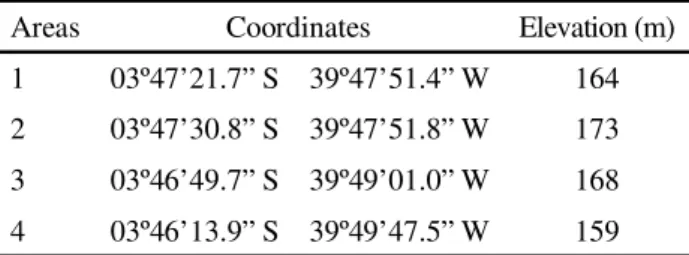
Four areas (Table 1) were evaluated, divided into a sub-area of fallow, with exclusion of domestic animals for 14 years, and a sub-area of overgrazing by cattle, goat and sheep. The experimental design was completely randomized, in a 4 x 2 factorial scheme, corresponding to four areas and two types of management (overgrazing and fallow), with four replicates and one area under native vegetation (reference).
Table 1 - Location of fallow in the municipality of Irauçuba, CE
Areas Coordinates Elevation (m)
1 03º47’21.7” S 39º47’51.4” W 164
2 03º47’30.8” S 39º47’51.8” W 173
3 03º46’49.7” S 39º49’01.0” W 168
The fallow areas were fenced in 2000 and the overgrazing areas were delimited around them, each one with 0.25 hectare. In 2014, soil samples were randomly collected in four points of each area, where four mini soil pits were open, representing four replicates. Soil samples were collected in the A horizon, according to the depth, varying from 3 to 4.5 cm (Table 2). Subsequently, the samples were air dried, pounded to break up clods, sieved through a 2-mm-mesh, homogenized and subjected to chemical and physical analyses (EMBRAPA, 2011). Undisturbed samples were collected using an Uhland sampler and 2.5-cm-high cylindric ring to determine soil density and total porosity.
Granulometric analysis and determinations of clay dispersed in water (CDW), degree of flocculation (DF), soil density through the volumetric ring method, particle density and total porosity were performed according to the methodology described in Embrapa (2011).
In the chemical analysis (EMBRAPA, 2011), the following variables were determined: pH in water, contents of Ca2+, Mg2+, K+ and Na+, potential acidity
(H++Al3+), and contents of H+ and Al3+. Sum of bases
(SB), cation exchange capacity (CEC) and base saturation percentage (V) were calculated. Sodium saturation percentage was calculated based on the ratio between Na+
and CEC. Electrical conductivity (EC) was determined by conductometry through the saturation extract method, using water-saturated paste.
Total organic carbon (TOC) was determined using the methodology adapted by Mendonça and Matos (2005), with wet oxidation of organic matter. Soil organic fraction was physically fractionated according to Cambardella and Elliott (1992), with dispersion in aqueous medium. During the procedure, the sand retained in 0.053-mm-mesh sieve was oven-dried for the determination of particulate organic carbon (POC), according to Mendonça and Matos (2005). Mineral-associated organic carbon (MAOC) was estimated by the difference between TOC and POC of the fraction retained in the sieve.
Labile (C-Lab) and non-labile (C-NLab) organic carbon fractions were obtained according to
Table 2 - Soil classification according to Brazilian soil classification system (SiBCS)/World Reference Base for Soil Resources (WRB,
2014) of the areas evaluated in the municipality of Irauçuba, CE
Source: Sousaet al. (2012)
Areas Soil type A Horizon Texture A Horizon thickness (cm)
1 Planossolo Nátrico Órtico vertissólico A fraco/Abruptic Vertic Solonetz (loamic) Sandy loam 4.5 2 Planossolo Nátrico Órtico vertissólico A fraco/Abruptic Vertic Solonetz (loamic) Loamy sand 3.0 3 Planossolo Nátrico Órtico vertissólico A fraco/Abruptic Vertic Solonetz (loamic) Sandy loam 3.5 4 Planossolo Nátrico Órtico típico A fraco/Abruptic Solonetz (loamic) Sandy loam 4.0
the method adapted by Mendonça and Matos (2005), through C oxidation at three concentrations of sulfuric acid (H2SO4): 3, 6 and 9 mol L-1. Four fractions were
obtained: F1 = 3 mol L-1; F2 = 6 mol L-1 - 3 mol L-1
(difference between oxidizable organic C extracted with 6 mol L-1 and 3 mol L-1); F3 = 9 mol L-1 - 6 mol L-1
(difference between oxidizable organic C extracted with 9 mol L-1 and 6 mol L-1); F4 = TOC - 9 mol L-1.
The sum of F1 and F2 fractions corresponds to C-Lab, whereas the sum of F3 and F4 to C-NLab.
Based on the TOC contents of the soil, reference area and treatments, the following indices were calculated: Carbon Pool Index (CPI = TOC (fallow and overgrazing)/ TOC (reference area)): Lability (L = C (Lab)/C (NLab)); and Lability Index (LI = L (fallow and overgrazing)/L (reference area)). After that, the Carbon Management Index (CMI = CPI x LI x 100) was calculated according to Blair, Lefroy and Lisle (1995).
The reference area for CMI calculation was not deforested, but has characteristics of secondary vegetation.
Data of soil chemical and physical analyses were subjected to analysis of variance and means were compared by Tukey test at 0.05 probability level. The program Sisvar (FERREIRA, 2011) was used in the statistical analysis.
RESULTS AND DISCUSSION
Physical attributes
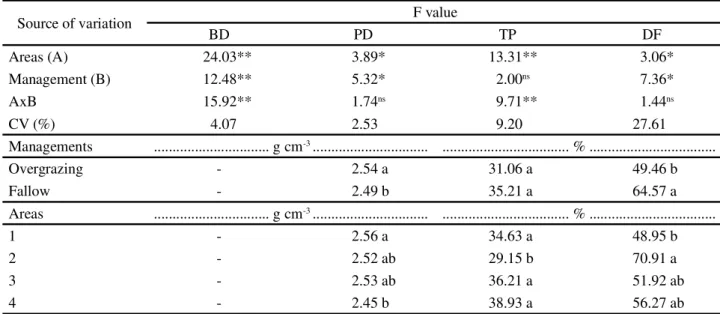
There were significant differences for the attributes soil bulk density (BD), particle density (PD), total porosity (TP) and degree of flocculation (DF). Interaction occurred for Ds and TP, whereas PD and DF showed individual responses to the treatment factors (Table 3).
Bulk density (BD) ranged from 1.46 to 1.83 g cm-3
Source of variation F value
BD PD TP DF
Areas (A) 24.03** 3.89* 13.31** 3.06*
Management (B) 12.48** 5.32* 2.00ns 7.36*
AxB 15.92** 1.74ns 9.71** 1.44ns
CV (%) 4.07 2.53 9.20 27.61
Managements ... g cm-3... ... % ...
Overgrazing - 2.54 a 31.06 a 49.46 b
Fallow - 2.49 b 35.21 a 64.57 a
Areas ... g cm-3... ... % ...
1 - 2.56 a 34.63 a 48.95 b
2 - 2.52 ab 29.15 b 70.91 a
3 - 2.53 ab 36.21 a 51.92 ab
4 - 2.45 b 38.93 a 56.27 ab
ns Not significant**and*significant at 1% and 5% of probability, respectively. Means fallows by same letters in the column do no differ by Tukey test
at 5% of probability level. BD: bulk density, PD: particle density, TP: total porosity, DF: degree of flocculation
Table 3 -Variance analysis and coefficient of variation (CV) for soil physical attributes of fallow and overgrazing areas in a desertification hotspot, Irauçuba - CE
an indication that the fallow contributed to the lower BD values, which occurs due to the greater supply of organic residues. Another explanation for the lower BD values is the higher capacity of soil restructuration caused by the greater C supply, allowing the soil to recover to a condition closest to the one prior to degradation.
Braida et al.(2006), evaluating soils susceptible to compaction, claimed that the increment in SOM and plant residues on soil surface contribute to the reduction of BD. Lower BD values are favorable to the recovery of the areas, because plant roots increase their capacity to penetrate the soil when BD and soil resistance decrease (REINERTet al., 2008).
However, except for the area 3Ps, the lower BD values associated with the fallow did not allow to infer on the recovery of soil physical quality. In the studied areas, the surface horizons showed loamy sand and sandy loam textures (Table 2) and, according to Reichert, Reinert and Braida (2003), the critical values of BD associated with these textural classes vary from 1.6 to 1.8 g cm-3. The area
2 showed BD values around 1.8 g cm-3, regardless of the
management, whereas the area 3 under overgrazing and areas 1 and 4 under fallow also showed Ds higher than 1.7 g cm-3(Figure 1). These critical values of BD are associated
with animal trampling, whose effects continue to be observed after 14 years of fallow; thus, the 14-year fallow was not sufficient to reverse such compaction. Hence, it is observed that the fallow system alone is not able to reverse this degradation, requiring an effective increase of SOM content for this purpose. Compaction causes increment in
soil density, resulting in reduction of porosity due to the rearrangement of soil particles (REICHERT et al., 2010) and restricting root system development.
Sousa et al. (2012), studying the same areas
evaluated in the present research, observed that the 7-year fallow period did not result in significant difference in BD compared with the one obtained in areas that remained under overgrazing.
In the fallow areas 3 and 4, where BD values were lower, there were positive effects on other physical
Figure 1 - Bulk density at fallow and overgrazing areas in a
desertification hotspot, Irauçuba - CE
attributes, such as total porosity (TP) and degree of flocculation (DF) (Table 3). TP values were similar to those of BD, but in reverse, since the increase in BD corresponds to lower soil aeration (Table 3). These
results corroborate those observed by Rossetti et al.
(2012). The fallow management led to lower BD values and higher TP, which cause increase in the empty spaces, allowing the circulation of gases and water, besides the development of the plants. Animal exclusion and C-org content (14.17 g kg-1 and 26.45 g kg-1 for the areas 3
and 4, respectively) influenced such improvement. Lunaet al.(2016) and Bieneset al.(2016), studying the fallow management in desertification areas of semi-arid regions, observed that the increment of organic matter by the vegetal cover contributes to improving soil physical attributes, such as density, porosity and formation of more stable aggregates, increasing water availability to plants.
The values of particle density (PD) differed between the managements (Table 3) and were higher in the overgrazing areas. On the other hand, the degree of flocculation (DF) was higher in the fallow areas (Table 3). According to Rosa Junior et al. (2006), the type of use influences the formation of soil aggregates, which is proportional to the degree of flocculation. Hence, the degree of flocculation can be an indication of soil physical state: higher values indicate quality, because the greater aggregation of particles favors aggregate stability and, consequently, soil structure
(FERREIRA, 2010). Therefore, lower values of degree of flocculation in the semi-degraded pasture indicate higher vulnerability of this soil to water erosion, if it is under no vegetal cover. The high calcium content and low sodium content in the surface horizon of the fallow area may have influenced this result.
Chemical attributes
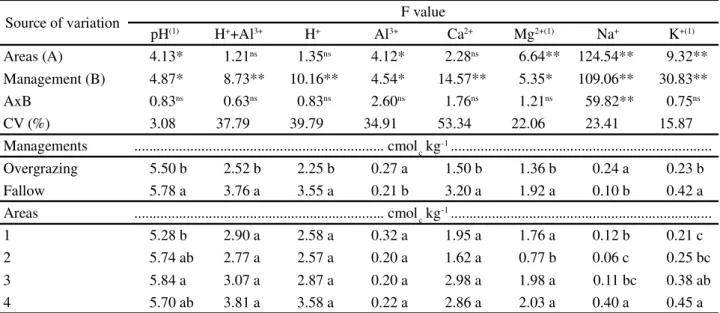
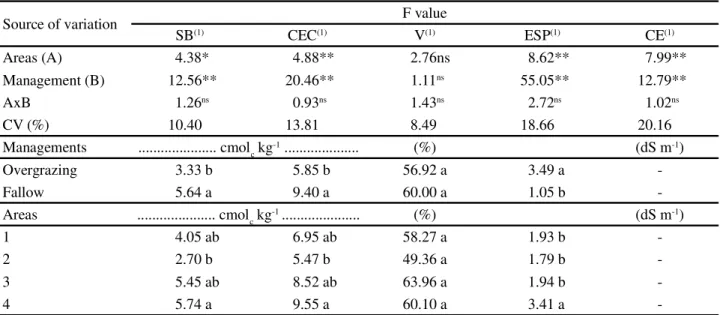
There was no interaction between treatment factors for the chemical attributes evaluated, except for Na. Responses to the isolated factors “area” and “management” were observed for the values of pH, Al, Mg, K, SB, CEC, ESP and EC. Significant response only to the factor “management” was observed in the values of H+Al, H and Ca, whereas for base saturation (V%) there was no significance of the factors (Tables 4 and 5).
Soil pH was higher in the fallow area (5.78) than in the overgrazing area (5.50) (Table 4). Higher values in the fallow area are related to the greater supply of plant residues, whose decomposition contributes to the increase of basic cations, as observed for the contents of Ca and Mg, in detriment of hydrogen concentration, resulting in higher pH.
The greater supply of organic residues in the fallow results in higher content of soil organic matter (SOM), which complexes the free H+ and Al3+ cations with
anionic organic compounds of the residues, increasing soil CEC and the contents of Ca2+, Mg2+ and K+, and
Source of variation F value
pH(1) H++Al3+ H+ Al3+ Ca2+ Mg2+(1) Na+ K+(1)
Areas (A) 4.13* 1.21ns 1.35ns 4.12* 2.28ns 6.64** 124.54** 9.32**
Management (B) 4.87* 8.73** 10.16** 4.54* 14.57** 5.35* 109.06** 30.83**
AxB 0.83ns 0.63ns 0.83ns 2.60ns 1.76ns 1.21ns 59.82** 0.75ns
CV (%) 3.08 37.79 39.79 34.91 53.34 22.06 23.41 15.87
Managements ... cmolc kg-1...
Overgrazing 5.50 b 2.52 b 2.25 b 0.27 a 1.50 b 1.36 b 0.24 a 0.23 b
Fallow 5.78 a 3.76 a 3.55 a 0.21 b 3.20 a 1.92 a 0.10 b 0.42 a
Areas ... cmolc kg-1...
1 5.28 b 2.90 a 2.58 a 0.32 a 1.95 a 1.76 a 0.12 b 0.21 c
2 5.74 ab 2.77 a 2.57 a 0.20 a 1.62 a 0.77 b 0.06 c 0.25 bc
3 5.84 a 3.07 a 2.87 a 0.20 a 2.98 a 1.98 a 0.11 bc 0.38 ab
4 5.70 ab 3.81 a 3.58 a 0.22 a 2.86 a 2.03 a 0.40 a 0.45 a
Table 4 -Variance analysis and coefficient of variation (CV) for soil chemical attributes of fallow and overgrazing areas in a desertification hotspot, Irauçuba - CE
ns Not significant**and*significant at 1% and 5% of probability, respectively. Means fallows by same letters in the column do no differ by Tukey test at
Source of variation F value
SB(1) CEC(1) V(1) ESP(1) CE(1)
Areas (A) 4.38* 4.88** 2.76ns 8.62** 7.99**
Management (B) 12.56** 20.46** 1.11ns 55.05** 12.79**
AxB 1.26ns 0.93ns 1.43ns 2.72ns 1.02ns
CV (%) 10.40 13.81 8.49 18.66 20.16
Managements ... cmolc kg-1 ... (%) (dS m-1)
Overgrazing 3.33 b 5.85 b 56.92 a 3.49 a
-Fallow 5.64 a 9.40 a 60.00 a 1.05 b
-Areas ... cmolc kg-1... (%) (dS m-1)
1 4.05 ab 6.95 ab 58.27 a 1.93 b
-2 2.70 b 5.47 b 49.36 a 1.79 b
-3 5.45 ab 8.52 ab 63.96 a 1.94 b
-4 5.74 a 9.55 a 60.10 a 3.41 a
-Table 5 - Variance analysis and coefficient of variation (CV) for others soil chemical attributes of fallow and overgrazing areas in a desertification hotspot, Irauçuba - CE
ns Not significant**and*significant at 1% and 5% of probability, respectively. Means fallows by same letters in the column do no differ by Tukey
test at 5% of probability. SB: sum of bases, CEC: cation exchange capacity, V: base saturation, ESP: exchangeable sodium percentage, EC: electric conductivity. (1) Processed data by 1/√x
reducing the acidity (PAVINATO; ROSOLEM, 2008). In the comparison between the areas, the lowest pH value occurred in the area 1, not differing from the values found in the areas 2 and 4.
Lower Al content found in the fallow treatment is consistent with the pH values, because higher pH leads to the reduction in Al availability. Although the values of pH and Al availability found in the present study are not critical, higher pH values and lower Al availability in the fallow treatment represent positive aspects for soil chemical quality.
The Na+content in the overgrazing treatment was
low, but higher than that of the fallow, which is attributed to the proximity of the B horizon, due to the loss of surface soil through erosion. The low Na+contents found in both
managements evidence the poor action of this element, with lower content for the fallow management, which is considered as good, because the excess of this element causes clay dispersion, compromising structuration. This result agrees with that observed for the attribute DF, which was higher in the fallow areas. Consequently, the Exchangeable Sodium Percentage (ESP) was also lower in the fallow (Table 5), indicating that the managements and areas do not exhibit solodic character, an attribute that occurs in many Planossolo.
In the present study, Ca2+, Mg2+, Na+ and K+ may
also be derived from the rocks, because the geology of the Irauçuba Sheet is composed of metamorphic rocks, especially micaschist and gneisses (PEREZ-MARINet al., 2012).
Soil sum of bases (SB) and cation exchange capacity (CEC) were higher in the fallow management. Base saturation (V%) did not differ between managements, considered as eutrophic. In a degraded soil of Ethiopia,
Mekuria et al. (2007) also found higher CEC for areas
with 5 and 10 years of fallow, which was related to the OM content and supply of nutrients.
EC values differed between areas 1 and 4 (Figure 2), with lower values in the fallow management. No area or management showed saline character in soil surface under the conditions of the region along the studied period.
Figura 2 - Soil electric conductivity at fallow and overgrazing
areas in a desertification hotspot, Irauçuba - CE
Total organic carbon (TOC) and its physical fractionation
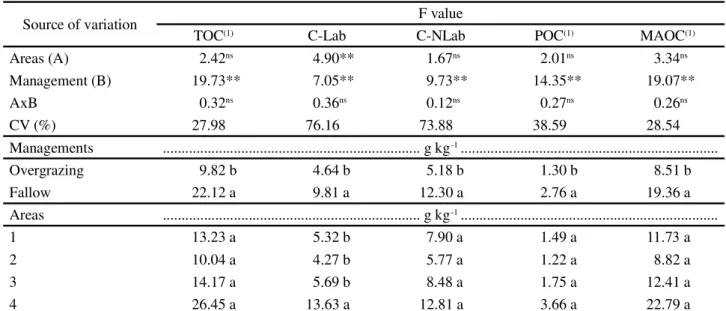
There was no interaction between treatments for the attributes related to total organic carbon (TOC). Responses to the factor “management” were observed for TOC, POC and MAOC (Table 6). Higher TOC was found in the fallow management, compared with the overgrazing (Table 6). This result was expected and is consistent with other studies conducted in semi-arid regions (SOUSAet al., 2012; WANGet al., 2011), which found accumulation of organic material on soil surface over time promoted by the vegetal cover. Descheemaeker et al. (2006), in areas under fallow for 5, 14 and 20 years, observed higher TOC and organic material, proportional to the time of exclusion. In the overgrazing areas, lower TOC can be attributed to the unprotected soil, greater OM mineralization, excessive trampling and soil losses due to laminar erosion.
For Salcedo and Sampaio (2008), the TOC content in the semi-arid region in the Ap horizon for Planosols is 7.4 g kg-1. The TOC contents found in the fallow areas
are higher than those reported by these authors (Table 6), showing the potential of this practice to increase soil TOC. These results also explain the effects of fallow, improving soil physical attributes, as discussed in the previous item.
The contents of the most sensitive fraction (POC) and most stable fraction (MAOC) were lower in the overgrazing management compared with the fallow
Source of variation F value
TOC(1) C-Lab C-NLab POC(1) MAOC(1)
Areas (A) 2.42ns 4.90** 1.67ns 2.01ns 3.34ns
Management (B) 19.73** 7.05** 9.73** 14.35** 19.07**
AxB 0.32ns 0.36ns 0.12ns 0.27ns 0.26ns
CV (%) 27.98 76.16 73.88 38.59 28.54
Managements ... g kg-1...
Overgrazing 9.82 b 4.64 b 5.18 b 1.30 b 8.51 b
Fallow 22.12 a 9.81 a 12.30 a 2.76 a 19.36 a
Areas ... g kg-1...
1 13.23 a 5.32 b 7.90 a 1.49 a 11.73 a
2 10.04 a 4.27 b 5.77 a 1.22 a 8.82 a
3 14.17 a 5.69 b 8.48 a 1.75 a 12.41 a
4 26.45 a 13.63 a 12.81 a 3.66 a 22.79 a
Table 6 - Variance analysis and coefficient of variation (CV) for TOC, C-Lab, C-NLab, POC and MAOC in the soils of fallow and overgrazing in a desertification hotspot, Irauçuba - CE
ns Not significant**and*significant at 1% and 5% of probability, respectively. Means fallows by same letters in the column do no differ by Tukey test
at 5% of probability. TOC: total organic carbon, C-Lab: labile carbon fraction, C-NLab: not labile carbon fraction, POC: particulate organic carbon, MAOC: mineral-associated organic carbon. (1) Processed data by 1/√x
(Table 6). The MAOC fraction corresponded to 86.6% and 87.5% and POC to 13.2% and 12.5% of the TOC for the overgrazing and fallow managements, respectively. The POC in cold and semi-arid regions usually represents from 20 to 50% of the TOC (CAMBARDELLA; ELLIOTT, 1992). For Roscoe and Machado (2002), soils exhibit 10 to 25% of TOC in regions with temperate climate and less than 2 to 25% in the tropics. The contents in the fallow management corroborate those reported by Roscoe and Machado (2002), which can be attributed to the hot and dry climate.
According to Cambardella and Elliott (1992), the low POC contents of the soil may occur because this fraction is more active and of higher lability, more prone to oxidation for being found in greater amount in soil surface and also more accessible to microorganisms. Since POC is associated with the sand fraction, this can be the reason for its low content, since the material adhered to the surface of the sand particle is subject to decomposition and action of microorganisms. Roscoe and Machado (2002) cite that POC has faster cycling than the C associated with silt and clay fractions. Other factors that can explain the intensification of POC mineralization are the scarcity of rainfall and high temperatures associated with low addition of crop residues, whereas the MAOC fractions show greater preservation of the decomposing agents.
to the management practices, thus requiring longer time for the alterations in the management systems to affect the stock of this fraction in the soil. Therefore, the lower proportion of the POC fraction instead of to the MAOC of the soil determines the lower C lability in both management systems. For the fallow area, this result may be related to the transformation of the POC over time and/or reduction in the supply of organic material on the soil. It is important that the soil has adequate POC content to guarantee the activity of microorganisms and C flow; however, if the MAOC content is very low, SOM oxidation can cause reduction in the TOC stock and even soil degradation.
Comparing the results of the present study with
those reported by Sousa et al. (2012), these authors
obtained TOC contents of 15-18.7 g kg-1 in the areas under
fallow and 11.3-14.8 g kg-1 in the areas under overgrazing,
respectively. The TOC contents obtained after 14 years increased in the fallow area and decreased in the overgrazing area. This indicates that, in the fallow area, the presence of vegetation promoted increments in TOC, as evidenced by the CMI. Such increase in TOC occurred with greater proportion in the more stabilized form, i.e., more protected from decomposing agents, acting on soil structuration, improving aggregation and, very slowly, contributing with the release of nutrients.
Carbon management index
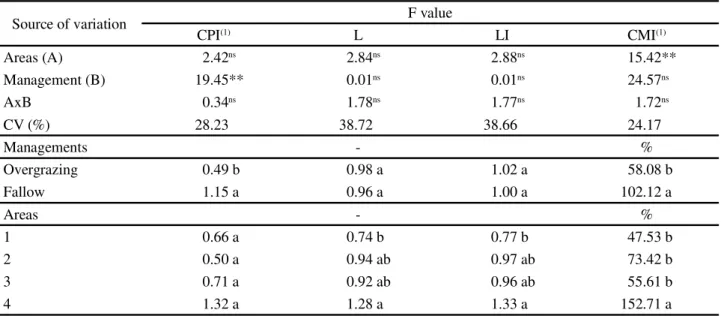
According to the carbon pool index (CPI), areas under overgrazing showed greater reduction in soil
C-Table 7 -Variance analysis and coefficient of variation (CV) for CPI, L, LI e CMI in the soils of fallow and overgrazing in a desertification hotspot, Irauçuba - CE
ns Not significant**and*significant at 1% and 5% of probability, respectively. Means fallows by same letters in the column do no differ by Tukey test
at 5% of probability. CPI: carbon pool index, L: carbon lability, IL: lability index, CMI: carbon management index. (1) Processed data by 1/√x
Source of variation F value
CPI(1) L LI CMI(1)
Areas (A) 2.42ns 2.84ns 2.88ns 15.42**
Management (B) 19.45** 0.01ns 0.01ns 24.57ns
AxB 0.34ns 1.78ns 1.77ns 1.72ns
CV (%) 28.23 38.72 38.66 24.17
Managements - %
Overgrazing 0.49 b 0.98 a 1.02 a 58.08 b
Fallow 1.15 a 0.96 a 1.00 a 102.12 a
Areas - %
1 0.66 a 0.74 b 0.77 b 47.53 b
2 0.50 a 0.94 ab 0.97 ab 73.42 b
3 0.71 a 0.92 ab 0.96 ab 55.61 b
4 1.32 a 1.28 a 1.33 a 152.71 a
org contents compared with areas under fallow (Table 7). This is due to the presence of plant material and absence of animals in the fallow area. Soil managements did not result in significant differences for lability (L) and lability index (LI), but the areas 1 and 4 exhibited significant differences. The greatest proportion of TOC corresponded to MAOC, which explains the low values of CMI. The highest CMI was observed in the fallow management, showing mean value of 102.12%, statistically differing from the overgrazing, which had mean value of 58.08%. However, these values indicate that the management promoting higher supply of plant material to the soil has greater potential to contribute to the improvement of soil attributes.
CMI values lower than 100 indicate negative impact of the management practices on the organic matter contents or quality of the system, and values equal to or higher than 100 indicate positive impact, demonstrating that the adopted management is contributing to the improvement in soil attributes (BLAIR; LEFROY; LISLE, 1995). The CMI values found in the present study were below 100 for the overgrazing management and for most areas. However, the fallow management resulted in CMI above 100, indicating the positive capacity of this system to improve soil attributes, i.e., to reestablish and promote the sustainability of the agroecosystem.
The CMI values found by Sousa et al. (2012),
In the present study, CMI increased in the areas under overgrazing (58.08%) and fallow (102.12%), indicating the positive capacity of this system to recover the degraded soil. The area 4 differed from the others, showing CMI higher than 100% (Table 7). It is assumed that, with longer fallow period and greater supply of organic material to the soil, the results will probably be satisfactory also for the other areas with respect to the evaluated attributes. However, long-term studies will be necessary to determine such fallow period.
CONCLUSIONS
Fallow management led to improvements in soil physical and chemical attributes when evaluated after 14 years of animal exclusion. However, according to the results of carbon management index (CMI), the areas are still degraded. The practice of fallow can be a strategy to recover areas under degradation and desertification in semi-arid region and, with longer fallow period and greater supply of organic material to the soil, the results will be more satisfactory.
ACKNOWLEDGMENTS
To the Coordination for the Improvement of Higher Education Personnel (CAPES), for granting the research scholarship to the first author; and to the Ceará Scientific and Technological Development Support Foundation (FUNCAP), for the financial support to the research.
REFERENCES
BIENES, R. et al. Eleven years after shrub revegetation in semi-arid eroded soils. Influence in soil properties.Geoderma, v. 273, n. 1, p. 106-114, 2016.
BLAIR, G. J.; LEFROY, R. D. B.; LISLE, L. Soil carbon fractions based on their degree of oxidation, and the development of a carbon management index for agricultural systems.Australian Journal of Agricultural Research, v. 46, n. 7, p. 1459-1466, 1995.
BRAIDA, J. A.et al. Resíduos vegetais na superfície e carbono orgânico do solo e suas relações com a densidade máxima obtida no ensaio proctor.Revista Brasileira de Ciência do Solo, v. 30,
n. 4, p. 605-614, 2006.
BRUUN, T. B.et al. Organic carbon dynamics in different soil types after conversion of forest to agriculture.Land Degradation and Development, v. 26, p. 272-283, 2015.
CAMBARDELLA, C. A.; ELLIOTT, E. T. Particulate soil organic-matter changes across a grassland cultivation sequence.
Soil Science Society American Journal, v. 56, n. 3, p. 777-783, 1992.
DESCHEEMAEKER, K. et al. Litter production and organic matter accumulation in exclosures of the Tigray highlands, Ethiopia.Forest Ecology and Management, v. 233, n. 1, p. 21-35, 2006.
EMPRESA BRASILEIRA DE PESQUISA AGROPECUÁRIA. Centro Nacional de Pesquisa de Solos.Manual de métodos de análise de solo. 2. ed. rev. Rio de Janeiro, 2011. 230 p. FERREIRA, D. F. Sisvar: a computer statistical analysis system.
Ciência e Agrotecnologia, v. 35, n. 6, p. 1039-1042, 2011. FERREIRA, M. M. Caracterização física do solo. In: LIER, Q. de J. van (Ed.). Física do solo. Viçosa, MG: Sociedade Brasileira de Ciência do Solo, 2010. 298 p.
JÓRDAN, A.; ZAVALA, L. M.; GIL, J. Effects of mulching on soil physical properties and runoff under semi-arid conditions in Southern Spain.Catena, v. 8, n. 1, p. 77-85, 2010.
KROL, M. et al. Integrated modeling of climate, water, soil, agricultural and socio-economic processes: a general introduction of the methodology and some exemplary results from the semi-arid north-east of Brazil.Journal of Hydrology, v. 328, n. 3/4, p. 417-431, 2006.
LUNA, L.et al. Restoration techniques affect soil organic carbon, glomalin and aggregate stability in degraded soils of a semi-arid Mediterranean region.Catena, v. 143, p. 256-264, 2016. MEKURIA, W. et al. Effectiveness of exclosures to restore degraded soils as a result of overgrazing in Tigray, Ethiopia.
Journal of Arid Environments, v. 69, n. 2, p. 270- 284, 2007. MENDONÇA, E. S.; MATOS, E. S.Matéria orgânica do solo: métodos de análises. Viçosa: UFV, 2005. 107 p.
PAVINATO, P. S.; ROSOLEM, C. A. Disponibilidade de nutrientes no solo: decomposição e liberação de compostos orgânicos de resíduos vegetais.Revista Brasileira de Ciência do Solo, v. 32, n. 3, p. 911-920, 2008.
PEI, S.; FU, H.; WAN, C. Changes in soil properties and vegetation following exclosure and grazing in degraded Alxa desert steppe of Inner Mongolia, China.Agriculture, Ecosystems and Environment, v. 124, n. 1/2, p. 33-39, 2008.
PEREZ-MARIN, A. M. et al. Núcleos de desertificação no semiárido brasileiro: ocorrência natural ou antrópica?Parcerias Estratégicas, v. 17, n. 34, p. 87-106, 2012.
PRASAD, J. V. N. S.et al. Effect of ten years of reduced tillage and recycling of organic matter on crop yields, soil organic carbon and its fractions in Alfisols of semi-arid tropics of southern India.
Soil and Tillage Research, v. 156, p. 131-139, 2016.
REICHERT, J. M.et al. Mecânica do solo.In:LIER, Q. de J. van (Ed.).Física do Solo. Viçosa, MG: Sociedade Brasileira de Ciência do Solo, 2010. 298 p.
REINERT, D. J.et al. Limites críticos de densidade do solo para o crescimento de raízes de plantas de cobertura em Argissolo Vermelho.Revista Brasileira de Ciência do Solo, v. 32, n. 5, p. 1805-1816, 2008.
REYNOLDS, J. F. et al. Global desertification: building a science for dryland development. Science, v. 316, n. 5826, p. 847-851, 2007.
ROSA JÚNIOR, E. J.et al. Calcário e gesso como condicionantes físico e químico de um solo de cerrado sob três sistemas de manejo.
Pesquisa Agropecuária Tropical, v. 36, n. 1, p. 37-44, 2006.
ROSCOE, R.; MACHADO, P. L. O. A.Fracionamento físico do solo em estudos da matéria orgânica. Dourados: Embrapa Agropecuária Oeste; Rio de Janeiro: Embrapa solos, 2002. 86 p. ROSSETTI, K. de V.et al. Atributos físicos do solo em diferentes condições de cobertura vegetal em área de plantio direto.Revista Brasileira de Ciências Agrárias, v. 7, n. 3, p. 427-433, 2012.
SALCEDO, I. H.; SAMPAIO, E. V. S. B. Matéria orgânica do solo no bioma caatinga.In: SANTOS, G. de A. (Ed.)Fundamentos da matéria orgânica do solo: ecossistemas tropicais e subtropicais. 2. ed. rev. atual. Porto Alegre: Metrópole, 2008.
SOUSA, F. P. et al.Carbon and nitrogen in degraded Brazilian semi-arid soils undergoing desertification. Agriculture, Ecosystems and Environment, v. 148, p. 11-21, 2012.
TRAORÉ, S. et al. Effect of land degradation on carbon and nitrogen pools in two soil types of a semi-arid landscape in West Africa.Geoderma, v. 241-242, p. 330-338, 2015.
WANG, Y.et al. Effects of vegetation restoration on soil organic carbon sequestration at multiple scales in semi-arid Loess Plateau, China.Catena, v. 85, n. 1, p. 58-66, 2011.
WENDLING, B.et al. Organic-matter pools of soil under pines and annual cultures. Communications in Soil Science and Plant Analysis, v. 41, n. 14, p. 1707-1722, 2010.