www.ccarevista.ufc.br ISSN 1806-6690
Nutritional value of hay from maize-crop stubble ammoniated with
urea
1Valor nutritivo do feno de restolho da cultura do milho amonizado com ureia
Miguel Arcanjo Moreira Filho2*, Arnaud Azevêdo Alves2, George Emanuel Silva do Vale2, Antonia Leidiana
Moreira2 e Marcos Cláudio Pinheiro Rogério3
ABSTRACT - The objective of this research was to evaluate the chemical composition and in situ degradability of
hay stubble from a maize crop fertilized with 40; 120 or 200 kg N ha-1, ammoniated with urea. To evaluate
in situ
degradability, 4 g samples were incubated in nylon bags in the rumen of cattle for 6; 24 and 72 hours. The levels of acid detergent fiber (35.4% DM) and acid detergent insoluble nitrogen (18.5% of total N) decreased, resulting in 32.7% of DM and 9.6% of the total N, and crude protein (CP) increased from 5.2 to 9.7% of DM as a result of the ammoniation with urea. The degradation of dry matter (48.7%), CP (56.5%) and neutral detergent fiber (33.6%) increased with ammoniation, averaging 54.5 and 75.4, and 38.4% respectively, but was not influenced by interaction fertilization x ammoniation x incubation time. The soluble fraction of DM and CP increased with ammoniation, and the degradation rate of b fraction was greater than 2% h-1. The ammoniation of the hay of stubble of maize-crop fertilized with 40 or
120 kg N ha-1 resulted in reduction of NDF content, fraction of the feed which best represents the cell wall. The protein
content,in-situ degradability and the kinetics of dry-matter and protein degradation of the hay of stubble of maize-crop
were increased by ammoniation with urea (3% in DM basis) and fertilization with 40 or 120 kg N ha-1, thus not justifying
the ammoniation of corn stubble from crops fertilized with 200 kg N ha-1.
Key words: Degradation. Hay ammoniated. Maize-crop stubble as forage.
RESUMO - Esta pesquisa objetivou avaliar a composição química e degradabilidadein situ do feno de restolho da cultura do milho proveniente de cultura adubada com 40; 120 ou 200 kg de N ha-1 e amonizado com ureia. Para
avaliação da degradabilidadein situ, foram incubadas 4 g de amostras no rúmen de um bovino canulado, nos tempos 6; 24 e 72 h. Os teores de fibra em detergente ácido (35,4% da MS) e nitrogênio insolúvel em detergente ácido (18,5% do N total) diminuíram, obtendo-se 32,7% da MS e 9,6% do N total, e o teor de proteína bruta (PB) aumentou de 5,2 para 9,7% da MS em decorrência da amonização com ureia. A degradação da matéria seca (48,7%), PB (56,5%) e fibra em detergente neutro (33,6%) aumentou com a amonização, com médias 54,5; 75,4; e 38,4%, respectivamente, mas não foi influenciada pela interação adubação x amonização x tempo de incubação. A fração solúvel da MS e PB aumentou com a amonização e a taxa de degradação da fração b foi superior a 2% h-1. A amonização do feno de restolho
da cultura do milho adubada com 40 ou 120 kg de N ha-1 promoveu redução da FDN, fração do alimento que melhor
representa a parede celular. O teor de proteína, a degradabilidade in situ e a cinética de degradação da matéria seca e proteína foram incrementados com a amonização do restolho da cultura do milho com 3% de ureia na MS e adubação com 40 ou 120 kg de N ha-1, não se justificando a amonização do restolho da cultura do milho resultante de culturas
adubadas com 200 kg de N ha-1.
Palavras-chave: Degradação. Feno amonizado. Restolho da cultura do milho como forragem.
*Autor para correspondência
1Recebido para publicação em 16/03/2012; aprovado em 27/06/2013
Parte da Dissertação de Mestrado do primeiro autor apresentada ao Programa de Pós-Graduação em Ciência Animal da UFPI
2Programa de Pós-Graduação em Ciência Animal, Centro de Ciências Agrárias/UFPI, Campus Agrícola da Socopo, Teresina,-PI, Brasil, 64.049-550,
[email protected], [email protected], [email protected], [email protected]
INTRODUCTION
The preservation of bulk feed, available during the rainy season, or stubble from agricultural crops (ROTH
et al., 2009), in the form of hay or silage, can be adopted in order to supplement herds during periods when forage is scarce, with a view to sustainable animal production
(BERTIPAGLIAet al., 2005).
Alternative low-cost feeds, or feeds which are readily available during the year, are interesting feeding alternative, it being important to evaluate the inclusion in
the animals’ diet of older grasses (PINHEIROet al., 2009)
and stubble or residue from annual crops ( PAIVAet al.,
1995a) associated with preservation processes.
Stubble of maize-crop correspond to the stem of the plant without the cobs, harvested before any natural drying out in the field. The use of straw and stubble dried in the field results in poor nutritional quality, due to the animal selecting the less fibrous parts and rejecting the more woody parts such as the stem. This can be reduced by the use of processing suitable for the feeding of ruminants. Brazil produces, in practical
terms, 2-3 tonnes of maize grain ha-1 and 10 to 12 t ha-1
of straw, the latter being returned to the soil or destined for animal feed.
The recommendations for applying nitrogen
fertiliser as cover to maize crops are for up to 200 kg N ha-1
(BASI et al., 2011), being N the nutrient most required
by the crop as it is primarily responsible for increased grain production and a higher relation of leaf to stem
(AMARAL FILHOet al., 2005), resulting in plants with
higher nutritional value and protein content. However,
high levels of N (more than 100 kg N ha-1) can lead to
an increase in cell-wall constituents due to overlarge growth of the plant and a corresponding increase in the amount of stem, and resulting in crop residue of lower
nutritional value (BASIet al., 2011), making necessary
the definition of suitable levels of N for the production of grain and quality forage.
Thus the chemical treatment by ammoniation with urea of hay from corn-crop stubble can mitigate factors that compromise quality, such as the high proportion of cell wall and low levels of crude protein
(PAIVAet al., 1995a). Ammonia acts mainly on the cell
wall, resulting in reduction of neutral detergent fiber
content (GOBBIet al., 2005) by partial solubilisation
of the hemicellulose (SCHMIDT et al., 2003) and by
increasing the availability of soluble carbohydrates. In addition to these aspects, the use of urea for treating fodder is easy to use, of low cost and enriches the fodder with non-protein nitrogen, the result of nitrogen
retention, according to Schmidtet al. (2003).
The effect of ammoniation of the corn stubble from an area fertilised with different doses of nitrogen was evaluated as regards to the chemical composition and
in situ degradation of the dry matter, crude protein and neutral detergent fiber.
MATERIAL AND METHODS
In this research stubble was used from a maize crop planted in an experimental area of the Teresina Agricultural College (CAT) of the Federal University of Piauí (UFPI), and the nutritive value of the hay was evaluated in the Laboratory of Animal Nutrition (LANA) of the Department of Animal Science (DZO) at the Centre for Agricultural Sciences (CCA) at UFPI.
The maize (Zea mays L.) single early hybrid, Dow
AgroSciences 2B710, suitable for grain production, was grown with a spacing of 0.8 m between rows and eight
seeds per linear metre, in a total area of 476.0 m2 ( 28.0
x 17.0 m), divided into 12 plots of 20 m2 (5 x 4 m),
separated by empty spaces of 1 m, in a soil classified as a red-yellow Argisol having the following chemical
characteristics: pH in CaCl2 = 4.80 ± 0.10; organic
matter = 10.00 ± 1.00 g dm-3; P = 6.00 ± 1.73 mg dm-3;
K = 0.80 ± 0.10 mmol dm-3; Ca = 10.00 ± 1.00 mmol
dm-3; Mg = 3.33 ± 0.58 mmol dm-3; H + Al = 20.67 ±
1.15 mmol dm-3; CTC = 34.80 ± 1.82 mmol dm-3; base
saturation = 40.67 ± 2.89%; B = 0.10 ± 0.03 mg dm-3;
Cu = 0.10 ± 0.00 mg dm-3; Mn = 1.67 ± 0.76 mg dm-3
and Zn = 0.27 ± 0.15 mg dm-3.
Based on the results of the chemical analysis,
soil amendment was carried out using 1.46 t ha-1 of
dolomitic limestone, in an effort to raise the base saturation to 70.0%, applying 50% during ploughing and 50 % when harrowing. Chemical fertiliser was
added to the furrow when sowing, using 26 kg N ha-1,
91 kg P2O5ha-1, 52 kg K
2O ha
-1 and 4 kg Zn ha-1.
Topdressing was carried out with three doses of
N (40, 120 or 200 kg ha-1) in the form of urea, applying
50% of the total N + 90 kg K2O ha-1 when the plants
presented 4 to 5 completely open leaves, and 50% of the N when eight to ten leaves were completely open. After topdressing, irrigation was carried out by sprinkler.
The dry matter content (DM) of the hay was determined following the methodology described by Silva and Queiroz (2002), and based on this DM, the material was then ammoniated with 3% cattle urea, dissolved in enough water to raise the moisture content of the hay to
30% (GOBBI et al., 2008). Samples of 2.0 kg per plot
of the DM of the maize stubble were treated. These were then placed in dark, 0.6 x 0.9 m polyethylene bags, 0.03 mm thick, and sealed with tape to avoid the loss of ammonia by ureolysis, remaining closed for 35 days, as
per Gobbiet al. (2008). Each bag of treated forage made
up one replication, as well as the forage sampled before ammoniation. After opening, the treated forage remained in the bags in a dry, airy place, where it was naturally aerated for 24 h in order to eliminate the excess ammonia
(GOBBIet al., 2008).
The chemical composition of the ammoniated and non-ammoniated hay was analysed. The samples were pre-dried in a forced-air oven at 50 5 °C for 72 hours, ground in a Willey mill with a 2.0 mm diameter screen, and analyzed for DM, crude protein (CP) , ash, ether extract (EE), neutral detergent fiber (NDF) and acid detergent fiber (ADF), as described by Silva and Queiroz (2002), and acid detergent insoluble nitrogen (ADIN, % N total),
as per Licitraet al. (1996). The total carbohydrate content
[CHOT = 100 - (B% + E% + Ash%] was calculated as
per Sniffenet al. (1992) and non-fibrous carbohydrates
(NFC = CHOT - NDF), as per Hall (2003).
The experimental design was a completely randomized in 3x2 factorial arrangement (three levels of fertiliser, and ammoniated and non-ammoniated hay), with four replications. The averages of the results for the chemical constituents of the hay were compared by Tukey test at a significance level of 5%, as per Sampaio (2002), by the GLM method using the Statistical Analysis Systems (2002) software.
In order to test the DM, CP and NDF in situ
degradability, a bovine cannulated in the rumen was used, as per Tomich and Sampaio (2004), with a live weight of 650 kg, fed during the seven-day adjustment and incubation period with a total maintenance diet, following the National Research Council (2001), which consisted of 80% bulk fodder and 20% concentrate (Table 1), supplied in two meals (at 0800 and 1600 hours), plus a mineral mixture and water as required.
In order to determine degradability in situ, 8 x
12 cm nylon bags with a porosity of 50 µm were used, to which were added 4.0 g of sample, according to the
methodology adopted by Alveset al. (2007), following the
relationship of 42 mg MS per cm2 of nylon bag surface, as
adopted by Camposet al. (2011). Incubation periods of 6;
24 and 72 hours were adopted (Sampaio, 1988) with, in
Table 1 - Feed and chemical composition of the diet of the fistulated bovine during thein situ degradability test
Feed composition
Ingredients % of diet, based
on the MS
Hay from maize stubble 30.8
Hay from Tifton 85 grass 46.1
Leucaena hay 4.9
Maize grains 15.2
Soybean meal 1.1
Urea 0.5
Dicalcium phosphate 0.6
Calcium carbonate 0.1
Common salt 0.7
Total 100.0
Chemical composition
Dry matter (%) 89.9
Crude protein (% of DM) 9.9
Neutral detergent fiber (% of DM) 66.6
Acid detergent fiber (% of DM) 28.6
Total digestible nutrients (% of DM) 59.2
Calcium (% of DM) 0.54
Phosphorus (% of DM) 0.30
1Estimated by formulas proposed by Cappelleet al. (2001)
descending order of time, the simultaneous removal of the rumen bags and their immersion in ice water in order to stop the fermentation process.
The readily water-soluble fraction (time 0) was determined by immersing the bags containing equivalent samples to those used in the rumen incubation, into a hot-water bath at 39 °C for 1 hour, and then together with the bags from the remaining incubation times, they were washed in a washing machine until the water turned clear. They were then pre-dried in a forced-air oven at 55 5 °C for 72 hours for subsequent analysis of the DM, CP and NDF as per Silva and Queiroz (2002).
Following the interactive method of Gauss-Newton, employing the NLIN procedure of Statistical
Analysis Systems (2002), the in situ degradation
parameters (a, b and c) and the degradability potential of the DM, CP and NDF were estimated using the model proposed by Ørskov and McDonald (1979):
Where: DP = actual percentage of degraded
nutrient after t hours of incubation in the rumen;A =
maximum degradation potential of the material in the
nylon bag (asymptote); B = potentially degradable
fraction of the material remaining in the nylon bag
after zero time;c = rate of degradation of the fraction
remaining in the nylon bag after zero time;t = incubation
time in hours. The effective degradability (ED) of the DM, CP and NDF in the rumen was estimated using the equation proposed by Ørskov and McDonald (1979):
DE = a + [(a.b)/(c + k)] (2)
Where: DE = effective degradation;a = rapidly
degraded soluble fraction; b = slowly degraded
insoluble fraction;c = fractional rate of degradation of
b;k = rate of passage of solids 2; 5 and 8% h-1.
To evaluate degradation, a completely randomized 3x2 factorial arrangement (three levels of fertiliser, and ammoniated and non-ammoniated hay) was adopted, in split lots, at times of 6; 24 and 72 hours, with three replications (three ammoniated lots and three non- ammoniated). Descriptive statistics were run for the mean and the standard deviation, following the MEANS procedure of Statistical Analysis Systems (2002). The Tukey test at 5% significance was applied (SAMPAIO, 2002) to the degradation data of the DM, CP and NDF for the incubation times, using the GLM procedure of Statistical Analysis Systems (2002).
RESULTS AND DISCUSSION
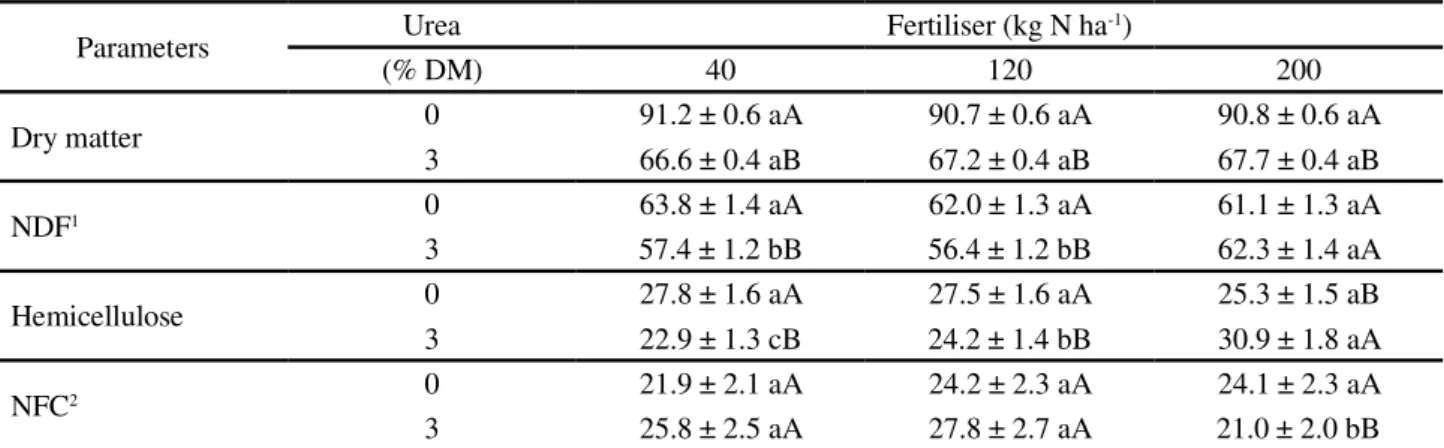
There was effect of interaction nitrogen fertiliser x ammoniation with urea, on the dry matter content (DM)
1DNF = neutral detergent fiber;2NFC = non-fiber carbohydrates; Averages followed by different letters, lowercase on a line and uppercase in a column,
differ by the Tukey test (P>0.05)
Table 2 - Chemical composition (%) of the hay from maize stubble under different levels of nitrogen fertiliser and urea ammoniation
Parameters Urea Fertiliser (kg N ha
-1)
(% DM) 40 120 200
Dry matter 0 91.2 ± 0.6 aA 90.7 ± 0.6 aA 90.8 ± 0.6 aA
3 66.6 ± 0.4 aB 67.2 ± 0.4 aB 67.7 ± 0.4 aB
NDF1 0 63.8 ± 1.4 aA 62.0 ± 1.3 aA 61.1 ± 1.3 aA
3 57.4 ± 1.2 bB 56.4 ± 1.2 bB 62.3 ± 1.4 aA
Hemicellulose 0 27.8 ± 1.6 aA 27.5 ± 1.6 aA 25.3 ± 1.5 aB
3 22.9 ± 1.3 cB 24.2 ± 1.4 bB 30.9 ± 1.8 aA
NFC2 0 21.9 ± 2.1 aA 24.2 ± 2.3 aA 24.1 ± 2.3 aA
3 25.8 ± 2.5 aA 27.8 ± 2.7 aA 21.0 ± 2.0 bB
(P = 0.0162), neutral detergent fiber (NDF) (P<0.0001), hemicellulose (HCEL) (P = 0.0107) and non-fiber carbohydrates (NFC) (P<0.0001) (Table 2).
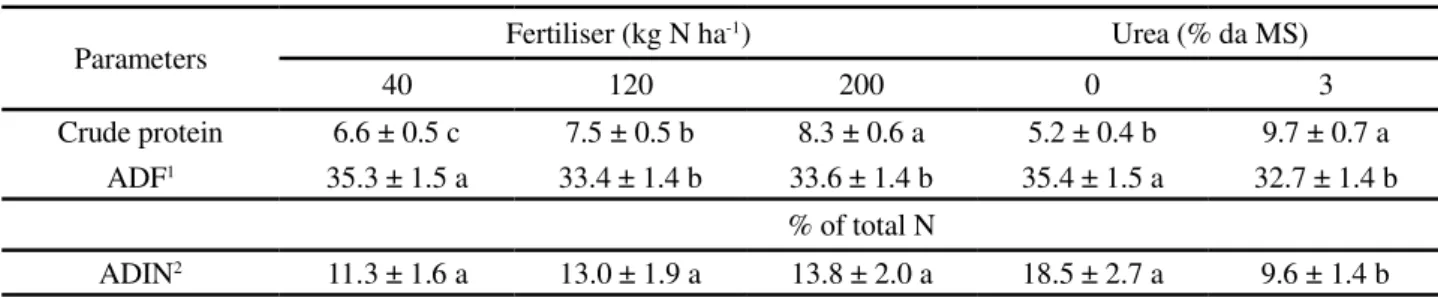
There was no interaction nitrogen fertiliser x urea ammoniation on the levels of crude protein (CP) (P = 0.6645), acid detergent fiber (ADF) (P = 0.1368) and acid detergent insoluble nitrogen (ADIN) (P = 0.1275). However, nitrogen fertiliser influenced (P<0.05) CP (P<0.0001) and ADF (P = 0.0311) contents, and urea ammoniation had an effect (P<0.05) on CP (P<0.0001), ADF (P = 0.0002) and ADIN (P<0.0001) contents (Table 3).
Ammoniation with 3% urea resulted in a lower (P<0.0001) DM content. This is attributed to the water added during ammoniation, necessary to raise the moisture content to about 30%, which is the ideal for the ammonia to act on the constituents of the cell wall
(GOBBIet al., 2008).
Nitrogen fertiliser with 200 kg N ha-1 resulted
in a higher (P<0.0001) CP content; an effect that may be explained by the increase of N in the soil, with a consequent increase in foliar N and a higher nutritional
value of the plants (AMARAL FILHO et al., 2005).
Ammoniation of the hay increased (P<0.0001) the CP level by 86.5% compared to the hay not treated with urea, resulting in 5.2 ± 1.5% for the untreated hay and 9.7 ± 1.4% for the ammoniated hay, an effect also
seen by Zanine et al. (2007). However, these authors
observed increase of 43.7% in CP content for hay from Tanzania grass, where the DM was treated with 3%
urea. Brandão et al. (2011) obtained an increase of
160.9% in CP content for the hay from the co-products
of the breaking down of sisal (Agave sisalana), with
Table 3 - Chemical composition (%) of hay from maize stubble under different levels of nitrogen or urea ammoniation
Parameters Fertiliser (kg N ha
-1) Urea (% da MS)
40 120 200 0 3
Crude protein 6.6 ± 0.5 c 7.5 ± 0.5 b 8.3 ± 0.6 a 5.2 ± 0.4 b 9.7 ± 0.7 a
ADF1 35.3 ± 1.5 a 33.4 ± 1.4 b 33.6 ± 1.4 b 35.4 ± 1.5 a 32.7 ± 1.4 b
% of total N
ADIN2 11.3 ± 1.6 a 13.0 ± 1.9 a 13.8 ± 2.0 a 18.5 ± 2.7 a 9.6 ± 1.4 b
1ADF = acid detergent fiber; 2ADIN = acid detergent insoluble nitrogen; Averages followed by different lowercase letters on a line for fertiliser or
ammoniation, differ by the Tukey test (P<0.05)
which is possibly used as a substrate for the growth of the microbe population in the rumen.
The NDF content of the ammoniated hay changed (P<0.0001) with the fertiliser, and was higher when from
those crops fertilised with 200 kg N ha-1. An increase in the
levels of N fertilisation tends to increase the proportion of stem in the total DM, due to the elongation of the internodes and reduction in the leaf to stem ratio (AMARAL FILHO
et al., 2005), consequently, it also tends to increase the
cell-wall content. With the DM ammoniated with 3% urea, the NDF content of the hay was lower when fertilising
with 40 or 120 kg N ha-1.
Fertiliser with 40 kg N ha-1 resulted in a higher
level of ADF (P = 0.0311) when compared to fertiliser
with 120 and 200 kg N ha-1, which may be related to the
increase in leaf-area index due to the increase of N in the fertiliser, with the leaves having a lower ADF content in relation to the stem. Ammoniation with 3% urea reduced (P<0.0002) the ADF content compared to the untreated hay, irrespective of the level of N in the fertiliser, an effect caused by the breakdown of ester bonds between molecules of structural carbohydrates, also seen by
Schmidtet al. (2003) and Gobbiet al. (2005) in hay from
signal grass (Brachiaria decumbens) and Zanine et al.
(2006) in sugarcane bagasse.
Ammoniation resulted in a decrease (P<0.0001) in the HCEL content with fertiliser
of 40 and 120 kg N ha-1, the same was not observed
for fertiliser of 200 kg N ha-1, when the HCEL content
of the ammoniated hay exceeded that obtained for the non-ammoniated, due to the proportionally lower ADF content (Table 3) in relation to the NDF (Table 2). Gomes
et al. (2009) observed an increase in the NDF content
of carnauba straw (Copernicia prunifera) with the DM
ammoniated with up to 10% urea, and Schmidt et al.
(2003) obtained an increase in HCEL content for hay from signal grass ammoniated with 5% urea, compared to the untreated hay.
Ammoniation of the hay from the maize crop
fertilised with 200 kg N ha-1 did not affect the NDF,
despite increasing the level of HCEL and resulting in a decreased (P = 0.0107) level of NFC (Table 3), this probably due to the breakdown of ester bonds in the ADF constituents.
Ammoniation with 3% urea resulted in a lower (P<0.0001) ADIN content, on average 9.6 ± 1.4% of the total N, being lower than 18.5 ± 2.7% for the untreated hay. This effect is related to the addition of NPN when ammoniating, increasing the total N, and resulting in proportionally lower levels of ADIN, the unavailable portion of the total N in the feed, mainly associated with lignin.
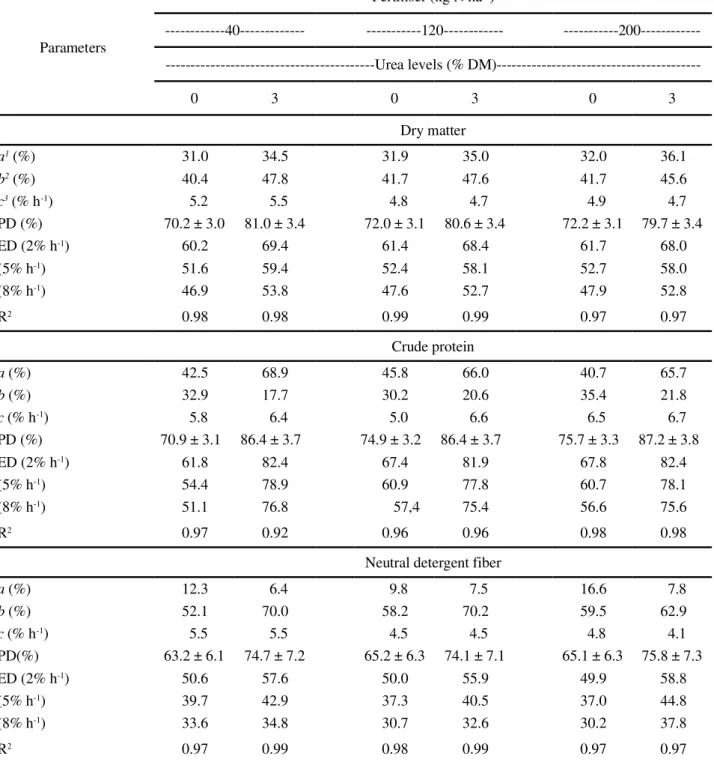
The soluble fraction (a fraction) of the DM and
CP increased with urea ammoniation (Table 4) and
exceeded that obtained by Nouala et al. (2004) for
corn-crop residue (30.7%) and hay from the groundnut (30.4%). This can be explained by the addition of NPN in the form of urea, and by the reduction in the lignocellulosic content, since the FDA decreased with the ammoniation of the hay.
There was no effect (P<0.05) from the interaction of nitrogen fertiliser with urea ammoniation and incubation
time on the in situ degradation of the DM (P = 0.8927),
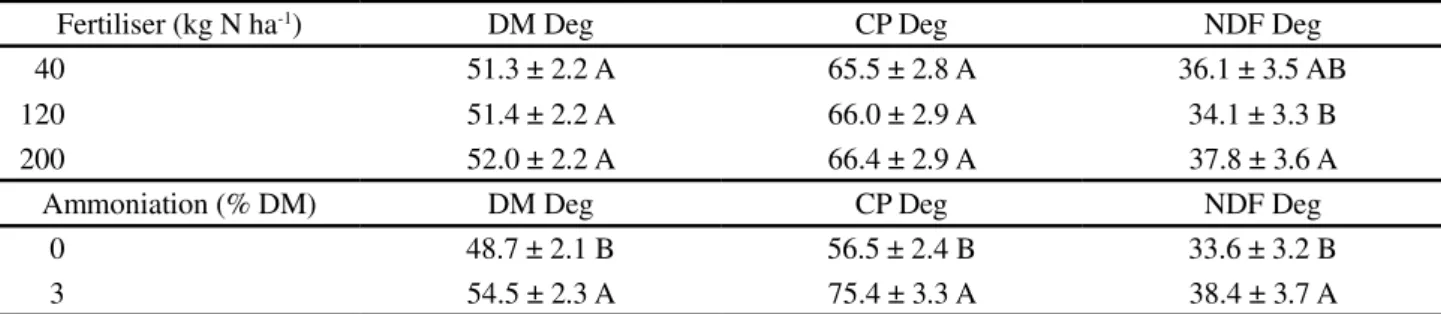
CP (= 0.6649) and NDF (P = 0.0795). The ammoniation of the corn stubble with 3% urea influenced (P<0.0001) the degradation of DM, CP and NDF, with an interaction being noted for the nitrogen fertiliser (P = 0.0005) and the incubation time (P = 0.0003) in the degradation of the NDF (Tables 5 and 6). Ammoniation resulted in a greater (P<0.0001) degradation of the DM and CP (54.5 ± 19.6 and 75.4 ± 9.0% respectively) than that obtained for the untreated hay (48.7 ± 17.2 and 56.5 ± 13.3% respectively, Table 5), due to a reduction in the lignocellulosic content (ADF) (Table 3), and the addition of NPN to the hay treated with 3% urea. As for
Table 4 - Degradation parameters, potential degradation (PD) and effective degradability (ED) of the dry matter, crude protein and neutral detergent fiber in hay from maize stubble, due to nitrogen fertilisation and ammoniation
Parameters
Fertiliser (kg N ha-1)
---40--- ---120---
---200---Urea levels (%
DM)---0 3 0 3 0 3
Dry matter
a1 (%) 31.0 34.5 31.9 35.0 32.0 36.1
b2 (%) 40.4 47.8 41.7 47.6 41.7 45.6
c3 (% h-1) 5.2 5.5 4.8 4.7 4.9 4.7
PD (%) 70.2 ± 3.0 81.0 ± 3.4 72.0 ± 3.1 80.6 ± 3.4 72.2 ± 3.1 79.7 ± 3.4
ED (2% h-1) 60.2 69.4 61.4 68.4 61.7 68.0
(5% h-1) 51.6 59.4 52.4 58.1 52.7 58.0
(8% h-1) 46.9 53.8 47.6 52.7 47.9 52.8
R2 0.98 0.98 0.99 0.99 0.97 0.97
Crude protein
a (%) 42.5 68.9 45.8 66.0 40.7 65.7
b (%) 32.9 17.7 30.2 20.6 35.4 21.8
c (% h-1) 5.8 6.4 5.0 6.6 6.5 6.7
PD (%) 70.9 ± 3.1 86.4 ± 3.7 74.9 ± 3.2 86.4 ± 3.7 75.7 ± 3.3 87.2 ± 3.8
ED (2% h-1) 61.8 82.4 67.4 81.9 67.8 82.4
(5% h-1) 54.4 78.9 60.9 77.8 60.7 78.1
(8% h-1) 51.1 76.8 57,4 75.4 56.6 75.6
R2 0.97 0.92 0.96 0.96 0.98 0.98
Neutral detergent fiber
a (%) 12.3 6.4 9.8 7.5 16.6 7.8
b (%) 52.1 70.0 58.2 70.2 59.5 62.9
c (% h-1) 5.5 5.5 4.5 4.5 4.8 4.1
PD(%) 63.2 ± 6.1 74.7 ± 7.2 65.2 ± 6.3 74.1 ± 7.1 65.1 ± 6.3 75.8 ± 7.3
ED (2% h-1) 50.6 57.6 50.0 55.9 49.9 58.8
(5% h-1) 39.7 42.9 37.3 40.5 37.0 44.8
(8% h-1) 33.6 34.8 30.7 32.6 30.2 37.8
R2 0.97 0.99 0.98 0.99 0.97 0.97
1a = water soluble fraction; 2b = water insoluble fraction but potentially degradable;3c = degradation rate of fractionb; R2 = coefficient of
determination of the degradation models
71.1% for the hay from buffalo grass, 71.4% for the hay from Tifton grass and 73.0% for that from signal grass, all incubated in the rumen for 72 hours, with
Ammoniation increased (P<0.0001) degradation of the CP by 33.4% compared to the non-ammoniated hay. This can be explained by the addition of non-protein nitrogen (NPN) and the decrease in levels of ADIN in the ammoniated hay, indicating a greater availability of CP.
Nitrogen fertiliser with 200 kg N ha-1 resulted
in 37.8 ± 25.5% NDF degradation, higher (P = 0.0018)
than that obtained with 120 kg N ha-1 (34.1 ± 27.0%),
both being similar to that obtained with 40 kg N ha-1
(36.1 ± 26.5%,Table 5). Ammoniation of the DM with 3% urea resulted in 38.4 ± 27.7% NDF degradation, which corresponds to an increase (P<0.0001) of 14.4% compared to the non-ammoniated hay, and agrees with
that obtained by Paiva et al. (1995b). These results
indicate an effect of ammoniation on the cell wall, and a better utilisation of the fibrous carbohydrates, which may favour a tendency to increase DM intake
(SCHMIDT et al., 2003) and availability of energy
for the ruminants. Associated with these effects, the
Table 5 - Average ruminal dry matter degradation (%) (DM Deg), crude protein (CP Deg) and neutral detergent fiber (NDF Deg) in hay from maize stubble, due to nitrogen fertilization and ammoniation
Fertiliser (kg N ha-1) DM Deg CP Deg NDF Deg
40 51.3 ± 2.2 A 65.5 ± 2.8 A 36.1 ± 3.5 AB
120 51.4 ± 2.2 A 66.0 ± 2.9 A 34.1 ± 3.3 B
200 52.0 ± 2.2 A 66.4 ± 2.9 A 37.8 ± 3.6 A
Ammoniation (% DM) DM Deg CP Deg NDF Deg
0 48.7 ± 2.1 B 56.5 ± 2.4 B 33.6 ± 3.2 B
3 54.5 ± 2.3 A 75.4 ± 3.3 A 38.4 ± 3.7 A
Averages followed by different letters for the same constituent (DM, CP and NDF), differ by the Tukey test (P <0.05)
Table 6 - Averages of the interaction between nitrogen fertiliser and levels of ammoniation, and between levels of ammoniation and incubation time, for degradation of the neutral detergent fiber in hay from maize stubble
Averages followed by different letters, lowercase on a line and uppercase in a column, differ by the Tukey test (P<0.05)
Degradation of neutral detergent fiber (NDF %)
Nitrogen treated fertiliser (kg N ha-1) and levels of ammoniation (% DM)
Fertliser/Ammoniation 0 3
40 34.7 ± 3.3 aA 37.5 ± 4.0 aB
120 33.0 ± 3.2 aA 35.1 ± 3.7 aB
200 33.0 ± 3.2 bA 42.7 ± 4.5 aA
Levels of ammoniation (% DM) and incubation time (hours)
Ammoniation/Time 0 6 24 72
0 10.0 ± 1.0 cA 14.7 ± 1.4 cA 45.1 ± 4.3 bB 64.5 ± 6.2 aB
3 10.2 ± 1.0 dA 17.1 ± 1.6 cA 51.5 ± 4.9 bA 74.9 ± 7.2 aA
addition of NPN, readily available to microorganisms in the rumen, provides better conditions for the development of those rumen bacteria that potentially promote increased degradation of the fiber in the
treated fodder (ROTHet al., 2010).
Nitrogen fertiliser had no effect (P = 0.0763) on the degradation of the NDF from the non-ammoniated hay, however when ammoniating with 3% urea, degradation of the NDF in the hay from the crop
treated with 200 kg N ha-1 (42.7 ± 27.1%) was higher
(P = 0.0005) than in the other crops. The soluble fraction
(fraction a) and NDF degradation over 6 hours were
similar for both the ammoniated and non-ammoniated hay, however degradation of NDF over 24 and 72 hours of incubation time were higher (P<0.0003) for the ammoniated hay (Table 6).
There was a difference (P = 0.0005) in NDF
degradation for fraction a at incubation times of 6 to
degradation over 6 hours were the same, as per Table 6.
The rate of degradation (c) of fractionb of the DM for all
variables was higher than 4% h-1 in the range of 2 to 6% h-1,
which was considered by Sampaio (1988) as being ideal for good-quality bulk feeds. Furthermore, it was superior
to that obtained by Paivaet al. (1995b) for stover.
The soluble fraction of the NDF decreased
when ammoniating the hay, increasing fraction b,
with a rate of degradation (c) greater than 4% h-1
(Table 4). A rate of degradation of the NDF of over
4% h-1 was also obtained by Carvalho et al. (2006)
for hay from buffalo, Tifton and signal grasses, with ammoniation of the hay obtained from an
area fertilised with 200 kg N ha-1 resulting in further
degradation of the NDF (42.7 ± 4.5%, Table 6).
The effective degradation (ED) of DM, CP and NDF increased with ammoniation (Table 4). With the
increasing rate of passage (2, 5 and 8% h-1), the ED
of the DM, CP and NDF of hay from maize stubble, obtained under different levels of nitrogen fertiliser, whether ammoniated or not with urea, decreased, i.e. the higher the rate of passage of the feed, the less time it remained in the digestive tract, reducing the time for the action of rumen micro-organisms on feed particles.
This same behaviour was observed by Carvalhoet al.
(2006) for hay from buffalo, Tifton and signal grasses.
The ED values for the NDF of 2% h-1 are acceptable
for crop stubbles, generally being near 50%, with further improvements in these values being noted with ammoniation of 3% urea.
CONCLUSIONS
1. Ammoniation of the hay from maize-crop stubble
fertilized with 40 or 120 kg N ha-1 promotes a reduction
in the NDF, fraction of the feed that best represents the cell wall;
2. The protein content, and dry matter and protein
degradability in situ and degradation kinetics
increase by ammoniation with 3% urea of the DM of the maize-crop stubble associated with fertilisations
of 40 or 120 kg N ha-1, not justifying ammoniation
of maize-crop stubble resulting from those crops
fertilised with 200 kg N ha-1.
REFERENCES
ALVES, A. A.et al. Degradabilidade ruminalin situ de vagens de faveira (Parkia platycephala Benth.) em diferentes tamanhos de partículas.Arquivo Brasileiro de Medicina Veterinária e Zootecnia, v. 59, n. 4, p. 1045-1051, 2007.
AMARAL FILHO, J. P. R. et al. Espaçamento, densidade populacional e adubação nitrogenada na cultura do milho.
Revista Brasileira de Ciência do Solo, v. 29, n. 3, p. 467-473, 2005.
BASI, S. et al. Influência da adubação nitrogenada sobre a qualidade da silagem de milho. Revista Brasileira de Tecnologia Aplicada nas Ciências Agrárias, v. 4, n. 3, p. 219-234, 2011.
BERTIPAGLIA, L. M. A.et al. Avaliação de fontes de urease na amonização de fenos de Brachiaria brizantha com dois teores de umidade.Revista Brasileira de Zootecnia, v. 34, n. 2, p. 378-386, 2005.
BRANDÃO, L. G. N. et al. Valor nutricional de componentes da planta e dos coprodutos daAgave sisalana para alimentação
de ruminantes.Arquivo Brasileiro de Medicina Veterinária e Zootecnia, v. 63, n. 6, p. 1493-1501, 2011.
CAMPOS, M. M. et al. Degradabilidade in situ da cana-de-açúcar tratada ou não com óxido de cálcio, em novilhas leiteiras Holandês x Gir.Arquivo Brasileiro de Medicina Veterinária e Zootecnia, v. 63, n. 6, p. 1487-1492, 2011.
CAPPELLE, E. R. et al. Estimativas do valor energético a partir de características químicas e bromatológicas dos alimentos. Revista Brasileira de Zootecnia, v. 30, n. 6, p. 1837-1856, 2001.
CARVALHO, G. G. P.et al. Degradabilidade ruminal de feno de forrageiras tropicais.Revista Brasileira de Agrociência, v. 12, n. 1, p. 81-85, 2006.
GOBBI, K. F.et al. Composição química e digestibilidadein vitro do feno deBrachiaria decumbens Stapf. tratado com ureia.
Revista Brasileira de Zootecnia, v. 34, n. 3, p. 720-725, 2005. GOBBI, K. F.et al. Leaf tissues degradation of signalgrass hay pretreated with urea and submitted toin vitrodigestion.Revista Brasileira de Zootecnia, v. 37, n. 5, p. 802-809, 2008.
GOMES, J. A. F.et al. Resíduo agroindustrial da carnaúba como fonte de volumosos para a terminação de ovinos. Pesquisa Agropecuária Brasileira, v. 44, n. 1, p. 58-67, 2009.
HALL, M. B. Challenges with non-fiber carbohydrate methods.Journal of Animal Science, v. 81, n. 12, p. 3226-3232, 2003.
LICITRA, G.et al. Standardization of procedures for nitrogen fractionation of ruminant feeds. Animal Feed Science and Technology, v. 57, n. 4, p. 347-358, 1996.
NOUALA, F. S.et al. Horticultural residues as ruminant feed in peri-urban area of the Gambia.Livestock Research for Rural Development, v. 16, n. 6, p. 1-6, 2004.
NATIONAL RESEARCH COUNCIL.Nutrient requirements of dairy cattle.7th rev. ed. Washington, D.C.: National Academy
Press, 2001. 381 p.
PAIVA, J. A. J. et al. Efeitos dos níveis de amônia anidra e períodos de amonização sobre os teores de compostos nitrogenados e retenção de nitrogênio na palhada de milho (Zea mays L.).Revista Brasileira de Zootecnia, v. 24, n. 5, p. 672-682, 1995a.
PAIVA, J. A. J. et al. Efeitos dos níveis de amônia anidra e períodos de amonização sobre a degradabilidade da matéria seca e de constituintes da parede celular da palhada de milho (Zea mays L.).Revista Brasileira de Zootecnia, v. 24, n. 5, p. 693-705, 1995b.
PINHEIRO, R. S. B.et al. Amonização do resíduo da produção de sementes de forragem no desempenho e biometria de cordeiros.
Ciência Animal Brasileira, v. 10, n. 3, p. 711-720, 2009. ROTH, M. de T. P. et al. Chemical treatment of post-harvest
Marandu grass seed residues with different moisture contents.
Revista Brasileira de Zootecnia, v. 39, n. 3, p. 479-486, 2010. ROTH, M. de T. P.et al. Performance and carcass characteristics of beef cattle fed with ammoniated marandugrass hay.Revista Brasileira de Zootecnia, v. 38, n. 9, p. 1847-1855, 2009. SAMPAIO, I. B. M. Estatística aplicada à experimentação animal. 2. ed. Belo Horizonte: Fundação de Ensino e Pesquisa em Medicina Veterinária e Zootecnia, 2002. 265 p.
SAMPAIO, I. B. M. Experimental designs and modeling techniques in the study of roughage degradation in rumen
and growth of ruminants. 1988. 214 p. Tese (Doctor in Physiology) - University of Reading, Reading, 1988.
STATISTICAL ANALYSIS SYSTEMS. SAS user’s guide:
statistics, version 9.0. Cary, NC, USA: SAS Institute Inc., 2002. SCHMIDT, P. et al. Valor nutritivo do feno de braquiária amonizado com ureia ou inoculado com Pleurotus ostreatus.
Revista Brasileira de Zootecnia, v. 32, n. 6, p. 2040-2049, 2003. Suplemento 2.
SILVA, D. J.; QUEIROZ, A. C.Análise de alimentos: métodos químicos e biológicos. 3. ed.. Viçosa: UFV, 2002. 235 p. SNIFFEN, C. J.et al. A net carbohydrate and protein system for evaluating cattle diets. II. Carbohydrate and protein availability.
Journal of Animal Science, v. 70, n. 7, p. 3562-3577, 1992. TOMICH, T. R.; SAMPAIO, I. B. M. A new strategy for the determination of forage degradability with anin situ technique through the use of one fistulated ruminant. Journal of Agricultural Science, v. 142, n. 5, p. 589-593, 2004.
ZANINE, A. M. et al. Efeito da amonização sobre o desenvolvimento de mofos e leveduras e valor nutricional do bagaço de cana-de-açúcar. Revista de Biologia e Ciência da Terra, v. 6, n. 2, p. 222-231, 2006.