INTRODUCTION
Ruminant neonates are born agammaglobulinemics, thus they are especially susceptible to infectious diseases and colostrum immunoglobulin intake is necessary to reach the adequate passive immunity (Weaver et al. 2000, Ti-zard 2009). Strategies to improve the survival in neonates are based on the increase of the passive immunity giving more immunoglobulin or colostrum substitute (Besser &
Effect of oral administration of
Propionibacterium acnes
on growth
performance, DTH response and anti-OVA titers in goat kids
1LuisMiguel Ferrer2, Antonio Fernández2*, Araceli Loste2, Aurora Ortín2, Delia Lacasta2,
Juan José Ramos2, María Teresa Verde2 and Tomás Conde2
ABSTRACT.- Ferrer L.M., Fernández A., Loste A., Ortín A., Lacasta D., Ramos J.J., Verde M.T. & Conde T.2013. Effect of oral administration of Propionibacterium acnes on growth performance, DTH response and anti-OVA titers in goat kids. Pesquisa Veterinária Bra-sileira 33(1):5-10.Departamento de Patología Animal, Facultad de Veterinaria, Universidad de Zaragoza, Miguel Servet 177, 50013-Zaragoza, Spain. E-mail: [email protected]
Immunostimulants are susbstances that stimuli the response of effector cells to acti-vate the immune response such as antigen uptake, cytokine release or antibody response. These substances can increase resistence to infection by different types of microorganisms, reducing dependence of antibiotics used in livestock animals. Recent reports have demons-trated the positive effect of Propionibacterium acnes (P. acnes) to control animal diseases. In
this study, we evaluated the effect of the non-specific immunostimulant P. acnes on
immu-nological functions and growth performance in goat kids. Twenty five goat kids served as
control group (A) and another 25 animals received P. acnes being the experimental group (B). Kids were challenged with ovalbumin (OVA) to assess humoral immunity. To assess
in vivo cell immunity, delayed type hypersensitivity (DTH) test with phytohemagglutinin (PHA) was used, clinical signs and body weight were recorded each week until 9 weeks of age when the experiment ended. Blood samples were obtained to analyze serum
pro-teins fractions and anti-OVA specific antibodies. No clinical signs of disease and no diffe -rences (p>0.05) on body weight between groups were recorded (7.32±0.81 kg in group A, 7.13±0.65 kg in group B). Goat kids from group B had more total protein (59.8±5g/l) and albumin levels (32.8±3.3g/l) than goat kids from group A (56.6±5.7 g/l, 29.6±3.9 g/l res-pectively) (p<0.05). DTH response in goat kids from group B on day 42 was higher (p<0.05) than group A. At day 63, goat kids from group receiving P. acnes had higher percentage (85.4) of anti-OVA IgM titers (p<0.05) than control group (57.7). In conclusion, the results showed that oral administration of P. acnes to goat kids improved some aspects of the im-mune system of the animals and it could be used to control goat diseases.
INDEX TERMS: Propionibacterium acnes, OVA, immunostimulant, goat kids, immunitary response.
1 Received on June 20, 2012.
Accepted for publication on September 20, 2012.
2 Departamento de Patología Animal, Facultad de Veterinaria, Universidad
de Zaragoza, Miguel Servet 177, 50013-Zaragoza, Spain. *Corresponding author: [email protected]
Gay 1994, Constant et al. 1994, Johnson et al. 2007, Godden et al. 2008, Poulsen et al. 2010, Moretti et al. 2012). The-se substitutes are lyophilized bovine colostrum or bovine serum-based colostrum which are commercial available to use directly to animals. Also, pasteurization of colostrum have been used as strategy to control transmition Maedi--Visna virus to newborn (Fernández et al. 2006, Loste et al. 2008), or destruction of Mycobacterium paratuberculosis
experimental inoculated in the cow’s colostrum (Stabel et al. 2004). The disadvantage of this method is that heat tre-atment of the colostrum resulted in a reduction in colostral IgG between 25-30% (Stabel et al. 2004, Fernández et al. 2006), but without affect animal’s health.
or-der to increase the active immunity. Immunostimulants are products that induce non antigen enhancement of innate or adaptative immunity (Ryan et al. 2010) and tend to stimula-te immunity with minimal or no tissue damage (Mutwiri et al. 2007). The bests immunomodulators that could be used in veterinary medicine are cytokines, but they are very ex-pensive, so another possibility is to induce cytokine regu-latory cascade with pharmaceutical products, microbial agents, and mutraceuticals (Blecha 2001, Tizard 2009). In
this way, the administration of non-specific immunostimu -lants has been used in horses (Flaminio et al. 1998, Rush 2006, Ryan et al. 2010) for treatment of respiratory dise-ases and at length as adjuvant to veterinary vaccines
(Mu-twiri et al. 2007). The mechanism of action of non-specific
immunostimulant is the activation of macrophages which subsequently activate terminal immune response such as antigen uptake, cytotoxicity, phagocytosis, cytokine release and antibody production (Flaminio et al. 1998, Rush 2006, Tizard 2009). Propionibacterium acnes, formerly known as
Corynebacterium parvum, is a non-spore Gram positive bac-teria and is considered an opportunistic pathogens (Per-ry & Lambert 2006). P. acnes is a potent stimulator of the reticuloendothelial system (RES) (Megid & Kaneno 2000, Megid et al. 2004, Tizard 2009) that enhanced both macro-phage and lymphocyte function, natural killer cytotoxicity and cytokine production in laboratory animals. It has been recognised that P. acnes contribute the induction of
pro-in-flammatory cytokines IL-1α, IL-1β, IL-8 and TNF-α (Perry
& Lambert 2006) and increase IL-10 in mice infected with street rabies virus (Megid et al. 2004). P. acnes is able to modulate the late phase reaction of the type I hypersensiti-vity in rodents and it has capacity to potentiate or suppress the Th2 response to OVA challenge, depending on the tre-atment protocol used (Braga et al. 2003). In this direction,
Squaiella et al. (2008) demonstrated that purified soluble
polysaccharide of P. acnes is the responsible the effects of modulation of immediate hypersensitivity reaction in mice.
Many of the experiments have been performed with la-boratory animals and little is known about the effect of P. acnes in livestock. We have not found any reference about the immunological activity of P. acnes on the systemic im-mune response in caprine livestock. The objectives of the present work was to evaluate the effect of the oral admi-nistration of P. acnes in goat kids of 6 days of age on gro-wth performance, humoral immunity after challenged with OVA, and determination of the in vivo cellular immunity to PHA by a DTH test.
MATERIALS AND METHODS Animals and feeding management
The Ethics Committee of the University of Zaragoza approved the experimental protocol of this study. One hundred Murciano--Granadina goats of a commercial milk producer farm in
Zarago-za (Spain) were synchronized with 45mg of fluorogestone ace -tate intravaginal sponges. After removal of the sponges, 500 IU of PMSG (Pregnant Mare’s Serum Gonadotropin) was injected to synchronize multiple births. Ultrasonography examination of the
pregnancy was performed and fifty goats were chosen. All births
were twin and 50 female kids were eligible for the study. The kids were immediately separated from their dams, their umbilical
cords disinfected and injected with a 2ml intramuscular vitamin AD3E dose (Biosvita AD3E parenteral, Lab. Ovejero, León, Spain). Goat kids were fed with 160 ml/kg body weight pooled natural colostrum obtained from goats of the same farm a few weeks be-fore. The total amount of colostrum was divided into three equal parts and given at 3, 10 and 17 hours after birth. All kids included in this study drank all colostrum administered by nipple bottle. When the kids of both groups were 24 hours old, they were fed
with artificial powdered milk, reconstituted in hot water (40ºC),
three times a day using nipple bottles. At 12 days of age, a starter feed and barley straw were introduced.
The body weight was recorded at birth and at the end of each week until 9 weeks of age and the average daily gain (ADG) was calculated. To assess the clinical status, goat kids were observed
twice daily to find of any clinical signs of disease.
Administration of the immunostimulant
Twenty five goat kids were used as control group without im -munostimulant (group A), and 2ml of sterile saline was adminis-tered as a placebo. A suspension of formalin-killed P. acnes was used as immunostimulant. This was suspended in sterile saline at a concentration of 0.17mg dry bacteria per ml, and given to 25
goat kids per os (2ml) mixed with artificial milk, twice a day du
-ring five days from 6 to 10 days of age (group B).
Immunization
All goat kids were subcutaneously immunized three times with ovalbumin (OVA) (Grade V, Sigma, USA). Injection was
prepa-red with 300µg of OVA/ml PBS and emulsified in 0.5ml Freund’s
incomplete adjuvant. Animals received a 1.5 ml subcutaneous in-jection at 1, 4 and 7 weeks of the experiment.
Blood collection and haematological analysis
Blood samples (4ml) were collected from the jugular vein and were added to a tube without anticoagulant to obtain serum. Sam-ples were obtained at 2, 5 and 9 weeks of the experimental period. Blood obtained was allowed to clot and the serum was separated
by centrifugation (2000xg, at 4ºC, 10 minutes). The serum was frozen and stored at -20ºC until analysis.
Protein serum electrophoresis
Serum protein fractions were segregated by electrophoresis with a Hydrogel 7 kit (Sebia, France) and were read with a Shima-dzu CS-9000 photodensitometer (Kyoto, Japan). Albumin, alpha-, beta- and gammaglobulins were calculated. Serum total protein was analysed with an ACE® autoanalyser (nº AE5-23, Clinical Che
-mistry System, AlfaWassermann, USA) using the manufacturer’s reagent and recommended procedures.
Anti-OVA ELISA assay
Anti-OVA immunoglobulins titres were measured using a non--competitive indirect ELISA, following the Kavanagh et al. (2003)
method. Briefly, ovalbumin, immunoglobulins, and specific IgG,
IgA and IgM antibodies in serum samples were detected by
ELI-SA. Ninety-six-well ELISA plates (Microtiter, Labsystem, Finland)
were coated overnight with ovalbumin by adding 100µl per well of a solution of 2.5 µg/ml of ovalbumin in sodium
carbonate/bi-carbonate buffer (pH 9.6) at 4ºC and then washed four times with washing fluid B (WFB, pH 7.2) containing 0.5% Tween 20 and 1.85 g EDTA bi Na. One hundred microlitres per well of Block Ace
(Serotec Ltd. UK) at 1/4 dilution was added and incubated for 30
minutes at 37ºC.
micro-litres of each sample was added in triplicate to the wells of the OVA-coated plates. The plates were incubated for 2 hours at room temperature, and washed thoroughly as before. One hundred mi-crolitres of the secondary antibody (Rabbit anti-sheep/goat im-munoglobulins conjugated with horse-radish peroxidase (HRP), (Serotec Ltd. UK) diluted 1/8000 in PBS were added to each well and incubated for 75 minutes at room temperature, following by washing as before. One hundred and sixty microlitres of the enzyme’s substrate 3,3’,5,5’-tetramethylbenzidine (TMB) (Chemi-con International Ltd., UK) were added to each well and the colour development was stopped after 10 minutes by addition of 160µl of H2SO4 2M. Optical density (OD) values were read at 450nm using an ELISA reader (Labsystem Multiskan RC, Finland) and means of the triplicate determination calculated. Also, anti IgG--OVA, anti IgM-OVA and anti IgA-OVA were determined, and the analysis were essentially the same with the following exceptions: for anti-IgG-OVA, the serum samples were diluted 1/20000 with Block Ace at 1/10 dilution. A donkey anti-sheep/goat IgG-HRP diluted 1/8000 in PBS was used as secondary antibody. For anti IgA-OVA analysis, control and problem serums were diluted 1/10, and the secondary antibody (Donkey anti-sheep/goat IgA, Serotec Ltd, UK) 1/100, and this was detected using a polyclonal rabbit anti-sheep immunoglobulins-HPR, (Serotec Ltd. UK) diluted to 1/2500 in PBS. In the next steps, period of incubation and wa-shing of the plates were done as before. For anti IgM-OVA, control and problem serums were diluted 1/10 and the secondary anti-body (Mouse anti-sheep/goat IgM, Serotec Ltd. UK) was diluted 1/1000. Also, for anti IgM-OVA analysis, 100 µl of tertiary antibo-dy marked with HPR (polyclonal rabbit anti-sheep immunoglobu-lins-HPR, Serotec Ltd. UK) diluted to 1/10000 were added. In both cases, the enzyme substrate TMB was then added as described above.
The OD values for the total immunoglobulins, IgG, IgM and IgA ELISA were expressed as a ratio of a positive control sample pre-sent on each plate.
Delayed type hypersensitivity test (DTH)
DTH test was performed to assess in vivo cellular immunity. Each kid was injected intradermically on days 28 and 42 with 0.1ml of 2.5mg/ml phytohemagglutinin (PHA, Sigma, USA.) in iso-tonic saline solution, at the central part of the costal area. Appro-ximately 10cm from this site, 0.1ml of saline solution was injec-ted, serving as a control. Double skinfold thickness was measured using a constant tension calliper, immediately and 3, 6, 12, 24 and 48 hours after injection. Data were expressed as a ratio of skin thickness of PHA-injected to that of saline solution.
Statistical analysis
Results were analysed with a StatView 4.1 for Windows sof-tware. Data are reported as mean ± SD. A non-parametric Mann--Whitney U rank sum test was used for comparisons between groups. p value less than 0.05 were considered statistically
sig-nificant.
RESULTS
Growth performance.No effect of the saline solution used as a placebo in the goats kids from group A was observed
in any analysis developed in this investigation. No statisti
-cally significant differences (p>0.05) between groups were
observed during the experiment when data of body weight were analyzed. At day 0, mean body weight was 2.44±0.35 kg in group A (range 1.80-3.20 kg) and 2.56±0.33 kg in group B (range 1.60-3.20 kg). At the end of the study, the
mean body weight recorded in group A was 7.32±0.81 kg (range 6.10-8.80 kg) and in group B was 7.13±0.65 kg (ran-ge 6.00-8.50 kg). The ADG at the end of 9 weeks were 77.46 g/day in group A (range 55-105.3g/day) and 72.47g/day in group B (range 60-96.6g/day) and no statistically
sig-nificant differences (p>0.05) was noted. Goat kids in both
groups appeared to be clinically normal and no deaths were recorded.
Protein serum electrophoresis. Statistical analysis of the data showed a difference (p<0.05) on TP (56.6±5.7g/l in group A, 59.8±5g/l in group B) and albumin concen-tration (29.6±3.9g/l in group A, 32.8±3.3g/l in group B) at day 14, and performed a higher A/G ratio in this group (1.22±0.13; 1.11±0.15 in group A; p<0.001). At day 35, albumin concentration was still higher in the group that received the immunostimulant (34.3±7.2g/l, 30.7±6.5g/l in group A; p<0.05). At the end of the experiment, globu-lin levels in group B was lower (21.7±4.5g/l) when data were compared with group A (24.2±3.9g/l, p<0.05) and A/G ratio was higher (1.55±0.31 and 1.41±0.23 in group A; p<0.05).
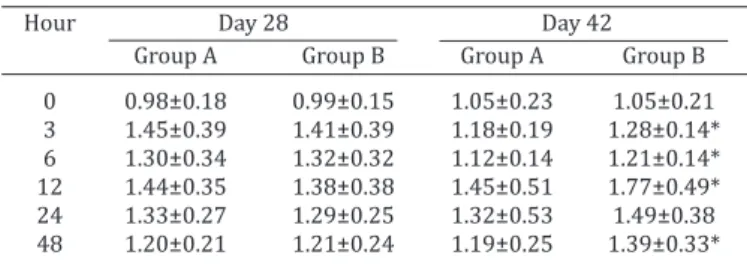
DTH test. Table 1 shows results of DTH test. At day
28, no statistically significant differences (p>0.05) were
found between groups in DTH test. When goat kids were
42 days old, statistically significant differences were ob -served for the response to PHA injection between the group receiving the immunostimulant (higher response) and the control group (lower response) at 3, 6, 12 and 48 hours.
Table 1. Delayed type hypersensitivity test (DTH) of goat kids from control group (A) and receiving an immunostimulant
(group B)
Hour Day 28 Day 42
Group A Group B Group A Group B
0 0.98±0.18 0.99±0.15 1.05±0.23 1.05±0.21 3 1.45±0.39 1.41±0.39 1.18±0.19 1.28±0.14* 6 1.30±0.34 1.32±0.32 1.12±0.14 1.21±0.14*
12 1.44±0.35 1.38±0.38 1.45±0.51 1.77±0.49*
24 1.33±0.27 1.29±0.25 1.32±0.53 1.49±0.38
48 1.20±0.21 1.21±0.24 1.19±0.25 1.39±0.33*
Data are mean ±SD, (n=25). *p<0.05, comparing groups A and B at each time point. Data is expressed as ratio between thickness of the skin with PHA and isotonic saline solution.
Antibody response to OVA. Antibody response follo-wing OVA inoculation is shown in Figure 1. The percentage was increasing by time, but there were no statistically
signi-ficant differences (p>0.05) between groups in total immu -noglobulins and IgG levels when data were analyzed during the experimental period. However, IgM levels were increa-sed by time and at day 63, a high percentage was found in the group receiving the immunostimulant (p<0.05).
OVA--specific IgA concentrations were very low in both groups
of animals (data not show).
DISCUSSION
mor-tality or clinical signs of disease of any kids of both groups were recorded. Also, application of the immunostimulant had no effect on body weight and ADG. There is not any reference of P. acnes effect on growth performance in the livestock. The use of an immunomodulator such as
inacti-vated Parapoxvirus improved significantly growth perfor -mance in piglets compared with controls (Kyriakis et al. 1998) and was due that immunomodulator could be
effec-tive against postweaning diarrhoea syndrome and wasting pig syndrome. In our experiment, in the goat kids no dise-ases or death were observed, so no effect of the
immunos-timulant on health could be observed. Neither, no adverse
effect of P. acnes on health parameters were recorded. Fla-minio et al. (1998) reported a high rectal temperature on foals after injection of P. acnes, and no effects were observed either in foals whose mothers had been inoculated before foaling with P. acnes to increase the quality of the mare’s colostrum (Turner et al. 2003). Recently, Ryan et al. (2010) did not record any adverse effect of an inactivated P. acnes
administrated intravenously in newborn foals and these animals had less intracellular proliferation of Rhodococcus equi within macrophages. However, Corrier & Ziprin (1989)
observed a significant increase of morbidity in one-day-old
broiler chickens inoculated with C. parvum and challenged with Salmonella typhimurium. For these authors, the data
recorded may reflect differences in the modulators effects
of the immunostimulant in chickens. Immunostimulants can produce systemic reactions such as fever, malaise,
diar-rhoea, hypotension or local inflammation following its ad -ministration and these effects are associated with cytoki-ne release by macrophages (Rush 2006, Tizard 2009). The intensity of the effects depends of the multiple dose of the immunostimulant given. Inthis experiment, the immunosti-mulant was administered per os, not by parenteral injection as it has been used in other studies (Corrier & Ziprin 1989, Flaminio et al. 1998, Turner et al. 2003, Ryan et al. 2010). Probably, this via of administration did not put in contact
sufficiently the killed bacteria with the macrophages and
this could explain lack of secondary effects found in our ex-periment.
In this study, the segregation of serum proteins shows normal values for all fractions and slightly higher values for albumin concentrations (normal values 26-31.7g/l) found in our laboratory for Murciano-Granadina goat kids (Fernández et al. 2006) mainly on day 14 in the group B. The results were similar to those found in a previous study (Fernández et al. 2006, Loste et al. 2008). The ingestion of
high quality colostrum during the first hours of life is es -sential for the synthesis and maintenance of the level of serum proteins (Besser & Gay 1994, Constant et al. 1994, Weaver et al. 2000). In this experiment, also the animals
received sufficient quantity and quality of colostrum since the first days of life. One of the reasons for the increase in
albumin level is the dehydration (Kaneko 2008), but this condition was not observed in any of the goat kids included
in our study. No effects of the P. acnes have been previous-ly reported on the albumin synthesis and no explanation could be found to explain these results. Also, the increase in A/G ratio observed only can be explained due to increase in albumin level.
The intradermal injection of PHA produces a local tis-sue reaction, stimulating T lymphocytes similar to that DTH, being a rapid method to assess the cellular immu-nity in vivo (Tizard 2009) and has been successfully used in our laboratory in both goat kids and lambs (Fernández et al. 2006, Loste et al. 2008). Cell immunity is an effector function of lymphocyte and the results of DTH test indicate Fig. 1. Serum OVA-specific antibodies from goat kids of control
group (A) and receiving an immunostimulant (group B).
that goat kids treated with an immunostimulant enhanced cell-mediated immunity (CMI). The lack of DTH response
in goat kids on day 28 could result from an insufficient an -tigen stimulus for induction of high levels of DTH. Also, this difference may be due to the experimental protocol used in our experiment. Braga et al. (2003) observed that type of protocol administrating P. acnes influenced in the outco -me of the immune response in mice because when HEW subcutaneous implant was made one week after adminis-tration of the immunomodulator, a typical DTH and cytoki-ne Th1 response was recorded. This results demonstrated that P. acnes promoted or suppressed the CMI response de-pending on the treatment protocol (Squaiella et al. 2008). The effect of P. acnes on DTH response is contradictory and many reports describe an immunosuppressive activity. In this sense, Gauthier-Rahman (1981) found an immunoinhi-bitory effect of C. parvum on DTH in two strains of guinea pigs when animals were treated with cyclophosphamide. For Corrier & Ziprin (1989) C. parvum suppressed signifi -cantly the DTH response to PHA in 1 day old broiler chi-ckens, indicating that T-lymphocyte activity was suppres-sed. However, for Bomford (1980), C. parvum was the only adjuvant which consistently boosts DTH response to sheep blood cells in a mouse model.
In this experiment, the effect of the administration of an immunostimulant on humoral response was variable.
Serum OVA-specific antibodies were increased by the time
and at day 63 a higher value of IgM was found. Immuni-zation with OVA produced a high and sustained systemic antibody response on immunoglobulins, meanly on IgG levels such as it has been observed in other species (Shel-drake et al. 1985, HogenEsch et al. 1996, Bowersock et al. 1998, Patel et al. 2007). The effect of an immunostimulant on antibody production depends on many factors such as the route of administration, timing of treatment in relation to antigen and the dose of the immunostimulant or the
an-tigen. We administered the immunostimulant during five
days when goat kids were six days old and a poor humoral immunitary response was observed. Perhaps, the oral ad-ministration was not the most appropriate route to cause a
sufficient stimulus to promote to the effectory cells to pro
-duce antibodies. Neither Flaminio et al. (1998) did not find
variations on serum IgG and IgM concentrations on foals injected with P. acnes.
In the goat kids, the immunostimulant was able to in-crease the serum levels of anti-OVA IgM at the end of the experiment. This could be due to the fact that P. acnes is a powerful stimulant of macrophages. These leukocytes pha-gocyte to the microorganisms and stimulate the cytokine synthesis; then, the macrophages stimulated enhance the IL-6 production helping the maturing process of the B lym-phocytes in plasmatic cells. IL-6 together with IL-1 is an important cofactor in the synthesis of IgM (Tizard 2009).
Very little anti-OVA IgA specific antibody was presented
in both groups of goat kids when OVA was injected sub-cutaneously. Similar result was reported by HogenEsch et
al. (1996) who did not find anti-OVA IgA in the serum of
calves challenged with OVA, but high levels could detect in bronchoalveolar lavage. On the contrary, when OVA were
administrated by intranasal, intraperitoneal or intrabron-chial route (Bowersock et al. 1998, Kavanagh et al. 2003,
Patel et al. 2007), vaginal, nasal fluids and faeces had high
levels of IgA. These results suggest that OVA subcutaneous immunization primer for an IgG and IgM production, but not for a mucosal IgA response. The IgA is meanly secreted by intestinal mucosa and has its function in the protection of mucosal surface neutralising microorganisms both ex-tracellularly in mucosal secretions and inex-tracellularly follo-wing infection of epithelial cells at mucosal surfaces (Kava-nagh et al. 2003). Furthermore, the ruminants have less IgA than other immunoglobulins (Tizard 2009).
CONCLUSION
The results of the present study indicate that
administra-tion of the non-specific immunostimulant Propionibacte-rium acnes enhanced both cellular and humoral immunity demonstrated by increasing DTH response to PHA and le-vels of anti-OVA IgM in serum. The immunostimulant admi-nistration could be used to improve immunological status
on the first month of life. However, more investigations are
needed to determine the optimum doses and route of ad-ministration to improve the immunitary response of the goat kids.
Acknowledgements.- This research was funded by a grant from
Diputaci-ón General de AragDiputaci-ón (group A30, Patología de la NutriciDiputaci-ón en Pequeños
Rumiantes).
REFERENCES
Besser T.E. & Gay C.C. 1994. The importance of colostrum to the health of
the neonatal calf. Vet. Clin. North Am., Food Anim. Pract. 10:107-117.
Blecha F. 2001. Immunomodulators for prevention and treatment of in-fectious disease in food-producing animals. Vet. Clin. North Am.,Food Anim. Pract. 17(3):621-633.
Bomford R. 1980. The comparative selectivity of adjuvants for humoral and cell-mediated immunity. II. Effect on delayed-type hypersensitivity in the mouse and guinea pigs, and cell-mediated immunity to tumour antigens in the mouse of Freund’s incomplete and complete adjuvants, alhydrogel, Corynebacterium parvum, Bordetella pertussi, muralmyl di-peptide and saponin. Clin. Exp. Immunol. 39:435-441.
Bowersock T.L., HogenEsch H., Torregrosa S., Borie D., Wang B., Park H. & Park K. 1998. Induction of pulmonary immunity in cattle by oral adminis-tration of ovalbumin in alginate microspheres. Immunol. Lett. 60:37-43.
Braga E.G., Ananias R.Z., Mussalem J.S., Squaiella C.C., Longhini A.L.F., Ma-riano M., Travassos L.R. & Longo-Maugéri I.M. 2003. Treatment with
Propionibacterium acnes modulates the late phase reaction of immedia-te hypersensitivity in mice. Immunol. Lett. 88:163-169.
Constant S.B., Leblanc M.M., Klapstein E.F., Beebe D.E., Leneau H.M. & Nu -nier C.J. 1994. Serum immunoglobulin G concentration in goat kids fed colostrum or a colostrum substitute. J. Am. Vet. Med. Assoc. 205:1759-1762.
Corrier D. & Ziprin R.L. 1989. Suppression of resistance to Salmonella typhimurium in young chickens inoculated with Corynebacterium par-vum. Avian Dis. 33:787-791.
Fernández A., Ramos J.J., Loste A., Ferrer L.M., Figueras L., Verde M.T. &
Marca M.C. 2006. Influence of colostrum treated by heat on immunity
function in goat kids. Comp. Immunol. Microbiol. Infect. Dis. 29:353-364.
Flaminio M.J.B., Rush B.R. & Shuman W. 1998. Immunologic function in
horses after non-specific immunostimulant administration. Vet. Immu -nol. Immunopathol. 63: 303-315.
par-vum in two strains of guinea-pigs and the effect of cyclophosphamide. Immunol. 42:99-109.
Godden S.M., Haines D.M. & Hagman D. 2008. Improving passive transfer of immunoglobulins in calves. I. Dose effect of feeding a commercial co-lostrum replacer. J. Dairy Sci. 92:1750-1757.
HogenEsch H., Torregrosa S., Borie D., Gaskell C. & Bowersock T.L. 1996. Systemic and pulmonary immune response to intrabronchial administra-tion of ovalbumin in calves. Vet. Immunol. Immunopathol. 51:293-302. Johnson J.L., Godden S.M., Molitor T., Ames T. & Hagman D. 2007. Effects of
feeding heat-treated colostrum on passive transfer of immune and nu-tritional parameters in neonatal dairy calves. J. Dairy Sci. 90:5189-5198. Kaneko J.J. 2008. Proteins, proteomics, and the dysproteinemias, p.117-155. In: Kaneko J.J., Harvey J.W. & Bruss M.L. (Eds), Clinical Biochemistry of Domestic Animals. 6th ed. Academic Press, San Diego.
Kavanagh O.W., Earley B., Murray M., Foster C.J. & Adair B.M. 2003.
An-tigen-specific IgA and IgG responses in calves inoculated intranasally
with ovalbumin encapsulated in poly(DL-lactide-co-glycolide) micros-pheres. Vaccine 21:4472-4480.
Kyriakis S.C., Tzika E.D., Lyras D.N., Tsinas A.C., Saoulidis K. & Sarris K.
1998. Effect of an inactivated Parapoxvirus based immunomodulator (Baypamun) on post weaning diarrhoea syndrome and wasting pig syn-drome of piglets. Res. Vet. Sci. 64:187-190.
Loste A., Ramos J.J., Fernández A., Ferrer L.M., Lacasta D., Verde M.T., Marca M.C. & Ortín A. 2008. Effect of colostrum treated by heat on immunologi-cal parameters in newborn lambs. Livest. Sci. 117:176-183.
Megid J. & Kaneno R. 2000. Natural killer activity in mice infected with
rabies virus submitted to P. acnes (Propionibacterium acnes) as immu-nomodulator. Comp. Immunol. Microbiol. Infect. Dis. 23: 91-97.
Megid J., Kaneno R., Nozaki C.N., Brito C.J.C. & Almeida M.F. 2004. Increa -sed interleukin-10 associated with low IL-6 concentrations correlated with greater survival rates in mice infected by rabies virus vaccinated against it and immunomodulated with P. acnes. Comp. Immunol. Micro-biol. Infect. Dis. 27:394-411.
Moretti D.B., Nordi W.M., Lima A.L., Pauletti P., Susin I. & Machado-Neto R.
2012. Lyophilized bovine colostrum as a source of immunoglobulins and insulin-like growth factor for newborn goat kids. Livest. Sci. 145: 223-229. Mutwiri G., Gerdts V., López M. & Babiuk L.A. 2007. Innate immunity and
new adjuvants. Rev. Sci. Tech. OIE 26:147-156.
Patel G.B., Zhou H., Ponce A. & Chen W. 2007. Mucosal and systemic immu-ne responses by intranasal immunization using archaeal lipid-adjuvan-ted vaccines. Vaccine 25:8622-8636.
Perry A.L. & Lambert P.A. 2006. Propionibacterium acnes. Letters Appl. Mi-crobiol. 42:185-188.
Poulsen K.P., Foley A.L., Collins M.T. & McGuirck S.M. 2010. Comparison of passive transfer of immunity in neonatal dairy calves fed colostrum or bovine serum-based colostrum replacement and colostrum supplement products. J. Am. Vet. Med. Assoc. 15:949-954.
Rush B.R. 2006. Immunomodulatory therapy. Proc. North America Vete
-rinary Conference (NAVC). Internet Publisher, International Vete-rinary
Information Service: <http://www.ivis.org/proceedings/navc/2006/ LA/080.asp?LA=1> Accessed Dec. 5, 2011.
Ryan C., Giguère S., Fultz L., Long M.T. & Crawford P.C. 2010. Effects of two commercial available immunostimulants on leukocyte function of foals following ex vivo exposure to Rhodococcus equi. Vet. Immunol. Immuno-pathol. 138:198-205.
Sheldrake R.F., Husband A.J., Watson D.L. & Cripps A.W. 1985. The effect of intraperitoneal and intramammary immunization of sheep on the num-bers of antibody-containing cells in the mammary gland and antibody titres in blood serum and mammary secretions. Immunol. 56:605-614.
Squaiella C.C., Longhini A.L.F., Braga E.G., Mussalem J.S., Ananias R.Z., Yendo T.M., Straus A.H., Toledo M.S., Takahashi H.K., Hirata I.Y. & Longo--Maugéri I.M. 2008. Modulation of the type I hypersensitivity late phase reaction on OVA by Propionibacterium acnes-soluble polysaccharide. Immunol. Lett. 212:157:166.
Stabel J.R., Hurd S., Calvente L. & Rosenbusch R.F. 2004. Destruction of
Mycobacterium paratuberculosis, Salmonella spp., and Mycoplasma spp. in raw milk by a commercial on-farm high-temperature, short-time pas-teurizer. J. Dairy Sci. 87:2177-2183.
Tizard I.R. 2009. Introducción a la Inmunología Veterinaria. 8ª ed. Elsevier Saunders, Barcelona, Spain.
Turner J.L., Arns M.J. & Minton J.E. 2003. Case study: effects of non-specific
immunostimulation of prepartum mares on colostral quality and foal immune function. Prof. Anim. Sci.19:62-67.