Oecologia Australis
20(2): 81-93, 2016
10.4257/oeco.2016.2002.06
COMPOSITION, BODY-SIZE STRUCTURE AND BIOMASS OF ZOOPLANKTON IN A HIGH-ELEVATION TEMPORARY POND (MINAS GERAIS, BRAZIL)
Raquel Aparecida Moreira 1*, Odete Rocha 1, Renata Martins dos Santos 1, Emerson Silva Dias 2, Francisco Wagner Araujo Moreira 2 & Eneida Maria Eskinazi-Sant’Anna 2
1 Universidade Federal de São Carlos (UFSCar), Programa de Pós-Graduação em Ecologia e Recursos Naturais. Rodovia
Washington Luiz, Km 235, s/n, Bairro Monjolinho, CP 676, São Carlos, SP, Brazil. CEP 13565-905
2 Universidade Federal de Ouro Preto (UFOP), Programa de Pós-Graduação em Biomas Tropicais. Departamento de
Biodiversidade, Evolução e Meio Ambiente. Campus Morro do Cruzeiro, s/n, Bauxita, Ouro Preto, MG, Brazil. CEP 35400-000 E-mails: [email protected], [email protected], [email protected], [email protected],
[email protected], [email protected]
ABSTRACT
Small ponds are vital inland water bodies, recognized as small repositories of freshwater biodiversity, but neglected in terms of conservation. Although high-elevation ponds are difficult to sample and monitor, it is important to extend their study, in view of their importance to aquatic biodiversity. The aim of this study was to analyze the composition, size structure biomass and diversity of zooplankton community in a temporary pond (Lagoa Seca) of a low-alpine area in the southern part of Serra do Espinhaço mountain in Minas Gerais State, Brazil. Three ecological aspects were analyzed: (I) the taxonomic composition of the zooplankton assemblage, (II) the size structure and biomass of the main groups in the zooplankton community and (III) whether the morphometric characteristics and biomass of the zooplankton result from the dominance of the microzooplankton, as expected in habitats subjected to frequent and strong disturbances, such as temporary ponds. Zooplankton samples were taken during the rainy period (Oc-tober 2010 to January 2011) in different mesohabitats, from the shallowest areas covered by emergent macrophytes to the open water area covered mainly by submerged macrophytes. The zooplankton community consisted of a small number of taxa (29). Rotifera showed the highest richness, with 21 taxa recorded, of which the most constant species were the cosmopolitan Lecane lunaris, L. obtusa and Lepadella patella. Among the Cladocera, Bosmina freyi and Moina minuta were the pelagic species recorded. The other cladoceran species observed are associated with littoral vegetation, and represented mainly by Alona ossiani, Chydorus pubescens, Ephemeroporus tridentatus and Ilyocryptus spinifer. The zooplankton biomass was very low (themaximum dry weight, observed at the peak of the rainy period in January was 62 µg.m-3). The zooplankton community was dominated by the microzooplankton, with the maximum body length below 900 µm. This assemblage was very changeable in the short term, both in numerical density and size structure, probably because of the highly variable hydrological regime of the pond. The results from zooplankton composition, including the first record of the rotifer Microcodon clavus to Minas Gerais state and the second in Brazil, highlighted the important role that high-elevation temporary ponds can play as aquatic biodiversity reserves. These unique ecosystems deserve greater efforts of research and monitoring, including studies of their hydrological pat-terns, biological diversity, and adaptive mechanisms of the zooplankton community.
Keywords: Iron Quadrangle; mountain; shallow lake; zooplankton community.
INTRODUCTION
The occurrence of a species of aquatic invertebrate in temporary and semi-temporary ponds is largely determined by its tolerance to changing environmental conditions or its capacity for dispersal and colonization of new habitats in periods of adversity (Carter et al. 1980, Hebert & Hann 1986, Girdner & Laron 1995). For this
of zooplankton as essential strategies to maintain their long-term persistence in such lakes, as well as to minimize the effects of the intense predation and competition in small aquatic bodies (Havens & Beaver 2010, Iglesias et al. 2011).
Very little information has been recorded yet about the diversity of the zooplankton communities in high-altitudinal ponds, particularly in Brazil. By virtue of the exceptional topography, which restricts these montane ecosystems to regions of
difficult access in the Brazilian landscape, and
also because the study of temporary lakes and ponds is still at an early stage, these ecosystems have received little attention (Santos-Wisniewsky et al. 2002, Eskinazi-Sant’Anna et al. 2011). Although mountain lakes remain hard to sample and monitor, it is important to maintain and extend their study, in view of their relevance to endemism and evolutionary processes (Psenner 2002).
Various mountain lakes are found in the region of Minas Gerais State known as the Iron Quadrangle (Oliveira et al. 2005), a region known nationally and internationally for its great mineral deposits. On account of the mining activity, the shallow lakes located in areas with outcrops of iron ore are viewed as critically threatened ecosystems (Carmo et al. 2012). In this context, the aim of this study was to analyze the composition of the zooplankton community in a temporary lake at high elevation in the Iron Quadrangle (MG, Brazil), namely “Lagoa Seca”. The following topics were investigated: (I) the composition and diversity of zooplankton species in a shallow temporary freshwater ecosystem; (II) the biomass and body size structure of zooplankton in this system; and (III) whether these characteristics show patterns similar to those expected in highly disturbed habitats, such as low biomass and dominance of small forms (microzooplankton).
MATERIAL AND METHODS
Study area, general characteristics of Lagoa Seca and abiotic variables
Lagoa Seca is a small pond (300 m2 of area when completely filled) located at Itacolomi State
Park, a Conservation Unit situated in the Districts of Ouro Preto and Mariana (Minas Gerais state).
This pond is a temporary natural freshwater body, formed in a small depression at 1,609 meters above sea level (m a.s.l.) and coordinates 20°22’30” - 20°30’00” S and 43°32’30” - 43°22’30” W; Figure
1). The pond is filled during the rainy season by
surface runoff reaching a maximum depth of 1.5 m and usually remaining completely dry throughout the dry season, from April to September. The climate is altitudinal, warm temperate (with mean annual temperature of 18.9°C. Mean temperature is 21.4°C in January and 15.7°C in July. Historical mean annual rainfall is 1,475 mm, with a monthly mean of 308 mm in December, the wettest month, and 15 mm in July, the driest month in the year (INMET 2015).
This pond has a rounded outline, with arms in the form of narrow canals radiating in several directions (Fig. 1), and being surrounded by natural alpine vegetation, predominantly grasses and small herbaceous plants. Lagoa Seca pond is almost entirely covered by macrophytes, notably Eleocharis densa, Juncus densiflorus and Egeria minima. There is no record of fish and the potential zooplankton predators are the benthic macroinvertebrates (mainly insect larvae) and tadpoles.
Sampling and analysis of zooplankton community
83 Moreira et al.
magnification), the entire sample being included.
For the rotifers, 1 mL sub-samples were analyzed under an optical microscope in a Sedgewick-Rafter cell. A specialized literature was used for rotifers taxonomic identification, (Edmondson 1959, Olivier 1963, Paggi 1973, Koste 1978, Paggi 1978, Berner 1985, Segers 1993, 1995, Elmoor-Loureiro 1997, Elmoor-Loureiro 2014).
Zooplankton density was obtained by multiplying counting data versus the water volume of the sample (90L of water). The indices of diversity, dominance and evenness were calculated using the statistical program PAST 1.94 (Hammer et al. 2001). The patterns of dominance and richness of the zooplankton community were
represented by dominance curves in which the species are shown in decreasing order of abundance against its respective ranking (Lambshead et al. 1983, Clarke 1990).
The Constancy Index of Dajoz (Lobo & Leigthon, 1986), was calculated based on the frequency of occurrence of each zooplankton species, as follows: c = 100 n/N, being: n = number of samples with the species occurrence; N = total number of samples analyzed. According to the
value of this index the species were classified as:
constant, if occurring in more than 50% of samples; accessory, if occurring in more than 25% and less than 50% of samples and accidental or rare, if occurring in less than 25% of samples.
During the zooplankton sampling, some physical and chemical parameters (water temperature, pH and electrical conductivity) were measured with a Horiba (model U-50) multiprobe analyzer.
Determination of the size-structure and biomass of the zooplankton
The size of the organisms in each group was measured for around 30 animals (or fewer for less abundant taxa), under an optical microscope with a graduated eyepiece. Combined with the density data, the measured lengths of the organisms were used to estimate the biomass of each genus/species, expressed in µg dry weight per cubic meter (µg DW m-3).
Microcrustacean species biomass was calculated from their length by means of a model proposed by Bottrel et al. (1976). For rotifers, the biomass was obtained according to Ruttner-Kolisko (1977) biovolume formulas. The biovolume was then calculated as the wet
weight, taking the specific density to be 1.0 and
the conversion from wet weight to dry weight was performed assuming a multiplication factor of 0.1 (Doohan 1973, according to Bottrell et al. 1976).
RESULTS
Abiotic variables, taxonomic composition and abundance of populations
The mean pH in Lagoa Seca reveals that water was slightly acid, with mean value of 6.52 ± 0.07. We did not observe the occurrence of thermocline in the water column, with mean water temperature from 19.2 ± 0.18°C. Very low value of conductivity was registered during all the sampling period; the mean value was 0.008 ± 0.006 mS cm-1.
We registered the occurrence of 29 taxa of zooplankton, being 8 Cladocera and 21 Rotifera taxa. Only juvenile phases (nauplii and copepodites) of Copepoda (Cyclopoida and Harpacticoida) were recorded, so that the individual taxa could
not be identified. The highest species richness
was observed in the Rotifera group followed by Cladocera in the month of October, and the nauplii
of an anostracan crustacean, Dendrocephalus sp (Daday 1908) were found in the lake.
The constant taxa ( > 50% of samples) were: Alona ossiani, Chydorus pubescens, Ilyocryptus spinifer and Ephemeroporus tridentatus (Cladocera), Lecane lunaris, Lecane obtusa, Lepadella patella, Microcodon clavus, Monommata sp., Trichocerca insignis, Trichocerca myersi and Trichocerca similis (Rotifera). Nauplii and copepodites of Cyclopoida and copepodites of Harpacticoida (Copepoda) as well as rotifers of the Subclass Bdelloidea were also constant in the samples. The rare taxa (occurring in one sample) were: Alona glabra and Moina minuta (Cladocera) and Colurella obtusa, Filinia opoliensis, Filinia longiseta, Keratella reducta, Lecane furcata, Lecane haliclysta, Trichocerca sp (Rotifera). Adult Harpacticoida copepods also occurred in one sample.
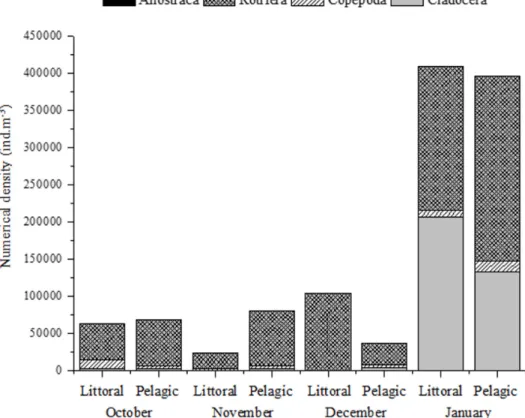
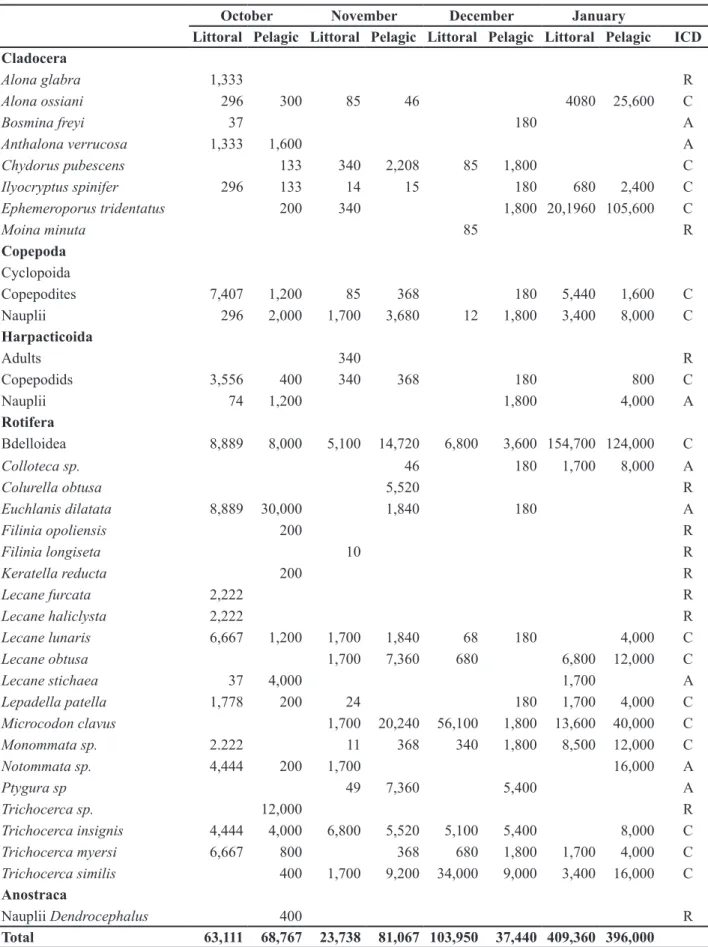
The highest total zooplankton densities were always observed in samples from the littoral zone in December and January (Figure 2). The species that contributed most to these results were: one species of Rotifera Bdelloidea (154,700 ind.m-3) and the rotifers Microcodon clavus
(56,100 ind.m-3) and Euchlanis dilatata (30,000
ind.m-3). The lowest densities were recorded for
the rotifer species Filinia longiseta (10 ind.m-3)
and Ptygura sp. (49 ind.m-3) in the littoral zone
(Table 1).
The results showed a variation in space and time of the zooplankton biomass, which generally showed rather low values (maximum density was 14,208 µg DW.m-3 in the littoral zone
in October, the beginning of the rainy period; Figure 3). In January, there was a notable peak with total biomasses of 62,797 µg DW.m-3 and
44,280µg DW.m-3 in the littoral and pelagic zones,
respectively.
85 Moreira et al.
Figure 2. Variation in the numerical density of the main component groups of the zooplankton community and the whole community, in the littoral and pelagic zones of Lagoa Seca, in October 2010 to January 2011 (rainy season).
Table 1. Composition, density (ind.m-3) and constancy (Dajóz constancy index-DCI) of zooplankton taxa sampled in Lagoa Seca, a temporary mountain lake in the Iron Quadrangle, MG (Brazil), from October 2010 to January, 2011. ICD: C = Constant; A = Accidental; R = Rare.
October November December January
Littoral Pelagic Littoral Pelagic Littoral Pelagic Littoral Pelagic ICD
Cladocera
Alona glabra 1,333 R
Alona ossiani 296 300 85 46 4080 25,600 C
Bosmina freyi 37 180 A
Anthalona verrucosa 1,333 1,600 A
Chydorus pubescens 133 340 2,208 85 1,800 C
Ilyocryptus spinifer 296 133 14 15 180 680 2,400 C
Ephemeroporus tridentatus 200 340 1,800 20,1960 105,600 C
Moina minuta 85 R
Copepoda Cyclopoida
Copepodites 7,407 1,200 85 368 180 5,440 1,600 C
Nauplii 296 2,000 1,700 3,680 12 1,800 3,400 8,000 C
Harpacticoida
Adults 340 R
Copepodids 3,556 400 340 368 180 800 C
Nauplii 74 1,200 1,800 4,000 A
Rotifera
Bdelloidea 8,889 8,000 5,100 14,720 6,800 3,600 154,700 124,000 C
Colloteca sp. 46 180 1,700 8,000 A
Colurella obtusa 5,520 R
Euchlanis dilatata 8,889 30,000 1,840 180 A
Filinia opoliensis 200 R
Filinia longiseta 10 R
Keratella reducta 200 R
Lecane furcata 2,222 R
Lecane haliclysta 2,222 R
Lecane lunaris 6,667 1,200 1,700 1,840 68 180 4,000 C
Lecane obtusa 1,700 7,360 680 6,800 12,000 C
Lecane stichaea 37 4,000 1,700 A
Lepadella patella 1,778 200 24 180 1,700 4,000 C
Microcodon clavus 1,700 20,240 56,100 1,800 13,600 40,000 C
Monommata sp. 2.222 11 368 340 1,800 8,500 12,000 C
Notommata sp. 4,444 200 1,700 16,000 A
Ptygura sp 49 7,360 5,400 A
Trichocerca sp. 12,000 R
Trichocerca insignis 4,444 4,000 6,800 5,520 5,100 5,400 8,000 C
Trichocerca myersi 6,667 800 368 680 1,800 1,700 4,000 C
Trichocerca similis 400 1,700 9,200 34,000 9,000 3,400 16,000 C Anostraca
Nauplii Dendrocephalus 400 R
87 Moreira et al.
Figure 4. Box plots representing body sizes ranges(μm) for each species, or developmental phases, as in the case of Copepoda, for the main zooplankton groups occurring in Lagoa Seca from October 2010 and January 2011.
The size structure of zooplankton community
In general the community was mainly represented by the small microzooplankton with sizes varying between 50 and 300 μm. Rotifera individuals were the smallest, most with sizes in the range 50-100 μm. Some Cladocera species, especially Bosmina freyi, Ephemeroporus tridentatus, Chydorus pubescens and Anthalona verrucosa were in the size range of 150-300 μm (Figure 4).
A second size range comprised the copepodids of Cyclopoida and Harpacticoida copepods, with
sizes in the range of 300-700 μm. The third size range comprised the cladocerans as Ilyocryptus spinifer, Alona ossiani and Moina minuta with sizes ranging between 170 and 850 μm.
Zooplankton species richness, Dominance and Shannon Wiener diversity
Species diversity indices for zooplankton community varied from 1.1 to 2.5 bits.ind-1, with
lower values in the littoral zone (Figure 5). The lowest values of dominance index (1.1) coincided with highest values of equitability (2.5) and
89 Moreira et al.
diversity (2.5) indices. The highest value for the dominance index (0.40) was recorded for samples from the littoral zone in December 2010 and January 2011.
The dominance component curves followed the broken-stick model with low dominance and relatively high richness (Figure 6). The curves evidenced the lowest richness and highest dominance in the littoral region in the period of December - January which coincided with the peak of abundance ofMicrocodon clavus (Rotifera)and Ephemeroporus tridentatus (Cladocera).
DISCUSSION
The zooplankton of Lagoa Seca was temporally dominated by Neotropical or cosmopolitan species, in which a new occurrence was registered for the state of Minas Gerais: the rotifer Microcodon clavus. The low species richness in the zooplankton community is probably related to a number of factors acting simultaneously, being the geographic isolation only one among these factors. According to Tavernini et al. (2009) there is a linear decrease of the species richness among the meso-zooplankton as altitude increases. Also, according to the Theory of Island Biogeography (McArthur & Wilson 1967, Rosindell & Phillimore 2011), as more isolated the habitat, lower is the probability of colonization by other species, especially for zooplankton species that are passively dispersed (Cáceres & Soluk 2002, Adamowicz et al. 2009).
Therefore, a large fraction of local diversity seems to be maintained by dormancy mechanisms (resting eggs) and some by passive dispersion (anemocoric or zoocoric), that favor mainly the microzooplankton morphotypes (Frisch et al. 2007; Meutter et al. 2008). Resting eggs from Chydoridae were observed during the sampling analysis (personal communication). This seems to
be an efficient strategy for the reappearing of local
populations and maintenance of local diversity. The Lagoa Seca is also a hotspot for amphibian species and tadpoles (Drummond 2009), which
can represent an extremely efficient zooplankton
dispersal agent (Vanschoenwinkel et al. 2008). The occurrence of nauplii and copepodids of Copepoda (Cyclopoida and Harpacticoida), in
high numbers during the study period, although no adults were collected, is an important fact to the populations dynamics and food web, considering that these initial phases can have a distinct niche from that of adults, thus increasing local functional diversity (Vogt et al. 2013). Nauplii and early instars of copepodids phases among Cyclopoida
copepods are mainly herbivore filterers, whereas
the last developmental stages and adults have raptorial feeding habits (Adrian & Frost 1992) but some species can be exclusively herbivorous, as Cyclops vicinus (Santer & Van den Bosch 1994).
Cladocerans were mainly represented by epibenthic species. Only two small-bodied and pelagic species were registered: Bosmina freyi and Moina minuta. The predominance of phytophylous Chydoridae species is a constant pattern in wetlands and shallow lakes (Araújo et al. 2013, Diniz et al. 2013) and some high-elevation temporary ponds (Coronel et al. 2007) probably due to the presence ofmacrophytes, which act as both shelter against predation and food source (Cazzanelli et al. 2008). Chydoridae species are particularly successful in temporary ponds (Dole-Olivier et al. 2000) because also are adapted to harsh environmental conditions (e.g. high temperatures and low oxygen concentrations) and able to exploit both the littoral and pelagic zones of permanent and temporary water bodies (Alonso 1996, Santos-Wisniewski et al. 2002). The occurrence of exclusive species and the highly specialized crustacean fauna play a substantial role in these temporary ponds to be a hot spot to Cladocera diversity.
Rotifers constituted the group with highest species richness and population densities in Lagoa Seca, a recurrent pattern in tropical freshwater environments (Matsumura-Tundisi 2007), and also being most representative in lakes and reservoirs throughout the world (Segers et al.1993, Rocha et al. 1995, Bozelli 2000, Sharma & Sharma 2012). The predominance of rotifers can be related to detritus food webs. According to Lijklema (1994), decomposition of macrophyte detritus in shallow lakes can be responsible for half of the observed
flux of dissolved total phosphorous and dissolved
2006), what can end up in a convergence of the
zooplankton assemblage to microfilterers.
Body size is ubiquitously recognized as a critically important attribute of animal functional biology and ecology (Havens et al. 2014). From the ecosystem view, size structure of zooplankton affects biological interactions (predation, feeding
response and efficiency), behaviour (e.g. vertical migration), feeding, metabolic rates, fecundity, growth rates, and play a fundamental role on ecosystem production rates, gas storage and release (e.g. CO2) (Schmitz et al. 2014), and net production rates (Kerr & Dickie 2001, Edvardsen et al. 2002).
Despite being a topic from many papers (see review in Hart & Bychek 2011), zooplankton size-structure is still a matter of ample controversy in aquatic ecology. In the classical paper of Brooks & Dodson (1965), zooplankton size was used to
test the size-efficiency hypothesis, and vertebrate
predation played a fundamental role in shaping zooplankton size structure. Recent studies have shown that not only vertebrate predation can constrain zooplankton body size, but invertebrate predation and water temperature can be decisive in determining zooplankton body size (Bonecker et al. 2011, Havens et al. 2014).
The size structure of the zooplankton community from Lagoa Seca was characterized by the dominance of microzooplankton with small sized species (< 800 µm). Usually, systems that are subjected to intense disturbances (e.g. eutrophication, top-predator effect, food quality changes) are characterized by the dominance of microzooplankton (Nogueira & Matsumura-Tundisi 1996, Brito et al. 2011). Rapid life cycles and growth can explain their success in these fluctuating and stressing ecosystems. In zooplankton community of Lagoa Seca, microzooplankton was mainly represented by rotifers (generalist feeding) and scrapers Cladocera (mainly Chydoridae), which are ineffective at controlling algal production and thus, less dependent of algal food sources.
According to Hart & Bychek (2011), literature on zooplankton feeding reveals the effect not only of food quantity, but also of food quality on individual body size. Food quality is a complex
topic, involving and/or influenced by physical/
morphological attributes, besides biochemical
features of food particles. Studies that have
considered their influence on body size reveal a
general decline in size when food quality is low (Gulati & DeMott 1997). Unfortunately we do not have phytoplankton composition data available
to Lagoa Seca, but a recent finding (Moreira et al. 2015) reveal that the dinoflagellate Ceratium furcoides occurs in the phytoplankton of this lake.
Dinoflagellates are considered a low quality food
for zooplankton, and the size of the cell (over 1000 µm) is also a limiting feature to zooplankton feeding. Trophic condition can be a determining factor driving the dominance of microzooplankton possibly via detritus consumption considering the oligotrophic condition of Lagoa Seca, as already described by Eskinazi-Sant’Anna et al (2011).
A pattern of zooplankton biomass increasing during the peak of rainy period (November and December) with Cladocera contributing most to total zooplankton biomass was observed in Lagoa Seca. Although there are few data available concerning zooplankton biomass in natural, temporary, altitudinal ponds, the same pattern was also observed in other Brazilian freshwater systems (Matsumura-Tundisi et al. 1989, Pinto-Coelho et al. 2005, Viti et al. 2013).
The short-term variability of the zooplankton community in ponds can be attributed to its natural variability and to its temporal heterogeneity regarding physical and chemical patterns of the ecosystem (Downing 2010). The low pH values observed in the water of Lagoa Seca (mean pH 6.52 ± 0.07) reinforce the role of the altitudinal aquatic ecosystems as early warning ecosystems to natural or anthropogenic impacts (Thompson et al. 2009, Eggermont et al. 2010). Low pH values in the water can occur when intense decomposition of macrophytes takes place (Carpenter & Lodge 1986). On the other hand, mountain lakes are also very sensitive to atmospheric deposition of
pollutants, and acidification is a very common
91 Moreira et al.
predation in shaping zooplankton size-structure has been highlighted in many studies (as reviewed in Hart & Bychek 2011). Nevertheless, our study was
conducted in a fishless lake and even without the
direct action of vertebrate predators, zooplankton size-structure in Lagoa Seca was quite similar
for those fish-lakes. Therefore, invertebrate lake
predators (mainly belonging to Trichoptera, Odonata, Belostomatidae and Plecoptera) are very abundant in the lake, and some specimens have been caught in the zooplankton samples (Eskinazi-Sant’Anna, personal observation). Thus, invertebrate predation may play a crucial role in shaping zooplankton size-structure in this temporary lake. According to Havens et al. (2014), invertebrate predation can be a source of variation in zooplankton size-structure, as important as temperature and vertebrate predation. In this sense, experiments looking for answers regarding these insights for tropical temporary ponds can provide new and a more consistent basis to the understanding of the factors regulating zooplankton size structure. Additionally, the results here obtained revealed the importance of such small humid areas to the aquatic biodiversity and the need to expand the knowledge regarding the adaptations and interaction of the altitudinal tropical aquatic communities.
ACKNOWLEDGEMENTS
To FAPEMIG for the financial support of the project (CRA -
APQ-01767-11). To MSc. Timothy J.C. Roberts for the English translation of the early version of the manuscript. We thank UFOP
for logistic support during field trips. OR and EMES are grateful to CNPq for finnancial support.
REFERENCES
Adamowicz, S. J., Petrusek, A., Colbourne, J. K., Hebert, P. D. N., Witt, J. D. S. 2009. The scale of divergence: A phylogenetic appraisal of intercontinental allopatric speciation in a passively dispersed freshwater zooplankton genus. Molecular Phylogenetics and Evolution, 50, 423-436.
Adrian, R., & Frost, T. M. 1992. Comparative feeding ecology of Tropocyclops prasinus mexicanus (Copepoda, Cyclopoida). Journal of Plankton Research, 14, 1369-1382.
Alonso, M. 1996. Fauna Iberica. Crustacea: Branchiopoda. Museo Nacional de Ciencias Naturales. Consejo Superior
de Investigaciones Cientificas. Madrid: España: p. 486.
Araújo, L. R., Lopes, P. M., Santangelo, J. M., Petry, A. C., Bozelli, R. L. 2013. Zooplankton resting egg banks in permanent and temporary tropical aquatic systems. Acta Limnologica Brasiliensia, 25(3), 235-245.
Berner, D. B. 1985. Morphological differentiation among species in the Ceriodaphnia cornuta complex (Crustacea, Cladocera). Verhandlungen der Internationalen Vereinigung der Limnologie, 22, 3099-3103.
Bonecker, C. C., Azevedo F. D., Simões, N. R. 2011. Zooplankton body-size structure and biomass in tropical
floodplain lakes: relationship with planktivorous fishes.
Acta Limnologica Brasiliensia, 23, 217-228.
Bottrell, H. H., Duncan, A., Gliwicz, Z., Grygierek, M. E., Herzig, A., Hillbricht-Ilkowska, A., Kurasawa, H., Larsson, P., Weglenska, T. A. 1976. Review of some problems in zooplankton production studies. Norwegian Journal of Zoology, 24, 419-56.
Bozelli, R. L. 2000. Zooplâncton. In: Bozelli, R. L., Esteves, F. A. and Roland, F. (Eds.). Lago Batata: impacto e recuperação de um ecossistema amazônico. pp. 119-138. Rio de Janeiro: Instituto de Biologia, Universidade Federal do Rio de Janeiro.
Brito, S. L., Maia-Barbosa, P. M., Pinto-Coelho, R. M. 2011. Zooplankton as an indicator of trophic conditions in two large reservoirs in Brazil. Lakes & Reservoirs: Research and Management, 16, 253-264.
Brooks, J. L., & Dodson, S. I. 1965. Predation, body size, and composition of plankton. Science, 150, 28-35.
Cáceres, C., & Soluk, D. 2002. Blowing in the wind: a field
test of overland dispersal and colonization by aquatic invertebrates. Oecologia, 131, 402-408.
Camarero, L., Botev, I., Muri, G., Psenner, R., Rose, N., Stuchlik, E. 2009. Trace elements in alpine and arctic lake sediments as a record of diffuse atmospheric contamination across Europe. Freshwater Biology, 54, 2518-2532. Carmo, F. F., Carmo, F. F., Campos, I. C., Jacobi, C. M. 2012.
Cangas: ilhas de ferro estratégicas para a conservação. Ciência Hoje, 295, 48-53.
Carpenter, S. R., & Lodge, D. M. 1986. Effects of submersed macrophytes on ecosystem processes. Aquatic Botany, 26, 341-370.
Carter, J. C. H., Dadswell, M. J., Roff, J. C., Sprules, W. G. 1980. Distribution and zoogeography of planktonic crustaceans and dipterans in glaciated eastern North America. Canadian Journal of Zoology, 58, 1355-1387. Cazzanelli, M., Warming, T. P., Christoffersen, K. S. 2008.
Emergent and floating-leaved macrophytes as refuge
for zooplankton in a eutrophic temperate lake without submerged vegetation. Hydrobiologia, 605, 113-122. Clarke, K. R. 1990. Comparisons of dominance curves.
Journal of Experimental Marine Biology and Ecology, 138, 143-157.
Coronel, J. S., Declerck, S., Brendonck, L. 2007. High-altitude peatland temporary pools in Bolivia house a high cladoceran diversity. Wetlands, 27(4), 1166-1174.
of a temporary shallow pond in the caatinga of Pernambuco, Brazil. Nauplius, 21(1), 65-78.
Dodson, S. I. 1974. Zooplankton Competition and Predation:
An Experimental Test of the Size-Efficiency Hypothesis.
Ecology, 55, 605-613.
Dole-Olivier, M. J., Galassi, D. M. P., Marmonier, P., Creuzé Des Châtelliers, M. 2000. The biology and ecology of lotic microcrustaceans. Freshwater Biology, 44, 63-91. Downing, J. A. 2010. Emerging global role of small lakes
and ponds: little things mean a lot. Limnetica, 29, 9-24. Drummond, L. O. 2009. Efeito do fogo na composição,
distribuição e dieta de uma taxocenose de anfíbios anuros de campos rupestres em Ouro Preto, MG. Departamento de Biodiversidade, Evolução e Meio Ambiente da Universidade Federal de Ouro Preto. p. 104.
Edmondson, W. T. 1959. Freshwater Biology. 2nd ed. John Wiley & Sons Inc; New York: p. 1248.
Edvardsen, A., Zhou, M., Tande, K. S., Zhu, Y. 2002. Zooplankton population dynamics: Measuring in situ growth and mortality rates using an Optical Plankton Counter. Marine Ecology Progress Series, 227, 205-219. Eggermont, H., Vershuren, D., Audenaert, L., Lens, L.,
Russell, J., Klaassen, G., Heiri, O. 2010. Limnological and ecological sensitivity of Rwenzori mountain lakes to climate warming. Hydrobiologia, 648, 123-142. Elmoor-loureiro, L. M. A. 1997. Manual de identificação de
cladóceros límnicos do Brasil. Universa: Brasília: p. 156. Elmoor-loureiro, L. M. A. 2014. Cladóceros do Brasil:
Famílias Chydoridae e Eurycercidae. Retrieved from http://cladocera.wordpress.com/ (Accessed on 08 de jan. 2014).
Eskinazi-Sant’anna, E. M., Freitas, L. D., Moreira, R. A. 2011. Ecossistemas lacustres montanos: biodiversidade e grau de vulnerabilidade à ação antrópica. MG-Biota, 4, 37-40.
Frisch, D., Green, A. J., Figuerola, J. 2007. High dispersal capacity of a broad spectrum of aquatic invertebrates via water birds. Aquatic Science, 69, 568-574.
Gélinas, Y., Lucotte, M., Schmit, J. P. 2000. History of the atmospheric deposition of major and trace elements in the industrialized St. Lawrence Valley, Quebec, Canada. Atmospheric Environment, 34, 1797-1810.
Girdner, S. F., & Larson, G. L. 1995. Effects of hydrology on zooplankton communities in high-mountain ponds. Mount Rainier National Park, USA. Journal of Plankton Research, 17, 1731-1755.
Gulati, R. D., & De Mott, W. R. 1997. The role of food quality for zooplankton: remarks on the state-of-the-art, perspectives and priorities. Freshwater Biology, 38(7), 53-768.
Hammer, U. T., Harper, D., Ryan, P. 2001. Past: Paleontological statistics software package for education and data analysis. Paleontological Electronic, 4, 1-9.
Hart, R. C., & Bychek, E. A. 2011. Body size in freshwater planktonic crustaceans: an overview of extrinsic determinants and modifying influences of biotic interactions. Hydrobiologia, 668, 61108.
Havens, K. E., & Beaver, J. B. 2010. Composition, size, and biomass of zooplankton in large productive Florida lakes. Hydrobiologia, 668, 49:60.
Havens, K., Pinto-Coelho, R. M., Beklioğlu, M.,
Christoffersen, K., Jeppesen, E., Lauridsen, T., Mazumder,
A., Méthot, G., Alloul, B., Tavşanoğlu, U. N., Erdoğan, Ş., Vijverberg, J. 2014. Temperature effects on body size of freshwater crustacean zooplankton from Greenland to the tropics. Hydrobiologia, 1-9.
Hebert, P. D. N., & Hann, B. J. 1986. Patterns in the Composition of Arctic Tundra Pond Microcrustacean Communities. Canadian Journal of Fisheries and Aquatic Sciences, 43, 1416-1425.
Iglesias, C., Mazzeo, N., Meerhoff, M., Lacerot, G., Clemente, J., Scasso, F., Kruk, C., Goyenola, G., García-Alonso, J., Amsinck, S., Paggi, J., José de Paggi, S., Jeppesen, E.. 2011. High predation is of key importance for dominance of small-bodied zooplankton in warm
shallow lakes: evidence from lakes, fish exclosures and
surface sediments. Hydrobiologia, 667, 133-147. INMET – Instituto Nacional de Metereologia. Retrieved
from http://www.inmet.gov.br/portal/ (Accessed on 18/05/2015).
Kerr, S. R., & Dickie, L. M. 2001. The biomass spectrum: a predator-prey theory of aquatic production. Columbia University Press: New York: p. 320.
Koste, W. 1978. Rotatoria die radertiere mitteleuropas, Übeiordnung Monogononta. Gebriider Bernträger: Berlim: p. 1010.
Lambshead, P. J. D., Platt, H. M., Shaw, K. M. 1983. The detection of differences among assemblages of marine benthic species based on an assessment of dominance and diversity. Journal of Natural History, 17, 859-874. Lijklema, L., 1994. Nutrient dynamics in shallow lakes:
effects of changes in loading and role of sediment– water interactions. Hydrobiologia, 275/276, 335-348. Lobo, E., & Leighton, G. 1986. Estructuras comunitarias
de las fitocenosis planctonica de los sitemas de desmbocaduras de rios e esteros de la zona central de Chile. Revista de Biología Marina y Oceanografía, 22(1), 1-29.
MacArthur, R. I., & Wilson, E. O. 1967. The theory of island biogeography. Princeton University Press: Princeton: New Jersey: p. 224.
Matsumura-Tundisi, T., Rietzler, A. C., Tundisi, J. G. 1989. Biomass (dry weight and carbon content) of plankton Crustacea from Broa reservoir (São Carlos, SP, Brazil)
and its fluctuations across one year. Hydrobiologia, 179, 229-236.
Matsumura-Tundisi, T. 2007. Diversidade de zooplâncton em represas do Brasil., In: R. Henry (Ed.). Ecologia de reservatórios: estrutura, função e aspectos sociais. pp. 39-54. Botucatu: Fundibio.
93
Moreira et al.
Meutter, F. V., Stoks, R., Meester, L. 2008. Size-selective dispersal of Daphnia resting eggs by backswimmers (Notonecta maculata). Biology Letters, 4, 494-496. Moreira, R. A., Rocha, O., Santos, R. M., Laudares-Silva, R.,
Dias, E. S., Eskinazi-Sant’anna, E. M. 2015. First Record of Ceratium furcoides (Dinophyta), an invasive species, in a temporary high-altitude lake in the Iron Quadrangle (MG, Southeast Brazil). Brazilian Journal of Biology, 75(1), 98-103.
Murphy, C., Thompson, P., Vinebrooke, R. 2010. Assessing the sensitivity of alpine lakes and ponds to nitrogen deposition in the Canadian Rocky Mountains. Hydrobiologia, 648, 83-90.
Nogueira, M., & Matsumura-Tundisi, T. 1996. Limnologia
de um sistema artificial raso (Represa do Monjolinho-São
Carlos, SP): dinâmica das populações planctônicas. Acta Limnologica Brasiliensia, 8, 68-149.
Olivier, S. R. 1963. Los cladoceros argentinos. Con claves
de las especies, notas biologicas y distribución geografica.
Revista del Museo de La Plata, 7, 173-269.
Oliveira, N. V., Endo, I., Oliveira, L. G. S. 2005. Geometria sinclinal Gandarela baseada na deconvolução Euler 2D e 3D – Quadrilátero Ferrífero, MG. Revista Brasileira de Geofísica, 23, 221-232.
Paggi, J. C. 1973. Acerca de algunas especies de la familia Moinidae (Crustacea, Cladocera) de la Republica Argentina. Physis Sección B, 32, 269-277.
Paggi, J. C. 1978. Revision de las especies argentinas del genero Diaphanosoma Fisher (Crustacea, Cladocera). Acta Zoologica Lilloana, 33, 43-65.
Pinto-Coelho, R., Pinel-Alloul, B., Méthot, G.., Havens, K. E. 2005. Crustacean zooplankton in lakes and reservoirs of temperate and tropical regions: variation with trophic status. Canadian Journal of Fisheries and Aquatic Sciences, 62, 348-361.
Psenner, R. 2002. Alpine waters in the interplay of global change: complex links – simple effects? In: Steininger, K. W., & Weck-Hannemann, H. Global Environmental Change in Alpine Region. New Horizons in Environmental Economics. Cheltenham: Edward Eldgar: p. 271. Rocha, O., Sendacz, S., Matsumura-Tundisi, T. 1995.
Composition, biomass and productivity of zooplankton in natural lakes and reservoirs of Brazil. In: Tundisi, J.G., Bicudo, C. E. M., & Matsumura-Tundisi, T. (Eds.). Limnology in Brazil. pp. 151-165. ABC/SBL: Rio de Janeiro.
Rosindell, J., & Phillimore, A. B. A. 2011. Unified model of
island biogeography sheds light on the zone of radiation.
Ecology Letters, 14, 552-560.
Ruttner-Kolisko, A. 1977. Suggestions for biomass calculation of plankton rotifers. Archiv für Hydrobiologie–Beiheft Ergebnisse der Limnologie, 8, 1-76.
Santos-Wisniewski, M. J., Rocha, O., Güntzel, A. M., Matsumura-Tundisi, T. 2002. Cladocera Chydoridae of high altitude water bodies (Serra da Mantiqueira), in Brazil. Brazilian Journal of Biology, 62, 681-687. Santer, B., & Van den Bosch, F. (1994) Herbivorous
nutrition of Cyclops vicinus: the effect of a pure algal diet on feeding, development, reproduction and life cycle. Journal of Plankton Research, 16, 171-195.
Schmitz, O. J., Raymond, P. A., Estes, J. A., Kurz, W. A., Holtgrieve, G. W., Ritchie, M. E., Schindler, D. E. A., Spivak C., Wilson, R. W., Bradford, M. A., Christensen, V., L., Deegan, V., Smetacek, M. J., Wilmers, C. C. 2014. Animating the Carbon Cycle. Ecosystems, 17, 344-359.
Segers, H. et al. 1993. On the taxonomy of the Brachionidae: description of Plationus n. gen. (Rotifera, Monogonta). Hydrobiologia, 268, 1-8.
Segers, H. 1995. Rotifera: The Lecanidae (Monogonta). In: Dumont, H. J. F. (Ed.). Guides to the identification of the microinvertebrates. SBP Academic Publishing: The Hague: p. 226.
Sharma, B. K., & Sharma, S. 2012. Diversity of zooplankton
in a tropical floodplain lake of the Brahmaputra river
basin, Assam (Northeast India). Opuscula Zoologica Budapest, 43, 187-195.
Tavernini S., Primicerio, R., Rossetti, G. 2009. Zooplankton assembly in mountain lentic waters is primarily driven by local processes. Acta Oecologica, 35, 22-31.
Thompson, R., Ventura, M., Camarero, L. 2009. On the climate and weather of mountain and sub-artic lakes in Europe and their susceptibility to future climate change. Freshwater Biology, 54, 2433-2451.
Vanschoenwinkel, B., Gielen, S., Vandewaerde, H., Seaman, M., Brendonck, L. 2008. Relative importance of different dispersal vectors for small aquatic invertebrates in a rock pool metacommunity. Ecography, 31, 567-577.
Viti, T., Wisniewski, C., Orlando, T. C., Santos-Wisniewski, M. J. 2013. Life history, biomass and production of
Coronatella rectangula (Branchiopoda, Anomopoda, Chydoridae) from Minas Gerais. Iheringia - Série Zoologia, 103, 110-117.
Vogt, R. J., Peres-Neto, P. R., Beisner, B. E. 2013. Using functional traits to investigate the determinants of crustacean zooplankton community structure. Oikos, 122, 1700-1709.