www.scielo.br/aabc
Rules of song development and their use
in vocal interactions by birds with large repertoires
NICOLE GEBERZAHN and HENRIKE HULTSCH
Institute of Biology, Department of Behavioural Biology, Free University of Berlin Haderslebener Str. 9, 12163 Berlin, Germany
Manuscript received on January 15, 2004; accepted for publication on February 5, 2004.
ABSTRACT
Songbirds are well known for settling their disputes by vocal signals, and their singing plays a dominant role. Most studies on this issue have concentrated on bird species that develop and use small vocal repertoires. In this article we will go farther and focus on examples of how species with large song repertoires make use of their vocal competence. In particular, we will outline the study of interaction rules which have been elucidated by examining time- and pattern-specific relationships between signals exchanged by territorial neighbors. First we present an inquiry into the rules of song learning and development. In birds with large song repertoires, the ontogeny of such rules proceeds along a number of trajectories which help in understanding the often remarkable accomplishments of adult birds. In both approaches, our model species will be the Common NightingaleLuscinia megarhynchosthat has been investigated intensively in the field and in the laboratory.
Key words: song development, developmental trajectories, interaction by song, vocal duels, Common Nightingale.
INTRODUCTION
The ontogenetic development of singing shows a number of characteristic traits that are widespread across oscine birds (Marler 1991). In the typical case, the early phase of auditory learning is segre-gated from the phase of vocal production by an interval of several weeks. Vocal activity of the young bird then covers another time span, often lasting for several months. Early in life, birds perform tempo-rally coherent arrays of vocalizations that first are structurally amorphous and only gradually improve in form and structure. Vocalizations are highly variable in the juvenile singing, and have been com-pared to the playful activities found in young
mam-Correspondence to: Nicole Geberzahn E-mail: [email protected]
mals. Referring to the profile of the developmental progress, Marler and Peters (1982a) have suggested a tripartite model which distinguishes among (a) subsong, (b) several stages of plastic song and (c) crystallized fullsong. We will outline how the study of these stages allows us to identify a set of ontoge-netic trajectories.
These forms of song performance prompt questions about whether and how far they are related to a mu-tual exchange of messages. Here we consider these issues in birds that develop and use a large repertoire of different song-types. These birds have a number of options for responding to each other, thus making their interactions particularly interesting (review in Todt and Naguib 2000).
Our model species will be the Common NightingaleLuscinia megarhynchos, thereafter re-ferred to as nightingale. Males of this species ac-quire and use a large vocal repertoire (about 200 discretely different song-types), and extensive field studies have been conducted on both its nocturnal and diurnal singing. Furthermore, studies of the acquisition and development of song in handraised birds allow us to explain a number of phenomena obtained from field experimentation.
SONG DEVELOPMENT
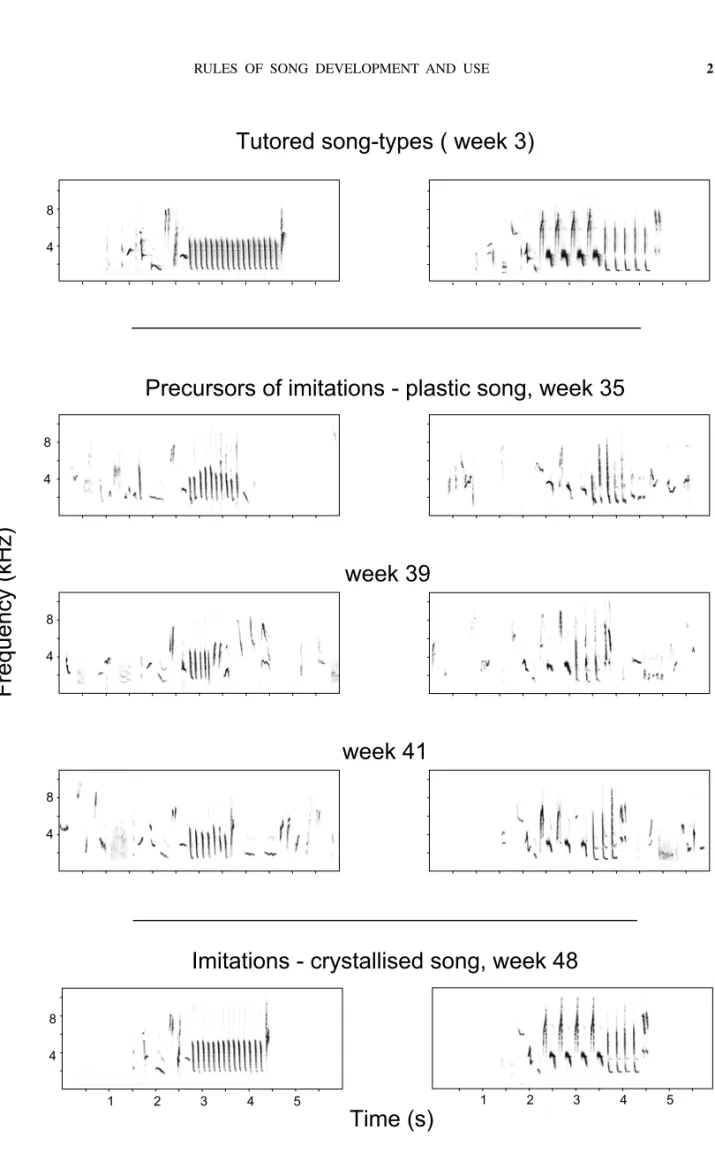
The subsong of birds consists of soft and rambling vocalizations which are structurally amorphous and rather difficult to analyze. Therefore, the next stage in vocal ontogeny, plastic song, is the preferred sub-ject of investigators who search for rules of pattern development. In nightingales that have a partic-ularly extended period of vocal ontogeny, plastic singing starts at an age of about eight months, i.e. in January. Then, first precursors of acquired imi-tations can be discerned and with time an increas-ingly larger number of song-type precursors can be identified (Fig. 1). The completion of the reper-toire of song-type precursors takes a period of sev-eral weeks. During this process, imitations of mas-ter songs that birds had heard early in life do not emerge earlier than imitations of other songs that they had experienced later during the tutoring. In other words, the temporal order of song-type pro-duction does not reflect the temporal order of audi-tory acquisition.
In nightingales, ontogenetic trajectories can be discerned both within and between songs, with pro-gression occuring on different hierarchical levels. Trajectories expressed at the intra-song level
ccern the following traits. During early stages of on-togeny, birds often sing incomplete songs; i.e. some song constituents may be missing (cf. Fig. 1). In addition, the serial succession of song sections may be inverted. For example the final trill-section of a song may be produced ahead of the normally pre-ceding note complex. Thus, the intra-song syntax is not initially stereotyped. At the same time, however, the structure of patterns is sufficiently elaborated to allow for easy identification of song-type precursors. In other words, pattern phonetics takes its adult form ahead of the intra-song syntax, which ‘crystallizes’ only at about 10 months of age. Interestingly, the phonetic or syntactic quality of those imitations that emerge only late in ontogeny is not inferior to the quality of imitations produced earlier (Fig. 2). This suggests a developmental trajectory which does not build on vocal ‘experience’ with a particular output, but concerns a general progression in motor compe-tence or skill (Hultsch 1989, 1993).
Besides trajectories concerning the pattern structure of vocalizations, ontogenetic progression also proceeds in the temporal domain of singing. As both the duration of vocal compounds as well as their temporal segregation have to be shaped, tra-jectories in the time domain are highly interrelated and follow complex rules (Hultsch and Todt 2000). The adult time structure of singing (songs alternat-ing with silent intervals of about the same duration) is the last performance feature to crystallize and the adult form is achieved only at an age of about 11 to 12 months.
de-Tutored song-types ( week 3)
1 2 3 4 5
4 8 4 8 4 8 4 8
Precursors of imitations - plastic song, week 35
Imitations - crystallised song, week 48
Time (s)
Frequency (kHz)
1 2 3 4 5
4 8
week 39
week 41
32 34 36 38 40 42 44 46 48 50 52
MAY APR
MAR FEB
JAN
Repertoire
Phonetics & Syntax
Time Structure
Age (weeks)
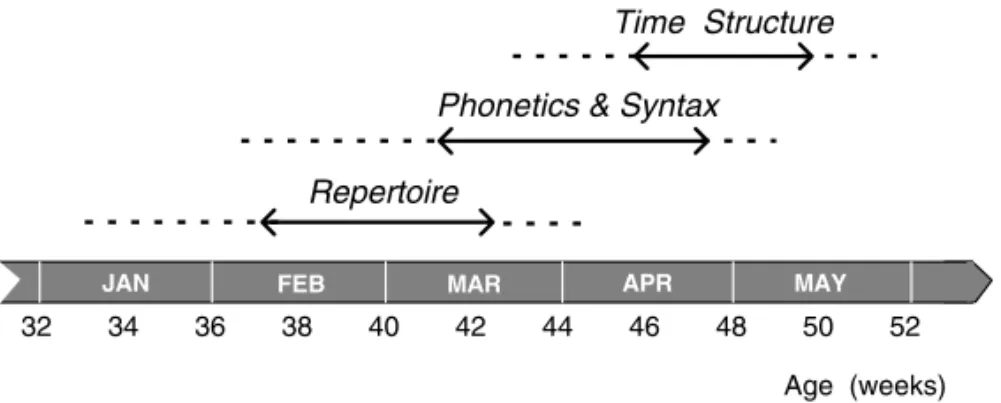
Fig. 2 – The time course of three ontogenetic trajectories assessed during the song development of Common Nightingales. The solid lines bounded by arrows give the core age during which the respective song characteristics show most rapid progression. To contrast the trajectory of pattern structure against the development of repertoire and time structure its two aspects (phonetics and syntax) are lumped here, although pattern phenotypes develop ahead of pattern syntax.
layed and in fully-grown form these so called ‘con-text groups’ can only be assessed close to the time of song crystallization. However, the time structure of singing gives some indication of context groups earlier in ontogeny. During the phase of continuous vocal production, for example, the intervals between imitations acquired from the same master string or context group were significantly shorter than inter-vals found when the birds switched to imitations of another context group (Hultsch 1993). Thus at the inter-song level, the early ontogeny of song material already reflects hierarchical properties of the song-type association groups.
The development of singing is not simply a process by which a bird improves the qual-ity of acquired song material by vocal rehearsal. At least two further characteristics merit considera-tion. One of them enlarges the repertoire of a bird, whereas the other one has the opposite effect. In nightingales, increasing the repertoire size is much more pronounced than decreasing it (Todt and Hultsch 1996, Geberzahn et al. 2002). Repertoire enlargement is achieved by either acquiring addi-tional song-types, or by developing new recombina-tions or, finally, inventing novel songs.
In bird species called ‘open-ended’ or ‘age-independent learners’ (Marler and Peters 1987),
fur-ther learning can occur during the phase of plastic singing or even later in life (Hultsch 1989, 1993, Todt and Geberzahn 2003). Learning beyond the early sensitive phase explains observations obtained for birds that, instead of being housed in isolation, are housed together, thus allowing them to vocally interact with each other. Here the composition of song repertoires and also the performance prefer-ences of shared song-types clearly converge. Thus, additional learning coupled with a shaping of the performance towards convergence can lead to a shar-ing of at least parts of repertoires among conspecific neighbors (Hultsch and Todt 1981, Slater 1989, Mar-ler and Nelson 1993, Lemon et al. 1994, Geberzahn et al. 2002).
and adult singing, genuine inventions occur as co-herent subsets in the singing, which results in an al-ternation of performance phases containing acquired imitations or novel inventions (Hughes et al. 2001). Upon reaching the final stage of song de-velopment (crystallization) birds may reduce their song-type repertoire. This phenomenon is espe-cially marked in species that use only small song-type repertoires as adults (Marler and Peters 1982b, Nelson et al. 1995). In nightingales, repertoire constriction is much less conspicuous; only about five to eight percent of imitations identified in the course of song development are discarded from the final repertoire. During the phase of plastic singing, these song-types are produced with a rather poor copy quality (Hultsch 1991). Thus, the ontogenetic ‘history’ of eventually discarded song-types makes repertoire constriction a quite interesting issue in nightingales, too.
The stability and persistence of song patterns can vary remarkably across species. Aside from birds, such as nightingales, that hardly modify their patterns (Kipper et al. 2004), there are other species where individuals may change quite radically. Star-lingsSturnus vulgaris(Eens et al. 1992) and Do-mestic Canaries Serinus canaria (Nottebohm and Nottebohm 1978), for example, may modify their song repertoires from year to year.
THE SINGING OF ADULTS AND THEIR INTERACTIONS
Interactive song exchanges have been examined from both formal and functional points of view. From a formal perspective, relationships that ex-changed signals shown in the time and/or the pattern domain are studied (Hultsch and Todt 1982, Wolff-gramm and Todt 1982). From a functional perspec-tive, song interactions are specified in terms of social relationships among signalers and distinguish, for example, behaviors between partners such as mates, or behaviors between rivals such as territorial neigh-bors. In some species mated birds interact by per-forming elaborated vocal duets (Todt et al. 1981, Farabaugh 1982), whereas rivals typically engage
in forms of counter-singing, i.e. vocal duels (Todt 1970, 1981, Krebs et al. 1978, Kroodsma 1979, Nielsen and Vehrencamp 1995). Here we will deal with vocal interactions among territorial neighbors and describe how their responses in the time and the pattern domains are related to functional aspects.
Responses in the Time Domain
Many animals avoid simultaneous production of vocal signals. In songbirds such avoidance be-havior can be observed as a segregation of perfor-mance times (including heterospecific avoidance) on a larger scale and as an alternation of songs on a finer scale. A basic functional aspect of signal al-ternation is the use of temporal signal displacement as a strategy to prevent the own vocalizations from being masked acoustically (Cody and Brown 1969, Ficken et al. 1974, Hultsch and Todt 1982). Tem-poral adjustment is especially clear during the noc-turnal singing of nightingales and can be specified as follows.
In a population of territorial birds, individuals exist which – during dyadic singing – preferentially start their songs shortly after a neighbor has termi-nated his preceding song. Such subjects are called ‘inserters’ or ‘alternators’; they are distinguished from ‘overlappers’, which prefer to start their songs some time before a neighbor has finished a preceding song. Still other individuals do not obviously adjust their songs to a neighbor’s vocalization, but rather seem to follow their temporal self-program. These birds are called ‘autonomous songsters’ (Hultsch and Todt 1982). There is evidence that these three types of behavior cannot simply be explained as in-dividual idiosyncrasies, but rather reflect different socially interactive roles. Application of the role concept here is appropriate for two reasons. First, each ‘role’ reflects a specific strategy that is used in relation to season and social context, and second, depending on season and context, individuals may change their ‘role’.
and thus may be related to dominance status. Insert-ing, on the other hand, is a more common strategy which obviously serves acoustic avoidance, mutual listening, signal detection and responding. Over-lapping, finally, is predominantly found at the be-ginning of the territorial season, and allows a bird to challenge or even repel a competitor, mainly by jamming another bird’s signals and so presenting a vocal threat (Todt 1981, Hultsch and Todt 1982, Naguib and Todt 1997).
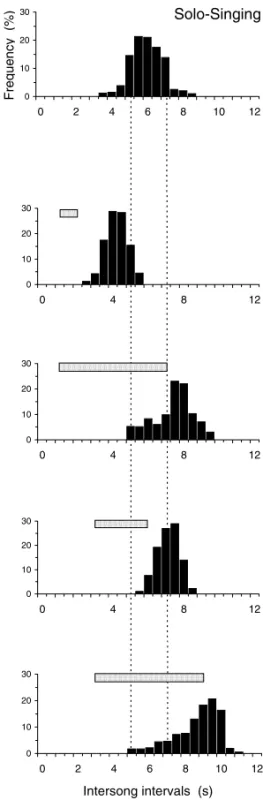
Studies of the significance of temporal interac-tion strategies led us to examine the mechanisms by which temporal adjustment is controlled. It turned out that in overlappers song onset latencies were rather precisely tuned to the timing of song onset in the other male, and in inserters to the song ending in the other male. In both overlappers and insert-ers, latencies peaked at about 1s, showing that birds are indeed listening and responding to each other (Hultsch and Todt 1982). This conclusion was sub-stantiated by interactive playback experiments that examined the inserter role in more detail. Both the latency with which stimulus songs were broadcast after each song utterance of the test bird and the duration of the stimulus songs were varied. The results revealed an impressive flexibility in the tem-poral adjustment of the test bird (Fig. 3). Further-more, there was a striking after-effect following the playback trials: the normal timing of song deliv-ery was not immediately resumed. Rather we found that there were prolonged intersong intervals for a couple of songs, before these gradually relapsed to normal duration. Such behavior suggests that the bird was ‘waiting’ for another song from the rival to occur. In line with findings from other playback experiments, these effects can not be explained by simple stimulus/response mechanisms. Rather they point to basic motivational variables, like being in an ‘interactive state’, underlying the diverse facets of temporal interactions.
Responses in the Pattern Domain
During singing interactions, territorial songbirds tend to modify the patterning of their performance
0 10 20 30
0 2 4 6 8 10 12
Fre
q
uenc
y
0 10 20 30
0 4 8 12
0 10 20 30
0 4 8 12
0 10 20 30
0 2 4 6 8 10 12
Intersong intervals (s)
0 10 20 30
0 4 8 12
0 10 20 30
0 4 8 12
0 10 20 30
0 2 4 6 8 10 12
Fre
q
uenc
y
(%
) Solo-Singing
?
-
1-
21 3 5
1 3 5 7 kHz
s
1 3 5
1 3 5 7 kHz
s
1 3 5
1 3 5 7 kHz
s
1 3
1 3 5 7 kHz
Fig. 4 – Spectrograms of songs produced during an interaction by two neighboring Common Nightingale males. Here, both males alternate their songs, and male 2 gives a song-type matching response to the first song of male 1.
and such responses show tonic or phasic properties. As a tonic response, a male may alter the quality of his singing gradually over an extended span of time, for instance by increasing the volume or duration of his songs. As a phasic response, in contrast, a bird selects a particular song type of his own repertoire and vocalizes this song as a reply to a stimulus song (cf. Fig. 4). Examples of this form of responding are song matching, convalent responding and coor-dinated switches between bouts of songs.
Song matching is widespread across species and particularly impressive in songsters which sing with ‘immediate variety’ (e.g. A-B-C-D-), like Eurasian BlackbirdsTurdus merula(Todt 1970) or Common Nightingales (Hultsch 1980). Coordi-nated song type switching, on the other hand, is found in species that sing with ‘eventual variety’, repeating renditions of a particular song type sev-eral times before starting to sing another one (e.g. A-A-A-A-B-B-B-.), like Abyssinian Ground Thrushes
Zoothera piaggiae (Todt 1971b), Song Sparrows
Melospiza melodia(Kramer et al. 1985), Western MeadowlarksSturnella neglecta(Falls and d’Agin-court 1982) and Great TitsParus major(McGregor et al. 1992).
Pattern-specific responses also build on prereq-uisites in the vocal repertoires of the interacting
in-dividuals, depending on the species. This depen-dence is particularly evident in song matching. By definition, during song matching (syn.: ‘equivalent response’) a songX1is responded to by a song with an equivalent patternX2. Thus matching can oc-cur only between individuals who share song-types in their vocal repertoires. If, in addition to sharing parts of their repertoire, individuals also have corre-sponding sequential associations among song-types, they may interact with convalent responses (syn.: ‘vocal supplementing’). Here a stimulus songXis responded to by a songYwhich can be regarded as a sequential continuation ofX. Convalent responding may have an interesting outcome, because it allows a male to become the ‘sequential leader’ in a vo-cal interaction (Todt 1971a, 1975, Todt and Hultsch 1980, 1996). Interactions involving convalent re-sponses are particularly impressive displays and the role of ‘vocal leader’ has been shown to bear some advantages in a contest (Naguib et al 1999).
such hypotheses range from straightforward ones, like ‘addressing an opponent’ (Todt 1975, Hultsch and Todt 1986) or ‘sending a keep-out signal’ (Falls et al. 1982, McGregor et al. 1992, Shackleton and Ratcliffe 1994), to more controversial ones like ‘dis-tance estimation’ (Krebs et al. 1978, Naguib 1997) or ‘attracting the attention of a third party’, like fe-males or other fe-males (Todt 1981, Todt and Naguib 2000).
The basic ‘addressing’ interpretation of vocal matching is a candidate mechanism to deal with the general problem of signaling to a particular male in a community of songsters. The interesting point is that a more specific message of the signal can be encoded in its timing, as has been shown in nightin-gales and blackbirds (Hultsch and Todt 1986). These species use song matching in two temporally differ-ent forms. In rapid matching, a matcher overlaps the other male’s song. In delayed matching, in con-trast, the matcher waits until the other bird has ended his song rendition and inserts his response into the intersong interval of his counterpart. The message implied by rapid matching is similar to the one de-scribed for temporal overlapping, i.e. a vocal threat. Rapid matching is especially dominant at the be-ginning of the singing season when songsters set up territories and have highly agonistic interactions. In contrast, delayed matching can be found particu-larly when territories are established and when other song features of neighbors indicate that they sing in a more relaxed way. Therefore it was interpreted as a vocal ‘greeting ritual’ (Todt 1981).
From a functional perspective, it is important in vocal interactions not to sacrifice the salience of a signal and hence to keep its occurrence at an op-timal level. This explains why vocal interactions, like many other kinds of signal exchange, are not perpetuated during the entire time when two neigh-bors are singing in parallel, but rather occur sporad-ically. From a proximate perspective, on the other hand, the length of interactional phases seems to be limited by the properties of a bird’s endogenous pro-gram of song delivery (self-propro-gram), which may in turn constrain the ease of access or retrieval of a
particular vocal pattern in response to what is heard from another bird.
CONCLUSION
Analyses of time- and pattern-specific relationships between exchanged songs reveal that birds perform differentiated forms of vocal interaction. We have shown that vocal interaction builds on certain pre-requisites, like sharing of song repertoires, if vocal matching is to occur. If neighbors share additional properties of their repertoires, such as associations among particular types of song, patterns of specific vocal interaction may be extended to include conva-lent responses. We can reasonably assume that vocal learning plays a crucial role in establishing the basis of such vocal interactions, as studied by asking how nightingales acquire and develop their vocal com-petence. In so doing, we found that there is much more to song ontogeny than just the perfection of a vocal skill. It also serves to establish vocal memory that results in the sharing of repertoires and singing programmes, providing an inventory that is the basis for interaction by song.
ACKNOWLEDGMENTS
We like to thank Dietmar Todt for his effective sup-port of our research on nightingales, and Friederike Schleuß for her valuable cooperation. We are also grateful to a number of other people, too many to name here, who provided skillful help in handrais-ing our birds, performhandrais-ing experiments or conduct-ing data analyses. Last, but not least, we appreci-ated the kind invitation to the IBAC conference in Belém. The study was supported by the DFG (Az.: To 13/30-1), and N.G. received a research fellowship of the City of Berlin.
RESUMO
fa-zem uso de suas capacidades. Descreveremos particular-mente o estudo das regras de interação que foram desven-dadas pelo exame das relações temporais e estruturais entre os sinais trocados por vizinhos. Inicialmente, in-vestigamos as regras de aprendizagem e desenvolvimento do canto. Nas aves com grande repertório vocal, a on-togênese dessas regras segue certas trajetórias que aju-dam a entender o desempenho dos adultos, geralmente notável. Em ambas abordagens, nossa espécie-modelo será o Rouxinol-comumLuscinia megarhynchos, que foi pesquisado intensamente no campo e no laboratório.
Palavras-chave: desenvolvimento do canto, trajetórias de desenvolvimento, interação pelo canto, duelos vocais, Rouxinol-comum.
REFERENCES
Cody ML and Brown JH.1969. Song asynchrony in chapparal birds. Nature 222: 778-780.
Eens M, Pinxten R and Verheyen RF.1992. Song learning in captive European Starlings,Sturnus vul-garis. Anim Behav 44: 1131-1143.
Falls JB and D’Agincourt LG.1982. Why do mead-owlarks switch song-types? Canad J Zool 60: 3400-3408.
Falls JB, Krebs JR and McGregor PK.1982. Song matching in the Great TitParus major: the effect of similarity and familiarity. Anim Behav 30: 977-1009.
Farabaugh SM.1982. The ecological and social signif-icance of duetting. In:Kroodsma DE and Miller EH.(Eds), Acoustic communication in birds. New York: Academic Press, p. 85-124.
Ficken RW, Ficken MS and Hailman JP.1974. Tem-poral pattern shift to avoid acoustic interference in singing birds. Science 183: 762-763.
Geberzahn N, Hultsch H and Todt D.2002. Latent song type memories are accessible through auditory stimulation in a hand-reared songbird. Anim Behav 64: 783-790.
Hughes M, Hultsch H and Todt D.2001. How do birds learn when they learn to sing? Imitation and invention in nightingale song. Ethology 108: 35-48.
Hultsch H. 1980. Beziehungen zwischen Struk-tur, zeitlicher Variabilität und sozialem Einsatz im Gesang der Nachtigall,Luscinia megarhynchos. PhD Thesis, FU Berlin.
Hultsch H.1989. Ontogeny of song patterns and their performance mode in nightingales. In: Erber J, Menzel R, Pflüger J and Todt D.(Eds), Neu-ral Mechanisms of Behaviour. Stuttgart: Thieme, p. 113.
Hultsch H. 1991. Correlates of repertoire constric-tion in the song ontogeny of Nightingales (Luscinia megarhynchos). Verh Dtsch Zool Ges 84: 474.
Hultsch H.1993. Tracing the memory mechanisms in the song acquisition of birds. Neth J Zool 43: 155-171.
Hultsch H and Todt D.1981. Repertoire sharing and song post distance in nightingales. Behav Ecol So-ciobiol 8: 182-188.
Hultsch H and Todt D.1982. Temporal performance roles during vocal interactions in nightingales. Behav Ecol Sociobiol 11: 253-260.
Hultsch H and Todt D.1986. Zeichenbildung durch mustergleiches Antworten. Z Semiotik 8: 233-244.
Hultsch H and Todt D.2000. Developmental Tra-jectories of Complex Signal in Animals: The Model of Birdsong. In: Weissenborn J and Höhle B.
(Eds), Approaches to Bootstrapping. Amsterdam and Philadelphia: John Benjamins, p. 309-331.
Kipper S, Mundry R, Hultsch H and Todt D.2004. Long term persistence of song performance roles in nightingales. Behaviour 141: in press.
Kramer HG, Lemon RE and Morris MJ.1985. Song switching and agonistic stimulation in the Song Spar-row (Melospiza melodia). Anim Behav 33: 135-149.
Krebs JR, Ashcroft R and Webber M.1978. Song repertoires and territory defence in the Great Tit. Na-ture 271: 539-542.
Kroodsma DE.1979. Vocal dueling among male Marsh Wrens: Evidence for ritualized expressions of dom-inance/subordinance. Auk 98: 506-515.
Lemon RE, Perrault S and Weary DM.1994. Dual strategies of song development in American Red-starts, Setophaga ruticilla. Anim Behav 47: 317-329.
Marler P.1991. Differences in behavioural develop-ment in closely related species: bird song. In: Bate-son P.(Ed), The development and integration of be-haviour. Cambridge: University Press, p. 41-70.
a new form of developmental plasticity in bird song. Neth J Zool 43: 91-101.
Marler P and Peters S.1982a. Structural changes in song ontogeny in the Swamp Sparrow,Melospiza georgiana. Auk 99: 446-458.
Marler P and Peters S.1982b. Developmental over-production and selective attrition: New processes in the epigenesis of birdsong. Dev Psychobiol 15: 369-378.
Marler P and Peters S.1987. A sensitive period for song acquisition in the Song Sparrow,Melospiza melodia: a case of age limited learning. Ethology 76: 89-100.
McGregor PK, Dabelsteen T, Shephard M and
Pedersen SB.1992. The signal value of matched singing in Great Tits: evidence from interactive play-back experiments. Anim Behav 43: 987-998.
Naguib M.1997. Ranging of songs in Carolina Wrens: effects of familiarity with the song-type on use of different cues. Behav Ecol Sociobiol 40: 385-393.
Naguib M and Todt D.1997. Effects of dyadic vocal interactions on other conspecific receivers in Nightin-gales. Anim Behav 54: 1535-1543.
Naguib M, Fichtel C and Todt D. 1999. Nightin-gales respond more strongly to vocal leaders in sim-ulated dyadic interactions. Proc R Soc Lond B265: 537-542.
Nelson DA, Marler P and Palleroni A.1995. A comparative approach to vocal learning: intraspecific variation in the learning process. Anim Behav 50: 83-97.
Nielsen BMB and Vehrencamp SL.1995. Responses of Song Sparrows to song-type matching via interac-tive playback. Behav Ecol Sociobiol 37: 109-117.
Nottebohm F and Nottebohm ME.1978. Relation-ship between song repertoire and age in the Canary, Serinus canarius. Z Tierpsychol 46: 298-305.
Shackleton SA and Ratcliffe L.1994. Matched counter-singing signals escalation of aggression in Black - capped Chickadees (Parus atricapillus). Ethology 97: 310-316.
Slater PJB.1989. Bird song learning: causes and con-sequences. Ethol Ecol Evol 1: 19-46.
Todt D.1970. Gesangliche Reaktionen der Amsel auf ihren experimentell reproduzierten Eigengesang. Z Vergl Physiol 66: 294-317.
Todt D.1971a. Äquivalente und konvalente gesangliche Reaktionen einer extrem regelmässig singenden Nachtigall (Luscinia megarhynchos). Z Vergl Phys-iol 71: 262-285.
Todt D.1971b. Abstraktionsleistung einer gesanglich korrespondierenden abessinischen Erddrossel ( Geo-kichla piaggiae). Z Tierpsychol 28: 59-61.
Todt D.1975. Short term inhibition of vocal outputs oc-curring in the singing behaviour of Blackbirds ( Tur-dus merula). J Comp Physiol A 98: 289-306.
Todt D.1981. On functions of vocal matching: effect of counter-replies on song-post choice and singing. Z Tierpsychol 57: 73-93.
Todt D and Geberzahn N. 2003. Age-dependent effects of song exposure: song organisation sets a boundary between fast and delayed vocal imitation. Anim Behav 65: 971-979.
Todt D and Hultsch H.1980. Functional aspects of sequences and hierarchy in bird song. Acta XVII Congr Int Orn, Berlin, p. 663-670.
Todt D and Hultsch H.1996. Acquisition and perfor-mance of repertoires: ways of coping with diversity and versatility. In:Kroodsma DE and Miller EH.
(Eds), Ecology and evolution of acoustic communi-cation in birds. Ithaca, NY: Cornell Univ. Press, p. 79-96.
Todt D and Naguib M.2000. Vocal Interactions in Birds: The Use of Song as a Model in Communica-tion. Adv Study Behav 29: 247-296.
Todt D, Hultsch H and Duvall FP.1981. Behavioural significance and social function of vocal and non-vocal displays in the monogamous duet-singer Cos-sypha heuglini. Zool Beitr 27: 421-448.