Procedia - Social and Behavioral Sciences 216 ( 2016 ) 829 – 840
ScienceDirect
1877-0428 © 2016 The Authors. Published by Elsevier Ltd. This is an open access article under the CC BY-NC-ND license (http://creativecommons.org/licenses/by-nc-nd/4.0/).
Peer-review under responsibility of IEREK, International experts for Research Enrichment and Knowledge Exchange doi: 10.1016/j.sbspro.2015.12.080
Urban Planning and Architecture Design for Sustainable Development, UPADSD 14- 16 October
2015
Improving building technologies with a sustainable strategy
Paulo Carneiro
a*, Alina Jerónimo
a, Vitor Silva
b, Fernando Cartaxo
c, Paulina Faria
baArchitecture Professional, Rua Marcos Marreiros 21, R/C, 1200-254, Lisbon, Portugal
bCERIS-ICIST, NOVA University of Lisbon, 2829-516, Caparica, Portugal
cFradical, Lime Transformation Enterprise, armazém 14, Vale Fetal, 2820-475 Charneca da Caparica, Portugal
Abstract
In recent years it has been noticed the progressive disappearance of vernacular sustainable building technologies all over the world mainly due to a strong urban rehabilitation process with modern technologies not compatible with ancient knowledge. Simultaneously new dwellings are needed all over the world and in this sense it was decided to study an ecological and cost-controlled building technology of monolithic walls that can combine the use of low carbon footprint materials, such as earth, fibres and lime using an invasive species: giant reed cane (Arundo Donax). This paper explains the development of this building technology through testing diverse prototypes.
© 2016 The Authors. Published by Elsevier Ltd.
Peer-review under responsibility of IEREK, International experts for Research Enrichment and Knowledge Exchange. Keywords: ecologic building technology; earth construction; social inclusion; heritage; innovation
1. Introduction
After the Second World War there was a massive need for reconstruction and new housing in Europe. New construction started to grow at high speed in new planned areas outside the historic center. For this it was fundamental the development of fast setting cement-based technology to respond to these urgent housing needs (Silveira, Varum & Costa, 2007). In a period of twenty five years this technology was also introduced in rehabilitation processes in historic areas of cities and had as consequence the disappearance of vernacular building technologies in such as wattle
* Corresponding author. Tel.:+351 910878715
E-mail address:[email protected] (Carneiro P.)
© 2016 The Authors. Published by Elsevier Ltd. This is an open access article under the CC BY-NC-ND license (http://creativecommons.org/licenses/by-nc-nd/4.0/).
0 20 40 60 80 100
0.01 0.1 1 10
Passin
g
pe
rcen
tage
[%]
Sieve dimension[mm]
Grit 0-4mm
Earth FCT
Earth Fradical
and daub and lime plasters. During the last decades the majority of the rehabilitation works use cement technology (Faria & Henriques, 2004) which is not fully compatible with ancient buildings made of wood, lime and stone, creating new building pathology.
In developing countries new construction adopts modern materials such as fired bricks instead of raw earth bricks, using a large amount of wood and, therefore, increasing deforestation and soil erosion (Jerónimo & Carneiro, 2013). Because of its low cost and apparent durability modern technology has been replacing ancient technology and causing a loss in the vernacular knowledge still established in developing countries.
Trying to present alternatives to the previously mentioned status, it was decided to study an ecological and cost-controlled building technology that can combine the use of materials that have been used in old buildings in Portugal, such as lime and earth, with others with low carbon footprint, as giant reeds in the form of cane and its fibres. Giant reed cane (Arundo Donax) is an invasive species in southern Europe which exists in excess in Portugal. The aim is to develop a building technology capable of improving ancient vernacular knowledge but adapted to present time constraints and comfort needs. A new technology named “reedcob” was developed and has been characterized. The technology mainly consists on building monolithic walls with successive layers of a mix of earth and reed fibres, and layers of reeds. This new technology is being developed to be used mainly in new construction in Europe, where giant reed is an invasive species, but it is foreseen that, in other Continents, the reed cane can be replaced by other types of reeds or bamboo.
2. Experimental campaigns
To recover and improve ancient knowledge on earth building, as well as creating a new technology applicable for the construction of dwellings, several experiments were made related to constructive feasibility, hygrothermal behaviour and mechanical characteristics. The “reedcob” technology was developed through several prototypes: a first linear experimental wall (prototype 1), a second experimental wall including a corner (prototype 2), several small samples, wallets and a small building (prototype 3) were built to assess and analyze constructive feasibility, mechanical and physical behavior and anti-seismic performance.
In the conception, production and analysis of the prototypes two architects, three engineers and five engineering students were involved, in a partnership between FRADICAL, a lime transformation factory and the Faculty of Science and Technology (FCT) of Nova University of Lisbon.
2.1. Materials, samples and general procedures
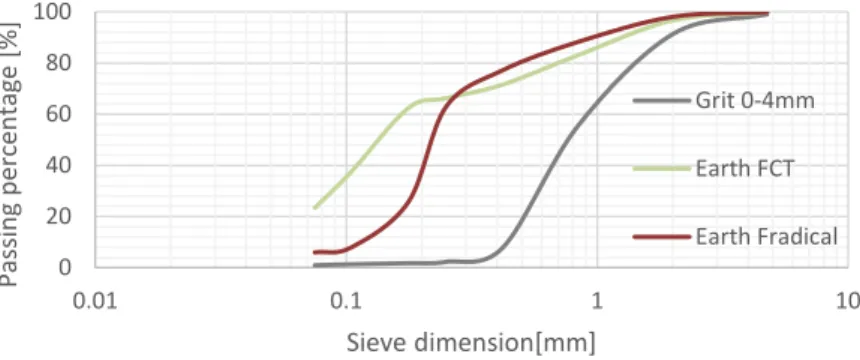
The materials used for the walls technology were: two types of raw earth from the Caparica region, Portugal (from the University Campus and from the factory area) and, in some formulations, a grit (Fig. 1); a calcium air lime putty from FRADICAL; an artificial pozzolan based on metakaolin and brick powder from FRADICAL; in some formulations a drying additive based on oxide lime from FRADICAL; reed canes and reed fibers (Arundo Donax).
The process of development of the building technique assessment can be divided in several stages. The first stage was to study the influence of materials (earth mortars, fibres and reeds) and their proportions on the characteristics of future walls. For that purpose, the type and proportions of earth, grit, air lime, pozzolan, drying additive, fibers and reeds varied in mortars formulations and samples were produced with different sizes - 4x4x16 [cm], 10x10x20 [cm], 15x15x15 [cm]. The samples were analyzed for physical durability properties (Fig. 2) and some results will be presented in section 2.3.
The second stage was to elaborate a 0.4x2.0x1.7 [m] prototype wall 1 to study foundation, constructive feasibility and mortar applicability, as well as type of wall structure, building speed and render needs. For the production of the prototype wall 1 wooden pillar were used near the periphery of the wall, in both sides of the wall, spaced about 2 m, as can be observed in Figure 3.
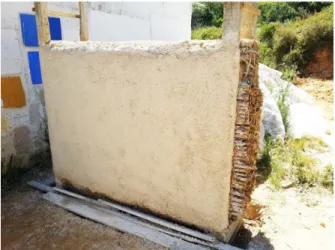
The third stage was to build a prototype wall 2 including a corner, to study joints on corners, optimize the quantity of reeds to be used, study the feasibility of openings and optimize the few pieces of formwork that are needed (Fig. 4). For this prototype wall 2 only one wooden pillar was used inside the wall, in its center and spaced about 2 m, while two other wood plumbs were used laterally, as provisional formwork and also spaced around 2 m, as can be observed in Figure 4 (a).
Fig 2. Small samples for mechanical, physical and durability testing.
Fig. 4. Reedcob experimental wall of prototype 2 including corner: (a) facing South with provisional formwork; (b) facing North with formwork already removed.
The fourth stage was the construction of a 2.80x2.80x2.00 [m] cubic prototype or cellule (Fig. 5) to apply the best results obtained from previous stages on the building of all the system, assess feasibility of the technique, as well as elements related with construction and labor time efficiency. These walls and all the previous prototypes were built on a basement of hydrophobic air lime concrete. The hydrophobicity of the lime concrete was delivered by the use of olive oil wastes in the lime. The walls itself were built with successive layers of earth-based mortar with reed fibers and small proportions of air lime and pozzolan, with intermediate layers of reeds, as can be observed in Fig. 6 (a) and (b).
Fig. 6. Reedcob cellule of prototype 3 under construction: (a) general view with students building the walls; (b) detail of a reed layer on the wall being built.
During the construction the cellule was prepared in order to gather indoor and outdoor temperature and relative humidity. Thermocouples were inserted in the thickness of the wall and their surface and, in the future, will able the determination of thermal resistance and inertia. To enhance the influence of the wall system, a 100 mm thermal insulation (thick for Portuguese thermal requirements) was applied in the roof.
In this stage five civil engineering students were involved in the construction of the prototype 3, which received training and built the module during five days. The students had no previous practical skills on earth construction but easily achieved the needed competences, including for the preparation of the material for the wall (preparation of the reeds and reed fibers, proportioning and mixing of the mortar constituents) and for building the walls itself. An informal assessment of the competences achieved by the students was performed based on earth building units and criteria developed by Leonardo PIRATE EU project (PIRATE, 2015).
The fifth stage was the production of small experimental wallets 0.20x0.50x0.50 [m] with reed layers, similar to the walls, for further mechanical testing, which will be performed soon.
All the samples and prototypes have been used for characterization of the walls material and the building technique. The different formulations of mortars are presented in Table 1. It can be seen that some formulated mortars include a proportion of the grit and the drying additive. The formulation of mortar R, with grit and 1.5 volumes of fibers; the formulation Y without grit, lower proportion of pozzolan and only 0.5 volumes of fibers (with and without drying additive); the formulation G also without grit and 1 (or zero) volumes of fibers; the formulation P with higher proportion of grit and lime putty and pozzolan and 2 (or zero) volumes of reed fibers. For this last formulation earth FCT was used while earth FRADICAL was used for all the other formulations.
Table 1. Mortar composition ratios by volume.
Type of mortar Earth Grit (0-4mm) Lime putty Pozzolan Drying additive (da)
Reed fibers
R 1 0.5 0.04 0.11 - 1.5 R+da 1 0.5 0.04 0.11 0.08 1.5 Y 1 0 0.09 0.06 - 0.5 Y+da 1 0 0.09 0.06 0.06 0.5
G 1 0 0.09 0.06 0.05 1
GwF 1 0 0.09 0.06 0.05 0
P 1 1 0.175 0.125 - 2
PwF 1 1 0.175 0.125 - 0
The small samples were produced for all the mortar formulations. Samples 4x4x16 [cm] (samples A) were always produced without reeds and in some cases without reed fibres in the mortar; samples 10x10x20 [cm] (samples B) were always produced with mortar with reed fibres, with or without reed layers; samples 15x15x15 [cm] (samples D) were always produced with reed fibres and reed layers.
The prototype 2 (with corner) was produced with mortar G; the cellule was produced with mortar P. The small wallets were only produced with this two mortar formulations G and P.
The samples were designated by the letter of the mortar formulation (R, Y, G or P) and the letter of the type of sample (A, B or D), whenever different samples were used for the same test; da is added when used in the mortar formulation and c (cane) is added when reed layers were used in the samples.
Mechanical results, as well as the building technology itself, are being used for modeling the cellule for seismic action, while the physical parameters, namely thermal conductivity, bulk density and water absorption and drying will be used for physical modeling. The final stage, which is still going on, will include all the analysis about the previous stages and the conclusions about the results. Some of the results already achieved, with the small samples and the cellule, will be presented and discussed in the following sections.
2.2. Testing procedures
The small samples were tested for physical properties (Val et al. 2015): water absorption by capillary and drying, bulk density, thermal conductivity, dynamic modulus of elasticity, flexural and compressive strength. Water absorption by capillary was performed based on EN 15801 (CEN, 2009) and expressed by the capillary curve and the capillary coefficient. Drying was performed based on EN 16322 (CEN, 2013) and expressed by the drying rate and the drying index. The previous was determined by a simplified equation used by Grilo et al. (2014). Bulk density was performed for diverse type of samples and formulations, with and without drying additive, fibers and reed layers. The test was performed based on EN 1015-10/A1 (CEN, 2006), by weighting with a 0.001 g range weighting device and measuring by a digital 0.01 mm caliper. Thermal conductivity was performed with an ISOMET 2104 Heat Transfer Analyzer and contact probe API 210412 with 60 mm diameter. Dynamic modulus of elasticity was performed with a Zeus Resonance Meter ZRM, based on EN 14146 (CEN, 2004). Flexural and compressive strength were performed based on EN 1015-11 (CEN, 1999), by a Zwick/Rowell Z050 equipment.
The cellule was monitored for indoor and outdoor temperature (T) and relative humidity (RH) during March-April 2015. During that period of time an electric heating device with 800 W was placed indoors and connected between 6:45 p.m. and 6:45 a.m..
2.3. Results
Fig. 7. Capillary curve of mortars, showing the initial slope (capillary coefficient) and the asymptotic value (total absorbed water)
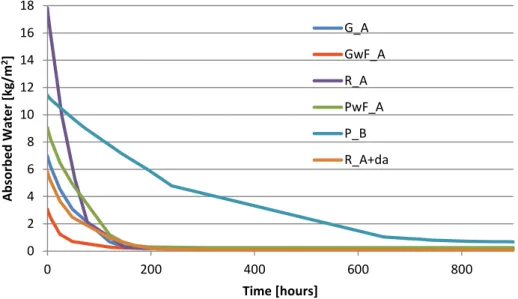
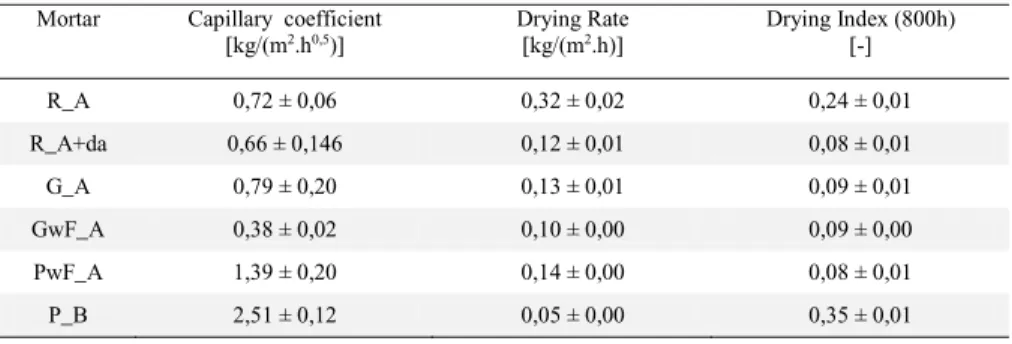
The drying curve of mortars can be seen in Figure 8. Table 2 shows the drying rate of the first phase of drying, determined by the initial slope of the curve, and the drying index, inversely related with the capacity of total drying.
Fig. 8. Drying curve of mortars, showing the initial slope of drying rate and the global behavior that leads to the drying index. 0
2 4 6 8 10 12 14 16
0 5 10 15 20 25 30
Ab
sorbed
W
ater [kg
/m
2]
Time [min0,5]
G_A GwF_A R_A
PwF_A P_B R_A+da
0 2 4 6 8 10 12 14 16 18
0 200 400 600 800
Ab
sorbed
W
ater [kg
/m
2]
Table 2. Capillary coefficient, drying rate and drying index after 800 hours. Mortar Capillary coefficient
[kg/(m2.h0,5)] Drying Rate[kg/(m2.h)] Drying Index (800h)[-]
R_A 0,72 ± 0,06 0,32 ± 0,02 0,24 ± 0,01
R_A+da 0,66 ± 0,146 0,12 ± 0,01 0,08 ± 0,01
G_A 0,79 ± 0,20 0,13 ± 0,01 0,09 ± 0,01
GwF_A 0,38 ± 0,02 0,10 ± 0,00 0,09 ± 0,00
PwF_A 1,39 ± 0,20 0,14 ± 0,00 0,08 ± 0,01
P_B 2,51 ± 0,12 0,05 ± 0,00 0,35 ± 0,01
In terms of drying rate, for formulation G (the one used for prototype 2) there was not a big difference when using or not fibers with the same type of samples. Initial drying is faster for formulations P of the same samples without fibers when compared with G. For the complete drying capacity, inversely connected with the drying index, the use of fibers and bigger samples decreases the drying capacity.
Results of bulk density and thermal conductivity can be seen in Figure 9. It can be noticed that bulk density is, of course, directly connected with the existence of reeds inside the samples. The drying additive (da) does not seem to have a significant influence while the inexistence of fibers and particularly the existence of reeds contributes for a bulk density decrease. Thermal conductivity is generally in agreement with the bulk density tendency; the addition of drying additive is not important while the addition of fibers decreases that property.
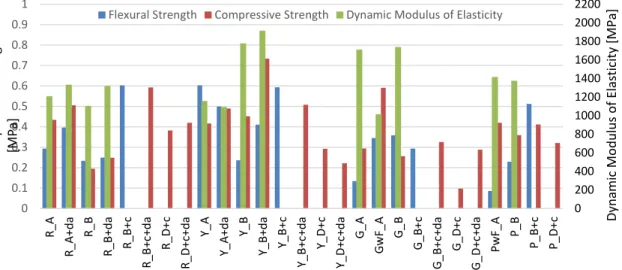
Mechanical behavior can be observed in Figure 10. The addition of drying additive increases the compressive strength while the elimination of fibers seems to increases it, as well as the dynamic modulus of elasticity. This fact should be directly connected with the bulk density increase. One of the most relevant aspects is the increase on flexural strength that can be obtained with samples with reeds (c) and it is justify by an increased deformability that can be achieved.
Fig. 9. Bulk density and thermal conductivity of mortars.
0 0.1 0.2 0.3 0.4 0.5 0.6 0 200 400 600 800 1000 1200 1400 1600 1800 R_ A R_ A+
da R_B
R_ B+ da R_ B+ c R_ B+ c+ da R_ D+ c R_ D+ c+
da Y_A
Y_
A+
da Y_B
Y_ B+ da Y_ B+ c Y_ B+ c+ da Y_ D+ c Y_ D+ c+
da G_A
Gw F_ A G_ B G_ B+ c G_ B+
c+da G_D+c
G_ D+c +d a Pw F_ A P_ B P_ B+ c P_ D+ c Th erma l co nd uct ivit y [W /(m.K)] Bul k de ns ity [ kg /m 3]
Fig. 10. Dynamic modulus of elasticity, flexural and compressive strength of mortars.
Figure 11 shows the temperature and relative humidity indoors and outdoors the cellule during 18 March and 13 April 2015. In terms of temperature it can be seen that the amplitude indoors is much reduced in comparison with outdoors even with only a heater connected during the night in the end of the Winter (since the first day of measured). The amplitude inside seems to stabilize around 3-4ºC while outdoors is at least the double, and the temperature seems to stabilize over 18ºC. The same happens in terms of relative humidity for the reduction of amplitude and stabilizing between 75-85%. The fact of being high values may be related to the building moisture during construction and that the cellule is not yet rendered and plastered.
Fig 11. Indoor and outdoor temperature and relative humidity on the cellule.
0 200 400 600 800 1000 1200 1400 1600 1800 2000 2200 0 0.1 0.2 0.3 0.4 0.5 0.6 0.7 0.8 0.9 1 R_ A R_ A+
da R_B
R_ B+ da R_ B+ c R_ B+ c+ da R_ D+ c R_ D+ c+
da Y_A
Y_
A+
da Y_B
Y_ B+ da Y_ B+ c Y_ B+ c+ da Y_ D+ c Y_ D+ c+
da G_A
Gw F_ A G_ B G_ B+ c G_ B+ c+da G_ D+c G_ D+c +d a Pw F_ A P_ B P_ B+ c P_ D+ c Dynam ic Modulus of Elas ticity [ MPa] Fle xural and Co m pre ss iv e Stre ngth [M Pa ]
Flexural Strength Compressive Strength Dynamic Modulus of Elasticity
0 10 20 30 40 50 60 70 80 90 6 12 18 24 30 36 42 48 54 60 18/ m ar 19/ m ar 20/ m ar 21/ m ar 22/ m ar 23/ m ar 24/ m ar 25/ m ar 26/ m ar 27/ m ar 28/ m ar 29/ m ar 30/ m ar 31/ m ar 1/a br 2/a br 3/a br 4/a br 5/a br 6/a br 7/a br 8/a br 9/a br 10/ abr 11/ abr 12/ abr 13/ abr Re lat ive h um id ity [% ] Tem per atu re [ºC]
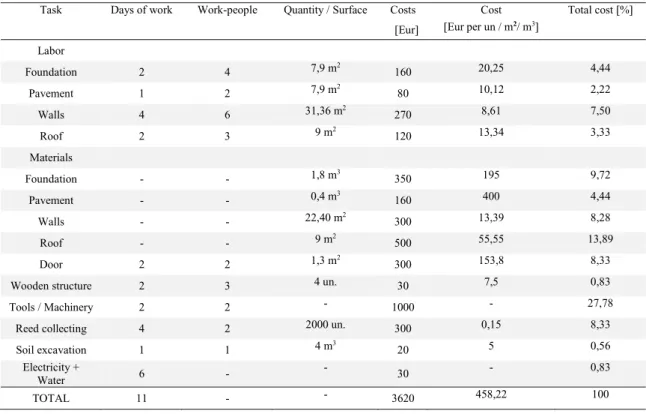
Table 3. Estimate of building costs / efficiency based in the construction of the cellule - prototype 3.
Task Days of work Work-people Quantity / Surface Costs Cost Total cost [%] [Eur] [Eur per un / m2/ m3]
Labor
Foundation 2 4 7,9 m2 160 20,25 4,44
Pavement 1 2 7,9 m2 80 10,12 2,22
Walls 4 6 31,36 m2 270 8,61 7,50
Roof 2 3 9 m2 120 13,34 3,33
Materials
Foundation - - 1,8 m3 350 195 9,72
Pavement - - 0,4 m3 160 400 4,44
Walls - - 22,40 m2 300 13,39 8,28
Roof - - 9 m2 500 55,55 13,89
Door 2 2 1,3 m2 300 153,8 8,33
Wooden structure 2 3 4 un. 30 7,5 0,83
Tools / Machinery 2 2 - 1000 - 27,78
Reed collecting 4 2 2000 un. 300 0,15 8,33
Soil excavation 1 1 4 m3 20 5 0,56
Electricity +
Water 6 - - 30 - 0,83
TOTAL 11 - - 3620 458,22 100
An estimate of building costs is shown in Table 3, based in the construction of the cellule at the Nova University Campus. Most of the materials were donated and labor was free of costs resulting of the collaboration and motivation of engineering students to develop this research. Due to this the average commercial prices in Portugal were applied for these specific materials (lime, pozzolan, sand, grit) and labor costs. This can vary depending on the costs per country but it can be seen through this table that the walls cost represents 25% of the total cost of the cellule.
2.4. Discussion
These results confirm what was expected relating with the main objectives of the experiments and other previous experiments. This was to achieve a technology that could have a low carbon footprint, made with natural materials and have both efficient mechanical properties in terms of flexural and compression strength and thermal resistance. This also confirms previous studies that were made in the field (Heathcote, 2010) and opens new possibilities of research to improve this technology and adapt it to several different contexts.
It is also important to follow the monitoring of the walls, namely after having a larger drying time for the walls to stabilize relative humidity content. As future research it would be important to test this construction in the city scale and confirm at a real scale what was already experimented in the prototype made in the university and laboratory (the cellule).
evasive species or in abundance, at least 25% of the total cost can be optimized while helping to solve an environmental problem and upgrade local building technologies performance.
In spite of having several minor aspects that can be improved, these experiments question some aspects and confirm new ones such as the realistic use of a material that exists as an invasive species. But all this species can be a material surplus that help to balance the ecosystem and open new technological and economic opportunities.
3. Conclusions
Compared to other earth walls solutions, this technology generally presents a lower density and higher thermal resistance and high mechanical flexural strength (Heathcote, 2010). It also allows a very fast building work in comparison with other earth monolithic building techniques.
The results of several of these experiments are shown, demonstrating the viability of this technology and explaining the development and characterization of the constructive solution. These experiments conclude that this technology is easily applicable and has potentiality for its future implementation in countries with housing needs (Akinkurolere et al, 2006). This technology combines the positive aspects of different elements such as the hygrometric capacity of an earth wall, the tensile strength of reed fiber and cane, water protection given by lime and pozzolan, thermal resistance
created by the voids inside the reed canes and, hopefully because that is still in study, the seismic resistance given by the wooden bracing. The seismic behaviour will now be modeled with results from the mechanical characterization.
Because of these different and complementary aspects, this technology works as an improved version of the vernacular “cob” building technique and can have an impressive positive impact in developing countries in the future (Watson & McCabe 2011). In fact this technology is viable because it seems that can be developed in contexts of flooding and earthquakes. The characterization of the constructive solution can be easily adapted to different contexts because its main materials are earth and reeds, which are relatively easy to find at low cost.
Also its easy application results in a potential future implementation because it does not need major technological devices to be built.
In this technology thermal conductivity is generally proportional to density so the use of vegetable fibers decrease density and increase tensile strength creating a function to an existing invasive species. The use of giant reed cane (Arundo Donax) or other similar canes such as bamboo can function as a main material in developing countries, decreasing the cost of construction where this material is available and a surplus.
Acknowledgements
The authors express their acknowledgements to engineer Diogo Val for their contribution in the development of laboratory tests. Thanks are also due to students Davide Malheiro, Tânia Simões, Tânia Santos and João Nabais for their help and effort to build the reedcob prototype 3 cellule at Caparica campus of Nova University of Lisbon.
References
Akinkurolere, O.O., Jiang, C., Oyediran, A.T., Dele-Salawu, O.I., Elensinnla, A.K.(2006). Engineering properties of cob as a building material. Journal of Applied Sciences, 6 (8), 1882-1885.
CEN (2006). EN 1015-10/A1 - Methods of test for mortar for masonry. Part 10: Determination of dry bulk density of hardened mortar. Brussels. CEN (1999). EN 1015-11 - Methods of test for mortar for masonry. Part 11: Determination of flexural and compressive strength of hardened mortar.
Brussels.
CEN (2004). EN 14146 - Natural stone test methods. Determination of the dynamic modulus of elasticity (by measuring the fundamental resonance frequency). Brussels.
CEN (2009). EN 15801 - Conservation of cultural property. Test methods. Determination of water absorption by capillarity. Brussels. CEN (2013). EN 16322 - Conservation of Cultural Heritage. Test methods. Determination of drying properties. Brussels.
Chabriac, P.A., Fabbri, A., Morel, J.C., Laurent, J.P., Gonnet, J.B. (2014). A procedure to measure the in-situ hygrothermal behavior of earth walls. Materials, 7, 3002-3020.
Faria, P. & Henriques, F. (2005). Condicionantes da conservação da construção em terra. IV SIACOT – Seminário Ibero-Americano de Construção em Terra (CD).
Gomes, M.I., Gonçalves, T.D., Faria, P. (2012). Earth-based repair mortars: experimental analysis with different binders and natural fibers. Rammed Earth Conservation, Mileto, Vegas & Cristini (eds.), 2012, Taylor & Francis Group, London, 661-668.
Grilo, J., Faria, P., Santos-Silva, A., Veiga, R., Velosa, A. (2014). New natural hydraulic lime mortars. Physical and microstructural properties in different curing conditions. Construction and Building Materials, 54, 378-384.
Heathcote, K. (2010). The thermal performance of earth buildings. Informes de la Construcción, 63, 117-126.
Jerónimo, A. & Carneiro, P. (2013). Le Royaume de Manica, amélioration des systèmes de construction locaux. Mémoire de DSA, École Supèrieure d’Architecture de Grenoble/CRAterre.
PIRATE project - http://pirate.greenbuildingtraining.eu/public/ (acessed 26/06/2015)
Quagliarini, E., Stazi A., Pasqualini E., Fratalocchi E. (2010). Cob construction in Italy: Some lessons from the past. Sustainability, 2, 3291-3308. Silveira, D., Varum, H. & Costa, A. (2007). Rehabilitation of an important cultural architectural heritage: the traditional adobe constructions in
Aveiro district, University of Aveiro, Portugal. WIT Transaction on Ecology and the Environment, 102, 702-709.
Val, D., Faria, P., V. Silva (2015). Solução construtiva eco-eficiente de paredes monolíticas. Contributo para a sua caracterização. CONPAT 2015 - XIII Congresso Latino-Americano de Patologia da Construção (CD).