PERI-URBAN LANDSCAPES IN METROPOLITAN AREAS: USING
TRANSDISCIPLINARY RESEARCH TO MOVE TOWARDS AN IMPROVED
CONCEPTUAL AND GEOGRAPHICAL UNDERSTANDING
Conference Paper · July 2013 CITATIONS
7
READS 696 4 authors:
Some of the authors of this publication are also working on these related projects:
PERIURBAN - PERI-URBAN AREAS FACING SUSTAINABILITY CHALLENGES:SCENARIO DEVELOPMENT IN THE METROPOLITAN AREA OF LISBONView project
TICYUrb'18View project Isabel Loupa Ramos
University of Lisbon
41PUBLICATIONS 657CITATIONS
SEE PROFILE
Maria Ferreiro
ISCTE-Instituto Universitário de Lisboa
37PUBLICATIONS 28CITATIONS SEE PROFILE M. Conceição Colaço University of Lisbon 33PUBLICATIONS 21CITATIONS SEE PROFILE Sebastião Santos
ISCTE-Instituto Universitário de Lisboa
8PUBLICATIONS 7CITATIONS
PERI-URBAN LANDSCAPES IN METROPOLITAN AREAS: USING
TRANSDISCIPLINARY RESEARCH TO MOVE TOWARDS AN
IMPROVED CONCEPTUAL AND GEOGRAPHICAL
UNDERSTANDING
Isabel Loupa Ramos1, Maria de Fátima Ferreiro2, Conceição Colaço3 and Sebastião Santos2
1Research Group on Urban Planning and Environment, CESUR, IST, Technical University of
Lisbon, [email protected]
2Dinâmia-CET/ISCTE-IUL, [email protected], [email protected]
3Center for Applied Ecology "Prof. Baeta Neves", CEABN, School of Agriculture, Technical
University of Lisbon, [email protected]
Keywords: peri-urban landscapes, metropolitan regions, transdisciplinarity
ABSTRACT
Peri-urban areas are diverse and complex landscapes. It is this complexity that is being recognized as the ground for the capacity to provide answers to the emerging global challenges, such as climate change, food security and the well-being of an increasingly urban population. Peri-urban areas have been rather neglected in regional and urban planning: they were perceived as a space for urban sprawl and the location of regional and trans-regional infrastructures. Despite the renewed attention being given to peri-urban areas, these remain geographically and conceptually ill-defined. This paper aims to contribute to this debate by approaching peri-urban landscapes from a transdisciplinary perspective. It does so by gathering different views as held by a panel of experts and a group of stakeholders on how peri-urban areas can be defined, what is unique about them and, ultimately, which criteria should be used in its definition. The obtained results made it possible to present the diversity of perspectives, as well as the common views. Together, these may provide better understanding towards the development of a new planning agenda for peri-urban landscapes.
1 INTRODUCTION
The polysemic and synthetic nature of the landscape concept, has called for knowledge production processes in landscape research and planning that go beyond the traditional ‘disciplinar’ (specialization in isolation), or ‘multidisciplinar’ and ‘interdisciplinar’ approaches. The latter two representing progressive stages of integration of knowledge: from involving diverse separate areas of knowledge without connections to scientific cooperation (Max-Neef, 2005; Tress et al., 2009). Nevertheless, understanding the complexity of landscapes and the relation between all its components is still not a straightforward task and therefore it raises the awareness to investigate other knowledge bases and knowledge production processes.
The debate about knowledge production includes the idea of a changing nature of the relations between science and society (Nowotny, Scott and Gibbons, 2001; Max-Neef, 2005; Lucks and Siebenhuner, 2007; Jahn et al., 2012; Hadorn et al., 2006; Gonçalves and Castro, 2009). The conceptual models that frame these relations moved from the vision rooted in the need to educate and inform an “ignorant public”, a view that dominates until the 70’s, to the perception of heterogeneity of the world ‘public’ (Gonçalves and Castro, 2009: 193) and the subsequent consideration of knowledge produced within diverse social contexts. This move
included the consideration of methods envisaging the incorporation of ‘public’ knowledge in a “research-in-progress” model where society is conceived “not just as a passive recipient of the results of science but rather as a partner of its co-production” (Latour, 2004 in Gonçalves and Castro, 2009: 195).
The progress towards new relations between science and society has been championed by the environmental and sustainability debate which aimed both at the integration of multiple dimensions (e.g., social, environmental, economic and institutional) and at the practical real-world implementation of those concepts (Nowotny et al, 2001; Lucks and Siebenhuner, 2007; Jahn et al., 2012; Hador et al., 2006; Horlick-Jones and Sime, 2004; Gonçalves and Castro, 2009). These issues fostered the development of both interdisciplinary (e.g., socio-ecological research) and transdisciplinar research (Max-Neef, 2005).
Nowotny and colleagues (2001) refer to transdisciplinary research as a “new” “transgressive” moment of science-society relations, alongside the Renaissance, the scientific revolution in seventeen century, and the industrial revolution in nineteen century. According to this approach, the expressions “contextualization” and “socially embedded” remits to a new mode of knowledge and science production where science and society comingle. In modernity (a “Mode-1 science”) science was still seen as an external force; in “Mode-2 science” it is an internal force. The term “Mode-2 science” was coined by Gibbons and colleagues (1995) and is concerned with problems characterised by “irreducible uncertainties, high complexity and
the need to transcend traditional boundaries of science and society” (Lucks and
Siebenhuner, 2007: 420).
Notwithstanding the raising awareness of the need of progressing in knowledge production, transdisciplinary science is still an “unfinished Project, around which there is still much to be discovered and investigated” (Max-Neef, 2005: 12). It is not a theory, a methodology or an institution, but it enables processes of mutual learning between science and society (i.e. between scientific and extra-scientific actors). Cross-fertilization and transdisciplinar
knowledge is notably capable to deal with complexity of societal problems as it suggests “a
different manner of seeing the world, more systemic and more holistic” (Nicolescu, 2000 in
Max-Neef, 2005: 14-15), providing new insights on the “tangled web of related problems”
(Marjolein and Rijkens-Klomp, 2002).
Conceptually transdisciplinary research involves the following steps (Jahn et al. 2012): 1) problem transformation; 2) interdisciplinary integration (clarification of researchers and stakeholders roles; design of an integration concept); 3) implementation of the integration concept); 4) transdisciplinary integration (assessment of integrated results); and 5) assembly of products for science and society). There is wide array of participatory methods in place to support transdiciplinary approaches depending on the objective of the research and the type of participant to be involved (Marjolein and Rijkens-Klomp, 2002).
Nevertheless, there is still little research experience to draw upon in landscape studies (e.g., Antrop and Rogge, 2006). Tress and others (2007) have contributed to an improved understanding of the existing barriers to transdisciplinary approaches in landscape studies: ‘interpersonal & organizational barriers’, ‘time demands & external barriers’ and ‘academic traditions & epistemological barriers’. All those have hampered an investment of projects in transdisciplinary research.
The complexity of peri-urban landscapes in social, economic and environmental terms constitutes a privileged research object regarding combination and integration of different knowledge areas.
Unlike urban areas, which have been object of in-depth research for a long time and from multiple disciplinary perspectives, peri-urban areas have not, until more recently, deserved much attention. Nevertheless more recent research and policy initiatives, as the FP6 PLUREL Project or the PURPLE network, have set the case that peri-urban areas in Europe might occupy nowadays the same amount of land as consolidated urban areas, concluding that these areas have become a “new” space that needs more targeted policies and treated as a “spatial system in its own right” (Rauws and de Roo, 2011:269).
Despite these insights, peri-urban areas remain geographically and conceptually ill-defined, an “uneasy phenomenon” as described by Allen (2003:136), located somewhere “in-between” the urban core and the rural landscape (e.g., Meeus and Gulinck, 2008; Korcelli et al., 2009).
Attempts in establishing a comprehensive set of criteria which make it possible to grasp geographical boundaries of peri-urban areas (e.g., OCDE, 2010; ESPON, 2005; Piorr et al., 2011; Van Eupen et al., 2012) are still unsatisfactory, mainly because the thresholds do not seem robust enough to ensure transferability. Rauws and de Roo (2011:269) reflect on this by stating that it “cannot solely be understood in terms a progressive intensification of urban functions in the rural environment”, but rather as a space of “interaction between urban and rural elements”. This puts the approaches that have been pursued in perspective as too much “urban focused” and too “simplistic” to grasp the total nature of peri-urban landscape. In fact the divers, fluid, dynamic, heterogeneous and fuzzy nature of peri-urban landscapes (e.g., Allen, 2003; Antrop, 2004; Meeus and Gulinck, 2008; Simon, 2008; Rauws and de Roo, 2011; Fertner, 2012) demand an analytical approach that fits the complexity of the characteristics and evolution of peri-urban landscapes envisaging their sustainability.
Therefore, the “integration of stakeholders’ ideas, knowledge and proposals allows a more
holistic and systemic view and contextualizes knowledge production: the challenges related with sustainability need to be envisaged through the integration of societal stakeholders such as the private sector and the broader public as well as diverse scientific disciplines into the process of generating knowledge” (Clark et al., 2005 in Luks et al., 2007: 420).
In this context, this paper aims to contribute to the debate on how transdisciplinary research can improve the understanding of complex real world problems as in the case of peri-urban landscapes. It is argued that by gathering different views - as held by a panel of experts, a group of stakeholders and a wider public interested on these topics - a more complete understanding on the nature of peri-urban areas.
2. METHODOLOGY
The case study used in this study is a process that has been undertaken in the framework of a research project focused on sustainability of peri-urban areas in the Metropolitan Area of Lisbon (MAL). The PERIURBAN project encompasses three main tasks: firstly, the definitions of typologies for the peri-urban areas of MAL; secondly the formulation of sustainability quality for each typology through exploratory scenario analysis in order to, and ultimately, develop a suitable planning and policy framework for these peri-urban areas, which are home to about a quarter of the Portuguese population. The present paper focuses on the research process undertaken during the first task on the definition a territorial typology for peri-urban areas for the metropolitan region of Lisbon.
To get an improved insight into the complexity of peri-urban landscapes, as mentioned above, it was considered that both an interdisciplinarity and transdisciplinary approach were crucial. The timeline was divided in three different moments, which behave like a vortex feeding the knowledge production involving different type of actors: experts and stakeholders.
The expert panel was formed by the research team encompassing twenty-one researchers, from four research centres in two Lisbon universities, covering twelve research areas. Namely from territorial knowledge areas: landscape architecture, biology and ecology, geographic information systems, spatial urban planning and management; a wide range of areas of engineering - operational research and systems, civil, chemical forestry and environmental. Disciplinary areas of social and economics were also present with urban social sciences, territorial economics and science and environmental education.
The group of stakeholders was constructed gathering people from different sectorial areas with influence on the management of the landscape in study. An invitation to attend the first workshop of the PERIURBAN project was sent directly to those individuals who, to our knowledge, hold some key-position in their institution or the community. Together with the
invitation, it was asked which was their definition of peri-urban areas and if they were willing to integrate a permanent group for the project.
According to the interest of participating in the stakeholder panel, individuals from various
sectors of activity and different institutions were selected. Simultaneously, some inhabitant’s
interested in this subject were also included in the group. As a result, the group of stakeholders involved thirty-six individuals from different areas of the public sector (central, regional and local administration), private sector, non-governmental organizations and community members.
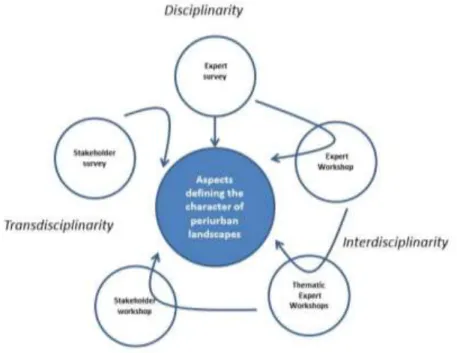
As presented in figure 1, it is possible to aggregate the different moments of research in three classes where disciplinary, interdisciplinary and transdisciplinary approaches were developed: (1) Individual expert surveys (open questions) on the characteristic defining peri-urban areas and the identification of main dimensions (disciplinary approach); (2a) Expert workshop to discuss the dimensions and aspects (pragmatic interdisciplinary); (2b) Thematic expert workshops to discuss the aspects and indicators to characterize each dimension (normative interdisciplinary); (3a) Individual stakeholder surveys on the definition of peri-urban areas and (3b) Stakeholder workshop provided inputs, and opportunity to discuss and validate the results (transdisciplinary).
Figure 1. Workflow: disciplinar, interdisciplinar and transdiciplinar
.
Once the aspects were stabilized for each dimension, the experts (in thematic workshops) identified indicators to describe them in the more accurate way with the available data. These indicators where subsequently used in statistical analysis that made possible to identify a range of territorial typologies for the metropolitan region of Lisbon.
3. DISCUSSION OF RESULTS
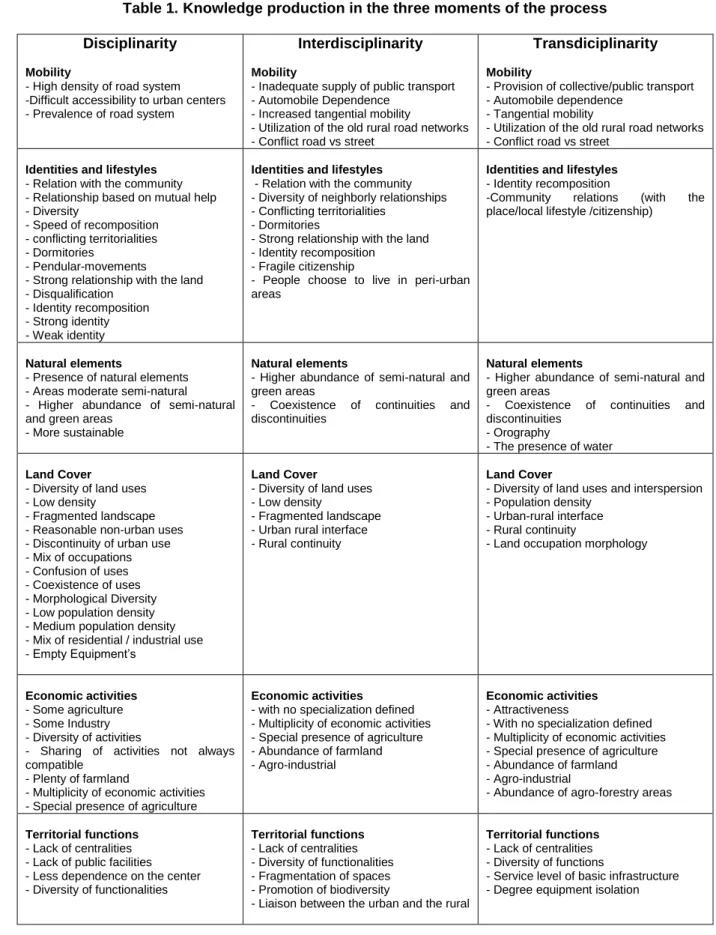
In this section is presented the process of knowledge production in the three moments that took place in this research project (Table 1). Firstly, in the disciplinary moment the specific characteristics distinguishing peri-urban areas were asked in an individual survey to the expert panel. From the content analysis an array of contributing aspects were identified and categorized into 6 dimensions: ‘mobility’, ‘identity and life-style’, ‘natural elements’, ‘land cover’, ‘territorial functions’, and ‘economic activities’, These established the starting-point
for further developments. The evolution of the aspects within each dimension is analysed according to its ‘persistence’, ‘innovation’ and ‘reformulation’.
Table 1.Knowledge production in the three moments of the process Disciplinarity
Mobility
- High density of road system -Difficult accessibility to urban centers - Prevalence of road system
Interdisciplinarity
Mobility
- Inadequate supply of public transport - Automobile Dependence
- Increased tangential mobility
- Utilization of the old rural road networks - Conflict road vs street
Transdiciplinarity
Mobility
- Provision of collective/public transport - Automobile dependence
- Tangential mobility
- Utilization of the old rural road networks - Conflict road vs street
Identities and lifestyles
- Relation with the community - Relationship based on mutual help - Diversity
- Speed of recomposition - conflicting territorialities - Dormitories
- Pendular-movements
- Strong relationship with the land - Disqualification
- Identity recomposition - Strong identity - Weak identity
Identities and lifestyles - Relation with the community
- Diversity of neighborly relationships - Conflicting territorialities
- Dormitories
- Strong relationship with the land - Identity recomposition
- Fragile citizenship
- People choose to live in peri-urban areas
Identities and lifestyles
- Identity recomposition
-Community relations (with the place/local lifestyle /citizenship)
Natural elements
- Presence of natural elements - Areas moderate semi-natural - Higher abundance of semi-natural and green areas
- More sustainable
Natural elements
- Higher abundance of semi-natural and green areas
- Coexistence of continuities and discontinuities
Natural elements
- Higher abundance of semi-natural and green areas
- Coexistence of continuities and discontinuities
- Orography
- The presence of water
Land Cover
- Diversity of land uses - Low density
- Fragmented landscape - Reasonable non-urban uses - Discontinuity of urban use - Mix of occupations - Confusion of uses - Coexistence of uses - Morphological Diversity - Low population density - Medium population density - Mix of residential / industrial use - Empty Equipment’s
Land Cover
- Diversity of land uses - Low density
- Fragmented landscape - Urban rural interface - Rural continuity
Land Cover
- Diversity of land uses and interspersion - Population density
- Urban-rural interface - Rural continuity
- Land occupation morphology
Economic activities
- Some agriculture - Some Industry - Diversity of activities
- Sharing of activities not always compatible
- Plenty of farmland
- Multiplicity of economic activities - Special presence of agriculture
Economic activities
- with no specialization defined - Multiplicity of economic activities - Special presence of agriculture - Abundance of farmland - Agro-industrial
Economic activities
- Attractiveness
- With no specialization defined - Multiplicity of economic activities - Special presence of agriculture - Abundance of farmland - Agro-industrial
- Abundance of agro-forestry areas
Territorial functions
- Lack of centralities - Lack of public facilities - Less dependence on the center - Diversity of functionalities Territorial functions - Lack of centralities - Diversity of functionalities - Fragmentation of spaces - Promotion of biodiversity
- Liaison between the urban and the rural
Territorial functions
- Lack of centralities - Diversity of functions
- Service level of basic infrastructure - Degree equipment isolation
Moment 1: Disciplinary approach
During this initial moment 'identities and lifestyle', and ‘land cover’ received the great number
of aspects: ‘mobility’, ‘natural elements’ and ‘territorial functions’ were those with fewer
contributions. ‘Economic activities’ occupied an intermediate position with a contribution of 7 aspects. The use of an individually expert survey did not mean that each expert limited its responses to their disciplinary field or area of expertise. In fact, results show that dimensions with greater scope, subjectivity and apparently less specificity, like 'identities and lifestyle' and 'land cover’ were attractive to contributions from all researchers. This dimensions draws to ‘familiar’ areas: ‘what we feel’ (‘identities and lifestyle’) and to ‘what we see’ (‘land cover’) and what we do (‘economic activities’). In contrast, 'natural elements', 'mobility', and ‘territorial functions’, where not so 'inviting', friendly or empathic. The results suggest that even if not forced, exchange of knowledge can happen between different areas by issue familiarity.
Moment 2: Interdisciplinary approach
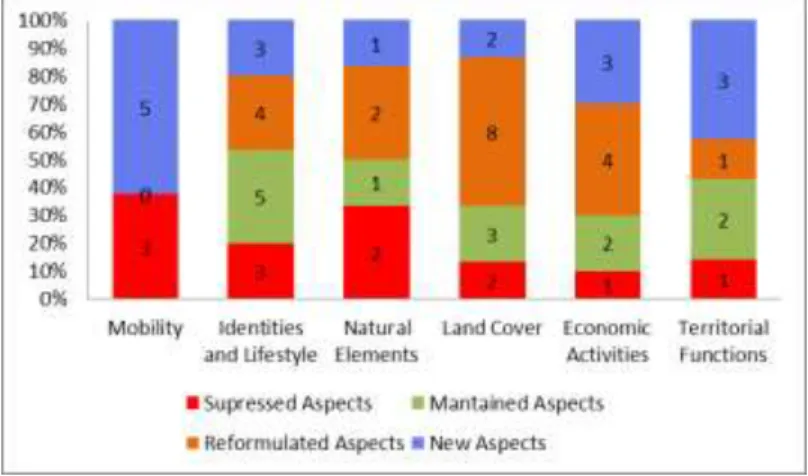
The interdisciplinary moment happened in two ways: a workshop setting where experts were invited to review in groups their previous contributions in the survey now organized into 6 dimensions in terms of the aspects listed (pragmatic interdisciplinary) and thematic working sessions by dimension where groups of experts met to discuss both the list of aspects as well as progressive on the indicators that could best describe them (normative interdisciplinary). In this process some aspects persisted, others were reformulated and new
ones were suggested. As presented in figure 2, ‘land cover’, ‘identities and lifestyle’, and
‘economic activities’ correspond to the dimensions where the reformulation is higher in relative terms expressing a reformulation that resulted from a synthesis effort. Concerning the introduction of new aspects, the panel ‘mobility’ presented the highest amount of new aspects added, followed by ‘territorial functions’. These new aspects correspond to effective
new issues like ‘tangential mobility’, ‘automobile dependence’ or ‘liaison between rural and
urban’. These results eventually reveal that dimensions that were less receptive to contributions in the initial phase are more ‘sensitive’ to change in an interdisciplinary
approach. Diversely ‘natural elements’ presented few new aspects and less reformulation.
This can probably be explained by the fact that these aspects are less “familiar” to
non-experts in natural sciences (e.g. ecology and biology).
Moment 3: Transdisciplinary approach
This moment proved to be pivotal in the validation and reformulation of the conceptual framework developed in disciplinary and interdisciplinary approaches. Stakeholders reviewed all aspects in each dimension. This approach intended to profit from multi-source knowledge but, foremost, from local knowledge and perceptions (Figure 3).
The dimensions related to ‘identities and lifestyles’ and ‘land cover’ suffered the greater
reformulation within transdisciplinary moment. It appears that these dimensions are more were of more interest to the stakeholders. The dimension ‘identities and lifestyles’ presented a smaller proportion of retained aspects (only one was kept). This may point to a high reformulation effort or synthesis of this dimension informed by stakeholder views.
Regarding the introduction of new aspects, ‘economic activities’ and ‘natural elements’ each one launched two new aspects that were introduced by stakeholders.
Figure 3. Aspects evolution in transdisciplinary moment by dimension
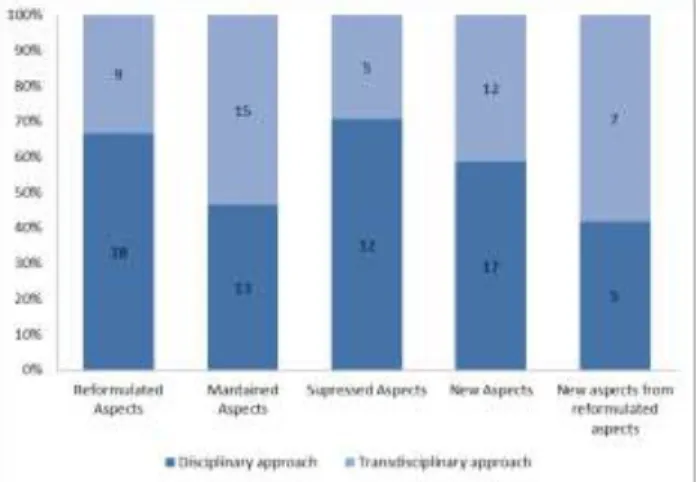
In summary, the disciplinary moment shows that dimensions with greater scope, subjectivity as 'identities and lifestyle' and 'land cover’ were attractive to contributions from all experts. Although not forced, knowledge flows can happen between different areas by ‘affectivity’. Interdisciplinary approach corresponds to a synthesis (suppression of aspects) and reformulation of the previous aspects. It also reveals the ability of a diverse interdisciplinary group to be effective in transformation and even transgressing disciplinary boundaries but also the importance of disciplinary skills/focus to reach the essential matters, as operative indicators. Furthermore it demonstrates a high level of innovation. Interdisciplinary strategies function on an ‘equal base between pairs’ and consensus evolution is eventually more likely to happen based on the recognition of skills and mutual understanding. This assumption can explain the high level of reformulated aspects. On the contrary, the transdisciplinar approach is characterized by a high degree of persistence (high levels of maintained aspects) revealing that those moments are not “revolutionary” but “reformative” in the sense that stakeholders rather than question previous expert work, prefered to reformulate and adapt existing aspects (Figure 4).
Figure 4. Total change in interdisciplinary and transdisciplinary moments
This more conservative nature of the transdisciplinary moment can also find explanation in the surveys carried out to the expert panel and the stakeholders before each of the groups was involved in the common discussion. The comparative analysis of the definitions used by both groups showed that there was a major consensus amongst experts and stakeholders in the kind of aspects to be integrated in each of the 6 dimensions. The main difference was that experts weighted the positive and negative sides of each aspect before expressing them, whereas the stakeholders mentioned the extreme conditions possible to occur in each aspect, which led to the fact that in some dimensions a characteristic and its exact opposite were mentioned alongside each other – “high quality of life” and “low quality of life” or “high ecological value” and also its degradation. This strengthens the initial argument that there might be wide range of “peri-urbanities” structured around the same urban core. Whereas experts aimed for a formulation encompassing “all” realities, stakeholders tend to express exactly that what is familiar to their own territorial experience. Ultimately, these findings justified the need to engage in the task differentiating territorial typologies.
4. CONCLUSION
Based on the awareness of the complexity of peri-urban landscapes in social, economic and environmental terms this process was designed to bring together multiple knowledge bases to inform a more complete picture of the meaning of “peri-urbanity” in the case of the Metropolitan Area of Lisbon. The focus was set on the collection of aspects that would best define the character of peri-urban landscapes, in order to set a solid basis for the selection of indicators to be used in the statistical analysis and the maps of typologies of peri-urban areas of the MAL. The evidence that this process was important in the final result was provided by the fact that both expert and stakeholder group felt comfortable with the resulting map, identifying 2 urban and 5 peri-urban clusters (Figure 5).
There is indeed a demanding and challenging nature to this kind of research approach and the recommendations provided by Tress and colleagues (2007) proofed useful in the organization of this process: the project planned from the beginning for a transdisciplinary approach and therefore time and resources were available to support the process; the team was chosen in order to cover the largest amount of needed expertise with the smallest possible number of experts; common knowledge of team members was fostered by regular (almost monthly) meetings and the organization of a field trip. This was also made easier because there was already a previous working experience of almost all members with the project leader, as well as amongst some members of the team. Notwithstanding this “privileged” situation of previous knowledge, the time considered for the creation of a common language was by large underestimated and had to be extended. At the end this time investment in strengthening the understanding of mutual languages and perspectives in the
shift from the disciplinary to the interdisciplinary moment turned out to be pivotal in the success of the transdisciplinary moment as each experts became more confident in communicating with the stakeholders which themselves came from a variety of personal and professional backgrounds.
Figure 5. Geographical representation of peri-urban typologies based on the aspects collected
The transdisciplinary knowledge production in the approach to these complex realities like peri-urban landscapes proved itself useful, but also showed the evidence of a disciplinary and interdisciplinary starting point in the construction of a common and integrated view. This needs an open-minded attitude and the willingness to share and to learn - without these prerequisites it seems not possible to work within inter and transdisciplinary environments. Ultimately, the results presented by strengthening the idea of the benefits of transdisciplinary research in the production of knowledge on complex issues and landscapes is found to justify the inclusion of regular contacts with stakeholders in planning curricula, where future professional can be confronted with the limitations of their own expertise and learn to embrace the value of the contribution of other types of knowledge.
Acknowledgements
This work has been carried out within the PERIURBAN project “Peri-urban areas facing
sustainability challenges: scenario development in the Metropolitan Area of Lisbon” (PTDC/AUR-AQI/117305/2010), funded by the Portuguese Science Foundation (FCT). The authors would like to acknowledge the research team for its engagement in this research
process.
REFERENCES
Allen, A. 2003. Environmental planning and management of the peri-urban interface: perspectives and emerging field, Environment & Urbanization, 15, pp. 135-147.
Antrop, M. 2004. Uncertainty in planning metropolitan landscapes. In: Planning Metropolitan Landscapes: concepts, demand and approaches. In: B. Tress and G. Tress eds. Delta Series: Wageningen, pp. 12-25.
Eupen, M. van; Metzger, M. J.; Pérez-Soba, M.; Verburg, P. H.; Doorn, A. Van; Bunce, R. G. H. 2012. A rural typology for strategic European policies, Land Use Policy, 29, pp. 473-482.
10 | Loupa-Ramos et al. Transdisciplinary research towards an improved understanding of peri-urban European Spatial Planning Observation Network (ESPON), 2005. ESPON 1.1.1 - Potentials for polycentric development in Europe. Stockholm: Nordregio.
Fertner, C. 2012. Urbanisation, urban growth and planning in the Copenhagen Metropolitan Region with reference studies from Europe and the USA. Forest & Landscape Research. No. 54-2012. Forest & Landscape Denmark, Frederiksberg.
Gonçalves, M. E. and Castro, P. 2009, Local is beautiful? Governing science-society relations in Europe, Portuguese Journal of Social Sciences, 8 (2), pp. 191-207.
Hadorn, G.; Bradley, D.; Pohl, C.; Rist, S.; Wiesmann, U. 2006. Implications of transdisciplinarity for sustainable research, Ecological Economics, 60, pp. 119-128.
Horlick-Jones, T. and Sime, J. 2004. Living on the border: knowledge, risk and transdisciplinarity. Futures, 36, pp. 441-456.
Jahn, T.; Bergman, M.; Keil, F. 2012. Transdisciplinarity: Between mainstreaming and marginalization, Ecological Economics, 79, pp. 1-10.
Korcelli P., Korcelli-Olejniczak E. and Kozubek E. 2009. Typologies of European Urban Rural Regions: a Review and Assessment, Geographia Polonica, 81, pp. 25-4.
Luks, F. and Siebenhuner, B. 2007. Transdisciplinarity for social learning? The contribution of the German socio-ecological research initiative to sustainability governance, Ecological Economics, 63, pp. 418-426.
Marjolein, B.A. and Rijkens-Klomp, N. 2002. A look in the mirror: reflection on participation in Integrated Assessment from a methodological perspective, Global Environmental Change, 12, pp.167-184.
Max-Neef, M. 2005. Foundations of transdisciplinarity, Ecological Economics, 53, pp. 5-16. Meeus, S. and Gulinck, H. 2008. Semi-urban areas in Landscape research: a Review, Living Reviews in Landscape Research, 2, pp. 1-45.
Nowotny, H.; Scott, P.; Gibbons, M. 2001. Re-Thinking Science, Knowledge and the Public in an Age of Uncertainty, Cambridge: Policy Press.
Organisation for Economic Co-operation and Development (OECD), 2010. OECD Regional Typology. Paris: Directorate for Public Governance and Territorial Development.
Piorr, A.; Ravetz, J.; Tosics, I. 2011. Peri-urbanisation in Europe: Towards a European Policy to sustain Urban-Rural Futures. Copenhagen: University of Copenhagen - Academic Books Life Sciences.
Rauws, W., and de Roo, G. 2011. Exploring Transitions in the Peri-Urban Area, Planning Theory & Practice,12(2), pp. 269-284.
Selman, P. 2012. Landscapes as integrating framework for human, environmental and policy processes. In: T. Plieninger and C. Bieling eds. Resilience and the Cultural Landscape: understanding and managing change in human-shaped environments. New York: Cambridge University Press, pp 27-48.
11 | Loupa-Ramos et al. Transdisciplinary research towards an improved understanding of peri-urban landscapes
Simon, D. 2008. Urban Environments: Issues on the Peri-Urban Fringe. Annual Review of Environment and Resources, 33, pp. 167–85.