Public finances in Portugal: a brief
long-run view
*António Afonso
$#January 2007
Abstract
This paper provides a succinct overview of long-run developments regarding public finances in Portugal with an emphasis on the spending side. Issues addressed are the excessive deficit experiences of Portugal, the past experience with fiscal consolidations, and labour cost competitiveness. It is fair to stay that public spending control has been a problem in Portugal, and fiscal consolidations in the 1980s and 1990s have been short-termed and mostly not successful. Additionally, the compensation of general government employees diverged vis-à-vis the EU15 after EU entry.
JEL: E62, E65, H6
Keywords: public finances, Portugal, fiscal consolidations, compensation of employees
*
I am grateful to Manuela Arcanjo, Vítor Gaspar, and participants at the seminar of the 25 years of CISEP (Lisbon, December 2006) for helpful comments. The opinions expressed herein are those of the author and do not necessarily reflect those of the ECB or the Eurosystem.
$
CISEP – Research Centre on the Portuguese Economy; UECE – Research Unit on Complexity and Economics; Department of Economics, ISEG/TULisbon – Technical University of Lisbon, R. Miguel Lupi 20, 1249-078 Lisbon, Portugal, email: [email protected].
#
Contents
1. Introduction... 3
2. Public finances quality and growth... 4
3. Developments in public finances ... 6
3.1. Past trends ... 6
3.2. Excessive deficits... 9
3.3. The capital markets view ... 14
3.4. Stress test ... 17
3.5. Fiscal consolidations ... 19
4. Compensation of employees and competitiveness ... 21
5. Conclusion ... 26
References... 27
Appendix 1... 29
1. Introduction
This paper provides a succinct overview of long-run developments regarding public
finances in Portugal, with a particular emphasis on the expenditure side. As regularly
mentioned by international organisations, in the last twenty years or so public spending
control has been a problem in Portugal, with significant increases in primary spending.
For instance, the gains obtained from the drop in interest rates and the reduction in the
interest payments on the outstanding government debt were mostly used to increase
public spending, and not seen as a window of opportunity to consolidate public finances.
Indeed, given past performance and outcomes, it seems fair to say that after entering the
European Union (EU) in 1986, joining the Exchange Rate Mechanism (ERM) of the
European Monetary System (EMS) in 1992 and adhering to the European and Monetary
Union (EMU) on January 1999, Portugal’s track record in implementing fiscal policy
could have been better.
The fiscal consolidations that occurred in the 1980s and in the 1990s have been
short-termed and mostly not successful. Portugal was the first country in the EU to breach the
Stability and Growth Pact (SGP) in 2002, becoming therefore subject to the Excessive
Deficit Procedure (EDP), a situation that occurred again in 2005. So far, capital markets
have given the benefit of the doubt to Portugal, allowing both for mostly stable sovereign
debt ratings and for low long-term government bond interest rates, with limited spreads
vis-à-vis the German benchmark. However, this may change in the future in the
continued absence of good fiscal performance.
Additionally, the compensation of employees in the general government, a relevant
spending item, notably in terms of demonstration effect for the private sector, diverged
vis-à-vis the EU15 average after 1987-88, as a share of GDP. Moreover, unit labour costs
also exhibited a higher growth than in the case of Portugal’s main trading partners. These
factors, coupled with high external imbalances in the last years, may have impinged
The organisation on the remainder of the paper is as follows. Section two offers some
considerations on the role of public finances in promoting growth. Section three reviews
developments in public finances in Portugal such as past trends, excessive deficits, the
capital markets assessment of fiscal outcomes, and episodes of fiscal consolidations.
Section four addresses developments of general government labour costs. Finally, section
five presents some concluding remarks.
2. Public finances quality and growth
Public expenditure composition is increasingly the focus of policy debate in the EU while
international institutions and governments realise that they need to assess expenditure
performance and efficiency. At the EU level the Working Group for the Quality of Public
Finances within the Economic Policy Committee carries out such related work and
analysis. Moreover, the European Commission argues for assessing the fiscal policy
stance in the Member States also taking into account the quality of spending and of fiscal
adjustments. Such analysis may also be present when assessing the countries’ Stability
Programmes, notably in terms of public spending redirecting measures.
Expenditure policies support growth and sustainability if they provide a supportive
environment for a functioning market economy; limit commitments to so-called core
and/or productive spending and to basic safety nets; provide services in an efficient
manner; and maintain sustainable deficits and debt, allowing automatic stabilisers to
operate.1 Figure 1 illustrates a possible set of linkages between public finances and growth, emphasising public spending composition and efficient outcomes as a relevant
determinant of economic growth.
Naturally, several problems arise when trying to assess core spending and “high quality”
of public finances. For instance, even if core spending is needed in such areas as
education, health, redistribution and infrastructure, this is a hard concept to define. On the
other hand, even if redistribution may reduce incentives to work, it may also promote
1
growth, by diminishing the need for high savings and fostering consumption.
Additionally, international comparability of results is scarce and a demanding exercise.2
Figure 1 – Public finances and economic growth
Figure 2 shows the positioning of OECD countries in terms of the pair performance and
efficiency of public sector outcomes. In this context, Portugal’s situation clearly suggests
that there is some room for improvement, both in terms of public spending performance
and efficiency. Indeed, according to the reported results, Portugal is located in the
diagram in the lower left-hand side quadrant (together with Italy, Greece, France and
Spain), implying that other countries are both more effective in producing public sector
outputs and that they are also more efficient in performing such tasks.
Interestingly, one can also observe the existence of good performing countries (in the two
right-hand side quadrants) both with lower (Finland, Sweden, and Denmark) and higher
(Austria, Japan, Ireland, US) efficiency levels. Overall, one can conclude that similar and
above average public outcomes may be attained with different amounts of resources
2
engaged in public spending activities, and this has to be seen as a country-specific policy
decision.
Figure 2 – Spending performance and efficiency
Source: adapted from Afonso, Schuknecht and Tanzi (2005).
3. Developments in public finances
3.1. Past trends
Public expenditure in Portugal has been a challenge for fiscal control and overall
competitiveness. Past expenditure trends have not been reassuring as can be seen from
Figure 3, with primary expenditure averaging 23.5, 31.6, and 35.5 per cent of GDP
respectively in the 1970s, 1980s, and 1990s, and reaching an average of 42.9 per cent
between 2000 and 2006. Naturally, this development tracked, to some extent, the upward
trend in public spending in the EU15 countries in the past three decades, where a
significant increase in the total expenditure-to-GDP ratio also occurred from 1970 until
the beginning of the 1990s, from 35.4 per cent of GDP in 1970 to around 50 per cent of
GDP in 1993-1995. Thereafter, the total expenditure ratio declined in the EU15 but
continued to increase in Portugal.
Public sector performance vs efficiency, 2000
NO JP
US AU
IR
NZ
0.60 1.00 1.40
0.60 1.00 1.40
Public sector performance/effectiveness
P
ubl
ic
s
e
c
tor
ef
fi
c
ienc
y
Fl SW DK
Effective & efficient Less effective
but efficient
Effective but less efficient Less effective &
less efficient
GE
IT
FR
AT BE
GR
CH
NL
PT
SP
Figure 3 – Public spending-to-GDP ratios, Portugal and EU15 (1970-2006)
15 20 25 30 35 40 45 50 55
19
70
19
73
19
76
19
79
19
82
19
85
19
88
19
91
19
94
19
97
20
00
20
03
20
06
% o
f
G
D
P
Total expenditure
Primary expenditure
Tot. exp. EU15
Source: European Commission.
The limitations imposed by the need to ensure sound public finances, notably in order to
meet the Maastricht fiscal criteria, led most EU countries to curb down public
expenditure behaviour from the mid-1990s onwards. The expenditure-to-GDP ratio in the
EU15 was reduced from 50.3 per cent in 1995 to 46.2 per cent in 2000, halting therefore
the raising trend of public expenditures in the EU. More particularly, the ratio of total
public expenditure-to-GDP declined between 1995 and 2000 for all EU countries, with
the exception of Greece and Portugal. Shortly after, Portugal was faced with a budget
deficit above 3 per cent of GDP in 2001 (see Figure 4).
Another conclusion to be drawn from Figure 4 is that in the twenty-one years that passed
after Portugal’s adhesion to the EU in 1986, only in six years was the general government
budget deficit below 3 per cent of GDP, averaging around 4 per cent in the entire period.
In other words, relevant fiscal imbalances were recorded in more than two thirds of the
Figure 4 – Budget balance and debt-to-GDP ratios in Portugal (1970-2006) 14 18 22 26 30 34 38 42 46 50 54 58 62 66 70 1 970 1 973 1 976 1 979 1 982 1 985 1 988 1 991 1 994 1 997 2 000 2 003 2 006 % o f G D P ( R ev , E x p, D ebt ) -13.0 -11.0 -9.0 -7.0 -5.0 -3.0 -1.0 1.0 3.0 5.0 7.0 9.0 11.0 13.0 % of G D P ( bal anc e) Balance Revenues Expenditures Debt
Source: European Commission.
As a result of an upward trend in public spending and persistent budget deficits, the
debt-to-GDP ratio increased during the 1970-2006 period, with a temporary reversion in the
second half of the 1990s.3 The debt ratio averaged 23.8, 48.9, and 56.0 per cent of GDP respectively in the 1970s, 1980s, and 1990s, reaching an average of 58.1 per cent
between 2000 and 2006. Quite telling of a lack of a strong commitment to fiscal
consolidation efforts in Portugal is the fact that even though the debt ratio declined 10.7
percentage points (pp) of GDP between 1995 and 2000, notably due to strong growth
(real GDP growth rate averaged 4.1 per cent in that period), and dropping interest rates,
the total expenditure ratio did not decline in a sustainable way.4
Another point worthwhile mentioning, and which can be confirmed with Figure 5, is that
the actual outcomes of public finances, notably on the spending side, have generally
turned out worse than initially foreseen. Put in another way, official forecasts have been
3
One should notice that it was in the period 1996-1998 that substantial privatisation revenues were obtained, with the amounts channelled to debt redemption adding up to 6.2 per cent of GDP in those three years.
4
mostly on the optimistic side. For instance, the 2002 Stability Programme reported for
2005 an expected spending-to-GDP ratio 3 percentage points below the actual outcome.
This systematic underestimation of spending also seemed to be a common feature of the
subsequent updates of the Portuguese Stability Programmes (even if not an isolated case
in the EU).
Figure 5 – Public spending-to-GDP ratio in the Stability Programmes
SP (2002/03)
SP (2003/04)
SP (2004/05)
SP (2005/06) Actual (EC,
autumn 2006)
SP (2006/07)
41.0 42.0 43.0 44.0 45.0 46.0 47.0 48.0 49.0
1998 1999 2000 2001 2002 2003 2004 2005 2006 2007 2008 2009 2010
% o
f G
D
P
Source: European Commission and Stability Programmes.
3.2. Excessive deficits
This subsection provides a brief factual stocktaking of the two EDP experiences faced by
Portugal. As already mentioned above, Portugal was the first country in the EU to breach
the SGP in 2001, becoming subject to the EDP in 2002, a situation that occurred again in
2005. After the first EDP for Portugal, both Germany and France also breached the 3 per
cent limit for the budget deficit in 2002, and become subject to an identical procedure
respectively in 2002 and in 2003. Figure 6 offers a graphical representation that
summarises the successive steps of the EDP, commonly considered as the corrective arm
of the SGP.5
5
Figure 6 – Excessive Deficit Procedure
EFC Opinion [104 (4)]
2 weeks EC Report [104 (3)]
EC Opinion
[104 (5)] No excessive deficit
End of EDP
Excessive
deficit
ECOFIN
Decision [104 (6)]
No excessive deficit
End of EDP
Excessive
deficit
ECOFIN
Recommendation
to MS [104 (7)] 4 months
MS announces measures
MS does not announce measures
Abeyance situation
ECOFIN Decision
[104 (8)] 6 months
MS does not implement
measures
MS implements measures
Notice to MS [104 (9)]
2 months
MS announces
measures
Abeyance
situation
Sanctions
[104 (11)] 4 months
16 months
MS implements measures
MS does not implement measures
Non-remunerated deposit Abrogation
[104 (12)]
MS – Member State.
Source: Adapted from Pereira, P.; Afonso, A.; Arcanjo, M. and Santos, J. (2007).
1467/97, both from 7 July 1997, published on 2 August 1997, modified by Regulations N.º 1055/2005 and N.º 1056/2005 of 27 June 2005. See the EC site for additional relevant information on this topic:
The first EDP for Portugal was launched in 2002, the year of the identification of the
excessive deficit. On 5 November 2002, the Council decided that an excessive deficit
existed in Portugal and issued a recommendation requesting Portugal to bring this
situation to an end by 2003 at the latest. Portugal then opted to address the excessive
deficit situation still in 2002 (one-off measures amounting to 1.4 per cent of GDP were
used in that year), therefore avoiding further steps in the procedure. Subsequently the
Council Decision of 11 May 2004 proposed the abrogation of the decision on the
existence of an excessive deficit in Portugal in accordance to Article 104(12), stating that
the correction of the excessive deficit was completed in 2003.
In 2003 and 2004 Portugal used again sizable temporary measures, amounting
respectively to 2.5 and 2.3 per cent of GDP, in order to keep the budget deficit below the
3 per cent limit. Among the temporary measures implemented in the 2002-2004 period,
adding up to 6.2 per cent of GDP, one can recall the more relevant ones:
i) In 2004, the transfers from public sector enterprises to CGA (civil servants pension
system) as counterpart for the assumption by the general government of future pension
liabilities of the employees of those enterprises;6
ii) In 2003, the securitization of tax credits, which were sold to a resident non-monetary
financial institution (comprising taxes and social contributions concerning the period 1
January 1993 to 30 September 2003);
iii) In 2003, transfers from CTT (Portuguese postal operator) to CGA and to the Treasury,
in exchange of the future payment of pensions;
iv) In 2002, the extraordinary settlement of tax arrears programme (a tax amnesty), the
sale of the fixed telecommunications network, and the sale of rights to reintroduce tolls in
a highway.7
6
Transfers were made from the following state-owned enterprises: Caixa Geral de Depósitos, Navegação Aérea de Portugal, Aeroportos de Portugal, and Imprensa Nacional Casa da Moeda.
7
The adoption of such strategy, making use of temporary measures, even if it prevented
the budget deficit from going above the 3 per cent limit, did not address the structural
factors behind the underlying Portuguese fiscal imbalances. Additionally, after the 2002
EDP, the consolidation strategy also included an increase in the standard VAT rate (from
17 to 19 per cent, which was again raised to 21 per cent in July 2005), while primary
spending continued rising.8
The second EDP was initiated against Portugal in 2005 via a Council Decision of 20
September 2005, in line with article 104(6). The deadline of 2008 was given for Portugal
to correct the situation. Additionally, the Commission recommended to Portugal a
reduction of the cyclically-adjusted deficit, excluding one-off and other temporary
measures, by 1.5 per cent of GDP in 2006, and at least ¾ per cent of GDP in 2007 and in
2008. Under Article 104(7) a Council Recommendation was also adopted on 7 October
2005 asking Portugal to take effective action regarding the measures needed to address
the excessive deficit situation.9
Against this background, a word is in order regarding some limitations concerning the
monitoring and collection of fiscal data. A specific commission led by the Banco de
Portugal was created in 2002 to determine the value of the 2001 budget deficit. It was on
the basis of that outcome, showing a much higher deficit than the one previously reported
by the national authorities to Brussels that the first EDP for Portugal was triggered.
Yet again in 2005, another commission under the aegis of the Banco de Portugal
concluded for the existence of still a higher number for the budget deficit in that year,
more specifically of twice the 3 per cent limit. As already mentioned, Portugal then faced
the second EDP in 2005. Therefore, it is somewhat worrying that in the past some
limitations prevented the fiscal and statistical authorities of being able of accurately
monitoring the outcomes of the several public finances related variables. Indeed, and
even if this is not an easy task, one expects all steps of the budgetary process and the
8
Guichard and Leibfritz (2006) also survey the reasons for the non-successful fiscal adjustment in the period 2002-2004.
9
ensuing implementation and monitoring of fiscal policy to be tackled in a timely fashion
by the fiscal authorities.
The second EDP was still underway at the end of 2006, and among the several measures
proposed by the authorities to control primary spending, one can mention as some of the
more structurally oriented ones, for instance, the revision of the civil servants’ pension
schemes (see section 4), and the reform of the health care sector.10
Portugal’s difficulties and experiences with excessive deficit situations are not an
exception in the EU. As a matter of fact, in the last years other members of the EU also
faced an EDP (in the euro area Portugal, Greece, France, Germany and Italy were
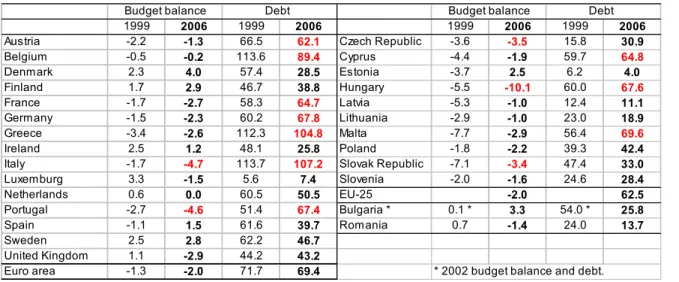
undergoing an EDP at the end of 2006).11 Table 1 provides the development of the
relevant fiscal variables, budget deficit and general government debt, for each country in
1996 and in 2006.12
Table 1 – Budget balance and debt-to-GDP ratios
Source: EC, autumn 2006 forecasts.
10
Actually, since 2002, some public hospitals have been transformed into public corporations, in an attempt to increase efficiency and decrease costs in the National Health Service, and the verdict is still out on the efficacy of these measures.
11
By the end of 2006, other countries already faced an EDP: Czech Republic, Cyprus, Hungary, Malta, Poland, and Slovak Republic. Additionally, in 2004 both the UK and the Netherlands found themselves in excessive deficit, vis-à-vis the 2003 budget deficit outcome.
12
For the status of the EDP on a country basis, one can see the main relevant information at the EC site:
http://ec.europa.eu/economy_finance/about/activities/sgp/procedures_en.htm.
Budget balance Debt Budget balance Debt
1999 2006 1999 2006 1999 2006 1999 2006
Austria -2.2 -1.3 66.5 62.1 Czech Republic -3.6 -3.5 15.8 30.9
Belgium -0.5 -0.2 113.6 89.4 Cyprus -4.4 -1.9 59.7 64.8
Denmark 2.3 4.0 57.4 28.5 Estonia -3.7 2.5 6.2 4.0
Finland 1.7 2.9 46.7 38.8 Hungary -5.5 -10.1 60.0 67.6
France -1.7 -2.7 58.3 64.7 Latvia -5.3 -1.0 12.4 11.1
Germany -1.5 -2.3 60.2 67.8 Lithuania -2.9 -1.0 23.0 18.9
Greece -3.4 -2.6 112.3 104.8 Malta -7.7 -2.9 56.4 69.6
Ireland 2.5 1.2 48.1 25.8 Poland -1.8 -2.2 39.3 42.4
Italy -1.7 -4.7 113.7 107.2 Slovak Republic -7.1 -3.4 47.4 33.0
Luxemburg 3.3 -1.5 5.6 7.4 Slovenia -2.0 -1.6 24.6 28.4
Netherlands 0.6 0.0 60.5 50.5 EU-25 -2.0 62.5
Portugal -2.7 -4.6 51.4 67.4 Bulgaria * 0.1 * 3.3 54.0 * 25.8
Spain -1.1 1.5 61.6 39.7 Romania 0.7 -1.4 24.0 13.7
Sweden 2.5 2.8 62.2 46.7
United Kingdom 1.1 -2.9 44.2 43.2
From Table 1, one can see that according to the EC forecasts, two of the euro area
countries had in 2006 a deficit above 3 per cent of GDP (Italy and Portugal), and seven
countries still had a debt-to-GDP ratio higher than the 60 per cent threshold. Regarding
the EU new Member States, three countries reported a deficit above 3 per cent (the Czech
Republic, Hungary and the Slovak Republic), while three countries surpassed the debt
ratio limit (Cyprus, Hungary and Malta).
According to Afonso and Claeys (2006), the main reasons for the three initial breaches of
the SGP in 2002 and 2003 seem to be expenditure rises in France and Portugal, while
large revenue reductions unmatched by expenditure cuts in Germany pushed the deficit
beyond 3 per cent of GDP. This evidence again seems to point, as already mentioned, to
some difficulties related to expenditure control in the case of Portugal.
3.3. The capital markets view
After entering the EU in 1986 both inflation and interest rates in Portugal decreased
steadily and converged towards the lower levels that were more common in other
countries in Europe. This was an obvious benefit from entering the EU, with capital
markets adjusting its expectations vis-à-vis Portugal, which also allowed for better and
more stable sovereign debt ratings attributed to the country.
Undeniably, Portugal was one of the countries that most had to gain from the decrease in
interest rates, given the quite high inflation and interest rate levels that it incurred in the
past. Indeed, between 1985 and 1993, the long-term interest rate decreased around 1650
basis points (bp), opening an extremely important window of opportunity to engage in
fiscal consolidations. It then further declined by some 700 bp from 1993 to 2003 (see
Figure 7 – Long-term government bond interest rates in Portugal
-10 -5 0 5 10 15 20 25 30 35
1980 1981 1982 1983 1984 1985 1986 1987 1988 1989 1990 1991 1992 1993 1994 1995 1996 1997 1998 1999 2000 2001 2002 2003 2004 2005
(%)
Real Nominal Inflation
Source: European Commission.
Regarding recent developments in sovereign credit ratings in the euro area, in 2006 only
the rating for Italy was reduced. On October 2006 Standard & Poor's (S&P) lowered its
rating notation on Italian sovereign debt from AA- to A+ while Fitch decreased its own
rating assessment from AA to AA-. The downgrade from Fitch moved Italian sovereign
debt from the usually labelled “high quality” borrowing to the “strong payment capacity”
category.
The sovereign credit ratings at the end of 2006 in the euro area are reported in Table 2.
One can also notice that the minimum credit rating for collateral, accepted by the
European Central Bank for its financial market activities, is a least A- from S&P or Fitch
or at least A3 from Moody’s.
Interestingly, the announcement of the rating downgrade for Italy in 2006 had a
somewhat benign effect on its 10-year government bond yield. Moreover, the yields of
the 10-year government bonds of Portugal have been steadily located, since the middle of
2005, inside a range between the yields of Greece and Italy in the upper bound, and the
spreads for Portugal vis-à-vis Germany have remained almost stable during the last two
years.
Table 2 – Sovereign credit ratings for euro area countries (December 2006)
Ratings Characterization of
debt and issuer
(source: Moody’s) S&P Countries Moody’s Countries Fitch Countries Highest quality
AAA
AT, DE, ES, FI, FR, IR,
LU, NL
Aaa
AT, DE, ES, FI, FR, IR,
LU, NL
AAA
AT, DE, ES, FI, FR, IR,
LU, NL
AA+ BE Aa1 BE AA+ BE
AA SL Aa2 IT, PT AA PT
High quality
AA- PT Aa3 SL AA- IT, SL
A + IT A1 GR A+
A GR A2 A GR
Strong payment capacity
A- A3 A- Sources: S&P, Moody’s, and Fitch.
Figure 8 – 10-year government bond yield (end-of-month)
3.0 3.2 3.4 3.6 3.8 4.0 4.2 4.4 J an-0 5 F eb-05 Mar -05 A p r-0 5 May -05 J un-0 5 Ju l-0 5 A ug-0 5 S e p-05 Oct -0 5 No v -0 5 De c -0 5 J an-0 6 F eb-06 Mar -06 A p r-0 6 May -06 J un-0 6 Ju l-0 6 A ug-0 6 S e p-06 Oct -0 6 No v -0 6 10-y e ar y iel d (% )
DE GR FR IT PT
Source: Reuters.
So far capital markets seem to have given the benefit of the doubt to Portugal in spite of
less than reassuring past fiscal developments. Actually, empirical evidence suggests that
the interest rate differentials do not react much to changes in the fundamentals, being the
bond yields in the euro area bond market mostly driven by common factors. Naturally,
negative spillover effects as pointed out, for instance, by Detken, Gaspar and Winkler
(2004).
On the other hand, and as mentioned by Afonso, Gomes and Rother (2007), fiscal
performance does matter in determining sovereign credit ratings. Moreover, according to
S&P and Fitch, the downgrade of Italian sovereign debt in 2006 was due to the fact that
the 2007 Budget relied more on revenue measures to cut down the general government
deficit, a strategy that did not address the expenditure side, notably current spending.
Therefore, other EU countries with fiscal imbalances cannot really dismiss lightly this
credit rating downgrade episode regarding Italy.
3.4. Stress test
In order to simulate and assess in a straightforward way possible future paths for public
finances in Portugal, one can use the arithmetic of the government budget constraint,
1 ( ) 1
t t t t t t t
b −b− = − + −g ρ i n b− (1)
where b is the debt-to-GDP ratio, g is the primary spending-to-GDP ratio, ρ is the
revenue-to-GDP ratio, and i and n are respectively the nominal long-term interest rate and
the nominal GDP growth rate.13 The simulation for the debt ratio at time t may then be computed from
1 ( ) 1
t t t t t t t
b =b− + − + −g ρ i n b− , (2)
while the budget balance, d, can be calculated from
1
t t t t t
d =ρ − −g i b− . (3)
13
The main assumptions used in the calculations, throughout a period of four years ahead
are as follows: nominal GDP growth rate, 3.5 per cent; nominal long-term interest rate,
4.5 per cent; expenditure ratio development, -0.5 pp of GDP annually; revenue ratio
development, 0.0 pp annually.14
Making a simple stress test using (2) and (3), for the period 2007-2010, shows the
difficulties underlining the development in Portuguese public finances, and Figure 9
presents the results of such exercise. The main conclusion is that given past spending and
revenue dynamics, and sensible and cautious assumptions for future spending and
revenues, it may take four to five years for Portugal to overcome a situation of excessive
deficit, once the budget deficit is as high as twice the three per cent threshold, and
government debt is approximately 67 per cent of GDP.
Figure 9 – Pubic finances stress test for Portugal
-7.0 -6.0 -5.0 -4.0 -3.0 -2.0 -1.0 0.0
2000 2001 2002 2003 2004 2005 2006 2007 2008 2009 2010
B
al
a
nc
e (
%
of
G
D
P
)
40 45 50 55 60 65 70 75
D
ebt
(
%
of
G
D
P
)
Debt (rhs)
Budget balance (lhs) Bud bal no temp (lhs)
Sources: European Commission, autumn 2006 Forecasts and Portuguese Stability Programme 2006-2010 (December 2006), and author’s calculations. Note: the line with the square mark for the budget balance excludes one-off measures amounting to 1.4, 2.5, and 2.3 per cent of GDP respectively in 2002, 2003, and 2004.
Portugal’s difficulties are compounded by the lack of a convincing cyclical recovery.
According to the European Commission, the output gap in Portugal has been negative,
14
averaging -1.0 per cent in the 2002-2006 period, which is twice as much as the one
observed in the euro area. Finally, the rate of capacity utilization has also been
historically low in recent years.
3.5. Fiscal consolidations
Regarding the past experiences in terms of fiscal consolidations, Table 3 identifies the
fiscal episodes in the EU15 countries, based on the change in the cyclically adjusted
primary budget balance. For this purpose, Afonso (2006) determined the periods when
the change in the primary cyclically adjusted budget balance is at least 2 pp of GDP in
one year or at least 1.5 pp points on average in the last two years. For the case of
Portugal, Table 3 reports two episodes of fiscal contraction and three episodes of fiscal
expansion between 1970 and 2005: 1982-83, 1986, and 1992.
Table 3 – Fiscal episodes (1970-2005)
Source: adapted from Afonso (2006), following the measure used by Alesina and Ardagna (1998).
Recalling Figure 4, it is possible to see that the abovementioned fiscal consolidation
episodes were, on the one hand short-termed, and on the other hand mostly unsuccessful.
Expansions Contractions Expansions Contractions
GR 75, 81, 85, 88-89, 01-02, 04
82-83, 86-87, 91-92, 94-97, 05
UK 72-73, 92-93, 02-03
81, 95-98
IR 74-75, 78-79, 95, 99, 01-02
76-77, 83-84, 88-89, 04
84, 97, 01 IT 77, 83, 91-93
BE 82-83, 85, 95 LU 86-87, 02-04 83-85, 01
AU 76
DK 76, 82, 94 83-86, 95-96 NL
FI 78-79, 87 76-77, 95-96, 00-01
PT
95-96 SP
91, 93, 95-96
80-81, 05 82-83, 86, 92
95-96
GE 75, 90-91 82-83 SW 74, 79, 91-93, 01-02
During the 1982-83 consolidation both expenditures and revenues increased, as a share of
GDP, while the debt-to-GDP ratio kept on increasing at the same time.15
Regarding the 1986 consolidation (the year of Portugal’s entry in the EU), one observes
in that period a certain stabilization of revenues as a share of GDP, a decrease in the
expenditure-to-GDP ratio, and also a decrease in the debt ratio in the following three
years. Additionally, the primary balance was also in surplus for the first time in thirteen
years.16
Finally, the 1992 episode was very short-termed, taking place in a difficult environment,
following revenue and expenditure increases with the debt ratio rising immediately
afterwards.17 Moreover, the 1993 economic downturn in Europe did not play in favour of prolonging the consolidation, with the primary spending-to-GDP ratio increasing more
significantly in that year. Indeed, a known feature of fiscal policies in Portugal in the past
has been the pro-cyclical behaviour of primary spending, which contributed to prevent
the implementation of successful fiscal consolidations (see, for instance, Pina, 2004).
Such pro-cyclical behaviour would again be present in 2001, with the budget deficit
going once more above the 3 per cent limit.
According to the existent literature, one would be more inclined to attribute a higher
degree of success to a fiscal consolidation if it is more based on the reduction of primary
current expenditure than on the increase on revenues or on the reduction of capital
spending. For instance, Alesina and Perotti (1997) define two types of fiscal adjustment:
Type 1 adjustment, when the budget deficit is reduced through cuts in social expenditures
(unemployment subsidies, minimum income subsidies) and cuts in public sector wages;
and Type 2 adjustment, when the budget deficit is reduced with the increase of taxes on
15
It is also worthwhile mentioning that the Portuguese Escudo effective exchange rate faced a devaluation of 17 and 23 per cent respectively in 1982 and 1983, while Portugal undertook an IMF stabilisation programme.
16
In that year also occurred the effective introduction of VAT, and Portugal started receiving European funds.
17
labour income and with cuts in public investment expenditures. Against this background,
one could tentatively label the episodes of fiscal consolidation of 1982-83 and 1992 more
likely as Type 2 adjustments, while the 1986 episode may have had more features of a
Type 1 adjustment.
4. Compensation of employees and competitiveness
Compensation of employees in Portugal diverged vis-à-vis the EU15 average after the
adhesion to the EU in 1986, a development that may have impinged adversely on the
country’s competitiveness. Indeed, compensation of employees as a share of GDP
increased roughly 1.0 percentage point of GDP for the EU15 countries, between 1970 and
2006 while it increased quite more substantially in Portugal (see Figure 10).
Figure 10 - Compensation of employees (% of GDP), Portugal and EU15
Compensation of employees (General government)
4.0 6.0 8.0 10.0 12.0 14.0 16.0
19
70
19
73
19
76
19
79
19
82
19
85
19
88
19
91
19
94
19
97
20
00
20
03
20
06
% o
f G
D
P
Portugal
EU15
To better place the Portuguese case in the broader picture of the EU15, it is important to
mention the existence of large differences both among countries and through time in
terms of this public spending category. For instance, one can mention that compensation
of employees as a share of GDP in 1980 ranged from 9.4 per cent in Greece and Spain to
values for those ratios were 7.2, 8.1 and 9.6 per cent respectively in Germany,
Luxembourg and in the Netherlands, while the highest reported values were 17.0 per cent
in Denmark, 15.9 per cent in Sweden and 14.2 per cent in Portugal (see Figure 11).
Figure 11 – Compensation of employees (% of GDP), EU15
0 2 4 6 8 10 12 14 16 18 20
AU
T
BE
L
DE
DN
K
ES
P
FI
N
FR
A
GB
R
GR
C
IR
E
IT
A
LU
X
NLD PR
T
SW
E
% of
G
D
P
1970 2006
EU15 1970 EU15 2006
Source: European Commission.
In spite of the moderate general increase in the share of compensation of employees in
GDP, between 1970 and 2006 in the EU15, the compensation of employees-to-GDP ratio
did increase more significantly in five countries: Portugal, Greece, Finland, Denmark,
and Spain. The biggest increases during that period occurred in Portugal and Greece, with
respectively changes of 6.9 and 4.1 percentage points. On the other hand, compensation
of employees as a share of GDP either decreased between 1970 and 2006 in three
countries, Germany, Netherlands and Austria, or remained broadly stable in Ireland.
A different way of looking at the weight of the compensation of employees, it to notice
that in the EU15 such public spending item accounted for 27.6 per cent of the general
government’s total expenditures in 1970, decreasing to 22.8 per cent in 2006 (a decline of
4.9 pp). Once more it is possible to identify significant differences among the EU15
countries. In 2006, the weight of public sector compensation of employees ranged from
33.4 and 29.5 per cent respectively in Denmark and in Portugal (see Appendix 2 for
country details).
In order to assess the contributions to the change in the compensation of employees, it is
possible to decompose the variation of that spending category as follows:
Effect via Effect via Cross effect change in change in (residual) civil servants average spending
W
N w
w N
N
w
∆ = ∆ × + ∆ ×
+ ∆ ×∆
(4)
where we have: W – compensation of employees (general government); N – number of
civil servants (as recorded in the CGA); and w – average spending per employee (W/N).18 The results for Portugal for the period 1989-2005, using the decomposition equation (4),
are presented in Figure 12.
Figure 12 – Contributions to changes in compensation of employees (General government)
-1250000 -750000 -250000 250000 750000 1250000 1750000
1989 1990 1991 1992 1993 1994 1995 1996 1997 1998 1999 2000 2001 2002 2003 2004 2005
1000 eur
o
Change in civil servants Change in average spending Cross effect
Source: CGA, EC, and author’s calculations.
18
Between 1989 and 1992, a period of strong increase in the share of the compensation of
public employees in GDP, the increase in the average spending per civil servant was
essentially the main driving force. On the other hand, it is possible to observe a period of
four years, 1998-2001, where the increase in the number of civil servants contributed
more significantly to the overall increase in the compensation of employees-to-GDP
ratio. Still one also notices the negative contribution from the change in civil servants
observed in 2004.
In this context, it is worthwhile mentioning the recent reform of the public sector
employees’ pension system, which apart from being intended to contribute to curb
primary spending in the general government, may constitute in the medium-term an
additional incentive for civil servants to move from the public to the private sector.19
Another relevant dimension, related to Portugal’s external competitiveness, can be
assessed by comparing both the compensation of general government employees and
labour costs with the realities’ of Portugal’s traditionally main trading partners. This
comparison is done in Figures 13a-c for Spain, France, Germany and the UK.
In terms of the share in GDP of the compensation of general government employees, such
ratio has been in Portugal above the observed in Germany, Spain, France, and the UK for
most of the last ten years (see Figure 13a). Regarding the compensation of employees for
the total economy, the picture is opposite, with the respective ratio to GDP being lower in
Portugal. Nevertheless, such ratio also increased after 1998, and actually surpassed the
corresponding ratio for Spain in 2005 (see Figure 13b). Finally, Figure 13c reports real
unit labour costs developments showing an upward trend for the case of Portugal after
2000, in opposition to the mostly downward trend that occurred in Portugal’s four main
trading partners.
19
Figure 13a Compensation of employees (general government) 6.0 7.0 8.0 9.0 10.0 11.0 12.0 13.0 14.0 15.0 19 95 19 96 19 97 19 98 19 99 20 00 20 01 20 02 20 03 20 04 20 05 20 06 % o f G D P
DE ES FR PT UK
Figure 13b Compensation of employees (total economy)
44.0 46.0 48.0 50.0 52.0 54.0 56.0 58.0 19 95 19 96 19 97 19 98 19 99 20 00 20 01 20 02 20 03 20 04 20 05 20 06 % o f G D P
DE ES FR PT UK
Figure 13c Real unit labour costs
92 94 96 98 100 102 104 106 108 110
1991 1992 1993 1994 1995 1996 1997 1998 1999 2000 2001 2002 2003 2004 2005
Index
: 2000=
10
0
5. Conclusion
In the past, public spending control has been a problem in Portugal, with significant
increases in primary spending. In the period of twenty-one years after Portugal’s adhesion
to the EU in 1986, only in six years was the budget deficit below the 3 per cent of GDP,
averaging around 4 per cent in the entire period. Certainly, the fiscal consolidations that
occurred in the 1980s and 1990s have been short-termed and mostly not successful.
Quite telling of a lack of a strong commitment to sustainable fiscal consolidation efforts
in Portugal is the fact that even though the debt ratio declined during some periods,
notably due to strong growth, and dropping interest rates, the total expenditure ratio did
not decline simultaneously. Indeed, between 1985 and 1993, the long-term interest rate
decreased around 1650 bp and it then further declined by some 700 bp from 1993 to
2003. So far, capital markets have given the benefit of the doubt to Portugal, but this may
change in the future in the absence of good fiscal performance.
The compensation of general government employees, as a share of GDP, diverged
vis-à-vis the EU15 average after 1987-88, while overall, unit labour costs exhibited a higher
growth than in the case of Portugal’s main trading partners. The rise in the share of the
compensation of public employees in GDP was related to the increase in average
spending per civil servant between 1989 and 1992, and notably also to the increase in the
number of civil servants in the period 1998-2001.
Some of the experiences of Portugal, both the preparation to the euro and the euro
experience itself, may provide useful insights to the EU new Member States that will
adopt the single currency in the future. Indeed, one must be aware of the implications and
requisites of the need of sound fiscal policies coupled with a single monetary policy, in
order to adjust procedures and take full advantage of such policy environment.
Finally, one can briefly sketch some desirable features that should surround the
implementation of fiscal policy in Portugal: fiscal policy should not be pro-cyclical;
with unforeseen shocks and prepare for the future fiscal costs of ageing populations;
structural measures rather than temporary ones should be favoured; the fiscal authorities
should monitor, collect, and provide comprehensive fiscal data in a timely fashion for all
sub-sectors of the general government; a periodical assessment of public finances
objectives and implementation, from an autonomous perspective, would also be
welcomed to help steer fiscal policy decisions towards a sustainable path.
References
Afonso, A. (2005). “Fiscal Sustainability: the Unpleasant European Case,” FinanzArchiv,
61 (1), 19-44.
Afonso, A. (2006). “Expansionary fiscal consolidations in Europe: new evidence”.
European Central Bank, Working Paper nº 675, September.
Afonso, A. and Claeys, P. (2006). “The dynamic behaviour of budget components and
output – the cases of France, Germany, Portugal, and Spain”. Department of Economics,
ISEG-UTL, Working Paper nº 26/2006/DE/UECE, November.
Afonso, A; Gomes, P. and Rother, P. (2007). “What ‘Hides’ Behind Sovereign Debt
Ratings?” European Central Bank, Working Paper nº 711, January.
Afonso, A.; Schuknecht, L. and Tanzi, V. (2005). “Public Sector Efficiency: An
International Comparison,” Public Choice, 123 (3-4), 321-347.
Afonso, A. and St. Aubyn, M. (2006). “Cross-country Efficiency of Secondary Education
Provision: a Semi-parametric Analysis with Non-discretionary Inputs”, Economic
Modelling, 2006, 23 (3), 476-491.
Alesina, A. and Ardagna, S. (1998). “Tales of Fiscal Contractions”. Economic Policy, 27,
Alesina, A. and Perotti, R. (1997). “Fiscal Adjustments in OECD countries: Composition
and Macroeconomic Effects,” International Monetary Fund Staff Papers, 44 (2), 210-248.
CGA (2005). Annual Report, Caixa Geral de Aposentações (several years)
[http://www.cga.pt].
Guichard, S. and Leibfritz, W. (2006). “The Fiscal Challenge in Portugal”, OECD
Working Paper N. 489.
Constâncio, V. (2005). “European monetary integration and the Portuguese case” in
Detken, C.; Gaspar, V. and Noblet, G. (eds.) The new European Union Member States:
convergence and stablity, ECB.
Detken, C.; Gaspar, V. and Winkler, B. (2004). “On prosperity and posterity: the need for
fiscal discipline in a monetary union”, European Central Bank, Working Paper nº 420,
December.
ECB (2006). “The importance of public expenditure reform for growth and stability”,
Monthly Bulletin, April, 61-73.
Pereira, P.; Afonso, A.; Arcanjo, M. and Santos, J. (2007). Economia e Finanças
Públicas, 2nd ed. Escolar Editora.
Pina, A. (2004). “Fiscal Policy in Portugal: Discipline, Cyclicality and the Scope for
Expenditure Rules”, proceedings of the 2nd Conference on Portuguese Economic
Development in the European Context, held by the Bank of Portugal in Lisbon, 11-12
Appendix 1
EDP timeline for Portugal
Date Report/Recommendation/Decision 24 Sep 2002 Commission report [104(3)]
16 Oct 2002 Commission opinion [104(5)] and recommendation for a Council decision [104(6)] and recommendation [104(7)] 5 Nov 2002 Council decision [104(6)]
Council recommendation [104(7)]
28 Apr 2004 Commission recommendation for a Council decision [104(12)] abrogating the Decision on the existence of an excessive deficit
11 May 2004 Council decision [104(12)] to abrogate the Decision on the existence of an excessive deficit
22 Jun 2005 Commission report [104(3)]
20 Jul 2005 Commission opinion [104(5)] and recommendation for a Council decision [104(6)] and recommendation [104(7)] 7 Oct 2005 Council decision [104(6)]
Council recommendation [104(7)]
21 Jun 2006 Commission communication to the Council on the action taken is response to the Council recommendations under the excessive deficit procedure
Appendix 2
Table A1 – Compensation of employees (General Government, % of GDP)
Total spending (1) Compensation of employees (2) (1)/(2)
1970 2006
change
(pp) 1970 2006 change
(pp) 1970 2006 change
(pp) AUT 37.1 48.6 11.4 9.9 9.1 -0.7 26.6 18.8 -7.8 BEL 38.9 49.6 10.7 9.8 12.1 2.3 25.1 24.4 -0.7
DEU 37.7 46.1 8.4 8.6 7.2 -1.4 22.8 15.7 -7.1
DNK 40.1 50.8 10.7 13.4 17.0 3.6 33.4 33.4 0.0
ESP 20.3 38.3 18.1 6.3 9.8 3.5 31.0 25.6 -5.4 FIN 29.6 49.9 20.3 10.1 13.8 3.7 33.9 27.6 -6.3 FRA 36.7 54.0 17.4 10.5 13.2 2.7 28.5 24.4 -4.1 GBR 36.3 45.2 8.9 10.5 11.3 0.8 28.9 25.0 -3.8 GRC 24.2 44.9 20.7 8.2 12.3 4.1 33.7 27.4 -6.3 IRE 33.8 34.9 1.1 10.0 10.1 0.1 29.6 29.0 -0.6 ITA 32.1 48.1 16.0 9.6 11.0 1.4 30.0 22.9 -7.1 LUX 25.3 44.0 18.7 6.2 8.1 1.9 24.6 18.4 -6.2
NLD 38.4 47.7 9.3 10.5 9.6 -0.8 27.2 20.2 -7.0
PRT 18.7 48.0 29.3 7.2 14.2 6.9 38.7 29.5 -9.2 SWE 41.8 55.9 14.1 14.0 15.9 1.9 33.5 28.5 -5.0 E15 35.4 47.3 11.9 9.8 10.8 1.0 27.6 22.8 -4.9 Source: European Commission. Note: numbers may not add up due to rounding.
Table A2 – Civil servants and compensation of employees
Civil servants, CGA (N)
units
Change in civil servants (%)
Compensation of employees, GG (W)
€1,000
Change in compensation
of employees (%)
W/N
€1,000
1988 615515 - 3937010 - 6.396
1989 634001 3.0 4931670 25.3 7.779
1990 653842 3.1 6011700 21.9 9.194
1991 665236 1.7 7504690 24.8 11.281
1992 668715 0.5 9087470 21.1 13.589
1993 661347 -1.1 9759280 7.4 14.757
1994 638327 -3.5 10184340 4.4 15.955
1995 637749 -0.1 10990150 7.9 17.233
1996 647893 1.6 11828910 7.6 18.258
1997 654228 1.0 12841880 8.6 19.629
1998 681169 4.1 14096300 9.8 20.694
1999 709167 4.1 15599830 10.7 21.997 2000 747449 5.4 17328770 11.1 23.184
2001 771285 3.2 18515950 6.9 24.007
2002 778782 1.0 19906640 7.5 25.561
2003 778357 -0.1 19567660 -1.7 25.140
2004 737355 -5.3 20376270 4.1 27.634
2005 739664 0.3 21327560 4.7 28.834





![Figure 6 – Excessive Deficit Procedure EFC Opinion [104 (4)] 2 weeks EC Report [104 (3)] EC Opinion [104 (5)] No excessive deficit End of EDP Excessive deficit ECOFIN Decision [104 (6)] No excessive deficit End of EDP Excessive](https://thumb-eu.123doks.com/thumbv2/123dok_br/16891051.756437/10.918.124.800.156.911/excessive-deficit-procedure-excessive-excessive-decision-excessive-excessive.webp)