CINTAL - Centro de Investiga¸
c˜
ao Tecnol´
ogica do Algarve
Universidade do Algarve
Underwater Acoustic Barriers Experiment
UAB’07 Part A: the Hopav˚
agen Bay
S.M. Jesus, A. Silva, C. Martins and F. Zabel
Rep 05/07 - SiPLAB 15/December/2007
University of Algarve tel: +351-289800131 Campus de Gambelas fax: +351-289864258 8005-139, Faro [email protected]
Work requested by CINTAL - Centro de Investiga¸c˜ao Tecnol´ogica do Algarve Campus de Gambelas, Universidade do Algarve
8005-139 Faro, Portugal
Tel: +351-289800131, fax: +351-289864258 [email protected], www.ualg.pt/cintal/
Laboratory performing SiPLAB - Signal Processing Laboratory
the work Universidade do Algarve, FCT, Campus de Gambelas,
8005-139 Faro, Portugal
tel: +351-289800949, fax: +351-289800066 [email protected], www.siplab.fct.ualg.pt/
Projects UAB (POCI/MAR/59008/2004)
Title Underwater Acoustic Barriers (UAB’07) Experiment
Part A: the Hopav˚agen Bay
Authors S.M.Jesus, A. Silva, C. Martins, F. Zabel
Date December 15, 2007
Reference 05/07 - SiPLAB
Number of pages 41 (forty one)
Abstract This report describes the data acquired during the UAB’07 experiment. Part A describes the data set
acquired at the Hopav˚agen Bay in Norway, from 11 to 13 September 2007.
Clearance level UNCLASSIFIED
Distribution list NTNU(1), SiPLAB(1), CINTAL (1) Total number of copies 3 (three)
III
Foreword and Acknowledgment
This report presents the data acquired with one Acoustic Oceanographic Buoy (AOB) system and the preliminary results obtained during the UAB’07 sea trial, that took place in the bay of Trondheim and at the Hopav˚agen Bay (Norway), during the period Septem-ber 3 - 14, 2007. Part A concentrates in the description of the experiment conducted at the Hopav˚agen Bay.
The authors of this report would like to thank:
• all the personnel involved and in particular Alexandra Neyts and Jens Hovem from NTNU for their collaboration and interest on this experiment,
• FCT (Portugal) for the funding provided under projects UAB (POCI/MAR/59008/2004) and RADAR (POCTI/CTA/47719/2002) (AOB equipment).
The work described in this report was supported by the European Community’s Sixth Framework Programme through the grant to the budget of the Integrated Infrastructure Initiative HYDRALAB III, Contract no. 022441 (RII3).
IV
Contents
List of Figures VI
1 Introduction 11
2 The UAB’07 sea trial 13
2.1 Generalities and sea trial area . . . 13
2.2 Ground truth measurements . . . 14
2.2.1 Archival environmental data . . . 14
2.2.2 Seafloor information . . . 15
2.2.3 Water column and surface data . . . 15
2.3 Deployment geometries in the Hopav˚agen Bay . . . 18
2.3.1 Acoustic source array . . . 18
2.3.2 AOB geometry: depth and range . . . 19
3 Acoustic data 23 3.1 Emitted signals . . . 24
3.2 Signal generator and amplifier . . . 25
3.3 Acoustic sources . . . 25
3.4 Received signals . . . 26
3.4.1 Data format . . . 26
3.4.2 Channel selection and summation . . . 26
3.4.3 The 4 by 4 repetition problem . . . 27
3.4.4 Day 254 (September 11, 2007) . . . 28
3.4.5 Day 255 (September 12, 2007) . . . 30
3.4.6 Day 256 (September 13, 2007) . . . 31
3.5 Signal detection . . . 33
4 Conclusions and future analysis 37
A Data reading routine: readlocapassdata.m 39
List of Figures
2.1 UAB experiment area in the Hopav˚agen bay map. . . 13 2.2 Mean temperature and salinity profiles from archival data for the month of
September of the last 10 years (1996 - 2006) for the Hopav˚agen bay. . . 14 2.3 Bathymetry recording of the Hopav˚agen bay (courtesy of NTNU / Bates [1]). 15 2.4 AOB22 thermistor string data for day 254 unfiltered (a) and lowpass filtered
(b). . . 16 2.5 low-pass filtered AOB22 temperature profiles from thermistor string data
for the first 10 minutes of day 254; thick line is the mean temperature profile. 17 2.6 first three EOF’s computed from thermistor chain data during the Hopav˚agen
bay part of the UAB07 experiment. . . 17 2.7 Hobo autonomous recording water depth (top) and temperature (bottom),
near the pier to infer tidal variation in the bay. . . 18 2.8 AOB and source moorings at the Hopav˚agen Bay. . . 18 2.9 sketch of the source array mooring and configuration. . . 19 2.10 sketch of the AOB folded receiver array during the mooring at Sletvik. . . . 19 2.11 AOB22 GPS position during the Hopav˚agen bay deployments of days 11,
12 and 13 of September, 2007: source position (red square), mean array poistion (black square), one standard deviation on GPS position of receiving array (thick circle), mean acoustic barrier position (green line). . . 21 2.12 AOB22 GPS estimated source range variations along time for days 11, 12
and 23 September, 2007. . . 22 2.13 Day 256, September 13, 2008: target GPS estimated position (a), source
depth (b) and source - target range (c). . . 22 3.1 experimental setup for signal control and processing during the Hopav˚agen
bay experiment. . . 23 3.2 Time - frequency sketch of the typical transmit sequence. . . 24 3.3 Signal generation system used during the Hopav˚agen bay phase of UAB07. . 25
LIST OF FIGURES VII
3.4 Lubell 916C sound source (a) and transmitt voltage response - TVR (b). . . 25 3.5 Day 254 14:12 UTC: pulse compression of all channels with LFM upsweep
0.2 s duration in the band LF band: 3500 - 6500 Hz. . . 27 3.6 Day 254 14:12 UTC: pulse compression of channels 1, 5, 9 and 13 at
re-spective depths of 6.6, 22.6, 7.7 and 13.7 meter [LF upsweep 0.2 s duration in the LF band: 3500-6500 Hz]. . . 28 3.7 Day 254: OFDM communication signals for source testing as received on
hydrophone 1 (6.6 m depth). . . 29 3.8 Day 254 hydrophone 1 (6.6 m depth): up - down sweeps in the lower 5 kHz
band and corresponding harmonics. . . 30 3.9 Day 254, hydrophone 1 (6.6 m depth): arrival pattern for the 3 kHz band
up sweep along time (a) and mean arrival pattern (b). . . 30 3.10 Day 255 hydrophone 5 at 22.6 m depth, 0.5 s LFM sweeps in the 7.5 - 10.5
kHz band, start time 10:31 UTC: time variability (a) and mean arrival pattern (b). . . 31 3.11 Day 256 impulse responses between sound source at 3 m depth (S1) and
each hydrophone for frequency bands : 3500 - 6500 Hz (a), 7500 - 10500 Hz (b) and 12000 - 15500 Hz (c). . . 34 3.12 Day 256 hydrophone 4 at 13:27 UTC as a summation of several channels
according to the tabel above: time - frequency (left) and time compressed time series (left), source 1 (a) and source 2 (b). . . 35 3.13 Day 256 correlations with HF downsweep pulse starting at 16:01 UTC for
channels: 1 at 6.6 m depth (a), 9 at 7.7 m depth (b), 13 at 13.7 m depth (c) and 5 at 22.6 m depth (d). Signal transmission was interrupted and re-initialized at 16:18 UTC. Horizontal lines mark the target crossings of the virtual barrier according to measured time of table 2.3. . . 36
VIII LIST OF FIGURES
Abstract
The project Underwater Acoustic Barriers (UAB) started in 2006 with the objective of proving the concept of using underwater sound propagation to detect submerged objects crossing a given area. The UAB project involved three phases: i) a theoretical study, ii) a system development and iii) at sea testing. The first two phases are respectively covered in [2] and [3, 4] and other future publications while this report concentrates on the testing at sea. The experimental testing of the UAB concept involves establishing an acoustic propagation plane (barrier) normally in a relatively shallow area (20-30 m depth) of a bay or port, while the equipment itself is connected to the nearby shore. For the purpose of this first testing it is important to perform the experiment in a relatively quiet and environmentally well controlled area, in order to avoid interfering noises and rapidly changing environmental conditions. These conditions are relatively difficult to find in Portugal with its long open ocean coast and too shallow semi-enclosed bays or river estuaries therefore decision was made to apply for performing this experiment at the Trondheim Research Infrastructure Facility (Hydralab III). The experiment took place at two different sites: the Trondheimsfjord / Trondheim Biological Station (TBS) using the R/V Gunnerus and at the Sletvik Field Station (Hopav˚agen bay) in the periods September 3 - 7 and 8 - 14, respectively. This part A of the report describes the data set acquired at the bay of Hopav˚agen during which both the acoustic source array and the receiving array were moored at an approximate range of 100 m, creating a virtual acoustic barrier.
10 LIST OF FIGURES
Chapter 1
Introduction
In the period after the 9/11 attacks the international community became aware of the necessity to protect critical areas from threats resulting from potential terrorist intrusion. Comercial and military ports, bays, straits and other coastal areas with industrial/energy plants are part of vital infrastructures that maybe targeted by terrorist groups. Land and air attacks are normally accounted for by traditional radars, infrared and other electro-magnetic means while underwater threats are much more difficult to detect in practical situations. Standard low frequency sonars are normally suited for long range deep water target detection and are therefore not adapted to the detection of possible small objects such as autonomous underwater vehicles (AUV) or divers in enclosed very shallow water bays or river estuaries. Therefore new techniques need to be developed for that partic-ular task of detecting small (say down to a meter size) objects moving at low speed in between two points, say, 500 m apart, at the entrance of the area to protect. The area itself is composed of a water layer varying between 10 and 40 m, and may be subject to strong acoustic noise interference as is common in a sea port with the frequent passage of commercial and fishing vessels.
There are a number of possible approaches for this task as for example the lay down of bottom upward looking acoustic transducers creating a virtual barrier much similar to the technique used in acoustic current profiling (ADCP), or a forward looking set of high frequency acoustic transducers. A common feature of all these approaches is that they are based on the detection of the target backscatter and therefore highly dependent on the target material, size, aspect and acoustic reflectivity which, we know, can be very defavorable in the case of a diver, for instance. A different concept applies to the setting of an acoustic barrier between two line arrays, one on each side of the entrance of the area to be protected: one side emmits signals and the other receives signals. In that case the target is possibly detected by its forward scatterer, i.e., its ability to perturb the permanent acoustic field created between the two line arrays. It is this perturbation that creates the detection. Of course the field perturbation still depends on the physical characteristics of the target, such as size, cross-section, acoustic impedance and so on, but it is anticipated that much smaller targets can be detected by detecting field perturbation / foreward scattering than based on the backward scatered energy.
The project Underwater Acoustic Barriers (UAB) was proposed to the Funda¸c˜ao para a Ciˆencia e a Tecnologia (FCT) under the POCI program in the open call of 2004, approved in 2005 and started in 2006 with the objective of proving the concept of using underwater sound propagation to detect submerged objects crossing a given area. The UAB project involved three phases: i) a theoretical study, ii) a system development and iii) at sea
12 CHAPTER 1. INTRODUCTION
testing. The first two phases are respectively covered in [2] and [3, 4] and other future publications while this report concentrates on the testing at sea. The experimental testing of the UAB concept involves establishing an acoustic propagation plane (barrier) in a generally relatively shallow area (20-30 m depth) of a bay or port, while the equipment itself is connected to the nearby shore. For the purpose of this first testing it is important to perform the experiment in a relatively quiet and environmentally well controlled area, in order to avoid interfering noises and rapidly changing conditions. These conditions are relatively difficult to find in Portugal with its long open ocean coast and too shallow semi-enclosed bays or river estuaries therefore decision was made to apply for performing this experiment at the Trondheim Research Infrastructure Facility (Hydralab III). The experiment took place at two different sites: the Trondheimsfjord / Trondheim Biological Station (TBS) (R/V Gunnerus) and at the Sletvik Field Station (Hopav˚agen) in the periods September 3 - 7 and 8 - 14, respectively. During the TBS part of the experiment signals were transmitted from the TBS peer using one or various acoustic high frequency sources to the receiving buoy (AOB) deployed using the R/V Gunnerus in a free drifting configuration, while during the second part, in Sletvik, both the acoustic source array and the receiving array were moored in the Hopavaagen bay at an approximate range of 100 m, creating a virtual acoustic barrier. This report describes only the data set acquired during the second part of the experiment, at the Hopav˚agen Bay wich purpose was to test the effective target detection capacity of an acoustic barrier in a semi-enclosed unperturbated area.
The present document aims at providing as much as possible a complete report of the various acoustic data sets acquired during the UAB’07 experiment as well as accompany-ing relevant information such as ship’s and buoy’s/array’s position, currents, temperature profiles, geo-acoustic information and other concurrent remote sensing data. This report is organized as follows: section 2 describes the sea trial itself with various archival data sets, bathymetry, geometries and environment information recorded during the experi-ment; section 2.3 makes a short description of the experimental setup and deployment geometries; section 3 describes the recorded acoustic data as well as all relevant informa-tion regarding signal transmission and preliminary results on the received data. Finally, section 4 concludes this report giving some hints about most interesting sets for posterior processing and/or future experiments.
Chapter 2
The UAB’07 sea trial
2.1
Generalities and sea trial area
The selected area for the Hopav˚agen bay part of the UAB’07 experiment is shown in figure 2.1. This area is interesting for the purpose of this experiment for the following reasons:
Figure 2.1: UAB experiment area in the Hopav˚agen bay map.
• it is an enclosed well protected bay from winds and waves, • it has no ship trafic at all,
• equipment can be left deployed and unattended for hours and days with no or very small risk,
• water depths are ideal for testing the UAB concept: between 8 and 30 m.
During the experiment, the bay was very calm, sea state 0 all days due to the natural bay protection with some 20/30 knot wind during day September 12 and 5 knot the other
14 CHAPTER 2. THE UAB’07 SEA TRIAL
days. A few thermistor chain measurements were made using an AOB included thermistor string (see 2.2.3.1).
A small outboard engine boat was used to deploy the two source array, that was left out during the whole experiment, and the AOB that was anchored approximately 100 m away and that was recovered every day in order to allow battery charging and full data downloading. Data transmission and reception was controlled from a base station close to the small pier used for accessing the small boat, via cable for the sound source array and via wireless for the AOB. Due to the time required for equipment preparation and mooring and then recovering, the actual data transmissions lasted for three entire days from 11 to 13 of September and are described below.
2.2
Ground truth measurements
The ground truth was relatively sparse and limited to archival data and some thermistor chain measurements. Bottom knowledge was limited to historical information.
2.2.1
Archival environmental data
Archival data of temperature and salinity profiles for the Hopavaagen bay are shown in figure 2.2. These are mean profiles obtained during the month of September in the years from 1996 and 2006 (courtesy of Alexandra Neyts, NTNU).
Figure 2.2: Mean temperature and salinity profiles from archival data for the month of September of the last 10 years (1996 - 2006) for the Hopav˚agen bay.
2.2. GROUND TRUTH MEASUREMENTS 15
2.2.2
Seafloor information
The bottom of the Hopav˚agen bay is traditionally described as being made of sand in most of the area (that has a depth of about 20 m). In the deepest parts of the bay (about 30 m), the bottom is more muddy, with some organic marine sediments. There, the bottom may be anoxic during parts of the summer. A complementary information about that area can be obtained from Bates [1], that performed a complete survey of the area using an echosounder system coupled with an additional processing for extracting bottom type information. The results show a variable bottom structure around the bay with a prodominance of fine sand to mud / silt in the deeper areas where acoustic signals were transmitted. This information was checked against ground truth coring.
2.2.2.1 Bathymetry
Hopav˚agen bay bathymetry was very rarely explored and only a partial record exists made by Bates [1]. That record is shown in figure 2.3 which shows the bathymetry recording varying from 0 to 30 m, where the deepest part is a small area in the direction of the bay entrance in the left corner of the figure. Unfortunately up to now it has been impossible to obtain a coordinate transfer system so as to be able to position the source and the AOB on the map using global GPS coordinates.
Figure 2.3: Bathymetry recording of the Hopav˚agen bay (courtesy of NTNU / Bates [1]).
2.2.3
Water column and surface data
As mentioned above a set of water-column measurements were performed during this part of the UAB’07 experiment, including recordings with the thermistor string colocated with the vertical array on the AOB. The AOB22 was fitted with a low precision digital array of 16 temperature sensors. The array structure and details are described in [5]. In short this is a series of 0.5◦ C precision sensors sampled at 4 s with 12-bit resolution. Unfortunately the array worked only during the first two days of the experiment in the Trondheim area, since after a forced buoy tow from the R/V Gunnerus on September 9, the thermistor
16 CHAPTER 2. THE UAB’07 SEA TRIAL
chain connector was broken and even after field repairing it only worked for a few minutes while deployed in the Hopav˚agen bay area. So the data described here covers those few samples taken as reference for area B.
2.2.3.1 Thermistor data
As mentioned above, the AOB22 thermistor string worked only for a few minutes during September 11 (Julian day 254). The recorded data is shown in figure 2.4), unfiltered (a) and lowpass filtered with a 10 order Butterworth filter and a cutoff frequency of 0.02 Hz in order to eliminate the ripples due to the digital sensor (b). It can clearly be seen that before juian time 254.33 the array was out of the water and when imerged the various T sensors gradually acquired the water temperature at the various depths. From plot (a) to (b) the ripple due to the digital sensors has disapeared while a transient due to the filter can be seen at the beginning of the recording but has no influence in the useful part of the data, that are the last 10 min before shutoff. These 10 min worth of data are
(a) (b)
Figure 2.4: AOB22 thermistor string data for day 254 unfiltered (a) and lowpass filtered (b).
shown in figure 2.5 for the filtered data as a function of depth together with the mean temperature profile (thick black line). This profile shows a 15 m thick mixed layer with a slightly upward refracting profile and then a sudden steep thermocline between 15 and 20 m depth with a total variation of about 6 degrees near the bottom.
2.2.3.2 Empirical Orthogonal Functions
The orthogonal decomposition of the AOB22 thermistor string temperature data record-ings made at the Hopav˚agen bay on day September 11, may be performed according to ˆ T (z) = ¯T (z) + N X i=1 αiUi(z), 0 ≤ z ≤ H (2.1)
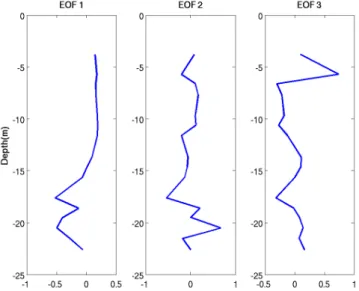
where αi are the EOF coefficients, Ui(z) the EOF’s and H is the water depth. The first
three EOF’s are shown in figure 2.6 and are meant to represent more than 95% of the total energy in the water column. The thermistor sensors were irregularly spaced according
2.2. GROUND TRUTH MEASUREMENTS 17
Figure 2.5: low-pass filtered AOB22 temperature profiles from thermistor string data for the first 10 minutes of day 254; thick line is the mean temperature profile.
to the hydrophone positions of figure 2.10 and reported in table 2.1 but covering the significant part of the water depth. A total of 125 profiles were used for this calculation.
Figure 2.6: first three EOF’s computed from thermistor chain data during the Hopav˚agen bay part of the UAB07 experiment.
2.2.3.3 Sea surface and tidal corrections
The Hobo autonomous recorder was used to measure the total tidal displacement during the day. Figure 2.7 shows the depth and temperature recording made with the Hobo recorder located in the bottom near the pier. It can be seen that the water depth varies
18 CHAPTER 2. THE UAB’07 SEA TRIAL
between a minimum of 0.299 m up to 1,167 m with, therefore, a total variation of 0.867 m with a clear period of 12,24 hours due to the tide. This curve allows for the correction
Figure 2.7: Hobo autonomous recording water depth (top) and temperature (bottom), near the pier to infer tidal variation in the bay.
of water depth tidal induced variations during the acoustic transmissions.
2.3
Deployment geometries in the Hopav˚
agen Bay
Signals were transmitted from a double source array and received on the 16 hydrophone AOB22 attached in a line between two existing moorings (see photo of figure 2.8).
Figure 2.8: AOB and source moorings at the Hopav˚agen Bay.
2.3.1
Acoustic source array
The acoustic source array was formed by two 916C Lubell acoustic sources arranged as shown in figure 2.9. The top buoy position was measured with an hand held GPS and
2.3. DEPLOYMENT GEOMETRIES IN THE HOPAV˚AGEN BAY 19
gave the following position: 63◦ 35.5862’ N, 009◦ 32.4035’ E.
Figure 2.9: sketch of the source array mooring and configuration.
2.3.2
AOB geometry: depth and range
The AOB22 was attached to an horizontal line stretched between two existing moorings in the bay as shown in figure 2.10. The 16-hydrophone array was hand folded before deployment so as to comply with the reduced water depth at the array location. A midlle array attach point was appropriately made so as to allow fixing the 8 Kg weight in order to maintain the array as much vertical as possible. Table 2.1 shows a double entry list of hydrophone depths according to hydrophone number or depth. Water depth
Figure 2.10: sketch of the AOB folded receiver array during the mooring at Sletvik. at the array location was estimated to be 26 to 28 m, always subject to tidal variations as measured by the Hobo depth sensor (see section 2.2.3.3). The AOB22 was slightly moving within an estimated radius of a few meters. This radius is exteremely difficult to measure since its value is induced by a small movement that is within GPS accuracy,
20 CHAPTER 2. THE UAB’07 SEA TRIAL
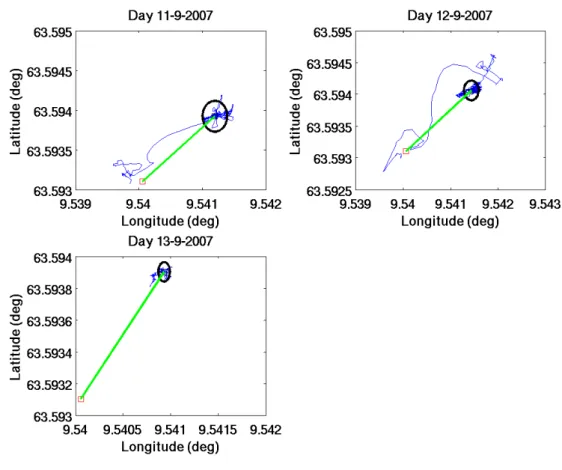
as shown in plots of figure 2.11 for the three days when the buoy was deployed. It can be seen that the movements from the bouy around the mooring were mostly due to GPS tracking error. The black square denotes the mean position and the black circle is the one standard deviation bound. Clearly, in this case the AOB would benefitiate from a D-GPS corrected positioning systems such as WAAS or EGNOS. The red square is the acoustic mooring location so, in a mean the green line represents the underwater acoustic barrier. A GPS was positioned on top of the source mooring for a whole day and gave a mean
Hyd # Depth Hyd # Depth Depth Hyd # Depth Hyd#
(m) (m) (m) (m) 1 6.6 9 7.7 3.8 10 14.6 3 2 10.6 10 3.8 5.7 11 15.6 7 3 14.6 11 5.7 6.6 1 17.6 14 4 18.6 12 9.7 7.7 9 18.6 4 5 22.6 13 13.7 9.7 12 19.5 6 6 19.5 14 17.6 10.6 2 20.5 16 7 15.6 15 21.5 11.6 8 21.5 15 8 11.6 16 20.5 13.7 13 22.6 5
Table 2.1: AOB hydrophone double entry depth table: by hydrophone number and by hydrophone depth.
position of 63◦ 35.5862’N 009◦ 32.4035’ E. Using this value and the AOB22 position of figure 2.11 allowed to calculate the source range in m as shown in figure 2.12.
The source range mean values and standard deviations are shown in table 2.2. As a last
Day Mean SR SR std
(m) (m)
Sep.11 108 7.5
Sep.12 130 3.7
Sep.13 97 3.2
Table 2.2: GPS estimated source - receiver range in meter.
geometry information, during day September 13, the barrier was several times crossed by a submerged alluminium plate meant to be a target. The GPS estimated trajectory of the boat towing the target is shown in figure 2.13: GPS position relative to the barrier of (a), target depth of approximately 4.4 m (b) and source - target estimated range (c). It should be taken into account that since the GPS receiver was on the boat that was towing the target, the target was slightly off the boat suspended from a surface buoy towed several meters behind the boat. In order to minimize the noise, the boat was moving using the rows and the outboard engine was off. Plot of figure 2.13(c) is rather strange since it seems that the plate is at rest during long periods of time, so there might be some error on the GPS acquisition made with a handheld PDA. In fact the crossing of the barrier was envisioned from land taking the alignment between the source signaling surface buoy and the AOB22 and the times recording. These times are shown in table 2.3 together with the direction of crossing where E - W means from the entrance to the inside of the bay and vice-versa. The crossings were made as much as possible perpendicular to the barrier and at low rowing speed. As it can be noticed the GPS tracks (in red) of figure 2.13(a) do not show the actual target movements so this data should be discarded for the purpose of actually determining source - target range as shown in plot (c).
2.3. DEPLOYMENT GEOMETRIES IN THE HOPAV˚AGEN BAY 21
Figure 2.11: AOB22 GPS position during the Hopav˚agen bay deployments of days 11, 12 and 13 of September, 2007: source position (red square), mean array poistion (black square), one standard deviation on GPS position of receiving array (thick circle), mean acoustic barrier position (green line).
Direction Boat Target buoy W - E 16:06:32 16:07:32 E - W NR NR W - E 16:10:59 16:12:32 E - W 16:14:39 16:15:12 W - E 16:17:04 16:17:36 E - W 16:21:52 16:22:23 W - E 16:23:50 16:24:19 E - W 16:25:36 16:26:03
Table 2.3: Underwater barrier crossing: crossing direction, boat time and target buoy time (NR= crossing not recorded).
22 CHAPTER 2. THE UAB’07 SEA TRIAL
Figure 2.12: AOB22 GPS estimated source range variations along time for days 11, 12 and 23 September, 2007.
Figure 2.13: Day 256, September 13, 2008: target GPS estimated position (a), source depth (b) and source - target range (c).
Chapter 3
Acoustic data
Acoustic transmissions performed during the Hopav˚agen bay phase of UAB’07 were unique since in many occasions the received signals were processed and retransmitted through the source array (reciprocal transmissions). The experimental setup for signal control and processing is depicted in figure 3.1. The base station ensured the control of the
Figure 3.1: experimental setup for signal control and processing during the Hopav˚agen bay experiment.
data acquisition on the buoy, while part of the acquired data (generally only one acoustic channel) was transmitted in real time to the TR processing computer that, after signal detection, time-reversal and conditioning was sending the transmit signal to the source signal generation computer that, itself was directly driving the source array.
24 CHAPTER 3. ACOUSTIC DATA
3.1
Emitted signals
The signals emitted by the source array, during the Hopav˚agen bay phase, were essen-tially composed by linear frequency modulated (LFM) chirps either up or down sweeps, of various durations, center frequencies and frequency bands (see table 3.1). A time -frequency sketch of the typical transmit sequence is shown in figure 3.2 where two main phases can be seen:
1. the source initialization phase where each source is excited, one at a time, with a series of LFMs with a predetermined duration, repetition rate, center frequency, and bandwidth whose typical values are shown in table 3.1; various combinations of those values are possible and have been used during this phase of the experiment. 2. the retransmit phase where the array received signals are processed and then
simultaneously retransmitted in both sources with a given repetition rate and for a number of repetitions during a certain amount of time.
Figure 3.2: Time - frequency sketch of the typical transmit sequence.
During the three days of testing there were variations of these typical cases with in-terrupted sequences, errors on the signal detection on the receiver side and then wrong retransmissions, etc... The retransmitted sequences are much more difficult to define since
Signal type LFM-up, LFM-down
Number of signals Nb 1 or 6 Duration (s) Tb 0.2, 0.5 or 1 Rep. rate (s) Tr 0.5, 1 or 2 Time interval (s) Ti 1 or 2 Center frequency (kHz) fc 5(LF), 9(MF) or 14(HF) Bandwidth (Hz) B 3000
Table 3.1: Emitted signal’s characteristics during the Hopavaagen bay phase. they depend both on the received signals and on further processing to detect, isolate and time-reverse the signal. In particular the “TR signal proc” computer on figure 3.1 is sending commands to the AOB22 DSP in order to perform channel selection and signal pre-processing (see section 3.4.2 below).
3.2. SIGNAL GENERATOR AND AMPLIFIER 25
3.2
Signal generator and amplifier
A block schematic of the signal generation and transmission is shown in figure 3.3. The signal generation system used was developed at SiPLAB/CINTAL (see details in [6]) and is composed of: i) one desktop computer fitted with a PCI DAC board, ii) a signal conditioning unit, iii) and audio amplifier and iv) two identical Lubell 916C sound sources. The main characteristics of the system as a whole are as follows: i) 100 kHz sampling
Figure 3.3: Signal generation system used during the Hopav˚agen bay phase of UAB07. frequency, ii) 12 bits resolution DAC, iii) 1 - 16 kHz bandwidth and iv) an approximate sound pressure level (SPL) of 170 dB/µP/m on each source.
3.3
Acoustic sources
The Lubell 916C source is shown in figure 3.4(a) while its transmitt voltage response (TVR) is shown in figure 3.4(b). It can be seen that the source response is non flat in the frequency range of interest showing a variation up to 10 dB With a maximum power
(a) (b)
Figure 3.4: Lubell 916C sound source (a) and transmitt voltage response - TVR (b). supply voltage of approximately 14 V, gives a gain of anoter 23 dB that should be added to the TVR curve so as to obtain the final SPL.
26 CHAPTER 3. ACOUSTIC DATA
3.4
Received signals
3.4.1
Data format
Both the acoustic and non acoustic data received on the AOB are stored on data files using a proprietary format that can be read using the routine ReadLOCAPASS.m shown in appendix A. This format can be summarized as follows:
• an ASCII header: cruise title, UTC GPS date and time of first sample on file, Lat - Lon GPS position, characteristics of non-acoustic and acoustic data such as sampling frequency, number of channels, sample size and total number of samples • non-acoustic data: temperature data in binary format
• acoustic data: acoustic data in binary format
Each data file contains 24s worth of data and there is no data loss between files. Data files are acquired in sequence with file names reflecting julian day, hour, minutes and seconds with the extension ”.vla”. The time used in the file name is obtained from the computer clock so it should not be used for synchronization purposes as it is almost certainly diferent from the GPS time in the header. The time stamp in the header of each file is the exact GPS - GMT time of the first acoustic sample in the file and it can/should be used for synchronization and time of flight measurement purposes, if necessary. The sampling frequency used during UAB07 was precisely 50000 Hz (GPS clock synchronized). The Lat/Lon location written in the header is that given by the AOB GPS at the time of the first sample. A decimal degree notation was used in order to simplify its usage for calculation and plotting purposes (inside Matlab, for example).
3.4.2
Channel selection and summation
During the first two days of this phase a real time procedure was developed, setup and tested to perform channel selection and summation on the AOB receiver side in order to avoid offline processing and to speed-up wireless communications. The basic idea was to perform channel summation on the AOB DSP during signal acquisition and transmit the result to the “TR signal proc” computer for processing and retransmission. The tasks performed by the DSP were very simple: 1) select channels according to a code given by the user in a command file, 2) accumulate the 16 bit words in a 32 bit buffer, 3) shift the 32 bit buffer 4 times to the right, which is equivalent to a division by 16, 4) write the resulting 16 LSB bits to channel 4 (damaged during phase 1 and therefore not used anyhow).
Channel selection was made by using a coding scheme where the N selected channels where designated by a single code given by Code =PN
i=12Channel numberi−1. Unfortunately
there was an error during the decoding which resulted in the following channel selections:
Code Selected channels ----
---516 5,6,7,8,13,14,15,16
3.4. RECEIVED SIGNALS 27
567 1,2,5,6,7,8,9,10,12,13,14,15,16 65527 1,2,5,6,7,8,9,10,12,13,14,15,16
3.4.3
The 4 by 4 repetition problem
As explained above during this phase in the Hopav˚agen bay, the received acoustic signals were acquired and stored on the AOB. In order to fullfil with the requirement for on the fly processing and retransmit for acoustic barrier implementation, the acquisition program was modified for post channel selection, summation and writing on top of channel 4. During the writing of this report it was found that due to a, at this time, unknown reason, the acquisition process failed to switch channel at the input of the AD converter which results in that all data files, instead of the 16 channels, contain just 4 times 4 channels. Therefore channel 1, is repeated in channels 2, 3 (channel 4 was used for saving all channels average) channel 5 is repeated in channels 6 to 8, channel 9 is repeated in channels 10 to 12 and finally channel 13 is repeated in channels 14 to 16. This is more clearly understood by observing figure 3.5 that shows the estimated channel impulse responses by pulse compressing the received with the emitted signal for each array channel from 1 to 16. Channel depths are shown on each line and follow the array folding pattern of table 2.1. As it can clearly be seen signals are equal within each block of four, except for channel
Figure 3.5: Day 254 14:12 UTC: pulse compression of all channels with LFM upsweep 0.2 s duration in the band LF band: 3500 - 6500 Hz.
4 that has the mean of all channels. At this point it seems that the only channels that can be used for the processing are those which impulse responses are shown in figure 3.6. Interestingly, this figure shows a relatively depth constant 4-arrival pattern for the upper hydrophones and a time shifted pattern with four well separated arrivals for the deeper (22 m) receiver. In the sequel we will focus only on channels 1, 5, 9 and 13.
28 CHAPTER 3. ACOUSTIC DATA
Figure 3.6: Day 254 14:12 UTC: pulse compression of channels 1, 5, 9 and 13 at respective depths of 6.6, 22.6, 7.7 and 13.7 meter [LF upsweep 0.2 s duration in the LF band: 3500-6500 Hz].
3.4.4
Day 254 (September 11, 2007)
This first day was mostly spent on testing the source array and then the receiving array. The AOB22 was deployed at 07:55 GMT and acquisition started at 08:07 GMT. A short log of the received signal sequences is given in table 3.2. The first test signals were
Time Event fc Bw Dt
(GMT) (kHz) (kHz) (s)
08:07 start ACQ
09:35 start coms (OFDM) 10 4/8 1
09:41 end coms (OFDM)
11:37 start up/down LFM 5 3 0.5
14:10 end up/down LFM
14:12 start up/down LFM 5 3 0.2
(several changes) 17:29 end ACQ
Table 3.2: Signals’ sequences log during day 254 (11 September 2007) in the Hopav˚agen bay.
transmitted at 09:35 using one of the Lubell 911C sound sources ending at 09:41. These were OFDM communication signals with a center frequency of 10 kHz interleaved with up and down LFM sweeps covering the whole frequency band as shown on figure 3.7 on hydrophone 1 at 6.6 m depth (see a complete description on the companion report Part B for the Trondheim site data set).
3.4. RECEIVED SIGNALS 29
Figure 3.7: Day 254: OFDM communication signals for source testing as received on hydrophone 1 (6.6 m depth).
on 5 kHz and with 0.5 s duration and 0.5 s interleave. Approximately 80 s after starting signal transmission a series of harmonics appeared above 7 kHz and more clearly above 10.5 kHz, in coincidence with the transmitted pulses, and for which, up to now, there is no convincent explanation. These are shown in figure 3.8, where second order harmonics are starting at 7 kHz and third order harmonics are starting at 10.5 kHz, the later much more clearly. The harmonics have the same duration as the original signal but cover frequency bands that are two and three times larger, 6 and 9 kHz respectively1. The
multipath is clearly longer than the signal interleaving resulting in a superposition of the impulse responses of the various pulses. Strangely enough a multipath can be seen also on the third harmonic. At 14:12 h the transmission resumed with the same center frequency, bandwidth and repetition rate but with shorter duration of only 200 ms in order to have a larger interval for the channel multipath. As in the previous run, the harmonics appeared approximately 80 s after the transmission started. The rest of Julian day 254 was spent on transmitting up and down sweeps in the 5 kHz band. The pulse compression of that sequence for the 0.2 second duration upsweep averaged over each 24 second file is shown in figure 3.9(a) for hydrophone 1 at 6.6 m depth. This result was obtained with a pre bandpass filter of 4 kHz centered in 5 kHz so as to eliminate the harmonics. The alignement of the mean replicas has shown an extremely small synchronization error with a standard variation of 8 µs over more than 2 hours of data which is a proof of stability of the channel and the source - array geometry. A detailed view of the mean arrival pattern is shown in figure 3.9(b), where a main arrival and 3 multipaths can be clearly distinguished.
1this is not very clear for the second order that shows a large attenuation but is clear for the third
30 CHAPTER 3. ACOUSTIC DATA
Figure 3.8: Day 254 hydrophone 1 (6.6 m depth): up - down sweeps in the lower 5 kHz band and corresponding harmonics.
(a) (b)
Figure 3.9: Day 254, hydrophone 1 (6.6 m depth): arrival pattern for the 3 kHz band up sweep along time (a) and mean arrival pattern (b).
3.4.5
Day 255 (September 12, 2007)
Most of this day was spent on adjusting the signal detection on the receiver side for re-transmission on the source side. Also some changes were done on the acquisition program for allowing the selection of the channels to be summed into channel 4. The sequence of events is shown in table 3.3. At 10:30 started a long sequence of 0.5 s duration upsweeps in the 7.5 - 10.5 kHz that lasted for approximately 80 min. The pulse compression of that sequence is shown in figure 3.10 for channel 5 at 22.6 m depth: the channel variability along time (a) and the mean arrival pattern (b). The correlation peak variability could be measured of the order of 0.034 s with a standard variation of 0.238 ms. There are four distinct paths possibly associated with the bottom reflected, direct, bottom - surface
3.4. RECEIVED SIGNALS 31 Time Event fc Bw Dt (GMT) (kHz) (kHz) (s) 07:19 start ACQ 08:17 start LFMs up 5 3 0.5 09:07 LFMs by packs of 12 5 3 10:10 LFMs by packs of 12 10 3 0.5 alternate LF and MF 12:46 source probes and
TR replicas
14:10 end up/down LFM
14:12 start up/down LFM 5 3 0.2
(several changes) 17:29 end ACQ
Table 3.3: Signals’ sequence log during day 255 (12 September 2007) in the Hopav˚agen bay.
(a) (b)
Figure 3.10: Day 255 hydrophone 5 at 22.6 m depth, 0.5 s LFM sweeps in the 7.5 - 10.5 kHz band, start time 10:31 UTC: time variability (a) and mean arrival pattern (b).
reflected and surface - bottom reflected. This is mainly due to the strongly downward bathymetric propagation profile.
3.4.6
Day 256 (September 13, 2007)
This last day was devoted to an attempt of implementing the actual acoustic barrier while simulating the target with a submerged square alluminium plate of approximate dimensions of 1,2 × 1.2 m towed by a small rowing boat in between the source and the acoustic array (the barrier). Unfortunately this day testing was also shortened due to a faulting connection on the battery charge during the night that left the battery still discharged in the morning. The battery was then put on charge in the morning and the AOB could be deployed around 12:30. The data acquisition was switched on at 13:05 GMT (see table 3.4). After 14:51 the probe source signals were followed by long successive transmissions of time-reversed replicas so as to reflect in the barrier crossing target (see table 2.3 for a log of target barrier crossings). Various center frequencies
32 CHAPTER 3. ACOUSTIC DATA
were tested during the several target crossings. The list below shows the output of a log
Time Event fc Bw Dt (GMT) (kHz) (kHz) (s) 13:05 start ACQ 13:06 LFMs up, TR replicas 14.5 3 0.5 13:17 LFMs up, TR replicas 5 3 13:32 LFMs up, TR replicas 10 3 0.5 13:40 stop ACQ 13:41 restart ACQ 13:51 LFMs up, TR replicas 10 3 0.5 14:02 LFMs up, TR replicas 5 3 0.5 14:12 LFMs up, TR replicas 14.5 3 0.5 14:51 LFMs up, long TR 14.5 3 0.5 alternate LF,MF,HF long TR transmission 17:37 end ACQ
Table 3.4: Signals’ sequences log during day 256 (13 September 2007) in the Hopav˚agen bay.
file containing all the channel sum settings during day 256. This log was filtered from the complete AOB22 log file screenlog.0 written during the data acquisition. In that log, an indication of channel codes 516, 532, etc, means that the corresponding channel numbers where selected and summed into channel 4. The relation between the code and the channel number was already explained in section 3.4.2. Unfortunately, due to a programming glitch, the settings were those given in the table below and ended in cases where different codes gave the same channel numbers and not those expected.
UTC Channel Channel
codes numbers 12:59:08 0 0 13:07:40 516 5 6 7 8 13 14 15 16 13:13:21 0 0 13:17:45 516 5 6 7 8 13 14 15 16 13:20:33 532 5 6 7 8 13 14 15 16 13:23:45 567 1 2 3 5 6 7 8 9 10 11 12 13 14 15 16 13:26:33 65527 1 2 3 5 6 7 8 9 10 11 12 13 14 15 16 13:32:33 516 5 6 7 8 13 14 15 16 13:35:45 532 5 6 7 8 13 14 15 16 13:38:33 567 1 2 3 5 6 7 8 9 10 11 12 13 14 15 16 13:41:23 0 0 13:51:47 516 5 6 7 8 13 14 15 16 13:54:59 532 5 6 7 8 13 14 15 16 13:57:23 567 1 2 3 5 6 7 8 9 10 11 12 13 14 15 16 13:59:23 65527 1 2 3 5 6 7 8 9 10 11 12 13 14 15 16 14:02:35 516 5 6 7 8 13 14 15 16 14:04:59 532 5 6 7 8 13 14 15 16 14:06:59 567 1 2 3 5 6 7 8 9 10 11 12 13 14 15 16 14:08:59 65527 1 2 3 5 6 7 8 9 10 11 12 13 14 15 16 14:12:35 516 5 6 7 8 13 14 15 16
3.5. SIGNAL DETECTION 33 14:14:59 532 5 6 7 8 13 14 15 16 14:16:59 567 1 2 3 5 6 7 8 9 10 11 12 13 14 15 16 14:19:23 65527 1 2 3 5 6 7 8 9 10 11 12 13 14 15 16 16:30:01 0 0 16:32:01 65527 1 2 3 5 6 7 8 9 10 11 12 13 14 15 16
This table of channel summation setups clearly shows that during the crossing of the barrier with the simulated target there was one single configuration using all the channels but channel 4: time interval between 16:06 and 16:30. This will be our primary target for analysis. Taking into account the problem of channel duplication this table also implies that :
• in positions 516 and 532, channel 4 contains 4 × channel 5 + 4× channel 13, divided by a factor of 16 (add in 32 bits and drop of the 4 least significant bits)
• in positions 567 and 65527, channel 4 contains 3× channel 1 + 4× channel 5 + 4× channel 9 + 4× channel 13, divided by a factor of 16 (add in 32 bits and drop of the 4 least significant bits)
In order to illustrate the data collected during day 256, figure 3.11 shows the time-compressed estimated channel impulse responses for the 4 active channels in the three frequency bands. The most strinking feature is the appearence of a fast sediment or close to sediment wave in the bottom hydrophone that becomes more apparent as the frequency increases. This is probably due to the strong downslope propagation effect where the water wave and the sediment interaction reflection are very close in both time and space.
3.5
Signal detection
One of the scopes of this phase of the UAB07 experiment was to attempt to detect a target crossing the barrier. There are a number of possible sub-optimal implementations of the theoretical detector, among which one is obtained by performing the summation of the time-reversal (TR) focus after reciprocal TR for all or some of the array channels. The so-called single implementation is therefore obtained as follows:
1. transmitt a given broadband signal from each of the sound sources, one source at a time.
2. detect the received signals and sum the selected channels on a single stream; repeat that for each source.
3. retransmitt the time-reversed versions of the channel sum streams simultaneously from each respective source.
4. collect the received signals and sum the selected channels (focus) after correlating with the time reversed version of the initially transmitted broadband signal; peek the maximum of the time correlations (or the maximum of the envelop if in base band).
34 CHAPTER 3. ACOUSTIC DATA
(a) (b)
(c)
Figure 3.11: Day 256 impulse responses between sound source at 3 m depth (S1) and each hydrophone for frequency bands : 3500 6500 Hz (a), 7500 10500 Hz (b) and 12000 -15500 Hz (c).
5. build the detector by comparing the result obtained from one snapshot to another plus a given threshold, to be adjusted according to the desired false alarm rate and existing SNR.
The word simultaneously was highlighted because it is important to keep coherence from one sound source to another since sound sources are positioned at different depths, and eventually at slightly different ranges in the case of tilted arrays, thus covering dis-tinct portions of the water column. In order to obtain synchronized focus after reciprocal TR, and thus an effective time summation of the energies over the array, each source sequence should not be detected separately from the other. Failling of doing so, would result in retransmitting asynchronous sequences on each source that will, most certainly, arrive out of phase at the array since the inter - source information is lost during the de-tection / synchronization process between transmissions. Unfortunately this was exactly what happened during the experiment: the sequences from the two sources were separately detected and synchronized before retransmission. The result of this procedure can be seen in figure 3.12: the time-frequency plot on the left shows two series of upsweeps in the LF band for initialization of source 1 and 2, respectively, and then the reciprocal receptions as received on channel 4 at time 13:20:57 UTC, where channels 5 to 8 and 13 to 16 were selected for summation. This process can be equated as follows: let us assume x(t; k, l) as given by
3.5. SIGNAL DETECTION 35
Figure 3.12: Day 256 hydrophone 4 at 13:27 UTC as a summation of several channels according to the tabel above: time - frequency (left) and time compressed time series (left), source 1 (a) and source 2 (b).
to be the noise free signal received on sensor k due to source l at time t response to the emitted signal s(t), assumed the same for all sound sources. In our experiment channel 4 contains the sum of a selection of received signals, thus
¯ x(t; l) = K X k=1 x(t; k, l) = K X k=1 h(t; k, l) ∗ s(t) (3.2)
In this case the reciprocal received signal (always in the noise free case) is then given by
¯ p(t; k) = L X l=1 h(t; k, l) ∗ ¯x(−t; l) = L X l=1 h(t; k, l) ∗ K X k=1 h(−t; k, l) ∗ s(−t) (3.3)
where L is the total number of sources, in our case L = 2. The received signal on sensor k is therefore the sum of four terms
¯ p(t; k) = h(t; k, 1) ∗ h(−t; k, 1) ∗ s(−t) + L X l6=k h(t; k, 1) ∗ h(−t; k, 1) ∗ s(−t) + h(t; k, 2) ∗ h(−t − ∆; k, 2) ∗ s(−t − ∆) + L X l6=k1 h(t; k, 2) ∗ h(−t − ∆; k, 2) ∗ s(−t − ∆) (3.4)
where the delay ∆ represents the artificial delay introduced by the synchronisation be-tween the two source signals. This simple delay makes that the focus for source 1 and 2 are not added at the h(t) ∗ h(−t) correlation peak. The other terms are interference or cross terms. Since the number of sources L is low the rejection ratio between the focus and the cross terms is also low but still, autocorrelations should provide a higher peak than cross-correlations.
36 CHAPTER 3. ACOUSTIC DATA
The effect of this delay can better be seen in the correlation of the received signals with the HF downsweep during day 256 that produces the result shown in figure 3.13. There is a clear severe time spread incompatible with what would be expected as a focus in time of the reciprocal transmissions. In fact there are two main peaks surrounded by sidelobes, indicating that this signal could be formed by the sum of two or more focus within a time interval or approximately 1.5 ms. Since it is very unlikely that the source -array geometric structure or the environment would change so dramatically so as to cause this delay, therefore the most plausible explanation is the lack of coherent detection of the two source signals prior to reciprocal transmission resulting in an artificially aligned reciprocal transmission. The horizontal lines represent the moments when the simulated
(a) (b)
(c) (d)
Figure 3.13: Day 256 correlations with HF downsweep pulse starting at 16:01 UTC for channels: 1 at 6.6 m depth (a), 9 at 7.7 m depth (b), 13 at 13.7 m depth (c) and 5 at 22.6 m depth (d). Signal transmission was interrupted and re-initialized at 16:18 UTC. Horizontal lines mark the target crossings of the virtual barrier according to measured time of table 2.3.
target crossed the barrier formed by the source array and the receiving array as measured by the GPS and line of sight during the experiment (see list of table 2.3). At first glance there is no particular correlation between the time compressed reciprocal received signal and the target crossings.
Chapter 4
Conclusions and future analysis
The UAB project aims at studying, developing and testing acoustic methods for protecting critical infrastructures. The UAB07 experiment served at: i) testing high frequency signals off the busy port of Trondheim, Norway, and ii) proving the acoustic barrier concept in an acoustically quiet and environmentally stable location in the Hopav˚agen bay, 200 km from Trondheim, Norway. This report concentrates on the experiment carried out at the Hopav˚agen bay, from September 9 to 13. The location turned out to be ideal for deploying the source and receiving array and its operation from land. The time spent in equipment installation and extensive debugging of hardware and software resulted in practice in only half day of actual acoustic barrier data. The results obtained confirmed an extremely stable environment with reproductible conditions in short (minutes) and long (hours) time frames. Parallel results obtained with simulations and not shown in this report showed that the limited environmental data gathered during the sea trial was sufficient to run computer models for determining signal propagation conditions that can explain the transmission patterns found during the experiment. However, due to two major drawbacks it appears extremely difficult to achieve target detections with the observed data sets. These drawbacks are:
• the limited number of receiving channels (4) due to the replication of every forth channel in the following three.
• the loss of synchronization between the two source received signals before reciprocal retransmissions.
As recommendations for future experiments and apart from the obvious correction of the above mentioned drawbacks, future experiments involving acoustic barriers should account for: i) saving reciprocal signals as transmitted from source array, ii) high precision GPS for surface buoy location through time, iii) real time correlation of received signals with time-reversed replica of the emitted signal beofre channel summation and iv) if possible, increase the number of sources in the active array.
Bibliography
[1] C.R. Bates and E.J. Whitehead. Echoplus measurements in hopav˚agen bay, norway. Sea-Technology, 42(6):34–43, June 2001.
[2] S.M. Jesus. Active acoustic time-reversal for underwater acoustic barriers. In 153th Meeting of the Acoustical Society of America, volume 121 - 5 Pt.2, page 3204, Salt Lake City, USA, May 2007.
[3] F. Zabel, C. Martins, Jesus S.M., and Silva A. Tra - transmit receive array (project plan). Internal Report Rep. 05/06, SiPLAB/CINTAL, Universidade do Algarve, Faro, Portugal, September 2006.
[4] F. Zabel, C. Martins, Jesus S.M., and Silva A. Tra - transmit receive array (project plan - version 2). Internal Report Rep. 02/07, SiPLAB/CINTAL, Universidade do Algarve, Faro, Portugal, March 2007.
[5] F. Zabel and C. Martins. Analog 16hydrophone vertical line array for the acoustic -oceanographic buoy - aob. Internal Report Rep. 03/06, SiPLAB/CINTAL, Universi-dade do Algarve, Faro, Portugal, August 2006.
[6] C. Martins. Uab07 transmission system technical specifications. Internal report, SiPLAB-CINTAL, University of Algarve, 2008.
Appendix A
Data reading routine:
readlocapassdata.m
function [data, Fs, NoSs, TITLE, TIMEPOS]=ReadLOCAPASSData(filename,DataType); %
% Reads a Data File from the LOCAPASS DAQ System %
% [data, fs, NoSs, TITLE, TIMEPOS]=ReadData(file,flag) %
% Where:
% data: is a matrix [ NoChannels * Total No Samples ] % fs: sampling frequency
% NoSs: Number of Channels
% TITLE: Description of the experiment
% TIMEPOS: Time/Position information of the data in the file %
% file: name of file to be read, empty variable will allow % theselection of the file to read, recognized extensions:
% * ".acust" - Acoustic Data
% * ".tilt1"/".tilt2" -Array Inclination Data % * ".pr1"/".pr2" -Array Depth Data
% * ".temp" - Temperature Data % * ".dummy" - Battery Voltage Data
% flag: if greater than 0, return values of data will be converted % to its usable System Units ( volts, degrees of inclination,
% meters, etc )
%
if ( nargin < 2 )
error(’Two parameter are required\n Sintax:ReadLOCAPASSData (filename,...
DataType);\n DataType must be"acoustic" or "nonaccoustic"’); end
disp([’Trying to open: ’ filename ’ !!!’]); fid = fopen(filename,’r’);
if (fid==-1)
error([’File:’ filename ’could not be open!!’]);
40 APPENDIX A. DATA READING ROUTINE: READLOCAPASSDATA.M end disp(’File Openned!!’); TITLE = fgetl(fid); teststr(TITLE); TIMEPOS = fgetl(fid); teststr(TIMEPOS); NonAcdatainfo = fgetl(fid);
%NonAcdatainfo= ’nonACOUSTIC Fs:0 NoSens:0 SampSz:0 TotS:0’ teststr(NonAcdatainfo);
%fgetl(fid);
Acdatainfo = fgetl(fid);
%Acdatainfo = ’ACOUSTIC Fs:63999 NoSens:08 SampSz:32 TotS:31457280’ teststr(Acdatainfo); %fgetl(fid); switch DataType case ’timeposition’, data = []; count = 0;
Fs = str2num(NonAcdatainfo(16:20)); % Sampling frequency NoSs = str2num(NonAcdatainfo(29:30)); % No of Channels SpSz = str2num(NonAcdatainfo(39:40)); % No of Bits per Samples ToSp = str2num(NonAcdatainfo(47:54)); % Total Number of Samples case ’nonacoustic’
Fs = str2num(NonAcdatainfo(16:20)); % Sampling frequency NoSs = str2num(NonAcdatainfo(29:30)); % No of Channels
SpSz = str2num(NonAcdatainfo(39:40)); % No of Bits per Samples ToSp = str2num(NonAcdatainfo(47:54)); % Total Number of Samples testinfo(Fs); testinfo(NoSs); testinfo(SpSz); testinfo(ToSp);
if NoSs > 0
[data count]=fread(fid,[NoSs ToSp/NoSs],[’int’ num2str(SpSz)]); else
data = []; count = 0; end
case ’acoustic’
NoSs = str2num(NonAcdatainfo(29:30)); % No of Channels SpSz = str2num(NonAcdatainfo(39:40)); % No of Bits per Samples ToSp = str2num(NonAcdatainfo(47:54)); % Total Number of Samples if NoSs > 0
[data count]=fread(fid,[NoSs ToSp/NoSs],...
[’int’ num2str(SpSz)]); %skip NonAc data end
Fs = str2num(Acdatainfo(16:20)); % Sampling frequency NoSs = str2num(Acdatainfo(29:30)); % No of Channels
SpSz = str2num(Acdatainfo(39:40)); % No of Bits per Samples ToSp = str2num(Acdatainfo(47:54)); % Total Number of Samples testinfo(Fs); testinfo(NoSs); testinfo(SpSz); testinfo(ToSp);
41
[data count]=fread(fid,[NoSs ToSp/NoSs],[’int’ num2str(SpSz)]); otherwise,
fclose(fid);
error(’Wrong data type!’) end
disp(’Data Read!’) fclose(fid);
disp(’File Closed..’) if count < ToSp
disp(’Not a Full File!’); end return %***************************************************************** % ********** Auxiliary Functions******************************* %***************************************************************** function teststr(strarr) if ~ischar(strarr)
error(’Not a Valid DATA file!!’); end
return
function testinfo(valuearr) if isempty(valuearr)
error(’Not a Valid DATA file!!’); end
return
function out=gettype(strarr) found=findstr(strarr,’.’); if isempty(found)
error(’No Filename extension!!!’) else
out=strarr((found(end)+1):end); end


![Figure 2.3: Bathymetry recording of the Hopav˚ agen bay (courtesy of NTNU / Bates [1]).](https://thumb-eu.123doks.com/thumbv2/123dok_br/19169429.940569/15.892.228.662.570.875/figure-bathymetry-recording-hopav-agen-courtesy-ntnu-bates.webp)