New Phytol. (1996), 133, 627-635
The response of Piantago major ssp.
pleiosperma to elevated CO2 is modulated
by the formation of secondary shoots
BY F . F O N S E C A ' ^ * ,
J. DEN HERTOG^
ANDI. STULEN^
^Department of Plant Biology, Biological Centre, University of Groningen,
Kerklaan 30, P.O. Box 14, 9750 AA Haren (Gr.), The Netherlands
^ UCTA, Universidade do Algarve, Campus de Gambelas, Gambelas 8000 Faro, Portugal
{Received 11 October 1995; accepted 1 March 1996)
SUMM.^RY
The effect of elevated CO.^ on the relative growth rate (RGR) of Piantago major ssp. pleiospernia was studied during the vegetative stage, in relation to plant development, by growing plants at 350 /il 1"' or at 700 /<] 1^' C O , m non-limiting nutrient solution with nitrate. T o minimize interference by the accumulation of non-structural carbohydrates in the interpretation of results, RGR was expressed on a f. wt basis (RGRp^^), as were all plant weight ratios. Stimulation of the RGRp^^- of the whole plant by elevated C O , was transient, and did not last longer than 8 d. At the same time a transient increase in root weight ratio (RWR) was observed.
In order to investigate whether the transient effect of elevated COg on RGRp^^ was size-dependent, the data were plotted versus total f. wt (log^ transformed). The transient period of stimulation of RGRp-^^- and of RWR by elevated CO.^ was still found, but in both CO, treatments RGRp^ decreased after a certam plant size had been reached. This size coincided with the stage at which secondary shoots started to develop, and was reached earlier in plants grown at elevated CO.,. The RGR of these secondary shoots (RGR^^.^.) was still increased when the period of whole plant stimulation of RGRp,^- had ended, indicating that the development of these new sinks took priority over a continuation of the stimulation of RWR. It is hypothesized that in this Piantago subspecies the response of the RGRp^, of the w'hole plants to elevated CO, is modulated by the formation of secondary shoots. Apparently, partitioning of the extra soluble carbohydrates at elevated CO^ to this tissue takes precedence over partitioning to the roots, resulting in a cessation of stimulation of plant RGRp.^^- by elevated CO.,.
Key words: Piantago major ssp. pleiosperma, elevated COj, RGR modulation, sink-source interaction, soluble sugars.
transient stimulation of the RGR during the first I N T R O D U C T I O N , „ , , T ^ TT O l ff T U ^ n m \ T-'U
10 d (Den Hertog, Stulen & Lambers, 1993). T h e In a compilation of literature sources on 156 plant temporary nature of the stimulation of RGR by species, Poorter (1993) found that the stimulation eleyated COj was also found for other species, such of growth of whole plants in the vegetative stage by as Triticum. aestiviim (Neales & Nicholls, 1978), elevated C O , was, on average, 37 °o- This enhance- Brassica pekinenses (Kriedemann & Wong, 1984), ment was small compared with what could be Cucumis sativus (Kriedemann & Wong, 1984; Peet, expected on the basis of CO.^-response curves of 1986), Glycine max (Rogers et al., 1984), Gliricidia photosynthesis. In many species relative growth rate sepium (Thomas et al., 1991), and Phaseolus vulgaris (RGR) was also increased by elevated C O j , but (Jolliffe & Ehret, 1985). Only in rare cases was a interspecific variation was large (Poorter, 1993). continuous stimulation of RGR found (Downton, Experiments with Piantago major ssp. pleiosperma Bjorkman & Pike, 1980).
showed that the effect of doubling the ambient C O , Both source-sink relationship and constraints of concentration resulted in an increase in whole plant size on growth such as pot size or self-shading, can d . w t of 3 0 % after 3 wk of exposure, due to a cause the transient stimulation of RGR by elevated CO, (Poorter, Pot & Lambers, 1988; Farrar & * To whom correspondence should be addressed. Williams, 1 9 9 1 ; Stitt, 1991). Several lines of evi-Abbreviations: LA, leaf area; RORp,^^,, relative growth rate on dence indicate that g r o w t h at elevated C O j leads to a a f. wt basis; RGR,,,, relative growth rate of the secondary ^.j^gnge in t h e sink-source balance of t h e p l a n t :
shoots; RWR, root weight ratio; SWR, shoot weight ratio; . I T
628 F. Fonseca, y. Dew Hertog and I. Stiden the rate of photosynthesis exceeds the capacity of the sinks to utilize the photosynthate, e.g. for growth and storage. According to Stitt (1991) the variability in the response to elevated CO^ in different species, developmental stages or environmental conditions, can be explained in terms of differences in sink strength of the plants.
During development, plants of Plantago major start to develop new sinks, namely secondary shoots. The present study was aimed at investigating the influence of the formation of these new sinks on the duration and the degree of stimulation of the RGR by elevated CO,. For that purpose we transferred seedlings of Plantago major ssp. pleiosperma to elevated CO.;, (700 //I \~^) at two developmental stages: (1) before the formation of secondary shoots, and (2) with secondary shoots present at the beginning of the C O , treatment. A detailed growth analysis was performed including measurement of the RGRp^yS of the whole plant and of the secondary shoots and of partitioning between root and shoot. At the same time, photosynthetic rate and carbo-hydrate concentrations in shoot and roots were measured, both during and after the period of stimulation of HGRp^^., in order to establish whether a diversion of the extra photosynthates from the roots to the developing secondary shoots might be the cause of the transience of the stimulation of
MATERI.-\LS AND METHODS
Platit material
An inbred line of Plantago major L. ssp. pleiosperma Pilger (A4), was used (see also Van Dijk & Van Delden, 1981; Dijkstra & Lambers, 1989). T h e plants were grown from seeds germinated on a sterilized commercial soil mixture, in a glasshouse at 24/17 °C day/night temperature. After germination the seedlings were transferred to a climate room, at 20 °C day/night, 6 0 - 6 5 % r.h. and 12 h light of 500-550/tmol m"'^ s~^ (400-700 nm, measured with a quantum sensor, S K P 215, Skye, Llandrindod Wells, U K ) provided by Philips H P I - T lamps (400 W) and incandescent bulbs (40 W) in a 1:1 ratio. Three weeks after germination the plants were transferred to an aerated Hoagland solution, 1/4 of the strength of that described by Smakman & Hofstra (1982), namely 3-75 mM nitrate, and p H 5-8, at a density of 20 plants in 30 1. T h e nutrient solution was changed once a week. Neither depletion of the nutrient solution nor change in pH occurred; nitrate concentration decreased by 1 0 % at most.
Experimental design
One week after transfer to the aerated nutrient solution (4 wk after germination; day 0 in the
figures), two groups of randomly selected plants were distributed over two controlled climate chambers kept at 350 and 700 fA 1"' CO2 respectively. The CO., concentration in the chambers was con-trolled by infra-red gas analysers (Siemens type ZFPCS and ZFP-DZ). Exposure to elevated COj lasted for 20 d. Other growth conditions were as described above.
Two weeks later (6 wk after germination; day 14 in the figures) a third group, randomly selected from the plants growing at 350 //11~' COj, was transferred to elevated CO,. Exposure to elevated COj lasted for 6 d. T o verify that no effect on population comp-osition had been introduced by removal of this third group of plants, a control experiment was conducted in which the plants were left undisturbed at 350 //I 1"' CO, until 6 wk after germination, when they were randomly divided into two groups, one of which was transferred to elevated CO,.
In all experiments, thinning to prevent mutual shading was carried out. Experiments started \vith a plant density of 20 plants per 0-16 m^, and ended with a density of four plants per 0-16 m^. All experiments were repeated at least once; the repetitions gave similar results and, therefore, the results of only one of the experiments are shown. Before repetition of the experiments, the C O , concentration in the chambers was switched from 350 to 700/il r^ CO2 and vice versa in order to eliminate a possible chamber effect. All results were reproducible and independent of the growth chamber used.
Growth analysis
Plants were harvested ever>' 2 d, with « = 10, and n = 20 at the start and end of the analysis. At each harvest, f. wt of leaves, stems and roots was determined. Dry weight was determined after ex-posure of the samples to 80 °C for at least 24 h. From day 10 onwards, the fresh and dry weights of leaves and stems of secondary shoots were also determined. The relative growth rate of the total plant and of the secondary shoots (after day 10) were calculated on a fresh weight basis (ROR^W) to minimize
interference by accumulated carbohydrates in plants at elevated C O , (Wong, 1990). T h e RGR analysis was carried out after Poorter (1989) with data obtained at 2 d intervals. In this method auto-correlation is minimized, since RGR is calculated by skipping one harvest each time, rather than deriving values from adjacent harvests (for further details see Wickens & Cheeseman, 1988; Poorter, 1989). Leaf area (LA) was measured with a digitizer (Hewlett Packard Company, model 9847a, Fort Collins, CO, USA).
The weight ratios (plant part f. wt/total plant f. wt.) of main shoot (SWR), secondary shoot
Modulation of growth response by elevated 629
10 12 14 16 18 20 22 0 2 4 6 8 10 12 14 16 18 20 22 000
0 2 4 6
Figure 1. (a) Relative growth rate (RGR^^.), on a f. wt basis of the total plant and (b) of the secondary shoots. Third order polynomials were fitted through the RGR data. The effects of elevated CO2 on RGR^^.^. were significant at P < 0-001 for the younger plants and P < 0-05 for the older plants, (c) Leaf area (LA) of the plants sampled for RGR analysis (meani.SE) (time x CO, interaction significant at P < 0-0001 in a two-way analysis of variance, for the younger plants), (rf) Shoot weight ratio (SWR), on a fresh weight basis (mean + SE). (9) 700 fi\ r ' COj, (O) 350 /il r^ COj, ( • ) older plants. Black triangles indicate the day when the older plants were transferred to elevated COj.
.) and root (RWR) were all calculated on a f. wt. basis. T h e various growth analysis parameters (RGRj,^y, LA, RWK, SWR^^p were corrected by plotting each parameter versus a measure of plant size, namely log(,-transformed total plant f. wt
Carbohydrate analysis
All plant material for the carbohydrate analyses was harvested at 1000 hours, that is 4 h after the lights had been switched on. Soluble sugar and starch concentrations in shoots and roots were determined on day 4, 7, 9, 16 and 20, using three sets of three plants each. On day 20, shoot material was divided between main and secondary shoots and starch and soluble sugar concentration was determined. For the plants transferred later, soluble sugar and starch in shoot and root were determined on days 16 and 20. Plant material, dried at 80 °C for at least 24 h, was ground to a fine homogeneous powder with a homogenizer (Retsch, type MA'12). Soluble sugars were then extracted with 8 0 % ethanol and the material washed four times with 8 0 % ethanol. The remaining pellet was boiled in 3 % HCl for 3 h in
order to hydrolyse starch. For both extracts soluble sugar was then determined colorimetrically accord-ing to Fales (1951), usaccord-ing anthrone reagent (Merck, Darmstadt, Germany). It vyas verified that starch and soluble sugar determination data from material dried at 80 °C were comparable with data obtained with fresh material.
Leaf photosynthesis yneasuretneiits
It! situ photosynthetic rate was measured with a
LICOR portable photosynthesis system (LI.-625O, Lincoln, NE, USA; 6000-13 cuvette). The air m the cuvette was circulated by a fan placed inside, and facing the abaxial side of the leaf; the relative humidity during the experiments was 65-70 °o-Photosynthetic rates were measured on (i) the youngest developing leaf, present at the start of the elevated C O , treatment (existing leaf), and on (ii) the leaf initiated and developed after transfer to elevated CO2 (new leaf).
For both C O , treatments net photosynthetic rate was measured on days 4, 8, 15 and 20 (existing leaf), and days 15 and 20 (new leaf), in the respective climate chambers, at the same photon flux density
630 F. Fonseca, y. Den Hertog and I. Stiden
and temperature as during development. All measurements were carried out between 1100 and 1500 hours, with w = 5.
Data analysis
Third order polynomials were fitted through the RGH data (for details see Poorter, 1989). The significance of the effect of elevated CO., on RGR^^V was tested by a two-way analysis of variance of the logp-transformed fresh weights and polynomial con-trasts, according to Poorter & Lewis (1986). The significance of the effect of elevated COj on the other parameters was tested by a two-way analysis of variance or by Student's /-test. All statistical analyses were performed with the SPSS/PC computer pack-age or the GraphPad Prism Instat packpack-age (GraphPad Software Inc., USA, 1994-95).
RESULTS
Growth analvsis
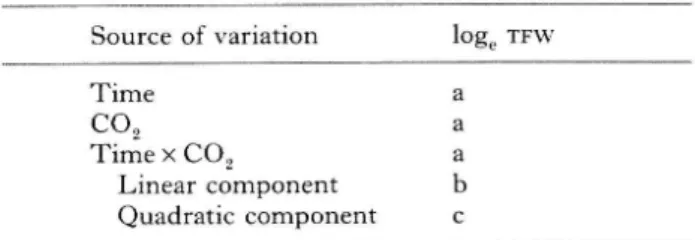
Stimulation of the RGHp^^- of the total plant by elevated CO, was transient in plants transferred 4 wk after germination (younger plants; Fig. l a ) . The transient nature of the effect was further evident from the significant interaction of time x CO, as found in a two-way analysis of variance of the log^.-transformed total plant f. wt (log^ TFW) (Table 1). In plants transferred 6 wk after germination (older plants) the effect of elevated CO, on the log^-transformed TWF was significant at P < 0-05 (two-way analysis of variance). The degree of the stimulation of RGRpy,. by elevated CO, was higher for the younger (30 °o) than for the older plants (20%) (Fig. l a ) . At elevated CO^, both the degree
Table 1. Analysis of variance of the logg-transformed total plant fresh weight {log^ TFtt') of the younger plants
and the duration of the stimulation of RGR^^,. were increased compared with the whole plant. This increase was evident in the younger as well as in the older plants (Fig. 1 b). LA of both the younger and older plants was increased by elevated CO.^ (Fig. 1 c). SWR of the younger plants decreased slightly during the period that RGRJ.^^. was stimulated, but this decrease was not significant (Fig. 1 d). In the case of the older plants, SWR was also not significantly changed (Fig. 1 d).
Plants grown at elevated COj started earlier to develop secondary shoots, visible on day 6, when 50 % of the plants used for the RGR analysis had secondary shoots (Fig. 2 a). In order to correct for ontogenetic drift, RGRp^j^; was plotted versus log^-transformed total f. wt (TFW). Before a certain plant size was reached, the effect of elevated CO, on RGRp^v was not size dependent; after that there was no difference between the treatments. For both CO, concentrations it was evident that the decrease in RGRp^^, occurred when a certain plant size was reached; this size coincided with the beginning of
Source of variation TFW Time CO., Time x CO, Linear component Quadratic component a a a b c
Independent variables: time (11 harvests) and treatment (CO., concentration). P,P-value of the F-test.
a, > < 0-0001; b, P < 0-001; c, P < 0-01.
Table 2. Starch and soluble sugar concentration in the secondary shoots {mean + SE, n = 3), on day 20
Starch Soluble sugar
CO, concentration (fii 1 ')
350 111+2 37 + 3 -9 -3 700 116 + 6-4 56 + 2-5 a a, P < 0-0001 (Student's /-test).
the formation of the secondary shoots (Fig. 2a, b). RWR was temporarily increased at elevated COj (Fig. 2c), during the period that RGRp^^. is stimu-lated. After this initial increase, RWR was decreased for both CO, treatments, at the same time that swRgpj, started to increase (Fig. 2e). In the case of the older plants, RWR was only increased signifi-cantly on day 16 (Fig. 2 c). Correction for ontogenetic drift showed that the increase by elevated COj, observed for the RWR of the younger plants, was not entirely size-dependent, although the later decrease in RWR was size-dependent, at both COj concen-trations (Fig. 2d). In the younger plants, SWR^^^, was markedly increased at elevated CO.^ (Fig. 2e). Correction of the SWRg^,. data for ontogenetic drift showed that the observed effect was strongly size-dependent for the younger plants (Fig. 2 / ) .
Carbohydrate atialysis
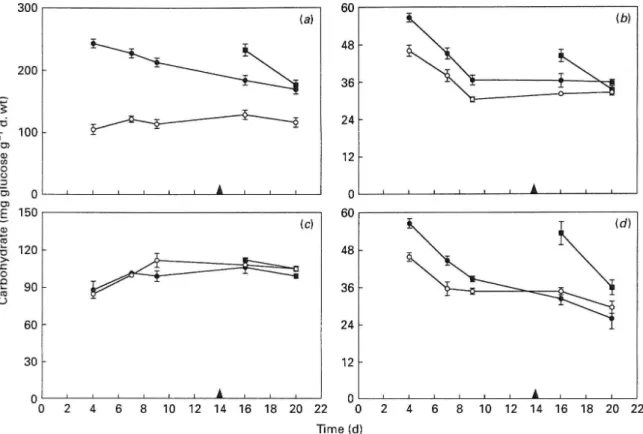
Shoot-starch concentration was greatly increased in plants grown at elevated COj. The difference in concentration decreased with time but the plants grown at elevated COj still showed an increase by the end of the experiment (Fig. 3 a). Soluble sugar concentration of the shoot was also higher at elevated CO2 both during and after the period of stimulation of HGRp^^, (Fig. 3b). In both COg treatments soluble sugar concentration decreased with time until day 9, after which it remained constant. The older plants, transferred 6 wk after germination, were also able to increase their shoot starch and soluble sugar
con-Modulation of growth response by elevated CO., 631 0-4 0-3 0-2 0-1 0.00 -a J— a 1 t 1 1 (c) I i Pi 10 12 14 Time (d) 16 18 20 - 2 - 1 0 1 2 TFW (log transformed)
F i g u r e 2. (a) Percentage of plants, sampled for RGR analysis, with secondary shoots, (b) RGRp^^- data corrected for ontogenetic drift, (c) Root weight ratio (RWR) of the plants sampled for RGR analysis (mean + SE). [d) RWR corrected for ontogenetic drift, (e) Shoot weight ratio of the secondary shoots of the plants sampled for RGR analysis (swR^j,,.) (mean±SE). (J) SWR^.^.^. corrected for ontogenetic drift. ( # ) 700/ilT^ CO.,, ( O ) 350/tl 1^' CO2, ( • ) older plants. Black triangles indicate the day when the older plants were transferred to elevated CO,, a, P < 0-05 (Student's ^-test).
centration, although not to the same extent in the case of starch (Fig. 3 a, b). The decrease with time was more marked than for the younger plants. At the last day of the experiment, the starch concentration in the secondary shoots was the same for both CO, treatments, but the soluble sugar concentration was higher at elevated CO^ (Table 2).
Starch concentration in the roots was not changed by elevated CO.^, either in the younger or older plants (Fig. 3 c). Soluble sugar concentration was only increased at elevated CO, during the period of growth stimulation (Fig. 3b). In both CO.^ treat-ments, soluble sugar concentration decreased with time, until day 9 for plants grown at ambient COg, and throughout the duration of the experiment for
plants grown at elevated COj. Root-starch con-centration of the plants transferred 6 wk after germination was not changed at elevated COj (Fig. 3c). Soluble sugar concentration, however, was markedly increased and this effect was more pro-nounced in the older than in the younger plants (Fig.
Leaf photosynthesis
Photosynthesis was increased by elevated COo in both the existing and the new leaves (Fig. Aa). The plants which were transferred later sho'wed the same pattern as the younger plants, for both existing and new leaves (Fig. 4a, b).
632 F. Fonseca, y. Den Hertog and I. Stulen 300
10 12 14 16 18 20 22 0 Time (d)
10 12 14 16 18 20 22
Figure 3. {a) Starch and soluble (6) sugar concentration in the shoots (mean + SE). The effect of elevated COj on soluble sugar concentration of the younger plants was significant at P < 0-0001 in a two-way analysis of variance, (c) Starch and (d) soluble sugar concentration in the roots (mean + SE). Elevated CO,, effects on soluble sugar concentration, tested hy a two-way analysis of variance, showed significant time x CO, at P < 0-001, for the younger plants and P < 0-05, for the older plants. (©) 700 /d T ' CO^, (O) 350 //I T ' CO,,"(B), older plants. Black triangles indicate the day when the older plants were transferred to elevated CO,.
DISCUSSION
Growth parameters
Plant growth analysis included a separate analysis of the RGRp^v of the secondary shoots. For the plants transferred 4 wk after germination, part of the plant, namely the secondary shoots, was still growing at a higher rate than at atmospheric COg when RGRpw of the whole plant was no longer stimulated. Because the weight of these secondary shoots is very small compared with the weight of the whole plant, their growth response is masked when calculation of RGR is based on plant total weight. During the period that RGRp^r was stimulated by elevated COg, RWR was also increased. Correction of RGRJ,^^. and RWR for ontogenetic drift showed that the transient, stimulatory effect of elevated COj on both para-meters was not entirely size-dependent. In the older plants the increase in RGRJ.,,,, and RWR by elevated CO2 was smaller than in the younger plants. At the later stage of development, the ratio between new and old tissue in the shoots is certainly different, possibh' affecting the capacity to accelerate metabolic responses.
In a previous study with the same Plantago subspecies no effect on RWR was detected (Den
Hertog, Stulen & Lambers (1993). In the present study the increase in RWR was detected because the RGR analysis was done at shorter intervals (2 d). The older root systems did not have the capacity to respond to the same extent as did the younger plants. Probably, at this stage of development, the ratio between new and old tissue in the root system is different from the younger plants, causing a decrease in the effect of elevated CO.^ on RWR, or even masking the fact that only the newest parts of the root system may be stimulated while the rest is not. It has been suggested that the extent to which roots may affect the response to elevated COj ultimately depends upon the allocation of carbon to coarse or fine roots, i.e. to storage vs. resource capture functions (Korner & Arnone 1992; Curtis et al., 1994; Norby, 1994).
The present data showed that elevated COj did not change the pattern of growth, but that it accelerated the rate of development, following a genetically determined inherent pattern of growth, as suggested by Brown (1991), Coieman, McConnaughay & Bazzaz (1993), Poorter (1993) and Lariguaderie, Reynolds & Strain (1994).
One of the reasons for the transient nature of the stimulation of RGR by elevated COj might be the occurrence of self-shading during the experiment
Modulation of growth response by elevated CO« 633
10 12 14 16 18 20 22 Time (d)
Figure 4. (a) Net photosynthetic rate of existing leaves
and (b) of young leaves (mean + SE). The efFect of elev-ated CO2 on net photosynthetic rate was significant at
P < 0-0001 for existing leaves (younger and older plants), P < 0-0001 for new leaves of younger plants and P < 0-001 for new leaves of older plants, in a two-way analysis
of variance. ( • ) 700//I 1"= CO^, (O) 350/^l
^, (•)
older plants. Black triangles indicate the day when the older plants were transferred to elevated COj.(Poorter et al., 1988). However, in Piantago major ssp. pleiosperma, the small differences in leaf area between the CO^ treatments would not seem to support the idea that differences in self-shading could be the major cause of the transient nature of the stimulation of the RGRp.^,,, of the whole plant. As discussed below, a change in the sink-source re-lationship in the plant as a result of the formation of secondary shoots might be a more plausible ex-planation.
Sink-source relationships
In the present study plant total leaf area was increased by elevated COj. Increases in average leaf size (Ford & Thorne, 1967; Sionit et al., 1981), leaf numbers (Sionit, Strain & Flint, 1987; Sasek & Strain, 1988), total leaf area (Rogers et aL, 1984; Cure, Thomas & Israel, 1987; Den Hertog et al. 1993), and increased initiation and rate of expansion (Hicklenton & Jolliffe, 1980; Kramer, 1981; Cure, Rufty & Israel, 1989) were found in plants grown at elevated CO,. All these changes in leaf morphology may be regarded as a way of increasing storage capacity for carbohydrates. Stitt (1991) suggested that new temporary storage capacity might not only
be formed within the leaves or other existing sinks, but that new sinks could also be initiated. Species can differ greatly in the extent to which this happens (Wardlaw, 1990), and the response of sink metab-olism to an increased availability of carbohydrates will depend partly on genetic factors (e.g. deter-minate versus indeterdeter-minate growth, internal genetic constraints on the rate and extent of sink growth) and partly on environmental factors, e.g. nitrogen availability (Stitt, 1991).
The younger plants of P. major ssp. pleiosperma, responded to elevated COg by transiently increasing partitioning to the root, increasing leaf area, and accelerating the development of new sinks for carbohydrates, namely, the secondary shoots. Ap-parently, the development of these new sinks took priority over a continuation of the stimulation of RWR.
The view that the allocation of materials via the phloem is governed by the relative strength of the terminal sinks under control of phytohormones, is well known (Brenner, 1987; Patrick, 1987). This concept attributes a major role to phytohormones in determining allocation patterns, shoot:root ratio and intraspecific shifts in RGR. A contrasting view is the 'functional equilibrium' model (Davidson, 1968; Brouwer, 1983). In this view, root growth is limited by the supply of photosynthates from the shoot and shoot growth by the supply of minerals and water from the root. The model predicts that the functional interdependence of root and shoot results in a balanced outgrowth of the sinks.
A model of whole-plant carbon partitioning in which sucrose plays a central role, with the pools of sucrose in the cytosol of source and sink controlling the capacity for synthetic metabolism, was proposed by Farrar (1992) and Farrar & Williams (1991). According to this model, sink growth should be greater at elevated CO.,, given no limitation from nutrients, temperature or inherent capacity'. In
Piantago, new sinks, the secondary shoots, placed
along the transport pathway from shoot to root, could have used relatively more of the extra carbo-hydrates at the expense of the roots, since root carbohydrate concentration decreased, at the time of the formation of secondary shoots and the end of the period of stimulation of RWR. The fact that the secondary shoots have a lower starch: soluble sugar ratio during stmiulation of their RGR agrees with the idea that sugars play a central role in synthetic metabolism (Farrar & Williams, 1991).
Leaf photosynthesis and carbohydrates
In some species, changes in leaf properties by elevated CO., include changes in chloroplasts, in particular the formation of starch grains (Carmi & Shomer, 1979; Yelle et al., 1989a). In some cases elevated CO., caused a decrease in photosynthetic
634 F. Fonseca, J . Den Hertog and I. Stulen rate (per unit leaf area) after a period (7-10 d) at elevated C O , (Aoki & Yabuki, 1977; Mortensen, 1983 ; Havelka et al., 1984; Spencer & Bowes, 1986), whereas in other cases no decrease in photosynthetic rate was found (Cure et al., 1987). Several hy-potheses have been put forward to explain this elevated-COj induced decrease in photosynthetic rate, referred to as photosynthetic acclimation.
Spencer & Bowes (1986) suggested that reduced stomatal conductance of leaves at elevated CO, could partly explain the photosynthetic acclimation. Yelle
et al. (19896) reported a significant decrease in
stomatal conductance of tomato leaves under el-evated CO.,. However, the constant value of internal CO, concentration throughout the experiment suggested that reduced stomatal conductance could not explain the photosynthetic acclimation in terms of a counter balancing effect.
Starch accumulation has also been related to the decrease in photosynthetic rate. It has been suggested that starch build-up could act as a feedback inhibitor (Thomas et al., 1975; Mauney, Fry & Guinn, 1978). Other lines of evidence indicated that photosynthetic acclimation cannot be attributed to a build-up of starch (Yelle et al., 1989(3, Stulen, den Hertog & Jansen, 1993), but rather to a decline of activated Rubisco, with starch accumulation being a symptotn, but not the primary cause of the decrease in photosynthetic rate at elevated CO.2 (Yelle et al., 19896).
More recently Van Oosten, Wilkins & Besford (1994) proposed a molecular model to account for the photosynthetic acclimation, in which plants exposed to elevated CO, will progressively accumu-late sugars (hexoses) when sink strength is reduced. T h e mechanism proposed for the acclimation is then mediated by increased hexose concentrations. .Ac-cumulation of hexoses might be detected by an as yet unknow'n protein in plants, involved in carbon metabolism, which will then initiate a cascade of reactions which will repress (Rubisco - ribulose-1,5-bisphosphate carboxylase oxygenase, small sub-unit, Rubisco activase) or activate (ADP-glucose pyrophosphorylase) specific nuclear genes involved in primary carbon metabolism.
In Plantago major ssp. pleiosperma, no decrease in leaf photosynthesis was found either in an existing leaf (during or after the transient period of growth stimulation by elevated COj) or in a new leaf. T h e observed decrease in photosynthetic rate with time was also present at atmospheric COj, and was probably caused by ageing of the leaf. Apparently, at elevated COj, relatively more soluble sugars were used at first for the stimulation of root metabolism, and thereafter for the growth of the secondary shoots. As a consequence of the presence of these sinks, a constant difference in soluble sugar con-centration between the CO2 treatments, rather than a progressive accumulation of soluble sugars at
elevated CO, was observed and so changes in genetic expression of carbon metabolism enzymes at elevated CO, might not occur to the same extent as predicted by the model of Van Oosten et al. (1994).
Final remark
It is concluded that the preference of the secondary shoots as a sink over the roots alters the sink-source balance in the roots, which results in a cessation of the stimulation of root metabolism, RWR and whole plant RGR.
ACKNOWLEDGEMENTS
Filomena Fonseca was financed hy the University of Algarve (UCTA), J.N.I.C.T. (Programa Ciencia) and the Fundagao Calouste Gulhenkian, Portugal. J. Den Hertog was financially supported by the Netherlands Organization for Scientific Research.
R E F E R E N C E S
Aoki M, Yabuki K. \911. Studies on the carbon dioxide
enrichment for plant growth. V I I . Changes in dry matter production and photosynthetic rate of cucumber during carbon dioxide enrichment. Agricultural Meteorology 18: 474—485.
Brenner ML. 1987. T h e role of hormones in photosynthetic
partitioning and seed filling. I n : Davies PJ, ed. Plant Hormones
mid their Role in Plant Growth and Development. Dordrecht:
Kluwer, 474—193.
Brouwer R. 1983. Functional equilibrium: sense or nonsense. Netherlands Journal of Agricultural Science 31: 335-348. Brown KR. 1991. Carbon dioxide enrichment accelerates the
decline in nutrient status and relative grow'th rate of Populus
tremuloides Michx. seedlings. Tree Physiology 8: 161-173. Carmi A, Shomer I. 1979. Starch accumulation and
photo-synthetic activity in primary leaves of bean (Phaseolus vulgaris L.). Annals of Botaiiy 44: 4 7 9 ^ 8 4 .
Coieman JS, McConnaughay KDM, Bazzaz FA. 1993.
Elevated CO., and plant nitrogen-use: is reduced tissue nitrogen concentration size dependent? Oecologia 93: 195-200.
Cure JD, Rufty TW, Israel DW. 1989. Alterations in soybean
leaf development and photosynthesis in a CO^-enriched atmosphere. Botanical Gazette 150: 337-345.
Cure JD, Thomas WR, Israel DW. 1987. Assimilate utilization
in the leaf canopy and whole-plant growth of soybean during acclimation to elevated CO,. Botanical Gazette 148: 67-72.
Curtis P, O'Neill EG, Teeri JA, Zak DR, Pregitzer KS. 1994.
Belowground responses to rising atmospheric C O j : impli-cations for plants, soil biota and ecosystem processes. Plant and
Soil 165: 1-6.
Davidson RL. 1968. Effect of root/leaf temperature differentials
on root/shoot ratios in some pasture grasses and clover. Annals
of Botany 33: 561-569.
Den Hertog J, Stulen I, Lambers H. 1993. Assimilation,
respiration and allocation of carbon in Plantago major as affected by atmospheric C O , levels. .A. case study. Vegetatio
104/105: 369-378.
Dijkstra P, Lambers H. 1989. .Analysis of specific leaf area and
photosynthesis of two inbred lines oi Plantago major differing in relative growth rate. New Phytologist 113: 283-290.
Downton WJS, Bjorkman O, Pike CS. 1980. Consequences of
increased atmospheric concentrations of carbon dioxide. In: Pearman GI, ed. Carbon Dioxide and Climate: Australian
Research. Canberra: The Australian Academy of Science,
143-151.
Fales FW. 1951. The assimilation and degradation of
carbo-hydrates by yeast cells. Journal of Biology and Chemistry 193: 113-124.
Modulation of growth response by elevated CO, 635
Farrar JF. 1992. The whole plant: carbon partitioning during
development. In: Pollock CJ, Farrar J F , Gordon AJ, eds.
Carbon Partitioning within and between Organisms. Oxford:
BIOS, 163-179.
Farrar JF, Williams MI. 1991. The effects of increased
atmospheric carbon dioxide and temperature on carbon par-titioning, source-sink relations and respiration. Plant, Cell and
Environment 14: 819-830.
Ford MA, Thorne GN. 1967. Effect of CO^ concentration on
growth of sugar-beet, barley, kale and maize. Annals of Botany 31:629-643.
Havelka VD, Ackerson RC, Boyle MG, Wittenbach VA. 1984.
CO2 enrichment effects of soybean physiology. I. Effects of long-term C O , exposure. Crop Science 24: 1146-1 ISO.
Hicklenton PR, Jolliffe PA. 1980. Alterations in the physiology
of CO.^ exchange in tomato plants grown in COj enriched atmospheres. Canadian Journal of Botany 58: 2181-2189.
Jolliffe PA, Ehret DL. 1985. Growth of bean plants at elevated
carbon dioxide concentrations. Canadian Journal of Botany 63: 2021-2025.
Korner CH, Arnone JA III. 1992. Responses to elevated carbon
dioxide in articifial tropical ecosystems. Science 257: 1672-1675.
Kramer P. 1981. Carbon dioxide concentrations, photosynthesis,
and dry matter production. Bioscience 31: 29-33.
Kriedemann PE, Wong SC. 1984. Growth response and
photosynthetic acclimation to C O j : comparative behaviour in two C3 crop species. Acta Horticulturae 162: 113-120.
Larigauderie A, Reynolds JF, Strain BR. 1994. Root response
to CO2 enrichment and nitrogen supply in loblolly pine. Plant
and Soil 165: 21-32.
Mauney JR, Fry KE, Guinn G. 1978. Relationship of
photo-synthetic rate to growth and fruiting of cotton, soybean, sorghum and sunflower. Crop Science 18: 259—263.
Mortensen LM. 1983. Growth response of some greenhouse
plants to environment. X. Long-term effect of CO2-enrichment on photosynthesis, photorespiration, carbohydrate content and growth of Chrysa?ithemum morifolium Ramat. Aleldinger fra
Norges Landbrukshogskole (tl: 1-11.
N e a l e s TF, Nicholls AO. 1978. Growth response of young
wheat plants to a range of ambient COj levels. Australian
Jouryial of Plant Physiology 5: 45-59.
Norby RJ. 1994. Issues and perspectives for investigating root
responses to elevated atmospheric carbon dioxide. Plant and
Soil 165: 9-20.
Patrick JW. 1987. Are hormones involved in assimilate transport ?
In: Hoad GV, Lenton JR, Jackson MB, Atkin RE, eds.
Hormone Actioti in Plant Development — a Critical Appraisal.
London: Butterworths, 175-188.
Peet MM. 1986. Acclimation to high C O , in monoecious
cucumbers. I. Vegetative and reproductive growth. Plant
Physiology 80: 59-62.
Poorter H. 1989. Plant growth analysis: towards a synthesis of
the classical and the functional approach. Physiologia Plantarum
75: 237-244.
Poorter H. 1993. Interspecific variation in the growth response of
plants to an elevated ambient CO, concentration. Vegetatio
104/105:77-97.
Poorter H, Lewis ?. 1987. Testing differences in relative growth
rate: a method avoiding curve fitting and pairing. Physiologia
Plantarum 67: 223-226.
Poorter H, Pot CS, Lambers H. 1988. The effect of an elevated
atmospheric CO2 concentration on growth, photosynthesis and respiration of Piantago major. Phvswlogia Plantarum 7 3 : 553-559.
Rogers HH, Cure JD, Thomas JF, Smith JM. 1984. Influence
of elevated COj on growth of soybean plants. Crop Science 24: 361-J66.
Sasek TW, Strain BR. 1988. Eff'ects of carbon dioxide enrichment
on the growth and morphology of kudzu (Pueraria lobata).
Weed Science 36: 28-36.
Sionit N, Mortensen DA, Strain BR, H e l l m e r s H. 1981.
Growth response of wheat to CO, enrichment and different levels of mineral nutrition. Agronomy Journal 73: 1023-1027.
Sionit N, Strain BR, Flint EP. 1987. Interaction of temperature
and CO2 enrichment on soybean: growth and dry matter partitioning. Canadian Journal of Plant Science 67: 59-67.
S m a k m a n G, Hofstra JJ. 1982. Energy metabolism of Piantago lanceolata as affected by change in root temperature. Physiologia Plantarum 56: 33-37.
Spencer W, Bowes G. 1986. Photosynthesis and growth of water
hyacinth under CO., enrichment. Plant Physiology 82: 528-533.
Stitt M. 1991. Rising CO.^ levels and their potential significance
for carbon How in photosynthetic cells. Plant, Cell and
Environment 14: 741—762.
Stulen I, D e n Hertog H, Jansen CM. 1993. The influence of
atmospheric CO., enrichment on allocation patterns of carbon and nitrogen in plants from natural vegetations. In: Abrol YP. Mohanty P, Go\-indjee, eds. Photosynthesis : Photoreactions to
Plant Producttvitv. Dordrecht: Kluwer Academic Publishers,
509-524.
Thomas JF, Raper CD Jr., Anderson CE, Downs RJ. 1975.
Growth of young tobacco plants as affected by carbon dioxide and nutrient variables. Agronomy Journal 67: 685-689.
Thomas RB, Richter DD, Ye H, Heine PR, Strain BR. 1991.
Nitrogen dynamics and growth of seedlings of an X-fixing tree
(Gliricidia sepium (Jacq.) Walp.) exposed to elevated
atmos-pheric carbon dioxide. Oecologia 88: 415-421.
Van Dijk H, Van Delden W. 1981. Genetic variability in Piantago species in relation to their ecology. I. Genetic analysis
of allozyme variation in P. major subspecies. Theoretical and
Applied Genetics 60: 285-290.
Van Oosten J-J, Wilkins D, Besford RT. 1994. Regulation of the
expression of photosynthetic nuclear genes by C O , is mimicked by regulation hy carbohydrates: a mechanism for the ac-climation of photosynthesis to high CO, ? Plant, Cell and
Enviromnent 11. 9\3-923.
Wardlaw IF. 1990. The control of carbon partitioning in plants. Xezi- Phytologist 116: 341-381.
Wickens LK, Cheeseman JM. 1988. Application of growth
analysis to phsyiological studies involving environmental discontinuities. Physiologia Plantarum 73: 271-277.
Wong SC. 1990. Elevated CO., partial pressures of CO, and plant
growth. 2. Nonstructural carbohydrate content in cotton plants and its effect on growth parameters. Photosynthesis Research 23 : 171-180.
Yelle S, Beeson RC Jr., Trudel MJ, Gosselin A. 1989 a.
Acclimation of two tomato species to high atmospheric CO,. I. Sugar and starch concentrations. Plant Physiology 90: 1465-1472.
Yelle S, Beeson RC Jr., Trudel MJ, Gosselin A. 19896.
Acclimation of two tomato species to high atmospheric CO,. II. Rihulose-l,5-bisphosphate carboxylase and phosphoenol-pyruvate carboxyiase. Plant Physiology 90: 1473—1477.