INTRODUCTION
Sapindaceae is a tropical and subtropical family com-prising approximately 136 genera and about 2000 species. Radlkofer (1931-1934) recognized 14 tribes, of which
Paullinieae is the only tribe characterized by a climbing habit, with the remaining tribes being shrubs or trees.
The most comprehensive studies on the karyology of
Sapindaceae were done in the last decade (Ferrucci, 1989; Hemmer and Morawetz, 1990; Nogueira et al., 1995; Ferrucci and Solís Neffa, 1997; Solís Neffa and Ferrucci, 1997, 1998; Lombello and Forni-Martins, 1998), and chro-mosome numbers of 127 species have been reported and the complete karyotypes of 35 species are known, although only a few papers give information on interphase nucleus structure, chromosome condensing behavior, Giemsa C-banding, NOR-banding and nucleolus counts (Eichhorn and Franquet, 1936; Guervin, 1961; Hemmer and Morawetz, 1990; Nogueira et al., 1995).
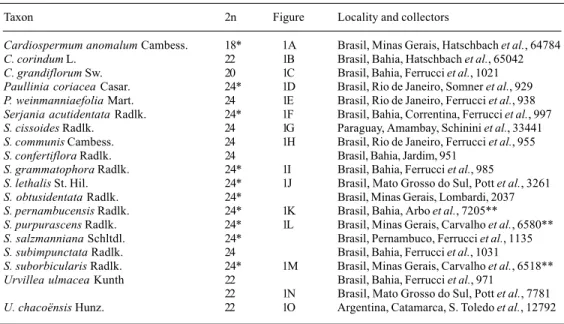
In the present study chromosome numbers are re-ported for 19 South American species of the tribe Paulli-nieae (Table I), with ten of them representing new records while previous reports are confirmed for other 9 species. These results are compared with a review of the karyol-ogy of the whole family, with special reference to the tribe
Paullinieae in an attempt to improve the understanding of the evolution of the family.
The species studied, chromosome numbers, localities and collectors are listed in Table I. Voucher specimens have been deposited in the herbaria of the Instituto de Botánica del Nordeste (CTES), Argentina.
Cytological studies were carried out using root mer-istems of germinating seeds, except for Cardiospermum anomalum, where roots from adult plant were used. The roots were pre-treated for 3 h in 0.002 M 8-hydroxyquino-line at room temperature, fixed in ethanol and lactic acid (5:1) at 4°C and then stored in 70% ethanol. The roots were hydrolyzed in 1 N HCl at 60ºC for 8 min and stained with Feulgen’s technique using Schiff reagent and squashed in a drop of 2% acetic orcein. Slides were made permanent us-ing Bowen’s method (1956) and mounted in Euparal.
BASIC CHROMOSOME NUMBERS
In the Sapindaceae, chromosome numbers for 42
gen-era belonging to 13 tribes and approximately 138 species have been reported, including the new counts presented in this paper, leaving only one tribe karyologically undefined.
Table II shows that there is a considerable variation in chromosome numbers within the family as a whole.
Paullinieae showed an almost complete aneuploidy series, from x = 7 to x = 14, only x = 8 and x = 13 being absent. The discovery of 2n = 14 in Cardiospermum integerrimum
Radlk. (Ferrucci, 1989) was the first record of x = 7 in New World Sapindales, while the count of 2n = 18 in C. anomalum (Table I) establishes a new basic chromosome number, x = 9, for the family. In Sapindales, the families
Bretschneideraceae and Akaniaceae included in the past in Sapindaceae have x = 9.
The basic chromosome numbers x = 7, 9 and 10 are exclusive to New World species, while x = 13 is only known for two closely allied tribes of the Old World. Among the 42 genera cytologically explored, only 7 exhibit more than two basic numbers.
According to available data, x = 15, x = 16 and x = 14 occur with the greatest frequency, while other basic num-bers are less frequent (Table II). In Paullinieae, the most advanced tribe of the family, the higher basic chromosome numbers x = 15 and x = 16 are absent. Considering that x = 7 would be the primitive base number for the family (Ferrucci, 1989), the other chromosome numbers would be derived by polyploidy and aneuploidy.
POLYPLOIDY
One-third to one-half of the angiosperms are estimated to be polyploid which has, thus, played an important role in the evolution of higher plants (Stebbins, 1971; Greilhuber and Ehrendorfer, 1988), but polyploid frequency in Sapin-daceae is scarce, with only three genera from different tribes exhibiting polyploid species, all American species with distinct life forms, such as climbers, shrubs and trees. In this context Urvillea Kunth (Paullinieae) possesses two basic numbers, x = 11 and x = 12, while among the four species studied with x = 11 three ploidy levels are present, 2n = 2x = 22, 2n = 4x = 44 and 2n = 8x = 86. The wide-spread species U. ulmacea is a unique species with two known cytotypes 2n = 2x = 22 as well as 2n = 8x = 86 in which polyploidy has been followed by reductional aneu-ploidy (Nogueira et al., 1995).
María S. Ferrucci
The largest and most cosmopolitan genus Allophylus
L. (Thouinieae) shows two ploidy levels, with four species possessing 2n = 2x = 28 while A. guaraniticus (A.St.-Hil.) Radlk. has 2n = 4x = 56 (Ferrucci and Solís Neffa, 1997).
Melicoccus P. Browne (Melicocceae) with its two cytologically studied species has two ploidy levels, 2n = 2x = 32 as well as 2n = 6x = 96, which represents the high-est chromosome number of the Sapindaceae (Ferrucci and Solís Neffa, 1997).
Although there is relatively little information on the cytology of the family as a whole, the rareness of polyp-loids is obvious, indicating that other mechanism of spe-ciation plays the main role.
KARYOTYPES AND SYSTEMATICS IN PAULLINIEAE
The Paullinieae with 7 genera and about 430 species
Table II - Distribution of basic chromosome numbers of 42 studied genera in 13 tribes of Sapindaceae. x = 7 x = 9 x = 10 x = 11 x = 12 x = 13 x = 14 x = 15 x = 16 Tribes
Paullinieae 1 1 1 2 4 2
Thouinieae 1 1
Sapindeae 4 3
Aphanieae 1 1
Lepisantheae 1 2
Melicocceae 1
Schleichereae 1 1
Nephelieae 5 2
Cupanieae 1 1 4
Koelreuterieae 1 1
Cossignieae 1
Dodonaeeae 1
Harpullieae 1 1 3 2
Percentage 2.4 2.4 4.6 4.6 14 4.6 24 35 30
Basic numbers
include a quarter of the species of the family, the tribe pre-senting an almost exclusively neotropical distribution. In Radlkofer’s (1931-1934) system there are two subtribes, the Thinouiinae with only one genus, Thinouia Triana & Planch., and the Paulliniinae with Lophostigma Radlk.,
Serjania Mill., Houssayanthus Hunz., Paullinia L.,
Cardiospermum L. and Urvillea. Chromosome numbers have been determined in 58 species distributed amongst the 7 genera of Paullinieae and the karyotypes of 32 species have been described, and, from a cytological point of view, it is the best explored tribe.
The genus Thinouia is considered the most primi-tive genus in the tribe, and although it has only 9 species karyotype analysis and chromosome number (2n = 28) are only known for T. mucronata Radlk. (Ferrucci and Solís Neffa, 1997; Solís Neffa and Ferrucci, 1998), with karyo-type characteristics confirming its basal position in the Table I - Chromosome numbers of some South American Sapindaceae,
Paullinieae. *New species counts, ** participation of the author in material collection.
Taxon 2n Figure Locality and collectors
Cardiospermum anomalumCambess. 18* 1A Brasil, Minas Gerais, Hatschbach et al., 64784
C. corindumL. 22 1B Brasil, Bahia, Hatschbach et al., 65042
C. grandiflorumSw. 20 1C Brasil, Bahia, Ferrucci et al., 1021
Paullinia coriaceaCasar. 24* 1D Brasil, Rio de Janeiro, Somner et al., 929
P. weinmanniaefoliaMart. 24 1E Brasil, Rio de Janeiro, Ferrucci et al., 938
Serjania acutidentataRadlk. 24* 1F Brasil, Bahia, Correntina, Ferrucci et al., 997
S. cissoidesRadlk. 24 1G Paraguay, Amambay, Schinini et al., 33441
S. communisCambess. 24 1H Brasil, Rio de Janeiro, Ferrucci et al., 955
S. confertifloraRadlk. 24 Brasil, Bahia, Jardim, 951
S. grammatophoraRadlk. 24* 1I Brasil, Bahia, Ferrucci et al., 985
S. lethalisSt. Hil. 24* 1J Brasil, Mato Grosso do Sul, Pott et al., 3261
S. obtusidentataRadlk. 24* Brasil, Minas Gerais, Lombardi, 2037
S. pernambucensisRadlk. 24* 1K Brasil, Bahia, Arbo et al., 7205**
S. purpurascensRadlk. 24* 1L Brasil, Minas Gerais, Carvalho et al., 6580**
S. salzmannianaSchltdl. 24* Brasil, Pernambuco, Ferrucci et al., 1135
S. subimpunctataRadlk. 24 Brasil, Bahia, Ferrucci et al., 1031
S. suborbicularisRadlk. 24* 1M Brasil, Minas Gerais, Carvalho et al., 6518**
Urvillea ulmaceaKunth 22 Brasil, Bahia, Ferrucci et al., 971
22 1N Brasil, Mato Grosso do Sul, Pott et al., 7781
tribe. When compared to other genera of Paullinieae, T. mucronata is characterized by small chromosomes with an average chromosome length of 1.47 µm as well as by a symmetric karyotype due to the predominance of m-type chromosomes, agreeing well with macromorphological evidence and pollen type. On the basis of cladistic analy-sis Acevedo-Rodríguez (1993) proposed to place Thinouia
in the tribe Cupanieae,but current knowledge supports its position in Paullinieae.
Lophostigma comprises only two species, native to Ecuador, Peru and Bolivia. Karyological information is con-fined to the chromosome number, 2n = 28 of L. plumosum
Radlk. (Ferrucci and Solís Neffa, 1997). Characters such as climbing habit, stipules and lightly zygomorphic flowers are essential for placing Lophostigma in the subtribe, and the calyx with five free sepals and the semiannular disc suggest a basal position in the Paulliniinae, the chromosome number supporting this hypothesis (Ferrucci and Anzótegui, 1993). Distinctive pollen, unique within Sapindaceae (Acevedo-Rodríguez, 1993; Ferrucci and Anzótegui, 1993), and the chromosome number are the characters that distinguish
Lophostigma from Serjania, its most closely allied genus.
Serjania Mill. with about 231 species is the largest genus of Paullinieae. Chromosome studies include the chromosome counts of 35 species belonging to eleven of the twelve sections of the genus, all with 2n = 24 (Guervin, 1961; Fernández Casas and Fernández Piqueras, 1981; Ferrucci, 1981, 1985; Sarkar et al., 1982; Maglio et al., 1984; Hemmer and Morawetz, 1990; Acevedo-Rodríguez, 1993; Nogueira et al., 1995; Ferrucci and Solís Neffa, 1997; Solís Neffa and Ferrucci, 1997 and this paper), while new counts for S. acutidentata (Figure 1F), S. gramma-tophora (Figure 1I), S. lethalis (Figure 1J), S. obtusi-dentata, S. pernambucensis (Figure 1K), S. purpurascens
(Figure 1L), S. salzmanniana and S. suborbicularis (Fig-ure 1M), all with 2n = 24, confirm the consistency of this chromosome number.
The karyotypes of 21 species of Serjania have been studied, in five of which two populations were analyzed (Hemmer and Morawetz, 1990; Nogueira et al., 1995; Solís Neffa and Ferrucci, 1997; Lombello and Forni-Mar-tins, 1998), with the karyotypes showing a moderate de-gree of asymmetry and gradual differences in chromo-some size. Although the predominance of m-type and sm-type chromosomes has been noted, st-sm-type and t-sm-type chro-mosomes are also generally present. Satellite nucleic acid is difficult to detect, although some species have 1 to 3 chromosome pairs with microsatellite nucleic acid at-tached to the short and long arms of m-type and t-type chromosomes, while S.hebecarpa Benth. is the only spe-cies in which macrosatellite nucleic acid has been detected associated with one chromosome pair. The size of Serjania
chromosomes varies from 0.97 µm in S.gracilis Radlk. to 4.7 µm in S. meridionalis Cambess. In the species ana-lyzed there was significant interspecific and intraspecific variation in chromosome length and karyotype formulae.
Within the tribe, Serjania shows morphological af-finities to both Lophostigma and Houssayanthus, but dif-fers from Lophostigma in the characters mentioned above and from Houssayanthus only by fruit morphology.
Houssayanthus with only 3 species is distributed from Venezuela to northeastern Argentina, with chromo-some numbers being known for 2 species, H. incanus
(Radlk.) Ferrucci and H. monogynus (Schltdl.) Ferrucci, both with 2n = 24 (Ferrucci, 1981). The karyotype of H. incanus has been studied and is characterized by a moder-ate degree of asymmetry due to its high number of sm-type chromosomes; one pair of st-sm-type chromosomes bears a microsatellite in the short arm (Solís Neffa and Ferrucci, 1998). The mean chromosome length as well as the degree of asymmetry is similar to the Serjania spe-cies studied, which agrees with the close relationship be-tween Houssayanthus and Serjania in which only fruit characteristics differentiate between genera.
Paullinia with about 150 species is mostly neo-tropical, with chromosome counts having been reported for seven species, including a new count for P. coriacea, the cytologically characterized species belonging to four of the 13 sections of the genus, all with 2n= 24 (Mangenot and Mangenot, 1958; Semple, 1974; Ferrucci, 1981; Guerra, 1986; Ferrucci and Solís Neffa, 1997 and this paper). The karyotypes of three species have been studied in detail, the analysis showing a moderate degree of asymmetry, with
P. racemosa Wawra having the smallest degree of asym-metry with a predominance of m-type chromosomes, while
P. meliaefolia Juss. has the highest degree of asymmetry due to its high number of sm- and st-type chromosomes, and bears a microsatellite on its pair of t-type chromo-somes (Solís Neffa and Ferrucci, 1998). In the tribe,
Paullinia is recognized by its capsular fruit, arillated seeds and pollen type.
Cardiospermum is a genus of herbs, vines or suffrutescent herbs and has 14 species native to the Ameri-cas, three of them being also present in the paleotropics. Chromosome counts are now known for six species repre-senting the three sections of the genus, C. integerrimum
Radlk., 2n = 14 (Ferrucci, 1989); C. grandiflorum, 2n = 20 (Ferrucci, 1981, 1989) and 2n = 22 (Dalgaard, 1986; Paiva and Leitão, 1989); C. halicacabum L., 2n = 22 (Sugiura, 1931); C. halicacabum L. var. microcarpum
(Kunth) Blume, 2n = 22 (Ferrucci, 1981), C. corindum L., 2n = 22 (Diers, 1961); C. pterocarpum Radlk., 2n = 22 (Ferrucci, 1989) and C. anomalum, 2n = 18 (this paper).
Figure 1 - Somatic chromosomes of Sapindaceae, Paullinieae. A: Cardiospermum anomalum,2n =18. B: C. corindum, 2n = 22. C: C. grandiflorum, 2n= 20. D: Paullinia coriacea, 2n= 24. E: P.weinmanniaefolia, 2n = 24. F: Serjania acutidentata, 2n = 24. G: S. cissoides, 2n = 24. H: S.communis, 2n = 24. I: S. grammatophora,2n = 24. J: S. lethalis, 2n = 24. K: S. pernambucensis, 2n = 24. L: S. purpurascens, 2n = 24. M: S. suborbicularis, 2n = 24. N: Urvillea ulmacea, 2n = 22. O: U.chacoënsis, 2n = 22. Arrows indicate microsatellites.
A B C
D E F
G H I
J K L M
N O
to 1.5 µm, while in C. integerrimum the chromosome length ranges from 2.57 to 4.36 µm. The analysis of asymmetry level showed that C. pterocarpum has a symmetric karyo-type, mainly composed of m-type and several sm-type chro-mosomes, while C. integerrimum has the most asymmet-ric karyotype with one submetacentasymmet-ric, one subtelocentasymmet-ric and one telocentric pair. In two species microsatellite nucleic acid was observed. In the Paullinieae, Cardios-permum is differenciated from Urvillea by flower and fruit characters.
Urvillea has 17 species distributed from the south-ern United States to central Argentina. Only 5 species have been cytologically studied, U. uniloba Radlk., 2n = 44, U. chacoënsis, 2n = 22 (Ferrucci, 1981), U. ulmacea, 2n = 22, 86 (Ferrucci, 1991; Nogueira et al., 1995), U. peru-viana Ferrucci, 2n = 22 (Ferrucci, 1997a) and U. laevis
Radlk., 2n = 24 (Ferrucci, 1997b; Lombello and Forni-Martins, 1998). Urvillea possesses two basic chromosome numbers, x = 11 in diploids and polyploid species of the section Urvillea, and x = 12 in U. laevis which belongs to the Stenelytron section, the other section of the genus. The two basic chromosome numbers provide additional evidence for the distinctness of the two sections of
Urvillea. The karyotypes of U. ulmacea, 2n = 86, and U. laevis have been analyzed (Nogueira et al., 1995; Ferrucci, 1997b; Lombello and Forni-Martins, 1998). In the U. ulmacea analysis showed small chromosomes, ranging from 0.64 to 2.4 µm, while in U. laevis the chromosome size ranged from 2.5 to 6.57 µm, both species having sym-metric karyotypes with a predominance of m-type chro-mosomes. In U. laevis one pair of sm-type chromosomes bears a microsatellite in the short arm.
CONCLUSIONS
The genera of the tribe Paullinieae appear to exhibit rather different chromosome patterns. Thinouia and
Lophostigma share the chromosome number 2n = 28, as well as the small size of the chromosomes, data which are in ac-cordance with the basal position of both genera in the tribe. The morphologically similar assemblages of Serjania,
Houssayanthus and Paullinia appear to have a constant chromosome number of 2n = 24. Cytologic data available of Serjania suggest that karyotypic evolution involved struc-tural rearrangements.
Cardiospermum is cytologically characterized by a heterogeneity of chromosome numbers, 2n = 14, 18, 20 and 22; these data indicate the important role of aneuploidy in karyotypic evolution. Urvillea, a close relative of Car-diospermum, has chromosome numbers of 2n = 22, 24, 44 and 86, and appears to have polyploidy and aneuploidy re-lated to evolutionary changes.
Paullinieae shows variation in chromosome numbers taxonomically useful at the generic level, and also, in cer-tain genera (such as Cardiospermum and Urvillea), at the infrageneric level.
The primitive basic number for Sapindaceae is x = 7, from which the widespread x = 14 has been derived, while x = 9, 10, 11, 12, 13, 15 and 16 have been derived via poly-ploidy and aneupoly-ploidy.
ACKNOWLEDGMENTS
The author wishes to thank Eng. Agr. A. Fernández, Lic. V.G. Solís Neffa and MSc. J.G. Seijo for comments on the manu-script. This work was carried out with the financial support of CONICET, SGCyT-UNNE and the National Geographic Soci-ety (Grant No. 5343-94).
REFERENCES
Acevedo-Rodriguez, P. (1993). Systematics of Serjania (Sapindaceae). Part I: A revision of SerjaniaSect.Platycoccus. Mem. New York Bot. Gard. 67: 1-93.
Bowen, C.C. (1956). Freezing by liquid carbon dioxide in making slides per-manent. Stain Technol. 31: 87-90.
Dalgaard, V. (1986). Chromosome numbers in flowering plants from Ma-deira. Willdenowia16: 221-240.
Diers, L. (1961). Der Anteil an Polyploiden in den Vegetationsgürteln der Westkordillere Perus. Z. Bot.49: 437-488.
Eichhorn, A. and Franquet, R. (1936). Numération chromosomique et évolution nucléaire chez le Koelreuteria paniculata. Compt. Rend. Hebd. Séances Acad. Sci.202: 1609-1611.
Fernández Casas, J. and Fernández Piqueras, J. (1981). Estudio cariológico de algunas plantas bolivianas. An. Jard. Bot. Madr.38: 149-152. Ferrucci, M.S. (1981). Recuentos cromosómicos en Sapindáceas.
Bon-plandia5: 73-81.
Ferrucci, M.S. (1985). Recuentos cromosómicos en Allophylus y Serjania
(Sapindaceae). Bol. Soc. Argent. Bot.24: 200-202.
Ferrucci, M.S. (1989). Cromosomas en Cardiospermum y Diplokeleba
(Sapindaceae), significado taxonómico y evolutivo. Bonplandia6: 151-164.
Ferrucci, M.S. (1991). Contribuciones citotaxonómicas en Thouinieae y
Paullinieae (Sapindaceae). Resúmenes del XXII Congreso Argentino de Genética, San Fernando Del Valle de Catamarca, Catamarca, p. 17. Ferrucci, M.S. (1997a). Urvillea peruviana (Sapindaceae) nueva especie
andina. Bonplandia9: 237-240.
Ferrucci, M.S. (1997b). El número cromosómico de Urvillea laevis
(Sapindaceae). Bonplandia 9: 305-306.
Ferrucci, M.S. and Anzótegui, L.M. (1993). El polen de Paullinieae
(Sapindaceae). Bonplandia6: 211-243.
Ferrucci, M.S. and Solís Neffa, V.G. (1997). Citotaxonomía de Sapindaceae
sudamericanas. Bol. Soc. Argent. Bot. 33: 77-83.
Greilhuber, J. and Ehrendorfer, F. (1988). Karyological approaches to plant taxonomy. ISI Atlas Sci.: Anim. Plant Sci. 1: 289-297.
Guerra, M. dos S. (1986). Citogenética de Angiospermas coletadas em Pernambuco. I. Rev. Bras. Genét.IX: 21-40.
Guervin, C. (1961). Contribution à l’ étude cyto-taxonomique des Sapindacées et caryologique des Mélianthacées et des Didiéréacées. Rev. Cytol. Biol. Vég. 23: 49-87.
Hemmer, W. and Morawetz, W. (1990). Karyological differentiation in
Sapindaceae with special reference to Serjania and Cardiospermum.
Bot. Acta103: 372-383.
Lombello, A.R. and Forni-Martins, E.R. (1998). Chromosomal studies and evolution in Sapindaceae. Caryologia 51: 81-93.
Maglio, C.A.F.P., Forni-Martins, E.R. and Da Cruz, N.D. (1984). In: Löve, A. (ed.), Chromosome number reports LXXXIV. Taxon33: 536.
Mangenot, S. and Mangenot, G. (1958). Deuxième liste de nombres chromosomiques nouveaux chez diverses Dicotylédones et Monoco-tylédones d’Afrique occidentale. Bull. Jard. Bot. État28: 315-329. Nogueira Zampieri, C., Ruas, P.M., Ruas, C.F. and Ferrucci, M.S. (1995).
Paiva, J. and Leitão, M.T. (1989). Números cromossómicos para alguns taxa da Africa Tropical- II. Bol. Soc. Broteriana, Sér. 262: 117-130. Radlkofer, L. (1931-1934). Sapindaceae, in Engler, Pflanzenr.98 (IV. 165):
1-1539.
Sarkar, A.K., Datta, N., Chatterjee, U. and Hazra, D. (1982). In: Löve, A. (ed.), IOPB Chromosome number reports LXXVI. Taxon31: 578. Semple, J.C. (1974). In: Chromosome numbers of phanerogams. 5. Ann. MO
Bot. Gard.61: 902-903.
Solís Neffa, V.G. and Ferrucci, M.S. (1997). Cariotipos de especies sudame-ricanas de Serjania (Sapindaceae, Paullinieae). Bonplandia 9: 265-276. Solís Neffa, V.G. and Ferrucci, M.S. (1998). Cariotipos de Sapindaceae
sudamericanas. Bol. Soc. Argent. Bot. 33: 185-190.
Stebbins, G.L. (1971).Chromosomal Evolution in Higher Plants. E. Arnold, London.
Sugiura, T. (1931). A list of chromosome numbers in angiospermous plants.