Evaluation of a sexuality education program
for young adolescents in Jamaica
Elizabeth Eggleston,
1Jean Jackson ,
2Wesley Rountree,
1and Zhiying Pan
1Despite their increasing numbers, few of the sexuality education and pregnancy prevention programs in developing countries have been evaluated. This study, conducted in 1995–1997, assesses the impact of a school-based sexuality education program, the Grade 7 Project, on 945 Jamaican seventh graders (aged 11–14) and their initiation of sexual activity and use of con-traception at first intercourse, as well as the knowledge and attitudes that influence their behaviors. Using a quasi-experimental design, the study measured the effects of the Grade 7 Project when the nine-month intervention was completed (short term) and one year after that (long term). Multivariate logistic regression analysis indicated that the project had no effect on initiation of sexual activity, but it had a positive short-term impact on use of contraception at first intercourse (P= .08); adolescents in the intervention group were more than twice as likely to use contraception. The project also had a positive short-term influence on several as-pects of the adolescents’ knowledge of and attitudes about sexuality and pregnancy. The mod-est impact of the Grade 7 Project is encouraging, as school-based sexuality education programs of limited duration rarely have a long-term impact. Moreover, competing socioeconomic and cultural forces in Jamaica encourage early sexuality and parenthood among adolescents. The use of more participatory teaching methods and smaller class sizes might strengthen the Grade 7 Project and enhance its impact.
ABSTRACT
Over the past several decades, pro-grams to prevent pregnancy and sex-ually transmitted diseases (STDs) among adolescents have proliferated in both the United States of America and in developing countries. In the United States, researchers have
evalu-ated the effectiveness of many of these programs (1–5, for example). How-ever, there are few reports on the ef-fectiveness of sexuality education and pregnancy prevention programs in Latin America and the Caribbean.
In the Caribbean nation of Jamaica, there is a particularly pressing need to evaluate sexuality education and pregnancy prevention programs. The country’s adolescent fertility rate has increased in recent years and, at 112 per 1 000 women aged 15–19, is among the highest in the region. Before they reach the age of 20, 37% of Jamaican women have been pregnant at least
once, and 81% of these pregnancies are unplanned. Sexual activity begins at an early age for many Jamaicans. Among those 15 to 17 years old, 38% of females and 64% of males reported having had sexual intercourse. The younger that adolescents begin sexual activity, the less likely they are to use contraception, thus increasing their risk of pregnancy and STDs (6).
Of the Jamaican young adults aged 15–24, 76% of the males and 86% of the females report they have taken a course in family life or sex education (6), but virtually none of these courses has been evaluated (7, 8). Family life 1 Family Health International, Research Triangle
Park, North Carolina, United States of America. Send correspondence to: Elizabeth Eggleston, Pop-ulation Leadership Program, 2168 Shattuck Ave., Suite 300, Berkeley, CA 94704, United States of America.
2 Fertility Management Unit, Department of
education in Jamaica varies widely from school to school, and instructors often do not provide frank, detailed in-formation about sexuality and preg-nancy prevention (7). As in many other countries, Jamaican family life educa-tors often stress the importance of waiting until marriage for sexual ac-tivity, despite the fact that only 16% of Jamaican women of reproductive age are legally married (9).
Now is an opportune time to provide information about the effectiveness of sexuality and family life education pro-grams in Jamaica. Policymakers and health care providers have grown in-creasingly alarmed over the levels of pregnancy and STDs among adoles-cents and are seeking new solutions to these problems (10). Improving adoles-cent reproductive health and reduc-ing teenage pregnancy rates are now among Jamaica’s stated top health pri-orities. The Government of Jamaica has announced plans to standardize and strengthen the family life education program and improve access to repro-ductive and family planning services for adolescents (11, 12).
The objective of this study was to assess the impact that a sexuality and family life education program known as the Grade 7 Project had on young adolescents (aged 11–14) and on their initiation of sexual activity and con-traceptive use, as well as the repro-ductive knowledge and attitudes that were likely to influence these be-haviors. Because the Grade 7 Project was implemented in schools typical of those attended by over half of Jamaican seventh graders, the results of this longitudinal study provide important evidence regarding the proj-ect’s potential effectiveness in delay-ing first sexual intercourse and en-couraging the use of contraception among a wider population of young a d o l e s c e n t s .
DATA AND METHODS The Grade 7 Project
The Grade 7 Project is a sexuality and family life education program for
young adolescents designed and im-plemented by the Women’s Centre of Jamaica Foundation. The Women’s Centre is best known for its Program for Adolescent Mothers, and develop-ment of the Grade 7 Project was in-formed by the Centre’s experience providing educational, health, and so-cial services to pregnant adolescents and adolescent mothers (13, 14). The Grade 7 Project can be considered both an “abstinence promotion” and a “risk reduction/safer sex” intervention. Its stated objectives are to delay initiation of sexual intercourse among young adolescents and encourage the use of family planning among those who choose to become sexually active, by providing information about sexual-ity, reproductive health, and family planning, and by influencing attitudes about sex, family planning, and ado-lescent pregnancy.
The Grade 7 Project was imple-mented in ten “new secondary” and “all-age” schools across Jamaica in 1994–1996, in place of the sexuality ed-ucation curricula normally offered. About 60% of Jamaican youth aged 12–14 attend all-age or new secondary schools, which are secondary institu-tions that generally do not prepare stu-dents for a university education (15). Adolescents at these schools, who tend to be from lower socioeconomic strata, have performed poorly on a place-ment test at the end of eleplace-mentary school and failed to gain entrance to a traditional high school or technical high school.
Female educator-counselors, em-ployees of the Women’s Centre, con-ducted Grade 7 Project sessions once per week throughout the academic year (about nine months). The sessions were coeducational, and each lasted approximately 45 minutes. Class size varied from 30 to 60 students. Due in part to the large class size, educator-counselors gave classroom lectures, supported by visual aids and ques-tion-and-answer sessions. In addition, small group discussions were held during some sessions. Educator-coun-selors provided students with frank, detailed information about reproduc-tive anatomy and physiology, STDs,
and contraceptive methods. They clar-ified myths about family planning, STDs, and pregnancy and explored the risks and consequences of sexual activ-ity and pregnancy among young ado-lescents. Also discussed were the mes-sages that adolescents receive from their peers, family, and the media about sex and adolescent parenthood.
Research design
The primary purpose of the evalua-tion was to assess the impact of the Grade 7 Project on initiation of sexual intercourse, use of contraception at first intercourse, and knowledge and attitudes that may be related to these behaviors. Since the Grade 7 curricu-lum was already in place in schools be-fore the evaluation was developed, stu-dents could not be randomly assigned to intervention or comparison groups. Therefore, a quasi-experimental study design was used to evaluate the inter-vention. First, five of the 10 schools participating in the Grade 7 Project were selected for study participation. These five schools were chosen be-cause they were located in different ge-ographic areas of Jamaica and repre-sented both urban and rural locations. Next, five schools were selected to form a matched comparison group. Each comparison group school was geographically close to a Grade 7 Proj-ect school and similar in terms of aca-demic caliber, number of students, and student demographics. Study partici-pants at comparison group schools were exposed to a variety of sexuality and family life education curricula other than the Grade 7 Project. The re-searchers did not desire a no-treatment comparison group because virtually all Jamaican secondary schools have some type of sexuality education instruction. No member of the evaluation team was affiliated in any way with the Grade 7 Project or the Women’s Centre of Ja-maica Foundation.
survey was first conducted. All the students’ parents were given the op-tion of refusing to allow their children to participate in the study, but none did so.
Sample
A total of 945 students, 490 girls and 455 boys, completed a baseline ques-tionnaire in September 1995. Ninety-two percent of these students com-pleted a posttest questionnaire in June 1996, and 76% of the original sample completed a second posttest in June 1997. There was no difference between adolescents lost to follow-up and those who remained in the study in terms of school attended or urban vs. rural school location. Between baseline and posttest 1, boys were significantly more likely than girls to be lost to follow-up, 10% vs. 5%. However, there was no sex difference in loss to follow-up at post-test 2. Between posttest 1 and posttest 2, adolescents in the compari-son group were somewhat more likely than Grade 7 project participants to be lost, 27% vs. 20%.
Data collection instruments
Study participants were surveyed three times during the study period. In September 1995, before the Grade 7 Project was implemented, students filled out the baseline questionnaire. They completed the posttest question-naires in June 1996, shortly after the Grade 7 Project ended, and in June 1997, a year after the project ended. This allowed the measurement of both short-term and long-term effects.
The questionnaire was reviewed by the Women’s Centre and several pro-fessionals in the field of adolescent reproductive health research. The questionnaire and methods of adminis-tering it were pretested twice, among seventh graders at schools similar in academic caliber and student demo-graphic composition to schools receiv-ing the Grade 7 Project. At the first pretest, one group of students com-pleted a self-administered
question-naire, while an interviewer guided a second group through the question-naire. In addition, discussion sessions were held with small groups of stu-dents to solicit their understanding of and reactions to the questionnaire items. The pretest determined that a large proportion of the students could not read and write well enough to com-plete self-administered questionnaires, and many had difficulty answering items asking them to indicate their level of agreement on a five-point Li-kert scale. The students’ low literacy also limited the number of written ques-tions they could answer in a reasonable time period. After the first pretest, the questionnaire was revised consider-ably. The second pretest, conducted at a different school, resulted in only minor changes to the questionnaire.
The researchers took care to assure respondents that the information they provided on the questionnaires would remain confidential. Adolescents were assured that neither teachers, class-mates, or parents would be able to learn of their responses. Names and other identifying information were kept separate from the questionnaire. Confidential identification numbers were used to match the baseline ques-tionnaire with the two posttests. Dur-ing study implementation, students filled out the questionnaires in single-sex groups of eight to 15, in a class-room setting. Due to the poor reading skills of many adolescents, an inter-viewer read aloud each question and its possible responses to the students, who were asked to follow along on the written forms. There were no skip pat-terns on the questionnaire; every stu-dent answered every question. “I have not had sex” was a possible response to all questions regarding sexual expe-rience. This prevented students from gauging the extent of their classmates’ sexual experience by observing who was answering a particular question.
Measures
To develop the questionnaire items, we drew on previous research in the field and discussions with the Grade 7
Project educator-counselors and other Women’s Centre staff. The main out-come of interest was whether an ado-lescent had become sexually active subsequent to the intervention. Addi-tionally, among adolescents who did become sexually active in this time pe-riod, we were interested in whether they used a method of contraception at first intercourse. Before reading the questionnaire items pertaining to ual activity, interviewers defined sex-ual intercourse aloud to students in simple terms as meaning heterosexual vaginal intercourse (“when a boy or man puts his penis in a girl’s or woman’s vagina”); the Grade 7 Project curriculum did not include discussion of homosexuality or such other expres-sions of sexuality as oral sex, anal sex, and mutual masturbation. Family plan-ning was defined aloud as “things peo-ple do to avoid getting pregnant when they have sexual intercourse, like using birth control pills or a condom.”
We also measured a range of vari-ables thought to shape adolescent decision-making regarding sexual be-havior. These included measures of household composition, religiosity, and experience with alcohol and marijuana. A range of questions assessed adoles-cents’ knowledge and attitudes. All knowledge and attitude questionnaire items addressed issues covered by the Grade 7 Project curriculum. Adoles-cents responded “true,” “false,” or “I don’t know” to most knowledge items; one item was multiple-choice. Twelve items with which adolescents agreed or disagreed measured attitudes about sexual activity, family planning, and teen pregnancy and parenthood.
of adolescents had discrepancies re-garding sexual activity; fewer than 1% gave discrepant answers on posttest 1 and posttest 2.
Statistical analysis
As a preliminary step, we conducted bivariate analysis using chi-square tests of association to compare adoles-cents lost to follow-up to those who re-mained in the study. Next, we com-pared the intervention and comparison groups for baseline sociodemographic information and sexual experience using chi-square analyses for categori-cal variables and ttests for continuous variables. We then compared the inter-vention and comparison groups’ re-sponses to dichotomized measures of knowledge and attitudes at each time p o i n t .
Multiple logistic regression analysis using generalized estimation equa-tions (GEE) as an estimating method was conducted to assess jointly the short-term and long-term effects of the Grade 7 Project on adolescents’ knowledge and attitudes, while con-trolling for gender and the passage of time. GEE accounts for the correlation of multiple responses (at different points in time) from a single respon-dent. We defined short term as imme-diately following the intervention and long term as one year after the inter-vention had ended.
We conducted logistic regression to evaluate the effect of the Grade 7 Proj-ect on initiating sexual activity and using contraception during first sexual intercourse, while controlling for other factors associated with adolescent re-productive behavior. Separate regres-sion models were fitted for the two time periods under study, baseline to posttest 1 and baseline to posttest 2. The analyses of sexual activity and use of contraception were conducted only among adolescents who reported in the baseline survey that they had not experienced first intercourse and who had no missing information for the outcome or independent variables. In all analyses, a Pvalue of less than .05 was considered statistically significant.
RESULTS
Sociodemographic characteristics and sexual experience
All adolescents in the study were from families of low or lower-middle socioeconomic status and attended schools of relatively poor academic caliber. At baseline, all were in seventh grade, and their ages ranged from 11 to 14 years; the mean age was just over 12 years (Table 1). There were no sta-tistically significant baseline differ-ences between adolescents in the Grade 7 Project and those in the com-parison group in terms of household composition (living with two parents or not), church attendance, or mari-juana use (Table 1). Comparison group adolescents were more likely than in-tervention group adolescents to have experimented with alcohol.
There was no significant difference between intervention and comparison groups regarding sexual experience. At baseline, approximately one-third of both groups said they had already experienced sexual intercourse (Table 1). Reports of sexual experience dif-fered dramatically between boys and girls; at baseline, 6% of girls versus 64% of boys claimed to be sexually ex-perienced (data not shown).
Reproductive knowledge
In general, in the surveys the stu-dents in the intervention and compari-son groups demonstrated a very low level of knowledge about reproductive matters (Table 2). On the surveys at all three points in time, only one of seven knowledge items (“using a condom is a good way to avoid getting a sexually transmitted disease”) was answered correctly by the majority of adolescents.
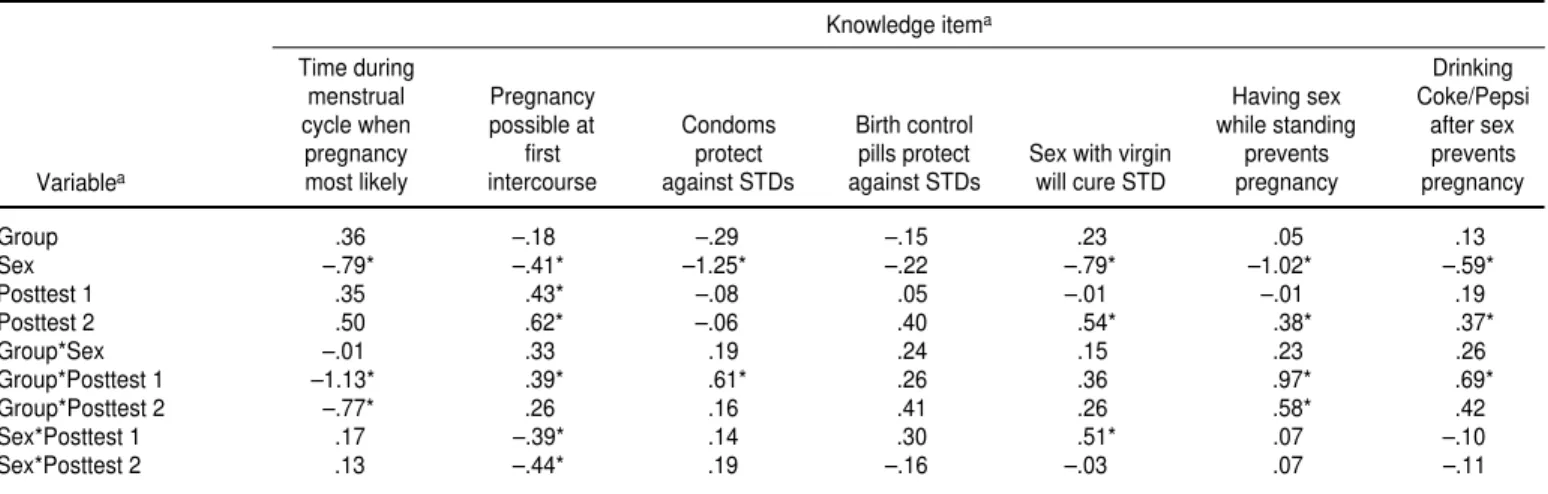
Multivariate analysis showed that the Grade 7 Project had a positive short-term effect on several knowl-edge items. At posttest 1, when the adolescents were finishing seventh grade, knowledge scores on four of seven items had increased signifi-cantly more among youth in the Grade 7 Project than among those in the com-parison group (as indicated by the positive coefficients for the variable “Group*Posttest 1” in Appendix Table A1). Knowledge on one item (time during menstrual cycle when preg-nancy is most likely) increased signifi-cantly more among the comparison group than the intervention group.
The project’s positive effects on knowledge were not sustained over time. At posttest 2, one year after the adolescents finished participating in the Grade 7 Project, there was little
TABLE 1. Baseline means and percentages for background characteristics of adolescents in intervention and comparison groups, Grade 7 Project evaluation, Jamaica, 1995–1997 (n= 945)a
Intervention Comparison
Characteristic (n= 426) (n= 519)
Mean age (years) 12.2* 12.1*
% male 50.7 46.1
% living with two parents 36.3 37.2
% attending church at least once per week 61.7 61.6
% ever used alcohol 38.0* 46.1*
% ever used marijuana 6.9 7.8
% reporting sexual experience 34.2 33.1
aThe “n” figures apply to total number of respondents in each group and may vary slightly for particular characteristics due to
item nonresponse.
evidence of differences in knowledge change between the two groups (as in-dicated by the nonsignificant coeffi-cients for “Group*Posttest 2” for most items in Table A1). While knowledge on one item (“having sex while stand-ing prevents pregnancy”) had in-creased significantly more among Grade 7 Project participants than among comparison group youth, knowledge levels increased more among the comparison group on an-other item (time during menstrual cycle when pregnancy most likely).
Attitudes
Sexual activity attitudes. On the sur-veys at all three points in time, most young adolescents disapproved of a person their age having sexual inter-course outside an established romantic relationship (Table 3). On the other hand, many felt that sex was required or expected in certain situations. One-third to one-half of all the students shared the opinion that “if you really love your boyfriend or girlfriend, you should have sex with him/her.” Many adolescents also thought that a girl should have sex with a boy who spent a lot of money on her.
Multivariate analyses indicated that the Grade 7 Project had a statistically
significant short-term influence on several attitudes about sexual activity. For three of four items (all except “it is okay for a boy to have sex with a girl who is not his steady girlfriend”), the attitudes of adolescents in the Grade 7 Project were likely to become more conservative by posttest 1, compared to comparison group adolescents (as indicated by the positive coefficients for the variable “Group*Posttest 1” in Appendix Table A2). However, by posttest 2, differences in attitudes about sex between the two groups were no longer evident.
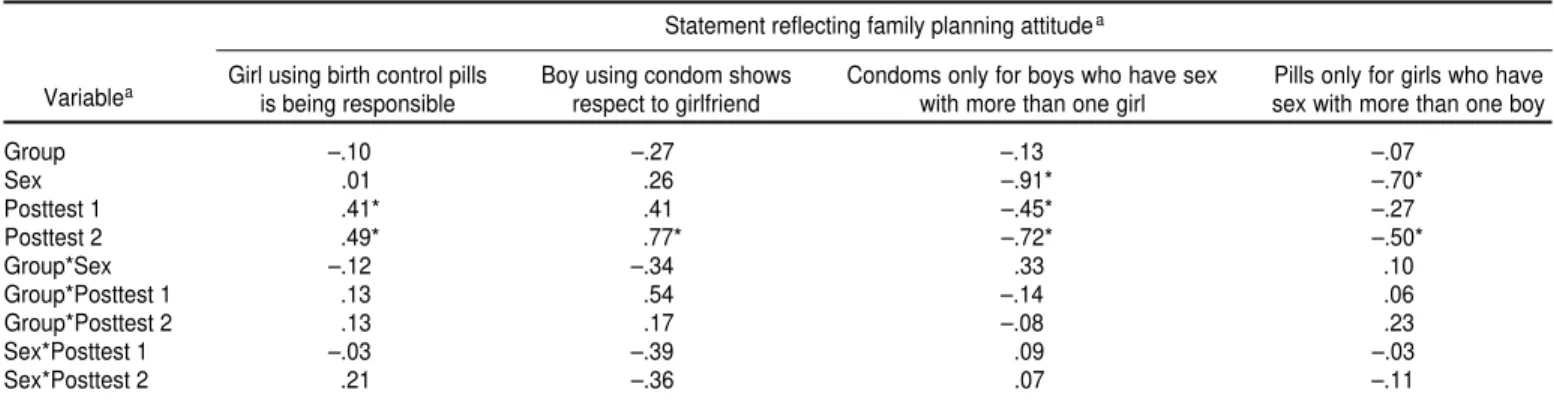
Family planning attitudes. A d o l e s-cents displayed mixed attitudes toward contraception and family planning (Table 3). A large majority agreed that using oral contraceptives is responsible behavior and that a boy who uses a condom is treating his girlfriend with respect. However, many adolescents also associated contraception with promiscuity, agreeing with statements that condoms and oral contraceptives are used only by boys and girls who have multiple sexual partners.
Multivariate analyses showed that the Grade 7 Project did not have a sig-nificant effect on attitudes about fam-ily planning, in either the short term or the long term (as indicated by the
non-significant coefficients for the vari-ables “Group*Posttest 1” and “Group* Posttest 2” in Appendix Table A3).
Parenthood attitudes. Most respon-dents expressed negative attitudes to-ward adolescent pregnancy and par-enthood (Table 3). At posttest 2 (the end of eighth grade), only 15%–17% agreed that a girl should have a baby as a teenager to prove her fertility. Similarly, few adolescents thought that a girl or boy their age was respon-sible enough to be a parent. As adoles-cents matured—and perhaps as teen pregnancy became more relevant to their lives—they became less likely to express positive attitudes about ado-lescent pregnancy.
The Grade 7 Project had a short-term influence on two of the three measures of attitudes toward adoles-cent parenthood. Multivariate analysis indicated that between baseline and posttest 1, adolescents in the Grade 7 Project were significantly less likely than those in the comparison group to adopt the views that a teenage girl should have a baby to prove her fertil-ity, or that a girl their age is responsi-ble enough to be a mother (as indi-cated by the negative coefficients for the variables “Group*Posttest 1” and “Group*Posttest 2” in Appendix Table
TABLE 2. Percentage of adolescents in intervention and comparison groups responding correctly to knowledge items, by timing of survey, Grade 7 Project evaluation, Jamaica, 1995–1997
Baseline Posttest 1 Posttest 2
Intervention Comparison Intervention Comparison Intervention Comparison Item (n= 426)a (n= 519) (n= 392) (n= 476) (n= 339) (n= 379)
Time during menstrual cycle when pregnancy most likely
to occur 8.0 5.6 4.1 8.0* 6.5 9.0*
Pregnancy is possible at first intercourse 29.9 30.0 44.4* 34.7 45.1 38.4
Condoms protect against STDs 63.3 65.8 75.5* 65.5 67.6 66.8
Birth control pills protect against STDs 15.2 15.6 22.1 18.2 27.2 20.1
Having sex with a virgin will cure an STD 25.4 19.8 38.0 23.3 41.7 29.2
Standing while having sex prevents pregnancy 24.0 20.9 45.2* 20.7 45.2* 27.7
Drinking Coke or Pepsi after having sex prevents pregnancy 22.4 18.1 39.6* 19.9 37.5 23.3
aThe “n” figures apply to total number of respondents in each group and may vary slightly for particular items due to item nonresponse.
A4). However, the Grade 7 Project had no long-term impact on any of the items reflecting parenthood attitudes.
Reproductive behavior
Sexual activity. About two-thirds of the adolescents in the baseline survey said that they were sexually
inexperi-enced. Among these respondents, 17.5% of the intervention group and 14.9% of the comparison group re-ported having sex for the first time between baseline and posttest 1. By posttest 2, among those sexually inex-perienced at baseline, 23.3% of the in-tervention group and 22.5% of the comparison group reported having ex-perienced sexual intercourse (Table 4).
Two multivariate logistic regression models were conducted to evaluate the impact of the Grade 7 Project on an adolescent’s odds of initiating sexual intercourse subsequent to the start of the Grade 7 Project, while controlling for sociodemographic characteristics and other factors associated with ado-lescent sexual activity. These models indicated that the project had no sig-nificant impact on young adolescents engaging in first sexual intercourse, in either the short term or the long term (Table 5).
Other variables, however, were pre-dictive of initiating sexual activity dur-ing the study period. Controlldur-ing for other factors, boys were 27 times more likely than girls to report having had sex between baseline and posttest 1. Boys were also 10 times more likely to say they had had sex in the long term (between baseline and posttest 2). Adolescents who had experimented
TABLE 3. Percentage of adolescents in intervention and comparison groups agreeing with statements reflecting attitudes about sexual activity, family planning, and parenthood, by timing of survey, Grade 7 Project evaluation, Jamaica, 1995–1997
Baseline Posttest 1 Posttest 2
Intervention Comparison Intervention Comparison Intervention Comparison Itema (n= 426)b (n= 519) (n= 392) (n= 476) (n= 339) (n= 379)
Sexual activity
It is okay for a girl to have sex with a boy who is not her
steady boyfriend 9.6 11.0 5.3* 10.2 10.3 9.2
It is okay for a boy to have sex with a girl who is not his
steady girlfriend 12.7 19.3 15.8 21.3 13.6 17.9
If you really love your boy-/girlfriend, you should have
sex with him/her 51.6 48.6 40.0* 45.3 42.2 37.6
If a boy spends a lot of money on a girl, she should have
sex with him 46.0 40.9 29.0* 35.7 31.9 26.6
Family planning
A girl who uses birth control pills is being responsible 65.0 66.7 75.3 75.4 79.1 79.7 A boy who uses a condom is showing respect to his
girlfriend 83.3 87.7 90.6 89.4 88.5 93.2
Condoms are only for boys who have sex with more than
one girl 63.4 61.5 50.6 51.4 45.4 45.5
Birth control pills are only for girls who have sex with more
than one boy 50.5 50.3 45.6 43.0 42.8 37.1
Parenthood
A girl should have a baby when she is a teenager to prove
she is fertile 38.3 30.1 18.6* 19.4 17.1 15.0
A girl my age is responsible enough to be a mother 17.4 13.9 7.4* 10.0 7.4 6.8
A boy my age is responsible enough to be a father 18.1 16.8 8.4 10.9 7.7 6.3
a“Disagree” is considered a favorable response for all of the attitude items except for the first two in the family planning group. bThe “n” figures apply to total number of respondents in each group and may vary for particular items due to item nonresponse.
* indicates where the attitude change was significantly more favorable in the intervention group than in the comparison group, at the P< 0.05 level. All indications of significance are based on the multivariate analyses presented in the Appendix.
TABLE 4. Among adolescents sexually inexperienced at baseline, percentages in interven-tion and comparison groups who initiated sexual activity and who used contracepinterven-tion at that first intercourse, by timing of survey, Grade 7 Project evaluation, Jamaica, 1995–1997
Posttest 1 Posttest 2
Item Intervention Comparison Intervention Comparison
Initiated sexual activity during study 17.5 14.9 23.3 22.5 (n= 252) (n= 322) (n= 219) (n= 258) Used contraception at that first sexual 45.5 29.2 39.2 36.2
with alcohol were 1.8 times more likely than others to say they had ex-perienced sexual intercourse in the short term, and 2.4 times more likely in the long term. In addition, adoles-cents who attended church weekly were 60% less likely to have engaged in first sexual intercourse between baseline and posttest 1 than those who attended church less frequently.
Use of contraception. Among ado-lescents who first experienced sexual
intercourse between baseline and posttest 1, 45.5% of the intervention group and 29.2% of the comparison group reported using a contraceptive method during first sexual inter-course. Among adolescents who first had sex between baseline and posttest 2, 39% of the intervention group and 36% of the comparison group reported using contraception (Table 4).
Multivariate logistic regression indi-cated that among adolescents who first experienced sexual intercourse in sev-enth grade (between baseline and
posttest 1), adolescents in the Grade 7 Project were more than twice as likely than those in the comparison group to use contraception (Table 6). This rela-tionship fell short of statistical signifi-cance at the .05 level, however, with a
Pvalue of 0.08. The Grade 7 Project did not have a significant impact on use of contraception at first intercourse over the long term (by posttest 2).
DISCUSSION
This study evaluated the impact of a sexuality education program, the Grade 7 Project, on young Jamaican adolescents’ initiation of sexual activ-ity and use of contraception at first in-tercourse, as well as the knowledge and attitudes that have an impact on these behaviors. We measured the ef-fects of the Grade 7 Project at the end of the intervention (short term) and one year post-intervention (long term).
We found that the Grade 7 Project had a positive short-term impact on use of contraception at first inter-course. Although this association fell short of statistical significance at the .05 level, it is worthy of mention given the small sample size of just 91 adoles-cents. The Grade 7 Project had no sta-tistically significant effect on the ado-lescents’ initiation of sexual activity. However, it had a positive short-term influence on several aspects of the adolescents’ knowledge. The project also influenced attitudes about sexual-ity and pregnancy, perhaps reflecting a higher level of respect and regard for girls.
The impact of the Grade 7 Project was not long lasting. At the end of eighth grade, one year after participat-ing in the project, there was no mea-surable difference in first-intercourse contraceptive use between adolescents in the Grade 7 Project and those in the comparison group. Nor did the short-term attitude changes or most of the other improvements persist after the end of seventh grade. These findings were not unexpected; it is unreason-able to expect a school-based interven-tion of limited durainterven-tion to have a long-term impact, given the competing
TABLE 5. Results of logistic regression analyses showing likelihood of adolescents report-ing experience of first sexual intercourse durreport-ing study period, Grade 7 Project evaluation, Jamaica, 1995–1997
Baseline – Posttest 1 Baseline – Posttest 2
(n= 567) (n= 472)
Variablea Odds ratio 95% CIb Odds ratio 95% CI
Sex 27.02* 14.29–50.00 10.20* 6.25–16.67
Group .85 0.48–1.51 .89 0.53–1.49
Age 1.01 0.63–1.61 1.18 0.78–1.78
Ever-use of alcohol 1.79* 1.02–3.14 2.42* 1.46–4.00
Household composition .84 0.47–1.50 1.18 0.70–2.00
Church attendance .39* 0.21–0.72 .89 0.50–1.58
aDependent variable coded 1 = experienced first sexual intercourse during study period, 0 = did not experience first intercourse
during study period. Sex coded 1 = boy, 0 = girl. Group coded 1 = intervention, 0 = comparison. Ever-use of alcohol coded 1 = yes, 0 = no. Household composition coded 1 = lives with mother and father, 0 = other. Church attendance coded 1 = at least once/week, 0 = less than once/week.
bCI = confidence interval.
* indicates statistical significance at the P< 0.05 level.
TABLE 6. Results of logistic regression analyses showing likelihood of adolescents using contraception during first sexual intercourse, among adolescents who reported experience of first intercourse during study period, Grade 7 Project evaluation, Jamaica, 1995–1997
Baseline – Posttest 1 Baseline – Posttest 2
(n= 91) (n= 108)
Variablea Odds ratio 95% CIb Odds ratio 95% CI
Sex 0.90 0.28–2.86 0.31* 0.12–0.81
Group 2.25 0.91–5.61 1.06 0.41–2.70
Age 0.86 0.46–1.61 1.27* 1.06–1.52
Partner 3+ years older NAc NAc 1.84 0.66–5.16
Ever-use of alcohol 0.78 0.32–1.90 1.62 0.64–4.08
Household composition 0.84 0.33–2.13 1.40 0.51–3.82
Church attendance 1.14 0.46–2.82 1.21 0.43–3.44
aContraceptive use coded 1 = yes, 0 = no. Sex coded 1 = boy, 0 = girl. Group coded 1 = intervention, 0 = comparison.
Part-ner 3+ years older and ever-use of alcohol coded 1 = yes, 0 = no. Household composition coded 1 = lives with mother and father, 0 = other. Church attendance coded 1 = at least once/ week, 0 = less than once/ week.
bCI = confidence interval.
cNA= not applicable; over half the responses were missing.
1. Kirby D, Short L, Collins J, Rugg D, Kolbe L, Howard M, et al. School-based programs to reduce sexual risk behaviors: a review of ef-fectiveness. Public Health Rep 1994;109(3): 339–360.
2. Frost J, Forrest JD. Understanding the impact of effective teenage pregnancy prevention pro-grams. Fam Plann Perspect 1995;27(5):188–195.
3. Franklin C, Grant D, Corcoran J, Miller PO, Bultman L. Effectiveness of prevention pro-grams for adolescent pregnancy. J Marriage Fam 1997;59(3):551–567.
4. Kirby D, Korpi M, Barth R, Cagampang HH. The impact of the postponing sexual involve-ment curriculum among youths in California. Fam Plann Perspect 1997;29(3):100–108.
5. Mitchell-DiCenso A, Thomas BH, Devlin MC, Goldsmith CH, Willan A, Singer J, et al. Eval-uation of an educational program to prevent adolescent pregnancy. Health Educ Behav 1997:24(3):300–312.
6. Friedman JS, McFarlane CP, Morris L. Jamaica reproductive health survey 1997, young adult report. Atlanta, Georgia: United States
De-REFERENCES
socioeconomic and cultural forces in Jamaica that encourage early sexual activity and parenthood among ado-lescents (16–18).
We were unable to evaluate the im-pact of the Grade 7 Project on sexual activity other than first sexual inter-course. Due to the method of question-naire administration, asking more questions requiring responses from only sexually experienced adolescents would have made it obvious to all stu-dents in the room who was sexually experienced and who was not. There-fore, we were unable to collect infor-mation about sexual experiences sub-sequent to first sexual intercourse and determine if the Grade 7 Project had an impact on, for instance, most recent sexual intercourse.
Modifications might enable the Grade 7 Project to strengthen and per-haps sustain its impact. The project’s educator-counselors used largely di-dactic teaching methods; using more participatory teaching methods might result in a greater influence on partici-pants. Previous research has demon-strated that students remember more from activities that require their active participation than from those which simply require them to listen (1, 19). Smaller class sizes might also enhance the project’s impact and could facilitate the use of participatory teaching meth-ods. Since resources in Jamaica, as in other developing countries, are ex-tremely limited, holding sessions less frequently than once per week would allow for smaller class sizes without expanding the program’s budget.
The prevalence of sexual experience among 12-year-old boys in this study (64%) was the same as that reported by
older adolescent males (those 15–17 years old) in the 1997 Jamaica Repro-ductive Health Survey (RHS) (6). It is difficult to validate the accuracy of self-reports of sexual behavior, and previous research indicates that some adolescents report sexual behavior in-consistently (20–22). It is possible that some boys in this study exaggerated the extent of their sexual experience, while girls may have underreported sexual activity. Considerable care was taken to assure study participants of the confidentiality of their responses. Nevertheless, given the sensitive na-ture of the questions and the sociocul-tural context of adolescent sexuality in Jamaica, some adolescents may not have reported their sexual behavior truthfully. Focus groups with some study participants revealed that boys perceive strong social encouragement and pressure to be sexually active, while girls who have sex are labeled as having poor moral character (16).
However, we cannot assume either that adolescents in this study reported their sexual experience inaccurately. Early sexual activity among males is not uncommon in Jamaica. In the RHS, 52% of males and 12% of females reported experiencing first inter-course before the age of 14 (6). In ad-dition, because the participants in our study were considered at high risk of early sexual activity based on their low socioeconomic class and poor aca-demic achievement, it is not surpris-ing that a high proportion of the boys reported being sexually active at a young age.
There were dramatic differences be-tween boys’ and girls’ odds of initiat-ing sexual activity and usinitiat-ing
contra-ception. These results suggest that boys and girls may have very different sexuality education needs and should be the focus of gender-specific inter-ventions. Our findings also suggest that interventions focused on encour-aging abstinence may be ineffective among low-income adolescent males in Jamaica. In addition, the high pro-portion (64%) of boys in this study who reported baseline sexual experi-ence suggests that sexuality education should be introduced well before young Jamaicans enter their adoles-cent years. Further research is needed to explore the development of gender norms among Jamaican adolescents and their effects on sexual attitudes and behavior.
partment of Health and Human Services, Cen-ters for Disease Control and Prevention; 1999. 7. Tomlinson M. Situation analysis on family life education in Jamaica and a statement of na-tional family life education policy. Kingston, Jamaica: Marlene Tomlinson and Associates; 1994.
8. United Nations Children’s Fund. A strategy for strengthening health and family life edu-cation in CARICOM member states. Kingston, Jamaica: UNICEF; 1995.
9. McFarlane CP, Friedman JS, Goldberg HI, Morris L. Jamaica reproductive health survey 1997, final report. Atlanta, Georgia: United States Department of Health and Human Ser-vices, Centers for Disease Control and Pre-vention; 1999.
10. Ansine J. Contraceptives for kids U-16? Gov-ernment wants to bypass parental consent. The Jamaica Sunday Gleaner 1998 20 September. 11. Hardee K. Reproductive health case study:
Ja-maica [POLICY Project working paper]. Washington, D.C.: Futures Group Interna-tional; 1998.
12. Jamaica, Ministry of Education, Youth and Culture. A statement of national policy for family life education in Jamaica. Kingston: Government of Jamaica; 1995.
13. Barnett B, Eggleston E, Jackson J, Hardee K. Case study of the Women’s Center of Jamaica Foundation program for adolescent mothers. Research Triangle Park, North Carolina, United States of America: Family Health In-ternational; 1996.
14. McNeil P, Olafson F, Powell DL, Jackson J. The Women’s Centre in Jamaica: an innova-tive project for adolescent mothers. Stud Fam-ily Plann 1983;13(5):143–149.
15. Jamaica, Ministry of Education. Education statistics 1993. Kingston: Government of Ja-maica; 1993.
16. Eggleston E, Jackson J, Hardee K. Sexual atti-tudes and behavior among young adolescents in Jamaica. Int Fam Plann Perspect 1999;25(2): 78–84.
17. Brody EB. Sex, contraception, and mother-hood in Jamaica. Cambridge, Massachusetts: Harvard University Press; 1981.
18. Blake J. Family structure in Jamaica: the social context of reproduction. New York: Free Press of Glencoe, Inc.; 1971.
19. Wilson D, Mparadzi A, Lavelle S. An experi-mental comparison of two AIDS prevention interventions among young Zimbabweans. J Social Psych 1992;132(3):415–417.
20. Lauritsen JL, Swicegood CG. The consistency of self-reported initiation of sexual activity, Fam Plann Perspect 1997;9(5):215–221. 21. Kahn JR, Kalsbeek WD, Hofferth SL. National
estimates of teenage sexual activity: evaluat-ing the comparability of three national sur-veys. Demog 1988;25(2):189–204.
22. Rodgers JL, Billy JOG, Udry JR. The rescission of behaviors: inconsistent responses in adoles-cent sexuality data. Soc Sci Res 1982;11:280–296.
Manuscript received on 28 April 1999. Revised version accepted for publication on 14 October 1999.
APPENDIX
TABLE A1. Coefficients from logistic regression analyses showing likelihood of adolescents correctly answering selected knowledge items, Grade 7 Project evaluation, Jamaica, 1995–1997
Knowledge itema
Variablea
Group .36 –.18 –.29 –.15 .23 .05 .13
Sex –.79* –.41* –1.25* –.22 –.79* –1.02* –.59*
Posttest 1 .35 .43* –.08 .05 –.01 –.01 .19
Posttest 2 .50 .62* –.06 .40 .54* .38* .37*
Group*Sex –.01 .33 .19 .24 .15 .23 .26
Group*Posttest 1 –1.13* .39* .61* .26 .36 .97* .69*
Group*Posttest 2 –.77* .26 .16 .41 .26 .58* .42
Sex*Posttest 1 .17 –.39* .14 .30 .51* .07 –.10
Sex*Posttest 2 .13 –.44* .19 –.16 –.03 .07 –.11
aKnowledge items were coded 0 = incorrect or don’t know. Group was coded 1 = Grade 7 Project, 0 = comparison group. Sex was coded 1 = girl, 0 = boy.
* indicates coefficients that were significant at the P< 0.05 level.
Time during menstrual cycle when pregnancy most likely
Pregnancy possible at
first intercourse
Condoms protect against STDs
Birth control pills protect against STDs
Sex with virgin will cure STD
Having sex while standing
prevents pregnancy
Drinking Coke/Pepsi
TABLE A4. Coefficients from logistic regression analyses showing likelihood of adolescents agreeing with state-ments reflecting parenthood attitudes, Grade 7 Project evaluation, Jamaica, 1995–1997
Statement reflecting parenthood attitudea
Variablea
Group .15 .29 .01
Sex –.76* –1.07* –1.25*
Posttest 1 –.60* –.37 –.58*
Posttest 2 –.86* –.84* –1.15*
Group*Sex .44* –.06 .19
Group*Posttest 1 –.44* –.69 –.43
Group*Posttest 2 –.21 –.25 .09
Sex*Posttest 1 .04 –.01* .22
Sex*Posttest 2 –.13 .11 .11
aParenthood attitude items were coded 1 = agree, 0 = disagree. Group was coded 1 = Grade 7 Project, 0 = comparison group. Sex was coded 1 = girl, 0 = boy.
* indicates coefficients that were significant at the P< 0.05 level.
TABLE A3. Coefficients from logistic regression analyses showing likelihood of adolescents agreeing with statements reflecting family planning attitudes, Grade 7 Project evaluation, Jamaica, 1995–1997
Statement reflecting family planning attitudea
Variablea
Group –.10 –.27 –.13 –.07
Sex .01 .26 –.91* –.70*
Posttest 1 .41* .41 –.45* –.27
Posttest 2 .49* .77* –.72* –.50*
Group*Sex –.12 –.34 .33 .10
Group*Posttest 1 .13 .54 –.14 .06
Group*Posttest 2 .13 .17 –.08 .23
Sex*Posttest 1 –.03 –.39 .09 –.03
Sex*Posttest 2 .21 –.36 .07 –.11
aFamily planning attitude items were coded 1 = agree, 0 = disagree. Group was coded 1 = Grade 7 Project, 0 = comparison group. Sex was coded 1 = girl, 0 = boy.
* indicates coefficients that were significant at the P< 0.05 level.
Girl using birth control pills is being responsible
Boy using condom shows respect to girlfriend
Condoms only for boys who have sex with more than one girl
Pills only for girls who have sex with more than one boy
Girl should have baby as teen to prove fertility
Girl my age responsible enough to be mother
Boy my age responsible enough to be father TABLE A2. Coefficients from logistic regression analyses showing likelihood of adoles-cents agreeing with statements reflecting attitudes about sexual activity, Grade 7 Project evaluation, Jamaica, 1995–1997
Statement reflecting sexual activity attitudea
Variablea
Group –.07 –.72* .01 .05
Sex –1.55* –2.17* –1.65* –1.27*
Posttest 1 .06 .31 .01 –.02
Posttest 2 –.15 .06 –.57* –.50*
Group*Sex –.78 .42 .15 .26
Group*Posttest 1 –.72* .05 –.47* –.61*
Group*Posttest 2 .24 .15 .05 .07
Sex*Posttest 1 –.44 –.47 –.21 –.35
Sex*Posttest 2 –.11 –.73 .13 –.51*
aSexual attitude items were coded 1 = agree, 0 = disagree. Group was coded 1 = Grade 7 Project, 0 = comparison group. Sex
was coded 1 = girl, 0 = boy.
* indicates coefficients that were significant at the P< 0.05 level.
Okay for girl to have sex with boy who is not steady boyfriend
Okay for boy to have sex with girl who is
not steady girlfriend
If you really love boyfriend/girlfriend,
should have sex with him/her
If boy spends money on girl, she should
Pese a su número creciente, son pocos los programas de educación sexual y prevención del embarazo que han sido evaluados en los países en desarrollo. Este estudio, realizado entre 1995 y 1997, evalúa en 945 escolares jamaiquinos de 7ogrado (11 a 14 años de edad)
el impacto de un programa escolar de educación sexual, el denominado “Proyecto de 7o
grado”, sobre la iniciación de su actividad sexual, el empleo de anticonceptivos durante el primer coito y los conocimientos y actitudes que influyen en sus comportamientos. Utilizando un diseño casi experimental, el estudio midió los efectos del proyecto al final de los nueve meses de intervención (corto plazo) y un año más tarde (largo plazo). El análisis de regresión logística multivariado reveló que el proyecto no tuvo efectos sobre la edad de inicio de la actividad sexual, aunque sí tuvo un impacto positivo a corto plazo sobre el empleo de anticonceptivos en el primer coito (P= 0,08); la probabilidad de uti-lizar anticonceptivos fue dos veces mayor en los adolescentes del grupo sometido a la intervención educativa. El proyecto también tuvo una influencia positiva a corto plazo sobre varios aspectos de los conocimientos y actitudes de los adolescentes hacia la se-xualidad y el embarazo. El moderado impacto del proyecto es alentador, dado que los programas escolares de educación sexual de duración limitada raramente tienen im-pacto a largo plazo y que, además, en Jamaica existen fuerzas socioeconómicas y cultu-rales antagónicas que alientan la sexualidad temprana y la paternidad entre los adoles-centes. El empleo de métodos educativos más participatorios y la reducción del número de alumnos por clase podría fortalecer el “Proyecto de 7ogrado” y aumentar su impacto. RESUMEN