Electronic Structure and Aspects of Unconventional
Superconductivity in Na
x
CoO
2
.
yH
2
O
H. Rosner,
Max-Planck-Institut f¨ur Chemische Physik Fester Stoffe, Dresden, Germany
S.-L. Drechsler, G. Fuchs, A. Handstein, A. W¨alte, and K.-H. M¨uller
Leibniz-Institut f¨ur Festk¨orper- und Werkstoffforschung Dresden (IFW Dresden), P.O. Box 270116, D-01171 Dresden, Germany
Received on 23 May, 2003.
We examine the electronic structure of NaxCoO2.yH2O within the local density approximation. The
parametrization of the band which forms the largest hole-Fermi surface centered atΓshows significant devia-tions from what is frequently assumed in recent sophisticated theoretical studies. In particular, the commonly used nearest neighbor approaches in the framework of single band pictures are found to be unrealistic. The special role of H2O in screening the disorder in the charge reservoir is briefly discussed and compared with the case of Y1−xCaxCu3O6+δ.
1
Introduction
The recent reports on unexpected superconductivity in Na0.35CoO2.1.3 H2O [1] below 5 K and also on magnetic anomalies in closely related Na(K)xCoO2+δ(see Ref. 2) be-low 31 K have strongly renewed the interest in layered tran-sition metal oxides. In particular, at present the symmetry of the order parameter and the relationship to cuprates and/or ruthenates are debated controversially. [3] Our paper is or-ganized as follows. The electronic structure calculated in the LDA (local density approximation) is presented in Sec. II. Furthermore consequences for the superconductivity and current theoretical scenarios are briefly discussed. In par-ticular, we propose also a novel solution of the water puz-zle in terms of sreening the disorder in the charge reservoir. In Sec. III susceptibility and structural data for nonhydrated samples are reported.
2
The LDA electronic structure and
current theoretical models
In order to provide a first insight into the involved orbitals and to make a reasonable starting point for more sophisti-cated but still realistic models, we have performed full po-tential bandstructure calculations within the FPLO code [4] for Na0.35CoO2.1.3 H2O and hypothetical Na0.35CoO2with lattice constants of the reference system Na0.74CoO2. The virtual crystal method has been used to model the partially occupied Na sites [5, 6]. To warrant a sufficient complete-ness of the basis set, the H2O sites have been modeled by empty spheres.
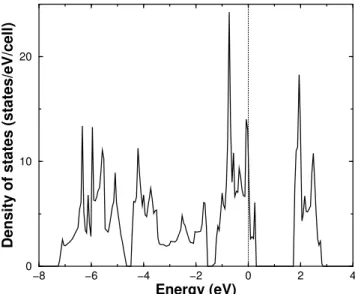
Let us start the discussion of our results with the den-sity of states (DOS) near the Fermi energy (see Fig. 1). Two narrow band complexes with predominant Co 3dcharacter occur: one fromeg-derived states roughly above 2 eV above
Ef and a t2g-derived one. The strongest peaks near 2 eV and -1 eV are remnants from 2D Van Hove singularities. The sizable gap between them justifies a low spin approach for the formal Co sites whose charge is formally+3.65e
.
−8 −6 −4 −2 0 2 4
Energy (eV)
0 10 20
Density of states (states/eV/cell)
Figure 1. Electronic density of states of Na0.35CoO2.1.3 H2O. The
Fermi energy is at zero energy.
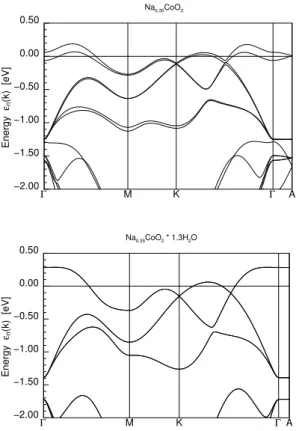
c-direction from 11 ˚A to 19.6 ˚A due to the presence of H2O molecules strongly enhances the two-dimensional (2D) character of the electronic structure (see Figs. 2a,b).
Γ M K Γ A
Na0.35CoO2
−2.00 −1.50 −1.00 −0.50 0.00 0.50
Energy
εn
(k) [eV]
Γ M K ΓA
Na0.35CoO2 * 1.3H2O
−2.00 −1.50 −1.00 −0.50 0.00 0.50
Energy
εn
(k) [eV]
Figure 2. Band structure of (non)hydrous NaxCoO2, upper and
lower panel, resp. The symmetry points read as: Γ=(0,0,0); M=2π
a
³ 1
√
3,0,0 ´
; K=2π a
³ 1
√
3, 1 3,0
´
; and A=2π
c (0,0,1).
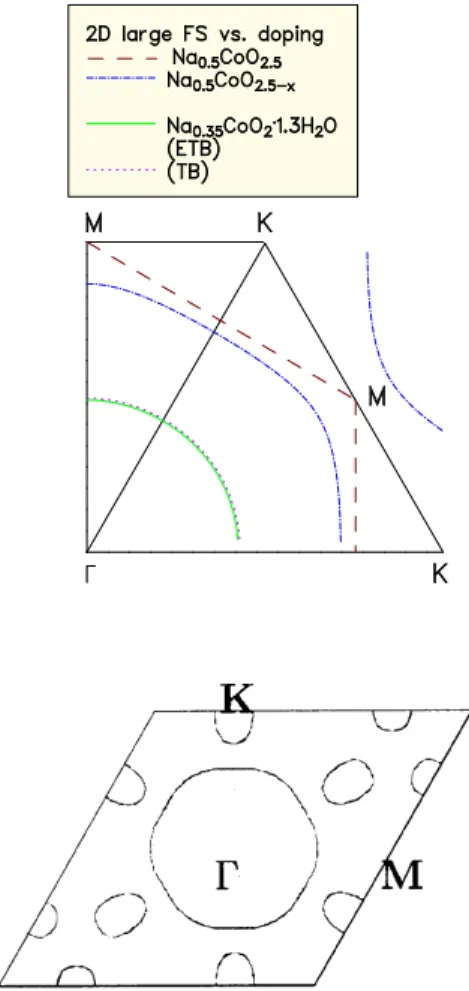
The tiny dispersion along c4tz ∼ 2 meV causes a huge anisotropy of Fermi velocitiesγv = vab/vc ≈ 2t1a/tzc ≈ 115. In the Ginzburg-Landau anisotropic mass approxi-mation one would arrive at a huge in-plane/out-of-plane anisotropy for the upper critical fields Hc2 of γH ≈81. However, for such extreme anisotropies the latter is usually governed by the intrinsic Josephson-coupling between adja-cent layers. The hole Fermi surface (FS) consists of a large sheet centered atΓwith a rounded hexagon-like cross sec-tion and six small ovoids centered betweenΓand K like in Na0.5CoO2. In our title compound there are also somewhat flattened parts on the large FS. This nesting-like behaviour stems from the interaction of thet2gderived bands and not from the vicinity of a 2D Van Hove singularity which occurs about 1 eV belowEF near the M-point. We have analyzed the bands shown in Fig. 2 within an extended tight-binding (ETB) band including at least also 2nd and 3rd neighbor
transfers:
E(k) = −2tzcosz+
µ−2 3
X
n=1
t2n−1(cos 2ny+ 2 cosnxcosny) +
−2 1
X
n=0
2t4n+2(cos 2(n+ 1)x+
2 cos(n+ 1)xcos√3y) +..., (1)
wherex=√3kxa/2,y=kya/2. z=kzc/2. The result is depicted in Tab. I and Fig. 3,4.
Figure 3. Single band fits for thea1gband shown in Fig. 2. In the
ETB fit 2nd and 3rd neighbors were taken into account while in
the simple TB appproximations only either the total band width or thevF/shape of FS (see Fig. 3,4) are properly described. Full line:
ETB, dashed line: TB description.
Table I. LDA parameters in meV of Na0.35CoO2.1.3H2O within tight binding (TB)and extended TB (ETB) pictures including 2ndand 3rdneighbor contributions and derived afm Heisenberg exchange integrals compared with literature data.
Reference t1 t2 t3 µ tz J1,af m J2,af m J3,af m
ETB -202 35 29 -545 0.5 40-20 1.2-0.6 0.8-0.4
TB -168 – – -340 0.5 28-14 – –
Wang -250 – – 0 – –
Kumar +19.4 – – 0 6.5 – –
Baskaran -100 – – 0 7 – –
Figure 4. Theoretical Fermi surfaces. Full line: ETB, dashed line: TB description. The dashed-dotted line corresponds to a strongly hole doped case or to the caset1 >0notrealized in NaxCoO2.
Lower panel: The LDA Fermi surface of the paramagnetic solu-tion.
Another important issue is the magnitude and the sign of the n.n. exchange integralJ1:
J1=J1,af m−J1,f m, whereJ1,af m= 4t21/U, (2)
With U=4 to 8 eV one arrives at J1,af m=40 to 20 meV. Where the first (second) value corresponds to CoO2 re-garded as a charge transfer(Mott-Hubbard) insulator, respec-tively. Even if the ferromagnetic (fm)J1,f m is ignored, a
large ratio|t1|/J1,af m= 5 to 10 for the remaining antifer-romagnetic (afm) part results, again in contrast with signif-icantly smaller values of 1 to 3 adopted and studied in the literature. More importantly, the very existence of a con-siderable afm exchange on the frustrated triangular Co lat-tice which is of crucial importance for the proposed sophis-ticated resonance valent bond (RVB)-type scenarios [7, 8] is unclear. Since our LSDA calculations [6] yield a fm ground state with an energy gain 160 meV and a magnetic moment of 0.66µB/Co, sizeable direct fm contributions to
J1 are expected. The experimental lack of a ferromagneti-cally ordered state predicted by the LSDA solution might be attributed to its mean-field character where non-negligible fluctuations important especially for low-dimensional sys-tems are ignored. However, the energy difference to an antiferromagnetic state is relatively small, a more sophis-ticated account of correlation and fluctuation effects beyond the LSDA maybe crucial for the title compound being near the border line of two different magnetic ground states. Sim-ilarly the symmetry of the superconducting order parameter will be strongly affected by the final choice. In addition, the inspection of the Co-O-Co bond angles≈90◦suggests
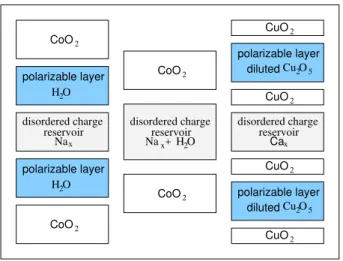
fm or strongly suppressed afm interactions. In the case of tripletp- orf-wave superconductivity which is likely to oc-cur, the remaining intrinsic disorder deserves closer consid-erations. In this context the sensitive effect of crystal water or of O excess ions, respectively, might be considered in terms of their high polarizibility, i.e. screening, and larger distances between Na and CoO2layers and this way weak-ening the detrimental effect of disorder from randomly lo-cated 2xNa+
-ions at the two Na sites per unit cell.
H O2
CoO2
CoO2
H O2
polarizable layer
CoO2
CoO2
H O2
2 5
Cu O
polarizable layer diluted
2
CuO
2
CuO
2
CuO
2 5
Cu O
polarizable layer diluted
2
CuO
disordered charge reservoir
Nax+
disordered charge reservoir
Nax
polarizable layer
disordered charge reservoir
x
Ca
Superconduct. Nonsupercond. Superconduct.
Figure 5. Schematical structure of Na0.351.3H2OCoO2(left panel)
and Y1−xCaxBa2Cu3O6+δ(right panel), two metallic compounds
with superconductivity induced by the screening of the detrimen-tal intrinsic disorder in their charge reservoirs by adding polariz-able molecules (radicals) outside their conduction layers. The non-superconducting compound Na0.350.6H2OCoO2 (middle panel)
with almost identical electronic structure of the CoO2 layers but unfavorable positions and a less amount of the polarizable H2O molecules ( now located at noneffective sites inside the charge reservoir).
Ca occupation within the Y1−xCaxcharge resevoir within the cuprate bilayer. In this context the lack of superconduc-tivity in Na0.35CoO2.0.6H2O [10] with only half as much water content at different position (within the Na-layer) and distance between the CoO2and the Na layers (3.45 ˚A) com-pared with the hydrous superconducting compound (4.9 ˚A) is of interest. It corresponds to the nonsuperconducting cuprate counterpart with δ = 0 in spite of the sufficient concentration of doped holes in the CuO2 planes. Alter-natively, the improved screening might also weaken or sup-press a charge ordered ground state as proposed recently by G. Baskaran[11]. The charge ordered state is expected to compete with superconductivity. However, the specific tri-angular CoO2 block structure causes considerable frustra-tion effects not only for an afm ordering which is at the heart of the afm RVB models discused above but also for any charge ordering.
3
Magnetic susceptibility
measure-ments
Finally, preliminary sample processing adopted from Ref. 2 yield X-ray patterns similar to Na0.74CoO2(see Fig. 6).
Preliminary magnetic susceptibility measurements showed so far no clear hints for superconductivity in the nonhydrous compound but point rather to a magnetic tran-sition near 22 K (see Fig. 7). Anyhow, at present it cannot be fully excluded, although it is rather unlikely, that the few superconducting samples of Ref. 2 are related to hole doped superconductivity like in Na(K)2δ−0.5CoO2+δ near 1/4-filling (count in electrons).
Figure 6. X-ray diffraction pattern of the sample whose magnetic susceptibility is shown in Fig. 7.
Figure 7. Real (full line) and imaginary (broken line) parts of the magnetic susceptibility (smoothened) of water free NaxCoO2
pre-pared as described in Ref. 2.
Anyhow, the study of hole doped cobaltates would be of great interest even in the case of lacking superconductivity.
4
Conclusion
To summarize, the parameters of most of the recently pro-posed single band tight binding approximations entering Hubbard ort-J-models are in some conflict with the multi-band nature predicted by the LDA. A solution of the water puzzle, the screening of the disorder detrimental forp-wave superconductivity, has been proposed.
Acknowledgments
References
[1] K. Takada et al. Nature422, 63 (2003).
[2] H.-H. Wen,et al., Chin. Phys. Lett.20, 725 (2003), v. 4 cond-mat/0304377. Due to the low reproducibility (only 3 uniden-tified samples from 100 exhibited superconductivity) this pa-per has been withdrawn by the authors.
[3] The work devoted to this topic is still given by a fastly grow-ing number of preprints on the cond-mat archive.
[4] K. Koepernik and H. Eschrig, Phys. Rev B59,1743 (1999).
[5] D. Singh, Phys. Rev. B61, 13397 (2000).
[6] D. Singh, cond-mat/0304532.
[7] G. Baskaran, preprint, cond-mat/0303649.
[8] B. Kumar and S. Shastry, preprint, cond-mat/0304210.
[9] M. Merzet al., Phys. Rev. Lett.80, 5192 (1998). The authors attribute the superconductivity in the samples withδ∼0.05
to an active role of the apical oxygen ions in the pairing. How-ever, due to the small amount of relevant ionic Cu2O5 birad-icals (see also Fig. 5) such an active scenario seems to us rather unlikely and we prefer the indirect effect by screening the intrinsic disorder as proposed above as a more realistic one.
[10] M.L. Fooet al., cond-mat/0304464.
[11] G. Baskaran, cond-mat/0306569, Physica C in press.
Note added in proof
Three recent ARPES measurements performed for an-hydrous NaxCoO2 samples withx = 0.5,0.6, and 0.7 (T. Valla et al., Nature 417, 627 (2002); H.-B. Yang et al., cond-mat/0310532 and references therein) confirm the neg-ative sign value of the main transfer integralt1predicted by the LDA calculations but at the same time show that it is strongly reduced in its absolute value pointing to a strong renormalization. Since a similar large mass renormalization has been suggested by a large electronic specific heat coeffi-cient, strong ferromagnetic spin fluctuations (paramagnons) are a likely candidate as proposed above. Antiferromagnetic spin fluctuations and other correlation effects are expected to cause weaker renormalization effects, especially for the specific heat.
Unfortunately, to the best of our knowledge, there are no data available in the lower doping range x ∼ 0.3 to 0.4 which is of interest for the superconductivity where an-tiferromagnetic fluctuations might be enhanced. Quite re-markably, for the three dimensional-s-wave superconductor MgCNi3(which is also more or less close to a ferromagnetic instability) some similarities with the cobaltates under con-sideration with respect to the normal state electronic specific heat have been observed (W¨alte et al., cond-mat/0208364 and further work to be published).