A
rti
g
o
*e-mail: [email protected]
ENZYME LOADING DEPENDENCE OF CELLULOSE HYDROLYSIS OF SUGARCANE BAGASSE
Carlos Martín
Department of Chemistry and Chemical Engineering, University of Matanzas, Matanzas 44740, Cuba / vTI-Institute for Wood Technology and Wood Biology, Hamburg 21031, Germany
George Jackson de Moraes Rocha
Laboratório Nacional de Ciência e Tecnologia do Bioetanol, CP 6192, 13083-970 Campinas – SP, Brasil Julliana Ribeiro Alves dos Santos, Maria Carolina de Albuquerque Wanderley e Ester Ribeiro Gouveia*
Departamento de Antibióticos, Universidade Federal de Pernambuco, Cidade Universitária, 50670-901 Recife – PE, Brasil
Recebido em 10/1/12; aceito em 2/7/12; publicado na web em 25/9/12
The enzymatic hydrolysis of steam-pretreated sugarcane bagasse, either delignified or non-delignified, was studied as a function of enzyme loading. Hydrolysis experiments were carried out using five enzyme loadings (2.5 to 20 FPU/g cellulose) and the concentration of solids was 2% for both materials. Alkaline delignification improved cellulose hydrolysis by increasing surface area. For both materials, glucose concentrations increased with enzyme loading. On the other hand, enzyme loadings higher than 15 FPU/g did not result in any increase in the initial rate, since the excess of enzyme adsorbed onto the substrate restricted the diffusion process through the structure.
Keywords: sugarcane bagasse; enzymatic hydrolysis; delignification.
INTRODUCTION
Lignocellulosic bioresources, such as sugarcane bagasse, are the most abundant complex organic materials available on Earth. They constitute the bulk of plant biomass and consist of three main com-ponents: cellulose, lignin and hemicelluloses,1,2 which are associated
with each other.3 Currently, there is growing interest in the use of
lignocellulosic bioresources, including agro-industrial residues, such as sugarcane bagasse, in a range of different processes. Electricity generation, pulp and paper production, as well as fermentative proces-ses for obtaining ethanol and enzymes are among the most promising industrial uses for sugarcane bagasse.4
The production of ethanol from bagasse requires the hydrolysis of the polysaccharide cellulose and hemicelluloses. The hydrolysis can be catalysed by either acids5 or cellulolytic enzymes.6,7 Great interest
is currently focused on enzymatic hydrolysis because it produces bet-ter sugar yields and less degradation products than acid hydrolysis. Enzymatic saccharification of cellulose is generally described as a heterogeneous reaction system, in which cellulases in an aqueous environment react with the insoluble, macroscopic and structured cellulose, containing highly ordered and less ordered regions.8
Prior to hydrolysis, a pre-treatment should be applied to ligno-cellulosic materials in order to enhance enzyme access to cellulose macromolecules.9 Among the different pre-treatment methods under
investigation, steam explosion is one of the most promising.10 This
process causes hemicellulose solubilisation, lignin transformation due to high temperature, and improves the susceptibility of cellulose to enzymatic hydrolysis. On the other hand, dilute NaOH treatment of lignocellulosic materials causes swelling, leading to an increase in internal surface area, a decrease in the degree of polymerization and crystallinity, separation of structural linkages between lignin and carbohydrates, and to disruption of the lignin structure.11
Increase in cellulase loading, to a certain extent, can enhance the yield and rate of hydrolysis, but would significantly increase the cost of the process. Cellulase loading in hydrolysis can vary over a wide
range, depending on the type and concentration of substrates, and on the protocol used. Increasing the substrate concentration normally results in an increase in hydrolysis yield and reaction rate. However, high substrate concentration can cause substrate inhibition.12
In this work, the enzymatic hydrolysis of steam-exploded sug-arcane bagasse, either delignified or non-delignified, was performed using five enzyme loadings (2.5; 5; 10; 15 and 20 FPU/g cellulose), while the concentration of solids was kept at 2% for both mate rials. The aim of this study was to gain a better understanding of the de-pendence of hydrolysis upon enzyme loading.
EXPERIMENTAL
Pretreatment
Pretreatment processes were carried out at sugarcane mills and etha-nol distilleries in the Vale do Rosário, Morro Agudo, São Paulo state, Brazil, as follows: in each pretreatment experiment, around 1000 kg of dry bagasse was loaded into a 5000-L stainless steel reactor (Caldema Equipamentos Industriais, Sertãozinho, São Paulo state, Brazil). The reactor was hermetically sealed and steam was injected up to a pressure of approximately 1.53 MPa (equivalent to 200 ºC was achieved). After 7 min of pressurization, the reactor was suddenly depressurised by an operator standing at a safe distance, and the steam-exploded slurry was discharged into an 8000-L cyclone, and then collected in a cylindrical container. By centrifugation of the slurry at 1100 rpm or 542.1 g for 10 min in a 100-L semi-industrial centrifuge (Grisanti Máquinas industriais Ltda, Ribeirão Pires, São Paulo state, Brazil), the solid fraction, here-after referred to as cellulignin, was separated from the liquid fraction, hereafter referred to as hemicellulosic hydrolysate. The cellulignin was thoroughly washed by resuspending it in a previously determined volume of water at 542.1 g for 10 min until the yellow colour of the effluent was totally removed.
Delignification and characterization
Martín et al.
1928 Quim. Nova
(w/V) NaOH at 100 °C for 1 h. The steam-exploded sugarcane bagasse
contained 49.9% cellulose, 8.0% hemicellulose and 34.0% lignin.13
The content of polysaccharides and lignin in the raw, pretreated and delignified materials was determined by two-step analytical acid hydrolysis, according to the analytical procedure recommended by Rocha et al.14 and validated for sugarcane bagasse by Gouveia et al.13
Polysaccharide content was calculated after the chromatographic quantification of sugars in the hydrolysates, and lignin was determined as the hydrolysis residue.
Scanning electron microscopy (SEM) images were acquired with a JEOL JSM-5900LV instrument operated with 15 kV accelerat-ing voltage, a 16 cm workaccelerat-ing distance and detection of secondary electrons. Sample preparation was done by particulate sticking on the sample holder followed by sputtering of a conductive gold layer.
Specific surface areas (in units of m2/g) were determined by
ap-plication of the Brunauer, Emmet, and Teller (BET) adsorption model with the relative pressure P/P0 within the range 0.05 < P/P0 < 0.2.
15
Enzymes
A commercial preparation of cellulases (Celluclast 1.5 L) was used. The enzyme activities of Celluclast (42.4 FPU/mL and 21.1 CBU/mL) were determined according to the method described by Ghose.16
Enzymatic hydrolysis
The pretreated solids were mixed with 0.05 M sodium citrate buffer (pH 4.8) resulting in a concentration of 2% (w/V). Enzyme loadings of 2.5, 5.0, 10.0, 15.0 and 20.0 FPU/g cellulose were used. The reaction mixtures were incubated at 50 oC and 150 rpm for 10
h. For monitoring of the hydrolysis reaction, 1-mL samples were taken at regular intervals. The samples were deactivated by increasing the temperature to 76 oC for 15 min and filtering through a 0.45 µm
membrane before HPLC analysis. All the experiments were carried out in duplicate.
Chromatographic analysis
Glucose and cellobiose were quantified by HPLC (Agilent HP 1100, Germany) on an Aminex HPX-87H+ (Bio-Rad, Hercules, CA,
USA) column at 50 oC, using 5 mM H
2SO4 at a flow rate of 0.6 mL/
min as mobile phase, and detected with an RI-detector (Agilent). All samples were filtered and diluted prior to analysis.
RESULTS AND DISCUSSION
The effect of the delignification was evident in the chemical com-position of the material. Lignin content decreased from 34.0% in the steam-pretreated bagasse to 3.0% in the cellulosic pulp obtained after delignification. On the other hand, as a result of the solubilisation of lignin, cellulose content increased from 49.9 to 81.8%. The alkaline treatment also led to a decrease in the content of hemicelluloses from 8.0 to 6.4%.
As can be seen in the SEM images of the materials, the removal of lignin by alkaline delignification led to unpacked fibers with an open structure (Figures 1a and 1b). These fibers are expected to be more accessible to the action of enzymes. The surface area analysis revealed a higher area (1.34 ± 0.02 m2/g) for the cellulosic pulp material than
for the non-delignified material (1.24 ± 0.03 m2/g).
The increase in cellulose content and decrease in lignin content achieved after delignification are expected to lead to an enhancement in the enzymatic convertibility of the cellulosic pulp compared to the
non-delignified bagasse. It has previously been reported that NaOH treatment increased hardwood digestibility from 14 to 55% concomi-tantly with a reduction in lignin content from 24-55 to 20%.17 This
was confirmed in our experiments by the higher glucose concentra-tions achieved in the enzymatic hydrolysis of the delignified material compared to the non-delignified bagasse (Figures 2a and 2b). This result can be attributed to a higher availability of substrate, since cellulose content was 64% higher than in the non-delignified mate-rial. Another reason is that the delignified material has a lower lignin content, which is known to be detrimental to enzymatic hydrolysis. Lignin forms a protective physical barrier to enzymatic attacks,18 and
is not extensively removed by steam pretreatment.19
In the experiments using 2.5 FPU/g cellulose, glucose concentra-tion in the non-delignified material was only 1.8 g/L, whereas it was more than five times higher in the delignified material. It is apparent that lignin inhibited the enzymatic hydrolysis of the non-delignified material, and this was probably due to adsorption of cellulases on lignin. According to Esteghlalian et al.,20 lignin appears to reduce
cellulose hydrolysis by non-productively binding cellulolytic en-zymes. This result indicates that steam explosion pretreatment alone is not sufficient for enhancing the enzymatic hydrolysis of sugarcane bagasse, and that removal of lignin, for example by alkaline deligni-fication, improves cellulose saccharification.
in cellobiose concentration was noted during the hydrolysis of the delignified material (1 to 2.5 g/L in 10 h). This was probably due to higher cellulose content in this material (81.8%).
Initial rates of cellulose hydrolysis were calculated by a linear fit of the data of Figures 2a and 2b for non-delignified and delignified material, respectively. The regression coefficients were all above 0.90, indicating a good linear fit. Initial rates (v0) were higher for the
delignified material, and increased steadily with the increase in enzy-me loading. However, compared to the experienzy-ments with an enzyenzy-me loading of 15 FPU/g, no increase in the initial rates was observed for either material when the hydrolysis was performed with a loading of 20 FPU/g cellulose (Figure 4).
The fact that the initial rates did not increase when the enzyme loading was increased from 15 to 20 FPU/g cellulose can be explained by assuming that the initially adsorbed enzyme on the fiber surface forms just a single layer in such a way that the excess of enzyme would be adsorbed forming additional layers.21 This superficially adsorbed
enzyme on the first layer of the fiber would play a significant role in the hydrolysis, but will also restrict the diffusion process of enzyme through the structure of the substrate,4 and most likely impact the
effectiveness of further loaded enzymes. This result is in agreement with a recent paper, reporting that, for different pretreatment meth-ods, glucan digestibility increases with enzyme addition only at a moderate loading.22 On the other hand, according to Sun and Chen,12
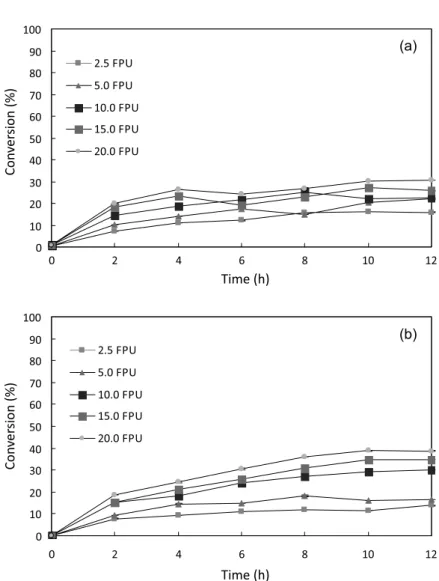
cellulase enzyme loadings in hydrolysis can vary from 7 to 33 FPU/g cellulose, depending on the type and concentration of substrates.In the hydrolysis of non-delignified material, the conversion of cellulose into glucose was 25.8 and 30.5% with 15 and 20 FPU/g cellulose, respectively, in 12 h. Higher conversion was observed in the hydro-lysis of delignified material: 34.9 and 38.7% with 15 and 20 FPU/g Figure 2. Glucose concentration during the enzymatic hydrolysis of the non-delignified (a) and the non-delignified (b) materials
Figure 3. Cellobiose concentration during the enzymatic hydrolysis of the non-delignified (a) and the delignified (b) materials
Figure 4. Initial rates of cellulose hydrolysis at different enzyme loadings. ND, non-delignified material; D, delignified material
cellulose, respectively, for the same period (supplementary material). Chen et al.,23 utilizing 20 FPU/g cellulose, obtained 23.1%
Martín et al.
1930 Quim. Nova
non-delignified material. These authors observed feedback inhibition by cellobiose (3.7 g/L). However, when cellobiase was added, con-version for 12 h increased to 33.2%. Soares et al.,24 utilizing around
10 or 20 FPU/g cellulose, obtained conversions lower than 10% after 72 h in the enzymatic hydrolysis of steam pretreated sugarcane bagasse which was unwashed or that had been washed with water or 1% aqueous NaOH solution.
Analysis of variance by Origin 6.0 was performed with conver-sions obtained at 12 h in the hydrolysis runs with all loadings, when the non-delignified (ND) or delignified (D) material was used. The results utilizing 15 or 20 FPU/g cellulose were not significantly dif-ferent for non-delignified (test F = 7.25; α = 0.05-95% confidence)
or delignified material (test F = 18.26; α = 0.05-95% confidence).
The analysis of variance (ANOVA) indicated that the maximum enzymatic conversion obtained with 15 or 20 FPU/g cellulose was similar when non-delignified or delignified material was used. These results correspond to the initial rates (Figure 4).
CONCLUSIONS
The removal of lignin by alkaline delignification led to unpacked fibers and a slight increase in surface area (1.24 ± 0.03 to 1.34 ± 0.02 m2/g to),considerably improving cellulose saccharification of
steam-exploded bagasse (25.8 to 34.5%, with 15 FPU/g cellulose and 30.5 to 38.7%, with 20 FPU/g cellulose).
Enzymatic hydrolysis of cellulose consists of three steps: ad-sorption of cellulase enzymes onto the surface of the cellulose, the biodegradation of cellulose to fermentable sugars, and desorption of cellulase. However, the irreversible adsorption of cellulase on cel-lulose is partially responsible for its deactivation.12 It is likely that
reversible adsorption was the factor responsible for higher enzymatic conversion of sugarcane bagasse in relation to results obtained by Soares et al.,24 when utilizing the same steam pretreated sugarcane
bagasse.
The higher cellobiose concentration (around 2 g/L) observed dur-ing the hydrolysis of the delignified material did not cause feedback inhibition, since the conversion was 35% in 10 h, when 15 FPU/g cellulose was used.
Enzyme loadings higher than 15 FPU/g cellulose resulted in no significant increase in the initial rate or in enzymatic conversion for ND or D material. It can be concluded that a lower enzyme loading can be used for both materials.
SUPPLEMENTARY MATERIAL
Available at http://quimicanova.sbq.org.br, in format pdf with free access. Figure 1S - Conversion during the enzymatic hydrolysis of the non-delignified (a) and the delignified (b) materials.
ACKNOWLEDGMENTS
The authors acknowledge the financial support from CNPq (Conselho Nacional de Desenvolvimento Científico e Tecnológico,
Brasilia DF, Brazil) and FACEPE (Fundação de Amparo à Ciência e Tecnologia do Estado de Pernambuco, Brazil). C. Martín gratefully acknowledges the financial support given by the Alexander von Humboldt Foundation.
REFERENCES
1. Sjöström, E.; Wood Chemistry: Fundamentals and applications. 2nd ed., Academic Press: San Diego, 1993.
2. Badhan, A. K.; Chadha, B. S.; Kaur, J.; Saini, H. S.; Bhat, M. K.; Bio-resour. Technol. 2007, 98, 504.
3. Fengel, D.; Wegener, G.; Wood, chemistry, ultrastructure, reactions, Waster & Grugter: New York, 1984.
4. Carrillo. F.; Lis, M. J.; Colom, X.; Lopez-Mesas, M.; Valdeperas, J.; Process Biochem. 2005, 40, 3360.
5. Taherzadeh, M. J.; Karimi, K.; Bioresources 2007, 2, 472.
6. Lynd, L. R.; Weimer, P. J.; van Zyl, W. H.; Pretorius, I. S.; Microbiol. Mol. Biol. Rev. 2002, 66, 506.
7. Taherzadeh, M. J.; Karimi, K.; Bioresources 2007, 2, 707. 8. Arantes, V.; Saddler, J. N.; Biotechnol. Biofuels 2010, 3, 4. 9. Yang, B.; Wyman, C. E.; Biof. Bioprod. Biorefin. 2008, 2, 26. 10. Saddler, J. N.; Ramos, L.; Breul, C. Em Bioconversion of forest and
ag-ricultural residues; Saddler, I. N., ed.; CAB International: Wallingford, 1993, p. 73-91.
11. Fan, L. T.; Lee, Y. H.; Gharpuray, M. M.; Adv. Biochem. Eng. 1982, 23, 157.
12. Sun, Y.; Cheng, J.; Bioresour. Technol. 2002, 83, 1.
13. Gouveia, E. R.; Nascimento, R. T.; Souto-Maior, A. M.; Rocha, G. J. M.; Quim. Nova. 2009, 32, 1500.
14. Rocha, G. J. M.; Silva, F. T.; Araújo, G. T.; Curvelo, A. A. S.; Resumos do V Brazilian Symposium Proceedings on the Chemistry of Lignin and Other Wood Components, Curitiba, Brasil, 1997.
15. Driemeier, C.; Pimenta, M. T. B.; Rocha, G. J. M.; Oliveira, M. M.; Mello, D. B.; Maziero, P.; Gonçalves, A. R.; Cellulose 2011, 18, 1509. 16. Ghose, T. K.; Pure Appl. Chem. 1987, 59, 257.
17. Kumar, R.; Mago, G.; Balan, V.; Wyman, C. E.; Bioresour. Technol.
2009, 100, 3948.
18. Palonen, H.; Tese de Doutorado, Helsinki University of Technology, Finland, 2004.
19. Ohgren, K.; Bura, R.; Saddler, J.; Zacchi, G.; Bioresour. Technol. 2007, 98, 2503.
20. Esteghlalian, A.; Bilodeau, M.; Mansfield, S. D.; Saddler, J. N.; Biotech-nol. Progr. 2001, 17, 1049.
21. Lee, Y. H.; Fan, L. T.; Biotechnol. Bioeng. 1983, 32, 853.
22. Pallapolu, V. R.; Lee, Y. Y.; Garlock, R. J.; Balan, V.; Dale, B. E.; Kim, Y.; Mosier, N. S.; Ladisch, M. R.; Falls, M.; Holtzapple, M. T.; Sierra, R.; Shi, J.; Ebrik, M. A.; Redmond, T.; Yang, B.; Wyman, C. E.; Donohoe, B. S.; Vinzant, T. B.; Elander, R. T.; Hames, B.; Thomas, S.; Warner, R. E.; Bioresour. Technol. 2011,102, 11115.
23. Chen, M.; Xia, L.; Xue, P.; Int. Biodeter. Biodegr. 2007, 59, 85. 24. Soares, I. B.; Travassos, J. A.; Baudel, H. M.; Benachour, M.; Abreu, C.
S
u
p
p
le
m
e
nta
ry
M
a
te
ri
a
l
*e-mail: [email protected]
ENZYME LOADING DEPENDENCE OF CELLULOSE HYDROLYSIS OF SUGARCANE BAGASSE
Carlos Martín
Department of Chemistry and Chemical Engineering, University of Matanzas, Matanzas 44740, Cuba / vTI-Institute for Wood Technology and Wood Biology, Hamburg 21031, Germany
George Jackson de Moraes Rocha
Laboratório Nacional de Ciência e Tecnologia do Bioetanol, CP 6192, 13083-970 Campinas – SP, Brasil Julliana Ribeiro Alves dos Santos, Maria Carolina de Albuquerque Wanderley e Ester Ribeiro Gouveia*
Departamento de Antibióticos, Universidade Federal de Pernambuco, Cidade Universitária, 50670-901 Recife – PE, Brasil