Copyright
© ABE&M todos os dir
eitos r
eser
vados.
Microvascular reactivity
in type 1 diabetics
Reatividade microvascular em diabéticos tipo 1
Tereza Cristina Abi-Chahin1, Moema de Alencar Hausen1,
Claudia Moraes Mansano-Marques1, Vera Lucia Rabello de Castro Halfoun2
ABSTRACT
Objective: To evaluate whether differences are present in microvascular response to the sche-mia induced by dynamic videocapillaroscopy (VCD), through analysis of the measured capillar transverse segment area (CTSA) in patients with type 1 diabetes mellitus (T1DM). Methods: The vascular reactivity of the CTSA was studied by VCD, using a reactive hyperemia test in 61 volunteers, being 31 healthy controls without diabetes family history (Group 1) and 30 patients with T1DM without complications (Group 2). The images were captured every two seconds, du-ring reperfusion after one minute induced ischaemia, and they were analyzed by the program Studio Version 8 and Motic Image Plus. The pre-ischemia capillary transverse segment (basal area, BA), the maximum strain post-ischemia (maximum area, MA), and time to achieve it (MAt) were measured during reperfusion, and the increased area percentage (Ap) was estimated. Re-sults: The mean differences between groups were evaluated by the t-test. The median compa-risons between the groups were studied by the Mann-Whitney test. There was no difference in BA between the groups. The Ap was significantly lower among the diabetic patients, and there was a significant increase in the Mat among the patients of Group 2 when compared to Group 1. Conclusions: These data suggest that type 1 diabetes provokes earlier endothelial dysfunction, before the onset of clinically detectable degenerative complications. The outcomes from these alterations need further studies. Arq Bras Endocrinol Metab. 2009;53(6):741-6
Keywords
Diabetes mellitus; microcirculation; angioscopy microscopy; endothelium-abnormalities
RESUMO
Objetivo: Avaliar se há diferença de resposta microcirculatória à isquemia induzida pela video-capilaroscopia dinâmica (VCD), por meio da análise de medida da área do segmento transverso capilar (ASTC) em pacientes com diabetes melito tipo 1 (DMT1). Métodos: A reatividade vascu-lar do ASTC foi estudada pela VCD usando o teste de hiperemia reativa em 61 voluntários, sen-do 31 controles sadios sem história familiar de diabetes (Grupo 1) e 30 pacientes com DMT1, sem complicações (Grupo 2). As imagens foram capturadas a cada dois segundos, durante a reperfusão após um minuto de isquemia induzida, e analisadas pelo programa Studio Version 8 e Motic Image Plus. O segmento transverso pré-isquemia (área basal, AB), a área máxima pós-isquemia (área máxima, AM) e o tempo para alcançá-la foram medidos durante a reperfusão, e o percentual de incremento foi estimado. Resultados: As principais diferenças entre os grupos foram avaliadas pelo teste t. As médias comparativas entre os grupos foram avaliadas pelo teste Mann-Whitney. Não houve diferença na área basal entre os dois grupos. O percentual de incremento foi significativamente menor entre os pacientes diabéticos e houve um aumento significativo no ASTC entre os pacientes do Grupo 2 quando comparados com o Grupo 1. Con-clusões: Os dados sugerem que o diabetes tipo 1 provoca disfunção endotelial precoce, antes mesmo de complicações degenerativas serem detectadas clinicamente. Os fatores que levam a essas alterações necessitam de estudos adicionais. Arq Bras Endocrinol Metab. 2009;53(6):741-6
Descritores
Diabetes melito; microcirculação; angioscopia microscópica; endotélio-anormalidades
1 Departamento de Ciências
Morfológicas, Faculdade de Medicina Souza Marques, Rio de Janeiro, RJ, Brasil
2 Departamento de Clínica Médica,
Faculdade de Medicina, Universidade Federal do Rio de Janeiro, UFRJ, Rio de Janeiro, RJ, Brasil
Correspondence to:
Vera Lucia Rabello de Castro Halfoun
Departamento de Clínica Médica, Faculdade de Medicina, UFRJ Nutrologia, Hospital Universitário Clementino Fraga Filho, 9o andar
Av. Brigadeiro Trompowsky, s/nº 21941-590 – Rio de Janeiro, RJ, Brasil
Copyright
© ABE&M todos os dir
eitos r
eser
vados.
INTRODUCTION
D
iabetes mellitus (DM) can be defined as ahetero-geneous group of metabolic disturbances that has hyperglycemia as a common finding. Type 1 diabetes
mellitus (T1DM) occurs in 5% to 10% of the cases,
re-sulting in a total destruction of β-pancreatic cells and, according to the Counsel of the Brazilian Society of Diabetics-2006 (3), it could be caused by autoimmune or idiopathic conditions.
With the advent of insulinotherapy, there was an in-crease in life expectancy of these patients. As a result, it was observed a substancial decrease in acute complica-tions, which was continuously substituted for chronic complications, such as micro and macrovascular. In fact, coronary arterial disease mortality is three to ten times more frequent in patients with T1DM (1).
Microcirculatory net is a suitable place for the study of some systemic diseases that can appear in this territo-ry, owing to alterations in the tissue blood flow (2,5).
After following healthy patients during annual capil-laroscopy and others laboratory exams, Coget, observed the presence of microvascular complications before di-abetes onset (5). The same was observed by another group (6), in diabetic when compared to healthy rela-tives controls.
In DM, the microangiopathy emerges as one of the most prevalent clinical complications which can be detected by periungueal videocapillaroscopy, as em-phasized by many researchers (7-10). The procedure involving nail fold to observe the microcirculation is considered innocuous and non-invasive. In basal con-ditions, several authors (9-15) noticed hard visibility pattern because of the presence of edema, distension of capillary transversal segment, tortuosity of efferent branch, microectasy and shortening of capillary loops in diabetics, when compared to healthy subjects (12-16). However, there are few available studies using this method in T1DM.
Most studies suggest that diabetic patients have en-dothelial dysfunction because there is a deficit in vaso-dilatation relaxing factors. The nitric oxid (NO) is the primary mediator of endothelium dependent vasodila-tation and it is known as endothelium-derived relax-ing factor. This mediator is severely diminished among those patients and seems to be the main factor to re-duce endothelium dependent vasodilatation.
This study aimed to evaluate the response of micro-circulation to isquemia induced by dynamic videocapil-laroscopy (VCD) through the measure’s analysis of the
area of capillary transverse segment in type 1 diabetic patients. These findings were also studied concerning to age, gender, family history of diabetes, capillary gly-cemia (CG), glicated hemoglobin (GH), time of disea-se, body mass index (BMI) and fundoscopy.
METHODS
A transversal, descriptive study was carried out from February 2007 until June 2008, at the Hospital versitário Clementino Fraga Filho (HUCFF) of Uni-versidade Federal do Rio de Janeiro (UFRJ). Sixty-one subjects, men and women, from all ethnic groups and with age ranging from 18 to 36 years old, took part in the study after signing a consent form.
Volunteers were divided into two groups: Group 1 (G1, Control Group), with 31 subjects without family history of diabetes and with normal oral glucose toler-ance test (OGTT), and Group 2 (G2), with 30 type 1 diabetic individuals, without complications or fam-ily history of diabetes in next relatives. The following criteria were used for exclusion of patients: use of oral hypoglycemiant and/or vasoactive substances; clinical evidence of hepatopathies; BMI ≥ 25 kg/m2; creatinine
> 1.5 mg/dL; peripheral arterial insufficiency; derma-tological lesions or inflammatory process in the hands; gestation; triglycerides (TCG) > 150 mg/dL; fasting glycemia (FG) ≥ 100 mg/dL (Control Group); gly-cemia after glucose overload ≥ 140 mg/dL (Control Group). Additionally, the arterial hypertension was in-cluded as exclusion criteria, according to the Brazilian Counsel of Arterial Hypertension-2006 (4).
In the day of the videocapillaroscopic exam, the patients should not smoke or use other type of drug or caffeine. The levels of CG should not be superior to 250 mg/dL. The images were captured by a CCD camera, Kocon, model KCC-31 OND (Sony, Japan) connected to a Sony 21” TV and to a computer with image software for capture (Studio Version 8) and anal-ysis (Motic Image Plus). Also, an image analanal-ysis digital cuff (Hokanson®) was connected to a manometer of
mercury to perform functional test (reactive hyperemia test) and to a thermometer (IncoTerm®) to register
en-vironmental temperature.
Copyright
© ABE&M todos os dir
eitos r
eser
vados.
20 mmHg above the maximum arterial pressure of the patient for one minute. The images were captured dur-ing one minute pre-ischemia, with a magnification of 100X. Afterwards, the cuff was uninflated and images were taken every two seconds, during a time of 40 sec-onds, for posterior analysis. The transverse capillary seg-ment area was delimitated by a perpendicular line to the largest axis of the selected capillary, tangent to internal arch limit and, in the sequence, by passing the external perimeter. Pre-ischemia basal area (BA) and maximum post-ischemia area (MA) were measured using the same capillary. BA was represented by three consecutively measurements of the same vessel. During post-ischemia, the maximum increase area, expressed in percentage (Ap), as well as the time spent to reach it (MAt) were registered. BA, MA, Ap and MAt were compared. Dif-ferences between the means from the two groups were compared by t-Student’s test when distribution curves
were considered normal. Differences between medians were tested by Mann-Whitney test.
RESULTS
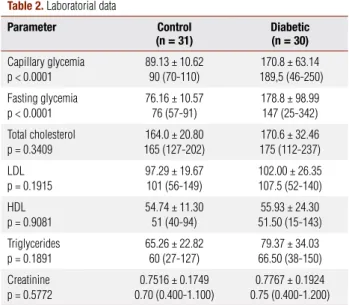
The detailed information of clinical and laboratorial parameters are presented in Tables 1 and 2. In G1, 67.74% were women, while in G2, they were 70%. Av-erage age was 23.39 ± 5.38 versus 23.67 ± 4.31 in G1
and G2, respectively.
As for ethnic group, the percentage of white sub-jects, in G1, was 74.2% and, in G2, 43.3%. Among non-white individuals, the percentages were 25.8% and 56.7% in Group 1 and 2, respectively. In G1, there were only nonsmokers, and G2 had only one smoker. Dis-ease duration ranged from 8 to 336 months (median = 132; average = 155.46 ± 80.17). Fifty percent of the subjects in G2 had duration of diabetes between 101 and 200 months.
FG (p < 0.0001) and CG (p < 0.0001) were signifi-cantly different between the groups. Conversely, HDL, LDL, total cholesterol (TC) and TCG levels were very similar between both groups, without significant dif-ferences. There was no statistical difference concerning other laboratorial parameters between the groups (p > 0.05, Table 2).
There was no difference between BA (pre-ischemia) and MA between the groups. The MAt, however, was significantly greater in diabetics (p < 0.0001, Table 3). Otherwise, Ap was significantly reduced among dia-betic patients when compared to controls.
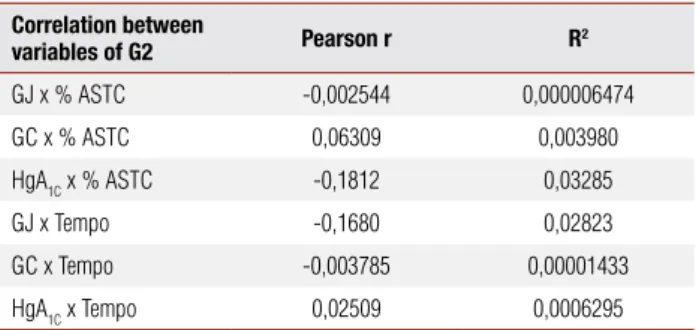
There was no significant correlation between FG, CG, GH and data from increase and time to reach max-imum dilatation in G2 (Table 4).
Furthermore, there was not significant correlation between environmental and digital temperature, when analyzed in each group, separately or together (p-value > 0.05, Table 5).
Table 1. Clinical data
Parameters Control
(n = 31)
Diabetic (n = 30)
BMI (kg/m2)
p = 0.659
22.34 ± 2.322 23.00 (17.10-25.00)
22.32 ± 1.928 22.65 (17.50-25.07)
SBP (mmHg) p = 0.5235
109 ± 12.22 110 (90-130)
107.6 ± 11.320 110 (90-130)
DAP (mmHg) p = 0.2630
70.00 ± 11.15 70 (60-85)
70.00 ± 9.714 70 (50-90)
BMI: body mass index; SBP: systolic blood pressure; DAP: diastolic arterial pressure. Values are shown as mean ± standard deviation, median and minimum and maximum values of each variable.
Table 2. Laboratorial data
Parameter Control
(n = 31)
Diabetic (n = 30)
Capillary glycemia p < 0.0001
89.13 ± 10.62 90 (70-110)
170.8 ± 63.14 189,5 (46-250)
Fasting glycemia p < 0.0001
76.16 ± 10.57 76 (57-91)
178.8 ± 98.99 147 (25-342)
Total cholesterol p = 0.3409
164.0 ± 20.80 165 (127-202)
170.6 ± 32.46 175 (112-237)
LDL p = 0.1915
97.29 ± 19.67 101 (56-149)
102.00 ± 26.35 107.5 (52-140)
HDL p = 0.9081
54.74 ± 11.30 51 (40-94)
55.93 ± 24.30 51.50 (15-143)
Triglycerides p = 0.1891
65.26 ± 22.82 60 (27-127)
79.37 ± 34.03 66.50 (38-150)
Creatinine p = 0.5772
0.7516 ± 0.1749 0.70 (0.400-1.100)
0.7767 ± 0.1924 0.75 (0.400-1.200)
Values are shown as mean ± standard deviation, median and minimum and maximum values of each variable;
p < 0.05 was considered as signiicant, comparing diabetics with controls.
Table 3. Capillaroscopy analysis data
Parameter Control
(n = 31)
Diabetic (n = 30)
Basal area (μ2)
p = 0.7130
412.7 ± 126.8 407.5 (159.0-726.3)
448.0 ± 159.6 410.8 (163.8-1089)
Maximum area (μ2)
p = 0.4398
635.3 ± 207.8 637.6 (223.0-1188.0)
635.07 ± 214.02 599.7 (269.5-1564)
Increase (%) p < 0.0001
53.53 ± 13.86 53.89 (22.57-85.75)
27.29 ± 12.95 25.30 (8.375-60.55)
Time (seg) p < 0.0001
9.161 ± 9.306 8.00 (4.00-38.0)
18.27 ± 10.23 16.00 (2.00-38.0)
Values are shown as mean ± standard deviation, median and minimum and maximum values of each variable.
Copyright
© ABE&M todos os dir
eitos r
eser
vados.
The variations in environmental temperature, which influence arteriolar vasodilatation, can be mentioned as other limitation, once the study was performed with variations between 24 and 34oC. However, there was
no correlation between environmental and digital tem-peratures when analyzed within each group or taking the two groups together. Moreover, averages and me-dians were similar between the two groups. In this way, it is hard to believe that this variable could have influ-enced significantly the capillary distensibility. No exam was performed with environmental temperatures under 24oC to avoid vasoconstriction.
As far as sample selection is concerned, according to previous data (23), there was a reduction in vasodi-latation capacity with ageing beginning after 30 years old, fact that was not proved by other work (24) which described this finding only after 60 years old. In the present study, 15 controls were in their thirties, vary-ing from 31 to 38 years old, and two diabetic patients had ages in their thirties (31 and 35 years old). This fact could reduce the differences in MAt between the groups because of the slower maximum dilatation in Control Group. However, the delay in dilatation was more important in Group 2. Thus, these patients were not excluded from the sample.
Ethnic differences were not considered, since the Brazilian population is highly multiracial, so that it is very difficult to identify the racial origin based only on the skin color.
The presence of microangiopathy was evaluated by fundoscopy, to exclude subjects with microvascular le-sions, provided that the objective of the study was to evaluate the influence of metabolic alterations in an ear-ly stage of the disease, without the well-known impact of diabetes upon microcirculation. Patients with signs of arterial or neurological alterations that could justify changes in vascular reactivity were excluded.
Furthermore, individuals with diastolic pressure > 90 mmHg, systolic pressure > 140 mmHg and BMI > 25 kg/m2 were also excluded. Obesity has been linked
to hypertension through increase in vessel tonus by the reduction in NO biodisponibility, oxidative stress and increase in sympathetic tonus (25).These facts high-light the assertion that diabetes is often accompanied by arterial hypertension, obesity, hyperlipidemia, which characterize metabolic syndrome and, in isolated form, could justify endothelial dysfunction – with or without diabetes. Hyperlipidemia in male young adults alters vascular reactivity when measured by braquial artery
Table 5. Pearson’s correlation data between environmental temperature x digital temperature
Correlation between
variables of G2 Pearson r R
2
GJ x % ASTC -0,002544 0,000006474
GC x % ASTC 0,06309 0,003980
HgA1C x % ASTC -0,1812 0,03285
GJ x Tempo -0,1680 0,02823
GC x Tempo -0,003785 0,00001433
HgA1C x Tempo 0,02509 0,0006295
R2 = dependency degree. There was not correlation between data. R2 < 1.
Table 4. Pearson’s correlation data between variables of Group 2
Correlation between
variables of G2 Pearson r R
2
GJ x % ASTC -0,002544 0,000006474
GC x % ASTC 0,06309 0,003980
HgA1C x % ASTC -0,1812 0,03285
GJ x Tempo -0,1680 0,02823
GC x Tempo -0,003785 0,00001433
HgA1C x Tempo 0,02509 0,0006295
R2 = dependency degree. There was not correlation between data. R2 < 1.
DISCUSSION
In this study, variations in the measurement of post-ischemia transverse capillary segment area was used as vascular reactivity indicative on the basis that it is a vali-dated, cheap, innocuous and easily reproducible meth-od (15). By this methmeth-od, there were well documented evidences of endothelial dysfunction in these patients. Concerning T1DM, rare studies are available in litera-ture and none of them used the present method. In general, studies use indirect methods for evaluating microcirculation based on measurement of blood flow in large arteries in association with Doppler laser and pletismography (14,17-22). VCD is a dynamic tech-nique, once it provides a direct evaluation of microcir-culation and possible alterations in microvascular bed.
Copyright
© ABE&M todos os dir
eitos r
eser
vados.
ultrasound (26). In this study, the greatest values were found in the diabetic group, without significant statisti-cal differences between the groups.
Subjects that used vasoactive substances, hypo-lipemiants and oral hypoglycemiant were not included to avoid possible bias. Oral hypoglycemiants are de-scribed in the literature as substances that interfere with endothelial dysfunction in DM (27-31). None of the subjects in G2 took these sorts of medicines.
One smoker was not excluded from G2; however, he was advised to stop smoking 24 hours before the exam, to normalize endothelial function and avoid vasocon-striction, as it was shown by others authors (32,33) as an adequate interval time. Besides that, their vasoactive response was similar to the other patients of the same group. In the day of the exam, all patients were advised to avoid substances similar to caffeine, tea, mate and soda to prevent other alterations in vasomotility. All subjects were clinically followed and had a laboratorial routine to evaluate renal and hepatic functions, which were normal to both groups. The course time of dia-betes ranged from 8 to 336 months (8 months to 28 years), being 50% of the individuals between 101 to 200 months of disease (approximately 9 to 15 years), with median of 120 months (8 to 336).
In this study, the capillary distensibility was reduced among diabetic patients and took more time to reach MA after induced ischemia-MAt. These alterations are probably due to the decreased release of NO and oth-er factors linked to artoth-eriolar vasodilatation, as many works in the literature describe (12,14,27,34-36). Furthermore, these alterations precede the detectable retinopathy by fundoscopy, which was not found in the subjects of the study. This fact put forward that the mechanisms of circulating vasodilators inhibition can be related to oxidative stress which is usually present in these patients. Our patients had, in average, hemoglo-bin of 8.36%, and, therefore, they could be under that condition mentioned before. However, more studies are required to support this interpretation.
The results of this study suggest that patients with type 1 diabetes present endothelial dysfunction, which has early onset regarding the evolution of the disease, preceding clinically detectable microvascular altera-tions. Further studies can elucidate the metabolic con-trol role in the evolution of these alterations and in the prognosis of that disease.
Acknowledgements: The authors wish to thank HUCFF for the equipment support.
Disclosure: no potential conflict of interest relevant to this article was reported.
REFERENCES
Bozza ACT. Macroangiopatias. In: Oliveira JE, Milech A, editores. 1.
Diabetes mellitus: clínica, diagnóstico, tratamento multidiscipli-nar. 1ª ed. Rio de Janeiro: Atheneu; 2004. p. 125-41.
Bollinger A, Butti P, Barras JP, Trachsler H, Siegenthaler W. Red 2.
blood cell velocity in nailfold capillaries of man measured by a television microscopy technique. Microvasc Res. 1974;7(1):61-72. Counsel of the Brazilian Society of Diabetics. 2006.
3.
Brazilian Counsel of Arterial Hypertension. 2006. 4.
Coget JM, Dupuis-Uvny C, Merlen JF. The value of studying the 5.
ocular conjunctiva in case-finding in prediabetic states. J Mal Vasc. 1989;14(1):68-70.
Danilova AI. State of the microcirculation in the relatives of diabe-6.
tes mellitus patients. Probl Endokrinol (Mosk). 1979;25(2):20-4. Danilishina VS, Kushnir VL. Functional and biochemical characte-7.
ristics of 2 types of diabetes mellitus. Ter Arkh 1984;56(10):86-8. Gasser P, Berger W. Nailfold videomicroscopy and local cold test 8.
in type I diabetics. Angiology. 1992;43(5):395-400.
Jörneskog G, Brismar K, Fagrell B. Skin capillary circulation seve-9.
rely impaired in toes of patients with IDDM, with and without late diabetic complications. Diabetologia. 1995;38(4):474-80. Jörneskog G, Fagrell B. Discrepancy in skin capillary circulation 10.
between fingers and toes in patients with type 1 diabetes. Int J Microcirc Clin Exp. 1996;16(6):313-9.
Volgin EG, Stroev Iu I, Yonskaia LI, Pechenkin ELU. Television ca-11.
pillaroscopy in the diagnosis of diabetic microangiopathies. Pro-bl Endokrinol (Mosk). 1986;32(3):27-30.
Fernandes TJ, Bernardini EMT, Morais IC, Castilho C, Halfoun 12.
VLRC. Capilaroscopia em crianças com diabetes mellitus tipo 1. Arq Bras Endocrinol Metab. 2001;45(5):441-6.
Meyer MF, Pfohl M, Schatz H. Assessment of diabetic alterations 13.
of microcirculation by means of capillaroscopy and laser-Doppler anemometry. Med Klin (Munich). 2001;96(2):71-7.
Halfoun VL, Pires ML, Fernandes TJ, Victer F, Rodrigues KK, Tava-14.
res R. Videocapillaroscopy and diabetes mellitus: area of trans-verse segment in nailfold capillar loops reflects vascular reactivi-ty. Diabetes Res Clin Pract. 2003;61(3):155-60.
Halfoun VLRC, Fernandes TJ, Pires MLE, Braun E. Estudos mor-15.
fológicos e funcionais da microcirculação da pele no diabetes mellitus. Arq Bras Endocrinol Metab. 2003;47:271-9.
Morais IC, Bernardini EMT, Halfoun VLRC. Capilaroscopia em 16.
pacientes portadores de diabetes tipo II. Rev Angiol Cir Vasc. 1993;2(4):186-94.
Fagrell B. Advances in microcirculation network evaluation: an 17.
update. Int J Microcirc Clin Exp. 1995;15 Suppl 1:34-40. Vayssairat M, Carpentier P. Microcirculation clinique. Paris: Mas-18.
son; 1996.
Abink EJ, Wollersheim, Netten PM, Smits P. Reproducibility of 19.
skin microcirculatory measurements in humans, with special em-phasis on capillaroscopy. Vasc Med. 2001;6(4):203-10.
Carpentier PH. Current techniques for the clinical evaluation of 20.
the microcirculation. J Mal Vasc. 2001; 26(2):142-7.
Tooke JE, Lins PE, Ostergreen J, Fagrell B. Skin microvascular 21.
autoregulatory responses in type 1 diabetes: the influence of du-ration and control. Int J Microcirc Clin Exp. 1985;4(3):249-56. Rooijens PP, Burgmans JP, Yo TI, Hop WC, de Smet AA, van den Dor-22.
Copyright
© ABE&M todos os dir
eitos r
eser
vados.
A randomized, multicenter study of the patency of primary hemo-dialysis access. J Vasc Surg. 2005;42(3):481-6; discussions 487. Jin SM, Nch CI, Yang SLU, Bae EJ, Shin CH, Chung HR, et al. En-23.
dothelial dysfunction and microvascular complications in type 1 diabetes mellitus. J Korean Med Sci. 2008;23(1):77-82.
Gerhard MM, Roddy MA, Creager SJ. Alterações endoteliais no 24.
envelhecimento. Endotélio e doenças cardiovasculares. 1a ed. Rio
de Janeiro: Atheneu; 1996. p. 369-79.
Taddei S, Virdis A, Ghiadoni L, Salvetti G, Bernini G, Magagna A, 25.
et al. Age-related reduction of NO availability and oxidative stress in humans. Hypertension. 2001:38(2): 274-9.
de Jongh RT, Serné EH, Jzerdan RG, de Vries G, Stehouwer CD, 26.
Stehouwer CD. Impaired microvascular function in obesity: im-plications for obesity-associated microangiopathy, hypertension, and insulin resistance. Circulation. 2004:109(21):2529-35. Lundman P, Eriksson MJ, Stühlinger M, Cooke JP, Hamsten A, 27.
Tornvall P. Mild-to-moderate hypertriglyceridemia in young men is associated with endothelial dysfunction and increased plasma concentrations of asymmetric dimethylarginine. J Am Coll Car-diol. 2001;38(1):111-6.
McVeigh GE, Brennan GE, Johnston GD, Mc Derrmott BJ, MC 28.
Grath LT, Henry WR. Impaired endothelium-dependent and inde-pendent vasodilation in patients with type 2 (non-insulin-depen-dent) diabetes mellitus. Diabetologia. 1992;35(8):771-6.
Fava D, Cassone-Faldetta M, Laurenti O, De Luca O, Ghiselli A, 29.
De Mattia G. Gliclazide improves anti-oxidant status and nitric oxide-mediated vasodilation in type 2 diabetes. Diabet Med. 2002;19(9):752-7.
De Mattia G, Laurenti O, Fava D. Diabetic endothelial dysfunction: 30.
effect of free radical scavenging in Type 2 diabetic patients. J Dia-betes Complications. 2003;17(2 Suppl):30-5.
Grant PJ. Beneficial effects of metformin on haemostasis 31.
and vascular function in man. Diabetes Metab. 2003;29(4 Pt 2):6S44-52.
Wiernsperger NF, Bouskela E. Microcirculation in insulin resistan-32.
ce and diabetes: more than just a complication. Diabetes Metab. 2003;29(4 Pt 2):6S77-87.
Pazos-Moura CC, Moura EG, Bouskela E, Torres Filho IP, Breiten-33.
bach MM. Nailfold capillaroscopy in non-insulin dependent dia-betes mellitus: blood flow velocity during rest and post-occlusive reactive hyperaemia. Clin Physiol. 1990:10(5):451-61.
Pieper GM. Review of alterations in endothelial nitric oxide pro-34.
duction in diabetes: protective role of arginine on endothelial dysfunction. Hypertension. 1998;31(5):1047-60.
Halfoun VLRC, Fernandes TJ, Pires MLE, Victer F, Tavares R, Car-35.
dozo M, et al. Videocapilaroscopia e diabetes mellitus: projeção da área do segmento transverso em processamento de imagem. Arq Bras Endocrinol Metab. 2001;45(5):S584.
Consentino F, Hishikawa K, Katusik ZS, Lüscher TF. High gluco-36.
se increases nitric oxide synthase expression and superoxide anion generation in human aortic endothelial cells. Circulation. 1997;96(1):25-8.
Perfett F, Tarquini R, Tapparini L, Tarquini B. Influence of non-insu-37.