Article
Printed in Brazil - ©2013 Sociedade Brasileira de Química0103 - 5053 $6.00+0.00
A
*e-mail: [email protected]
Comparison of Extraction Methods for Kahweol and
Cafestol Analysis in Roasted Coffee
Rafael C. E. Dias,*,a Adelia F. de Faria,b Adriana Z. Mercadante,b
Neura Bragagnolob and Marta de T. Benassic
aInstituto Federal Catarinense,Campus Araquari, CP 21, 89245-000 Araquari-SC, Brazil
bFaculdade de Engenharia de Alimentos, Universidade Estadual de Campinas,
CP 6121, 13083-862 Campinas,SP, Brazil
cDepartamento de Ciência e Tecnologia de Alimentos, Universidade Estadual de Londrina,
CP 6001, 86051-970 Londrina,PR, Brazil
Caveol e cafestol, diterpenos da fração lipídica do café, têm efeitos conhecidos na saúde humana, como atividade anticarcinogênica e hipercolesterolêmica. Existem divergências quanto às concentrações desses compostos reportadas para café torrado, provavelmente devido aos processos de extração empregados. Assim, quatro métodos de preparo de amostra foram estudados: saponificação direta a quente (SDQ), saponificação direta a frio (SDF); e extração por Bligh e Dyer (BD) ou soxhlet (SO) seguida de saponificação. Teores dos diterpenos e seus dehidroderivados obtidos por cromatografia líquida de alta eficiência acoplada a detector de arranjo de diodos e espectrometria de massa (HPLC-DAD-MS/MS) e perfis cromatográficos de café torrado, obtidos pelos quatro métodos, foram comparados. SDQ foi mais eficiente quanto à extração, mostrando melhor separação dos picos cromatográficos e teores de 930,2 (± 36,8), 113,2 (± 4,7), 568,6 (± 16,6) e 87,1 (± 3,7) mg 100 g–1 para caveol, dehidrocaveol, cafestol e dehidrocafestol, respectivamente. O extrato SDQ apresentou teores de diterpenos (caveol e cafestol) 15% superiores àqueles obtidos por SDF e até 88% maiores que pelos métodos SO e BD.
Kahweol and cafestol, diterpenes from the unsaponifiable fraction of coffee, present known effects on human health such as anticarcinogenic and hipercholesterolemic activities. There are discrepancies regarding the levels reported for these compounds in roasted coffee, probably due to the extraction processes. Therefore, four sample preparation methods were studied: direct hot saponification (DHS), direct cold saponification (DCS); and Bligh and Dyer (BD) or Soxhlet (SO) extraction followed by saponification. The levels of diterpenes and their dehydro derivatives obtained by high performance liquid chromatography with diode array and mass spectrometry detectors (HPLC-DAD-MS/MS) and the chromatographic profiles of roasted coffee, obtained by these four methods, were compared. DHS was more efficient for extraction, showing better separation of chromatographic peaks and levels of 930.2 (± 36.8), 113.2 (± 4.7), 568.6 (± 16.6) and 87.1 (± 3.7) mg 100 g–1 for kahweol, dehydrokahweol, cafestol and dehydrocafestol, respectively. The DHS extract presented a diterpene content (kahweol and cafestol) 15% superior to that of DCS and up to 88% superior than using SO and BD methods.
Keywords: direct saponification; soxhlet; Bligh and Dyer; diterpenes; dehydroditerpenes
Introduction
Diterpenes are a group of compounds present in the unsaponifiable matter of the lipid content of coffee, where kahweol and cafestol, two pentacyclic alcohols, are their main representatives. The roasting process,
however, may produce small amounts of diterpene dehydro derivatives.1-3 Positive effects for human health such
as antioxidant, anti-inflammatory and hepatoprotective (against cancer) activities as well as negative factors such hypercolesterolemic activity have been attributed to diterpenes.4-6 Furthermore, kahweol and cafestol have been
temperature) passes through the sample for an extended time (generally, from 5 to 8 h). Despite being the official method of AOAC,10 it may lead to the degradation of
thermo-sensible compounds due to their long period of heat exposure.3,11 The Bligh and Dyer method(BD),12 which
consists of a cold extraction with a mixture of chloroform-methanol, does not require any special equipment, and the analysis is faster. However, volatile and toxic solvents are used in this methodology. BD and SO methods allow for the estimation of the lipid content and produce extracts for the further analysis of several lipophilic compounds of interest. Besides these more conventional extraction techniques, alternative methods based on solvent volume reduction have been proposed as solid phase extraction, matrix solid phase dispersion, supercritical fluid extraction and microwave assisted extraction and QuEChERS (Quick, Easy, Cheap, Effective, Rugged and Safe).13,14,15 However,
in spite of the advantages considering environmental issues and laboratorial security, they are yet less usual for food analysis as expensive equipment or material is required.13,14
Regarding the extraction of unsaponifiable fractions, different approaches are reported in the literature. Some methodologies describe the use of preliminary extraction of lipids as a first step, before saponification,16-21 while others
suggest direct saponification without pre-extraction.1,22-25
Direct saponification, either cold (DCS) or hot (DHS), has been described as the most rapid and efficient alternative for extracting unsaponifiable compounds in different food matrices because it avoids the formation of artifacts26 and
is also considerably faster and demands lower amounts of solvent.27,28
A considerable discrepancy between the content of kahweol and cafestol in coffee has been observed: levels from traces to 750 mg 100 g−1 of sample for kahweol
and from less than 10 to 670 mg 100 g−1 of sample for
cafestol.1,5,7,17,20,23,25,29,30 Despite the variability in raw
materials, to which the differences found in diterpene levels could be partially attributed, the diversity of extraction methods is outstanding. The literature describes the occurrence of decomposition products from diterpenes in roasted coffee;3 nevertheless, it is not known whether such
components could be formed during the roasting process or simply correspond to the artifacts of an inefficient analytic extraction.
The aim of this work was to evaluate the influence of different extraction methods on the determination of kahweol and cafestol contents in roasted coffees using
and hot (SO) and cold (BD) preliminary extractions of lipids followed by saponification. The efficiency and the advantages of each procedure were compared.
Experimental
Solvents and standards
The following reagents were used for the analyses: anhydrous sodium sulphate ACS 100% (Synth, São Paulo, Brazil); chloroform p.a. (Merck, Darmstadt, Germany); ethanol 96% (Merck, Darmstadt, Germany); methanol p.a. (Merck, Darmstadt, Germany); potassium hydroxide (KOH) analytical grade (Merck, Darmstadt, Germany); standards of kahweol and cafestol (Axxora, San Diego, USA), purity ≥ 98%, certified by Alexis Biochemicals (Lausanne, Switzerland); methyl tert-butyl ether (MTBE), spectroscopic grade (Merck, Darmstadt, Germany); water purification system (Milli-Q, Millipore; Billerica, USA).
Sample preparation
Arabica coffee beans (cv. Iapar-59, derived from cross of Villa Sarchi × Timor Hybrid), were collected in Londrina City in Parana State, Brazil at the Instituto Agronômico do Paraná (IAPAR) located at latitude 23°08’47” S and altitude 560 m, with an average annual temperature of 22 to 23 °C. Cherry fruits were manually selected, washed and sun-dried on a patio. The green coffee beans were processed and standardized in grade 16 size sieves (6.5 mm), and all defective beans were removed. The coffee beans (0.50 kg) were roasted (Rod-Bel roaster, Brazil) at 190-230 °C until reaching the weight loss of 20% (m/m), corresponding to dark roasting. After roasting and grinding to a particle size of 0.500 mm (sieve size ABNT 35), the samples presented 2.4 ± 0.1 g 100 g–1 moisture, 29.0 ± 0.4 lightness and
50.1 ± 2.1 hue. The color was obtained by a color-guide portable colorimeter (BYK-Gardner, USA) in triplicate and the moisture was evaluated in a halogen moisture analyzer (HB43-S model, Mettler Toledo, UK) in duplicate.
of extraction of the unsaponifiable matter, use of a lower amount of solvent, and the level of danger presented to the analyst.
Extraction and saponification
An overview of the employed procedures is shown in Figure 1.
Direct hot saponification (DHS)
The method described by Dias et al.1 was employed
and consisted of weighing, in a test tube, 0.200 g of roasted arabica coffee and then adding 2 mL of KOH solution for direct sample saponification. After a 1 h water bath at 80 ºC, the unsaponifiable matter was extracted using MTBE and washed with water (pathway 1, Figure 1).
Direct cold saponification (DCS)
This method was based on the DHS extraction conditions used by Bandeira et al.27 and Mariutti, Nogueira
and Bragagnolo.28 Two milliliters of a KOH solution were
added to 0.200 g of roasted and ground coffee sample in a sealed Erlenmeyer flask (25 mL) and then stirred for 20 h (Orbital agitator, MA-140/CFT) at 168 rpm and 25 ºC (pathway 2, Figure 1). After saponification, extraction was performed (Figure 1).
Hot lipid extraction by soxhlet (SO)
The procedure was based on the method used by Kölling-Speer et al.18 for coffee (green beans and
roasted coffee) lipid extraction through soxhlet for further analyses of diterpenes. Five grams of roasted ground coffee in an extraction cartridge were placed in a flat-bottomed flask (250 mL). The extraction was
carried out in a soxhlet extractor setup for 6 h of reflux with 150 mL of MTBE at the solvent boiling temperature (55 to 60 ºC). After evaporating the solvent in a rotary evaporator (Büchi R-114), the mass of the lipid extract was gravimetrically determined. One portion of the extract was submitted to saponification. MTBE (10 mL) was added to a flat-bottomed flask to obtain a solution of known concentration, and one milliliter of this solution was transferred to a test tube. The solvent was evaporated (at 50 ºC for 15 min) and saponification with a KOH solution and the extraction of diterpenes were performed (pathway 1, Figure 1).
Lipid extraction through Bligh and Dyer (BD)
For 10.0 g of sample, with a moisture content of 2.4% (m/m),12 the solvent ratio used was 10:20:8
concentration was transferred to a test tube. The solvent was evaporated (50 ºC for 15 min), followed by saponification with a KOH solution and the extraction of diterpenes (pathway 1, Figure 1).
Chromatographic analysis
The identity and purity of the peaks were verified by HPLC-DAD-MS/MS using a Shimadzu liquid chromatograph (Kyoto, Japan) with a quaternary solvent delivery system (LC20AD) and degasser (DGU20A5) and a 20 µL Rheodyne fixed-loop injector (Rheodyne LCC, Rohnert Park, EUA). The system was connected in series to a diode array detector (DAD) (Shimadzu, model SPD-M20A) and a mass spectrometer with an ion-trap analyzer and atmospheric pressure chemical ionization (APCI) source from Bruker Daltonics, model Esquire 4000 (Bremen, Germany). The mass spectrometer conditions were previously optimized using standards and coffee samples roasted at different degrees (data not published). The MS parameters were set as follows: positive mode; corona current of 4.0 µA; source temperature of 450 ºC; dry nitrogen gas, N2, temperature, 350 ºC; flow, 4 L min−1;
nebulizer pressure, 60 psi; MS/MS fragmentation energy, 1.4 V. The mass spectra were acquired over an m/z (mass-to-charge ratio) scan range from 100 to 700 (scan mode). The quantification was carried out in a Waters liquid chromatograph with a quaternary solvent manager (Waters, model 600), diode array detector (Waters, model 996), Rheodyne injector valve with a 20 µL loop, online degasser (Waters) and a Millennium (Waters) acquisition and data processing system. A Spherisorb ODS-1 column (Waters,
Milford, USA) measuring 250 × 4.6 mm and 5 µm in
diameter and isocratic elution (acetonitrile:water 55:45 v/v; 0.9 mL min−1) under controlled temperature condition (25°C)
were used.1 The run time (35 min) was extended beyond the
retention time (tR) of the last diterpene of interest (cafestol,
tR = 15.5 min) to allow for the elution of other compounds and thus accommodate the different extraction procedures that were tested. The chromatographic conditions were the same for quantification of compounds and for the mass spectrometry analysis. The resolution factor (R) between two peaks of interest was also calculated.
The quantification was carried out using external calibration curves with 6 points in triplicate (R2 ≥ 0.999,
p < 0.001). The spectra were acquired at wavelengths between 190 and 400 nm and processed at the maximum
presented the same molar absorptivity of the corresponding diterperne alcohol (kahweol or cafestol).24
Statistical analysis
The data regarding the concentration of compounds under study were submitted to analysis of variance
(ANOVA, Tukey test for p ≤ 0.05), considering the
extraction method as the source of variation, using the software Statistica version 6.0.31
Results and Discussion
The chromatographic profiles for all sample preparation methods were similar (Figure 2). It should be emphasized that the peak intensities (Figure 2) between the procedures should not be directly compared because they were analyzed under different dilutions.
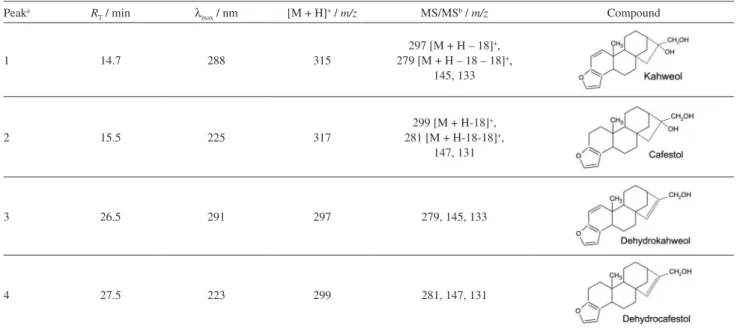
As shown in Figure 2, kahweol (tR = 14.5 min, peak 1) and cafestol (tR = 15.5 min, peak 2) showed well-defined sharp peaks with separation with satisfactory resolution (R = 1.6), considering the great similarity between the structures of such compounds. The worst separation between peaks 3 and 4 (Figure 2), which were identified as dehydro derivatives (Table 1), was verified for the SO method, hindering both the identification and quantification in the analysis through MS.
Regarding the efficiency of lipid extraction, an overestimation was observed for SO (18.6 ± 0.01 g of lipids 100 g–1 of coffee, dry base). In the literature, the highest
values ever reported for the total lipid level of dark roasting arabica coffee approach 15.4%.3,29,32 The solvent used in
the SO method carried colored compounds with greater solubility in the organic solvent (MTBE). The extraction of interfering compounds was probably also enhanced by the long exposure time of the solvent and the reflow operations. This could be the reason for the co-elution of compounds between peaks 3 and 4 even after the saponification, extraction and cleaning procedures (Figure 2).
The peaks were identified according to the following combined information: standard addition method, UV-Vis spectrum and mass spectrum compared with authentic standards (Table 1 and Figure 2). In addition, the MS/MS spectra confirmed the assignment of the protonated molecule [M + H]+.
For peak 2 (Figure 2), the [M + H]+ at m/z 317 and MS/MS
fragments at m/z 299 and m/z 281 due to the loss, respectively, of one and two molecules of water and another MS/MS fragment at m/z 147 [M + H – C10H18O2]+ confirmed the
identity of cafestol (Table 1 and Figure 3). Kahweol (peak 1), which presents one more double bond in the kaurene ring and two less hydrogen atoms, showed analogous fragments, with 2 u less than the fragments of cafestol (Table 1).
Peaks 3 and 4 (Figure 2) were identified as dehydrokahweol and dehydrocafestol, respectively. These dehydro derivatives showed UV-Vis spectra with similar profiles compared to their respective diterpene alcohols,
kahweol and cafestol (Figure 4 and Table 1). The wavelength of maximum absorption (λmax) depends on the presence
of the chromophores in a molecule, especially those with conjugated double bonds.33 Despite the double bond created
from the output of a water molecule, a specific diterpene and its dehydro derivative had the same number of conjugated double bonds, which resulted in similar λmax values (Table 1
and Figure 4). Furthermore, the protonated molecules Table 1. Characteristics of diterpenes from roasted coffee beans obtained by HPLC-DAD-MS/MS
Peaka R
T / min λmax / nm [M + H]+ / m/z MS/MSb / m/z Compound
1 14.7 288 315
297 [M + H – 18]+,
279 [M + H – 18 – 18]+,
145, 133
2 15.5 225 317
299 [M + H-18]+,
281 [M + H-18-18]+,
147, 131
3 26.5 291 297 279, 145, 133
4 27.5 223 299 281, 147, 131
aNumbered according to Figure 2;bsecond fragmentation from the protonated molecule.
Figure 3. Mass fragments of cafestol (peak 2 of Figure 2).
for the analyzed compounds (Table 1) indicated that both dehydrocafestol and dehydrokahweol presented the same fragmentation patterns shown, respectively, by cafestol and kahweol, which confirms the structural similarities between these compounds.
The unidentified peaks did not present fragments with
m/z that would indicate a fragmentation mechanism for diterpenes.
The presence of the dehydro derivatives were not observed in previous studies, when an HPLC method and direct hot saponification were used to determine kahweol and cafestol in green coffee.1 In the present work, the
occurrence of dehydrokahweol and dehydrocafestol in the four methods indicated that they were not artifacts of analytic extraction but a product of the roasting process of coffee.
Comparing the levels of kahweol, cafestol and their derivatives through different extractions, it was verified that direct saponification was more effective than the methodologies that pre-extracted the lipids before saponification. Both BD and SO demonstrated low efficiency with regard to the extraction of the four compounds identified, resulting in much lower levels than those obtained through direct saponification (DHS, DCS) (Table 2).
In addition to the diversity among the methods, differences in the extraction could also be attributed to the different solvents used. Considering the selectivity and efficiency of extraction, organic solvents should be characterized according to their ability to interact with the solute either as a dipole (dipolarity, π*), as a proton acceptor (acidity, α), and as a proton donor (basicity, β)34
and the polarity index.35,36 The polarity indexes of
MTBE, methanol and chloroform are 2.5, 5.1 and 4.1, respectively. The solvatochromic parameters for MTBE were not determined, so the values of diisopropyl ether were considered. Diisopropyl ether (α 0.00; β 0.64; π* 0.36) presents different parameters compared to methanol (α 0.43; β 0.29; π* 0.28) and chloroform (α 0.43; β 0.00; π* 0.57). However, similar results (low levels of diterpenes) were observed for both BD and SO, which indicated that the solvents were not primarily responsible for the low efficiency of the BD and SO extractions.
For SO, at first, problems would be expected regarding compound degradation because, according to the literature, the reflux of hot solvent for several hours favors the peroxidation and hydrolysis reactions, which could later jeopardize the analytical results.11 The literature also
indicates that kahweol could be subjected to degradation and produce dehydro derivatives when submitted to high temperature for long periods, e.g., during intense coffee roasting.3,24 It was observed, however, that both
hot extraction (SO) and cold extraction (BD) of lipid for further saponification presented inadequate results, so the lower results obtained for SO and BD could not be mainly attributed to thermal degradation. Moreover, it was also verified that cafestol and even kahweol, which presents a structure that is more susceptible to oxidation, were not affected by temperature and time of exposition (80 ºC, 1 h) applied in DHS (Table 2). These results indicate that direct saponification is more appropriate in ensuring the efficient quantification of the diterpenes from roasted coffee.
Considering the amount of solvent, SO demands a minimum of 150 mL of MTBE, which cannot be reused for the same analysis, while BD requires 10 mL of MTBE and approximately 20 mL of methanol and chloroform. Because an extraction step is not followed in the DHS and DCS procedures, these methods are more economic and less dangerous to the analyst. Moreover, direct hot saponification has also proved to be advantageous with respect to speed of processing. Almost 24 h was necessary to complete sample preparation by DCS, which is much longer than the 4 h (six times) required by DHS.
method
Kahweol
DHS 930.2 a 36.8 3.9
DCS 789.8 b 14.5 1.8
SO 192.4 c 8.31 4.3
BD 101.6 d 4.20 4.1
Dehydrokahweol
DHS 113.2 a 4.66 4.1
DCS 111.5 a 1.76 1.5
SO 22.7 b 1.42 6.2
BD 14.1 c 0.13 0.9
Cafestol
DHS 568.6 a 16.6 2.9
SDF 483.1 b 15.0 3.1
SO 126.3 c 10.3 8.1
BD 68.6 d 0.78 1.1
Dehydrocafestol
DHS 87.1 a 3.74 4.2
DCS 86.2 a 1.77 2.0
SO 18.1 b 1.07 5.9
BD 11.1 c 0.26 2.4
aDirect hot saponification (DHS), direct cold saponification (DCS),
extraction through soxhlet with hot saponification (SO) and extraction through Bligh and Dyer with hot saponification (BD); bMean concentration
(mg 100 g−1 of sample, dry basis) of 5 repetition of extraction. Different
By comparing the results from the direct saponification methods, we observed the same efficiency for dehydroditerpene extraction for both procedures; however, the hot technique (DHS) showed better performance for kahweol and cafestol. This result indicates that the greatest extraction efficiency at high temperatures overlaps with the possible degradation that can occur at this temperature.
Recovery tests were carried out to ensure the efficiency of the DHS procedure. Kahweol and cafestol standards were added to the sample before analysis in an amount of approximately 50% of the content (duplicate). Good recovery were observed: 109% for kahweol and 106% for cafestol. Kolling-Speer et al.18 reported recovery of 80.5%
for cafestol, using the same procedure of test. There are no reports of recovery for kahweol.
A mean level of 930 mg of kahweol 100 g–1 of sample
was found through DHS, nearly 15% superior to the value obtained through DCS (790 mg 100 g–1 of sample). Cafestol
presented a similar difference as follows: 568 (DHS) and 483 mg 100 g–1 of sample (DCS) (Table 2). However, the
difference among levels of diterpenes considering the methodologies by direct saponification and those with pre-extraction for subsequent saponification, SO and BD, was even greater: 75-87.5%. For arabica roasted coffee, the literature describes concentrations of kahweol that reach up to 870 mg 100 g−1 and a maximum of 700 mg 100 g–1 for
cafestol,7,16,17,19,20,23,30 corroborating the results described in
this work for extraction through DHS.
Some papers have investigated the stability of compounds from the unsaponifiable matter at the temperature of saponification. Bandeira et al.27 tested
several procedures of extraction to evaluate cholesterol through HPLC: direct hot saponification; lipid extraction (Folch method) followed by hot saponification; and direct cold saponification. The last procedure has presented a chromatograph with fewer interfering compounds and a higher cholesterol peak area and is also very easy to execute and uses a smaller amount of solvent.
Other authors have reported good results regarding the use of DHS for diterpenes. Roos et al.22 and Urgert et al.23
used an ethanol solution of sodium hydroxide for 1 h at 80 ºC for the direct saponification of lipids from green coffee beans. After the extraction of the unsaponifiable matter with diisopropyl ether and clean up with water, adequate values for kahweol and cafestol in fresh fruits of Coffea canephora, C. liberica, C. congensis and C. arabica were obtained through gas chromatography.
De Souza et al.25 found up to 800 mg of kahweol 100
g–1 sample and up to 550 mg of cafestol 100 g–1 for 38
roasted and ground commercial coffee using direct hot saponification.
The direct hot saponification (DHS) method, with the addition of a saponificating solution (KOH in ethanol) to the sample and 1 h heating at 80 ºC, was considered to be, overall, the most efficient for the extraction of diterpenes for further quantification.
Conclusions
The direct hot saponification (DHS) was observed to be more efficient, quicker and more economical for extracting diterpenes from roasted coffee. For DHS, the levels of kahweol and cafestol were nearly 15% higher than those obtained by cold saponification (DCS) and up to 88% superior to those obtained through preliminary extractions of the lipid fraction (SO and BD) followed by saponification.
Acknowledgments
The authors acknowledge the Brazilian foundations National Council for Technological and Scientific Development (CNPq), São Paulo Research Foundation (FAPESP) and Brazilian Federal Agency for Support and Evaluation of Graduate Education (CAPES) for financial support.
References
1. Dias, R. C. E.; Campanha, F. G.; Vieira, L. G. E.; Ferreira, L. P.; Pot, D.; Marraccini, P.; Benassi, M. T.; J. Agric. Food Chem.2010, 58, 88.
2. Scharnhop, H.; Winterhalter, P.; J. Food Comp. Anal. 2009, 22, 233.
3. Speer, K.; Kölling-Speer, I.; Braz. J. Plant Physiol. 2006, 18, 201.
4. Kim, H. G.; Hwang, Y. P.; Jeong, H. G.; Toxicol. Lett. 2009,
187, 28.
5. Nkondjock, A.; Cancer Lett. (N. Y., NY, U. S.)2009, 227, 121. 6. Cavin, C.; Holzhäuser, D.; Scharf, G.; Constable, A.; Huber,
W. W.; Schilter, B.; Food Chem. Toxicol. 2002, 40, 1155. 7. Campanha, F. G.; Dias, R. C. E.; Benassi, M. T.; Coffee Sci.
2010, 5, 87; De Souza, R. M. N.; Benassi, M. T.; J. Braz. Chem. Soc.2012, 23, 1347.
8. Kemsley, E. K.; Ruault, S.; Wilson, R. H.; Food Chem. 1995,
54, 321.
9. Soxhlet, F.; Polytechnisches J. 1879, 232, 461.
10. Association of Official Analytical Chemists. (AOAC); Official Methods of Analysis. Method No. 920.85, 15th ed.; AOAC: Washington, USA, 1990.
14. Prestes, O. D.; Friggi, C. A.; Adaime, M. B.; Zanella, R.; Quim. Nova2009, 32, 1620.
15. Bojko, B.; Cudjoe, E.; Gómez-Ríos, G. A.; Gorynski, K.; Jiang, R.; Reyes-Garcés, N.; Risticevic, S.; Silva, E. A. S.; Togunde, O.; Vuckovic, D.; Pawliszyn, J.; Anal. Chim. Acta2012, 750, 132.; Lanças, F. M.; Extração em Fase Sólida (SPE), 4th ed.; RiMa: São Carlos, Brasil, 2004; Anastassiades, M.; Lehotay, S.; Stajnbaher, D.; Schenck, F. J.; J. AOAC Int. 2003, 86, 412.
16. Araújo, J. M. A; Sandi, D.; Food Chem. 2006, 101, 1087. 17. Rubayiza, A. B.; Meurens, M.; J. Agric. Food Chem.2005, 53,
4654.
18. Kölling-Speer, I.; Strohschneider, S.; Speer, K.; J. High Resol. Chromatogr. 1999, 22, 43.
19. Lercker, G.; Frega, N.; Bocci, F.; Rodriguez-Estrada, M. T.;
Chromatographia1995, 41, 29.
20. Frega, N.; Bocci, F.; Lercker, G.; J. High Resol. Chromatogr.
1994,17, 303.
21. Pettitt Jr., B. C.; J. Agric. Food Chem.1987, 35, 549. 22. Roos, B.; van der Weg, G.; Urgert, R.; van de Bovenkamp, P.;
Charrier, A.; Katan, M. B.; J. Agric. Food Chem. 1997, 45, 3065. 23. Urgert, R.; van der Weg, G.; Kosmeijer-Schuil, T. G.; van de
Bovenkamp, P.; Hovenier, R.; Katan, M. B.; J. Agric.Food Chem. 1995, 43, 2167.
24. Dias, R. C. E.; Faria, A. F.; Mercadante, A. Z.; Bragagnolo, N.; Benassi, M. T.; Diterpenes profile in coffee: influence of roasting process, 242nd National Meeting of the American Chemical
M. T.; Quim. Nova 2010, 33, 885.
26. Saldanha, T.; Sawaya, A. C. H. F.; Eberlin, M. N.; Bragagnolo, N.;
J. Agric. Food Chem. 2006, 54, 4107.
27. Bandeira, C. M.; Ferreira, J. M.; Bragagnolo, N.; Mariutti, L. R. B.; Quim. Nova2008, 31, 1422.
28. Mariutti, L. R. B.; Nogueira, G. C.; Bragagnolo, N.; J. Agric. Food Chem.2008, 56, 2913.
29. Lago, R. C. A.; Boletim do CEPPA2001, 19, 319. 30. Kurzrock, T.; Speer, K.; Food Rev. Int. 2001,17, 433. 31. Statsoft 6.0; Statistica for Windows: Computer Program
Manual; Software Inc.: Tulsa, 2001.
32. Lercker, G.; Caboni, M. F.; Bertacco, G.; Turchetto, E.; Lucci, A.; Bortolomeazzi, R.; Pagani, E.; Frega, N.; Bocci, F.;
Industrie Alimentari1996, 35, 1057.
33. Skoog, D. A.; West, D. M.; Holler, F. J.; Crouch, S. R.;
Fundamentals of Analytical Chemistry, 8th ed.; Thomson Brooks-Cole: Boston, USA, 2004.
34. Snyder, L. R.; Carr, P. W.; Rutan, S. C.; J. Chromatogr., A1993,
656, 537.
35. Johnson, A. R.; Vitha, M. F.; J. Chromatogr., A2011, 1218, 556. 36. Fu, C.; Khaledi, M. G.; J. Chromatogr., A2009, 1216, 1891.
Submitted: July 10, 2012 Published online: March 15, 2013