Valeska Carvalho FigueiredoI
Moyses SzkloII
André Salem SzkloI
Neal BenowitzIII
José Azevedo LozanaI
Leticia CasadoI
Elaine MassonI
Jonathan SametII
I Departamento de Epidemiologia e Vigilância. Coordenação de Prevenção e Vigilância. Instituto Nacional de Câncer. Rio de Janeiro, RJ, Brasil
II Johns Hopkins Bloomberg School of Public Health. Johns Hopkins University. Baltimore, MD, USA
III Division of Clinical Pharmacology. Departments of Medicine, Psychiatry and Biopharmaceutical Sciences. University of California. San Francisco, CA, USA Correspondence:
Valeska Carvalho Figueiredo Instituto Nacional do Câncer
R. dos Inválidos nº 212, 3º andar – Centro 20231-048 Rio de Janeiro, RJ, Brasil E-mail: [email protected] Received: 3/13/2007 Approved: 6/21/2007
Determinants of salivary
cotinine level: a
population-based study in Brazil
Determinantes dos níveis de
cotinina salivar: um estudo de base
populacional no Brasil
ABSTRACT
OBJECTIVE: A cross-sectional population-based study was conducted to assess, in active smokers, the relationship of number of cigarettes smoked and other characteristics to salivary cotinine concentrations.
METHODS: A random sample of active smokers aged 15 years or older was selected using a stepwise cluster sample strategy, in the year 2000 in Rio de Janeiro, Brazil. The study included 401 subjects. Salivary cotinine concentration was determined using gas chromatography with nitrogen-phosphorus detection. A standard questionnaire was used to collect demographic and smoking behavioral data. The relation between the number of cigarettes smoked in the last 24h and cotinine level was examined by means of a nonparametric fi tting technique of robust locally weighted regression.
RESULTS: Signifi cantly (p<0.05) higher adjusted mean cotinine levels were found in subjects smoking their fi rst cigarette within fi ve minutes after waking up, and in those smoking 1–20 cigarettes in the last 24h who reported inhaling more than ½ the time. In those smoking 1–20 cigarettes, the slope was signifi cantly higher for those subjects waiting for more than fi ve minutes before smoking their fi rst cigarette after waking up, and those smoking “light” cigarettes when compared with their counterparts. These heterogeneities became negligible and non-signifi cant when subjects with cotinine >40 ng/mL per cigarette were excluded.
CONCLUSIONS: There was found a positive association between
self-reporting smoking fi ve minutes after waking up, and inhaling more than ½
the time are consistent and higher cotinine levels. These can be markers of dependence and higher nicotine intake. Salivary cotinine proved to be a useful biomarker of recent smoking and can be used in epidemiological studies and smoking cessation programs.
Nicotine has a short half-life and its major metabolite is cotinine. Cotinine has a half-life of 16–20 hours and is a useful indicator of nicotine intake from recent smoking. About 70% to 80% of nicotine absorbed into the blood stream is converted into cotinine.5 Thus, measurement
of cotinine in biological samples provides is an objec-tive approach to identify recent smoking exposure.5
In smokers, the level of cotinine is determined by many factors which vary widely for the same number of ciga-rettes smoked per day. Factors potentially infl uencing cotinine levels relate to the product smoked (fi lter or non-fi lter and nicotine yield), the way the product is smoked (depth of inhalation and butt length), and smoker characteristics (age, gender, and phenotype of nicotine metabolism).15 Cotinine levels also vary
across racial groups, perhaps refl ecting differences in some of these factors.3,10 These racial differences are of
interest and may refl ect intrinsic metabolic differences, differences related to the circumstances of exposure,
such as frequency and depth of smoking,3,22 or
diffe-rential accuracy in self-reported number of cigarettes smoked recently.1 The heterogeneity of effects by ethnic
background also suggests that other variables may modify the observed relationship between number of cigarettes smoked and cotinine concentration. If this is the case, these variables would have to be taken into consideration when assessing the value of cotinine as a marker of recent smoking exposure.
Although the relationship between salivary cotinine and number of cigarettes smoked has been studied for specifi c ethnic groups, the replication of prior fi ndings in a previously unstudied country with different genetic and cultural characteristics is novel and important. The present study is part of a multi-country study, which also included China, Mexico and Poland, aiming at the assessment of the association between cigarette characteristics and smoking behavior and salivary co-tinine. The objective of the present study was to assess
INTRODUCTION
RESUMO
OBJETIVO: Realizou-se um estudo transversal para analisar a relação entre número de cigarros fumados e outras características com a concentração de cotinina salivar entre fumantes.
MÉTODOS: Fumantes ativos de 15 anos ou mais foram selecionados por meio de amostra probabilística em múltiplos estágios no ano 2000, município do Rio de Janeiro, Brasil. O estudo incluiu 401 fumantes. A concentração de cotinina salivar foi determinada utilizando-se cromatografi a gasosa com detector de nitrogênio/fósforo. Coletaram-se informações demográfi cas e sobre o comportamento tabágico utilizando-se questionário padronizado. A relação entre o número de cigarros fumados nas últimas 24h e o nível de cotinina foi analisada utilizando técnica não paramétrica baseada em regressões robustas locais ponderadas.
RESULTADOS: O nível médio ajustado de cotinina foi signifi cativamente (p<0,05) mais elevado entre indivíduos que fumaram o primeiro cigarro até cinco minutos depois de acordar e entre os que fumaram de um a 20 cigarros nas últimas 24h e tragavam mais de metade das vezes. Considerando-se fumantes de um a 20 cigarros, a inclinação da curva de regressão foi signifi cativamente maior entre os que, após acordar, esperam mais de cinco minutos para fumar e para os que consumiam cigarros “suaves”, quando comparados a seus opostos. Essas heterogeneidades desaparecem ao se excluir indivíduos com cotinina inferior a 40 ng/ml/cigarro.
CONCLUSÕES: Houve associação positiva entre referir fumar até cinco minutos depois de acordar e tragar mais da metade das vezes e níveis de cotinina salivar. Essas informações podem ser marcadores de dependência e maior absorção de nicotina entre fumantes. A cotinina salivar mostrou-se útil como biomarcador do uso recente de tabaco a ser usado em estudos epidemiológicos e programas de cessação de fumar.
in active smokers the relationship between number of cigarettes and other characteristics and salivary cotinine concentrations in an admixed population, and to exa-mine whether certain variables modify the relationship of number of cigarettes to cotinine.
METHODS
In 2000, a cross-sectional survey was conducted based on a random sample of the metropolitan population of the city of Rio de Janeiro, Brazil. A stepwise clus-ter strategy was used. Eligible household members consisted of individuals aged 15 years or older living in Rio. Only active cigarette smokers were included. Individuals using nicotine replacement therapy, those with cotinine concentration under 10 ng/mL, and those from whom saliva samples could not be obtained were excluded. In addition, individuals who did not smoke at least one cigarette per day during the month prior to the interview and those who did not smoke in the previous 24 hours were excluded.
The total random sample included 2,393 subjects, representing a response rate of 96.5%. Subjects were interviewed in the households by trained interviewers after obtaining their informed consent. Information was collected on age, gender, education, smoking his-tory and smoking behavior variables using a standard questionnaire. The latter included average number of cigarettes smoked daily, number of cigarettes smoked in the previous 24 hours, duration of smoking, depth and frequency of inhalation and type of cigarette. The Fa-gerström Test for Nicotine Dependence index (FTND)12
and whether their fi rst cigarette was smoked within fi ve minutes after waking up were both used as dependence indicators. Weight was measured in kilograms using a portable scale. Height was measured without shoes in meters using a tape mounted on the wall. Body mass index (BMI) was calculated as weight divided by the square of the height. Stringent quality assurance and control procedures were followed.
Saliva samples were collected from smokers in the households shortly after the interviews. Subjects were asked to spit approximately six milliliters of saliva in a test tube. Specimens were frozen, stored at –20oC,
and shipped for cotinine measurements to the Clinical Pharmacology Laboratory at San Francisco General Hospital, University of California, San Francisco. Coti-nine concentration was determined using gas chromato-graphy with nitrogen-phosphorus detection.18 Cotinine
concentrations were determined using standard curves ranging from 10 to 5,000 ng/mL. The lower limit of the test’s sensitivity was 10 ng/mL.
Regarding data analysis, fi rst frequency distributions were assessed. The shape of the function expressing the relationship between number of cigarettes smoked in
the last 24 hours and cotinine levels was examined by means of a nonparametric fi tting technique of robust locally weighted regression (LOWESS).
Crude and adjusted means of salivary cotinine con-centration were calculated for categories of selected variables, separately for those smoking 1–20 and those smoking 21–40 cigarettes in the last 24 hours. Linear regression was used for multiple adjustment using mean cotinine ng/mL as the outcome. Covariates included demographic and socioeconomic variables (age, gen-der, educational level), BMI, and smoking behavior variables. Variables for which effect modification was suspected upon stratifi cation were included in the regression models as interaction terms. For the multi-variable models it was used as a marker of dependence the amount of time subjects wait to smoke their fi rst cigarette after waking up.
Cotinine concentrations greater than 40 ng/mL per cigarette smoked in the previous 24 hours (cot>40) are believed to be unlikely from a biological viewpoint, possibly resulting from information or measurement bias. The rationale for excluding values >40 ng/mL per cigarette is based on studies of how much nicotine a person can take in from a cigarette and nicotine and co-tinine metabolism rate. Commercial cigarettes typically contain 10–15 mg nicotine per tobacco rod. The usual systemic absorption of nicotine from a cigarette is 1–1.5 mg but can be as high as three milligrams per cigarette with very intense smoking.6 In experimental studies
in which cigarette smoking is measured and in which nicotine and cotinine pharmacokinetic parameters are characterized, the typical cotinine concentration per cigarette is 12 ng/mL.5 Assuming this refl ects an intake
of one milligram of nicotine, one can estimate a cotinine level of 36 ng/mL for a person taking in 3 mg nicotine from each cigarette. To be conservative it was set a limit of 40 ng/mL per cigarette as a limit above which a level would be considered biologically implausible. Thus, in supplementary sensitivity analyses, subjects with such values were excluded.
Analyses were performed using Stata Statistical Soft-ware package, release 8.0.
The study was approved by the institutional review boards of Instituto Nacional do Câncer (Brazilian Na-tional Cancer Institute), and Johns Hopkins Bloomberg School of Public Health. Subjects’ informed consents were obtained.
RESULTS
Table 1. Characteristics of all interviewees and current active smokers. Rio de Janeiro, Southeastern Brazil, 2001.
Variable All interviewees* (N=2,393) Active smokers** (N=401)***
Individual characteristic N % N %
Age (in years)
15–34 995 41.7 111 27.7
35–54 892 37.4 218 54.4
55–89 498 20.9 72 17.9
Gender
Males 1,032 43.1 194 48.4
Education
Up to high school 1,246 52.3 244 61.1
BMI****
< 24 1,154 48.2 201 50.1
Smoking prevalence
Current 513 21.4 401 100.0
Former 416 17.4 -
-Cigarettes smoked daily on average*****
1–10 - - 190 47.4
11–20 - - 161 40.1
21–30 - - 28 7.0
31 - - 22 5.5
Cigarettes smoked in the previous 24 hours*****
1–10 - - 143 35.8
11–20 - - 189 47.3
21–30 - - 33 8.3
31 - - 35 8.8
When do you have your fi rst cigarette after waking up*****
Within 5 minutes - - 142 35.4
6–30 minutes - - 124 30.9
31–60 minutes - - 39 9.7
1 hour - - 96 27.0
Frequency of inhaling*****
< 1/2 the time - - 51 12.7
1/2 the time - - 23 5.7
> 1/2 the time - - 15 3.7
Always - - 312 77.8
Depth of inhaling*****
Never - - 26 6.0
Lightly - - 164 40.9
Moderately - - 139 34.7
Deeply - - 74 18.4
Duration (years)*****
< 25 - - 202 50.4
> 25 - - 199 49.6
Fagerstrom Index*****
Very low - - 123 30.7
Low - - 93 23.2
Medium - - 58 14.5
High - - 90 22.4
Very high - - 37 9.2
Type of cigarette*****
Light - - 282 70.3
Regular - - 119 29.7
* The following information was missing (number of subjects): education (11) and age (1) ** 112 current active smokers were excluded for various reasons (see text)
*** Information was missing for 2 subjects on education, and for 1 subject on number of cigarettes smoked in the previous 24 hours
**** BMI = body mass index (weight/height2 in kg/m2)
under 10 ng/mL (42), failure to collect saliva (9), not having smoked at least one cigarette per day in the last month or in the 24 hours preceding the interview (87), and discrepant values between average number of cigarettes and number of cigarettes smoked in the last 24 hours (one subject). After these exclusions, there
remained 401 current active smokers. For sensitivity analyses, an additional 35 subjects who reported smok-ing 1–20 cigarettes in the past 24 hours were excluded because of cotinine values greater than 40 ng/dL per cigarette smoked. These unlikely values were not seen in those smoking more than 20 cigarettes.
Table 2. Crude and adjusted* mean cotinine concentration in subjects who reported smoking 20 cigarettes or less and 21 to 40 cigarettes. Rio de Janeiro, Southeastern Brazil, 2001.
Individual characteristic Cigarettes smoked in the last 24 hours
1–20 21–40 Salivary cotinine level
per cigarette >0
0 < Salivary cotinine level per cigarette > 40
Salivary cotinine level per cigarette > 0 N=332**
Mean value (SD)
Adjusted mean value****
N= 297**,***
Mean value (SD)
Adjusted mean value****
N=58 Mean value
(SD)
Adjusted mean value**** Age (in years)
15–34 184.3 (125.4) 196.6 172.9 (123.2) 176.6 194.7 (134.1) 183.7
35–54 215.9 (141.1) 214.3 203.2 (134.3) 204.5 293.4 (133.4) 293.9
55–89 226.1 (150.9) 208.8 221.1 (143.3) 210.7 295.0 (121.6) 302.7
Gender
Female 199.6 (129.0) 202.6 186.9 (124.7) 192.3 266.8 (145.5) 264.2
Male 217.7 (148.9) 214.1 208.7 (142.1) 202.7 284.8 (125.9) 286.9
Schooling***** Complete high
school or more 197.3 (136.2) 197.0 194.9 (135.1) 194.5 250.9 (114.4) 298.0
Up to high school 216.1 (140.4) 215.1 199.9 (132.5) 199.2 329.7 (157.9) 232.9
BMI******
> 24 193.9 (132.6) 194.1 182.5 (124.1) 181.6 255.9 (143.2) 248.2
< 24 221.9 (143.7) 221.7 211.9 (140.9) 212.9 302.3 (119.9) 311.8
When do you have your fi rst cigarette after waking up
> 6 minutes 181.5 (124.3) 190.7 171.4 (118.1) 186.0 219.2 (116.6) 230.4
“within 5 minutes” 273.2 (151.2) 250.4 261.5 (147.5) 225.1 311.9 (133.3) 304.9
Duration (years)
< 25 182.6 (126.8) 193.1 171.5 (122.0) 191.6 259.7 (135.9) 294.1
> 25 236.3 (146.3) 221.3 226.3 (139.9) 203.5 290.5 (133.2) 262.1
Depth of inhaling
Never/ lightly 199.6 (130.8) 213.5 183.7 (121.1) 200.9 297.8 (148.9) 268.9
Moderately/ deeply 216.5 (146.2) 202.5 210.0 (143.2) 193.7 265.7 (126.4) 291.5
Frequency of inhaling
< 1/2 the time 177.8 (144.2) 174.3 168.5 (137.3) 173.6 367.8 (164.9) 344.6
> 1/2 the time 215.4 (136.7) 216.2 204.4 (131.6) 203.2 262.2 (124.4) 265.8
Type of cigarette
Light 203.3 (137.5) 207.5 195.6 (135.6) 201.8 253.7 (125.4) 262.8
Regular 221.2 (142.2) 209.5 201.8 (127.0) 183.4 303.2 (141.2) 292.6
Bold values: difference signifi cant at α=0.05
* Multiple linear regression was used in the analyses
** 181 current active smokers were excluded for various reasons (see text) *** 216 current active smokers were excluded for various reasons (see text)
**** Each variable adjusted simultaneously for all other variables shown in the table and number of cigarettes smoked in the past 24 hours
***** Information was missing for 2 subjects on education for those who smoked 1–20 cigarettes in the past 24 hours
For the total population sample, 39% reported current or past smoking. Compared with the total random sample, current smokers were more likely to be older, male and less educated (Table 1). Among current smokers, the proportions smoking a daily average of 20 or fewer cigarettes, or smoking this same amount in the 24 hours prior to saliva collection were 87.5% and 83.1%, respectively. Approximately 1/3 reported smoking their
fi rst cigarette within 5 minutes after waking up. About 78% reported always inhaling but only around 18% were deep inhalers. Half of current smokers reported smoking for 25 years or longer. About 1/3 had high or very high FTND index scores, and close to 70% smoked “light” cigarettes.
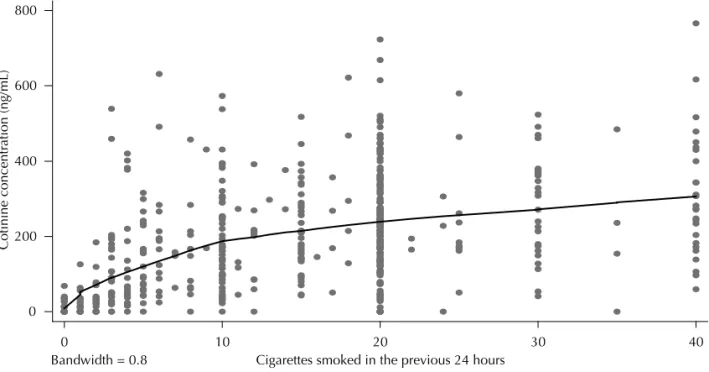
Two approximately straight lines with an infl ection point at about 20 cigarettes characterized the relation-ship between number of cigarettes smoked in the prior 24 hours and salivary cotinine concentration (Figure). The predicted slope was much steeper for subjects who reported smoking 1–20 cigarettes (8.0 ng/mL) than for those reporting more than 20 cigarettes (1 ng/mL).
Table 2 shows mean salivary cotinine concentrations according to selected variables, for two categories of number of cigarettes (1–20 and 21–40), and both before and after excluding those smoking 1–20 cigarettes with cotinine levels greater than 40 ng/mL (cot>40). The adjusted values refl ect simultaneous adjustment for the number of cigarettes as well as for all other variables shown in Table 2.
Although not statistically signifi cant at α=0.05, higher cotinine levels were consistently found for older com-pared to younger subjects and for men, comcom-pared to
women. No consistent or signifi cant differences were found for educational level.
Subjects with lower BMI (<24) had higher cotinine concentrations than those with higher BMI, and the adjusted difference was found to be signifi cant (p<0.05) after excluding smokers of 1–20 cigarettes with cot>40. Those who reported smoking their fi rst cigarette within
fi ve minutes after waking up had higher levels of sa-livary cotinine than those who waited longer than fi ve minutes before starting to smoke, and these differences were signifi cant for the adjusted values both before and after excluding persons with cot>40, and regardless of the category of number of cigarettes smoked (1–20 or >20).
Duration of smoking and depth of inhaling were not signifi cantly related to cotinine concentrations, but those subjects in the 1–20 cigarettes category who reported inhaling more frequently (>1/2 time) had a higher cotinine concentration than their counterparts, and the adjusted difference was found to be signifi cant before excluding those with cot>40. No consistent or signifi cant differences were seen with regard to type of cigarette (light vs. regular).
Because the slope for those smoking more than 20 cigarettes was very small and most subjects reported smoking 1–20 cigarettes, interactions were explored only for the 1–20 cigarettes category. Before excluding subjects with salivary cotinine >40 ng/mL per cigarette, statistically signifi cant interactions were seen between number of cigarettes and both waiting time after waking up until fi rst cigarette is smoked, and cigarette type. Not shown in the Table, the predicted increases in cotinine
Figure. Cotinine increase per cigarette smoked in the previous 24 hours. Rio de Janeiro, Southeastern Brazil, 2001. 0
200 400 600 800
Cotinine concentr
ation (ng/mL)
0 10 20 30 40
concentration per cigarette smoked (ng/mL) were found to be for the former variable: within fi ve minutes, 1.5; more than fi ve minutes, 8.3 (p for interaction =0.02); and for the latter variable: “light”, 7.9; regular, 2.6 (p for interaction=0.009). However, after exclusion of subjects whose salivary cotinine concentrations were greater than 40 ng/mL per cigarette, no signifi cant inte-ractions or important heterogeneities remained.
DISCUSSION
In the present and previous studies, the increase in co-tinine per cigarette smoked in the past 24 (or, in some studies, 48) hours seems to be particularly evident up to an infl ection point of about 20 cigarettes. Over this amount the slope noticeably decreases, which would indicate that cotinine is a weak predictor of the number of cigarettes in those individuals who smoke more than one pack per day.10,11,17 This fi nding suggests that
smokers satisfy their dependence-related craving with around 20 cigarettes per day. Also, corroborating pre-vious studies,8,9,13 marked inter-individual variability
was found in cotinine levels for the same number of cigarettes smoked (Figure).
A direct relationship of salivary cotinine was found with age, regardless of number of cigarettes, although it was not statistically signifi cant. Two previous studies have similarly found a weak association between age and cotinine levels.11,17 A weak or no association with
age found in the present and previous studies suggests that cotinine metabolism does not seem to change as individuals’ age.13,19
Mean cotinine levels were found to be higher in men, although not signifi cantly at α=0.05. Prior research has been inconsistent with regard to the relationship between cotinine and gender. In a recent study by Etter et al,11 (2000) males were found to have higher mean
concentration of salivary cotinine than women, regar-dless of the number of cigarettes, duration of smoking, nicotine yield, FTND index score, attempts to stop smoking in the past year, perceived diffi culty to quit smoking, and stage of change with regard to intention to quit smoking. Benowitz et al2 recently reported that
nicotine and cotinine are metabolized more rapidly in
women than men.More rapid metabolism may explain,
at least in part, the lower levels of cotinine seen in wo-men compared to wo-men in the present study. However, other studies have found that cotinine concentration per
cigarette smoked was similar in men and women.4
The concentration of cotinine was higher in subjects with lower BMI, even after multiple adjustment. The concentration of cotinine in the body varies according
to the daily intake of nicotine, the extent of conversion of nicotine to cotinine, and the rate of cotinine meta-bolism.5 That salivary cotinine appears to increase in
individuals who lose weight even while they continue smoking the same number of cigarettes suggests that either a great amount of nicotine is converted to coti-nine or that the rate of coticoti-nine metabolism is slower in individuals with lower BMI.16,21
In the present study, after controlling for the number of cigarettes smoked, the mean level of salivary cotinine was higher in subjects who reported smoking within
fi ve minutes after waking up than in those who reported waiting for a longer period. This fi nding and the positive correlation between Fagerström Tolerance Questionnai-re (FTQ) or FTND12 score and biochemical measures of
nicotine intake – like saliva or blood cotinine or blood nicotine – seen in other studies14,23 indicate that higher
levels of nicotine dependence can be associated with greater daily intake of nicotine, and therefore higher cotinine levels.
For the 1–20 cigarettes category, higher concentration of cotinine was seen in those who reported inhaling >1/2 time, with the adjusted difference found to be signifi cant – probably refl ecting increased absorption of nicotine – before excluding those with cot>40. Ho-wever, no signifi cant associations were found between cotinine concentration and depth of inhaling. A possible misclassifi cation bias related to depth of inhaling may explain this apparently inconsistent result.
No signifi cant association was found between cotinine concentration and duration, although among those re-porting 1–20 cigarettes in the past 24 hours, a pattern of higher mean levels of cotinine with longer duration of smoking (>25 years) was seen. In Etter et al11
stu-dy (2000) they reported a positive association with duration, which, however, disappeared after multiple adjustment.
The authors failed to fi nd differences in cotinine levels between those who reported smoking either “light” or regular yield cigarettes. Changes in cigarette design – such as ventilation holes in cigarette fi lters, more efficient filters, or more rapidly burning cigarette paper – are designed to decrease machine-determined measures of tar and nicotine. They result in changes in conscious or unconscious smoking behavior. These changes in smokers of “light” nicotine yield cigarettes include increased volume and frequency of puffs, and attempts at covering ventilation holes with fi nger or lips.20,* Benowitz & Jacob7 (1984) noted that low-yield
cigarette smokers smoked 25% more cigarettes, and absorbed 60% more nicotine per cigarette than
dicted by the Federal Trade Commission. According to Benowitz et al8 (1983), only about 4% to 5% of the
total serum cotinine variance can be explained by ni-cotine yield. Results of previous studies are, therefore, consistent with the authors’ failure to fi nd a difference in cotinine concentration between smokers of “light” and smokers of regular cigarettes.
For the analysis of interactions, there were excluded subjects smoking more than 20 cigarettes, in whom the increase in mean cotinine with increasing number of cigarettes was found to be negligible. In those smoking 1–20 cigarettes, two modifi ers of the effect of number of cigarettes on cotinine concentration were found. The fi rst one was a marker of addiction, which is the length of time individuals waits before smoking their
fi rst cigarette; and the second modifi er was the type of cigarette (“light” vs. regular cigarette). Stronger associations were seen in those who waited more than
fi ve minutes before smoking their fi rst cigarette and in those who reported smoking “light” cigarettes. These
fi ndings, which are consistent with a study conducted in China,17 suggest that these individuals adopt an adaptive
behavior, such as increasing the number of puffs or depth of inhaling, so as to reach a “satisfactory” level of nicotine while at the same time avoiding serious side effects. However, it is possible that the interac-tions found resulted from measurement error as they disappeared with the exclusion of subjects with cotinine levels greater than 40 ng/mL per cigarette.
The present study’s limitations included its reliance on information provided by subjects with regard to the independent variables. Whenever possible, further studies should try to validate subject information with objective measures, such as determination of nicotine yield using smoking machines. The study’s strengths included its population-based design, high participation rate, and stringent quality control measures.
In conclusion, the present study was the fi rst to assess determinants of cotinine concentration in a Brazilian population. Of practical public health importance, the marked racial admixture in Brazil and the consistency between this study’s fi ndings and those reported in populations with different ethnic backgrounds suggest that predictors of cotinine levels, especially number of cigarettes, are similar across different populations. The results of the present study showed that self-reports of
smoking fi ve minutes after waking up, and inhaling
1. Ahijevych KL, Wewers ME. Patterns of cigarette consumption and cotinine levels among African
American women smokers. Am J Respir Crit Care Med.
1994;150(5 Pt 1):1229-33.
2. Benowitz NL, Swan GL, Lessov CN, Jacob P 3rd. Oral contraceptives induce CYP2A6 activity and
accelerate nicotine metabolism. Clin Pharmacol Ther.
2004;75(2):36.
3. Benowitz NL, Pérez-Stable EJ, Herrea B, Jacob P 3rd. Slower metabolism and reduced intake of nicotine
from cigarette smoking in Chinese-Americans. J Natl
Cancer Inst. 2002;94(2):108-15.
4. Benowitz NL, Hatsukami D. Gender differences in
the pharmacology of nicotine addiction. Addict Biol.
1998;3(4):383-404.
5. Benowitz NL. Cotinine as a biomarker of
environmental tobacco exposure. Epidemiol Rev.
1996;18(2):188-204.
6. Benowitz NL, Jacob P 3rd, Denaro C, Jenkins R. Stable isotope studies of nicotine kinetics and bioavailability.
Clin Pharmacol Ther. 1991; 49(3):270-7.
7. Benowitz NL, Jacob P 3rd. Nicotine and carbon monoxide intake from high- and low-yield cigarettes.
Clin Pharmacol Ther. 1984;36(2):265-70.
8. Benowitz NL, Hall SM, Herning RI, Jacob P 3rd, Jones RT, Osman AL. Smokers of low-yield cigarettes do not
consume less nicotine. N Engl J Med.
1983;309(3):139-42.
9. Benowitz NL, Kuyt F, Jacob P 3rd. Circadian blood
nicotine concentrations during cigarette smoking. Clin
Pharmacol Ther.1982;32(6):758-64.
10. Caraballo RS, Giovino GA, Pechacek TF, Mowery PD, Richter PA, Strauss WJ, et al. Racial and ethnic differences in serum cotinine levels of cigarette smokers. Third National Health and Nutrition Examination
Survey 1988-1991. JAMA. 1998;280(2):135-9.
11. Etter JF, Vu Duc T, Perneger TV. Saliva cotinine
level in Smokers and nonsmokers. Am J Epidemiol.
2000;151(3):251-8.
12. Fagerstrom KO. Measuring degree of physical dependency to tobacco smoking with reference to
individualization of treatment. Addict Behav.
1978;3(3-4):235 -41.
13. Gourlay SG, Benowitz NL, Forbes A, McNeil JJ. Determinants of plasma concentrations of nicotine and cotinine during cigarette smoking and
transdermal nicotine treatment. Eur J Clin Pharmacol.
1997;51(5):407-14.
14. Heartheton TF, Kozlowski LT, Frecker RC, Fagerström KO. The Fagerström Test for Nicotine Dependence: a
revision of the Fagerström Tolerance Questionnaire. Br
J Addict. 1991;86(9):1119-27.
15. Herning RI, Jones RT, Benowitz NL, Mines AH. How a cigarette is smoked determines nicotine blood levels.
Clin Pharmacol Ther.1983;33(1):84-90.
16. Istvan JA, Nides MA, Buist AS, Greene P, Voelker H. Salivary cotinine, frequency of cigarette smoking, and body mass index: fi ndings at baseline in the Lung
Health Study. Am J Epidemiol. 1994;139(6):628-36.
17. Jaakkola MS, Ma J, Yang G, Chin MF, Benowitz NL, Ceraso M, et al. Determinants of salivary cotinine
concentrations in Chinese male smokers. Prev Med.
2003;36(3):282-90.
18. Jacob P 3rd, Wilson M, Benowitz NL. Improved gas chromatography method for the determination of
nicotine and cotinine in biologic fl uids. J Chromatogr.
1981;222(1):61-70.
19. Molander L, Hansson A, Lunell E. Pharmacokinetics
of nicotine in healthy elderly people. Clin Pharmacol
Ther. 2001;69(1):57-65.
20. Nakayama T, Yokoyama T, Yoshiike N, Ichimura T, Yamamoto A, Tanaka H. Behavioral factors predicting serum cotinine concentrations of male smokers in a
Japanese community. J Epidemiol. 1999;9(3):143-5.
21. Niaura R, Clark MM, Raciti MA, Pera V, Abrams DB. Increased saliva cotinine concentrations in smokers
during rapid weight loss. J Consult Clin Psychol.
1992;60(6):985-7.
22. Pérez Stable EJ, Herrera B, Jabob P 3rd, Benowitz NL. Nicotine metabolism and intake in black and white
smokers. JAMA. 1998;280(2):152-6.
23. Prokhorov AV, Moor C, Pallonen UE, Hudmon KS, Koehly L, Hu S. Validation of the modifi ed Fagerström tolerance questionnaire with salivay cotinine among
adolescents.Addict Behav. 2000;25(3):429-33.
REFERENCES