Camilla Alexsandra SchneckI
Maria Luiza Gonzalez RiescoII
Isabel Cristina BonadioII
Carmem Simone Grilo DinizIII
Sonia Maria Junqueira Vasconcellos de OliveiraII
I Curso de Obstetrícia. Escola de Artes, Ciências e Humanidades. Universidade de São Paulo (USP). São Paulo, SP, Brasil II Departamento de Enfermagem
Materno-Infantil e Psiquiátrica. Escola de Enfermagem. USP. São Paulo, SP, Brasil III Departamento de Saúde Materno Infantil.
Faculdade de Saúde Pública. USP. São Paulo, SP, Brasil
Correspondence: Camilla Alexsandra Schneck
Escola de Artes, Ciências e Humanidades da USP
R. Dr. Arlindo Bettio, 1000 03828-000 São Paulo, SP, Brasil E-mail: [email protected] Received: 4/24/2011 Approved: 9/20/2011
Article available from: www.scielo.br/rsp
Maternal and neonatal
outcomes at an alongside birth
center and at a hospital
ABSTRACT
OBJECTIVE: To compare maternal and neonatal outcomes in low-risk women assisited in an alongside birth center and at a hospital.
METHODS: A cross-sectional study was conducted with a representative sample of low-risk women in São Paulo (Southeastern Brazil), from 2003 to 2006. The study included 991 women who delivered a child at the alongside birth center and 325 who delivered a child at a hospital. Data were obtained from medical records. A comparative analysis was performed for all of the women, who were stratifi ed according to parity. The chi-square test and Fisher’s exact test were used to compare outcomes between women who delivered in alongside birth center and those who gave birth in the hospital.
RESULTS: There was a homogeneous distribution of women according to parity (45.4% were nulliparous, and 54.6% had one or more previous deliveries). Statistically signifi cant differences were found in the frequency of amniotomy (more frequent in nulliparous women treated at the hospital), the use of oxytocin during labor, and the use of postpartum analgesia (both more frequent among women of any parity treated at the hospital). The rate of episiotomy was higher in nulliparous women, both in the alongside birth center and at the hospital. Neonatal interventions were more frequent at the hospital and included aspiration of the upper airways, gastric aspiration, gastric lavage, and the use of an open oxygen mask. Other events that occurred with greater frequency at the hospital included caput succedaneum, respiratory discomfort, and admittance to the neonatal unit. There was no difference in Apgar scores at the fi fth minute or cases of maternal or perinatal death.
CONCLUSIONS: Care at the alongside birth center involved fewer interventions and had maternal and neonatal outcomes similar to those of the hospital setting.
DESCRIPTORS: Natural Childbirth. Perinatal Care. Maternal-Child Health Services. Outcome Assessment (Health Care). Cross-Sectional Studies. Birthing Centers.
INTRODUCTION
Some commonly used practices in the childbirth care setting are supposed to enhance the quality of care but have not undergone scientifi c evaluation of their effectiveness or safety. Since the 1970s, the number of interventions performed during the birth process in hospitals has increased, with the objective of conforming to institutional standards. This practice has resulted in a high number of cesarean sections (C-sections), active management of labor, routine performance of episiotomies, and an absence of a birth companion.4
in the increasing maternal and perinatal mortality rates. Despite advances in knowledge and the increasing use of technology to care for women during labor and neonates, no corresponding improvement in health indicators was observed.
The 1990s were therefore characterized by the develop-ment of public health policies that aimed to decrease the number of C-sections by changing obstetrics practices
and improving childbirth care in the Sistema Único
de Saúde (SUS– Unifi ed Health System).5,15 One of
these measures included the creation of Birth Centers
(BC) (known as Centro de Parto Normal) by law nº
985/1999.a These centers provide childbirth care outside
of the hospital setting.
The BC model is designed to provide care for natural delivery without dystocia. The centers fi t within the local health system and can function either inside or outside of the hospital. When located outside of the hospital setting, the BC has access to the hospital for further care with a delay of no more than one hour.
BCs have high patient satisfaction rates and can reduce unnecessary interventions. Available data do not show a significant difference in maternal and perinatal mortality and morbidity between in- and out-of-hospital births.9,11,13,18,20
BCs have been in operation for ten years in Brazil, and descriptive data on this model are available only now.8,14,16 Preliminary data indicate a need to create
instruments and analytical indicators to assess the safety and viability of BCs among the different models of childbirth assitance.18
This study aimed to compare maternal and neonatal outcomes among straightforward pregnant women assisted in alongside birth centers (ABC, located outside a general hospital) and and in hospital setting.
METHODS
This was a cross-sectional study performed at an ABC. The general hospital provides obstetric care at all levels of complexity and serves as a referral center for the ABC and the primary healthcare units of health (UBS). The ABC caters to low-risk pregnant women referred by the UBS. Both centers belong to the network of services provided by the SUS of the Department of Health of the state of São Paulo and are administered by the same social health organization.
The ABC guideline defi nes several admission criteria, including single pregnancy with a live fetus; gestational age between 37 and 41 weeks; absence of clinical or
a Ministério da Saúde (BR). Portaria n. 985/GM, de 5 de agosto de 1999. Cria o Centro de Parto Normal-CPN, no âmbito do Sistema Único de Saúde. Brasília (DF); 1999 [cited 2009 Aug 24]. Available from: http://pnass.datasus.gov.br/documentos/normas/45.pdf
obstetric complications; no previous uterine surgeries, including C-sections; and normal results of prenatal laboratory testing.
The eligible population consisted of pregnant women who delivered at the ABC (n = 2,977) or at the hospital (n = 15,511) from 2003 to 2006. The women were grouped according to the place of birth assitance in a mutually exclusive manner. The inclusion criteria for the women who delivered at the hospital were the same as for the women at the ABC, i.e., eligible women delivering at the hospital would also have been eligible for delivery at the ABC. This criterion ensured that women from similar risk categories would be enrolled at both the ABC and the hospital.
For sample size calculations, the difference in the proportion of women with episiotomy in both settings, as estimated by a pilot study, was used as a parameter.
Episiotomy was chosen because it is a signifi cant
indicator of obstetric practices and is usually registered accurately in the patient chart. Given the reported episiotomy rates of 35% in the hospital and 25% in the ABC, there was a possibility of a 10% reduction in the episiotomy rates in the ABC with respect to the hospital.
The detection of this difference considered an error given by = 0.05. The test power was 90%, and a ratio of 1:3 individuals between the two groups was needed. The calculation of the sample size was performed with the Power and Sample Size Calculation (version 3.0®) software.7 Given these parameters, the minimum
number of individuals necessary (n) was 295 at the hospital (nH) and 886 at the ABC (nABC). To account for the typical loss of data arising from secondary issues such as misplaced or incomplete patient charts, the required number of participants was increased by 15%. Thus, the calculated sample size was 339 for the hospital and 1,018 for the ABC.
Because the proportion of women at the hospital who were considered to be eligible for this study was esti-mated to be 33% of the total women seen, it was neces-sary to calculate the number of charts that would be randomly chosen. The corrected number was nH = 1,027 (339/0.33), which was the necessary number of sample units to be consulted at the hospital to obtain the n indi-cated in the sample size calculations. Because only one woman delivering at the hospital was needed for every three women delivering at the ABC, a smaller number of women needed for the hospital group. Therefore, the size of the initial sample for the hospital was defi ned as nH = 1,027 and the fi nal sample as nH = 339.
study. For the ABC , 991 out of the 1,018 charts required were located. Finally, 325 women from the hospital and 991 from the ABC were included in the study, resulting in a total of 1,316 women.
To obtain the sample, a registry was developed that consisted of the sequence of deliveries listed in the delivery records of the hospital and the ABC, and the women were selected via systematic sampling, consid-ering the proportion of deliveries in the period when the study was conducted.
The charts of the women and their respective newborns were used as the data source. The data were collected via a pretested instrument and stored with double data entry in the EpiInfosoftware, version 2000®.
The variables evaluated for this study included the place of birth; sociodemographic characteristics and maternal conditions at admission; newborn conditions; and the use of interventions at the time of delivery and during initial peri-natal care. Analyses were performed using the contents of the medical records; data that could not be obtained by chart review were not included.
The variables were analyzed according to parity because parity can affect the course of labor and infl uence interventions during childbirth. Signifi cant differences in the physiology of labor exist between nulliparous and multiparous women.
Analyses of the differences between the variables in both settings were performed using chi-squared analysis and Fisher’s exact test, with p < 0.05 estab-lished as statistically signifi cant. Statistical analyses were performed using SAS for Windows, Version 9.0.
The project was approved by the Ethics Committee in Research of the Itaim Paulista General Hospital, under protocol number 50, on April 19th, 2006.
RESULTS
The results refer to 1,316 women and their respective newborns. Of these patients, 991 were seen at the ABC and 325 at the hospital. There was no signifi cant difference in the parity of women who delivered at the ABC versus at the hospital (p = 0.2202); 54.6% of the women were nulliparous, and 45.4% were multiparous, as shown in Table 1.
The amniotomy rate was signifi cantly higher in the
hospital among all women (p < 0.0001), nulliparous women (p = 0.0009), and multiparous women (p = 0.0195). The amniotomy rates varied from 71.1% among nulliparous women at the ABC to 88% for nulliparous women at the hospital (Table 2).
The use of oxytocin during labor was more frequent among women delivering at the hospital (p < 0.0001)
for women of all parities. Among nulliparous women, oxytocin was administered in 50.6% of women at the hospital and in 26.7% at the ABC. Postpartum analgesia was utilized in 97.1% of women at the hospital and in 22.4% at the ABC. Oxytocin was only used at the ABC in 2003 and 2004, and its use was discontinued at the ABC after 2005 (Table 2).
There was a statistically signifi cant difference in the use of perineal management techniques between the ABC and the hospital for all women (p = 0.0486) and among multiparous women (p = 0.0109). Episiotomy was performed more frequently in the hospital than
in the ABC (32.9% vs. 25.7%) in all women and in
multiparous women (20.4% vs. 11.7%). The rate of
episiotomy was greater among nulliparous women at the ABC and at the hospital (41.9% and 49.7%, respectively). Thirty-three charts lacked data about the management of the perineum during labor (Table 3).
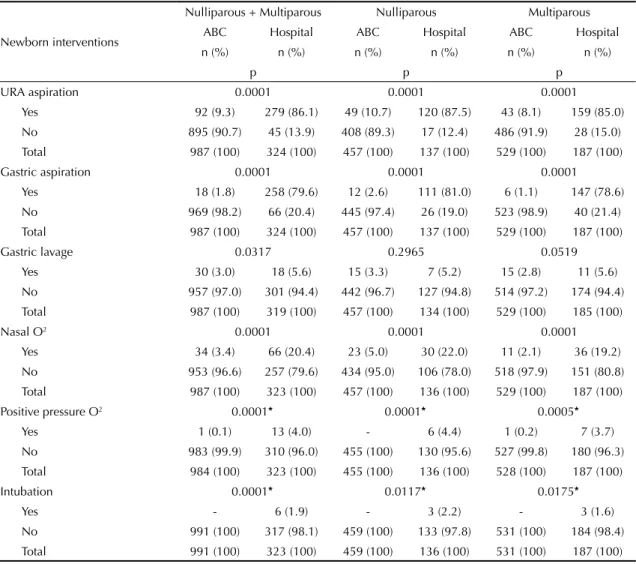
All of the interventions during the perinatal period
were signifi cantly different between the ABC and
the hospital. This difference was observed when the women were analyzed as a whole and when the women were divided into groups according to parity. The only exception, gastric lavage, differed signifi cantly between the two settings only when the entire sample of women was analyzed (p = 0.0317). At the hospital, more than 85% of babies received upper respiratory tract aspiration; at the ABC, only 10.7% of newborns received this intervention. Approximately 80% of the newborns at the hospital underwent gastric aspiration, which was performed in only 1.8% of babies born at the ABC. The administration of oxygen by open face-mask occurred in approximately 20% of newborns at the hospital but only 2.1%–5% of the newborns at the ABC. The rates of these procedures were signifi cantly different between the ABC and the hospital for all women, nulliparous women, and multiparous women, as shown in Table 4.
There was a statistically signifi cant difference in the Apgar score for the fi rst minute of life, with babies
born at the ABC having a signifi cantly lower Apgar
score < 7 at the fi rst minute. However, the fraction of babies with a score less than seven at the fi rst minute did not exceed 5.8%, which was the rate seen among babies born to nulliparous women at the hospital. There was no signifi cant difference in the Apgar scores at
fi ve minutes between babies born at the ABC and at
was in babies born to nulliparous women at the hospital (23.4%), and the lowest rate was in babies born to multiparous women at the ABC (2.1%). There was a statistically signifi cant difference in these rates when the women were analyzed as a group and separately according to parity, as shown in Table 5
DISCUSSION
In the hospital setting, more interventions are performed when assisting women and newborns during delivery. However, equivalent maternal and perinatal results were observed in both settings.
Table 1. Sociodemographic characteristics of pregnant women according to place of birth and parity. São Paulo, Southeastern Brazil, 2003-2006.
Sociodemographic characteristics
Nulliparous + Multiparous Nulliparous Multiparous ABC Hospital ABC Hospital ABC Hospital
n (%) n (%) n (%) n (%) n (%) n (%)
p p p
Age (years) 0.8605 0.3229 0.8975
11 ├ 20 268 (27.2) 94 (29.3) 216 (47.4) 76 (55.1) 528 (9.9) 18 (9.8) 20 ├ 25 345 (35.1) 113 (35.2) 169 (37.0) 47 (34.0) 176 (33.4) 66 (36.1) 25 ├30 204 (20.7) 61 (19.0) 53 (11.4) 10 (7.2) 151 (28.8) 51 (27.9) 30 167 (17.0) 53 (16.5) 18 (4.2) 5 (3.7) 147 (27.9) 48 (26.2) Total 984 (100) 321 (100) 456 (100) 138 (100) 527 (100) 183 (100)
Schooling (years) 0.0510 0.1166 0.2393
None 8 (0.8) 6 (1.9) 3 (0.7) 1 (0.7) 5 (0.9) 5 (2.7) 1 ├ 8 220 (22.6) 75 (23.1) 57 (12.7) 13 (9.4) 163 (31.2) 62 (33.2) 8 ├ 12 714 (73.2) 241 (74.2) 371 (82.9) 123 (89.1) 342 (65.5) 118 (63.1) 12 33 (3.4) 3 (0.9) 21 (4.7) 1 (0.7) 12 (2.3) 2 (1.1) Total 975 (100) 325 (100) 452 (100) 138 (100) 522 (100) 187 (100)
Partner 0.0003 0.0657 0.0006
Yes 399 (40.8) 170 (52.3) 216 (47.6) 78 (56.5) 183 (34.9) 92 (49.2) No 579 (59.2) 155 (47.7) 238 (52.4) 60 (43.5) 341 (65.1) 95 (50.8) Total 978 (100) 325 (100) 454 (100) 138 (100) 524 (100) 187 (100)
Paid employment 0.0966 0.0402 0.5955
Yes 252 (25.6) 68 (21.0) 107 (23.5) 21 (15.3) 144 (27.3) 47 (25.3) No 731 (74.4) 255 (79.0) 347 (76.5) 116 (84.7) 384 (72.7) 139 (74.7) Total 983 (100) 323 (100) 454 (100) 137 (100) 528 (100) 186 (100)
Tobacco use 0.1414 0.6133 0.1959
Yes 114 (11.5) 47 (14.6) 37 (8.0) 13 (9.4) 77 (14.6) 34 (18.6) No 874 (88.5) 274 (85.4) 422 (92.0) 125 (90.6) 452 (85.4) 149 (81.4) Total 988 (100) 321 (100) 459 (100) 138 (100) 529 (100) 183 (100)
Drugs 0.9843* 0.9120* 0.0800*
Yes 8 (1.0) 7 (2.1) 5 (1.1) 3 (2.2) 3 (0.6) 4 (2.1) No 978 (99.0) 317 (97.9) 454 (99.0) 135 (97.8) 524 (99.4) 182 (97.9) Total 986 (100) 324 (100) 459 (100) 138 (100) 527 (100) 186 (100) Prenatal consultations <0.0001 <0.0001 <0.0001
1 to 3 65 (6.8) 49 (15.7) 21 (4.7) 13 (9.6) 44 (8.6) 36 (20.4) 4 to 6 739 (76.8) 172 (55.1) 343 (76.6) 78 (57.8) 395 (77.0) 94 (53.1) 7 or more 158 (16.4) 91 (29.2) 84 (18.7) 44 (32.6) 74 (14.4) 47 (26.5) Total 962 (100) 312 (100) 450 (100) 135 (100) 513 (100) 177 (100) ABC: alongside birth center
Table 2. Obstetric conditions at admission, interventions during delivery, and medications used in women according to place of birth and parity. São Paulo, Southeastern Brazil, 2003-2006.
Variable
Nulliparous + Multiparous Nulliparous Multiparous ABC Hospital ABC Hospital ABC Hospital
n (%) n (%) n (%) n (%) n (%) n (%)
p p p
Cervical dilation (cm) 0.0156 0.0166 0.3640
0 ├ 5 403 (43.4) 105 (35.5) 231 (52.0) 53 (40.1) 172 (35.6) 52 (31.7) 5 ├ 10 525 (56.6) 191 (64.5) 213 (48.0) 79 (59.9) 311 (64.4) 112 (68.3) Total 928* (100) 296 (100) 444 (100) 132 (100) 483 (100) 164 (100)
Amniotic sac 0.0137 0.0640 0.1055
Intact 764 (77.8) 231 (71.1) 360 (78.6) 98 (71.0) 403 (77.1) 133 (71.1) Ruptured 218 (22.2) 94 (28.9) 98 (21.4) 40 (29.0) 120 (22.9) 54 (28.9) Total 982 (100) 325 (100) 458 (100) 138 (100) 523 (100) 187 (100)
EFM 0.1649 0.3844 0.1888
Yes 45 (4.6) 21 (6.5) 30 (6.5) 12 (8.7) 15 (2.8) 9 (4.8) No 946 (95.4) 303 (93.5) 429 (93.5) 126 (91.3) 516 (97.2) 177 (95.2) Total 991 (100) 324 (100) 459 (100) 138 (100) 531 (100) 186 (100)
Amniotomya <0.0001 0.0009 0.0195
Yes 477 (71.3) 175 (84.5) 234 (71.1) 81 (88.0) 242 (71.4) 94 (82.5) No 192 (28.7) 31 (15.0) 95 (28.9) 11 (12.0) 97 (28.6) 20 (17.5) Total 669 (100) 206 (100) 329 (100) 92 (100) 339 (100) 114 (100) Food intake <0.0001* <0.0001* <0.0001*
Non-restricted 986 (99.7) 279 (86.7) 458 (100) 122 (88.4) 527 (99.4) 157 (88.3) Restricted 3 (0.3) 43 (13.3) - 161 (1.6) 3 (0.6) 27 (14.7) Total 989 (100) 322 (100) 458 (100) 138 (100) 530 (100) 184 (100)
Oxytocinc <0.0001 <0.0001 <0.0001
Yes 158 (23.6) 83 (47.2) 87 (26.7) 41 (50.6) 71 (20.6) 42 (44.2) No 512 (76.4) 93 (52.8) 238 (73.3) 40 (49.4) 273 (79.4) 53 (55.8) Total 670 (100) 176 (100) 325 (100) 81 (100) 344 (100) 95 (100)
BGP <0.0001 <0.0001 <0.0001
Yes 26 (3.9) 47 (26.7) 14 (4.3) 28 (34.6) 12 (3.5) 19 (20.0) No 644 (96.1) 129 (73.3) 311 (95.7) 53 (65.4) 332 (96.5) 76 (80.0) Total 670 (100) 176 (100) 325 (100) 81 (100) 344 (100) 95 (100)
Ergometrine <0.0001 <0.0001 <0.0001
Yes 26 (3.9) 58 (33.7) 7 (2.2) 25 (31.2) 19 (5.5) 33 (35.1) No 644 (96.1) 116 (66.7) 318 (97.5) 55 (68.8) 325 (94.5) 61 (64.9) Total 670 (100) 174 (100) 325 (100) 80 (100) 344 (100) 94 (100) Postpartum analgesia <0.0001 <0.0001 <0.0001
Yes 150 (22.4) 169 (97.1) 55 (16.9) 78 (97.5) 95 (27.6) 91 (96.8) No 520 (77.6) 5 (2.9) 270 (83.1) 2 (2.5) 249 (72.4) 3 (3.2) Total 670 (100) 174 (100) 325 (100) 80 (100) 344 (100) 94 (100)
ABC: alongside birth center EFM: electronic fetal monitoring BGP: Buscopan® + Plasil® + glucose
a 218 women who were admitted with ruptured sacs and 104 with a non-informed rupture were excluded b Included all different records of non-restricted “free” diets
Table 3. Conditions at placental expulsion and in the postpartum period according to the place of birth and parity of the mother. São Paulo, Southeastern Brazil, 2003-2006.
Variable
Nulliparous + Multiparous Nulliparous Multiparous ABC Hospital ABC Hospital ABC Hospital n (%) n (%) n (%) n (%) n (%) n (%)
p p p
Perineal conditions 0.0486 0.2345 0.0109
Intact or 1st degree laceration 640 (66.8) 191 (60.5) 226 (51.0) 57 (42.2) 414 (80.5) 134 (74.1)
2nd or 3rd degree lacerationsa 72 (7.5) 21 (6.6) 32 (7.2) 11 (8.1) 40 (7.8) 10 (5.5)
Episiotomyb 246 (25.7) 104 (32.9) 185 (41.8) 67 (49.7) 60 (11.7) 37 (20.4)
Total 958 (100) 316 (100) 443 (100) 135 (100) 514 (100) 181 (100)
Placental expulsion 0.8933* 0.7730* 0.9447*
Spontaneous 983 (99.5) 318 (99.1) 454 (99.4) 135 (99.3) 528 (99.6) 183 (98.9) Manual removal 5 (0.5) 3 (0.1) 3 (0.6) 1 (0.7) 2 (0.4) 2 (1.1) Total 988 (100) 321 (100) 457 (100) 136 (100) 530 (100) 185 (100)
Vaginal bleeding 0.0882* 0.1201* 0.3700*
Physiologic 939 (94.9) 315 (96.9) 439 (96.1) 136 (98.5) 499 (94.0) 179 (95.7) Enhanced 50 (5.1) 10 (3.1) 18 (3.9) 2 (1.5) 32 (6.0) 8 (4.3) Total 989 (100) 325 (100) 457 (100) 138 (100) 531 (100) 187 (100) ABC: alongside birth center
a There was one 3rd degree laceration at the hospital b Median-lateral and Median episiotomy
* Fisher’s exact test
The sociodemographic characteristics may be different among women who choose to deliver at a birth center compared with women who decide to have their babies utilizing traditional services. However, the population of regional SUS users was homogenous, with the exception of marital status, paid employment status, and number of antenatal consultations.
A larger proportion of pregnant women was admitted with a cervical dilation of between five and nine centimeters at the hospital than at the ABC. However, it is expected that women would be more likely to be admitted to the ABC during the active phase of labor.
The use of oxytocin to correct or accelerate uterine contractions during the fi rst stage of labor was stopped at the ABC in 2005. From 2003 to 2004, the propor-tion of oxytocin use observed in this study was lower than that previously found in free-standing birth center (33.7%) in São Paulo16 and similar to that of
an free-standing birth center (24%) in Juiz de Fora
(Southeastern Brazil).8 In some ABCs, the need to
accelerate labor with oxytocin is considered to be grounds for transferring the woman to the referral hospital, as was the case with the ABC in this study.
A systematic review of nine clinical trials with 10,684 women summarized the maternal and perinatal results in the ABC and in traditional hospital settings but did
not include studies in free-standing birth centers. The women allocated to the ABC had a reduced likelihood of undergoing interventions, including labor accelera-tion (RR = 0.78, 95%CI 0.66;0.91), episiotomy (RR = 0.83, 95%CI 0.77;0.90), instrumental birth (RR = 0.89, 95%CI 0.79;1.00), and C-section (RR = 0.89, 95%CI 0.78;1.01). The risk of uterine hemorrhage was also lower in the ABC (RR = 0.98, 95%CI 0.85;1.14).9
The rate of episiotomy among all women (nulliparous and multiparous) in both settings (25.7% at the ABC and 32.9% at the hospital) was less than that estimated for the sample size calculations but remains clinically relevant.
The rate of episiotomy at the ABC in this study was similar to that encountered at the BC in Juiz de Fora (24.7%)8 and higher than the rate reported at the BC
in São Paulo (15.2%). Both of these centers were free-standing birth centers.16 At the in-hospital BC in
São Paulo, an episiotomy rate of 26.6% was reported among women at all risk levels.19 An episiotomy rate
of 40.4% was reported in a setting that cared for all
women in labor on demand. However, these fi gures
cannot be used as a reference for high-risk patients.2
episiotomy was 71.6%; the Southwest (80.3%), Central-West (78.8%), and South (78.5%) regions had the highest episiotomy rates.b
Approximately 97% of the women at the hospital received postpartum analgesia, compared with 16.9% of nulliparous women and 27.6% of multiparous women at the ABC. These data suggest that women delivering at the hospital routinely received postpartum analgesia.
Pain from perineal trauma can negatively infl uence
post-partum activities by affecting the physical, psycho-logical, and social well-being of women, interrupting breast-feeding, and interfering with family life and sexual intercourse.
Several studies of different ABCs throughout the country have reported that more than 95% of newborns had Apgar scores > 6 at the fi fth minute after birth.2,3,8,19
A systematic review of care in ABCs did not fi nd a signifi cant difference in the rates of Apgar scores < 7 in the fi fth minute after birth (OR = 0.98, 95%CI
0.69;1.40).9 Two other studies in the ABC setting
reported that 1% of newborns had Apgar scores < 7 at the
fi fth minute after birth, and 93% and 98% of the babies had Apgar scores of 7 to 10 at the fi rst and fi fth minutes after birth, respectively.6,17 In Brazil, a study showed a
reduction in the proportion of babies with Apgar scores < 7 at the fi fth minute (2.1% to 1.1%) after implementation
of a ABC (OR = 0.55; 95%CI 0.27;1.14).c
Table 4. Interventions used in immediate care of newborns according to place of birth and parity of the mother. São Paulo, Southeastern Brazil, 2003-2006.
Newborn interventions
Nulliparous + Multiparous Nulliparous Multiparous ABC Hospital ABC Hospital ABC Hospital n (%) n (%) n (%) n (%) n (%) n (%)
p p p
URA aspiration 0.0001 0.0001 0.0001
Yes 92 (9.3) 279 (86.1) 49 (10.7) 120 (87.5) 43 (8.1) 159 (85.0) No 895 (90.7) 45 (13.9) 408 (89.3) 17 (12.4) 486 (91.9) 28 (15.0) Total 987 (100) 324 (100) 457 (100) 137 (100) 529 (100) 187 (100)
Gastric aspiration 0.0001 0.0001 0.0001
Yes 18 (1.8) 258 (79.6) 12 (2.6) 111 (81.0) 6 (1.1) 147 (78.6) No 969 (98.2) 66 (20.4) 445 (97.4) 26 (19.0) 523 (98.9) 40 (21.4) Total 987 (100) 324 (100) 457 (100) 137 (100) 529 (100) 187 (100)
Gastric lavage 0.0317 0.2965 0.0519
Yes 30 (3.0) 18 (5.6) 15 (3.3) 7 (5.2) 15 (2.8) 11 (5.6) No 957 (97.0) 301 (94.4) 442 (96.7) 127 (94.8) 514 (97.2) 174 (94.4) Total 987 (100) 319 (100) 457 (100) 134 (100) 529 (100) 185 (100)
Nasal O2 0.0001 0.0001 0.0001
Yes 34 (3.4) 66 (20.4) 23 (5.0) 30 (22.0) 11 (2.1) 36 (19.2) No 953 (96.6) 257 (79.6) 434 (95.0) 106 (78.0) 518 (97.9) 151 (80.8) Total 987 (100) 323 (100) 457 (100) 136 (100) 529 (100) 187 (100) Positive pressure O2 0.0001* 0.0001* 0.0005*
Yes 1 (0.1) 13 (4.0) - 6 (4.4) 1 (0.2) 7 (3.7)
No 983 (99.9) 310 (96.0) 455 (100) 130 (95.6) 527 (99.8) 180 (96.3) Total 984 (100) 323 (100) 455 (100) 136 (100) 528 (100) 187 (100)
Intubation 0.0001* 0.0117* 0.0175*
Yes - 6 (1.9) - 3 (2.2) - 3 (1.6)
No 991 (100) 317 (98.1) 459 (100) 133 (97.8) 531 (100) 184 (98.4) Total 991 (100) 323 (100) 459 (100) 136 (100) 531 (100) 187 (100) ABC: alongside birth center
URA: Upper respiratory airways * Fisher’s exact test
Table 5. Apgar score and newborn conditions according to place of birth and parity of the mother. São Paulo, Southeastern Brazil, 2003-2006.
Variable
Nulliparous + Multiparous Nulliparous Multiparous ABC Hospital ABC Hospital ABC Hospital n (%) n (%) n (%) n (%) n (%) n (%)
p p p
Apgar, 1st minute of life < 0.0001* 0.0002* 0.0158* < 7 4 (0.4) 13 (4.0) 2 (0.4) 8 (5.8) 2 (0.4) 5 (2.7) 7 977 (99.6) 312 (96.0) 455 (99.6) 130 (94.2) 521 (99.6) 182 (97.3) Total 981 (100) 325 (100) 457 (100) 138 (100) 523 (100) 187 (100) Apgar, 5th minute of life 0.1547* 0.9465* 0.2634*
< 7 1 (0.1) 2 (0.6) 1 (0.2) 1 (0.7) - 1 (0.5)
7 980 (99.9) 323 (99.4) 456 (99.8) 137 (99.3) 523 (100) 186 (99.5) Total 981 (100) 325 (100) 457 (100) 138 (100) 523 (100) 187 (100)
Caput succedaneum 0.0001 0.0069 0.0001
Yes 74 (7.5) 56 (17.3) 63 (13.7) 32 (23.4) 11 (2.1) 24 (12.8) No 917 (92.5) 268 (82.7) 396 (86.3) 105 (76.6) 520 (97.9) 163 (87.2) Total 991 (100) 324 (100) 459 (100) 137 (100) 531 (100) 187 (100)
Clavicular fracture 0.7534* 0.7701* -* *
Yes 1 (0.1) - 1 (0.2) - -
-No 989 (99.9) 324 (100) 458 (99.8) 137 (100) 530 (100) 187 (100) Total 990 (100) 324 (100) 459 (100) 137 (100) 530 (100) 187 (100)
Respiratory discomfort 0.0001 0.9932* 0.0001*
Yes 15 (1.5) 20 (6.2) 11 (2.4) 9 (6.6) 4(0.8) 11 (5.9) No 974 (98.5) 304 (93.8) 446 (97.6) 128 (93.4) 527 (99.2) 176 (94.1) Total 989 (100) 324 (100) 457 (100) 137 (100) 531 (100) 187 (100) Admission to neonatal unit 0.0001 0.0042* 0.006*
Yes 14 (1.4) 18 (5.6) 9 (1.2) 10 (7.3) 5 (1.0) 8 (4.3) No 976 (98.6) 306 (94.4) 449 (98.0) 127 (92.7) 526 (99.0) 179 (95.7) Total 990 (100) 324 (100) 458 (100) 137 (100) 531 (100) 187 (100) ABC: alongside birth center
* Fisher’s exact test
* * It was not possible to calculate the p-value because one or more expected values were equal to zero
When interpreting the results of this study, it is impor-tant to consider the differences and similarities among the models of assistance and the particular characteris-tics of each setting. Furthermore, some limitations are inherent to the observational design; other limitations are related to the use of data originating from secondary sources.
Högberg10 (2008) emphasizes the fragility of
retro-spective observational studies that compare the results of deliveries performed at home and at the hospital, referring to the possibility of the introduction of an auto-selection bias or “healthy mother effect.” This effect refers to the possibility that the self-referral of healthier women to alternative settings can modify the clinical results seen in these centers compared with the
hospital setting. The hypothesis that there are differ-ences in the profi le of women who choose to deliver in alternative settings rather than the hospital still must be investigated.
Another factor that must be considered when comparing birth centers and hospital settings is the admission criteria, which can vary greatly among studies or, in many cases, is not stated.
Another limitation of the present study is that it did not include women and newborns needing transfer to the hospital. A study performed at the same institu-tion among newborns transferred from the ABC to the hospital in 2006 and 2007 did not show any increase in mortality or other adverse sequelae.d Another study at
a free-standing BC in São Paulo observed a neonatal
mortality of 1:1.000 live births; 1.1% of all newborns required transfer to the hospital.12 A systematic review
by Hodnett et al9 (2010) showed a RR = 1.67 (95%CI
0.93;3.00) for perinatal mortality at the ABC compared with the hospital setting, but the difference was not statis-tically signifi cant. Unnecessary interventions performed in hospital deliveries are termed “overtreatment” by Albers1 (2005). Albers1 argues that such overtreatment
does not alter the maternal and perinatal results and questions the aim of such interventions in studies that compare the results of hospital deliveries with those performed outside of the hospital.11 Our data support
this previous study and show that although the rates of intervention were higher in the hospital setting, the two settings had similar maternal and perinatal outcomes.
Longitudinal studies that include follow-up evalua-tions of the women who delivered in the ABC and in the hospital, including patients who were transferred, are needed. Clinical evaluations should be performed to compare models of assistance in which nurses-midwives and nurses-midwives have the primary responsibility for the care of low-risk women, from antenatal care to the postpartum period.18
This study is not an evaluation of service quality, but it indicates certain advantages of the ABC compared with the hospital. The hospital and the ABC were compared
to evaluate the safety of the ABC model for low-risk women. The safety of the ABC is the most frequently questioned aspect of this model amongst professionals, stakeholders, and patients. However, hospitals and ABCs can both use interventions in a safe and directed manner to accompany physiologic labor among women with straightforward pregnancies.
This philosophy converges with the SUS’s principle of equity, in which resources are assigned according to complexity. When childbirth is considered a physiological event, the logic of resource allocation is inverted. This policy does not indicate the omission of assistance to women; on the contrary, childbirth care and health promotion can be brought closer to the community. This model situates childbirth at the level of primary clinical care.
1. Albers LL. Overtreatment of normal childbirth in U.S. hospitals. Birth. 2005;32(1):67-8. DOI:10.1111/j.0730-7659.2005.00343.x
2. Barbosa da Silva FM, Koiffman MD, Hitomi Osava R, Junqueira V de Oliveira SM, Gonzalez Riesco ML. Centro de parto normal como estrategia de incentivo del parto normal: estudio descriptivo. Enferm Glob [Internet]. 2008 [cited 2009 Sep 11];(14):1-11. Available from: http://revistas.um.es/eglobal/article/ viewFile/35921/34941
3. Campos SEV, Lana FCF. Resultados da assistência ao parto no Centro de Parto Normal Dr. David Capistrano da Costa Filho em Belo Horizonte, Minas Gerais, Brasil. Cad Saude Publica. 2007;23(6):1349-59. DOI:10.1590/S0102-311X2007000600010 4. Davis-Floyd R. The technocratic, humanistic and
holistic paradigms of childbirth. Int J Gynaecol Obstet. 2001;75 Suppl 1:S5-S23.
5. Diniz CSG. Humanização da assistência ao parto no Brasil: os muitos sentidos de um movimento. Cienc Saude Coletiva. 2005;10(3):627-37. DOI:10.1590/ S1413-81232005000300019
6. Eakins PS, O’Reilly WB, May LJ, Hopkins J. Obstetric outcomes at the birth place in Menlo Park: the fi rst seven years. Birth. 1989;16(3):123-9.
7. Faul F, Erdfelder E, Lang A-G, Buchner A. G*Power 3: a fl exible statistical power analysis program for the social, behavioral, and biomedical sciences. Behav Res Methods. 2007;39(2):175-91. DOI:10.3758/ BF03193146
8. Fernandes BM. Casa de parto: experiências e vivências orientam um novo pensar em saúde. Juiz de Fora: Editora UFJF; 2006.
9. Hodnett ED, Downe S, Walsh D, Weston J. Alternative versus conventional institutional settings for birth. Cochrane Database Syst Rev. 2010;(9):CD000012. DOI:10.1002/14651858.CD000012.pub3 10. Högberg U. Homebirths in a modern setting:
a cautionary tale. Acta Obstet Gynecol Scand. 2008;87(8):797-9. DOI:10.1080/00016340802348534 11. Jackson DJ, Lang JM, Swartz WH, Ganiats TG, Fullerton
J, Ecker J, et al. Outcomes, safety and resource utilization in a collaborative care birth center program
compared with traditional physician-based perinatal care. Am J Public Health. 2003;93(6):999-1006. 12. Koiffman MD, Schneck CA, Riesco MLG, Bonadio IC.
Risk factors for neonatal transfers from the Sapopemba free-standing birth centre to a hospital in São Paulo, Brazil. Midwifery. 2010;26(6):e37-e43. DOI:10.1016/j. midw.2009.02.004
13. Laws PJ, Tracy SK, Sullivan EA. Perinatal outcomes of women intending to give birth in birth centers in Australia. Birth. 2010;37(1):28-36. DOI:10.1111/ j.1523-536X.2009.00375.x
14. Lobo SF, Oliveira SMJV, Schneck CA, Silva FMB, Bonadio IC, Riesco MLG. Resultados maternos e neonatais em centro de parto normal peri-hospitalar na cidade de São Paulo, Brasil. Rev Esc Enferm USP. 2010;44(3):812-18. DOI:10.1590/S0080-62342010000300037
15. Rattner D. Humanização na atenção a nascimentos e partos: ponderações sobre políticas públicas. Interface (Botucatu). 2009;13 Supl 1:759-68. DOI:10.1590/ S1414-32832009000500027
16. Riesco MLG, Oliveira SMJV, Bonadio IC, Schneck CA, Silva FMB, Diniz CSG, et al. Centros de parto no Brasil: revisão da produção científi ca. Rev Esc Enferm USP. 2009;43 n. espec 2:1297-302. DOI:10.1590/ S0080-62342009000600026
17. Rooks JP, Weatherby NL, Ernst EKM, Stapleton S, Rosen D, Rosenfi eld A. Outcomes of care in birth centers. N Engl J Med. 1989;321(26):1804-11. DOI:10.1056/ NEJM198912283212606
18. Sandall J, Hatem M, Devane D, Soltani H, Gates S. Discussions of fi ndings from a Cochrane review of midwife-led versus other models of care for childbearing women: continuity, normality and safety. Midwifery. 2009;25(1):8-13. DOI:10.1016/j. midw.2008.12.002
19. Schneck CA, Riesco MLG. Intervenções no parto de mulheres atendidas em um centro de parto normal intra-hospitalar. REME Rev Min Enferm. 2006;10(3):240-6.
20. Waldenström U, Nilsson CA, Winbladh B. The Stockholm birth centre trial: maternal and infant outcome. Br J Obstet Gynaecol. 1997;104(4):410-8.
REFERENCES
Paper based on the doctoral thesis of Schneck CA presented to the Escola de Enfermagem (Nursing School) of the Universidade de São Paulo in 2009.