Continuity and patterns of externalizing
and internalizing behavior problems in
girls: A variable- and person-oriented study
from preschool to youth age
Friedrich Lösel
1& Mark Stemmler
2Abstract
This article addresses the continuity and patterns of externalizing and internalizing behavior prob-lems in girls from kindergarten to secondary school age and also relations to offending in adoles-cence. It is a sequel to a similar investigation of boys at the same age (Stemmler & Lösel, 2012). The sample consisted of 294 girls from the Erlangen-Nuremberg Development and Prevention Study. Behavior problems were measured by the Social Behavior Questionnaire at approximate child ages of 4.5 years (kindergarten educators as informants), 10.5 years (school teachers’ infor-mation) and 13.5 years (mothers’ inforinfor-mation). The third assessment also contained a self report on juvenile delinquency. Both person-oriented and variable-oriented methods of data analysis were applied (i.e. correlations and Prediction-Configural Frequency Analysis).
The correlations between externalizing and internalizing problems at preschool age and in youth were mainly small, but in the same range as in the boys’ study. In contrast to the boys’ study no significant type of ‘externalizing only’ problem behavior was observed. The externalizing problems at youth age were more related to internalizing problems than in the boys’ sample. There were no significant differences in juvenile delinquency between the various patterns of externalizing and internalizing problems in adolescence except for status offenses (e.g. truancy, substance misuse). Overall the results suggest similarities as well as differences between both genders, whereby inter-nalizing problems in girls seem to play a stronger role for antisocial behavior than in boys. Poten-tial content and methodological explanations for these findings are discussed.
Key words: Behavior problems in girls, externalizing behavior, internalizing behavior, juvenile delinquency, longitudinal research, Prediction-Configural Frequency Analysis
1
Correspondence concerning this article should be addressed to: Friedrich Lösel, PhD, Institute of Criminology, University of Cambridge, Sidgwick Avenue, Cambridge, United Kingdom; email: [email protected]
2
Introduction
Most studies on aggression, delinquency, violence and other externalizing behavior prob-lems in young people address males. In comparison, the forms, prevalence, development and origins of antisocial behavior in girls are much less investigated (Baxendale, Cross & Johnson, 2012; Moffitt, Caspi, Rutter & Silva, 2001). Although there is not always con-sistency between different studies and countries, previous findings suggest the following (e.g. Baxendale et al., 2012; Lösel & Bliesener, 2003; Moffitt et al., 2001; Piquero, Car-riaga, Diamond, Kazemian & Farrington, 2012): The prevalence of delinquency in girls is lower than in boys, particularly with regard to violent offenses. Differences in the frequency and seriousness of antisocial behavior between boys and girls are less distinct in indirect or verbal aggression and petty theft. Although the relationship between gender and violence is moderated and mediated by other factors, the main risk factors and ori-gins are similar to those in boys. In both sexes there is significant stability of the problem behavior (particularly for early starting antisocial youngsters), however, most studies also found much behavioral flexibility as indicated by processes of desistance, late start-ing and fluctuation of antisocial activity over time. Because of the relative scarcity of studies on female antisocial behavior and tendencies of an increase of such problems, this topic should attract more attention in research (Alsaker & Bütikofer, 2005; Baxendale et al., 2012).
Within this context, the present article addresses the question of continuity and different patterns of externalizing and internalizing problems in girls from preschool to secondary school age. The paper is a sequel to our previous publications on variable- and person-oriented analyses of antisocial behavior in boys (Stemmler & Lösel, 2010; 2012; Stemmler, Lösel, Beelmann, Jaursch & Zenkert, 2005; Stemmler, Lösel, Beelmann & Jaursch, 2008). In these studies we applied Configural Frequency Analysis (CFA; Lienert & Krauth, 1975; von Eye, 2002; von Eye, Mair & Mun, 2010) to investigate different patterns of externalizing problems in the Erlangen-Nuremberg Development and Prevention Study (ENDPS) from preschool over primary school to secondary school age. Among other findings, the shorter follow-up studies revealed a clear type of rela-tively stable problem behavior. These children showed high externalizing and no inter-nalizing problems at preschool age and were also most delinquent in the follow up. This finding was in accordance with the description of proactively aggressive and ‘cool-tempered’ antisocial youngsters in the literature (e.g. Dodge, Lochman, Harnish, Bates, & Pettit, 1997; Frick, Cornell, Barry, Bodin, & Dane, 2003). In our shorter follow ups we also observed a relatively stable type with both externalizing and internalizing prob-lems that indicated a more reactive pattern of aggression (e.g. Dodge et al., 1997; Fontaine, 2007; Vitaro, Barker, Boivin, Brendgen & Tremblay, 2006). However, in our most recent and longest follow up we did not observe the latter type (Stemmler & Lösel, 2012).
out the same analysis as in Stemmler and Lösel (2012) for the subsample of girls in the ENDPS. The present paper reports our findings.
Method
Sample
The Erlangen-Nuremberg Development and Prevention Study is a combined longitudinal and experimental project that investigates the development and origins of social behavior problems and evaluates child- and parent-oriented intervention programs (Lösel, Beel-mann, Stemmler & Jaursch, 2006; Lösel, Stemmler, Jaursch & BeelBeel-mann, 2009). The original sample of the core study consisted of 675 kindergarten children (336 boys, 339 girls) from 609 families. The sample was largely representative of young families living in Erlangen and Nuremberg (North Bavaria). According to an index of the socioeco-nomic status (SES; Geißler, 1994) which included income, education, profession, and housing conditions, 13.3% of the families were lower class, 32.3% were lower middle class, 30.6 % middle class, 15.4% upper middle class, and 3.0 % upper class. Approxi-mately 86% of the parents were married at Time 1. The ENDPS contains seven waves of data collection that were carried out annually in the first years and at larger intervals more recently. The retention rates varied over time; in the most recent wave (nearly 10 years after the first one) circa 90% of the original sample participated. The analyses in this paper focused on all girls with available data at three measurement points: At Time 1
the average age of the girls was M = 4.67 years (SD = 9.11 months). At Time 2 the mean age was M = 10.50 years (SD = 10.89 months). Finally, at Time 3 the girls were nearly 14 years old (M = 13.59; SD = 11.23 months). Accordingly, the average time lag be-tween the first and last measurement was nearly nine years. In total, we had data of N = 294 girls from the three waves included in this article. In some statistical analyses the sample size was a little smaller due to missing data for specific variables.
Measures
with-drawal). The Externalizing Scale contains 20 items such as ’She kicks, bites and hits other children’, ‘She steals at home/in the kindergarten’, ‘She is impulsive and acts with-out thinking’. The reliabilities for the different informants were α = .89 (kindergarten educators), α =.91 (school teachers), and α =.74 (mothers). The Internalizing Scale ad-dresses emotional problems and anxiety and consists of 8 items such as ‘She is too fear-ful or anxious’ or ‘She is not as happy as other children’. The scale reliabilities were α =.75 (kindergarten educators); α =.78 (school teachers), and α =.63 (mothers).
Offending in adolescence. The adolescent’s delinquent behavior was assessed by a Ger-man delinquency self-report scale (DBS; Lösel, 1975). The DBS was filled in by the youngsters themselves and contains a total score and various subscales. The Total Delin-quent Behavior Scale is a summary of all 28 items. Its reliability in various studies varied between α =.77 and .89. In the present study we also used the subscales Property Of-fenses (12 items; e.g. ‘Have you stolen goods from a department store or shop?’ or ‘Have you stolen a bicycle or used it without permission?’), Aggressive/Violent Offenses (7 items; e.g. ’Have you hurt another person in a fight?’ or ‘Have you intentionally de-stroyed windows, street lights or similar things?’), and Status Offenses (5 items; e.g.’“Have you skipped school for several days?’ or ‘Have you used drugs?’). Each item is answered according to whether the act under question has ever been committed, and if yes, how often in the last year. In various studies the reliabilities for the subscales were α =.60 - .78 (Property Offenses), α =.56 - .74 (Aggressive/Violent Offenses) and α = .69 - .74 (Status Offenses).
Results
Table 1 shows the correlations between the kindergarten educators’ SBQ ratings (Time 1), the elementary school teacher’s SBQ ratings (Time 2), the mothers’ SBQ ratings and the girls’ self-reports in the DBS at Time 3 (secondary school). The longitudinal correla-tions for externalizing problems were significant, even from Time 1 to Time 3 (r = .22), suggesting some stability in the rank order of problem behavior. The longitudinal corre-lations for internalizing problems were significant for two adjacent time points, however, not between Time 1 and Time 3. The cross-sectional correlations between externalizing problems and internalizing problems were all positive and significant, but of small effect size (maximum r = .20 at Time 3). This suggests some co-occurrence between these two forms of the girls’ problem behavior. Self-reported delinquency at youth age correlated only positively with externalizing behavior in elementary school and with internalizing behavior in secondary school. Contrary to expectations, the mother-rated externalizing problems at secondary school were not significantly related to self-reported delinquency.
the P-CFA as well as the z-values based on the standardized residuals, which are basi-cally the normal approximation of the χ2 component.
Table 1:
Longitudinal and cross-sectional correlations for girls’ externalizing and internalizing behavior from kindergarten (T1) via elementary school (T2) to secondary school (T3) and
correlation with delinquent behavior (T3)
Kindergarten (T1) Elementary School (T2) Secondary School (T3) Ext Int Ext Int Ext Int T1 Ext
Int .11*
Ext .22*** .02 T2
Int .15* .19** .15* T3 Ext .22
***
.02 .20** .22***
Int .05 .08 .01 .32*** .20***
DBS .06 -.08 .25*** .03 .04 .12* Note:*p < .05, **p < .01, *** p < .001. Sample sizes varied from n = 258 through n = 294 due to missing
data. T1 = kindergarten teachers’ ratings, T2 = elementary school teachers’ ratings, and T3 = mothers’
ratings; DBS = delinquent behavior scale (self-report).
Table 2:
Prediction CFA for externalizing problems in kindergarten (ExtT1) and externalizing and
internalizing problems in secondary school (Ext/IntT3)
Cell Index P-CFA
ExtT1 IntT3 ExtT3 f(o)ijk f(e)ijk zijk
- - - 148 146.10 0.16
- - + 26 26.78 -0.16
- + - 49 46.26 0.40
- + + 14 17.86 -0.91
+ - - 32 33.90 -0.37
+ - + 7 6.22 0.31
+ + - 8 10.74 -0.81
+ + + 8 4.14 1.89
Note: N = 292 T = Type, A = Antitype. zijk = z-approximation of the chi-square statistic. ‘+’ = above the
75th percentile. ‘-‘ = below the 75th percentile. The listed z-value is based on the standardized residualsin
the SPSS printout.
Time 3 criterion variables (i.e., externalizing and internalizing). No types or antitypes evolved.
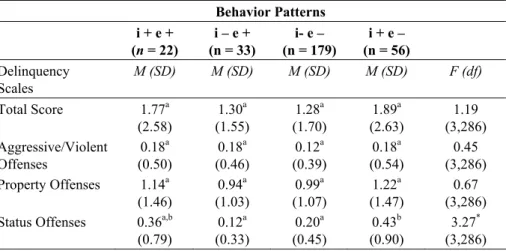
Table 3 contains the relationship of behavioral patterns with delinquency at Time 3. As the sizes of the subsamples with different patterns of problem behavior were rather small, we restricted our analysis to the configurations of Time 3. We entered the Delinquent Behavior Scale (DBS) of self-reported delinquency and the three DBS subscales as de-pendent variables in oneway-ANOVAs. The four patterns of externalizing and internaliz-ing behavior were ‘i + e +‘ (n = 22), ‘i – e +‘ (n = 33), ‘i – e – ‘(n = 179), and ‘i + e –‘ (n
= 56). Only the scale on Status Offenses revealed significant mean differences between the four behavior patterns. The highest scores were found in the two patterns with high internalizing problems (‘i + e –’ and ‘i + e +’) and the score for the latter pattern was only slightly below that of the first. No significant mean differences emerged in any other DBS scale, although the patterns with high internalizing problems also showed the highest absolute values.
Table 3:
One-way ANOVAs comparing the four patterns of externalizing and internalizing behavior regarding to adolescent delinquent behavior in secondary school (cross-sectional analyses)
Behavior Patterns
i + e + (n = 22)
i – e + (n = 33)
i- e – (n = 179)
i + e – (n = 56) Delinquency
Scales
M (SD) M (SD) M (SD) M (SD) F (df)
Total Score 1.77a (2.58) 1.30a (1.55) 1.28a (1.70) 1.89a (2.63) 1.19 (3,286) Aggressive/Violent Offenses 0.18a (0.50) 0.18a (0.46) 0.12a (0.39) 0.18a (0.54) 0.45 (3,286) Property Offenses 1.14a
(1.46) 0.94a (1.03) 0.99a (1.07) 1.22a (1.47) 0.67 (3,286) Status Offenses 0.36a,b
(0.79) 0.12a (0.33) 0.20a (0.45) 0.43b (0.90) 3.27* (3,286)
Note: *p < .05. N = 290. ‘+’ = above the 75th percentile. ‘-‘ = below the 75th percentile. Means with
different indices were significantly different (post hoc comparisons). For the post hoc comparison the least significant difference (LSD) was applied. Delinquency scores were based on the adolescents’ self-report, externalizing and internalizing behavior ratings on mothers’ report.
Discussion
variable-oriented and person-oriented approaches of data-analysis. The study must be interpreted in connection with the paper by Stemmler and Lösel (2012) which applied the same methods on the boys’ subsample of the Erlangen-Nuremberg Development and Prevention Study. In the variable-oriented approach, boys’ externalizing problems rated by kindergarten educators, elementary school teachers and mothers correlated signifi-cantly over time (ranging between r = 0.24 and r = 0.34). Externalizing problems at all three measurement points correlated also significantly with self-reported delinquency in youth (between r = 0.20 and r = 0.28). In addition, internalizing problems showed sig-nificantly positive cross-sectional relations with externalizing problems (between r = 0.12 and r = 0.28) and longitudinal auto-correlations (between r = 0.13 and r = 0.20). The longitudinal correlations between internalizing problems and later delinquency were small and negative (r = -.10 and -.19).
As Table 1 reveals, various results on the girls were similar to the findings in the boys’ sample, but others were different. The significant longitudinal auto-correlations for ex-ternalizing behavior problems (twice: r = 0.22) and the cross-sectional correlations be-tween internalizing and externalizing problems (ranging between r = 0.11 and r = 0.20) were rather consistent between both studies. However, in this study the internalizing problems did not significantly correlate between preschool and adolescent age. The rela-tion between girls’ externalizing problems and delinquency also showed a less consistent picture: Teachers’ ratings of externalizing problems at about age 10 correlated signifi-cantly with self-reported delinquency in the DBS, but mothers’ externalizing ratings four years later did not. In contrast, mothers’ ratings of internalizing problems showed a small but significant correlation with self-reported delinquency in youth (r = 0.12). This rela-tion was even stronger (r = 0.21; p <.05) for the DBS subscale on status offenses that is not presented in Table 1. Whereas the internalizing problems ratings at the two earlier measurement points predicted lower delinquency in boys, there was no significant rela-tion to the DBS in the girls’ sample.
The latter findings are in line with other research suggesting that internalizing problems such as depressive mood or anxiety are more related to female than to male delinquency (e.g. Kofler, McCart, Zajac, Ruggiuero, Benjamin, & Kilpatrick, 2011; Lösel & Bliese-ner, 2003). This may be due to stressors such as early puberty, negative body image, conflicts in the family, problems with peers, a more ruminating coping style and other factors that were not present in childhood (Petersen, Compas, Brooks-Gunn, Stemmler, Ey & Grant, 1993). Such an interpretation is also supported by findings on the greater relevance of family problems for girls’ than for boys’ antisocial behavior (Lösel & Bli-esener, 2003; Moffitt et al, 2001). Perhaps, the externalizing problem behavior may have a stress-reducing function (Byrne, Byrne, & Reinhart, 1995).
not emerge. At first glance, this differs from other studies that used trajectory analyses and found similar developmental pathways for adolescent girls and boys (e.g. Martino, Ellickson, Klein, McCaffrey, & Edelen, 2008; Piquero et al., 2012). However, research also showed that high stable antisocial girls were much less frequent than high stable antisocial boys (Harachi, Fleming, White, Ensminger, Abbott, Catalano, & Haggerty, 2006; Martino et al., 2008; Moffitt, 1993; Piquero, Brame, & Moffitt, 2005). For exam-ple, in the Dunedin Longitudinal Study (Moffitt, Caspi, Rutter & Silva, 2001) the ratio of females versus males in the life-course persistent pathway was 1:10. In contrast, the
adolescence-limited pathway showed less gender differences in prevalence (ratio of females to males = 1:1.5), suggesting that most of the females’ antisocial behavior starts in adolescence, a time when internalizing problems begin to grow (see also Silverthorn & Frick, 1999). As our study began at preschool age, does not yet cover the whole adoles-cence, and applied P-CFA, some differences to the above-mentioned trajectory results are not implausible. Although the stable ‘externalizing only’ pattern did not reach statis-tical significance beyond the base-rates, there was some problem stability in our person-oriented analysis. Fifteen girls (5.1% of the sample) had high externalizing scores at both preschool and secondary school age and seven (2.4%) showed the ‘externalizing only’ pattern.
One must also take into account that our analysis addressed not only aggression or physi-cal aggression but the broader syndrome of externalizing problems. The combination of high externalizing behavior and low or ‘normal’ internalizing behavior represents the
direct or proactive type of aggression. This form of aggressiveness is more common among boys, whereas girls tend more to other forms like indirect, reactive or verbal aggression (e.g. Fontaine, 2007; Lösel & Bliesener, 2003; Vitaro & Brendgen, 2012). The latter behaviors are not only more dependent on the actual social context (e.g. pro-voking classmates), but follow a different trajectory. In comparison to boys, girls seem to desist more often from physical aggression but rise in indirect aggression (Côté, Vaillan-court, Barker, Nagin, & Tremblay, 2007).
In the study of Stemmler and Lösel (2012) the ‘externalizing only’ pattern was also sig-nificantly associated with self-reported offending in adolescence. Boys who exhibited this pattern had significantly higher scores in the Total DBS scale on self-reported delin-quency and in the subscales on Property Offenses and Aggressive/Violent Offenses. In the girls’ sample, however, these three comparisons were not significant. We only observed a significant means difference in the subscale on Status Offenses (e.g. truancy, substance misuse, staying out overnight without permission). Here, the pattern ‘i + e –’ had the highest mean scores, closely followed by the pattern ‘i + e +’. This suggests again that internalizing symptoms in adolescence are not only more frequent among girls (Hölling, Erhart, Ravens-Sieberer, & Schlack), but also more relevant for other behavior problems than in boys. As mentioned above, anxiety, depressive mood or social withdrawal may be related to stressors such as family problems which are, for example, more important for the substance misuse of girls (Lösel & Bliesener, 1998).
floor effect that reduced effect sizes. Comparing the results of Stemmler and Lösel (2012) with the present study, the boys had significantly higher values than the girls in the Total DBS Score (t = 4.65, p < .001) and in the scales on Aggressive/Violent Offenses
(t = 6.10, p < 001), and Property Offenses (t = 2.58; p < .05), but no significant mean difference emerged in the scale on Status Offenses (t = 1.15, ns). Such differences are in line with a large body of literature on the prevalence of aggression, violence and crime in young males and females (e.g. Baxendale et al., 2012; Lösel & Bliesener, 2003; Moffitt et al., 2001). Smith and Ecob (2007), for example, found that the proportion of adoles-cents involved in delinquency was higher for males than for females. Girls more often showed theft from home, writing graffiti, and truancy, whereas males were more fre-quently involved in carrying weapons, housebreaking, robbery, and car theft. The latter serious offenses were particularly rare in our girls’ sample.
Last but not least, it needs to be mentioned that a part of the overall small effects and partial inconsistencies between girls and boys could have been due to the different in-formants at the various time-points. The latter usually leads to relatively low inter-correlations between child problem behavior ratings (Achenbach, 2006; Lösel, Stemmler, Beelmann, & Jaursch, 2005). As Lösel (2002) has shown, already the cross-sectional correlations between different informants are smaller than the longitudinal correlations of behavior ratings by the same informants (Lösel, 2002). Against this background it is plausible that our observed correlation between externalizing problems at preschool age and secondary school age are not larger than r = .22. That the equivalent coefficient for internalizing symptoms was even non-significant is in accordance with the overall lower stability of this type of problem or these types of problems (Lösel & Bliesener, 2003; Robins & Price, 1991). Similarly, bullying victimization at school is less strongly related to later internalizing problems than bullying perpetration to externalizing outcomes (Ttofi, Farrington & Lösel, 2012; Ttofi, Farrington, Lösel & Loeber, 2011). Although the search for high predictive validity is a key aim in psychological assessment, one should not forget that the individual patterns of risk and protective factors lead to both continu-ity and substantial change in the development of (antisocial) behavior (Lösel & Farring-ton, 2012; Rutter, 2012).
Acknowledgement
This research was supported by grants from the German Federal Ministry of Family Affairs, Seniors, Women and Youth.
References
Alsaker, F., & Bütikofer, A. (2005). Geschlechtsunterschiede im Auftreten von psychischen und Verhaltensstörungen im Jugendalter [Gender differences in the prevalence of py-chological and behavioral problems in adolescence]. Kindheit und Entwicklung, 14, 169-180.
Baxendale, S., Cross, D., & Johnston, R. (2012). A review of the evidence on the relationship between gender and adolescents’ involvement in violent behavior. Aggression and Vio-lent Behavior, 17, 297-310.
Byrne, D. G., Byrne, A. E., & Reinhart, M. I. (1995). Personality, stress, and the decision to commence cigarette smoking in adolescence. Journal of Psychosomatic Research, 39, 53-62.
Côté, S. M., Vaillancourt, T., Barker, E. D., Nagin, D., & Tremblay, R. E. (2007). The joint development of physical and indirect aggression: Predictors of continuity and change dur-ing childhood. Development and Psychopathology, 19, 37-55.
Dodge, K. A., Lochman, J. E., Harnish, J. D., Bates, J. E., & Pettit, G. S. (1997). Reactive and proactive aggression in school children and psychiatrically impaired chronically as-saultive youth. Journal of Abnormal Psychology, 106, 37-51.
Fontaine, R. G. (2007). Disentangling the psychology and law of instrumental and reactive subtypes of aggression. Psychology, Public Policy and Law, 13, 143-165.
Frick, P. J., Cornell, A. H., Barry, C. T., Bodin, S. D., & Dane, H. E. (2003). Callous-unemotional traits and conduct problems in the prediction of conduct problems severity, aggression, and self report of delinquency. Journal of Abnormal Child Psychology, 31, 457-470.
Geißler, R. (Ed.) (1994). Soziale Schichtung und Lebenschancen in Deutschland [Social strata and life opportunities in Germany]. Stuttgart: Enke.
Harachi, T. W., Fleming, C. B., White, H. R., Ensminger, M. E., Abbott, R. D., Catalano, R. F., & Haggerty, K. P. (2006). Aggressive behavior among girls and boys during middle childhood: predictors and sequelae of trajectory group membership. Aggressive Behavior, 32, 279-293.
Hölling, H., Erhart. M., Ravens-Sieberer, U., & Schlack, R. (2007). Verhaltensauffälligkeiten bei Kindern und Jugendlichen: Erste Ergebnisse aus dem Kinder und Jugendgesund-heitssurvey (KIGGS) [Behavior problems in children and adolescents: First results of the child and youth health survey]. Bundesgesundheitsblatt – Gesundheitsforschung-Gesundheitsschutz, 50, 784-793.
Kofler, M. J., McCart, M. R., Zajac, K., Ruggiuero, K. J., Benjamin, E. S., & Kilpatrick, D. G. (2011). Depression and delinquency covariation in an accelerated longitudinal sample of adolescents. Journal of Consulting and Clinical Psychology, 79, 458-469.
Lienert, G. A., & Krauth, J. (1975). Configural Frequency Analysis as a statistical tool for defining types. Educational and Psychological Measurement, 35, 197-209.
Lösel, F. (1975). Handlungskontrolle und Jugenddelinquenz [Self-control and juvenile delin-quency]. Stuttgart: Enke.
Roesch, S.D. Hart and J. Gierowski (Eds.), Multiproblem violent youth (pp. 35-57). Am-sterdam: IOS/NATO Book Series.
Lösel, F., Beelmann, A., Stemmler, M., & Jaursch, S. (2006). Prävention von Problemen des Sozialverhaltens im Vorschulalter: Evaluation des Eltern- und Kindertrainings EFFEKT [Prevention of social behavior problems at preschool age: Evaluation of the parent and child training EFFEKT]. Zeitschrift für Klinische Psychologie und Psychotherapie, 35, 127-139.
Lösel, F., Beelmann, A., & Stemmler, M. (2002). Skalen zur Messung sozialen Problemver-haltens bei Vorschul- und Grundschulkindern: Die deutschen Versionen des Eyberg Child Behavior Inventory (ECBI) und des Social Behavior Questionnaire (SBQ) [Scales for measuring problem behavior in preschool- and elementary school children: The German versions of the Eyberg Child Behavior Inventory (ECBI) und des Social Behavior Ques-tionnaire (SBQ)]. Universität Erlangen-Nürnberg: Institut für Psychologie.
Lösel, F., & Bliesener, T. (1998). Zum Einfluss des Familienklimas und der Gleichaltrigen-gruppe auf den Zusammenhang zwischen Substanzengebrauch und antisozialem Verhal-ten von Jugendlichen [The impact of family climate and peer group on the relation be-tween substance use and antisocial behavior in adolescents]. Kindheit und Entwicklung, 7, 208-220.
Lösel, F., & Bliesener, T. (2003). Aggression und Delinquenz unter Jugendlichen: Untersu-chungen von kognitiven und sozialen Bedingungen [Aggression and delinquency among adolescents: Studies on cognitive and social origins]. Neuwied: Luchterhand.
Lösel, F., & Farrington, D. P. (2012). Direct protective and buffering protective factors in the development of youth violence. American Journal of Preventive Medicine, 43 (2, sup-plement), 8-23.
Lösel, F., Stemmler, M., Beelmann, A., & Jaursch, S. (2005). Aggressives Verhalten im Vorschulalter: Eine Untersuchung zum Problem verschiedener Informanten [Aggressive behavior at preschool age: A study on the issue of different informants]. In I. Seiffge-Krenke (Ed.) Aggressionsentwicklung zwischen Normalität und Pathologie [Development of aggression between normality and pathology] (pp.141-167). Göttingen: Vandenhoeck & Ruprecht.
Lösel, F., Stemmler, M., Jaursch, S., & Beelmann, A. (2009). Universal prevention of antiso-cial development: Short- and long-term effects of a child and parent-oriented program. Monatsschrift für Kriminologie und Strafrechtsreform, 92, 289-308.
Martino, S. C., Ellickson, P. L., Klein, D. J., McCaffrey, D., & Edelen, M. O. (2008). Multi-ple trajectories of physical aggression among adolescent boys and girls. Aggressive Be-havior, 34, 61-75.
Moffitt, T. E. (1993). Adolescence-limited and life-course-persistent antisocial behavior: A developmental taxonomy. Psychological Review, 100, 674-701.
Moffitt, T. E., Caspi, A., Rutter, M., & Silva, P. A. (2001). Sex differences in antisocial be-haviour: Conduct disorder, delinquency, and violence in the Dunedin Longitudinal Study. Cambridge: Cambridge University Press.
Piquero, A. R., Brame, R., & Moffitt, T. E. (2005). Extending the study of continuity and change: Gender differences in adolescent and adulthood offending. Journal of Quantita-tive Criminology, 21, 219-243.
Piquero, A. R., Carriaga, M. L., Diamond, B., Kazemian, L., & Farrington, D. P. (2012). Stability in aggression revisited. Aggression and Violent Behavior, 17, 365-372.
Robins, L. N., & Price, R. K. (1991). Adult disorders predicted by childhood conduct prob-lems: Results from the NIMH Epidemiologic Catchment Area Project. Psychiatry: Inter-personal and Biological Processes, 54, 116-132.
Rutter, M. (2012). Resilience as a dynamic concept. Development and Psychopathology, 24, 335-344.
Silverthorn, P., & Frick, P. J. (1999). Developmental pathways to antisocial behavior: The delayed-onset pathway in girls. Development and Psychopathology, 11, 101-126.
Smith, D. J., & Ecob, R. (2007). An investigation into causal links between victimization and offending in adolescents. British Journal of Sociology, 58, 633-659.
Stemmler, M., Lösel, F., Beelmann, A., Jaursch, S., & Zenkert, B. (2005). Child problem behavior in kindergarten and in primary school: A comparison between prediction con-figural frequency analysis and multiple regression. Psychology Science, 47, 467-478.
Stemmler, M. Lösel, F., Beelmann, A., & Jaursch, S. (2008). A configural perspective on the stability of externalizing problem behavior in children: Results from the Erlangen-Nuremberg Development and Prevention Study. In M. Stemmler, E. Lautsch & D. Mar-tinke (Eds.), Configural Frequency Analysis (CFA) and other non-parametrical statistical methods: Gustav A. Lienert memorial issue (pp. 70-83). Lengerich: Pabst Science Pub-lishers.
Stemmler, M., & Lösel, F. (2010). Different patterns of boys’ externalizing behavior and their relation to risk factors: A longitudinal study of preschool children. Bulletin de la Société des Sciences Médicales Luxembourg, 10, 53-62.
Stemmler, M., & Lösel, F. (2012). The stability of externalizing behavior in boys from pre-school age to adolescence: A person-oriented analysis. Psychological Test and Assess-ment Modeling, 54, 195-207.
Tremblay, R. E., Desmarais-Gervais, L., Ganon, C., & Charlebois, P. (1987). The Preschool Behavior Questionnaire. Stability of its factor structure between cultures, sexes, ages and socioeconomic classes. International Journal of Behavioral Development, 10, 467-484.
Tremblay, R. E., Vitaro, F., Gagnon, C., Piché, C., & Royer, N. (1992). A prosocial scale for the Preschool Social Behavior Questionnaire: Concurrent and predictive correlates. Inter-national Journal of Behavioral Development, 15, 227-245.
Ttofi, M. M., Farrington, D. P., Lösel, F., & Loeber, R. (2011). Do the victims of school bullies tend to become depressed later in life? A systematic review and meta-analysis of longitudinal studies. Journal of Aggression, Conflict and Peace Research, 3, 63-73.
Vitaro, F., Barker, E. D., Boivin, M., Brendgen, M., & Tremblay, R. E. (2006). Do early difficult temperament and harsh parenting differentially predict reactive and proactive aggression? Journal of Abnormal Child Psychology, 34, 685-695
Vitaro, F., & Brendgen, M. (2012). Subtypes of aggressive behaviors: Etiologies, develop-ment, and consequences. In T. Bliesener, A. Beelmann & M. Stemmler (Eds.), Antisocial behavior and crime: Contributions of developmental and evaluation research to preven-tion and intervenpreven-tion (pp. 17-38). Göttingen & Cambridge, MA: Hogrefe.
von Eye, A. (2002). Configural Frequency Analysis: Methods, models and applications. Mahwah, NJ: Lawrence Erlbaum Associates.