Avaliação de atividades de campanha de saúde ocular na escola
-percepção de professores
Trabalho realizado no Departamento de Oftalmologia da Faculdade de Medicina da Universidade de São Paulo - USP - São Paulo (SP) - Brazil.
1Pedagogue, Post-graduation student in Ophthalmo-logy, Universidade de São Paulo - USP - São Paulo (SP) - Brazil.
2Associate Professor, Research Assistant to the Ophthalmology Department at the USP São Paulo (SP) -Brazil and at the Universidade de Campinas - UNI-CAMP - Campinas (SP) - Brazil.
3Head Professor of Ophthalmology at the USP - São Paulo (SP) - Brazil and at the UNICAMP - Campinas (SP) - Brazil.
Address for correspondence: Rua Barão do Triunfo, 1220 - Apto 122 - São Paulo (SP) CEP 04602-005 E-mail: [email protected]
Recebido para publicação em 28.05.2006 Aprovado em 30.11.2006
Nota Editorial: Depois de concluída a análise do artigo sob sigilo editorial e com a anuência do Dr. Marinho Jorge Scarpi sobre a divulgação de seu nome como revi-sor, agradecemos sua participação neste processo. Regina de Souza Carvalho1
Edméa Rita Temporini2 Newton Kara-José3
INTRODUCTION
For many decades, both public school educators and clinical ophthal-mologists have been concerned about visual difficulties in school-age children. As early as in 1938, in Brazil, the prevention of childhood blind-ness aimed primarily at fighting ophthalmia neonatorum and at preventing trachoma, smallpox and hereditary syphilis(1).
In that same year, the fight against trachoma received an important
schools - teachers' perception
Keywords: Ocular health; School health; School health services; Health promotion; Health education; Health knowledge, attitudes, practice; Eye diseases/diagnosis; Eye diseases/ prevention & control; Refractive errors/diagnosis
Purpose: 1) To assess the opinion of teachers involved in visual screening of school-age children and their referral to ophthalmologic examination within the “Eye-to-Eye National Campaign for Visual Disorders Prevention and Rehabilitation” (Campanha Nacional de Prevenção e Reabilitação Visual Olho no Olho); 2) To identify the teachers’ perception with respect to the training received for conducting the campaign. Methods: A descrip-tive study has been conducted, based on data recorded from the application of a questionnaire to 1,517 elementary school teachers working in public schools in 27 Brazilian states. The following items were examined: received orientation, use of educational videos and handbooks, supplied explana-tions, difficulties, questions and overall campaign assessment. Results:
82.0% of the teachers stated they had received orientation and 92.0% stated they had read the “Teacher Orientation Manual”. Among those who received orientation, 47.0% stated it had been supplied by school officials; 30.0%, by healthcare agents, and 23.0% by ophthalmologists. In the self-assessment of performance, 58.0% reported no difficulties; 32.0% reported questions concerning the campaign activities and the professionals who most frequently asked to provide clarification were those from the State Education Agency (38.0%), followed by the school director (20.0%).
Conclusions: Most teachers considered themselves adequately trained and oriented to take part in the campaign. Teachers’ training was provided by administrative officials, previously trained by ophthalmologists (“mul-tiplying effect”) and the small percentage of questions raised indicated the validity of the procedure. Concerns have been raised as to the information about the ophthalmologic examination, transportation of the children and delivery of glasses. This kind of program always presents some difficulties and requires adjustments. It should, indeed, be improved, perhaps through a closer involvement of the community and families during its development.
contribution from teachers, who transmitted to the children and the community information about habits and attitudes required for the maintenance of ocular health(2).
Continued visual screening and ophthalmologic assistance programs, developed in partnership by healthcare and educa-tion agencies, started in the 1950’s in the state of São Paulo(3-4). In the year 1970, the “School-age Child Care Plan” started to be developed (P. O S. E.) being subsequently implemented in 1973, 1974, and 1975. During this period, 2,981,276 children in the 1st grade of elementary school underwent visual scree-ning conducted by teachers (93.19% of the program’s target group of children) and 399,647 were referred to ophthalmolo-gic examination(4).
From 1976 on, the P. O S. E. was included in the routine procedures of the State Healthcare Agency, but its implemen-tation has been gradually reduced and is currently limited to some isolated initiatives in a few cities. The projects have been conducted in an uncoordinated fashion, by city govern-mental agencies, associated ophthalmologists, communities and NGOs.
The “Eye-to-Eye National Campaign for Visual Disorders Prevention and Rehabilitation” (Campanha Nacional de Preven-ção e ReabilitaPreven-ção Visual Olho no Olho), implemented initially in 1998 as a systematic approach to care, is conducted through a joint effort of the Brazilian Council of Ophthalmology (CBO), the Education Ministry (FNDE), ophthalmologists from diffe-rent regions of Brazil, teachers from the public school system (State and City levels) and volunteers, and covers the children regularly attending the 1st grade of elementary school in the public education network (State and City levels)(5).
For the orientation of teachers concerning visual scree-ning, observation of signs and symptoms of low vision, com-pletion of forms, and referral to ophthalmologic consultation, a “Teacher Orientation Manual” has been developed, toge-ther with VHS tapes showing, step-by-step, the measurement of visual acuity and lectures delivered by ophthalmologists; and the “School Kid Good Vision Manual” containing orienta-tion on ocular disorders (strabismus, amblyopia, blepharitis, conjunctivitis and eye care) was also supplied to the chil-dren’s parents(6-7). Over the three years since the initial imple-mentation of the program, 10.5 million copies of the “School Kid Good Vision Manual” have been distributed(7).
The “Eye to Eye” campaign took place, on national scale, in the years 1998, 1999, 2000, and 2001, covering, in this last year, 658 city areas, 3,011,442 children of the 1st grade elemen-tary school; 91,000 teachers, 2,600 ophthalmologists; 368,844 school-age children referred to ophthalmologic examination; 177,284 visits, and 73,775 pairs of glasses prescribed and distributed(8).
Based on the P. O S. E. model, the visual screening of the children was performed primarily by teachers, because, in addi-tion to their closer involvement with the children, they also serve as a link between the children’s parents and the ophthal-mologists, and are also responsible for disseminating informa-tion on visual health in the community related to the school(4).
The present survey had two objectives: to check the opi-nion and perceptions of the involved teachers and the sche-duling of activities of the “Eye-to-Eye” /2001 Campaign.
METHODS
A descriptive study was conducted, concerning the acti-vities of the “Eye-to-Eye National Campaign for Visual Con-ditions Prevention and Rehabilitation”/2001. The answers re-corded from the application of questionnaires completed by the involved teachers were analyzed.
A semi-structured questionnaire was sent, by mail, to 3,000 teachers, randomly selected from the 91,000 working in the public network of elementary schools. The teachers’ partici-pation was voluntary and the answers have been kept strictly confidential. All teachers received a postage-paid envelope with instructions for sending the completed questionnaire back to the CBO. The sample included 1,517 teachers who answered the questionnaire, distributed in 27 Brazilian states. The following variates were assessed: orientation received about the campaign, people responsible for supplying orien-tation, use and understanding of the manuals and video tapes, difficulties, questions and overall campaign assessment. The questionnaire included multiple choice and discursive ques-tions. Non-structured questions were used to assess difficul-ties, questions raised during the campaign and for the overall assessment.
For data presentation, as this was a self-applied question-naire, the “n” on the tables showed some variation, due to the returned answers.
RESULTS
Of the 3,000 sent out questionnaires, 1,517 (50.6%) were returned completed.
Table 1 shows the teachers’ perceptions concerning orien-tation received. Among the 1,517 teachers, 82.0% stated they had received orientation and 92.0% stated they had read the “Teacher Orientation Manual”. The “School Kid Good Vision Manual” was read by 92% of the teachers, while 63.0% said they had seen the explanatory video tapes.
As for the teachers’ perceptions about the orientation on “school-age children visual acuity measurement”, 67.0% con-firmed having been oriented; 47.0% indicated school officials as those responsible for this orientation; healthcare agents were mentioned by 30.0%, and ophthalmologists were mentio-ned by 23.0% as supplying orientation (Table 2).
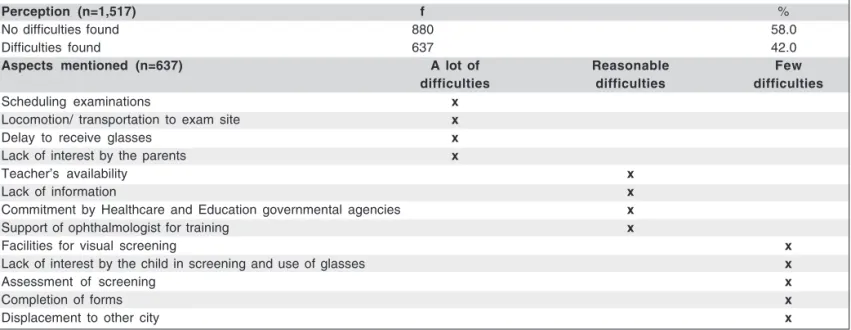
Concerning difficulties found during the campaign, 58.0% did not find difficulties whereas 42.0% did.
commitment by State Healthcare and Education Agencies and support from the ophthalmologists for the teachers’ training. They mentioned few difficulties with: facilities for visual scre-ening, lack of interest by the child in the screening and in the use of glasses, the screening procedure carried out by the teacher, the completion of forms and the displacement between different cities (Table 3).
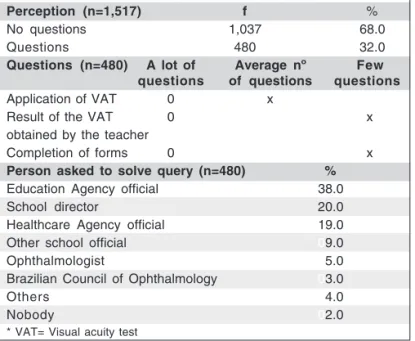
Table 4 shows the questions raised by the teachers con-cerning the Campaign activities. Among those who mentioned having raised questions (32.0%), such questions were strati-fied as: a lot of questions, average number of questions and few questions.
No mentions were recorded concerning a lot of questions on the activities to be performed during the campaign. The teachers reported an average number of questions concer-ning the performance of the visual acuity test (VAT) and a few questions concerning the result of the obtained visual acuity test and the completion of the forms. Of the 480 tea-chers who mentioned having questions, most (38.0%) repor-ted having searched for help from the State Education Agen-cy officials, followed by the school director (20.0%), the State Healthcare Agency officials (19.0%), other school offi-cials (9.0%), ophthalmologists (5.0%), the CBO (3.0%), and others (4.0%); 2.0% said they did not look for help to answer to their questions.
Chart 1 shows the assessment of the campaign by the teachers, including positive aspects (identification of school-age children with deficiency and helping these children to improve their learning process, availability of free examination for poor children, incentive to permanence of the children in the school avoiding early dropouts, improved school perfor-mance of children with visual difficulties) and negative as-pects (delayed start of the campaign activities, lack of efficient distribution of glasses, assistance limited to 1st graders,
in-sufficient commitment by ophthalmologists and state agenci-es, delay in scheduling examinations, lack of efficient referral of the more severe cases, and lack of technical supervision).
DISCUSSION
A successful project in the area of Ophthalmology should take into account some basic assumptions: the target popula-tion’s access to basic notions on prevention; availability of the offered services - screening, optical correction; complian-ce with the proposed treatment - surgery, optical correction, medication, return visits; participation of ophthalmologists in
Table 1. Perceptions concerning received orientation about the Eye to Eye / 2001 campaign. Teachers - 1st grade elementary school of
public schools, in 27 Brazilian states (%)
Perceptions on orientation (n=1,517) Yes (%) No (%)
Orientation received 82.0 18.0
Reading the "Teachers Orientation Manual" 92.0 08.0 Reading the "School Kid Good Vision Manual" 92.0 08.0
Watching explanatory videos 63.0 37.0
Table 2. Orientation received on measurement of visual acuity (VA) of children. Perception of teachers - 1st grade elementary school
of public schools, in 27 Brazilian states (%) Perceptions regarding (n=1,517) orientation on VA Yes (%) No (%)
Measuring visual acuity 67.0 33.0
Person in charge (n=1,016)
School admin. official 47.0
Ophthalmologist 23.0
Healthcare agent 30.0
Table 3. Perception of difficulties found during the Eye to Eye / 2001 campaign. Teachers - 1st grade elementary school of public schools,
in 27 Brazilian states (%)
Perception (n=1,517) f %
No difficulties found 880 58.0
Difficulties found 637 42.0
Aspects mentioned (n=637) A lot of Reasonable Few
difficulties difficulties difficulties
Scheduling examinations x
Locomotion/ transportation to exam site x
Delay to receive glasses x
Lack of interest by the parents x
Teacher’s availability x
Lack of information x
Commitment by Healthcare and Education governmental agencies x
Support of ophthalmologist for training x
Facilities for visual screening x
Lack of interest by the child in screening and use of glasses x
Assessment of screening x
Completion of forms x
all the phases of the project; participation of volunteers, com-munity, NGOs and healthcare authorities (partnerships); in addition, some conditions should be implemented in order to make the project become permanent(9-10).
The Eye to Eye Campaign has been directed towards the accomplishment of all these goals, the only point missing being the assurance of continuity.
Teachers and school administration personnel have a po-sitive influence on the educational process and may help in the different phases of the project, from locomotion and trans-portation of the poor population to direct forms of help, such as creating appropriate working conditions for the local oph-thalmologists.
At school, the teacher is the core element for the
identifica-tion of children with signs, symptoms and behavioral patterns that suggest refractive errors and other visual disorders(4,10-11). In a survey with parents and school-age children during the "Veja Bem Brasil" Campaign 1998, reported that the teacher was the person who most often perceived the child’s visual impairment (70.6%), followed by the parents (18.9%) and by the child itself (7.9%)(12).
Teachers are also responsible for the transmission of the obtained information on visual health to the school-based com-munity. We may say that the teacher is one of the key elements for the successful implementation of the campaign, and should, therefore, be adequately oriented and trained for the execution of the required tasks. In this survey, most of the teachers (82.0%) reported having been “oriented” about the campaign; only 18.0% reported not having received any orientation (Table 1).
In an other survey including the personnel working in the public education network of the city of Curitiba, PR, during the Eye to Eye Campaign/2000, showed that, among teachers, 85.9% of the responders considered the received orientation as “good” and/or “very good”(13).
The search for mechanisms that facilitate the understan-ding of the project by the teacher is one of the key issues for the success of the campaign.
Educational materials, such as booklets and illustrative video tapes, should be supplied to the teacher, to help appro-priate assimilation of concepts.
For the Eye to Eye Campaigns, two manuals have been developed and delivered to the teachers, together with a VHS tape explaining how to perform the visual screening: the “Tea-cher Orientation Manual”(6) and the “School Kid Good Vision Manual”(7,10).
These manuals, handed to each target teacher and target child were read by most of the teachers (92.0%), which confir-med the aroused interest and that these were excellent means for transmitting information, and should justifiably be availa-ble in future campaigns. The VHS tapes delivered to schools were watched by 63.0% of responders. As they require a TV set, which is not available in many schools, the 37.0% of teachers who did not see the tapes are justified (Table 1).
Two of the key tasks performed by teachers during the campaigns are the measurement of the children’s visual acuity and the observation of attitudes that reveal visual impairment. In the 2001 campaign, 368,844 school-age children were referred to ophthalmologic examination; 177,284 have been examined and 73,775 corrective glasses were prescribed(8). One might argue against the validity of the visual acuity test performed by the teacher, since of 177,284 school-age children referred to ophthalmologic examination, only 73,775 needed corrective lenses.
It is understandable that teachers refer children who do not require correction, and the reasons for that are overesti-mation of risk, the intention to take advantage of this unique opportunity of having the child examined, or feelings of un-certainty about the test result(12).
Teachers should receive continuous recycling on this
mat-Chart 1. Assessment of the Eye to Eye campaign. Teachers - 1st grade elementary school of public schools in 27 Brazilian states
(qualitative aspects) Positive aspects:
Detection of school-age children with visual difficulties Contribution to the learning process
Free examination available for poor children
Incentive to child’s permanence in school and fewer dropouts Improved school performance of children with visual difficulties
Negative aspects:
Delay in the start of campaign activities Delay in delivery of glasses
Assistance limited to 1st grade school-age children Little commitment by ophthalmologists and Healthcare and Education Agencies
Delay in scheduling consultations Inefficient referral of more severe cases Lack of technical supervision
Table 4. Questions related to the campaign activities Eye to Eye / 2001. Teachers - 1st grade elementary school of public schools in
27 Brazilian states (%)
Perception (n=1,517) f %
No questions 1,037 68.0
Questions 480 32.0
Questions (n=480) A lot of Average nº Few questions of questions questions
Application of VAT 0 x
Result of the VAT 0 x
obtained by the teacher
Completion of forms 0 x
Person asked to solve query (n=480) %
Education Agency official 38.0
School director 20.0
Healthcare Agency official 19.0
Other school official 09.0
Ophthalmologist 05.0
Brazilian Council of Ophthalmology 03.0
Others 04.0
Nobody 02.0
ter, focused on the visual acuity measurement and the diffe-rent types of behavior presented by children during the test, i.e., simulation, inattention and shyness(14).
Visual screening is more effective when all those involved receive adequate training and are highly motivated.
In a survey the authors(14) reported a high percentage of correct procedures (more than 80%) performed by adequately trained teachers, confirming that “it is highly recommended to have the visual acuity test in school-age children performed by trained teachers”.
The training could take place at the school itself, under the supervision of the ophthalmologist, but this would require a much higher number of ophthalmologists and extended fi-nancial support(15).
There is consensus about the notion that visual screening to detect possible deviations in visual function should be per-formed by adequately trained lay people(10).
Table 2 shows that training and orientation on the measu-rement of visual acuity in school-age children have been pri-marily delivered by a “school official” (47.0%) whereas 23.0% reported to have received training and orientation directly from the ophthalmologist. The trained teacher has performed the task correctly, since when asked about “questions raised concerning the campaign activities”, 68.0% said they had raised no questions (Table 4). A similar result was found by a survey(13) which reported that 57.5% of the teachers conside-red the orientation received from a non-ophthalmologist as good, whereas 59.3% thought it important to obtain better training and orientation on how to proceed in terms of referral and action to be taken in cases requiring treatment.
The professionals most often chosen to solve the tea-chers’ queries about the campaign were those working at the State Education Agency (38.0%), followed by school direc-tors (20.0%) and State Healthcare Agency officials (19.0%). Ophthalmologists were looked for by only 5.0% of the tea-chers, since they were not always available or because the educators had the needed answers (Table 4).
As for the item “difficulties found during the campaign”, some teachers mentioned again the lack of “support” by oph-thalmologists, concerning training of the measurement of vi-sual acuity (Table 3).
In 2002, in the state of São Paulo, the “Visual Habilitation Project” has been implemented in a joint effort of the São Paulo State Healthcare Agency (SES) and the São Paulo State Education Agency (SEE), including ophthalmologists, tea-chers, and volunteers. The project was supported by the Fundação Faculdade de Medicina / USP (FFM); Logistics -CBO(10). It was conducted in 509 city areas with less than 40,000 inhabitants each, in the state of São Paulo, and took 10 months to be completed, covering 111,500 school-age chil-dren in the 1st grade of the public network of elementary schools(10). In this project, visual screening has also been performed by teachers, trained by non-medical professionals, called “multiplying agents”, who, in turn, had been trained by ophthalmologists (“cascade effect”). The task of these agents
was to give instructions and solve questions raised by the teachers concerning the visual acuity measurement, the com-pletion of forms and the referral to ophthalmologists. The idea was to develop qualified trainers, with a theoretical and prac-tical course being given to the agents by ophthalmologists.
The way the project was organized produced a “cascade effect”, with the development of agents capable of orientating teachers.
The idea of introducing multiplying agents in the project, to orientate and train the teachers, is not a new one. In 1988, the Department of Assistance to the Schoolage Child (DAE) -a government-al -agency in the st-ate of São P-aulo - conducted healthcare orientation programs to train the teacher, and for that purpose the position of Coordinator of Assistance to the School-age Child (OAE) was created, representing a multi-plying agent in charge of disseminating the information on healthcare at the school level(16).
This procedure may be very useful to broaden the assis-tance to teachers, improve the standard of care and further reduce the questions raised about the campaign.
Among the “difficulties mentioned by teachers as occur-ring duoccur-ring the campaign” we found “transportation (locomo-tion)” of the children to the site of ophthalmologic examina-tion, an item rated as “very difficult” (Table 3).
In a survey the authors(17) reported cost constraints to take the child and its parent to the site of the examination as one of the important causes of absence, despite the fact that the examination was free.
Another survey(12) found similar results, with 41.6% re-porting the cost of the bus tickets for the parents, the child and its brothers or sisters who had to be taken along as the major difficulty to accomplish the ophthalmologic examination during the “Veja Bem Brasil” campaign, conducted at the University of São Paulo Medical School General Hospital in 1998.
In another study “Socioeconomic aspects influencing the absence of school-age children with visual disorders from the ophthalmologic examination”, the authors(18) found 15.2% of parents or tutors of school-age children reporting “transpor-tation issues” as the reason for not taking the child to the scheduled ophthalmologic examination. However, 22.2% re-ported that the reason for absence was the fact that the child had already been taken to a visit with another ophthalmologist (healthcare insurance coverage).
Other causes for the absence of the child from the site of the examination were added(17):
• Lack of awareness of the importance of the ophthalmo-logic examination
• Denial of the child’s low vision • Illness - of the child or in the family • Lack of interest by the parents
• Lack of information concerning the scheduled exami-nation
Concerning the scheduling of the examination, teachers have also reported it as a “very difficult” issue (Table 3).
time between the screening and the ophthalmologic exami-nation. In addition, the information about scheduled dates must reach teachers and children / parents in due time, so that families get prepared for the visit. In the projects conducted in the city area of São Paulo, screening, ophthalmologic examina-tion and distribuexamina-tion of glasses were all completed over a period of a few months, showing great improvement, from the logistics perspective, over previous projects(10).
In 2001, the CBO presented some suggestions for change, so that the Eye to Eye Campaign could fix some critical points. One of these points referred to the fact that some glass manu-facturers, working under contract for the Education Ministry, did not deliver the glasses in due time to the children who needed them. As a solution for future campaigns, the CBO suggested contracting local manufacturers(10).
Table 3 and chart 1 show that the teachers consider as another “very difficult” issue the delay in delivering the glas-ses. On the other hand, some authors(17) found that 65.77% of the responders reported “no delay in the delivery of glasses in the Eye to Eye Campaign/2000, in the city of Maceió (AL)”.
During the same campaign, both in the state and in the city of São Paulo, the glasses were delivered within less than six months after the ophthalmologic examination. In both cases, the higher level of efficiency was due to contracts with local manufacturers for the supply of glasses. In São Paulo, an agreement with FEDEX (courier) has contributed to speed up the delivery of glasses, despite the difficulties inherent to the distances to be covered in this huge city.
Regional variations in the time to deliver glasses have impaired the acceptance and the results of the campaign. In several places, the glasses were only available in the next school year. This was due to bureaucratic constraints in the Education Ministry, and to the selection of lens manufac-turers that had to supply the whole country(10).
Based on the analysis of the literature, several authors have stressed the critical importance of teachers, but no prac-tical measure to acknowledge their contribution has been taken. We should not forget that the teacher’s visual acuity is an important element in the performance of his/her tasks as an educator, and therefore the teacher should also benefit from these campaigns.
CONCLUSIONS
1) Most teachers considered they had received appropria-te orientation. Most of them had read the supplied manuals and watched the video tapes, demonstrating the importance and the interest aroused by these training tools.
2) A large number of teachers was oriented and trained by administration officials, themselves trained by ophthalmo-logists. The fact that most of the teachers had no questions during the campaign indicates the effectiveness of the training and orientation of teachers by non-medical professionals (mul-tiplying agents), adequately instructed by ophthalmologists.
3) The few who had questions reported them to be linked to the application of the visual acuity test, the obtained re-sults and the completion of forms.
4) Among the difficulties mentioned concerning the cam-paign, we should mention “transportation (locomotion)” of the children to the site of the ophthalmologic examination, the “scheduling of the ophthalmologic visit”, the delay in the delivery of glasses and the fact that the examination was limited to children in the 1st grade. Some suggestions to solve these difficulties have been pointed out: ophthalmologic exa-mination conducted at sites close to the schools; communita-rian efforts and search for partners in order to provide free transportation, together with better orientation of the school administration personnel, improving the scheduling of exami-nations and the transmission of corresponding information to the parents.
5) Positive aspects mentioned were: better learning perfor-mance and fewer dropouts from school.
6) Such programs have difficulties to be executed and will always require adjustments. They should be continuously improved. To cancel such a relevant program would be a major step backwards in terms of the social and cognitive develop-ment of these children.
Suggestions
• Increase the number of meetings with multiplying agents, to allow for better training of teachers.
• Get parents and the community involved in the develop-ment of the project.
• Acknowledgement of the teachers’ contribution through positive attitudes, such as: awarding a merit certificate for the accomplished work and offering a free ophthal-mologic examination to teachers directly involved with the campaign.
RESUMO
Saúde e 23,0% por oftalmologistas. Na auto-avaliação de de-sempenho, 58,0% não apontaram dificuldades. 32,0% relata-ram dúvidas em relação às atividades da campanha e o profis-sional mais procurado para solucioná-las foi o profisprofis-sional da Secretaria da Educação (38,0%), seguido do diretor da escola (20,0%). Conclusões: A maioria dos professores considerou-se bem orientado e treinado para participar da campanha. O treinamento aos professores foi fornecido por profissionais administrativos após orientação de oftalmologistas (“efeito multiplicador”) e o pequeno percentual com dúvidas indica sua validade. Foram relatadas preocupações com o aviso para realização do exame oftalmológico, o transporte dos escolares e a entrega dos óculos.
Descritores: Saúde ocular; Saúde escolar; Serviços de saúde escolar; Promoção da saúde; Educação em saúde; Conheci-mentos, atitudes e prática em saúde; Oftalmopatias/diagnósti-co; Oftalmopatias/prevenção & controle; Erros de refração/ diagnóstico
REFERENCES
1. Krueguer EA. Prevenção da cegueira na infância. Planejamento. Arq Bras Oftalmol. 1969;32(1):23-5.
2. Toledo SA. Cooperação da escola primária no combate ao tracoma. São Paulo: Revista Os Tribunais; 1938. p.134-8.
3. Castro RS. Correção óptica em escolares e condições de uso dos óculos. [tese]. Campinas: Faculdade de Ciências Médicas da Universidade Estadual de Campinas; 2001.
4. Kara-José N, Ferrarini ML, Temporini ER. Avaliação do desenvolvimento do plano de oftalmologia sanitária escolar em três anos de sua aplicação no Estado de São Paulo. Arq Bras Oftalmol. 1977;40(1):9-15.
5. Conselho Brasileiro de Oftalmologia: “60 anos de CBO”; livro demonstrati-vo; gestão 1999-2001. São Paulo:CBO; 2001.
6. Alves MR, Kara-José N. Manual de Orientação ao professor. Campanha Nacio-nal de Reabilitação Visual “Olho no Olho”. São Paulo: Impresa Oficial; 1998. 7. Oliveira RCS, José NK, Arieta CEL. Manual da boa visão do escolar: solu-cionando dúvidas sobre o olho e a visão. São Paulo; Brasília: Conselho Regional de Oftalmologia: Ministério da Educação; 2001.
8. Conselho Brasileiro de Oftalmologia. Ofício - CBO da Campanha “Olho no Olho”. Quadro analítico dos resultados finais e parciais 2001. São Paulo: CBO; 2001.
9. José NK, organizador. Prevenção da cegueira por catarata. Campinas: Uni-camp; 1996. p.55-80.
10. Kara-José N, Gonçalves ER, Carvalho RS, organizadores. Olho no olho: campanha nacional de prevenção à cegueira e reabilitação visual do escolar. Rio de Janeiro: Cultura Médica; 2006.
11. Temporini ER, Kara-José N, Rigolizzo HB. Envolvimento de pessoal da comunidade em projeto de detecção de ambliopia em pré-escolares. Arq Bras Oftalmol. 1983;46(3):85-9.
12. Alves MR, Temporini ER, Kara-José N. Atendimento oftalmológico de esco-lares do sistema público de ensino no município de São Paulo: aspectos médico-sociais. Arq Bras Oftalmol. 2000;63(5):359-63.
13. Russ HHA, Temporini ER, Kara-José N. Impacto da Campanha Olho no Olho em escolas de ensino fundamental: percepção do pessoal de ensino. Arq Bras Oftalmol. 2004;67(2):311-21.
14. Temporini ER, Kara-José N, Taiar A, Ferrarini ML. Validade da aferição da acuidade visual realizada pelo professor em escolares de 1ª a 4ª séries de primeiro grau de uma escola pública do município de São Paulo, Brasil. Rev Saúde Pública. 1977;11:229-37.
15. Conselho Brasileiro de Oftalmologia. Ofício CBO: “Orientações Gerais aos Coordenadores Estaduais, Municipais e demais participantes da Campanha”; 1998. São Paulo: CBO; 1998.
16. Temporini ER. Percepção de professores do sistema de ensino do Estado de São Paulo sobre seu preparo em saúde do escolar. Rev Saúde Pública. 1988; 22(5):411-21.
17. Cavalcante SM, José NK, Temporini ER. Percepção de pais de escolares da 1ª série do ensino fundamental a respeito da campanha Olho no Olho 2000, na cidade de Maceió-Alagoas. Arq Bras Oftalmol. 2004;67(1):87-91.
18. Abud AB, Ottaiano JAA. Aspectos socioeconômicos que influenciam no comparecimento ao exame oftalmológico de escolares com alterações visuais. Arq Bras Oftalmol. 2004;67(5):773-9.
*Participação neste evento conta 20 pontos para a revalidação do título de especialista em oftalmologia
INFORMAÇÕES:
XXXIV CONGRESSO BRASILEIRO DE OFTALMOLOGIA
SEPS 714/914 - ED. TALENTO, SALA 422 - ASA SUL - CEP 70390-145 - BRASÍLIA - DF - BRASIL TELS.: (61) 3346-6971 ou (62) 3251-0500/3252-5570
e-mail: [email protected]