www.bjorl.org
Brazilian
Journal
of
OTORHINOLARYNGOLOGY
ORIGINAL
ARTICLE
Assessment
of
mucosal
changes
associated
with
nasal
splint
in
a
rabbit
model
夽
,
夽夽
Mehmet
Tan
a,
M.
Tayyar
Kalcioglu
b,∗,
Nurhan
Sahin
c,
Tuba
Bayindir
a,
Emine
Samdanci
c,
Aliye
Filiz
daDepartmentofOtorhinolaryngology,InonuUniversityMedicalFaculty,Malatya,Turkey
bDepartmentofOtorhinolaryngology,IstanbulMedeniyetUniversitySchoolofMedicine,Istanbul,Turkey cDepartmentofPathology,InonuUniversityMedicalFaculty,Malatya,Turkey
dDepartmentofOtorhinolaryngology,ZekaiTahirBurakHospital,Ankara,Turke
Received19November2013;accepted28March2014 Availableonline23August2014
KEYWORDS Nasalmucosa; Nasalseptal perforation; Nasalseptum; Tamponssurgical
Abstract
Introduction:Thereisnoconsensusondurationofthenasalsplintafternasalseptum surger-ies.The pressureofnasalsplintonthemucosamay causetissuenecrosisandnasalseptum perforation.
Objectives:Toinvestigatethehistopathologicalchangesofthenasalmucosacausedbynasal splintsinarabbitmodel.
Methods:NosplintwasusedingroupA.Bilateralsiliconenasalsplintswereplacedforfive, ten,and15daysingroupsB,C,andD,respectively.Biopsyofthenasalmucosawasperformed afterremovalofsplint.Histopathologicevaluationswereperformed.Theseverityanddepth oftheinflammationwerescored.
Results:GroupA hadanormalhistologicalappearance.Comparisonoftheresultsofgroups B,C,andDwithgroupAdemonstratedstatisticallysignificantdifferenceswithregardstothe severityofhistopathologicalfindings.Therewasnostatisticallysignificantdifferencebetween groupsBandC.TherewerestatisticallysignificantdifferencesbetweenthegroupsBandD, andalsobetweengroupsCandD.
Conclusions:Longerdurationofnasalsplinthadahigherriskforseptalperforation.Therefore, removalofthesplintassoonaspossiblemaybehelpfulforpreventingpotentialperforations. © 2014Associac¸ãoBrasileira de Otorrinolaringologiae CirurgiaCérvico-Facial. Publishedby ElsevierEditoraLtda.Allrightsreserved.
夽 Institution:IstanbulMedeniyetUniversity,SchoolofMedicine,Turkey. 夽夽
Pleasecitethisarticleas:TanM,KalciogluMT,SahinN,BayindirT,SamdanciE,FilizA.Assessmentofmucosalchangesassociatedwith nasalsplintinarabbitmodel.BrazJOtorhinolaryngol.2015;81:184---9.
∗Correspondingauthor.
E-mail:[email protected](M.T.Kalcioglu).
http://dx.doi.org/10.1016/j.bjorl.2014.08.004
1808-8694/©2014Associac¸ãoBrasileiradeOtorrinolaringologia eCirurgiaCérvico-Facial. PublishedbyElsevierEditoraLtda.All rights
PALAVRAS-CHAVE Mucosanasal; Perfurac¸ãodosepto nasal;
Septonasal; Tampõescirúrgicos
Avaliac¸ãosobrealterac¸õesnamucosa,associadasaousodesplintsnasais,utilizando coelhoscomocobaias
Resumo
Introduc¸ão: Nãoexiste consensoacercadotempodepermanênciadesplintsnasaisno pós-operatóriodecirurgiasnosepto.Apressãocausadapelosmesmosnamucosanasalpodecausar necroseeperfurac¸õesseptais.
Objetivos: Investigarmudanc¸ashistopatológicasdamucosa nasalcausadasporsplintsnasais emcoelhos.
Método: NenhumsplintsfoiutilizadonogrupoA.Splintsdesiliconeforamutilizadospor5, 10 e15 diasnos grupos B, Ce D, respectivamente. Biópsia da mucosa nasal foi realizada apósa remoc¸ãodos mesmos.Avaliac¸ões histopatológicasforamrealizadas, eagravidadee aprofundidadedoprocessoinflamatórioforammedidas.
Resultados: GrupoAapresentouumaaparênciahistológicanormal.Comparac¸õesderesultados entreosgruposB,CeDcomogrupoA demonstraramdiferenc¸asestatísticasrelevantes na gravidadehistopatológica.Nãohouvediferenc¸asestatísticasrelevantesentreosgruposBeD, assimcomoentreosgruposCeD.
Conclusão:Deacordocomosresultados,quantomaioradurac¸ãonousodesplintsnasaismaioro riscodeperfurac¸ãoseptal.Portanto,aremoc¸ãodesplintsnasaisdeveserrealizadaassimque possível,prevenindopotenciaisperfurac¸ões.
©2014Associac¸ãoBrasileiradeOtorrinolaringologiaeCirurgiaCérvico-Facial.Publicado por ElsevierEditoraLtda.Todososdireitosreservados.
Introduction
Various types of packing are placed into the nasal pas-sagesafternasalseptum surgeriesinordertoensure that thebilateralmucoperichondrialflapsaresecuredinplace. Securingthemucoperichondrialflapsisimportanttoprevent complications suchas bleedingor hematoma.1 Placement
of packingintothe nasalpassages betweenthe nasal lat-eralwallandtheseptumalsopreventspotentialsynechiae. Thereisnoconsensusonhowlongthenasalsplint canbe keptinplacewithoutcausinginjurytothenasalstructures.2
Nasal septum perforation as a post-surgical complica-tionisobservedinapproximately0.7---1.4%ofpatientsafter septoplasty.3Nasalseptumperforationoccursdueto
respec-tivemucosaldamage,particularly.Suchaperforationmay becausedbydisruptedbloodfloworiginatingfromthenasal splintpressureonthemucosaandtissuenecrosis.
Thepresentstudyassessedthehistopathologicalchanges of thenasal mucosacaused bynasal splint andevaluated therelationshipbetweenthedurationofnasalpackingand septalperforationinarabbitmodel.
Methods
TheexperimentalstudywasapprovedbytheExperimental AnimalEthicsCommittee(2011/A39).Atotalof28healthy rabbitswithnormalanteriorrhinoscopicexaminationwere included. Animals were randomly assigned to four equal groups.Inthecontrolgroup(groupA),nonasalsplintwas placed. Nasal packing was placed using bilateral silicone nasal splints sutured with 4-0 silk suture and were held in placefor five,ten,and 15days ingroups B,C, andD, respectively,afteranesthesiausingketaminehydrochloride
80mg/kg IM(Ketalar 10mL flask, E.Warner Lambert)and xylazinehydrochloride2mg/kgIM(Rompun50mL2%flask, Bayer) combination. After the procedure, metamizole 10mg/kgwasadministeredintramuscularlytorelievepain. Thesizeofnasalsplintwasapproximately1.5cm×0.7cm diameter.
According to the clinical observations, septal perfora-tiondue to the nasal splint wasseen onthe end portion (proximal)of the splint. Based onthis observation, biop-sieswere obtained 1cm behindthe columella, measuring approximately0.5cm×0.5cm diameter,under anesthesia in the group A at the beginning of the study and in the other groups, after the nasal splint was removed. The biopsyspecimenwasfixed ina 10%neutralformalin solu-tionandaroutinetissuefollow-up wasperformed.It was then embedded in paraffin and cut into 5m thickness. Hematoxylin---eosin(H---E)stained sectionswere evaluated underlight microscopyby twosingle-blindedpathologists; allevaluationsbetweenthetwopathologistswerein agree-ment.
Thesurfaceofnormalseptalmucosawaslinedby respi-ratoryepithelium,withhyalinecartilage,whichconsistsof vessels and connective tissue under the submucosa. The findingswerecompared withnormalmucosal patternand scoredfrom0to3,basedonthepresenceandcharacterof inflammation(acuteorchronicinflammation),mucosal ero-sion,ulceration, andperforation. The acuteinflammation wasshownbyneutrophilprepotencywithrareeosinophils. Also,the severity of the inflammation was scored by the number of inflammatory cells in a 400× magnification area (no inflammatory cells [0]; less than 10 inflamma-torycells,mild1;10---30inflammatorycells,moderate2;and
over 30 inflammatory cells, severe3). Histomorphological
Table1 The severityandlocalizationofinflammationin groupD.
Groups Inflammationa Localizationb
0 1 2 3 0 M MS P
A 1 + +
2 + +
3 + +
4 + +
5 + +
6 + +
7 + +
B 1 + +
2 + +
3 + +
4 + +
5 + +
6 + +
7 + +
C 1 + +
2 + +
3 + +
4 + +
5 + +
6 + + +
7 + +
D 1 + +
2 + +
3 + +
4 + +
5 + +
6 + +
7 + +
aInflammation:0,noinflammation;1,mild;2,moderate;3,
severe.
b Localization:0,normal;M,limitedtothemucosa;MS,limited
tothemucosaandthesubmucosa;P,perforation.
mucosa,involvingthesubmucosa,andmucosalulcerations and/orperforations.
SPSS 17.0 was used for statistical evaluation. The Kruskal---Wallistestwasusedtocompareallgroups,andthe Mann---WhitneyUtestwasusedforcomparingtwogroups.
Results
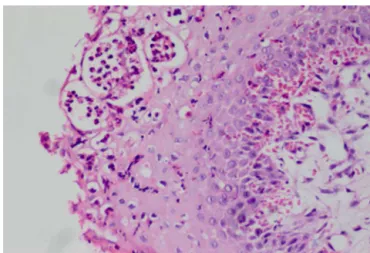
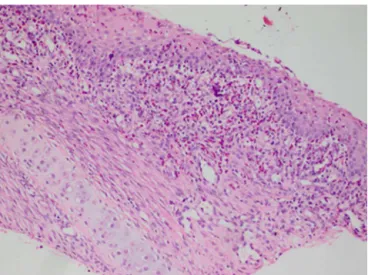
Inflammatoryandhistopathologicchangesobserved inthe groups areshown in Table1. The controlgroup (groupA) hadanormalhistologicalappearance(Fig.1).Therewasno inflammationinthegroupA.InthegroupB,therewasmild inflammationinvolvingthemucosainfiveanimals,and mod-erateinflammationthatextendedtothesubmucosaintwo animals(Fig.2).Theaverageseverityoftheinflammation was1.28forthegroupB(Fig.3).
IngroupC,mildinflammationinvolvingthemucosawas foundintwoanimals,moderateinflammationextendingto thesubmucosa inthreeanimals, andsevere inflammation
Figure1 Normalhistologicalappearance(hematoxylin---eosin [H---E]100×).
Figure 2 Acuteinflammation confined tothemucosa (H---E 400×).
extendingthesubmucosaintwoanimals(Fig.4).Increased inflammationwasseeninthegroupCcomparedtogroupB. IngroupD,therewassevereinflammationextendingto thesubmucosainfouranimals(Fig.5).Oneanimalwasfound to have moderate inflammation extending to the submu-cosa. Intwoanimals,severe inflammation presentedwith perforations and ulcerations.The average severity of the
Inflammation
Se
ver
ity of inflammation
3
2.5
1.5
0.5
0 1 2
Groups
A B C D
Figure4 Severeacuteinflammationofthesubmucosa(H---E 200×).
Figure5 Ulcerationofthemucosa(H---E100×).
inflammationwas2.85(Fig.3).Therewasincreased inflam-mationcomparedwithgroupC.
Theresultsshowedthattherewasastatistically signifi-cantdifferenceintheseverityofhistomorphologicalfindings betweenthegroupAandtheothergroups(groupsB,C,and D).
There wasno statisticallysignificant differenceon the severityofhistomorphologicalfindingsbetweengroupBand C(p>0.05).However,statisticallysignificantdifferencesin theseverityofhistomorphologicalfindingsbetweengroups BandD,andgroupsCandD(psplint)heldforthelongest timeandmacroscopicperforationswereseenintwoanimals inthisgroup.
Discussion
Septoplasty,septorhinoplasty,andendoscopicsinussurgery are commonly performed surgical methods by ear, nose, and throat, and plastic surgeons. Various types of nasal packing are used both to prevent nasal bleedings and/or septal hematomas, and also to support fenestrated parts untiltheyarehealedwithfibrin,especiallyinseptoplasty
andseptorhinoplasty.1Nasalpackingusedinthesesurgeries
affectsfunctionofthenoseandcomfortofthepatient. How-ever,therehasbeennoconsensusachievedontheduration, indications,andtypeofnasalpacking.2,4
Nasalpackingmaycausevariousproblemssuchasnasal septalperforations,5pyogenicgranulomas,6life-threatening
toxicshocksyndromes,7obstructivesleepapneas,8reduced
oxygensaturationandincreasedpulserates,9pains,10,11and
necrosisoftheinferiorturbinate.5Changesintheear
pres-sureassociatedwithnasalpackingwerealsofound.12Ithas
beenacceptedthatthedurationofnasalpackingpotentially influencesthedevelopmentofthesecomplications.Theuse ofnasal packing afterseptal surgeryis still under discus-sion.Inordertoavoidthecomplicationsof nasalpacking, trans-septalsuturingtechniqueshavebeenadoptedinstead ofpacking,andvariouscomparativestudieshavebeen con-ductedinthisrespect.Inonesuchstudy,Ardehalietal.11
comparedpatientswhoreceivednasalpackingwithpatients whoreceivedtrans-septalsuturingaftersurgeryandfound nosignificantdifferencesfortherateofhematoma, perfo-rations,andsynechiae.Camirandetal.13reportedthatthey
didnotuseanytypeofnasalpackingafterthesurgeryand documentednocomplications,suchasepistaxis,synechiae, hematoma,orseptalperforations,similartothefindingsof Lemmensetal.14
Genc et al. investigated the effects of nasal packing moistened with vaseline-nitrofurazone against trans-nasal suturingtechniquesontheseptumofrabbitsbyevaluating thehistopathologicalchangesofpackingonnasalmucosa.15
Thepackingwasheldinthenosefor48h.Increasedmucosal inflammationwasobservedinbothtechniques,andno sta-tisticalsignificancewasfoundwhencomparedtothecontrol group.McIntoshetal.16causedwoundsonthenasalmucosa
on an animal model, then applied Merocel® as packing material to the one side and leftthe other side without packing.Thepackingwasremovedonthefifthday,andno histopathologicaldifferenceinthere-epithelizationand cil-iaryfunctionsofthenasalmucosawasfoundbetweenthe twogroups. Thisstudy suggestedthatholdingthepacking inplaceforextendedperiodsfollowedbyendoscopicsinus surgeries has no effects on the recovery of the mucosa. Againstthese studies, the present study found significant increasedinflammationscoresevenifthenasalpackingwas keptinthenoseforfivedays.Itissuggestedthatthis find-ingcouldbeduetonecrosisasaresultofmucosalpressure. Necrosisonthecartilage wasobservedin groupD, where thepackingwasheldfor thelongest timeinourstudy.In addition,perforation wasobserved in two animalsin this group. Nasal septal perforation may be related with the hypoxemic---ischemicnecrosisofthecartilageasaresultof pressure.
Maccabee et al. investigated the histopathological effectsofnasalpackingonparanasalsinusmucosa.17 They
resultinginloss ofthe entire epitheliallayer is similarto thefindingsofthepresentstudy.However,itisimpossible forthesiliconenasalpackingusedinthepresentstudy to beintroducedintotheregeneratedepithelium.Theuseof nasalpackingisexpectedtodisruptciliaryactivity,which isoneofthemostimportantelementsofnasalepithelium. Shaw,inhisstudyonthenasalmucosaofsheep,showedthat theciliarysurfaceonthenose wasreducedby 50---68%by intranasalpacking.18Anotherstudycomparedthe
mucocil-iaryactivitybyrhinoscintigraphyfollowingseptumsuturing ofnasalpacking,andfoundnomeaningfuldifferences.Also, nopre-andpost-operativedifferenceswerefound.19Inthe
presentstudy,epithelialinflammationwasobservedatthe lowest level in the group in which the nasal packing was removedatanearlystage.Likewise,itis anticipatedthat earlyremovalofnasalpackingcontributespositivelytothe ciliaryfunction.
The knowledgeof howlong afrequentlyusedmaterial canbeheldinaspecificregionandwhichproblemsmayarise duringthisperiodhaspotentialtocontributetothemore efficientuseof that material.There hasbeen no consen-susonhowlong nasalpackingshouldbeheld inthenose. Toaddressissue,mostoftheear,nose,andthroatsurgeons andsourcebookshaverecommendedtheremovalofpacking at48handbeyond.InacontrolledstudybyJiannisetal., 75patients were treated by septoplasty, and thepacking washeldinplacefor24hinonegroup,and48hinanother group.20 Theyscored thepatientcomfortduringthis time
usingavisualanalogscale.Theyfoundthatthepatient com-fortwaspoorerinthegroupwherethepackingwasheldin placefor48h.Thesamestudyfoundnodifferencesfor post-operativecomplicationsofbleedingandpain,alsoreporting that the group where the packing was held for 48h had higherfever.Theyrecommendedtheremovalofthepacking intheshortesttimepossible.However,theymadeno men-tionofitseffectsonnasalmucosaintheirstudy.Thisfinding isinsupportofthepresentfindingthatthepackingshould beremovedquickly.Inanotherstudy,nostatistically signifi-cantdifferenceswerefoundforhemorrhagiccomplications betweenmaintenanceofthepackingfor24hor48h.4
There hasbeen noconsensusonhow long thepacking usedafter nasal surgery should be held in the nose, and the typeof packing to be used.No studies, except for a study by Lubiancaet al.4 regarding the duration of nasal
packinginthenose,werefoundintheliterature.Thisstudy alsoreportedthattherewerenostatisticaldifferencesfor hemorrhagiccomplicationsbetweentheplacementof24-h packingand48-hpacking.Ensuringthatpatientscanquickly returntotheirworkandresumetheirdailysocialactivities afterthesurgeryisanimportantcriterionusedtoassessthe successof operations. However,despite short hospitaliza-tionafternasaloperations,extendeddurationofthenasal packingseriouslydisruptsthepatient’scomfort.
Conclusion
After nasal splint, the inflammation of the nasal mucosa andthe risk for septal perforation increasedas thenasal splintwaskeptinplacelonger.Conceivably,therecouldbe acorrelationbetweenseptalperforationandtheduration ofnasalsplintafterseptoplasty.
Conflicts
of
interest
Theauthorsdeclarenoconflictsofinterest.
Acknowledgements
The research wassupported by the Research Fund of the InonuUniversity,Malatya,Turkey.
The authors would like to thank Ms. Nazire Bulam, a biostatistics expert from the Turgut Ozal Medical Center Medical Center,whocontributedtostatistical evaluations ofthisstudy.
Theauthors wouldalsolikethank SeckinUlualp, M.D., from the Department of Otolaryngology-Head and Neck Surgery University of Texas Southwestern Medical Center Dallas, Texas, USA, for his assistance with editing the manuscript.
References
1.IllumP,GrymerL,HilbergO.Nasalpackingafterseptoplasty. ClinOtolaryngolAlliedSci.1992;17:158---62.
2.Weber R, Keerl R, Hochapfel F, Draf W, Toffel PH. Pack-ing in endonasal surgery. Am J Otolaryngol. 2001;22: 306---20.
3.TopalO,CelikSB,ErbekS,ErbekSS.Riskofnasalseptal per-forationfollowingseptoplastyinpatientswithallergicrhinitis. EurArchOtorhinolaryngol.2011;268:231---3.
4.Lubianca-NetoJF,Sant’annaGD,MauriM,ArrarteJL, Brinck-man CA. Evaluation of time of nasal packing after nasal surgery: a randomized trial. Otolaryngol Head Neck Surg. 2000;122:899---901.
5.DowleyAC,StrachanDR.AllergytoMerocelnasalpackscausing septalperforationand inferiorturbinatenecrosis.JLaryngol Otol.2001;115:735.
6.LeeHM,LeeSH,HwangSJ.Agiantpyogenicgranulomainthe nasalcavitycausedbynasalpacking.EurArchOtorhinolaryngol. 2002;259:231---3.
7.ManstiedCJ,PetersonMB.Toxicshocksyndromeassociatedwith nasalpacking.ClinPediatr(Phila).1989;28:443---5.
8.JensenPF,KristensenS,JullA,JohannessenN.Episodic noc-turnal hypoxia and nasal packs. Clin Otolaryngol. 1991;16: 433---5.
9.OgretmenogluO,YilmazT,RahimiK,AksoyekS.Theeffectof arterialbloodgasesandheartrateofbilateralnasalpacking. EurArchOtorhinolaryngol.2002;259:63---6.
10.ThomasDM,TierneyPA,SamuelD,PatelKS.Auditofpainafter nasalsurgery.AnnRCollSurgEngl.1996;78:380---2.
11.ArdehaliMM,BastaninejadS.Useofnasalpacksandintranasal septalsplintsfollowingseptoplasty.IntJOralMaxillofacSurg. 2009;38:1022---4.
12.KochU,HerberholdC,OpitzHJ.Middleearpressureafter rhino-plastysurgery.LaryngolRhinolOtol.1977;56:657---61.
13.Camirand A, Doucet J, Harris J. Nose surgery (rhinoplasty) without external immobilization and without internal pack-ing: a review of 812 cases. Aesthetic Plast Surg. 1998;22: 245---52.
14.LemmensW,LemkensP.Septalsturingfollowingnasal septo-plasty,avalidalternativenasalpacking?ActaOtorhinolaryngol Belg.2001;55:215---21.
15.GencE, ErginNT, BilezikB. Comparison ofsutureand nasal packinginrabbitnoses.Laryngoscope.2004;114:639---45.
17.MaccabeeMS,TruneDR,HwangPH.Effectsoftopicallyapplied biomaterialsonparanasalsinusmucosalhealing.AmJRhinol. 2003;17:203---7.
18.ShawCL,DymocRB,CowinA,WarmoldPJ.Effectofnasal pack-ingonnasalmucosaofsheep.JLaryngolOtol.2000;114:506---9.
19.KulamM, YuceI, Unlu Y, Tutus A, Cagli S, Ketenci I.Effect ofnasalpackingandhaemostaticseptalsutureonmucociliary
activityafterseptoplasty:anassessmentbyrhinoscintigraphy. EurArchOtorhinolaryngol.2010;267:541---6.