R E S E A R C H A R T I C L E
Open Access
SLCO1B1
rs4149056 polymorphism associated
with statin-induced myopathy is differently
distributed according to ethnicity in the Brazilian
general population: Amerindians as a high risk
ethnic group
Paulo CJL Santos
1*, Renata AG Soares
1, Raimundo M Nascimento
2, George LL Machado-Coelho
2, José G Mill
3,
José E Krieger
1and Alexandre C Pereira
1*Abstract
Background:Recent studies reported the association betweenSLCO1B1polymorphisms and the development of statin-induced myopathy. In the scenario of the Brazilian population, being one of the most heterogeneous in the world, the main aim here was to evaluateSLCO1B1polymorphisms according to ethnic groups as an initial step for future pharmacogenetic studies.
Methods:One hundred and eighty-two Amerindians plus 1,032 subjects from the general urban population were included. Genotypes for theSLCO1B1rs4149056 (c.T521C, p.V174A, exon 5) andSLCO1B1rs4363657 (g.T89595C, intron 11) polymorphisms were detected by polymerase chain reaction followed by high resolution melting analysis with the Rotor Gene 6000® instrument.
Results:The frequencies of theSLCO1B1rs4149056 and rs4363657 C variant allele were higher in Amerindians (28.3% and 26.1%) and were lower in African descent subjects (5.7% and 10.8%) compared with Mulatto (14.9% and 18.2%) and Caucasian descent (14.8% and 15.4%) ethnic groups (p < 0.001 and p < 0.001, respectively). Linkage disequilibrium analysis show that these variant alleles are in different linkage disequilibrium patterns depending on the ethnic origin.
Conclusion:Our findings indicate interethnic differences for the SLCO1B1rs4149056 C risk allele frequency among Brazilians. These data will be useful in the development of effective programs for stratifying individuals regarding adherence, efficacy and choice of statin-type.
Keywords:SLCO1B1, rs4149056, statins, myopathy, Amerindian, pharmacogenetic
Background
Statins, inhibitors of 3-hydroxy-3-methylglutaryl-coen-zyme A (HMG-CoA), are widely prescribed drugs to reduce cardiovascular morbidity and mortality and their use is well tolerated by the majority of patients [1,2]. Nonetheless, statins can lead to myopathy (i.e., muscle
pain) with symptoms ranging from mild myalgia without elevated serum creatine kinase to fatal rhabdomyolysis (i.e., muscle breakdown and myoglobin release) [2,3]. In clinical practice, the incidence of mild statin-induced side effects (about 5-10%) appears to be greater than in controlled trials and the mechanisms by which statins lead to myopathy remain unclear. However, studies have suggested that blood statin concentrations, daily dose, female gender, hepatic or renal dysfunction, and conco-mitant drugs are all predictors of statin-induced myopa-thy [4-7].
* Correspondence: [email protected]; [email protected]
1Laboratory of Genetics and Molecular Cardiology, Heart Institute (InCor),
University of Sao Paulo Medical School, (Av. Dr. Enéas de Carvalho Aguiar, 44), Sao Paulo, (05403-000), Brazil
Full list of author information is available at the end of the article
In addition, some recent studies reported the associa-tion betweenSLCO1B1polymorphisms and the
develop-ment of musculoskeletal side effects [8-10]. The
SLCO1B1gene (Gene ID: 10599) encodes the organic
anion-transporting polypeptide 1B1 (OATP1B1) that plays a crucial role in the hepatic uptake and clearance of albumin-bound organic compounds [11]. In particular,
theSLCO1B1 rs4149056 functional polymorphism (c.
T521C, p.V174A) in exon 5, leads to higher statin circu-lating concentration [12,13].SLCO1B1rs4149056 was
associated with an odds ratio for myopathy of 4.5 (95% CI, 2.6 to 7.7) per copy of the C allele and 16.9 (95% CI, 4.7 to 61.1) among CC homozygotes as compared with the TT genotype, in a genome-wide association study plus replication in a trial of simvastatin 40 mg daily invol-ving 20,000 participants [9]. The frequencies ofSLCO1B1
polymorphisms vary significantly among different world-wide populations, leaving the impact of pharmacogenetic testing for these variants extremely dependent on a parti-cular population genetic architecture.
The Brazilian population is one of the most heteroge-neous in the world, being a mixture of different ethnic groups, composed mainly of European (Caucasian des-cent), African descent and Amerindians [14,15]. Thus, the main aim of the present study was to evaluate the
SLCO1B1polymorphisms according to ethnic groups as
an initial step for future pharmacogenetic studies and screening programmes.
Methods Study Population
This study included 1,032 subjects of the general urban population selected from the Hearts of Brazil Project (HBP) [16]. The universe of the HBP consisted in the set of inhabitants of Brazilian urban centers with more than 100,000 inhabitants. The HBP sample plan was cal-culated as 2,500 interviews, distributed in 72 cities from the 5 regions of the country proportionally to the num-ber of inhabitants, per sex and age range, based on data from IBGE (Brazilian Institute of Geography and Statis-tic). In the selected cities, the “households” constituted the second-stage units, with one interview per house-hold. Subjects were separated in self-identified sub-groups according to ethnicity, as Caucasian descent, African descent, or Mulattos (considered mixed ethnic subjects) [16]. In addition, one hundred and eighty-two Amerindians derived from two different groups (Guarani and Tupinikin; Aracruz Indian Reserve, Espirito Santo State in the Southeast Brazilian coast) were also ana-lyzed. The study protocol was approved by the involved Institutional Ethics Committees and National Ethic Committee for Human Research (CONEP Register
Number 4599), and written informed consent was obtained from all participants prior to entering the study.
Genotyping
Genomic DNA from subjects was extracted from per-ipheral blood following standard salting-out procedure [17]. Genotypes for the SLCO1B1 rs4149056 (c.T521C,
p.V174A, exon 5) andSLCO1B1rs4363657 (g.T89595C,
intron 11) polymorphisms were detected by polymerase chain reaction (PCR) followed by high resolution melt-ing (HRM) analysis with the Rotor Gene 6000® instru-ment (Qiagen, Courtaboeuf, France) [18-20]. The QIAgility®(Qiagen, Courtaboeuf, France), an automated instrument, was used according to instructions to opti-mize the sample preparation step (approximately 30 minutes). One specific disc is able to genotype 96 sam-ples for these polymorphisms.
Amplification of the fragments was performed using the primer sense 5’-TTGTTTAAAGGAATCTGGGTCA-3’
and antisense 5’-GAGTCTCCCCTATTCCACGA-3’(77 pairs base) for the rs4149056; and sense 5’ -GAGTCCTTCTTTCTCAATTTTTCA-3’and antisense 5’-AAAAGCCCTAGACCAAATGC-3’(107 pairs base) for the rs4363657. A 35-cycle PCR was carried out with the following conditions: denaturation of the template DNA for first cycle of 94°C for 120 s, denaturation of 94°C for 20 s, annealing of 53.4°C (rs4149056) or of 50.5°C (rs4363657) for 20 s, and extension of 72°C for 22 s. PCR was performed using a 10μL reactive solution (10 mM
Tris-HCl, 50 mM KCl, pH 9.0; 2.0 mM MgCl2; 200μM of
each dNTP; 0.5 U Taq DNA Polymerase; 200 nM of each primer; 10 ng of genomic DNA template) with addition of fluorescent DNA-intercalating SYTO9®
(1.5μM;
Invitro-gen, Carlsbad, USA).
In the HRM phase, the Rotor Gene 6000®
Statistical Analysis
Chi-square test was performed for comparative analysis of theSLCO1B1polymorphism frequencies according to
ethnicity (African descent, Mulatto, Caucasian descent, and Amerindian). Chi-square test was also performed for the comparative analysis between our data and pre-vious reports. Hardy-Weinberg equilibrium and linkage disequilibrium analyses were conducted with Haploview 4.0. All statistical analyses were carried out using the SPSS software (v. 16.0), with the level of significance set at p < 0.05.
Results
General data of the studied population sample
Of the 1,214 subjects (mean age 43.1 ± 14.2), 647 (53.3%) were female and 567 (46.7%) male. Ethnic group distribution was: African descent 8.0% (n = 97), Mulatto 27.3% (n = 332), Caucasian descent 49.7% (n = 603), and Amerindians 15.0% (n = 182).
Frequencies of theSLCO1B1polymorphisms
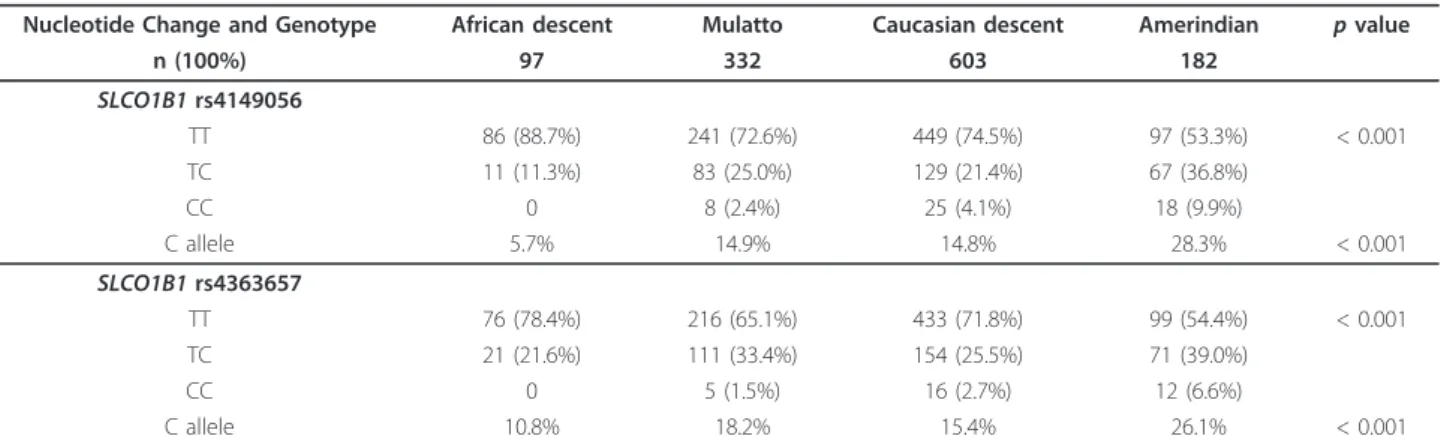
The frequencies of the SLCO1B1 rs4149056 C variant
allele and of the homozygous genotype (CC) were higher in Amerindians (28.3% and 9.9%) and were lower in African descent subjects (5.7% and 0%) compared with Mulatto (14.9% and 2.4%) and Caucasian descent (14.8% and 4.1%) ethnic groups (p < 0.001 and p < 0.001, respectively) (Table 1).
The frequencies of theSLCO1B1rs4363657 C variant
allele and of the homozygous genotype (CC) were also higher in Amerindians (26.1% and 6.6%) and were lower in African descent subjects (10.8% and 0%) compared with Mulatto (18.2% and 1.5%) and Caucasian descent (15.4% and 2.7%) ethnic groups (p < 0.001 and p < 0.001, respectively) (Table 1).
The genotypic distributions for the SLCO1B1
rs4149056 and rs4363657 polymorphisms were in Hardy-Weinberg equilibrium according to ethnic groups.
Normalized
Fluorescenc
e
(%)
Temperature(°C)
70.0 73.0 76.0 79.0
0 25 50 75 100
Normalised
Fluorescenc
e
by
genotype
2
Temperature(°C)
70.0 73.0 76.0 79.0
Fluoresce
nc
e
(dF/dT)
Temperature(°C)
70.0 79.0
A B
1
2 3
2 1
3 C
1
3
2
Figure 1Graphs of theSLCO1B1rs4149056 (c.T521C, exon 5) nucleotide changes results in different curve patterns using high resolution melting analysis. A: Graph of normalized fluorescence by temperature. B: Graph of normalized fluorescence (based on genotype 2) by temperature. C: Graph of melting curve analysis (fluorescence differential/temperature differential). 1: wild-type genotype (TT); 2: heterozygous genotype (TC); 3: homozygous genotype (CC) for theSLCO1B1rs4149056 polymorphism. The curve patterns for theSLCO1B1rs4363657 polymorphism (g.T89595C, intron 11) were similar to curve patterns of rs4149056.
Table 1 Allelic and genotypic frequencies for theSLCO1B1polymorphisms according to ethnic groups
Nucleotide Change and Genotype African descent Mulatto Caucasian descent Amerindian pvalue
n (100%) 97 332 603 182
SLCO1B1rs4149056
TT 86 (88.7%) 241 (72.6%) 449 (74.5%) 97 (53.3%) < 0.001
TC 11 (11.3%) 83 (25.0%) 129 (21.4%) 67 (36.8%)
CC 0 8 (2.4%) 25 (4.1%) 18 (9.9%)
C allele 5.7% 14.9% 14.8% 28.3% < 0.001
SLCO1B1rs4363657
TT 76 (78.4%) 216 (65.1%) 433 (71.8%) 99 (54.4%) < 0.001
TC 21 (21.6%) 111 (33.4%) 154 (25.5%) 71 (39.0%)
CC 0 5 (1.5%) 16 (2.7%) 12 (6.6%)
C allele 10.8% 18.2% 15.4% 26.1% < 0.001
SLCO1B1rs4149056: c.T521C, p.V174A (exon 5);SLCO1B1rs4363657: g.T89595C (intron 11). Mulatto group was composed of mixed ethnicity subjects.
Linkage disequilibrium analysis betweenSLCO1B1 rs4149056 and rs4363657 variant alleles according to ethnic groups
Linkage disequilibrium analysis show that theSLCO1B1
rs4149056 and rs4363657 variant alleles are in different linkage disequilibrium patterns depending on ethnic ori-gin (African descent: 89; Mulatto: 81; Caucasian descent: 68; Amerindian: 64) (Figure 2).
Discussion
The main finding of the present study was to observe significant differences between the allelic and genotypic frequencies ofSLCO1B1 rs4149056 polymorphism
asso-ciated with statin-induced myopathy, according to ethni-city in the Brazilian general population. To our knowledge this is the first study indicating that Brazilian Amerindians present higher frequencies of rs4149056 C variant allele (28.3%) and probably higher risk for statin-induced myopathy. These findings could be useful in the strategic planning of the implementation of pharma-cogenetic testing according to ethnicity.
The SLCO1B1rs4149056 C variant allele frequency
found in our study was higher (p < 0.001) in Amerin-dian subjects (28.3%) compared with other ethnic groups and with Turkish [21] (12.2%); English [9] (13.0%); European American [22] (14.3%); and German [21] (15.0%) subjects. However, the Caucasian descent (14.8%) and Mulatto (14.9%) ethnic groups of our study presented similar (p > 0.050) rs4149056 C variant allele frequency compared with Caucasian descent subjects from Europe and USA. In addition, our African descent (5.7%) subject group had similar (p > 0.050) frequency compared with African American [22] (2.3%), Uganda African [21] (3.9%), and Tanzania [23] (6.0%) subjects. Interestingly, the frequency observed for the Mulatto subjects indicates that the Amerindian ancestry may be present in this multi-ethnic group, besides the presence of known African ancestry.
For theSLCO1B1 rs4363657 polymorphism, C allele
frequency found in Caucasian descent in our study (15.4%) was similar (p > 0.050) to that reported in Eng-lish subjects (13.0%) who participated as controls in a
A
Linkage disequilibrium and haplotype analysis
C
B
D
genome-wide association study (GWAS) [9]. The non-coding rs4363657 polymorphism was in nearly complete linkage disequilibrium (LD = 97) with the non-synon-ymous rs4149056 polymorphism, in the population sam-ple in which the cited GWAS was performed [9]. In our population sample plus Amerindians, it is possible to observe that theSLCO1B1rs4149056 and rs4363657 are
in different linkage disequilibrium patterns depending on the ethnic origin. The African descent (LD = 89) and Mulatto (LD = 81) ethnic groups present higher degree of linkage disequilibrium. This highlights two main points: first, even with the different linkage disequili-brium among ethnic groups, the haplotype analysis are not need because only the rs4149056 polymorphism have been described as functional [11,24]. Second, the different frequencies among ethnic groups for the poly-morphisms used as markers in the GWAS platforms are limitations/peculiarities of the GWAS methodology [25], which may be acting as interferents in replication stu-dies, mainly in countries with admixed population.
The association between SLCO1B1 rs4149056 with
myopathy (odds ratio: 4.5 - 95% CI 2.6 to 7.7, per copy of the C allele; and odds ratio: 16.9 - 95% CI 4.7 to 61.1, among CC homozygotes as compared with TT geno-types) was observed in 85 subjects with myopathy taking 80 mg of simvastatin daily as part of a trial involving 12,000 participants; plus replication in a trial of 40 mg of simvastatin daily involving 20,000 participants [9]. The authors of this GWAS plus replication study con-cluded that common variants in the SLCO1B1gene are
strongly associated with an increased risk of statin-induced myopathy and genotyping may help to obtain benefits of statin therapy more safely and effectively [9].
Other studies were performed to replicate this associa-tion. Brunham et al observed that rs4149056 genotype was significantly associated (odds ratio 2.3 per C allele) with myopathy in patients receiving simvastatin (mean ~30 mg daily), but not in patients who received atorvas-tatin [8]. In this way, genotype CC individuals compared with wild-type TT individuals, the area under the plasma concentration time curve for simvastatin acid was increased 221% and for atorvastatin was increased 145% [12,13]. Voora et al confirmed, in 99 subjects with statin-related adverse events, the association previously identified, but also expanded this finding to the most commom statin-induced side effects (e.g., myalgia or muscle ache without significant creatine kinase eleva-tions) [10]. Puccetti et al reported the same association, but in a group of 46 subjects affected by familial hypercholesterolemia treated with atorvastatin and developing myopathy [26].
There are potential limitations in our study. First, the self-referred ethnicity could be creating wrong separa-tion. However, this form of classification is the one
most probable to be encountered in real-life situations in the clinical practice. In addition, even self-referred ethnicity was able to clearly differentiate groups of indi-viduals with rather different allele and genotype fre-quencies. Second, in order to implement a genotyping program in this context, some points could still be eval-uated, for example: other genetic markers, primary dis-ease, use of concomitant medications, types of statins, age and gender [11].
Conclusion
Our findings indicate interethnic differences for the
SLCO1B1 rs4149056 C risk allele frequency among
Brazilian general population plus Amerindians. Recent studies indicated the genotyping for this functional polymorphism as an important clinical tool in future patient-tailored programs. Data of the present study will be useful in the development of effective pro-grams for stratifying individuals regarding adherence, efficacy and choice of statin-type for patients who need statin, specially in high-dose (e.g., familial hypercholesterolemia).
Acknowledgements
PCJLS is recipient from fellowship from FAPESP, Proc. 2010-17465-8, Brazil. The technical assistance of the Laboratory of Genetics and Molecular Cardiology group, Heart Institute group is gratefully acknowledged.
Author details
1Laboratory of Genetics and Molecular Cardiology, Heart Institute (InCor),
University of Sao Paulo Medical School, (Av. Dr. Enéas de Carvalho Aguiar, 44), Sao Paulo, (05403-000), Brazil.2Department of Medicine, Ouro Preto
Federal University, (R. Diogo de Vasconcelos, 122), Ouro Preto, (35420-000), Brazil.3Department of Physiology, Espirito Santo Federal University, (Av.
Marechal Campos, 1468), Vitoria, (29040-577), Brazil.
Authors’contributions
PCJLS carried out the molecular genetic studies, statistical analysis and drafted the manuscript. RAGS carried out the molecular genetic studies. ACP participated in the design of the study, statistical analysis and manuscript preparation. RMN, GLLMC, JGM, JEK participated in the design of the study and were responsible for individual selection and characterization. All authors contributed critically to the manuscript, whose present version was read and approved by all.
Competing interests
The authors declare that they have no competing interests.
Received: 1 March 2011 Accepted: 12 October 2011 Published: 12 October 2011
References
1. Baigent C, Keech A, Kearney PM, Blackwell L, Buck G, Pollicino C, Kirby A, Sourjina T, Peto R, Collins R,et al:Efficacy and safety of cholesterol-lowering treatment: prospective meta-analysis of data from 90,056 participants in 14 randomised trials of statins.Lancet2005,
366(9493):1267-1278.
2. Ghatak A, Faheem O, Thompson PD:The genetics of statin-induced myopathy.Atherosclerosis210(2):337-343.
3. Thompson PD, Clarkson PM, Rosenson RS:An assessment of statin safety by muscle experts.Am J Cardiol2006,97(8A):69C-76C.
4. Armitage J:The safety of statins in clinical practice.Lancet2007,
5. Gotto AM Jr:Statins, cardiovascular disease, and drug safety.Am J Cardiol 2006,97(8A):3C-5C.
6. Law M, Rudnicka AR:Statin safety: a systematic review.Am J Cardiol2006,
97(8A):52C-60C.
7. Nichols GA, Koro CE:Does statin therapy initiation increase the risk for myopathy? An observational study of 32,225 diabetic and nondiabetic patients.Clin Ther2007,29(8):1761-1770.
8. Brunham LR, Lansberg PJ, Zhang L, Miao F, Carter C, Hovingh GK, Visscher H, Jukema JW, Stalenhoef AF, Ross CJ,et al:Differential effect of the rs4149056 variant in SLCO1B1 on myopathy associated with simvastatin and atorvastatin.Pharmacogenomics J2011. 9. Link E, Parish S, Armitage J, Bowman L, Heath S, Matsuda F, Gut I,
Lathrop M, Collins R:SLCO1B1 variants and statin-induced myopathy–a
genomewide study.N Engl J Med2008,359(8):789-799.
10. Voora D, Shah SH, Spasojevic I, Ali S, Reed CR, Salisbury BA, Ginsburg GS:
The SLCO1B1*5 genetic variant is associated with statin-induced side effects.J Am Coll Cardiol2009,54(17):1609-1616.
11. Niemi M, Pasanen MK, Neuvonen PJ:Organic Anion Transporting Polypeptide 1B1: a Genetically Polymorphic Transporter of Major Importance for Hepatic Drug Uptake.Pharmacol Rev63(1):157-181. 12. Pasanen MK, Fredrikson H, Neuvonen PJ, Niemi M:Different effects of
SLCO1B1 polymorphism on the pharmacokinetics of atorvastatin and rosuvastatin.Clin Pharmacol Ther2007,82(6):726-733.
13. Pasanen MK, Neuvonen M, Neuvonen PJ, Niemi M:SLCO1B1 polymorphism markedly affects the pharmacokinetics of simvastatin acid.Pharmacogenet Genomics2006,16(12):873-879.
14. de Lima Santos PC, de Oliveira Alvim R, Ferreira NE, de Sa Cunha R, Krieger JE, Mill JG, Pereira AC:Ethnicity and arterial stiffness in Brazil.Am J Hypertens24(3):278-284.
15. Santos PC, Pereira AC, Cancado RD, Schettert IT, Sobreira TJ, Oliveira PS, Hirata RD, Hirata MH, Figueiredo MS, Chiattone CS,et al:HFE gene mutations in patients with primary iron overload: is there a significant improvement in molecular diagnosis yield with HFE sequencing?Blood Cells Mol Dis45(4):302-307.
16. Makdisse M, Pereira Ada C, Brasil Dde P, Borges JL, Machado-Coelho GL, Krieger JE, Nascimento Neto RM, Chagas AC:Prevalence and risk factors associated with peripheral arterial disease in the Hearts of Brazil Project.
Arq Bras Cardiol2008,91(6):370-382.
17. Miller SA, Dykes DD, Polesky HF:A simple salting out procedure for extracting DNA from human nucleated cells.Nucleic Acids Res1988,
16(3):1215.
18. Alvim RO, Freitas SR, Ferreira NE, Santos PC, Cunha RS, Mill JG, Krieger JE, Pereira AC:APOE polymorphism is associated with lipid profile, but not with arterial stiffness in the general population.Lipids Health Dis9:128. 19. Santos PC, Soares RA, Krieger JE, Guerra-Shinohara EM, Pereira AC:
Genotyping of the hemochromatosis HFE p.H63D and p.C282Y mutations by high-resolution melting with the Rotor-Gene 6000((R)) instrument.Clin Chem Lab Med2011.
20. Santos PC, Soares RA, Santos DB, Nascimento RM, Coelho GL, Nicolau JC, Mill JG, Krieger JE, Pereira AC:CYP2C19 and ABCB1 gene polymorphisms are differently distributed according to ethnicity in the Brazilian general population.BMC Med Genet12:13.
21. Mwinyi J, Kopke K, Schaefer M, Roots I, Gerloff T:Comparison of SLCO1B1 sequence variability among German, Turkish, and African populations.
Eur J Clin Pharmacol2008,64(3):257-266.
22. Tirona RG, Leake BF, Merino G, Kim RB:Polymorphisms in OATP-C: identification of multiple allelic variants associated with altered transport activity among European- and African-Americans.J Biol Chem 2001,276(38):35669-35675.
23. Aklillu E, Mugusi S, Ngaimisi E, Hoffmann MM, Konig S, Ziesenitz V, Mikus G, Haefeli WE, Weiss J:Frequency of the SLCO1B1 388A > G and the 521T > C polymorphism in Tanzania genotyped by a new LightCycler(R)-based method.Eur J Clin Pharmacol2011.
24. Ho RH, Choi L, Lee W, Mayo G, Schwarz UI, Tirona RG, Bailey DG, Michael Stein C, Kim RB:Effect of drug transporter genotypes on pravastatin disposition in European- and African-American participants.
Pharmacogenet Genomics2007,17(8):647-656.
25. Haiman CA, Stram DO:Exploring genetic susceptibility to cancer in diverse populations.Curr Opin Genet Dev20(3):330-335.
26. Puccetti L, Ciani F, Auteri A:Genetic involvement in statins induced myopathy. Preliminary data from an observational case-control study.
Atherosclerosis211(1):28-29.
Pre-publication history
The pre-publication history for this paper can be accessed here: http://www.biomedcentral.com/1471-2350/12/136/prepub
doi:10.1186/1471-2350-12-136
Cite this article as:Santoset al.:SLCO1B1rs4149056 polymorphism associated with statin-induced myopathy is differently distributed according to ethnicity in the Brazilian general population: Amerindians as a high risk ethnic group.BMC Medical Genetics201112:136.
Submit your next manuscript to BioMed Central and take full advantage of:
• Convenient online submission
• Thorough peer review
• No space constraints or color figure charges
• Immediate publication on acceptance
• Inclusion in PubMed, CAS, Scopus and Google Scholar
• Research which is freely available for redistribution